




Abstract
Previous studies predominantly examined self-reported attitudes toward economic migrants and refugees along with different types of public concerns. Few of these studies used behavioral measures to analyze how asylum seeker inflows may sway public preferences toward them. However, the literature remains largely silent on the issue as to how correcting misperceptions of asylum seeker inflows may improve a host population’s support for them. The authors’ research addresses this gap, using a lab experiment to examine how providing factual information on asylum seeker inflows changes other-regarding behaviors and attitudes of a host population toward asylum seekers, depending on people’s political leanings. Specifically, the authors examine whether factual information provided by a nonpartisan source may ease or backfire giving behaviors and unwelcoming attitudes toward asylum seekers through the moderation of partisanship. The findings suggest that providing accurate information about the number of asylum seekers counteracts low-level giving behaviors and unwelcoming attitudes of right-wing-leaning citizens.
In the aftermath of ethnic, political, and religious conflicts over different regions, countries have confronted a growing number of asylum seekers and refugees, which reached a record high, almost 70.8 million, in 2018 (UNHCR 2019). This unprecedented increase in the global number of asylum seekers and refugees has been associated with social and political discontent in refugee-hosting countries, especially among the right-wing parties and electorates (Steinmayr 2020).
In understanding the micro-foundations of public preferences toward immigrants and refugees, recent research has relied largely on the following theoretical pillars: cultural concerns, egoistic concerns, humanitarian concerns, and sociotropic concerns related to the economic impact on host communities (Adida, Lo, and Platas 2019, Alesina, Miano, and Stantcheva 2018; Andersson, Bendz, and Stensöta 2018; Bansak, Hainmueller, and Hangartner 2016; Brooks, Manza, and Cohen 2016; Fraser and Murakami forthcoming; Hainmueller and Hiscox 2010; Hainmueller and Hopkins 2014; Jeannet, Heidland, and Ruhs 2021; Mayda 2006; McLaren and Johnson 2007). However, social scientists have paid relatively less attention to how the inflows of asylum seekers influence host populations’ attitudes and behavior toward asylum seekers (Hangartner et al. 2019). Given that native groups’ misperceptions about out-group populations can sway public preferences for out-group members (Gorodzeisky and Semyonov 2020), it is crucial to account for how correcting information on the inflow of asylum seekers modifies attitudes and behaviors.
Citizens seek information cues from the public sphere to shape their preferences for different issues (Druckman, Peterson, and Slothuus 2013; Petersen et al. 2013). In evaluating these information cues, individuals are expected to update their beliefs in the light of new information. However, motivated reasoning scholarship suggests that individuals are often reluctant about processing new information or situations challenging their status quo (Druckman, Fein, and Leeper 2012; Kunda 1990). In line with the bounded rationality perspective (Simon 1972), scholars argue that people base their degree of support for a specific policy on value-consistent political positions in lieu of engaging with cognitively costly information search (Bakker, Lelkes, and Malka 2020). Nevertheless, recent research shows that people can take new information into consideration despite the polarized political context (Boudreau and MacKenzie 2018; Bullock et al. 2013; Nicholson 2012).
In the present study we assess whether individuals with different political inclinations modify their other-regarding behavior and attitudes toward asylum seekers when exposed to accurate information on the size of the asylum-seeking population. We conducted a lab experiment in the United Kingdom, where we created a strictly controlled information environment and randomized the exposure to accurate statistics on asylum seeking in the United Kingdom. Although the United Kingdom has received fewer asylum applications per capita than the majority of European Union (EU) countries in recent years, the United Kingdom public has a general tendency to overestimate numbers of immigrant groups in the country (Duffy, Frere-Smith, and Frieß 2014). However, we still know little about how correcting misperceptions of asylum seeker inflows affects British public preferences toward asylum seekers and refugees.
Our findings show that exposure to factual information on the inflow of asylum seekers to the United Kingdom can induce individuals who favor right-wing political parties and Brexit to offset their low-level support for asylum seekers’ well-being. Overall, our study makes three main contributions. First, the present study fills the gap in research on the impacts of correcting misperceptions of asylum seeker inflows on public support for asylum seeking in the United Kingdom with experimental data. Second, it confirms that inducing accuracy motivation can be a suitable intervention by a nonpartisan source to increase support for asylum seekers despite right-wing inclinations. Third, previous studies often captured only attitude formation in the light of correcting information, but the present study also shows whether the factual information can change actual behavior (e.g., donation to a refugee charity) in the context of supporting asylum seekers. The remainder of the article proceeds as follows. In the next section we reflect on the theoretical perspectives and selection of the case study (asylum seeking in the United Kingdom). We then explain our study’s experimental design and present empirical findings. In the final section, we conclude with the implications and limitations of the results.
Theoretical Perspectives
Perceptual Bias toward Out-Group Members
There is a wealth of literature on public attitudes toward different types of immigrants and immigration policies (see, e.g., Fussell 2014; Hainmueller and Hopkins 2014; Hellwig and Sinno 2017; Hopkins, Sides, and Jack Citrin 2019). This scholarship resonates with Blumer’s (1958) canonical theory of prejudice against out-group members, focusing on perceived economic, cultural, or security threats in explaining underlying factors behind anti-immigration preferences. However, in such studies, public preferences toward asylum seekers and refugees are often neglected or considered a consistent subset of public preferences toward immigrants. Nonetheless, recent research points out substantial differences between predictors explaining attitudes toward immigrants and refugees (Abdelaaty and Steele forthcoming). Studies show that in the European context, attitudes toward refugees are better explained by macro-level factors (e.g., ethnic fractionalization, terrorist incidents, the size of the Muslim population), whereas attitudes toward immigrants are more associated with micro-level economic concerns (e.g., income). In this vein, previous studies also illustrate how some macro-indicators, such as institutional context and adherence to international norms, influence reactions against refugee flows and policies on asylum seeking (Hamlin 2014; Joppke 1997; Thielemann 2003). In addition to the macro-level factors, scholars draw attention to some underlying micro-level drivers in shaping public support for the refugee admission: the role of religious affiliation (Bansak et al. 2016; Cowling and Anderson 2019), humanitarian values (Fraser and Murakami forthcoming), right-wing political views (Anderson and Ferguson 2018; Canetti et al. 2016), and perceived threats (Ferwerda, Flynn, and Horiuchi 2017; Hartley and Pedersen 2015).
Group competition theory posits that the increase of out-group members poses a potential threat to in-group members, thereby promoting unfavorable attitudes toward out-group members (Blumer 1958; Bobo and Hutchings 1996). Reflecting on this theory, the most up-to-date research shows that a perceived sudden increase in the group size of asylum seekers can deteriorate attitudes toward them (Deiss-Helbig and Remer forthcoming; Hangartner et al. 2019). That is, citizens may be concerned about their economic well-being (egocentric) (Burns and Gimpel 2000; Gerber et al. 2017) or fiscal burdens at group level (sociotropic) (Goldstein and Peters 2014) when admitting additional out-group members. In addition, drawing on symbolic threats, host populations may also become hostile toward out-group members if they perceive articulated differences in norms, values, and customs of out-groups (Kauff et al. 2015; Schneider 2008). In this regard, Bansak et al. (2016) found that negative public sentiments toward Muslim asylum seekers are prevalent among in-group members in dominantly Christian societies. However, even if host populations do not observe that their personal interests (e.g., economic well-being) are undermined by out-group members, they might still perceive the presence of out-group members as a threat to their own group’s interest (Riek, Mania, and Gaertner 2006).
The general public is often likely to misperceive the actual share of out-group members in the country (Gorodzeisky and Semyonov 2020). Hopkins et al. (2019) found that providing accurate information on the size of foreign-born population to correct these misperceptions does not influence attitudes toward immigration policies. Along similar lines, Gorodzeisky and Semyonov (2020) showed that native groups’ misperceptions about out-group populations can play a more salient role than factual information in shaping public preferences for out-group members. Also, we know that the perceived increase in asylum seeker inflows does not create the same level of concern among different in-groups in host populations: right-wing-leaning people consider asylum seekers more threatening (Canetti et al. 2016). Taken together, previous studies suggest that the misperception about the proportion of out-group population may interact with the political leaning of in-group members in explaining attitudes toward them (Czymara 2021).
Information Processing through Motivated Reasoning
People constantly receive new political information through different mediums. However, this information environment has often an asymmetric structure, where the majority of people receive few factual information but a large number of opinions. They can gather additional information at a costly cognitive effort (e.g., searching for official statistics on the Internet). For instance, recent public opinion research suggests that people in most countries heavily overestimate the factual figures related to political issues, such as crime rates and the size of out-group populations (Duffy 2018).
Reflecting on how to deal with uninformed citizenry, the growing literature elaborates on information processing through motivated reasoning (Kahan 2012; Leeper and Slothuus 2014; Levendusky 2013). When citizens encounter new information at a snapshot in time, some people may fail to update their beliefs. Motivated reasoning scholarship argues that people evaluate new information in a biased manner (consciously or not), holding on to their particular beliefs or ideas through a series of cognitive mechanisms (Kunda 1990). That is, individuals have a tendency to process new evidence and information in relation to how persuasive they are vis-à-vis their prior ideas or values. When confronted with disconfirming information, individuals make a cognitive effort to rebut evidence that is not congruent with their preexisting ideas. On the other hand, if new information or evidence is congenial to one’s political inclination, people may strengthen their preexisting ideas, ultimately leading to attitude polarization.
In line with this argument, both laboratory and online experiments in different policy contexts demonstrate that individuals who are exposed to dissonance-inducing situations in relation to their prior beliefs do not moderate or correct their attitudes. Contrarily, they further skew their preexisting attitudes, which is known as the “backfire effect” (Nyhan and Reifler 2010; Nyhan et al. 2014; Taber and Lodge 2006). Reflecting on the possible mechanisms to explain the backfire effect, scholars have suggested that individuals perceive political information with selective attention and desire to reach conclusions by minimizing their cognitive efforts. This is consistent with their political identities, most notably partisan identity (Alesina et al. 2018; Bartels 2002; Brooks et al. 2016; Grigorieff, Roth, and Ubfal 2018), even when new information provision is unbiased without partisan implications (Huber, Hill, and Lenz 2012). For instance, Democrats and Republicans in the United States increase their support for renewable energy policy when the policy is endorsed by in-group partisan actors (Bolsen, Druckman, and Cook 2014). Relatedly, liberals’ support for immigration policy tends to decrease if the issue is framed with national security concerns, whereas conservatives’ support increases when the issue salience is primed with family concerns (Bloemraad, Silva, and Voss, 2016; Lahav and Courtemanche 2012).
As opposed to the backfire effects, there is a great deal of recent studies showing that people are able to revise their attitudes in response to new information rather than polarizing their existing views (Bullock 2009; Guess and Coppock 2020; Hill 2017). For instance, Wood and Porter (2019) showed that individuals consistently endorse corrective messages and update their beliefs across a variety of polarized contexts. In a recent review of the literature on motivated reasoning, Druckman and McGrath (2019) pointed out the relevance of “accuracy motivation” to explain how and when people bring their attitudes in alignment with the facts. According to the “accuracy motivation” view, individuals aim to arrive at an accurate assessment of the impact of the issue at hand. They update their opinions in the direction of the new information irrespective of their prior beliefs insofar as they perceive information sources as credible (Druckman and McGrath 2019). As people have limited time and cognitive resources to comprehend policy- or science-related topics, they may use the perceived credibility of information source as a heuristic to guide their judgement (Pornpitakpan 2004). Hence, individuals can update their beliefs in heterogenous ways even if their reasoning is in line with accuracy motivation. Overall, given the mixed evidence on information processing (i.e., backfire effects vs. accuracy motivation), the literature offers little clarity on what types of factual information would resonate with the public to correct particular misperceptions.
A Formalization of the Theoretical Argument and Methodological Challenges
In the present study, we explore whether providing accurate information on asylum-seeking inflows motivates a host population to modify behaviors and attitudes toward asylum seekers through the moderation of respondents’ political leanings.
Taking the domains of information processing into account, disentangling the pathways by which factual information provision may change other-regarding behavior and attitudes is not a straightforward task. In this regard, to show why we focus on the moderation of political leanings through the information treatment rather than mediation, we draw upon a directed acyclic graph (Morgan and Winship 2015) to represent the methodological caveats of the information environment (Figure 1).

Directed acyclic graph of information environment.
In Figure 1, Z is the random assignment itself to the treatment; and I is the exposure to factual information in two states of world, one of which is the counterfactual state in which factual information is available; Y is the measured outcome through either observed giving behavior or latent variables of support for policies on asylum seeking;
First, to create a controlled asymmetric information environment, the first assumption is that the exposure to factual information (I) must be randomly assigned (Z). Therefore, I is independent of
Dealing with Social Desirability Bias
In studying public preferences for out-group members through self-reported attitudes, social desirability may bias the results, especially when respondents are aware of the researchers’ expectations (e.g., welcoming refugees). That is, respondents may express their willingness or reluctance for policy support without any incurred cost. However, in real-world contexts, asylum seekers participate in the consumption of collective goods (e.g., welfare benefits, accommodation) provided by the taxpayers of the host country. Reflecting on this, we argue that supporting asylum seekers constitutes a costly other-regarding behavior for in-group members. Although Mummolo and Peterson (2019) showed that people are not likely to adjust their attitudes in line with researchers’ expectations across different research contexts, we use a behavioral measure that is costly for respondents and thus potentially less subject to social desirability bias (Camerer and Hogarth 1999). For similar reasons, scholars have adopted various economic games in their survey and laboratory experiments to scrutinize whether a wide range of other-regarding behaviors align with attitudes toward policies aimed at improving the well-being of others in need (for a detailed discussion, see Gilens and Thal 2018). However, analyzing these behaviors toward asylum seekers and refugees compared with ethnic or religious minorities is limited. Given that, our study specifically contributes to two previous studies: (1) Böhm et al. (2018) showed that individual costs significantly affect citizens’ helping behavior toward refugees, and (2) Dinas, Fouka, and Schläpfer (2021) revealed that mentioning shared experiences of forced migration increases willingness to donate the UNHCR and improves attitudes toward refugee admission.
Following the growing literature on economic games to assess other-regarding behavior, we focus on a variant of the dictator game (see Engel 2011 for a meta-analysis of dictator games) in which respondents earn money through an effort task instead of receiving fictitious or financial endowments. Then they must decide whether to share their financial endowment with others or keep it for themselves. Previous research shows that fictitious endowments increase the artificiality of the experimental situation, promoting costless giving behavior at the expense of ecological validity (Zizzo 2010). On the other hand, using earned endowments allows researchers to form a better real-world setting with declining giving behavior (Cherry, Frykblom, and Shogren 2002). Thus, in the context of charitable giving to out-group members, helping asylum seekers and refugees constitutes other-regarding behavior in which in-group members’ payoffs decrease while out-group members’ payoffs increase. Overall, using a dictator game based on the effort task can provide a robust measure to identify the effects of correcting information on intake of asylum seekers on incurring an actual individual cost to support out-group members.
Hypotheses
As the evidence regarding backfire effects and accuracy motivation in information processing and political leanings is mixed (Bolsen et al. 2014; Hill 2017; Guess and Coppock 2020; Lahav and Courtemanche 2012; Nyhan et al. 2014), we prefer to take an exploratory approach (rather than a confirmatory approach) to assess the potential effects of factual information provision. Hence, we evaluate whether new evidence supports the following arguments. On the one hand, in line with accuracy motivation and political heterogeneity, hypothesis 1 should be confirmed:
Hypothesis 1: Right-wing-leaning individuals’ support for asylum seekers increases when they are exposed to accurate information on asylum seeking in the host country, while left-wing-leaning individuals remain supportive toward asylum seekers.
On the other hand, according to backfire effects, hypothesis 2 should be confirmed:
Hypothesis 2: Right-wing-leaning individuals’ support for asylum seekers decreases when they are exposed to accurate information on asylum seeking in the host country, while left-wing-leaning individuals remain supportive toward asylum seekers.
Case Selection: Asylum Seeking in the United Kingdom
There has been considerable heterogeneity regarding the reaction to the influx of asylum seekers among wealthy democracies. After the Syrian civil war, the German government, for example, chose welcoming policies in 2015 and stood out against restrictive policies on asylum seeking in the other EU member states, despite the large number of prior refugee settlements in the country. The U.K. government, on the other hand, pledged to resettle only 20,000 Syrian refugees from 2015 to 2020 (McGuinness 2017). In fact, the United Kingdom received fewer asylum applications per capita than the majority of EU countries in 2019 (Sturge 2019). Historically, the number of asylum applications to the United Kingdom reached its highest level, at 84,132, in 2002. The volume of applications has drastically declined since then; it was at a two-decade low of 17,916 in 2010.
Although the numbers suggest a curbed influx of asylum seeking in the country in recent years, right-wing political parties, such as the Conservative Party and the U.K. Independence Party (UKIP) in the United Kingdom, in particular mobilize citizens around anti-asylum-seeking and immigration policies. In the case of the Vote Leave campaign before the 2016 Brexit referendum, right-wing political party leaders and tabloids focused on economic and cultural concerns regarding asylum seekers, particularly that immigrants and refugees exploit welfare resources (Berry, Garcia-Blanco, and Moore 2016). Regarding perceived financial threat derived from out-group members, previous opinion research suggests that there has been a sharp partisan division in the United Kingdom. That is, 84 percent of UKIP supporters are uneasy about the economic impact of refugee intake on British society, compared with 35 percent of Labour Party supporters (Wike, Stokes, and Simmons 2016). As supporting asylum seekers has been electorally unfavorable in the United Kingdom, public authorities have leveraged political incentives to steadily restrict financial supports and working rights for asylum seekers over the past two decades (Mayblin and James 2019).
Emphasizing the perception-reality gap in Britain’s immigrant population, Blinder (2015) showed that the contextual features of the information environment in the public sphere can affect public perceptions toward out-group populations in the United Kingdom. For instance, although asylum seekers, refugees, and migrants are distinct groups, the British public is likely to perceive migrants as asylum seekers (Blinder and Jeannet 2018). Hence, given the gradual decline in the number of asylum seekers and financial support for asylees over the past two decades, we assume that wider perception-reality gap in the British public against asylum seekers provides an opportune case for this study to examine whether providing accurate information on asylum seeker inflows helps improve support for these out-groups.
Methods
Research Design
Our lab experiment assesses the effect of exposure to factual information on the size of asylum-seeking applications using a between-subjects design. Individuals were randomly assigned to two experimental conditions. In the first (information-scarce environment, control group), respondents were asked for their best guess on the size of asylum seeker population in the country after being given the number of asylum-seeking applications in 2002. The question was as follows: “According to the Office for National Statistics, in 2002, the number of asylum-seeking applications in the UK was 84,132. Can you please provide us with your best guess of the number of asylum-seeking applications in the UK in 2017?” In the second condition (information-rich environment, information treatment), respondents were asked for their best guess on the size of asylum seeker population (using the same wording). Then they were provided with additional information on the size of asylum seekers in the United Kingdom between 2002 and 2017 and the United Kingdom’s asylum seeker population, relative to other EU countries. Specifically, respondents received the following statement with charts: According to the Office for National Statistics, the number of asylum applications in the UK decreased by 69% from 84,132 in 2002 to 26,350 in 2017. There were 51 asylum applications for every 100,000 people resident in the UK. However, across all EU countries, there were 140 asylum applications for every 100,000 people. The UK is therefore below the average among EU member states for asylum applications per capita, ranking 15th among 28 EU countries.
We use a nonpartisan information source to limit source credibility heterogeneity, in line with recent contributions on motivated reasoning (Druckman and McGrath 2019; Wood and Porter 2019).
The study was conducted in the spring of 2019 at EssexLab, where computers are separated by partitions to ensure privacy and anonymity. Ethical approval was granted at the University of Essex before we ran the study. Research subjects were sampled through the EssexLab’s recruitment system, which provides a more diverse participant pool than student samples (see sample characteristics in Appendix A). The data are available in a repository at https://osf.io/mecpj/?view_only=4c1d81746fd545a7a62462fbeeee2194.
Our sample includes 215 subjects (information-scarce environment, n = 107; information-rich environment, n = 108). To identify whether the issue under investigation was unusually salient in public sphere throughout data collection, we tracked the volume of online information search in the United Kingdom on the relevant terms using Google Trends. We did not identify any particular irregularity within the time period of data collection (see Figure 2). Also, unlike online survey experiments, we rigorously controlled the information environment during the study to minimize the experimenter demand effect (e.g., searching for appropriate answers and cues), blocking access to the Internet on the allocated computer, and restricting the use of other electronic devices.

Google search trends.
After the experimental conditions, research subjects were given a posttreatment questionnaire including attitudinal questions on the United Kingdom’s policies on asylum seeking, trustworthiness in the information source, perceptions of Muslims, emphatic concerns about out-group populations in society, and their open-ended definitions of asylum seekers, refugees, and migrants (see Appendix A for descriptive statistics). In addition to the randomization of the information environment, the order of questions and choices was randomized to avoid order effects.
In the next stage, all participants were asked to participate in a standard effort task in which they were required to multiply four different two-digit numbers and sum up all multiplications within two minutes. Participants could earn up to £8.10 depending on their performance on the effort task. In the final stage, participants could see their total earnings (including the showing-up fee) and were then presented a one-shot dictator game. In the dictator game, respondents had to decide whether to donate to an actual local charity helping asylum seekers and refugees using their own earnings or to keep the money for themselves. In this variant of the dictator game, participants’ choice set was α ∈ {keep all earnings, donate}, and the amount of donation went from a minimum of £0.50 to £8 in 50-pence increments. Note that participants were reminded that their monetary contributions were real.
Conducting an in-lab experiment allowed us to randomly assign people to different treatments while strictly controlling for the information environment (which can be hardly done in field or survey experiments). This importantly strengthened the internal validity of our study. Also, the lab setup and the implementation of the dictator game allowed us to explore other-regarding behaviors toward asylum seekers with an approach that is well grounded in behavioral game theory. However, even though our sample is rather heterogeneous in comparison with standard student samples, it is far from being a representative sample of the general population, limiting the external validity of our study. Thus, although in our experiment inferences are somewhat more warranted than in survey or field experiments in terms of internal validity, these inferences should not be generalized to the broader population.
Measures and Estimation Strategy
In the main analysis, giving monetary contributions to a charity helping asylum seekers and refugees is our first main dependent variable of interest. The outcome variable ranges from 0 to 8. The treatment variable is a dummy variable coded 0 for the information-scarce environment and 1 for the information-rich environment. Political leaning is our main moderator variable of interest. To measure political party favorability, we follow the research design of prior studies investigating ideology-by-treatment interactions (Bloemraad et al. 2016; Brooks et al. 2016; Wood and Porter 2019). In this regard, we ask respondents to what extent they have favorable or unfavorable opinions of the four political parties in the United Kingdom (Conservatives, Labour, Liberal Democrats, and UKIP) on a 6-point Likert-type scale on which 1 denotes “very unfavorable” and 6 denotes “very favorable.” Furthermore, Brexit is commonly thought of as a major partisan divide in British society. For instance, Hobolt, Leeper, and Tilley (2020) considered Brexit a new source of political identification into two categories: leave and remain. Given this recently emerged political identity, we ask respondents for their opinions regarding whether Britain was right or wrong to vote to leave the EU. This is coded 1 if “right to leave” is chosen and 0 otherwise.
To control for the main demographic variables, we ask for participants’ age, sex, ethnicity, and religion. For ethnicity, we group them into three categories: white, Black, and other ethnic group. Following the same strategy, we also categorize religion into three groups: no religion, Christians, and other religion.
We measure five additional theoretical covariates on the basis of previous literature: participants’ prior beliefs regarding the number of asylum seekers in the United Kingdom, perceived trustworthiness in the Office for National Statistics, participants’ financial well-being, anti-Muslim perceptions, and group empathy. First, following the notion that people’s prior beliefs and perceived information-source trustworthiness may confound the reasoning in information processing (Tappin, Pennycook, and Rand 2020), we ask for participants’ guesses on the number of asylum seekers in an open-ended fashion: we take the natural log of their guesses in order to linearize the relationship in the analysis. Second, as the Office for National Statistics is the highlighted information source in our information provision, we ask participants how much confidence they personally have in the Office for National Statistics on a 11-point Likert-type scale (0 = “no confidence at all,” 11 = “full confidence”). Third, previous research highlights that people’s financial conditions can affect their generosity level (Côté, House, and Willer 2015). Hence, we ask participants how well they would say they are managing financially these days on a 5-point scale (1 = “living comfortably,” 5 = “finding it very difficult”).
Fourth, Muslim asylum seekers are less likely to be accepted by host populations in dominantly Christian societies, and this penalty is significantly larger among people placing themselves on the right side of the political spectrum compared with those on the left (Bansak et al. 2016). Therefore, we measure anti-Muslim bias by combining three item responses (Cronbach’s α = 0.80) on the basis of a vignette. That is, thinking of asylum seekers who have come to the United Kingdom from the Muslim-majority countries, we ask research subjects how much they would mind or not mind the following three occurrences on a 5-point Likert-type scale on which 1 denotes “I would not mind” at all and 5 denotes “I would mind very much”: (1) “If someone like this was appointed as your boss,” (2) “If someone like this was married to a close relative of yours,” and (3) “If someone like this was appointed as your councillor.” The final theoretical covariate derives from the group empathy theory scale tested on understanding emphatic concerns toward undocumented immigration (Sirin, Valentino, Villalobos 2016). It consists of seven items (Cronbach’s α = 0.76) based on a 5-point Likert-type scale (see S1 File for all items). Respondents evaluate their feelings under various situations to indicate how well each statement describes them (e.g., “I often have tender, concerned feelings for people from another racial or ethnic group who are less fortunate than me”).
Appendix A.4 shows that the distribution of donations (the main dependent variable) for the pooled sample is quite right skewed, and the Shapiro-Wilk test for normality also rejects that donations are normally distributed. This nonnormality is consistent with previous findings in other studies using the dictator game, as many individuals often choose not to donate at all (see Engel 2011). Following a suggested econometric approach in analyzing dictator games, we treat the probability of donating as another observed behavior (Cragg 1971; Wooldridge 2010). That is, giving behavior to a charity can be considered a two-stage decision process: (1) the decision to make any positive contribution and (2) the decision on how much to give. Therefore, we can analyze whether the information treatment has separate effects on both the probability of donating and the amount of positive contributions, conditional on willingness to give at all. This is estimated using a Cragg-Hurdle model. More formally, it could be represented by the relationship yi = sihi*, where yi is the quasi-continuous observed value of the donation variable. The selection variable si equals 1 if research subjects choose a positive donation amount and 0 otherwise, acting as a lower limit that binds the outcome variable. Identifying the effects of political leanings through the information environment, we investigate the treatment effect heterogeneity across favorability for different political parties. The coefficient estimates are not directly interpretable. To obtain the effect of a covariate on the model, we use the margins command to estimate the average marginal effects (AMEs).
Hence, the final selection model is

where Ii is the dummy for information treatment, and γ is its coefficient;

where the quasi-continuous latent outcome variable that is observed when si is 1. The interaction terms and control variables remain the same, and ν is an error term, which is a normal distribution with the exponential model. As clarified formally, the parameters of the interaction terms and control variables in both the selection and latent outcome variables may differ. Thus, the potential difference will show us whether the decision to donate any amount is affected by different factors than the decision on how much to donate. The estimation is carried out in Stata using the churdle command.
In our estimation strategy, we begin with the simple moderation model without any covariates. The second empirical specification further includes demographic controls by the vector
We extend our investigation beyond the behavioral outcome using a different outcome variable that measures the attitudinal formation: public support for intake and protection of asylum seekers. Respondents answer three questions on a 5-point Likert-type scale (1 = “definitely disagree,” 5 = “definitely agree”), yielding a variable that taps into general public support (Cronbach’s α = 0.80): “To what extent do you agree or disagree with the statements? 1) UK should offer protection and asylum to people in need; 2) UK should receive more asylum seekers; and 3) UK is taking in too few asylum seekers.” In investigating the effects of political leanings through the information environment, we employ a linear regression with the ordinary least squares estimator. Similarly, we provide AMEs to facilitate the interpretation.
Results
Charitable Giving to Asylum Seekers and Refugees
Figure 3 and Table 1 present the first set of results of the experiment. At first glance, we observe that information-rich environment offsets the negative effects of favoring right-wing parties and Brexit on the donation amount to the charity. We apply the Cragg-Hurdle regression model to distinguish the decision on a nonzero contribution to the charity from the decision to give a specific amount of donation. We start with the latter. Figure 3A and Table 1 show that on average, a one-unit increase in favoring UKIP and Conservatives statistically significantly decreases the amount of donation in the information-scarce environment, conditional on having decided to donate. For example, a one-unit increase in favoring UKIP and Conservatives decreases the predicted amount of donation by £0.52 and £0.28, respectively. Nonetheless, the information-rich environment completely offsets these negative effects of favoring right-wing parties on the amount of donation given to the charity. This finding is in the direction of hypothesis 1 in relation to accuracy motivation as opposed to backfire effects (hypothesis 2). Figure 3B and Table 1 indicate that the findings are robust when controlling for all covariates. In addition, the results in Figure 3B also show that the AME of favoring Labour on the predicted amount of donation (£0.22) becomes inconsequential when research subjects are treated with factual information, while there is not much change for people favoring Liberal Democrats across information environments. Focusing on the second differences, we find that the AME of favoring UKIP and Brexit on predicted amount of donation is statistically significantly offset in the information-rich environment.

Average marginal effects of political leanings across information environments on the amount of donation.
AMEs of Political Leanings across Information Environments on the Amount of Donation.

Note: Panel A shows the AMEs without controlling covariates. Panel B shows the AMEs by controlling both demographic covariates and theoretical covariates. D AMEs represent the second differences (whether two marginal effects are equal). Cragg-Hurdle regressions with robust standard errors in parentheses (n = 212–215). See the regression tables for all models in Appendix A. AME = average marginal effect; UKIP = U.K. Independence Party.
p < .10. **p < .05. ***p < .01.
We now return to the selection model in the Cragg-Hurdle regression, in which the probability of donating any nonzero amount is the dependent variable of interest. Table 2 accordingly shows that nonsignificant AMEs of political leanings on the probability of donating a nonzero amount suggest that only Brexiteers are less likely to clear the hurdle to donate in the information-rich environment. In other words, the probabilities to donate any nonzero amount to the charity for subjects who favor Brexit are about 22 to 21 percentage points lower than for those who do not favor Brexit when they are exposed to factual information on intake of asylum seekers.
AMEs of Political Leanings across Information Environments on the Probability of Donating.
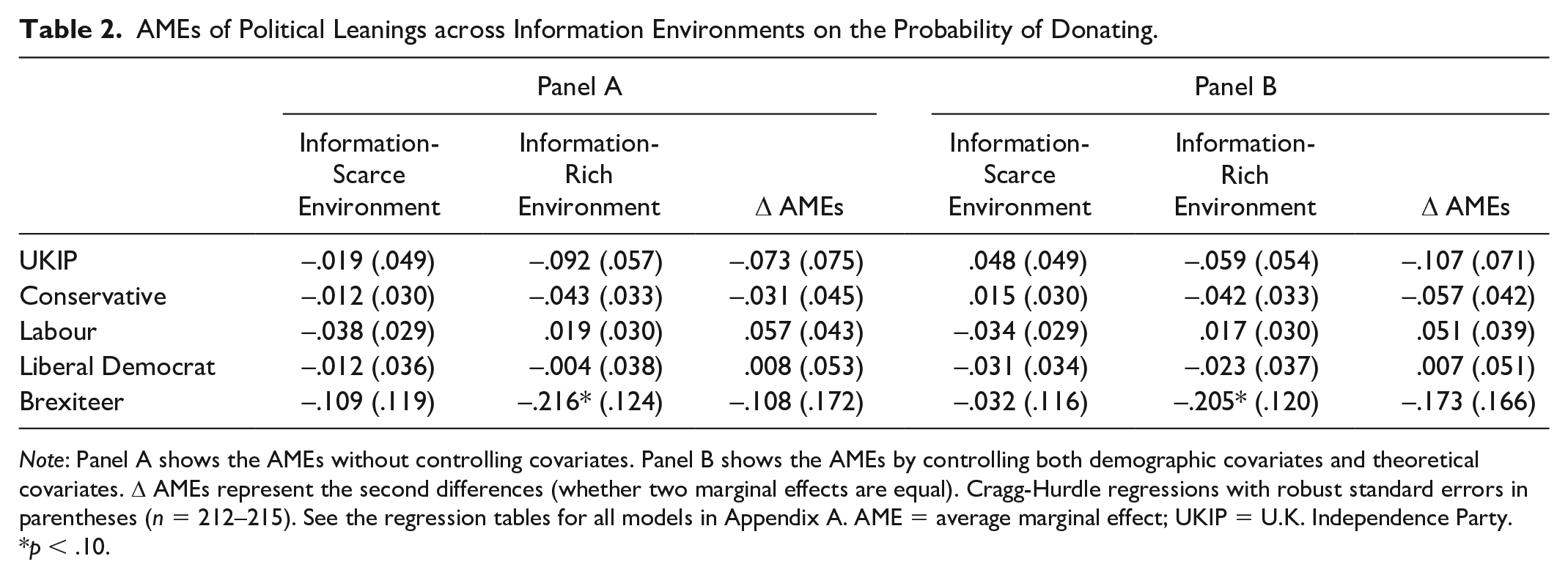
Note: Panel A shows the AMEs without controlling covariates. Panel B shows the AMEs by controlling both demographic covariates and theoretical covariates. D AMEs represent the second differences (whether two marginal effects are equal). Cragg-Hurdle regressions with robust standard errors in parentheses (n = 212–215). See the regression tables for all models in Appendix A. AME = average marginal effect; UKIP = U.K. Independence Party.
p < .10.
Attitudinal Formation toward Intake of Asylum Seekers
The observed patterns of predicted AMEs on the amount of donation to the charity from the models are similar to the results from the attitudinal support for intake of asylum seekers. Figure 4 and Table 3 show that, on average, although a one-unit increase in favoring UKIP, Conservatives, and Brexit significantly decreases public support for intake of asylum seekers by −0.369, −0.181, and −0.945 (p < .01), respectively, these negative effects drop and become negligible in the information-rich environment. These results are again in line with hypothesis 1 (accuracy motivation) rather than hypothesis 2 (backfire effects). However, the findings for left-wing-leaning participants are mixed and do not entirely confirm our expectation (hypothesis 1) that left-wing-leaning individuals remain supportive toward asylum seekers when they are treated with factual information. That is, on average, a one-unit increase in favoring Labour increases public support for intake of asylum seekers by 0.136 in the information-scarce environment, but this effect becomes smaller once individuals are treated with factual information. On the other hand, the negligible positive effects of favoring Liberal Democrats become meaningful when individuals are treated with factual information. We also test the equality of these AMEs in both information environments (information scarce vs. information rich) with a test of the second difference. Consequently, the results indicate that the effect of favoring the right-wing political parties and Brexit on public support for intake of asylum seekers is significantly larger in the information-scarce environment. However, the AMEs do not statistically significantly vary between the two information environments for left-wing favorability. Figure 4B and Table 3 also show that the directions of AMEs do not change when accounting for all demographic and theoretical covariates, although the effect sizes become smaller. The results of second differences also show that the AMEs statistically significantly vary between the two information environments only for favoring Brexit.

Average marginal effects of political leanings across information environments on public support for intake of asylum seekers.
AMEs of Political Leanings across Information Environments on Public Support for Intake of Asylum Seekers.

Note: Panel A shows the AMEs without controlling covariates. Panel B shows the AMEs by controlling both demographic covariates and theoretical covariates. D AMEs represent the second differences (whether two marginal effects are equal). Ordinary least squares regressions with robust standard errors in parentheses (n = 212–215). See the regression tables for all models in Appendix A. AME = average marginal effect; UKIP = U.K. Independence Party.
p < .10. **p < .05. ***p < .01.
Discussion
Host populations are prone to overestimate the size of out-group members (e.g., ethnic minorities, asylum seekers) in Western nation-states, and this political misinformation may further foster unfavorable views of policies on asylum seeking, thereby leading to distorted collective decisions (Alesina et al. 2018). Unveiling how uninformed citizens could be mobilized over humanitarian protection is crucial to maintaining international human rights. In understanding other-regarding behavior and attitude formation toward asylum seekers, the present study presents results from a lab experiment with British citizens to investigate the heterogeneous effects of accessing to factual information on asylum seekers through people’s political domain.
Our study offers three main contributions to the literature on the role of information in shaping public preferences. The first contribution addresses study design and context. Previous studies investigating information environments in the context of asylum seekers intake are scarce, as they focus mainly on general immigration policy preferences (Hopkins et al. 2019). Moreover, existing research investigating the impact of information environments on attitude polarization has overwhelmingly used American samples. In this regard, our study brings experimental evidence to asylum seeking preferences in the U.K. context.
The second contribution concerns public information processing for citizens. Our results highlight that factual information provision by a nonpartisan source may counteract negative attitudes and behavior toward asylum seekers among people who favor right-wing political parties and Brexit. Hence, our study reinforces the evidence that people may update their behavior and attitudes in favor of accuracy motivation rather than polarizing their views to a certain extent (Guess and Coppock 2020; Hill 2017), even though new information communicated with them is not congruent with their political domain and prior beliefs.
As the third contribution to the literature, our study enhances the measurement issues on the effect of information treatments, measuring other-regarding behavior for out-group members (e.g., asylum seekers and refugees) (Böhm et al. 2018). Following this, the present study shows that accuracy motivation is not limited to attitude formation but can also resonate with positive behavioral changes. That is, right-wing-leaning citizens override their negative behavior to help asylum seekers despite incurring personal costs. Therefore, the present research provides us with encouraging findings on receptivity to public communication regarding vulnerable out-group members, once an information-rich environment is granted.
Reflecting on the moderating role of political leanings in the formation of behavior and attitudes toward asylum seekers, in line with previous research (Bloemraad et al. 2016; Lahav and Courtemanche 2012), there is heterogeneity in evaluating new information between different political leanings. That is, our results show that an information-rich environment does not induce people favoring Labour to significantly sway their public preferences for asylum seekers, while people favoring right-wing political parties and Brexit are induced to substantially counteract their low support for asylum seekers.
Even though our results contradict backfire effects that people selectively evaluate information in ways that support one’s own political leaning or views (Nyhan and Reifler 2010; Taber and Lodge 2006), we are mindful of the limitations of our research. First, our factual information treatment was direct and one-shot but might not have created an effective information-rich environment in which people would be repeatedly exposed to factual information over a longer period of time. As the effectiveness of correcting misinformation or new information may decay over time, adopting a longitudinal strategy to treat and assess the attitude and behavior formation periodically would better measure the lasting impact of receptivity to new information in the context of contentious topics, such as policies on asylum seeking (Carnahan, Bergan, and Lee 2020).
Second, in our study we statistically control for the influence of people’s relevant prior information on asylum seekers and perceived trustworthiness in the information source. Future studies can seek ways to experimentally manipulate relevant prior beliefs and trustworthiness of different factual information sources (e.g., official vs. news) to identify their potential causal impacts on public communication for attitude and behavior formation toward asylum seekers. Third, our experimental design does not delve into the categorization of asylum seekers, for instance by place of origin, and how this would change a host population’s preferences for their admission. However, asylum seekers’ places of origin can also influence public preferences by causing heterogenous levels of perceived threat. Future studies could analyze the effects of correcting misperceptions with the combination of different features of asylum seekers on their admission through a conjoint design (Bansak et al. 2016). Finally, our in-lab experimental design has a trade-off between internal and external validity in creating an asymmetric information environment that is relatively challenging to implement in online and field experimental settings. We had a tighter degree of control over participants’ ability to search for appropriate answers, cues, and prior information in the laboratory environment, ensuring internal validity of experimental manipulation. On the other hand, our sample is not representative of the broader U.K. electorate. Thus, further research should also investigate whether the findings emerged in this in-lab study can be generalized to natural and wider contexts by replicating our manipulation across different sample pools, using field experiments and representative samples in survey experiments.
Supplemental Material
sj-docx-1-srd-10.1177_23780231211073392 – Supplemental material for Other-Regarding Behaviors and Attitudes toward Asylum Seekers
Supplemental material, sj-docx-1-srd-10.1177_23780231211073392 for Other-Regarding Behaviors and Attitudes toward Asylum Seekers by Burak Sonmez and Sergio Lo Iacono in Socius
Supplemental Material
sj-docx-2-srd-10.1177_23780231211073392 – Supplemental material for Other-Regarding Behaviors and Attitudes toward Asylum Seekers
Supplemental material, sj-docx-2-srd-10.1177_23780231211073392 for Other-Regarding Behaviors and Attitudes toward Asylum Seekers by Burak Sonmez and Sergio Lo Iacono in Socius
Footnotes
Acknowledgements
We thank ESSEXLab and lab assistants for supporting and helping us conduct this research. We would like to thank participants of ExCESS Behavioural Seminar Series for providing their comments on the research design. We are also grateful to Yasemin Soysal, editors, and anonymous reviewers for useful feedback on the research and manuscript.
Funding
The author(s) disclosed receipt of the following financial support for the research, authorship, and/or publication of this article: This study was funded by ESSEXLab grant (FY00701) from the University of Essex ( ). The funders had no role in study design, data collection and analysis, decision to publish, or preparation of the manuscript.
Supplemental Material
Supplemental material for this article is available online.
Author Biographies
References
Supplementary Material
Please find the following supplemental material available below.
For Open Access articles published under a Creative Commons License, all supplemental material carries the same license as the article it is associated with.
For non-Open Access articles published, all supplemental material carries a non-exclusive license, and permission requests for re-use of supplemental material or any part of supplemental material shall be sent directly to the copyright owner as specified in the copyright notice associated with the article.
