



Abstract
Social science interest in professionals and managers as a left- and liberal-trending stratum has increased in recent years. Using General Social Survey data over a 44-year period, the authors examine 15 attitudes spanning social, economic, and political identity liberalism. On nearly all attitudes, professionals and managers have trended in a liberal direction, have liberalized more quickly than blue-collar workers, and are either as or more liberal than blue-collar workers. The authors find that the higher levels of education among professionals and managers, their tendency to adopt nonauthoritarian outlooks, and their lower propensity to identify with fundamentalist religion mediate their more liberal trends vis-à-vis blue-collar workers. Conversely, their higher relative incomes suppress the extent of their economic and criminal justice liberalism. The authors’ theorization links changes in the macro-economy to growing gaps in the composition of the two strata and the activities of politicians and parties to consolidate emerging political differences.
Keywords
In this article we revisit arguments of a generation ago that professionals and nonprofit managers were becoming a distinctively left and liberal stratum in American society. Although the argument of that era failed to hold up fully to empirical scrutiny, evidence is accumulating that it is worth reconsidering now. Much of this new interest has arisen from the documentation of the growing allegiance of suburban voters, a high proportion of whom are professionals and managers, to the Democratic Party (see, e.g., Cohn 2021; Florida, Patino, and Dottle 2020; Frey 2020). Social science accounts have tended to focus on the link between people with high levels of education and support for left-of-center politics, as well as the growing support of blue-collar workers for right-of-center politics (Piketty 2018; Rydgren 2007; Sides, Tesler, and Vavreck 2018; cf. Hout 2021). These accounts include assertions that professionals and managers are trending left even on issues of economic redistribution (Gross 2016).
The original arguments of the 1970s emphasized the rise of a “new class” with commitments to ideas and policies distinctively different from those of “the business class” and “the working class” (see, e.g., Bruce-Briggs 1979; Ehrenreich and Ehrenreich 1979; Gouldner 1979; Kristol 1975; Ladd 1976–1977). The argument suggested an inversion of class politics, reversing long-standing assumptions that less privileged strata have an interest in social change and economic redistribution, while privileged strata have an interest in preserving or expanding prevailing conditions that are favorable to themselves (see Manza and Crowley 2019 for an overview).
The “new-class” idea was challenged by social scientists who produced evidence that professionals and managers were comparatively liberal on many issues related to social inclusion, morality, and tolerance for dissent but favored conservative views on issues related to economic power and economic redistribution. These people also did not tend to identify as political liberals or with the Democratic Party (Brint 1984, 1994; Brooks and Manza 1997, 1999; Macy 1988; Zipp 1986). Instead, of a left and liberal stratum, these researchers found a politically divided stratum – liberal on social issues and conservative on economic issues, and more often Republican than Democratic in party identification.
In this article, we avoid the terms new class and class inversion because they raise thorny issues about the constitution and interests of “classes.” Instead, we focus on the substance of the argument about political realignment in the United States: that professionals and managers (PM) are trending in a left and liberal direction and have overtaken blue-collar workers (BC) as a left and liberal occupational stratum in American society. We provide a theorization as to why professionals and managers may be trending in liberal and left directions. We also identify and analyze those elements of the theorization that are susceptible to empirical investigation on the basis of survey data. Throughout we use blue-collar workers as our primary comparison category because these workers were at one time the base of support for both the Democratic Party and the politics of economic redistribution (see, e.g., Abramowitz and Teixiera 2010; Brady, Sosnaud, and Frenk 2009; Sides et al. 2018).
Our analysis uses data from the General Social Survey (GSS) and linear probability models of attitudes and linear probability structural equation models of mediation. We go beyond the existing literature to examine trends on a wide range of political attitudes and identifications. We find that professionals and managers are trending liberal on two thirds of the 15 attitudes and political identifications we examine. By comparison, blue-collar workers are trending liberal on only one third and conservative on two thirds. In cases in which members of both strata are trending liberal, professionals and managers are, with few exceptions, trending liberal at a faster rate than blue-collar workers. Moreover, PM are now as liberal or more liberal than BC on 13 of the 15 items and scales we analyze.
Our theorization links the growing differences between PM and BC in economic security brought on by macro-economic change to widening gaps in their demographic and cultural characteristics (cf. Inglehart 2018). We show that these widening gaps are helping drive divergence in political attitudes and identifications. Using mediation analysis, we find that the higher attainment of graduate degrees and the adoption of nonauthoritarian values by PM explain a significant proportion of their relatively faster liberal and left trend lines, as do their less frequent identifications with religious fundamentalism. But conversely, and inconsistent with this theorization, the higher incomes of PM reduce their absolute and relative left and liberal trends on most economic and some crime control issues. Thus, professionals and managers are becoming more liberal and left despite their increasingly stronger income position relative to blue-collar workers.
Two Conceptions of PM Politics
Divided Trends
We explicitly compare two conceptions of PM politics. The first conception can be described as the “divided-trends” thesis because it makes a distinction between attitudes on items related to social issues and those related to economic and political identity issues. This was, as we have indicated, the prevailing view among the sociologists of the 1980s and 1990s who challenged the new-class theory. The divided-trends thesis reflects these findings and is grounded in a straightforward causal argument: although professionals and managers may be socially liberal and supportive of government spending on projects that benefit the middle classes, their relatively privileged positions incline them to support conservative views on issues related to redistribution, the power of labor and capital, and crime control. By contrast, blue-collar workers, as a subordinate stratum, remain more interested in economic redistribution and more supportive of a greater balance of power between capital and organized labor. Moreover, because economic conservatives do not tend to identify with the Democratic Party, PM will be less likely than BC to identify with the Democratic Party.
Left-Liberal Trends
The second conception can be described as the “left-liberal-trends” thesis and is at the heart of current discussions of political realignment. It is grounded in the idea that professionals and managers have replaced blue-collar workers as leading proponents of left-of-center politics among occupational strata in the United States, including on economic issues involving redistribution and the power of labor and capital, and in their party and ideological identifications.
The counterintuitive notion that this relatively privileged stratum is trending left requires a plausible theory of how and why this could be occurring. Advocates of the thesis have yet to provide such a theorization. In our view, the elements of such a theorization can be developed by combining the relevant observations of political economists, demographers, and media analysts. The central elements are as follows: (1) The increasing security of professionals and managers and the increasing insecurity of blue-collar workers due to macro-level economic changes. Here we take into account the findings of political economists who have shown that globalization, skill-biased technological change, the dominance of the financial sector, and union decline have had differential effects on the security of professionals and managers compared with blue-collar workers. (2) The widening gaps in demographic and cultural composition of PM and BC associated with these macro-economic changes. Here we focus on the higher incomes, more advanced degrees, less authoritarian values, 1 and lesser identification with fundamentalist religion in PM compared with BC. We argue that each one of these demographic and cultural divisions can be expected to foster more left and liberal politics in PM compared with BC. The growing gaps between the two strata with respect to each of these characteristics can be conceptualized as mediators of political trends and can be measured using survey data. 2 (3) Political and partisan messaging that works to sharpen and cement emerging differences in political outlooks associated with macro-economic changes and their effects on the composition of the two strata. Under conditions that have prevailed in the United States since the late 1960s, a sizable part of this maneuvering involves the projection of flattering ideas about and images of those people partisans are hoping to bond to their coalition base and unflattering ideas about and images of those who are trending in the opposite direction.
We provide below a discussion of processes of change consistent with this theorization by examining how macro-economic forces affect the mediating variables we have identified and how these mediators are, in turn, linked to changes in political messaging. We note that macro-changes in the economy and in political messaging are not systematically observable, and we cannot therefore estimate the precise impact of specific macro-economic changes or political messages. But we can establish a plausible theoretical account of how the elements in this theorization are interconnected.
Advanced Degrees
Globalization improves the position of professionals and managers working in corporations with global market reach but depresses the wages of workers who lose out in the reconstitution of global supply chains to maximize production in countries with low-wage labor (Mahutga, Roberts, and Kwon 2017). The increasing dominance of the financial services sector benefits professionals and managers in those and related industries but also managers in general (Lin and Tomaskovic-Devey 2013). Skill-biased technological change increases the productivity and therefore the salaries of most professionals and managers who rely on computing power to do their jobs and has the opposite effect on BC workers who compete for a shrinking share of skill-relevant jobs (Autor, Dorn, and Hanson 2013). Labor unions ameliorate inequality between BC and PM between groups by raising wages among less educated and BC workers and within groups by standardizing wages within firms and industries (Western and Rosenfeld 2011). Thus, the decline of labor unions depresses wages for BC but not PM, leaving BC in a more vulnerable economic position. These macro-economic processes are also linked to the growing gaps between PM and BC in adoption of nonauthoritarian values, in their relative incomes, and in their religiosity.
Changes in the macro-economy are encouraging more people to obtain advanced degrees because these degrees are better rewarded on the labor market in PM positions. More liberal students tend to select themselves into graduate programs because they are interested in ideas and developing expertise as much or more than obtaining high incomes (Gross 2013). In addition, attainment of advanced degrees is associated with socialization into more liberal political attitudes in institutions of higher education and professional workplaces (Gross 2013). For these reasons, macro-economic trends that lead to larger educational gaps between PM and BC will be partially responsible for diverging trends in political attitudes between the two strata.
Changes in political messaging also matter for the impact of advanced degrees on political attitudes. The efforts to tie blue-collar workers to conservatism began in the late 1960s with the opposition of Republican candidates to violent protests in the cities and on college campuses. These critiques were often accompanied by explicit appeals to “middle America,” “the silent majority,” and “hard hats” who supported law and order (Hodgson 1976:chap. 19; Perlstein 2008:chap. 16). During the same period, the denunciation of experts as “know-it-alls” who looked down on ordinary Americans became a staple of conservative rhetoric and led to the proliferation of terms such as “pointy-headed intellectuals,” “liberal elites,” “limousine liberals,” and “so-called experts” (Fraser 2016; Miller and Schofield 2008; Perlstein 2008). These notions were frequently tied to condemnations of “big government” and, more recently, “the deep state” run by experts who grew wealthy on tax dollars, enforced job-killing regulations, and appropriated hard-won earnings for “useless” government programs (see, e.g., Hurst, quoted in Frank 2004). By contrast, Democratic Party politicians have often extolled scientists for producing life-enhancing new technologies and for showing the way toward the solution of social and environmental problems (see, e.g., Clinton 1992; Obama 2011). Similarly, ideas attractive to the highly educated, such as “postindustrial” transformation (Bell 1973), the “rise of the creative class” (Florida 2002), and “college for all” (Rosenbaum 1998) were staples of liberal social thought during the period but elicited little interest among conservatives (Brint 2018).
Nonauthoritarian Values
Economic security is associated with greater cultural security. When people experience greater security from economic anxieties, they tend to trust others more and to have greater openness to a broader range of people and ideas (Wroe 2016), as well as greater adaptability and flexibility in interactions with others (Hetherington and Weiler 2018). By contrast, economic and cultural insecurities are associated both with a stronger feeling of rootedness in familiar circumstances and a greater sense of threat when those familiar circumstances appear to be changing too fast (Brint and Abrutyn 2010; Norris and Inglehart 2019). These conditions map closely onto preferences for nonauthoritarian as opposed to authoritarian values (Hetherington and Weiler 2018).
To the extent that the changing economic conditions of PM and BC lead to increasing divergence between PM and BC in the adoption of nonauthoritarian values, we would expect to see left-liberal trends among PM accompanied by greater conservatism among BC. Nonauthoritarian outlooks should be connected to political views insofar as flexibility and openness to a wide range of people and ideas allow distance from the stability-seeking and threat-sensitive mentality characteristic of conservative politics (see, e.g., Adorno et al. 1950; Altemeyer 1981, 2007; Stouffer 1955). The liberalizing effects of nonauthoritarian outlooks have most recently been demonstrated by Hetherington and Weiler (2018).
Political and partisan messaging has been responsive to these developments. Political communications emphasizing the values of diversity and inclusion, consistent with nonauthoritarian outlooks, have been staples of liberal politics during the period (see, e.g., Sterling, Jost, and Hardin 2018). By contrast, political and partisan communications based on traditional values and raising fears about groups threatening those values were staples of conservative discourse and media throughout the period (see, e.g., Hodgson 1976; Iyengar 1991; Perlstein 2008; Williams 2009). These messages can activate authoritarian reactions among conservatives but have no effect, or the opposite effect, among liberals (Jost and Amodio 2012).
Nonfundamentalist Religion
A large body of literature has demonstrated a positive relationship between religiosity and various forms of insecurity, including uncertainty about survival (Norris and Inglehart 2004), lack of social support (Gill and Lundsgaarde 2004), and stress (Scheiman et al. 2013). Following this literature, we anticipate that increasing economic security among professionals and managers will reduce reliance on fundamentalist religious communities for alternative sources of security. By contrast, for blue-collar workers and their families, belief in God and participation in a church community may provide an alternative sense of security in turbulent times on the basis of timeless religious verities and prospects in the afterlife.
We anticipate further that declining identification with fundamentalist religion among PM relative to BC will have a liberalizing effect in politics insofar as those who are members of nonfundamentalist denominations will tend to adopt a more skeptical view of worldly authorities and will in many cases show a greater receptivity to more inclusive nonreligious alternative ideologies, whether based in secular humanism (Hunter 1991) or egalitarian conceptions of social justice (Haidt 2012). On these grounds, we theorize that some part of the political gap between PM and BC should be attributable to a faster waning of belief in fundamentalist religion among PM than BC.
Political messaging has been attentive to these developments. Beginning in the 1970s, Republican Party leaders made explicit appeals to the rising political force of evangelical Protestants and traditionalist Catholics through their opposition to abortion and homosexuality and their advocacy of policies focusing on family and “traditional moral values” (Williams 2010). The ties between Republicans and traditionalist Christians remained strong throughout the period on the basis of the reaffirmation of these themes as well as Republicans’ opposition to groups in society that religious conservatives find threatening (Brint and Abrutyn 2010) and their support for court appointees whose views are known to coincide with those of religious conservatives (Newport 2020). By contrast, Democratic Party leaders have not tended to make appeals on religious grounds, except with regard to support for separation of church and state and for the inclusion of members of all religious traditions as part of the American political community (Layman 2001; see also Democratic National Committee 2021).
High Incomes
The macro-economic changes we have identified have led to a widening income gap between PM and BC, with many more professionals and managers and many fewer BC at the high end of the distribution. We anticipate that greater economic security should lead to an openness to reform and redistribution, as well as greater interest in rebalancing the power of business and labor. This expectation is buttressed by evidence that individuals with greater economic security may be more likely to support efforts to address income inequality (see, e.g., NPR, Robert Wood Johnson Foundation, and Harvard T. H. Chan School of Public Health 2020). Conversely, we expected the weaker economic position of BC to encourage greater dependence on business and opposition to redistribution as a “government giveaway.” Workers’ prospects are dependent on a progrowth environment for the industries in which they work, and many saw tax increases and government regulation as impediments to business expansion in those industries (Cramer 2016; Hochschild 2016; Wuthnow 2018).
Changes in political messaging may also matter for income’s effect on political attitudes insofar as the two parties begin to cater economic “winners” (PM) and “losers” (BC) in explicit ways. During the early years of the time series, Republican Party messaging to white working-class voters focused primarily on cultural issues involving protest and nontraditional lifestyles. Although neoliberal preferences for market-based policies was ascendant in both parties in the 1990s, some conservatives began adopting positions opposed to globalization and free trade. These positions were favored by labor unions and resonated with workers (Jackson, Bigelow, and Green 2003). In succeeding decades, opposition to globalization and free trade led to advocacy for the protection of “old-economy” agricultural, mining, and manufacturing jobs at a time when Democrats were advocating of economic transformation in the direction of high-technology, clean energy, and other jobs requiring higher levels of education (Miller and Schofield 2008). Workers’ prospects are dependent on a progrowth environment for the industries in which they work, and many saw tax increases and government regulation as impediments to business expansion in those industries (Cramer 2016; Hochschild 2016; Wuthnow 2018).
Empirical Expectations
We turn now to the empirical expectations that derive from these two conceptions of PM politics, the divided-trends thesis and the left-liberal-trends thesis. We adopt the conventional distinction between social and economic liberalism (see, e.g., Baldassarri and Goldberg 2014; Gerber et al. 2010; Manza and Crowley 2019; Starks and Robinson 2009). As we will use the term, social liberalism refers to attitudes that reflect higher levels of support for social inclusiveness, nonrestrictive morality, higher levels of tolerance for unconventional or dissenting views, and criminal justice reform. Economic liberalism refers to attitudes about government social spending, economic redistribution, and the power of capital and labor. We use the term economic liberalism to follow conventional usages in survey analysis, recognizing that the term represents views that can equally be characterized as “left.” We also introduce a third category, political identity liberalism. In the U.S. context, political identity liberalism refers to Democratic Party identification as well as self-identified liberal political views.
Trends
We summarize empirical expectations about trends in PM and BC attitudes in Table 1. As we interpret these two perspectives, both lead to expectations of liberalizing trends among PM and BC on social-liberalism attitudes. However, the left-liberal-trends thesis leads to the expectation of a faster liberalizing trend among PM because of their stronger position in the wake of economic change and the emphasis on social issues in the Democratic Party (see Bobo et al. 2012; Davis 2012; Manza, Heerwig, and McCabe 2012).
Expectations for PM-BC Trends and Trend Gaps: The Divided PM Trends Thesis versus the Left-Liberal PM Trends Thesis.
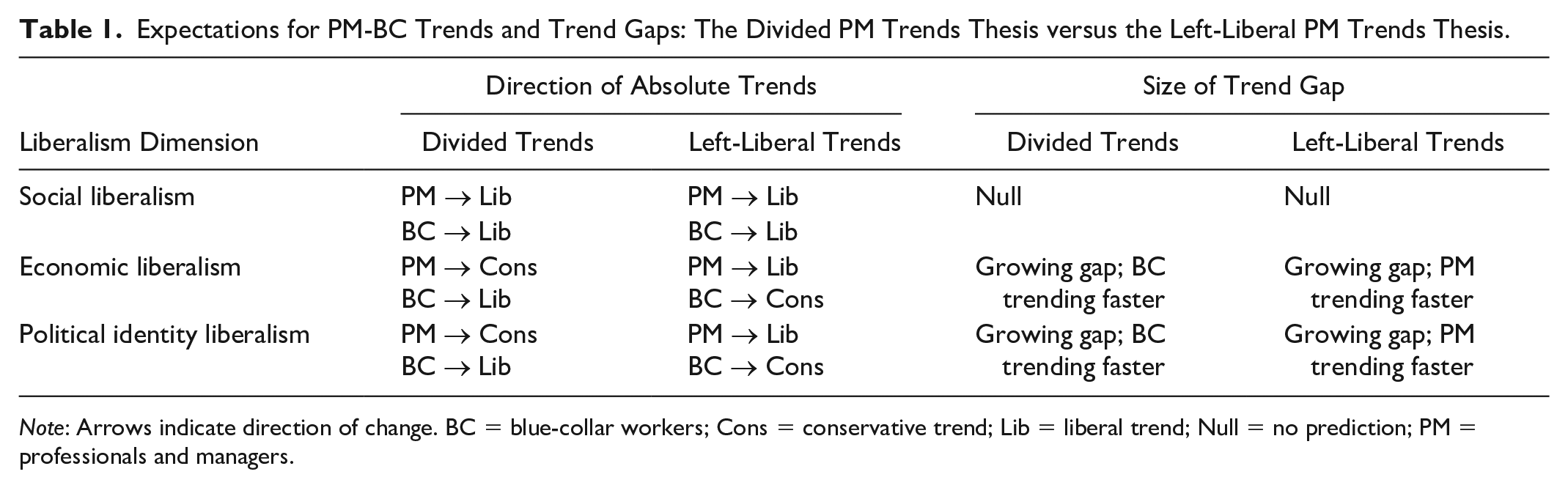
Note: Arrows indicate direction of change. BC = blue-collar workers; Cons = conservative trend; Lib = liberal trend; Null = no prediction; PM = professionals and managers.
The two perspectives produce opposite expectations about the direction of change among members of the two strata on economic issues related to redistribution and the balance of power between capital and labor. The divided-trends thesis is based on the expectation that PM will remain more conservative than BC on most if not all such issues because professionals and managers have an interest in protecting their economic advantages and status (see, e.g., Tilly 1998:147–69). By the same token, the declining position of blue-collar workers should, according to this view, lead to a continuing or even greater interest among BC in using government to control the powerful and to ameliorate inequalities (see Bartels 2008:chap. 3; Gelman, Kenworthy, and Su 2010). Conversely, the left-liberal-trends thesis suggests that PM should become more supportive of redressing inequalities. If this thesis is correct, BC should more strongly identify with business interests and be less inclined to support government programs for redistribution, ameliorating racial injustices, or alleviating poverty over time (Hochschild 2016; Wuthnow 2018.)
Empirical expectations also vary between the two theses on political identity liberalism. The divided-trends view is based on the expectation that members of the PM stratum resist the Democratic Party’s advocacy of economic redistribution and greater power for organized labor. The left-liberal-trends thesis, by contrast, suggests that PM should be trending toward both self-identified liberal political views and stronger Democratic Party affiliations, while BC should be trending away from both.
Mediators
Our approach to providing a theoretical grounding for the left-liberal-trends thesis is based on the idea that changes in the macro-economy are associated with a greater sense of security in PM, a declining sense of security in PM, and growing gaps between PM and BC with respect to their educational levels, authoritarian versus nonauthoritarian values, religiosity, and incomes. Thus, in addition to the direct effects of changes in the relative security levels of the two strata brought on by these macro-economic developments, the growing gaps between PM and BC in these four characteristics, each linked directly or indirectly to macro-economic change, should help explain divergent trends between the two strata in so far as higher levels of education, lower levels of authoritarianism, lower levels of identification with fundamentalist religion and higher incomes are associated with greater support for left and liberal attitudes. Thus, we also analyze the effects of these four mediators in explaining trend gaps that have emerged during the period of the study.
Data and Methods
Data
The study is based on data from the GSS over the period from 1974 to 2018. Because of the large sample size and the range of background variables available through the GSS, it is the best source of data on the trajectory over time of the political attitudes and identifications of U.S. adults. A major strength of the GSS is the sheer number of years it has been fielded and the consistency of question stems and response categories for repeated questions. Unlike the American National Election Study, which has yet to incorporate occupational codes for the past decade of surveys, the cumulative GSS includes coding for occupation for every year in the time series. The GSS also includes a wide array of questions relevant to the study of political attitudes, policy preferences, and partisan and ideological identifications. 3
Outcome Variables
A full consideration of the left-liberal-trends thesis requires analysis of a wide range of attitudes and identifications across the three domains. To identify outcome variables of interest, we first identified 48 relevant variables included in the GSS during a majority of survey years. We then used principal-components analysis (PCA) on this set of variables. We eliminated four scales and eight items on the basis of their redundancy, restricted temporal span, or weak differentiation among GSS respondents. 4 We retained the remaining scales produced by PCA for analysis, and we also retained consequential individual items that did not factor onto scales. 5 Our retained outcome variables include six scales and nine items.
Social liberalism scales and items include variables measuring attitudes toward social inclusion and cultural tolerance (women’s labor force participation, moral nonrestrictiveness, and civil liberties for dissenting speakers) as well as variables measuring attitudes about public safety and criminal justice (gun laws, capital punishment, and court sentencing). Economic liberalism scales and items include variables measuring attitudes toward government social spending (spending on the environment, spending on health and education, and race-related spending 6 ) as well as economic power (confidence in business and labor) and views on redistributive policies (equalization of wealth and poverty amelioration). Political identity liberalism items include variables measuring partisan and ideological identifications (Democratic Party identification and self-identified liberal political views).
We divided the scales and items to isolate clearly left-of-center and liberal positions. Methodologists typically advise not to dichotomize continuous variables because of loss in variation and statistical power (DeCoster, Iselin, and Gallucci 2008). In our view, theoretical considerations warrant the use of dichotomization in this study. The thrust of the debate about PM and BC liberalism is that professionals and managers are becoming (or have become) a distinctively liberal stratum in U.S. political life, while blue-collar workers are abandoning these positions. We interpret this to mean that the debate is not about gradations on a continuous scale but rather about clearly demarcated left and liberal positions. To ensure that our findings are not an artifact of dichotomization, we conducted robustness checks on the continuous scales and on the full set of ordinal item responses.
Table 2 provides detailed information on the outcome variables in the analysis. In Table 2 we specify the categories we used to identify liberal positions for the nine items we include as dependent variables. We also provide the proportion of GSS respondents who adopted those positions during the entire 44-year period. On these items, we found it straightforward to construct divisions to produce liberal categories. On the confidence in labor unions item, for example, we used “a great deal” of confidence as the response category of interest, excluding the other two response categories: “hardly any” and “only some.” On the item measuring whether respondents thought wealth should be equalized, we used the last three categories on the seven-point scale to identify those who favored greater equalization of wealth.
Dependent Variables in General Social Survey Analysis, Employed Population, 1970s to 2018.

Source: General Social Survey, 1974 to 2018.
Proportions are the share who answer in the liberal category pooled over the entire period.
Principal-components analysis individual items and response categories appear in Supplemental Table 1.
In Table 2 we also provide proportions adopting liberal positions and α values for the six scales we include as dependent variables. For the three scales that included just two items, we required respondents to choose liberal responses on both items in order to be classified in the liberal category. On the remaining three scales, we divided responses through examination of histograms of the distribution of scale scores. We used clear breaks in the histograms as points for dividing liberal positions from nonliberal positions. We compared the histograms based on scale scores with the distributions on the items from which the scales were composed and the factor loadings of each of the scaled items. For example, if the distribution of attitudes on items with high loadings suggested that approximately one third of respondents were liberals, and the histograms confirmed a break at approximately one third of the scale distribution, we felt confident in identifying this proportion of the distribution as liberals.
Occupational Strata
We combine the census occupational codes for professionals and managers to form PM, and we combine skilled and unskilled blue-collar workers to form BC. 7 We excluded business owners and chief executive officers from the managerial group, treating them as part of a separate business owner and executive stratum (see Supplemental Table 2 for the census occupational codes we used to compose the professional-managerial and blue-collar strata).
Previous researchers who have used occupational categories to study U.S. political divisions have typically separated professionals from managers. The separation has been justified principally on empirical grounds (see, e.g., Brint 1994:chap. 5; Brooks and Manza 1997; Hout, Brooks, and Manza 1995). It can also be justified conceptually on the basis of the different assets each brings to claims for a privileged position in the class structure: organizational assets in the case of managers and skill assets in the case of professionals (see, e.g., Wright 1985). Similarly, it is plausible to argue that many professionals face and may identify with clients that liberal policies aim to help while managers face and may identify with people higher up in the organizations that employ them (see, e.g., Freidson 1985:chap. 3).
We depart from the convention of treating professionals and managers separately for two reasons. First, professionals and managers together constitute the great majority of individuals and families found just below the very top of the American economic order (Gilbert 2018). Second, it is becoming more difficult conceptually to distinguish professionals from managers. It is well known that a large proportion of professionals have managerial responsibilities of one type or another (Freidson 1985:chap. 3). Professionals who do not have formal managerial responsibilities nevertheless tend to incorporate managerial priorities into their work practice (Noordegraaf 2007; Scott 2008). In addition, a sizable proportion of managers, particularly those with advanced degrees, claim to incorporate professional expertise into their work (Hallett and Gougherty 2018; MacDonald 1995:chap. 6).
However, because legitimate questions exist about whether professionals and managers should be collapsed into one category and, similarly, about whether skilled and unskilled blue-collar workers should be collapsed into one category, we conducted robustness checks separating these occupational strata from one another. As we will show, the empirical results fully justify combining professionals with managers. They also fully justified combining skilled with unskilled blue-collar workers.
Mediating Variables
We used the category of individuals with advanced degrees as our mediating variable in analyses of compositional effects due to educational differences. Large gaps exist between PM and BC on graduate degrees, and people with graduate degrees tend to have significantly greater attachments to liberalism than those with baccalaureate and lower level degrees (Pew Research Center 2016). 8 We used the category of people who did not list “obeying parents” as one of three “most important” child-rearing values as our mediating variable in analyses of compositional effects due to differences in nonauthoritarian outlooks. Child-rearing values are the only variables in the GSS that are relevant to the measurement of authoritarian and nonauthoritarian values. A long line of researchers has shown a strong correlation between child-rearing values focusing on obedience and other measures of authoritarianism (Feldman and Stenner 1997; Hetherington and Weiler 2018; Martin 1964). The GSS provides a coding of fundamentalist and nonfundamentalist religious denominations. We use this coding to form our focal category of nonfundamentalists. 9 Finally, we used the GSS (base = 1986) real U.S. dollar measure for income rather than contemporaneous measures of income because we wanted to ensure that any observed effect was not the artifact of increasing inflation over the 44-year period. We logged the income measure to adjust for skew.
Control Variables
The analyses control for six sociodemographic variables that previous studies have shown to be associated with more liberal or more conservative political attitudes. These are employment sector (coded as for-profit or nonprofit), race/ethnicity (white, minority), gender (male, female), age, region (South, coasts, other region), and city size (rural, small town, urban). As we emphasize previously, our approach to mediation focuses on characteristics of PM and BC that are becoming more divergent over time and are related directly or indirectly to macro-economic changes. This is not true for the control variables in the analysis; instead, the proportions of people in these groups between PM and BC remain very nearly the same over time.
Linear Probability Structural Equation Models
In the analysis that follows, we estimate linear probability models of attitudes and linear probability structural equation models of mediation. We chose linear probability models over logistic regression for two reasons. First, interactions are more readily interpretable than those obtained from logit models (Allison 1999). Interactions between managers and professionals and time are the key independent variable of interest. Second, our mediation analysis (described later) includes both dichotomous and continuous mediator variables, which would require us to combine logistic regression coefficients with ordinary least squares coefficients to estimate indirect effects. Because the former are effects at the average (rather than average effects), the resulting indirect effects would be difficult to interpret. Linear probability models are heteroscedastic by definition, and we therefore use heteroscedasticity-consistent standard errors.
Analysis of Trends and Trend/Level Gaps
Our research questions require a dynamic analysis. Macro-changes in the economy and in political messaging are occurring simultaneously in time, and we can therefore use time as a proxy for their aggregate effect. The analyses investigate how much and how fast PM and BC have been changing over time. It is possible that PM and BC have been moving in different directions on some of the attitudes and identifications we investigate. It is also possible that PM and BC are changing in the same direction but at markedly different rates. We therefore examine both time trends and trend gaps. Our analysis proceeds in two stages. We first test null hypotheses about (1) the absolute direction of change in attitudes toward or away from the liberal view for both PM and BC and (2) the relative rate of change in attitudes between PM and BC. These first two analyses tell us whether PM and BC are trending in a liberal direction and if PM are changing faster or slower than BC. To test these hypotheses, we estimate

where pm is the dummy variable for PM, year is a linear time trend, and
Moderated Mediation
The second stage in the analysis requires the use of moderated mediation because we are interested in the dynamics of the indirect effects of the mediators discussed above. To estimate the indirect effects of our four mediators on observed attitudinal gaps between BC and PM, we use structural equations. Our conceptual approach is described below.
To estimate the indirect effect of mediator k, we estimate two models:

where Mk refers to mediator k, and

We then estimate the indirect effect of mediator k in time t (IEM kt ) with Sobel:

Equation 4 gives us the indirect effect of mediator k on the attitude gap between PM and BC in time t. Equations 2 and 3 are estimated using Stata’s SEM package; equation 4 is estimated using post hoc tests available after SEM.
In addition to the problem of heteroscedasticity noted above, it is implausible to assume the sampling distribution of indirect effects is normal (MacKinnon, Lockwood, and Williams 2004). Thus, we test the null hypothesis that these indirect effects equal zero with both (heteroscedasticity consistent) classical standard errors and bootstrap resampling (Bollen and Stine 1990). For the latter, we conduct 500 bootstrap resamples for each indirect effect.
Results
Attitude Trends and Trend Gaps
Figure 1 reports trends for PM and BC on attitudes in all three domains of liberalism. Positive trends imply a liberal shift over time, while negative trends imply a conservative shift. The trends for PM are shown in blue, and those for BC are shown in red.
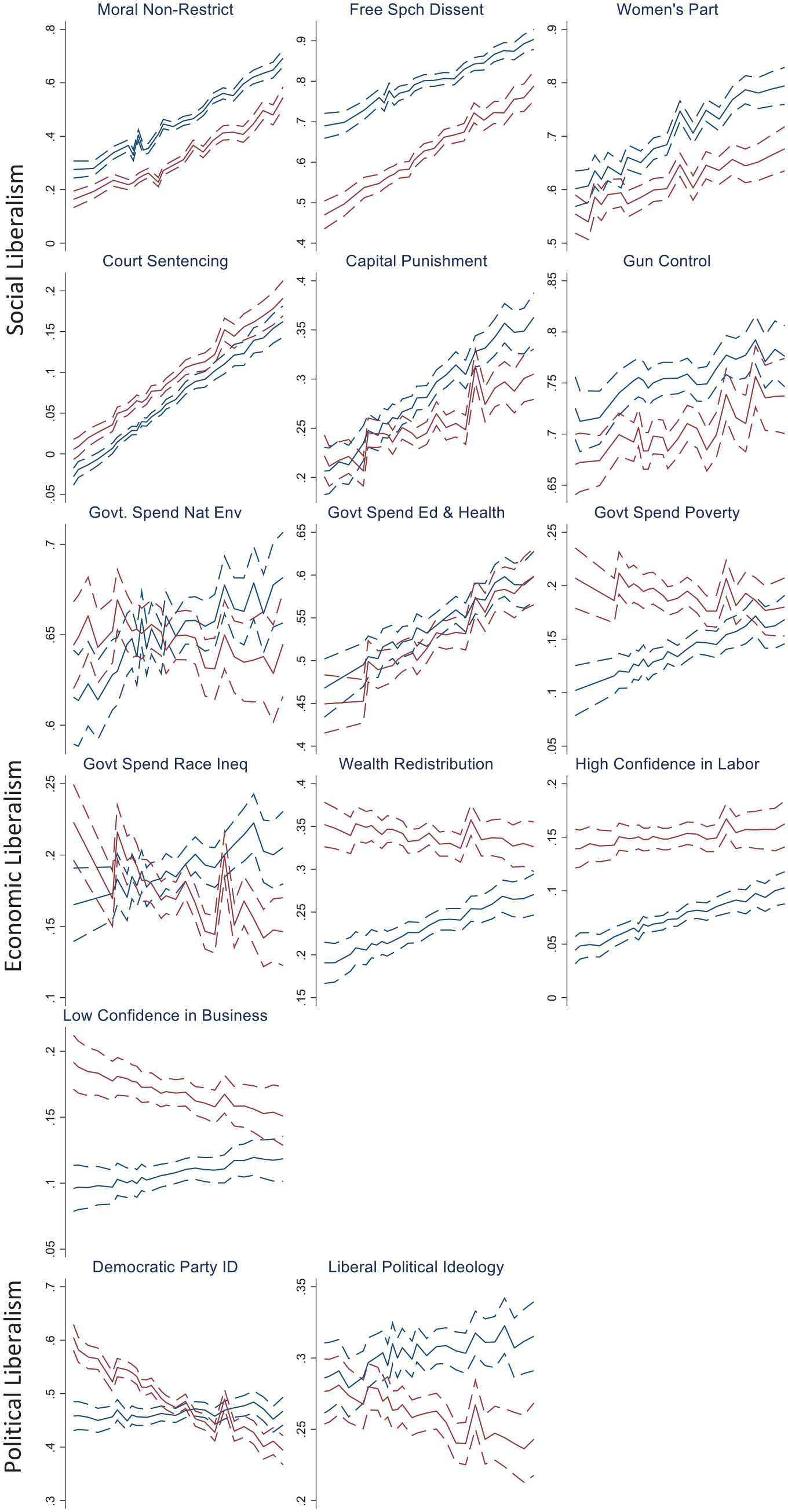
Trends in attitudes among professionals and managers and blue-collar workers.
Social Liberalism
The two rows of Figure 1 show that both PM and BC hold increasingly liberal attitudes over time on all six social liberalism issues. The first three columns of Table 3 report tests of the null hypotheses that the BC and PM trends are equal to zero (columns 1 and 2) and that the difference between their trends is equal to zero (column 3). Consistent with the casual impression of Figure 1 (top), PM show a significantly liberal trend on all social issues attitudes except gun control, for which the baseline is already high. BC show significantly liberal trends on all attitude domains except capital punishment and gun control. With respect to trend gaps, the liberal trend among BC with regard to free speech is steeper than that among PM. The liberal trend among PM is steeper with regard to women’s participation in the polity and economy (p < .10) and capital punishment. There is no significant difference in the PM and BC trends on moral nonrestrictiveness, court sentencing, or gun control. In short, both PM and BC show fairly liberal trends on social attitudes. The trend among PM is more steeply liberal on two of six, equal to BC on three of six, and slower than BC on one of six.
Trends and Trend Gaps among Professionals and Managers and Blue-Collar Workers.

Note: Values are unstandardized coefficients; heteroscedasticity-consistent t statistics are in parentheses. Positive coefficients represent liberalizing absolute or relative trends. These estimates control for race, age, industry, sex, region and location city/town size. See Supplemental Tables 3 to 5 on the Socius Web site for observations per outcome and full regressions.
p < .10. *p < .05. **p < .01. ***p < .001.
The last three columns of Table 3 test the null hypothesis that the level of liberalism among PM is equal to that among BC at the beginning, middle, and end of each series. 10 By 2018 (the end of each series), PM were significantly more liberal on four of six outcomes. Of the remaining two outcomes, PM moved from significantly less liberal to nonsignificantly more liberal on one issue (court sentencing) and from marginally more liberal to nonsignificantly more liberal on another (gun control).
Economic Liberalism
The middle portion of Figure 1 displays the trends for attitudes about economic liberalism, which indicate that PM and BC trend in opposite directions, for the most part, in this domain. PM show a liberal trend on all outcomes. Conversely, BC show a liberal trend on only one of seven issues (health and education spending). BC display increasingly conservative attitudes with respect to wealth redistribution and spending on the environment, poverty, racial inequality, and confidence in labor. Moreover, the attitude trend for PM appears more liberal on all but the health and education spending items.
These opposing trends mostly bear out statistically in Table 3. PM show a significantly liberal trend on all but race-related government spending and low confidence in capital (both null). BC show a significantly conservative trend on all but spending on the environment (null), spending on health and education (liberal), and confidence in labor (null). PM have a significantly more liberal trend on all but the health and education spending attitude. In terms of levels, PM transitioned from significantly less to significantly more liberal than BC in their attitudes on two of seven outcomes: attitudes about the environment and race-related government spending. On two more (spending on poverty and confidence in business), PM transitioned from significantly less liberal to no different from BC. In two cases (wealth redistribution and confidence in labor), PM reduced their liberal deficit with BC but remained significantly less liberal. On one outcome (spending on education and health), PM and BC were indistinguishable in their liberal attitudes throughout the period.
Political Identity Liberalism
The bottom portion of Figure 1 shows the trends on attitudes about political identity liberalism. PM show a liberal trend on political ideology but are relatively flat on Democratic Party identification. The BC trend is conservative on both political ideology and party identification. Table 3 indicates that the PM trend on political ideology is not significantly different from zero, while support among PM for the Democratic Party trends in a marginally conservative direction. The BC trends, by contrast, are significantly conservative. This difference creates a significantly more liberal trajectory for PM than BC on both outcomes in the third column of Table 3. In terms of levels, PM transitioned from significantly less to significantly more liberal in their party identification and from insignificantly to significantly more liberal in their self-identified liberal political ideology.
Mediation Analysis
Can the four mediators account for the relatively greater liberal trajectory of PM? Figure 2 displays the indirect effects for which we reject the null hypothesis at p < .10 or lower using both parametric and bootstrapped hypothesis tests. For each outcome, there are three possible indirect effects for each mediator: one each for three time points (early, mid, and late). Coefficients above zero are liberalizing, while those below zero are conservatizing. 11

Mediating effects and their trends.
Social Liberalism
As indicated in Figure 2 with respect to social liberalism issues, the nonauthoritarian attitudes and the greater educational attainment of PM are clearly important drivers of the relatively stronger liberal trajectory among PM vis-à-vis BC. Nonauthoritarian values play an important liberalizing role in five of the six outcomes. In total, this indirect effect is significantly different from zero in 14 of 18 instances. 12 Graduate education is a significant driver of the attitudinal gaps in at least two periods for all but one outcome. In total, this indirect effect is significantly different from zero in 13 of 18 tests. In all but one case (attitudes toward the court in the early period), the greater attainment of graduate degrees among PM is a liberalizing factor. 13 Income and nonfundamentalism play a smaller role than the other two but are nevertheless important, as each is a significant mediator in 11 of 18 tests. Income is countervailing in its effect about half the time. It is positive (liberalizing) and significant in 6 of 18 outcome-years. However, it is negative (conservatizing) and significant in 5 of 18 outcome-years. The pattern is consistent: high incomes are liberalizing on issues related to civil liberties (nonrestrictive morality, free speech, and the role of women) and conservatizing with respect to the criminal justice system. 14 Nonfundamentalism, on the other hand, is always liberalizing. 15
Economic Liberalism
As indicated in Figure 2 and Appendix A, with respect to the economic liberalism issues, nonauthoritarianism appears to be the most important mediator and is followed by income, graduate degrees, and nonfundamentalism. Nonauthoritarian attitudes are significantly different from zero in at least two periods in 5 of 7 outcomes and in one period on the other two and 12 of 21 times overall. They have a liberalizing mediating effect on attitudes about government spending on the environment, health and education, and race and low confidence in business. Somewhat surprisingly, they have a significant (but small) conservatizing mediating effect on wealth redistribution and trust in organized labor. 16
Income plays the second most important mediating role for economic liberalism; it is significantly different from zero in 10 of 21 tests. Income has a conservatizing mediating effect on the attitude gap in government spending on poverty and wealth redistribution as well as attitudes about business and labor. 17 Graduate education is also an important mediator. It is significantly liberalizing in at least two periods for three of seven outcomes and 7 of 21 times overall. It is a liberalizing force in all but one instance: high confidence in labor in the earliest period. 18 Finally, nonfundamentalism plays the least important role in economic liberalism. It mediates only three outcomes: government spending on the environment and health and education and high confidence in labor. Overall, it is significant in only 5 of 21 tests.
Political Identity Liberalism
Figure 2 and Appendix A suggest that graduate degrees, nonauthoritarian values, and nonfundamentalism are the strongest mediators of political liberalism, with income playing a very small role. Each of these factors is significantly different from zero in five of six tests. 19 Conversely, income differences between PM and BC have a conservatizing effect in one of six tests (political identity liberalism), but the effect is small. 20
Robustness Checks
We report here the results of robustness checks on several operational choices that might influence our findings. To address potential concerns, we replicate the analyses above after changing these operational decisions.
To address the issue of whether professionals and managers should be combined into one category, we reran the analyses after separating professionals and managers into two categories. We tested the null hypothesis that the separate professional and manager trends were significantly different from the blue collar trends. In cases in which the results of these tests differed from those in the main analysis (Table 3, column 3), we then tested the null hypothesis that the managerial trend was significantly different from the professional trend. These results were substantively identical to those reported in Table 3 in 12 of 15 outcomes. The exceptions were government spending on the natural environment (managers more liberal), poverty (professionals more liberal), and attitudes about the redistribution of wealth (professionals more liberal).
For these three outcomes, we therefore conducted a mediation analysis in both a joined PM group and after separating managers and professionals. In the preceding analysis, there were 16 variable-periods for which estimated indirect effects on these three outcomes were significantly different from zero among the combined PM group. Thus, in our reanalysis, there were 32 possible variable-periods. Thirty of these were substantively identical to those reported in Figure 2. The marginally significant mediating effect of a graduate degree in the middle period for wealth redistribution was nonsignificant for both managers and professionals when they were disaggregated. This is not altogether surprising given the asymptotics of splitting the group.
To address the possibility that the mediators we have identified are relevant for only whites (e.g., McElwee, Rhodes, and Schaffner 2016), we first tested the null hypothesis that minority trends equaled white trends within occupational groups. For any case in which we rejected this null hypothesis, we then tested the null hypothesis that the occupational trend gap among minorities equals the occupational trend gap among whites. These results were substantively identical to the main analysis in 13 of 15 outcomes. The two exceptions were confidence in labor and Democratic Party identification. In the first case, BC minorities have an even less confident trend in labor than BC whites, which leads to a significantly different occupational trend gap between whites and minorities. In the second, BC minorities have a more liberal trend on Democratic Party identification than BC whites, which leads to a significantly different occupational trend gap between whites and minorities.
For these two variables, we estimated the indirect effects of the significant mediators for minorities. There were nine significant variable-periods across these two outcomes reported in Figure 2. Our reanalysis was substantively identical with one exception: the marginally significant (p < .10) effect of graduate degree in the early period of high confidence in labor was nonsignificant among minorities (p < .11).
To address potential concerns about our choice to dichotomize scales to identify liberal categories, we replicated the analysis using the full continuous scales on moral nonrestrictiveness, free speech for dissenters, women’s participation, and government spending on health and education, poverty, and racial inequality. These replications were substantively identical in 17 of 18 cases. The one exception was moral nonrestrictiveness, for which the significantly more liberal PM trend in the main analysis was not significantly different from zero. We therefore reestimated the indirect effects of the significant mediators for moral non-restrictiveness after replacing the dichotomous variable used in the main analysis with the continuous scale. Seven of seven of the significant variable periods reported in Figure 2 were significant in these replications.
Discussion
The left-liberal-trends thesis gains considerably more support in these analyses than it did in analyses conducted in the 1980s and 1990s. On social issues, PM are trending liberal more quickly on two of six issues and at the same rate on one. BC, who were far behind PM at the beginning of the period, are trending more liberal on the remaining three of the issues. PM are now more liberal than BC on three of six social issues, indistinguishable in their liberalism on two, and less liberal on one. On economic issues, PM are trending more liberal than BC on six of seven outcomes and are indistinguishable on one. In the most recent period, they are now more liberal in their level of support for economic liberalism in two cases, indistinguishable on three, and less liberal on only two. In the political identity liberalism domain, PM are trending more liberal than BC on both outcomes and are now more attached to the Democratic Party and more liberal in political ideology than BC. These results are largely robust to shifts in the definition of occupational groups, differences in political attitudes between whites and racial-ethnic minorities, and treatments of scale items as continuous rather than categorical.
This level of support for the left-liberal-trends thesis contrasts with the lesser accuracy of the divided-trends thesis. The latter accurately predicts the direction of change of the two strata on social liberalism issues but not the faster rates of change among PM. It fails to predict the direction of change on nearly all economic issues, as well as the rates of change between the two strata. It also fails to predict either the direction or rate of change in the political identity liberalism domain (see Table 1).
These findings are consequential for social science analyses of American politics. No previous studies have shown a dominant left and liberal trend in PM attitudes across a wide range of issues or such broadly consistent evidence of variation in PM and BC trends. We were able to detect these trends through the use of a longer time series, a larger number of items and scales, and better controlled analyses than social scientists have previously used. Our findings contrast not only with the prevailing view from the 1980s and 1990s but also with arguments that emphasize traditional lines of class division (Bartels 2008; Gelman et al. 2010), as well as those that emphasize trendless fluctuation in class politics (Manza, Hout, and Brooks 1995).
The mediators we propose also matter for explaining the attitude gaps between PM and BC. Differences in graduate education, nonauthoritarian values, nonfundamentalist religion, and income help explain observed attitude gaps between PM and BC in all three domains of liberalism. Nonauthoritarian values appear to be the most important compositional difference between PM and BC. Their indirect effect was significantly different from zero 31 of 45 times. The next most important was graduate degrees, which were significantly different from zero 25 of 45 times. In general, the mediating effects of nonauthoritarian values and graduate education are trending in a liberal direction, as evidenced by the positive trends on the graduate degree and nonauthoritarian values coefficients in Figure 2. Nonfundamentalist religion was the least consistent influence on liberal attitudes, as it was significant in 21 of 45 tests. Unlike the other gaps we have discussed, the gap between PM and BC in affiliation with nonfundamentalist religion is narrowing moderately rather than widening, suggesting the possibility that the politics of the two strata could become more similar in the future in so far as these identifications mediate the trends we have observed.
Although income was the third most important compositional factor (significantly different from zero 22 of 45 times), the sign was generally opposite from our expectation. Income showed the expected effects on three social issues, but it showed a conservatizing effect on most issues involving crime control, the power of business and labor, and economic redistribution. It was also not associated with higher levels of adoption of Democratic Party identification or with higher levels of support for government social spending. Income also appears to be trending in a conservative direction, as evidenced in the downward slopes for income in Figure 2. Thus, income generally has no effect or an increasingly conservatizing effect on the attitude gap between PM and BC. These results are consistent with the work of others who have found that higher incomes tend to increase conservatism (Bartels 2008; Hout and Greeley 2010; Tilly 1998). PM are becoming, and in many cases have already become, more liberal and left than BC despite the growing income gap between these two groups rather than because of this gap.
These findings on compositional influences are also consequential for social science analyses of American politics. As far as we know, no social scientists have shown the extent to which attitude trends in the two strata can be explained by macro-level changes that are mediated by changes in the composition of the two strata over time. A next step for researchers will be to explicate the portion of the gaps between PM and BC that cannot be accounted for by these compositional dynamics.
Supplemental Material
sj-docx-1-srd-10.1177_23780231211068654 – Supplemental material for Are U.S. Professionals and Managers More Left Than Blue-Collar Workers?: An Analysis of the General Social Survey, 1974 to 2018
Supplemental material, sj-docx-1-srd-10.1177_23780231211068654 for Are U.S. Professionals and Managers More Left Than Blue-Collar Workers?: An Analysis of the General Social Survey, 1974 to 2018 by Steven Brint, Michaela Curran and Matthew C. Mahutga in Socius
Footnotes
Appendix A
Dynamic Mediation Analysis of Gaps in Political Liberalism among Blue-Collar Workers and Professionals and Managers.

| Mediator | Period | b | Sig | Base Gap | ||||
|---|---|---|---|---|---|---|---|---|
| Para | Boot | Gap | Sig | % Exp | ||||
| Democratic party ID | Graduate degree | Early | −.002 | −.139 | *** | 1.40 | ||
| Mid | .005 | * | * | −.021 | * | −25.90 | ||
| Late | .020 | ** | ** | .091 | *** | 21.90 | ||
| Nonauthoritarian | Early | −.001 | −.139 | *** | 0.57 | |||
| Mid | .007 | *** | *** | −.021 | * | −34.20 | ||
| Late | .021 | *** | *** | .091 | *** | 22.80 | ||
| Income | Early | −.001 | −.139 | *** | 0.45 | |||
| Mid | −.003 | −.021 | * | 12.31 | ||||
| Late | −.006 | .091 | *** | −6.19 | ||||
| Nonfundamentalist | Early | .001 | −.139 | *** | −0.45 | |||
| Mid | .005 | *** | *** | −.021 | * | −24.00 | ||
| Late | .005 | * | ** | .091 | *** | 5.11 | ||
| Liberal political ideology | Graduate degree | Early | .014 | *** | *** | .005 | ||
| Mid | .021 | *** | *** | .044 | *** | 47.19 | ||
| Late | .026 | *** | *** | .083 | *** | 30.79 | ||
| Nonauthoritarian | Early | .004 | * | * | .005 | |||
| Mid | .013 | *** | *** | .044 | *** | 29.50 | ||
| Late | .027 | *** | *** | .083 | *** | 32.07 | ||
| Income | Early | −.004 | .005 | |||||
| Mid | −.006 | * | * | .044 | *** | −13.90 | ||
| Late | −.008 | .083 | *** | −9.31 | ||||
| Nonfundamentalist | Early | .008 | ** | ** | .005 | |||
| Mid | .008 | *** | *** | .044 | *** | 18.70 | ||
| Late | .006 | * | * | .083 | *** | 6.69 | ||
Note: Values are unstandardized indirect effects. These estimates control for race, age, industry, sex, region, and location city/town size. See Appendix B online for observations per outcome. Positive coefficients indicate a liberalizing indirect effect, and negative coefficients indicate a conservatizing indirect effect. The last column reports the indirect effect as a percentage of the base (unmediated) trend gap. When this ratio is the same sign as that of the base gap, the focal covariate is a mediator and explains the percentage of the base gap reported. When it is the opposite sign as that of the base gap, the focal covariate is a suppressor and decreases the base gap by the percentage reported. We report the percentage of the base attitude gap explained by the focal moderator only if the base gap is significantly different from zero.
p < .05. **p < .01. ***p < .001.
Acknowledgements
We would like to thank David Brady, Michael Hout, and two anonymous reviewers for comments that improved the quality of this article.

Supplemental Material
Supplemental material for this article is available online.
Notes
Author Biographies
References
Supplementary Material
Please find the following supplemental material available below.
For Open Access articles published under a Creative Commons License, all supplemental material carries the same license as the article it is associated with.
For non-Open Access articles published, all supplemental material carries a non-exclusive license, and permission requests for re-use of supplemental material or any part of supplemental material shall be sent directly to the copyright owner as specified in the copyright notice associated with the article.
