




Abstract
Interpersonal socializing is important to many sociological outcomes, but assessing the affective dynamics within interactional contexts is extremely challenging methodologically. As a first step toward capturing socializing and affective outcomes concurrently, this pilot study (n = 118) combines intensive daily surveys with a wearable sensor that tracked affective arousal. This approach allowed the operationalization of affect along its two primary dimensions, valence and arousal, which were then linked to periods socializing with a romantic partner, a best friend, and/or a group of friends. Although socializing predicted positive and negative affective valence concurrently in time, only socializing with groups of friends consistently predicted increased affective arousal. Findings for romantic partners and/or socializing with a close friend suggest that low arousal “downtime” with close intimates may also provide important social functions. This work demonstrates a new biosignaling approach to affective dynamics broadly relevant to emotion-related sociological research.
Keywords
The affective and emotional outcomes of social interactions underlie a diverse array of intra- and interpersonal phenomena. Peering into these dynamics quantitatively is extremely challenging methodologically, however, for two overarching reasons. First, social encounters vary along multiple axes of heterogeneity—the who, what, when, where, and why—when viewed on short-term time scales from one encounter to the next, and second, these short-term scales are inherently difficult to measure in the natural flow of life. However, developing new approaches to emotional and other health-related dynamics embedded in the microsociological flow of social life holds the potential to enhance research in numerous areas. For example, microsociological research emphasizes the importance of affective dynamics within the social contexts they take place in and additionally considers the chains of interaction outcomes that over time come to broadly shape and direct individuals through life. In this vein, Collins (2004) described how successful interactions create emotional energy in the participants, supporting both positive affective outcomes at the individual level and interpersonal bonding at dyadic and larger group levels. Collectively, these bonds are proposed to produce solidarity in groups and to concatenate interpersonal bonds into social network structures, joining individual to collective social outcomes.
In general, social interactions can be both harming and protective (House, Landis, and Umberson 1988). For example, positive social interactions can offset the impact of low socioeconomic status on stress levels (Taylor and Seeman 1999), while lacking connection is a bigger risk factor for mortality later in life than smoking and obesity (Holt-Lunstad, Smith, and Layton 2010; Liu et al. 2017; Woodward et al. 2018). In fact, a perceived lack of meaningful social connection (i.e., loneliness) is associated with a diverse array of adverse outcomes (Goosby et al. 2013; Cacioppo and Cacioppo 2014), pointing to a need for research that goes beyond objective network connections or the amount of socializing (Cacioppo and Cacioppo 2014). New approaches to examining the microsociological processes underlying how individuals experience their social encounters is needed. For example, Goosby, Cheadle, and Mitchell (2018) described the physiological processes by which the social exclusionary experience of interpersonal racial discrimination affects health, which recent studies have tested by linking perceived discrimination during specific social encounters to concurrent sympathetic nervous system (SNS) activity tracked continuously using a noninvasive wearable sensor (Cheadle et al. 2020; Jelsma, Goosby, and Cheadle 2021).
Our goal in this article is to describe affective dynamics during common socializing encounters. Affect, or the feelings one has from moment to moment, is characterized along two primary dimensions (Russell 1980): valence (how positive or negative one feels) and arousal (the intensity of the feeling from low to high). To measure affective arousal, we used a wearable sensor of SNS arousal (i.e., electrodermal activity [EDA]) and time-synchronized this signal with reports of concurrent positive and negative affective valence every 15 minutes throughout the day for up to two weeks. These measures were then linked to periods spent copresent with a romantic partner, a close friend, and/or a group of friends. With this approach, we sought to identify the associations between relationship context and affect. A key goal was to determine whether arousal was higher or lower on average in positively and negatively valenced encounters compared with baseline. As part of a larger project examining how individual and group dynamics feed into each other to mutually shape both intra- and interpersonal outcomes, this study demonstrates a new approach to measuring and interlinking how individuals feel when interacting with others.
Literature Review
Interaction Ritual Chain Theory
Humans are “hard-wired” to develop and maintain social connections (Massey 2002), and this drive to connect spans the life course (Zeman, Cassano, and Perry-Parrish 2006). Social network theory has long recognized that interpersonal associations are patterned and evince structure in ways that have considerable impacts on diverse facets of life (Christakis and Fowler 2011; Zhang and Centola 2019). Recent trends in network theory emphasize network change through social selection processes such as homophily (McPherson, Smith-Lovin, and Cook 2001) and the endogenous constraints of local and global network structures that individuals are embedded within (Snijders 2001, 2017). This emphasis on dynamics has also introduced new insights into both how the behaviors and characteristics of individuals influence social network change over time (Cheadle et al. 2013) and how network processes affect individuals’ behaviors and characteristics (Steglich, Snijders, and Pearson 2010; Snijders, van de Bunt, and Steglich 2010).
Collins’s (2004) interaction ritual (IR) chain theory provides a microsociological framework that describes network structure at a point in time as a temporally smoothed and filtered representation of the amount and quality of the interactional histories among network members. Although network theory emphasizes connections based upon some relational criteria such as “best friend,” IR theory (IRT) accentuates the interactional histories that determine which relationships do and do not satisfy those criteria from the perspective of each participant. The conditions of IRs are physical copresence, the rapid and automatic synchronization of microbehaviors such as body movements and vocalizations, the intersubjective sharing of a focus of attention, and emotional synchronicity (Collins 2004). Successful IRs are proposed to generate positive “emotional energy,” a key behavioral motivator to renew associations with individuals and groups when encounters increase it. Viewed holistically, a social network measured at one point in time is a snapshot summarizing the intersection of the interactional and emotional histories among the set of potential interaction partners. For instance, a close friendship network is a summary of the feelings of bonding, trust, and closeness that have developed between each network member and the others who constitute their personal IR chain, while network change reflects the trajectories and discontinuities in these IR chains over time.
Recognizing the important role that interpersonal processes play in the dynamics of larger social network structures, we sought to identify microsocial time-scale dynamics within which affective outcomes could be embedded within socializing contexts with a romantic partner, a close friend, or a group of friends.
Affect, Emotion, and Measurement
Sociological traditions have emphasized specific emotions (e.g., shame; Scheff 1988) while illustrating the ways that social structure organizes, channels, and constrains emotions (Bonilla-Silva 2019; Hochschild 1990; Lovaglia and Houser 1996; Scheff 1988; Shott 1979). Our focus on affect is driven by measurement strategy, and measurement strategy is driven by biological, cognitive, and technological constraints. Affect, which reflects the ongoing stream of feelings from moment to moment, is a lower level concept than “emotion” that is rooted in two broad sets of physiological processes (Barrett 2018; Barrett, Quigley, and Hamilton 2016). The first is captured by the concept of allostasis, which refers to the brain’s anticipatory regulation of cardiometabolic, immune, and other systems (Sterling 2012). Allostasis, the process that manages cardiometabolic and immune resources and prepares the body to navigate the (commonly social) environment, refers to the “downstream” regulation of the body by the brain. The second concept is interoception, which refers to the rich array of signals ascending from sensors monitoring states throughout the body and into the brain, where the information is then used in various ways (Chen et al. 2021; Craig 2003). For example, the energized arousal feelings a youth may experience when socializing with friends reflects allostatic regulation to increase energy, as well as the interoceptive monitoring of these states, which are then summarized and experienced in consciousness as affect.
Affect is described along two primary dimensions of feeling, as shown in Figure 1 (Posner, Russell, and Peterson 2005; Russell 1980): negative to positive (valence; x-axis) and low to high arousal (y-axis). Affect is a fundamental feature of consciousness that is produced by the brain continuously (whether one is consciously aware of it or not), functioning like a barometer for what is happening in the body (Barrett 2020). It is important to recognize that the regulation of different physiological systems is done in anticipation of, and in response to, the environment (Sterling 2012). Affect is the root of emotion (Barrett 2017), but emotion is much more complex, as it classifies affective feelings into more complex categories that often overlap and may only be subtly distinguished (Turner 2007). According to modern neuroscientific theories of emotions, people feel affect and learn how to interpret affect in terms of emotion concepts (Barrett 2018), tying emotions and cognitions together and situating them as a cultural product. Although there is considerable interest in classifying emotions from physiological, neural, and other signals (e.g., Dar et al. 2020; Valenza et al. 2015), it is not yet possible to do so in the microsociological flow of real life.

Circumplex model of affect.
Wearable sensors, however, allow researchers to track the arousal dimension of affect dynamically and noninvasively on the body (Picard, Fedor, and Ayzenberg 2016; Poh, Swenson, and Picard 2010). The arousal dimension of affect varies along the two divisions of the autonomic nervous system: the SNS (“fight or flight”) and the parasympathetic nervous system (PNS; “rest and digest” or “feed and breed”), which typically function inversely to each other. The SNS is particularly amenable to noninvasive measurement because sweating increases with arousal, changing the electrical characteristics of the skin and increasing the conductivity of the skin with a registration delay, as it takes time to sweat on the order of one to three seconds (Boucsein 2012). This “electrodermal activity” is considered a direct and linear index of SNS arousal.
However, because there are no available passive sensing technologies for affective valence, we adapted the day reconstruction method (Diener and Tay 2014; Lucas et al. 2021) as a structured daily diary in which participants independently indicated feeling negative and/or positive throughout the day. This structure allowed us to partially represent the affective state space depicted in Figure 1 when participants were and were not involved in social encounters. Although more work remains to be done on refining and expanding the affective and emotional coverage of ambulatory sensing technologies, the design presented here provides a starting point for dynamically capturing affective states and linking them to microsociological processes.
Socializing Context and Affect
Our first goal in this article is to characterize how affective valence and arousal dynamics are commonly embedded in young adult socializing contexts. We focus on three common socializing contexts that are important for both adolescents and young adults of college age, the group upon which our analysis is based. First, we examine affect during periods spent with a romantic partner, periods that can be deeply intimate but ultimately cross through a range of emotions, particularly as many relationships during this period of the life course are exploratory (Furman, Brown, and Feiring 1999). Second, we assess the affect created when spending time with a close friend. Variations on the concept of a close friend are commonly used as the core framework for studying youth social experiences, and a close friend can also have a high degree of intimacy and closeness. Both romantic partners and close friends have what Goffman (1959) described as “backstage” qualities, as these relationships provide opportunities when people can let their guard down, relax, and be themselves (Gosnell, Britt, and Mckibben 2011; Kernis 2003). Youth often lead active social lives with a considerable “frontstage” spent interacting with and fitting into larger collectives, however. We therefore also examine affect in the context of groups of friends, a collective dynamic that is expected to lead to high degrees of positive and elevated affect.
However, high positive affective arousal is but one part of the equation for a successful social experience, as low-arousal recovery periods are likely to provide important restorative functions. In fact, rather than heightened arousal, recovery mechanisms may be critical for social support buffering during times of stress (Gosnell et al. 2011). Moreover, recovery may be an important component of backstage relationships. Romantic and close friendships, for example, likely support a range of affective states (Lishner, Batson, and Huss 2011). Emphasizing only positive affective arousal may lead to an underappreciation of the pathways by which interpersonal connections are strengthened and maintained. Time spent with romantic partners and or a close friend may also provide opportunities for the social embedding of low-energy states such as relaxation, serenity, and contentedness that are critical to supporting individual recovery (Collins, Welsh, and Furman 2009). In this way, finding individuals who support a range of affective states, including the expression of negative affect, may be a critical social goal that individuals pursue. These shared experiences may create cohesion out of dyadic and small intimate group settings by working in tandem with high-arousal experiences that support the formation and perpetuation of larger collectives in group settings. Accordingly, the affect generated in intimate small “backstage” group settings, compared with larger “frontstage” group settings, may differ in important ways, particularly with respect to the level and intensity of the affective arousal generated.
Humans are also highly attuned to negative social threats and monitor the environment constantly for potential exclusions (Cavanagh and Allen 2007). Boyns and Luery (2015) extend IRT by including negative emotional energy that arises from experiences of exclusion, withdrawal, and frustration at low levels, and conflict and aggression at more intense levels. Critically, negative social experiences are not uncommon as social networks are inherently multiplex and can be characterized along both positive and negative dimensions. For example, though social networks as commonly measured summarize positive social interactions, they can also be assessed in terms of different dimensions of conflict such as bullying (Salmivalli, Huttunen, and Lagerspetz 1997) or enmity (Kitts 2006). Even specific relationships selected for positive affect can create frustration, disappointment, and anger (Lepore 1992). Most romantic relationships end (Simpson 1987), friendships during youth shift and change constantly (Collins and Laursen 2004), and group-oriented interactions can also lead to negative social experiences (Rhee 2007).
Whereas the positive affective arousal created during successful social interactions is health promoting, negative social experiences are generally expected to be stressful and health harming. There is a considerable literature on the negative health effects of social exclusion and negative social experiences that adversely affect individual health by increasing negative affect (Cacioppo and Cacioppo 2014; Holt-Lunstad et al. 2015; Klinenberg 2016). The internalized threat of negative evaluations by others reflects needs for acceptance and social connection (Dickerson, Gruenewald, and Kemeny 2004; Smith, Birmingham, and Uchino 2012). Accordingly, our second goal is to evaluate the links between socializing contexts and negative affective states.
Data and Methods
The data we use to evaluate social affect was collected as part of a pilot project that sought to develop new protocols for the use of ambulatory sensors in sociological research. The sample was recruited on a large, predominantly white midwestern university campus during the fall of 2016 and the spring of 2017. A key focus of the project was on the social experiences of racial/ethnic minority students, who were recruited through list server e-mails sent to campus groups focused on students of color, in addition to the distribution of flyers around campus (Jochman et al. 2019). Following an intake interview, fall 2016 participants were enrolled for a two-week period, while spring 2017 participants were enrolled for one week. Participation in the project involved the completion of daily diaries, distributed through text messages each morning and evening to assess daily experiences, activities, and sleep. The short morning survey asked about sleep quantity and quality, and a more detailed evening diary asked participants to document experiences and activities throughout the day. Each survey had a six-hour response window.
The daily diaries were complemented with biosignals collected on an Empatica E4, a wearable sensor aesthetically similar to a fitness tracker. The E4 devices were placed on the students’ nondominant wrist, and the data were uploaded each day to the cloud through a provided laptop. These devices provide more flexibility for users than others using the same sensor (discussed later), which traditionally have been wired and/or connected to the palm or fingers using gels and adhesives, which limit usability and durability over time (Boucsein et al. 2012). In contrast, the wrist-worn E4 used dry electrodes on the wrist so that it can be worn comfortably in the course of daily life and continuously within battery and storage limitations. Fall participants wore two wristbands so that lateralization could be assessed and had the potential to receive up to $270 in compensation upon completing all study procedures (two lab visits for the intake and exit interviews, all daily diaries, and for wearing the wristbands throughout the day) over the two-week period. Because access to laboratory space was limited, and because students wore a device on each wrist in the fall, the number of participants who could be recruited was limited during this period. To increase enrollment, the second wristband was removed in the spring, and the duration of the data collection was halved. The incentive was accordingly reduced to $144 for completing all study procedures for one week of participation. All study procedures were approved by the university’s institutional review board.
Dependent Variables and Sample Selection
This study uses data from the Empatica E4’s EDA sensor, which provided a linear index of SNS arousal (i.e., affective arousal) from small changes in skin conductivity due to sweating (Garbarino et al. 2014; Picard et al. 2016; Poh et al. 2010). The EDA signal varies depending on sweating and can be used to measure affective arousal on the basis of the relationship between SNS arousal and sweat gland activity. As the SNS ramps up (i.e., as the affective arousal increases on the y-axis in Figure 1), sweat gland activity also increases. The addition of sweat affects the electrical characteristics of the skin (Boucsein 2012), which can be measured by running a small current between two electrodes. This neuromodulated electrophysiological signal allows researchers to use these small changes in skin conductance as a proxy for emotional and affective arousal.
EDA data preprocessing followed the procedure outlined in Cheadle et al. (2020) and Jelsma et al. (2021). The raw signals from the sensor, which recorded four samples per second (4 Hz), were batched into 5-minute windows aligned to the top of the hour. The signal was then median-filtered to remove movement artifacts. Each window was subsequently processed using a reverse inference dynamic causal model to infer sudomotor neuron activity (SNA; i.e., sweating) from nonspecific skin conductance fluctuations in terms of the firing rate per unit of time (Bach et al. 2011; Bach and Staib 2015; see also Benedek and Kaernbach 2010a, 2010b). These 5-minute EDA-SNA activity rates were then grouped into 15-minute “moments” so that they could be time-synchronized with the diary surveys. The 5-minute momentary average, maximum, minimum, and maximum-minimum difference rates during each moment were then calculated. We used multiple EDA-SNA measure operationalizations to summarize different aspects of momentary arousal. Average EDA-SNA provides a scaled summary of total activity throughout the moment, while the maximum and minimum reflect the 5-minute highs and lows within each moment. The maximum-minimum difference captures spiking within the moment or baseline shifts when considered along with the minimum. We refer to moments with very low EDA-SNA rates as “zero moments” because no activity was recorded, possibly indicating a crossover from the SNS where PNS activity is dominant.
These EDA-SNA affective arousal measures were complemented with the daily survey that inquired about the affective valence component. For negative affective valence, participants were asked, “Think about how negative, anxious, bad, or stressed you felt throughout the day. Were there instances during the following three-hour periods when you felt very negative, anxious, bad, or stressed?” In the positive affect section, participants were asked a similar question: “Think about how positive, excited, or good you felt throughout the day. Were there instances during the following three-hour periods when you felt very positive, excited, or good?” If participants responded affirmatively to either independent statement for a three-hour time period, they were directed to conditional questions to further detail their positive and negative experiences in 15-minute increments within each of the selected moments. This procedure allowed us to couple survey responses throughout the day to momentary EDA-SNA.
The final sample used for this analysis combined the daily diaries, transformed into within-day moments, and the processed EDA-SNA momentary sensor data, along with the intake survey. Our final analysis sample of n = 118 participants provided nt = 43,406 observations out of the theoretical number of moments of nt = 60,984. To select the sample, there were initially 147 participants with sensor data out of a total of 151 participants. However, only 142 participants were able to join together sensor, daily diary, and intake data. Of these, another 18 did not have valid sensor data between 7 a.m. and 12 p.m., the waking day, and so were removed from the study, reducing the sample size to 124 participants. Another 4 participants showed no evidence of an EDA response despite providing a valid sensor stream. Finally, after removing empty moments due to the construction of lags, an additional two participants did not have sufficient observations to remain in the study. Some missing moments reflect hardware failures for the wearable device or nondelivered or nonreceived text-message survey links. Participants also removed devices at different times to charge and upload data, when participating in competitive sports, during activities they did not want to be tracked, and during periods of noncompliance.
Key Predictors
The main independent variables, being with a romantic partner, close friend, or a group of friends, were ascertained with the telescoping procedure described previously for affective valence. Each evening survey asked, “Over the course of the day, did you spend time with any of the following people: romantic partner, close friend, group of friends?” If a respondent indicated that they did, they were further prompted to select which three-hour blocks they spent within the relevant socializing context, then asked to indicate the specific moments within the selected three-hour blocks. Multiple selection was possible, meaning that respondents could be with different types of friends simultaneously at different times of the day.
Control Variables
Several within-day measures were included in the study to assist in characterizing common student experiences and activities throughout the day that could affect both EDA and socializing. These indicators captured when study participants had breakfast, lunch, and dinner; were in class, studying, or at work; or were exercising or napping. We also include measures for respondent’s age (centered), whether the respondent is Black (non-U.S.-born or family, mostly drawn from a local refugee community), continental African (i.e., international student), Hispanic (reference category: African American), and female in models without person fixed effects. Time fixed effects were included to capture variability by time of day by day of week. Additionally, lagged variables for both EDA-SNA and valence were included to account for temporal dependence between moments.
Analytic Strategy
The analytic strategy follows those of Cheadle et al. (2020) and Jelsma et al. (2021), who examined momentary affective dynamics in the context of discriminatory racial experiences. First, we test the hypothesis that socializing experiences are positively associated with concurrent momentary positive and negative dimensions of affect, measured as independent binary indicators that the state was recorded within each moment. We used participant-nested multilevel logistic regression models for this analysis with coefficients capturing the difference in the log odds that positive or negative affect was reported versus moments when no such experience was recorded. Control variables included lagged positive and negative affect from the prior moment, race/ethnicity, meals, napping, exercise, in class, studying, at work, day number in the study, and fixed effects for hour of the day and day of week.
Next, we model EDA-SNA with participant fixed-effects linear regression models using standardized EDA-SNA measures with robust standard errors. For these analyses, each EDA-SNA operationalization was standardized within each person so that coefficients capture average associations when comparing individuals with themselves during moments when socializing was reported versus moments when it was not, all else equal. These models use the time-varying controls noted previously, in addition to lagged EDA-SNA from the prior moment, time of day by day of week fixed effects, and person fixed effects. The final EDA-SNA arousal analysis includes interactions between the socializing variables and the valence indicators.
Results
Descriptive Statistics
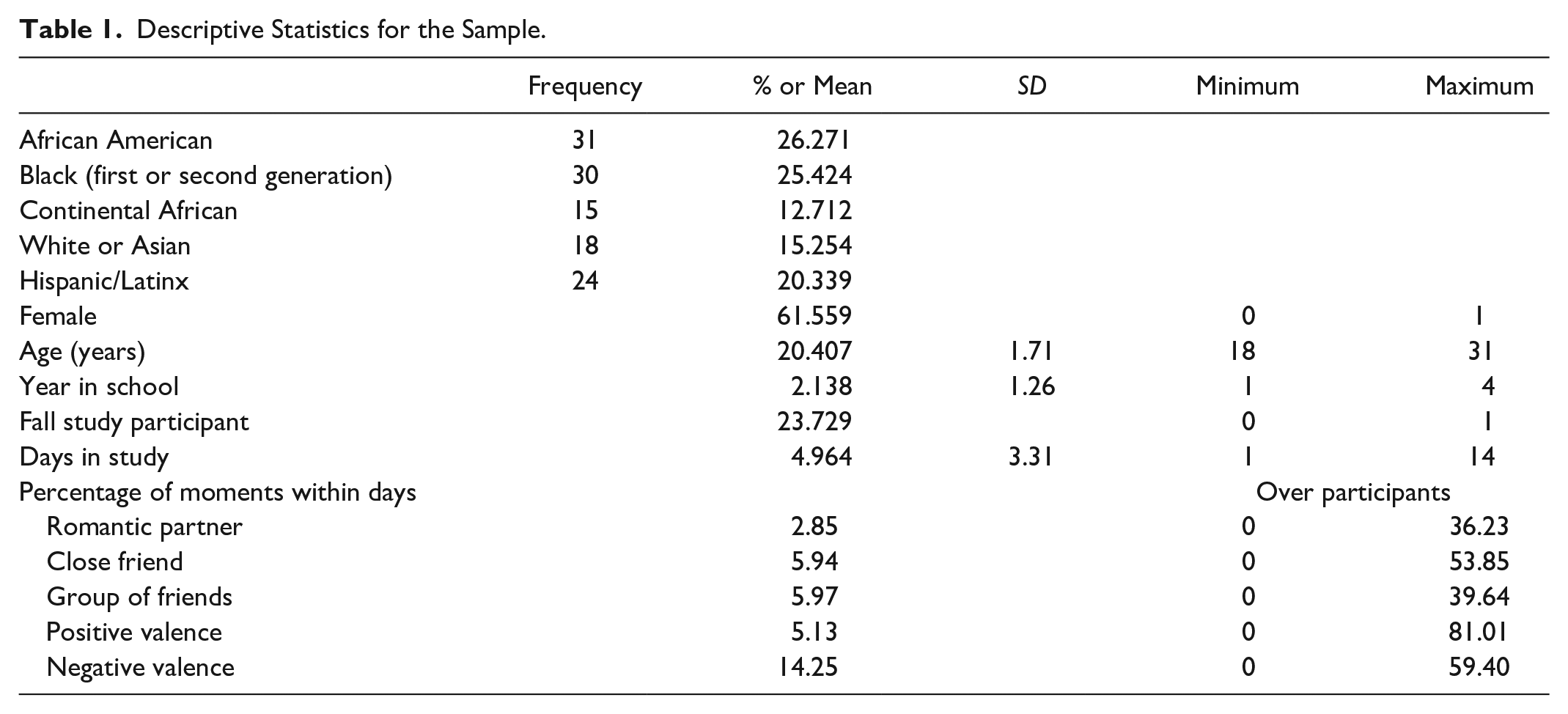
Descriptive statistics are presented in Tables 1 and 2. Our final analytic sample was 118 participants who jointly contributed 43,406 moments. Of the 118 participants, 61 identified as Black (either African American or first- or second-generation immigrants to the United States), 15 respondents indicated their race to be continental African (international students), 24 were Hispanic/Latinx, and 18 were white or Asian. The sample was 61.56 percent female, and the average participant was 20.41 years old and in their sophomore year of college. Approximately 24 percent of the sample participated in the fall study. EDA-SNA rates were highest during group settings for the average, maximum, and minimum but were similar to that for romantic partners for the maximum-minimum difference. These descriptive results suggest that arousal was sustained in group settings, while there is some evidence of arousal spikes when with a romantic partner. Notably, EDA-SNA is right skewed. As a relatively pure measure of SNS activity, it does not capture parasympathetic activity, resulting in about 60 percent of moments recording no EDA-SNA, which is why the statistical models use robust standard errors. Approximately 6 percent of moments involved socializing with a close friend or group of friends, and about 3 percent of moments were spent with a romantic partner. With regard to valence, negative affect was reported in about 5 percent of moments, and positive affect was reported in about 14 percent of moments.
Descriptive Statistics for the Sample.
EDA-SNA Affective Arousal Summary Statistics.
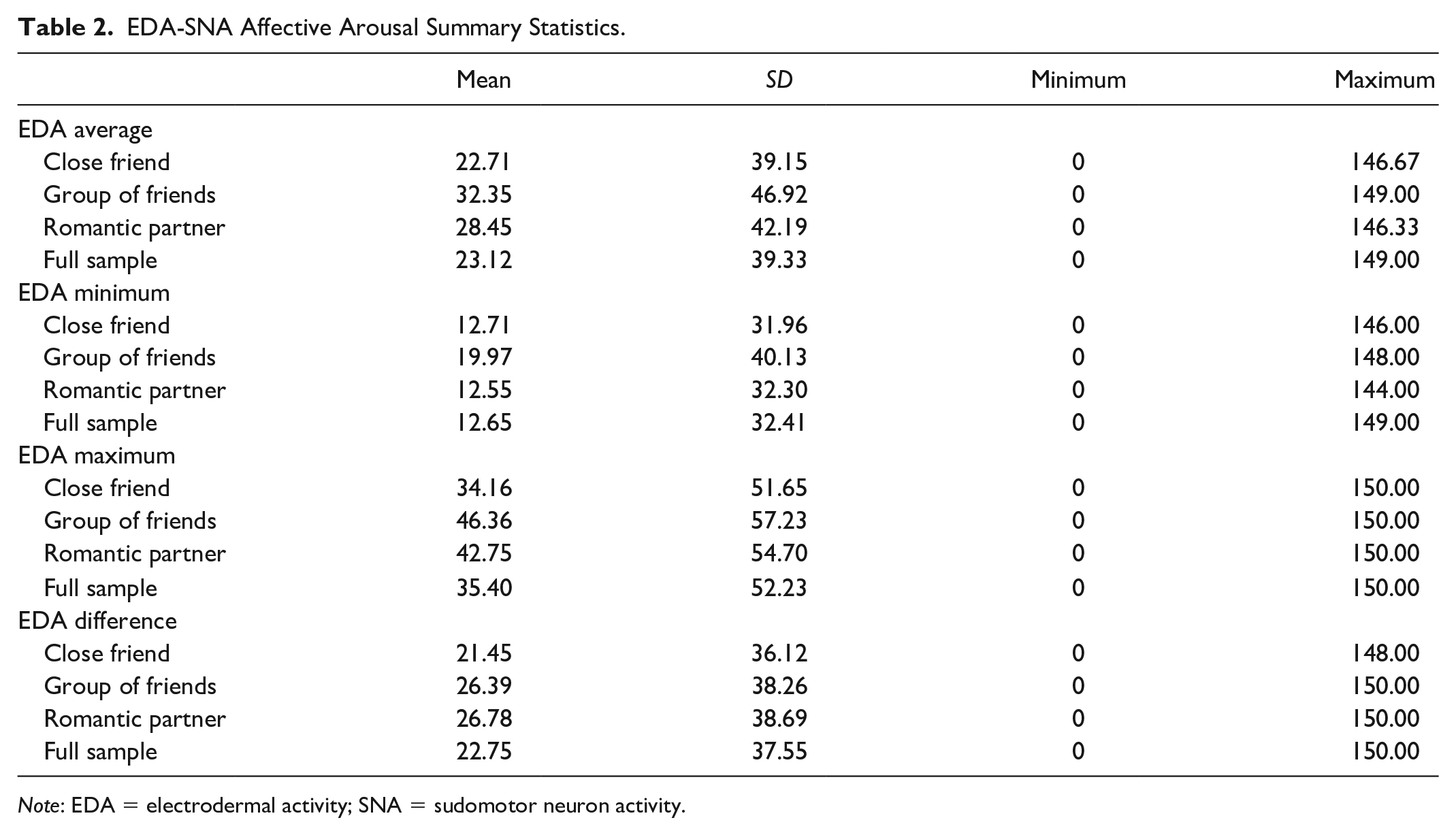
Note: EDA = electrodermal activity; SNA = sudomotor neuron activity.
Affective Valence
To test the relationship between positive and negative affect and types of socializing, we used participant-nested random-intercept logistic regression models. Coefficients (log odds) and standard errors are presented in Table 3. The odds of reporting momentary positive affect when with romantic partners is exp(1.115) = 3.05 times larger compared with baseline moments “alone” (i.e., not with a romantic partner, close friend, or group of friends; p < .001). The odds of reporting positive affect are also considerably higher both when with a close friend (exp[1.335] = 3.80, p < .001) and especially when with a group of friends (exp[1.864] = 6.45, p < .001) compared with baseline moments when participants did not report socializing per the included categories. However, the odds of reporting negative affect were also positively associated with socializing with romantic partners (exp[0.409] = 1.51, p < .01), a close friend (exp[0.758] = 2.13, p < .001), and/or a group of friends (exp[0.804] = 2.23, p < .001). Although affective valence is considerably more likely to be positive than negative, these results show that both affective states are more likely than neutral states when socializing.
Random-Intercept Logistic Regression for Positive and Negative Affective Valence.

p < .10. **p < .05. ***p < .01.
Affective Arousal
The goal of analyzing momentary EDA-SNA is to examine how different types of social interaction impact affective arousal. For this analysis, we used person and time (time of day by day of week) fixed-effects linear regression models with robust standard errors. These models predicted the momentary EDA-SNA five-minute rate summaries standardized within person, controlling for the in the prior moment of the same operationalization. Four separate models, one for each operationalization of EDA-SNA arousal (average, maximum, minimum, difference), are presented in Table 4.
Fixed-Effects Regression of Average, Maximum, Minimum, and Maximum-Minimum Difference in EDA-SNA Affective Arousal Rates.

Note: Models control for time and person fixed effects. EDA = electrodermal activity; SNA = sudomotor neuron activity.
p < .10. **p < .05. ***p < .01.
Across models in Table 4, spending time with a romantic partner was not associated with EDA-SNA. The coefficients were all very close to zero, suggesting that time with romantic partners was consistently neutral along the arousal dimension. Time with a close friend was associated with decreased arousal for average momentary EDA-SNA (b = 0.061, p = .009), maximum momentary EDA-SNA (b = 0.037, p = .09), and minimum EDA-SNA (b = 0.061, p = .013). To provide a concrete interpretation, average momentary EDA-SNA was on average 0.061 standard deviations lower during moments when a student was with a close friend compared with baseline moments “alone,” adjusting for person-specific fixed effects, time of day by day of week trends, and the time-varying momentary within-day control variables. Given that both the maximum and minimum rates were lower during moments with close friends, it is not surprising that the difference was not statistically significant (p = .244).
Affective arousal was consistently higher during moments when students were with groups of friends. On average, during these moments compared with moments not with groups of friends, close friends, or romantic partners, average momentary EDA was elevated by 0.17 standard deviations (p < .001), the maximum was elevated by 0.18 standard deviations (p < .001), the minimum was elevated by 0.16 standard deviations (p < .001), and the maximum-minimum difference was elevated by 0.09 standard deviations (p < .001). These results suggest both some spiking during moments with close friends compared with the reference category as indicated by the maximum-minimum difference, as well as a rise in baseline EDA-SNA levels with the increase in the minimum momentary EDA-SNA. Time spent in groups of friends is therefore associated with a broad pattern of increased affective arousal, consistent with IRT predictions.
Table 5 depicts the interactions between positive or negative affect and socializing across momentary EDA-SNA operationalizations. This analysis allows us to address questions along the lines of whether affective arousal is higher during positively valenced socializing moments. The main effects for affective valence were not associated with arousal. Time with a romantic partner also was not associated with arousal, regardless of whether the moment was positively or negatively valenced with one exception, a decrease in the maximum during negatively valenced moments (b = −0.236, p = .017), which is more consistent with a sadness experience rather than, for example, anger.
Fixed-Effects Regression of EDA-SNA Affective Arousal Rates Including Interactions Between Positive and Negative Affect and Types of Socializing.

Note: Models also control for breakfast, lunch, dinner, naps, being in class, studying, being at work, exercising, and person and time fixed effects. CF = close friend; GF = group of friends; EDA = electrodermal activity; RP = romantic partner; SNA = sudomotor neuron activity.
p < .10. **p < .05. ***p < .01.
Findings for moments with a close friend tracked closely to the main effects results reported in Table 4. However, this negative association was reduced to nonsignificance during positively valenced moments when summing the terms (average: F = 0.387, p = .534; maximum: F = 0.681; p = .409; minimum: F = 0.131, p = .717; maximum-minimum difference: F = 0.496, p = .481). Furthermore, there is evidence of EDA-SNA spiking during negatively valenced moments, as indicated by the rise in the maximum (b = 0.173, p = .01) and maximum-minimum difference (b = 0.199, p = .008) during these moments, though the total effects did not differ statistically (maximum: F = 0.091, p = .762; maximum-minimum difference: F = 1.536, p = .215). Considered collectively, these results suggest that affective arousal is lower during valence-neutral moments with friends, but people are otherwise arousal neutral during positive moments, and there is preliminary and only partial support for evidence of spiking during negative moments during moments spent with a close friend.
The main effects for time spent with a group of friends were reduced when the valence interactions were included. The overall trend was for considerably higher affective arousal during positively valenced moments: average, b = 0.128, p < .001; maximum, b = 0.138, p < .001; minimum, b = 0.121, p < .001; and maximum-minimum difference, b = 0.113, p < .01. These results are consistent with expectations from IRT. In fact, the approximate doubling of the effect sizes when comparing the interactions and main effects is consistent with the valence-arousal linearity assumption in IRT. None of the negative interactions are statistically significant, but the effect sizes are larger than for the positive interactions that were statistically significant, perhaps because there were fewer reported negative than positive moments overall. It is important to note that the total effects for negative affective arousal were statistically significant for average (F = 7.445, p = .006), maximum (F = 6.556, p = .010), minimum (F = 5.099, p = .024), and maximum-minimum difference (F = 4.392, p = .036). The group of friends results are therefore consistent with baseline IRT for positive valence and for the negative valence extension offered by Boyns and Luery (2015).
Discussion
This article contributes to a small but growing body of work examining affective and emotional differences in daily life (e.g., Daly et al. 2010) but differs from the heavy individualist and psychological emphasis of most prior work by accentuating dynamics situated within common social interaction contexts. One overarching goal for this article has been to describe a new approach to capturing affect in the moment-to-moment flow of real life when socializing. We piloted a set of new procedures integrating daily diaries with guided day reconstruction techniques (Diener and Tay 2014; Kahneman et al. 2004; Lucas et al. 2021) along with a wearable sensor that captured affective arousal noninvasively on the body (Garbarino et al. 2014; Poh et al. 2010). Our hope is that intensive data collection designs will inspire new avenues for both discovery and theory testing within microsociological frameworks, while also providing quantitative complements to ethnographic and qualitative modalities. To these ends, we demonstrated links between affect and periods spent copresent with a romantic partner, a close friend, and/or a group of friends, all key contexts within which individual and small group emotional life is situated and that sustain and shape network dynamics on more abstract and collective levels of social organization over time.
Our results point to the importance of affective heterogeneity in social bonding. Time with romantic partners, for example, was positively associated with both positive and negative valence reports, but was not consistently associated with arousal. This period of early adulthood is, of course, one of romantic exploration. On one side, many of these relationships will likely end, so some negative valence moments are to be expected, and falling in love can also be a volatile and stressful experience (Simon and Barrett 2010; Simpson 1987). At the same time, romantic relationships may provide a safe place where frustrations and negative experiences can be explored, perhaps toward achieving some catharsis within a supportive context (Loving, Crockett, and Paxson 2009; Murray et al. 2019; Ulmer-Yaniv et al. 2016). Our data, unfortunately, were not sufficiently detailed to explore negative affect at this level of detail. Notably, however, moments with a romantic partner tended to be affectively positive in valence, but neutral in terms of arousal, which is consistent with the hypothesis that many of these moments were restorative rather than arousing. In the future, theories of social interaction and emotional outcomes may consider both how low-arousal recovery states are implicated in bonding processes and how relationships create “downtime” moments backstage that support physiological and emotional recovery from the vicissitudes of life.
As with romantic partners, close friendships showed affective heterogeneity that spanned positive and negative experiences. Time with a close friend was also associated with both positive and negative affective valence, but arousal was on average lower compared with reference. Arousal was also indistinguishable from the reference in positively valenced moments, though there was evidence of arousal spiking during negative moments. Reasons for negative arousal are likely heterogeneous and could reflect both relationship dynamics and the backstage opportunities to explore and ruminate on other negative or troubling experiences safely with a trusted confidant. Unfortunately, our exploratory research design was not able to assess these forms of heterogeneity, which remain important contextual targets for future work.
Moments with romantic partners and close friends where affect was embedded within group contexts largely conformed to expectations from Collins’s (2004) classic IRT formulation, as well as the expectations for negative affective arousal developed by Boyns and Luery (2015). It is important to note here that IRT, deriving from the Durkheimian notion of “collective effervescence,” is most strongly a theory of the group dynamics that support long-term group outcomes. A positive valence moment was most likely when with a group of friends compared with the other socializing categories, and arousal was higher, especially during positively valenced moments. Negative moments were also more likely than neutral moments compared with being “alone” vis-à-vis our socializing categories, and negative affect in the arousal also tended to be magnified during these moments. In short, arousal was intensified when socializing with groups of friends, regardless of the direction of valence. Although there is no guarantee that a social interaction with other individuals or in groups will produce positive affect, our results suggest that the way people feel while socializing is quite heterogeneous on short-term time scales.
This study is limited in important ways. For example, we measured only three different aspects of socializing, so our reference category may be somewhat admixed, likely decreasing effect sizes and introducing some ambiguity into our analysis. Addressing this issue should be a primary target in future work. In addition, though this design is extremely rich along the time dimension, our sample was small and, perhaps more important, was a convenience sample. Clearly, stronger sampling designs are needed, and we hope that demonstrations such as those provided here can help justify future studies. In general, there are many axes of heterogeneity that we could not explore but may be important: age and development, racial/ethnic background, gender dynamics and intersectionality, geographic and local cultural variabilities, and individual differences (Williams et al. 2011). We note that although there were significant race effects on negative affect in our models, the scope of this study is limited in how to assess race/ethnic affective differences in socializing contexts. Although previous research has examined race differences in the context of discrimination in this sample with explicit hypotheses (Cheadle et al. 2020), we do not have strong hypotheses about why these processes would differ across groups in the socializing contexts studied here. Because of our use of fixed-effects regression, any hypothesis would necessarily be one of moderation.
Our approach also linked experiences in real-world settings to short-term affect dynamics following prior work linking within-day affect variation to heart rate using the day reconstruction method diary technique (Daly et al. 2010). It is likely that the reconstruction-based approach introduces some recall biases (Diener and Tay 2014; Lucas et al. 2021). At the same time, it is also true that gold-standard experience-sampling techniques are discrete and have important limitations when considered against the continuous signal streams provided by ambulatory sensors (Cheadle et al. 2020). In addition, it is worth noting that our approach has operationalized only short-term dynamics and was not able to assess socializing outcomes such as relationship stability or group cohesion over the longer term. Our approach to measurement also relied on self-reports, which we hope will be unnecessary in the future as sensors and machine learning techniques advance (e.g., Dar et al. 2020). Finally, the sensor we used also comes with important limitations. We measured affective arousal using a direct signal of SNS activity, but the sensor was unable to index PNS crossovers that directly index gradational variation in low-arousal states. Future research may consider the electrocardiogram, a more complex signal that includes SNS and PNS arousal components, and that also contains rich information on valence (Ernst 2017). However, the electrocardiogram is a more invasive measure as it is typically measured on the chest using adhesive electrodes (e.g., Holter devices).
Conclusion
This article provides a first attempt at capturing affective dynamics within the natural flow of social life. Being able to measure such processes is key for understanding how individuals are moved by their interpersonal social experiences. Of course, when stepping back and expanding the view, these microsociological dynamics support and interact with larger-scale group and social network dynamics. Following IRT, we suggest that future research may consider the flow of affect within various social contexts as an important avenue in the study of social selection and influence in networks. For example, emotional arousal has been hypothesized to be a key mediator between stimulating social contexts such as parties and adolescent risk behaviors resulting from emotional susceptibilities due to patterns of neurobiological development (Steinberg 2010). Moreover, negative arousal is also a critical component of physiological stress in daily life and its long-term health implications over time. Considerable theoretical work (e.g., Collins 2004; Turner 1988, 2007) has been dedicated both to emotional and social interaction dynamics, but measurement constraints combined with a lack of relevant data in traditional data sources has limited operationalization and testing. That is changing, however, with new technological developments that will help expand our ability to capture temporality in meaningful layers spanning from the microdynamic to long-term trends in social processes common in traditional sociological data sources. The work presented in this article, for example, demonstrates a novel biosignal approach to studying positive and negative affective dynamics in real time, providing a foundation for future research focused on how emotions are embedded in different constellations of socializing experiences.
Footnotes
Acknowledgements
We want to thank Julia McQuillan and Dan Hoyt for the instrumental support they provided to the development of this project.
Funding
The author(s) disclosed receipt of the following financial support for the research, authorship, and/or publication of this article: This research was generously supported by the University of Nebraska–Lincoln College of Arts and Sciences. This research was also supported by grant P30AG066614 awarded to the Center on Aging and Population Sciences at the University of Texas at Austin by the National Institute on Aging and by grant P2CHD042849 awarded to the Population Research Center at the University of Texas at Austin by the Eunice Kennedy Shriver National Institute of Child Health and Human Development. The content of this article is solely the responsibility of the authors and does not necessarily represent the official views of the National Institutes of Health, the University of Nebraska–Lincoln, or the University of Texas at Austin.
