




Abstract
In this visualization, the author shows the trend in the proportion of households that comprise only one person in 75 countries, representing 73 percent of the world’s population, using national data collected between 1960 and 2019. At the time of the latest observations for each country, the percentage of households that include only one person ranges from 2.6 (Cambodia) to 38 (Switzerland). Europe and the United States have the highest solo living rates, along with two African countries (South Africa and Botswana, both severely affected by the HIV/AIDS epidemic), Israel, Jamaica, and Puerto Rico. In all, 53 of the 75 countries exhibit increases in one-person households, including all European countries. Those with (generally much smaller) declines are disproportionately in Africa and Asia, including China and India.
The rise of living alone reflects later marriage and nonmarriage, delayed childbearing and childlessness, higher divorce rates, living-apart-together relationships, longer life spans, and widowhood—and a growing desire for individual autonomy and independence. Living alone is most common among young adults and older adults, when people are not yet coupled or are divorced or widowed (Esteve et al. 2020). Inequality and social exclusion push some people toward life alone; but rising living standards also make it possible for people to avoid living with their families (Klinenberg 2013). Although all societies may be experiencing at least some of these trends, there is substantial variation in the pace and degree of change. For both cultural and economic reasons, wealthy societies have been leading these developments, but they are increasingly apparent among middle-income countries as well (Lesthaeghe 2014).
A comparison of one-person household prevalence is possible across a large number of societies, rich and poor, that have conducted national censuses and surveys since 1960. Esteve et al. (2020) examined the rate of solo living around the world by age, using contemporary data. Ortiz-Ospina (2019) tracked the trend for almost all countries using United Nations data, Demographic and Health Surveys, and European state data.
In this visualization (Figure 1), I show the trend in the proportion of households that comprise only one person in 75 countries using national censuses (or, in a minority of cases, national surveys) only, collected between 1960 and 2019. To show trends, I include only countries that have at least two data points at least 10 years apart, with the latest observation in 2000 or later. These 75 countries represent 73 percent of the world’s population in 2019. The figure is color coded to show countries by region (as defined by the World Bank), with panels sorted by the value of the latest observation.
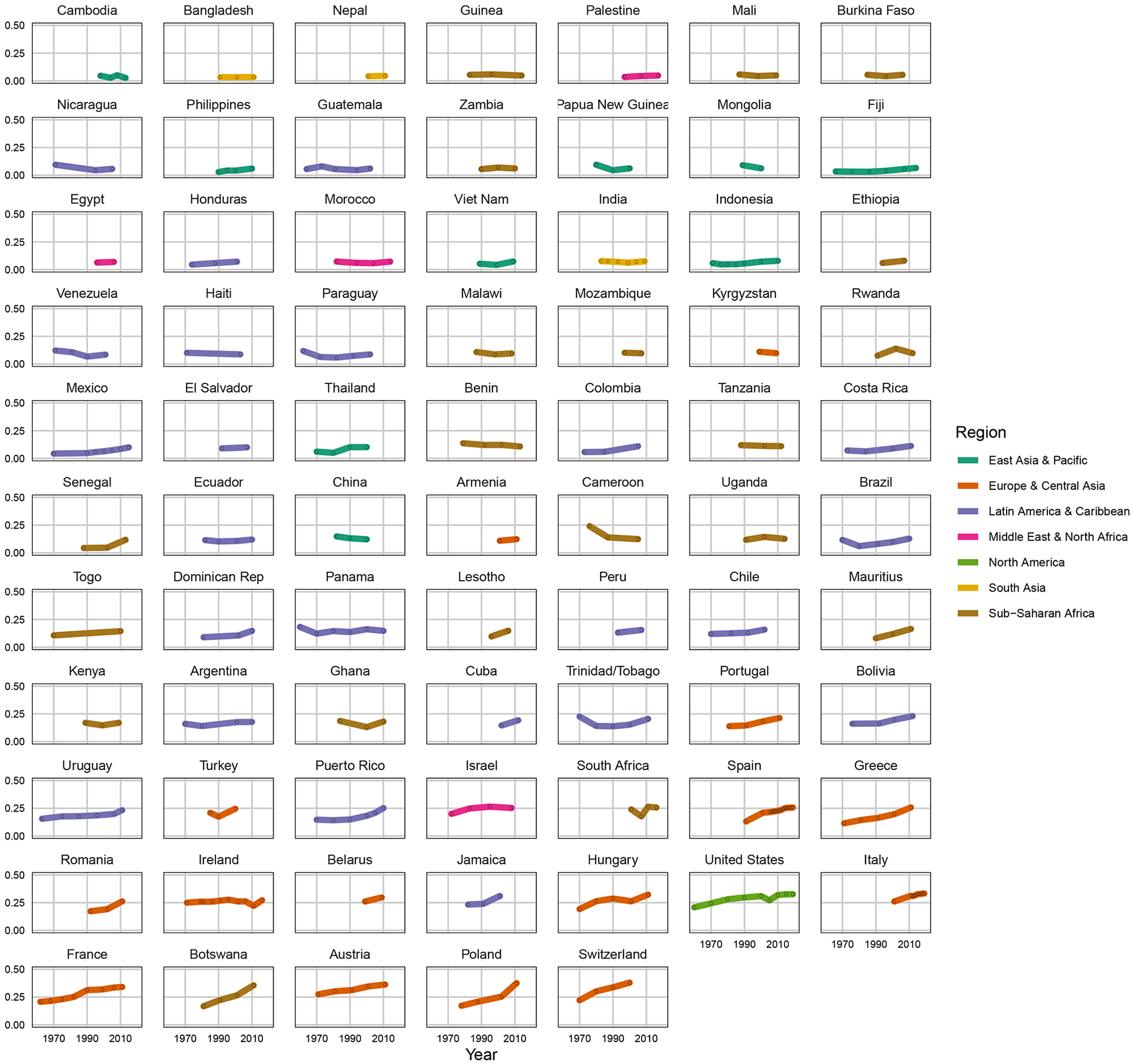
One-person households as a proportion of all households, by country: selected dates, 1960 to 2019.
The data were retrieved from the Integrated Public Use Microdata Series, International (Minnesota Population Center 2020). As I am estimating only one parameter, I did not need to use the full (very large) data set from every country, so instead I drew a sample of 50,000 households from each census or survey (fewer were available in some cases) and used household or person weights where available. For the United States, I added data from the American Community Survey for 2019, as it was not yet part of the international data collection. Puerto Rico is in the data set as a separate country. Codebooks, Stata code to compile the data, R code to generate the figure, and the final data set are available at https://osf.io/wkpa5/.
In the latest observations for each country, the percentage of households that include only one person ranges from 2.6 in Cambodia to 38 in Switzerland. Seventeen countries have more than 25 percent solo households, most of them in Europe or North America. The two African countries with high one-person prevalence, South Africa and Botswana, are among the most severely affected by the HIV/AIDS epidemic. Israel, Jamaica, and Puerto Rico are above 25 percent as well. In all, 53 of the 75 countries exhibit rising one-person prevalence (including all included European countries). Those with declines are disproportionately in Africa and Asia and show much smaller changes (including China and India). Two additional figures are in the supplemental file, showing the rate of change in each country and the trends grouped by region.
This visualization captures the concentration of one-person households in wealthy societies but also those with cultural traits or demographic idiosyncrasies that lead to living alone. Although widely prevalent, the rise of one-person households is not universal, as evident in China and India. Studying this pattern is important for understanding the relationship between families and social change.
Supplemental Material
sj-docx-1-srd-10.1177_23780231211062315 – Supplemental material for The Rise of One-Person Households
Supplemental material, sj-docx-1-srd-10.1177_23780231211062315 for The Rise of One-Person Households by Philip N. Cohen in Socius
Footnotes

Supplemental Material
Supplemental material for this article is available online.
Author Biography
References
Supplementary Material
Please find the following supplemental material available below.
For Open Access articles published under a Creative Commons License, all supplemental material carries the same license as the article it is associated with.
For non-Open Access articles published, all supplemental material carries a non-exclusive license, and permission requests for re-use of supplemental material or any part of supplemental material shall be sent directly to the copyright owner as specified in the copyright notice associated with the article.
