




Abstract
Although decades old, the terms “anti-racism/antiracism” and “anti-racist/antiracist” have grown in usage by scholars, authors, and activists to convey the necessity of active opposition to racial injustice. But as the terms have become more mainstream, researchers have yet to examine the social and ideological correlates of actually describing oneself as “anti-racist.” Drawing on nationally representative survey data fielded at the height of national interest in “antiracist/anti-racist” language, the authors find that Blacks and Hispanics are significantly less likely than whites to describe themselves as “anti-racist,” and only the “very liberal” are more likely than other political orientations to identify with the label. Considering ideological correlates, progressive racial ideology is the strongest predictor of identifying as “anti-racist.” However, the second strongest correlate is describing oneself as “color-blind.” Analyses of quadratic terms suggests that this correlation is curvilinear for nonwhites but more linear for whites. Although originally conveying more radical and subversive ideals, those currently most likely to self-describe as “anti-racist” are white progressives with what we call “generically liberal” racial views.
The terms “anti-racism” and “anti-racist” (also unhyphenated as “antiracism” and “antiracist”) are not new (see Aptheker 1992; Bonnett 2000; Drake 1978; Gilroy 1990). Yet they have undeniably grown in popularity, particularly over the past decade because of the prominence of certain best-selling books (e.g., DiAngelo 2018; Jewell 2020; Kendi 2019; Oluo 2019) and the proliferation of educational campaigns and curricula employing the terms (Scharfenberg 2020). Despite the recent explosion in popularity for these terms—and particularly for “anti-racist/antiracist” as an identity or a characteristic—scholars have yet to examine the social antecedents and attitudinal correlates of identifying with anti-racism in the general population.
This is a glaring gap considering that identification with such terms could be localized within a particular ethnic community (e.g., majority group members, historically disadvantaged racial minorities). Moreover, their growing popularity could suggest that those who identify with terms such as “anti-racist” are genuinely more racially conscious, progressive, and even activistic. Such would intuitively be the goal of anti-racism books, campaigns, and curricula. Alternatively, however, the mainstreaming of “anti-racist” language could result in the term being co-opted or at least embraced by more “generically liberal whites” (white Americans who generally affirm any racial views that sound progressive without embracing more critical perspectives) who then empty the idea of its more radically race-conscious and subversive import (Scharfenberg 2020).
The present study fills this gap by examining the social and ideological correlates of identifying as anti-racist. Drawing on nationally representative survey data collected near the height of interest in “anti-racist/antiracist” terminology (August 2020), we find that Blacks and Hispanics are significantly less likely than whites to identify as “anti-racist” and that only those who identify as “very liberal” are significantly more likely to identify with the term compared with others across the political spectrum. Looking at ideological correlates, we find that progressive racial attitudes are the strongest predictor of describing oneself as “anti-racist.” However, we also find that the second strongest predictor is identifying as “‘color-blind’ when it comes to race.” And though that connection is curvilinear for nonwhites (those who strongly reject or strongly affirm color-blindness are more likely to self-describe as “anti-racist”), the association for whites is more consistently linear and positive. Our results suggest that at the height of racial unrest and interest in “anti-racist/antiracist” language, the self-description was most fully embraced by white progressives (not minorities) with generically liberal—even self-consciously color-blind—racial views.
Background and Expectations
As expressed above, the use of “anti-racism” or “anti-racist” terminology is not new, though there had long been little attempt to formally define the terms (see treatment in Berman and Paradies 2010). From the outset, however, the concepts conveyed the idea of going beyond simply being “nonracist” to “understanding the institutional nature of racial matters and accepting that all actors in a racialized society are affected materially . . . and ideologically by the racial structure” (Bonilla-Silva 2018:15). For example, in an early attempt, Bonnett (2000) defined anti-racism as “forms of thought and/or practice that seek to confront, eradicate and/or ameliorate racism” (p. 4). Similarly, others stressed that anti-racism must involve “the construction of a positive project” (Anthias and Lloyd 2002:16) intended to transform a racist society. Given this emphasis on praxis, studies deploying these concepts were also strongly tethered to academic critical theory (e.g., critical whiteness studies, critical education studies) with an applied and transformative focus, often involving pedagogy and curricula targeted toward white allies (Bonilla-Silva 2018; Case 2012).
Despite its use in academic and activist circles in earlier decades, the growing proliferation of “anti-racist/antiracist” and “anti-racism/antiracism” language is undeniable. In fact, we can document the growing popularity of these terms through available online data. Google’s Ngram tool is a search engine that allows viewers to track trends in the usage of keywords in Google’s text corpora over time. Figure 1 presents results for the terms “antiracism,” “antiracist,” “anti-racism,” and “anti-racist” from 1950 to 2019 (the most recent year available). Clearly the terms did not emerge until the 1960s and were seldom in use until the 1990s. Starting in the mid-1990s, the term “antiracist” started to become more commonly used, and since 2013 its usage has spiked tremendously.

Trends in the use of “antiracism,” “antiracist,” “anti-racism,” and “anti-racist” over time shown in Google Books Ngram results, 1950 to 2019.
But what about tracking general interest in the terms? Figure 2 allows us to observe the increased popularity of these terms in Google searches using Google Trends data going back to 2004 (the earliest year available) until the summer of 2021. The spikes show the relative popularity of search terms over time compared with their greatest period of popularity. The highest point for all terms occurs for “antiracist” in the summer of 2020. Examining the prevalence of the term on Google during that time frame reveals that interest was connected to both the media buzz surrounding Ibram X. Kendi’s (2019) bestselling book How to Be an Antiracist and growing racial unrest following the murder of George Floyd in May 2020 and subsequent protests throughout that summer. The apparent declines in Google searches for “antiracist” language since that time period should not be interpreted as a sudden lack of interest, however. Rather, because Google Trends rankings are calculated comparatively across time, the sudden drop tells us more about the tremendous spike in interest during the summer of 2020. This was followed by a still elevated interest in “antiracist” language compared with years prior to that uniquely elevated period.

Trends in the use of “antiracism,” “antiracist,” “anti-racism,” and “anti-racist” over time shown in Google Trends results, 2004 to 2021.
As the terms themselves have become more mainstream, several lines of research shape our expectations regarding what societal factors could predict who describes oneself as anti-racist/antiracist. First, historically disadvantaged persons of color—particularly Black Americans and Hispanics or Latinos—have always had to contend with a racist social structure, and thus merely surviving and thriving would entail “anti-racist” praxis. In contrast, most white Americans are blind to (or in denial of) their white structural advantage (Bonilla-Silva 2018; Hartmann, Gerteis, and Croll 2009; Mueller 2017, 2020), and as a result they are the explicit targets of anti-racist curricula and campaigns. Consequently, as the terminology has become more mainstream, we would expect white Americans to more readily embrace the “anti-racist” label than would historically disadvantaged minorities for whom anti-racism is simply part of life and does not symbolically distinguish them from other minorities.
Yet does the “anti-racist” self-description correspond to critical race perspectives that challenge dominant white racial frames? On the one hand, the very goals of anti-racist pedagogical curricula and training for the past several decades have involved transforming engaged learners, particularly whites, to go beyond discomfort with overt interpersonal racism to understand and actively dismantle white structural advantage (see Bonilla-Silva 2018:242–44). The growing consumption of books, campaigns, and popular discussions of “anti-racism/antiracism” might be either a cause or effect of engaged allies adopting more critical awareness. Given that much of this educational work involves numerous examples of corrective policy such as reparations, redirecting funds from (if not abolishing) the police, and the removal of racist legacies and symbols (e.g., Bonilla-Silva 2018; Kendi 2019), we would anticipate persons who embrace an anti-racist identity to adopt similar views.
Correspondingly, antiracist work has also quite explicitly denounced “color-blindness” as a racial frame that is insufficient to address America’s unjust racial system. In fact, color-blindness is often explicitly juxtaposed with anti-racism and articulated as standing in opposition to true anti-racist views and praxis (Bonilla-Silva 2018; Braunstein 2021; Kendi 2019; Mueller 2020). Thus, if the popularity of anti-racist campaigns, books, and curricula reflects a genuine awakening of the target audience, we would anticipate those who identify with “anti-racist” language to demure from identifying as “color-blind” or with “color-blind” views.
In contrast, however, numerous studies have documented that white Americans have historically co-opted once radically progressive language and leaders, thereby emptying them of their revolutionary and subversive import. Far-right political actors and groups, for example, have co-opted the civil rights language of “equality” either to enjoy the psychological benefits of being “good liberal white people” or to oppose policies that would redress structural inequalities or past injustices on the grounds of “reverse discrimination” (Lewis-Durham 2020; Quinones 2020; Torres and Ferry 2019). Along these lines, white conservative politicians and activists frequently quote Martin Luther King Jr. to protest against any policy that takes racial identity into account, arguing that citizens should not be “judged by the color of their skin, but the content of their character” (Braunstein 2021; Rounds 2020). Other campaigns in more recent years have co-opted the language of “inclusivity” to argue that higher education should support “ideological diversity,” which is often code language for everything from libertarianism to white nationalism and creationist accounts of human origins (Torres and Ferry 2019). If this pattern is taking place in the current instance of proliferating “anti-racism” language and identification as “anti-racist,” we would expect self-description as “anti-racist” to correspond to “generically liberal”—though not race-critical, radical, or subversive—concepts such as color-blindness.
Another possibility we assess is that the relationship between racial attitudes and identifying as “anti-racist” is nonlinear. Croll’s (2007) study of white racial identity found that racial attitudes corresponded to white racial identity in a curvilinear (U-shaped) fashion, such that whites who thought their white racial identity was more important could be whites who are more prejudiced toward minorities (more old-fashioned or symbolic racists), or they were more progressive whites who recognized the importance of race to social outcomes. In contrast, whites who held moderate racial attitudes were also among those who valued their white racial identity very little. Similarly, it is possible that Americans who embrace the “anti-racist” identity include some who embrace the term in a more race-critical and subversive manner, while others also affirm the identity but in a way that suggests they have co-opted the term for more generically liberal or color-blind purposes. And these associations could also differ across racial identity.
Methods
Data
Data for this study come from two waves of the Public and Discourse Ethics Survey (PDES; Perry, Baker, and Grubbs forthcoming; Perry, Schnabel, and Grubbs forthcoming). Wave 1 was collected in August 2019 and wave 4 in August 2020. Survey waves were designed by the authors, and the survey instrument was fielded by YouGov, an international research data and analytics company. YouGov recruits a panel of respondents through Web sites and banner ads. These respondents are not paid directly but are entered into lotteries for monetary prizes. To draw a nationally representative sample, YouGov uses a method called “matching.” Drawing a random sample from the American Community Survey, YouGov then matches a respondent in the opt-in panel who is the closest to the census respondent on the basis of key sociodemographic factors. Because of the specific recruitment and sampling design used by YouGov, the company does not publish traditional response rates. However, YouGov develops sampling weights to ensure that the survey sample is in line with nationally representative norms for age, gender, race, education, and census region. The resulting original survey sample included 2,519 Americans that were matched and weighted. Sample attrition over multiple waves and a very modest amount of missing data result in a final analytic sample of 1,376 cases in full models. 1
Self-Describing as “Anti-Racist”
Our outcome for this study is a single-item measure. Wave 4 of the PDES asked respondents to indicate their level of agreement with the statement “I would describe myself as ‘anti-racist.’” 2 Respondents could choose values from 1 = strongly disagree to 5 = strongly agree. Because the outcome has five values, we estimated our model with ordinary least squares (OLS) regression. Alternative modeling strategies such as ordinal logistic regression and binary logistic regression (with strongly agree and somewhat agree = 1, all else = 0) yielded virtually identical results (see Appendix Table A1 online). However, ordinal regression failed the proportional odds assumption and thus OLS regression was deemed more appropriate.
Key Independent Variables
Wave 4 of the PDES includes a number of questions assessing Americans’ racial attitudes. All questions asked respondents to indicate their level of agreement with various statements, with responses ranging from 1 = strongly disagree to 5 = strongly agree. We conducted factor analyses to reduce measures to indexes when possible, to minimize the possibility that collinearity was diminishing results.
The first measure is an index of progressive racial attitudes. This measure includes responses to five statements. These include “I support removing Confederate monuments and statues of former slave owners because they are racially insensitive,” “The government should financially compensate Black Americans who are descendants of slaves,” “I support reallocating funds away from the police and toward agencies that better serve the community,” “Reports of police brutality against Black Americans are exaggerated by the media” (reverse coded), and “One of the most effective ways to improve race relations in the US is to stop talking about race” (reverse coded). We averaged responses to make our index. Cronbach’s α coefficient for these measures was .90, indicating strong reliability.
The second measure is an index of old-fashioned racism. This is made from two questions, including “I think there may be genetic differences in intelligence between racial groups,” and “Police officers in the United States shoot Black Americans more often because they’re more violent than whites.” Although the α coefficient for these measures is relatively weak (α = .56), this is partly because it is only two measures (Cronbach’s α is sensitive to the number of measures being considered). Ancillary analyses indicated the two measures are strongly correlated and likely tap the same construct of old-fashioned racism. Thus, they were averaged together.
The third measure asks Americans their agreement with the statement “I would confront a friend who told a joke about racial minorities in my presence.” Not necessarily an indicator of attitudes, this measure differed from others in its focus on Americans’ willingness to confront racial insensitivity in their close interpersonal relationships. And finally, the fourth measure asks Americans to indicate their agreement with the statement “I would describe myself as ‘colorblind’ when it comes to race.” Like the question asking whether respondents self-describe as “anti-racist,” this question uses quotation marks to signal a more formal identification.
Other key independent variables include racial identity, which is broken down into white (the reference category), Black, Hispanic, Asian, and other race.
Control Variables
Our analyses include a number of sociodemographic, religious, and political controls in order to isolate the association between self-description as “anti-racist” and other social and ideological variables. Sociodemographic controls are included for age (in years), gender (male = 1, female = 0), educational attainment (1 = less than high school, 6 = postgraduate degree), family income (dummy variables: 0 = zero to $29,000 per year, 1 = $30,000 to $99,000 per year, 1 = $100,000 or more per year, 1 = did not report), and region (southern residence = 1, other = 0).
Religious and political variables are often powerfully connected to Americans’ racial attitudes (Davis and Perry 2021; Perry 2022; Perry and Whitehead 2019). Religious variables include religious tradition, religious commitment, and adherence to Christian nationalist ideology. Religious tradition is measured with six categories: Evangelical Protestant (reference), liberal Protestant, Catholic, other Christian, other religion, and seculars (including atheists, agnostics, and the unaffiliated). Religiosity is a summative scale from three standardized measures: religious service attendance, prayer frequency, and religious importance (Cronbach’s α = .85). Recent studies have shown that Christian nationalism is among the most powerful predictors of racial attitudes (Perry, Whitehead, and Grubbs 2021). Our Christian nationalism scale follows recent studies (e.g., Davis 2018, 2019; Perry, Whitehead, and Grubbs, 2021) that use six level-of-agreement questions with responses ranging from 1 = strongly disagree to 5 = strongly agree. 3 Following previous research, we combine these measures into an additive scale from 0 to 24, with higher scores indicating greater adherence to Christian nationalist ideology (Cronbach’s α = .90).
Last, our political measures include partisan identification and political ideology. Party identification includes Republican (reference), Democratic, independent, and other/don’t know. Political ideology is also broken down into a series of dummy variables with moderate (reference), very liberal, liberal, conservative, very conservative, and don’t know. For descriptive statistics on all variables included in the analyses, see Table 1.
Descriptive Statistics.

Source: Public and Discourse Ethics Survey, waves 1 and 4 (August 2019, August 2020).
p < .05, **p < .01, and ***p < .001 (two-tailed tests).
Plan of Analysis
The analytical strategy is straightforward. Along with descriptive statistics, Table 1 also presents zero-order correlations between all predictor variables and identification as “anti-racist” in order to establish key bivariate associations. Table 2 presents our full OLS regression models. Table 3 includes the full models with quadratic terms for our racial attitudes, thus allowing the associations to be nonlinear. Model 1 is the full sample; model 2 is whites alone; and model 3 is only nonwhites. We include both unstandardized and standardized regression coefficients in all models so that we can assess both substantive and statistical significance.
Ordinary Least Squares Regression Model Predicting Self-Description as “Anti-Racist.”
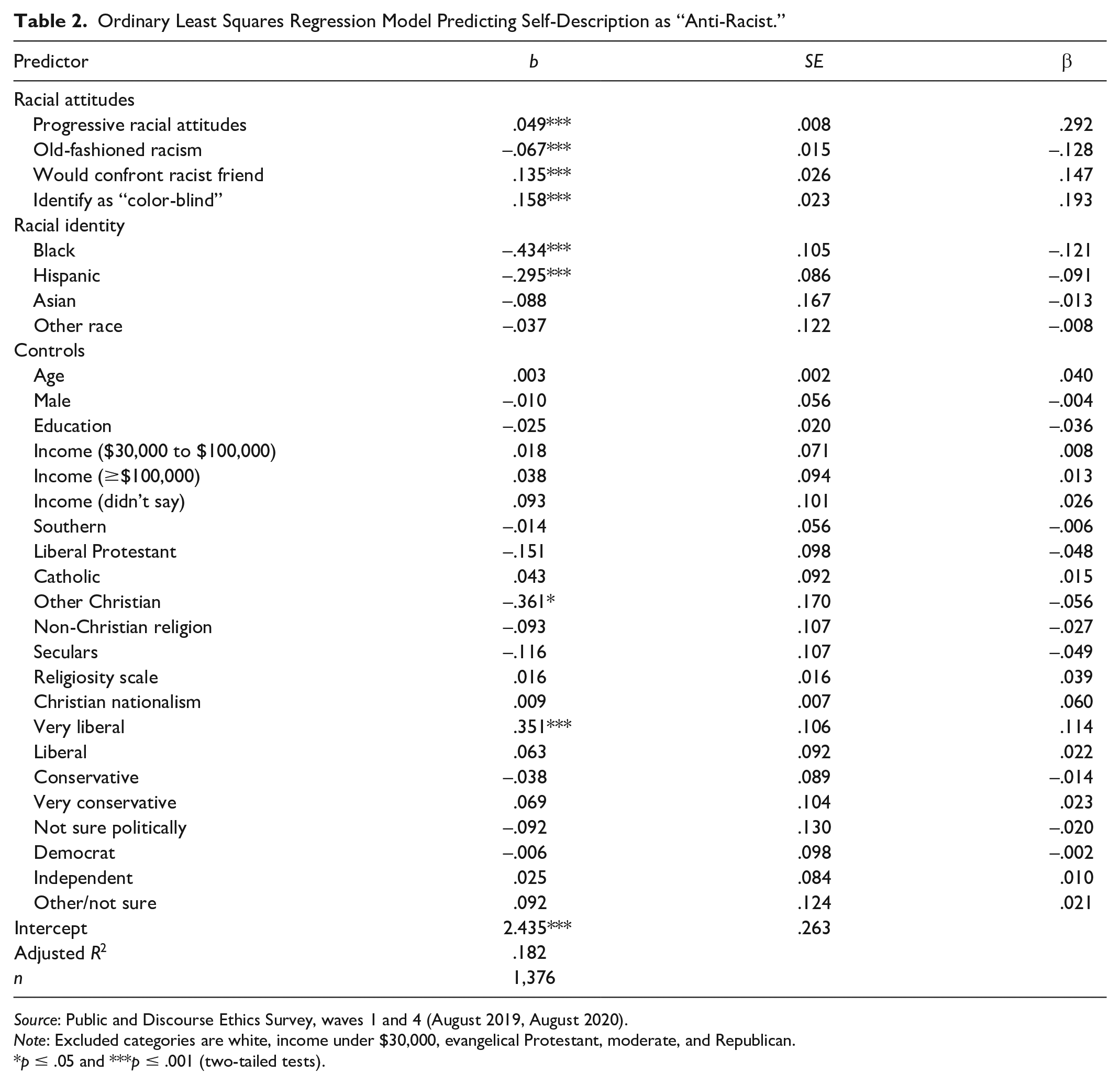
Source: Public and Discourse Ethics Survey, waves 1 and 4 (August 2019, August 2020).
Note: Excluded categories are white, income under $30,000, evangelical Protestant, moderate, and Republican.
p ≤ .05 and ***p ≤ .001 (two-tailed tests).
Ordinary Least Squares Regression Model Predicting Self-Description as “Anti-Racist” with Quadratic Terms for Racial Attitudes.

Source: Public and Discourse Ethics Survey, waves 1 and 4 (August 2019, August 2020).
Note: Excluded categories are white, income (under $30,000), evangelical Protestant, moderate, and republicans.
p ≤ .05, **p ≤ .01, and ***p ≤ .001 (two-tailed tests).
Results
Correlations presented in Table 1 affirm general expectations but also yield some surprises. Identifying as “anti-racist” is positively associated with holding more progressive racial views (r = .24, p < .001) and being willing to confront a friend who told a racist joke (r = .29, p < .001) and negatively associated with holding old-fashioned racist views about genetic differences in intelligence or Blacks being more violent than whites (r = –.26, p < .001). Also as anticipated, identifying as Black (r = –.05, p < .10) or Hispanic (r = –.08, p < .01) are both negatively associated with anti-racist identification, while identifying as white (r = .08, p < .01) is positively associated. Other intuitive relationships include education (r = .06, p < .05), identifying as “very liberal” (r = .21, p < .001), and identifying as a Democrat (r = .13, p < .001) being positively associated with “anti-racist” identification and Christian nationalism (r = –.15, p < .001), political conservatism (r = –.14, p < .001), and identifying as a Republican (r = –.13, p < .001) being negatively associated with the “anti-racist” self-description.
However, despite these predictable trends pointing toward a consistent link between progressive cultural and political ideology and anti-racist identification, identifying as “‘colorblind’ when it comes to race” is also positively associated with self-describing as “anti-racist” (r = .11, p < .001). Although none of these bivariate associations seems particularly strong in magnitude, multivariate analyses will affirm that several key associations are robust.
Regression results presented in Table 2 show that the strongest predictor of identifying as “anti-racist” is holding to what most would consider progressive racial views (b = .243, p < .001, β = .292). Specifically, those Americans who support reparations for the descendants of slaves, removing Confederate monuments, reallocating funds from the police, and addressing racial issues by talking about race and who deny that the media exaggerate anti-Black police brutality are all more likely to self-describe as “anti-racist.” Curiously, however, the second strongest predictor of identifying as “anti-racist” is identifying as “‘colorblind’ when it comes to race” (b = .158, p < .001, β = .193). Following these correlates in substantive significance are willingness to confront a friend who told a racist joke (b = .135, p < .001, β = .147) and rejection of old-fashioned racism (b = –.133, p < .001, β = –.128).
Among sociodemographic predictors, we also see that Black Americans (b = –.434, p < .001, β = –.121) and Hispanics (b = –.295, p < .001, β = .091) are significantly less likely than white Americans to identify as “anti-racist.” And compared with moderates, only adults who are “very liberal” are significantly more likely to self-describe with the label (b = .351, p < .001, β = .114). 4
Figure 3 illustrates the net associations between our racial attitude measures and identifying as “anti-racist.” To be sure, the majority of American adults score at “neutral” or higher on their willingness to self-describe as “anti-racist” regardless of where they fall on their racial views. Importantly, this is even true among Americans who subscribe to views consistent with old-fashioned racism, suggesting that the term “anti-racist” has been emptied of its radical import. Additionally, the positive connection between identifying both as “color-blind” and “anti-racist” also suggests that “anti-racist” identity is not necessarily isolated among those who hold attitudes that are radically distinct from those of mainstream Americans—at least not anymore since the popularization of the language.

Predicted values of self-describing as anti-racist across racial attitude measures.
But could these associations be nonlinear? Might Americans’ racial attitudes correspond to “anti-racist” identity at extremes, particularly when they are disaggregated by racial identity? Table 3 presents models that include quadratic terms for our racial attitude measures. In the full sample model, only identifying as “color-blind” is significant and negative (b = –.253, p < .05, β = –.309), while the quadratic terms for progressive racial attitudes (b = .003, p < .001, β = .595) and color-blindness (b = .067, p < .001, β = .516) are both positive and significant. Breaking these down to compare whites and nonwhites, however, reveals slightly different patterns. Model 2 focuses on whites, and only the quadratic term for progressive racial attitudes (b = .004, p < .001, β = .649) is strongly significant, and the quadratic term for color-blindness also attains statistical significance (b = .049, p < .05, β = .390). These patterns suggest that for whites, progressive racial attitudes or identification with color-blindness are unassociated with self-describing as “anti-racist” until whites reach more extreme positive values. This reflects the paradox we observe in Table 2 and Figure 3, in which white Americans who are more progressive and identify with color-blindness self-describe as “anti-racist.”
But when nonwhites are examined in isolation, we see a slightly different pattern. The main term for color-blindness (b = –.504, p < .05, β = –.571) is significant and negative, while its quadratic term (b = .107, p < .001, β = .765) is strongly significant and positive, suggesting a clearer U-shaped curvilinear association. Figure 4 illustrates these different association patterns for white and nonwhite Americans across their agreement that they identify as “color-blind.” Across all values, whites are more likely than nonwhites to self-describe as “anti-racist,” as we would expect (Table 2). And after a nonsignificant dip for white Americans between “strongly agree” and “agree” with being “color-blind,” the more white Americans affirm the color-blind label, the more likely they are to identify as “anti-racist.” But for nonwhites, the association is more truly curvilinear. Nonwhites who “strongly disagree” with identifying as “color-blind” are more likely to identify as “anti-racist,” as are nonwhites who “strongly agree” with identifying as “color-blind.” And nonwhites who are “neutral” on color-blindness are also the least likely to self-describe as “anti-racist.” Thus we see the association between color-blindness and anti-racist identity captures different patterns for nonwhites, whereas for whites there is a more consistently linear, positive association.

Predicted values of self-describing as “anti-racist” across describing oneself as “color-blind” for whites and nonwhites.
Discussion and Conclusions
Although the past decade has witnessed a traceable explosion of interest in “anti-racism/antiracism” or “anti-racist/antiracist” language coinciding with the proliferation of anti-racist books, campaigns, and curricula, social scientists had yet to examine the social and ideological correlates and antecedents of actually identifying with the label “anti-racist.” Using nationally representative data fielded at the height of interest in anti-racist/anti-racism terms, we find that whites are the group most likely to identify with the label, as opposed to Blacks or Hispanics. Moreover, only the “very liberal” were more likely than other Americans to identify with the term. But although progressive racial views are strongly associated with self-describing as “anti-racist,” among the strongest predictors was also identifying as “‘colorblind’ when it comes to race.” In fact, color-blindness was an even stronger predictor of identifying as “anti-racist” than willingness to confront a racist friend or a rejection of old-fashioned racism. When we analyzed nonlinearity with quadratic terms, we found that the association between color-blindness and identifying as “anti-racist” was curvilinear for nonwhites (those who strongly reject or strongly affirm color-blindness are more likely to self-describe as “anti-racist”) yet still largely linear and positive for whites. Our findings thus paint a picture of progressive whites (not minorities) self-describing as “anti-racist,” particularly those characterized by a more “generic liberalism” on racial issues (i.e., a liberalism that affirms any racial attitudes that seem liberal, rather than explicitly race critical or radical).
Findings from this study extend our understanding of the current racial landscape in the United States in several key ways. First, they fill an important gap in showing that as “anti-racism” and “anti-racist” language has proliferated in the past decade (see Figures 1 and 2), there is evidence that white Americans (the targets of anti-racist books, campaigns, and curricula) are indeed the ones heeding the call. However, there is less evidence that such efforts are either influencing critically engaged whites or attracting them. Rather the whites who self-describe as “anti-racist” may be more likely to self-identify as “very liberal,” but their liberalism is of a more generic variety. They support progressive racial policies (on surveys), oppose old-fashioned racism, and would confront a friend who told a racist joke. Yet they are also strongly more likely than other Americans to identify with color-blindness, suggesting that such Americans, characterized by what we call “generic liberalism,” simply affirm any views that sound racially progressive. Although color-blindness is most often contrasted with anti-racist ideals and praxis as antagonists (e.g., Bonilla-Silva 2018; Mueller 2020), white Americans who affirm an “anti-racist” identity may simply see color-blindness as an ideal they wish to affirm rather than a construct that critical race or whiteness scholars identify as problematic and insufficient to address racial injustice.
Another key finding that became apparent when trends were plotted out is that Americans on the whole—even those who rejected progressive racial views, would not confront a racist friend, or held old-fashioned racist views—would describe themselves as “anti-racist.” Perhaps even more than the connection with color-blindness, this suggests that most Americans, even those who hold racist views, want to reject identification with overt racism or explicit racists. Thus, the term “anti-racist” may ultimately lend itself to being co-opted by whites who simply wish to maintain a view of themselves as decent people. To be sure, it may be possible that respondents were reading “anti-racist” as simply someone who is against racism. (In that case, who would not be against racists or racism in general?) Yet the fact that Black and Hispanic respondents, who would almost certainly be against racists or racism, were less likely than whites to describe themselves as “anti-racist” suggests that the terminology did in fact resonate in ways that we would predict if respondents were somewhat aware of how the language has been deployed in popular culture, books, campaigns, and curricula.
Unlike Croll’s (2007) analysis, which demonstrated that white racial identity was associated with more conservative and more progressive racial attitudes in a U-shaped fashion, we found that nonwhites who either strongly rejected or strongly affirmed color-blind identity were more likely to identify as “anti-racist.” This pattern suggests that the survey is capturing different ways of relating to “anti-racist” identity for nonwhites. There are some who fully embrace the more race-critical and subversive implications of anti-racist identity and thus reject color-blindness as insufficient and antithetical to racial justice. And there are others who (like whites) affirm color-blindness as they also affirm anti-racist identity, reflecting a more generically liberal interpretation of the latter. Future studies should further explore this dynamic with large enough sample sizes of nonwhites to sufficiently disaggregate racial categories to discern different patterns for Blacks, Hispanics, Asians, and perhaps other nonwhite racial groups as well.
On the topic of future studies, several limitations of this study are worth addressing to chart a path for future research. First, as acknowledged earlier, concepts such as “anti-racist” and “color-blind” can be vague depending on each respondent’s level of familiarity with thinking and literature on racial issues. Future studies would ideally incorporate qualitative interview data that would allow research participants to unpack such concepts in their own words and analyze patterns of meaning both within and across racial and ethnic groups.
Second, though the survey placed “anti-racist” in quotation marks to indicate an identity or label rather than a general disposition (someone who dislikes racists), and authors still frequently use the hyphenated term “anti-racist” (e.g., Jewell 2020; Oluo 2019), Figure 1 shows that the term that has grown the most in usage over the past decade is “antiracist” without the hyphen. This may more aptly convey the idea of a formal identity (see Bonilla-Silva 2018 or Kendi 2019). Future surveys on this topic should thus use the unhyphenated version to test for a difference.
Third, the survey did not ask about respondents’ level of exposure to anti-racist books, campaigns, or curricula where they would learn how the language of “anti-racism” or “color-blindness” is often used in such circles. Although we did take educational attainment into account, future studies would ideally include more pointed measures inquiring about Americans’ relative exposure to race literature.
Finally, one potential limitation has to do with the unique timing of the survey, just before a presidential election and during the coronavirus disease 2019 pandemic. Racial rhetoric and attitudes were already intensified following George Floyd’s murder in May 2020 (Williams 2021), and these tensions could have potentially been exacerbated or uniquely shaped because of a racially polarizing election and collective anxiety over the pandemic, which studies have also shown was interpreted through a racial lens (Perry 2022, Perry et al. 2021). Thus, future studies in years ahead may uncover somewhat different effects simply by the timing.
In this same vein, it is worth speculating about the future of “anti-racist/antiracist” language and identity as the growth of such writing, campaigns, and curricula continues. On one hand, studies have shown that there has been some white backlash to anti-racist movements such as Black Lives Matter since the summer of 2020 (Williams 2021), suggesting that the initial momentum that compelled liberal whites to embrace anti-racist ideals and praxis may have either faded in response to Joe Biden’s election or because even liberal whites began to feel uncomfortable with the slogans of “abolish the police” or “reparations” (Crabtree 2020; Johnson 2020; Pew Research Center 2020). Thus, data that might track identification with anti-racism/antiracism over time might find a peak in 2020, followed by an ebb like we document in Figure 2. Another possibility is that the term “anti-racist/antiracist” simply takes on the color-blind liberalism of white Americans and essentially becomes the same as being “nonracist” (Bonilla-Silva 2018:15). Ultimately, data tracking such trends are necessary to map identification with these terms onto current events over time.
Supplemental Material
sj-docx-1-srd-10.1177_23780231211052945 – Supplemental material for Who Identifies as Anti-Racist? Racial Identity, Color-Blindness, and Generic Liberalism
Supplemental material, sj-docx-1-srd-10.1177_23780231211052945 for Who Identifies as Anti-Racist? Racial Identity, Color-Blindness, and Generic Liberalism by Samuel L. Perry, Kenneth E. Frantz and Joshua B. Grubbs in Socius
Footnotes

Supplemental Material
Supplemental material for this article is available online.
Notes
Author Biographies
References
Supplementary Material
Please find the following supplemental material available below.
For Open Access articles published under a Creative Commons License, all supplemental material carries the same license as the article it is associated with.
For non-Open Access articles published, all supplemental material carries a non-exclusive license, and permission requests for re-use of supplemental material or any part of supplemental material shall be sent directly to the copyright owner as specified in the copyright notice associated with the article.
