




Abstract
Numerous studies highlight the value of spouses spending quality time together. Although it is undoubtedly important to make sufficient time for each other, minimal research considers the degree to which married individuals socialize with others outside the presence of their spouses. These latter interactions provide an opportunity to practice social autonomy (i.e., time during which one’s actions are not directly influenced by their spouse). Drawing on data from the American Time Use Survey, the author finds that (1) the number of minutes married women engage in nonspousal interactions peaks in midlife and declines in later life, (2) married men spend more time engaging in nonspousal interactions at work than married women, and (3) the number of minutes married men engage in nonspousal interactions in nonwork settings steadily decreases as they age. These findings suggest that age and gender play central roles in the social lives of married couples.
Marriage has consistently been shown to enhance health and longevity, promote happiness, and aid financial stability (Carr 2019; Umberson and Thomeer 2020; Waite and Gallagher 2002). Beyond its many celebrated benefits, marriage also restructures one’s social life. According to the dyadic withdrawal hypothesis, couples disinvest from many preexisting social relationships and replace them with shared social contacts as they progress through the stages of a romantic relationship (Slater 1963). Numerous studies lend support to this hypothesis by analyzing either personal network data or proxy measures of how well each partner knows the other’s friends (Cohn-Schwartz, Roth, and Widmer 2021; Johnson and Milardo 1984; Kalmijn 2003; Rözer, Mollenhorst, and Volker 2015; Sprecher and Felmlee 2000; Stein et al. 1992). These studies collectively highlight the social interconnectivity of married life.
Despite the wealth of knowledge on social relations among married couples, less is known about the amount of time spouses engage in group settings. This is an important distinction, as spouses often know many people in each other’s lives. Yet there is presumably considerable variation in the number of hours that spouses interact with these people. For instance, individuals likely spend large portions of their workdays interacting with colleagues in the absence of their spouses, whereas many of their interactions with family and close friends occur jointly in the presence of their spouses. Quantifying the duration of these interactions has direct implications for a variety of marital issues. For instance, spouses who routinely correspond with each other’s social contacts tend to view their partners as reliable sources of support (Cornwell 2012), face steep social cost of splitting up (Levinger 1979), and are unlikely to commit infidelity, as there are few opportunities to foster secret sexual relations outside of the marriage (Treas and Giesen 2000).
Although spouses who are highly involved in each other’s social lives enjoy multiple benefits as a couple, they may inadvertently be limiting each other’s sense of social autonomy (Cornwell 2011). In other words, married individuals socially constrain each other if they do not engage in social interactions outside of the presence of their spouses. These interactions serve several important functions. Time away from one’s spouse can be used to discuss marital issues with family or friends (Helms, Crouter, and McHale 2003), engage in gender-specific activities (Aukett, Ritchie, and Mill 1988; Huxhold, Miche, and Schüz 2014), and gain new perspectives and information (Burt 1992; Cornwell 2011).
In the present study, I assess married men and women’s social interactions. Using detailed data from time diaries, I quantify the number of minutes per day these individuals spend interacting with other people in the absence of their spouses. Given the gendered patterns of socialization (Ridgeway and Smith-Lovin 1999) and the strong influence of life course factors on structuring daily life (Alwin, Felmlee, and Kreager 2018), I also consider how these social interactions differ across gender and age. To explore these issues of social autonomy, I analyze data from the American Time Use Survey (ATUS), a repository of 24-hour time diaries from a nationally representative sample.
Marriage and Social Relationships
Social relationships are a fundamental aspect of life. Not only do they constitute the basis of society (Mead 1934; Moreno 1934), but the types of people with whom one interacts and the frequency, duration, and intensity of these interactions collectively influence personal development across the life span (Alwin et al. 2018; Antonucci et al. 2019; Landes and Settersten 2019; Roth 2020c). Throughout their lives, individuals encounter multiple opportunities to interact with a range of people, such as family members, friends, schoolmates, coworkers, neighbors, and other acquaintances. Upon entrance into romantic relationships (and eventually marriages), many of these relationships diminish as attention shifts inward toward the couple. This process of dyadic withdrawal finds support in numerous empirical studies that indicate that people’s friendship networks become smaller and more overlapping with their partners’ over the duration of romantic relationships (Johnson and Milardo 1984; Kalmijn 2003; Rözer et al. 2015; Stein et al. 1992).
A notable limitation in the social withdrawal literature is that existing studies focus primarily on the presence of shared social relationships rather than the intensity of interactions within these relationships. Studies in the social support tradition use proxy questions to get a sense of the number of people in each partner’s life (Cohn-Schwartz et al. 2021; Fiori et al. 2017; Sprecher and Felmlee 2000; Surra 1985). In these studies, researchers ask questions such as “To what degree do you and your partner share mutual friends?” (Sprecher and Felmlee 2000:330). Although these questions are easy to administer, they provide a crude account of one’s social life (Perry, Pescosolido, and Borgatti 2018). Studies in the social network tradition, meanwhile, use name-generating prompts to elicit the names of specific people (Cornwell 2011; Johnson and Milardo 1984; Kalmijn 2003; Rözer et al. 2015; Stein et al. 1992). Although this latter method improves on the former by eliciting a roster names that can be compared across partners, it has several drawbacks (e.g., time-intensive data collection, recall error, subjective interpretations of network inclusion) (Bearman and Parigi 2004; Brewer 2000; Marin 2004; Perry and Roth 2021). Moreover, neither method can efficiently quantify the duration of interactions occurring between spouses and their respective social contacts.
An alternative approach to assessing the intensity of shared social relationships would be to use time diaries in which individuals document all of their social interactions throughout the entire day. Although this method places significant burden on study participants, it provides information on the duration of every interaction one experiences as well as the context in which these interactions occur (Cornwell, Gershuny, and Sullivan 2019). Time diaries are traditionally used to study how people allocate their time across different activities, but they can be repurposed to assess the different combinations of social interactions in which individuals engage (Fu 2005; Milardo 1982). By doing so, time diaries offer a unique advantage over the two aforementioned methodological approaches in that the data produced from such diaries allow the researcher to quantify the amount of time per day that individuals socialize with others in the absence of their spouse.
Social Autonomy
The prevailing theme of the dyadic withdrawal literature highlights the benefits of romantic partners merging their two social lives into one. Indeed, couples that maintain a strong presence in each other’s social lives are often satisfied with their marriages, likely to discuss health issues, and unlikely to split up (Cornwell 2012; Flood and Genadek 2016; Kearns and Leonard 2004; Sprecher and Felmlee 2000). At the same time, sharing highly connected social lives increases spousal interdependence because the resources and influence of one’s social contacts are “tied up with [one’s] partner” (Kalmijn 2003:232). Social network theorists would argue that spouses who jointly engage in many of the same social activities constrain each other’s ability to bridge social ties within their respective personal networks (Burt 1992; Cornwell 2011). In other words, individuals may be unable to derive the benefits of engaging in nonoverlapping social groups if their spouses are always present.
Although research shows that spouses value time spent together (Flood and Genadek 2016; Genadek, Flood, and Moen 2019), time away from one’s spouse can be healthy for a marriage. Nonspousal interactions provide a space to reflect on marital issues, pursue personal hobbies or gender-specific activities, and gain new perspectives from others that can be used to benefit the couple (Aukett et al. 1988; Burt 1992; Cornwell 2011; Helms et al. 2003; Huxhold et al. 2014; Oliker 1989). Each of these scenarios offers an opportunity to exercise social autonomy because of the nature of group-based social interactions. As famously noted by Simmel (1950), social interactions occurring between dyads allow unconstrained exchange of affect and emotion. Yet the presence of a third party introduces social monitoring, which constrains the behavior of those involved in the social interaction. In the case of married couples, individuals are likely to act differently when socializing with people outside of the company of their spouses—regardless of whether their spouses know these people—compared with when their spouses are present. 1 For instance, married individuals might be more likely to privately discuss the intimate details of their marriages and solicit advice from close friends rather than discuss these issues with the same friends in the presence of their spouses. The important distinction is not whether the spouse knows the friend but simply the temporarily absence of the spouse during these interactions. Therefore, even though married individuals tend to know the majority of the people in their spouses’ lives, they can still build social autonomy by socializing with others outside of the company of their spouses.
In reality, everyone interacts with people outside the presence of their spouses at least some of the time. Yet there is likely to be considerable variation in the actual amount of time married individuals engage in such social interactions. As with nearly all social activities, the frequency and duration of social interactions is partially dependent on several sociodemographic attributes, including gender and age. In the following sections, I highlight these attributes and consider how they relate to social autonomy.
Gender and Social Relationships
It is well established that men and women approach social relationships differently (Marsden 1987; Reevy and Maslach 2001; Ridgeway and Smith-Lovin 1999; Taylor 2011). Across the life span, women tend to form personal networks consisting largely of family and close friends, whereas men often have a smaller, less interconnected circle of people with whom they socialize (Liebler and Sandefur 2002; Marsden 1987; Schwartz and Litwin 2018; Stevens and Van Tilburg 2011). These disparities in social relationship formation map onto larger issues of gendered access to power and independence. For instance, men been shown to use their social connections to leverage workplace advantages over women (Cullen and Perez-Truglia 2019). More relevant to marriage, the Bott hypothesis states that exposure to dense, kin-centered social networks leads to rigid conjugal roles via group-level enforcement of social norms (Bott 1957). Theoretically, many of the previously observed gender differences in social relationship formation have been attributed to a combination of structural and dispositional factors (Fischer and Oliker 1983).
The structural perspective highlights the ways in which gender roles shape the daily lives of men and women (Moore 1990; Ridgeway and Correll 2004; Williams 2001). Traditionally, men have been viewed as breadwinners who should dedicate themselves to the workplace, whereas women have been expected to perform housework and care for children. Although these gender roles are changing, there are still considerable disparities in how men and women participate in these social domains (England 2010; Horne et al. 2018; Lachance-Grzela and Bouchard 2010; Sayer, Freedman, and Bianchi 2016). For instance, women are engaging in paid work now more than ever, yet men still work more hours per day and are more likely to work overtime (Cha and Weeden 2014). This additional time in the workplace provides men with more opportunities to practice social autonomy. By contrast, women have greater difficultly fostering social relationships in the workplace, particularly beneficial relationships (Cullen and Perez-Truglia 2019; Ibarra 1993). Women also face greater structural constraints to engage in extensive work-related interactions, as they must often retain primary responsibility for housework and childcare. On the basis of these structural insights, I derive my first hypothesis:
Hypothesis 1: Men will spend more time interacting in work-related settings in the absence of their spouses compared with women.
The dispositional perspective, meanwhile, emphasizes the psychosocial differences between men and women. Social network research frequently argues that women prefer intimate relationships on the basis of support and affection, whereas men favor utilitarian relationships on the basis of shared activities (Felmlee and Muraco 2009; Liebler and Sandefur 2002; Stevens and Van Tilburg 2011). For example, Fischer and Oliker (1983) analyzed data from the Northern California Community Study and found that women reported having more contact with friends whom they would not otherwise see during the course of their day. They concluded that these women presumably exerted personal effort to engage in such social interactions, whereas the men in their sample experienced their social interactions mainly through the existence of structured opportunities (e.g., work). In addition to their dispositional preferences, women are also structurally situated in social contexts that are conducive to fostering relationships with friends and family (e.g., child-oriented activities, informal caregiving) (Pinquart and Sörensen 2006; Small 2009). Collectively, these dispositional and structural considerations inform my second hypothesis:
Hypothesis 2: Women will spend more time interacting in nonwork settings in the absence of their spouses compared with men.
Social Relationships across Life Stages
As evidenced by the structural perspective, social relationships are dependent largely on the social context in which they occur (Blau 1977; Feld 1981). Indeed, one’s opportunity for social interaction will look dramatically different depending on whether one is working, attending school, caring for children, staying at home, or engaging in leisure activities. Whereas participation in a combination of these social contexts differs according to one’s gender, it is further important to recognize that people’s daily lives are structured differently depending on their life stages (Alwin et al. 2018; Gillespie et al. 2015; Marcum 2013).
Children and adolescents spend much of their time at school, where they frequently interact with others of similar age, social class, and geographic residence (Moody 2001). Upon entering adulthood, individuals assume a variety of new social roles (e.g., employee, spouse, parent, informal caregiver) that situate them within a combination of different social contexts. Exposure to these contexts, in turn, conditions the types of people with whom individuals can interact (Cornwell and Warburton 2014; Kalmijn 2012; Mollenhorst, Völker, and Flap 2008; Munch, McPherson, and Smith-Lovin 1997; Roth 2020a; Settels and Schafer 2018; Small 2009). Given that midlife is a time during which individuals are most heavily involved in a variety of social roles, I anticipate that opportunities to exercise social autonomy from one’s spouse (i.e., engage in nonspousal social interactions) will be exceptionally high during this life stage.
In contrast, older adulthood is marked by a transition out of many central social roles (e.g., retirement, emptying of familial nest, death of a parent). Although entry into later life was once believed to increase social isolation (Cumming and Henry 1961), contemporary gerontological research suggests that older adults experience bidirectional changes in their social lives rather than strict isolation (Cornwell, Goldman, and Laumann 2020; Schwartz and Litwin 2018). Once again, these changes in social life are due to a combination of structural and dispositional factors. From a structural perspective, older adults will decrease social contact with those with whom they previously shared a social domain (Antonucci and Akiyama 1987). For instance, the transition to retirement, which redirects one’s time away from the workplace, makes it less convenient to interact with work colleagues. Retirees, therefore, are more likely to spend time with a dense network of family and close friends (Cornwell 2009). From a dispositional perspective, older adults tend to be incentivized to spend quality time with a small group of loved ones. Indeed, socioemotional selectivity theory posits that people will increasingly invest in emotionally rewarding social relationship as they near the end of their lives (Carstensen 1992). Collectively, these life course insights form the basis for my third hypothesis:
Hypothesis 3: The amount of time spent interacting with others in the absence of one’s spouse will peak in midlife and decrease in later life.
Data and Methods
I use integrated yearly ATUS data from 2011 to 2019 to examine the social interactions of married men and women. The ATUS is a 24-hour time diary of a nationally representative sample of Americans that was collected as a supplement to the Current Population Survey. One respondent was randomly selected from each household to complete the time diary. Each ATUS case was conducted through a computer-assisted telephone interview in which respondents retrospectively reported on all their activities from the preceding day. This was achieved by first asking respondents, “Yesterday [e.g., Wednesday], at 4:00AM. What were you doing?” The ATUS interviewers proceeded through the rest of the day, collecting information about (1) what the respondent was doing during each activity, (2) the start and finish times for each activity, (3) where each activity occurred, and (4) whom the respondent was with during each activity. 2 Each respondent completed the time diary for a single day, with weekends being oversampled. Sample weights were applied to provide a representative depiction of the average time use among the population. I restrict my analyses to heterosexual married respondents with a spouse present in the household at the time of the interview. This generates an analytic sample of 45,586 respondents (23,492 women, 22,094 men) between the ages of 18 and 85 years at the time of the interview. 3
Social Autonomy
Social autonomy, which in the present study refers to the amount of time respondents interact with people in the absence of their spouses, is assessed across two domains. Work autonomy measures the total number of minutes respondents report being in the company of work-related contacts (i.e., “coworkers,” “boss or manager,” “people I supervise,” and “customers”) when their spouses are not present. Although the majority of these interactions occur in the workplace, the work autonomy measure also includes interactions with work-related contacts that occur outside the workplace. Nonwork autonomy measures the number of minutes respondents report being in the company of nonwork contacts (e.g., friends, nonhousehold family, neighbors) outside the presence of their spouses. To avoid artificially inflating this value for respondents who live with multiple people, I do not count other household members in this distinction.
Figure 1 shows a hypothetical example of a time diary in which a respondent interacts with other people outside the presence of their spouse for 360 minutes. The two instances of work autonomy (outlined in red) indicate that the respondent interacted with coworkers and customers at work for 4 hours (240 minutes) in the morning and ate lunch with coworkers for 45 minutes at midday, thus resulting in 285 minutes of work autonomy. The respondent’s only nonwork autonomy came when they ate and drank with nonhousehold adults at a restaurant or bar for 75 minutes in the evening.
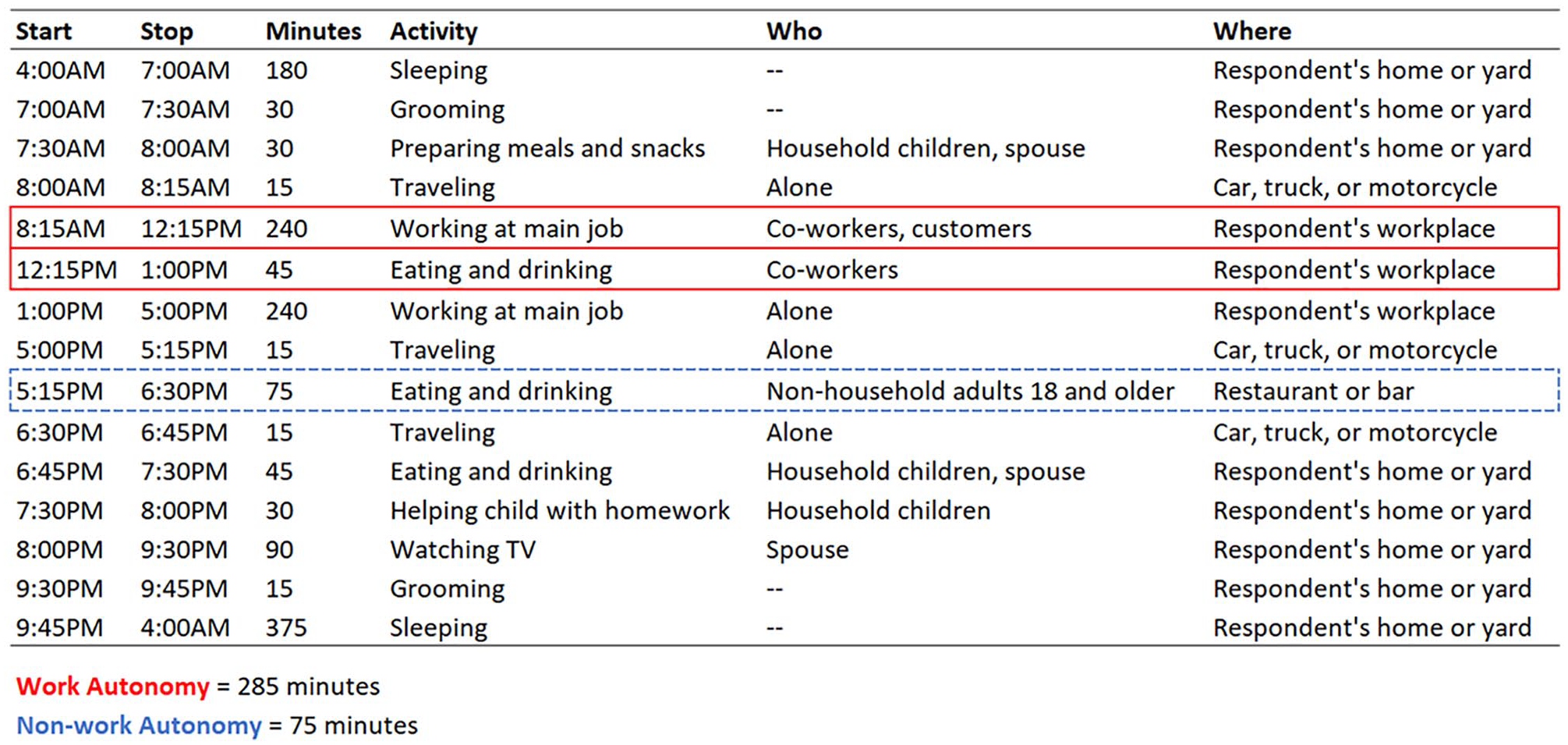
Example of American Time Use Survey respondent file. Activities representing social autonomy are outlined in red solid lines (work autonomy) and blue dashed lines (nonwork autonomy).
Covariates
The Current Population Survey collected data on the sociodemographic characteristics of ATUS respondents as well as data on household composition that can all be merged with the ATUS time diaries. Because they have been suggested to influence how individuals allocate their time, I include the following variables in my analyses of social autonomy: age (years), educational attainment (less than high school, high school, some college, college), race/ethnicity (White, Black, Hispanic, Asian, Other), occupational status (employed, unemployed, retired, disabled, other), weekly work hours, family income (less than $25,000, $25,000–$49,999, $50,000–$99,999, $100,000 or more), presence of children in household (no child, coresident child), and whether respondent provides informal care to an older adult (noncaregiver, caregiver). An age squared term is entered into models in which there is evidence of quadratic fit. Finally, I include a dichotomous variable that indicates whether the time diary was recorded on a weekday or weekend.
Analytic Strategy
I model social autonomy (number of minutes) using negative binomial regression. These models estimate count variables while adjusting for overdispersion of the outcome variable. To aid interpretation of the findings, I provide separate tables and figures that display average marginal effects from the regression models as well as a table with traditional incidence rate ratios (IRRs), standard errors, and p values. Because theory suggests that married men and women differ in their patterns of social autonomy, I stratified all models by gender. Cross-gender comparisons of average marginal effects are made using seemingly unrelated estimations, which allow me to test for statistically significant differences between men and women using stacked models (Mize, Doan, and Long 2019). These tests were performed in Stata version 16.0 using the suest command (StataCorp, College Station, TX).
Results
Table 1 provides the summary statistics for the men’s and women’s samples. On average, the men were slightly older ( x– = 50.85 years) than the women ( x– = 48.20 years). The majority of respondents had either graduated from college (men, 44 percent; women, 44 percent) or had attended college but not earned a degree (men, 25 percent; women, 26 percent). Moreover, the majority of respondents were White (men, 72 percent; women, 71 percent), employed (men, 72 percent; women, 55 percent), and had at least one child younger than 18 in the household (men, 54 percent; women, 56 percent). Family income was more evenly distributed, with the plurality of respondents living in households that earned between $50,000 and $99,999 per year (men, 36 percent; women, 36 percent). Roughly one in five men (19 percent) and one in four women (24 percent) provided informal care to older adults. Men worked more hours per week than women (men, 30.03 hours; women, 20.17 hours). At the bivariate level, men reported greater work autonomy than women, as they engaged in nonspousal interactions in a work setting for an average of 89 minutes per day (compared with 50 minutes for women). These 89 minutes accounted for 68 percent of men’s socially autonomous interactions. Women, meanwhile, were more evenly split, as they engaged in socially autonomous interactions for 50 minutes at work and 45 minutes in nonwork settings.
Summary Statistics.

p < .05. **p < .01. ***p < .001.
Table 2 displays the IRRs from the negative binomial regression models predicting the number minutes per day that respondents socialize with other people outside the company of their spouse. As anticipated by theory, respondents whose daily lives were structured by employment, parental duties, and caregiving duties tended to exhibit significant differences in their levels of social autonomy compared with those who were not constrained by such activities. Unsurprisingly, men and women who were unemployed, retired, disabled, or otherwise not working were all expected to spend significantly fewer minutes per day interacting with people in a workplace setting outside the company of their spouses compared with their employed counterparts. At the same time, unemployed women were expected to spend 22 percent more minutes engaging in non-spousal interactions outside of work compared to employed women (IRR = 1.22, SE = 0.09, p = .009). There were no significant differences, however, in men’s levels of nonwork autonomy across employment statuses.
Negative Binomial Regressions Estimating Minutes per Day Spent Socializing without Spouse.

Note: All models adjust for interview day (weekday or weekend) and apply American Time Use Survey–supplied weights. IRR = incidence rate ratio.
p < .05. **p < .01. ***p < .001.
The presence of a household child appeared to decrease the amount of time spent in nonwork interactions for both men (IRR = 0.66, SE = 0.04, p < .001) and women (IRR = 0.53, SE = 0.02, p < .001). Yet there was no detectable difference in work autonomy between men who live with children compared with men who do not live with children (IRR = 1.05, SE = 0.15, p = .728). Women, meanwhile, differed in that those who have coresident children were expected to spend 25 percent fewer minutes engaging in work-related interactions compared with women who do not have children in their households (IRR = 0.75, SE = 0.10, p < .001). These findings suggest that parental duties influence multiple spheres of women’s social autonomy, including their capacity to interact with others at work, whereas men’s parental duties are linked only with nonwork autonomy (e.g., socializing with friends and family outside of the company of their spouses). Informal caregiving, meanwhile, trended in the opposite direction. Both men (IRR= 1.37, SE = 0.06, p < .001) and women (IRR= 1.31, SE = 0.05, p < .001) who provided care to older adults were expected to engage in significantly more minutes of nonwork interactions outside the presence of their spouses compared with their noncaregiving counterparts. These differences, which are likely attributed to the time that caregivers interact with their care recipients, align with past research showing that informal caregiving is associated with loosely connected personal networks (Roth 2020b).
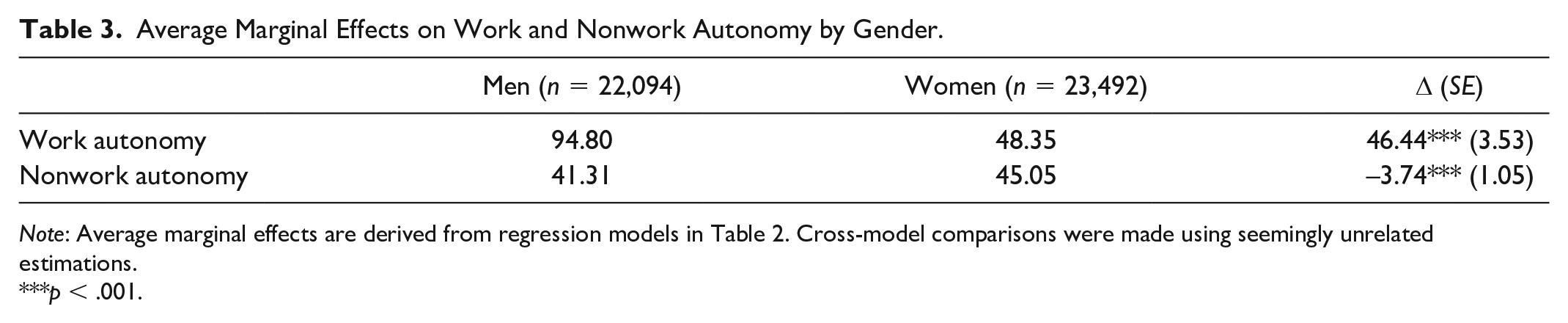
Hypotheses 1 and 2 anticipated that on average, men and women would spend different amounts of time engaging in each of the two types of social interactions (i.e., work autonomy and nonwork autonomy). Specifically, hypothesis 1 stated that men will spend more time interacting in work-related settings in the absence of their spouses compared with women. Hypothesis 2 stated that women will spend more time interacting in nonwork settings in the absence of their spouses compared with men. To test these hypotheses, I estimated the total number of minutes from the models in Table 2. These estimates, which were derived using average marginal effects, are presented in numeric format in Table 3 and visual format in Figure 2. Hypothesis 1 received strong support, as men were expected to engage in 95 minutes of nonspousal interactions with work-related contacts, adjusting for all covariates. Women, meanwhile, were expected to engage in 48 minutes of work autonomy (Δ = 46.44, SE = 3.53, p < .001). Although hypothesis 2 also received support, the gender differences were far smaller. Women were expected to engage in 4 additional minutes of nonwork interactions (45.05 minutes) compared with men (41.31 minutes). This difference was statistically significant (because of the large sample size), but it is questionable whether a few minutes difference would translate to any meaningful advantage.
Average Marginal Effects on Work and Nonwork Autonomy by Gender.
Note: Average marginal effects are derived from regression models in Table 2. Cross-model comparisons were made using seemingly unrelated estimations.
p < .001.

Work and nonwork autonomy by gender. Predicted count (minutes) estimated from work autonomy and nonwork autonomy models in Table 2 using average marginal effects.
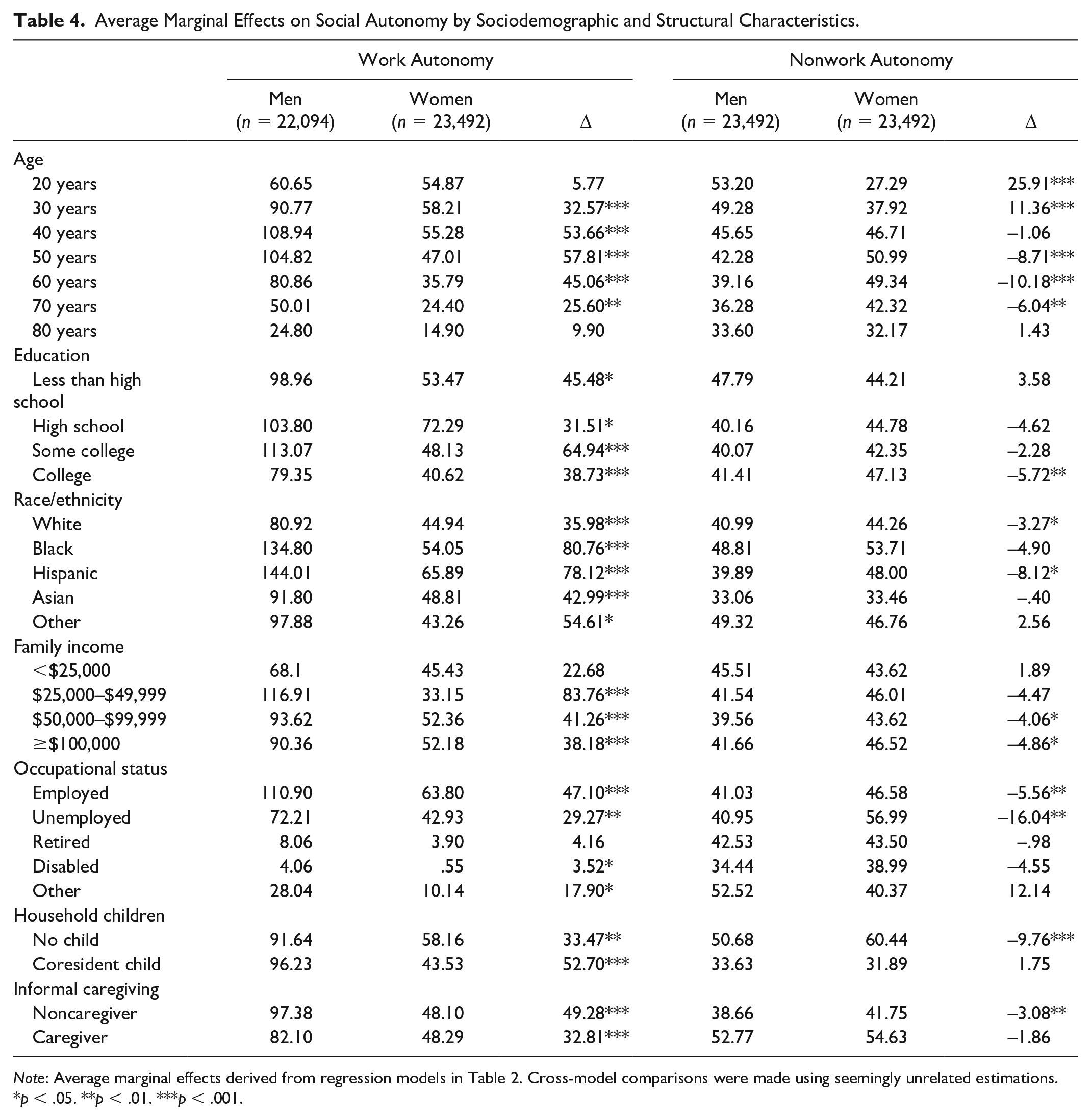
Table 4 presents the average marginal effects for the independent variables previously shown in the negative binomial models. These values are used to calculate the differences between men and women across models (shown in the Δ column). As seen across both types of social autonomy, the average marginal effects for the majority of independent variables differ significantly by gender. This implies that men and women’s social behaviors are influenced to different degrees by sociodemographic and structural factors. For instance, men who do not have children in their households are expected to engage in 53 more minutes of work autonomy than women who do not have children. Yet the difference among men and women who live with children is 33 minutes. Similar comparisons can be made for the other independent variables.
Average Marginal Effects on Social Autonomy by Sociodemographic and Structural Characteristics.
Note: Average marginal effects derived from regression models in Table 2. Cross-model comparisons were made using seemingly unrelated estimations.
p < .05. **p < .01. ***p < .001.
Hypothesis 3 draws attention to how age structures men and women’s social lives. According to hypothesis 3, the amount of time spent interacting with others in the absence of one’s spouse will peak in midlife and decrease in later life. As anticipated by hypothesis 3, the age-graded work autonomy trends for men and women both follow curvilinear relationships, albeit with women’s estimated levels of work autonomy peaking slightly earlier (30 years old) than men (40 years old). In terms of nonwork autonomy, women were found to follow a pronounced curvilinear age trend. According to the average marginal effects shown in Table 4, women in their 50s and 60s were estimated to engage in approximately 50 minutes of socially autonomous interactions outside of work per day, whereas 20-year-old women clocked 27 minutes and 80-year-old women clocked 32 minutes. The trend for men, however, looked dramatically different, as their nonwork autonomy followed a steady decline across the life span. 4 At younger ages (e.g., 20s and 30s), men were estimated to spend more time than women interacting with nonwork contacts outside of the presence of their spouse. Yet older men consistently spent less time engaging in these types of interactions, to the point at which 50-year-old women were expected to exhibit significantly higher levels of nonwork autonomy compared with 50-year-old men. This age-related decline in men’s nonwork social interactions may be explained by a combination of (1) young men’s tendency to engage in high levels of nonspousal interactions in nonwork settings and (2) older men’s disinterest in engaging in such interactions with family and friends. The nonwork autonomy age trends for men and women are visualized in Figure 3.

Nonwork autonomy by age. Predicted count (minutes) estimated from models in Table 2 using average marginal effects.
Discussion
Considerable research on the social lives of married couples has focused on the degree to which spouses harmonize their familial and friendship ties (Cohn-Schwartz et al. 2021; Johnson and Milardo 1984; Kalmijn 2003; Stein et al. 1992). A parallel strand of studies, meanwhile, have examined exactly how married couples jointly spend their time on a daily basis (Dew 2009; Flood and Genadek 2016; Genadek et al. 2019). Building on social network theories that emphasize the relevance of nonoverlapping social relationships, I merged the two approaches to investigate the extent to which married individuals engage in social interactions in the absence of their spouses. Because gender and age influence various aspects of social disadvantage (e.g., power, independence), I assessed how men and women differed in the amount of time they engage in nonspousal interactions and how these behaviors follow an age gradient. I tested these ideas using nationally representative data from the ATUS.
In support of hypothesis 1, I found that, on average, married men spent nearly twice as many minutes engaging in work-related social interactions in the absence of their spouses compared with married women. Even during a time when traditional gender roles are diminishing, there remains clear evidence that men and women’s social interactions in the workplace are structured differently. Although the ATUS diaries cannot deduce the exact nature of these workplace interactions (e.g., routine meetings vs. water cooling schmoozing), these gender disparities indicate that married men may hold a competitive workplace advantage over married women. As evidenced by labor market research, the increased frequency of face-to-face interactions can lead to workplace inequalities in the form of promotions, raises, and favoritism (Castilla 2011; Cullen and Perez-Truglia 2019). These workplace inequalities may be further exacerbated by the fact that parenthood manifests differently for men and women. Specifically, women who had children living in their households reported less time engaging in work interactions compared with women who did not live with children. Men, meanwhile, reported no difference in such interactions regardless of whether they lived with children. These latter findings align with studies showing that motherhood tends to negatively affect women’s working lives (i.e., motherhood penalty), whereas men are less negatively affected (Glauber 2018; Jee, Misra, and Murray-Close 2019).
Whereas married men were found to exhibit elevated levels of work-related autonomy, married women, who are often viewed as more family and friend oriented than men, were hypothesized to spend more time engaging in nonwork social interactions outside of the presence of their husbands (hypothesis 2). This hypothesis received mixed support, albeit with some interesting nuances. On average, women in the ATUS sample were found to engage in roughly four more minutes of nonwork interactions outside the presence of their spouse than men. This aggregate difference held little substantive significance, as both men and women reported socializing with nonwork contacts outside of the company of their spouses for approximately three quarters of an hour per day. The key findings, however, appeared upon observing the age-graded trends within the nonwork domain. As anticipated by hypothesis 2, women’s nonspousal social interactions peaked in middle age and declined into older adulthood. Men, however, exhibited a markedly different trajectory. The amount of time that young married men (i.e., 20s and 30s) interacted with friends, nonhousehold family members, neighbors, and other nonwork acquaintances outside of the company of their wives was higher than that of married women of the same age. By age 40, the situation was balanced, with women and men spending similar amounts of time engaging in these socially autonomous interactions. The consistent downward trend for men, however, showed middle-aged and older men spending significantly less time devoted to nonspousal endeavors compared with their younger counterparts. Women, meanwhile, maintained their social autonomy well into later life. It was only once women reached their 80s that the amount of time they spend socializing in nonspousal settings decreased to a point at which it once again equaled that of men.
Collectively, these age-graded findings indicate that married men and women externally invest in their social lives differently according to their life stage. Whereas women are often viewed as being more socially active with friends and family (Taylor 2011), the findings of the present study suggest that at younger ages it is men, not women, who spend more time with these types of people in the absence of their spouses. As suggested in the social network and social support literatures, women manage to maintain their social involvement much later into life than men (Cornwell, Laumann, and Schumm 2008; Fischer and Beresford 2015). These findings can be interpreted in multiple ways. First, married men may grow increasingly disinterested in seeking out nonspousal interactions with friends and family as they grow older. This explanation aligns with prior research showing that middle-aged and older men tend to report having fewer friends than women (Liebler and Sandefur 2002; Stevens and Van Tilburg 2011). Alternatively, women may prefer to become increasingly involved in their husbands’ social lives over time while maintaining an element of their own separate social lives. Although any psychological motives behind these trends cannot be deduced using the ATUS data, the findings of the present study ultimately suggest that married men and women differ in the ways they socialize in their free time (i.e., nonwork time) across the life span.
Implications
A motivating assumption of this study was that socializing with people outside of the presence of one’s spouse affords individuals with a sense of independence. If true, engagement in socially autonomous interactions may provide married men and women with important psychological benefits achieved through activities such as the pursuit of personal interests with friends or the discussion of marital issues with close confidantes. Yet the gender disparities observed in the present study suggest that men and women do not consistently have equal access to social autonomy throughout their lives. For instance, young women spent less time engaging in nonspousal interaction both in work and nonwork settings compared with young men. This time deficit may make it harder for young women to maintain an identity beyond their marriage (e.g., employee, friend, relative) compared with men. Conversely, older men’s relative lack of nonspousal interactions may heighten their reliance on their wives for social needs. Older women, who maintain relatively stable levels of social autonomy, are likely to be less dependent solely on their husbands for social support as they may also derive support from nonspousal sources (Taylor 2011).
Beyond its individual-level benefits, social autonomy may also provide access to communal resources in which spouses collectively use their time to obtain useful information from separate sources that could benefit the couple as a whole (e.g., learning about alternative health care and medicine, childcare options). In this scenario, spouses effectively double their potential for new information, perspectives, or other social resources if they each independently spend some time per day interacting with different people in different settings. The age-graded findings indicate that married couples are best poised to mobilize these social resources during middle age, a stage of life during which they are likely to collectively occupy a wide range of social roles (McDonald and Mair 2010).
Strengths and Limitations
This study has two main strengths. First, I leveraged data from a large nationally representative sample. Unlike many studies on the social lives of married couples, this enabled me to generalize my findings to the U.S. population. Second, the time-use diaries allowed me to quantify the number of minutes that respondents interacted with different combinations of people. Prior studies on married couples tended either to look at the presence (or absence) of shared social relationships or to use broad self-assessments of how well one’s social contacts knew their spouses. 5 The richness of the ATUS data provides an alternative view on these well-studied topics.
Despite these strengths, this study has several limitations. First, I cannot deduce social network structure from these data. In other words, I am unable to know whether the opposing spouse knows the person(s) with whom the acting spouse interacts in any given instance. Therefore, the present study is restricted to quantifying immediate exposure to others in the absence of one’s spouse. Second, the ATUS time diaries capture only a single day in the life of each respondent. Although aggregating these diaries across a large sample provides a broad depiction of the daily life of an average American, I cannot speak to within-person time trends. Third, the present study is limited to studying heterosexual couples. Because this study was theoretically motivated by heterosexual gender norms, the findings cannot be extended to homosexual couples.
Conclusion
In the present study, I assessed the extent to which married men and women socialize with nonhousehold members in the absence of their spouses. Whereas previous research has addressed the copresence of social ties between spouses’ personal networks, I analyzed time-use diaries to quantify the number of minutes per day that married individuals engage in nonspousal interactions. By focusing on the ways in which gender and age structure daily life, I showed how married individuals differed in their abilities to exercise social autonomy. Moving forward, research should address the extent to which this may translate into meaningful social advantages and disadvantages.
