




Abstract
Connecting theories of identity formation and coming out with impression management, this research highlights that transgender disclosures are not static. Rather, disclosures are continuously mediated by various contextual concerns, ranging from accurate gender recognition, discrimination and stigmatization, the cultivation of emotional and physical intimacy, alerting people of the bodily changes, and understandings of how bodies will be perceived. Through 20 interviews with trans men, I found that they manage their trans identity through two tactics: symbolic disclosure and disclosure avoidance. Disclosure patterns reveal a twin force shaping disclosures: Trans men want gender recognition and/or to strengthen relationships while simultaneously avoiding potential violence, discrimination, and stigmatization. This research contributes to sociological scholarship on identities and disclosure more broadly by elucidating some ways trans men strategically negotiate disclosures based on a variety of concerns.
Introduction
Sociological research has made strides in retheorizing coming out as an important aspect of identity management, strategically deployed in certain social domains based on contextual factors (e.g., Brumbaugh-Johnson and Hull 2019; Doan and Mize 2020; Orne 2011). However, identity disclosures remain an understudied phenomenon. This research considers how certain identity disclosures complicate what is already known about how people manage their strategies of choosing to disclose or not within various social encounters. Drawing on scholarship that frames gender and sexual disclosures as forms of identity management (i.e., Brumbaugh-Johnson and Hull 2019; Orne 2011), this research builds on the notion that disclosures are not static actions and that gender disclosures are both similar to and different from sexual minorities’ experiences (i.e., Brumbaugh-Johnson and Hull 2019; Lev 2004; Morrow 2006). In this article, I show that trans men’s experiences with gender disclosures provide fertile ground to illuminate how disclosure patterns are a social process, continuously negotiated based on social contexts and concerns that make gender salient across a diverse range of social interactions. This research empirically analyzes how contextual factors influence the availability and efficiency of gender disclosure strategies across diverse social encounters.
Through 20 in-depth interviews with trans men, I analyze a collection of specific contextual circumstances across social interactions related to the relationships among actors and the concerns surrounding perceived benefits or losses associated with disclosures. I analyze two emerging interactional patterns related to disclosure stemming from these circumstances that I term symbolic disclosure and disclosure avoidance. Drawing on the significance associated with coming out, I conceptualize symbolic disclosure as an interaction to either strategically validate one’s gender identity (e.g., as a trans man or man) and/or to strengthen a bond in significant relationships. Disclosure avoidance, by contrast, is an interactional process of strategically not revealing one’s identity as trans because of concerns of potential violence and discrimination. Disclosure avoidance is also used to avoid dealing with the emotional and mental processes related to revealing one’s identity (i.e., see shuster 2017) or further potential stigmatization (i.e., see Doan and Mize 2020).
These two patterns of disclosure present a social and internal paradox that trans men continually navigate. On one hand, these men construct narratives of wanting to be accurately seen and/or share personal information to deepen relationships. Yet on the other hand, these same men weight concerns of violence, discrimination, and stigmatization that may accompany disclosure. This paradox is a conflict that previous coming out and identity formation theories do not address and that pertains to identities beyond gender as well. Throughout this article, I not only shed light on the nuances associated with this paradox but also analyze how the same 20 trans men switch between symbolic disclosure and disclosure avoidance based on types of encounters and context.
This research empirically contributes to sociological theories of coming out by asking: To whom, when, and why do trans men elect to reveal their trans status or gender histories across various social interactions and contexts? Through addressing this question, this article distills some of the ways trans men use certain disclosures to navigate concerns related to accurate gender recognition, discrimination and stigmatization, cultivating emotional and physical intimacy, alerting people of the bodily changes, and/or how their bodies will be perceived and experienced physically. Simply, trans men strategize which type of disclosures to practice based on the perceived gains or losses associated with revealing their identity to strangers, coworkers, friends, family members, and romantic/sexual partners. Through critically examining gender disclosure, this article highlights the inconsistent and varied ways that gender disclosures organize social life and vice versa. As such, disclosure patterns motivate a better understanding of how identity recognition is established in social interactions and inevitably institutional interactions as well.
Gender Recognition
Within everyday encounters, the primary characteristics people draw on to interact with others are age, race/ethnicity, and gender (Ridgeway 2011). Gender is one of the main characteristics individuals initially decipher for social interactions to proceed smoothly (shuster 2017). That is, gender is initially “determined,” and interactions proceed differently depending on the determination reached. Drawing from theories of “doing gender” (West and Zimmerman 1987) and “gender categorization” (Kessler and Mckenna 1978), Westbrook and Schilt (2014) theorize “gender determination” as the process through which gender is presented, how others recognize and determine gender within interactions, and how institutions are organized to “determine gender” as well.
Westbrook and Schilt (2014) discuss two ways gender is determined in various contexts (e.g., sports, legal documents, legislation about gender-segregated restrooms). First, they describe a biologically based determination system, which relies on chromosomes and genital characteristics. The second, and more common way gender is determined, however, is through an identity-based process. This happens when people “can be recognized as a member of the gender category with which they identify if their identity claim is accepted as legitimate by other people determining their gender,” such as romantic/sexual partners, friends, family, and medical experts (Westbrook and Schilt 2014:33). Building on identity-based categorization, in their study on voice-based gender classification processes, Lagos (2019) found that people draw on a combination of senses (e.g., sight, sound, and sense) when determining gender for others. However, in interactions, especially those in which there are no visual cues available, Lagos notes that even if a trans person perceives that their gender can easily be recognized in interactions, it can be misrecognized or vice versa.
A related concept to gender determination is recognition, which derives from theories of impression management. Sociologists have long recognized that everyone practices impression management to showcase idealized images of themselves in interaction (Goffman 1959, 1963). Impression management research has tended to focus on how communities or individuals “manage” the concealment of (in)visible physical characteristics or “deviant” and “stigmatized” identities (e.g., Goffman 1959, 1963; Page 1984), such as biracial identities (Khanna and Johnson 2010; Sims 2016), socioeconomic status (Streib 2015), sobriety (Herman-Kinney and Kinney 2013), undocumented immigrant youth, fat acceptance activist, Mormon fundamentalist polygamists, sexual harassment lawyers and activists (Saguy 2020), or those who previously experienced an abortion (Cockrill and Nack 2013).
Within gender studies specifically, scholarship engaging with the notion of impression management has historically focused on the outdated concept of “passing,” or a person’s ability to be viewed as a member of social groups other than their own (i.e., Garfinkel 1967; Goffman 1963; Kessler and McKenna 1978; West and Zimmerman 1987). Gender scholars have challenged this conceptualization of passing because it “carries the assumption that certain individuals somehow naturally embody particular identities to which others can stake only inauthentic membership claims” (Pfeffer 2014:11). Further troubling is that it focuses on trans individuals’ capacity to pass as a normative standard for success (Connell 2009). Instead of passing, Connell (2009) relies on recognition to theorize the intersections of one’s subjective identity, body, and group memberships alongside social evaluations of these factors. Pfeffer (2014:12) furthers Connell’s (2009) understanding by arguing that recognition allows scholars to “attend not only to the ways in which we may come to see individuals in accordance with how they see themselves but also to the ways in which making any attribution of identity is part of the process of bringing identities into social being.” As such, recognition highlights the social and processual components of disclosure, in which actors are reflexive about their gender based on how they assume others perceive them. It also captures identities as explicitly not fixed, but in flux, contextually transforming depending on the type of disclosure that is practiced in encounters.
As it relates to the social phenomenon of disclosure, gender recognition is consequential. Drawing on the impression management and gender determination scholarship, I show that all people present and exchange information about their gender(s) (e.g., embodiments of dress, sounds, mannerisms), whereas others read this information and draw on certain cues to determine and recognize their gender. When a trans person’s gender is misrecognized, they experience a conflict between their identity, authentic, and actual gender impressions (i.e., Lagos 2019; shuster 2017; Westbrook and Schilt 2014), causing their gender identity to become particularly salient. Those who desire accurate gender recognition but whom others misinterpret (e.g., trans men not recognized as men or trans men recognized as men but not as trans) must navigate whether to reveal their identity to correct the misinterpretation. During these instances, trans individuals negotiate and make decisions about “appropriate” methods for correcting (or not) the misrecognition through either what I refer to as symbolic discourse or disclosure avoidance.
Coming Out: Strategies of Disclosure
Early psychological theories have focused on how sexual minorities internally framed their sense of self, quality of life, and synthesized nonheteronormative identities through “coming out” (Cass 1984; Trodien 1988). This stage is symbolically perceived as life-changing in that disclosure can be psychologically healthy and improve quality of life (Maguen et al. 2007; Morrow 2006). This work, however, emphasizes internal feelings of developing an identity without fully considering the social contexts that mediate disclosures across various social domains. To address this gap, sociological research has framed coming out as a strategic and ongoing social process (e.g., Brumbaugh-Johnson and Hull 2019; Lev 2004; Morrow 2006; Orne 2011; Scherrer, Kazyak, and Schmitz 2015). Orne (2011:699) argues that coming out is not a “static action, but a range of various motivations, goals, and strategies that people wrap up in a single term, a catch-all for this complex identity management system.” They conceptualize “strategic coming out” to address the continual and contextual management of a sexual identity (Orne 2011). Relatedly, in their study that distinguishes gay, lesbian, and bisexual (LGB) individuals’ decisions to disclose their identity across social domains, Doan and Mize (2020) found that disclosure was dependent on identity salience—the perception that an identity will become a master status across situations. They found LGB individuals more likely to reveal their sexual identity based on having a strong identity salience and its relation to social contextual factors (e.g., perceived social acceptance, integration with others who share similar identities). This work demonstrates that sexual disclosure is a social process shaped by how integrated and salient an identity is perceived to be.
Relatedly, empirical scholarship has analyzed transgender disclosure strategies in certain social contexts or relationships (e.g., Abelson 2016; Bettcher 2007; Brumbaugh-Johnson and Hull 2019; Galupo et al. 2014; Haines, Ajayi, and Boyd 2014; Hines 2006; Maguen et al. 2007; Pfeffer 2014; Schilt 2010; Ward 2010). For example, in her composition of trans men who were either stealth (not out) or out at work, Schilt (2010) found that cisgender women coworkers may have legitimated their gender as masculine but did not fully recognize them as men in all contexts and interactions (e.g., sexual interactions). Scholars have also studied disclosure by trans parents to partners and children, finding that trans parents conceal their trans identity in certain spaces to protect their children from perceived courtesy stigma (Hines 2006). Additionally, shuster (2017) and Brumbaugh-Johnson and Hull (2019) showed that trans individuals base disclosure decisions on their perception of the safety of the interaction.
When examining transgender coming out narratives, Zimman (2009) found that transgender individuals often declare their trans identity to gain gender recognition before they medically transition; however, once their gender is recognized, it is not always necessary for them to share their identity (Rubin 2003; Schilt 2010). Although an analysis of medical transition is connected to aspects of disclosure, limiting understandings of coming out to only those pursuing medical transitions excludes myriad trans people who are routinely recognized accurately without medical intervention. Notably, Brumbaugh-Johnson and Hull (2019) applied Orne’s (2011) strategic outness to understand how trans people navigate the social implications of revealing a gender identity differently from sexual minorities, finding that coming out was navigated through three aspects. First, adhering to specific and generalized others’ gender expectations creates a significant challenge that imposes transgender people from expressing a trans identity. Second is the anticipated type of recognition factored into navigating disclosure. Finally, beyond receiving negative reflected appraisals, trans individuals also navigate disclosure based on the real possibility that others’ negative appraisals can be demonstrated violently (Brumbaugh-Johnson and Hull 2019:1172).
Drawing on this scholarship, I theorize a bridge between existing conceptualizations of gender recognition and strategic outness accounting for the types of disclosure strategies transgender individuals employ to manage their gender across various social contexts. Expanding on Brumbaugh-Johnson and Hull (2019) specifically, I illuminate how trans men grapple with negotiating the costs and benefits of employing symbolic disclosure or disclosure avoidance in diverse interactions. This research provides a new account of the intersection between social interactions, relationships, and internal negotiations that take place when disclosing stigmatized identities.
Methods
In 2016, I conducted 20 in-depth interviews with self-identified trans men. 1 My criteria for selection were that participants had been assigned “female” at birth but transitioned to identifying and presenting as men or trans masculine, living in the United States (one participant is Canadian) and 18 or older. For confidentiality, all identifying information has been removed, and all names are pseudonyms. Respondents were recruited through snowball sampling, beginning with three insiders to trans communities in different regions: the South, West, and Northeast. Participants were also recruited through social media. I conducted interviews face-to-face (five), over Skype (nine), by phone (five), and one over email. Respondents were diverse in geographical location, and although all respondents identified along the trans masculine spectrum, their gender was not always recognizable in interactions. When discussing their gender recognition across interactions, I draw on Schilt’s (2010) method of categorizing trans men as being either recognized as men or not recognized as men based on self-reports; however, self-reports may not be accurately perceived by others (see also Hart et al. 2019; Lagos 2019). In my sample, 9 men reported frequent gender misrecognition, and 11 reported regular recognition as men. These 11 participants also had “top” surgery and/or were on hormone therapy; consistent with scholarship, through having masculine characteristics (e.g., beards, deep voices), they were often recognized as men (Kessler and McKenna 1978; West and Zimmerman 1987; Westbrook and Schilt 2014). Most respondents identified as white non-Hispanic (see Table 1).
Sample Characteristics.

Interviews centered on respondents’ recognition of being men and ongoing disclosures in diverse encounters. To formulate initial questions, I drew on scholarship indicating sexual and gender minorities revealing their identity to significant others: friends, spouses, family, employers, and coworkers (Galupo et al. 2014; Haines et al. 2014; Hines 2006; Maguen et al. 2007; Orne 2011; Schilt 2010). The protocol not only included questions on respondents’ disclosure experiences with significant others but also addressed other social interactions and relationships. I also produced field notes and detailed memos following interviews. This iterative process enabled me to incorporate emergent themes into subsequent interviews while collecting this sample.
Interviews ranged from 46 minutes to 3 hours; the average time was 90 minutes. With respondents’ permission, most interviews were audio-recorded (19) 2 and transcribed (20). Interviews were conducted until I reached saturation. Indeed, scholarship has shown that the lesser the variation and greater homogeneity in responses account for saturation to be reached more quickly (Compton 2018:196). Furthermore, research on hidden populations, such as trans people (see Abelson 2014; zamantakis 2020), has demonstrated that we still can “learn a great deal from small samples” (Compton 2018:195).
My analysis relied on a deductive and inductive modified open coding grounded theory approach (Charmaz 2006). Starting with line-by-line coding, I discovered themes and developed sensitizing concepts related to previous scholarship on disclosure. Subsequent coding relied on these organic themes and concepts (e.g., strategies and negotiations of when and how disclosure came about or was avoided in everyday social interactions). Throughout data collection, I stayed close to participants’ narratives by constantly analyzing instances when trans men discussed choosing to reveal or not to reveal their identity.
At the outset of this research, I was unsure how I would be perceived as a trans man/masculine individual of color doing research on other trans men. I assumed participants would be more open and willing to participate once they learned about our shared gender identities (Hesse-Bieber 2014). I made it clear at the beginning and end of each interview that I was happy to answer questions about my research intentions and goals as well as personal questions. Most respondents asked if I am trans and related gender questions regarding my lived experiences; I disclosed that I am trans to each interviewee and answered their questions. Due to our shared identities, I emphasized that I was there to learn about their experiences, rather than be an expert, and through this openness, I gained rapport. Although sharing my trans identity may have led to assumptions that we had similar experiences, I was careful to ask participants to elaborate and clarify their personal experiences to avoid assumptions about insider knowledge.
Findings
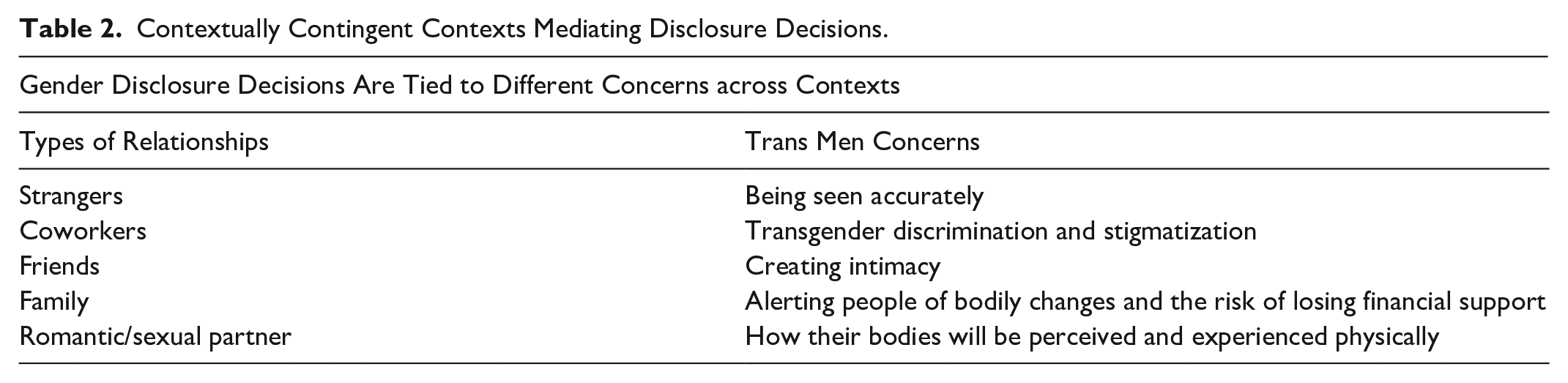
In the following sections, I analyze how symbolic disclosure and disclosure avoidance are tactful social processes tied to different concerns across interactions with strangers, coworkers, friends, family, and romantic/sexual partner(s) (see Table 2). Within each of these interactions, there are moments when their trans status or gender histories become salient, causing trans men to deliberate which type of disclosure to employ based on the concerns surrounding perceived associated cost and benefits. These contextual concerns range from accurate gender recognition, discrimination and stigmatization, cultivating intimacy, explaining bodily changes, and/or navigating how their bodies will be perceived and experienced physically.
Contextually Contingent Contexts Mediating Disclosure Decisions.
Disclosing to Strangers: Accurate Gender Recognition
In encounters with strangers, people typically do not divulge personal information for it to proceed smoothly. As such, trans men readily recognized as men generally avoid disclosure in these encounters. This type of disclosure avoidance is not related to fears of potential violence or expectations of further stigmatization; rather, revealing their trans status is not deemed necessary because their gender is being accurately recognized. Henry, who is regularly recognized as a man, said that he chooses not to disclose in these types of interactions because “It’s not the most important thing about me, I feel like, somebody else might feel like it’s the most important thing about me. But to me it’s just not the most important thing about me anymore.” Henry’s declaration of his trans identity as being “not the most important thing about [him]” highlights his perception that his trans identity is not vital information needed for the encounter to flow smoothly, a perception that shapes his decisions regarding disclosure and his encounters. However, when Henry stresses that his identity is “not the most important thing about me anymore,” it illuminates that in previous encounters when he was younger and his gender was misrecognized, his trans identity was salient and correcting misrecognition would be important. Indeed, when the trans men routinely recognized as men in this sample were first transitioning, they described disclosing in encounters with certain strangers, especially to strangers that would become acquaintances, to exert more control over their own gender recognition.
Mason, who explained that his gender was often misrecognized in interactions, vividly discussed benefits associated with symbolically disclosing to certain strangers and acquaintances. Mason shared that appropriate gender recognition was not only significant but a necessity in extended interactions: “I also think it’s important to disclose to . . . people who you have to interact with for longer than 5 minutes. Because you don’t want to continually have a conversation that’s hurting your mental health by using the wrong pronoun or things like that.” From Mason’s perspective, improper gender recognition is harmful. And his rationale for employing symbolic disclosure aligns with identity formation models; revealing his identity creates a better sense of self and well-being (Maguen et al. 2007; Morrow 2006; Riggle et al. 2011). When comparing Henry’s and Mason’s experiences, we see that disclosures are a social process that are contextually dependent on the alignment of how trans men want others to recognize their gender—something that is subject to change over time as well. For Mason, disclosure not only affords him the benefits of having his gender properly recognized but also enables his gender to be accurately recognized in future interactions, whereas Henry perceives fewer benefits from revealing his trans identity in these types of interactions.
The men who shared that their gender was not properly recognized stated that in repeated interactions with strangers and acquaintances, their trans identity becomes salient because of misrecognition. Like Mason, because of routine gender misrecognition, they elected to reveal their trans identity, pronouns, and sometimes proper names in repeated and extended interactions with strangers and acquaintances. Therefore, the employment of symbolic disclosure in these encounters allows for actors to correctly recognize them as men in future interactions. However, in brief, one-time encounters with strangers, these men reported practicing disclosure avoidance because these are noncontinuous interactions that lack ongoing development for intimate relationships. Disclosure avoidance allows these men to avoid the emotional labor and uncertain reactions in noncontinuous interactions. As Henry, Mason, and these trans men’s experience illustrate, gender disclosure is contextually and relationally navigated based on how their gender is recognized in real time, the benefits associated with disclosure, and the spatiotemporal relationship associated with the encounters.
Disclosing to Coworkers: Discrimination and Stigmatization
Nine respondents practiced disclosure avoidance at work: eight because they were recognized as men and one because he was not recognized as a man. One participant had symbolically disclosed at work; however, coworkers forgot his trans identity because he was understood as a “man’s man.” Eight participants 3 reported that they symbolically disclosed their identity at work, stating it was a necessary aspect of proper gender recognition (e.g., usage of correct pronouns and names). Two participants were unemployed and had not faced this decision.
The eight men (all self-reported they are recognized as men) who did not reveal their transgender identity at work practiced disclosure avoidance because of concerns of transgender discrimination and potential stigmatization. Although Ryan ultimately practiced disclosure avoidance, his narrative captures the complexity of the social and internal paradox of negotiating the different types of disclosures—something he explains as mediated by his relationships with coworkers. Ryan worked in a highly masculinized construction site and shared he “had the choice to come out or not . . . [and] I’m not out at work at all.” He explained engaging in disclosure avoidance in this way: [I’ve] heard enough stories . . . [of] trans men [who] come out and next thing, you know, like suddenly they can’t lift as much as they use to lift and that people started placing all these really ridiculous gender stereotypes based on their birth sex and, I mean I can’t have that. I lift a lot of heavy stuff all day at my job and . . . I just can’t have that reaction.
Ryan’s explanation for not sharing his trans identity at work illustrates other scholarship on trans men’s workplace experiences. Trans men who meet hegemonic masculine standards are often characterized as “just one of the guys” and forgo divulging their trans identity out of fear of changing others’ perceptions of them (Schilt 2010; Westbrook and Schilt 2014). Ryan articulated three apprehensions associated with disclosure to coworkers. (1) He imagined his coworkers might invalidate his masculinity and gender identity, to (gender) police his work (e.g., not allowing him to do physically demanding tasks), leading to him being viewed as less competent. (2) He shared that if he were to reveal his identity to a coworker whom he trusted, he was concerned they would share this with others without his consent. (3) Finally, he explained that if he did reveal his identity, he worried his coworkers would ask inappropriate questions or make comments about his body and sexuality.
Although Ryan chose not to disclose, he described wanting to symbolically disclose his gender history to foster deeper relationships with coworkers: I don’t know, [disclosure is] something that I have been playing with a little bit, to figure out what feels comfortable and I mentioned earlier, I’m not out at work at all. And in some ways it’s nice, because nobody asks me horrible invasive questions. But it’s also been more frustrating than I thought it would be. Because I feel like there is this wall between me and my coworkers. So, at a certain level they just don’t get to know me . . . they just don’t really know me that well. They don’t know [the] important things that are going on in my life.
This sense of alienation from his colleagues was particularly acute during certain interactions. For instance, when coworkers discussed childhood stories, Ryan’s disclosure avoidance led him to consider the benefits and consequences of joining in: There [are] a lot of stories I can’t tell about my past . . . like at one point we were talking, prom came up. They asked me if I went to prom, and I said no. . . . That’s where it has to end and either I make up some story or say “No, I didn’t want to wear a dress. I refused to wear a dress and wasn’t in an environment where I could wear anything else. So, I didn’t go.” And you know, talking about like playing sports when I was little. I [said] “No, I didn’t play sports when I was little, because I wasn’t allowed to play the sports I wanted to play.” And there’s a lot of stories, that I can’t tell [them] and parts of myself that I can’t share with them. [It’s] been more frustrating to me than I thought it would be.
Ryan’s experiences provide a nuanced example of a dynamic that all the trans men in my study shared: the complex social and internal paradox of wanting to divulge personal information to develop a deeper social relationship but not doing so because of the fear of not being recognized as a man. Ryan practiced disclosure avoidance at work because the benefits of not disclosing outweighed the perceived potential of fostering more meaningful relationships with his colleagues.
In comparison to Ryan’s explanation for disclosure avoidance at the work, eight participants employed symbolic disclosure at work because they planned to medically transition and change legal documentations. For instance, before starting his medical transition, Jackson disclosed his name and proper pronouns at the restaurant at which he worked. Once his name was legally changed, Jackson asked his managers to update it in the computer system, a request that Jackson perceived as necessitating disclosing his trans identity to his coworkers: I was never going to get away with nobody noticing [the name change] or anything like that . . . I immediately email[ed] the whole staff and that was 70 people who I had varying relationships to. Of course, I didn’t know all of them or had relationships with all of them or knew all of them by name. . . . I tried to do the pronoun thing and fumbled [with correcting]. But everybody got on to the name very quickly, partly because we had to see it all the time.
Because Jackson worked in a large restaurant, his use of symbolic disclosure was not about having an emotionally intimate conversation about his transition; rather, it was more about being seen and labeled as a man in the most efficient way possible. The repetition of seeing his new name in the computer system and on orders allowed others to quickly familiarize themselves with his new name. Jackson said that he tried to correct coworkers about his pronouns but was not always able to because of the fast-paced job. However, he said he did authorize some coworkers to correct others as well to navigate this. Coworkers who corrected misrecognition helped ensure Jackson’s proper gender recognition while also supporting Jackson by undertaking some of the emotional labor associated with correction. The instances of others employing symbolic disclosure on behalf of Jackson sheds light on the action of disclosure. Jackson’s action of allowing some others to disclose his identity on behalf of them was a common occurrence when these men were not recognized as men. Once continuously recognized as men, trans men in this study asked others to cease sharing this information, desiring renewed control over who would know about their identity or gender histories.
When juxtaposing Ryan’s and Jackson’s narrative of disclosure, Jackson stresses that he “was never going to get away with nobody noticing [the name change] or anything like that”; therefore, for him, symbolic disclosure was not about intimacy but rather a necessity for gender recognition. Whereas Ryan deliberated about wanting to share memorable childhood stories to foster an intimate relationship with his coworkers, he ultimately felt that there are “parts of myself that I can’t share with them” (i.e., his trans status and gender histories). Therefore, his employment of disclosure avoidance illuminates how he is not completely recognizable as a full person to his coworkers because he perceives his trans status and gender histories limit his ability to fully cultivate an emotionally intimate bond with his coworkers. Thus, as Ryan put it, “they just don’t get to know me . . . they just don’t really know me that well. They don’t know [the] important things that are going on in my life.”
Ryan ultimately practiced disclosure avoidance because being able to manage the possibility of transgender discrimination and potential stigmatization (e.g., having “ridiculous gender stereotypes based on [his] birth sex” and being “ask[ed] horrible invasive questions” regarding his body and sexuality) takes precedence over the relational and emotional benefits associated with symbolic disclosure. Ryan’s narrative articulates the nuances associated with the benefits and losses of choosing not to disclose and potentially disclosing. Overall, within the workforce, disclosure is mediated on the contextual factors surrounding potential transgender discrimination and stigmatization, the potential cultivation of developing an intimate relationship with coworkers, and/or wanting proper gender recognition from coworkers.
Disclosing to Friends: Cultivating Intimacy
Trans men identified two main reasons for disclosing to friends, both influenced by the benefits associated with symbolic disclosure: accurate gender recognition and cultivating intimacy. First, disclosure occurred for accurate gender recognition; then, once respondents were recognized as men, they explained that disclosure offered a way to foster an emotionally intimate relationship with friends.
Lucas described his decision and strategies to disclose to friends before he transitioned: “[It] depend[ed] on the friends. Like, some friends I’ve disclosed to, really quickly, because . . . I just knew that they would be cool with it.” This is consistent with Kaufman and Johnson’s (2004) findings that those with stigmatized identities are more likely to reveal their identity when they expect positive responses. Other men echoed Lucas, stating disclosure was negotiated based on perceptions of how friends would react. Yet 18 respondents eventually disclosed to all their friends regardless of expected response. They received mixed reactions; some friendships were lost, some unaffected, and some grew stronger. As this helps to illustrate, for these trans men, disclosure is a calculated risk; although some men like Lucas made the decision to disclose based on an assumption of trustworthiness (being “cool with it”), others felt compelled to prioritize their recognition over certain friendships.
The second common point of disclosure occurred once trans men felt that their friendship reached a certain level of emotional intimacy. Particularly, disclosure was used as a reciprocal action after a friend shared intimate information with them. Identity formation models predict that identity disclosures are made to a significant person (Devor 2004; Lev 2004); however, they do not explicitly describe the level of intimacy leading people to disclose. For instance, Lucas illustrates the appropriate level of emotional intimacy is reached when he feels his friends are “more invested in me and need to know.” Furthermore, Henry recalled an occasion where he decided to reveal to friends to reciprocate: [My wife and I have] had these friends for years now, but as we were becoming friends I was like, this is a real relationship and they’re sharing things about themselves. . . . Then it just feels like at a certain point it’s, I generally don’t feel like it’s dishonest to not disclose to people. But there comes a point where you feel this intimacy with somebody, friendship or connection or whatever. . . . But if you’re sharing [information] with a person on a deeper level, then [disclosure] does matter and well, you share [your history/identity].
Both Lucas and Henry disclosed their trans identities when they felt their social friendships became emotionally closer and after friends first shared intimate stories. This allowed Henry and Lucas to feel a connection, and they decided to reciprocate. As Lucas put it, he tactfully elects to reveal his identity to a friend under the condition that “I will keep your secret safe, as long as you keep my secret safe too.” Significantly, Lucas and Henry disclosed not because they felt a need to inform (significant) others of their identities, as previous coming out models have suggested (Devor 2004; Lev 2004), but as a reciprocal action to foster intimacy and trust. When trans men are recognized as men, choosing which friends to reveal this information to becomes a complex social interaction shaped by considerations not only of fears associated with disclosure but also an appreciation of how disclosure works to foster stronger, more intimate, and meaningful friendships.
Disclosing to Family Members: Bodily Changes and Risk of Losing Support
Seventeen respondents symbolically disclosed to their family of origin out of a desire for relatives to recognize them as men. For some, disclosure was a foundation action that allowed them to start living and presenting as men without surprising family members with physical bodily and embodiment changes. Some were certain in advance that their disclosures would either strengthen or end familial relationships. Reflecting on disclosing to his parents, Henry shared, “I was on the way to being fully estranged from my parents. So [disclosing was] the straw that broke the camel’s back, [so to] say.” Although Henry knew his parents would not accept his identity, he disclosed to them to start his transition process to live completely as a man without worrying about their reactions.
Similarly, Dominic knew that his trans identity would be received negatively by his grandmother. However, he felt he had to disclose to her because she would notice his physical changes from taking testosterone: I knew I had to tell her. Because she was going to figure it out, and she was going to see me anyway; and when I told [her] it [was] a very short conversation. She was pretty upset . . . I called her and she [said] “What’s up with your voice are you sick or what?” And [I said], “No. I’m like, well. I’ve been taking testosterone since June.” And she [said] “Why are you doing that?” and [I said] “Because I am transitioning, I’m a guy.” And she [said] “Well, you know, God didn’t make you that way.” And I said, “I’m not going to argue with you, I’m just letting you know so that when you see me at Christmas you’re not surprised,” and then she hung up and that was it.
Dominic and Henry’s disclosure narratives contradict theories that assume individuals strategically disclose only when they expect positive feedback (Kaufman and Johnson 2004); both fully anticipated negative reactions but still chose to symbolically disclose. The expected loss of emotional intimacy and support from their families did not stop Henry, Dominic, and other trans men from disclosing despite anticipated negative, even hostile, reactions. Three men lost familial relationships to be recognized (although one, Lucas, said his family later accepted his identity).
Crucially, when Henry and Dominic revealed their identities, they were not financially or emotionally dependent on their families. Thus, they knew that they could support themselves when they lost familial connections. Two respondents, however, practiced disclosure avoidance to family members because they anticipated negative reactions. Ian, a first-year college student, explained that he did not want to tell his parents because given his age as a young adult and being a full-time traditional college student, he depended on them financially and fearfully anticipated losing their financial support. Once he could support himself, he planned to reveal his trans identity and to medically transition. Ian’s disclosure narrative shows that for individuals with a “nonnormative” identity, age and financial dependence also structure decisions surrounding disclosures as well.
Additionally, Dominic’s and Henry’s narratives highlight a difference between identity disclosures for trans and LGB individuals. In contrast to LGB experiences, trans disclosure processes highlight how symbolic disclosure is not only about verbally declaring one’s identity to their self and another individual. Rather, trans disclosure processes consider that trans people typically go through more social and physical developments (e.g., medically transitioning, legally changing name and gender on documentations) to have their gender properly recognized in a variety of social encounters compared to LGB individuals. That is, as Dominic highlights, physical changes associated with testosterone are noticeable enough that he “knew I had to tell [my grandmother] because she was going to figure it out. She was going to see me.” Therefore, the embodiments associated with transitioning are used by trans people to ensure proper gender recognition, illustrating a core aspect of these disclosures as distinct from sexuality minorities’ experiences. Trans men like Dominic and Henry typically medically transition and/or modify embodiments to be recognized as having masculine characteristics (Devor 2004; Lev 2004), which allows others to recognize them as men (Westbrook and Schilt 2014).
Disclosing to Romantic and/or Sexual Partners: How Bodies Will Be Perceived and Experienced Physically
Men who were sexually and/or romantically active centered symbolic disclosure around wanting to inform potential partners about their bodies. Eight respondents described themselves as single or actively dating. Eleven respondents were in long-term committed relationships. One participant, Wyatt, was in a committed open relationship and actively dating. The men who were single or actively dating stated they either had or were constructing a disclosure script to use on potential partners depending on the contexts in which they met. For example, when discussing how he reveals his identity to potential partners he meets in person, Ryan stated: I struggle with [disclosing] a lot. At what point can you tell? . . . I think as far as how to disclose to potential partners, I don’t know. It is hard . . . I think that I would definitely want to do it before it got physical in any way. But at the same time . . . it’s hard to get to know somebody without telling that . . . that’s a hard thing to figure out. I’m still figuring it out.
Ryan’s concerns for symbolic disclosure were centered around not wanting his partner(s) to be alarmed that his body may not meet cisnormative expectations associated with men’s bodies. Moreover, disclosure avoidance could interfere with emotional closeness; as Ryan said, “It’s hard to get to know somebody without telling that,” establishing his desire to be not only physically intimate but also share emotional intimacy. Symbolic disclosure provides a connection with his partners (just as it does with friends), whereas not disclosing may create barriers that Ryan perceives as working against building intimacy.
Noah felt differently, explaining that when he meets someone in person, he is “straightly upfront about [disclosing]” and that he “find[s] it rude if I wasn’t [upfront]. That would be misleading.” For Noah, disclosure avoidance would deceive potential partner(s) about his physical body. Wyatt, who dates both men and women, echoed Noah’s sentiment, discussing when and how he discloses: “If I meet someone at a bar . . . I almost typically and immediately tell that person, ‘Hey, by the way, I’m transgender. No hard feelings if this is not something that would work for you.’” Through this, Wyatt, along with other trans men, attempt to “[weed] out all the people who wouldn’t typically, I don’t know, not date someone who is trans.” Wyatt further explained why he discloses to potential partners, specifically gay men: I have no reason not to [disclose] and I think that doing it is [for] my safety more than anything. I’ve just heard horror stories about people dating a trans person, who they didn’t know were trans . . . I think that it’s only to my benefit to disclose my trans status.
Wyatt divulges his trans identity immediately to potential cis men partners because of “horror stories” he has heard about trans women’s experiences dating men—cis men harming trans women they view as “deceiving” them into “gay” sexual acts (e.g., Bettcher 2007; Westbrook and Schilt 2014). Specifically, Wyatt discloses his identity because of fears of being perceived to threaten gay/bi cis men’s self-identity. Simply, trans men also disclose to potential romantic/sexual partners not just for their mental health and well-being (Maguen et al. 2007; Morrow 2006) but also for their protection, particularly from cis men.
Not wanting to be labeled as deceiving was common when symbolically disclosing to people in person. When discussing online dating applications, however, disclosure choices centered around being chased or fetishized. When conducting this study, trans men had to navigate their gender identity within the limits of the gender binary, 4 as when making a profile, they selected their gender to be listed as male/man. Due to the strict binary options, some men would put that they are a trans(gender) man in their bio section to quickly inform the people interested in them.
Although many men appreciated that they could easily symbolically disclose in the bio section, there were concerns of heightened vulnerability to unwanted interactions. For instance, Ryan reflected on his experience surrounding the types of people who would contact him: I talked to one girl who ended up being a total chaser and that was like a not feel good [interaction] for me. She was with me because she wanted to date a trans person, not because she was interested in me. Then a lot of the most of the other response[s] I got were like “oh that’s so brave,” and that’s [pause] I mean that[’s] just like a ridiculous hearing people just [say] again. I think that I did it [disclose] ’cause I wanted to make sure that I was meeting people who would be interested in dating a trans guy. But I think what happened was that I didn’t end up seeing [them]. If I were at a point where I wanted to do that again I don’t think I would put it right in my profile.
Similarly, Lucas, who claimed to be the type of person who would rather meet someone in person, explained how he feels about the people he meets in online dating sites: I’m kinda wary of doing any of that kind of stuff because I feel like my information, or maybe I’m a little too paranoid because who’s going to be looking back at this stuff. . . . Sometimes you can end up with just being messaged by people who fetishized you and that, I don’t want that either. I always kinda really tried to forge as genuine relationship as much as possible, so yeah. I don’t know what else to say about that.
Ryan’s and Lucas’s narratives highlight the process of navigating disclosure in online dating sites. Both men shared that when using dating applications, they first would disclose their identity; however, receiving messages from people who only wanted to “date someone who is trans” caused them to change their stance on disclosing. Ryan explicitly states that if he were to use dating applications again, he would practice disclosure avoidance until he felt that he made a connection with someone. Lucas added that he was concerned about the possibility of public disclosure enabling others to dox him—that is, once they learn about his gender identity, they may try to use this against him by disclosing this information to others.
Experiences with disclosure in the arena of sexual and/or romantic intimacy illuminate an area less discussed in identity formation and coming out models. When comparing disclosure strategies from online and in person, trans men’s trans status was salient for different reasons. When discussing disclosure in person, most men symbolically disclosed under the guise of not wanting to be seen as deceiving but also, as Wyatt stated, to “[weed] out all the people who wouldn’t typically, I don’t know, not date someone who is trans.” However, many confessed that symbolic disclosure in online dating applications did not always have this effect. Rather, men like Ryan shared the opposite, finding women who were only “with [him] because she wanted to date a trans person, not because she was interested in me.” These two narratives highlight how social context influences disclosure strategies in romantic/sexual relationships.
Significantly, in comparison to symbolic disclosure with family or friends, many respondents invoked “horror stories” and narratives of gendered violence as an explanation for disclosure in romantic/sexual interactions. Symbolic disclosure allows trans men to explain that their bodies may not meet cisnormative standards for men’s bodies (i.e., Ryan’s narrative of “I would definitely want to [disclose] before it got physical in any way”). But they also stressed that disclosure also allows them to create emotional intimacy with partners through revealing personal facts about their gender histories.
Discussion and Conclusion
Through examining the contexts associated with disclosures across various social interactions, this research extends how disclosure is a form of identity management (e.g., Brumbaugh-Johnson and Hull 2019; Doan and Mize 2020; Orne 2011). Extending previous scholarship that addresses transgender disclosures in certain social contexts or relationships (Abelson 2016; Bettcher 2007; Brumbaugh-Johnson and Hull 2019; D’Auggelli, Hershberger, and Pilkington 1998; Galupo et al. 2014; Haines et al. 2014; Hines 2006; Maguen et al. 2007; Pfeffer 2014; Schilt 2010; Ward 2010), my findings document the diverse contexts and concerns that mediate disclosures.
Previous research on transgender disclosure practices suggests individuals will declare their identity before medically transitioning, but once they are recognized, it is not necessary to share their identity (Rubin 2003; Schilt 2010; Zimman 2009). However, I find that men who are both recognized and misrecognized illustrate that coming out or not via symbolic disclosure or disclosure avoidance is a complex social and internal paradoxical process that is strategically deliberated and negotiated on the benefitting capacity of accurate gender recognition and cultivation of deeper relationships while simultaneously acknowledging and weighing concerns of violence, discrimination, and stigmatization.
My research on disclosures is consistent with current coming out theories, particularly sexual minorities, that argue disclosure as a sequential identity formation stage to becoming oneself that should be viewed as a complicated, continuous social process (see Brumbaugh-Johnson and Hull 2019; Lev 2004; Morrow 2006; Orne 2011; Scherrer et al. 2015; Sedgwick 1990). Here, I extend Orne’s (2011) conceptualization of “strategic outness” to highlight two different types of disclosures trans men described themselves to manage their trans identity. Symbolic disclosures provide trans men access to both proper gender recognition and cultivating intimacy. Specifically, the continued reliance on symbolic disclosure among trans men recognized as men illuminates trans identity is salient “shareable” information despite being recognized as men in interactions. Simply, these men frame symbolic disclosure as a kind of gift—a reciprocal action that happens with significant others to nurture intimacy in emotional and sometimes sexual relationships. In comparison, disclosure avoidance allows men to manage who knows about their trans identity or gender histories as a way to protect themselves from potential violence, discrimination, and stigmatization. Therefore, this research provides new ways to think about disclosure as not just verbally stating one’s identity but also managing and protecting how one’s gender is perceived and organizes social interactions.
Through examining the contexts surrounding disclosure, this research highlights gender disclosures as simultaneously similar to yet different from revealing a sexual minority identity. In contrast to LGB coming out theories, transgender people provide a more sociological theorization of disclosure processes when incorporating gender recognition within social encounters. This is not to say that sexual minorities also seek proper recognition for their sexuality; rather, the experiences of becoming oneself and having others accurately recognize it is extremely salient with transgender individuals because of misrecognition. In other words, revealing a trans identity is not just about verbally declaring one’s identity to their self and another individual, but these individuals will go through more developments to have their gender be accurately recognized.
Finally, although this article analyzes trans men’s gender disclosures as one form of identity management, scholarship has highlighted that everyone practices forms of impression or identity management to showcase idealized images of themselves in interaction (Goffman 1959, 1963). For instance, empirical scholarship has analyzed how those with biracial identities (Khanna and Johnson 2010; Sims 2016), socioeconomic status (Streib 2015), sobriety (Herman-Kinney and Kinney 2013), sexual identities on social media (Gilroy and Kashyap 2021), undocumented immigrant youth, fat acceptance activists, Mormon fundamentalist polygamists, sexual harassment lawyers and activists (Saguy 2020), or those who previously experienced an abortion (Cockrill and Nack 2013) have practiced identity management through disclosure. Thus, my research on disclosures from trans men is applicable to a wider scale of people who practice impression or identity management. Future research on disclosure should examine a variety of identities and how social contexts and concerns shape identity recognition and disclosure strategies. By examining disclosure decisions through diverse identities, we are better able to understand the ways in which individuals frame and manage identities.
Footnotes
Acknowledgements
I am grateful to Tristan Bridges, Miriam Abelson, D’Lane Compton, and Gwen Sharp for critical feedback and ongoing support and Maura Kelly, Emily Shafer, Dara Shifrer, and the Feminist Writing Group and Career Analysist Group at Portland State University. I would like to thank the editors and two anonymous reviewers at Socius for their thoughtful comments. Lastly, thank you to the men who shared their disclosure experiences with me.
