




Abstract
The murder of George Floyd by a Minneapolis police officer triggered U.S. and worldwide protests—protests that raised questions about police funding, use of force, and whether police officers are distinctly racist. In this article, the authors draw on nearly four decades of the General Social Survey to examine trends over time and specifically model whether those in law enforcement are more likely to hold racialized and arguably racist views, vested “blue” occupational interests, or both. Trends show declining public support for police expenditure and police use of force over time. The authors’ further modeling highlights stark differences between police and the general public, as well as between cops and those of similar occupational status. Specifically, police uniquely believe that they should receive more funding and have the right to use physical force against citizens; they are also more racist, a pattern especially apparent among white male officers. These findings, which largely support the arguments of current Black Lives Matter protesters, show how vested occupational interests and racialized orientations intersect in important ways, sometimes with perilous consequences.
The murder of George Floyd reflected a solitary and horrific moment of police brutality. Yet it was also symptomatic of a long history of racial violence and inequality at the hands of state agents. The emergence of the Black Lives Matter (BLM) movement, nearly a decade ago, but especially with the diffusion of the video of Floyd’s final moments and mass mobilizations across the United States and worldwide, has explicitly called into question police use of force, police funding, and whether there is something systemic and fundamentally racist in police attitudes, identities, and conduct. Such questions are sociologically important, to be sure. They challenge individualistic “bad apple” interpretations and force attention to structural issues, including whether law enforcement agencies are imbued with structural racism (Ray 2020a) and/or should be defunded in ways that reduce police violence and instead allocate needed resources to communities (Ray 2020b).
We already know full well, from the vast criminological and inequality literatures, that there are institutionalized processes of policing (e.g., geographically specific patrolling, stop-and-frisk strategies) that disparately affect minority communities and that ensure a higher likelihood of stops, arrests, and potentially violent confrontations with police (e.g., Smith and Holmes 2014). This is consequential for young African American men in particular, who face a 1-in-1,000 chance of being killed by a cop in their lifetimes, but also for African American women, American Indian/Alaska Native men and women, and Latino men (Edwards, Lee, and Esposito 2019). Less clear is whether the views of police differ in significant ways from those of the general public and, if they do, whether this results from either their occupational identity and interests or specific beliefs about racial groups and racial inequality itself. Such distinction, especially in the second regard, would lend support to structural racism and racist interpretations, may underlie some of the disparate police violence against individuals and communities of color, and thus should be part of policy reformulation efforts.
We examine precisely these issues in this article, drawing from four decades of General Social Survey (GSS) data. We pool data across waves, including occupational indicators, pertinent controls, and a series of questions repeated across waves that capture occupational vested interests (i.e., whether too much is being spent on law enforcement and the extent to which police should have the right to strike a citizen) and racist views (i.e., whether too much is being spent on assistance to blacks and whether ongoing racial inequalities are due mainly to discrimination). We purposely use the term racist when discussing these last two indicators surrounding race specifically. They capture attitudes about both lack of “deservingness” of African Americans and acknowledgment (or lack thereof) of racial inequality’s roots in systemic bias and discrimination—attitudes that, when taken in tandem, jointly contribute to the legitimation and persistence of racial inequality.
We begin with a brief overview of prior pertinent literature on policing and report general population trends across the four outcomes noted above. We then analytically compare officers to both the general public and to others of relatively similar occupational status. 1 Importantly, our modeling includes interactional tests by race, gender, and age as well as pertinent controls for employment, income, education, political affiliation, locality, survey year, and other factors. Although our analyses cannot speak directly to issues of selection into policing versus policing’s unique effect on attitudes, given the cross-sectional nature of these data, we are able to explicitly examine whether police are in fact distinct and the degree to which racist attitudes and “blue” occupational interests uniquely and jointly exist. We conclude by discussing the most central findings in these regards and highlight important avenues for future research on this important topic.
Policing, “Blue Culture,” and Race Attitudes
Organizational theorists regard behaviors and decision making within organizations as a function of the hierarchal relationships that exist among social actors (Armacost 2003; Ray, Ortiz, and Nash 2018; Schein 1985; Tomaskovic-Devey and Avent-Holt 2019). On this point and relative to policing, Terrill, Paoline, and Manning (2003) found that policing styles promoted by top cops influenced the extent of use-of-force incidents within departments (see also Alpert and MacDonald 2001). Moreover, officer use of coercive behavior is, according to some literature, a product of attitudes and commitment to traditional “blue” police culture. Our use of blue culture in what follows is consistent with a long body of literature and its attention to what has been described as “police culture” and “warrior-like” mentality and conduct (e.g., see Butler 2018; Carlson 2020; Fielding 1988; Stoughton 2014; Waddington 1999).
Blue culture is generally defined by the behaviors, language, characteristics, and perspectives that are said to unite all officers regardless of racial, cultural, and geographical differences (Moskos 2008a). 2 Blue culture includes a warrior-like mentality (Sierra-Arévalo 2019) that is overwhelmingly insular and resistant to nonpolice critique. This culture, along with the identities of those within it, is infamous for its code of silence and is typically seen as racist, sexist, and homophobic. Cohesiveness is further rooted in the occupation’s paramilitary-like structure and the state’s capacity to amass support by branching power and funding to departmental actors in the name of public safety (Balko 2014). Blue culture likewise prods cops to routinely validate perceptions of guilt, innocence, deservedness, and criminality (Ray et al. 2018).
What was captured in the video of Mr. Floyd’s murder was an embodiment of this culture and identity, including the strength of officer code-of-silence dispositions and the behaviors and attitudes that undergird it. Wolfe and Piquero (2011) found that officers’ perceptions of organizational justice are strong predictors of officer code-of-silence attitudes. Police perceptions and attitudes of organizational justice along with peer-to-peer associations (see Ouellet et al. 2019) are especially influential to such misconduct. Such findings point to larger occupational cultural and identity explanations for officer misconduct and police violence and, in and of themselves, lend some support to structural racism arguments for police reform.
We also know that perceptions within policing and of the community being policed vary to some degree depending on position as well as background attributes (i.e., race and gender). Cordner (2017), for instance, found that higher status officers (i.e., supervisors) tend to have more positive attitudes toward the administration, community policing, and citizens (see also Rosenberg, Sigler, and Lewis 2008). Those lower in the hierarchy, on the other hand, are more likely to overlook misconduct and use of physical force. Weisburd et al.’s (2000) findings generally concur in this regard, suggesting that those officers in supervisory roles are generally less likely to hold code-of-silence attitudes and to legitimate officer use of excessive force and are more likely to value “whistle-blowing” against officer misconduct. It is for these reasons that our analyses include consideration of age as a rough proxy for rank and tenure 3 as well as other aspects of background including, but not limited to, race/ethnicity, gender, and political orientation.
Research regarding racial attitudes more specifically suggests that officers tend to hold more conservative views than civilians and that these views often also differ by a given officer’s race (LeCount 2017; Pew Research Center 2017). According to findings from a national survey conducted by the Pew Research Center (2017), 69 percent of Black officers and 6 percent of white officers believe that the country still has some work to do to ensure Black-white racial equality, compared with 84 percent of Black civilians and 41 percent of white civilians. Officers also differ considerably from the public in their views of officer-involved homicides of Black citizens. Sixty-seven percent of officers reported that such homicides are isolated incidents (compared with 39 percent of the public). Officer race seems to matter as well, with approximately 27 percent of white officers, 26 percent of Hispanic officers, and 57 percent of Black officers reporting that officer-involved homicides of Blacks were symptomatic of larger social issues. These findings suggest that officer and civilian racial attitudes differ significantly but that Blackness may have particularly unique effects on Black officers’ viewpoints. 4
LeCount’s (2017) recent analyses reveal largely similar patterns. Specifically, he found that white officers are 1.4 times more likely than white civilians to report that Black people face no educational disadvantage and are almost twice as likely to believe that antiblack racism is not an issue for Black Americans. On these same measures, Black officers were no more likely than Black citizens to deny or minimize the impacts of antiblack discrimination. These findings seem to suggest that Black officers have similar experiences as Black civilians and may be subject to racist encounters in their own lives and despite their organizational affiliation (Barlow and Barlow 2002; Bolton and Feagin 2004; Moskos 2008a, 2008b; Paul and Birzer 2017; Sklansky 2005; Wilson and Wilson 2014; Wilson, Wilson, and Thou 2015). Even more recently, Braddock et al. (2020) found that cops consistently exhibit higher levels of racial bias overall than civilians, an effect that tends to hold even when comparing cops with citizens from a given officer’s respective racial group.
Prior research points to a “blue culture” of occupational identity that sets officers apart from the general public. Alternatively, other work highlights potentially consequential divides with the public and within police organizations themselves when it comes to racial antipathy and racist attitudes. Our analyses test for both possibilities and for the simultaneous coexistence of racist views and “blue” identities. We first begin with attention to general population attitudes and trends on these very same issues, issues that underlie and are the basis for many of the recent BLM protests. We then turn to comparative tests of police versus the public in the aforementioned regards.
General Attitudes toward Policing and Race across Time
One tremendous benefit of the GSS lies in its repeated questions over time and, in the case of the four central outcomes of interest, over at least four decades. For continuity, we restrict these outcomes to the years 1984 through 2018, for which we have complete occupational data and nearly complete data 5 for all other measures used in our later analyses. 6 This equates to approximately 22 waves of data across a 34-year time period and overall samples between 21,000 and 28,000 respondents.
The first two outcomes of interest center on policing in particular and funding and use of force specifically. In the first, respondents were read the following: We are faced with many problems in this country, none of which can be solved easily or inexpensively. I’m going to name some of these problems, and for each one I’d like you to tell me whether you think we’re spending too much money on it, too little money, or about the right amount. First, law enforcement . . . are we spending too much, too little, or about the right amount on law enforcement?
Responses were recoded such that those who believe that there is too much spending on law enforcement are coded 1, while those who think spending is about right or too little are coded 0. For the second outcome, which has to do with police use of force, respondents were asked the following: “Are there any situations you can imagine in which you would approve of a policeman striking an adult male citizen?” Response categories are yes (1) and no (0).
Figures 1 and 2 report general population responses to each of these items, with a dashed trend line within each figure. Especially noteworthy is (1) the growth in the percentage of the population over time that sees the amount of spending on law enforcement as problematic and (2) declining public support for police use of physical force. Both trends, interestingly, are very much in line with recent calls by BLM protesters to defund the police and now well-known grievances surrounding use of force. Given such trends, it should perhaps come as no surprise, especially in the face of the high-visibility case of George Floyd (and those of Tamir Rice, Sandra Bland, Michael Brown, Breonna Taylor, and many others for that matter), that the recent protests have received significant support from the general public (Russonello 2020). But what of cops themselves? There is good reason to suspect that these two issues—funding of law enforcement and the right of officers to use force—will be aligned with occupational identities and vested interests in a manner that sets cops apart from the civilian population. Our analyses assess this possibility.

Percentage of the general population agreeing that there is too much spending on law enforcement, 1986 to 2018.

Percentage of the general population who approve of situations in which it is okay for police to physically strike a citizen, 1986 to 2018.
The second set of outcomes on which we focus tap into racist views. As noted previously, we use the term racist because these indicators (i.e., aversion to spending on assistance to African Americans and whether racial inequality is due mainly to discrimination) capture respondents’ views on the relative deservingness
7
of African Americans as a group and the extent to which respondents recognize both contemporary inequalities and their roots in discrimination. First, respondents were asked the following: We are faced with many problems in this country, none of which can be solved easily or inexpensively. I’m going to name some of these problems, and for each one I’d like you to tell me whether you think we’re spending too much money on it, too little money, or about the right amount. Assistance to Blacks . . . are we spending too much, too little, or about the right amount on assistance to Blacks?
As with the earlier measure on funding to law enforcement, this has been recoded into “too much” (1) versus the right amount or too little (0). This question speaks to perceptions of deservingness, the legitimacy of race-specific redistribution, and self-interest (Bobo and Kluegel 1993; Tuch and Hughes 1996).
The second question differentiates between those who hold a structural understanding of inequality and its roots in systemic exclusions and discrimination from those who do not (see also Hunt 2007; Kluegel and Smith 1986; McDonald 2001). Specifically, respondents were asked, “On the average, Blacks/African-Americans have worse jobs, income, and housing than white people. Do you think these differences are mainly due to discrimination?” Those who agree are coded 1; those who disagree are coded 0.
Figures 3 and 4 report both of these race-centered outcomes over time. Figure 3 suggests that among the general population, there is a general decline over time when it comes to particularly strong aversions to race-targeted assistance and redistribution to African Americans; a pattern that may be tied to demographic trends and an overall population decline among those explicitly and traditionally racist (see also Hunt 2007; Kluegel and Smith 1986). One simultaneously sees a decline in the view that discrimination plays a central role in generating contemporary racial inequalities (Figure 4), although there is a rather striking reversal of this pattern beginning around 2014, about the time of Michael Brown’s killing by Ferguson, Missouri, police and the rising visibility of the BLM movement; a reversal and relatively steep increase in recognition of discrimination’s role in inequality among the general GSS sample. The central question at hand is whether cops stand out as distinct not only in terms of their occupational identities and interests but also in terms of racialized or racist views. To address this, we turn to a more detailed discussion of the GSS data, the measures used, and then our modeling.
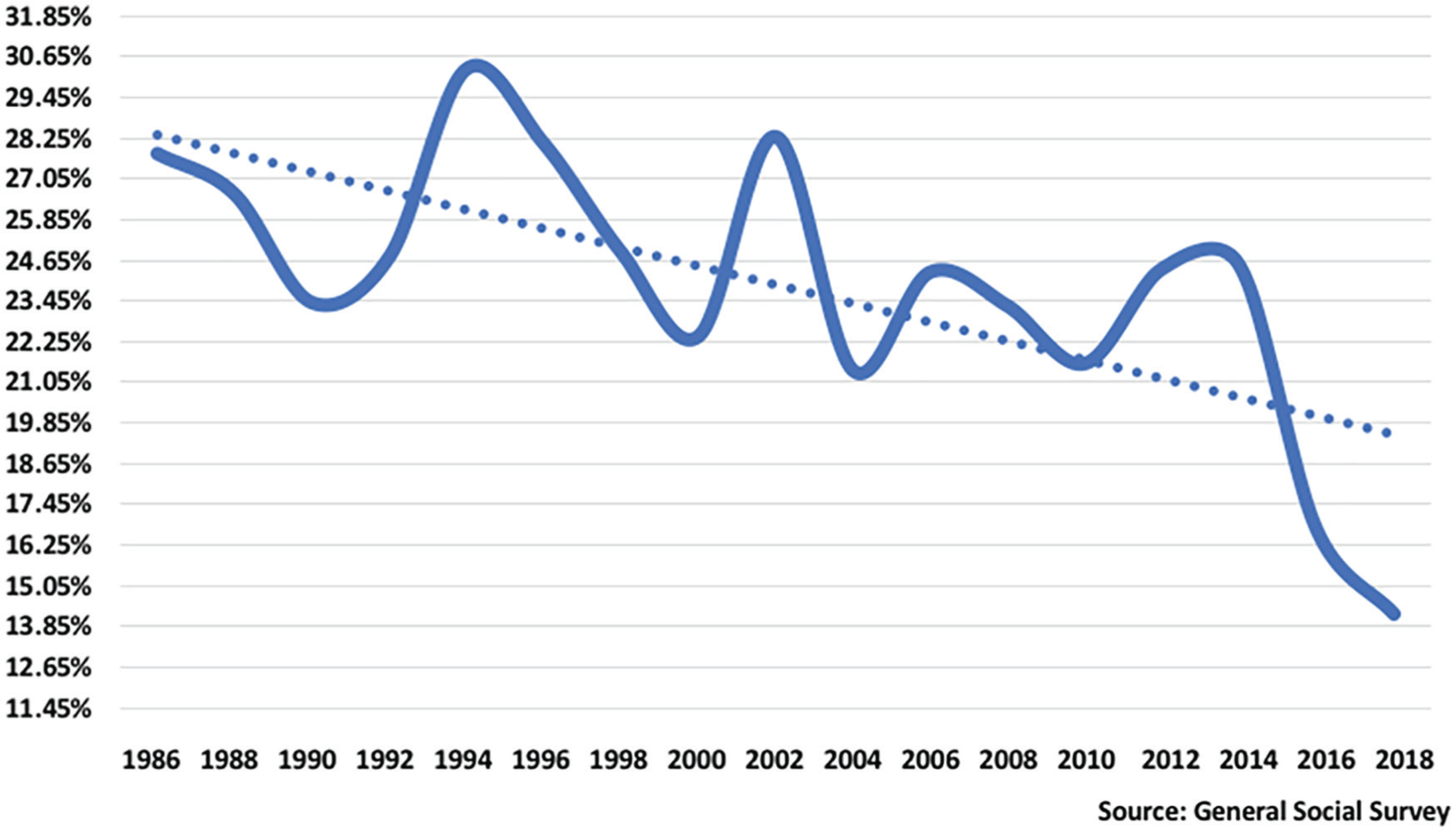
Percentage of the general population agreeing that there is too much spending on improving the conditions of blacks, 1986 to 2018.
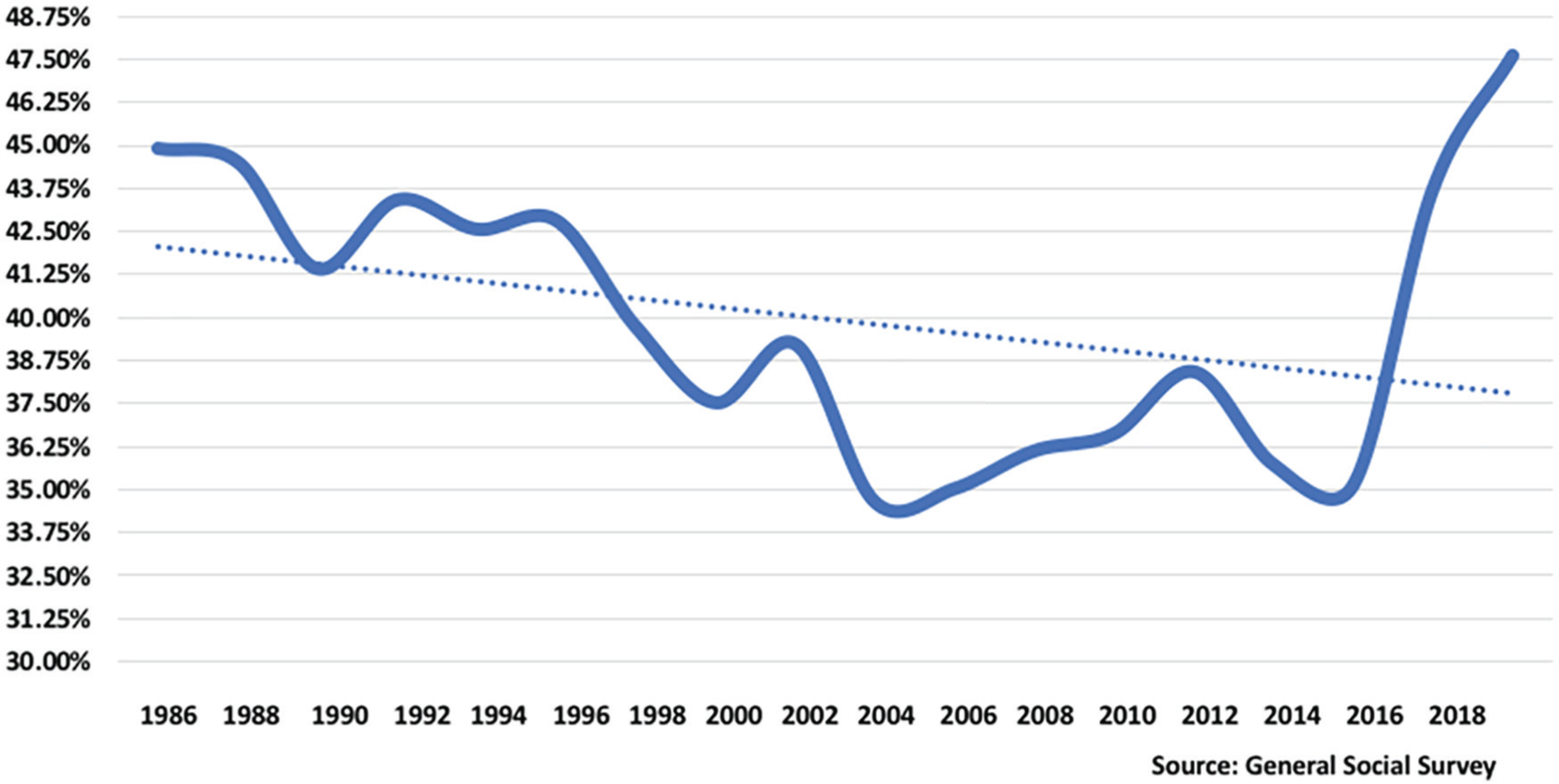
Percentage of the general population who believe that contemporary racial inequalities are due mostly to discrimination, 1986 to 2018.
Data and Measurement
Our main analyses draw from 1984 through 2018 waves of the GSS to assess whether cops are distinct from the general public and from those of a similar occupation status. The GSS is a full probability sample of English-speaking adults living in households in the United States (for a full description of the GSS, see Davis, Smith, and Marsden 2007). The resulting samples across pooled GSS waves are 23,138 (spending too much on law enforcement; mean = 9 percent), 28,384 (approval of police physical force; mean = 69 percent), 21,026 (spending too much on assistance to blacks; mean = 24 percent), and 27,725 (racial inequality is due mostly to discrimination; mean = 40 percent). All analyses that follow use the appropriate GSS sample weight.
Detailed occupational indicators in the GSS allow the construction of a binary indicator for cops. Cops is composed of patrol officers, detectives, and those in supervisor policing positions. Although cops are generally few in any given GSS wave, the pooling of more than 22 waves allows analyses of between 135 and 179 police officers, depending on the particular outcome being examined, and comparative analyses of cops versus the general population. Among those identified as police, between 65 percent and 70 percent are white men, between 14 percent and 21 percent are women, between 14 percent and 17 percent are African American, and 3 percent to 5 percent are of another racial/ethnic group (again, with small variations depending on the outcome analyzed).
Along with the key outcomes described previously and comparison of cops with others, the central modeling also includes individual level controls for African American (mean = .14), other race (mean = .07), 8 female (mean = .55), age (mean = 44.75 years) of respondents, education in number of years (mean = 13.20, SD = 3.04), the natural logarithm of income (mean = 9.47, SD = .64), conservative political affiliation (on a scale of 0–6, from strong Democrat to strong Republican; mean = 2.78, SD = 1.97), and full-time (mean = .52) and part-time (mean = .12) employment (referent: not employed). Finally, the models also account for urban and rural locality (referent: suburban); Northeast, West, and South region (referent: Midwest/central United States), and GSS year. 9
Analytic Strategy and Results
Using logistic regression and iterative interaction modeling, we first report whether cops are unique relative to the general public when it comes to law enforcement spending and police use of physical force. For both outcomes, one could reasonably expect unique occupational identity and vested interest patterns to emerge in these data. Interactions between cop and race, gender and age were introduced one at a time to test for variations and significance, and only significant interactions are included in the final trimmed baseline models (model 1). Model 2 introduces other controls to ensure that any differences associated with cops persist and not accounted for by, for instance, education, income, locality type, or more general political affiliation. We then report parallel analyses of racialized or racist views. Although prior research has linked such views to specific racial groups and the issue of group interest, few analyses to date have interrogated occupationally specific patterns in these regards and, in the case of our analyses, those pertaining especially to police (for recent exceptions, see especially LeCount 2017 and Braddock et al. 2020).
To boost confidence in the veracity of results, we also undertake an alternative modeling strategy and robustness check. In this regard, we limit the samples and compare cops with only those of similar occupational status 10 and replicate baseline models and significant interaction effects reported earlier. 11 This robustness check reduces the overall sample sizes to between approximately 2,400 and 3,500 respondents and bolsters confidence that the main effects observed earlier are not simply a function of large sample sizes or unaccounted for effects surrounding higher occupational status.
Spending on Police, Police Use of Force, and Cops’ Vested Occupational Interests
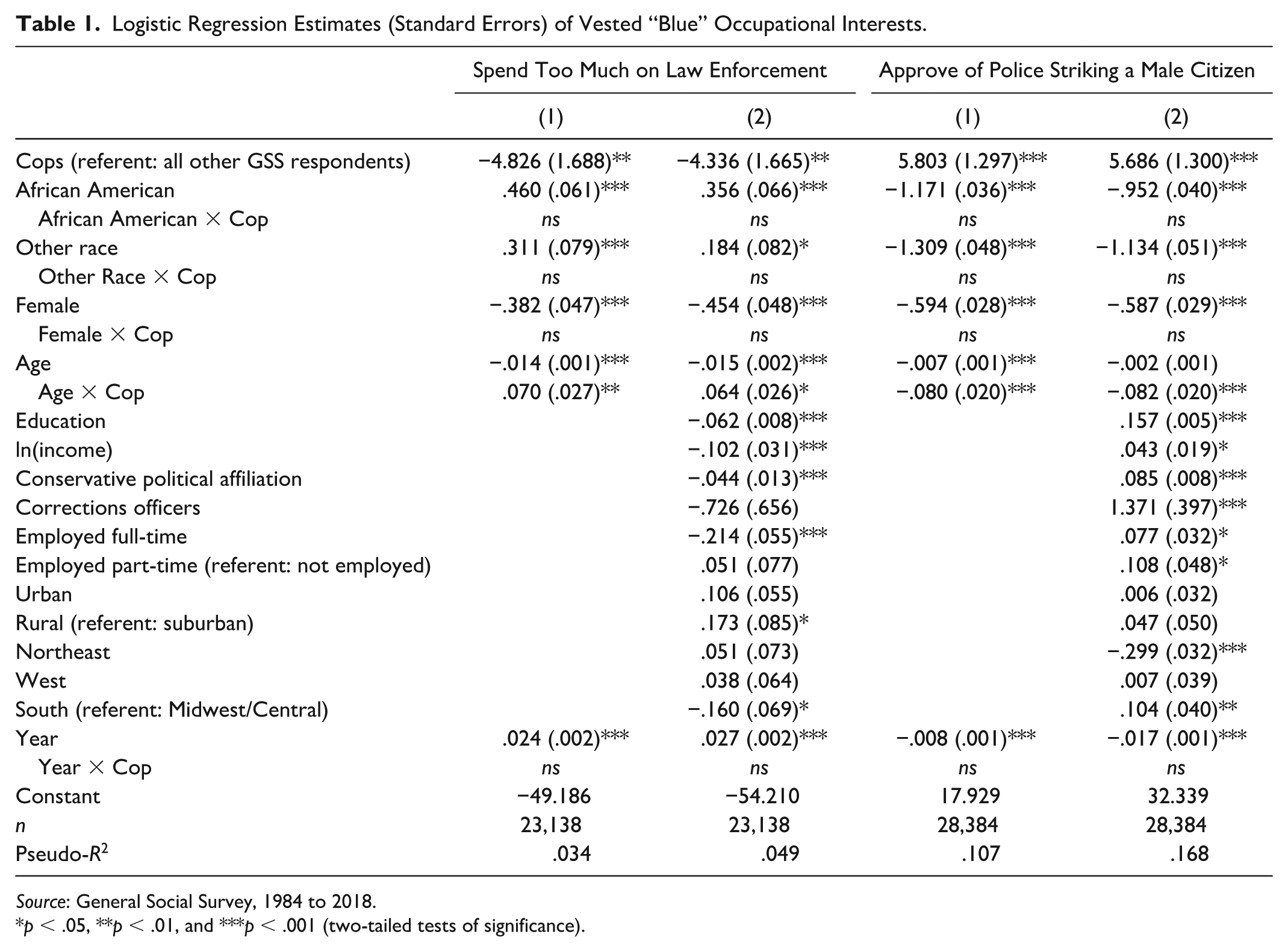
Model 1 in Table 1 suggests quite clearly that cops’ views of spending and justifications for police use of physical force squarely align with their occupational identities and interests, in a manner that is distinct from the general U.S. adult population. Such effects appear to be consistent regardless of race and gender, although they do vary by age. Specifically, it appears that younger officers are more apt to support police spending than older officers and are also more likely than older officers to see police use of physical force as more legitimate. We suspect that these age differences are tied to rank; hypermasculinity among newer, younger officers; and possibly a higher level of accountability of senior, higher ranked officers when force is used. Consistent with the trends reported earlier, the effect of year reported at the bottom of the table is positive for (too much) police spending and negative for police use of physical force, and there appears to be no significant change among officers across either outcome over time.
Logistic Regression Estimates (Standard Errors) of Vested “Blue” Occupational Interests.
Source: General Social Survey, 1984 to 2018.
p < .05, **p < .01, and ***p < .001 (two-tailed tests of significance).
The inclusion of individual and geographic controls in model 2 indicates that more advantaged individuals (i.e., more education, higher income, white, and male), those who are corrections officers, and those with more generally conservative political affiliations are more supportive of police funding and use of force. Their inclusion, however, does little to explain away the unique and strong stance of cops on both of these issues. Although education is often presumed to be a liberalizing factor with regard to social relations, inequality and interaction, this hardly appears to be the case when it comes to police funding and interactions with the public. Last, the South stands out as especially unique and conservative relative to other regions, while those located in the Northeast appear to be less tolerant of police use of force.
These results, at least as presented thus far, offer evidence of “blue culture” and an alignment of occupational interests and identities with funding and use of physical force. Although this, in and of itself, is probably of little surprise, the fact that cops are so distinct from the general public is noteworthy. Moreover, it suggests that those currently prodding for defunding and/or greater police accountability for treatment and interactions with the public will likely face staunch resistance from the very outset from police, police departments, and their representatives.
Racialized Beliefs: Assistance to African Americans and the Importance of Discrimination
Much attention and focus of previous and current BLM protests center on disparate police treatment of Black Americans and Black American communities, a focus that has likewise seen similar emphases in recent sociological attention to racism in policing (e.g., Preito-Hodge 2020b; Ray 2020a), police reliance on deadly force (Hirschfield 2015; Preito-Hodge and Tomaskovic-Devey 2020), and police violence on communities of color (Edwards et al. 2019). To what extent, however, are cops similar or distinct when it comes to racialized and arguably racist views, and above and beyond the more general occupational interests analyzed previously? Table 2 addresses this question.
Logistic Regression Estimates (Standard Errors) of Racist Attitudes.

Source: General Social Survey, 1984 to 2018.
p < .05, **p < .01, and ***p < .001 (two-tailed tests of significance).
Especially notable in Table 2 is how much police stand out as unique and in ways that support the contention that their worldviews are more racist in character. Focusing first on model 1 and converting log odds to odds ratios for interpretability, cops are about twice as likely as members of the general public to view spending on assistance to African American as being too much. They are also about half as likely as the general public to see discrimination as mainly responsible for contemporary inequalities in housing, work, and education. The first pattern, regarding spending and deservingness, seems to hold for all cops, regardless of race, gender, and age. Our findings regarding the denial of discrimination as important notably reflect the views of white and male officers (who constitute the majority of their occupation) in particular. Indeed, the consistent and significant interactions suggest that African American, other racial/ethnic, and female cops are much more likely than their white male counterparts to see discrimination as pertinent to contemporary institutional inequalities (see also Braddock et al. 2020; LeCount 2017; Pew Research Center 2017).
Model 2 introduces other individual status attributes and geographic indicators. Here, education and income have expected and contrasting effects, conservative political affiliations are aligned with more rigid stances on spending for African Americans and recognition of discrimination, and corrections officers and those employed full-time appear to be somewhat more conservative, depending on the outcome. Rural respondents are more averse to assisting African Americans, while urban residents and those residing in the Northeast and West are more apt to recognize discrimination’s significance. Finally, those residing in the South are more conservative and arguably racist, on average, in both regards.
The fact that gaps between cops and the general public on both outcomes persist throughout, even with the introduction of these controls, lends support to the presumptions that (1) cops generally, but especially white male cops, hold arguably more racist views than the general public, and (2) such views coexist simultaneously with occupationally specific “blue” identities and vested interests (analyzed previously). Such coexistence, if and when activated within the process of policing, is both problematic and dangerous for minority communities while also possibly posing contradictory identity dilemmas for minority and female officers.
Comparing Cops with Only Those of Similar Occupational Status: A Robustness Check
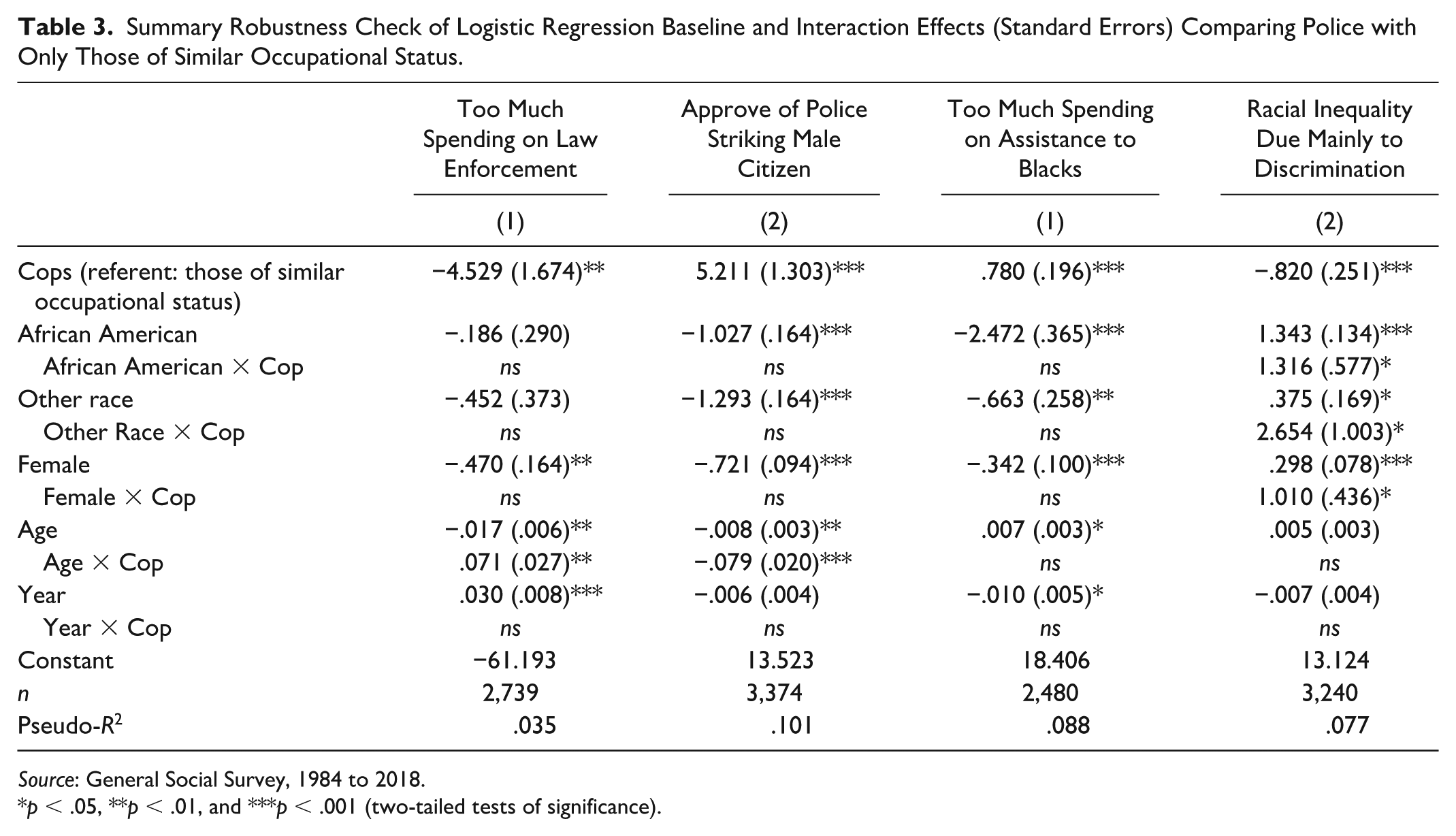
To ensure that the effects observed, especially the unique stances of police officers, are not being driven merely by large GSS sample sizes, overlooked status differences, or problematic comparisons, we retested each baseline model with interactions but limited the overall sample and comparison to cops versus those of largely similar occupational status. Results across each of the four outcomes for these models are reported side by side in Table 3.
Summary Robustness Check of Logistic Regression Baseline and Interaction Effects (Standard Errors) Comparing Police with Only Those of Similar Occupational Status.
Source: General Social Survey, 1984 to 2018.
p < .05, **p < .01, and ***p < .001 (two-tailed tests of significance).
As was the case with the previous modeling, officers are occupationally aligned in vested ways when it comes to law enforcement spending and approval of police use of physical force but are also uniquely conservative in their racialized views of assistance to African Americans and the extent to which discrimination is seen as contributing significantly to racial inequality. Although those of a similar status may be somewhat aligned directionally with cops on policing issues (see effects of education and income earlier, in Table 1), here we see that cops are more staunchly conservative in their views of policing and racial inequality compared with their similar occupational status peers. Similar conditional effects to those observed previously are likewise observed in Table 3, effects pointing to some age and potential rank effects among officers on policing issues specifically, minority and female cops’ recognition of discrimination as an important force underlying contemporary inequality, and higher levels of racial antipathy among white male cops in particular.
Discussion and Conclusions
The murders of Ahmaud Arbery, Breonna Taylor, George Floyd, and countless others, along with the social movement mobilization that has occurred since, has amplified critically important questions about police funding, use of force, race-specific tensions with police, and unjust and deadly consequences for minorities. Sociology is especially well positioned to speak to these topics and, in fact, has been doing so recently in analyses and discussions of deadly force and its disparate impact (e.g., see Edwards et al. 2019; Hirschfield 2015; Ray 2020a, 2020b). More research is warranted, however, especially as policy agendas surrounding police funding, training, and tactics move forward. It is for this reason that we set out to assess whether and/or to what degree cops differ from the general population and from peers of similar occupational status.
Our analyses, drawing on four decades of pooled GSS survey responses, suggest that cops are indeed distinct in potentially problematic ways. First, and with the exception of some variations by age, police officers display largely uniform stances consistent with their “blue” occupational identities and interests, a pattern that will more than likely result in significant resistance to BLM calls for defunding and restructuring of tactical policies and that also probably helps explain law enforcement’s aggressive, relatively militarized response, and aggressive treatment of protesters. The problem, however, seems to run deeper still, as suggested by our analyses of views on African Americans assistance and discrimination. If cops (1) disproportionately surveil and patrol minority communities, (2) are generally more racist in their orientations and beliefs, and (3) believe that they have the right to use physical force against citizens because of their occupational position, then addressing racial violence in policing will be a complex undertaking, to be sure—an undertaking fraught with significant internal resistance and that will necessitate major restructuring of both policy and personnel.
Understanding from where “blue” occupational identities and interests arise seems relatively straightforward. Most occupational groups would, if the situation demanded, probably fight to protect their own interests. In the case of policing—an occupation that has historically been white and male segregated, has had a strong union presence, and in which reliance on one another is arguably essential for safety—occupational identity and interests are solidified in ways that will be difficult to shake and that, moreover, are legitimated internally and externally by notions of the “thin blue line.” But what of cops’ racialized views compared with the public? Do these derive from some selection process into policing from the very outset? Or might the actual character and structuring of policing itself (i.e., surveillance and patrolling of poor and minority neighborhoods, vilification and suspicion of minority youth, etc.) create or at least reify racialized views and racist assumptions? Although the cross-sectional nature of our data precludes specific insights on these issues, these are and will be important questions, especially in the face of policy reassessments. Future sociological work, especially that entailing in-depth qualitative work, organizational analyses, and attitudinal research, can be especially informative here. A helpful theoretical launch point—a launch point that could offer insight on how organizational culture might be penetrated and dismantled—would be recent literatures on relational dynamics and inequality within and across organizations (Tomaskovic-Devey and Avent-Holt 2019), perspectives centering on the fundamentally racialized nature of organizations (Ray 2019), and attention to how power abuses and disparate treatment emerge despite claims of organizational neutrality (Roscigno 2011).
No less interesting within our results were observed variations for minority and female compared with white male officers. Our results in this vein point to general alignment when it comes to occupational identity and interests yet important divergences surrounding the salience of discrimination in the creation of contemporary racial inequalities (see also LeCount 2017; Pew Research Center 2017). Is minority and female cops’ recognition of discrimination general in character, or is it connected directly or indirectly to their own job experiences? And, no less important, how do they balance prospective tensions between occupational identities, on one hand, and what they see as the root sources of inequality on the other?
These are fascinating and important questions, particularly if police departments attempt to diversify, and recent work is certainly informative. Preito-Hodge (2020b), for instance, recently found that Black police officers’ responses to racialized policing practices were conditioned by officers’ role orientations (i.e., racially conservative, racially neutral, and racial justice) and situational and contextual factors. For example, in the presence of white officers, racially conservative and racially neutral officers police in ways that are consistent with the existing blue organizational frame (e.g., aggressive and discriminatory). Those Black officers who had experienced racial discrimination (e.g., racial profiling, subject to police violence) either before or during their tenure as officers, in contrast, hold more critical views of policing (i.e., racial justice oriented). Along somewhat similar lines, Morris and LeCount (2020), drawing on three national survey samples, found an important link between racial resentment and punitiveness and police spending. Such work suggests a complex interplay of racial attitudes and policing that our data are unable to address but that we hope future scholarship will be able to explore. Additional in-depth interviewing along these lines would be useful by pinpointing the sequence of attitude formation, the intersection of racial and policing attitudes, trade-offs that minority and female officers experience, and/or whether such cops find ways of engaging in what DuBois (1897) referred to as “double-consciousness” (see Preito-Hodge 2020a).
We are at a critical inflection point in American history. The façade of color-blind racism and implicit bias in policing is stubbornly fading, and calls for more race conscious politics has set the tone for policy makers across the county. To move forward in conversations around police reforms, we must first look to our past and present to understand (and admit) what has not worked. Political leaders and police administrators must invest in data-driven research that draws on both qualitative and quantitative methodologies and do away with the notion that police actors are best fit to study policing issues.
Reform, to be clear, must also undoubtedly be multilayered. First, it will require a significant shift in control and power from bureaucratic hierarchies in police departments to the communities they serve. Such a shift must prioritize the general needs and interests of the community, as long as those needs do not infringe on the rights of others. Second, reform and reinvestment must also take place in city social services and communities (e.g., social work, education, community programming). Third, current policies that incentivize police militarization and occupation, especially in communities of color, must be abandoned, and political leaders must be held accountable for policies that provide cops with “qualified immunity” and those that disproportionately target marginalized communities. In this regard, and given some of our results, police organizational culture must be dislodged, and officers whose beliefs and behaviors are antithetical to the very communities they serve should be removed. Finally, the role of police as gatekeepers to a criminal and juvenile justice system fraught with racist practices (see Clair and Winter 2016) must be critically challenged. We hope that sociological work on these pressing matters, and what we know about policing, race, and inequality, will be front and center to these conversations and help inform policy efforts in a more just direction.
Footnotes
Acknowledgements
We are grateful to Donald Tomaskovic-Devey, Alexandra Kalev, Sam Roscigno, and the editors and reviewers of Socius for thoughtful and constructive suggestions on prior versions of this article.
