




Abstract
Collective action is a fundamental feature of human social life. If public goods are to materialize, social norms are to emerge, and social protests are to succeed, individuals must act jointly to achieve their collective ends. But how can collective action evolve when individuals receive the benefits of a common good without contributing to its production? According to theories of the critical mass, the success of collective action hinges on the type of production function required for the provision of a common good. Production functions and mobilization functions, however, have proven difficult to observe empirically in large groups. Here, the authors report results from a factorial survey experiment administered to a disproportionate stratified random sample of undergraduate students (n = 880) that required respondents to rate their perceptions of and intentions to participate in a hypothetical student protest. Results show that the population-average production and mobilization functions are decelerating, but individual heterogeneity is observed around the population averages. Moreover, the experiment demonstrates that latent class trajectories of production and mobilization functions, rather than population-level consensus or complete individual heterogeneity, exist in the population. The authors show that the majority of latent class trajectories are decelerating, while a minority are linear or relatively constant. The authors find that subjective interest in the common good and attitudes toward protest predict membership in latent class trajectories. Importantly, the authors provide evidence for the predictive validity of their estimates. The authors discuss the implications of these results for theories of the critical mass and for promoting collective action.
Keywords
Many of the most challenging problems we face today reside at the intersection of individual interests and collective goals. For some situations, individually reasonable behavior produces outcomes in which everyone is better off in the aggregate. For other situations, social dilemmas loom large and collective action problems seem inescapable: individual rationality leads to collective irrationality (Balliet 2010; Hardin 1982; Kollock 1998; Olson 1965; Van Lange et al. 2013). To comprehend the logic of collective action, theories of the critical mass have focused on the relation between the level of resources contributed toward the production of a common good and the level of the common good that is provided, a relationship known as the production function (PF) (Marwell and Oliver 1993; Oliver, Marwell, and Teixeira 1985; Oliver and Marwell 1988, 2001). By examining PFs, we can gain a better understanding of the conditions favorable or unfavorable to collective action.
This is an important stream of research given Mancur Olson’s (1965) original claim: collective action in large groups is impossible unless selective incentives are available that motivate individuals to act in their common interests. In the absence of selective incentives, self-interested individuals will free-ride on the efforts of others. Contrary to Olson, theories of the critical mass claim that the dynamics of collective action are more dependent on the shape of the PF than on group size or selective incentives.
Oliver et al. (1985) and others (Heckathorn 1989, 1996; Kollock 1998; Opp 2009) have identified common types of PFs relevant to collective action, four of which we review: accelerating, decelerating, linear, and step. With an accelerating PF (Figure 1A), initial contributions have the smallest effect, with additional contributions generating increasing returns. Positive interdependence characterizes accelerating PFs: each individual’s contribution makes the subsequent individuals’ contributions more worthwhile, and thus more likely. For this reason, the success of collective action marked by accelerating PFs, such as social revolutions, hinges on a critical mass of motivated actors who, by contributing first, can hurdle past the initial efficacy problem (Marwell and Oliver 1993; Vasi and Macy 2003).

General types of production functions. (A) Accelerating. (B) Decelerating. (C) Linear. (D) Step, or discontinuous.
A decelerating PF (Figure 1B), in contrast, produces great returns for the initial contributions but generates increasingly diminishing returns as contributions increase. Negative interdependence characterizes decelerating PFs: each individual’s contribution makes the next individuals’ less worthwhile and thus less likely. As a result, forms of collective action that have the general character of a decelerating PF, such as demonstrations and protests, must somehow overcome the free-rider problem or witness underinvestment and inefficiency (Oliver et al. 1985). The majority of contributions to real common goods are made when the PF approximates a decelerative curve (Oliver and Marwell 2001).
With a linear PF (Figure 1C), each added contribution yields the same amount of the common good regardless of how much has already been contributed. This type of PF produces dichotomous collective action in which everyone will contribute either everything possible or nothing at all. Linear PFs have no startup costs or diminishing returns and are rarely observed in the production of real common goods. For a step PF (Figure 1D), little or no amount of the common good is produced until a certain threshold is achieved, at which point a small increase in the level of contributions returns a large and discontinuous amount of the common good. An example of a step PF is voting: the one vote that changes a minority to a majority yields a large amount of the common good (Hardin 1982). Finally, although not shown, general third-order PFs exist as well. These S-shaped PFs consist of an accelerating and a decelerating function in which participants of collective action must simultaneously contend with efficacy problems and free-rider problems.
With some types of collective action, third parties supply common goods. In the case of protest, the act of protest itself is the contribution and the third party (who is often a target of the protest such as the state) provides the common good. In these cases, it is important to distinguish the PF from the mobilization function (MF), which is the relation between participation of a certain proportion of a group and the level of cooperation of other members of the group (Opp 2009). It is also necessary to highlight that the PFs required for third-party provision of common goods are often unknown and uncertain to participants. Subjective PFs inform collective action under these conditions. PF and MF curves may thus differ empirically in the provision of common goods. For instance, many large-scale antiwar protests exhibit accelerating MFs but decelerating PFs (Opp 2009). In this case, the level of collective effort (MF) may not yield the desired collective end (PF). The theoretical and empirical distinction between PFs and MFs is therefore critical for any analysis of collective action.
Mapping subjective PFs and MFs empirically, however, presents four methodological challenges. First, fully tracing individual PFs and MFs is not possible by observing the point at which group size motivates an individual to participate in collective behavior. This type of research design limits counterfactual analysis: what would an individual believe, or how would they act, beyond their tipping point? To trace out subjective PFs and MFs, individuals should be exposed to a spectrum of group sizes below and above the point at which others’ participation spurs them to act. Second, introducing treatments of various magnitudes, such as a small-, medium-, and large-scale protest, is logistically difficult to manipulate in the lab or the field. Third, political protest and social movement research tends to observe collective behavior in situ and recruit participants of collective action while overlooking bystanders, which limits causal identification and population-based inferences (Gerring 2011; King, Keohane, and Verba 1994). Fourth, the noninterference assumption—that the outcome of one unit is unaffected by the assignment of treatments to other units—is difficult to maintain in large-scale studies of contagion and social influence (Aronow and Samii 2017). To maintain this assumption, researchers must prevent units who receive one treatment assignment from interfering with units who receive a different treatment assignment (Rosenbaum 2007). These four methodological challenges account for why most of the research on PFs and MFs as well as threshold models of collective behavior consist of theoretical simulations or post hoc applications (Centola 2013; Chwe 1999; Crossley 2008; Crossley and Ibrahim 2012; Granovetter 1978; Heckathorn 1993; Kim and Bearman 1997; Kuran 1991; Macy 1990, 1991; Oberschall 1994; Schelling 1978).
In an attempt to push the empirical literature forward, we administered a Web-based factorial survey experiment of student protest to a disproportionate stratified random sample of undergraduate students (n = 880) at a large public university in the United States. Respondents were informed of a hypothetical scenario in which the university administration supported a proposed tuition increase. In response, a new student group had formed to oppose the tuition increase by organizing a walkout during final exams week. In addition to manipulating a number of vignette dimensions concerned with the size of the tuition increase and pecuniary costs of participation, each respondent was randomly assigned without replacement 12 levels of the size of the protest, which ranged in size from 0 to 22,000 students (or 95.65 percent of the student body). Each respondent assessed 12 unique vignettes, all of which contained, in random order, the 12 levels of the size of the protest. To operationalize the PF, we used the size of the protest as the level of resources contributed toward the production of a common good and subjective probabilities of the protest’s success as the level of a common good that will be provided (Oliver et al. 1985). To operationalize the MF, we used the size of the protest as the level of participation in a group and the respondents’ probabilistic intention to participate as the level of cooperation (Opp 2009). Six months after completing the factorial survey experiment, 49 percent (n = 432) of the original subjects participated in a follow-up survey measuring self-reports of social and political action. This was done to assess the predictive validity of our statistical estimates modeled from the factorial survey experiment.
Our research design allows us to address the four methodological challenges outlined above. First, by randomly assigning the same broad spectrum of protest sizes to each respondent, we can causally identify estimates of PFs and MFs and visually map out between- and within-individual variation in each. This design feature is important: theories of the critical mass assume a single PF and MF curve for any given collective action in a population, and that individuals know the true functional form of the PF and MF (Marwell and Oliver 1993; Oliver et al. 1985; Oliver and Marwell 1988, 2001). We relax the assumption of a single PF and MF curve and posit individual heterogeneity around the aggregate functional forms within the population. With our design, we investigate whether latent subgroups of PFs and MFs exist and predict latent class membership as a function of interests and resources—parameters central to theories of the critical mass—as well as other variables favored by alternative models of collective action (Fehr and Gintis 2007; Henrich et al. 2001; Lichbach 1995; Teske 1997; Tilman, Dixit, and Levin 2019). Second, the hypothetical nature of our design grants us the ability to manipulate small-, medium-, and large-scale protests. This is a unique feature of factorial survey experiments that escapes traditional lab experiments and field experiments. Third, we drew a disproportionate stratified random sample of respondents (freshman, sophomores, and juniors) from a sampling frame that included all registered undergraduate students for a particular academic quarter. This research strategy dramatically reduced coverage error and sampling error and avoided sampling on the dependent variable, which is endemic to the social movements and political protests literature. Fourth, our research design maintains the noninterference assumption by virtue of being Web based and hypothetical. To match our design on causal inference, a large-scale field experiment of social protest would have to employ thousands of confederates to serve as treatments (i.e., protest size) and randomly generate groups of subjects to receive varying sizes of the treatment. Not only is this imaginary study prohibitively expensive and logistically difficult to coordinate, but preventing subjects who receive one treatment assignment from interfering with subjects who receive an alternative treatment assignment is a herculean task.
Using our design, we observe population-average decelerative PFs and MFs as well as between-individual heterogeneity around these population averages. We also reveal latent class trajectories of PFs and MFs, as opposed to population-level consensus or complete between-individual disagreement. Although the majority of the latent class trajectories are decelerating, a minority are linear or relatively constant (i.e., classes of individuals characterized by dispositions for collective action independent of others’ decision making). We find that membership in the latent class trajectories of PFs and MFs are predicted by interest in the public good and attitudes toward protest. Finally, estimates from our statistical models predict self-reports of political action occurring six months after the experiment. In the discussion, we reconcile our findings with the existing literature on critical mass models of collective action and identify avenues of future research.
Methods
Respondents
We recruited 880 respondents from a disproportionate random sample of 3,000 undergraduate students. In terms of relative majorities, 57.5 percent of the respondents were female, 44.4 percent were non-Hispanic white, 40.6 percent were juniors, 73 percent were in-state residents, and the average age was 19.9 years old. See Tables S2 and S3 in the Supplemental Materials online for more information about the sociodemographic characteristics of respondents.
The sample was drawn from a sampling frame of all freshman, sophomore, and junior undergraduate students who were legal adults (ages 18 and older) registered at the University of Washington for the autumn quarter of 2014 (N = 20,241). Students from other satellite campuses, such as the University of Washington at Tacoma, were excluded from the sampling frame, as were students who previously participated in pilot studies and pretests. The Council of American Survey Research Organizations response rate was 31.67 percent, and the American Association for Public Opinion Research cooperation rate was 64.99 percent. For the follow-up survey, we recruited 432 of the 880 respondents six months after the original data collection effort (further details about sampling error and nonresponse error can be found in the Supplemental Materials online). Respondents were compensated US $10 for completing the factorial survey and US $10 for completing the follow-up survey.
Procedure and Experimental Design
Respondents completed an online survey. First, respondents read an informed-consent document and were asked to voluntarily consent to participate. Next, they read instructions about a hypothetical situation in which a student walkout was being organized to protest a proposed tuition increase at the university. The instructions included information about the goals of the protest, emphasized the collective action problem, and told respondents what they were going to evaluate. Respondents were then asked to assess 12 different hypothetical scenarios.
For each hypothetical scenario, we manipulated the size of the protest as well as other vignette dimensions such as the magnitude of the tuition increase. Respondents then made decisions about the percent chance that the student walkout would succeed (likelihood of success) and the percent chance that they would take part in the student walkout (intention to protest). Likelihood of success and intention to protest were both measured using horizontal visual analogue scales with a slider bar that ranged from 0 to 100. Following critical mass models of collective action, we assume a single PF and MF for any given collective action in a population. Unlike critical mass models, we do not assume that individuals know the true functional form of the PF or MF. Instead, we assume that knowledge about the PF and MF is subjective and posit individual heterogeneity around the population-average functional forms. Because of these two assumptions, we contend that self-reports are a reasonable strategy for the measurement of PFs and MFs. For this contention to hold, we further assume that random (or systematic) measurement error is minimal. After evaluating the 12 vignettes, respondents filled out a survey questionnaire, were shown a debriefing statement, and were thanked for their participation. Further details about the factorial survey experiment and survey questionnaire can be found in the Supplemental Materials online. The median survey length was approximately 29.40 minutes.
Six months after the factorial survey experiment, respondents completed an online follow-up survey. As before, respondents read an informed-consent document and were asked to voluntarily consent to participate. Respondents were then asked whether and how often they participated in nine different types of political action during the past six months, such as having written a letter expressing a point of view to an editor or a politician, signed a protest letter or petition, or participated in a demonstration or protest march (see the Supplemental Materials online for further details). After providing self-reports of political action, respondents filled out a survey questionnaire, were shown a debriefing statement, and were thanked for their participation. The median survey length of the follow-up survey was approximately 10.43 minutes.
Number of Protest Participants
Each respondent was randomly assigned without replacement 12 levels of the size of the protest, which ranged in scope from 0 to 22,000 students: 0, 1, 3, 7, 20, 55, 150, 400, 1,100, 3,000, 8,100, and 22,000. The values we selected were based on an exponentiated quasi-log scale. When logged, nonzero values would approximate a vector of integers ranging from 0 to 10. This is an important strategy because we assume that small differences at small numbers (e.g., between 0 and 1) are more important than small differences at large numbers (e.g., between 10,000 and 10,001). The exponentiated values of the quasi-log scale allow us to capture meaningful variation at the low end of the scale and to observe values toward the high end of the total target population. By having each respondent evaluate vignettes with all 12 levels of the size of the protest, we can obtain estimates of the shape of the PF and MF within and between individuals in the population. 1
Results
Observed Trajectories of Likelihood of Success and Intention to Protest
Despite opportunity and short-term incentives for nonparticipation, respondents’ expectations about the success of, and intention to participate in, the hypothetical student protest were greater than zero. The mean probability of expected success averaged across vignettes and respondents was 36.253 (SD = 30.635), while the average probability of participating in the student protest was 36.578 (SD = 34.925) (Figures 2A and 2B). The sample averages support the idea that tuition increases are a salient political issue for the population under study and that there is no universal tendency toward free riding. Yet the observed trajectories shown in Figures 2C and 2D suggest that growth in the likelihood of success and intention to protest might be decelerative. Decelerating PFs and MFs indicate that returns to participation are greater early on but diminish as the size of the protest increases, resulting in underinvestment and inefficiencies in the protest overall. 2

Frequencies, observed trajectories, and growth estimates. (A) Frequency of ratings of likelihood of success (10,483 vignette ratings). (B) Frequency of ratings of intention to protest (10,462 vignette ratings). (C) Solid blue lines indicate observed individual trajectories of likelihood of success by number of participants (n = 880). (D) Solid purple lines indicate observed individual trajectories of intention to protest by number of participants (n = 880). (E) Solid blue lines indicate predicted individual-specific growth curves of likelihood of success based on estimates of the means, variances, and covariances found in model 2, Table 1 (n = 880). The solid lime-green line designates the predicted population-average growth curve of likelihood of success based on the fixed portion of model 2, Table 1. (F) Solid purple lines indicate predicted individual-specific growth curves of intention to protest based on estimates of the means, variances, and covariances found in model 4, Table 1 (n = 880). The solid cyan line designates the predicted population-average growth curve of intention to protest based on the fixed portion of model 4, Table 1.
Growth Curves of Likelihood of Success and Intention to Protest
We used hierarchical growth curve models (HGCMs) to estimate the between- and within-individual PFs and MFs (Bryk and Raudenbush 1987). Instead of time, we modeled growth as a function of the size of the protest (i.e., the number of protest participants manipulated in the factorial survey experiment). Further details about the HGCMs and model selection can be found in the Supplemental Materials online.
In Table 1, HGCMs revealed that change in the likelihood of success as a function protest size is best modeled as quadratic growth (model 2: Akaike information criterion [AIC] = 94,832, Bayesian information criterion [BIC] = 94,904) rather than linear growth (model 1: AIC = 95,680, BIC = 95,724). Estimates from model 2 indicate that the population-average growth in likelihood of success is decelerative (intercept = 26.717, slope = 5.865, quadratic = –.160) and exhibits variation around the random intercept, Var(300.592), random slope, Var(11.916), and random quadratic, Var(0.013). Figure 2E illustrates the individual variation observed around the decelerating PF’s starting point, rate of growth, and rate of decay.
Hierarchical Growth Curve Models of Likelihood of Success and Intention to Protest by Number of Protest Participants.

Note: Maximum likelihood for missing data with robust standard errors (in parentheses) used throughout. Residual variances were constrained to equality for all models. Growth is modeled as a function of protest size (not time). Protest size (or the number of participants) ranges from 0 to 22,000 students. Values of the number of participants are divided by 1,000 to ease model convergence. AIC = Akaike information criterion; BIC = Bayesian information criterion; I = intercept; S = slope; Q = quadratic.
p < .05. **p < .01. ***p < .001.
Similar results were observed for mapping the growth curves of intention to protest. Estimates from model 4 in Table 1 indicate that the population-average growth in intention to protest is decelerative (intercept = 29.660, slope = 4.027, quadratic = –.102) and exhibits variation around the random intercept, Var(414.770), random slope, Var(9.131), and random quadratic, Var(0.010). Figure 2F illustrates the individual variation observed around the decelerating MF’s starting point, rate of growth, and rate of decay.
For both the PF and MF, we found that the population-average functional forms were approximately linear at low levels of participation but decelerate at a tipping point of 8,100 participants (or 35 percent of the hypothetical student body). 3 Given that we graph estimates of the PF and MF by the manipulated number of participants (see Figure 2), we provide figures in the Supplemental Materials online that plot interpolated estimates of the PF and MF.
Latent Class Trajectories of Likelihood of Success and Intention to Protest
Given that we found individual heterogeneity around the population-average decelerative PF and decelerative MF, we posit that subgroups of actor types with divergent interests and resources exist in the population (Fehr and Gintis 2007; Henrich et al. 2001; Kollock 1998; Marwell and Oliver 1993; Oliver et al. 1985; Tilman et al. 2018), which implies different latent class trajectories of PFs and MFs across protest size. The trajectories we expect to find consist of subgroups with fast decelerators (fast rate of decay), slow decelerators (slow rate of decay), other functional forms (accelerating, linear, etc.), as well as cooperative actor types (persistently high PF and MF across protest size) and noncooperative actor types (persistently low PF and MF across protest size). We thus used latent class growth analysis (LCGA) to investigate whether heterogeneous latent groups of individuals vary in their trajectories of PFs and MFs (Muthén and Muthén 2000). After exploring different model estimates and assessing estimates of model fit across k classes of models, k = 1, . . ., 10 (see the Supplemental Materials online for a discussion of LCGA model selection), we settled on a latent four-class solution for likelihood of success and a latent five-class solution for intention to protest.
Figure 3 shows that all four classes of PFs are decelerating to certain degrees. Two of these, C#1 (persistently low) and C#3 (undecided), characterize groups of individuals whose expectations about a protest’s success are largely unaffected by the size of the protest (i.e., the level of resources contributed toward averting the tuition increase). Yet these groups differ with respect to their starting points or PF propensities (C#3 starting point > C#1 starting point). The two other latent classes of PFs, C#2 (slow decelerator) and C#4 (fast decelerator), characterize classic decelerating PFs (Oliver et al. 1985), but differ in their starting points and rates of decay. Fast decelerators (C#4) have greater PF starting points than slow decelerators (C#2) but also faster rates of decay as the size of the protest increases. Finally, the LCGA reveals that the majority of individuals (73 percent) are classified in one of the decelerating PFs (C#2 [slow decelerator] and C#4 [fast decelerator]).

Latent class trajectories of likelihood of success.
Figure 4 shows that three of the five latent classes of MFs are relatively constant, while the other two trajectories exhibit linear and decelerative growth. Three of the latent classes, C#2 (undecided), C#3 (persistently high), and C#4 (persistently low), characterize groups of individuals whose intentions to protest are largely unaffected by the size of the protest. But all three latent classes differ with respect to their starting points. We observe low, medium, and high propensities to participate for individuals in C#4 (persistently low), C#2 (undecided), and C#3 (persistently high), respectively. The two other latent classes of MFs, C#1 (linear) and C#5 (fast decelerator), characterize classic linear and decelerating MFs, respectively (Opp 2009). The linear MF, C#1, implies a one-to-one relationship between the proportion of undergraduate students who are already participating in the student protest and the level of cooperation of student bystanders. The fast decelerator MF, C#5, suggests that individuals are less likely to participate later on as the proportion of protestors increases. The two groups with the largest number of classified individuals are C#1, the linear MF (27 percent), and C#5, the fast decelerator MF (25 percent). All other latent classes constitute a minority of individuals (<21 percent per class). We provide figures in the Supplemental Materials online that plot interpolated estimates of the latent class trajectories.
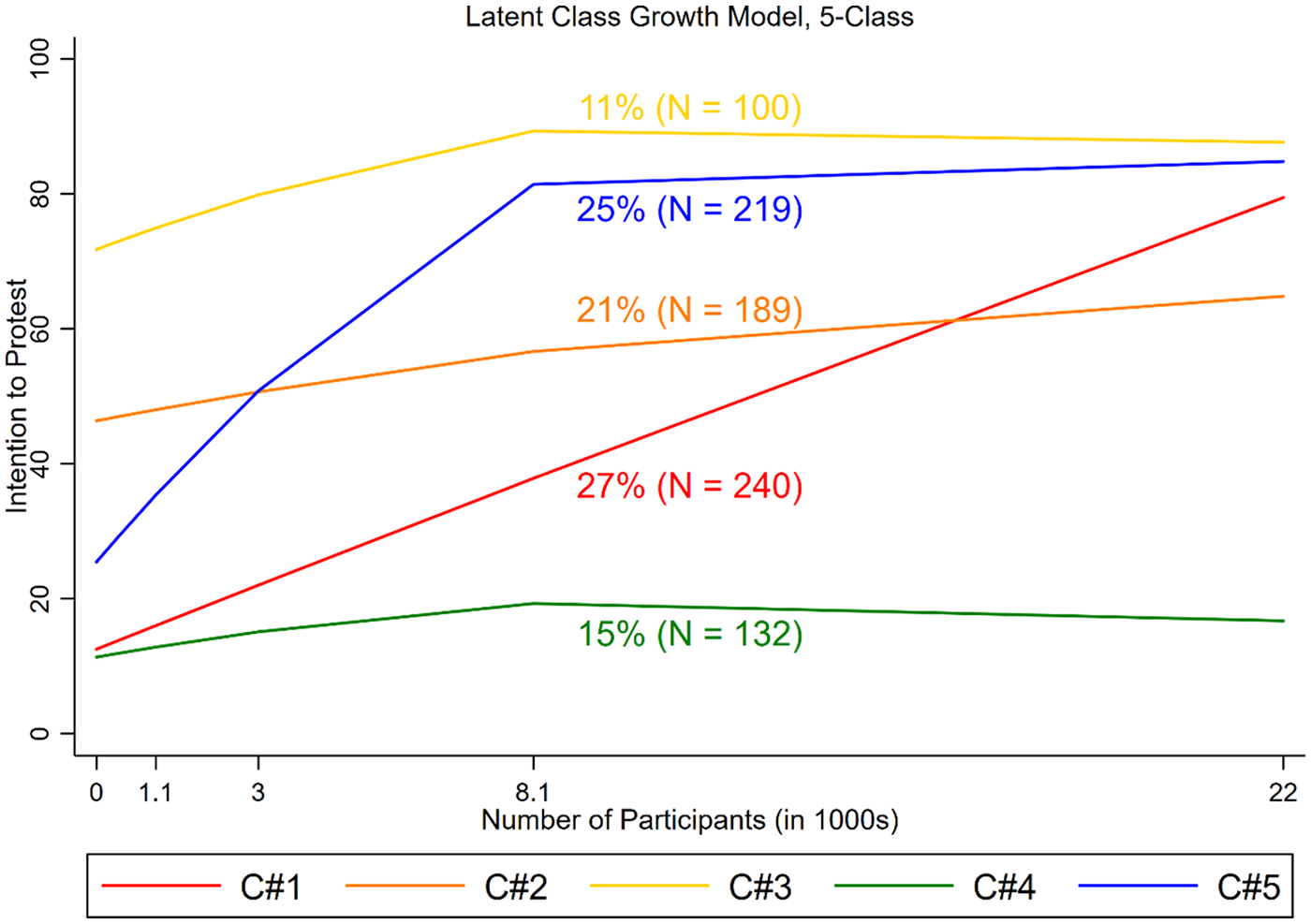
Latent class trajectories of intention to protest.
Predictors of Latent Class Trajectories
Having established different latent class trajectories of PFs and MFs, next we empirically identify their predictors. Theories of the critical mass contend that a PF is determined by (1) interest in (or desire for) the common good and (2) the resources available to produce the common good (Marwell and Oliver 1993; Oliver et al. 1985; Oliver and Marwell 1988, 2001). Interests are defined as an individual’s subjective value of the common good and may be based on any number of factors that motivate action (e.g., monetary gain, social preferences, attitudes toward the common good). Resources refer to an individual’s supply of time, money, materials, staff, or other assets that could potentially contribute to provision of the common good. To investigate interests and resources as predictors of latent class trajectories, we extracted respondents’ class membership. We then constructed a multiply imputed data set and used multinomial logit models to estimate the conditional probability of membership in class k as a function of attitudes, beliefs, preferences, and sociodemographic characteristics (i.e., interests and resources). Details about the multinomial logit models can be found in the Supplemental Materials online.
A number of variables accounted for membership in latent class trajectories of PFs. Of the sociodemographic characteristics, equal fraction-missing-information tests of joint significance revealed that the overall effect of years of education on class membership is statistically significant, F(15, 269,157.2) = 19.33, p < .001, with advanced students less likely to be members of C#2 (slow decelerator) than freshmen or sophomores. Class membership is also a function of attitudes toward protest: for protesting despite failure, positive attitudes toward protesting decreased the probability of membership in C#2 (slow decelerator) but increased the probability of membership in C#3 (undecided), F(3, 121,613) = 7.23, p < .001; for protest as an effective tool for social change, positive attitudes toward protest decreased the probability of membership in C#2 (slow decelerator) but increased the probability of membership in C#4 (fast decelerator), F(3, 96,408) = 4.57, p < .01. Finally, stronger preferences for risk taking decreased the probability of membership in C#2 (slow decelerator) but increased the probability of membership in C#3 (undecided), F(3, 74,972.1) = 3.22, p < .05. Taken together, positive attitudes toward protest decreased the likelihood of membership in the decelerating PF (C#2), which is a PF that, in practice, yields inefficiencies and underinvestment.
Similar covariates predicted membership in latent class trajectories of MFs. Of the sociodemographic characteristics, we found that advanced students are less likely to be members of C#1 (linear) and C#5 (fast decelerator) than freshmen or sophomores, F(20, 724,457.5) = 12.70, p < .001. We also found a statistically significant effect of state residency, F(8, 846,951.7) = 1.96, p < .05, and observed that out-of-state students are more likely to be members of C#2 (undecided) than in-state students. Class membership is also a function of attitudes and preferences: we observed that respondents who would never be willing to participate in a student protest are more likely to be members of C#1 (linear) and C#4 (persistently low) than first movers (i.e., respondents who would be the first person to participate in a student protest) but less likely to be members of C#2 (undecided), C#3 (persistently high), and C#5 (fast decelerator) than first movers, F(8, 69,906.6) = 6.06, p < .001; positive attitudes toward protesting despite failure increased the probability of membership in C#2 (undecided) and C#3 (persistently high) but decreased the probability of membership in C#1 (linear), C#4 (persistently low), and C#5 (fast decelerator), F(4, 136,925.5) = 16.00, p < .001; and stronger identification as a student activist increased the probability of membership in C#2 (undecided), but decreased the probability of membership in C#1 (linear), C#4 (persistently low), and C#5 (fast decelerator), F(4, 126,467.3) = 2.59, p < .05. In short, interests and resources, as operationalized here, predicted to which subgroup of MFs an individual belonged.
The effects of all other variables (e.g., social value orientations, gender, race) on membership in latent class trajectories of PFs and MFs yielded statistically nonsignificant joint tests. See the Supplemental Materials online for full models with estimates of all of the variables as well as plots of predicted probabilities.
Predictive Validity of Estimates
To investigate the predictive validity of our factorial survey experiment, we estimated the effect of intention to protest, measured as individual-specific means (n = 432, M = 36.557, SD = 20.544, minimum = 0, maximum = 100) on self-reports of political action ascertained six months after completion of the factorial survey experiment.
Using logistic regression, we found that intentions to protest were positively associated with the likelihood of joining a demonstration (log odds = 0.025, SE = .009, p < .01) as well as participating in any form of political action (log odds = .025, SE = .005, p < .001) during the six-month period between the administration of the factorial survey experiment and the follow-up survey (see Figures 5A and 5B). Using negative binomial regression (see Figures 5C and 5D), similar findings were observed for the count of demonstrations (log count = .028, SE = .007, p < .001) and political actions (log count = .025, SE = .005, p < .001). See the Supplemental Materials online for estimates and plots of alternative modeling specifications. In sum, we show that estimates from our factorial survey experiment have predictive validity.

Plots of predicted probabilities and predicted counts. (A) Predicted probabilities and 95 percent confidence intervals (CIs) of participating in a demonstration as a function of individual-specific mean intentions (n = 432). (B) Predicted probabilities and 95 percent CIs of participating in any form of political action as a function of individual-specific mean intentions (n = 432). (C) Predicted counts and 95 percent CIs of the number of demonstrations as a function of individual specific mean intentions (n = 432). (D) Predicted counts and 95 percent CIs of the number of political actions as a function of individual-specific mean intentions (n = 432).
Discussion and Conclusion
In 1965, Mancur Olson advanced a paradigm-shifting proposition in the pages of The Logic of Collective Action: unless the number of individuals in a group is quite small, or unless there is coercion or some other special device to make individuals act in their common interest, rational, self-interested individuals will not act to achieve their common or group interest. (p. 2)
In the decades since, research has painted a more optimistic picture of collective action. Under some conditions, individuals embedded in unregulated large groups will act jointly to achieve their common goals (Dietz, Ostrom, and Stern 2003; Hardin 1982; Kollock 1998; Medina 2007; Opp 2009; Van Lange et al. 2013). One perspective in particular—theories of the critical mass (Marwell and Oliver 1993; Oliver et al. 1985; Oliver and Marwell 1988, 2001)—insists that the dynamics of free riding are more dependent on the shape of the PF than on the size of the group or the magnitude of the selective incentives. Free riding, in other words, is avoidable in large groups given the right circumstances (Esteban and Ray 2001; Udehn 1993). However persuasive theories of the critical mass have been, PFs and MFs have proven difficult to observe empirically.
To overcome the intractable problem of mapping PFs and MFs, we developed a factorial survey experiment of student protest and administered it to a disproportionate stratified random sample of undergraduate students. With a follow-up survey, we measured self-reports of political action that occurred in the six months between completion of the factorial survey experiment and administration of the follow-up survey. Our results show that student protest is characterized by population-average decelerative PFs and MFs, but that between-individual heterogeneity exists around these population averages. At low levels of participation, the population-average functional forms are approximately linear, but flatten—or decelerate—once the size of the protest reaches a tipping point of 8,100 participants (or 35 percent of the hypothetical student body). We also model latent class trajectories of PFs and MFs. We show that some latent class trajectories are linear or relatively constant (i.e., classes of individuals exhibit dispositions for collective action independent of the actions of others), while the majority are decelerating. We find that membership in latent class trajectories is a function of interest in the public good and attitudes toward protest. Finally, behavioral intentions measured in our factorial survey experiment were able to predict self-reports of political action that occurred during the six-month period after the experiment.
This study makes several contributions to the literature on collective action and social protest. First, by leveraging a factorial survey experiment, we are able to trace out the PF and MF of social protest. In support of theories of the critical mass (Oliver et al. 1985), we show empirically that PFs and MFs of social protest are decelerating. When turnout is low, the PF and MF are roughly linear, which indicates constant marginal returns to participation until the size of the protest reaches a tipping point of 8,100 participants, at which point returns to participation diminish as the size of the protest increases. Given the results, we would predict that some protest will occur, but provision of the collective good with certainty (averting the tuition increase) is unlikely. The solution is a classic one: provide incentives to individuals who have the least interest in the collective good, so that those individuals with the greatest interest are more likely to contribute later on (Oliver et al. 1985; Olson 1965). This is the first study to experimentally observe these processes.
Second, by using a within-subjects design, we are able to investigate between- and within-individual variation in PFs and MFs. This is important because theories of the critical mass assume a single PF and MF curve within a population for any given common good (Marwell and Oliver 1993). The present findings challenge this assumption by revealing that PFs and MFs vary subjectively between individuals. Third, by embracing a person-centered approach, we are able to detect latent class trajectories of PFs and MFs. Importantly, we find that measures of subjective interest in the common good and attitudes toward protest predict membership in latent trajectories (e.g., positive attitudes about the effectiveness of social protest reduces the likelihood of membership in decelerating trajectories), while other measures such as race and gender do not. This implies that in populations where attitudes toward protest are favorable—say at liberal university campuses—we would expect different types of action and protest outcomes than in more conservative populations because of the distribution and size of latent class trajectories of PFs and MFs.
Our analyses focus on a particular type of collective action: student protest. In this context, the observed effects should be interpreted as a conservative set of results. The findings could diverge in populations with heterogenous interests (e.g., University of California, Berkeley, students) and heterogeneous resources (e.g., Princeton University students), as theories of the critical mass suggest (Marwell and Oliver 1993). We would also expect to observe different types of PFs and MFs for different types of collective action (e.g., paying taxes) and political behavior (e.g., signing petitions). Relatedly, issues with broad consequences for all (e.g., economic inequality), issues that do not directly affect group members (e.g., genocide in other countries), and issues with no simple solution (e.g., climate change) may yield fundamentally different PFs and MFs. We thus welcome future research using similar designs, but focused on different types of collective action in populations facing complex issues with varying consequences.
Because of the research design, our findings are based on static survey responses of subjective beliefs and behavioral intentions and not on actual protest behavior observed in dynamic situations characterized by sequential decision making. The results, however, are relevant. They show that PFs and MFs behave as theoretically expected and can be modeled as a consequence of theoretically motivated variables. Moreover, research shows that behavioral intentions strongly predict self-reports of behavior (as in the present study) as well as behavior observed in other settings (Balliet, Wu, and De Dreu 2014; Hainmueller, Hangartner, and Yamamoto 2015). That being said, future research should use dynamic research designs that examine actual behavior to validate the present findings.
In summary, the results presented here contribute to our knowledge of collective action in general and social protest in particular. Our findings furnish insights into the distribution of PFs in a finite population and supply revelations about the MFs one would expect to observe given actual behavior. Although our results were consistent with predictions of theories of the critical mass, other results suggest that it will be important for theories of collective action to incorporate individual heterogeneity into models of PFs and MFs. Specifically, we propose that greater attention be paid to the diversity and size of latent class trajectories of PFs and MFs that exist in a population. This means that a better understanding of interests and attitudes toward protest is an important task for social science research. A deeper appreciation of the conditions in which collective action blossoms or withers is likely to emerge as a consequence.
Supplemental Material
sj-docx-1-srd-10.1177_2378023120977722 – Supplemental material for Mapping the Production and Mobilization Functions of Collective Action
Supplemental material, sj-docx-1-srd-10.1177_2378023120977722 for Mapping the Production and Mobilization Functions of Collective Action by Blaine G. Robbins, Ross L. Matsueda and Steven J. Pfaff in Socius
Footnotes
Acknowledgements
We are indebted to Aimée Dechter, Maria Grigoryeva, Michael Hechter, Jerald Herting, Edgar Kiser, Yuan Hsiao, Karl-Dieter Opp, Karen Snedker, Katherine Stovel, and the anonymous reviewers for comments, conversations, and/or suggestions. We also thank Richard J. Callahan for programming assistance.
Funding
The author(s) disclosed receipt of the following financial support for the research, authorship, and/or publication of this article: The research reported here was funded by grants from the University of Washington’s Royalty Research Fund (A69919), the Blumstein-Jordan Endowed Professorship in Sociology, and the National Science Foundation (SES-1330559). Partial support for this research came from a Eunice Kennedy Shriver National Institute of Child Health and Human Development research infrastructure grant to the Center for Studies in Demography and Ecology at the University of Washington (R24 HD042828).

Supplemental Material
Supplemental material for this article is available online.
Notes
Author Biographies
References
Supplementary Material
Please find the following supplemental material available below.
For Open Access articles published under a Creative Commons License, all supplemental material carries the same license as the article it is associated with.
For non-Open Access articles published, all supplemental material carries a non-exclusive license, and permission requests for re-use of supplemental material or any part of supplemental material shall be sent directly to the copyright owner as specified in the copyright notice associated with the article.
