




Abstract
The coronavirus disease 2019 (COVID-19) pandemic has upended nearly every aspect of social life in the United States and abroad. People turn to news to provide public health updates about the virus, such as reports of new cases and deaths, but also to understand how COVID-19 is affecting jobs and the economy. The news, irrespective of its format, serves as a central conduit of information during the pandemic. Prior research examining public traumas, such as terrorist attacks, suggests that greater media intake may also amplify perceived threats about the virus and therefore have a negative effect on mental health. We argue that in the absence of a solution to the virus, such as a vaccine, greater COVID-19 media viewing is likely to heighten uncertainty and anxiousness about the future threat the virus poses to health and well-being, which should in turn increase psychological distress. Drawing on a unique data set of U.S. residents in mid- to late March 2020, the authors examine the relationships among COVID-19 news consumption, perceptions of COVID-19 threats to health and economic well-being, and psychological distress. The findings suggest that greater COVID-19 media consumption is associated with greater psychological distress and that approximately two thirds of this effect operates indirectly through increased perceptions of COVID-19 threats.
On January 30, 2020, the World Health Organization announced that the coronavirus outbreak “now meets the criteria for a Public Health Emergency of International Concern” (WHO 2020). Less than six weeks later, on March 11, 2020, the organization officially declared coronavirus disease 2019 (COVID-19) to be a global pandemic. A day after this declaration, the U.S. stock market experienced its biggest one-day loss since 1987. Across the United States, people began panic buying of hand sanitizers, masks, soap, toilet paper, and food. This was all simultaneously accompanied by a virtually 24-hour news cycle. Flooding into homes across the nation was news that expounded on many unknowns: the virus, public health, economic and food security, and the overall future. The news media have also served to continuously showcase public voices of distress over the pending uncertainties. For example, below are two statements that were captured by the news media that echoed these views: The thing I’m mentally battling now is no one knows about their jobs—whether they’re going to have a job to go back to. . . . I’m living hand to mouth. All of the shelves are empty. There’s limitations on what people can buy. . . . People are asking, “Are you freaking out about this?” Externally, I’m not. But internally, I don’t know whether I can feed my children. (Evanoff 2020) It’s so easy to get lost on the internet with one article leading to another . . . it totally consumed me at one point. . . . I was stressed. . . . I [was] constantly worried about my elderly parents and when I would be able to travel to them” (Savage 2020)
These comments reflect how the global pandemic has brought about beliefs and behaviors that reflect a growing sense of uncertainty, worry, and threat that are likely to affect the mental well-being of people across entire nation. Thus, a critical question emerging from this saturated global pandemic news is: Is there a relationship between COVID-19 news consumption and mental health?
To date, very little is known about the mental health consequences of COVID-19, as the pandemic is still unfolding. The U.S. Centers for Disease Control and Prevention (CDC) warns that pandemics, because of their uncertainty, can be harmful to mental health. In particular, distress is likely to emerge as a result of “fear and worry” about one’s personal health and the health of others, as well as one’s “financial situation or job” (CDC 2020a). Increased viewing of news about COVID-19 may amplify perceptions of threats to health and economic security and create increased distress for consumers. In a recent commentary about the potential mental health effects of COVID-19, Garfin, Silver, and Holman (2020) stated, “paradoxically, while journalists and public health officials worked to communicate critical information globally regarding risk assessments and recommendations, a related threat emerged: psychological distress resulting from repeated media exposure to the outbreak” (p. 355).
Psychological distress resulting from factors related to the COVID-19 pandemic is important for investigation because distress symptoms are disruptive across multiple domains of life, including physical health, family, and work (Kowaleski-Jones and Christie-Mizell 2010; Ramchandani and Psychogiou 2009). Psychological distress may impede a person’s ability to cope with the many life changes COVID-19 has required, such as fewer social interactions and physical distancing or quarantining. Additionally, work productivity or caregiving needs may be neglected when psychological distress is present. Therefore, although it is imperative that people be provided with information about how to avoid the virus itself, there is also a need to empirically examine the social conditions related to the pandemic, such as increased news coverage and news consumption, that may be related to increased psychological distress.
The COVID-19 pandemic and the 24/7 news cycle have created a social context in which information overload is a real possibility and sometimes difficult to avoid. The sheer volume of information may be distressing. Additionally, conflicting messages about the virus from different news media sources, public health experts, and politicians may also be distressing. News media intake, although rarely studied directly in sociological research on mental health, is one pathway through which events, such as a pandemic, may have spillover effects affecting individuals (Evans and Hargittai 2020). In the United States, media coverage of the spread of COVID-19 across the globe began to increase in December 2019, most notably the coverage of the number of COVID-19 cases and deaths in China and Italy. Estimates suggest that COVID-19-related news consumption increased dramatically beginning in March 2020. Over the last three weeks of March, cable television news ratings were up more than 100 percent from the prior year (J.P. Morgan 2020). The use of mobile devices to follow news and current events was even more pronounced, with estimates suggesting a 215 percent increase in March 2020 compared with March 2019 (Nielsen 2020; Ohme et al. 2020).
We suggest that COVID-19 news media consumption, especially in the absence of a solution to the virus, such as a vaccine, may amplify the perceived threats the virus presents to personal and population health and well-being. The repeated viewing of information about the number of new infections, deaths, and strained medical facilities, as well as the economic consequences of the virus, such as business closings and job loss, may serve to shape perceptions about the threats that COVID-19 poses to personal and public well-being. This is particularly true with regard to health and finances. Thus, in addition to the more direct issues people are navigating because of the pandemic, such as new work and childcare arrangements (e.g., Schieman and Badawy 2020), the 24/7 news cycle covering the virus may amplify perceived threats and have harmful effects on mental health.
Therefore, we examine whether greater viewing of COVID-19 news media is associated with increases of perceived threats of COVID-19 for health and financial well-being. Drawing on a data set collected during the early stages of the COVID-19 pandemic in the United States (March 19–24, 2020), we examine two research questions, specifically regarding COVID-19, that have not been addressed in the prior literature: (1) Is greater consumption of COVID-19 news media associated with psychological distress? And if so, (2) does this effect operate indirectly through increases in perceptions of COVID-19 threat to health and economic well-being? We use the terms news media consumption and news media exposure interchangeably in this article to refer to how closely people follow COVID-19-related news.
Background and Theory
A global pandemic presents a macro-level stressor that amplifies general uncertainty across the nation. In the case of COVID-19, information about the virus abroad began appearing in the news media in late 2019. By March 15, 2020, the United States had nearly 3,000 confirmed COVID-19 cases. State-level responses to the virus were uneven, but by mid-March, businesses, daycare facilities, schools, colleges and universities, and restaurants across the nation had begun to close in an effort to halt the spread of the virus. On March 16, 2020, the federal government issued travel restrictions, as well as guidelines on social distancing and limiting public gathering for a 15-day period. No part of social life was left untouched by the changes. By March 26, the United States became the site of the most COVID-19 infections in the world. To date, it is unclear when or if daily living will return to pre-COVID-19 standards.
One of the most noted contributions of sociology in understanding population health is the consistent evidence that psychological distress can be an outcome of social conditions. Sociologists have shown that ranging contextual factors, from neighborhoods (Hill, Ross, and Angel 2005) and nations (Montazer and Wheaton 2011), produce socially patterned mental health outcomes. Thus, although the biological effects of the novel coronavirus are at the forefront of larger discussions, it is logical that social and psychosocial factors related to the pandemic may produce mental distress as well.
Among many potential factors, one mechanism by which COVID-19 threats can enter individual personal lives is news media. The widespread exposure and consumption of the news media, which provides inconsistent details about threats that the pandemic and the virus itself imposes, likely has an impact on mental health. The news media is socially influential and not only functions as a source of information but also shapes public perceptions (Evans and Hargittai 2020), including notions about future reliefs and threats. For example, in an explanation of how economic recessions, a macro-level event, may affect mental health, Pearlin and Bierman (2013) argued that “as economic hardships . . . are daily subjects of media reports, the misfortunes of others can result in anxiety . . . among those who have not directly experienced such strain” (p. 328). Using this same logic, it is also plausible that increased news media viewing that communicates details about the coronavirus epidemic may also have negative impacts on mental health.
Moreover, it is also possible that news media may function as a comfort, a means of reducing uncertainty about the virus itself and the consequences of the pandemic as a whole. The more people know about what is occurring in the world around them, the safer they may feel. However, during periods of great uncertainty about the future, such as the lack of a vaccine, job losses, rising infections and deaths, and concern for the health of loved ones, greater news intake may actually amplify distress (e.g., see Lachlan, Spence, and Seeger 2009).
The relationship between news media consumption and psychological distress has not been empirically examined in the sociology literature, but prior research studies in public health and psychology have explicitly examined this relationship. For example, scholars have shown that greater news media exposure to traumatic events, such as the Oklahoma City bombing (Pfefferbaum et al. 1999, 2000), Boston Marathon bombing (Holman, Garfin, and Silver 2014; Thompson et al. 2019), the Pulse nightclub massacre (Thompson et al. 2019), and 9/11 (Ahern et al. 2002, 2004; Lachlan et al. 2009; Schuster et al. 2001; Silver et al. 2013), has a negative effect on mental health. From these studies, it is clear that a person does not need to be directly affected by an event in order to suffer psychological distress as a consequence of the event. Instead, news media consumption may be one pathway by which the event becomes distressing, especially when news media about the event are repeatedly viewed.
Although an analysis of news media intake on population health is largely absent in sociological studies of health, it is often signaled as a significant social determinant of health. For example, Knudsen et al.’s (2005) study of the effect of the 9/11 attacks on mental health begins with a discussion of how the “tragedy unfolded in ‘real-time’ on live television. . . . Within hours, these acts of terrorism were characterized as having a scope beyond the direct victims who died or were injured” (p. 260). Catalano and Hartig (2001), in developing their idea of communal bereavement, stated, “We have assumed that the media precipitate communal bereavement by alerting the community to events that genuinely induce a feeling of distress in the population” (p. 339). Thus, although these aforementioned studies mention the role of news media, they do not directly study its impact on mental health.
The stress process model, widely used in sociology, is useful for understanding the impacts of COVID-19 news exposure, a macro-level stressor, on individual psychological distress (Richman, Cloninger, and Rospenda 2008; Wheaton and Montazer 2017). The stress process model specifies the interrelationships among stressors, stress, and distress (Pearlin 1989; Pearlin and Skaff 1996). Specifically, exposure to stressors creates opportunities for direct and indirect negative impacts on mental health, often assessed as psychological distress or depression. Stressors refer to “the circumstances and experiences to which it is difficult to adjust and, therefore, that can impose deleterious effects on emotions, cognitions, behavior, physiological functioning, and well-being” (Pearlin and Bierman 2013:326). Stressors have been described as operating at differing contextual levels, including micro (personal relationships and interactions), meso (organization, neighborhood, community), and macro (e.g., societal) (Wheaton 1994; Wheaton et al. 2013). In sociology studies that have used the stress process model, macro-stressors have included economic recessions (Brand 2015; Buffel, Missinne, and Bracke 2016) and terrorist attacks (Richman et al. 2008). Wheaton and Montazer (2017) explained that contextual stressors, including macro-level events, “are defined by exposure to threats resulting from common membership in social units, typically . . . nations” (p. 192). In other words, membership within the social unit implies exposure to the stressor, including resulting threats, and shapes the meaning and experience of the stressor.
Exposure to macro-stressors, which is the case in this study’s focus on COVID-19, can be direct and indirect. An example of direct exposure to macro-stressors is being at ground zero during 9/11. Indirect exposure to macro-stressors is operationalized as viewing hours of television coverage of the event (Schlenger et al. 2002; Silver et al. 2002 ). In these studies, and consistent with the stress process model, television exposure to the macro-level stressor increases psychological distress (Schlenger et al. 2002; Silver et al. 2002). As mentioned earlier, global health crises present another macro-level stressor, and social science research shows that during the severe acute respiratory syndrome epidemic, the news media shaped the meaning and experience of the health threat for media consumers (Washer 2004; see also Muzzatti 2005). Yet despite its potential significance, the sociology literature lacks empirical examinations of mental health consequences associated with news media exposure during a global pandemic. Additionally, there is a noticeable omission outside of sociology with regard to identifying mediating factors that shape the relationship between news exposure and mental health.
Furthermore, also relevant here is the discussion of stress proliferation, which refers to secondary stressors that emerge after exposure to the first or primary stressor (Pearlin and Bierman 2013). A secondary stressor may mediate the influence of the primary stressor on the mental health outcome. In other words, secondary stressors may help explain the relationship between how closely people follow news media and psychological distress. Secondary stressors include anticipated threats or perceptions about future stressors (Wheaton and Montazer 2017). Hence, perceptions of threat that COVID-19 poses to health and economic well-being function as important anticipatory stressors. Pearlin and Bierman (2013) described anticipatory stressors as follows: A type of stressor deserving more attention than it has as yet received is those that are anticipated or apprehended rather than operant. . . . Unlike those negative events and strains that have a current and active presence in the lives of people, anticipated stressors do not exist as realities but are viewed as having the potential to become so. . . . On a much larger scale is the arousal of anticipatory stressors associated with fluctuations in the economic conditions across the society. (pp. 327–28)
Importantly, the overall impact of the primary stressor on distress outcomes includes its indirect effects through the anticipated or secondary stressor (Wheaton and Montazer 2017). Using the stress process model, it is plausible that increased news consumption about COVID-19, a macro-level stressor, not only directly influences psychological distress but also indirectly shapes mental health through perceptions of threats to personal safety and economic security.
We provide our conceptual model regarding the relationships among news media exposure, perceived threat, and psychological distress in Figure 1. Although the cross-sectional study design prevents a formal test in this study, we include a path from perceived threat to media exposure in the conceptual model, indicated with a dashed line, to acknowledge the possible feedback loop between the variables. The same is done to indicate a possible path from psychological distress to media consumption. Prior research on traumatic events, such as 9/11 and the Boston Marathon bombing, also examined this process in the direction we do in this work; however, it has been shown in longitudinal studies that there is a small feedback loop whereby stress caused by prior media exposure shaped media consumption of future traumatic events (Thompson et al. 2019). We acknowledge this possibility in the conceptual model in the hope of encouraging future research, but we cannot test the feedback in the context of the present study.

Conceptual model of the relationship between COVID-19 news exposure, perceived COVID-19 threat, and psychological distress.
Hypotheses 1, 2, and 3 are indicated in the model as H1, H2, and H3. Our fourth hypothesis concerns the indirect effects of following news media on psychological distress via heightened perceptions of virus threat (anticipatory stressors) and, therefore, is not indicated in the conceptual model. Drawing on the previous theory and research, we examine four hypotheses.
Hypothesis 1: COVID-19 news exposure is positively associated with psychological distress.
Hypothesis 2: Greater perceptions of COVID-19 threat will be associated with greater psychological distress than those with weaker perceptions of threat.
Hypothesis 3: Following COVID-19 news more closely will be associated with greater perceived COVID-19 threat.
Hypothesis 4: Perceived COVID-19 threat should reduce the association between COVID-19 news exposure and psychological distress
Data and Methods
In this study we analyze data from the American Trends Panel, an ongoing, online, national, probability-based sample of noninstitutionalized adults, ages 18 and older, residing in the United States collected by the Pew Research Center. We examine the March 19 to 24, 2020 survey, which asked questions specifically about COVID-19. The survey was conducted in both English and Spanish, with a total of 11,537 respondents completing the survey out of 15,433 active panel participants. The reported response rate for wave 64 is 78.4 percent (American Association for Public Opinion Research RR1). After deleting cases with missing data, our analytic sample size is 10,606. The data are unique in that they represent some of the only available information about U.S. residents during the initial stages of the COVID-19 pandemic. The data capture the influences of news consumption at a relatively early point in the pandemic: the period right after the federal government’s initial 15-day, stay-at-home/shelter-in-place order but before the United States became the country with the highest infection rate. This time period also marks the peak period of news media consumption (J.P. Morgan 2020; Nielsen 2020). The data are particularly well suited to our research questions, as they contain information about respondents’ perceptions about how threatening COVID-19 was to personal and public health and economic well-being.
Dependent Variable
Psychological Distress
We used a set of five commonly used survey items to measure psychological distress in previous research. Respondents were asked, “In the past 7 days, how often have you” (1) “Felt nervous, anxious, or on edge?” (2) “Felt depressed?” (3) “Felt lonely?” (4) “Felt hopeful about the future?” and (5) “Had trouble sleeping?” Response categories for each item were coded from 0 to 3 and included “Rarely or none of the time (less than 1 day),” “Some or a little of the time (1–2 days),” “Occasionally or a moderate amount of time (3–4 days),” and “Most or all of the time (5–7 days).” We reverse-coded item 4 and then created an additive index, which ranged from 0 to 15, with higher values indicating more psychological distress over the past 7 days (Cronbach’s α = .730). Descriptive statistics for our analytic sample are provided in Table 1.
Descriptive Statistics for Analytic Sample.

Note: n = 10,606. COVID-19 = coronavirus disease 2019.
Focal Independent Variable
COVID-19 news exposure is the primary independent variable of interest. We used the following survey item to capture respondents’ exposure to COVID-19 news coverage: “How closely have you been following news about the outbreak of the coronavirus strain known as COVID-19?” Response categories include “very closely” (1), “fairly closely” (2), “not too closely” (3), and “not at all closely” (4). Because only 62 people (.58 percent of the sample) reported following the news not at all closely, we combined this category with not too closely. We include indicator variables for very closely and fairly closely. Not at all and not too closely is the reference.
Mediator Variables
Perceived COVID-19 Threat
We include four measures—two personal and two collective (national)—of the perceived threats of COVID-19 on health and economic well-being. Respondents were asked, “How much of a threat, if any, is the coronavirus outbreak for” the following areas: “The health of the U.S. Population as a whole,” “Your personal health,” “The U.S. economy,” and “Your personal financial situation.” The four items were randomized in the survey to minimize the effect of question order on responses. Response options for each question include (1) “a major threat,” (2) “a minor threat,” and (3) “not a threat.” The variables were reverse-coded so that higher values indicate greater perceived threat.
Control Variables
We control for additional factors that may shape differences in mental well-being, including COVID-19-related job loss or reduction in pay, race/ethnicity, sex, age, education, marital status, family income, and mental health history.
Because we are trying to isolate the relationship between media consumption, assessed threat, and mental well-being, we control for objective experiences of financial challenges resulting from the pandemic, which may shape perceptions of personal and collective threat. We account for whether the respondent or someone in the respondent’s household experienced job loss or wage cuts as a result of COVID-19. Respondents were asked, “For each of the following, indicate whether or not it is something that happened to YOU OR SOMEONE IN YOUR HOUSEHOLD because of the coronavirus outbreak: (1) Been laid off or lost a job, (2) Had to take a cut in pay due to reduced hours or demand for your work?” Response categories for each item were coded as “yes” or “no.”
Respondent Demographics
Racial categories in the Pew data include white non-Hispanic, black non-Hispanic, Hispanic, and other. The Pew data set combines cases with missing race data in the “other race” category. Race is estimated using indicator variables, with white non-Hispanic serving as the reference. Sex is measured using an indicator variable (female = 1, male = 0). Educational attainment is examined with a three-category variable: high school or less, some college, and four-year college degree or more. Indicator variables are created for some college and four-year college or more. High school or less is the reference category in our models. Respondents’ age is captured in the data categorically. We include a series of indicator variables for these categories, including 30 to 49, 50 to 64, and 65 years and older. The 18 to 29 years of age group serves as the reference category in our statistical estimates. Marital status is estimated using four indicator variables: married, cohabiting, or partnered; divorced; separated; and widowed. Respondents reporting never married serve as the reference category. Household income is reported using nine categories ranging from less than $10,000 to $150,00 or more. We assigned the income midpoint to each household income category. Household incomes in the $150,000 or more category were top-coded at $150,000. Even with top income capped at $150,000, the distribution is skewed. We use the natural logarithm of household income in the models that follow. Finally, we control for past mental health in the psychological distress estimates. Respondents were asked, “Has a doctor or other healthcare provider EVER told you that you have a mental health condition?” Respondents who responded “yes” were coded 1, and those who responded “no” were coded 0.
Analysis Plan
We organize our statistical analyses in two parts and examine each of our hypotheses in turn. First, we estimate psychological distress using three ordinary least squares regression models (Table 2). These models allow testing of hypotheses 1 and 2. Second, we estimate a seemingly unrelated regression (SUR) model to test hypothesis 3 (Table 3). This analysis provides the first step in establishing formal mediation.
Psychological Distress Regressed on News Consumption and Perceived COVID-19 Threat.

Note: Ordinary least squares regression estimates. n = 10,606. COVID-19 = coronavirus disease 2019.
p ≤ .05, **p < .01, and ***p < .001 (two-tailed tests).
Seemingly Unrelated Regression Estimates of COVID-19 News Exposure, Perceived COVID-19 Threats, and Psychological Distress, Abridged.
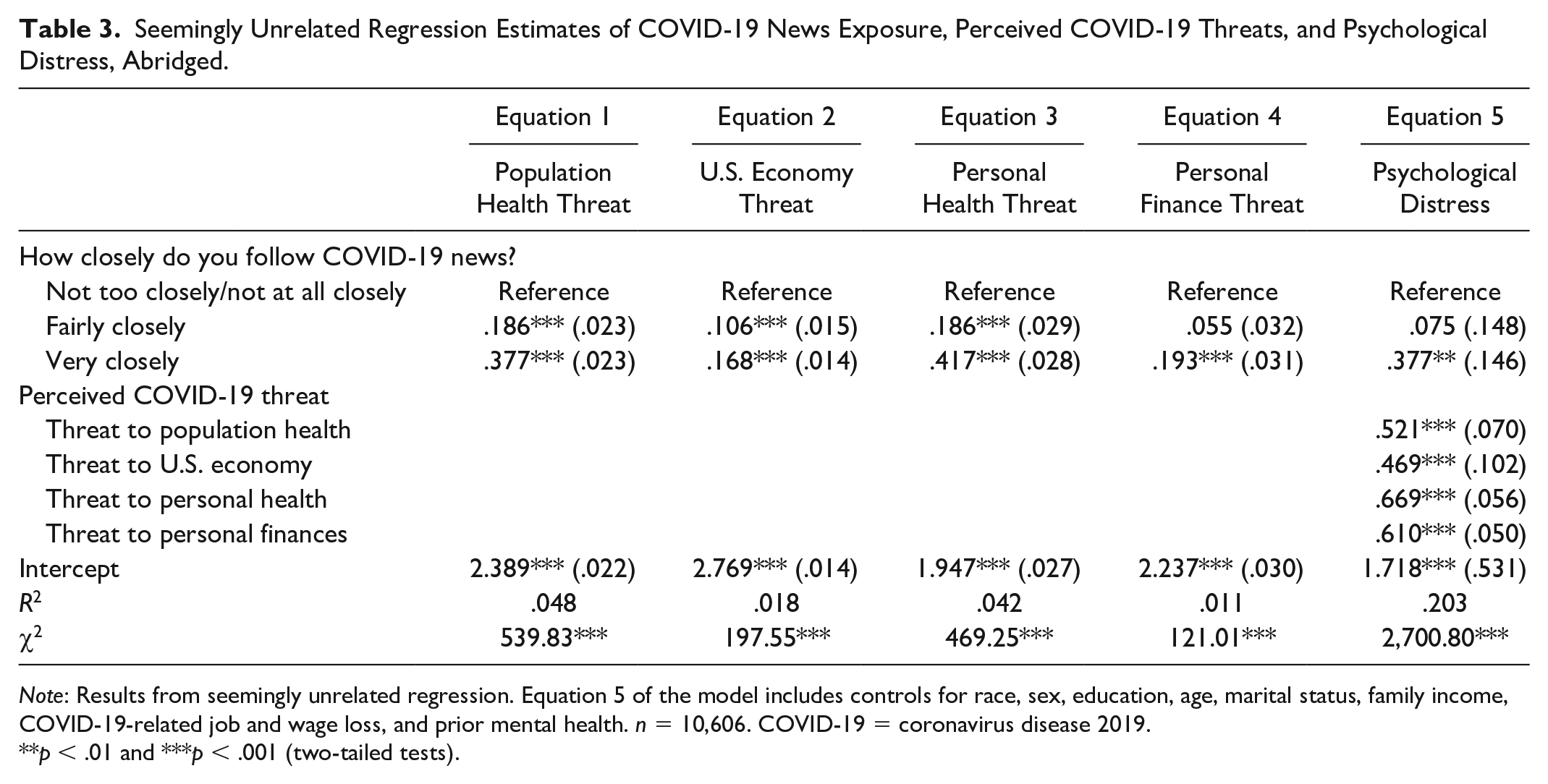
Note: Results from seemingly unrelated regression. Equation 5 of the model includes controls for race, sex, education, age, marital status, family income, COVID-19-related job and wage loss, and prior mental health. n = 10,606. COVID-19 = coronavirus disease 2019.
p < .01 and ***p < .001 (two-tailed tests).
Mediation analysis has long relied on the work of Baron and Kenny (1986). This approach focuses on change in the magnitude and statistical significance of the relationship between an independent variable and the dependent variable once a mediator is introduced. This approach mirrors our analysis plan in Table 2. Although it is elegant in its simplicity, it has some potential problems. For example, how do we know if small changes in either coefficient or p value indicate statistically significant indirect effects? This has led scholars to call for more formal test of indirect effects (e.g., Preacher and Hayes 2008). Following this approach, we use bootstrapped standard errors to construct 95 percent bias-corrected confidence intervals to formally test indirect effects (Table 4). Preacher and Hayes (2008) recommended using the bias-corrected confidence interval, rather than statistical significance alone, to formally determine indirect effects (hypothesis 4).
Mediation Analysis: Indirect Effects of COVID-19 News Exposure on Psychological Distress.

Note: The indirect effect for threat to personal finance is nonsignificant. The total indirect effect and confidence intervals presented are based only on the seven significant indirect effects. n = 10,606. BCCI = bias corrected confidence interval; COVID-19 = coronavirus disease 2019.
p < .001.
Results
Table 2 presents the results of three ordinary least squares regression models. Model 1 provides a baseline estimate of the relationship between COVID-19 news exposure and psychological distress. Net of controls, greater COVID-19 news consumption is associated with greater psychological distress. Compared with those who are not following COVID-19 news closely (the reference category), those who follow fairly closely have, on average, psychological distress scores that are .412 (SE = .153, p < .01) higher, while those who report watching very closely report scores that are 1.037 (SE = .149, p < .001) higher. We provide a visual depiction of this result in Figure 2. Compared with those with the least news exposure, those who follow the news very closely have average distress index scores that are 24.1 percent higher (4.31 vs. 5.35), net of other factors in the model. To further put this in perspective, the magnitude of these differences is about one eighth (follow COVID-19 news fairly closely) and one third (follow COVID-19 news very closely) of a standard deviation of the psychological distress index. This provides support for hypothesis 1 that greater exposure to COVID-19 news is significantly associated with greater psychological distress net of statistical controls.

The relationship between COVID-19 news exposure and psychological distress.
Having established a relationship between COVID-19 news consumption and mental health, we now turn to the question of how more news media exposure affects mental health. Although media could be beneficial for mental health by providing information and reducing uncertainty about the future, we theorized that in the absence of a vaccine and under boundless uncertainty, greater exposure to news media is likely to amplify concerns about threats posed by the virus. We hypothesized that perceived threat, as an anticipatory stressor, would be associated with an increase in psychological distress. Model 2 examines the relationship between perceived COVID-19 threat assessments (threats to population health, the U.S. economy, personal health, and personal financial situation) and psychological distress. All four threat measures are positively and significantly associated with psychological distress. Greater perceptions of COVID-19 threat to collective and personal health and economic well-being are associated with greater psychological distress. For example, the average difference in psychological distress scores between people who report that COVID-19 poses a minor threat to personal health and those who believe that it poses a major threat is .692 (SE = .056, p < .001). The difference between those believing that COVID-19 poses no threat and those who believe that it poses a major threat is 1.384 (.692 × 2). Hence, this finding supports hypothesis 2, which states that perceptions of COVID-19 threat are positively associated with psychological distress.
Model 3 examines whether the relationship between COVID-19 news exposure, observed in model 1, is mediated by perceived COVID-19 threat. Theoretically, we hypothesized that greater exposure to news media would amplify perceptions of health and economic threats posed by COVID-19. Hence, perceived COVID-19 threat is expected to be a key anticipatory stressor associated with mental health. This model suggests that perceived threat mediates a substantial amount of the effect observed in model 1. The threat coefficients remain relatively similar in magnitude between models 2 and 3, while the COVID-19 news exposure variables are markedly reduced compared with their magnitude in model 1. We provide the visual relationships of perceived threat variables and psychological distress in Figure 3.
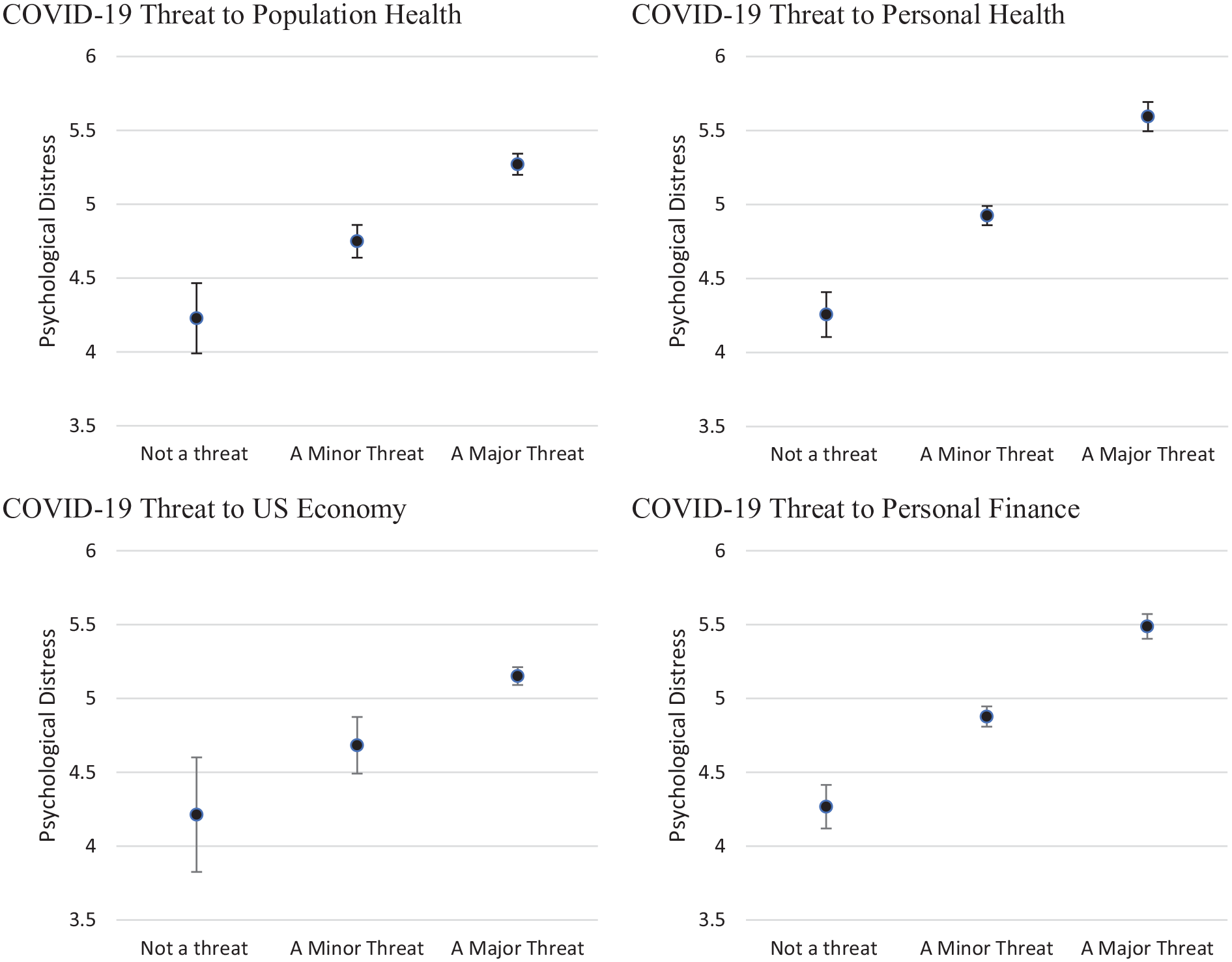
The relationship between perceived COVID-19 threats and psychological distress.
Once threat mediators are introduced into the model, the difference between those who follow COVID-19 news not very closely or not at all, compared with fairly closely, is no longer significant in model 3 (.075, SE = .149, p > .05). The difference between those who report not following COVID-19 news closely and those watching very closely is reduced from 1.037 to .377 but remains significant (SE = .147, p < .01). This provides initial evidence that a large amount of the exposure to COVID-19 news on psychological distress effect operates through heightened perceived COVID-19 threat. These results support our theoretical expectations that media exposure plays a key role in understanding mental health. We more formally test for mediation in the following analyses.
Table 3 presents the results of a SUR model, which estimates five equations. The purpose of this analysis is to test hypothesis 3. The first four equations estimate the relationships between COVID-19 news exposure and the four perceived COVID-19 threat mediator variables. The final equation estimates the relationship between COVID-19 news exposure, threat variables, and controls on psychological distress.
The first three equations demonstrate that COVID-19 news exposure significantly predicts perceived population health threat (follow news fairly closely = .186, SE = .023, p < .001; follow news very closely = .377, SE = .023, p < .001), perceived threat to the U.S. economy (follow news fairly closely = .106, SE = .015, p < .001; follow news very closely = .168, SE = .014, p < .001), and perceived threat to personal health (follow news fairly closely = .186, SE = .029, p < .001; follow news very closely = .417, SE = .028, p < .001). COVID-19 news exposure is less predictive of threat to personal finance situation than the other measures (follow news fairly closely = .055, SE = .032, p > .05; follow news very closely = .193, SE = .031, p < .001). 1 This largely supports the expectation that COVID-19 news exposure would be associated with greater threat (hypothesis 3). The final equation of the model in Table 3 reproduces the results from model 3 in the previous table estimated within the SUR model. The nature of these relationships is visually displayed in Figure 4.

Path model summarizing relationships among COVID-19 news exposure, perceived COVID-19 threats, and psychological distress.
In general, COVID-19 news exposure is more predictive of perceived health threats than the economic ones on the basis of the magnitude of differences and the R2 values. This could be related to the timing of the data collection. The data were collected between March 19 and 24, 2020, a time when some economic impacts would have been felt, such as the stock market declines. However, the worst unemployment data had not yet been released at this point in time. Consequently, the news may have elevated the health threats over economic threats in the earlier stages of the pandemic. It is also possible that work closures had direct effects on people’s perceptions of personal financial threats irrespective of the extent to which they follow COVID-19 news media.
Table 4 presents the formal test of mediation and tests hypothesis 4. We use bootstrap standard errors and construct bias-corrected 95 percent confidence intervals to determine the statistical significance of the indirect effects. Seven of the eight indirect effects are significant, which indicates that the relationship between COVID-19 news exposure and psychological distress appears to operate through perceived personal and collective threat. Perceived COVID-19 threat mediated about two thirds (67.62 percent) of the total mental health effect of COVID-19 news exposure. This largely supports hypothesis 4. The relationship between COVID-19 news exposure and psychological distress is partially mediated by perceptions of COVID-19 threat.
Discussion and Conclusion
The CDC has issued a warning that the social disruption spurred by COVID-19 is likely to exert a significant negative effect on the population’s mental health. On its Web site, under “Taking Care of Your Emotional Health,” the CDC (2020b) specifically suggests that one way to cope with a disaster or pandemic is to “Take breaks from watching, reading, or listening to news stories. It can be upsetting to hear about the crisis and see images repeatedly.” Scholarly commentary has also suggested that COVID-19 is likely to affect mental health, specifically resulting from news media exposure (Garfin et al. 2020). Furthermore, the popular press has also published stories about the potential mental health threats of the virus, some focusing specifically on news media exposure. For example, in a recent news story, “Coronavirus: How Much News Is Too Much?” one interviewee told the BBC reporter, “Mentally it’s been quite overwhelming. . . . I’ve definitely had to slow it down to only one [news] show a week and glance at a few press conferences . . . because it all just feels like the same news over and over again” (Savage 2020).
This article was written in direct response to the news media’s anecdotal accounts of the role of media, as well as the CDC, and scholarly commentary on the likely effects of COVID-19 news exposure on mental health. In this article, we provide the first empirical study investigating the relationship between COVID-19 news exposure and mental health in the United States. In doing so, we make numerous contributions to the sociological study of health. First, we provide one of the first assessments of how COVID-19 affects mental health in the United States. This global pandemic has disrupted every aspect of social life imaginable. It is crucial that researchers understand how the virus affects not only physical health among those infected but also the mental well-being of the entire population.
Second, we seek to encourage the sociological study of health to examine the role and influence of news media exposure on mental health. How news is produced, disseminated, and consumed today is dramatically different than a few decades ago. The role of changing technology, and the multiple social media platforms (e.g., Twitter, Facebook [live], Instagram) born out of these changes, have led to the constant and immediate dissemination of news (Ohme et al. 2020). This evolution necessitates changes in how sociological studies of health approach investigating population health. Hence, it is important that we understand how this continual, and in real time, news media exposure affects well-being. It is important to consider the implications of media exposure in understanding macro-level health. It is a one mechanism by which national events become local and the local events may become national.
Third, we seek to encourage more emphasis on identifying theoretically relevant mechanisms in macro-level studies of social stress. Sociological studies of the effects macro-level stressors often do not observe theoretical mechanisms. For example, research on the effects of 9/11 on mental health suggest that the event itself produced communal bereavement and vicarious trauma, which in turn negatively affected health (e.g., Knudsen et al. 2005). However, there are no measures of these theoretical constructs. Although sociological studies of health have not focused on the role of news media and mental health, prior research outside of sociology has shown that media exposure negatively affects health. However, the mechanisms responsible are speculated, yet unobserved. In this article, we have identified personal and collective threat as mediators. We hypothesized that greater media exposure of COVID-19 news would amplify perceptions of threat from the virus. Our findings show that people who are exposed to more COVID-19 news tend to have greater psychological distress. Furthermore, we show that approximately two thirds of this relationship appears to operate indirectly through increasing perceptions of COVID-19 threat on population and personal health, the economy, and personal financial situation—anticipatory stressors.
The findings of this study should be understood in light of its limitations. Although we are able to show that relationships exist among news media consumption, perceived threats to health and finances, and psychological distress, we are unable to establish casual relationships or test for bidirectional relationships with cross-sectional data. It is important to note that the relationship between news media consumption and perceived threats could be bidirectional. A positive feedback loop between news media consumption and perceived threats would imply that perceptions of threat encourages more media consumption, which, in turn, continues to increase perceived threat. Similarly, a feedback loop may exist between media consumption and psychological distress. The analyses are adjusted for previous mental health diagnosis, but a formal test of a feedback loop would strengthen the findings presented here. We have indicated the possibilities of feedback loops in the conceptual model, and we encourage further investigation in future research.
Further research on COVID-19, the role of media exposure, and mental health is critical and necessary. Does the effect of media exposure and perceived threat accumulate over time? Unlike discrete events, such as 9/11, in which negative effects tend to wane, especially among those not directly involved, COVID-19 will continue to produce uncertainty and threat into the foreseeable future. Understanding the health effects of prolonged chronic stress resulting from the pandemic should be a top priority for health researchers. Such feelings were reflected by an interviewee in a recent news article on COVID-19: “I guess my main anxiety is the unknown surrounding everything. How long will this go on? The longer this goes on the more of a financial hole we’ll be in at the end of it” (Fowler 2020). This statement suggests anxiety deriving from both general and specifically financial uncertainty. Thus, as time passes and the virus continues to spread, the mental health consequences are likely to propagate; the results can be potentially dire.
Although this study is one of the first to examine the role of COVID-19 news exposure and mental health, there is much we do not know about the role of news exposure and mental health. Does the format of news consumption matter? For example, is there a difference between news consumed through social media versus more traditional sources (e.g., nightly news through television)? Does one form heighten perceived threat more than the other? What is the role of the duration of news exposure relative to frequency? Finally, does news from different sources matter (CNN, NBC, Fox)? Additionally, we are unable to specify the source of the news media, the content of the media (beyond COVID-19 as the topic), or the mode of delivery (e.g., cell phone vs. television). The specific content of the news likely plays a role in the association between perceived threat and mental distress. For example, if reporters of the news downplay the significance of the virus for health but highlight the harms of closing businesses for the economy, the viewers of that news may report different types and levels of perceived threat or distress than someone viewing media content that focuses only on the harm to health caused by the virus. The release of more detailed data related to news media consumption should allow examinations of these possibilities.
Consistent with the stress process model tradition, we also suggest that researchers widen their research focus to include potential social resources that may reduce or offset the negative health consequences of COVID-19-related stressors. For example, because of quarantining and social isolation, how is social support being provided and received? Is it online or in person? Does it matter? In addition, the scientific community could benefit from exploring additional health and behavior outcomes (e.g., drinking, substance abuse) that may manifest as a result of COVID-19 stressors.
As we write this conclusion, the global pandemic continues to pose an ongoing threat to physical health. However, as we have argued in this article, COVID-19’s threat to mental health cannot be overlooked. We cannot underscore enough the importance of further research on the impact of COVID-19 and mental health. This message is explicitly (and sadly) conveyed by one individual interviewed recently by CNN (Chavez 2020); the individual had this to say about the impact of COVID-19: “The end of March, beginning of April, I stayed in my room. My body just wasn’t processing my new normal. I was sad, I was depressed. I just felt so terrible about everything that was going on.” There is great urgency in further research on this topic, and much work left to be done.
