




Abstract
Researchers have long noted that role expectations of a “good” mother conflict with those of a “good” worker, described as the “cultural contradiction” of motherhood. But given that work roles vary tremendously in terms of the cultural meanings the public assigns them, the authors examine variability in the perceived compatibility of mother-occupation and father-occupation combinations. Building on previous research, the authors hypothesize that (1) some parent-occupation pairings will be viewed as significantly less compatible because of incongruent expectations and meanings, and (2) incumbents of supposedly compatible parent-occupation pairings will be evaluated more favorably than incumbents of incompatible pairings. Both hypotheses are tested using original survey data on perceptions of mothers and fathers in 28 occupations merged with occupational characteristics from secondary data sources. The results strongly suggest that even though there are well-known prescriptive norms for both mothers and fathers, mothers’ occupational choices are more actively policed compared with fathers’.
Cultural scripts guide individuals on how to act in social roles (e.g., mother, friend, worker) (Burke and Stets 2009; Heise 2007; Stryker 1980). These cultural scripts are simultaneously used by observers to evaluate role performances, such as whether an individual is a “good” or “bad” mother, friend, or worker. Observers may shame or punish those who deviate from role expectations with acts of discrimination or social exclusion (Eagly and Karau 2002; see also Mize and Manago 2018). The prospect of punishment can in fact constrain which roles individuals strive to inhabit (Lee 1998) and influence role incumbents’ choices, effectively forcing them “to compromise themselves” in order to feel socially accepted in their roles (Settles 2004:489). Moreover, the shame and punishment that stem from the policing of roles may ultimately undermine role incumbents’ mental health (Simon 1995; Thoits 2013).
The broad objective of this study is to investigate the policing process around individuals combining two roles. We address two questions: Does the public perceive some role combinations to be more compatible than others? In turn, are those who inhabit incompatible roles socially devalued? Our study focuses specifically on parent-occupation role combinations. We begin by examining public perceptions about which occupations mothers and fathers “should” and “should not” hold, while highlighting differences between the two groups. Next, we compare how harshly mothers and fathers are judged if they work in so-called incompatible occupations.
Scholars have theorized that incumbents who inhabit two roles with a high level of perceived incongruity will face significant prejudice (e.g., Eagly and Karau 2002; Okimoto and Heilman 2012; Settles 2004). But empirical tests of the role congruity theory of prejudice have been relatively limited in that they typically focus on women in only one occupation or work role (e.g., female leaders, mothers in female- vs. male-typed jobs, or female scientists). We examine pairings of mothers and fathers across different occupations, thus providing the first systematic empirical test of the correlation between perceptions of role compatibility and perceptions of incumbent’s social value, such as their likability. More specifically, we test whether mothers and fathers suffer different penalties for making “incompatible” occupational choices. In summary, although the extant literature tells us that prescriptive norms for both mothers and fathers exist, our analysis provides empirical evidence on the extent to which the public enforces these norms with respect to parents’ occupational choice. We also offer insight into whether the roles of mothers and fathers are differentially policed.
To carry out these objectives, we gather original survey data on perceptions of compatibility and likability of mothers and fathers in 28 occupations in the United States. Drawing on research about what it means to be a “good” mother and “good” father in modern America (Hays 1996; Kimmel and Messner 1992; Ridgeway and Correll 2004), and research on occupation-specific meanings and stereotypes (e.g., White and White 2006), we hypothesize that the public will construe certain role combinations, such as mother-teacher or mother-pediatrician, to be more compatible than others, such as mother-scientist or mother-lawyer. More generally, we expect that occupations that seemingly align with the prescribed norms around motherhood and fatherhood will be perceived as the most compatible. That said, because mothers and fathers are expected to be and do different things, the correlates of compatibility are expected to be different for mothers and fathers. Finally, on the basis of the role congruity theory of prejudice, we hypothesize that the public will find role combinations that are less compatible to be less appealing and likable.
An empirical study of how these parent-worker roles are policed is long overdue given that the vast majority of parents today work outside of the home. Approximately 70 percent of mothers and 93 percent of fathers with children under the age of 18 work for pay at least part-time (Bureau of Labor Statistics 2015). This does not represent a significant increase over time for fathers, but it does for mothers, especially among those with young children (Patten 2015). In the wake of this increase, scholars have closely examined, as detailed below, how perceptions of incompatibility and social approval vary for mothers with different work statuses (i.e., full-time, part-time, or not at all) (e.g., Bridges and Etaugh 1995; Jacobs and Gerson 2016). But now that such a large proportion of mothers are working, we argue that it is important to expand the investigation to specific occupational roles in combination with motherhood.
By quantifying the extent to which the public perceives it as compatible to combine the role of parent with various occupational identities, our study also helps unpack cultural assumptions about the roles of mother and father themselves. Our findings suggest that there are relatively strict “rules” dictating which occupational roles are right for mothers. Moreover, these rules align almost perfectly with the vast literature on cultural definitions of good mothering (i.e., occupations that are safe and provide part-time work opportunities) and feminine identity (i.e., occupations that are female dominated and involve ethically oriented work). Furthermore, the results show that the public values mothers more when they work in occupations compatible with mothering and the feminine identity.
In contrast, our results suggest that the prescriptive stereotypes around working fathers are much weaker. Stereotypes dictate that fathers should be in authoritative, masculine work roles associated with high earning potential, but our results show that the only correlate of father-occupation compatibility is the level of authority in the occupational role. Furthermore, the relationship between incompatibility and unlikability is far weaker for fathers. We address the implications of these findings in the discussion.
Perceived Role Compatibility: Parent and Worker Combinations
Broadly, theory suggests that any two social roles will be perceived as (in)compatible if the expectations and meanings associated with one are construed as (mis)aligned with those of the other (Eagly and Karau 2002; Hays 1996). For example, well-known work on the cultural contradictions of motherhood (e.g., Blair-Loy 2001; Hays 1996) highlights how the dominant ideology around being a “good” mother (i.e., warm, nurturing, and always available for family) fundamentally conflicts with modern ideals associated with “good” workers (i.e., cool-headed, competitive, and always “on call” to the employer). That is, regardless of the degree to which a working mother feels that her work and motherhood demands are incompatible, the public legitimizes and polices the boundaries of the motherhood role (as well as the worker role) by claiming that the pairing of mother and worker roles is culturally incompatible because of their contradictory role expectations.
But given that work roles vary tremendously in terms of both objective features (e.g., percentage who work part-time in an occupation) and the meanings (e.g., helpful, powerful) the public associates with them (Gottfredson 1981; White and White 2006; see also Freeland and Hoey 2018; Valentino forthcoming), it seems likely that some occupations might be perceived as more compatible with motherhood or fatherhood, which is precisely why other occupations stand out as incompatible. Our first objective, then, is to test the extent to which our theoretical knowledge regarding the cultural definitions of “good” and “bad” mothers and fathers predict perceptions of incompatibility: among mothers (and fathers) who are employed, to what extent do extant cultural stereotypes explain why certain kinds of work roles (i.e., occupations) are widely construed to be less compatible with motherhood (and fatherhood) compared to others? 1
Despite decades of research on the incompatibility of gender roles and work roles, systematic knowledge as to which occupations are culturally defined as more or less incompatible with motherhood (and fatherhood) remains lacking. Most studies of incompatibility are designed around just one or a few types of role combinations selected intentionally because they are already widely believed to be incongruous (e.g., Blair-Loy 2001; Eagly and Karau 2002; Okimoto and Heilman 2012; Steinke 2017). For example, research finds that the cultural expectations associated with being a woman and being a leader are inconsistent because the woman role is culturally associated with communal qualities whereas the leadership role is associated with agentic qualities (e.g., Eagly and Karau 2002; Tinkler et al. 2019). 2 Similarly, the role of scientist is perceived to be more compatible if filled by a man rather than a woman: societal stereotypes consistently communicate that scientists are “supposed” to be objective and rational men (Barbercheck 2001), specifically men who are “white, middle-aged or elderly, unattractive, dressed in a lab coat and glasses, geeky or nerdy, socially awkward, and . . . who work alone” (Steinke 2017:2; see also Thébaud and Charles 2018). Unlike these studies, our study is designed explicitly to examine perceived compatibility across a variety of parent-occupation role combinations, such as mother-scientist, mother-politician, and mother-teacher. Our core hypothesis is that the degree of compatibility for a given parent-occupation pairing depends on how well the expectations and meanings of the occupational role fit with the expectations and meanings of the parenting role.
Below, we outline the dominant cultural beliefs of what it means to be a good mother and good father in contemporary U.S. society. Note that our interest lies specifically in the cultural expectations of what good mothers and fathers should do for their children and families, not what they actually do. These injunctive or prescriptive norms are “consensual expectations about what a group of people ought to do or ideally would do” (Eagly and Karau 2002:574; Prentice and Carranza 2002). We pay specific attention to the place of paid work within the roles of mother and father and review empirical studies that explore perceptions of incompatibility between motherhood, fatherhood, and paid work more generally.
Two important points about the scope of our study need to be highlighted before moving forward. First, the literature on ideologies surrounding motherhood and fatherhood is based largely on white, middle-class men and women, which means that the prescriptive norms discussed below are best interpreted as pertaining to this particular segment of the population. Given that this is a first step toward measuring how mother-occupation and father-occupation roles are policed, we do not unpack the multitude of stereotypes about parenthood and occupational roles, and we recognize the limitations of not doing so. Scholars have long noted, for example, that cultural understandings of what it means to be a good mother or father (as well as definitions of femininity and masculinity) vary across races and ethnicities (e.g., Cazenave 1979; Collins 1987; Glenn 1992; Kimmel and Messner 1992). Similarly, research suggests that there may be specific stereotypes associated with specific kinds of mothers and fathers (e.g., single moms, deadbeat dads, tiger moms, snowplow parents) (see Mandell 2002; Valiquette-Tessier, Vandette, and Gosselin 2015). We strongly suspect that perceptions of (in)compatibility of various parent-worker role combinations will likely vary with respect to these characteristics (see, e.g., Cuddy and Wolf 2013), but we leave for future research the detailed study of the contingencies of types and their intersections.
Second, our sample is disproportionately composed of white and relatively well-educated respondents, which means that our empirical study is best characterized as measuring the cultural perceptions of specifically this segment of the population. These limitations are addressed in the discussion section. On a related note, in part because of the limitations of our sample, our empirical analysis does not unpack whether certain members of the public police parent-occupation roles more or less aggressively or if they apply different “rules” when policing. Although research clearly shows that the symbolic meanings assigned to cultural objects can vary by social location (e.g., Gauchat and Andrews 2018, Lynn and Ellerbach 2017), we also consider this outside the scope of the present study.
With that in mind, we briefly summarize below previous research on “good” mothers and fathers (broadly defined). Overall, mothers’ and fathers’ primary activities within the family (i.e., caretaking and/or breadwinning) have changed somewhat since the 1970s, albeit more for mothers than for fathers (Sayer 2005). Since that time, mothers have increased their labor force participation and contributions to the family income, and men have taken on more caregiving responsibility (i.e., childcare and housework). Despite these changes, within married families mothers remain primarily responsible for caretaking and fathers remain primarily responsible for breadwinning (Haines, Deaux, and Lofaro 2016). 3
The Good Mother
According to the dominant ideology of “intensive mothering” (Hays 1996), a “good” mother is expected to be “always there” for her children (Kobrynowicz and Biernat 1997; Russo 1979) and will “direct her time and emotional energy toward her children without limit” (Ridgeway and Correll 2004:690). In addition, a good mother is an unselfish nurturer (Hays 1996), and as such, the cultural stereotypes around motherhood are closely linked to those of women’s being community-oriented (Eagly and Steffen 1984; Ridgeway and Correll 2004:687) and generally more moral than men (see Epstein 1992:244). Given the importance of bonding and early life attachment between infant and caregiver (Bowlby 1982), mothers are generally seen as less replaceable—or less “insurable”—than fathers, especially when children are young (DeLeire and Levy 2004).
Paid work does not generally mesh with our societal perceptions of the good mother. Perhaps most obviously, paid work and caregiving both demand significant time and energy. Thus, working mothers are assumed to have less family commitment compared with nonworking mothers and less work commitment compared with men and childless women (Mincer and Polachek 1974). In addition to time-based conflict, work and motherhood also conflict in terms of cultural expectations around behavior (e.g., Blair-Loy 2001; Hays 1996; Williams 1999). That is, there are conflicting ideas about how working mothers should behave at work and at home: they must be “cool-headed and competitive at work but warm-hearted and nurturing at home” (Hays 1996:10).
Not surprisingly, empirical research finds that compared with nonemployed mothers, employed mothers are perceived to be less communal (Bridges 1987; Riggs 1997), especially if they remain employed when their children are infants (Bridges and Orza 1993) or if they work for personal fulfillment rather than financial necessity (Bridges and Etaugh 1995; Okimoto and Heilman 2012). The number of hours a mother works and her marital status also affect attitudes about employed mothers; approval of a working mother increases if she is portrayed as working part-time (vs. full-time) or if she is single (vs. married) (Jacobs and Gerson 2016).
The Good Father
The dominant perspective of the “good” father is that of provider. Contemporary research on fathers suggests that a good father no longer only provides income for his family but is also active in taking care of his children (Dermott and Miller 2015; Kaufman and Uhlenberg 2000). Despite this new “involved father” model, the pervasive norm in contemporary U.S. society still equates successful fatherhood with breadwinning (Coltrane 2004; Deutsch and Saxon 1998; see also Randles 2018). That is, fathers are “culturally expected to provide and protect” primarily through breadwinning and not via direct care for their children (Ridgeway and Correll 2004:695).
The notion that fathers are essential breadwinners for the family is also intertwined with the still common perception that fathers provide their families with an authoritative, disciplinary figure who—more so now through breadwinning than physical force—protects the family from “bad guys” and bad circumstances (Summers et al. 1999). The fatherly hero-protector is generally portrayed as someone who stably leverages authority and physical superiority, both traits linked to stereotypes of manliness (e.g., Young 2003). Note that fathers are also expected to be caring but—in terms of dominant cultural norms—are “allowed” to show that caring through authoritativeness, discipline, and breadwinning. In stark contrast to the role of mother, employment is seen as an integral part of fathers’ identity (Ranson 2011). In fact, a large body of work explores the cultural centrality of being a good worker—and thus a good provider—for fathers (Coltrane 2004; Pleck 1987).
Not surprisingly, empirical research supports the mandate that fathers work in order to provide financially for their families. For example, in an experimental study, Riggs (1997) found that approval ratings of fathers decrease significantly if they give up a job that provides financially security in order to take care of their children. In other work, Brescoll and Uhlmann (2005) found that employed fathers are evaluated more positively than stay-at-home fathers, and Rochlen et al.’s (2010) qualitative research study on approximately 200 stay-at-home fathers showed that about half experienced “stigma-based” incidents because of this role. Likewise, Pedulla (2016) found that prospective employers are far less likely to hire applicants who are men compared with women with part-time work histories, and Jacobs and Gerson (2016) found that if a hypothetical family (with a pre-school-aged child) depends on the father’s income, the public generally believes that he should stay at his full-time job even if he is not satisfied with the job or with the family’s childcare arrangements. Interestingly, the majority of respondents in Jacobs and Gerson’s (2016) study approved of the father’s switching to part-time or to becoming a stay-at-home dad, but only if the family does not depend on his income. All in all, prior research strongly suggests that the social mandate for fathers to provide for their families has not dwindled despite mothers’ increased financial contributions to the family income (Riggs 1997).
Hypotheses: Parent-Occupation Compatibility
To sum up, (1) the “good” mother is a nurturing and warm figure who puts her caretaking duties above all others, (2) the “good” father is an authoritative figure who protects and provides for his family mainly through breadwinning, and (3) prior research shows that paid employment is perceived to be generally incompatible for mothers and compatible for fathers. The key point and focus of the present study, however, is that there is tremendous variation in work roles in terms of the objective features of occupations as well as stereotypes associated with occupational identities.
In terms of objective features, occupations vary across a number of dimensions (U.S. Department of Labor 2016), such as sex composition, 4 earnings, educational requirements, work hours (part-time positions), working conditions (e.g., exposure to hazards), level of authority (e.g., manager or supervisor), and skill demands (e.g., manual vs. nonmanual) (see, e.g., Charles and Grusky 2004; Freeland and Hoey 2018; Reskin 1993). Moreover, research suggests that adults are relatively accurate in judging occupations on a variety of dimensions, including earnings and physical requirements (Walls 2000) and sex composition (Cejka and Eagly 1999). In addition, sociologists have long noted that the public assigns symbolic meaning to occupations (e.g., Duncan 1961; Lynn and Ellerbach 2017; Martin 2000). Freeland and Hoey’s (2018) research on occupational identities suggests two major axes along which occupations are symbolically evaluated in the United States: goodness or honor (e.g., we commonly throw parades for firefighters but not business executives) and power 5 (e.g., we think of business executives as wielding power over others given their financial clout, educational training, and social capital). 6 For example, certain occupations, such as doctor, are associated with high levels of goodness and power, whereas other honorable occupations, such as nursing assistant or social worker, are associated with considerably less power (e.g., see Freeland and Hoey 2018:259). Some occupational identities, such as lawyer or police officer, are assigned far more power than goodness, while others, such as salesperson, rank low on both dimensions (see Appendix B).
Given this variability, we suspect that certain mother- and father-occupation pairings will be construed as more or less compatible depending on how they complement the dominant prescriptive norms as to what mothers and fathers should and should not do. For mothers, we hypothesize that four specific aspects of occupations will be related to perceptions of mother-occupation compatibility. First, given the dominant prescriptive norm that mothers should be there “all the time” for their kids (Hays 1996; Ridgeway and Correll 2004), we hypothesize that mother-occupation compatibility will be positively correlated with the percentage of part-time workers in the occupation (hypothesis 1a) and negatively correlated with the level of danger associated with the occupation (hypothesis 1b).
Many believe, as expressed by former U.S. senator Rick Santorum (2005), that something “bad” must have happened in America such that mothers are now willing to “leave their children in the care of someone else.” According to the 2012 General Social Survey, 42 percent of a nationally representative sample of Americans (n = 977) say that it is “best” if a mother works part-time (and a father works full-time) in families with pre-school-aged children. In contrast, fewer than .5 percent of respondents say that it would be “best” if the mother works full-time (and the father works part-time). Hence, we expect that occupations that have stronger traditions of offering part-time work opportunities will be viewed as more compatible with motherhood.
For similar reasons, we expect that occupations that routinely put workers in physical danger will be perceived as contradictory to motherhood. As noted earlier, mothers are “supposed” to be children’s primary caretakers and thus are, in a sense, priceless (i.e., not insurable). A job that threatens a mother’s life clearly jeopardizes the chance that she will “be there” for her child and is therefore likely to be seen as a poor fit.
Entwined with the primary caretaking role is the notion of mothers as nurturing forces and comforters (Hays 1996). We therefore suspect that the mother role will be viewed as more compatible with occupations associated with warmth and high ethical standards; conversely, occupations that are culturally stereotyped as slimy, aggressive, or ruthless in nature will be viewed as less compatible with motherhood. Finally, because motherhood is often viewed as an extreme of the more general expectations associated with “woman” (Ridgeway and Correll 2004:687), we expect that occupations construed as “right” for women will be perceived as more compatible with the mother role. Thus, we also hypothesize that mother-occupation compatibility will be positively correlated with the warmth and goodness associated with the occupation (hypothesis 1c) and positively correlated with the percentage of female workers in the occupation (hypothesis 1d).
For fathers, we hypothesize that four aspects of occupations will be associated with father-occupation compatibility. First, given the primacy of breadwinning in the cultural narrative of the good father (Pleck 1987), we suspect that fathers “should” be, above all, in occupations that allow them to earn a “good living” (i.e., occupations that offer well-paid, full-time employment opportunities will be perceived as more compatible for fathers). To this point, we hypothesize that father-occupation compatibility will be positively correlated with the wage-earning potential in the occupation (hypothesis 2a) and negatively correlated with the percentage of part-time workers in the occupation (hypothesis 2b).
Entwined with breadwinning is the notion of fathers as authoritative figures in the family (Ridgeway and Correll 2004). Whereas mothers are supposed to protect and care for children, fathers are culturally scripted to be the leaders of their families. Thus, an occupation that complements the father role would be one that is associated with power and authority. For this reason, we hypothesize that father-occupation compatibility will be positively correlated with the power and authority associated with the occupation (hypothesis 2c). Similarly, female-dominated jobs offer lower pay (Levanon, England, and Allison 2009), and female role identities are typically associated with less power (Kroska 2014). 7 For both of these reasons, plus the fact that the public is likely to perceive a father working in a “woman’s job” as wrong or incompatible because it violates gender norms, we expect that father-occupation compatibility will be negatively correlated with the percentage of female workers in the occupation (hypothesis 2d).
Valuation of Individuals Occupying Compatible versus Incompatible Roles
Next, we review prior work that examined the extent to which individuals who combine two supposedly incongruous roles are culturally sanctioned. Eagly and Karau’s (2002) “role congruity theory of prejudice” argues that a group member (e.g., woman) attempting to fulfill a given role (e.g., leader) will be devalued if the presumed characteristics of the group member are misaligned with the socially ascribed demands of the role. In short, if two roles are believed to be incompatible, the incumbent will be punished.
Prior empirical research strongly suggests that women are indeed sanctioned for attempting to combine motherhood with a supposedly incompatible work role. Okimoto and Heilman (2012), for example, examined evaluations of three groups of mothers—those employed in male sex–typed jobs, those employed in female sex–typed jobs, and those who are nonemployed—and found that it is only mothers in male sex–typed jobs that are perceived more negatively (i.e., less communal, worse parents, less interpersonally appealing) than nonemployed mothers. They concluded that it is not “working per se that decreased working mothers’ social acceptance but working in a gender-inconsistent job” (p. 715). In a related study, Heilman et al. (2004) similarly found that “successful” women who work in male-dominated occupational roles are rated as less likable and perceived with more hostility (e.g., less trustworthy, more manipulative) than women or men who work in female-dominated or neutral occupational roles.
On the basis of this past research, we hypothesize that mothers working in occupations that are viewed as good fits with motherhood will be viewed as more likable individuals and better mothers compared with those working in occupations that are viewed as more contradictory to the ideal mother role (hypothesis 3). In other words, the social valuation (Lamont 2012) of working mothers will be shaped by the perceived compatibility of their occupations with their roles as mothers. The likability penalty constitutes a more active form of policing relative to merely perceiving the two roles as incompatible.
It is less clear, however, if fathers will be subject to the same social sanctions for working in occupations that are deemed incompatible with fatherhood. In general, as noted by Rudman and Phelan (2008), there is far more research on the topic of negative sanctions for counter-stereotypical behavior for women and mothers relative to men (and fathers in particular). Findings from studies that have explored this issue for men are mixed. On the one hand, Heilman et al.’s (2004) results suggest that men working in female-typed jobs are not seen as less likable compared with those in neutral- or male-typed jobs. 8 This same form of gender asymmetry in sanctioning was noted by Rudman and Glick (1999), who argued that prescriptive stereotypes for women may be stronger than those for men, and thus violations will be more costly for women than men. After all, if the dominant prescriptive stereotype is that men should be breadwinners, the public may pass judgement on whether a father’s occupation is compatible but then reserve more active forms of social sanctioning only for those who do not work.
On the other hand, some studies suggest that the penalty to men who transgress prescriptive gender role norms is even greater than that to women (e.g., Cahill and Adams 1997; Cherry and Deaux 1978; Sandnabba and Ahlberg 1999). Also, as noted earlier, Pedulla (2016) showed that fathers are indeed punished for having the “wrong” type of employment situation (i.e., a history of part-time work). Given these mixed findings, we leave as an open question the extent to which fathers are socially penalized for working in occupations that are viewed as poor complements to fatherhood.
Data
We test our hypotheses by analyzing original survey data on perceptions of 28 parent-occupation pairings. We chose these 28 occupational identities because goodness and power ratings, key variables in our analysis, were publicly available for them at the time we collected our data. Importantly, these 28 occupations also exhibit substantial variability on the other key occupational characteristics we incorporate into our analyses.
Our sample includes 188 participants who were recruited via Amazon Mechanical Turk (MTurk) in March 2014 and were paid $1 for their participation in the study. The sample is 84 percent white, 53 percent self-identified female, and 50 percent married or cohabiting; 38 percent are parents, and 47 percent have bachelor’s degrees or higher. The average age in the sample is 35 years, and the median income is $45,000. Participants were randomly assigned to rate either mother-occupation role pairings (n = 96) or father-occupation role pairings (n = 92). To ease rater fatigue, participants were assigned to rate only 16 of the 28 potential pairings. In sum, approximately 50 respondents rated each parent-occupation pairing on several dimensions.
There are clear limitations to the generalizability of our results given this relatively small MTurk sample. Like other MTurk samples, ours is disproportionately white, young, and highly educated compared with the U.S. population as a whole (see Levay, Freese, and Druckman 2016). Levay et al. (2016) suggested that credible inferences to the population can be made with MTurk results if, at the least, the following nine variables are accounted for: age, gender, race and ethnicity, income, education, marital status, religion, ideology, and partisanship. We did not collect data on all nine, nor would we likely have enough variation on these nine to benefit from weighting the data given our sample size. As a result, we caution against generalizing our results beyond the segment of the population for which we have data. On the positive side, however, studies have found that the quality of the data collected from MTurk respondents is actually high compared with other online research panels (Chandler et al. 2019), which gives us confidence that the results are at least meaningful, if only generalizable to this segment of the population.
Analytic Plan
The empirical analysis is presented in two parts. First, we determine the extent to which mean perceptions of parent-occupation compatibility correlate with a core set of occupation-level characteristics. We calculate correlation statistics between each of the occupation-level characteristics and parent-occupation compatibility separately for fathers and mothers. Next, we estimate a regression model predicting parent-occupation compatibility as a function of the occupation-level measures, again separately for fathers and mothers. In the regression, our focus is on the R2 measure in the full model; this tells us the percentage of variability in parent-occupation compatibility we are able to explain with all four of the occupation-level measures.
Second, we examine the association between parent-occupation compatibility and potential “consequences” for the pairing, including perceptions of likability, sincerity, trustworthiness, and attentiveness to children. More specifically, we estimate a regression model predicting each of the four parent-occupation valuation measures as a function of the parent-occupation compatibility measure, again separately for fathers and mothers. Our focus in the regressions is on the extent to which perceived compatibility can explain how incumbents are valued.
Measures
Beliefs about the Compatibility of Parent-Occupation Role Combinations
Beliefs about the compatibility of parent-occupation role combinations are operationalized with the following survey item: “How natural do you think it is to combine the roles of [mother/father] and [occupational role]?” (1 = “very unnatural,” 6 = “very natural”). 9 See Table 1A for a descriptive summary of each measure. Overall, the mean compatibility score for mothers is 4.10 (SD = .67), and for fathers it is 4.15 (SD = .49). To capture both within- and between-occupation variability, Figure A1 in Appendix A shows the distribution of compatibility scores (95 percent confidence intervals [CIs]) for each of the 28 mother- and father-occupation pairings, ordered from most to least compatible. For example, the estimated 95 percent CI for a mother-pediatrician (5.03–5.52) is statistically higher than that of a mother-attorney (3.11–3.72). Similarly, the 95 percent CI for father-professor (4.39–4.93) does not overlap with that of father-surgeon (3.53–4.14).
Descriptive Statistics.
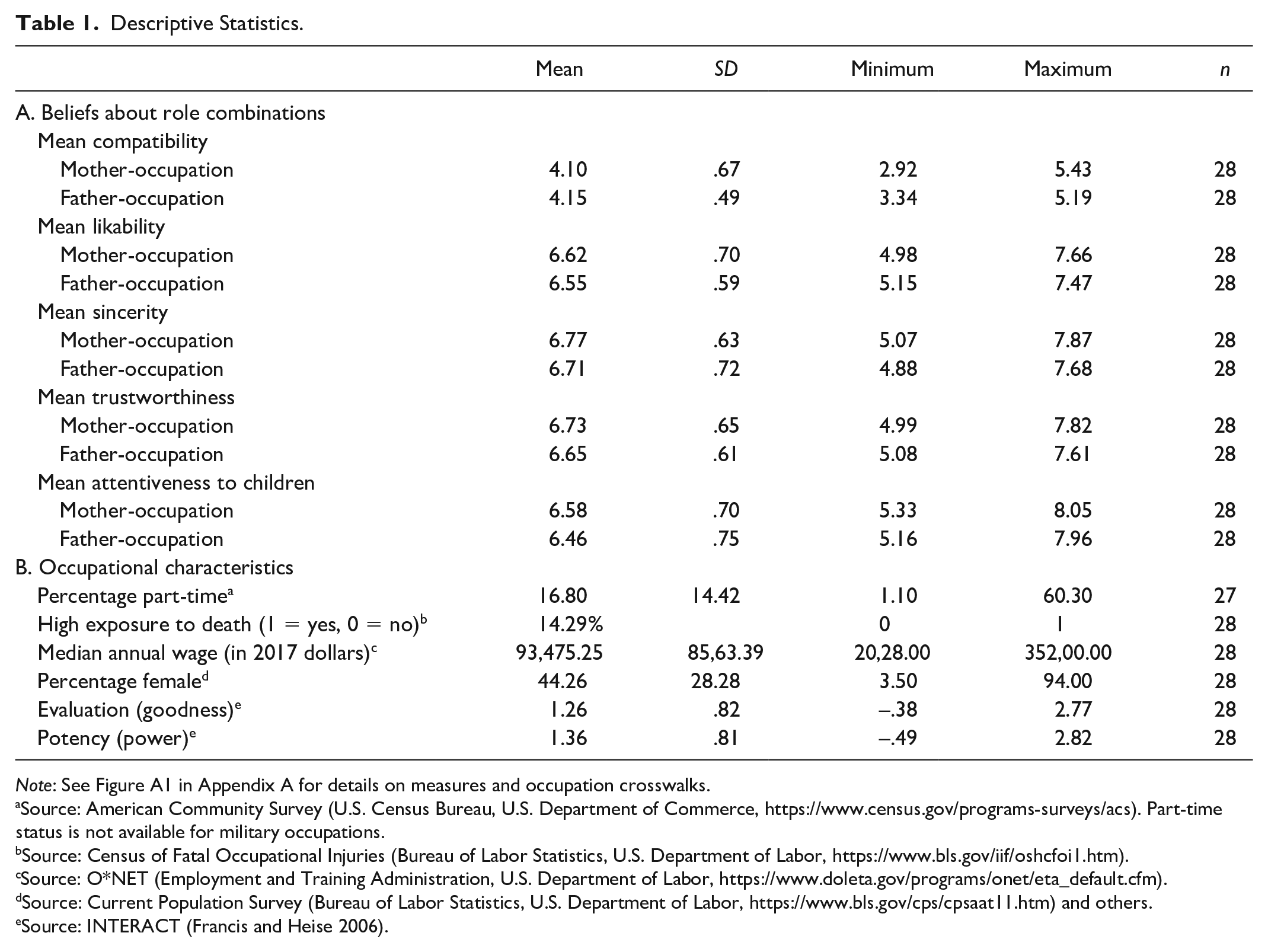
Note: See Figure A1 in Appendix A for details on measures and occupation crosswalks.
Source: American Community Survey (U.S. Census Bureau, U.S. Department of Commerce, https://www.census.gov/programs-surveys/acs). Part-time status is not available for military occupations.
Source: Census of Fatal Occupational Injuries (Bureau of Labor Statistics, U.S. Department of Labor, https://www.bls.gov/iif/oshcfoi1.htm).
Source: O*NET (Employment and Training Administration, U.S. Department of Labor, https://www.doleta.gov/programs/onet/eta_default.cfm).
Source: Current Population Survey (Bureau of Labor Statistics, U.S. Department of Labor, https://www.bls.gov/cps/cpsaat11.htm) and others.
Source: INTERACT (Francis and Heise 2006).
Occupational Characteristics
As described in Appendix B, data from the 2016 American Community Survey are used to measure percentage part-time, which is the percentage of workers within an occupation who work fewer than 35 hours per week. High exposure to death (1 = yes, 0 = no) is derived from 2017 Census of Fatal Occupational Injuries data on fatal injury rates by occupation. Median annual wage (in 2017 dollars) for each occupation comes from version 20.1 of O*NET. Finally, percentage female for 19 occupations comes from the 2018 Current Population Survey. The remainder of the data come from professional associations and other published sources.
To measure the extent to which the public perceives occupations to be associated with goodness and power, we use, respectively, the “evaluation” and “potency” scores linked to the occupational identity from the 2003 INTERACT sentiment dictionary. 10 Building from the semantic differential scale developed by Osgood et al. (1975), the INTERACT sentiment dictionary measures three affective responses to social concepts—evaluation (good vs. bad), potency (powerful vs. weak), and activity (active vs. quiet) (Francis and Heise 2006). In their study of occupational identities, Freeland and Hoey (2018) argued that the evaluation score captures “feelings of esteem, goodness and warmth that provide the basis for acts of voluntary compliance,” 11 whereas the potency score is indicative of “power, competence, and strength, which [are characteristics that] enable actors to compel behaviors from others” (p. 247). Descriptive statistics for the six occupational measures are shown in Table 1B, and their correlations are shown in Appendix C.
Beliefs about the Social Value of Parent-Occupation Incumbents
In line with previous research, we measure the valuation of a target with respect to multiple dimensions of value, including interpersonal appeal and hostility (Heilman et al. 2004; Okimoto and Heilman 2012), authenticity (Hicks, Schlegel, and Newman 2019), and parental worth (Okimoto and Heilman 2012). Specifically, respondents are asked, “What are your feelings about someone who is both a [mother/father] and a [occupational role]?” with respect to the following four items: (1) likability, (2) sincerity, (3) trustworthiness, and (4) attentiveness to children. All items are measured on a nine-point bipolar scale (e.g., 1 = infinitely unlikable/inattentive, 9 = infinitely likable/attentive) and are highly correlated with each other for mothers (α = .96) and fathers (α = .95). Descriptive statistics for these four items are shown in Table 1A.
Results
Correlates of Parent-Occupation Compatibility
We hypothesized that perceptions of parent-occupation compatibility would increase as the image of the occupation became more aligned with the dominant expectations associated with the parent role. To test these hypotheses, we calculated correlation statistics for each of the occupation variables with the parent-occupation compatibility variable (see Figure 1). All hypotheses for mother-occupation compatibility are supported (hypotheses 1a–1d): mother-occupation compatibility is positively correlated with percentage part-time (r = +.42, p = .031), negatively associated with death (r = –.41, p = .031), positively correlated with the goodness score of occupational identities (r = +.58, p = .001), and highly correlated with percentage female (r = +.79, p = .000). For the hypotheses for father-occupation compatibility (hypotheses 2a–2d), all the correlation coefficients are in the hypothesized direction, but only one is statistically significant. Father-occupation compatibility is statistically correlated with the power assigned to occupational identities (r = +.41, p = .030) (hypothesis 2c). However, father-occupation compatibility is not statistically correlated with median wages (r = +.09, p = .656), percentage part-time (r = –.28, p = .160), or percentage female (r = –.16, p = .412).

Correlates of compatibility for mother- and father-occupation pairings.
That all the correlation statistics are in the hypothesized direction suggests that the dominant prescriptive norms for mothers and fathers indeed constrain the kinds of occupations deemed compatible for each role. But it is also clear that there is much stronger support for the hypotheses around mother-occupation compatibility compared with father-occupation compatibility.
Next, we ran a series of regression models with mother- and father-occupation compatibility as the outcome variable and each of the occupation measures as the independent variables (for mothers, percentage part-time, death, goodness, and percentage female; for fathers, median wages, percentage part-time, power, and percentage female) (see Appendix D). For mothers, the final model generates a notably large R2 value (73 percent), especially given the sample size of just 28 occupations. This suggests a very high level of constraint: dominant expectations of motherhood appear to strongly predict (constrain) beliefs about which occupations are “right” for mothers. The constraint on fathers is substantially lower; the R2 value is only 19 percent. This difference in predictability is striking. Compared with mothers, the prescriptive norms for fathers seem to have little impact on constraining ideas about which occupations are right for them.
Note also the asymmetry with respect to percentage female and percentage part-time, both of which were hypothesized to be correlated with mother- and father-occupation compatibility (but in opposite directions). The results suggest that the public thinks that mothers are indeed better suited for female-dominated jobs, but conversely, they find it acceptable for fathers to venture outside of male-dominated jobs or to work in jobs more traditionally associated with men (e.g., teacher vs. laborer, respectively). Similarly, mothers are seen to “fit” better with occupations characterized by part-time work, but it appears to be acceptable for fathers to pursue occupations associated with more or fewer part-time opportunities (e.g., salesperson vs. judge, respectively).
Parent-Occupation Valuation
We hypothesized that for mothers, a social premium would accrue to those in compatible role pairings (hypothesis 3). We find strong support for this hypothesis (see Table 2): mean compatibility is significantly and positively associated with all four valuation outcomes (likability, sincerity, trustworthiness, and parental worth) for mothers. To illustrate with one of the four outcomes, Figure 2 displays the scatterplot of compatibility and likability for mother-occupation pairings (with linear fit superimposed) and reveals a strong positive association between the two measures (R2 = .64). Mother-occupation pairings that are judged as more compatible tend to be simultaneously judged as more likable (e.g., nurse); conversely, mother-occupation pairings judged as less compatible are simultaneously judged as less likable (e.g., sheriff).
Regression Results Predicting Parent-Occupation Valuation (Hypothesis 3).

Note: Values in parentheses are standard errors.
p < .05. **p < .01. ***p < .001.
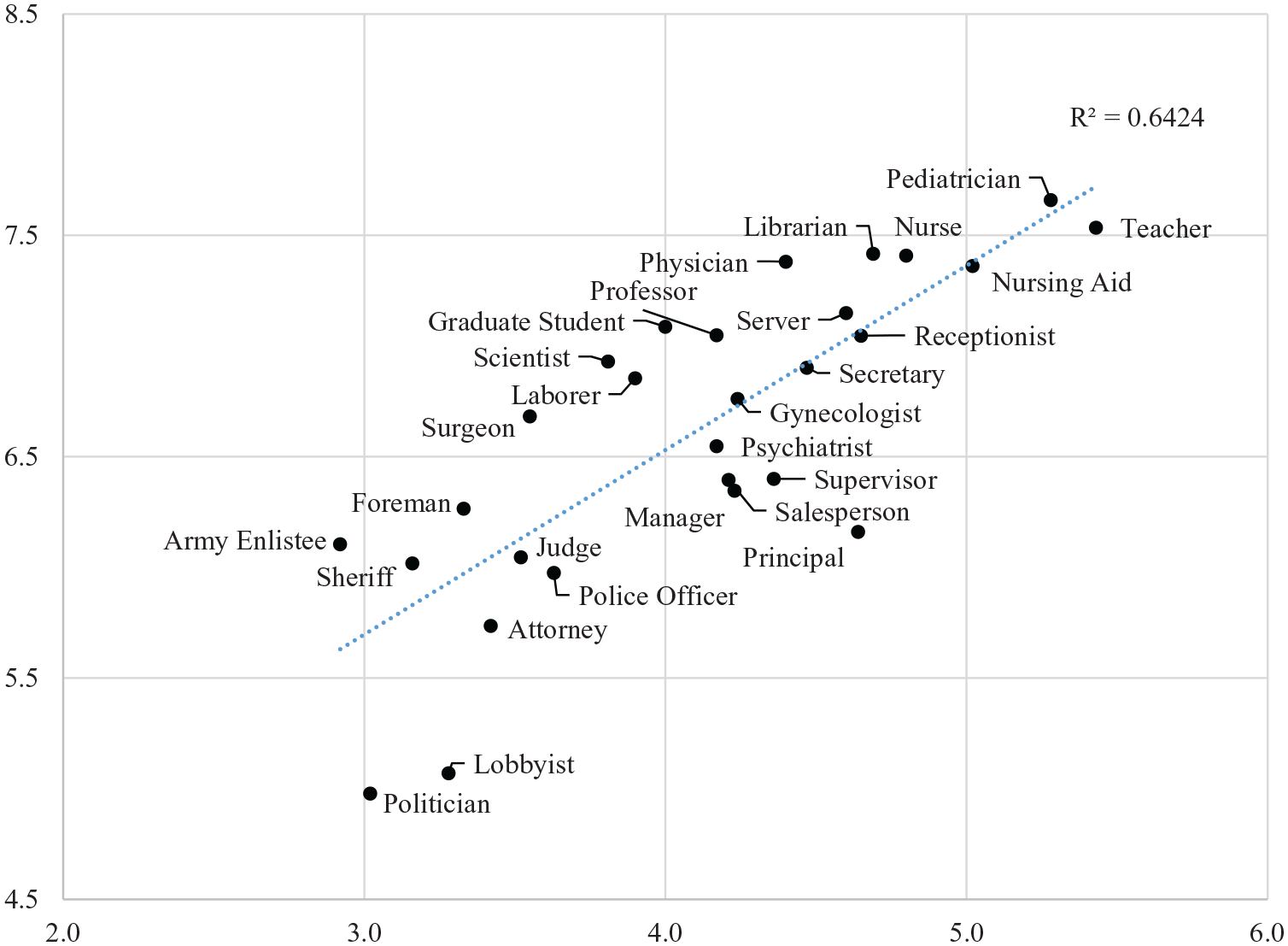
Scatterplot of compatibility (x axis) and likability (y axis), mother-occupation pairings (R2 = .64).
Although we find that an increase in compatibility leads to more positive social evaluations (all regression coefficients are significant and positive for both mothers and fathers), clearly the conversion of (in)compatibility into (un)likability is much tighter for mothers than fathers (see higher R2 values for mothers compared with fathers). In other words, perceptions of compatibility do not predict a pairing’s likability to the same degree for fathers as they do for mothers. In sum, the public appears to devalue both mothers and fathers in occupations that are deemed less compatible for them, but for mothers, compatibility and likability move in lockstep formation (are more systematically tied) relative to fathers. This suggests that occupational incompatibility is a more consistent trigger for how mothers are valued compared with fathers.
Discussion
Managing multiple roles, such as those of worker and parent, is a key feature of daily life. Cultural beliefs suggest that work outside of the home aligns with fatherhood but contradicts motherhood (Blair-Loy 2001; Hays 1996; Ridgeway and Correll 2004). Our study digs deeper into this broad generalization by unpacking the extent to which certain types of work roles are viewed as more and less compatible for mothers and fathers. Our sample of raters is not representative of the U.S. population, and thus our results are preliminary in terms of what “most people” think, but the patterns we detect suggest important next steps for future work.
With regard to mothers, we find that we can easily predict which occupational roles the public perceive as more and less compatible. For mothers, a compatible occupation is one that is, above all, female dominated, which translates into an occupation associated with high ethical standards or “goodness,” safety, and part-time opportunities. In contrast, perceptions of father-occupation compatibility are harder to explain. Only one of the prescriptive norms (power) could systematically explain variation in perceived compatibility for father-occupation pairings. Taken together, these findings suggest that the act of combining mother-occupation roles is policed vis-à-vis more systematic “rules” than the act of combining fatherhood with work.
Second, we find that an occupation that is a good fit with motherhood appears to also confer social value on the mother: a mother in an incompatible role pairing is judged as less likable, less sincere, less trustworthy, and less attentive to her children. This too, is generally true for fathers. However, the policing process around mothers once again seems to be stricter. Our results show that we can easily predict, on the basis of the supposed compatibility of her occupational role, if a mother will be judged as likable, sincere, trustworthy, and attentive to her children. In stark contrast, for fathers, attributions of compatibility are relatively weak predictors of attributions of worth (e.g., likability, sincerity, attentiveness to children). Given this, the present study suggests that, from the perspective of cultural beliefs, there are easily detectable constraints on our ideas about what mothers should and should not do when it comes to occupational choice, but our conceptualization of what fathers should and should not do in terms of occupational choice are not as obviously constrained. These findings have several implications.
First, our results suggest that there could be negative mental health repercussions for mothers working in incompatible occupations. This idea rests on the assumption that cultural beliefs about the value of the mother-occupation role pairing (e.g., likability, sincerity) are internalized by individuals with some degree of intensity; if so, cultural beliefs about working parents’ occupational choices could affect their health and well-being. That is, although all working parents must deal with standard work-family conflict issues (e.g., not enough hours in the day), mothers working in relatively incompatible occupations might face additional “soft” penalties if they are treated as less likable and less authentic individuals. Settles (2004), for example, argued that in the case of female scientists, the diffuse sense of incompatibility associated with the pairing could ultimately hurt incumbents’ well-being because (1) the audience, colleagues and noncolleagues alike, may feel uncomfortable with women in the scientist role and hence punish them through acts of discrimination or exclusion (see also Eagly and Karau 2002), and (2) female scientists are put in the position of having “to alter or compromise themselves . . . to better fit into the masculine culture” (Settles 2004:489).
Second, these findings shed light on important next steps for research exploring the determinants of career choice among young women (see, e.g., Rosenthal et al. 2011; Thébaud and Charles 2018). Although young people are often told to “follow their dreams” and “pursue their passions,” our findings imply that young women are facing a landscape in which not only are some occupations perceived as not a good “fit” for them, but combining the roles of mother and worker in those occupations will also render them less likable and less authentic individuals. As an example, our study suggests that the mother-teacher role combination, in terms of cultural beliefs, is seen in a much more positive light than the mother-lawyer combination. Perhaps young women who plan to have children or who want to be particularly involved parents self-select disproportionately into teaching instead of lawyering in part for this very reason: mother-teacher is seen as a more compatible and likable combination. Rosy images associated with mothers in certain occupations, but relatively tarnished images of mothers in other occupations, may be part of the reason young women continue to pursue traditionally female-dominated occupations at a higher rate than traditionally male-dominated occupations.
Third, future explorations should focus as much on fathers as mothers. Although our results suggest that perceptions of compatibility across father-occupation pairings do not appear to hinge on the occupational characteristics included in our model, the explanation for this is not clear. One possibility mentioned earlier is that prescriptive norms for fathers are not as strong as the prescriptive norms for mothers (Rudman and Glick 1999). But another, potentially simpler explanation is that the one overriding rule for fathers is to work, with less focus on the type of work they perform. If so, this would imply that there are simply fewer rules when it comes to combining work and parenting for men compared with women. Another possibility is that there are rules for fathers with respect to occupational choice, but our measures (earnings potential, sex composition) are simply not tapping into them. It may also be the case that the position a father holds within an occupation is more important than the occupation itself; for instance, the public may assume that fathers working in female-dominated occupations are in high-ranking leadership positions or in subspecialties with high pay and prestige (Pierce 1995; Williams 1995) and thus find both male- and female-dominated occupations relatively compatible with fatherhood. Finally, it could also be that viewpoints about what constitutes a good father are in such a state of flux (Burke and Stets 2009; Collett, Vercel, and Boykin 2015) that raters are relying on different versions of a good dad when rating father-occupation compatibility.
To move forward with this line of work, we suggest that future research replicate and expand the present study by (1) exploring other measures of perceptions of role compatibility (e.g., appropriateness instead of naturalness); (2) sampling on a larger set of occupations; (3) drawing on a large, nationally representative set of raters and theorizing how raters might differ in their perceptions of compatibility; and (4) exploring variation and intersectionality in terms of parent stereotypes. With respect to perceptions of fit or compatibility, previous research provided little guidance as to how to measure this construct. As Freeland and Hoey (2018) demonstrated with the measurement of occupational prestige, future research could test for construct and criterion validity by developing different measures of compatibility. One promising avenue may be Hunzaker and Valentino’s (2019:954) concept association approach, in which respondents are given pairs of concepts and asked to report, on the basis of “initial instinct,” if the pair is related or not related.
In terms of sampling on a larger set of occupations, this is an important next step given that evaluation and potency scores are now available for more than 300 occupations (Robinson et al. 2016). Our sample of 28 is diverse in terms of variability on the occupational characteristics tested here (see Appendix B), but we are clearly limited in our ability to test finer grained hypotheses regarding parent-occupation compatibility that a broader set of occupations that vary in more subtle ways would permit.
We theorized, for example, that mother-occupation compatibility would be negatively correlated with an occupation’s level of danger. But empirically, an occupation’s death rate is likely highly correlated with the extent to which it requires manual labor and strength. In other words, although we believe that there is a strong case for the public’s being opposed to mothers’ working in dangerous jobs, an alternative explanation is that the public feels strongly that mothers should not work in jobs that involve manual labor. The only way to convincingly tease apart these explanations is with a larger sample of occupations. 12
Future studies should also, no doubt, aim to use larger samples of respondents drawn from a nationally representative sample. As noted earlier, our sample is disproportionately white, young, and highly educated. Importantly, in addition to generalizability, gathering a larger sample with a more diverse set of respondents will facilitate the investigation of whether different subsets of raters subscribe to different cultural schemas on parent-worker compatibility and display different levels of consensus in their beliefs. 13 Finally, variability in the types of mothers and fathers should also be incorporated in future studies on perceptions of parent-work compatibility. As noted earlier, the stereotypes around mothers and fathers are far from monolithic. Although this dimension of variability was beyond the scope of this study, future studies featuring larger samples of respondents could easily examine whether demographic factors (e.g., race/ethnicity, age of child[ren], marital status), style of childrearing (intensive parenting), socioeconomic class, or reason for working (personal fulfillment vs. financial necessity) affect perceptions of parent-occupation fit. Currently, for example, there are already strong reasons to anticipate that perceptions of compatibility will differ for black and white mothers, given that black mothers are expected to work (e.g., there may be less perceived compatibility between black mothers in occupations with a high percentage of part-time work opportunities) (see Cuddy and Wolf 2013), but it remains less clear if the likability penalty will differ across racial groups. More generally, the broad theoretical question moving forward is why we should expect some roles to be policed more aggressively, in general, than others (see Mize and Manago 2018).
In sum, we encourage future researchers to tease out the nature of the apparent gender asymmetry in constraint and punishment associated with prescriptive norms for combining parental roles with occupational roles. Sociologists of culture argue that the transmission of culture between individuals is the transmission of “perceptions about which beliefs or behaviors are compatible with one another” (Goldberg and Stein 2018:819). In turn, culture can be “sticky” insofar as ideas and objects can become constrained in a nexus of meanings (Hays 1994, 1996). This study demonstrates that our understanding of the cultural constraints (or lack thereof) of any social role can be sharpened by examining the extent to which the public approves of it being paired with other social roles.
Supplemental Material
Noonan_Lynn_Walker_Syntax_June2020 – Supplemental material for Boxed In: Beliefs about the Compatibility and Likability of Mother-Occupation and Father-Occupation Role Combinations
Supplemental material, Noonan_Lynn_Walker_Syntax_June2020 for Boxed In: Beliefs about the Compatibility and Likability of Mother-Occupation and Father-Occupation Role Combinations by Mary C. Noonan, Freda B. Lynn and Mark H. Walker in Socius
Research Data
Noonan_Lynn_Walker_Data_June2020 – Research Data for Boxed In: Beliefs about the Compatibility and Likability of Mother-Occupation and Father-Occupation Role Combinations
Research Data, Noonan_Lynn_Walker_Data_June2020 for Boxed In: Beliefs about the Compatibility and Likability of Mother-Occupation and Father-Occupation Role Combinations by Mary C. Noonan, Freda B. Lynn and Mark H. Walker in Socius
Footnotes
Appendix A
Appendix B
Appendix C
Correlation Table for Occupation Variables.

| Percentage Part-Time | Death | Median Wage | Percentage Female | Evaluation (Goodness) | |
|---|---|---|---|---|---|
| Death | –.20 | ||||
| .31 | |||||
| Median wage |
|
–.23 | |||
| .05 | .23 | ||||
| Percentage female | . |
|
–.20 | ||
| .00 | .01 | .30 | |||
| Evaluation (goodness) | . |
–.23 | .32 | . |
|
| .61 | .24 | .10 | .02 | ||
| Potency (power) |
|
–.16 | . |
–.35 | .25 |
| .00 | .42 | .01 | .07 | .20 | |
| n | 27 | 28 | 28 | 28 | 28 |
Note: P values are listed beneath the Pearson correlation coefficients. Boldface values represent correlations with p values < .05.
Appendix D
Correlates of Parent-Occupation Compatibility.

| Mother-Occupation Compatibility |
Father-Occupation Compatibility |
||||||||||
|---|---|---|---|---|---|---|---|---|---|---|---|
| Occupational Characteristics | H1a |
H1b |
H1c |
H1d |
Occupational Characteristics | H2a |
H2b |
H2c |
H2d |
||
| M1 | M2 | M3 | M4 | M5 | M6 | M7 | M8 | M9 | M10 | ||
| Percentage part-time | .02* | .00 | Median wage | .00 | –.00 | ||||||
| (.01) | (.01) | (.00) | (.00) | ||||||||
| Death | –.77* | .27 | Percentage part-time | –.01 | –.00 | ||||||
| (.34) | (.26) | (.01) | (.01) | ||||||||
| Evaluation (goodness) | .48** | .27* | Potency (power) | .25* | .26 | ||||||
| (.13) | (.10) | (.11) | (.15) | ||||||||
| Percentage female | .02*** | .02*** | Percentage female | –.00 | –.00 | ||||||
| (.00) | (.00) | (.00) | (.00) | ||||||||
| Constant | 3.83*** | 4.21*** | 3.50*** | 3.27*** | 3.07*** | Constant | 4.10*** | 4.32*** | 3.81*** | 4.27*** | 3.94*** |
| (.18) | (.13) | (.20) | (.15) | (.18) | (.14) | (.14) | (.17) | (.17) | (.34) | ||
| Observations | 27 | 28 | 28 | 28 | 27 | Observations | 28 | 27 | 28 | 28 | 27 |
| R 2 | 17% | 17% | 34% | 63% | 73% | R 2 | 1% | 8% | 17% | 3% | 19% |
| Correlation | .42 | –.41 | .58 | .79 | Correlation | .09 | –.28 | .41 | –.16 | ||
| p value | .03 | .03 | .00 | .00 | p value | .66 | .16 | .03 | .41 | ||
Note: Values in parentheses are standard errors.
p < .05. **p < .01. ***p < .001.
Authors’ Note
An earlier version of this article was presented at the 2016 annual meeting of the American Sociological Association. We thank Rob Freeland and Jennifer Glass for their feedback on previous drafts. We also thank Christin Landivar for help retrieving the American Community Survey data and Asaf Levanon for data on manual/non-manual distinction for occupations.

Supplemental Material
Supplemental material for this article is available online.
Notes
Author Biographies
References
Supplementary Material
Please find the following supplemental material available below.
For Open Access articles published under a Creative Commons License, all supplemental material carries the same license as the article it is associated with.
For non-Open Access articles published, all supplemental material carries a non-exclusive license, and permission requests for re-use of supplemental material or any part of supplemental material shall be sent directly to the copyright owner as specified in the copyright notice associated with the article.
