




Abstract
How does immigrant generation shape Latinos’ neighborhood attitudes? We extend theoretical frameworks focused on neighborhood attainment to explore how immigrant generation structures Latinos’ neighborhood satisfaction, particularly with respect to neighborhood immigrant composition. Using longitudinal data from the Los Angeles Family and Neighborhood Survey, we estimate fixed-effects regression models to examine the associations between self-reported neighborhood satisfaction and changes in neighborhood immigrant composition. We find that first-generation Latino immigrants tend to react more positively to growing immigrant populations in their neighborhoods compared to 1.5-generation and native-born Latinos; these differences are most pronounced in more socioeconomically advantaged neighborhoods. We consider the implications of these attitudinal differences for understanding the mechanisms of Latino residential segregation and neighborhood attainment.
Keywords
As Latino population growth has transformed American society, the residential segregation and neighborhood attainment patterns of Latinos have become key indicators of racial/ethnic relations and inequality (Tienda and Fuentes 2014). At the same time as rates of Black-White segregation have moderately declined, Latino-White segregation has stagnated or even increased, and Latino immigrants in particular experience high levels of segregation from non-Hispanic Whites (Iceland 2009; Massey 2015). Most work to date has focused on identifying the patterns of Latino segregation and neighborhood inequality, but more work remains to fully understand the underlying mechanisms (Tienda and Fuentes 2014).
One potential mechanism is neighborhood satisfaction—defined as residents’ overall evaluations of their neighborhood conditions (Swaroop and Krysan 2011). Since integration cannot stabilize unless people hold similar neighborhood preferences (Schelling 1971; Clark 1991; Quillian 2002; Clark and Fossett 2008), if (some) Latinos think about neighborhoods differently than do members of other groups, like non-Hispanic Whites, that could help to explain continuing Latino segregation and lagging neighborhood attainment. Existing work tends to define the end goal of Latino neighborhood attainment as high levels of integration with native-born, non-Hispanic Whites, implicitly assuming that all Latinos want to live in such neighborhoods (Tienda and Fuentes 2014; but see South, Crowder, and Pais 2008 for an exception). We question this assumption based on the insight that Latinos are not a monolithic group; along with other characteristics like ethnicity, generation since immigration is a major source of diversity among Latinos (Jiménez 2010; Alba, Jiménez, and Marrow 2014; Jiménez, Fields, and Schachter 2015).
Immigration thus complicates studies of Latinos’ neighborhood attitudes—and the implications for segregation and neighborhood attainment—at multiple levels by introducing heterogeneity in the characteristics of a neighborhood’s Latino population and heterogeneity in the neighborhood evaluations of individual residents. Current work implicitly assumes Latino neighborhood orientations are homogeneous and all Latinos prefer lower levels of segregation, suggesting that Latino immigrants, who tend to live in more segregated neighborhoods (Iceland 2009), are necessarily the most dissatisfied and “stuck” in undesirable neighborhoods (Sharkey 2013). However, if immigrants are relatively more satisfied by more segregated neighborhoods (e.g., enclaves) (Zhou and Bankston 1994), they may be less stuck than previously assumed. Conversely, whereas they tend to experience relatively lower levels of segregation (Iceland 2009), later-generation Latinos may be the ones facing greater barriers to living in their desired neighborhoods if their current neighborhood conditions substantially deviate from their preferences. It is only by explicitly testing for heterogeneity in neighborhood attitudes that we can begin to identify who is stuck and what structural barriers they may face.
Although most work to date has focused on non-Hispanic Whites and Blacks (see Charles 2003 for a review), more recently, scholars have begun to study Latinos’ neighborhood attitudes (Greif 2009; Lewis, Emerson, and Klineberg 2011; Swaroop and Krysan 2011). We contribute to this scholarship by investigating how immigration shapes Latinos’ satisfaction with their neighborhoods. We first consider how influxes of immigrant residents transform neighborhoods themselves and then extend existing theories of neighborhood attainment to consider how individual-level immigrant status and generation influence Latinos’ evaluations of these neighborhood-level immigrant characteristics, including the size of the noncitizen population. Finally, using longitudinal data from the Los Angeles Family and Neighborhood Survey (LAFANS), we empirically examine how the dynamic interplay between individual- and neighborhood-level immigrant characteristics shapes Latino residents’ satisfaction with their neighborhoods.
Background
Our current understanding of Latinos’ neighborhood attitudes and their implications for residential inequality are grounded in a long line of scholarship focused on non-Hispanic Whites and Blacks, which prioritizes neighborhood racial composition (see Charles 2003 for a review). Scholarship on Latinos is more limited but tends to find that Latinos’ racial residential preferences are in between those of non-Hispanic Whites and Blacks. For example, Latinos report being more willing to live in predominantly White neighborhoods than are Blacks, but Latinos also prefer predominantly Latino neighborhoods compared to those with large numbers of Black residents (Zubrinsky and Bobo 1996; Charles 2000, 2001, 2006). Similar to Blacks, Latinos appear to be more satisfied in integrated (i.e., White-Latino) neighborhoods relative to majority-Latino or Black neighborhoods mostly because they tend to have higher–socioeconomic status (SES) residents and fewer perceived social problems, as opposed to having independent preferences for White neighbors or against Blacks (Swaroop and Krysan 2011). And Lewis et al. (2011) demonstrate that independent of experimental manipulations of neighborhood crime, school quality, and property values, neighborhood ethnoracial composition has little impact on Latinos’ preferences. Similarly, Greif (2009) finds that the proportion of Latino residents has only a small, positive association with Latinos’ neighborhood satisfaction. In sum, the existing evidence suggests that, like Blacks, Latinos prioritize living in higher-SES neighborhoods, which tend to have more White residents, and that this SES preference is stronger than—and can account for—most of Latinos’ neighborhood “racial” preferences.
Despite strong evidence that immigration has important effects on segregation (Iceland 2009), even work on neighborhood attitudes that includes Latino respondents has largely relied on existing hypotheses drawn from previous research on Whites and Blacks that debates the relative roles of ethnoracial composition and neighborhood SES/quality indicators (e.g., Lewis et al. 2011; Swaroop and Krysan 2011). These existing models, while offering a useful starting point, ignore the potential impact of immigration on both individual orientations and neighborhoods themselves. Immigration is a key source of the growing heterogeneity among the more than 55 million Latinos in the United States (Jiménez 2010; Alba, Jiménez, et al. 2014; Jiménez et al. 2015), who are almost evenly divided between the first (e.g., foreign born), second (native born to immigrant parents), and third-plus (native born to native-born parents) generations (Pew Research Center 2013; Stepler and Brown 2016). Substantial proportions of later-generation Latinos are achieving middle-class status (Aguis Vallejo 2012), whereas many unauthorized Latino immigrants continue to live in the shadows (Bean, Brown, and Bachmeier 2015). Among other outcomes, immigrant generation is associated with Latinos’ language ability and use, socioeconomic attainment, political attitudes and behaviors, and perhaps most tellingly, residential attainment (Waters and Pineau 2015), suggesting that generational status is a key characteristic shaping neighborhood satisfaction.
Similarly, previous research has not paid attention to the unique neighborhood-level characteristics that may be important in understanding immigration’s effect on Latinos’ neighborhood attitudes. Like Latino individuals, not all Latino communities are the same. Rather, they vary in terms of the ratio of Spanish to English language speakers, the size of noncitizen/undocumented populations, and the proportion of residents who are recent immigrants to the United States as opposed to long-standing residents, among other characteristics (Tienda and Fuentes 2014). These differences may be critical to understanding Latinos’ subjective evaluations of their neighborhoods but are not generally included in studies of neighborhood attitudes or attainment. 1 Ethnoracial concentration, the typical focus of such work, is not a proxy for these immigration-driven neighborhood dynamics. For example, it seems likely that residents would respond differently to a growing middle-class, second-generation-plus Latino population on the one hand and a growing community of undocumented immigrants on the other, even though both scenarios could involve similar increases in a neighborhood’s concentration of Latino residents. In particular, given a large body of research the role of legal status as a key source of stratification among Latinos (Portes and Zhou 1993; Portes and Rumbaut 2001, 2006; Telles and Ortiz 2008; Bean et al. 2015; Waters and Pineau 2015), we focus on reactions to the size of the local noncitizen population.
Immigration and the Transformation of Neighborhoods
High levels of immigration from Latin America and Asia during the past several decades have transformed communities throughout the United States (Iceland 2009), particularly the neighborhoods in which most Latinos—regardless of generation status—reside (Pew Research Center 2013). The implications of this trend are mixed. On the one hand, high rates of immigration have contributed to steady or rising levels of racial segregation for Latinos, even as Black-White segregation has somewhat fallen (White and Glick 1999; Logan, Stults, and Farley 2004; Timberlake and Iceland 2007; Iceland 2009; Logan and Stults 2011). 2 Upon arrival, new Latino immigrants initially tend to settle in traditional Latino destinations, including Los Angeles County (Tienda and Fuentes 2014), which contributes to increased/sustained Latino residential segregation. 3 Furthermore, immigrant concentration is associated with higher rates of residential instability and weakened collective efficacy (Sampson, Morenoff, and Earls 1999), which can have negative implications for neighborhood social organization and satisfaction (Sampson 2012).
On the other hand, influxes of immigrants are associated with positive neighborhood changes like economic and social revitalization (Winnick 1990), decreasing crime (Lee and Martinez 2009; Kirk and Laub 2010; MacDonald, Hipp, and Gill 2012), and gentrification (Hwang 2015). 4 And communities with larger, well-established immigrant populations often offer a more welcoming context of reception (Chavez and Provine 2009; Boushy and Luedtke 2011; Steil and Vasi 2014). In one of the few studies to examine Latinos’ subjective orientations toward their neighborhoods, Greif (2009) finds that percentage of immigrants has no independent association with neighborhood satisfaction and sentiment, suggesting that residents may indeed perceive both positives and negatives when it comes to growing local immigrant communities.
In sum, immigration affects neighborhoods in multiple ways beyond ethnoracial composition and SES. Existing work does not investigate the potentially unique roles of immigrant concentration in general nor the specific characteristics of local immigrant populations, such as citizenship status, for Latinos’ neighborhood attitudes. Thus, the first contribution of this article is to describe the associations between multiple measures of neighborhood immigrant characteristics and Latinos’ overall satisfaction with their neighborhoods.
Immigrant Generation and Latino Neighborhood Satisfaction
Our second aim is to consider whether and how immigrant generation interacts with neighborhood immigrant characteristics to shape Latinos’ overall satisfaction with where they live. We know from research on spatial assimilation (Massey and Denton 1985) that Latino immigrants tend to live in more racially segregated neighborhoods than their native-born counterparts (South, Crowder, and Chavez 2005b; Brown 2007; Iceland and Nelson 2008; Iceland and Scopilliti 2008; Iceland 2009). 5 Immigrant households also tend to be in lower-SES neighborhoods than those of natives (White and Sassler 2000; Rosenbaum and Friedman 2001).
Although these differences in neighborhood attainment are well documented, scholars disagree on the underlying mechanisms that account for these patterns. Place stratification theory offers one potential explanation: (Non-White) immigrants and their offspring are targets of exclusionary practices that make it difficult for them to move into higher-SES neighborhoods, even when they have the economic resources to do so (Massey and Denton 1985; Logan and Alba 1993; Pais, South, and Crowder 2012; Quillian 2012; Tienda and Fuentes 2014). Significant evidence suggests that regardless of immigrant generation, Latinos are subject to the exclusionary practices outlined in the place stratification model (Ross and Turner 2005; Telles and Ortiz 2008; Pais et al. 2012; Alba, Deane, et al. 2014; Tienda and Fuentes 2014). However, Latino immigrants, who tend to have lower levels of SES than the native born (Waters and Pineau 2015), might be particularly susceptible to experiencing place stratification. In addition, a lack of citizenship may trap Latino immigrants in high-poverty enclave neighborhoods where there is little hope of converting individual SES gains into higher-quality, more integrated residential neighborhoods (i.e., spatial assimilation) (Bean and Stevens 2003; Alba, Deane, et al. 2014; Tienda and Fuentes 2014). Thus, according to place stratification reasoning, Latino immigrants experience higher rates of segregation than do their native-born counterparts due to their relatively lower SES circumstances and/or their greater susceptibility to exclusionary practices.
Critically, the place stratification model suggests that all Latinos, regardless of immigrant generation status, have a shared preference for higher-SES, more integrated White-Latino neighborhoods (Lewis et al. 2011; Swaroop and Krysan 2011). The draw of high-SES neighborhoods, with less social disorder and higher proportions of non-Hispanic White residents, may be strong for all Latinos, including recent immigrants, many of whom migrate in search of greater economic security and safety from violence and crime (Portes and Rumbaut 2006). In addition, while exposure to the U.S. racial order changes Latinos’ notions of racial boundaries and hierarchy, Latino immigrants also bring notions of race and skin color stratification with them from their home countries (Roth 2012) and so may already perceive neighborhoods with fewer Black residents as more desirable prior to experiencing any assimilation of U.S. cultural norms and values.
In contrast, other research suggests that rather than being trapped or stuck, compared to their later-generation counterparts, Latino immigrants might be relatively more satisfied by more segregated neighborhoods with greater concentrations of immigrants. Scholarship on enclaves—generally poor, inner-city neighborhoods with large immigrant and coethnic communities (Zhou 1992, 2005; Portes and Zhou 1993; Zhou and Bankston 1994; Portes and Rumbaut 2001)—argues that less-assimilated immigrants can obtain substantial social capital benefits from living in these segregated neighborhoods (e.g., Wilson and Portes 1980; Hall, Greenman, and Farkas 2010; Donato and Armenta 2011; Xie and Gough 2011; Flippen 2012; but see Sanders and Nee 1987 for an alternative perspective). In addition to offering economic and social benefits, a growing body of scholarship on Latino health and well-being finds protective effects of residing in neighborhoods concentrated with coethnics (Bécares et al. 2012). Thus, while enclave neighborhoods may be disadvantaged based on socioeconomic measures of neighborhood quality (Logan, Zhang, and Alba 2002; Alba, Deane, et al. 2014), less-assimilated residents, and particularly those with limited English proficiency or those lacking legal status, may nonetheless feel more integrated and socially supported in places where they are more similar to their neighbors. Supporting this claim, Hall and Stringfield (2014) find that undocumented Latinos are more likely to live in Black or Latino neighborhoods, and Asad and Rosen (2019) find that immigrants lacking legal status strategically chose to live in segregated neighborhoods to evade detection.
These potential benefits may drive less-assimilated Latino immigrants to be more satisfied with neighborhoods inhabited by larger concentrations of immigrants. However, as Latinos become more assimilated in U.S. society—that is, gain U.S. citizenship and accrue English language skills—the perceived benefits of enclave residence likely erode, leading native-born and later-generation Latinos to favor higher levels of integration with native-born, non-Hispanic Whites.
These alternative perspectives offer competing hypotheses. On the one hand, the place stratification model suggests that all Latinos are equally dissatisfied by neighborhoods that have high concentrations of immigrant residents, but native-born Latinos typically have higher SES backgrounds and are thus more equipped to fight discriminatory forces, which is why they are less likely to end up living in such neighborhoods. On the other hand, research on immigrant enclaves suggests that less-assimilated Latino immigrants may obtain substantial benefits from living in more segregated, immigrant-concentrated neighborhoods. In contrast with the place stratification model, this perspective suggests that rather than being more “stuck” in such neighborhoods compared to the native-born, Latino immigrants are actually relatively more satisfied with immigrant-concentrated neighborhoods. The following hypotheses put this more formally:
No Generational Differences Hypothesis: All Latinos, regardless of immigrant generation, evaluate their neighborhoods similarly, favoring neighborhoods with fewer immigrants. Less-assimilated Latino immigrants simply may be less able to live in their favored neighborhoods compared to the native born due to their lower SES circumstances and/or their greater susceptibility to exclusionary practices.
Generational Differences Hypothesis: Alternatively, immigrant generation may structure Latinos’ neighborhood satisfaction. Whereas first-generation immigrants prefer neighborhoods with larger concentrations of immigrants and less-assimilated residents (e.g., higher proportions of Spanish speakers, more noncitizens), later-generation Latinos, who are more assimilated themselves, are more satisfied by neighborhoods with fewer immigrants and/or more assimilated residents.
A third possibility is that Latinos evaluate neighborhoods on multiple dimensions of varying importance (Tversky 1972). Most Latinos, regardless of generation/assimilation status, may similarly prioritize higher-SES neighborhoods with lower levels of social disadvantage. However, net of these homogeneous SES orientations, immigrant generation may structure Latinos’ additional, second-order attitudes toward the immigrant makeup of their neighborhoods, as predicted by our Generational Differences Hypothesis. Whereas Latinos, regardless of generation status, may favor higher-SES neighborhoods, their additional evaluations of the immigrant makeup of their neighborhoods could still follow an assimilation pattern, such that more recent immigrants respond more positively to higher levels of immigrant neighborhood concentration relative to later-generation Latinos.
Like the intuition behind our Generational Differences Hypothesis, this perspective suggests that immigrant generation status will structure Latinos’ neighborhood satisfaction. However, these differences may be at least somewhat attenuated by measures of neighborhood quality because of the associations between neighborhood immigrant concentration and neighborhood SES indicators (Tienda and Fuentes 2014). Although our data do not allow us to explicitly evaluate the relative order or importance of neighborhood SES and immigrant concentration in shaping Latinos’ overall neighborhood satisfaction (see details on data below), a testable extension is that neighborhood SES moderates Latinos’ neighborhood evaluations. Specifically, in less-disadvantaged neighborhoods, where first-order concerns about neighborhood SES are presumably less relevant, we expect neighborhood immigrant composition to have a stronger association with Latinos’ neighborhood satisfaction, such that less-assimilated immigrants are more satisfied with higher immigrant concentrations. In contrast, in highly disadvantaged neighborhoods we expect first-order concerns about neighborhood SES to overwhelm second-order orientations toward neighborhood immigrant concentration, yielding few if any satisfaction differences by immigrant generation. This leads to our final hypothesis:
Neighborhood SES Moderation Hypothesis: In disadvantaged neighborhoods, all Latinos, regardless of immigrant generation, evaluate their neighborhoods similarly, favoring neighborhoods with fewer immigrants. However, in less-disadvantaged neighborhoods, less-assimilated Latino immigrants are more satisfied by neighborhoods with greater concentrations of immigrants, whereas later-generation Latinos prefer fewer immigrants.
Measuring Attitudes through Neighborhood Satisfaction
We adjudicate among these three hypotheses by examining changes over time in Latinos’ self-reported satisfaction with their neighborhoods. Following Swaroop and Krysan (2011), we consider satisfaction to be a measure of residents’ overall evaluations of neighborhood conditions. Relative to direct questions about preferences for neighborhood immigration characteristics, overall satisfaction is less likely to be subject to social desirability bias. Furthermore, as opposed to reactions to hypothetical neighborhoods (e.g., Emerson, Chai, and Yancey 2001; Krysan et al. 2009; Lewis et al. 2011), by relying on respondents’ satisfaction with their actual neighborhoods, along with data on objective neighborhood conditions, we are able to examine reactions to a greater number of neighborhood-level characteristics than the typical factorial experiment (Swaroop and Krysan 2011). However, while our data have certain advantages over hypothetical/experimental work, it is important to recognize that our results may be subject to selection effects. As described in detail below, we use longitudinal fixed-effects models, which should minimize this bias (Sampson and Sharkey 2008), though it remains possible that our models omit time-varying characteristics that shape individuals’ selection into their residential neighborhoods.
We also focus on satisfaction because the classic model of residential decision making implicates residential satisfaction as the key determinant of mobility (Speare 1974; Speare, Goldstein, and Frey 1975). From this logic, dissatisfaction arises when individuals within a household are no longer getting their needs met at their current residence, often resulting from such major life transitions as childbearing, marriage, and changing employment (Rossi 1955; Clark, Deurloo, and Dieleman 1984). Other research has found that satisfied residents are less likely to entertain thoughts about relocating, which in turn reduces the probability of actual mobility (Speare 1974; Landale and Guest 1985; Lee, Oropesa, and Kanan 1994). It is reasonable to assume, then, that Latinos who become increasingly dissatisfied as their respective neighborhoods become more concentrated with less-assimilated immigrants will be more apt to consider moving because their current neighborhood surroundings no longer satisfy their expectations.
Data and Methods
Data
To assess these hypotheses, we use restricted-access longitudinal data from LAFANS. LAFANS is based on a stratified random sample of 65 neighborhoods (census tracts) in Los Angeles County and was administered in two waves: 2000–2002 and 2006–2008. In wave 1, LAFANS randomly selected and interviewed adults and children living in 3,085 households across the 65 sampled tracts, including an oversample of households with children younger than 18. In wave 2, LAFANS tried to reinterview all sampled children and adults, whether they left the tract or not, and a sample of new residents in each neighborhood was interviewed. Although sample members were tracked even if they moved out of the county, state, or country, they could provide information only via telephone interview and not the standard face-to-face interview and thus were not administered health-related questions (Sastry et al. 2006). An important advantage of LAFANS is that it combines a panel study of individuals with a repeated cross section of neighborhoods to facilitate an in-depth investigation of changing neighborhood attitudes and contextual effects research more broadly.
There is substantial attrition in the LAFANS sample of panel respondents. Among the original randomly sampled 3,085 adults, there are 1,193 panel respondents interviewed in the Adult Module in wave 2, of which 652 are Latinos. There are 648 Latino panel respondents who have valid data on all variables used in the study. Given our longitudinal (two-wave) data structure, our final analytic sample is 1,296 person-waves. LAFANS provides panel weights to be used in all longitudinal analyses, which are a combination of the wave 1 design weight and a wave 2 attrition adjustment. Panel weights are designed to account for the oversampling of census tracts in the poorest strata of Los Angeles County, the oversampling of households with children, and the attrition of eligible wave 1 panel members due to nonresponse (Peterson et al. 2011). LAFANS staff derived the attrition factor by executing logistic regression models predicting nonresponse among panel respondents who at wave 2 were not known to be ineligible (e.g., deceased, incarcerated, mentally or physically disabled). These panel weights also are designed to make the sample representative of the Los Angeles County adult population at wave 1 who reside in the county at wave 2.
Los Angeles provides an intriguing setting in which to study the neighborhood attitudes of Latinos, particularly due to the influence of Mexican immigration and how the residential landscape transformed as a result (Telles and Ortiz 2008). With a steady stream of immigrants (mainly from Mexico) throughout the twentieth century, Los Angeles became the largest immigrant-receiving metropolitan area in the country (Charles 2006), and although Los Angeles routinely stands out as one of the most ethnoracially diverse places to live in the nation (Lee, Iceland, and Sharp 2012), ethnoracial residential segregation still persists at high levels (Logan and Stults 2011). In fact, among metropolitan areas with the largest Hispanic populations in 2010, Los Angeles now exhibits the highest level of Hispanic-White segregation in the nation (Logan and Stults 2011). As Charles (2006:18) states, “increasing racial/ethnic diversity can add to intergroup tensions and intensify conflict, especially in a society marked by a history of racial/ethnic oppression, extreme racial residential segregation, and economic stratification . . . (and) in many ways, Los Angeles illustrates something close to a worst-case scenario.” From a more positive outlook, scholars have argued that increasing diversity from continued immigration has served to erode sharp ethnoracial boundaries and buffer Black-White hostility (Lee and Bean 2010). Although diversity does not guarantee contact, the associated intergroup interactions, or lack thereof, should have substantial implications for Latinos’ neighborhood satisfaction.
Because LAFANS data provide census tract identifiers, we can create neighborhood measures that correspond to individual residences. We follow existing research on neighborhood context and satisfaction and use census tracts as proxies for neighborhoods (e.g., Greif 2009; Hipp 2009). Although census tracts may or may not coincide with residents’ subjective definitions of the neighborhood (Lee and Campbell 1997; Pebley and Sastry 2009), they are designed to be consistent in terms of their demographic, economic, and residential features and are frequently bounded by visible physical markers such as streets, bridges, or rivers. LAFANS respondents are asked to think of their neighborhood as encompassing “the block or street you live on and several blocks or streets in each direction” when answering questions specific to the neighborhood, which should provide some level of standardization among these responses. Census 2000 and the 2005–2009 American Community Survey five-year estimates are the sources of data used to create neighborhood measures for both waves of LAFANS respondent data. 6
Measures
The dependent variable, neighborhood satisfaction, is based on responses to the question, “All things considered, would you say you are very satisfied, satisfied, dissatisfied, or very dissatisfied with your neighborhood as a place to live?” Responses for this survey question range from (1) very dissatisfied to (5) very satisfied. 7
Our key individual-level independent variables are nativity (0 = native-born, 1 = foreign born) and generation (1 = native-born, 2 = 1.5 generation, 3 = first generation). Although nativity captures the most basic distinction among Latinos, generation is more nuanced, allowing us to differentiate among the first—Latinos who immigrated to the United States as adults—and 1.5—Latinos who immigrated to the United States as children—generations as well as compare both groups to the native born, all of whom are second generation or later. Unfortunately, we do not have enough third-plus-generation respondents to further disaggregate this group, a limitation of the data. Differentiating between first- and 1.5-generation individuals may be critical given evidence that on many outcomes the 1.5 generation more closely resembles the second generation than the first (Portes and Rumbaut 2006). Although there is certainly heterogeneity within these categories, both nativity and generation status are standard proxies for the overall assimilation levels of immigrants and their descendants (Alba and Nee 2003; Portes and Rumbaut 2006) and allow us to create large enough groups so that we can estimate interaction effects (see below for details about our modeling strategy). 8
We also control for several time-varying individual characteristics that may shape neighborhood preferences. Married (0 = no, 1 = yes) captures current marital status. Number of kids, homeowner (0 = no, 1 = yes), and age capture potentially important life course and household differences. Family income (in 2007 dollars) and educational attainment (less than high school, high school degree, some college, college+) capture individual and household-level SES. We also account for length of residence in the current neighborhood (in years) and a dummy indicating whether the respondent moved between waves (1 = yes). As described below, time-invariant individual-level controls, including gender and country of origin, are automatically accounted for in our fixed-effects models.
Our key neighborhood-level measures capture the immigrant characteristics of respondents’ census tracts. Similar to what we did at the individual level, we begin with a simple measure of proportion immigrant. We compare results for this measure to those for proportion of noncitizens in the neighborhood, which captures a crucial legal status distinction among immigrants and their children. In the online appendix we present models using two additional measures of neighborhood immigrant characteristics: proportion recent arrivals to the United States and proportion speaking non-English at home (e.g., people who sometimes or always speak a language other than English at home, who may or may not also speak English outside of their home). These indicators capture important heterogeneity within Latino neighborhoods and may be more accurate measures of a neighborhood’s “assimilation” level than is the proportion of immigrants (Tienda and Fuentes 2014). 9
Finally, we control for key neighborhood-level characteristics that help us adjudicate among our three hypothesized models. We have three indicators for ethnoracial concentration in respondents’ neighborhoods, proportion Latino, proportion Black, and proportion Asian, which allow us to disentangle reactions to changing immigrant populations and reactions to changing ethnoracial composition. Concentrated disadvantage is a commonly used objective measure of overall neighborhood SES (see Sampson 2012). Beginning with all census tracts in Los Angeles County, we derive concentrated disadvantage from a factor analysis with oblique rotation representing six variables (all proportions): persons younger than 18 years old, households on public assistance, female-headed households with children, persons without high school degrees, unemployment rate, and poverty rate. We also control for the population size of the residential neighborhood (in thousands). 10 Descriptive statistics for all variables used in the analysis are reported in Table 1.
Descriptive Statistics for Latino Respondents (Means and Standard Deviations Weighted).

Source: Los Angeles Family and Neighborhood Survey.
Note: N = 1,296. Note that minimum and maximum values for continuous measures are unweighted.
Analytical Strategy
To exploit the longitudinal data structure of LAFANS, we employ a fixed-effects regression modeling strategy to examine the effects of neighborhood change on changes in satisfaction. As LAFANS contains two waves of data, we rely on the change score approach to fixed-effects modeling, which is ideal for handling the two-period panel case (Allison 2009; Firebaugh, Warner, and Massoglia 2013). An important advantage of the fixed-effects approach is that it removes the effects of unmeasured stable individual- and neighborhood-level characteristics, thus reducing the risk of endogeneity bias (Allison 2009; Firebaugh et al. 2013). Though this analysis is not explicitly causal, fixed effects is a powerful tool with which to assess within-individual change while being able to account for potential selection effects that might influence the relationship between neighborhood immigration factors and residents’ satisfaction. In line with studies of contextual mobility (see Sharkey 2013), this approach provides a strong test of contextual effects by disentangling the impact of changes in individuals’ respective neighborhoods regardless of whether they moved or stayed put. Our fixed-effects regression models take the form of the following change score equation:

where
Guided by our theoretical framework, our modeling of neighborhood satisfaction proceeds in the following steps. First, for each neighborhood-level measure of local immigrant composition, we estimate multivariate models that allow us to establish if there is an overall association with Latinos’ neighborhood satisfaction. Second, we test whether there are differential effects on satisfaction by individual nativity and generation status, again separately examining each neighborhood-level immigrant composition measure. It is important to note that because respondents’ own nativity or generation status is time invariant, there are no “main effects” estimated for these measures, and the interaction terms alone capture the full interaction effect (Allison 2009). We also examine whether the relationships between neighborhood immigrant characteristics and satisfaction are attenuated by neighborhood ethnoracial composition and disadvantage. Finally, to test the Neighborhood SES Moderation Hypothesis, we reestimate our models stratified by three levels of neighborhood concentrated disadvantage. This allows us to examine whether and how neighborhood SES moderates the relationships between individual nativity/generation status, neighborhood immigrant composition, and neighborhood satisfaction.
Results
Table 2 presents a series of fixed-effects models examining the effect of immigrant concentration on neighborhood satisfaction. As shown in model 1, among all Latinos, increases in neighborhood immigrant concentration decrease satisfaction, net of changes in neighborhood ethnoracial composition and concentrated disadvantage. 11 In the subsequent models we do not find any variation among Latinos by nativity status (model 2) or generation (model 3). Together, these results support the No Generational Differences Hypothesis by demonstrating that all Latinos have similar reactions (i.e., diminishing satisfaction) to changes in neighborhood immigrant concentration. This homogeneous, negative reaction to a growing neighborhood immigrant population remains even after we account for changes in neighborhood disadvantage and ethnoracial composition.
Fixed-Effects Regression Models Predicting Neighborhood Satisfaction by Proportion Immigrant.

Source: Los Angeles Family and Neighborhood Survey.
Note: N = 1,296 person-waves. All models include individual-level controls for age, marital status, number of kids, homeownership, length of residence, whether the respondent moved between survey waves, family income, and educational attainment. P. = proportion; NB = native born; FB = foreign born.
p < .01. ***p < .001, two-tailed tests.
However, when we repeat the same modeling strategy but investigate the effect of changes in the proportion of noncitizens, a distinct picture emerges. As with proportion immigrant, we find that net of neighborhood ethnoracial composition and concentrated disadvantage, overall Latino satisfaction decreases with growing shares of noncitizen neighbors (model 1), and there are no differences by immigrant status (model 2). However, when we examine differences by immigrant generation, we find a key difference between first-generation immigrants on the one hand, and 1.5-generation immigrants and the native born (e.g., second-generation-plus) on the other (model 3). Compared to later-generation Latinos, first-generation Latino immigrants react much less negatively to noncitizen neighbors, even when we control for neighborhood concentrated disadvantage. Results for proportion noncitizen support our Generational Differences Hypothesis by demonstrating that after accounting for neighborhood ethnoracial composition and concentrated disadvantage, first-generation Latino immigrants have distinct neighborhood evaluations relative to 1.5-generation and native-born Latinos.
Figure 1 further examines the effects of proportion noncitizen by graphing predicted changes in neighborhood satisfaction by generation status. This plot is generated by holding all measures at their means and varying only the change in proportion noncitizen (using coefficients from model 3 of Table 3). Note the general trend for satisfaction to increase across waves; thus the graph compares relative gains in satisfaction by generation status as the change in proportion noncitizen varies. The differences between first- and later-generation (e.g., 1.5-generation and native-born) Latinos are striking: Whereas later-generation Latinos experience about a .35-point drop—or about four-tenths of a standard deviation—in predicted satisfaction gains with a one standard deviation increase in the change in proportion of noncitizens, first-generation immigrants experience a drop of only .16 points (less than two-tenths of a standard deviation). Given that decreases in neighborhood satisfaction are precursors to residential mobility (Speare 1974), these results suggest that as a neighborhood’s noncitizen population grows, later-generation Latinos are more susceptible to moving out of the neighborhood than are first-generation Latino immigrants, who themselves are more likely to be noncitizens, potentially hastening a neighborhood’s transformation into a more concentrated enclave. These findings also serve to emphasize the importance of using more detailed measures of immigrant assimilation at both the individual and the neighborhood level, as they appear to better capture the complexity of Latinos’ neighborhood attitudes relative to simple measures of nativity.
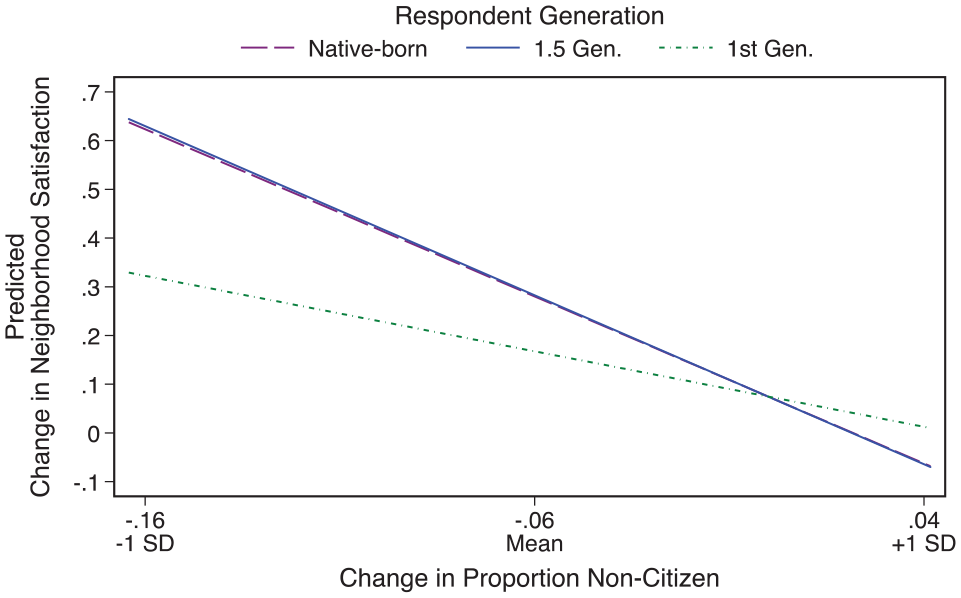
Predicted change in neighborhood satisfaction by change in tract proportion noncitizen.
Fixed-Effects Regression Models Predicting Neighborhood Satisfaction by Proportion Noncitizen.

Source: Los Angeles Family and Neighborhood Survey.
Note: N = 1,296 person-waves. All models include individual-level controls for age, marital status, number of kids, homeownership, length of residence, whether the respondent moved between survey waves, family income, and educational attainment. P. = proportion; NB = native born.
p < .05. **p < .01. ***p < .001, two-tailed tests.
Our findings for changes in the proportion of recent arrivals—immigrants who arrived in the United States less than 10 years ago—offer further support for our Generational Differences Hypothesis (see online Appendix Table 1 and Figure 1). However, we find no evidence of generational differences in response to changes in the proportion of people speaking non-English at home (see online Appendix Table 2). These findings add important nuance to our results; whereas for some measures of neighborhood immigrant composition Latinos’ neighborhood satisfaction is shaped by their own immigrant generation status, on other dimensions (proportion immigrant, language), Latinos appear to have more homogeneous attitudes.
Without more detailed measures of Latinos’ neighborhood attitudes and social lives within their neighborhoods, we are unable to test why reactions to some aspects of neighborhood immigrant composition are more heterogeneous than others. We speculate that noncitizens and recent arrivals are both the least assimilated immigrant members of these communities, whom first-generation immigrants are more likely to resemble (and relate to) relative to 1.5- and later-generation Latinos, and this may explain their divergent reactions. In contrast, we speculate that our measure of speakers of non-English at home captures the dominance of Spanish language in a community, which can include later-generation Latinos, and here it seems that all Latinos’ are more satisfied when this dominance declines. Despite these data limitations (an issue we discuss further below), the first set of results provides mixed support for the No Generational Differences Hypothesis and the Generational Differences Hypothesis: Immigrant generation is associated with Latinos’ orientations toward some changing neighborhood immigrant characteristics, but not all.
Interesting to note, across models for all four immigrant composition measures, we find that increases in the proportion of Black neighborhood residents decrease satisfaction, whereas increases in the proportion of Asian residents have positive effects, indicating that ethnoracial composition remains important to Latinos’ satisfaction (Swaroop and Krysan 2011). In addition, we find that neighborhood disadvantage has a consistent, negative effect on satisfaction. It is noteworthy that, unlike in previous work (Swaroop and Krysan 2011; Lewis et al. 2011), in additional models available upon request we find little evidence that neighborhood disadvantage explains the ethnoracial and/or immigrant composition effects.
To further interrogate the relationship between neighborhood disadvantage and immigrant composition, our last analysis gauges whether neighborhood SES moderates the patterns we have observed. These analyses allow us to test our Neighborhood SES Moderation Hypothesis by examining whether the effects of neighborhood immigrant composition on satisfaction depend on neighborhood disadvantage. To this end, we reestimate our models stratifying by three levels of neighborhood concentrated disadvantage: low, moderate, and high. These categories are determined by first grouping all census tracts in Los Angeles County into quartiles based on concentrated disadvantage scores. Because Latino respondents in LAFANS are overrepresented in disadvantaged neighborhoods, we combine the bottom two quartiles (less disadvantage) into the “low” category; the third quartile is coded as “moderate” and the fourth as “high.” This modeling strategy allows us to test two key implications of the Neighborhood SES Moderation Hypothesis: first, that in highly disadvantaged neighborhoods, Latinos’ neighborhood evaluations are homogeneous regardless of their own nativity or generation status and, second, that in less disadvantaged neighborhoods, individual nativity/generation status more strongly structures Latinos’ orientations toward neighborhood immigrant composition.
The results of these stratified models provide some support for both implications. In neighborhoods characterized as highly disadvantaged, we find no evidence of differences by individual nativity or generation status. As shown in Table 4, increases in the shares of neighborhood noncitizens are associated with decreases in neighborhood satisfaction among all Latinos, regardless of nativity or generation status. None of the interaction effects are statistically significant. This pattern suggests that, as predicted in the Neighborhood SES Moderation Hypothesis, in disadvantaged neighborhoods, shared concerns about neighborhood SES take precedence over any potential differences in evaluations of neighborhood immigrant composition. Models using the other measures of neighborhood immigrant composition yield more mixed results but are consistent with the patterns presented in Table 4 (see online Appendix Tables 3–5).
Fixed-Effects Regression Models Predicting Neighborhood Satisfaction by Proportion Noncitizen, Stratified by Neighborhood Concentrated Disadvantage.

Source: Los Angeles Family and Neighborhood Survey.
Note: All models include individual-level controls for age, marital status, number of kids, homeownership, length of residence, whether the respondent moved between survey waves, family income, and educational attainment as well as neighborhood-level controls for proportion Latino, proportion Black, proportion Asian, and population size (in 1,000s). P. = proportion; NB = native born; FB = foreign born.
p < .10. *p < .05. **p < .01. ***p < .001, two-tailed tests.
In contrast, across the neighborhood immigrant composition measures, we tend to find statistically and substantively significant interaction effects in moderate- and low-disadvantage neighborhoods. This is particularly evident when we categorize respondents by generation status, such that first-generation Latino immigrants tend to react less negatively (and sometimes even positively) to increases in neighborhood immigrant composition, relative to their later-generation counterparts, whose satisfaction gains decrease. Again, these findings support the Neighborhood SES Moderation Hypothesis by suggesting that in less disadvantaged neighborhoods, where residents’ neighborhood evaluations are not overwhelmed by concerns about neighborhood SES, immigrant generation shapes Latinos’ neighborhood satisfaction in response to changing neighborhood immigrant composition. Furthermore, the fact that these interaction effects are statistically significant despite the small sample sizes of these models (N = 181 for low disadvantage and N = 377 for moderate disadvantage) lends further confidence in our findings that neighborhood SES moderates the links between individual generation status and attitudes toward neighborhood immigrant composition. Similarly, the relatively larger sample size for high-disadvantage neighborhoods (N = 742) suggests that the consistent null interaction effects are robust.
Limitations
Because we are using observational data, we cannot rule out the possibility that selection effects may be influencing our results. Under this scenario, rather than Latinos’ reactions to changing neighborhood immigration characteristics varying based on levels of neighborhood disadvantage, it may be the case that Latinos who live in more disadvantaged neighborhoods were already different from Latinos who live in less disadvantaged neighborhoods and that these preexisting differences explain the patterns we observe. Indeed, compared to those living in less-disadvantaged areas, we find that Latinos living in more-disadvantaged neighborhoods tend to have lower family incomes and less educational attainment (see online Appendix Table 6). Yet because our models examine within-individual changes over time in Latinos’ neighborhood satisfaction, and include controls for within-individual changes in respondents’ SES (as well as other individual fixed effects), these individual-level SES differences are taken into consideration in our analyses. Without experimental data we cannot rule out additional, unobserved, time-varying characteristics driving selection effects that could influence our models, but our modeling strategy should limit the potential bias.
In addition to the threat of selection effects, our data have some limitations. First, we are unable to identify the third-plus generation of Latinos, limiting our window of comparison for generational differences. Data on the third-plus generation (which are unavailable in most surveys) would allow us to confirm whether the generational differences we have identified are part of a longer trend (Telles and Ortiz 2008). Next, the second wave of data was collected from 2006 to 2008, which includes the beginning of the Great Recession, which may have uniquely affected neighborhood satisfaction at wave 2 (Rugh and Hall 2016). In addition, we are unable to tease apart our different measures of neighborhood immigrant composition. As shown in online Appendix Table 7, they tend to be highly correlated to one another. The mixed pattern of our results suggests that residents respond differently to these different measures and that the contextual measures researchers chose to include in their studies can strongly influence their findings. We hope both implications will motivate future research. Finally, our data are restricted to residents of Los Angeles County. Although Los Angeles is a rich site for studying Latinos given the large, spatially concentrated community and long history of scholarship (e.g., Telles and Ortiz 2008), it also limits the generalizability of our findings. It may be the case that neighborhood satisfaction is distinct in places with smaller, less-segregated Latino populations. These limitations underscore the importance of future research on the determinants of Latinos’ neighborhood attitudes across contexts and generations.
Discussion
In a recent article, Crowder and Krysan (2016:21) called for “fundamental shifts in the ways we conceptualize and analyze residential segregation.” To that end, this article makes two key contributions: first, by presenting both theoretical and empirical support for examining heterogeneity in neighborhood attitudes within ethnoracial groups and, second, by exploring the complexity of neighborhood immigrant composition as a distinct characteristic that does not fit into the traditional race versus SES debates of previous work (e.g., Charles 2003).
Although the literature about neighborhood attitudes has long focused on differences between ethnic and racial groups, we argue that heterogeneity within groups (Jiménez et al. 2015) is critical to understanding neighborhood dynamics. We focus on immigrant generation as a key axis of differentiation among Latinos (Jiménez 2010; Alba, Jiménez, et al. 2014) and draw on insights from the neighborhood attainment literature to develop three contrasting hypotheses about how immigrant generation shapes Latinos’ neighborhood evaluations. Overall, we find strong empirical support for our Neighborhood SES Moderation Hypothesis, which argues that Latinos share similar, primary desires for higher-SES neighborhoods but that immigrant generation structures additional, secondary preferences for neighborhood immigrant composition. In the most disadvantaged neighborhoods, Latinos share common reactions to lower levels of immigrant concentration and more assimilated neighbors. We speculate that rises in dissatisfaction are driven by a sense that influxes of immigrant and less-assimilated neighbors are signals of future neighborhood SES decline (Ellen 2000). However, in less-disadvantaged neighborhoods, where concerns about neighborhood poverty, unemployment, and the like are less salient, we find evidence of generational differences: Although 1.5- and second-plus-generation Latinos react quite negatively to less-assimilated and foreign-born neighbors, similar to native-born, non-Hispanic Whites (Schachter 2016) and Blacks (Jiménez 2016), first-generation Latino immigrants tend to have more positive orientations toward immigrant and less-assimilated neighbors.
Interesting to note, we find that immigrant generation does a better job of capturing this heterogeneity than does a simple dichotomous measure of nativity status (immigrant vs. native born). We speculate that other key sources of diversity among Latinos, including language ability, citizenship status, and skin color, may operate similarly (see also South, Crowder, and Chavez 2005a; Alba, Deane, et al. 2014). Indeed, Asad and Rosen (2019) find that immigrants who lack legal status use distinct neighborhood selection strategies that maximize evading legal enforcement and detection, underscoring the importance of examining heterogeneity in the neighborhood attitudes of Latinos. We hope our findings will encourage additional research on other dimensions of attitude heterogeneity among Latinos as well as push scholars to consider potential axes of differentiation within other racial/ethnic groups.
The heterogeneity in Latinos’ neighborhood satisfaction that we have identified has important implications for the study of segregation and neighborhood attainment. Much of the literature debates whether Latinos are experiencing spatial assimilation or place stratification by comparing the neighborhood characteristics of Latinos to those of non-Hispanic Whites and/or Blacks (see Tienda and Fuentes 2014 for a review). But our Neighborhood SES Moderation Hypothesis indicates that this approach obscures the possibility that the mechanisms and consequences of Latino neighborhood attainment are not uniform. Our findings suggest first-generation Latino immigrants are less likely to feel stuck in immigrant-concentrated, segregated neighborhoods that are not highly disadvantaged in terms of SES, and may in fact prefer them, whereas later-generation Latinos living in similar neighborhoods are more likely there in spite of their attitudes—and presumably efforts—to exit them for communities with more-assimilated neighbors. This implies that discrimination is a less-potent mechanism causing the segregation of first-generation immigrants relative to later-generation Latinos. Furthermore, consistent with the enclave literature (e.g., Wilson and Portes 1980; Hall et al. 2010; Donato and Armenta 2011; Xie and Gough 2011; Flippen 2012), the consequences of living in these neighborhoods may be more positive for first-generation Latino immigrants than for their later-generation counterparts.
Conversely, if later-generation Latinos are dissatisfied living in neighborhoods with growing immigrant concentrations, even if they are experiencing relatively higher neighborhood attainment than the first generation, discrimination may be a critical mechanism if later-generation Latinos are being prevented from living in their desired neighborhoods. More work is needed to explore the implications of mismatches between neighborhood conditions and neighborhood satisfaction; we speculate that feeling dissatisfied and stuck in one’s neighborhood may lead to negative consequences (Sharkey 2013), even if by objective measures, later-generation Latinos are experiencing some residential upward mobility relative to the first generation. Comparisons of segregation levels and neighborhood characteristics across immigrant generations that do not also consider how attitudes vary miss these important distinctions.
Our second key finding is that neighborhood immigrant composition matters for how Latino residents evaluate their neighborhoods and is distinct from ethnoracial concentration as well as neighborhood SES. Our findings corroborate other work identifying how immigrant status and assimilation characteristics are influential social and symbolic boundaries, uniquely shaping how residents understand their neighbors and neighborhoods (Jiménez 2016; Schachter 2016). Along with recent work documenting the link between immigrant influxes and gentrification (Hwang 2015), our findings underscore the importance of considering neighborhood immigrant composition as a distinct characteristic separate from race/ethnicity or neighborhood SES in studies of neighborhood attitudes and neighborhood selection. We also encourage researchers to consider the multiple dimensions of neighborhood immigrant composition, which may have distinct effects. Indeed, our findings vary depending on the measure of immigrant composition we examine, although due to data limitations we are unable to examine why Latinos have heterogeneous responses to some indicators but not others. Furthermore, because the neighborhood characteristics we examine are highly correlated with one another, we are not able to directly compare responses to each dimension, but we consider these questions fruitful areas for future (experimental) research that can better disentangle them.
Although scholars and community activists have long (rightly) focused on the potential vulnerability of first-generation Latino immigrants, particularly noncitizens, one key implication of our work is that later-generation Latinos also may be subject to structural forces that prevent them from being well satisfied with their neighborhoods. By taking a closer look at not just how immigration and assimilation shape neighborhoods (Hwang 2015) and residential segregation (Iceland 2009) but also where people want to be living, we gain greater insight into how race/ethnicity and immigrant status can be such powerful sources of inequality.
Supplemental Material
Socius_submission_appendix_updated – Supplemental material for (Can’t Get No) Neighborhood Satisfaction?: How Multilevel Immigration Factors Shape Latinos’ Neighborhood Attitudes
Supplemental material, Socius_submission_appendix_updated for (Can’t Get No) Neighborhood Satisfaction?: How Multilevel Immigration Factors Shape Latinos’ Neighborhood Attitudes by Ariela Schachter, Gregory Sharp and Rachel T. Kimbro in Socius
Footnotes
Supplemental Material
Supplemental material for this article is available online.
1
For example, Alba, Deane, et al. (2014) capture only percentage foreign born, percentage who do not speak English fluently, and percentage who speak only English at home as measures of neighborhood-level acculturation.
3
Increasingly, new immigrants are moving to new destinations and the suburbs, where they experience even higher rates of segregation (Hall 2013); however, the majority continue to settle in traditional destinations ( ).
).
4
5
6
It should be noted that this study uses 2000 census tract boundaries for both survey waves, ensuring comparability over time.
7
8
We also considered two other key indicators of assimilation: citizenship and English language ability/use (). Unfortunately, these measures are time varying, and data constraints made it difficult for us to use these measures. First, there were too few observations of naturalization between waves (e.g., changing from noncitizen to citizen) for us to estimate the effects of citizenship over time. Second, English ability/use is measured only in the second wave of the survey, so we did not have an accurate measure of language ability at wave 1.
9
Similar to what we considered at the individual level, other indicators were considered, but we were constrained by the available data.
10
Supplemental tests using population density rather than population size of the neighborhood produced similarly substantive results.
11
Models wherein we separately add ethnoracial composition and concentrated disadvantage yield similar results.
Author Biographies
References
Supplementary Material
Please find the following supplemental material available below.
For Open Access articles published under a Creative Commons License, all supplemental material carries the same license as the article it is associated with.
For non-Open Access articles published, all supplemental material carries a non-exclusive license, and permission requests for re-use of supplemental material or any part of supplemental material shall be sent directly to the copyright owner as specified in the copyright notice associated with the article.
