




Abstract
This figure describes the distance from meritocracy in 36 European countries between 2002 and 2017. Following Krauze and Slomczynski, the author defines meritocratic allocation of individuals by education to occupational status groups as a situation when more educated persons do not have jobs with lower status than less educated persons. Using data from the European Social Survey rounds 1 to 8, for each country-round, the author identifies the theoretical meritocratic joint distribution of education and occupational status, as well as the theoretical distribution under statistical independence, and measures the distance of empirical distributions to these two ideal situations. The author finds that the distance to meritocracy varies substantially across European countries, with some countries being closer to allocation under independence than to meritocratic allocation. In terms of cross-country differences, the distance to meritocracy is smaller in postcommunist countries than in Western Europe, with some convergence observable over time.
The belief in meritocracy on the job market makes investments in education worthwhile in anticipation of a commensurate return in terms of occupational prestige and financial rewards. According to Mijs (2018), meritocratic beliefs have been increasing over the past two decades in most developed countries covered by the analysis. At the same time, Krauze and Slomczynski (1985) found that the distribution of individuals across educational and occupational status groups in the United States was closer to random than to meritocratic allocation.
In this article I apply the algorithm proposed by Krauze and Slomczynski (1985) to measure the distance from meritocracy in European countries. According to the meritocratic principle, “more educated persons should not have lower social status than less educated ones” (Krauze and Slomczynski 1985:628). The difference between the observed distribution of education by occupational categories and the theoretical distribution stemming from the meritocratic principle is the distance to meritocracy.
Data come from the European Social Survey, rounds 1 to 8, which cover 36 countries surveyed between 2002 and 2017 (European Social Survey 2018). Education is divided into four categories: incomplete secondary, secondary and postsecondary nontertiary, BA or equivalent, and MA and higher. Occupational status is grouped into five categories: four categories are constructed on the basis of quartiles of the International Socioeconomic Index (Ganzeboom 2010) separately for each country-year, while the lowest fifth category comprises individuals who are unemployed but looking for work (see the supplementary materials for details). Individuals outside of the labor market are excluded, as are respondents younger than 35 and older than 65.
Given a matrix of education by occupational categories, according to the meritocratic principle, as many individuals would find themselves on or close to the diagonal as allowed by the marginal distributions of education and occupation. For each country and year, I calculate the relative distance to meritocracy as the earth mover’s distance (EMD) between the observed and meritocratic allocation divided by the distance between meritocratic and random allocation (i.e., under statistical independence). The resulting relative distance to meritocracy theoretically ranges from 0 (when the observed and meritocratic allocations are identical) to 1 (when the observed allocation is random). The EMD measures the distance between two probability distributions taking into account both what proportion of one distribution would need to be relocated to obtain the other distribution and the distance of that move. Given that both education and occupational status categories have an inherent order, the EMD is a more informative measure than the index of dissimilarity originally used by Krauze and Slomczynski (1985), which is based only on the proportion of cases to be moved.
Figure 1 shows relative distances to meritocracy by country and year, with countries ordered increasingly by average distance from meritocracy. Values below 0.5 (in green) indicate that the observed allocation of education levels to occupational categories is closer to meritocratic than to random allocation. Red shades indicate that the observed distribution is closer to statistical independence than to meritocracy. Both shades intensify as the distance from 0.5 increases. The neutral value of 0.5 is colored in light gray, while white indicates that the country was not included in the given European Social Survey round.
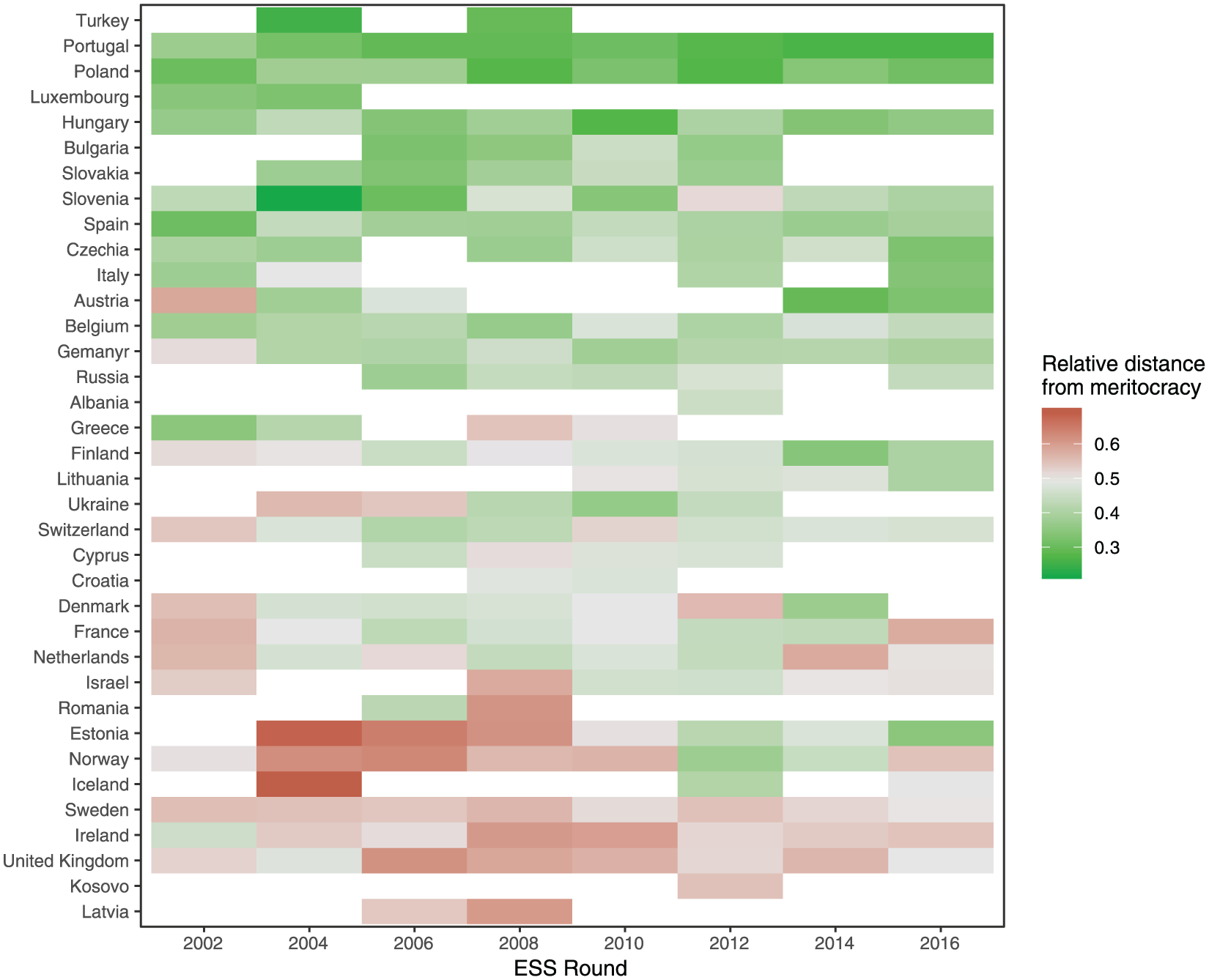
Relative earth mover’s distance from meritocracy by country and survey round.
The graph is dominated by green shades, meaning that most country-years are relatively close to meritocracy. According to these results, Turkey, Portugal, and Poland are the closest to meritocracy, while Latvia, Kosovo, and the United Kingdom are the furthest.
On average, the distance from meritocracy is lower in postcommunist countries and Turkey (0.42) compared with Western European countries with Israel (0.47). At the same time, the distance from meritocracy has been changing over the 16 years covered by the analysis, with decreases in some countries and increases in others. There is evidence of slight convergence over time in the distance to meritocracy across the studied countries, as reflected in the decline of variance from 0.01 in the first three rounds of the European Social Survey to 0.006 in the last two rounds.
Supplemental Material
SRD858825_DS – Supplemental material for How Far From Meritocracy? A Cross-National Longitudinal Analysis of European Countries
Supplemental material, SRD858825_DS for How Far From Meritocracy? A Cross-National Longitudinal Analysis of European Countries by Marta Kołczyńska in Socius
Footnotes
Acknowledgements
I would like to thank Tadeusz Krauze for convincing me of the merits of meritocracy and algorithmic solutions. I further thank Ilona Wysmułek and Denys Lavryk for discussions about the meaning and measurement of meritocracy; the participants of the 4th International ESS Conference, Mannheim, Germany, April 2019, for their feedback; and the editors of Socius for their valuable comments and suggestions on the final version. The data used in this analysis are publicly available through the Web site of the European Social Survey (http://www.europeansocialsurvey.org). The replication code can be accessed at  .
.
Supplemental Material
Supplemental material for this article is available online.
Author Biography
References
Supplementary Material
Please find the following supplemental material available below.
For Open Access articles published under a Creative Commons License, all supplemental material carries the same license as the article it is associated with.
For non-Open Access articles published, all supplemental material carries a non-exclusive license, and permission requests for re-use of supplemental material or any part of supplemental material shall be sent directly to the copyright owner as specified in the copyright notice associated with the article.
