




Abstract
In the era of 9/11, terrorist attacks occur with sufficient frequency and lethality to constitute a realistic threat to the well-being of the American public. Sensing this concern, politicians emphasize the threat of violent attacks to advance a platform of making public safety a priority. In this context, the authors assess the extent, sources, and emotional impact of the public’s concern about terrorism. On the basis of a national survey of 1,000 Americans, the authors examine levels of fear of a terrorist attack and worry about terrorism relative to other potential harms. They also determine whether concern about terrorism translates into support for homeland security measures that target Muslims. Of the predictors in the authors’ models, gender, religiosity, and psychological distress were most consistently associated with fear of terrorism and worry about being a victim of a terrorist attack. Structural equation modeling demonstrated that terrorism-related fear and worry predict support for anti-Muslim policies.
Recent national polls suggest that since the terrorist attacks of September 11, 2001, Americans have continued to fear terrorism. A 2017 Gallup poll reported that 60 percent of Americans feel that it is very or somewhat likely that a terrorist attack will occur in the United States in the near future; this percentage is up from 38 percent in 2011. The same poll found that 38 percent of Americans are less willing to attend large events and 46 percent are less willing to travel overseas because of concerns related to terrorism, whereas 42 percent are very or somewhat worried that they or a family member will be a victim of a terrorist attack. Furthermore, a national survey by the Pew Research Center disclosed that Americans ranked addressing terrorism concerns as the top priority for President Trump and Congress in 2018, outranking issues including the economy, health care costs, social security, and the environment. Despite estimates that the actual likelihood of a person living in the United States dying in a terrorist attack over the course of his or her lifetime is 1 in 75,000 (Mueller 2009), Americans are clearly concerned about national security and the potential for terrorist attacks within the United States.
Indeed, politicians have succeeded in harnessing the fear of Americans. As Joel Best (2018) detailed in his recent book, Americans have a long history of obsessions with threatening “American nightmares,” and targeted rhetoric has been used to convince people that they should be afraid. Notably, Donald Trump’s presidential campaign focused heavily on threats facing Americans and, in particular, threats related to terrorism (Altheide 2017; Best 2018). President Trump’s executive order 13769, “Protecting the Nation from Foreign Terrorist Entry into the United States,” commonly referred to as “the Muslim ban,” serves as an example of a measure that captures Americans’ fears about a selected group of people with the stated intent of limiting the threat of terrorism.
Yet as Best (2018) explained, some audiences are more receptive to such messages than others, varying by factors such as race, gender, class, and ideology. Thus, it is necessary to examine Americans’ concerns in context, by comparing levels of concern from different sources of threat and determining whether some Americans are more concerned than others. The aim of the present study is to understand Americans’ concern about terrorism by placing it in context among other issues and examining the utility of theoretically driven models for understanding this reaction. More specifically, we draw on the fear of crime, sociology of emotions, and culture of fear literatures to assess predictors of concern about terrorism on the basis of structural vulnerability, cultural orientation, emotional vulnerability, political partisanship, and instrumental factors. We then examine whether concern about terrorism translates into support for policy measures that target Muslims in particular.
Our analyses are based on data from a national probability survey of 1,000 Americans conducted in 2018. We designed the survey to measure concern about terrorism in two ways: fear and worry. First, the respondents were asked how afraid they were of terrorism relative to other harmful events in society. Second, they were asked how much they worry about terrorism compared with other day-to-day personal troubles. Previous literature has tended to treat items measuring fear and worry as equivalent, grouping them under the concept of fear (e.g., Alper and Chappell 2012; Andersen and Mayerl 2018; Franklin, Franklin, and Fearn 2008; Gray, Jackson, and Farrall 2008; Jackson 2005; Nellis and Savage 2012; Rader 2004). Other researchers, however, have argued that fear and worry are distinct emotions that should be treated as separate constructs (e.g., Ferraro and LaGrange 1987; Lupton 2000; Warr and Stafford 1983; Williams, McShane, and Akers 2000). Thus, fear is generally described as an emotion that is reactive and not based on sustained deliberation, whereas worry is seen as an emotion that involves individuals ruminating about issues that bother them (e.g., Garofalo 1981; Jackson and Gouseti 2014; Kemper 1987). We have maintained this distinction in our study so as to tap into fear and worry as separate, yet related emotions; we group them under the global construct of “concern” about terrorism. Thus, this study has two goals: (1) to examine levels and sources of fear and worry about terrorism and (2) to determine whether fear and worry each predict anti-Muslim policies.
The rapidly growing field of terrorism and homeland security has produced insights regarding the nature of terrorism (e.g., extent, global spread, methods, harm) and on measures aimed at controlling its origins, spread, and impact (Haner 2017). By contrast, the scholarly literature on fear of terrorism is limited and tends to reference general public opinion polls (e.g., Chapman University 2016; Gallup 2016) or explore sources of fear, such as governments or political parties (e.g., McGill 2016). The present study integrates the academic research on terrorism with theory concerning the experience and antecedents of concern (e.g., Bericat 2016; Glassner 1999; Stearns 2010; Tudor 2003; Walsh 2017) to examine Americans’ emotional responses to terrorism and their outcomes. Notably, elected officials often cite Americans’ worries to justify a range of policies, including banning citizens from Muslim nations and expanding the national security powers of the federal government. Thus, there is a need for systematic research that measures the extent of concern about terrorism versus other threats to public safety, possible sources of variation in emotional responses, and the extent to which these concerns are (or are not) related to homeland security proposals. In the following section, we review the literature in this area and hypothesized predictors of concern about terrorism.
Concerns about Terrorism in Context
Again, much literature on terrorism centers on the fear component. Fear is considered a primary emotion, that is, a universal emotion that has fitness-enhancing properties (e.g., fight or flight) and constitutes the foundation from which all other, more complex emotions are formed (Izard 1977; Kemper 1987; Turner 2000). The experience of fear signals danger to individuals and encourages them to evaluate their options for behavior in ways that protect their interests (Barbalet 1998; Clay-Warner 2014). In his power-status theory of emotions, Kemper (1978, 1987) argued that individuals experience fear when they feel that they have insufficient power, either because of a loss of power or not receiving power that is expected. Thus, the sense of powerlessness or vulnerability associated with the potential for a terrorist attack may instill fear (Barbalet 1998).
Although fear is a universal experience, the sources, extent, and expression of fear are shaped by culture and vary over time (e.g., Furedi 2018; Glassner 1999; Stearns 2006). For example, historian Peter Stearns (2006) noted a shift in American society in which Americans were no longer encouraged to master their fears but instead have become socialized to avoid them. Public attention to potential threats to American society has resulted in emotional overreaction and, notably, excessive fear. Scholars who have examined the American culture of fear point to the role of mass media in arousing and manipulating the fears of the public (Altheide 2017; Best 2018; Glassner 1999; Stearns, 2006, 2010). The “media-ization of emotion” can be seen in the deliberate use of fear-based reporting, where even weather reports seek to create fear (Stearns 2010). In regard to fear of terrorism, Altheide (2017) argued that the American media operate on the “politics of fear,” whereby fear creates entertainment value, generates profits, and controls audiences. Fear is thus socially constructed, and according to Altheide, the topic of terrorism is sufficiently threatening to create extensive fear in audiences.
Therefore, in our effort to understand concern about terrorism, it is important that we both place it in a context among other concerns and attend to current events. For example, on the basis of public opinion polls (e.g., Pew Research Center 2013; Reinhart 2017), we expect terrorism to rank highly among Americans’ concerns, although other salient issues may rank higher depending on media coverage at the time of the data collection. Notably, we fielded the survey in mid-July 2018. At that time, the media focused heavily on the Trump administration’s “zero-tolerance” immigration policy, which led to thousands of children being separated from their families and detained in ill-equipped facilities operated by the U.S. Department of Health and Human Services upon crossing the U.S.-Mexico border (e.g., Barry et al. 2018). Thus, we expect that immigration was a particularly concerning issue at the time of the survey. With this context in mind, we explore the salience of terrorism as a fearful and worrisome topic among the American public and subsequently analyze potential antecedents of concern about terrorism. Given that much research focuses on fear, the hypotheses for the present study are drawn from the fear of terrorism literature and are assumed to apply to worry about terrorism. Again, this assumption is tested by examining whether the predictors are the same for both components of concern. Thus, this study examines the following seven hypotheses.
Predicting Concern about Terrorism
Empirical analyses of predictors of concern about terrorism are limited. Most examinations have focused on the role of mass media in generating fear and worry about terrorism (e.g., Altheide 2017; Nellis and Savage 2012). One notable exception is a recent study by Andersen and Mayerl (2018), who examined predictors of worry about terrorism on the basis of the fear of crime literature as well as attitudes toward Muslims using data from a sample of residents of Kaiserslautern, Germany. To our knowledge, similar research has not been conducted with U.S. samples. Thus, as a starting point, we draw on the fear of crime literature, and the vulnerability perspective in particular, to develop fear of terrorism prediction models. Additionally, we test models based on findings from the mass communications literature and public opinion polling that highlight the role of cultural and political factors in shaping terrorism-related concerns (Cox and Jones 2015; Das et al. 2009; Jacobs, Boukes, and Vliegenthart 2018; Mueller 2009; Smeltz 2015). We also assess the influence of emotional vulnerability and political media exposure on concern about terrorism (Andersen and Mayerl 2018; Ellis and Renouf 2018).
First, according to the vulnerability perspective, fear of crime is greater among individuals who, by their personal characteristics, are believed to be more susceptible to victimization compared with others (Lane et al. 2014; Wyant 2008). In the fear of crime literature, women and the elderly have been found to be consistently more fearful of crime, even when their objective risks may be relatively low (Hale 1996; Henson and Reyns 2015; Lane et al. 2014; Warr 1984, 2000). Research suggests that women’s greater fear of crime is due largely to fear of sexual assault (Ferraro 1995; Fisher and Sloan 2003) or physical assault more generally (Hirtenlehner and Farrall 2014). Furthermore, through differential socialization, women tend to feel and express negative, powerless emotions such as fear more than men (Brody 1999; Hochschild 1981; Hollander 2001; Sutton and Farrall 2005). On the basis of the vulnerability perspective as well as gender differences in emotional socialization, we predict the following:
Hypothesis 1: Women will report greater concern about terrorism than men.
Hypothesis 2: Older Americans will report greater concern about terrorism than younger Americans.
Second, we examine the role of culture in shaping fear of terrorism. The sociology of emotions literature has recognized the influence of emotion cultures in shaping the antecedents, experiences, and expressions of emotion (e.g., Gordon 1989; Thoits 1989). Here, we consider cultural orientation to consist of beliefs that might differentiate respondents in their experiences of terrorism-related fear. As we focus our study in the United States, the key cultural factor that we examine is strength of Christian religiosity (Marfouk forthcoming). Empirical research has shown a positive correlation between religiosity and expression of terrorism concerns (Adamczyk and LaFree 2015). Furthermore, strength of group identification increases fear of the out-group (Bloom, Arikan, and Courtemanche 2015; Mackie, Silver, and Smith 2004). This may be particularly true for persons with strong Christian religious identities because research suggests that the media has encouraged a culture of fear of Islam in which Muslims are working against “Christian America” (Powell 2018). On the basis of this cultural argument, we hypothesize as follows:
Hypothesis 3: Strength of Christian religiosity will be positively associated with concern about terrorism.
Third, in addition to structural and cultural factors, emotional vulnerability may also relate to the extent of fear experiences. Ferraro and LaGrange (1987) noted that higher levels of fear of crime may be due to a tendency to be more fearful in general (also see Ellis and Renouf 2018). Within the sociology of mental health literature, psychological distress is frequently analyzed as an indicator of emotional vulnerability that varies by social statuses and environmental conditions (e.g., Mirowsky and Ross 2003). Indeed, in a large survey of Los Angeles residents, Eisenman et al. (2009) found that persons with severe psychological distress expressed greater terrorism-related fear and avoidance behaviors. Thus, we predict:
Hypothesis 4: Psychological distress will be positively associated with concern about terrorism.
Fourth, national public opinion polls consistently show patterns in fear of terrorism by political ideology. In particular, conservatives express greater concern, anger, and worry about terrorism compared with liberals (Reinhart 2017; Sury, Schlegelmilch, and Redlener 2016). Furthermore, Altheide (2002, 2017) argued that conservative political agendas have generated a fear of crime and of terrorism in particular (also see Stearns 2006). As Best (2018) observed, Donald Trump’s successful presidential campaign relied heavily on rhetoric about threats menacing America—and other politicians’ failure to address them. These fears resonated with some voters . . . people find it easy to congregate among and listen to those who share their views—and their worries. (pp. 187–88)
With the current conservative administration, we expect that terrorism-related fear messages will resonate more with like-minded individuals.
Hypothesis 5: Political conservatives will report greater concern about terrorism than nonconservatives.
Finally, we examine the role of the media in shaping perspectives on the threat of terrorism. As Altheide (2017) argued, the media aim to generate fear among audiences, particularly when it concerns the threat of crime or major violent events by outsiders (see Rumbaut and Ewing 2007; Stearns 2010). Empirical research has also found that terrorism-related news consumption strengthens anti-Muslim attitudes and fears about terrorism (Jacobs, Boukes, and Vliegenthart 2018; Nellis and Savage 2012; Ogan et al. 2014). We predict the following:
Hypothesis 6: Greater interest in the news will be positively associated with concern about terrorism.
Concern about Terrorism and Anti-Muslim Policy Support
Several scholars have identified increasing levels of fear among the American public and have connected these fear responses to the proliferation of emotionally laden news media and political campaigns (e.g., Best 2018; Furedi 2018; Glassner 1999; Stearns 2006, 2010). With a focus on terrorism in particular, Altheide (2017) argued that tying terrorism coverage to an expansive discourse of fear has contributed to the emergence of the politics of fear, or decision makers’ promotion and use of audience beliefs and assumptions about danger, risk, and fear in order to achieve certain goals. (p. 133)
Politicians draw on the public’s fear to argue for emotionally charged policy measures, such as policies that target specific religious and immigrant groups (Best 2018; Norris, Kern, and Just 2003).
Empirical studies have shown that general media coverage that portrays Muslims as terrorists or extremists creates fear and worry about terrorism among the public and generates out-group prejudices (e.g., Das et al. 2009; Kishi 2017; Nellis and Savage 2012; Powell 2018). Furthermore, perceived threat from outsiders, such as Muslims, has been linked to fear, and such fear can serve as justification for prejudiced national security policy measures (Cottrell and Neuberg 2005; Dunwoody and McFarland 2018). For instance, fear of terrorism has been used by politicians to suggest terrorism prevention policies that specifically harm Muslims, such as banning all Muslim immigration and shutting down mosques (Dunwoody and McFarland 2018; Saleem et al. 2015). Therefore, in addition to identifying the antecedents of fear of terrorism, we also examine whether terrorism-related fear translates into support for national security policies that single out Muslims as a threatening group. Such policies are consistent with the Trump administration’s “Muslim ban” approach to terrorism prevention.
To our knowledge, no empirical studies have assessed the direct relationship between concern about terrorism and anti-Muslim policy support using nationally representative data. Several studies (mostly from Europe), however, have examined how the occurrence of major events (e.g., terrorist acts) influences attitudes toward Muslims and immigration more generally. Some of these investigations showed no association between terrorist events and attitudes toward immigrants (e.g., Finseraas and Listhaug 2013; Finseraas, Jakobsson, and Kotsadam 2011; Smiley, Emerson, and Markussen 2017). By contrast, on the basis of comparisons of survey data collected before and after major catastrophic events, other studies reported that terror attacks perceived to be carried out in the name of Islam have evoked fear and anxiety toward Muslims and fostered the perception of immigrants as threatening to Western societies (see Allen and Nielsen 2002; Finseraas and Listhaug 2013; Hopkins 2010; Legewie 2013; Spilerman and Stecklov 2009). More specifically, Hopkins (2010) found that the American public expressed more negative attitudes about Muslim immigration after the 9/11 attacks compared with a year before the attacks. Likewise, Czymara and Schmidt-Catran’s (2017) results revealed that the German public’s acceptance of immigrants (mainly Middle Eastern and African) significantly decreased between April 2015 and January 2016, mostly because of the mass sexual assaults allegedly committed by men of Arab or North African appearance during the 2016 New Year’s Eve celebration. Similarly, Legewie’s (2013) findings indicated that the level of anti-immigrant attitudes in Spain increased after the 2004 Madrid train bombings. Thus, presumably, exposure to terrorist attacks heightens concern about terrorism, which may then relate to attitudes toward immigrants.
Furthermore, studies have linked fear of crime more generally to concerns about immigrants. For example, Smiley et al. (2017) found that Copenhagen residents with greater fear of crime had stronger reactions to immigration and opposed to citizenship for immigrants. Similarly, in an analysis of data from the 2002 European Social Survey, Semyonov, Gorodzeisky, and Glikman (2012) found that perceived neighborhood safety was lower among Europeans who live in neighborhoods with high proportions of ethnic minorities and immigrants relative to those living in predominately European neighborhoods.
On the basis of the extant research concerning the media’s influence on public fear as well as the demonstrated associations between terrorist events, fear of crime, and attitudes toward immigrants, we hypothesize as follows:
Hypothesis 7: Concern about terrorism will predict support for anti-Muslim policies.
Although we hypothesize that concern, whether about crime or terrorism, promotes anti-immigrant or anti-Muslim views more specifically, additional factors may influence support for anti-Muslim policies. In a review of the literature on public attitudes toward immigrants and immigration, for example, Ceobanu and Escandell (2010) noted consistent associations between conservativism and anti-immigrant attitudes as well as increases in prejudice toward immigrants when religious interests are threatened (also see Ogan et al. 2014). The association between Christian religiosity and anti-immigrant attitudes was also observed by Ciftci (2012), in which an analysis of data from 15 nations showed that expressing a Christian religious identity was positively associated with views of Muslims as violent and fanatical. In addition, analyses of data from 11 European countries found that Catholics and Protestants reported greater prejudice against ethnic minorities relative to nonreligious people as well as a positive association between church attendance and prejudice against ethnic minorities (Scheepers, Gijsberts, and Hello 2002). Furthermore, women have been shown to express less anti-Muslim prejudice than men, while older individuals tend to report more prejudiced attitudes toward Muslims (Ciftci 2012; Strabac and Listhaug 2008). Therefore, we examine the possible associations among conservativism, Christian religiosity, and other predictors of terrorism-related concern (gender and age) and support for anti-Muslim policy measures.
Methods
Sample
After we designed the questionnaire, we commissioned YouGov America to conduct a national survey of 1,000 respondents in July 2018. YouGov undertakes an array of polls: marketing, political, and current affairs. It uses a panel of more than 2 million American adults (6 million worldwide) who have “opted in” or agreed to complete online surveys in return for earning points toward vouchers for “big brand” gift cards, such as Amazon, Macy’s, Old Navy, and Walmart (YouGov 2018c). All respondents in the panel complete a “basic battery of questions—socio and political profile items when they join the panel,” which are updated regularly and are known as the “core profile items” (YouGov 2018a, p.1). These are made available when the survey data are transmitted in an SPSS file to the “customer.” These data can be viewed in weighted and unweighted form. To increase the representativeness of the sample, we used the weighted data in our analyses. 1
Opt-in Internet surveys are now a standard method in research on public opinion across disciplines, ranging from medicine and public health to psychology and sociology (for a review of this methodology, see Thielo 2017). Although selection biases cannot be ruled out fully, the results from these surveys mirror, and at times outperform (e.g., in polls on elections), public opinion studies using national probability samples that have their own methodological challenges (e.g., nonresponse). They also have more generalizability than state or local opinion polls. Notably, articles using data from the YouGov panel have appeared in first-tier journals such as the American Sociological Review, the American Journal of Political Science, and Public Opinion Quarterly (see, e.g., Ennis and Ramirez 2018; Schachter 2016).
Table 1 reports the characteristics of our sample. As shown, approximately half of the sample is female, the average age is approximately 48 years, and about 33 percent are conservative.
Sample Characteristics (n = 980).
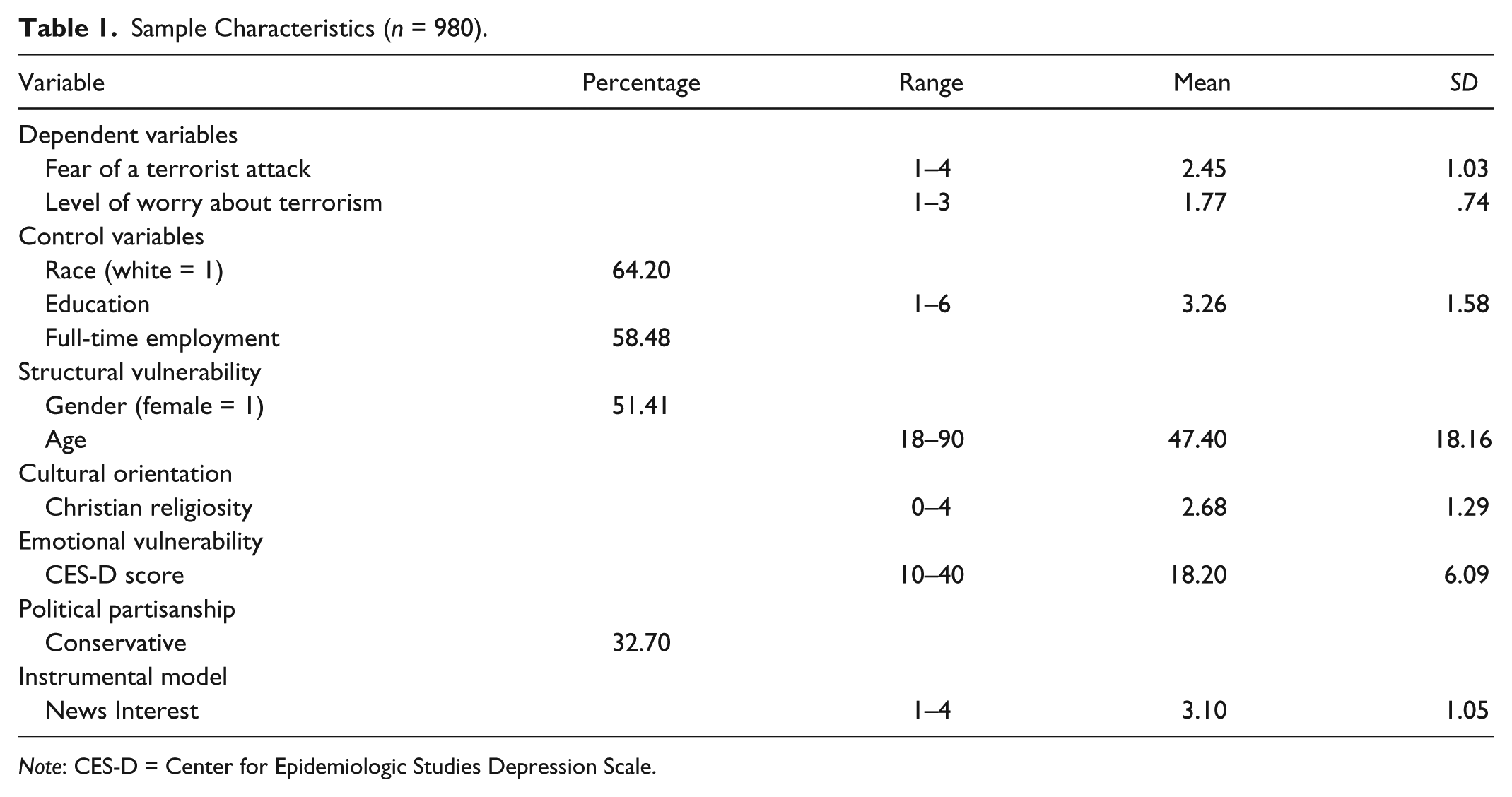
Note: CES-D = Center for Epidemiologic Studies Depression Scale.
Dependent Variables
We examine two separate dependent variables that assess concern about terrorism. First, fear of terrorism assesses the emotional response to terrorism threat. The respondents were asked, “How afraid are you of the following events?” and presented with a list of eight events: a terrorist attack, economic or financial collapse, a natural disaster, a nuclear weapons attack, a pandemic or a major epidemic, Whites no longer being the majority in the United States, and widespread civil unrest. In essence, respondents were asked about how fearful they are about harmful events in society more generally. The response scale ranged from 1 (“not afraid”) to 4 (“very afraid”). We present descriptive statistics on responses to each event and use the responses to fear of a terrorist attack in the multivariate analyses.
Second, we assess personal worry about terrorism. As an indicator of concern about risk, our measure of worry about terrorism asks respondents about problems they worry about in their personal, day-to-day lives. More specifically, the respondents were asked, “How much, if at all, do you worry about the following things happening to you?” The list included being the victim of a terrorist attack, a mass shooting at some event or at work or school, being the victim of a violent crime, having a personal health crisis, someone breaking into your house when you are home, losing your job, a hurricane, tornado, or some natural disaster hitting your home, experiencing police brutality, being the victim of a racial or hate crime, and being in a serious car accident. The responses included 1 (“do not worry at all”), 2 (“worry a little”), and 3 (“worry a lot”). Again, we present descriptive statistics on responses to each concern and use the responses to worry about being a victim of a terrorist attack in the multivariate analyses. Note that in the sample, fear and worry about terrorism are correlated at r = .68. This finding suggests that although those who reported fear of terrorism are also likely to worry about it, this was not the case for all respondents.
We also examine support for restrictive anti-Muslim policies. The respondents rated the extent to which they agreed with three statements: (1) “Strict border control policies are necessary to protect us from threats such as Islamic extremism and terrorism,” (2) “America should cease all immigration from Muslim countries,” and (3) “Muslims living in the U.S. should be subject to more scrutiny than people in other religious groups.” Agreement was indicated on a scale of 1 (“strongly disagree”) to 4 (“strongly agree”). We combined these items into a summed scale with higher values indicating more support for anti-Muslim policies. Cronbach’s α value for anti-Muslim policy support is 0.916.
Independent Variables
Structural Vulnerability
The structural vulnerability model includes gender measured with a dichotomous variable. Self-identified women were coded 1 and men were coded 0. Age is measured in years.
Cultural Orientation
Christian religiosity is measured by Christian respondents’ rating of the importance of religion on a scale from 0 (“not at all important”) to 4 (“very important”). Non-Christian respondents received a code of 0 on the Christian religiosity measure. 2
Emotional Vulnerability
Emotional vulnerability is measured using the shortened form of the Center for Epidemiologic Studies Depression Scale (CES-D), a 10-item measure that asks respondents to indicate the frequency of a series of feelings on a scale of 1 (“rarely or none of the time”) to 4 (“most or all of the time”) (Björgvinsson et al. 2013). The CES-D was originally developed by Radloff (1977) and is commonly used in studies of depression and psychological distress. Cronbach’s α value for the CES-D is 0.836.
Political Ideology
A scale of 1 (“very liberal”) to 5 (“very conservative”) was used to assess conservative ideology. Consistent with previous research, these measures were dichotomized to prevent a loss of cases because of missing data (or for those who answered “not sure”) (Haner et al. 2019; King and Wheelock 2007). Thus, respondents who indicated that they were “conservative” or “very conservative” were coded 1, and all others were coded 0.
Instrumental Factor
News interest is measured by the extent to which respondents follow political news, from 1 (“hardly at all”) to 4 (“most of the time”).
Control Variables
Race is measured dichotomously with 1 = White and 0 = non-White, education is measured ordinally from 1 = no high school to 6 = postgraduate degree, and full-time employment is measured dichotomously with 1 = yes and 0 = no.
Analytic Strategy
After presenting descriptive statistics for our sample, including central tendency and dispersion for all variables, we present the frequencies of fear and worry for each major event included in the survey. We then test hypotheses 1 through 6 using ordinary least squares (OLS) regression analysis with level of fear and level of worry as the dependent variables. 3 We examined the independent variables for multicollinearity, which was not a concern, as none shared a correlation above 0.40, and the variance inflation factors across the regression models ranged between 1.01 and 1.87.
Next, to examine whether concern about terrorism translates into support for anti-Muslim policy (hypothesis 7), we used structural equation modeling in Stata 15. The structural model shown in Figure 1 predicts support for anti-Muslim policy as a latent construct measured by the three indicators described above. Confirmatory factor analysis revealed the measurement model to be a good fit, with standardized factor loadings above 0.77 for all items and statistically significant at the .001 level. In the structural models, we test the influence of both terrorism fear and worry on anti-Muslim policy support, with the significant structural, cultural, emotional, political, and instrumental predictors of fear as predictors of both fear and worry and support for anti-Muslim policy directly.
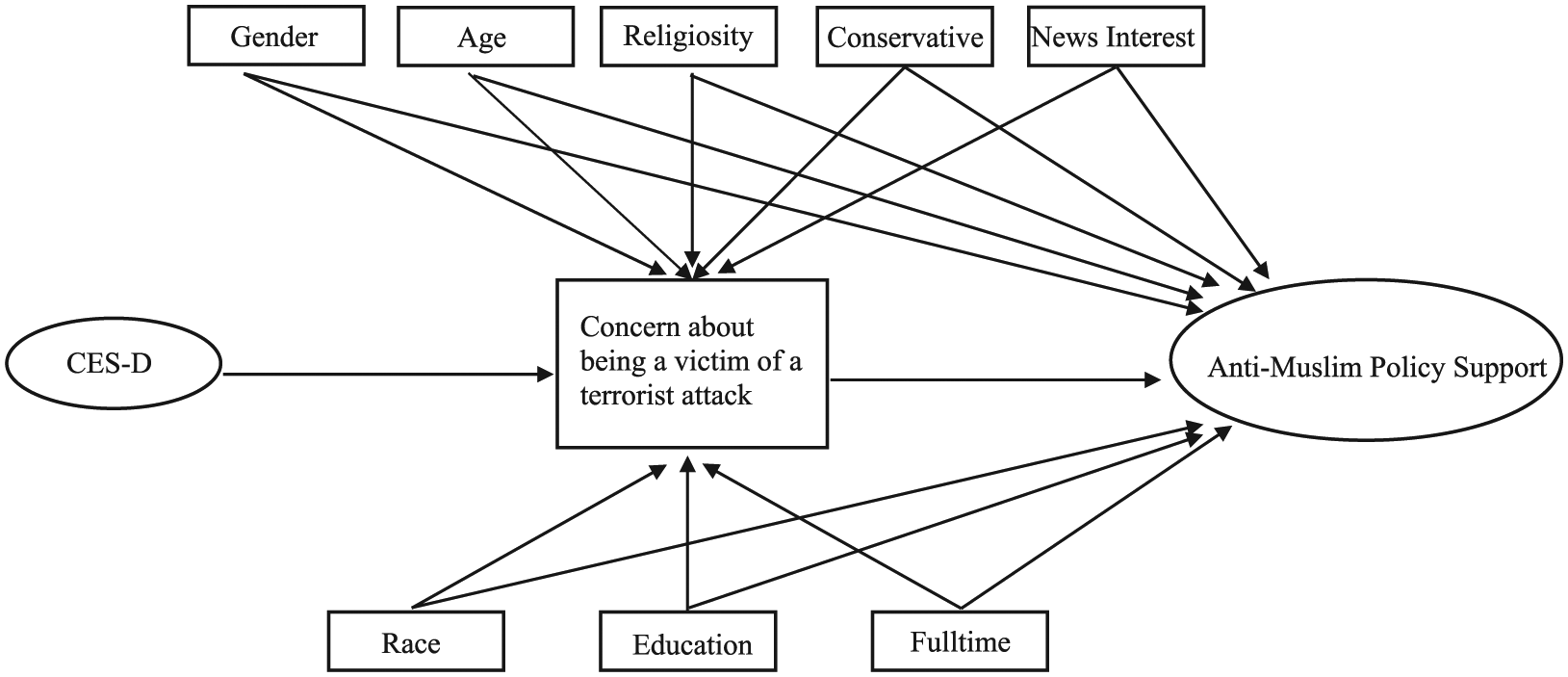
Structural equation modeling for concerns about terrorism.
Results
Extent of Concerns about Terrorism and Support for Anti-Muslim Policies
We begin our analysis by examining how terrorism-related fear and worry compare with fear and worry about other major events or concerns. Table 2 presents the sample distribution of fear of major events by event type. Overall, the results indicate that about 45 percent of the sample is “afraid” or “very afraid” of a terrorist attack. Placed in context, fear of a terrorist attack was the second greatest fear expressed by respondents, outranked only by widespread civil unrest. Americans appear to fear terrorism more than many other potentially harmful events, including economic or financial collapse (43.3 percent), natural disasters (40 percent), nuclear weapons attack (39.6 percent), pandemic or major epidemic (37.5 percent), illegal immigration (37.2 percent), and Whites no longer being the majority (21.5 percent).
Sample Distribution of Fear of Major Events by Event Type (Percentages Reported; n = 973).

Table 3 shows the sample distribution of level of worry by event type. These descriptive statistics suggest that almost one in five respondents (18.7 percent) worry a lot and nearly three in five (58.4 percent) worry at least a little or a lot about being the victim of a terrorist attack. However, unlike fear of a terrorist attack, worry about being the victim of a terrorist attack was outranked by several other harmful events, including having a personal health crisis (35.6 percent), a mass shooting at some event or at work or school (30.0 percent), being the victim of a violent crime (25.0 percent), being in a serious car accident (24.6 percent), and someone breaking into your house when you are at home (23.6 percent). The data do indicate that Americans appear to worry about being the victim of a terrorist attack more than some events, including being the victim of a racial crime (17.3 percent), losing your job (16.7 percent), a hurricane, tornado, or some natural disaster hitting your home (16.7 percent), or experiencing police brutality (13.0 percent). 4 The comparison of Tables 2 and 3 suggests that in general, a large proportion of Americans experience fear as an emotional response to the threat of a terrorist attack but are less personally concerned about being a victim of an attack relative to other types of harmful events.
Sample Distribution of Level of Worry by Event Type (Percentages Reported; n = 974).

Next, we examine the level of support for anti-Muslim policies. As shown in Table 4, between 33 percent and 61 percent of the respondents agree or strongly agree with policy-related statements that target Muslims as a feared group. More specifically, about 6 in 10 of sample members favor stricter border security policies, and about 1 in 3 subjects endorse discriminatory policies, including banning immigration from Muslim countries and subjecting Muslims to more scrutiny than other groups. These findings suggest two conclusions. First, a majority of Americans do not want to ban or discriminate against Muslims, but they do want enhanced security at the border so that terrorists can be weeded out. Second, about one third of Americans clearly harbor anti-Muslim views and favor their differential treatment.
Sample Distribution of Support for Anti-Muslim Policies (Percentages Reported; n = 946).

Sources of Terrorism Concerns
We turn next to the OLS regressions of terrorism-related fear and worry on the structural vulnerability, cultural orientation, emotional vulnerability, political ideology, and instrumental factors, which are presented in Table 5. As shown, of the structural vulnerability factors, gender is a significant predictor of both fear of terrorism and worry about personal victimization from terrorism (β = 0.088 and β = 0.122, respectively). In both models, women report greater fear and worry concerning terrorism than men, which is expected given the fear of crime literature. These findings offer consistent support for hypothesis 1. Age, however, is negatively associated with worry about being a victim of a terrorist attack (β = −0.081). This finding is counter to the fear of crime literature as well as hypothesis 2. It may be possible that older Americans feel less exposed to areas or activities that may become targets of terrorist attacks.
Ordinary Least Squares Regression Predicting Fear and Worry of Terrorism (n = 965).

Note: b = unstandardized coefficient, β = standardized coefficient; CES-D = Center for Epidemiologic Studies Depression Scale.
p < .05. **p < .01. ***p < .001.
As expected in hypothesis 3, strength of Christian religiosity is positively associated with both fear and worry about terrorism (β = 0.174 and β = 0.123, respectively). The results also offer support for the emotional vulnerability model (hypothesis 4), with a positive association between psychological distress and terrorism-related fear and worry (β = 0.121 and β = 0.151, respectively). In addition, conservatives, compared with those who do not identify as conservative, report greater fear of terrorism (β = 0.168) and greater worry about being a victim of a terrorist attack (β = 0.085). This finding offers some support for hypothesis 5. Finally, news interest is a significant negative predictor of both fear and worry about terrorism (β = −0.076 and β = −0.126, respectively). This finding is the opposite of the relationship we predicted in hypothesis 6. We expected that greater media exposure to terrorism-related news would lead to greater fear of terrorism. Upon further consideration, it may be likely that our news interest variable, the extent to which respondents follow political news, is not specific enough to tap exposure to terrorism-related news. Instead, this measure may capture political awareness in general.
In sum, we find that women, persons who place a greater importance on Christian religion, conservatives, and persons reporting greater psychological distress are more fearful of terrorism and more worried about being a victim of a terrorist attack than men, those who are less religious, and those with lower levels of psychological distress. In contrast, individuals who pay greater attention to political news report less terrorism-related fear and worry. Among the control variables, White individuals report less fear and worry about terrorism than non-White individuals and education is negatively associated with fear of terrorism. The models shown in Table 5 explain approximately 14 percent of the variation in fear of terrorism and approximately 16 percent of the variation in personal worry about terrorism.
Impact of Concern about Terrorism
The next step in our analysis is to determine whether terrorism-related fear and worry translates into policies that target Muslims as an out-group. As noted above, results from confirmatory factor analysis suggested that the three indicators of anti-Muslim policy support form a good measure. Building on the measurement model, we use structural equation modeling to analyze the connections among terrorism-related fear and worry, their significant predictors, and policy support. As shown in Figure 1, on the basis of the results of the OLS regression, fear or worry is predicted by eight observed variables: gender, age, Christian religiosity, conservative, news interest, race, education, and full-time employment, as well as the latent variable of psychological distress. With the exception of psychological distress, these variables are also modeled as predictors of anti-Muslim policy support (see Saleem et al. 2015). Theoretically, we may expect these structural, cultural, political, and instrumental factors to be associated with policy support; however, we do not have reason to expect that psychological distress will predict policy support. Fear and worry about terrorism are also, separately, included as predictors of anti-Muslim policy support. The unstandardized and standardized structural equation modeling coefficients for these models are presented in Tables 6 and 7. The model fit statistics suggest that both models fit the data well (root mean square error of approximation = 0.048, confirmatory fit index = 0.952 for both fear and worry).
Structural Equation Modeling Coefficients for Fear of a Terrorist Attack and Anti-Muslim Policy Support (n = 965).

Note: χ2 = 517.69, root mean square error of approximation = .048, confirmatory fit index = .952. b = unstandardized coefficient; β = standardized coefficient; CES-D = Center for Epidemiologic Studies Depression Scale.
p < .05. **p < .01. ***p < .001.
Structural Equation Modeling Coefficients for Worry about a Terrorist Attack and Anti-Muslim Policy Support (n = 965).
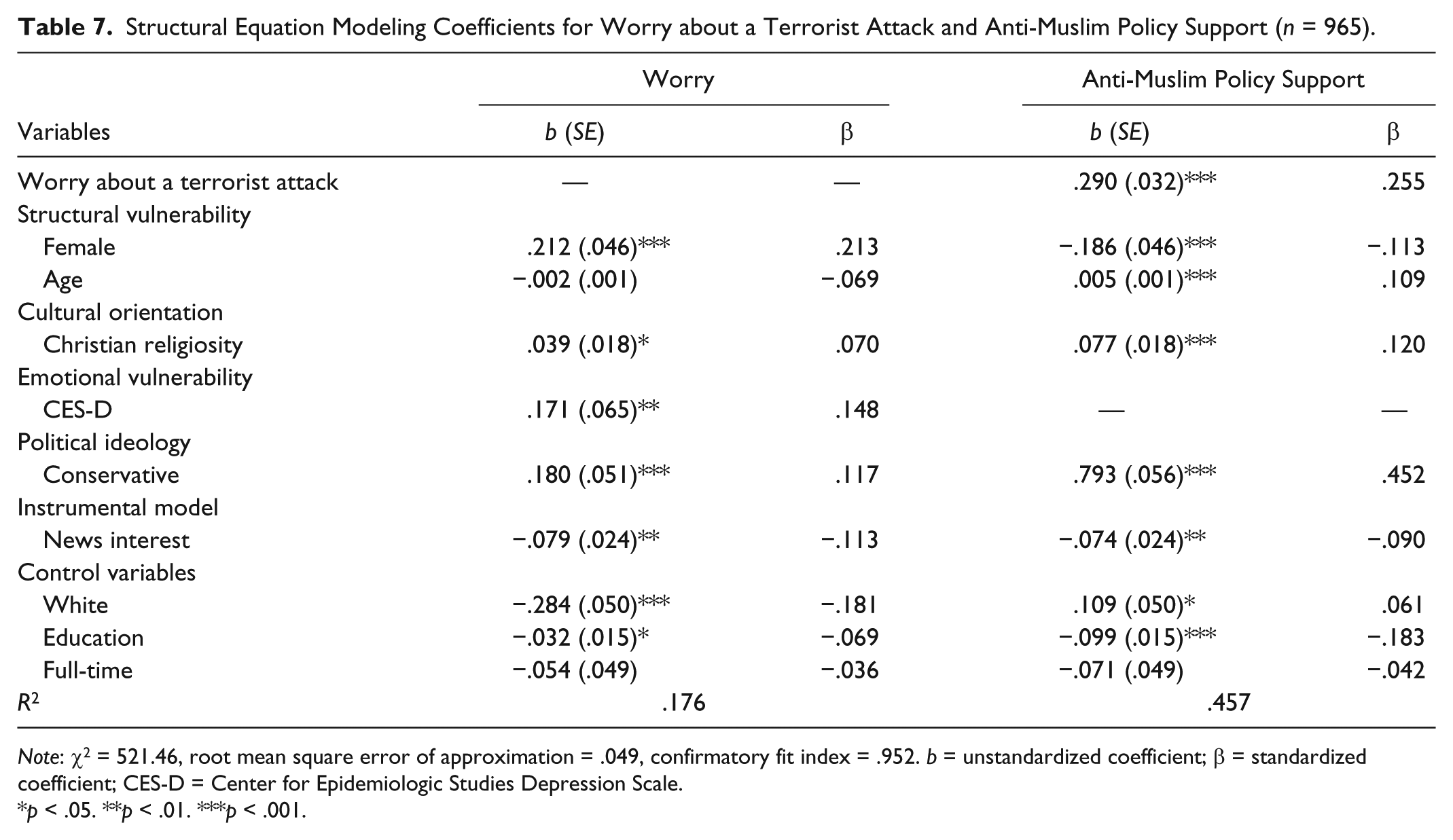
Note: χ2 = 521.46, root mean square error of approximation = .049, confirmatory fit index = .952. b = unstandardized coefficient; β = standardized coefficient; CES-D = Center for Epidemiologic Studies Depression Scale.
p < .05. **p < .01. ***p < .001.
As anticipated given the OLS results, gender, Christian religiosity, conservativism, news interest, race, and education are significant predictors of fear of terrorism in the expected directions. Table 6 shows that these indicators also predict anti-Muslim policy support. More specifically, women, persons employed full-time, persons with higher levels of education, and those who follow political news report less support for such policies, whereas policy support is greater among older persons, Whites, and those who report greater Christian religiosity. In support of hypothesis 7, fear of terrorism significantly predicts support for policies targeted toward Muslims. Indeed, as indicated by the standardized coefficients, after conservativism (β = 0.418), fear of terrorism is the strongest predictor of support for terrorism-related policies that specifically target Muslims (β = 0.307). Our model also reveals significant indirect effects of race, gender, education, religiosity, news interest and conservativism on policy support through fear of terrorism. 5
Table 7 reports the unstandardized and standardized coefficients from the structural model presented in Figure 1 with worry about being a victim of a terrorist attack in place of fear of terrorism. Overall, we see substantively the same findings as those in the model with fear of terrorism. Worry about being the victim of a terrorist attack significantly predicts support for anti-Muslim policies (β = .255). Unlike the fear model, however, we also see that psychological distress has a significant indirect on policy support through personal worry (β = 0.037). 6
Discussion
Terrorist attacks domestically and abroad have received increasing levels of attention because of the often devastating nature of these events. When attacks are “successful,” human lives are lost, buildings are destroyed, and spaces once considered safe are deemed hazardous. Thus, the physical and emotional human cost is palpable. Although these incidents are recognized as harmful, limited information is available on how Americans view these attacks and how these perceptions influence support for policies developed to prevent such events, albeit often with limited evidence for their effectiveness. In this way, the present study placed concern about terrorism in context and tested predictors of terrorism-related fear and worry as well as the connection between emotional responses to terrorism and policy support using data from a national sample of U.S. adults. Given the portrayal of Muslims as terrorists in the United States (e.g., Das et al. 2009; Kishi 2017; Nellis and Savage 2012; Powell 2018), we focused on anti-Muslim policies specifically.
Level and Sources of Public Concern
Our findings suggest that there are segments of the American public that do express fear and worry about terrorism. The results on the absolute level of fear of a terrorist attack indicate that almost half of the American public is “afraid” or “very afraid” of the possibility of a terrorist attack. Additionally, nearly one in five Americans indicated that they were worried about being a victim of a terrorist attack. In this way, fear of and worry about terrorism do not necessarily constitute an “American nightmare,” but it would be inappropriate to dismiss these concerns as a myth. Although the prevalence of these fears should not be overestimated, they do exist in the American public, and as we will see, they appear to be consequential.
Many of the variables derived from the extant empirical and theoretical literature consistently predicted variation in fear and worry. In particular, being female, expressing Christian religiosity, and being non-White increased the likelihood of reporting fear or worry about a terrorist attack. As hypothesized, it is likely that women are more fearful in general and that this fear extends to terrorist attacks. Additionally, highly religious Christians could be concerned about outsiders or “others” who try to work against them thus increasing their fear and worry. Although no hypotheses were specified for race, non-White individuals were significantly more likely to experience fear and worry compared with White respondents. It is possible that non-White individuals have greater fear and worry because the publicity of a terrorist attack could highlight certain populations, such as non-White individuals, as being risky. However, more research is needed to explore the relationship between race, fear, and worry about terrorism.
Another relevant finding is that those who reported being more depressed or distressed were more fearful of and worried more about terrorism. This suggests that emotional vulnerability may have a general effect of making individuals concerned by a range of risks in their lives. Again, the importance of scholars examining emotions is accentuated by this possibility.
We also found that interest in political news was negatively associated with both fear and worry; this finding was counter to our expectations. Although, as noted, our measure is not specific to exposure to terrorism-related news, this finding suggests that the news media in general may not have consistent fear-arousing effects on Americans. Rather, it is possible that greater interest in political news indicates more awareness of current issues and a decreased likelihood of emotional responses to terrorism.
Finally, some variables included in the models were unique to fear and worry and illustrate discrepancies in influential factors. Thus, fear and worry could be tapping into different dimensions of concern related to terrorism. In particular, individuals who were less educated were more likely to be fearful of a terrorist attack but were not more worried about being a victim of an attack. In addition, age was negatively associated with personal worry about a terrorist attack but was not associated with fear of terrorism. Individuals who were older were less likely to worry about attacks, which contradicts our hypothesis that older individuals were more vulnerable and likely more afraid. Given the relative infrequency of terrorist attacks in the United States, older individuals could have more experience supporting that these are relatively rare events thus making them less worrisome. The relationships among fear, worry, education, and age should be examined in future research to fully unpack these dynamics.
Policy Implications
In general, the data on public opinion show that most Americans want stricter boarder control measures to protect the nation from extremism and terrorism. They also suggest that a substantial minority of the Americans (between 30 percent and 40 percent) agree with policy measures that would be harmful to Muslims. These include embracing discrimination by banning immigrants from Muslim countries and, while in the United States, placing Muslims under greater scrutiny than those of other religions. Some solace can be drawn from the fact that about two thirds of Americans reject these practices, likely seeing them as un-American. Still, a good portion of the nation’s citizenry believes that such discrimination is legitimate.
Given the existence of this anti-Muslim sentiment, we sought to determine the extent to which emotions underlie support for such policies. Our analyses revealed that how concerned people are about terrorist attacks can influence whether they support anti-Muslim policies. In other words, feelings about terrorism have real-world policy implications. Notably, the strongest predictor in the model was holding a conservative political ideology. It is difficult to know if this association was heightened by Donald Trump’s use of anti-Muslim rhetoric during his presidential campaign, but this possibility is likely (Best 2018). Part of being a Trump loyalist now might entail being anti-immigrant, whether that means banning immigrants from Mexico using a wall or from Muslim countries through airport security.
Next to conservativism, however, fear and worry about terrorism were the most influential predictors of anti-Muslim policy support. This finding suggests that not only political ideology but also emotions matter. Thus, policies such as the Muslim ban are likely to hold special appeal for those who are conservative and for those who fear and worry about terrorism. Consistent with arguments in the culture of fear literature, these beliefs and emotions may be inviting targets for exploitation by President Trump and other right-wing, nationalist politicians (e.g., Altheide 2017; Saleem et al. 2015; von Sikorski et al. 2017). In contrast, elected officials who ignore this emotional infrastructure and seek to persuade voters only by rational argumentation may be ineffective in reaching a large slice of the voters. More generally, these results suggest that especially in policy areas marked by racial/ethnic resentment, future research should examine the impact of a range of emotions (e.g., concern, anger, hatred) on public policy preferences (more broadly, see, e.g., Benson and Sams 2012; Nagin 2007).
Footnotes
1
YouGov uses a sophisticated matching approach when choosing whom to invite and then include in any given survey.  , p.1) describes the methodology used in the current study as follows: “YouGov interviewed 1102 respondents who were then matched down to a sample of 1000 to produce the final dataset. The respondents were matched to a sampling frame on gender, age, race, education, party identification, ideology, Census region, and political interest. The frame was constructed by stratified sampling from the full 2010 American Community Survey (ACS) sample with selection within strata by weighted sampling with replacements (using the person weights on the public use file). Data on voter registration status and turnout were matched to this frame using the November 2010 Current Population Survey. Data on interest in politics and party identification were then matched to this frame from the 2007 Pew Religious Life Survey. The matched cases were weighted to the sampling frame using propensity scores. The matched cases and the frame were combined and a logistic regression was estimated for inclusion in the frame. The propensity score function included age, gender, race/ethnicity, years of education, non identification with a major party, Census region, voter registration, and ideology. The propensity scores were grouped into deciles of the estimated propensity score in the frame and post-stratified according to these deciles. The subset of voters in the 2016 election was then post-stratified to match the 2016 election results, and the total sample was post-stratified to match the frame on the full stratification of four category race, four category age, gender, and four category education.”
2
We examined the issue of religiosity in a number of ways. In a separate analyses (not reported), we ran our models with non-Christians excluded and found the same results reported in the tables. We also created a measure of born-again Christian identity and found associations similar to those between Christian religiosity and the dependent measures. The limited number of non-Christian respondents in the sample prevents us from a more specific subgroup analysis. However, bivariate analyses indicated only Muslims and agnostic participants showed no significant association between strength of religiosity and anti-Muslim policy support.
3
4
Additional analyses (available upon request) show that both African Americans and Hispanics report significantly greater worry about experiencing police brutality compared with Whites.
5
The standardized coefficients for the statistically significant indirect effects on anti-Muslim policy support through fear of terrorism for the analysis in are as follows: race, β = −0.023; gender, β = 0.033; education, β = −0.037; religiosity, β = 0.062; news interest, β = −0.023; and conservative, β = 0.047.
6
For the analysis in , the standardized coefficients for the statistically significant indirect effects on policy support through personal worry are as follows: race, β = −0.039; gender, β = 0.034; education, β = −0.017; religiosity, β = 0.035; age, β = −0.018; news interest, β = −0.028; conservative, β = 0.023; and psychological distress, β = 0.037.