




Abstract
This article provides estimates of white residential mobility within and between specific suburban places differentiated by ethnoracial diversity. The authors draw on intrametropolitan mobility data from the Panel Study of Income Dynamics, linked to social and economic data measured at the metropolitan, place, and block levels. First, analyses show that the exodus of whites is significantly lower in predominantly white suburbs than in places with racially diverse populations. Most suburban whites have mostly white neighbors, a pattern reinforced by white residential mobility. Second, suburban whites who move tend to choose predominantly white communities with mostly white neighbors. Third, patterns of white intrametropolitan suburban mobility and minority avoidance are highly segmented. Affluent whites are seemingly better positioned to leave diversifying places for mostly white communities with white neighbors. White residential mobility, from more diverse to less diverse suburban places, builds on most previous studies emphasizing neighborhood-to-neighborhood mobility in metropolitan areas.
The residential attainment literature has focused overwhelmingly on whether racial and ethnic minorities are integrating spatially into America’s white majority mainstream or, instead, are being left behind in mostly poor, minority-concentrated, or high-crime inner-city neighborhoods (Akresh and Frank 2018; Clark and Brazil forthcoming; Crowder, Pais, and South 2012). We instead examine residential mobility among suburban whites as a demographic response to growing racial and ethnic diversity in suburban communities. This is an important task. Recent declines in racial residential segregation at the census tract or neighborhood level (Ellis et al. 2018; Iceland and Sharp 2013) have been counterbalanced by increasing segregation at the place level, including many suburban communities (Farrell 2016; Lichter, Parisi, and Taquino 2015). This empirical fact highlights the need to examine not only patterns of white residential mobility between racially dissimilar suburban communities but also the movement of whites to exurban periphery areas or back to gentrifying neighborhoods in cities (Hall, Tach, and Lee 2016; Hwang 2015). Emerging patterns of white residential mobility are seemingly remaking the racial structure of metropolitan America.
Our empirical approach focuses on America’s burgeoning suburban communities (census-defined places) and on white population responses to growing ethnoracial diversity. Unlike in the past, the suburbs may no longer be a safe haven from growing nonwhite or immigrant minority populations (Frey 2014; Walker 2018). Whether suburban whites embrace diversity is unclear. We have three main objectives. First, this study provides baseline national estimates of white residential mobility out of specific suburban communities distinguished by different levels of racial and ethnic diversity. Second, for white suburban movers, we document the racial composition of specific destination communities and white proximity to same-race neighbors on the same block. Third, we provide evidence of highly segmented patterns of white avoidance of diversifying suburban communities. We ask whether some whites are better positioned than others (e.g., low–socioeconomic status white) to escape diversifying suburban places for other predominantly white communities or blocks in the metropolitan area.
To accomplish these goals, we use available proprietary household data from the Panel Study of Income Dynamics (PSID) that are linked to various population data at the metropolitan, place, and block levels. We concatenate 20 years of person-year records from multiple waves of the PSID to spatially based economic and demographic data from the U.S. decennial censuses and American Community Survey. This is a data- and time-intensive task but one that yields new insights about intrametropolitan residential mobility among suburban whites.
Background and Hypotheses
Nationally, the unprecedented growth in racial and ethnic diversity has been variously described as the “third demographic transition” (Coleman 2006; Lichter 2013) or the “diversity transition” (Alba and Foner 2015). Frey (2014) referred to the “diversity explosion,” which is needlessly alarmist, implying a sudden new danger or threat to American society. Instead, growing racial and ethnic diversity is best viewed as a master demographic trend that has unfolded and spread broadly over the past three decades (Hall et al. 2016; Lee and Hughes 2015). The rapid geographic dispersal of minority groups, including Asians and especially Hispanics, is leading to rapid increases in ethnoracial diversity across America’s cities and suburbs, neighborhoods, and small towns (Fowler, Lee, and Matthews 2016; Johnson and Lichter 2010, 2016; Walker 2018). The past decade has exposed the nation’s white majority to diverse minority populations, even in the suburbs.
New settlement patterns are also revealed in the emergence and growth of so-called global neighborhoods, where the path to racial integration often begins with influxes of Hispanics and Asians, followed by the entry of blacks, without triggering the usual invasion-succession processes sometimes called “white flight’ (Parisi, Lichter, and Taquino 2015; Zhang and Logan 2016). This “buffering hypothesis” has received modest empirical support. For example, Parisi et al. (2015) found that 40 percent of all metropolitan whites in 2010 lived with blacks in integrated places, often alongside Hispanics and Asians. Hall et al. (2016) also showed that since 1980, formerly all-white places have experienced unusually rapid increases in diversity, which stands in stark contrast to the stated preferences of most whites for living in all-white or mostly white settings (Emerson, Yancey, and Chai 2001). The number of places with substantial white majorities has declined rapidly, suggesting that the residential preferences of some demographic and economic segments of America’s white population have shifted in favor of more racially inclusive communities (Fowler et al. 2016). Alternatively, some suburban whites may face economic or other constraints that limit the intrametropolitan mobility that would allow them to achieve their neighborhood or residential preferences. The Great Recession, for example, sometimes trapped white homeowners in place when mortgage debt exceeded the market value of homes (Johnson, Curtis, and Egan-Robertson 2017).
Much of the literature on white intrametropolitan mobility is framed theoretically by the “minority group threat” hypothesis and its close companion, the “tipping point” hypothesis (Clark and Morrison 2012; Krysan and Crowder 2017). Whites presumably are threatened by rising shares of minorities, especially African Americans. Whites then respond with their feet by moving away, accelerating the pace of neighborhood transitions. 1 This has been revealed historically in residential mobility from cities to suburbs (Frey 1987; Kye 2018; Woldoff 2011), a population response reinforced by government housing policies and lending practices that paved the way to homeownership and the “American dream” in the suburbs (Mele 2017). More recently, white gentrification back to the city has reconstituted the racial mix of many inner-city neighborhoods, displacing low-income blacks to other parts of the city or to inner-ring suburbs. The accelerated suburbanization of blacks, Asians, and other racial and ethnic minorities has presumably changed the calculus of suburban whites, prompting many to leave for other predominantly white communities and neighborhoods.
Perhaps paradoxically, the share of all metropolitan whites living in the suburbs has continued to climb, from 49.1 percent in 1970 to 63.1 percent in 2010 (Massey and Tannen 2017), even as the racial composition of suburban places has diversified. To be sure, much of the increase is driven by the overall growth of suburban areas, largely from metropolitan reclassification at the periphery of expanding metropolitan regions and from internal natural increase (from fertility and low mortality rates among whites of reproductive age) (Huang, South, and Spring 2018; Lobo, Flores, and Salvo forthcoming). Shifting white residential mobility rates also reveal an unfolding demographic story of growing sociospatial differentiation and instability across the metropolis (Wright et al. forthcoming). Between 2000 and 2001, for example, approximately 26 million whites changed addresses within metropolitan areas. 2 Of those, 15 percent left metropolitan principal cities for the suburbs; this movement to suburbs was nearly two times greater than the movement of suburban whites to the city (Current Population Survey 2018). However, by the end of the 2010s, approximately 11 million whites changed residence annually within metropolitan areas. This decadal decline in white movers reflects population aging, that is, the “drying up” of the most geographically mobile whites (i.e., children and young adults) (Current Population Survey 2018). Perhaps more important, these data show that a slightly greater percentage of white movers today are leaving suburbs for the city as opposed to the reverse. This is a significant demographic shift from the early 2000s. 3 Gentrification of cities is expressed in the influx of mostly white young professionals and affluent older empty nesters and retired people seeking urban cultural and recreational amenities.
These newly emerging patterns of metropolitan population growth and redistribution suggest that it is well past the time to study white intrametropolitan movers to and from specific suburban communities. Theoretical formulations of white residential mobility are usually framed by a literature rooted in the movement from cities to suburbs (“chocolate cities, vanilla suburbs”; see Farley et al. 1978). Moving to the suburbs—the undifferentiated settlement areas outside of inner cities—was part and parcel of achieving the “American dream.” Today, the emergence and growth of so-called melting-pot suburbs (Frey 2011) has called into question this canonical view. As America’s suburban communities have become increasingly differentiated by racial composition, whites have presumably responded by fleeing racial diversity for racial homogeneous white communities and neighbors.
This discussion leads to our first general hypothesis, which is that white intrametropolitan moves, including those originating from specific suburban communities, are influenced by racial diversity. Previous studies typically focused on the racial composition of metropolitan neighborhoods, on the basis of census-tract data (Crowder and South 2008; Quillian 2002). Specific suburban places are not identified in most previous urban studies of this genre. Yet suburban places represent political and economic actors that presumably affect white decision making and community attachment (Logan and Molotch 1987). They also are social arenas for interpersonal interactions of all kinds (e.g., economic transitions, political participation, and neighboring). Suburban communities, for example, may be changing politically because of the changing composition of the local electorate. Such change is revealed in the election of minority political candidates or in the elevation of local civil servants (e.g., police chief) into new positions of authority, which for whites may represent a threat to the racial status quo. As another example, school district boundaries are often coterminous with suburban place boundaries, which means that the overall racial composition of suburban communities may matter more than changes in particular neighborhoods. Theoretically, the calculus involved in intrametropolitan mobility must accommodate a larger set of place- and race-based considerations than those typically applied in studies of small, geographically circumscribed metropolitan neighborhoods.
Residential mobility also reflects residential preferences (Emerson et al. 2001), those comprising both positive in-group and negative out-group sentiment (Timberlake 2018). Surveys show that whites prefer living in majority-white neighborhoods; intrametropolitan mobility presumably allows whites to achieve their preference for living with other whites (Crowder and Krysan 2016). And whites are mostly familiar with largely white communities and neighborhoods that serve to restrict their “choice set” of possible destinations for intrametropolitan movement. For white suburban movers, racial composition may thus affect their choice of destinations. This is our second hypothesis: The destinations selected by white suburban movers will be influenced by racial diversity (i.e., whites will be attracted to predominantly white communities and avoid racially diverse communities). Of course, metropolitan areas with large shares of minorities may provide relatively fewer mostly white destinations to relocate, even as the push to move increases with local diversity at the origin. Indeed, particular places in the metropolitan region are often perceived differently, favorably or unfavorably, because of their ethnoracial composition, socioeconomic status, quality of housing stock, crime rates, and school quality, among other considerations (Krysan and Crowder 2017). The choice set of neighborhoods or even specific housing locations is filtered first by such macro-level or community perceptions (Quillian 2015). This two-stage selection process is presumably responsible for the changing spatial redistribution of whites and minorities across different types of suburban communities. Yet even today, the suburbs are almost always identified in empirical research as undifferentiated urban conglomerations located outside principal cities rather than as separate or identifiable incorporated communities or as political actors that impose racially inclusive or exclusive housing and economic development policies.
For example, a recent study by Anacker, Niedt, and Kwon (2017) highlighted the role of race in patterns of residential segregation and mobility in the suburbs. They showed lower levels of segregation in “developing” rather than “mature” suburbs in the 100 largest metropolitan areas in 2010, even as overall suburban segregation generally declined over the 2000s. Conventional exposure indices revealed a much lower average exposure of whites to blacks in suburban areas than in principal cities. However, overall declines in black-white segregation since 1970 in America’s suburban areas (Massey and Tannen 2017) may say little if anything about the changing racial and ethnic composition across suburban communities (Hall et al. 2016). The interpretative problem is that declining racial segregation is typically gauged from the perspective of blacks (or other minorities), with segregation measures weighed by the number of blacks (or minorities). In practice, this means that predominantly black suburban places are weighted more heavily in these estimates than are largely white places with relatively few resident blacks (Ellis et al. 2018; Iceland and Sharp 2013). The paradox is that white exposure to blacks may decline even as black-white segregation declines. This decline in exposure to blacks happens quite mechanically if suburban whites move from diverse places to less diverse places (Farrell 2016; Fowler et al. 2016; Lichter et al. 2015). 4
Our third general hypothesis is that different segments of the white population are likely to respond differently to race, at both the origin and destination, because of their ability or motivation to move and/or to move into particular kinds of communities (i.e., those that are predominantly white). This is a question of segmented residential integration (Hall et al. 2016). Affluent whites may be especially responsive to local area racial and ethnic composition and to its nonracial correlates, including housing values, crime rates, and the quality of schools (Kye 2018). They have greater financial freedom to escape diversifying areas and to find alternative housing in mostly white communities and neighborhoods. Affluent whites also are unlikely to be affected by local area practices and policies (e.g., zoning restrictions) that indirectly restrict in-movement of low-income populations or racial minorities (Massey, Rothwell, and Domina 2009; Rugh and Massey 2010). Low-income and working-class whites are “left behind” in racially diverse suburban communities (Kye 2018).
Affluent suburban whites are clearly in a better position to realize their residential preferences, which are formed by perceptions about the racial suitability of other possible destinations—in other suburban communities and neighborhoods (Bader and Krysan 2015). Whereas previous studies of locational attainment indicate that higher income among minorities is associated with movement into metropolitan neighborhoods with larger shares of whites and individuals with higher education and income levels, this is not likely to be the case for whites. White mobility from diverse metropolitan neighborhoods to well-to-do neighborhoods, for example, has always been the province of the economically well-to-do and educational elite (Crowder and South 2008; Quillian 2002). We expect the same in the suburbs. The movement from more diverse to less diverse communities and neighborhoods is most likely to be revealed among high–socioeconomic status whites.
Methods
Data and Sample
The primary data for this study come from the PSID. The PSID is the nation’s largest running household panel survey and is perhaps the most commonly used longitudinal survey for tracking the changing employment, income, family, and residence patterns of U.S. residents and their descendants. The PSID began in 1968 with a nationally representative sample of about 18,000 individuals living in 5,000 households in the United States. As the children of sampled households grew up, moved out of their parents’ homes, and formed independent households of their own, they were interviewed separately, increasing the number of interviews to more than 10,000 households and 24,000 individuals. The PSID was conducted annually from 1968 to 1997 and biennially thereafter.
We use data from the 1989 to 2009 PSID waves and restrict the sample to all whites. We further restrict the analytic sample to household heads to avoid double-counting household members. Our underlying assumption is that residential mobility—when and where to move—reflects joint decision making that considers the circumstances of all household members. We also restrict our sample to individuals residing in census-defined places (i.e., cities and communities) during each survey year. These selection criteria resulted in 4,588 individual white household heads, some of whom may have moved multiple times over the study period. The data were therefore structured in a series of person-interview periods, accounting for all mobility intervals between successive interviews. Mobility is defined as any move to a different housing unit within the same metropolitan area of residence; that is, we restrict mobility to intrametropolitan mobility. 5 The choice set of possible destinations include other housing units within the same suburban place, different suburban places, the principal city (of the same metropolitan area), and fringe or exurban areas. Our analytical sample resulted in 21,620 person-period records. 6 Of this sample, 4,162 person-periods involved house-to-house mobility; 40 percent of these cases (1,883 households) involved households moving within the same suburban community, while the remaining households (2,279) moved out of their suburban communities. These data raise obvious questions about the racial mix of places and neighbors (living on the same block) at both origins and destinations.
We define metropolitan areas using the 2013 delineation of the U.S. Census Bureau. Our sample included 262 metropolitan areas containing PSID householders. We then used restricted-access geocode files of the PSID to assign a census-defined place and a census block to each householder at the time of interview. Census-defined places include cities, towns, boroughs, and villages. Places are conceptualized here as spatially based “communities” that circumscribe the social and economic activities and day-to-day social experiences of residents (e.g., where they shop, work, attend religious services, and send their children to school) (Hall et al. 2016). Places are also conceptualized as political actors that shape social interaction by including or excluding specific population groups within the broader metropolitan region of competing places (Alba and Logan 1993; Molotch 1976).
We also nest PSID respondents within census-defined blocks within specific places in the metropolitan area. For our purposes, census blocks are especially useful for examining the proximity of whites—movers and nonmovers—in our sample to minority neighbors. Blocks also implicitly acknowledge patterns of backyard and street-side segregation, which have historically characterized patterns of segregation in the postbellum South (Grigoryeva and Ruef 2015). Grannis (1998) showed that configurations of streets and other aspects of the built environment influence micro-scale patterns of intergroup interaction. Census blocks delineate neighborhoods representing spatial containers at a more granular level than census tracts (Lichter Parisi, and Taquino 2017). Census blocks also have an analytical advantage: they can be nested perfectly within other census geographies, such as places, principal cities, and fringe areas.
Micro-level data from the PSID were linked with data from the 1990, 2000, and 2010 100 percent items of the decennial censuses. The decennial census data were used to measure the racial composition of places and blocks. The 2010 census did not include a long-form questionnaire, so our multivariate analysis takes advantage of the 2011 to 2013 American Community Survey to measure key independent variables. We used linear interpolation to estimate values for the racial composition of places and blocks in noncensus years. Because census block data are available only through 2010, our study does not take advantage of additional PSID data beyond 2009.
Measurement
We created a dummy variable to simply measure whether white suburbanites move (or not) from their current housing unit. These moves can be further disaggregated by whether they represent moves within a specific suburban place or moves between places within the metropolitan area of residence.
We also developed a multicategory classification that identifies moves to another suburban place, to the principal city, or to a metropolitan exurban fringe area (i.e., the nonplace population). Here, we followed Crowder et al. (2012) to identify places that are (1) predominantly white, (2) predominantly black, and (3) predominantly nonblack, nonwhite. Predominantly white places are defined as 80 percent or more white. Predominantly black minority places are restricted to majority-minority places with disproportionately large shares of African Americans. For example, they include (1) places that are at least 50 percent non-Hispanic black, with no other group representing more than 10 percent of the racial composition; (2) places that are between 10 percent and 50 percent black, at least 40 percent white, and less than 10 percent Hispanic or Asian; and (3) places that are at least 10 percent black, at least 10 percent Hispanic or Asian, and no more than 40 percent white. Mixed-race places includes all other places, including those that are (1) at least 50 percent Hispanic or Asian and no more than 10 percent black, (2) white-other (between 10 percent and 50 percent Hispanic or Asian and less than 10 percent black); or (3) multiethnic (10 percent black, 10 percent Hispanic or Asian, and at least 40 percent white). We used the same logic to gauge the racial composition of block destinations, which are measured with the same multicategory classification used for places.
We also developed several other measures that capture individual and metropolitan characteristics that are commonplace in the demographic literature on diversity and segregation (for discussion, see Iceland, Sharp, and Timberlake 2013; Lichter et al. 2015). The socioeconomic status of the householder is measured using education and family income. Specifically, education is measured as the number of completed years of schooling. Family household income is measured as a ratio of the total taxable income to household need (Crowder et al. 2012) (i.e., the income-to-poverty ratio, using the poverty threshold defined by the federal government). This ratio is a family size–adjusted measure of income that adjusts for changes in the cost of living over time. An income-to-poverty ratio of 2, for example, indicates that household income is twice the income level required to avoid the federal definition of poverty. Age of the householder is measured in number of years. Dummy variables are used to differentiate the gender of household heads (1 = female, 0 = male), marital status (1 = married, 0 = not married), employment status (1 = employed, 0 = otherwise), and homeownership (1 = own, 0 = rent) at the time of the survey. Presence of dependent minors is measured as the number of children in the household. Persons per room is measured on a ratio scale and, as an indicator of housing pressure, is expected to be positively associated with mobility. We include the survey year as a continuous variable to control for year-to-year temporal changes in residential mobility over the study period. A separate dummy variable for the survey years beginning with 1997 was included to accommodate the PSID’s shift to biennial interviews. All continuous variables are grand mean centered to aid in the interpretation of the results.
Our multilevel analysis includes metropolitan-level measures of the demographic and economic context of the geographic area in which suburban places is situated. Metropolitan population size is measured in 1990, 2000, and 2010 as the natural log of the population of a metropolitan area (to account for skew in the size distribution of places). To account for the impact of the size of the suburban area on our outcome variables, we include a variable that measures the metropolitan population percentage living in suburban areas. We also examine political fragmentation, which is measured as the number of places in the metropolitan area per 1,000 population (see Crowder et al. 2012; Lichter et al. 2015) and, like population size, is expected to be negatively associated with white exposure to minorities. More places in a metropolitan area suggest greater spatial economic and racial differentiation and more opportunities for whites to separate themselves among specific places. Industrial structure is measured as (1) the percentage of the labor force employed in manufacturing and (2) the percentage of the labor force employed in federal, state, or local government jobs. We also control for the percentage in poverty in the metropolitan area, as mobility for whites is facilitated by the opportunity to live or move into a middle-class neighborhood (Kye 2018).
We control for minority racial composition by using percentage black, percentage Hispanic, and percentage Asian. We use a five-group entropy score (E) to gauge the overall level of diversity in a metropolitan area (Fowler et al. 2016; Lee, Iceland, and Farrell 2014; Parisi et al. 2015). The five pan-ethnic groups are non-Hispanic white (hereafter white), non-Hispanic black (black), non-Hispanic Asian and Pacific Islanders (Asian), Hispanic, and other. Indian/Alaskan Natives are included in the other category, as are people with racial statuses not identified by census categories. E is defined as follows:

where pr refers to the proportion of the population of racial group r in a place, and n indicates the number of groups under consideration (in our case, five racial groups). The maximum possible value of E (the natural log of n) is obtained only when all groups are of equal size in a place. Because there is no fixed upper bound, a place consisting of more equal-sized groups will produce a higher E than one consisting of fewer equal-sized groups. An E of 0 (complete homogeneity) means that the place contains a single group. Dividing E by its maximum value standardizes it to a range of 0 to 1. We have multiplied the standardized scores by 100 so that 0 equals the lowest level of diversity and 100 the highest.
Results
Patterns of White Mobility from Suburban Places
Our first hypothesis addresses the question of whether the racial composition of suburbs affects white out-mobility. Table 1 provides descriptive results on rates of white suburban residential mobility within and between places. As a baseline (column 1), a plurality of PSID person-year records came from predominantly white places, accounting for 65 percent (14,113 of 21,620) of all white person periods. Most whites (74 percent) lived with mostly white neighbors on the same block (16,083 of 21,620). This finding is consistent with the expectation that most suburban whites live in predominantly white places or on suburban blocks made up of mostly white people. Moreover, the smallest share of person-year records, as expected, came from places and blocks with significant black populations. That is, only 7.5 percent of the total sample (1,638 of 21,620) lived in predominantly “black” places, while an even smaller percentage (5 percent) lived with mostly black neighbors on the same block (1,077 of 21,620). By and large, suburban whites live with other whites, seemingly to avoid minorities in certain places and neighborhoods.
Racial Composition of Origin of Movers within and out of Places.

The bottom row of data in Table 1 (last column) provides the overall mobility rate of suburban whites. Roughly one in five white suburbanites (19.25 percent) moved among those “at risk” for moving over the study period. Of these, slightly more than one half moved out of their current places of residence (i.e., 10.54 percent). The data, however, show significant departures from these baseline estimates when we consider the racial composition of the origin suburban place or block of residence. White mobility rates were lowest in predominantly white places and blocks and highest in suburban places and blocks with significant black populations. The rates of white mobility were especially large if neighbors tended to be black. Nearly 28 percent of whites moved away from predominantly black neighbors, compared with an overall average of only 19.25 percent. In suburban blocks with mostly white neighbors, the mobility rate was even lower at 17.45 percent.
These results show that the racial composition of suburban places and blocks is positively associated with white residential mobility. Geographic mobility is exacerbated in these data if whites live in close proximity to blacks. In an additional analysis (not shown), we found that whites living in predominantly black blocks are 78 percent more likely to leave the place altogether than move to another block in the same place. 7 Similarly, whites living in places with high concentrations of blacks are 51 percent more likely to leave the place altogether than move to another block within the same place. For whites originating from mixed blocks or places, the odds ratios were relatively smaller (between 45 percent and 52 percent).
Of course, what we cannot discern from simple correlations is whether whites are responding with their feet to the presence of blacks or other minorities or instead to other characteristics of places or neighborhoods that are associated with the presence of racial minority populations (e.g., crime, housing values, school quality). Moreover, whites living in places or on blocks with minorities may themselves have personal and family characteristics (e.g., low income) that put them at greater risk for moving to a less diverse place or block. These observations suggest a cautionary note in making strong causal inferences about racial motivations underlying residential mobility, an issue to which we will return in our multivariate analyses.
Destination Selection among White Suburban Movers
Our second hypothesis addresses the question of whether white suburban out-movers relocate to other areas of the metropolitan region with lower percentages of minority populations. Here we examine the racial composition of new residential destinations, of both places and blocks. We begin with baseline results in Table 2, which provides information on overall place-to-place movement. The bottom row of Table 2 shows that the majority of intrametropolitan moves from suburban places, 60 percent, involved movement to other suburban places. Roughly 25 percent, interestingly enough, involved moves to the exurban fringe, and another 15 percent involved moves to the principal city (see bottom row, Table 2).
Place Outmigration from Racially Diverse Suburban Places to New Destinations within Metropolitan Areas for White Household Head Migrants.
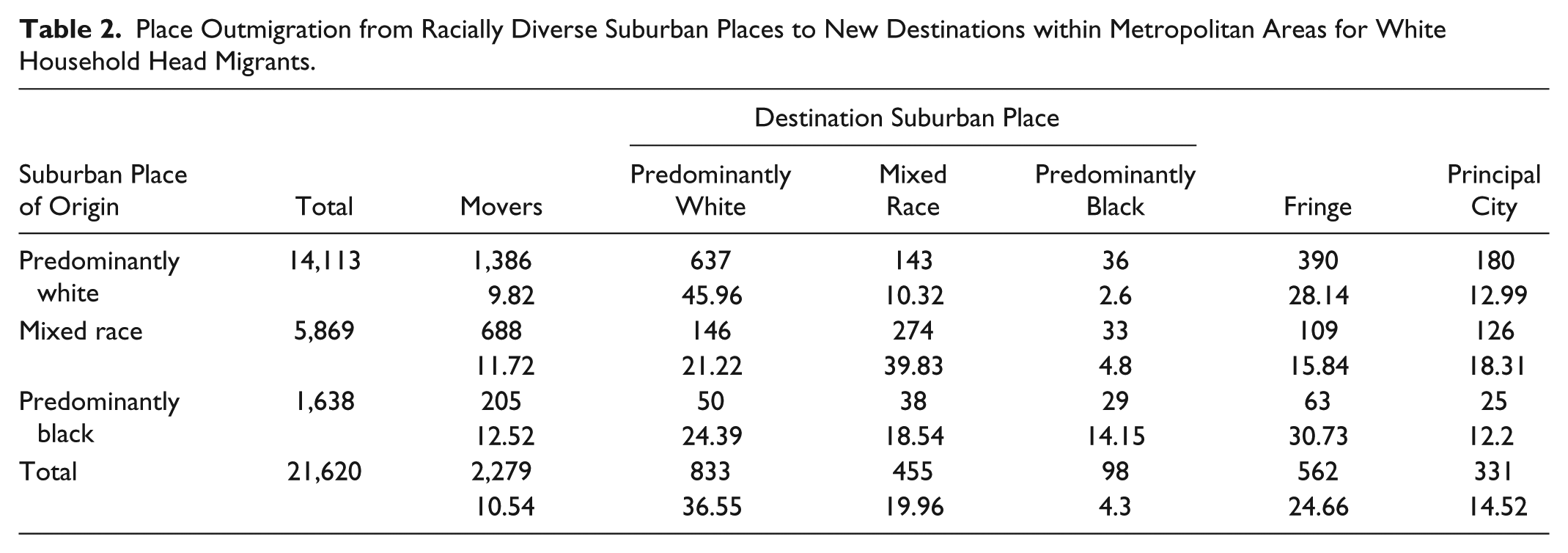
What is unclear is whether these patterns of white mobility from suburban places are conditional on origin racial composition and the racial mix at destination. In this section, we highlight the movement of suburban whites into either predominantly white or racially mixed places and neighborhoods, measured at the block level, followed by analyses of intraplace movement between specific blocks in specific suburban places. The overall goal is to show how specific mobility streams are associated with the racial composition of origins and destinations.
Movement between Suburban Places by Racial Composition
Racial motivations may underlie white residential mobility if they mostly involve the movement from more diverse to less racially diverse places. As shown in Table 2 (columns 3–5), a significant majority of white intersuburban place moves involve movement to predominantly white places (36.55/60.81 = 60.1 percent). Only a tiny fraction involved moves to places with predominantly black populations (4.3/60.81 = 7.1 percent). Moves to mixed-race places, however, accounted for a significant minority share of all destinations (19.96/60.81 = 32.8 percent). These percentages are not especially surprising if, as is the case here, most suburban communities are predominantly white in racial composition. The more interesting result is that patterns of avoidance are conditional on the racial composition of origin places. For example, an overwhelmingly large share (45.96/58.88 = 78.1 percent) of white movers from predominantly white places moved to other predominantly white places. Only a tiny fraction moved to predominantly black communities (2.6/58.88 = 4.4 percent).
If we shift the analysis to whites living in racially diverse places, which most directly addresses our interest, the results clearly reveal the salience of racial considerations in destination choice. In mixed-race suburban places, for example, approximately one third of white suburb-to-suburb movers relocated to predominantly white suburban areas (21.22/65.85 = 32.2 percent). In predominantly black suburban communities, an even higher percentage of white movers, roughly 40 percent (24.39/57.08 = 42.7 percent), changed their residence to predominantly white suburbs. Only 24.8 percent (14.15/57.08) moved to another predominantly black suburban community.
To summarize these results, a simple χ2 test showed that shifts in the cells of our origin-by-destination transition matrix are not random (χ2 = 384.18, p < .001). As expected, there is a positive association between the racial composition of the origin and destination. But this association undoubtedly reflects, at least in part, the uneven racial distribution across metropolitan places, but especially the relative scarcity of predominantly black suburbs. Still, our analysis suggests that movement from predominantly minority to predominantly white places is far greater than what would be expected by chance alone (on the basis of the distribution of types of suburban communities in metropolitan areas). Additional analysis (data not shown) shows that whites are always more likely to choose a white community than any other destination in a metropolitan area. 8 Specifically, whites are 5.3 times more likely to go to a white over a black suburban place, 43 percent more likely to move to a white place over the fringe, and 20 percent more likely to move to a white place over a principal city. Clearly, whites might see place boundaries as a tool to better insulate themselves from other groups.
White Movement to Suburban Blocks by Racial Composition
Our analyses show that most white movers choose predominantly white destinations, especially if they originate from predominantly white places. Of course, some white movers who choose mixed-race or predominantly black destinations may nevertheless choose to live mostly with other whites on the same suburban block. The data in Table 3 addresses this issue.
Block Racial Composition within New Destinations.

These data show that the largest share of white suburban place-to-place movers relocated to predominantly white blocks (64.07 percent). As expected, the percentages at the block level are much higher among white movers who relocated to predominantly white communities (Table 3, row 1) than they are for whites who moved to mixed-race communities (30.77 percent) or to predominantly black communities (31.63 percent). The large majority of whites moving to predominantly minority communities originated from other predominantly minority communities (67 percent) and lived disproportionally on suburban blocks with other minorities (53 percent) (data not shown).
For the 562 whites who moved from a suburban place to the fringe, a significant majority (427 [75.98 percent]) relocated to a fringe area with mostly other whites rather than with mostly nonblack minorities (15.66 percent) or mostly blacks (8.36 percent) on the same block. Suburban whites moving to the city, however, were much more likely to live with racially mixed neighbors or with predominantly black neighbors (39.58 percent and 13.9 percent, respectively). The apparent implication for white gentrification is that white movement to the city mostly involves movement to neighborhoods undergoing racial transitions. Whites avoid predominantly black micro-neighborhoods (at the block level) in the city.
Within–Suburban Place Mobility among Whites
Perhaps the best evidence of a white demographic response to growing diversity would involve mobility within specific places; it would be indicated by white movement from blocks with mostly minority neighbors to new destinations with mostly whites. Such evidence would suggest a kind of “hunkering down” among a community’s white population. Here, by considering only within-place movement, we are in effect controlling for other nonracial factors, such as the quality of schools, tax rates, or local governance issues, which would likely be considered by whites when they contemplate place-to-place moves or other intrametropolitan moves to the exurban fringe or principal city. Table 4 provides the transition matrix of origin-by-destination neighborhood racial mix for intraplace movers.
Origin and Destination Blocks within Places for White Household Head Movers.

The largest percentages of white intraplace movers relocate to blocks with predominantly white or racially mixed residents with similar racial profiles within the community. For example, 87.36 percent of intraplace white movers originating from predominantly white blocks moved to other blocks with predominantly white neighbors. Roughly 75 percent of whites originating in racially mixed blocks moved to other racially mixed blocks. And 64 percent of whites originating from predominantly black blocks moved to other predominantly black blocks.
For whites moving to a different kind of neighborhood within their communities, however, the data indicate pattern of avoidance of black neighbors. In the case of whites who originate from predominantly white places and move to nonwhite blocks, the large majority move to racially mixed blocks (10.53/12.64 = 83.3 percent) rather than predominantly black blocks (2.11/12.64 = 16.7 percent). For whites who originate from predominantly racially mixed blocks, a larger share move to blocks made up of mostly whites rather than blacks. For whites who originate from predominantly black blocks, roughly equal shares relocate to blocks with predominantly white or racially mixed residents. The obvious question is whether these patterns reflect racially motivated incentives or other factors, including whether racially diverse communities and neighborhoods are available to relocate to within the suburbs of metropolitan regions.
Multivariate Analysis: Racial Context and Residential Mobility among Suburban Whites
Our analysis has described contemporary patterns of white residential mobility from suburban communities and has identified flows to other suburban places as well as to the city or metropolitan fringe. Our final objective addresses the hypothesis that white spatial assimilation (as opposed to avoidance) is highly segmented, especially by socioeconomic status. The results of our multivariate analysis are reported in Tables 5, 6, and 7 in the form of multinomial logistic regression models that predict the selection of destinations for whites who choose to leave the place (Tables 5 and 6) and the selection of the blocks for whites who move within a place (Table 7) among suburban whites.
Baseline Multilevel Logistic Regression Models of New Destinations for White Household Heads Moving out of Suburban Places.

Note: ICC = intraclass correlation coefficient.
p < .10. *p < .05. **p < .01. ***p < .001.
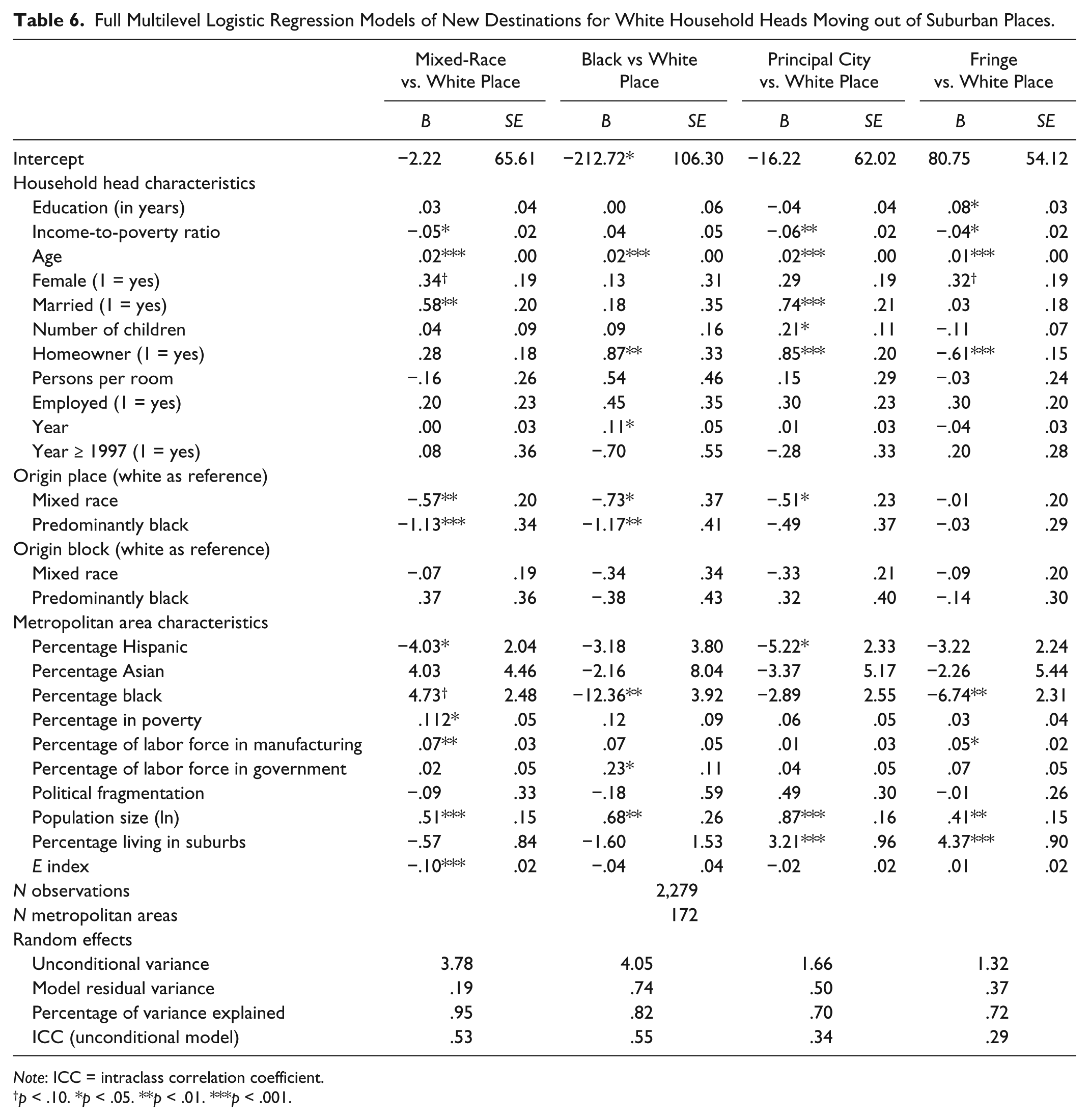
Full Multilevel Logistic Regression Models of New Destinations for White Household Heads Moving out of Suburban Places.
Note: ICC = intraclass correlation coefficient.
p < .10. *p < .05. **p < .01. ***p < .001.
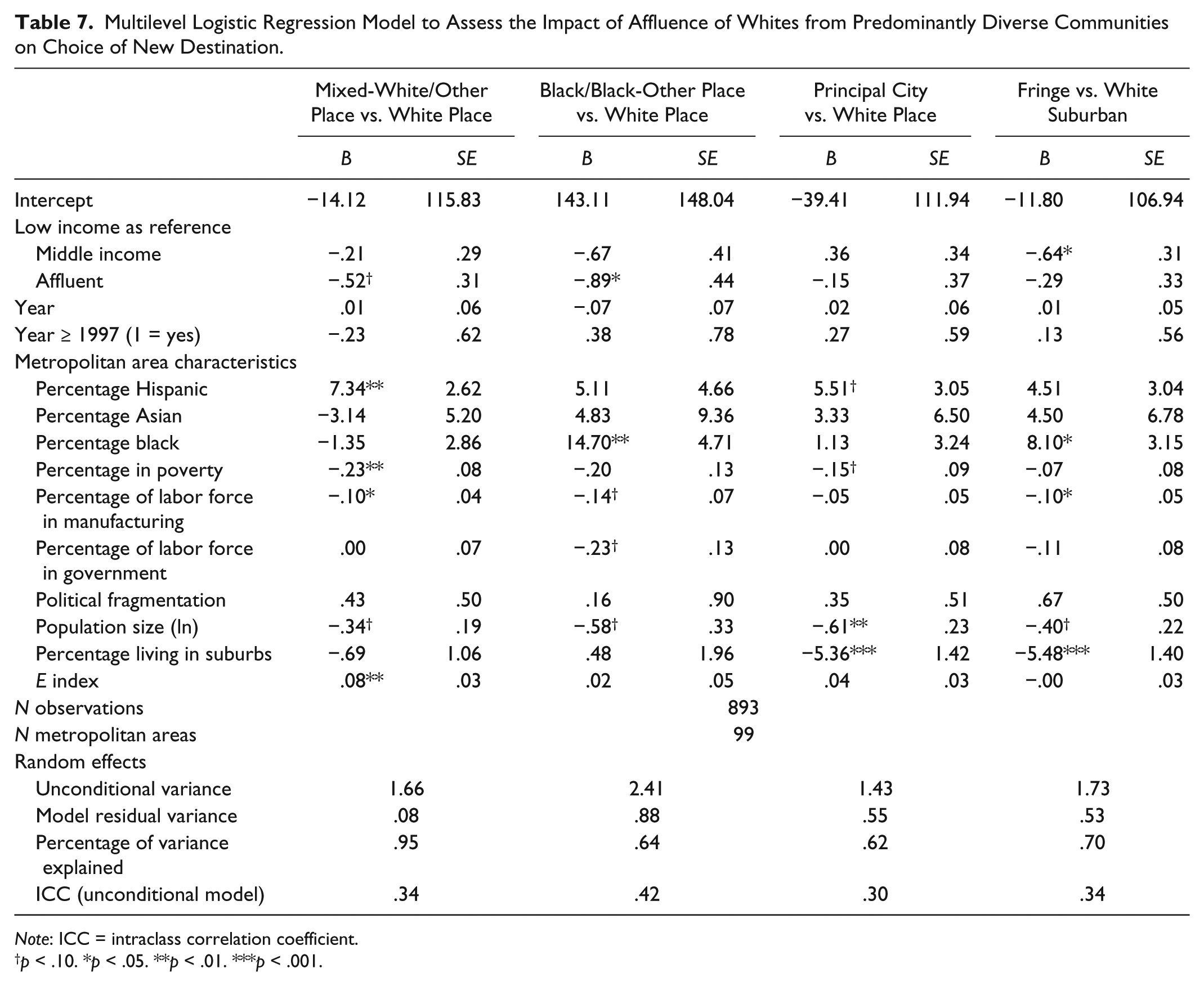
Multilevel Logistic Regression Model to Assess the Impact of Affluence of Whites from Predominantly Diverse Communities on Choice of New Destination.
Note: ICC = intraclass correlation coefficient.
p < .10. *p < .05. **p < .01. ***p < .001.
Interplace Residential Mobility of Whites
We begin with a simple baseline model of interplace mobility that includes the racial composition of the place and block, along with metropolitan control variables (see Table 5). For the most part, these baseline results, as expected, confirm the descriptive results from the bivariate (tabular) analyses reported earlier (i.e., that the racial composition of places is associated with the racial composition of the destination place).
To simplify these results, we contrast racially diverse origins with predominantly white origins. The regression coefficients indicate that householders originating from mixed-white/other places are less likely to move to another mixed-white place or a place with a high presence of blacks (b = −0.73 and b = −0.78, respectively). Similarly, those originating from places with high concentrations of blacks are less likely to move to another mixed-white place or a place with a high presence of blacks (b = −1.09 and b = −1.23, respectively). The racial composition of the origin was also associated with the selection of a principal city as a potential destination. That is, whites originating from mixed-race places were 46 percent less likely to move to a principal city than a predominantly white suburban place. The racial composition of blocks was not associated with the selection of destination.
Whether these patterns of white mobility are entirely an expression of racially motivated “white flight” requires additional study (Crowder and South 2008; Kye 2018), especially considering that statistical links between observed individual/household characteristics and moving from racially diverse places or neighbors are modest or ambiguous. It could be that poor white households are overrepresented in minority areas and therefore are more transient on average than other suburban whites. If this is the case, controlling for household characteristics will eliminate any “effects” of racial composition at the place and block levels. The aforementioned place effects would be entirely due to selection (i.e., to the kinds of households that live in racially diverse areas). On the other hand, if racially motivated mobility is occurring, then controlling for household traits (e.g., education, income) will not eliminate or reduce the significance of the estimated coefficients for our spatial characteristics. Such a result arguably would provide stronger evidence of causal effects.
The results in Table 6 indicate that the racial composition of the origin remains significantly associated with the racial composition of the destination and that the magnitude of this statistical association remains largely unchanged after controlling for household characteristics. Whites from racially mixed (b = −0.57) and predominantly black (b = −1.13) origin places are significantly less likely to move to other racially diverse places vis-à-vis predominantly white places. White geographical mobility from racially diverse suburban areas to predominantly white suburban places or to the city is clearly not a simple function of the kinds of households that reside in racially mixed suburban places. It is not a result of selection. The data also show that the racial composition of the origin is statistically unrelated to whether white households choose to move to the fringe (which is mostly white) or predominantly white suburban places. The results also indicate that these place-based patterns are not confounded by the racial composition of the blocks in which whites live. The racial composition of places trumps the racial composition of blocks in selecting a place destination.
The results in Table 6 also highlight the significant variation by family size–adjusted income and age. That is, higher income white households are more likely to move to other predominantly white suburban places than to racially diverse suburban places (b = −0.05), principal cities (b = −0.06), or the fringe (b = −0.04). The fact that the association between income-to-poverty ratio and the movement to predominantly black suburban places is not statistically significant is largely a result of limited statistical power. There simply are too few instances (in our data) of whites, regardless of income, moving to mostly black suburban places. Interestingly enough, our results also show that age is positively associated with mobility to racially diverse suburban places, principal cities, or the fringe. This result is unexpected but could simply reflect the movement of older whites to retirement housing that is located in places that happen to be diverse. Alternatively, this finding could indicate that younger suburban whites are most likely to avoid exposure to racial diversity (perhaps because of their limited exposure to minorities while growing up). These results suggest a need for additional study.
The data also show that differences in metropolitan characteristics account for a substantial amount of variation in destination selection. In the selection of suburban-place destinations, differences in metropolitan characteristics account for more than 50 percent of total variation in destination selection. For example, for every unit change in the diversity index (E), whites are 10 percent less likely to move to a mixed-race place than a predominantly white place. Similarly, the higher the percentage of blacks in the metropolitan area, the lower the odds that whites will move to a place with a high percentage of blacks (b = −12.36) or a fringe area (b = −6.74). 9 Whites in metropolitan areas with comparatively large suburban populations are significantly more likely to move to principal cities and fringe areas as destinations than to predominantly white suburban places. In this metropolitan context, whites are 25 times more likely to move to a principal city (b = 3.21) and 29 times more likely to move to a fringe area (b = 4.37) than to a white suburban place. Finally, the population size of the metropolitan area is positively associated with moving to another destination over a predominantly white place.
In some additional analyses, we also examined the question of whether suburban whites are more likely to respond to diversity if they have the financial ability to do so. This question represents our third hypothesis, which states that the association between the racial composition of the origin and interplace mobility will depend on household income (measured here by the income-to-poverty ratio). Simply put, affluent households are expected to have much greater freedom of residential choice than their middle and low income counterparts. The affluent are more likely to leave racially diverse communities in search of alternative housing in predominantly white suburban communities. To test this hypothesis, we estimated a model that includes only white movers originating from diverse suburban places (i.e., mixed race and predominantly black). We identified affluence as those having an income-to-poverty ratio of 5 or greater. The middle class are identified as households having an income-to-poverty ratio between 2 and 5, and poor and near-poor households as having incomes below 2 times of the poverty threshold. These results are reported in Table 7.
As expected, affluent white movers are consistently more likely to choose a predominantly white place over any other destinations in the metropolitan area, compared with their low and middle income counterparts (see Table 7). This association is statistically significant only for those whites choosing white places over predominantly black destinations. That is, affluent whites are 59 percent less likely to move to a predominantly black place (b = −0.89) compared with their low-income counterparts or, alternatively, 2.44 times more likely to move to a predominantly white suburban place. Middle-class white movers, on the other hand, prefer white places over the fringe, at least as measured by their actual behavior. That is, middle class whites are 47 percent less likely to move to fringe areas (b = −0.64) compared with a predominantly white place, or in other words, they are 88 percent more likely to move to a predominantly white place than their low-income counterparts. White intrametropolitan mobility is expressed differently across the income gradient.
Intraplace Residential Mobility of Whites
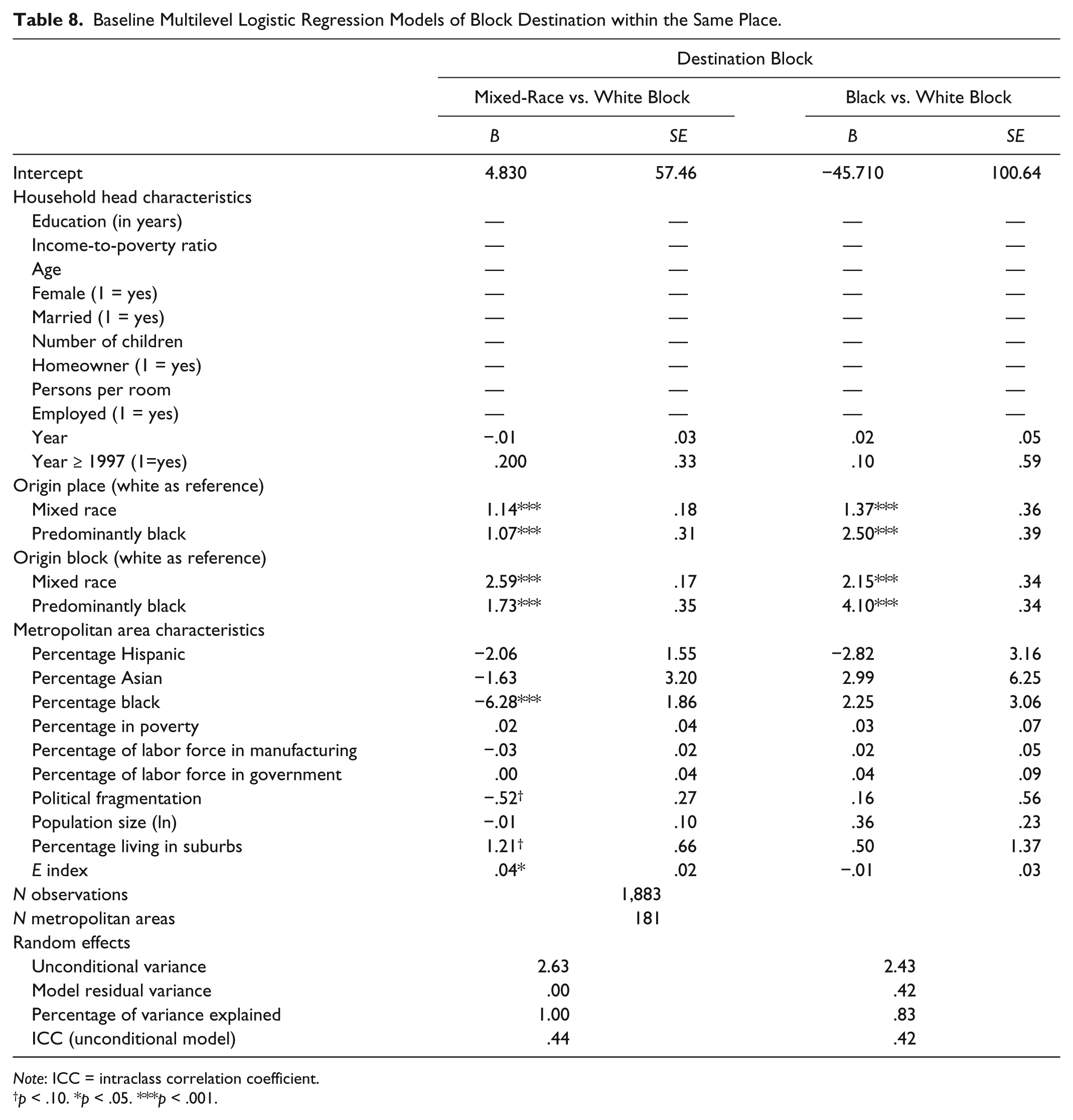
Other evidence of whites’ “hunkering down” would be indicated by the movement from more racially diverse to less racially diverse blocks. In fact, our multivariate analyses provide little if any evidence for such claims, in both the multivariate analyses that do not control for household characteristics (see Table 8) and analyses that do (Table 9). In fact, for intraplace movers, the racial composition at the block level is positively correlated with the racial composition of the destination block. The results provide little evidence that whites move to whiter neighborhoods within the same community.
Baseline Multilevel Logistic Regression Models of Block Destination within the Same Place.
Note: ICC = intraclass correlation coefficient.
p < .10. *p < .05. ***p < .001.
Full Multilevel Logistic Regression Models of Block Destination within the Same Place.

Note: ICC = intraclass correlation coefficient.
p < .10. **p < .01. ***p < .001.
As shown in Table 9, for example, whites originating from mixed neighborhoods are 13 times more likely to move to another mixed block and 9 times more likely to move to a predominantly black block (b = 2.24) than to a predominantly white block within the same place. Similarly, whites originating from blocks with a high presence of blacks are 5 times more likely to move to a mixed block (b = 1.69) and 47 times more likely to move to a predominantly black block (b = 3.85) than to a predominantly white block within the same place. These findings are not an artifact of the availability of predominantly white blocks in these places, as we statistically control for the racial composition of the place and metropolitan region. The implication is that white suburbanites who move, on average, are not basing their moving decisions on race. Instead, they seem to adapt to racial diversity and embrace it, at least as measured here by patterns of destination selection.
These data indicate that household characteristics are only weakly associated with the movement to racially diverse blocks within the same suburban community. In contrast to the results for patterns of interplace mobility (Table 5), the income-to-poverty ratio is statistically unrelated to the kinds of destinations chosen by intraplace movers. However, there is some evidence that older suburbanites are more likely to avoid diverse blocks, as are white suburban movers with children, which is consistent with previous research suggesting that white movers consider the racial composition of schools in deciding where to live. This phenomenon is also suggested by some additional analysis (not shown) indicating that households with elementary school-age children are 20 percent less likely to move to racially diverse blocks. This result is consistent with the idea that elementary school–age children are more likely to attend nearby neighborhood schools. This is less likely the case for teenage children who typically attend high schools that attract students from many different elementary schools in the district.
Differences in metropolitan area characteristics account for more than 40 percent of the variance in the selection of block destinations. As in the previous analysis, the overall diversity of the metropolitan area positively contributes to the selection of mixed-white and predominantly white blocks. However, the higher the percentage of blacks, the lower the odds that a white household will move to a mixed-white block compared with a predominantly white block.
Finally, we estimated the extent to which affluent whites were overrepresented in moves to predominantly white blocks within the same community. As before, we limited the analysis to those originating from racially diverse blocks. The results (data not shown) show that affluent whites are more likely to move to predominantly white blocks than middle- or low-income whites, but this relationship is not statistically significant at conventional levels. This result suggests that white geographic mobility, from racial diversity, is not a micro-level demographic process (at the neighborhood or block level) but is occurring at a higher geography of scale: the place or community level.
Discussion and Conclusion
This article shows that minority suburbanization has been countered demographically by white population shifts between suburban places, to outlying exurban areas, and back to the city. Here we use data from the PSID, along with other place- and metropolitan-based measures, to refocus attention on suburban whites, who arguably have not received the attention they deserve, especially if recent residential shifts are motivated by racial considerations. Our multiscale approach departs from typical neighborhood studies in emphasizing contemporary patterns of racial integration across and within suburban places.
Our results provide the basis for several general conclusions. First, as an empirical baseline, our analyses show, at the block level, that suburban whites overwhelmingly have white rather than racially diverse neighbors, regardless of the overall racial composition of the particular suburban place they live. Even in racially diverse suburban communities, whites typically live on city blocks that range from 60 percent to 90 percent white. At a minimum, this empirical fact reinforces evidence of growing white suburban segregation (i.e., a kind of “hunkering down,” as suggested by Putnam 2007) in response to the influx of minority populations or to any unobserved factors correlated with white residential preferences and mobility (e.g., housing values, crime, or school; see Kye 2018 for an excellent discussion).
Second, our results provide evidence that is consistent with our first hypothesis, which is that whites are more likely to leave racially diverse than predominantly white suburban places. Whites are moving to other suburbs, gentrifying central cities, and exurban fringe areas that seem to set them apart spatially from newly arriving suburban minorities. This finding is not a matter of neighborhood racial turnover but rather of increasing mobility from geographic units at a higher level of geography: at the place or community level. One implication is that white residential mobility may be racially motivated, inasmuch as white movement is revealed in residential shifts from more to less diverse suburban places (rather than from diversifying neighborhoods). These patterns, however, are uneven across demographic subgroups and in ways that are consistent with the economic and household life decisions that can trigger residential mobility (e.g., the freedom of retirement or new high-paying employment).
Third, our results show that white movers are avoiding minorities in their choices of alternative destinations, a result that supports our second hypothesis. Racial composition matters; racial considerations clearly affect, directly or indirectly, where suburban whites decide to move. This result suggests that white suburban movement may exacerbate racial segregation among whites and slow overall residential integration across metropolitan regions. Whites seemingly avoid suburban communities and neighborhoods where blacks predominate. Our empirical analyses build on conventional neighborhood studies of racial segregation and diversity by simultaneously considering white racial integration at both the macro (place) and micro (block) levels. Racial integration in the suburbs is not simply a matter of black or minority city-to-suburban residential mobility; scholars must acknowledge the demographic role—perhaps the growing demographic role—of America’s suburban whites (Timberlake 2018). This point is important because the large majority of U.S. whites live in suburban communities rather than rural areas or principal cities.
Fourth, our results show that different segments of the white population are responding differently to diversity—moving to less diverse suburbs or other areas. But other whites seem to be embracing diversity, at least as measured by decisions to move. Our third hypothesis on white segmented integration thus is given only qualified support on the basis of the evidence provided in our multivariate analyses. It is clear, for example, that patterns among whites are not uniform and that some whites, especially those with the financial means to do so, often move away from racial diversity. This movement acts to concentrate minorities and whites unevenly across suburban communities. It also reinforces income segregation and the concentration of suburban poverty. Indeed, we showed that white mobility, within and between places (cities and suburbs), often depended more on individual and family traits (e.g., no children or having more money) that seemingly gave some but not others the freedom to move.
Our study is not without limitations. One limitation is that we cannot make strong causal claims about “white flight” and have chosen not to do so here. We have not evaluated residential preferences, or the ability of whites to act upon them or to realize their preferences for diversity or homogeneity. Observed white residential mobility flow may simply be an artifact of white reactions to other arguably nonracial factors that we cannot account for in our analyses (Kye 2018). Such factors would include community characteristics that are associated statistically with the presence of minority populations in the neighborhood or community (e.g., declining housing values or increasing crime rates). Separating racial and nonracial “causes” is difficult. Yet regardless of the reasons, suburban whites are now clearly distancing themselves from other racial groups across America’s diversifying suburban places. White geographic mobility has taken on new forms and is now remaking the racial distribution across America’s metropolitan regions.
To conclude, our overall goal has been to provide an empirical benchmark for studying newly emerging patterns of white mobility to and from racially differentiated suburban communities. By shifting the theoretical and empirical lens to whites, we acknowledge directly that racially based mobility patterns of the past require new scrutiny today as America moves toward a majority-minority society by midcentury (Lichter 2013). Will white suburbanites join the new American racial mosaic? Or instead, will they leave areas of rapid racial and ethnic change, including the suburbs that no longer provide a “safe haven” from racial minorities and immigrants? It is time to shift the spotlight from cities to the suburbs, which are remaking the social and economic fabric of metropolitan America.
Footnotes
Funding
The author(s) disclosed receipt of the following financial support for the research, authorship, and/or publication of this article: The author(s) acknowledge the support of the Cornell Population Center and the National Strategic Planning & Analysis Research Center at Mississippi State University.
1
This process was most vividly illustrated in the pre–civil rights era by the practice of “blockbusting,” when unscrupulous real estate agents introduced black residents into white neighborhoods, preying on white fears and profiting from rapid turnover in the housing market.
2
Residential mobility is defined by any change of address. Such change can involve residential movement between specific communities or movement within a particular community, from one neighborhood in the community to another or even a change of residence down the block.
3
In part, this trend simply reflects the changing relative size of the population “at risk” of geographic mobility in cities and suburbs. With time-invariant rates of city-to-suburb and suburb-to-city movement, declining shares of whites in the city means that fewer movers will originate in the cities vis-à-vis the suburbs (which have grown in white population size).
4
Minority-weighted estimates tell us about the average experience of suburban segregation among minorities but not among whites, whose experience may be quite different from that of disadvantaged minority populations (Iceland and Sharp 2013). Despite rising shares of whites in America’s suburbs, the average white percentage in the suburbs declined from 92.5 percent to 68.4 percent between 1970 and 2010 ( ). Whether this decline reflects the average experience of whites across suburban places is much less obvious, especially if some suburban areas are becoming increasingly white or, alternatively, becoming largely minority places because of white flight to mostly white suburban places or to the city.
5
Motivations for intermetropolitan mobility are unlikely to be closely linked to racial considerations; they typically involve job-related factors. However, racial motivations may nevertheless cause intermetropolitan movers to choose one community or neighborhood over others as possible destinations. This issue awaits another study. We keep the focus here on residential mobility.
6
Moves originating from principal cities and fringe areas were not included in the analysis.
7
8
9
Our focus here is on metropolitan-level characteristics in relation of white mobility rates. However, some additional analysis revealed significant regional differences in destination selection in the South (vis-à-vis the non-South). Specifically, in the South, white interplace movers were significantly less likely to choose mixed-race than predominantly white destinations (b = −.75) and especially avoided those destinations that were predominantly African American in racial composition (b = −1.37).