




Abstract
Gendered expectations are imported from the larger culture to permeate small-group discussions, creating conversational inequalities. Conversational roles also emerge from the negotiated order of group interactions to reflect, reinforce, and occasionally challenge these cultural patterns. The authors provide a new examination of conversational overlaps and interruptions. They show how negotiated conversational roles lead a status distinction (gender) to shape conversational inequality. The authors use a mixed-effects logit model to analyze turn taking as it unfolds in task-group discussions, focusing on how previous behavior shapes current interaction. They then use these conversational roles to examine how locally produced interaction orders mediate the relationship between gender and interruptions. The authors find a more complex process than previous research has revealed. Gender influences the history of being interrupted early in an interaction, which changes the ongoing behavioral patterns to create a cumulative conversational disadvantage. The authors then discuss the implications of these group dynamics for interventions.
Gender inequalities regularly structure our day-to-day conversations. These inequalities occupy academic discussions on gender (e.g., Aries 1996; Ridgeway 1992, 2011; Tannen 1993, 1994). They make their way into discourse outside academia in popular books such as Tannen’s (1991) You Just Don’t Understand and in discussions of mansplaining, manterrupting, and manologuing (Baird 2016). Conversational manifestations of gender have a pervasive nature, affecting even those in incredibly high positions, such as Supreme Court justices (Jacobi and Schweers 2017) and congressional representatives.
As formal, quantitative social scientists, we join Fişek, Berger, and Norman (1991), Gibson (2008), Skvoretz and Fararo (2016), and others in their general project of understanding the interactions within groups that reflect and create inequality. This interactional level is an important social domain both in its own right and as a fundamental link between macro-level structural inequality and the shared cognitive structures that perpetuate inequality even when material sources of dominance change (Ridgeway 2011). Understanding the process through which external statuses (such as gender) structure interaction in groups, and how alternative status structures can be generated in group conversations, is important to sociologists in many substantive areas.
Sociologists have problematized conversational inequality for decades and have made considerable progress into understanding who gets to talk and who gets interrupted. However, we still do not know much about the how and why of interruption. Here, we work to unpack the how of interruption patterns, modeling turn transitions while noting the effects of previous interactional turns. We then examine how gender shapes the emergence of these conversational roles, noting the locally produced structures that provide insights into why a person is interrupted at a given point in a conversation.
Understanding process is important because so much important activity occurs in group interaction. One has only to look at the citations to Fişek et al.’s (1991) article to be reminded that work groups occur in many domains, from entrepreneurial startup teams to juries to political crisis management to social movements. Webster and Whitmeyer (2001) provided a scholarly review of applications of the status characteristics and expectation states work, including police-perpetrator encounters and many educational interactions. Few tasks get accomplished without interaction in groups.
Understanding these processes is important for practical reasons. How do we deal with dysfunctional inequality in groups? (Clearly, not all inequality is dysfunctional, but some certainly is, as it keeps lower status members from contributing valuable information to the group enterprise and achieving their own goals, including upward mobility.) Even when encouraged to do so, people are unlikely to ignore basic distinctions such as gender that frame their interactions (Ridgeway 2011). Changing the larger structural features that convey material resources to one gender (male) rather than another (female) will take historic changes in societal structures. How, then, can one intervene to make work groups, criminal justice processes, educational activities, and collective action more egalitarian and effective? It will take an understanding of the processes through which conversational roles develop to develop such interventions. Without knowing how status works within groups, we cannot effectively intervene to change it.
The Confusion over Interruptions
In the mid-1970s, Harvey Sacks and his collaborators introduced an influential conceptualization of turn taking in conversations (Sacks, Schegloff, and Jefferson 1974). Group processes researchers, who examine how status affects conversational behavior, have benefited from the insights of these conversation analysts, who study the sequential, negotiated structures of talk (see an excellent review by Gibson 2008). As violations of turn-taking norms came to be viewed as conversational dominance, researchers studied behaviors such as interruptions and overlaps with a focus on gender. Reviews of this literature describe widely varying results (Anderson and Leaper 1998; Aries 1996:79–101; James and Clarke 1993).
In part, this confusion arises because simple counts of non-normative turn-taking events ignore much of the complexity of conversation. More recent research focuses on the dynamics of turn taking, analyzing the ways in which conversational patterns develop and stabilize, reflecting and occasionally challenging macro-level status distinctions (Gibson 2010; Skvoretz and Fararo 2016). In fact, the very notion of conversational “dominance” through behaviors such as interruptions (found primarily in the literature focusing on gender and talk) remains problematic, with only mixed support coming out of previous investigations (e.g., James and Clark 1993; Robinson and Smith-Lovin 1990; Smith-Lovin and Robinson 1992). Interruptions and overlaps may indicate deference mechanisms or cultural differences instead of dominance. Researchers in the status characteristics tradition focus on deference patterns on the basis of cultural expectations regarding performance. Alternatively, researchers such as Tannen (1991) argued that men and women, because of socialization, have different linguistic cultures.
These questions of dominance, deference, and culture strike deeply at the notion of what Gibson (2008) called “permeation,” or the effects of outside characteristics on face-to-face interaction. Here, we first review the three major strands of literature that contribute to these intellectual questions: the group processes work on status characteristics and expectation states, the “doing gender” perspective, and the highly inductive conversation analytic tradition. We indicate key questions remaining within each of those literatures, which might be addressed by their joint examination. Then we turn our empirical focus on how emergent structures develop and then express exogeneous status characteristics (in this case, gender).
We first ask, “How do endogenous patterns of behavior (and subsequent local structure) influence the patterns of non-normative turn transitions that occur during ongoing interaction?” We examine how conversational roles develop, revealing the dynamics of participation, interruptions, and overlapped speech. Specifically, we ask how non-normative speaker transitions, via interruptions and overlapped speech, serve to regulate the allocation of floor time, a scarce, valued resource in task-group discussions.
We then turn from this dynamic, inductive analysis to use these conversation roles as an explanatory mechanism for links between gender and interruptions. We first demonstrate the mediation. Then, we use a path model to demonstrate the ways gender influences interruption sequentially through the process of conversational interaction. In essence, we explore the black box in previous examinations of gender and non-normative turn transitions by modeling internal processes of negotiated group interaction and how these processes mediate the relationship between gender and interruptions.
Three Literatures on Gender, Conversation, and Group Interaction
Doing Gender
Sociologists understand gender as a system instead of something one “is” (e.g., Ridgeway 2011). West and Zimmerman (1987) offered an early statement of this approach in their article on “doing gender.” They advanced an ethnomethodological viewpoint of gender as an accomplishment in which actors “do” gender through everyday practices.
Their initial research was rooted in their previous work on interactional inequalities (Zimmerman and West 1975). That work included an analysis of conversational overlaps and interruptions in speech that drew insights from the concurrently developing field of conversation analysis (see below). West and Zimmerman’s (2009) subsequent work moved away from the nuances of face-to-face interactions and interruptions but maintained a focus on the interactional behavior of actors that underpin gender as a system. This perspective has found considerable overlap with theories in sociological social psychology, being drawn together with theories of identity (Ridgeway and Smith-Lovin 1999) and with expectation states approaches (Ridgeway and Correll 2004). However, not much recent work within this perspective has focused on conversation analytic–based research (Kitzinger 2000, 2009).
The research on gender and interruption behaviors yields no single pattern. For example, in their original article on the subject, Zimmerman and West (1975) reported differences in interruption behaviors between men and women in their groups. Later, Murray and Covelli (1988) found no differences in their analysis of interviews, staff meetings, black parties, and white parties. Later scholars, using more elaborate quantitative analyses, found complex interactions. For example, Smith-Lovin and Brody (1989) found that men interrupted women more frequently but that women interrupted and yielded the floor to an interrupter at equal rates regardless of the gender of the other. In the end, the evidence has been mixed when it comes particularly to interruption rates (James and Clarke 1993).
Considering conversational overlaps adds even more complexity. Although most interaction adheres to the “one-speaker rule” (Sacks et al. 1974), considerable attention has been given to when this rule is not in fact followed (see Jefferson 1973, 1984; Schegloff 2000, 2001). Furthermore, such behavior is performed in different ways; for instance, a backchannel is technically an overlap but does not end speaking rights by overtaking the “next” position. Additionally, overlap may serve a variety of different purposes, including collaborative work. Therefore, the definition of what exactly constitutes an interruption (or whether it should be distinguished from other forms of overlapping speech) has received considerable attention (Jefferson 1984; Murray 1985; Okamoto, Rashotte, and Smith-Lovin 2002; Schegloff 2000, 2001).
Arguments about the relationship between gender and interruptions in the doing gender literature tend to focus on interruptions as power or dominance displays (e.g., Karakowsky, McBey, and Miller 2004; Zimmerman and West 1975). However, interruptions could instead be driven by status or deference. In their analysis comparing predictions about gender and interruptions from group processes and sociolinguistic traditions, Robinson and Smith-Lovin (1990) found that both the power and status/deference perspectives were partially supported. We argue that questions regarding the nature of the distinction between status and power are important to gaining a deeper understanding of how interactions occur and how inequalities are reified through group interaction sequences. Do actors in high-status positions (or desiring them) simply push their intentions on other members of a group? Is the structure more collaboratively produced as cultural meanings are played out in group interaction? Although the “doing gender” literature is not always clear about the distinction between conversational dominance against resistance and conversational deference in service of expectations, it is an important theoretical and practical matter. We now turn our attention to research in the group processes tradition.
Group Processes Research
In contrast to the doing gender perspective, the group processes tradition in social psychology has focused on conversational behaviors as deference. A large body of literature has developed focusing on interactional behaviors, including overlaps and interruptions, participation, influence, tentative speech, and gaze toward others (see Ridgeway and Smith-Lovin 1999 for an early review). Ridgway and Correll (2004) provided an excellent overview of this theoretical paradigm when applied to the gender system. They pointed out that one of the core components of this system is the “social relational context,” when actors “define themselves in relation to others in order to act” (p. 511). They pointed out the reciprocal relationship between larger social structures and local contexts in which inequalities play out.
Ridgeway and Correll (2004) drew from Zimmerman and West’s (1975) formulations in describing their approach. According to Ridgeway and Correll (2004), gender acts as a background characteristic that is activated any time that an actor’s alters (real or imagined) can be differentiated on the basis of gender or when the task is culturally charged with gender expectations. In such situations, gender-based expectations will be activated and expectations about the ability of the actor (e.g., in task groups) will change how the actor will act and be acted toward.
Most group processes research focuses on a “power and prestige order” that develops during the early portions of an interaction on the basis of behavioral cues from the interaction itself (e.g., Berger, Cohen, and Zelditch 1972; Fişek, Berger, and Norman 2005; Correll and Ridgeway 2006). Scholars who developed this tradition (called expectation states) were influenced by Bales’s work on status homogeneous groups that focused specifically on inequalities created in group-level interactions (Bales et al. 1951; Bales and Slater 1955). Later theoretical developments focused on the impact of status characteristics such as gender imported into the group interaction from larger society. The theoretical work describes a deference order in which lower status actors defer to those who are perceived to have higher competence, in order to promote group task success.
Expectation states researchers often study participation rates and the influence that one actor has over another (e.g., Balkwell and Berger 1996; Johnson, Clay-Warner, and Funk 1996; Ridgeway 1993; Skvoretz and Fararo 2016; Wagner and Berger 1997; Walker et al. 1996; Wood and Karten 1986). The findings of conversational analysts in the 1970s led group process researchers to expand their focus to turn-taking behaviors (Gibson 2003; Johnson 1994; Okamoto and Smith-Lovin 2001; Robinson and Smith-Lovin 2001; Smith-Lovin and Brody 1989; Smith-Lovin and Robinson 1992). Researchers often made use of deviations from smooth turn-taking norms (e.g., interruptions and overlaps) as part of the power and prestige order. They studied how these behaviors were influenced by status structures within a group.
The dynamics that task-oriented group discussions use to organize talk have been of particular interest (e.g., Balkwell 1991; Fişek et al. 1991; Skvoretz and Fararo 1996, 2016). These dynamic theories develop models of how internally generated status combines with external status elements to generate group structures. Much of this quantitative work, however, has used dynamic theoretical models to predict static outcome distributions of conversational behaviors. Even the more dynamic analyses of empirical data (Drass 1986; Okamoto and Smith-Lovin 2001; Robinson and Smith-Lovin 1990, 2001; Smith-Lovin and Robinson 1992) typically predict which category of speaker will perform some conversational behavior at a higher rate than another, on the basis of the status value positions within larger societies (for a comprehensive review of such work, see Gibson 2008). This literature leaves a gap in our understanding of the process. Most notably, although it accounts for effects of categorical attributes that actors bring into the situation and explores the ways in which actors behave while establishing a status order (see Balkwell 1991; Fişek et al. 1991; Skvoretz and Fararo 1996, 2016) it does not attend to the ongoing process of the interaction and the behaviors that continue to accumulate over the course of the interaction.
For example, Fişek et al. (1991) developed the concept of “behavior interchange pattern” to link the expectation-behavior-expectation sequencing of group interactions within their theory, combining (1) status charactersitics that are imported from outside the group and (2) the inequalities that arise and become legitimated within group interactions. A behavior interchange pattern occurs when one actor defers to another. It becomes salient (theoretically relevant in determning the expectations for competence within the group) when it differentiates two people with the same initial status. It therefore conceptualizes the emergence of interactional inequalities through sequential behaviors. However, a behavior interchange pattern only remains active until it is replaced by another such pattern (i.e., A defers to B will be eliminated if B then defers to A) (Fişek et al. 1991:124). Therefore, the behavior patterns act as indicators of an underlying expectation order, rather than describing the cumulative, sequential development of negotiated conversational roles.
The work of Skvoretz and Fararo (1996, 2016) takes a different tack on the same important question. Building on Fişek et al. (1991), they developed formal models that combine expectation states with social network structures. Importantly, they developed axiomatic structures describing their E-state structural approach (often including a stochastic element) and then compare the distribution of behaviors across actors to the predictions of their model. Specific sequences of action are not used either in prediction or as outcomes.
To move this research forward, we must deepen our understanding of the ongoing interaction. The insights of conversation analysis are of particular concern in moving toward this goal. In particular, Gibson (e.g., 2003, 2008, 2010) has been a vocal proponent of incorporating insights of the conversation analytic tradition into quantitative examinations of group interactions. These crucial insights date back to Sacks et al.’s (1974) original work on turn taking. It is to this conversation analytic work that we will now turn.
Conversation Analysis and Interaction
Although the early contributors to the group processes tradition (Bales 1950; Bales et al. 1951; Bales and Slater 1955) focused on how participation was distributed, the conversation analytic tradition (Sacks et al. 1974) focused on the structure of ongoing interaction. The former quantified interaction using counts of various behaviors, while the latter focused on a qualitative ethnomethodology driven by an interest in the process of the interaction itself.
Conversation analysis proper takes as problematic the very ways in which people go about producing talk (Schegloff 2007). The focus is on understanding the basic structure of ongoing interaction, what people are “doing” through their talk. Conversation analytic work is a relatively atheoretical qualitative examination of transcribed interactions. Work within this tradition has focused specifically upon structures of talk, regardless of setting. It has produced a corpus of knowledge about how and in what contexts behaviors are performed. Research includes phenomena such as turn taking (Sacks et al. 1974), formulating greetings and endings of conversations (Schegloff 1968), and the sequencing surrounding the production of various events in conversation (Schegloff 2007). Explicitly focused on the patterns that develop within the interactions studied, the goal is to unveil processes necessary to produce the ongoing interaction.
In one of their most influential works, Sacks et al. (1974) noted that conversational data show patterns regarding how actors take turns at talk. One party usually spoke at a time, even though the lengths of turns and ordering of speakers varied. Speakers generally coordinated their transitions between turns at talk smoothly, using a variety of techniques for allocating those turns and shaping the transition to the next speaker. Sacks et al. (1974:704) proposed a minimal set of rules that generated these patterns, focusing on the point in an utterance when a shift in speaker is permitted (a “turn-relevance place”).
There has been some criticism of the proposition that utterances contain a structure that allows listeners to anticipate accurately the time at which a new speaker can begin without interfering with the speaker’s right to complete his or her turn at talk (Power and Dal Martello 1986; Wilson, Wiemann, and Zimmerman 1984). However, a large number of researchers embraced the turn-taking model as a general, powerful way of describing how conversation is managed to achieve sequences of speakers with few gaps or overlaps in speech. The focus on coordinated turn-taking led to an interest in deviations from this coordinated pattern.
Interruptions (and overlaps in speech) have been discussed within both conversation analytic and group processes traditions, sometimes with differing opinions about what an interruption is itself (for a critique, see Schegloff 2000, 2001). The question of how, when, and toward whom these behaviors are used remains open. Interruptions and overlaps have an effect on participation and speaking rights within an interaction: they may disrupt the ongoing process of the interaction by superseding the choice of next speaker. According to the first rule of turn taking (Sacks et al. 1974), that choice would likely be the responsibility of the concluding speaker (who could continue with another statement following rule number 3).
The consequentiality of the action for determining floor time in the ongoing interaction invokes the longtime question of “who” interrupts “whom.” Conversation analysts would point analysts toward the previous situated “doings” of the interactants while group processes researchers point toward exogeneous characteristics of actors or (in the absence of differentiation) early behavior interaction patterns (BIPs).
There are at least two features of conversation analytic work that seem important for theoretical insight into gendered group processes. The first is the sense of an interruption or overlap as a non-normative event. Deviance always has meaning within groups and can be either sanctioned or permitted. Seeing whether interruptions lead to higher levels of later participation or lower ones may provide clues about how other group members respond to these norm violators. Seeing if those patterns interact with gender will indicate whether men and women have differential rights to assert themselves within a conversation and to reassert their speaker rights after a violation.
The second issue that conversational analysts highlight is the sequential signaling nature of conversation. Unlike the BIP in expectation states theory, conversational analysts do not see a particular conversational act (A defers to B) as a concrete indicator of some underlying expectation structure. Instead, they are more inclined to pay attention to sequential, patterned interactions that are group accomplishments. This emphasis on sequence and interactional history may still be useful for group processes researchers, however, as it points them toward new features of conversation that are worthy of study. In fact, they may serve to be a better indicator of a developing power and prestige order than a single BIP.
Combining the insights of both conversation analytic and group process traditions has long been a goal of some researchers in the group processes tradition. Some previous research has sought to do so by accounting for time (Robinson and Smith-Lovin 1990, 2001; Smith-Lovin and Robinson 1992; Okamoto and Smith-Lovin 2001). A new push spearheaded by Gibson (2003, 2005, 2008, 2010) seeks to account for the insights of conversation analysts more fully and explicitly. It is to this new literature and Gibson’s (2008) critiques of previous examinations that we now turn our attention.
Analyzing Conversation Dynamics: The Questions That Remain
Although both the doing gender perspective and conversation analysis both come out of the ethnomethodological tradition, quantitative studies that attempt to break down the black box of face-to-face interaction remain relatively sparse (Gibson 2008). Even the most sophisticated recent theoretical advances only attempt to describe how patterns within groups create outcome distributions (Fişek et al. 1991; Skvoretz and Fararo 1996, 2016). These major advances still ignore the cumulating sequences that actually constitute group interaction. Our present research focuses on those ongoing sequences that produce the outcome distributions. Although conversation analysts have stressed the localized context (e.g., Antaki and Widdicombe 1998; Schegloff 2007), most quantitative research has not examined the events of interaction in a processual manner. We propose a solution to this problem, building on Gibson’s (2008) discussion of “permeation” by applying this notion to the case of gender.
Gibson (2008) provided an analysis of the issues that researchers must address when studying conversational sequences, particularly when examining the effects of larger, exogenous structures (a process he called “permeation”). Among the concerns are the sequential nature of the data, the contingent nature of conversation, and the independence assumption. Several researchers have attempted to assess dynamics in conversational sequences using event history methods to better model the sequential nature of the data (Okamoto and Smith-Lovin 2001; Robinson and Smith-Lovin 1990, 2001; Smith-Lovin and Robinson 1992). These studies, however, typically used models that violated the independence assumption (Gibson 2008). Most of this work also focused on preexisting status structures rather than the previous behaviors of the actors during the interaction. Thus, the true sequential, contingent nature of the negotiated interactional order was obscured. Gibson’s (2003, 2005, 2010) own work provides analyses that answer a number of these concerns. His studies of participation shifts within group interaction provide a link between multiple turns in a local context (e.g., speaker A follows speaker B, then speaker B follows speaker A). Here, we adopt a slightly different approach by cumulating the behaviors of each speaker over the course of a conversation. This approach places more emphasis on the development of conversational roles over the course of a conversation and less emphasis on which specific actors trade turns, call on other actors, or address the group as a whole.
The work in the three traditions point to a place where the literature and theoretical development in previous studies of interactions have left off. Conversation analysts study emergent behavior patterns within ongoing interaction, even to the point of talking about temporary identities and roles that are taken on over the course of interaction (e.g., Zimmerman 1998). But they have remained wary of assuming the salience of characteristics permeating conversations from larger society (see the discussion in Antaki and Widdicombe 1998). Conversely, group processes researchers have focused heavily upon those characteristics brought into the interaction by the actors. Although work by Fişek et al. (1991), Skvoretz and Fararo (1996), and Gibson (e.g., 2003) has produced great advances in studying the dynamics of such processes, researchers have rarely focused on the sequential development of conversational roles rather than granular portions of an interaction (BIPs or participation shifts). In literature focused specifically on interruptions and overlaps, studies have not accounted for the interdependence of conversational acts (Okamoto and Smith-Lovin 2001; Smith-Lovin and Robinson 1992).
Therefore, we begin our analysis with a focus on exploring cumulative conversational roles in more depth. We explore the “in” of Gibson’s (2008) “how the outside gets in.” In analysis 1, we address the issue of sequential dependence of behavior patterns directly, looking for the emergent properties of actors’ habits regarding previous behaviors and then looking at the present options for action as an actor decides to take the floor. We do this through an inductive quantitative analysis examining the emergent behavioral patterns that inform the next transition in talk. We examine how the history of conversational interaction cumulates to affect the organization of participation, turn taking, and non-normative conversational transitions (overlaps and interruptions). In analysis 2, we explore how these sequential conversation roles that develop within a group interaction might account the permeation of the gender system into local conversations. In analysis 3, we use the sequential nature of our data to offer a more complete picture of how conversational elements develop to create an outcome inequality. We then discuss how these new insights might be used to change interactional inequalities, in settings in which they are judged to be illegitimate or dysfunctional.
Analysis 1: What Conversational Roles Emerge from a Sequential Analysis of Turn Transitions?
Data
We use a classic data set that has been used in studying both status structure formation (e.g., Balkwell 1995; Fişek et al. 1991; Robinson and Balkwell 1995; Skvoretz and Fararo 1996, 2016) and gender (Okamoto and Smith-Lovin 2001; Robinson and Smith-Lovin 1990, 2001; Smith-Lovin and Brody 1989; Smith-Lovin and Robinson 1992). We use transcripts of discussions in 29 six-person groups to create a turn transition data set. The groups contained only white subjects between the ages of 17 and 25. Group members were seated randomly around a round table. A gender-neutral collectively oriented task (originally developed by Fişek 1974) stimulated group discussion. The conversation was videotaped (with the participants’ knowledge) by two cameras; transcripts were later produced from the better of the two tapes, using the secondary tape for clarification purposes. A more complete description of the data collection is available in Smith-Lovin, Skvoretz, and Hudson (1986).
Measurement
The unit of analysis was the transition space in which one actor terminates a turn and another begins a new turn at talk. Three types of events could end a spell. A normal speaker transition occurred when the initial speaker completed his or her turn and a speaker change occurred with no overlapped speech. The coding of overlaps and interruptions followed closely the conceptualization used by Zimmerman and West (1975). We coded an overlap when the new speaker broke into another’s speech at a place other than a normal transition point, but the original speaker finished the utterance. We coded an interruption when the new speaker broke into another’s speech at a place other than a normal transition point and took the floor, preventing the current speaker from completing the utterance to a normative transition point. Events involving backchannels (e.g., “mhmm” in the middle of an ongoing utterance) were not coded as interruptions or overlaps, because they did not involve speaking beyond a transition point. An analysis reported in Tables A1 and A2 in the Appendix demonstrates that the interruptions and overlaps show parallel patterns and are not significantly different from each other (Wald test of difference = 5.943, p = .546). Although this is a major finding in itself, we use this finding primarily to simplify our analysis of the multilevel interdependencies in our data. In all of our main analyses here, we collapse overlaps and interruptions and contrast them with normal transitions. We attend to the order of events through a count of turns.
There are 5,222 speaker transitions (events) in the 29 group discussions. Normal speaker transitions with no overlapped speech were the most numerous, at 4,657; 565 events are conversational overlaps or interruptions. The final turn in each of the 29 conversations is treated as missing (or censored), because it did not result in a speaker transition.
Covariates
The members of these small groups are strangers initially, so the information they have about other participants (other than gender) is gleaned primarily through interaction. In the first analysis presented here, all of the covariates are process variables that are a function of the conversations themselves. Independent variables in the analyses are counters that begin at zero and are incremented as the discussion proceeds. We include the participation histories of both the current and following speakers, the interruption histories of the current and following speakers, and the history of both speakers being previously interrupted.
Participation histories for the speaker and follower are simply the number of turns that each has held the floor since the beginning of the discussion. The speaker is the person whose floor turn is ending during the transition of interest. The follower is the person who is taking over at the end of the transition, either normally or via interruption or overlap. For both speaker and follower, the history of being interrupted is the number of times, prior to this speaker transition, that the person has been interrupted or overlapped in the past. Similarly, the history of interrupting others is the number of times that the person has previously interrupted or overlapped any other speaker.
We also controlled for the log of conversation duration (duration between the beginning of the conversation and the current turn, measured in words). Robinson and Smith-Lovin (1990) found the hazard rate for interruptions to be an increasing function of the duration of the conversation. The log of conversation duration accounts for this time dependence of interruptions, controlling for any spurious relations between our time-varying independent variables and the point in conversation. Finally, we control for the potential impact of one-step dependencies (interruption following another interruption) using a single indicator (1 = last transition was an interruption) to account for this type of an event.
Methods
For this analysis, we performed a mixed-effects logit model to reflect the multiple levels of dependence in the data. We included two random effects in the model. The higher nesting level is the group-level random effect for each of the 29 groups. This allows us to account for unmeasured effects of the ongoing encounter. Nested within the group level is a dyad-level random effect combining each speaker with each follower to capture relational effects between the two group members. In the present analyses, the state space consists of uninterrupted speech and overlaps or interruptions. Normal transitions are treated as the omitted category for this analysis. We model the log odds of a given state transition type on the basis of our conversational covariates.
Examining the Flow of Conversation
Table 1 reports some descriptive statistics for our turns at talk. The average turn in our six-person task discussions was 11.29 words in length, with a large number of shorter turns and a few very long (up to 178-word) turns. Interestingly, turns ending in smooth speaker transitions were not any longer than turns ending in successful interruptions or overlaps. Normal speaker transitions were 11.22 words long, on average, compared with 11.57 words for successfully interrupted or overlapped turns. Although interruptions may be an attempt to limit someone’s ability to continue speaking, they are not resulting in shorter turns.
Descriptive Statistics for Turn Taking in Six-Person Task Groups.

This may be evidence in support of conversation analytic discussion about when overlaps and interruptions often occur (e.g., Lerner 1991; Schegloff 2000). Assuming that a single utterance takes a certain number of words to complete, this pattern might indicate that overlaps and interruptions are occurring at a point at which one would often reach a transition-relevant point, when another speaker could naturally take the floor. Whether or not this is the case, we can see that floor time is relatively balanced in each of the possible types of turn transitions.
Turning to the participation and interruption process variables in Table 2, we see the typical skewed pattern of participation, ranging from a minimum of 1 to a maximum of 98 turns at talk. The average number of times a group member occupied the floor was 23.91. Interruptions were relatively rare in these discussions (as in most others): speakers interrupted others or were interrupted by others an average of about 2.5 times. (From this point on, we will use the term interruption to refer to our combination of successful interruptions and overlapped speech.) Again, there is a dramatically skewed distribution: some speakers were never interrupted, while one was interrupted 21 times. Similarly, some speakers never interrupted another, while the most frequent interrupter obtained the floor 16 times through this mechanism.
Descriptive Statistics for Process Variables.

Examining Patterns of Interaction
We conceptualize the conversational flow as a series of transitions between states. To analyze the different state transitions, we used a multilevel logit model to compare the effects of the process variables on event type. We begin with random effects for the groups and then nest an interaction between the speaker and follower within this model. This results in the following nesting structure for the mixed-effects model: group > relationship between speaker and follower > turn. (We also tested a model including only the focal actor taking the floor, the “follower” in our language here. This model did not change the outcome and but is available in Table A3 in the Appendix.)
Through this model, we can look at the relative effects of covariates on the odds of different types of speaker transitions. The coefficients indicate the effects of the variables on the log odds of a turn transition type. As mentioned previously, smooth speaker transitions were the norm in these conversations, far outnumbering any type of turn-taking violation. Therefore, we use the model of normal speaker transitions as the comparator. Our models of overlaps and interruptions (Table 3) assess the log odds that a given turn will end in an overlap or interruption compared with a normal transition.
Logit Model of Conversational Roles.

Note: AIC = Akaike information criterion; BIC = Bayesian information criterion.
p < .01. ***p < .001.
Our covariates are cumulative characteristics of the speaker and the follower prior to the turn transition. In the case of the speaker, the interpretation is quite straightforward and represents the interactional history of the person who has the floor. The characteristics of the follower are somewhat more interesting to interpret. Who will be the follower is not a given but something that is determined by a complex and incompletely known set of conversational structures. We use the concept of an “action opportunity” within the group process tradition. The follower has either taken the floor at the end of a completed utterance (a normative transition) or cut short the turn of the previous speaker by beginning to speak before a normal transition point. In either case there is an agentic move to interject oneself into the flow of the discussion (which has potentially important effects for the speaker, follower, and group). We are interested in how the characteristics of the follower influence the type of transition and its later effects on the follower’s position within the group.
Non-normative Transitions
Table 3 shows the results of our multilevel logit model. It indicates that the more a speaker has participated in the past, the lower the likelihood of that speaker’s taking or yielding the floor via interruption (log odds = −0.036 [p < .001] for taking the floor via interruption and −0.035 [p < .001] for yielding the floor via interruption). This translates into a reduction in the odds that a participant will be interrupted or overlapped of about 4 percent for each time the participant has participated in the interaction previously and a similar 4 percent reduction in the likelihood that a participant will interrupt or overlap when he or she takes a new turn.
Additionally, speakers with histories of being interrupted had higher risks for losing the floor via violation of turn-taking norms and lower chances of trading the floor smoothly (log odds = 0.259, p < .001), indicating fewer rights to floor time, because they were more likely to be interrupted or overlapped later in the interaction. This finding translates to about a 30 percent increase in the odds of being interrupted per previous time being interrupted. We also find that having interrupted previously increases the chances that one will interrupt in the future (log odds = 0.286, p < .001) revealing patterned behaviors within actors. (We examined the potential interactions among the various process-oriented variables and found that adding such interactions to the model was not beneficial, as evidenced by the Bayesian information criterion; see Table A4 in the Appendix.)
Finally, the chance that an interruption will occur increases over the course of the conversation (log odds = 0.225, p < .01) and jumps markedly immediately following another interruption or overlapping transition (log odds = 0.471, p < .01). Thus, we can see that over time, the likelihood of an interruption’s occurring increases, but it spikes more prominently when such an event has just recently occurred. In this model, the impact is nearly twice the impact of having interrupted once previously.
Discussion of Analysis 1
These results add texture to previous work on status, participation, and interruptions. High participators are usually assumed to be high-status members of the group. Consistent with this interpretation, we find that their rights to floor time allow frequent turns and lower risks for interruption or overlap compared with low participators. However, they were not especially likely to take the floor through non-normative transitions. Instead, others seem to grant them the floor through normal, smooth turn transitions (probably in response to nonverbal cues or similar mechanisms).
On the other hand, speakers who interrupted or talked over others frequently in the past showed a higher propensity for doing the same in the future, with an increase in the odds of interrupting or overlapping increasing by about 33 percent for each previous interruption or overlapping attempt. These types of non-normative transitions appear to constitute stable conversational roles. They do not, however, appear to be associated with high status. It is the lower participators who engage in these behaviors at a higher rate.
An interesting point of divergence from previous research on interruptions and overlaps appears in these analyses. We find that the low participators seem to be regulating one another, with their turns being interrupted or overlapped by other low participators. High participators benefit from their relatively stronger claim to floor time without having to resort to the use of non-normative means of claiming the floor. Group members seem to fall into conversational roles of interrupted and interrupter as the discussion progresses, just as earlier researchers had observed the formation of stable participation hierarchies (Bales et al. 1951; Bales and Slater 1955).
Our analysis implies an answer to an implicit debate about the function of interruptions and overlaps in talk. Interrupted utterances typically were no shorter than smoothly ending turns. When interruptions did occur, it was not usually the high-participation (presumably high-status) group members doing the interruption. Low participators generally interrupted and overlapped one another more often than high participators dominated them through this non-normative transition. Low participators interrupted other low participators at a higher rate but seldom interrupted high participators. When high participators were trading the floor, the risk for interruption was low.
These findings contrast rather sharply with the picture of interruptive behavior as a dominance mechanism. In fact, it seems to support a picture of regulation that constitutes a deference system, with lower status members of the group performing a policing role for the group while deferring to higher status speakers. The findings are consistent with the idea that group members use conversational strategies to maintain a normative turn-taking structure within the established group discussion. Interruptions are used not as displays of power or status but as mechanisms for maintaining the conversational floor-trading process and denying lower status members longer turns and conversational control they do not “deserve.”
This conclusion fits with a number of explanations that already exist in the social psychological literature. Murray (1994), for example, argued that speakers perceive an economy of speaking turns and respond to one another’s claims to the floor using rules of distributive justice. It may be that lower status or socially inept interlocutors are interrupted for taking longer or more turns than their statuses allow. Additionally, the propensity for other low participators to serve the policing role is consistent with the findings of Horne (2004). In Horne’s work, she found that actors received rewards for performing sanctioning duties. In the present case, a valuable resource is floor time itself, and lower status actors are able to receive participation rewards (by gaining the floor through interruption or overlap) when they serve as enforcers for expectations regarding floor time. This would hint at a potential competition for the remaining floor time that also serves as a regulating mechanism whereby low-status interlocutors claim their time while remaining deferent to the emergent order of higher status speakers.
Conversation is an orderly affair. Why would high-status group members not interrupt in the way a strong dominance-focused perspective would predict? The simple answer is that they have no need to do so. As Gibson (2003, 2005) observed, people frequently respond to remarks or questions directed at them (AB-BA: A addresses B, and then B responds to A). In much of these group conversations, high participators are in a smooth conversation among themselves, addressing remarks to one another (and the group) and responding to those remarks in a natural movement onto the floor.
Low-participation people are less likely to be the focus of these conversations. Instead, they seem to (perhaps inadvertently) take on the role of policing the turns of other low-status actors. They also take their opportunities to take the floor (when another low-status person is talking). In doing so, they reproduce the already-in-place status order that formed during the earlier parts of the interaction.
Analysis 2: Do Conversational Roles Show How We Do Gender?
We began this article with the goal of understanding how gender permeates conversational interactions. Having discovered a set of conversational roles in Table 3 that express and regulate an apparent deference hierarchy, we now ask whether those patterns mediate the effects of gender on conversational outcomes. The traditions that deal with doing gender in conversations and status hierarchies in task groups both are focused on mixed-sex interactions. In the doing gender literature, the other gender is both an audience and a foil for the expression of gendered interaction. In the status characteristics literature, gender becomes salient when it differentiates the members of a task group in the expectation formation process. Therefore, we limit our analysis 2 to the 22 mixed-sex groups in our classic data set. (The descriptive data for the mixed-sex subset of groups is displayed in Tables A5 and A6 in the Appendix. We do not discuss them here because the patterns are virtually identical to those in Tables 1 and 2.)
Beyond removing the single-sex groups, our analytic methods are parallel to those for analysis 1. We use mixed-effects logit models with normal transitions as the comparator. Because we cannot analyze gender in a model that includes random effects for the speaker and follower, we include only random effects for the group. We note that this does not completely model the interdependencies among the group, follower and speaker. It does, however, allow us to examine the extent to which the conversational role variables we established in analysis 1 can mediate the gender effects that have been observed before in the outcome distributions of participation, interruptions, and overlaps. Additionally, a comparison between three-level and two-level models reveals few differences between the two models (see the Appendix for comparison in Table A3).
The first two columns of Table 4 show the effects of gender in these data that have been found in earlier analyses (Smith-Lovin et al. 1986; Smith-Lovin and Brody 1989). With our current statistical models (which correct more completely for the interdependence among turn-level observations), we see that there is no significant effect for the follower’s gender; men are no more likely to interrupt than women. However, there are significantly greater odds (about 30 percent greater) that a female participant will be the target of an interruption compared with a male speaker. The interaction between gender of speaker and gender of follower found by Smith-Lovin and Brody (1989) is not replicated in supplementary analyses (see Table A7 in the Appendix). Analysis of the entire 29 group data set using this method suggests that excluding the same gender groups does not completely account for the difference. The greater control for interdependence in our present models may be the reason this interaction falls to insignificance. Another possibility is that the interaction found by Smith-Lovin and Brody simply summarized the more complex findings in our models, which control for the history of interruption at the same time as gender.
Nested Logit Model of Gender and Process Effects for Mixed-Sex Groups (n = 22).
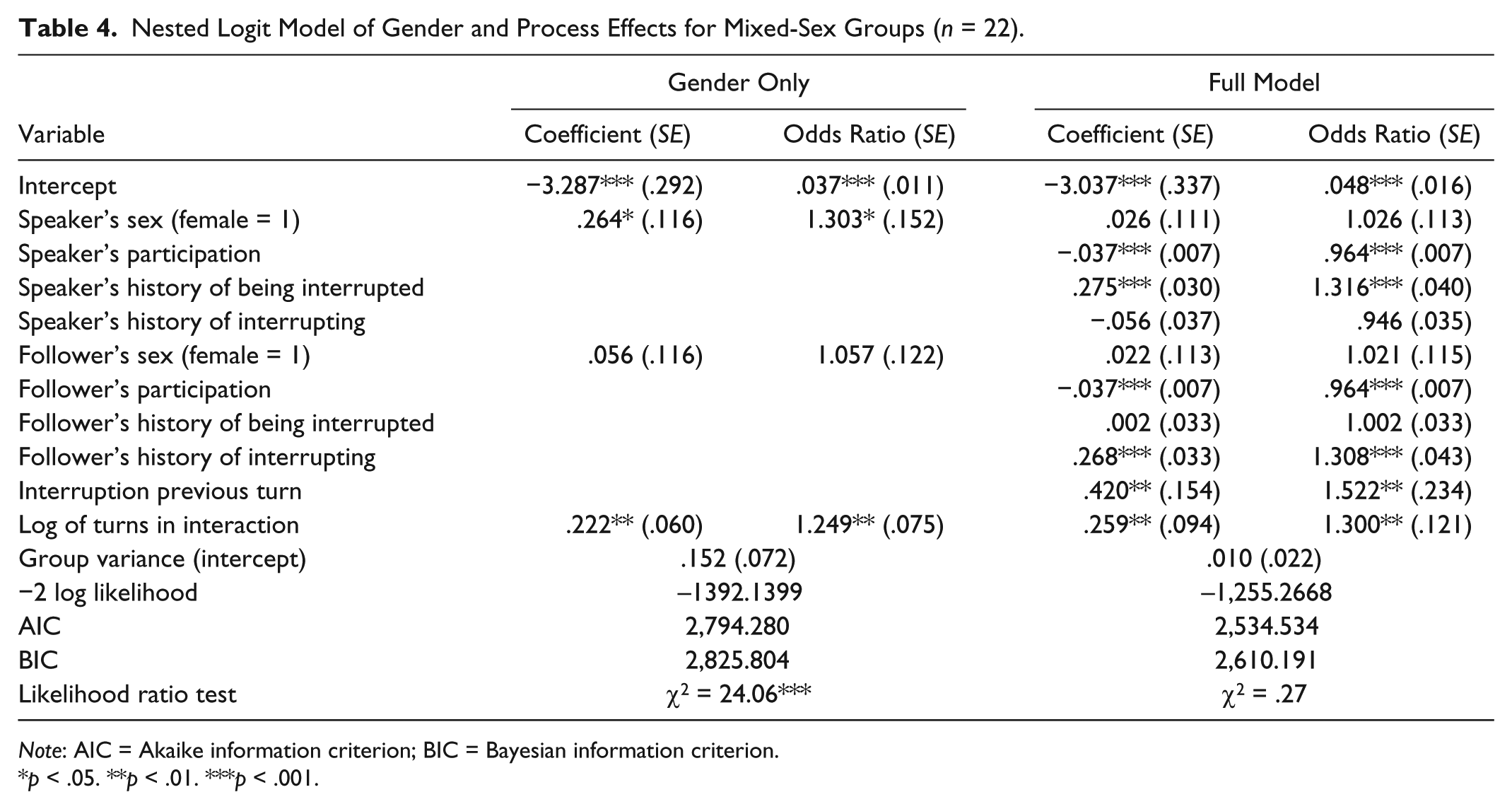
Note: AIC = Akaike information criterion; BIC = Bayesian information criterion.
p < .05. **p < .01. ***p < .001.
The third and fourth columns of Table 4 illustrate that the gender of speaker effect (women being more likely to be interrupted) falls to insignificance once the process variables we discovered in analysis 1 are included into the model. We find that the effect of speaker gender on the odds that a given turn will end in an overlap or interruption can be explained by the conversational roles that develop during the conversation: the growing sense of who is a participator, who interrupts others to gain the floor, and who is often interrupted.
The process variables themselves remain very close to those reported in analysis 1, though the impact of an interruption the previous turn is reduced to about a 52 percent increase (log odds = 0.420, p < .01). This again provides a relative scale to consider when thinking about the process variables. We see that an interruption the previous turn provides roughly the equivalent impact on the odds of an interruption as having interrupted or having been interrupted twice before throughout the entire interaction.
In addition to these models, we also examined the possibility of interaction effects between gender and the process variables. Similar to our analyses of interactions among the process variables, the interaction effects between gender and conversational roles did not improve the model as measured by the Bayesian information criterion for the two models (see Table A7 in the Appendix).
Discussion of Analysis 2
In analysis 2, we have shown that gender inequality in group discussions is mediated by conversational roles that develop in the localized settings of those discussions. This is consistent with both the doing gender and the group processes perspectives. But it makes clear the extent to which gender is something that is done within conversation. The lack of statistical interactions between the process variables and gender indicates that participation, overlaps, and interruptions operate in roughly the same ways for men and women. It is taking on these conversational roles that creates the gendered pattern, rather than something more essential about gender itself.
Both the doing gender perspective and the group processes theories assume that gender operates through conversation to create these inequalities. Our analysis illustrates this point. What we add is the concrete, cumulative picture of how this process unfolds. Our findings are perhaps somewhat more consistent with the group processes traditions (and their more structural emphasis), because the doing gender literature might have led one to expect some differences in the ways conversation acts unfolded and were viewed on the basis of the gender of the speaker. The fact that we do not find statistical interactions undermines this interpretation of the evidence.
There is still one aspect of the process we have left unexplored. Because we are now making use of the sequential nature of conversational flow (as encouraged by the conversational analysts), we can look at which aspects of sequencing affect the development of the gendered process. In analysis 3, we test the sequential mediation process using a path model to examine the pathways through which gender influences the turn to turn likelihood of an interruption occurring. Understanding the sequencing of effects can have implications for interventions to reduce inequality.
Analysis 3: How Does Gender Inequality Develop within a Group Discussion? What Comes First, the Participation Inequality or the Interruptions?
We use the same data set as for analysis 2, the 22 mixed-sex groups. We expand our analysis into a structural equation modeling–based path model with simultaneous equations for the effects of participation and overlap or interruption. We include all potential paths from gender to the conversational process variables, because both status characteristics theory and doing gender perspectives allow many such behaviors to influence final power and prestige hierarchies. Additionally, we maintain our controls on the history of the speaker who takes over a turn.
Because of the count nature of the history variables, the best models are likely either Poisson or negative binomial models for these path analyses. On the basis of the dispersion tests (Table 5), we opted to use mixed-effects negative binomial models for the mediating analyses in the simultaneous models. We control for random effects in the same way as in analysis 2, with speaker nested in follower. Additionally, we include the linear time in the negative binomial models on the basis of the shape of the process (mostly linear) and the log of time as before for the logit model capping the end of the process (to be consistent with analysis 2 and previous research). Finally, we test for mediation using normalized versions of the process variables on the basis of Muthén’s (2011) recommended procedure to examine the level of effects moving through each of the separate mediation paths discussed above. We use a log transformation of the count over

total turns within the group plus .001 (to avoid unspecified values when the count is zero). This successfully normalizes the variables with final levels of skewness less than 0.8 and kurtosis less than 2 for all variables (see Table A8 in the Appendix for these values for both the original variables and the transformation). We also account for correlated error terms in the pathways moving from the gender of the interlocutor to his or her history variables in the linear model to add additional controls to the model. Additionally, following the advice of Preacher (2015), we reduce the model’s complexity by removing the random effects and clustering the standard errors by group, because we are not focusing on any group-level factors.
Dispersion Test.

p < .001.
Results
In the path analysis, we find that the conversational processes do account for the effect of being a woman on the likelihood of being interrupted. Figure 1 presents the findings of the path model succinctly with nonsignificant paths trimmed to increase readability (full tables for the path analysis are available in Table A9 in the Appendix). The path model reveals an interesting story about how interaction proceeds. We see that, as in analyses 1 and 2, the relative risk for being interrupted or overlapped is affected by participation history and a group member’s history of being interrupted. Being a woman does not directly lead to lower participation but does lead to an increase in the history of being interrupted (coefficient = 0.338, p < .001) in the past. Additionally, there is a small increase in women’s history of interrupting (coefficient = 0.095, p < .001), though this effect disappears when correlations among the process variables are accounted for (see Table A9) in the linear-based path analysis used for the mediation tests. Women are more likely to have previously experienced interruptions, which then increases their likelihood of being interrupted at any given point thereafter, on the basis of the conversational roles we discussed in analysis 1. Thus, being interrupted is a signal that cascades through the conversation, leading to even greater risks for future interruption.

Path model with count mediators (n = 22 mixed-sex groups).
Table 6 presents the mediation analysis. We find that the previous interruption path accounts for the missing gender effect noted in previous studies with a total indirect effect of 0.167 (p < .001). Compared with men, women are more likely to have been interrupted previously during an interaction, subsequently leading to a greater likelihood that the speaker will be interrupted later during the interaction. This would then lead to a feedback effect that would exacerbate the effect further (by the roughly 30 percent increase in the odds of being interrupted noted in analysis 1).
Mediation Analysis of Gender through Process to Non-normative Transition (22 Mixed-Sex Groups) with Log Transformation and Correlations Included.

p < .001.
Discussion of Analysis
The story revealed by this analysis is a complex yet clear one. Its interpretation is most easily discerned by starting when participation and interruption histories would necessarily be zero. In such cases, women in the groups would be more likely to experience an initial interruption of one of their early participation attempts. Once an interruption occurs, the likelihood of subsequent interruptions increases considerably, thus creating a cascading effect whereby women involved in the discussions are more likely to be interrupted by their peers at any given point in the interaction. When this occurs, the disadvantage compounds further.
The patterns that we observe have a strong resemblance to the BIP concept discussed by Fişek et al. (1991), but with a few crucial differences. Recall that a BIP was a single “A defers to B” event that establishes an expectation state that then shapes future interactions until it is violated with an opposing pattern (such as “B defers to A”). Clearly, our path analysis showing that an initial interruption can create a conversational role as someone who is frequently interrupted and has fewer rights to the floor is closely related to Fişek et al.’s concept. However, Fişek et al. argued that BIPs were important only for establishing expectations for previously status-equal actors. Here, we show that they are much more general, creating the cumulative process through which even status-differentiated actors gain their interactional advantage. Our analysis also makes clear the way in which a BIP works. It is the beginning of a cumulative process, in which a single interaction begins the development of a situated conversational role, whereby one interruption leads to higher odds of future interruptions.
Discussion and Conclusions
Conversational analysts attend to conversational acts in context, concentrating on the micro-organization and sequential structures of conversations (Sacks et al. 1974; Schegloff 2000). They take seriously the fact that group structure is a collective accomplishment. In our first analysis, we examined the dynamics of speaker transitions as they are influenced by emerging conversational patterns, addressing a considerable gap in previous quantitative examinations of interruptions and overlaps in conversations. In so doing, we provide a more fine-grained, dynamic picture of the interactions that lie behind the typical distributions, counts, or averages analyzed in research on gendered task group interaction.
By making use of mixed effects logistic regression, we addressed issues regarding interdependence of actors in this type of data (see Gibson 2008). Additionally, by accounting for previous behaviors exhibited over the course of the interaction, we took the history of the group and the emergent properties of the conversational interaction order into account; making these properties and habits of actors the focus of the analysis. Finally, we addressed these issues in a relatively large collection of data, relative to earlier qualitative studies.
We do not claim that conversational analysts would find our modeling of conversational roles compelling. They clearly examine their transcripts at a very different level of evidence. Instead, we hope we have demonstrated that their insights from more detailed analysis of smaller corpuses of speech can lead to advances in our understanding of status organizing processes. Like Gibson (2003, 2008), we hope to illustrate how the inductive insights of qualitative researchers can enhance the work of formal theorists.
Social inequalities reveal themselves in everyday interactions. This insight is foundational both to researchers in the expectation states tradition in group processes and to gender researchers interested in the behavioral practices of doing gender. However, although the arguments about inequality have used evidence about distributions of interactional behaviors, the processes through which these inequalities evolve within the interactional setting have been less well explored. The question of how gender “gets in” to ongoing interaction has been a continuing question, theoretically, empirically, and methodologically.
In our analyses 2 and 3, we show that gender differences in interruptions are not simply a direct overt process of women being interrupted by men but that instead, gender influences the conversational roles actors take on in a situation. Women are placed in less advantaged and more likely interrupted conversational roles. They are not provided with as many opportunities to speak during the conversation, making them more likely to experience interruptions compared with higher participators as the conversation evolves. Subsequently, they are then likely to experience even more interruptions as they are forced into low participator, frequently interrupted roles within the interaction, resulting in a cascading effect in which they accumulate more and more disadvantage.
There has been debate about whether the meaning of non-normative turn transitions is predominately dominance (a power play by high-status speakers) or deference (a collaborative conversational structure that expresses cultural expectations about competence). The evidence we present suggests that deference mechanisms predominate, at least in the collaborative, task-oriented groups we study. However, it also extends the processual models previously put forth by expectation states researchers, showing the importance of BIPs for establishing the onset of even established status inequalities within a given group conversation.
The importance of these dynamics becomes paramount when developing mechanisms for avoiding the development of gender inequality in task groups. Our results point to two features of conversational roles that might be important for interventions. The first is the central role of early interruptions in establishing both gendered patterns and interactional inequalities among status equals. It may be that conversational strategies that either prevent early interruptions (e.g., allocating each group member a set period to talk in an initial round of comments) or call attention to the first interruptions or overlaps (e.g., “please let me finish”) might stop the cascading effect of repeated interruptions from happening. Classic work on gender (Ridgeway 1982) indicates that such forcefulness will lead to negative evaluation, unless it can be framed in terms of helping the group. But it may prevent early interruptions from leading to a permanently disadvantaged conversational role. A second mechanism is more structural and could be imposed by group organizers who wished to avoid gender inequality. Note that in Figure 1, there is no direct path from gender to participation. Instead, it is the non-normative transitions that begin the cascade into disadvantaged, disrupted conversational roles. But there are pathways from participation to later interruptions, with lower participators being more likely to both interrupt and be interrupted. So any procedure that serves to level participation should result in women’s being less likely to fall into undesirable conversational roles. Going around the table to allow everyone to voice a first opinion on the task at hand could work. Starting with a female speaker can help even more, given the cumulative nature of these processes. As an example that illustrates our point, Hinsley, Sutherland, and Johnston (2017) showed that having a woman ask the first question after an academic presentation completely eliminated the tendency for men to ask almost twice as many questions as women (relative to their audience composition) at a major science, technology, engineering, and medicine conference. Simply calling on a woman first can allow a group leader who wishes to dampen gender inequality to achieve that goal.
Clearly, we need more research on a wider variety of group contexts before we can be sure of such results. Newly developed methods have allowed us to learn much more from these classic data than previous studies. We need more large corpuses of well-documented conversational interaction that allow the estimation of such models (and the better ones sure to become available in the future). We also need to see if other statuses permeate group interaction through the same mechanisms that gender does. Given how clearly our results support the deference processes described by expectation states, we are optimistic that the process we describe is quite general. The similarity of our results to Fişek et al.’s (1991) analysis of BIPs also supports this view. Like Gibson (2008), we hope that formal group processes analysts can continue to learn from conversation analytic work to broaden their understanding of the conversational features that signal status and inequality and the sequences through which conversational patterns develop. Many of the subtleties of conversation that are highlighted in conversation analytic work—affect, body language, emphasis, and so on—could be incorporated into more formal analyses, given new technology and sufficient effort. Additionally, the present analysis does not include information that is much more readily understood by a conversation analytic examination of interaction. For example, we did not examine aspects such as the content of the talk surrounding interruptions (e.g., what the interrupted actors were saying at the time). We argue that group processes researchers and conversation analysts still have much to learn from each other.
Footnotes
Appendix
Acknowledgements
We would like to thank Miller McPherson, David R. Heise, Jody Clay-Warner, Justine Tinkler, and Lucas D. Bradley for comments on earlier drafts of the paper. The data analyzed here were collected by Charlotte G. Hudson and transcribed by Arthur L. Williams with a grant to Smith-Lovin from the Department of Sociology, University of South Carolina. John Skvoretz was a core participant in the original data collection and its transcription. We would like to thank Suzanne Ryan and Annette Lee for help in coding the data set.
Funding
The author(s) disclosed receipt of the following financial support for the research, authorship, and/or publication of this article: Preparation of this manuscript was partially supported by the Army Research Office Grant #W911NF-15-1-0180 to the second and third authors.
