




Abstract
Women face a double bind in positions of leadership; they are expected to display authority in order to appear competent but are judged as socially deficient if they are perceived to be too dominant. This dominance penalty is well documented, but most studies examine reactions only to white women’s leadership displays. The authors use an experimental design to compare evaluations of hypothetical job promotion candidates who are all characterized as extremely accomplished but who differ on their race (Asian American or white American), gender (man or woman), and behavioral style (dominant or communal). Regardless of behavioral style, participants evaluate the white woman as having the worst interpersonal style and the Asian American woman as the least fit for leadership. These findings demonstrate the importance of accounting for intersectionality in documenting the effect of cultural stereotypes on workplace inequality.
Research documents a double bind women face in positions of authority. To appear competent, women have to behave authoritatively, but when women display dominance behavior, they violate gender-stereotypical expectations of women’s communality and are often perceived as less likable. In other words, women face backlash (i.e., a dominance penalty) when they act authoritatively and face questions about their competence when they do not act authoritative enough. Research has documented this double bind in a number of settings, but these studies have by and large focused on white women (Brescoll and Uhlmann 2008; Rudman 1998; Rudman et al. 2012; Williams and Tiedens 2016).
Recent research challenges the universality of the dominance penalty and suggests that race and gender intersect to differentially shape reactions to authoritative behavior. In particular, research that takes an intersectional account has highlighted distinct reactions to dominance behavior exhibited by black Americans compared with white Americans (Livingston and Pearce 2009; Livingston, Rosette, and Washington 2012; Pedulla 2014). For example, Livingston et al. (2012) showed that black women who demonstrate high levels of competence face less backlash when they behave authoritatively than do comparable white women or black men. One explanation for this is that nonwhite women receive more lenience for their dominance behavior because people with multiple subordinate identities experience social invisibility (Purdie-Vaughns and Eibach 2008). Thus, nonwhite women’s behavior is generally less seen, heard, or recalled (Sesko and Biernat 2010). Another (not necessarily competing) explanation emphasizes differences in the content of prescriptive stereotypes for black and white women. The argument is that race and gender intersect to create unique stereotypic expectations of black women that are more in keeping with strong leadership styles (Binion 1990; Reynolds-Dobbs, Thomas, and Harrison 2008). In this conceptualization, because stereotypes hold black Americans to be more aggressive (Sniderman and Piazza 1993:45), black women’s authoritative behavior is read as stereotype consistent, whereas white women’s is read as stereotype violating and thus more likely to elicit backlash.
In this study, we investigate these mechanisms of intersectional invisibility and differences in stereotype content by examining reactions to Asian American and white women’s dominance behavior. 1 Asian American women offer an intriguing case for theory and research on the dominance penalty because, similar to black women, they also possess dual subordinate identities on race and gender. However, Asian American women are subjected to prescriptive stereotypes of high deference and femininity that is incongruent with expectations regarding leadership.
Drawing on Ridgeway and Kricheli-Katz’s (2013) theoretical account of how race and gender intersect in social relational contexts, we predict that when competence has been unambiguously established, Asian American women will face less backlash than white women for their dominance behavior. However, we also expect that highly competent Asian American women will be evaluated as the least suitable for leadership. We test these predictions using an experimental design in which we compare reactions to dominance behavior exhibited by white and Asian American men and women.
An Intersectional Account
Widely held cultural beliefs about social groups are hegemonic in that they are reflected in social institutions, and tend to be shaped by dominant groups (Sewell 1992). Because white people represent the dominant racial standard by which others are contrasted (cf. Fiske et al. 2002), the prototypical man and woman, that is, whom most Americans imagine when they think about (stereotypical) differences between men and women, are white. Moreover, because gender is indicated by the degree of femininity one embodies relative to a masculine standard (Connell 1995), the prototypical person is a man. Prototypicality affects how much stereotypes shape evaluations of members of social groups (Maddox and Gray 2002; Wilkins, Chan, and Kaiser 2011). Cognitive social psychologists have shown that the extent to which an individual appears prototypical of his or her group affects perceivers’ basic categorization and memory processes (Macrae and Quadflieg 2010). For example, prototypical members are more likely to be recognized and categorized as group members, and their contributions are more likely to be recalled than nonprototypical members of social groups (Zárate and Smith 1990). As a consequence, those who most closely embody the prototypical American man and women (i.e., white men and women) are the most strongly associated with gender stereotypes and, ironically, are expected to behave in more gender stereotypic ways (Ridgeway and Kricheli-Katz 2013).
Because gender relations are hierarchical, displaying appropriate femininity means conforming to norms that prescribe lower status and deferential behavioral interchange patterns (Berger et al. 1977; Ridgeway 2011). Violating these behavioral norms leads to the dominance penalty that research has documented for white women (Rudman et al. 2012). Likewise, because race relations are also hierarchical and black men are seen as prototypical of their race, research has shown that black men face a dominance penalty and have been shown to be more accepted as managers and leaders when they possess less traditionally masculine attributes, such as being gay (Pedulla 2014) or baby-faced (Livingston and Pearce 2009). But nonwhite women occupy dually subordinate race and gender identities. As Ridgeway and Kricheli-Katz (2013) put it, they are “doubly off-diagonal.” Therefore, their dominance behavior may not be perceived as norm-violating in the same way as it is for white women and black men.
In addition to being less easily categorized and less strongly associated with the race and gender stereotypes of their social groups, researchers have documented an “intersectional invisibility” that accompanies being nonprototypical (Ghavami and Pelau 2013; Purdie-Vaughns and Eibach 2008; Ridgeway and Kricheli-Katz 2013; Sesko and Biernat 2010). Feminist theories of intersectionality have long emphasized that rather than race and gender disadvantages being additive, identities intersect in complex ways and lead to distinct forms of discrimination for women of color (Collins 2000). Qualitative research has documented the various ways in which black women experience being discounted, marginalized, and treated as if their experiences and opinions matter less (St. Jean and Feagin 2015). Although they are not literally invisible, cognition research shows that perceivers are less able to differentiate black women’s faces and less accurate at recalling and attributing their contributions to group discussions (Sesko and Biernat 2010).
In this study, we focus on the effects of intersectional “invisibility” in workplace contexts in which women of color are evaluated for job promotion. We argue that even in contexts when the candidate is seen or cannot be ignored (e.g., when the candidate is the only person applying for a promotion or when giving a presentation), being dually subordinate and nonprototypical on race and gender can mean that the content and quality of his or her contributions are less likely to be remembered. This relative invisibility presents freedoms and binds for women of color. One ironic freedom is that acting dominant, a behavior that violates gender stereotypes and often triggers backlash reactions against white women, less often rises to the level of being noticed and punished. It is less likely to get coded as a gender norm violation (Ridgeway and Kricheli-Katz 2013). This is in part because the success of women of color is less threatening to existing status hierarchies. Social dominance theorists have long argued that discrimination is greater against out-group men than women because men pose a larger threat to the existing status hierarchy (Sidanius and Pratto 1999). Rudman et al. (2012) showed that backlash is not simply a negative reaction to counter-stereotypical behavior but is a negative reaction to behavior challenging prescriptive stereotypes that function to maintain men’s relative advantages. Thus, even when nonwhite women’s dominance behavior is visible, it may not elicit a backlash reaction because it does less to threaten the status hierarchy.
Although this relative invisibility may reduce backlash reactions, it is a double-edged sword. Precisely because intersectional invisibility increases the likelihood that evaluators will not recall the details of one’s contributions and behavior, stereotypes are more likely to become a cognitive shortcut for assessing performance (Wigboldus et al. 2004; for a review, see Fiske 1998). In other words, group stereotypes (e.g., stereotypes of black Americans as less competent and Asian Americans as less agentic) are more likely to influence performance evaluations when the details of a person’s actual behavior are less easily recalled.
Experimental studies focused on evaluations of black female leaders provide evidence that the advantages and disadvantages of intersectional invisibility are related to subgroup stereotypes. For example, because stereotypes hold black Americans to be less competent than white Americans and hold women to be less competent than men, black women are punished more harshly for poor performance than their white and male counterparts (Rosette and Livingston 2012; Settles 2006). However, when black women’s competence has been firmly established (e.g., with an elite graduate degree), they face less backlash for authoritative behavior and are evaluated as better leaders than white women (Livingston et al. 2012; Purdie-Vaughns and Eibach 2008). Stereotypes of black Americans as strong, aggressive, and masculine overlap with expectations for prototypical leaders. As such, highly competent black women leaders’ relative invisibility may protect against backlash, while stereotypes about their more assertive interpersonal style might make them seem like a better fit for leadership. If this is the case, it has implications for groups, such as Asian Americans, who are stereotyped as highly deferential and feminine.
The Case of Asian Americans
Asian American women also have dual subordinate race and gender identities. However, whereas research has shown that white, black, Latino, Middle Eastern, and South Asian men are perceived as the prototypical members of their respective racial groups, East Asian women are as likely as East Asian men to be associated with the prototypical “Asian” category (Ghavami and Peplau 2013; Phills et al. 2018; Schug, Alt, and Klauer 2015). Asian American women may differ from other racial minority women in this way, but there is still evidence that they face intersectional invisibility (Ghavami and Peplau 2013). This is because the content of group stereotypes combines in distinct ways with the experience of being nonprototypical on gender. Asian Americans are stereotyped as more feminine and deferential than other racial groups, traits that are negatively associated with leadership (Chen 1999; Garg et al. 2018; Ho and Jackson 2001; Lin et al. 2005). Thus, it is the feminizing stereotypes about Asian men that lead to less gender differentiation in the stereotypes of Asian Americans. Whereas black women’s experience of invisibility may be due in part to their nonprototypicality on gender and race (as well as stereotypes that hold black Americans to be less competent), Asian American women’s invisibility is not because they do not fit with the category “Asian” but because they are nonprototypical on gender and the category “Asian” is one in which stereotypes overlap with being relatively invisible (e.g., deferential, agreeable, and foreign). The unusual predicament for Asian Americans is that both men and women suffer from a relative invisibility that comes from being perceived as feminine and nonaggressive.
Hypotheses
For this study, we limit the scope of our hypotheses to professional contexts in which a high level of competence has already been established with an advanced degree and a strong, unambiguous record of success in the field. In addition, we focus on a workplace setting, promotion to full professor in an academic department, in which Asian and white professors are known to be well represented. Although the scope conditions limit generalizability, it is an important first step to test our hypotheses in a setting in which we control for competence and other aspects of job fit.
Dominance Penalty
When the context is one in which Asian women are visible (e.g., when an Asian woman is the only person being evaluated for a promotion), intersectional invisibility can still affect how their dominance behavior is perceived. In particular, Asian women’s dominance behavior may not be read as domineering in part because it does not trigger threats to the status order. Thus, we expect that Asian American women’s relative invisibility may mean they face less backlash for authoritative behavior than comparable white women.
An alternative possibility is that because Asian American women who display dominance are violating stereotypes about Asian and women’s deference behavior, they could face more backlash than other women. Asian American women often encounter pressure to comply with caricatured notions of Asian femininity (Pyke and Johnson 2003) and report experiencing backlash and racial harassment for displaying dominance (Berdahl and Min 2012; Williams, Phillips, and Hall 2015). Although there are contexts in which Asian American women may face more backlash than white women (e.g., the “tiger mom” and “dragon lady” stereotypes imply that when gender is highly salient as with motherhood/sexuality, Asian American women face unique dominance penalties), we do not expect to find it in the professional workplace setting in which we test our hypotheses. A recent meta-analysis showed that women only face backlash for acting authoritative when their behavior is explicitly encoded as counter-stereotypical (Williams and Tiedens 2016). To the extent that women of color’s behavior is generally less noticed and recalled, we expect that even when Asian American women act in counter-stereotypical ways at work, observers are less likely to perceive the behaviors as such. We are not arguing that women of color never face a dominance penalty but that their relative invisibility and lesser threat to the gender status hierarchy allow them to get away with behaving authoritatively more than white women, who trigger backlash more automatically.
Thus, we hypothesize that Asian American women will pay less of a penalty (i.e., be characterized as less socially deficient) for dominance behavior than white women. Previous research further suggests that white women will pay more of a penalty for dominance behavior compared with white men.
Leadership Ability
We expect Asian American women to avoid backlash relative to white women but to nonetheless seem less fit for leadership. To the extent that women of color’s behavior is less often noticed and remembered, racial group stereotypes may be more cognitively accessible than the particular details of their actual behavior. For Asian American women, because stereotypes of Asians as less aggressive and more feminine conflict with traits associated with leadership, we expect that Asian American women will be evaluated as the least suitable for leadership roles compared with white and Asian men and white women. Although Asian men and women are stereotyped as more feminine, Asian men in academia are more prototypical of the category professor and the category Asian professor. In addition, Asian men are still perceived as more masculine than Asian American women. Thus, we expect Asian American women to be disadvantaged relative to all groups on leadership ability.
Method
Experimental research is useful for testing theories and establishing causality because the researcher can isolate and manipulate the effects of the independent variables on the dependent variables, while controlling for confounding factors. Although other modes of investigation are important for generalizing findings outside of the laboratory, we conducted a social psychological experiment as a first step toward testing our hypotheses. The experiment placed participants in the position of evaluating a candidate for a full professor position in an academic institution. The study had a 2 × 2 × 2 between-subject design; participants were randomly assigned to one of eight possible conditions in which we experimentally manipulated the candidate’s sex (male vs. female), race (white American vs. Asian American), and behavioral style (dominant vs. communal).
Participants
As in most social psychology lab experiments, we use a sample of undergraduate students to test our hypotheses because we believe that they are similar to the general population in ways most relevant to the goals of this study (Lovaglia et al. 1998). Although American college students are sometimes different from other groups in their feelings, goals, and behavior, they are central to mainstream cultural consumption and production and have been shown to be apt cultural informants (Romney, Weller, and Batchelder 1986). Because we seek to identify general social processes that arise as a consequence of being exposed to dominant cultural beliefs in American culture, our hypotheses require a sample of participants that understand and recognize broad cultural stereotypes about race and gender. Because college students have been shown to be ideal participants for studies aimed at identifying unbiased estimates of meanings in the larger culture (Wisecup 2011), they are a useful population for a first test of our theoretical model.
In exchange for fulfillment of an introductory psychology course requirement, 276 undergraduates at a public university participated in the experiment. We excluded 9 participants from the analysis because of experimenter error, and we discarded data from another 16 (5.7 percent) participants who failed manipulation checks. 2 Of the 251 participants in the final population, 143 (57 percent) were female, 209 (75 percent) were white American, 24 (9 percent) were black American, 20 (7 percent) were Asian American, 10 (4 percent) were Hispanic, and 13 (5 percent) reported other ethnicities.
Procedure
With some modifications on the basis of pretesting for the case of race, we adopted Rudman et al.’s (2012) hiring paradigm and procedures from previous dominance penalty research. Participants were told that researchers were interested in their responses to a candidate being evaluated for promotion. Upon arrival, the participant was shown to a private cubicle and given a letter of recommendation for the candidate being evaluated (see Appendix A). The letter was written on the stationary of an elite and easily recognized university and addressed to the dean of the Faculty of Arts and Sciences. All letters stated that the candidate had a PhD from the University of North Carolina at Chapel Hill, numerous accomplishments (e.g., more than 40 publications, five well-received books, and winner of the MacArthur Genius Award), and was eligible for promotion to professor of comparative literature at the University of Virginia. 3 All candidates were also described as American (e.g., born and raised in Virginia) so that participants did not base evaluations on presumptions about nationality or immigrant status. After the participant finished reading the letter, the participant entered evaluations of the candidate on a computer. 4 Participants then answered manipulation check questions, ratings of the candidate, and demographic questions. Participants were then debriefed and assigned course credit.
Sex and Race Manipulations
The sex and race categories of applicants were manipulated by using names commonly associated with men and women and with white and Asian Americans in the United States on the recommendation letters. The first names used were Edward and Emily for the male and female candidate, respectively, with Mullen as the last name for a white American candidate and Yang for an Asian American candidate. We added a gender-neutral middle name, Wei-lin, for both the male and female Asian American names. 5
Behavioral Style Manipulation
Following earlier work (Rudman et al. 2012), behavioral style was manipulated by describing the candidate’s style as a literary critic. In the “dominant” condition, the recommendation letter described the candidate as “brutally honest . . . in order to maintain the high standards of the field.” In the “communal” condition, the letter described the candidate as “overly polite . . . in order to protect authors’ fragile egos.” Because our hypotheses are limited in scope to contexts in which performance information unambiguously indicates high competence, the letter in all conditions concluded that the candidate was a genius, highly deserving of promotion.
Dependent Measures
Dominance Penalty
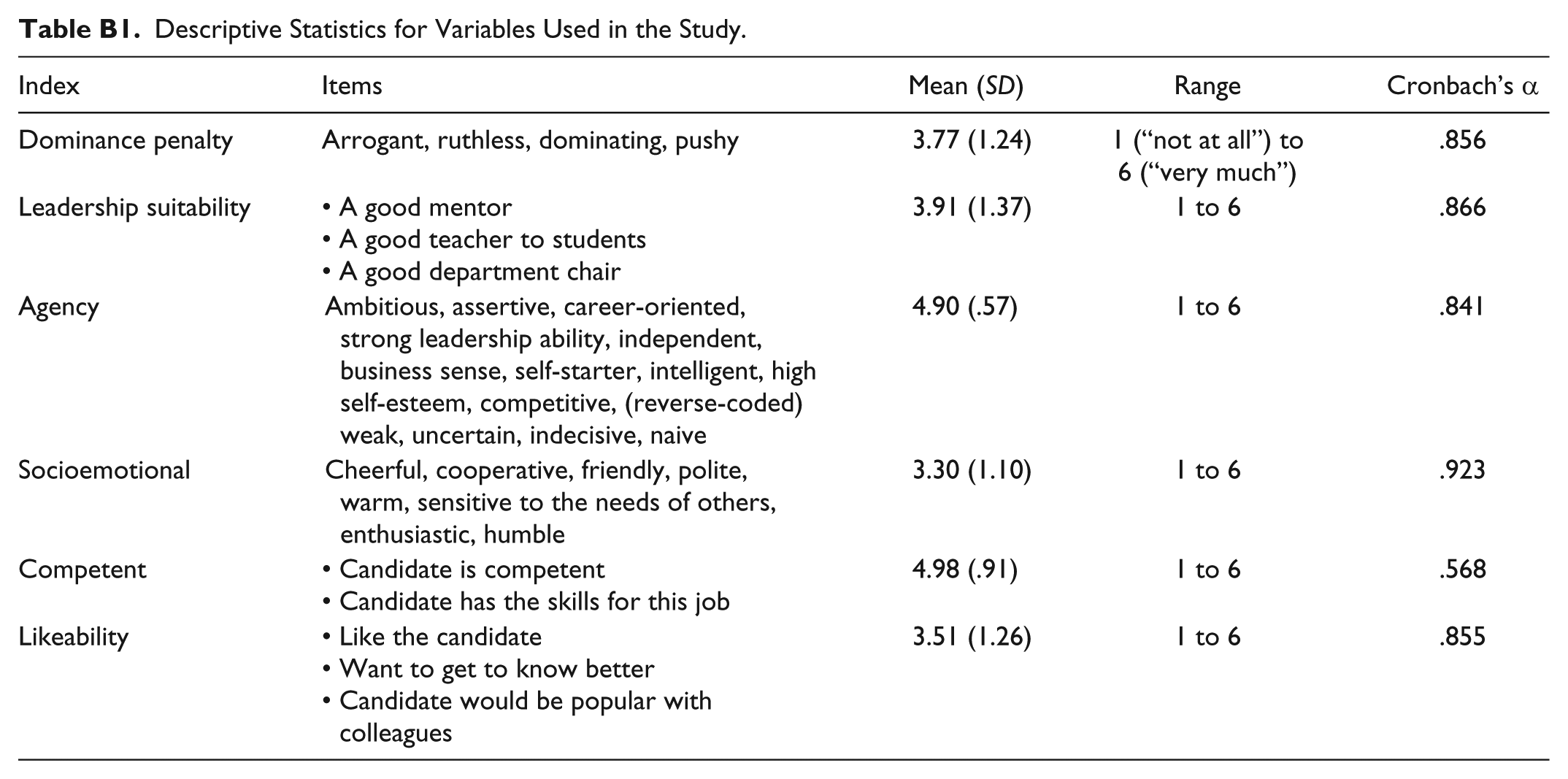
To test our hypotheses about race and gender differences in dominance penalties, we created a four-item index of negative traits associated with dominance behavior measured on a six-point scale (1 = “not at all,” 6 = “very much”): arrogant, dominating, pushy, and ruthless (α = .85). Higher numbers indicate a larger dominance penalty.
Leadership Suitability
We measured the perceived suitability of the job candidate for leadership with an index composed of three questions. Participants were asked on a scale ranging from 1 (“not at all”) to 6 (“very much”) whether the candidate struck them as a “good teacher,” “good mentor,” and “good department chair” (α = .87). Although the teacher role is unique to the university setting, both mentor and department chair represent leadership positions that could be well represented in most organizations. Exploratory analyses showed that results are the same when the scale includes or excludes the “good teacher” item. We also note here that being a good mentor and teacher requires “soft” forms of leadership ability that are less strongly associated with masculine traits (e.g., a good teacher or mentor is expected to be assertive but not necessarily aggressive). Thus, because good teachers and mentors should embody warmth and “softer” forms of leadership compared with, for example, the CEO of a for-profit company, the variable allows a conservative test of bias against women and Asian Americans in evaluations of leadership suitability.
Additional Measures
Additional Evaluations of the Candidate
To control for additional dimensions that are important for evaluating one’s leadership potential, participants rated the candidate on a variety of items. The program randomly presented each of the items to avoid potential effects of question ordering.
Our theory is that Asian American women will be rated lower on leadership ability partly because they face stereotypes that associate Asian Americans with a less agentic behavioral style. To assess the stereotype content part of our hypothesis, we asked participants to evaluate how agentic they perceived the candidate on a scale ranging from 0 (“not at all”) to 6 (“very much”). We averaged ratings from 14 items to form the agentic scale (e.g., ambitious, assertive; α = .84). If this part of our hypothesis is correct, then perceptions of the candidate’s agency will mediate Asian American women’s disadvantage.
To evaluate additional possible causes for Asian American women’s disadvantage on leadership ability, we asked participants to evaluate the candidates’ competence, interpersonal likability, and socioemotional style on a scale ranging from 0 (“not at all”) to 6 (“very much”). We averaged ratings on two items (“candidate strikes you as competent” and “candidate has the necessary skills for this job”) to form a competence index (α = .57), three items (“you like the applicant,” “you want to get to know the candidate better,” and “the applicant would be popular with colleagues”) to create the likability index (α = .86), and eight items (e.g., cheerful, cooperative) to form the socioemotional index (α = .92). See Appendix B for indexes and Appendix C for all variable means by condition.
Demographic Measures
Finally, participants reported their age, gender (1 = male, 2 = female), race (1 = white, 2 = Asian, 3 = black, 4 = others), and years in school.
Analytic Strategy
Although there is some cognitive support for intersectional invisibility measured as a dependent variable (Sesko and Biernat 2010), it is inherently difficult to measure an absence as a cause for something else (i.e., as an independent variable). Despite the wide appeal of the concept in the theoretical literature, no one has really solved this problem. Although our study is not able to directly measure invisibility, if we find that Asian American woman face less rather than more backlash than white women for their dominance behavior, that will be evidence that their counter-stereotypical behavior (which is typically met with a penalty when it is coded as stereotype violating) is less visible or threatening. Moreover, after evaluating our hypothesis that Asian American women will be perceived as the least suited for leadership, we will attempt to show other plausible causes do not eliminate Asian American women’s disadvantage in ratings of leadership ability. Of course, this will not constitute evidence for invisibility as a cause but at least will allow us to assess these other plausible causes. Below, we report on the effectiveness of our experimental manipulations before turning to the results of our hypotheses tests.
Results
Effectiveness of Our Experimental Design
To check the effectiveness of our behavioral style manipulation, we compared the measures of perceived agency and socioemotionality across conditions. Participants in the “dominant” condition rated the candidate as significantly more agentic (mean difference = .28, p < .001) and less socioemotional (mean difference = 1.50, p < .001) than participants in the “communal” condition. Thus, our manipulations were successfully perceived and recalled by participants. In addition, we intentionally limited the scope of our hypotheses to job candidates who would be perceived as similarly and highly competent regardless of their race and gender. We checked and found no differences in the perceived competence of the job candidates across race and gender conditions (p values > .10).
Dominance Penalty
Table 1 reports means on the dominance penalty variable across conditions. Mean differences show that all candidates were evaluated more negatively in the conditions in which their behavioral style was characterized as dominant (p values < .01). Although leadership is often stereotypically associated with having an assertive or forceful disposition, this finding is consistent with prior studies showing that leaders who display strong dominance behavior are evaluated as less likable than those who do not (Hall, Galinsky, and Phillips 2015). In both behavioral style conditions, the white woman appears to receive a greater dominance penalty than her Asian and male counterparts. In support of hypothesis 1, the Asian American woman is penalized significantly less than the white woman in the dominance condition, F(1, 130) = 7.91, p < .01. It is also worth noting that in the dominance condition, the Asian American woman is penalized the least for her dominance behavior (mean for Asian women = 4.25, aggregated mean for other groups = 4.73, p < .01). In sum, mean differences across conditions are consistent with hypothesis 1. We further examined hypothesis 1 in multivariate analyses described below.
Dominance Penalty Means (Standard Deviations) across Conditions.
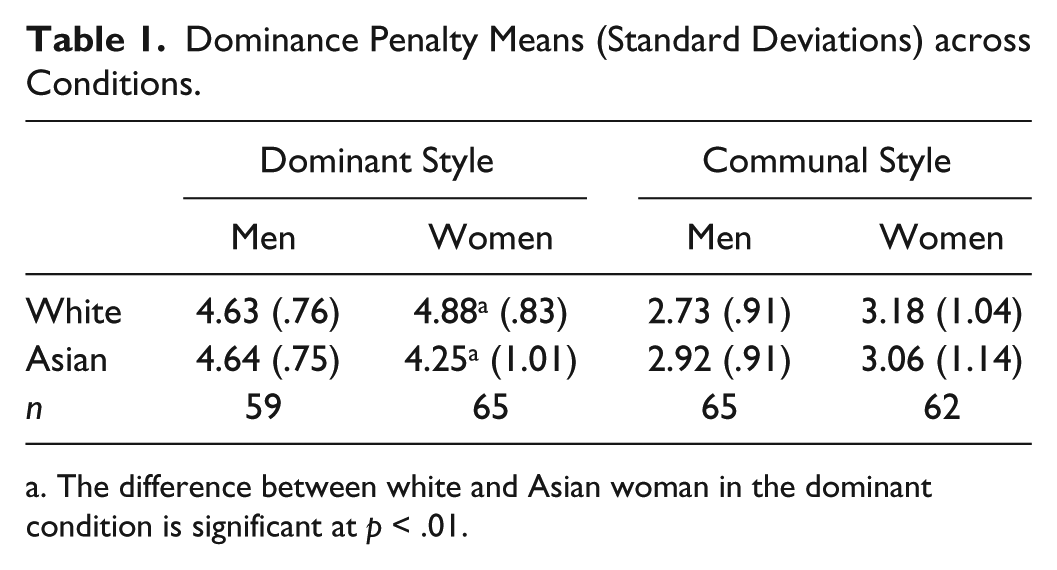
The difference between white and Asian woman in the dominant condition is significant at p < .01.
In an analysis not presented here (tables available on request), we tested our first hypothesis using ordinary least squares (OLS) multiple regression in which we regressed the dominance penalty scale on variables for the candidate’s race, gender, behavioral style, and all two- and three-way interactions between variables. Contrary to our hypothesis, we did not find a significant three-way interaction, but did find a significant race × gender interaction. Because interactions between experimental factors can be difficult to interpret, we follow Brambor, Clark, and Golder (2006) and plot the dominance penalty across the race and gender conditions in Figure 1. Figure 1 presents the estimated marginal means on the basis of an OLS regression that includes indicators for the candidate’s race, candidate’s gender, and the interaction between the two, while controlling for candidate’s behavioral style and participant’s race and gender. OLS estimates from the full analyses can be found in Table D1 in Appendix D. In support of hypothesis 1, Figure 1 shows that the white woman receives a significantly greater dominance penalty than the Asian American woman, white man, and Asian man (p values < .05). In other words, regardless of whether the candidate’s behavioral style is dominant or communal, participants perceive a highly competent white woman as more “pushy” and “ruthless” than her Asian and male counterparts. These results also do not differ by race and gender of the subject.
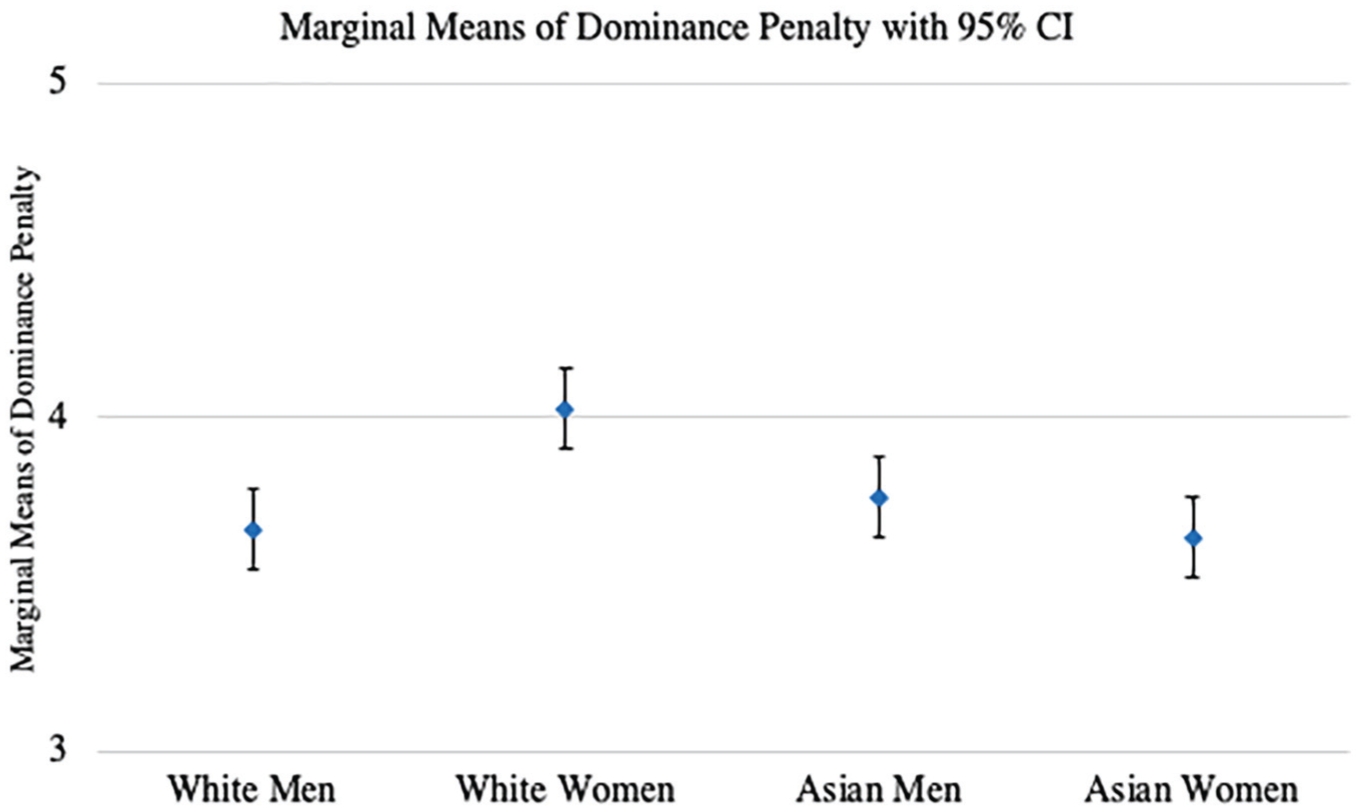
Marginal Means of Dominance Penalty across Race and Gender.
Leadership Suitability
We now turn to our second hypothesis that the Asian American woman would be evaluated as the least fit for leadership. Table 2 reports means of the leadership suitability variable across conditions. The means show that participants evaluated all candidates as better leaders in the communal than in the dominant condition (p values < .01). Means also show that white and Asian American women are rated lower than men on leadership ability in the dominant condition and that Asian American women are rated lower than their white and male counterparts across both dominant and communal conditions. Compared with the other candidates, the Asian American woman is rated particularly low in leadership ability in the communal condition (p values < .05), where her behavioral style most closely conforms to stereotypic expectations of Asian American women as deferential and polite. The means are consistent with our expectation that despite the dominance penalty white women face, the Asian American woman would actually be evaluated as the least fit for leadership.
Leadership Ability Means (Standard Deviations) across Conditions.

As in the dominance penalty analyses described earlier, we began testing this hypothesis by estimating OLS regression models in which we regressed leadership suitability on variables for the candidate’s race, gender, behavioral style, and all two- and three-way interactions between variables. Again, we did not find a significant three-way interaction among race, gender, and behavioral style, but we did find a significant race × gender interaction. Thus, model 1 in Table 3 reports OLS estimates in which we control for behavioral style but do not include the three-way race × gender × behavioral style interaction. To most easily illustrate the test of our hypothesis, Asian American woman is the omitted category, so that all significant coefficients can be interpreted as significantly different than the Asian American woman. In the first model, we include candidate gender, candidate race, and the interaction between the two while controlling for behavioral style and the participant’s race and gender. The results confirm what the mean differences in Table 2 show: the Asian American woman is evaluated as the least fit for leadership, and this disadvantage is not conditional on her behavioral style (p values < .05, one tailed 6 ).
Ordinary Least Squares Estimates (Standard Errors) of Leadership Ability Ratings (n = 251).

For participants’ race, the omitted category combines nonwhites and non-Asians.
p < .10, *p < .05, and **p < .01 (two tailed).
We argue that even when Asian American women are visible (in this case, because participants only evaluated one candidate for promotion), the details of their actual behavior are less memorable because of their dually subordinate status and nonprototypicality. This is a difficult mechanism to evaluate empirically. One way to indirectly assess the role of intersectional invisibility is to rule out other explanations for why Asian American women would be evaluated as less fit for leadership. In the second model in Table 3, we first add the dominance penalty variable from the earlier analysis. Looking across models 1 and 2, we find that with the addition of the dominance penalty variable, the magnitude of the Asian American woman’s disadvantage actually becomes larger, χ2(1) = 4.6, p = .03. 7 This change across models is consistent with our argument that Asian American women are more protected from the dominance penalty white women face. In other words, the Asian American woman faces less of a dominance penalty, so that the level of bias against her leadership abilities is suppressed until the dominance penalty variable is added to the model.
In model 3, we add the index measuring how agentic participants rated the candidate. The addition of this variable allows us to evaluate our argument that stereotypes about Asians act as cognitive shortcuts when one’s behavior is less noticed or recalled. In other words, we examine whether the Asian American woman’s disadvantage is partly mediated by stereotypes that associate Asian women with a deferential and less agentic behavioral style. Mediation analyses (Hicks and Tingley 2011) show that participants’ ratings on agency explained 14 percent of the effect of race on the leadership evaluation and the coefficients of Asian reduced from .62 to .54 upon controlling agency ratings (p values < .01). In other words, stereotypes of Asians as deferential play a part but do not fully explain the bias against Asian American women.
Finally, in model 4, we add additional worker characteristics that could further potentially mediate the disadvantage Asian American women face in ratings of leadership ability. In particular, we include the participants’ ratings of the candidates’ competence, likability, and socioemotionality. The R2 for the full model is .74. Results show that all of the characteristics are statistically significant and, together, partially but do not fully mediate lower ratings of the Asian American woman’s leadership suitability. The fact that we can find no worker characteristic variable that fully mediates the Asian American woman’s disadvantage suggests that it is something unmeasured that marks her as less fit for leadership. Although we cannot rule out the possibility that it is another unmeasured factor that underlies the bias against Asian American women, alternative explanations that would be based on disadvantaging stereotypes of Asian women are accounted for (e.g., that Asians are less agentic, less warm, and less likable or that women are less competent). Taken together, our results are consistent with experimental and qualitative research showing that women of color face the unique experience of having their contributions discounted, ignored, and/or forgotten. This “relative invisibility” is a contextual backdrop for status and stereotype processes to affect evaluations of Asian women’s leadership. An ironic benefit is that Asian women appear to face less of a dominance penalty compared with white women. Unfortunately, this also disadvantages Asian women in evaluations of their leadership potential.
Discussion
This study has important theoretical implications. First, our findings suggest that although the competence implications of gender and race may combine as status characteristics theory suggests (Berger et al. 1977), an intersectional account is necessary to explain how race and gender shape reactions to dominance behavior. Our study is consistent with more recent research in showing that when high competence has been unambiguously demonstrated, white women face a greater dominance penalty than women of color. However, this “freedom” for women of color may not provide much benefit to the extent that it reflects their relative invisibility in sociorelational contexts. This suggests the need for further theoretical specification about the outcomes of intersectional status processes.
Second, by expanding the scope of recent intersectional inquiries to include reactions to Asians and Asian Americans, our study has implications for how the content of various racial stereotypes differentially shapes disadvantages. Although women of color may struggle more than white women to be heard and seen in the workplace, stereotypes that associate Asian Americans with subservience and black Americans with lower competence have different implications for how visibility and invisibility affects performance evaluations. For example, research shows that black women who lead successful organizations are evaluated comparably with their white and/or male counterparts, while black female leaders of failing organizations are evaluated more harshly (Rosette and Livingston 2012). In contrast to black women, whose visibility is heightened by a competence-related error that aligns succinctly with stereotypes about their race (and gender), Asian women’s invisibility appears to be exacerbated by stereotypes about their subservience (hence unsuitable as leaders), even though they are stereotyped and perceived as competent.
Our results also have practical implications. We find that the white woman receives a dominance penalty and the Asian woman is perceived as less fit for leadership regardless of behavioral style. The fact that behavioral style does not attenuate gender bias in this study suggests that when competence is firmly established, white women may not avoid backlash by being nicer and Asian women may not avoid questions about their leadership by being more assertive. Future research should investigate whether there are conditions in which behavioral style might reduce the impact of negative stereotypes.
We also find that Asian men do not experience bias in this context. This is good news, but it is important that future research examine whether our findings would hold in other workplace contexts. Asian men are well represented in the technical workforce of Silicon Valley but underrepresented at executive levels (Gee, Peck, and Wong 2015). Because Asian men are stereotyped as more feminine and deferential than other men, workplaces that privilege aggressive leadership styles (e.g., law firms, Fortune 500 companies, technology startups) may be sites for bias against Asian men.
Limitations of this study suggest the need for future research. First, although our results are consistent with the theory that women of color’s behavior is less noticed or memorable as a consequence of being nonprototypical and marginal on race and gender, our design does not allow a direct test of this. The strongest evidence that it is not simply stereotypes about Asian Americans that explain our findings is the fact that Asian American women face less backlash than white women. Because Asian American women are prescribed by stereotypes to be even more deferential than white women, we would expect to find that when they violate that stereotype, they face as much or more of a dominance penalty than white women. This finding, combined with the fact that no stereotype commonly associated with Asians or women fully mediates Asian American women’s disadvantage on leadership suitability, lends support to theory and research on intersectional invisibility. However, a much stronger test of the relationship between stereotype content and intersectional invisibility would involve comparing evaluations of black women leaders with Asian American and white women. Future research should undertake such a study.
In addition, our study leaves much unspecified about the concept of intersectional invisibility. For example, “intersectional invisibility” can mean women of color find it more difficult to be seen and their contributions recalled in sociorelational interaction, but it can also be applied to contexts in which women of color do not seem to matter as much or do not seem to be treated as if they are playing the same game. Both experiences of invisibility are likely related to being nonprototypical and posing less of a threat to existing race and gender status hierarchies. The research literature suggests that both mechanisms shape biases against women of color, but teasing them out remains a necessary area for future theorizing and empirical research.
Finally, we limited the scope to a work environment in which competence is firmly established. Thus, we do not know whether we would find the same thing in nonacademic settings or with job candidates whose performance is less stellar. Future research would do well to further test the theory in an interactive setting and expand the scope conditions to other workplace contexts.
Footnotes
Appendix A: Letter of Recommendation
Appendix B
Descriptive Statistics for Variables Used in the Study.
| Index | Items | Mean (SD) | Range | Cronbach’s α |
|---|---|---|---|---|
| Dominance penalty | Arrogant, ruthless, dominating, pushy | 3.77 (1.24) | 1 (“not at all”) to 6 (“very much”) | .856 |
| Leadership suitability | • A good mentor • A good teacher to students • A good department chair |
3.91 (1.37) | 1 to 6 | .866 |
| Agency | Ambitious, assertive, career-oriented, strong leadership ability, independent, business sense, self-starter, intelligent, high self-esteem, competitive, (reverse-coded) weak, uncertain, indecisive, naive | 4.90 (.57) | 1 to 6 | .841 |
| Socioemotional | Cheerful, cooperative, friendly, polite, warm, sensitive to the needs of others, enthusiastic, humble | 3.30 (1.10) | 1 to 6 | .923 |
| Competent | • Candidate is competent • Candidate has the skills for this job |
4.98 (.91) | 1 to 6 | .568 |
| Likeability | • Like the candidate • Want to get to know better • Candidate would be popular with colleagues |
3.51 (1.26) | 1 to 6 | .855 |
Appendix C
Mean Ratings of Study Variables by Conditions.

| Dominant | Communal | |||||||
|---|---|---|---|---|---|---|---|---|
| White | Asian | White | Asian | |||||
| Male | Female | Male | Female | Male | Female | Male | Female | |
| Dependent variables | ||||||||
| Dominance penalty | 4.68 (.79) | 4.83 (.84) | 4.63 (.74) | 4.24 (1.08) | 2.75 (.90) | 3.20 (1.03) | 2.87 (.91) | 3.33 (1.25) |
| Leadership Suitability | 3.26 (1.22) | 3.19 (1.33) | 3.55 (1.43) | 3.11 (1.27) | 4.68 (1.18) | 4.73 (1.14) | 4.66 (.87) | 3.90 (1.33) |
| Independent variables | ||||||||
| Agentic | 5.06 (.53) | 5.06 (.50) | 5.00 (.50) | 4.96 (.52) | 4.67 (.48) | 4.80 (.51) | 4.75 (.53) | 4.70 (.60) |
| Socioemotional | 2.45 (.61) | 2.58 (.74) | 2.60 (.59) | 2.54 (.82) | 4.26 (.88) | 3.95 (.99) | 4.05 (.82) | 3.63 (1.08) |
| Likability | 2.91 (1.17) | 2.79 (1.17) | 3.17 (1.06) | 2.68 (1.29) | 4.28 (1.08) | 4.16 (1.04) | 4.10 (1.02) | 3.72 (1.15) |
| Competency | 4.68 (1.32) | 4.82 (.93) | 4.95 (.82) | 4.90 (.93) | 5.20 (.88) | 5.19 (.70) | 5.03 (.81) | 4.98 (.86) |
| n | 31 | 36 | 33 | 41 | 35 | 32 | 33 | 42 |
Note: Standard deviations are in parentheses.
Appendix D
Ordinary Least Squares Estimates of the Dominance Penalty.

| Variable | Coefficient (SE) |
|---|---|
| Dominant applicant | 1.63 (.12)** |
| Asian applicant | −.39 (.17)* |
| Male applicant | −.37 (.16)* |
| Asian × male | .49 (.24)* |
| Female participant | .01 (.12) |
| White participant | −.18 (.16) |
| Asian participant | −.30 (.27) |
| R 2 | .45 |
| n | 251 |
Note: For participants’ race, the omitted category combines nonwhites and non-Asians.
p < .05 and **p < .01 (two tailed).
Acknowledgements
We wish to thank the undergraduate researchers from the University of Georgia’s Laboratory for the Study of Social Interaction for their assistance in running the experiment.
1
We use Asian and Asian American interchangeably in this article, though our experimental design itself includes evaluations only of Asian Americans.
2
Manipulation check questions asked participants to mark the candidate’s gender and race. Nine participants misidentified the gender of the candidate, five participants misidentified an Asian candidate as a white candidate, and two participants failed manipulation checks on both gender and race.
3
Rudman et al. (2012) used a similar design but described the candidate as an English professor (after pretests showed that students perceived it to be a gender-neutral field of study). “English professor” would not have been race-neutral for our experimental design because Asian Americans are often perceived as foreign and not English proficient. Thus, as detailed in  , the materials provided to participants described the professor as one of “Comparative Literature, a discipline that requires international and literary expertise.”
4
College students are unlikely to be familiar with the standards used to evaluate a professor for promotion. However, this experiment required only that subjects be capable of evaluating the hypothetical candidate on the basis of the information contained in the letter of recommendation, not understand the standards universities use for promotion to full professor. See for the full letter and for the information subjects received about the job position and general standards for promotion.
5
Although our manipulation with Asian names points to Chinese, our goal in choosing name was to choose one that was recognizable to our mostly non-Asian sample as Asian.
6
Because our hypothesis is directional and based on existing theory and widely replicated empirical research, we evaluated it using a one-tailed test. This is the appropriate test of the theory because a two-tailed test increases the chances of type II error (Murphy 2017). As can be seen in models 2 to 4, in which the differences are significant even when tests are two tailed, accepting the null hypothesis would be the wrong interpretation. However, given recent recommendations in sociology that discourage one-tailed tests (Mustillo, Lizardo, and McVeigh 2018), we report all p values in tables according to two-tailed tests. We suspect that these recommendations apply more to analyses of nonexperimental data in which one-sided theoretical predictions are not being tested, but we err on the side of not capitalizing on chance in our presentation of results in .
7
We compared differences in coefficient size for the variable white across model 1 and model 2 using Stata suest test. A significant χ2 value means that the difference between white female and Asian female in leadership evaluation increased significantly (i.e., Asian American women became more disadvantaged compared with white women) when we controlled for the dominance penalty in model 2. We also estimated the marginal means from OLS models that include and exclude the dominance penalty variable. Comparisons of marginal means across models show that the white woman’s leadership suitability is elevated once the dominance penalty variable is controlled for while Asian American woman’s leadership suitability remains stable across the two models.