




Abstract
What percentage of Americans have ever had a family member incarcerated? To answer this question, we designed the Family History of Incarceration Survey (FamHIS). The survey was administered in the summer of 2018 by NORC at the University of Chicago using their AmeriSpeak Panel. It was funded by FWD.us, which released a separate report using the data. The data show that 45 percent of Americans have ever had an immediate family member incarcerated. The incarceration of an immediate family member was most prevalent for blacks (63 percent) but common for whites (42 percent) and Hispanics (48 percent) as well. College graduates had a lower risk of having a family member incarcerated, but the risk for black college graduates was comparatively high. The most common form of family member incarceration was the incarceration of a sibling.
Introduction
Residents of the United States are incarcerated at a greater rate than residents of any other country in the world (Walmsley 2016). Their risk of incarceration, moreover, varies dramatically by race and class (e.g., Bonczar 2003; Pettit and Western 2004). Because incarceration undermines people’s health (e.g., Massoglia and Pridemore 2015; Wildeman and Muller 2012; Wildeman and Wang 2017), removes them from the labor market and worsens their labor market prospects (e.g., Harding et al. 2018; Pager 2003; Western 2002), and interferes with their family lives (e.g., Comfort 2008; Comfort et al. 2018; Turney and Wildeman 2013), scholars have tied it to racial and class disparities in several dimensions of social and economic well-being (e.g., Wakefield and Wildeman 2013; Western 2006). With such a high risk of incarceration and such wide disparities in it, a growing body of research has examined Americans’ likelihood of having a family member incarcerated.
Previous research has generated point-in-time estimates of the share of the population that currently has any family member imprisoned (e.g., Lee et al. 2015) and estimates of the cumulative prevalence of having a parent imprisoned at the national (e.g., Wildeman 2009) and state and regional levels (e.g., Muller and Wildeman 2016). But two gaps in this area of research remain. First, although a substantial body of work has examined how parental incarceration affects children (e.g., Foster and Hagan 2015; Hagan and Dinovitzer 1999; Murray, Farrington, and Sekol 2012; Wakefield and Wildeman 2013), our understanding of the effects of having a family member other than a parent or romantic partner incarcerated is limited (e.g., Brown, Bell, and Patterson 2016; Lee, Porter, and Comfort 2014; Roberts 2004; Western 2018; Wildeman, Schnittker, and Turney 2012). Second, we have estimates of the cumulative risk of imprisonment for American adults and the cumulative risk of parental imprisonment for American children but not the cumulative risk of lower levels of incarceration, such as spending time in jail. If we do not take into account these other types of incarceration and other types of family relationships, we will underestimate the share of people affected by the growth of incarceration since the early 1970s.
The Family History of Incarceration Survey (FamHIS) fills in these gaps in research by generating nationally representative estimates of the cumulative prevalence of incarceration and the incarceration of a family member across a range of family member types. It also enables us to study how these experiences are associated with survey respondents’ health, opinions about the criminal justice system, and civic participation. In this article, we focus on the prevalence of family member incarceration. Although FWD.us has already published some of the descriptive statistics reported here (Elderbroom et al. 2018), we include additional information of special importance to research and academic audiences. Specifically, we (1) provide a more in-depth discussion of the rationale behind the survey, the survey weights, and how the data map on to the general population and (2) calculate confidence intervals for all estimates. In addition, we extend the analysis to consider (3) how the likelihood of having a family member incarcerated varies by both race and education and (4) survey respondents’ own risk of incarceration. Future research using these data will explore how having a family member incarcerated is related to the outcomes listed previously.
In the next section, we describe our sample. Then we discuss the questionnaire, which is reproduced in its entirety in Appendix A. We close with a brief discussion of the findings, conclusions, and next steps.
Survey Methods
The sample relies on the probability-based AmeriSpeak panel, which is maintained by NORC at the University of Chicago. More information about AmeriSpeak is available from NORC (https://amerispeak.norc.org/about-amerispeak/Pages/Panel-Design.aspx). Three features of the panel are relevant to our study. First, NORC’s use of field staff for in-person recruitment helps ensure that the sample is representative of young adults, households of lower socioeconomic status, households without access to the Internet, and other hard-to-reach households. Second, because AmeriSpeak is conducted in English and Spanish, our estimates for Hispanics are not likely to be biased by language barriers. Finally, because the AmeriSpeak panel allows respondents to answer surveys online and over the phone, it minimizes the underrepresentation of respondents who prefer not to use a computer.
For our sample, a total of 4,041 people—34 percent of the 11,992 panelists initially contacted about participating in the FamHIS survey—completed an initial screener. The screener asked respondents whether they had ever had a spouse; partner; co-parent; biological, step, or adoptive parent; sibling; or child incarcerated. All 1,808 of those who responded affirmatively to this question were given the complete survey. We also randomly selected 1,009 respondents who reported that they had never had an immediate family member incarcerated to complete the full survey. This enables us to compare families that have and have not experienced the incarceration of an immediate family member.
The FamHIS data can be weighted using two weights, weight1 and weight2. As we show in the following, even the unweighted data closely match population estimates. However, these weights ensure that the FamHIS data even more closely represent the U.S. adult population. The weights, which were prepared and furnished by NORC, account for all stages of sampling and adjust the final sample to general population benchmarks. Additional detail about the construction of the survey weights is available in Appendix B.
Weight1 should be used to calculate incidence rates of having an immediate family member incarcerated. The incidence rates are based on the full sample (n = 4,041), because all respondents were asked whether they had ever had an immediate family member incarcerated. Weight2, which applies to all respondents who received the full questionnaire, should be used for all other analyses. Of the original 4,041 respondents, 1,806 reported that they have had an immediate family member incarcerated and received the full questionnaire. 1 Of the remaining 2,233 respondents, we randomly selected an additional 1,009 to receive the full questionnaire, for a total of 2,815 full questionnaire respondents. Weight2 adjusts for the fact that we subsampled among those who reported never having an immediate family member incarcerated and benchmarks all respondents who received the full questionnaire to the general population. A statistical comparison of the unweighted FamHIS, weighted FamHIS, and benchmark population-level weighted estimates from the 2012–2016 American Community Survey and General Social Survey are presented in Table 1, with a more fine-grained breakdown by racial/ethnic group in Appendix Tables C1 through C5.
Family History of Incarceration Survey (FamHIS) National Sample.
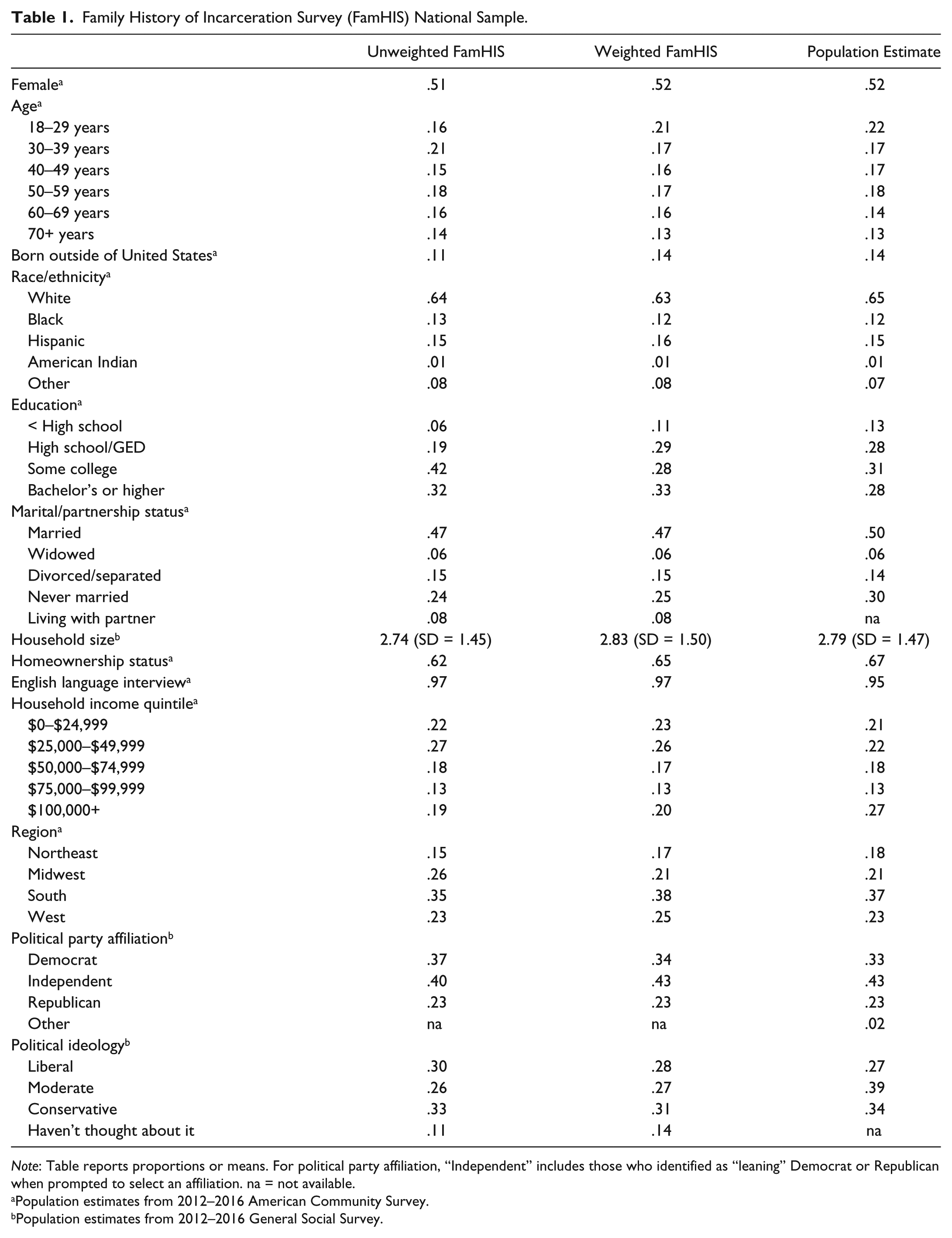
Note: Table reports proportions or means. For political party affiliation, “Independent” includes those who identified as “leaning” Democrat or Republican when prompted to select an affiliation. na = not available.
Population estimates from 2012–2016 American Community Survey.
Population estimates from 2012–2016 General Social Survey.
Questionnaire
The full questionnaire is reported in Appendix A. Here, we describe three types of survey questions: questions used to measure the prevalence of family member incarceration, questions used to measure the prevalence of respondents’ own incarceration, and the broader suite of questions asked to measure other aspects of respondents’ lives that may have been affected by the incarceration of a family member, including attitudes toward the criminal justice system, levels and types of civic participation, and overall well-being.
Measuring Family Incarceration
In designing the family member incarceration questions, we used two definitions of family: one focusing on immediate family and the other focusing on extended family to whom respondents’ reported feeling close. The immediate family question began as follows: Many people have been held in jail or prison for a night or more at some point in their lives. Please think about your immediate family, including parents; brothers; sisters; children; and your current spouse, current romantic partner, or anyone else you have had a child with. Please include step, foster, and adoptive family members. Confidentially and for statistical purposes only, have any members of your immediate family, NOT including yourself, ever been held in jail or prison for one night or longer?
Respondents who indicated that they had experienced the incarceration of an immediate family member were subsequently asked how many family members in each category had experienced this event. We code the incarceration of a family member conservatively: Respondents were only coded as having experienced the incarceration of a family member if they responded “yes” to the immediate family member question and also specified which family member had been incarcerated. Consequently, our estimates may slightly underestimate the prevalence of having a family member incarcerated.
In addition to information about immediate family members, we asked about the incarceration of extended family members. Specifically, we asked: Now we would like you to think about any other, more extended, family members you feel close with who are not included in the earlier groups. As far as you are aware, have any of those other family members you feel close with ever been held in a jail or prison for a night or more at some point in their lives?
Respondents who answered affirmatively were given a list of relations including grandparents, grandchildren, cousins, aunts and uncles, nieces and nephews, godparents, mothers-in-law and fathers-in-law, sisters-in-law and brothers-in-law, and other family members.
We asked those who answered affirmatively to questions about whether an immediate family member had been incarcerated to report the length of the longest spell of incarceration their immediate family member experienced (1 day, 2 days to a month, 1 month to a year, 1–5 years, 6–10 years, and more than 10 years). We did this to differentiate families who may have had only very brief contact with the criminal justice system from those who were likely to have had more sustained contact. Asking about the length of incarceration also enabled us to distinguish jail from prison incarceration without requiring respondents to distinguish between these types of facilities when describing the experiences of their family members. 2
We asked those who answered affirmatively to questions about whether an immediate or extended family member had been incarcerated a set of follow-up questions about their experiences with the criminal justice system as related to their family member’s incarceration. If the respondent had only one immediate family member incarcerated, subsequent questions focused on that family member. If the respondent had more than one immediate family member incarcerated, we randomly selected one immediate family member to focus on. We then asked how many times that family member had been incarcerated. If the family member had been incarcerated more than once, we asked respondents to focus on the most recent incarceration. We then asked how long their family member was incarcerated, whether their family member had experienced pretrial detention or accepted a plea deal, whether they visited their family member while they were incarcerated, how they felt about any visits they made to see that family member during their incarceration, and how they felt their family member’s incarceration affected them financially, among other things. For those who did not have an immediate family member incarcerated but did have an extended family member incarcerated, we asked the same set of questions, again randomly selecting an extended family member if multiple extended family members had been incarcerated and asking the respondent to focus on the family member’s most recent incarceration if they had multiple spells.
The data from all of these questions have been made available free of charge both through the FWD.us website and the Roper Center for Public Opinion Research at Cornell University so that researchers can verify and extend the results presented here and in the report (Enns et al. 2018).
Measuring Respondents’ Own Incarceration
The questions about whether respondents themselves had ever been incarcerated, which were asked of everyone who completed the full survey, follow the same pattern as the questions about family member incarceration.
Additional Questions
There are two types of additional questions. The first allows us to study how the incarceration of a family member is associated with respondents’ (1) experiences with police and the criminal justice system; (2) health and well-being; (3) opinions about crime, the police, the criminal justice system, and the government; (4) civic and political engagement; and (5) drug and alcohol use. We leave the analysis of these items to future work. As noted previously, all of these questions were asked of all respondents who had an immediate family member who had been incarcerated and a random selection of 1,009 respondents who had not.
The survey also includes demographic data, including respondents’ political affiliation, religious denomination, race/ethnicity, age, gender, income, education, marital status, and household size. Additionally, we asked whether respondents were born in the United States.
Findings
All results presented in this article are weighted estimates of the cumulative prevalence of having a family member incarcerated at the national level. Supplementary tabulations of the disaggregated prevalence of respondents’ own incarceration and the incarceration of their immediate and extended family members across sociodemographic groups not explored in the main manuscript are included in a series of four appendix tables (Appendix Tables C6–C9). As shown in Table 1, even the unweighted data (Column 1) are extremely similar to the U.S. adult population (Column 3). With the exception of some small differences in the shares of those with less than a high school education and in the highest income quintile, the FamHIS estimates align with population estimates from the American Community Survey and General Social Survey almost perfectly across all categories. The weighted estimates are even more similar.
Core Family Estimates
Figure 1 presents estimates of the cumulative risks of having a family member incarcerated in the United States. We report point estimates and confidence interval bounds in tabular form in Appendix C. For the incarceration of an immediate family member, we present estimates both for those who reported any family member incarceration (Panel 1) and those who reported that a family member had been incarcerated for at least one year (Panel 4). We use incarceration for longer than one year as a rough proxy for imprisonment. Information on the length of the longest incarceration is available only for immediate family members. Consequently, for both extended family incarceration (Panel 2) and total family incarceration (both immediate and extended family; Panel 3), we report estimates only for incarceration of any length (for at least one night). All estimates include 95 percent confidence intervals.

The risk of having an immediate or extended family member incarcerated for at least a night or longer than a year by racial/ethnic group.
In Panel 1, we see that 45 percent of Americans have ever had an immediate family member in jail or prison. 3 Whites (42 percent) and respondents recorded as other race (34 percent), many of whom identified as Asian or identified with two racial categories, are the only groups that have cumulative risks below the national average. Hispanics (48 percent) have risks similar to the national average, and blacks (63 percent) have risks far above the national average. Although Native Americans also have a risk far above the national average (63 percent), this estimate should be interpreted with caution given the large confidence interval, which reflects the small number of Native Americans in the sample. Panel 4 shows that 14 percent of Americans have had an immediate family member incarcerated in jail or prison for over a year. Whites and persons recorded as other race have slightly lower than average risks of experiencing the incarceration of an immediate family member for more than a year (10 percent and 11 percent) while blacks and Native Americans have significantly higher risks (31 percent and 29 percent).
The second panel of Figure 1 shows estimates of the number of Americans who have had an extended family member to whom they feel close incarcerated. We see that extended family member incarceration (47 percent) is roughly as common as immediate family member incarceration. With the exception of Native Americans (81 percent), for whom the data are able to provide only an imprecise estimate, blacks have the highest risk (61 percent) of having ever had an extended family member incarcerated for one night or more. The incarceration of an extended family member is also quite common for whites.
Panel 3 shows the percentage of Americans who have ever experienced any family member incarceration, including both immediate and extended family members. According to our estimates, a striking 64 percent of Americans have ever had any family member incarcerated. Blacks again experienced the incarceration of a family member at the highest rates among the groups for which we are able to generate stable estimates: Four in five black Americans have ever had a family member incarcerated for at least one night.
Figure 2 examines the cumulative risk of incarceration for each type of immediate family member. The most common form of family member incarceration in the sample was sibling incarceration, a result that holds across racial/ethnic groups. More than one in four American adults have had a sibling incarcerated for at least a night (27 percent). The rate for blacks is almost double the national average (48 percent). There is limited research on the impact of sibling incarceration in childhood and adulthood (Western 2018). These results point to the need for significantly more research on this topic.

The risk of having an immediate family member incarcerated for at least a night by type of family member and racial/ethnic group.
Figure 3 presents the risk of having an immediate family member incarcerated, overall and by family member type, by respondents’ education level. Although those with less than a high school degree have the highest cumulative risks (60 percent), it is striking that the incarceration of a family member is prevalent across respondents’ levels of education. The main dividing line is between those who have a college degree and those who do not, but even among college graduates, the incarceration of an immediate family member was common (30 percent). Still, for some family relationships, educational differences at the bottom of the education distribution were stark. For instance, roughly one in three adults with less than a high school degree have had a parent (32 percent) incarcerated.
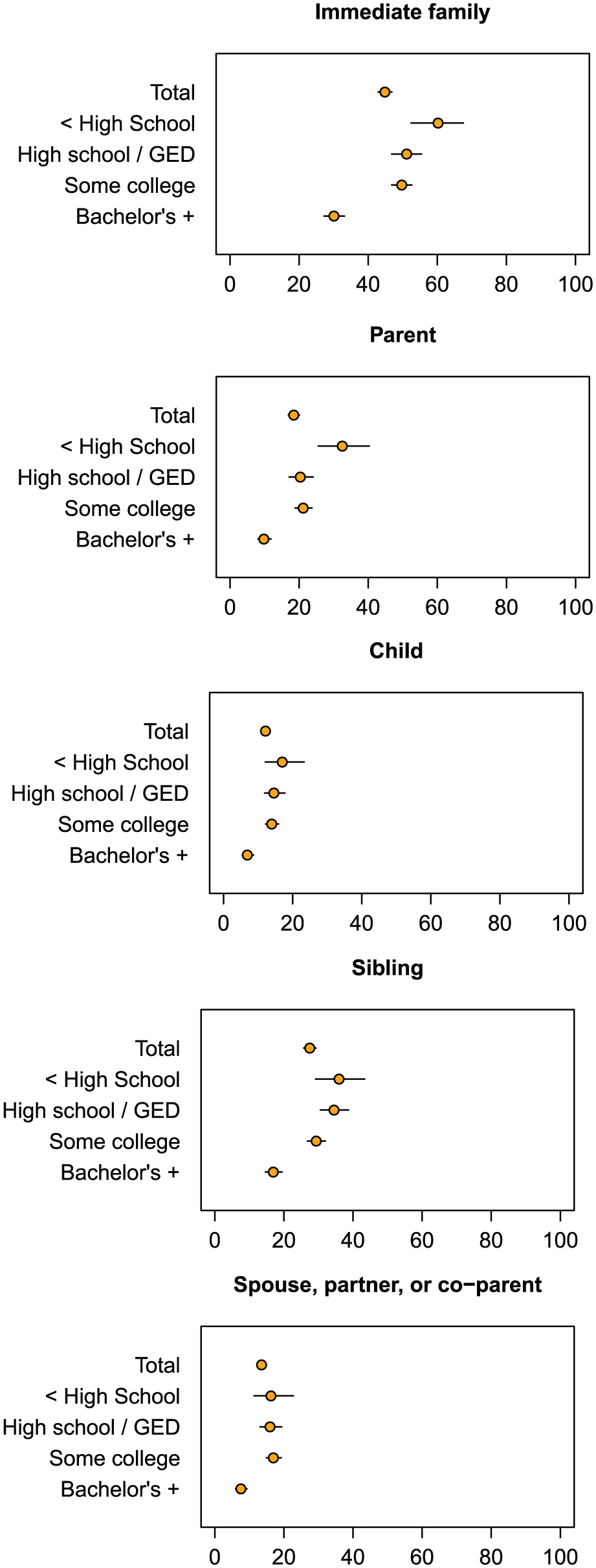
The risk of having an immediate family member incarcerated for at least a night by type of family member and education.
Figure 4 presents respondents’ risk of having an immediate family member incarcerated by age and family member type. The growth of parental incarceration within younger age cohorts is especially notable (Panel 2). One in three (34 percent) people between 18 and 29 years old have had a parent incarcerated while just 1 in 20 (5 percent) of people 70 or older report having ever had a parent incarcerated.

The risk of having an immediate family member incarcerated for at least a night by type of family member and age.
Conditional Risk Factors, Family Estimates
The FamHIS data enable us to examine the cumulative risk of family incarceration by many additional demographic characteristics, such as income level, religious and political affiliation, and foreign-born status. Furthermore, because of the large sample size (n = 4,041), we can estimate the conditional risk of family incarceration across multiple demographic characteristics. It will be especially important for future research to examine the risks associated with multiple economic and social circumstances as it is often the interaction of circumstances such as class and race that best predicts people’s likelihood of being incarcerated (e.g., Western 2006).
Figure 5 reports cumulative risks of family incarceration by sex, race/ethnicity, and duration. 4 Looking at the top two panels, we see that women overall and white women in particular are more likely than men to have an immediate family member who has been incarcerated (48 percent vs. 42 % 46 percent vs. 38 percent, respectively). However, these differences do not exist for other racial groups, and the differences for whites disappear when we focus on immediate family members who have spent over a year incarcerated.

The risk of having an immediate family member incarcerated for at least a night or longer than a year by sex and racial/ethnic group.
Figure 6 shows that the cumulative risk of having a family member incarcerated declines as education levels increase. However, this decline varies dramatically across racial groups. For example, among whites with a college degree, the cumulative risk of having a family member incarcerated for more than a year is about one-fifth the rate of whites with less than a high school degree (5 percent vs. 23 percent). By contrast, blacks with at least a college degree are only half as likely to have an immediate family member incarcerated for at least a year as blacks with less than a high school degree (23 percent vs. 46 percent). These results further highlight the unequal risk of imprisonment in the United States. Blacks with a college degree are just as likely to have a family member imprisoned as whites with less than a high school degree.
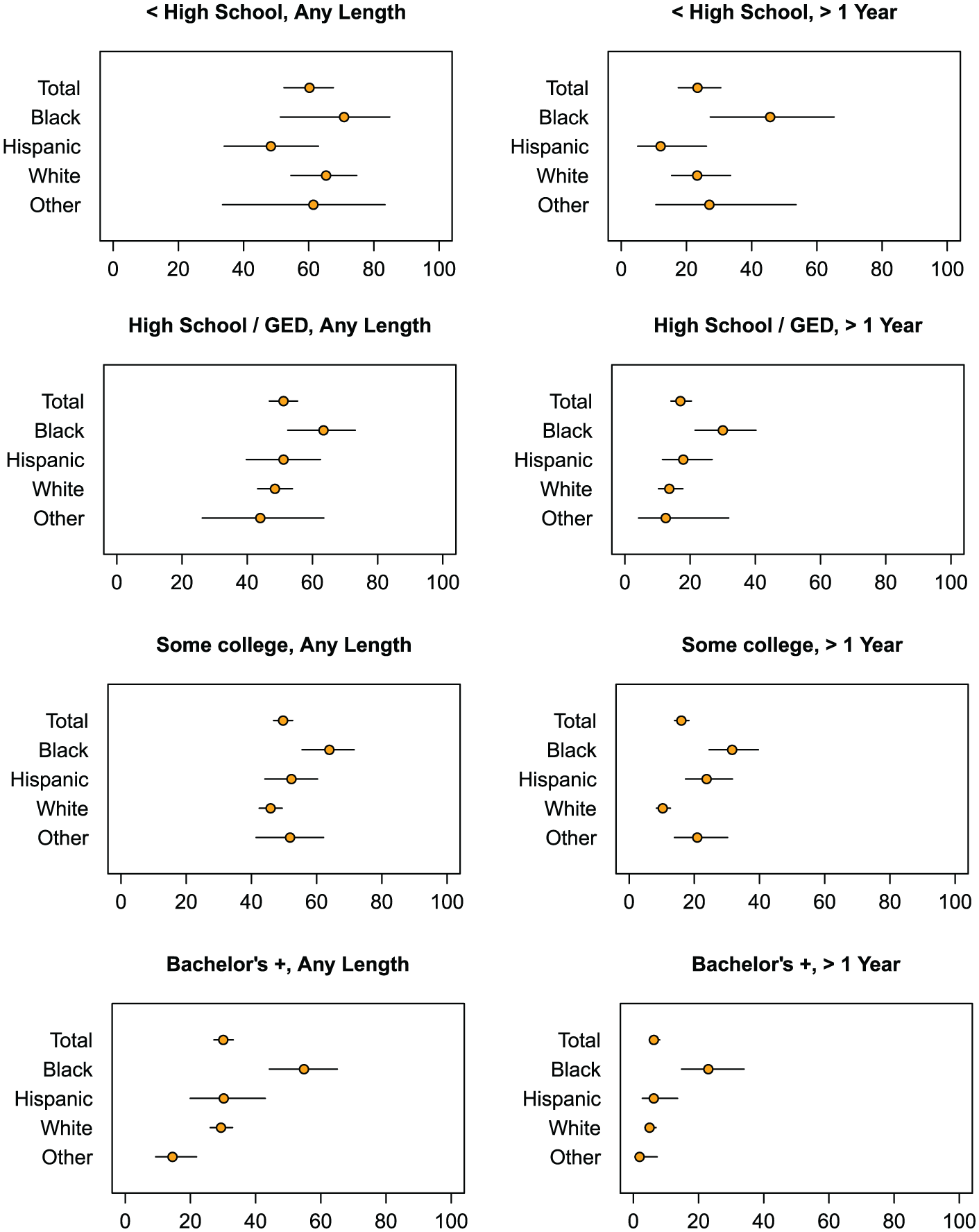
The risk of having an immediate family member incarcerated for at least a night or longer than a year by education and racial/ethnic group.
Estimates of Respondents’ Incarceration
Although the experience of having a family member incarcerated is the primary focus of the FamHIS study, the survey also asked about respondents’ personal experiences with the jail and prison systems. Figure 7 presents estimates of the cumulative prevalence of incarceration among our respondents. It also reports variation in length of incarceration. The survey asked respondents who reported that they had been incarcerated how many times they had been incarcerated and if they had been incarcerated once, the length of that incarceration. If they had been incarcerated multiple times, it asked the length of their most recent incarceration. Using this information, Figure 7 presents mutually exclusive categories of the duration of respondents’ only or most recent incarceration. These estimates are unusual because existing data only measure imprisonment, not incarceration of other kinds (Bonczar 2003; Pettit and Western 2004). Racial disparities in the risk of incarceration are notable. For example, 31 percent of blacks have ever experienced incarceration compared to 17 percent of whites and Hispanics. It is important to emphasize that these disparities are underestimated by the data because people who are currently incarcerated are not eligible for inclusion in the FamHIS study (Pettit 2012). In addition, people who have been to prison are a group that is especially hard to reach with traditional sampling methods (Western et al. 2016). For these reasons, our study is better equipped to measure the prevalence of having a family member incarcerated than of having been incarcerated oneself.

The risk of having been incarcerated by duration and racial/ethnic group.
Conclusion and Next Steps
Our estimates support a number of conclusions. We focus on three. First, as the initial FWD.us report using these data indicated (Elderbroom et al. 2018), having a family member incarcerated is a ubiquitous experience in the United States. Just under one in two (45 percent) Americans have ever had an immediate family member incarcerated. Roughly one in seven (14 percent) have ever had an immediate family member imprisoned—an estimate we derive by asking about incarceration for over a year. Second, although blacks and people with low levels of education experience exceptionally high rates of family member incarceration, with roughly three in five members of each of these groups reporting having ever had a family member incarcerated (63 percent for African Americans; 60 percent for people who did not complete high school), relatively more advantaged groups are far from immune to experiencing this event. People with a college degree stood out for having the lowest risks of family member incarceration, but the college advantage was much less pronounced for blacks. Moreover, in absolute terms, the overall percentage of college graduates who reported having a family member incarcerated was very high (30 percent). Finally, sibling incarceration, an experience that has received little attention (but see Western 2018), was the most common form of immediate family member incarceration. Just over one in four (27 percent) Americans reported having ever had a sibling incarcerated; for blacks, the number was nearly one in two (48 percent). Taken together, these estimates indicate that mass incarceration is a phenomenon that has touched many American families. The incarceration of a family member is the modal experience for blacks and people with low levels of schooling.
There is much more work to be done with these data. To facilitate this work, we will release the data in two stages. At each stage, the data will be made available free of charge through the Roper Center for Public Opinion Research. In the first stage, all data related to family incarceration were made publicly available the day the FWD.us report using them was released (Elderbroom et al. 2018). In the second stage, the full data will be released on September 1, 2019. We eagerly anticipate what further analyses of these data will yield. We are especially interested to learn how scaling by family size affects the estimates presented here and to examine what may be driving the decreasing racial/ethnic disparities in respondents’ incarceration as the length of time served increases. The release of the FamHIS Study—the first nationally representative study designed explicitly to measure family member incarceration—provides a unique opportunity to understand how mass incarceration has affected the lives of many Americans.
Footnotes
Appendix A: Family History of Incarceration Survey (FamHIS) Questionnaire
PHONE SCRIPTS
[CATI - OUTBOUND]
INTRO
Hello, my name is $I. I’m calling from AmeriSpeak by NORC. May I please speak with [FIRSTNAME]?
Hola, mi nombre es $I. Lo estoy llamando de AmeriSpeak del NORC. ¿Podría hablar con [FIRSTNAME]? [SHOW IF RESPONDENT IS AVAILABLE] Thank you for your continued participation in AmeriSpeak. I am calling to let you know that your next survey is available. The survey takes approximately [SURVEYLENGTH] minutes to complete. If you complete the survey, you will receive [INCENTWCOMMA] AmeriPoints for your time. We will keep all of your answers confidential. Shall we proceed? Gracias por su participación continúa en AmeriSpeak. Le estoy llamando para informarle que su próxima encuesta está lista. La encuesta toma aproximadamente [SURVEYLENGTH] minutos para completar. Si completa la encuesta, recibirá [INCENTWCOMMA] AmeriPoints por su tiempo. Mantendremos todas sus respuestas confidenciales. ¿Desea que procedamos? Great. As always, for quality assurance purposes, this call may be recorded or monitored. Excelente. Esta llamada puede ser grabada o monitoreada.
[CATI-INBOUND]
INTRO
Thank you for calling AmeriSpeak by NORC. My name is $I. How are you today?
Gracias por llamar a AmeriSpeak de NORC. Mi Nombre es $I. ¿Cómo está hoy?
And are you calling to take your next survey?
¿Y está llamando para tomar su próxima encuesta?
I just need to confirm that I’m speaking with [FIRSTNAME] [LASTNAME]. Is that you?
Sólo necesito confirmar que estoy hablando con [FIRSTNAME] [LASTNAME]. ¿Sería usted?
Great. This survey takes approximately [SURVEYLENGTH] minutes to complete over the phone and you will earn [INCENTPOINTS] AmeriPoints for your time. We will keep all of your answers confidential.
Excelente. Esta encuesta dura aproximadamente [SURVEYLENGTH] minutos para completar a través del teléfono y usted ganará [INCENTWCOMMA] AmeriPoints por su tiempo. Mantendremos todas sus respuestas confidenciales.
As always, for quality assurance purposes, this call may be recorded or monitored.
Esta llamada puede ser grabada o monitoreada.
Shall we proceed?
¿Desea que procedamos?
[CATI-CALLBACK]
CBINTRO
Hello, my name is $I. I’m calling from AmeriSpeak by NORC. We previously spoke with [FIRSTNAME] about completing an AmeriSpeak survey. Is [FIRSTNAME] available?
Hola, mi nombre es $I. Estoy llamando de AmeriSpeak de NORC. Previamente hablamos con [FIRSTNAME] acerca de completar una encuesta de AmeriSpeak. ¿Esta [FIRSTNAME] disponible? [SHOW IF RESPONDENT IS AVAILABLE] Hello, my name is $I, calling from AmeriSpeak by NORC. We previously spoke with you about completing an AmeriSpeak survey. Are you available now to continue? As always, for quality assurance purposes, this call may be recorded or monitored. Hola, mi nombre es $I, y estoy llamando de AmeriSpeak de NORC. Previamente hablamos con usted acerca de completar una encuesta de AmeriSpeak. ¿Está usted disponible ahora para continuar? Esta llamada puede ser grabada o monitoreada.
[DISPLAY THIS AM LANGUAGE IF SurveyAccessEnd-CALLDATE>1 DAY]
[CATI-MISSED OUTBOUND, ANSWERING MACHINE]
AM1
Hello, this message is [FIRSTNAME] [LASTNAME]. I’m calling from AmeriSpeak from NORC to let you know that you have a survey waiting for you. The survey will take approximately [surveylength] minutes and you will receive [INCENTWCOMMA] AmeriPoints for your time. Call us toll-free at 888-326-9424 and enter your PIN number, [MEMBER_PIN], to complete your survey and earn rewards. Thank you.
Hola, este mensaje es para [nombre y apellido del panelista]. Estoy llamando de AmeriSpeak de NORC para informarle que tiene una encuesta esperando. La encuesta le tomará aproximadamente [surveylength] minutos y recibirá [INCENTWCOMMA] AmeriPoints por su tiempo. Llámenos al número gratuito 888-326-9424 e introduzca su número PIN, [MEMBER_PIN], para completar la encuesta y ganar premios. Gracias.
[DISPLAY THIS AM LANGUAGE IF SurveyAccessEnd-CALLDATE>1 DAY]
[CATI-ANSWERING MACHINE MISSED APPOINTMENT CALLBACK]
AMHARD
Hello, this message is for [FIRSTNAME] and I’m calling from AmeriSpeak from NORC. When we spoke previously, you requested that we call you back <at this time>. I’m sorry that we’ve missed you. We’ll try to contact you again soon but please feel free to return our call any time at 888-326-9424 and enter your PIN number, [MEMBER_PIN], to complete your survey and earn rewards. Thank you.
Hola, este mensaje es para [FIRSTNAME] y estoy llamando de AmeriSpeak de NORC. Cuando hablamos anteriormente, solicitó que le llamaramos de nuevo <en este momento>. Siento no haber podido contactarlo/a. Intentaremos ponernos en contacto con usted otra vez pronto, pero no dude en devolver nuestra llamada en cualquier momento al 888-326-9424 e introduzca su número PIN, [MEMBER_PIN], para completar su encuesta y ganar premios. Gracias.
[DISPLAY THIS AM LANGUAGE IF SurveyAccessEnd-CALLDATE>1 DAY]
[CATI-ANSWERING MACHINE MISSED CALLBACK]
AMSOFT
Hello, this message is for [FIRSTNAME]. I am calling from AmeriSpeak from NORC. We are calling you back to complete your AmeriSpeak survey. Remember, you will earn rewards for completing this survey. I’m sorry that we’ve missed you. We’ll try to contact you again soon but please feel free to return our call any time at 888-326-9424 and enter your PIN number, [MEMBER_PIN], to complete this survey. Thank you.
Hola, este mensaje es para [FIRSTNAME]. Estoy llamando de AmeriSpeak de NORC. Le estamos regresando la llamada para completar su encuesta de AmeriSpeak. Recuerde, usted ganará premios por completar esta encuesta. Siento no haber podido contactarlo/a. Intentaremos ponernos en contacto con usted otra vez pronto, pero no dude en devolver nuestra llamada en cualquier momento al 888-326- 9424 e introduzca su número PIN, [MEMBER_PIN], para completar esta encuesta. Gracias.
[DISPLAY THIS AM LANGUAGE IF SurveyAccessEnd-CALLDATE=1 DAY]
[CATI-NEARING END OF FIELD, ANSWERING MACHINE]
AMEND
Hello, this message is for [FIRSTNAME]. I’m calling from AmeriSpeak from NORC to let you know that a survey will be ending tomorrow. We’d love to hear from you so please call us toll-free at 888-326-9424 and enter your PIN number, [MEMBER_PIN], to complete your survey and earn rewards. Thank you.
Hola, este mensaje es para [FIRSTNAME]. Estoy llamando de AmeriSpeak de NORC para informarle que una encuesta terminará mañana. Nos encantaría saber de usted, así que por favor llámenos al número gratuito 888-326-9424 e introduzca su número de PIN, [MEMBER_PIN], para completar su encuesta y ganar premios. Gracias.
Please include the following options for all questions in CATI:
77 DON’T KNOW
99 REFUSED
Please code refusals in CAWI:
98 IMPLICIT REFUSAL, WEB SKIP
Do not code 77 Don’t Know/99 Refused options in CAWI unless written in item response options
Text shown in green includes researcher notes and should not be included in the programming.
Text shown in purple indicates Spanish translation that should be incorporated into the Spanish version of the survey
[START OF SURVEY]
CREATE DATA-ONLY VARIABLE: QUAL
1=Qualified Complete
2=Not Qualified
3=In progress
AT START OF SURVEY COMPUTE QUAL=3 “IN PROGRESS”
CREATE MODE_START
1=CATI
2=CAWI
Family Incarceration Experience Draft
Date: 6/6/2018
[DISPLAY – WINTRO_1]
Thank you for agreeing to participate in our new AmeriSpeak survey! To thank you for sharing your opinions, we will give you a reward of [INCENTWCOMMA] AmeriPoints after completing the survey. As always, your answers are confidential.
¡Gracias por participar en nuestra nueva encuesta de AmeriSpeak! Para agradecerle por compartir su opinión, le daremos una recompensa de [INCENTWCOMMA] AmeriPoints después de completar esta encuesta. Como siempre, sus respuestas son confidenciales.
Please use the “Continue” and “Previous” buttons to navigate between the questions within the questionnaire. Do not use your browser buttons.
Por favor utilice los botones “Continuar” y “Anterior” para navegar entre las preguntas del cuestionario. No utilice los botones de su navegador.
[DISPLAY_1]
This is a study about the criminal justice system, including policies on prisons and jails.
Este es un estudio sobre el sistema judicial penal, incluyendo políticas sobre prisiones y cárceles.
PROGRAM Q1 AND Q2 ON THE SAME SCREEN
[PROMPT FOR Q2]
[SP]
Q1.
How much confidence do you have in the criminal justice system in your area?
¿Cuánta confianza tiene usted en el sistema judicial penal de su área?
RESPONSE OPTIONS:
[SP]
Q2.
Many people have been held in jail or prison for a night or more at some point in their lives. Please think about your immediate family, including parents; brothers; sisters; children; and your current spouse, current romantic partner, or anyone else you have had a child with. Please include step, foster, and adoptive family members.
Muchas personas han estado en prisión o en la carcel por una noche o más en algún momento de su vida.Por favor piense en su familia cercana, incluyendo a sus padres; hermanos; hermanas; hijos; y su actual esposo, pareja, o a cualquier otra persona con quien tenga un hijo/a. Por favor incluya a familiares adoptados, políticos o de crianza.
[SPACE]
Confidentially and for statistical purposes only, have any members of your immediate family,
<u>NOT</u> including yourself, ever been held in jail or prison for one night or longer?
En forma confidencial y sólo con fines estadísticos, ¿alguno de los miembros de su familia más próxima,
<u>SIN</u> incluirse a usted, ha estado en prisión o en la cárcel por una noche o más?
CAWI RESPONSE OPTIONS:
CATI RESPONSE OPTIONS:
UPDATE 9/10—REMOVING Q2 SCREENING LOGIC AND P_TERM LOGIC—ALL R’S WILL BE ASSIGNED DOV_PATH=1 AND CONTINUE TO Q3.
IF Q2=1,2,77,98,99 CONTINUE TO NEXT QUESTION
CREATE DOV_PATH:
IF DOV_PATH=1, CONTINUE TO Q3
IF Q2=1,2,77,98,99: DOV_PATH=1
[GRID 4,4, SP]
Q3.
[CAWI] Thinking again about your immediate family, how many family members do you have in each of the groups listed below? Include step, foster, and adoptive family members.
[CATI] Thinking again about your immediate family, how many family members do you have in each of the following groups? Include step, foster, and adoptive family members.
[CAWI] Pensando nuevamente en su familia cercana, ¿cuántos familiares tiene en cada uno de los grupos enumerados a continuación? Incluya a familiares adoptados, políticos o de crianza.
[CATI] Pensando nuevamente en su familia cercana, ¿cuántos familiares tiene en cada uno de los siguientes grupos? Incluya a familiares adoptados, políticos o de crianza.
GRID ITEMS:
CAWI RESPONSE OPTIONS:
CATI RESPONSE OPTIONS DO NOT NEED TO READ RESPONSE OPTIONS TO Rs:
CREATE DOV_FAM. DOV_FAM=SUM OF Q3_1-Q3_8 (I.E., DOV_FAM EQUALS THE SUM OF ALL IMMEDIATE FAMILY MEMBERS INDICATED IN Q3). WHEN ADDING RESPONSE VALUES, EXCLUDE ANY VALUES OVER 4 FROM THE SUM (E.G., DO NOT COUNT ‘DON’T KNOW’ (77) RESPONSES FROM CATI VERSION).
[SHOW IF Q2=1]
[GRID, SP]
Q4.
[CAWI] You mentioned a moment ago that a member of your immediate family has been held in jail or prison for one night or longer. How many people from the following groups have ever been held in jail or prison for one night or longer? Include step, foster, and adoptive family members.
[CAWI] Hace un momento mencionó que un familiar cercano ha estado en prisión o en la cárcel por una noche o más. ¿Cuántas personas de los siguientes grupos han estado alguna vez en prisión o en la cárcel por una noche o más? Incluya a familiares adoptados, políticos o de crianza.
[CATI] You mentioned a moment ago that a member of your immediate family has been held in jail or prison for one night or longer. How many from the following groups have ever been held in jail or prison for one night or longer? Include step, foster, and adoptive family members.
[CATI] Hace un momento mencionó que un familiar cercano ha estado en prisión o en la cárcel por una noche o más. ¿Cuántas personas de los siguientes grupos han estado alguna vez en prisión o en la cárcel por una noche o más? Incluya a familiares adoptados, políticos o de crianza.
GRID ITEMS:
CAWI RESPONSE OPTIONS:
CATI RESPONSE OPTIONS DO NOT NEED TO READ RESPONSE OPTIONS TO Rs:
CREATE DOV_JAIL. DOV_JAIL=SUM OF Q4_1-Q4_8 (I.E., DOV_JAIL EQUALS THE SUM OF ALL INCARCERATED IMMEDIATE FAMILY MEMBERS INDICATED IN Q4). WHEN ADDING RESPONSE VALUES, EXCLUDE ANY VALUES OVER 4 FROM THE SUM (E.G., DO NOT COUNT ‘DON’T KNOW’ (77) RESPONSES FROM CATI VERSION).
IF Q2=1 AND DOV_JAIL=0 TERMINATE
TERMINATE instruction should be short hand for:
→ SET QUAL=2, CO_DATE
→ GO TO TERMSORRY
→ No back (disable browser back button)
→ auto redirect to member portal after 10 seconds
[NO PIMS TRANSACTION]
TERMSORRY.
[CAWI] Thank you for your time today. Unfortunately you are not eligible for this study. We value your opinion and hope that you will participate in future AmeriSpeak surveys.
Gracias por su tiempo hoy. Desafortunadamente usted no es elegible para este estudio. Valoramos su opinión y esperamos que usted participe en futuras encuestas de AmeriSpeak.
[CAWI] We will redirect you to the AmeriSpeak Member Portal in [n] seconds.
[CAWI] Nosotros lo/la redirigiremos al Portal de Miembros AmeriSpeak en [n] segundos.
[CATI] Thank you for your time today. Unfortunately you are not eligible for this study. Thank you so much for your participation. We will be in touch when your next survey is available. Have a great day/evening.
[CATI] Gracias por su tiempo hoy. Desafortunadamente usted no es elegible para este estudio. Muchas gracias por su participación. Estaremos en contacto cuando su próxima encuesta se encuentre disponible. ¡Qué tenga un buen día/tarde!
[[CATI], ONLY OFFER THIS IF PROMPTED BY RESPONDENT: I mentioned earlier that we would complete the survey if you were eligible, and it appears that you are not for this particular survey. We appreciate your time and will be in touch with your next survey soon.]
[[CATI], ONLY OFFER THIS IF PROMPTED BY RESPONDENT: Mencioné anteriormente que completaríamos la encuesta si usted era elegible, y al parecer usted no lo es para esta encuesta en particular. Le agradecemos por su tiempo y estaremos en contacto con su próxima encuesta pronto.]
[SET QUAL=2 “Not Qualified” and END INTERVIEW, no incentive given]
[REMOVE “PREVIOUS” BUTTON FROM PAGE]
[CAWI NO BACK – disable web browser back button]
CAWI auto-redirect to MEMBER PORTAL in 10 seconds, display remaining number of seconds in [n]
[SHOW IF DOV_JAIL >0]
[SP]
Q4LONG.
Thinking about your immediate family members who have been held in jail or prison, what was the longest amount of time that any one of your family members spent in jail or prison?
Pensando en sus familiares cercanos que han estado en la cárcel o prisión, ¿cuál fue la mayor cantidad de tiempo que cualquiera de sus familiares pasó en la cárcel o prisión?
RESPONSE OPTIONS:
[SP]
Q5.
Now we would like you to think about any other, more extended, family members you feel close with who are not included in the earlier groups. As far as you are aware, have any of those other family members you feel close with ever been held in a jail or prison for a night or more at some point in their lives?
Ahora nos gustaría que usted piense en forma más extendida, en otros miembros de su familia, con quienes se sienta cercano y que no estén incluidos en los grupos anteriores. Según su conocimiento,
¿alguno de estos otros familiares con quienes se siente cercano ha estado alguna vez en prisión o en la cárcel por una noche o más en algún punto de su vida?
[CATI] If you aren’t sure, you can just say so.
[CATI] Si no está seguro/a, puede decirlo simplemente.
[CAWI RESPONSE OPTIONS]
[CATI RESPONSE OPTIONS]
[SHOW IF Q5=1]
[GRID 5,4, SP]
Q6.
How many people in each group have ever been held in jail or prison for one night or longer?
¿Cuántas personas en cada uno de los siguientes grupos han estado alguna vez en prisión o en la cárcel por una noche o más?
GRID ITEMS:
CAWI RESPONSE OPTIONS:
CATI RESPONSE OPTIONS DO NOT NEED TO READ RESPONSE OPTIONS TO Rs:
CREATE DOV_EXT_JAIL. DOV_EXT_JAIL =SUM OF Q6_1-Q6_9 (I.E., DOV_EXT_JAIL EQUALS THE SUM OF ALL INCARCERATED EXTENDED FAMILY MEMBERS INDICATED IN Q5). WHEN ADDING RESPONSE VALUES, EXCLUDE ANY VALUES OVER 4 FROM THE SUM (E.G., DO NOT COUNT ‘DON’T KNOW’ (77) RESPONSES FROM CATI VERSION).
CREATE DOV_MAIN. IF SUM OF DOV_EXT_JAIL AND DOV_JAIL >0 DOV_MAIN=1 ‘MAIN SURVEY’. IF SUM OF DOV_EXT_JAIL AND DOV_JAIL <1 DOV_MAIN=2 ‘SHORT SURVEY’
[SHOW IF DOV_MAIN=1]
[DISPLAY_FAMILY]
The next questions will be used to understand people’s experiences with the criminal justice system. Your answers are completely confidential, and will be used only in combination with other responses to help guide efforts to improve criminal justice policies in the United States.
Las siguientes preguntas serán utilizadas para comprender las experiencias de las personas con el sistema judicial. Sus respuestas son completamente confidenciales, y sólo serán utilizadas en combinación con otras respuestas para ayudar a guiar los esfuerzos para mejorar las políticas del sistema judicial en los Estados Unidos.
***SURVEY SUBJECT SELECTION PROGRAMMING***
CREATE DOV_SUBJ WITH THE FOLLOWING VALUES:
IF DOV_JAIL=1 SELECT THE ONLY FAMILY MEMBER INDICATED IN Q4 (I.E., SELECT THE ITEM IN THE Q4 GRID THAT EQUALS 1). ASSIGN VALUE TO DOV_SUBJ THAT CORRESPONDS WITH SELECTED FAMILY MEMBER FROM Q4 (E.G., IF DOV_JAIL=1 AND Q4_3 ‘Brother(s)’=1, DOV_SUBJ=3 ‘Brother’)
IF DOV_JAIL >1 RANDOMLY SELECT A FAMILY MEMBER FROM Q4 WITH A VALUE >=1 (E.G., IF DOV_JAIL=3 AND Q4_3 ‘Brother(s)’=2, AND Q4_3 ‘Sister(s)’=1, RANDOMLY ASSIGN DOV_SUBJ TO 3 ‘Brother’ OR 4 ‘Sister’)
IF DOV_JAIL<1 AND DOV_EXT_JAIL=1 SELECT THE ONLY FAMILY MEMBER INDICATED IN Q6 (I.E., SELECT THE ITEM IN THE Q6 GRID THAT EQUALS 1). ASSIGN VALUE TO DOV_SUBJ THAT CORRESPONDS WITH SELECTED FAMILY MEMBER FROM Q6 (E.G., IF DOV_EXT_JAIL=1 AND Q6_3 ‘Cousin(s)’=1, DOV_SUBJ=3 ‘Cousin’)
IF DOV_JAIL < 1 AND DOV_EXT_JAIL>1 RANDOMLY SELECT A FAMILY MEMBER FROM Q6 WITH A VALUE >=1 (E.G., IF DOV_EXT_JAIL =3 AND Q6_3 ‘Cousin(s)’=2, AND Q6_4 ‘Aunt(s) and Uncle(s)’=1, RANDOMLY ASSIGN DOV_SUBJ TO 3 ‘Cousin’ OR 4 ‘Aunt or uncle’)
Create DATA-ONLY VARIABLE: DOV_AGE.
IF TWO RELATIONSHIPS REPORTED FOR DOV_SUBJ (E.G., IF DOV_SUBJ=1 ‘Father’ AND Q4_1=2) RANDOMLY ASSIGN A VALUE OF 1 ‘older’ OR 2 ‘younger’ FOR DOV_AGE. IF MORE THAN TWO RELATIONSHIPS REPORTED FOR DOV_SUBJ (E.G., IF DOV_SUBJ=1 ‘Father’ AND Q4_1=3) RANDOMLY
ASSIGN A VALUE OF 3 ‘oldest OR 4 ‘youngest’ FOR DOV_AGE. NOTE: When inserting text for DOV_AGE, if no value is assigned, insert nothing (e.g., if ‘brother’ is selected for DOV_SUBJ (DOV_SUBJ=3), and only one brother is reported in Q4_3, the DOV_AGE insert should be left blank—FOR EXAMPLE, IF DOV_SUBJ=3 AND Q4_3=1, DOV_AGE=<blank>
CREATE DATA-ONLY VARIABLE: DOV_GENDER.
IF DOV_SUBJ=1, 3, OR 5 THEN DOV_GENDER=1 ‘he’. IF DOV_SUBJ=2, 4, OR 6 THEN DOV_GENDER=2 ‘she’. IF DOV_SUB <> 1-6 THEN DOV_GENDER=3 ‘he/she’.
[SHOW IF DOV_MAIN=1]
[SP]
Q7.
Now I would like to ask you some questions about [IF DOV_SUBJ <> 8 INSERT: your] [IF DOV_SUBJ=8 INSERT: the] [DOV_AGE] [DOV_SUBJ] who you indicated has ever been held in jail or prison for one night or longer. Thinking about [IF DOV_SUBJ <> 8 INSERT: your] [IF DOV_SUBJ=8 INSERT: the][DOV_AGE] [DOV_SUBJ], was [DOV_GENDER] in jail or prison once or more than once?
Ahora nos gustaría realizarle algunas preguntas sobre [IF DOV_SUBJ <> 8 INSERT: su] [IF DOV_SUBJ=8 INSERT: el/la] [DOV_SUBJ] [DOV_AGE] quien usted indicó que ha estado en prisión o en la cárcel por una noche o más. Pensando en [IF DOV_SUBJ <> 8 INSERT: su] [IF DOV_SUBJ=8 INSERT: el/la] [DOV_SUBJ] [DOV_AGE], ¿estuvo [DOV_GENDER] en prisión o en la cárcel una vez o más?
CAWI RESPONSE OPTIONS:
CATI RESPONSE OPTIONS:
[SHOW IF DOV_MAIN=1]
[SP]
Q8.
Is [DOV_GENDER] currently in prison or jail, or not?
¿Está [DOV_GENDER] actualmente en prisión o en la cárcel, o no?
CAWI RESPONSE OPTIONS:
CATI RESPONSE OPTIONS:
[SHOW IF Q8=1]
[SP]
Q9a.
Approximately how long has [DOV_GENDER] been in jail or prison?
¿Aproximadamente cuánto tiempo ha estado [DOV_GENDER] en prisión o en la cárcel?
RESPONSE OPTIONS:
[SHOW IF Q7=1 AND Q8=2]
[SP]
Q9b.
Approximately how long was [DOV_GENDER] in jail or prison?
¿Aproximadamente cuánto tiempo estuvo [DOV_GENDER] en prisión o en la cárcel?
RESPONSE OPTIONS:
[SHOW IF Q7=2 AND Q8=2]
[SP]
Q9c.
Thinking about the last time [DOV_GENDER] was held in a jail or prison, approximately how long was [DOV_GENDER] in jail or prison?
Pensando en la última vez que [DOV_GENDER] estuvo en prisión o en la cárcel, ¿aproximadamente cuánto tiempo estuvo [DOV_GENDER] en prisión o en la cárcel?
RESPONSE OPTIONS:
[SHOW IF Q8=2]
[SP]
Q10.
About how long ago did [DOV_GENDER] leave jail or prison?
¿Cuánto hace que [DOV_GENDER] salió de prisión o de la cárcel?
RESPONSE OPTIONS:
[SHOW IF DOV_MAIN=1]
[SP]
Q11.
Often when accused of a crime, a person will accept a plea deal in which they legally admit to being guilty of a crime in exchange for a reduced sentence. Thinking about [IF DOV_SUBJ <> 8 INSERT: your] [IF DOV_SUBJ=8 INSERT: the][DOV_AGE] [DOV_SUBJ], do you recall whether [DOV_GENDER] did or did not accept a plea deal?
A menudo, cuando se le acusa de un delito, la persona acepta un trato negociado por el cual admiten legalmente ser culpables de un delito a cambio de una pena reducida. Pensando en [IF DOV_SUBJ <> 8 INSERT: su] [IF DOV_SUBJ=8 INSERT: el/la] [DOV_SUBJ] [DOV_AGE], ¿recuerda si [DOV_GENDER] aceptó un trato negociado o no?
[CATI]: If you aren’t sure, you can just say so.
[CATI]: Si no está seguro/a, puede decirlo simplemente.
RESPONSE OPTIONS:
[SHOW IF DOV_MAIN=1]
[SP]
Q12.
Often when accused of a crime, a person will spend time in jail or prison before their trial starts or before they accept a plea deal. Do you know whether or not [IF DOV_SUBJ <> 8 INSERT: your] [IF DOV_SUBJ=8 INSERT: the][DOV_AGE] [DOV_SUBJ] spent time in jail or prison <i>before</i> their trial started or before they accepted a plea deal?
A menudo, cuando se le acusa de un delito, la persona pasa un tiempo en prisión o en la cárcel antes de que comience el juicio o antes de aceptar un trato negociado. ¿Sabe si [IF DOV_SUBJ <> 8 INSERT: su] [IF DOV_SUBJ=8 INSERT: el/la] [DOV_SUBJ] [DOV_AGE] pasó tiempo en prisión o en la cárcel <i>antes</i> de que comenzara su juicio o antes de aceptar el trato negociado?
[CATI: If you aren’t sure, you can just say so.
[CATI: Si no está seguro/a, puede decirlo simplemente.
CAWI RESPONSE OPTIONS:
CATI RESPONSE OPTIONS:
[SHOW IF DOV_MAIN=1]
[SP]
Q13.
Did you ever get to visit [IF DOV_SUBJ <> 8 INSERT: your] [IF DOV_SUBJ=8 INSERT: the][DOV_AGE][DOV_SUBJ] in jail or prison, or not?
¿Alguna vez visitó [IF DOV_SUBJ <> 8 INSERT: a su] [IF DOV_SUBJ=8 INSERT: a el/la] [DOV_SUBJ] [DOV_AGE] en prisión o en la cárcel, o no?
CAWI RESPONSE OPTIONS:
CATI RESPONSE OPTIONS:
[SHOW IF Q13=1]
[SMALL TEXTBOX]
Q14.
What word or words come to mind when you think of the visit or visits?
¿Qué palabra o palabras le vienen a la mente cuando piensa en la visita o visitas?
[SHOW IF DOV_MAIN=1]
[SP]
Q15.
Did [IF DOV_SUBJ <> 8 INSERT: your] [IF DOV_SUBJ=8 INSERT: the][DOV_AGE] [DOV_SUBJ][IF
DOV_SUBJ<>8 INSERT:’s] incarceration hurt your family’s financial situation, help your family’s financial situation, or make no difference?
¿La encarcelación de [IF DOV_SUBJ <> 8 INSERT: su] [IF DOV_SUBJ=8 INSERT: el/la] [DOV_SUBJ] [DOV_AGE] perjudicó la situación financiera de su familia, contribuyó con la situación financiera de su familia, o no generó diferencias?
[CATI] IF R SAYS HURT OR HELP: Is that a great deal or somewhat?
[CATI] IF R SAYS HURT OR HELP: ¿Es eso mucho o un poco?
CAWI RESPONSE OPTIONS: SHOW IF RND_07=0
CAWI RESPONSE OPTIONS: SHOW IF RND_07=1
CATI RESPONSE OPTIONS:
SHOW IF RND_07=0
CATI RESPONSE OPTIONS:
SHOW IF RND_07=1
[SHOW IF DOV_MAIN=1]
[SP]
Q16.
Nearly half of Americans report they have a family member or close friend who has struggled with addiction to alcohol or other drugs. Do you know if [IF DOV_SUBJ <> 8 INSERT: your] [IF DOV_SUBJ=8 INSERT: the][DOV_AGE] [DOV_SUBJ] currently struggles with or has ever struggled with addiction to alcohol or other drugs?
Casi la mitad de los estadounidenses informan que tienen a un familiar o amigo cercano que está luchando contra una adicción al alcohol u otras drogas. ¿Sabe usted si [IF DOV_SUBJ <> 8 INSERT: su] [IF DOV_SUBJ=8 INSERT: el/la] [DOV_SUBJ] [DOV_AGE] lucha actualmente o ha luchado contra una adicción al alcohol u otras drogas?
[CATI]: If you aren’t sure, you can just say so.
[CATI]: Si no está seguro, puede decirlo simplemente.
CAWI RESPONSE OPTIONS:
CATI RESPONSE OPTIONS:
START OF MAIN SURVEY
[SHOW IF DOV_MAIN=1]
[DISPLAY_2]
We’re also interested in your own experiences.
También estamos interesados en sus propias experiencias
[SP]
Q17.
Have you ever been stopped by the police while you were in a public place, but not in a moving vehicle?
¿Alguna vez lo ha detenido la policía mientras usted estaba en un lugar público, pero no en un vehículo en movimiento?
CAWI RESPONSE OPTIONS:
CATI RESPONSE OPTIONS:
[SHOW IF Q17=1]
[SP]
Q18.
At any time during this stop, did the police officer(s) search you, frisk you, or pat you down?
¿En algún momento durante dicha detención, el/los oficial(es) lo/la revisaron, cachearon o lo/la palparon?
CAWI RESPONSE OPTIONS:
CATI RESPONSE OPTIONS:
[SP]
Q19.
Have you ever been arrested by the police or taken into custody?
¿Alguna vez ha sido arrestado por la policía o lo han llevado bajo custodia?
CAWI RESPONSE OPTIONS:
CATI RESPONSE OPTIONS:
[SP]
Q20.
Have you yourself ever been held in a jail or prison for a night or more?
¿Alguna vez ha estado usted en prisión o en la cárcel por una noche o más?
CAWI RESPONSE OPTIONS:
CATI RESPONSE OPTIONS:
[SHOW IF Q20=1]
[SP]
Q21.
Have you been in jail or prison once or more than once?
¿Ha estado usted en prisión o en la cárcel una vez o más de una vez?
CAWI RESPONSE OPTIONS:
CATI RESPONSE OPTIONS:
[SHOW IF Q21=1]
[SP]
Q22a.
Approximately how long were you in jail or prison?
¿Aproximadamente cuánto tiempo estuvo usted en prisión o en la cárcel?
[SHOW IF Q21=2]
[SP]
Q22b.
Thinking about the most recent time, approximately how long were you in jail or prison?
Pensando en la última vez, ¿aproximadamente cuánto tiempo estuvo usted en prisión o en la cárcel?
RESPONSE OPTIONS:
[SHOW IF Q20=1]
[SP]
Q23.
About how long ago did you [INSERT IF Q21=2: last] leave jail or prison?
¿Hace cuánto tiempo dejó la prisión o la cárcel [INSERT IF Q21=2: la última vez]?
RESPONSE OPTIONS:
[SHOW IF Q20=1]
[SP]
Q24.
Often when accused of a crime, a person will accept a plea deal in which they legally admit to being guilty of a crime in exchange for a reduced sentence. Do you recall if you accepted a plea deal, or not?
A menudo, cuando se le acusa de un delito, la persona acepta un trato negociado por el cual admiten legalmente ser culpables de un delito a cambio de una pena reducida. ¿Recuerda haber aceptado usted un trato negociado, o no?
[CATI]: If you aren’t sure, you can just say so.
[CATI]: Si no está seguro/a, puede decirlo simplemente.
CAWI RESPONSE OPTIONS:
CATI RESPONSE OPTIONS:
[SHOW IF Q20=1]
[SP]
Q25.
Often when accused of a crime, a person will spend time in jail or prison before their trial starts or before they accept a plea deal. Do you recall if you spent time in jail or prison before your trial started or before you accepted a plea deal, or not?
A menudo, cuando se le acusa de un delito, la persona pasa un tiempo en prisión o en la cárcel antes de que comience el juicio o antes de aceptar un trato negociado. ¿Recuerda haber pasado usted un tiempo en prisión o en la cárcel antes de que comenzara el juicio o antes de aceptar un trato negociado, o no?
[CATI]: If you aren’t sure, you can just say so.
[CATI]: Si no está seguro/a, puede decirlo simplemente.
CAWI RESPONSE OPTIONS:
CATI RESPONSE OPTIONS:
[SHOW IF Q20=1]
[SP]
Q26.
Did your incarceration [SHOW IF RND_01=0 hurt] [SHOW IF RND_01=1 help] your family’s financial situation, [SHOW IF RND_01=1 hurt] [SHOW IF RND_01=0 help] your family’s financial situation, or make no difference?
¿Su encarcelación [SHOW IF RND_01=0 perjudicó] [SHOW IF RND_01=1 contribuyó] a su situación económica familiar, [SHOW IF RND_01=1 perjudicó] [SHOW IF RND_01=0 contribuyó] a su situación económica familiar, o no tuvo diferencia?
[CATI] IF R SAYS HURT OR HELP: Is that a great deal or somewhat?
[CATI] IF R SAYS HURT OR HELP: ¿Es eso mucho o un poco?
CAWI RESPONSE OPTIONS: SHOW IF RND_01=0
CAWI RESPONSE OPTIONS: SHOW IF RND_01=1
CATI RESPONSE OPTIONS:
SHOW IF RND_01=0
CATI RESPONSE OPTIONS:
SHOW IF RND_01=1
[SHOW IMAGE OF THE LADDER TO THE RIGHT OF DISPLAY TEXT ON THIS SCREEN AND Q27-Q29 FOR CAWI]
[DISPLAY]
LADDER_DISPLAY.
For the next three questions please imagine a ladder with steps numbered from zero at the bottom to ten at the top. The top step of the ladder represents the best possible life for you and the bottom of the ladder represents the worst possible life for you.
Para las próximas tres preguntas por favor imagine una escalera con pasos numerados del cero en la parte inferior al diez en la parte superior. El paso superior de la escalera representa la mejor vida posible para usted y el paso inferior de la escalera representa la peor vida posible para usted.
[SHOW IMAGE OF LADDER TO THE RIGHT OF THE TEXT AND RESPONSE OPTIONS FOR CAWI]
[SP]
Q27.
Indicate where on the ladder you feel you personally stand right now.
Indique en qué lugar de la escalera siente que usted está personalmente parado/a ahora mismo.
[CATI] DO NOT READ RESPONSE OPTIONS TO R
[CATI] Read TO R IF NECESSARY: The top rung of the ladder, a ten, represents the best possible life for you and the bottom rung of the ladder, a zero, represents the worst possible life for you.
El escalón superior de la escalera, un diez, representa la mejor vida posible para usted y el escalón inferior de la escalera, un cero, representa la peor vida posible para usted.
RESPONSE OPTIONS:
[SHOW IMAGE OF LADDER TO THE RIGHT OF THE TEXT AND RESPONSE OPTIONS FOR CAWI]
[SP]
Q28.
On which step do you think you will stand about five years from now?
¿En qué peldaño cree usted que estará parado de aquí a cinco años?
[CATI] DO NOT READ RESPONSE OPTIONS TO R
[CATI] Read TO R IF NECESSARY: The top rung of the ladder, a ten, represents the best possible life for you and the bottom rung of the ladder, a zero, represents the worst possible life for you.
El escalón superior de la escalera, un diez, representa la mejor vida posible para usted y el escalón inferior de la escalera, un cero, representa la peor vida posible para usted.
RESPONSE OPTIONS:
[SHOW IMAGE OF LADDER TO THE RIGHT OF THE TEXT AND RESPONSE OPTIONS FOR CAWI]
[SP]
Q29.
Now imagine the top of the ladder represents the best possible financial situation for you, and the bottom of the ladder represents the worst possible financial situation for you. Please indicate where on the ladder you stand right now.
Ahora imagine que la parte superior de la escalera representa la mejor situación financiera posible para usted, y la parte inferior de la escalera representa la peor situación financiera posible para usted. Por favor indique en qué lugar de la escalera está usted ahora.
[CATI] DO NOT READ RESPONSE OPTIONS TO R RESPONSE OPTIONS:
[SP]
Q30.
In general, how would you rate your physical health? En general, ¿cómo calificaría su salud física?
RESPONSE OPTIONS:
[SP]
Q31.
In general, how would you rate your mental health, including your mood and your ability to think?
En general, ¿cómo calificaría su salud mental, incluyendo su estado de ánimo y su capacidad de pensar?RESPONSE OPTIONS:
[SP]
Q32.
How often do you get the social and emotional support you need?
¿Con qué frecuencia tiene el apoyo social y emocional que usted necesita?
RESPONSE OPTIONS:
[SP]
Q33.
Do you agree, disagree, or neither agree nor disagree with the following statement?
¿Está usted de acuerdo, en desacuerdo o ni de acuerdo ni en desacuerdo con el siguiente enunciado? [SPACE]
“I lead a purposeful and meaningful life.”
“Llevo una vida con propósito y significado.”
[CATI] IF R SAYS THEY AGREE: Do you strongly agree, agree, or slightly agree?
[CATI] IF R SAYS THEY DISAGREE: Do you strongly disagree, disagree, or slightly disagree?
[CATI] IF R SAYS THEY AGREE: ¿Está usted fuertemente de acuerdo, de acuerdo, o apenas de acuerdo?
[CATI] IF R SAYS THEY DISAGREE: ¿Está usted fuertemente en desacuerdo, en desacuerdo, o apenas en desacuerdo?
CAWI RESPONSE OPTIONS:
CATI RESPONSE OPTIONS:
[SP]
Q34.
Now a few final questions on a different topic.
Ahora unas pocas preguntas finales sobre un tema diferente.
[SPACE]
If you saw someone breaking into your neighbors’ home, how likely would you be to [SHOW IF RND_04=0 call the police] [SHOW IF RND_04=1 call 911]?
Si usted viera a alguien ingresando por la fuerza en una casa de su vecino, ¿qué tan probable sería que usted [SHOW IF RND_04=0 llamara a la policía] [SHOW IF RND_04=1 llamara al 911]?
CATI: Would you be…
CATI: ¿Estaría usted…
RESPONSE OPTIONS:
SHOW IF RND_03=0
SHOW IF RND_03=1
[SP]
Q35.
If you saw something in your neighborhood that made you feel unsafe, how likely would you be to [SHOW IF RND_04=0 call the police] [SHOW IF RND_04=1 call 911]?
Si viera algo en su barrio que lo hiciera sentir inseguro/a, ¿qué tan probable sería que usted [SHOW IF RND_04=0 llamara a la policía] [SHOW IF RND_04=1 llamara al 911]?
[CATI]: Would you be…
[CATI]: ¿Estaría usted…
RESPONSE OPTIONS:
SHOW IF RND_03=0
SHOW IF RND_03=1
[SP]
Q36.
How big of a problem do you think crime is in the United States?
¿Qué tan serio cree usted que es el problema del crimen en los Estados Unidos?
RESPONSE OPTIONS:
SHOW IF RND_05=0
SHOW IF RND_05=1
[SP]
Q37.
How big of a problem do you think crime is <i>in the community where you live</i>?
¿Qué tan serio cree usted que es el problema del crimen <i>en la comunidad donde vive usted</i>?
RESPONSE OPTIONS:
SHOW IF RND_05=0
SHOW IF RND_05=1
[SP]
Q38.
How much of the time do you think you can trust the police to do what is right for your community?
¿Con qué frecuencia piensa usted que puede confiar en que la policía haga lo correcto para su comunidad?
RESPONSE OPTIONS:
SHOW IF RND_06=0
SHOW IF RND_06=1
[SP]
Q39.
In general, do you think the courts in this area deal too harshly or not harshly enough with people who are found guilty of a crime?
En general, ¿cree usted que las cortes en esta área tratan con demasiada severidad o no con la suficiente severidad a las personas que son halladas culpables de un delito?
RESPONSE OPTIONS:
[MP]
Q40.
People may be involved in their communities in many different ways. In the past 12 months, have you…
Las personas se pueden involucrar en sus comunidades de diferentes formas. En los últimos 12 meses,
¿ha …
[SPACE]
[CAWI remove bold><i>Please select all that apply. </i> [CATI:
[CAWI remove bold><i>Por favor seleccione todas las que apliquen. </i> [CATI:
RESPONSE OPTIONS:
[MP]
Q41.
People may also be involved in civic and political activities.
Las personas también se pueden involucrar en actividades cívicas y políticas
[SPACE]
In the past 12 months, have you…
En los últimos 12 meses, ¿ha…
[CAWI remove bold><i>Please select all that apply. </i> [CATI:
[CAWI remove bold><i>Por favor seleccione todas las que apliquen. </i> [CATI:
RESPONSE OPTIONS:
SHOW IF RND_08=0
RESPONSE OPTIONS:
SHOW IF RND_08=1
[RANDOMIZE ORDER OF Q42_1, Q42_2, Q42_3]
[SP]
Q42_1.
How often can you trust the federal government in Washington to do what is right?
¿Con qué frecuencia puede usted confiar en que el gobierno federal en Washington haga lo correcto?
RESPONSE OPTIONS:
[SP]
Q42_2.
How often can you trust the state government to do what is right?
¿Con qué frecuencia puede usted confiar en que el gobierno estatal haga lo correcto?
RESPONSE OPTIONS:
[SP]
Q42_3.
How often can you trust the local government to do what is right?
¿Con qué frecuencia puede usted confiar en que el gobierno local haga lo correcto?RESPONSE OPTIONS:
[SP]
Q43.
As we told you earlier, many Americans have struggled with addiction to alcohol or other drugs. Confidentially and for statistical purposes only, have you ever struggled with addiction to alcohol or other drugs?
Como le mencionamos anteriormente, muchos estadounidenses han luchado contra adicciones al alcohol u otras drogas. De forma confidencial y sólo con fines estadísticos, ¿ha usted luchado alguna vez contra adicciones al alcohol u otras drogas?
CATI: If you aren’t sure, you can just say so.
CATI: Si no está seguro/a, puede decirlo simplemente.
CAWI RESPONSE OPTIONS:
CATI RESPONSE OPTIONS:
[SHOW IF MISSING P_RELIG]
[SP]
RELIG.
What is your present religion, if any?
¿Cuál es su religión actual, si es de alguna?
RESPONSE OPTIONS:
[SHOW IF MISSING P_PARTYID7]
[SP]
PID1.
Do you consider yourself a Democrat, a Republican, an independent or none of these?
¿Usted se considera Demócrata, Republicano/a, independiente o ninguna de estas opciones? RESPONSE OPTIONS:
[SHOW IF PID1=1]
[SP]
PIDA.
Do you consider yourself a strong or moderate Democrat?
¿Usted se considera Demócrata moderado/a o fuerte?
RESPONSE OPTIONS:
[SHOW IF PID1=2]
[SP]
PIDB.
Do you consider yourself a strong or moderate Republican?
¿Usted se considera Republicano/a moderado/a o fuerte?
RESPONSE OPTIONS:
[SHOW IF PID1=3, 4, 77, 98, 99]
[SP]
PIDi.
Do you lean more toward the Democrats or the Republicans?
¿Tiene mayor inclinación hacia los Demócratas o Republicanos?
RESPONSE OPTIONS:
[SHOW IF MISSING P_IDEO]
[SP]
D3.
When it comes to politics, do you usually think of yourself as extremely liberal, liberal, slightly liberal, moderate, slightly conservative, conservative or extremely conservative?
En lo que respecta a la política, ¿usted generalmente se considera extremadamente liberal, liberal, un poco liberal, moderado, un poco conservador, conservador, o extremadamente conservador?
RESPONSE OPTIONS:
[SP]
Q44.
Finally, for statistical purposes, were you born in the United States or were you born in another country? Finalmente, con fines estadísticos, ¿nació usted en los Estados Unidos o nació en otro país?
CAWI RESPONSE OPTIONS:
CATI RESPONSE OPTIONS:
RE-COMPUTE QUAL=1 “COMPLETE”
SET CO_DATE, CO_TIME, CO_TIMER VALUES HERE CREATE MODE_END
1=CATI
2=CAWI
SCRIPTING NOTES: PUT QFINAL1, QFINAL2, QFINAL3 in the same screen.
[SINGLE CHOICE]
QFINAL1.
Thank you for your time today. To help us improve the experience of AmeriSpeak members like yourself, please give us feedback on this survey.
Gracias por su tiempo hoy. Para ayudarnos a mejorar la experiencia de los miembros de AmeriSpeak como usted, por favor envíenos sus comentarios sobre esta encuesta.
[RED TEXT – CAWI ONLY] If you do not have any feedback for us today, please click “Continue” through to the end of the survey so we can make sure your opinions are counted and for you to receive your AmeriPoints reward.
[RED TEXT – CAWI ONLY] Si usted no tiene ningún comentario para nosotros hoy, por favor haga clic en “Continuar” hasta el final de la encuesta para que podamos hacer que sus opiniones sean contadas y para que usted pueda recibir su recompensa de AmeriPoints.
Please rate this survey overall from 1 to 7 where 1 is Poor and 7 is Excellent.
Por favor califique esta encuesta en términos generales del 1 al 7, siendo 1 Pobre y 7 Excelente.
[SINGLE CHOICE – CAWI ONLY]
QFINAL2.
Did you experience any technical issues in completing this survey?
¿Experimentó algún inconveniente técnico al completar esta encuesta?
[TEXT BOX] [CATI version needs “no” option]
QFINAL3.
Do you have any general comments or feedback on this survey you would like to share? If you would like a response from us, please email
QFINAL3. ¿Tiene algún comentario u observación sobre esta encuesta que le gustaría compartir con nosotros? Si desea recibir una respuesta de nosotros, por favor envíe un mail a
[IF CATI AND DOV_MAIN=2]
[DISPLAY]
SHORT_END
We realize this survey was shorter than initially stated. However, you will still be receiving 4000 points for participating.
Nos damos cuenta de que esta encuesta fue más breve de lo que fue indicado inicialmente. Sin embargo, usted seguirá recibiendo 4000 puntos por participar.
[DISPLAY]
END.
[CATI version]
Those are all the questions we have. You have earned a reward of [INCENTWCOMMA] AmeriPoints for completing the survey. If you have any questions at all for us, you can email us at
Esas fueron todas las preguntas. Usted ha ganado una recompensa de [INCENTWCOMMA] Ameripoints por completar esta encuesta. Si tiene alguna pregunta, puede enviarnos un correo electrónico a
[CAWI version]
Those are all the questions we have. You have earned a reward of [INCENTWCOMMA] AmeriPoints for completing the survey. If you have any questions at all for us, you can email us at
Esas fueron todas las preguntas. Usted ha ganado una recompensa de [INCENTWCOMMA] Ameripoints por completar esta encuesta. Si tiene alguna pregunta, puede enviarnos un correo electrónico a
You can close your browser window now if you wish or click Continue below to be redirected to the AmeriSpeak member website.
Ya puede cerrar la ventana de su explorador si lo desea o puede hacer clic en Continuar para ser redireccionado al sitio de usuario de AmeriSpeak.
Appendix B: Description of Statistical Weighting Provided by NORC
This description is taken directly from Family History of Incarceration Survey (FamHIS) survey documentation provided by NORC at the University of Chicago:
Statistical weights for the study eligible respondents were calculated using panel base sampling weights to start. Panel base sampling weights for all sampled housing units are computed as the inverse of probability of selection from the NORC National Frame (the sampling frame that is used to sample housing units for AmeriSpeak) or address-based sample. The sample design and recruitment protocol for the AmeriSpeak Panel involves subsampling of initial nonrespondent housing units. These subsampled nonrespondent housing units are selected for an in-person follow-up. The subsample of housing units that are selected for the nonresponse follow-up (NRFU) have their panel base sampling weights inflated by the inverse of the subsampling rate. The base sampling weights are further adjusted to account for unknown eligibility and nonresponse among eligible housing units. The household-level nonresponse adjusted weights are then post-stratified to external counts for number of households obtained from the 2018 Current Population Survey. Then, these household-level post-stratified weights are assigned to each eligible adult in every recruited household. Furthermore, a person-level nonresponse adjustment accounts for nonresponding adults within a recruited household.
Finally, panel weights are raked to external population totals associated with age, sex, education, race/Hispanic ethnicity, housing tenure, telephone status, and Census Division. The external population totals are obtained from the Current Population Survey. The weights adjusted to the external population totals are the final panel weights.
Study-specific base sampling weights are derived using a combination of the final panel weight and the probability of selection associated with the sampled panel member. Since not all sampled panel members respond to the screener interview, an adjustment is needed to account for and adjust for screener nonrespondents. This adjustment decreases potential nonresponse bias associated with sampled panel members who did not complete the screener interview for the study.
Furthermore, among eligible sampled panel members (as identified via the survey screener questions), not all complete the survey interview for the study. Thus, the screener nonresponse adjusted weights for the study are adjusted via a raking ratio method to general population totals of U.S. adults (with or without family incarceration experience) associated with the following sociodemographic characteristics: age, sex, education, race/Hispanic ethnicity, and Census Division. The weights adjusted to the external population totals are the final study weights.
Raking and re-raking is done during the weighting process such that the weighted demographic distribution of the survey completes resemble the demographic distribution in the target population. The assumption is that the key survey items are related to the demographics. Therefore, by aligning the survey respondent demographics with the target population, the key survey items should also be in closer alignment with the target population.
There are two sets of final study weights. WEIGHT1 includes all screener completes (n = 4,041), and these cases are weighted to the general population. For analysis of the total screener completes (n = 4,041), use WEIGHT1. A second set of weights was also created for only the final survey completes (n = 2,815). These weights are benchmarked to the general population but are adjusted for the subsampled cases family incarceration experience. For analysis of the final survey completes (n = 2,815), use WEIGHT2.
Appendix C. Supplementary Tables
Duration of Own Incarceration, Only or Most Recent Spell.
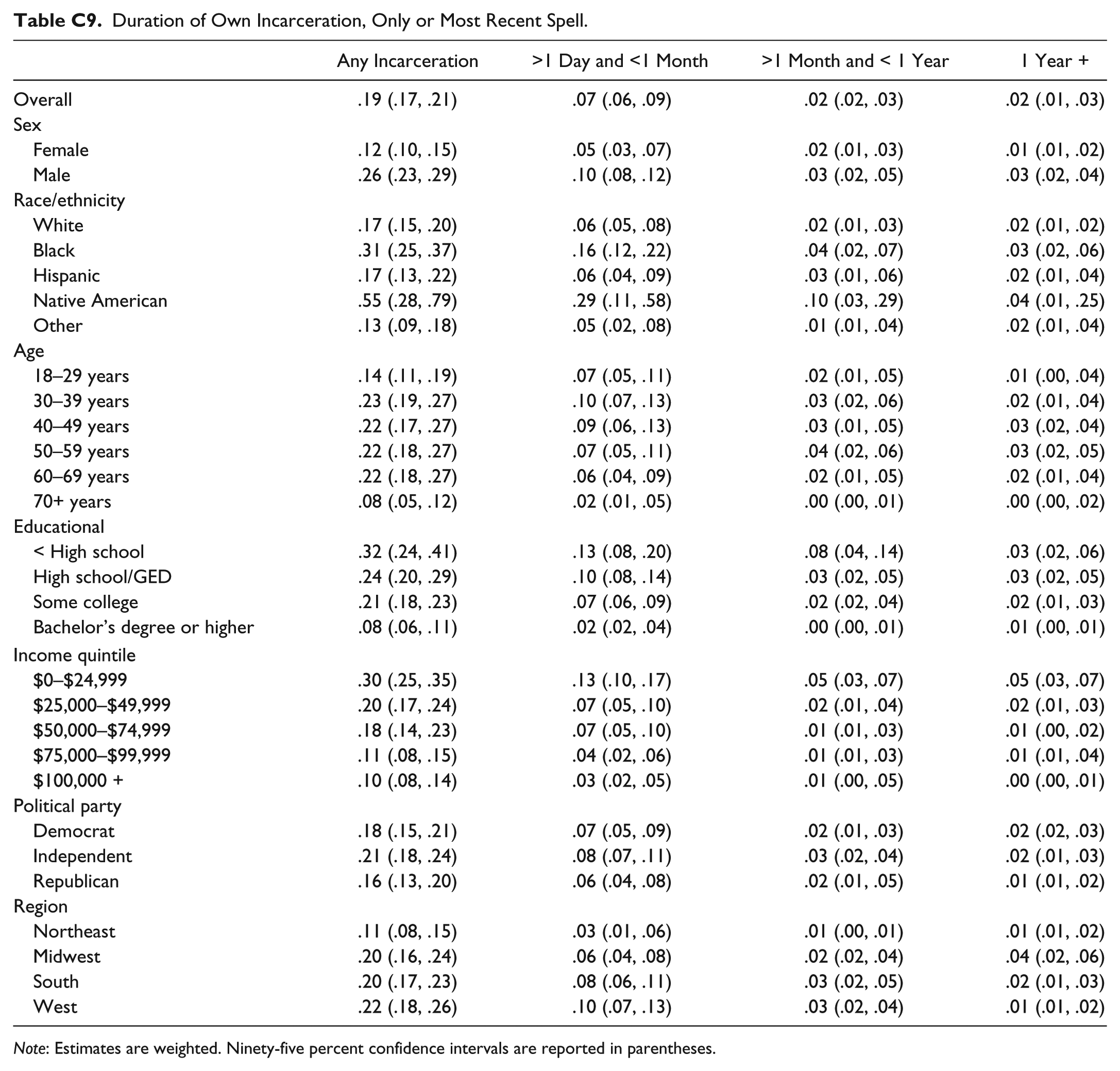
| Any Incarceration | >1 Day and <1 Month | >1 Month and < 1 Year | 1 Year + | |
|---|---|---|---|---|
| Overall | .19 (.17, .21) | .07 (.06, .09) | .02 (.02, .03) | .02 (.01, .03) |
| Sex | ||||
| Female | .12 (.10, .15) | .05 (.03, .07) | .02 (.01, .03) | .01 (.01, .02) |
| Male | .26 (.23, .29) | .10 (.08, .12) | .03 (.02, .05) | .03 (.02, .04) |
| Race/ethnicity | ||||
| White | .17 (.15, .20) | .06 (.05, .08) | .02 (.01, .03) | .02 (.01, .02) |
| Black | .31 (.25, .37) | .16 (.12, .22) | .04 (.02, .07) | .03 (.02, .06) |
| Hispanic | .17 (.13, .22) | .06 (.04, .09) | .03 (.01, .06) | .02 (.01, .04) |
| Native American | .55 (.28, .79) | .29 (.11, .58) | .10 (.03, .29) | .04 (.01, .25) |
| Other | .13 (.09, .18) | .05 (.02, .08) | .01 (.01, .04) | .02 (.01, .04) |
| Age | ||||
| 18–29 years | .14 (.11, .19) | .07 (.05, .11) | .02 (.01, .05) | .01 (.00, .04) |
| 30–39 years | .23 (.19, .27) | .10 (.07, .13) | .03 (.02, .06) | .02 (.01, .04) |
| 40–49 years | .22 (.17, .27) | .09 (.06, .13) | .03 (.01, .05) | .03 (.02, .04) |
| 50–59 years | .22 (.18, .27) | .07 (.05, .11) | .04 (.02, .06) | .03 (.02, .05) |
| 60–69 years | .22 (.18, .27) | .06 (.04, .09) | .02 (.01, .05) | .02 (.01, .04) |
| 70+ years | .08 (.05, .12) | .02 (.01, .05) | .00 (.00, .01) | .00 (.00, .02) |
| Educational | ||||
| < High school | .32 (.24, .41) | .13 (.08, .20) | .08 (.04, .14) | .03 (.02, .06) |
| High school/GED | .24 (.20, .29) | .10 (.08, .14) | .03 (.02, .05) | .03 (.02, .05) |
| Some college | .21 (.18, .23) | .07 (.06, .09) | .02 (.02, .04) | .02 (.01, .03) |
| Bachelor’s degree or higher | .08 (.06, .11) | .02 (.02, .04) | .00 (.00, .01) | .01 (.00, .01) |
| Income quintile | ||||
| $0–$24,999 | .30 (.25, .35) | .13 (.10, .17) | .05 (.03, .07) | .05 (.03, .07) |
| $25,000–$49,999 | .20 (.17, .24) | .07 (.05, .10) | .02 (.01, .04) | .02 (.01, .03) |
| $50,000–$74,999 | .18 (.14, .23) | .07 (.05, .10) | .01 (.01, .03) | .01 (.00, .02) |
| $75,000–$99,999 | .11 (.08, .15) | .04 (.02, .06) | .01 (.01, .03) | .01 (.01, .04) |
| $100,000 + | .10 (.08, .14) | .03 (.02, .05) | .01 (.00, .05) | .00 (.00, .01) |
| Political party | ||||
| Democrat | .18 (.15, .21) | .07 (.05, .09) | .02 (.01, .03) | .02 (.02, .03) |
| Independent | .21 (.18, .24) | .08 (.07, .11) | .03 (.02, .04) | .02 (.01, .03) |
| Republican | .16 (.13, .20) | .06 (.04, .08) | .02 (.01, .05) | .01 (.01, .02) |
| Region | ||||
| Northeast | .11 (.08, .15) | .03 (.01, .06) | .01 (.00, .01) | .01 (.01, .02) |
| Midwest | .20 (.16, .24) | .06 (.04, .08) | .02 (.02, .04) | .04 (.02, .06) |
| South | .20 (.17, .23) | .08 (.06, .11) | .03 (.02, .05) | .02 (.01, .03) |
| West | .22 (.18, .26) | .10 (.07, .13) | .03 (.02, .04) | .01 (.01, .02) |
Note: Estimates are weighted. Ninety-five percent confidence intervals are reported in parentheses.
Acknowledgements
We thank Gary Langer of Langer Research, Felicity Rose, and Laura Bennett for comments on the questionnaire and the article. The opinions expressed here are those of the authors and do not necessarily reflect or endorse the views of FWD.us.
Authors’ Note
The third through seventh authors are listed alphabetically to indicate equal authorship. Anna Lifsec, Ava Laub, Gabriella Lifsec, Rebecca Jackson, and Tatiana Barraza provided research assistance.
Funding
The author(s) disclosed receipt of the following financial support for the research, authorship, and/or publication of this article: This study was funded by FWD.us, which published a separate summary of the design and findings (Elderbroom et al. 2018). The data and replication code for this article are available at the Roper Center for Public Opinion Research at Cornell University ( ).
).
1
One thousand eight hundred and eight respondents reported at least one immediate family member who had ever been incarcerated for at least one night, but 2 of these respondents skipped nearly all items in the full questionnaire and were therefore assigned missing values for weight2.
2
It is common for people to spend time in both jail and prison related to a single conviction, so we did not want to create confusion by asking respondents to differentiate between the two.
3
This excludes 10 respondents who skipped the family incarceration question and 1 who indicated that they did not know if one of their family members had been incarcerated.
4
Even in our large national sample, American Indians and Alaska Natives represent just .7 percent (unweighted) of respondents. We do not include this group in Figures 5 or 6 because disaggregating by gender and education would further reduce the sample size. It is worth noting, however, that .7 percent closely tracks the estimated share of American Indians and Alaska Natives in the population aged 18 and above according to 2012–2016 American Community Survey estimates (see ).