




Abstract
The authors estimate migration flows of women in the 1990s at a global scale and provide a description of these migratory movements. The authors produce these data combining the 2011 World Bank Global Migrant Stock Database and state-of-the-art techniques to estimate migratory flows from stock data. The authors examine these flows in light of the global demand for care workers in the 1990s, showing that migration flows of women in that decade map onto the global care chains discussed in the qualitative literature. The data show that feminized migration flows in the period under analysis have a strong regional component. Yet the data also show that some of the largest feminized migratory corridors are in fact cross-regional.
Although migration was relatively gender balanced for much of the twentieth century, in recent decades there has been an increase in women-predominant or feminized flows, often indicative of a demand for care work migrants, who provide domestic work, childcare, elder care, and other forms of care for wealthier families (Parreñas 2012). Yet gender imbalances in migration remain understudied by quantitative scholars (Donato and Gabaccia 2015).
Using an unusually global World Bank bilateral migration data set (Özden et al. 2011), we estimate (Abel 2013) and map the largest feminized transnational flows, in which women constitute more than 53 percent of migrants (Donato and Gabaccia 2015) between 1990 and 2000 (Figure 1). Our visualization depicts movements among the 51 countries with the largest absolute feminized flows. Most of these feminized flows occur within regions. Yet flows to countries such as the United States, Canada, France, and the Great Britain, and flows from countries such as the Philippines, Indonesia, Russia, and China, often traverse regions.
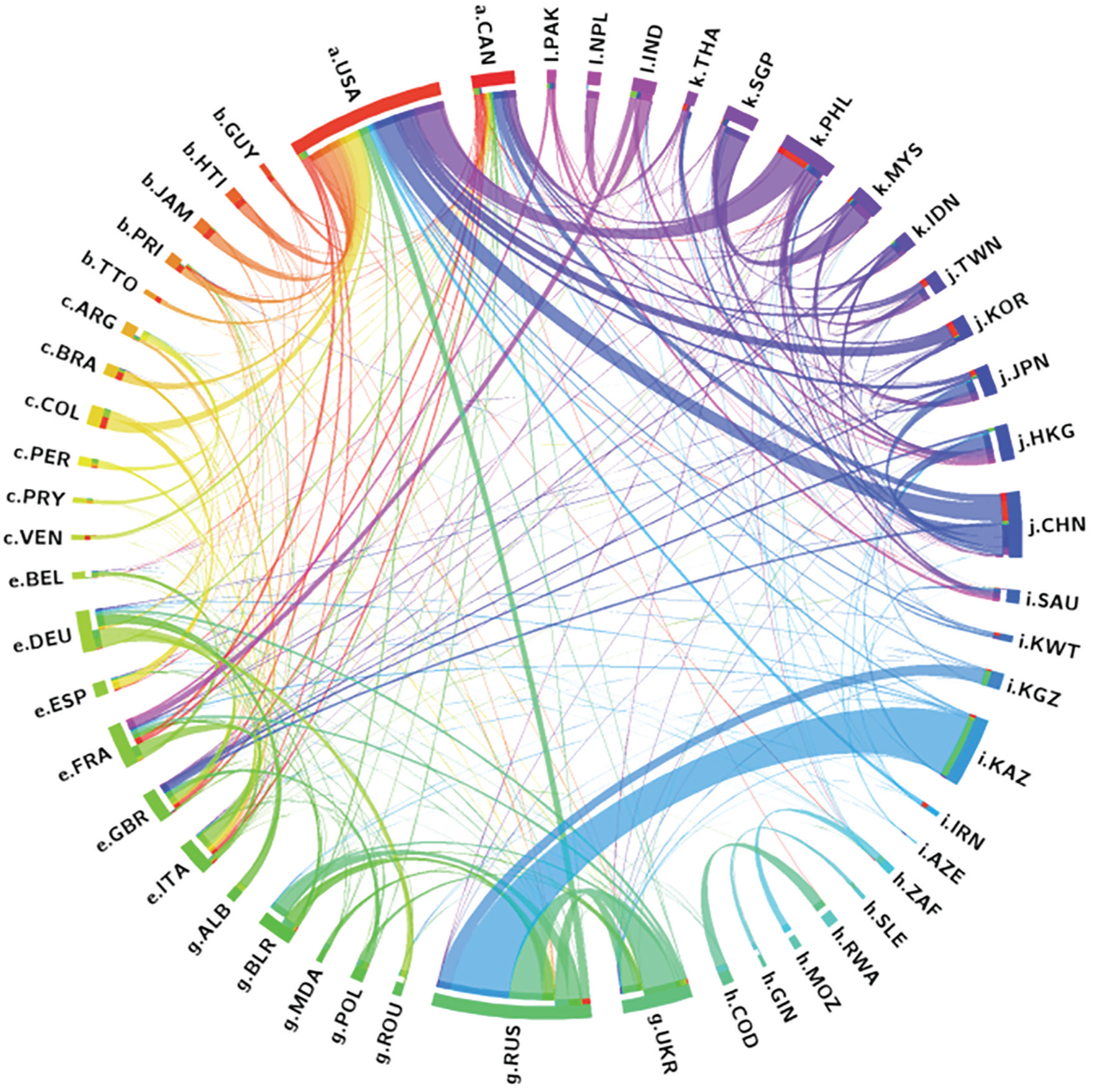
Feminized international migration flows, 1990s.
Migration within Asia, as well from Asia, is particularly interesting. The largest feminized movements within and between South East and East Asia include flows from Malaysia to Singapore and from China to Hong Kong and Japan. Smaller feminized flows exist from the Philippines to Japan and Taiwan, from Indonesia to Taiwan and Singapore, and from Korea to Japan. Many of these flows—including those from the Philippines to Saudi Arabia, which are very intensely feminized—likely indicate care work (Oishi 2005).
Wealthy countries in North America and Western Europe appear to accept many feminized flows of women. Those that look like a “rainbow” are attracting women migrants from different parts of the world. Several wealthy countries receive very large feminized flows from the Philippines, a global supplier of care workers (Parreñas 2012), as well as China. Within Western Europe, Great Britain, Italy, France, and Germany are top destination countries, attracting feminized in-flows from neighboring countries as well as Asian countries. Feminized flows to the United States, Canada, and Spain are more likely than those to other wealthy destinations to include migrants from South America and the Caribbean. Within South America, Argentina attracts women to work in care services from Paraguay and Peru (Cerrutti and Parrado 2015).
Russia is a top destination for regional female migrants primarily from the former Soviet republics of Kazakhstan, Ukraine, Kyrgyzstan, and Belarus. This reflects the resettlement and influx of immigrant workers to Russia from post-Soviet states during the 1990s and evidence of care work and marriage migration of Ukrainian and Belarusian women. Within Africa, a region that seems relatively disconnected from the global circuit, the largest feminized flows are from the Democratic Republic of Congo to Rwanda, followed by South Africa to Mozambique, and Sierra Leone to Guinea.
Ultimately, feminized flows occur regionally and globally, from within the Global South to the Global North, and from poorer countries within the Global South to wealthier ones in the same region. In the case of post-Soviet states, Russia attracts large feminized flows from its smaller neighbors while also sending feminized flows. Research must unpack the ways in which women migrate, including to meet global care needs.
Supplemental Material
migWomen1990s_appendix – Supplemental material for Visualizing Feminized International Migration Flows in the 1990s
Supplemental material, migWomen1990s_appendix for Visualizing Feminized International Migration Flows in the 1990s by Diego F. Leal, Ragini Saira Malhotra and Joya Misra in Socius
Footnotes
Acknowledgements
We thank Guy Abel for sharing invaluable information about his estimation procedures and Hsin Fei Tu for her help obtaining data.
Authors’ Note
The code necessary to replicate our results is included in the Supplementary Appendix.

Author Biographies
References
Supplementary Material
Please find the following supplemental material available below.
For Open Access articles published under a Creative Commons License, all supplemental material carries the same license as the article it is associated with.
For non-Open Access articles published, all supplemental material carries a non-exclusive license, and permission requests for re-use of supplemental material or any part of supplemental material shall be sent directly to the copyright owner as specified in the copyright notice associated with the article.
