




Abstract
The literature on group differences and social identities has long assumed that value judgments about groups constitute a basic form of social categorization. However, little research has empirically investigated how values unite or divide social groups. The authors seek to address this gap by developing a novel measure of group values: third-order beliefs about in- and out-group members, building on Schwartz value theory. The authors demonstrate that their new measure is a promising empirical tool for quantifying previously abstract social boundaries. Results from a midwestern sample show an important dichotomy such that in-groups were attributed the more positive and altruistic transcendence and openness values, while out-groups were associated conservation and enhancement, the value domains revolving around a self-focus and social restraint. Furthermore, religious attendance and political ideology also emerged as strong predictors of value boundaries, whereas socioeconomic indicators were less influential. Significance and implications are discussed.
Values are abstract, cognitive goals people use as their moral standards for establishing personal priorities (Schwartz 1992). Rooted in systems of cultural and societal moral and ideological systems, value priorities act as more than a personal moral compass; they constitute the basis of shared group moral understanding. Thus, on one hand, value priorities bring together symbolic communities through a shared sense of moral priorities; on the other hand, they operate as important bases for social distinctions capturing stable and coherent aspects of culture underlying societal differences (Hofstede, Hofstede, and Minkov 1991; Inglehart and Baker 2000; Schwartz 1992). This notion holds that values reinforce moral cohesion within groups by reaffirming social identities, often at the same time amplifying differences between groups through excluding the “other” (Kinder and Kam 2009; Tajfel and Forgas 2000). Although value differentiations (attributing different values to groups and their members) constitute a basic form of social categorization, little research has empirically tested this process (Tajfel and Forgas 2000). We still do not know which basic values (e.g., power vs. conformity) are the most important for bonding or dividing social groups and what demographic, structural, and cultural factors shape these value boundaries.
We seek to answer these questions with a novel, quantitative measurement technique that builds on the successful cross-cultural measurement of values with the Schwartz Portrait Values Questionnaire (PVQ) (Schwartz et al. 2001) to assess value distinctions as anchored in important social identities. Research on social identity theory has long established behaviorally in laboratory experiments powerful in-group biases and a resulting sense of out-group derogation (Tajfel and Turner 1979, 2004). Less has been studied, however, about the beliefs that people have about these in- and out-groups, what Ridgeway and Corell (2006; see also Correll et al. 2017) termed “third-order beliefs.” Such beliefs capture what a person thinks that members of a group or society think “in general.” We introduce a novel measure that captures third-order beliefs for in- and out-groups, offering a window into measurement of processes central to a variety of subfields across social psychology and the sociology of culture.
We suggest that a potentially crucial component of social categorization processes accentuating intragroup differences and in-group similarities and promoting established in-group processes like conformity, in-group altruism, cohesion, and so on (Hogg and Terry 2000), involves ascription of different types of values to in- and out-group members. By associating personally and culturally preferred values to in-groups and those less desirable to their out-groups, individuals create normatively and symbolically delineated social landscapes (Tajfel and Turner 2004). We propose a novel, visually accessible value boundary measure tapping into these distinctions by investigating value priorities ascribed to respondents’ most important in- and out-groups. After testing the robustness of our measurement in two samples (see Online Appendix A for details), we provide evidence, using data from a midwestern sample, for the qualitative importance of the third-order value preferences by elucidating how identifying with (or dissociating from) different groups and background characteristics contributes to the ways individuals draw value-based group boundaries. Our results suggest that respondents attributed transcendence and openness values to their in-groups more than out-groups and associated conservation and enhancement values with their out-groups. Religious attendance and political ideology emerged as strong predictors of value boundaries, whereas socioeconomic indicators were less likely to engender value-based group distinctions.
Values and Social Identities
Values are abstract cognitive systems that orient behavior toward desirable states, transcending situations and events (Schwartz 1992). Values are positioned by sociostructural and cultural factors and social institutions; yet they are also core to the self and motivate individual behavior (Hitlin and Piliavin 2004). Values have long been recognized for their potential for moral cohesion, unifying social groups toward common goals, tracing back to Parsons’s (1951) selective presentation of Durkheim (see Joas, Knöbl, and Skinner 2009 for critiques) and echoed more recently in the psychological study of culture (e.g., Schwartz 2013b, 2014). However, with some exceptions (e.g., Edgell, Gerteis, and Hartmann 2006), previous research emphasizes values as an individual-level construct (e.g., Schwartz 2012) or as an aggregated measure of national or in-group commonality from individual responses (e.g., Inglehart and Baker 2000; Schwartz 2013b), failing to take into account intergroup dimensions crystallizing group boundaries.
We suggest that values are an important part of social categorization and social identity formation as these processes are inherently normative and evaluative. People make value-laden attributions to their in- and out-group members by not only delineating group boundaries but also promoting self-esteem and enhancement (Tajfel and Turner 1979, 2004). People attribute morally charged stereotypes and emotions to group members, resulting in an in-group bias by associating uniquely human, moral emotions such as love, hope, guilt, and embarrassment with their in-group (Leyens et al. 2000) and motivating distinct types of out-group biases ranging from pity for the disabled or elderly, contempt and disgust for the poor and drug addicts, to more extreme cases of dehumanization: the inability to mentalize (or empathize) with another human being by reducing him or her to nonhuman (Fiske et al. 2002; Haslam 2006).
Although evaluative stereotypes and emotions have been studied widely in the context of in-group and out-group biases, direct comparisons of value hierarchies have been scarce. Combining belief congruence theory (Rokeach 1973) with social identity theory, Schwartz and colleagues argued that both the types of values held by evaluators and perceived value dissimilarities between in- and out-group values play a role in intergroup bias and aggression (Schwartz, Struch, and Bilsky 1990; Struch and Schwartz 1989). For example, among Israeli adults who identified more strongly with their own religious group, perceived value dissimilarities increased the level of aggression toward the ultraorthodox Jewish out-group (Schwartz et al. 1990). This view fits with image theory, proposing that perceptions of the values and goals of out-groups influence alliance and enemy formation as people and leaders demonize or dehumanize those they deem to have threatening or incompatible values (Alexander, Brewer, and Hermann 1999; Healy et al. 2002). Eicher, Pratto, and Wilhelm (2013) found that Israelis, Palestinians, Americans, and the Swiss assigned values opposite from what they hold more to their enemies than their allies. The notion of self-as-values anchored in identity (Hitlin 2003) also finds support in recent research emphasizing that individuals seek goal-directed action verifying their moral identities (Stets and Carter 2012), with moral priorities shaping individual action (Miles 2015). Accordingly, values are well suited to tap into the core elements of identities as well as culture, given their utility for understanding how culture gets internalized and shapes behavior across national and cultural contexts.
Studying how value differences are used to create and maintain social identity distinctions provides important insights into understanding how social systems and hierarchies are perpetuated or challenged (Tajfel and Forgas 2000). The sense of cohesion with others is anchored in the sense of being a member of a group important to one’s identity (Guibernau 2007). We suggest that symbolic value boundaries become tools that people use to “distinguish between ‘their sort of folks’ and ‘the sorts they don’t like much’ and in how they describe abstractly and concretely people they perceive as better or worse than themselves” (Lamont et al. 1996:34). We investigate beyond individuals’ perceptions of their personal values (“I-ness”) toward their senses of self anchored in “we-ness” (Thoits and Virshup 1997) and “them-ness.” In-group members’ violating personal values lead to a sense of dissonance (Glasford, Pratto, and Dovidio 2008), whereas out-group members are not expected to uphold an individual’s own values. We introduce a novel instrument to systematically measure the content of these values used in self- and other-definition.
Our measure of the values attributed to in- and out-groups captures a third-order sense of individuals’ beliefs about what these groups believe and thus allows us to quantify the extent that such understandings actually motivate intergroup processes established within social identity theory. By subscribing to understandings of identity anchored in a shared collective understanding of a portion of self (Tajfel and Turner 1979), our new measurement of third-order values has the potential to shift the focus of social identity studies from the personal “I” to the social “we” (Thoits and Virshup 1997) by systematically capturing collective social boundaries drawn between “us” and “them.”
The Present Study
We build on a well-established theory of basic human values, the Schwartz value theory (Schwartz 1992), which recognizes values both at the individual and cultural levels. Theory and measurement have been replicated hundreds of times, finding 10 universal value dimensions that can further be organized under four domains: openness to change values focusing on independent action, thought, and eagerness for new experiences (i.e., stimulation, self-direction, hedonism); self-transcendence values revolving around pro-socialness and concern about the welfare of others (i.e., universalism, benevolence); self-enhancement values emphasizing self-interest, power, and competitive advantage (i.e., power, achievement); and conservation values related to self-preservation, social norms, and constraints (i.e., security, traditionalism, conformity) (Schwartz 1992, 2010). These values form a circumplex in which adjacent values (e.g., achievement and power) share similar motivations, while opposite values (e.g., achievement vs. benevolence) represent conflicting poles (see Figure 1).
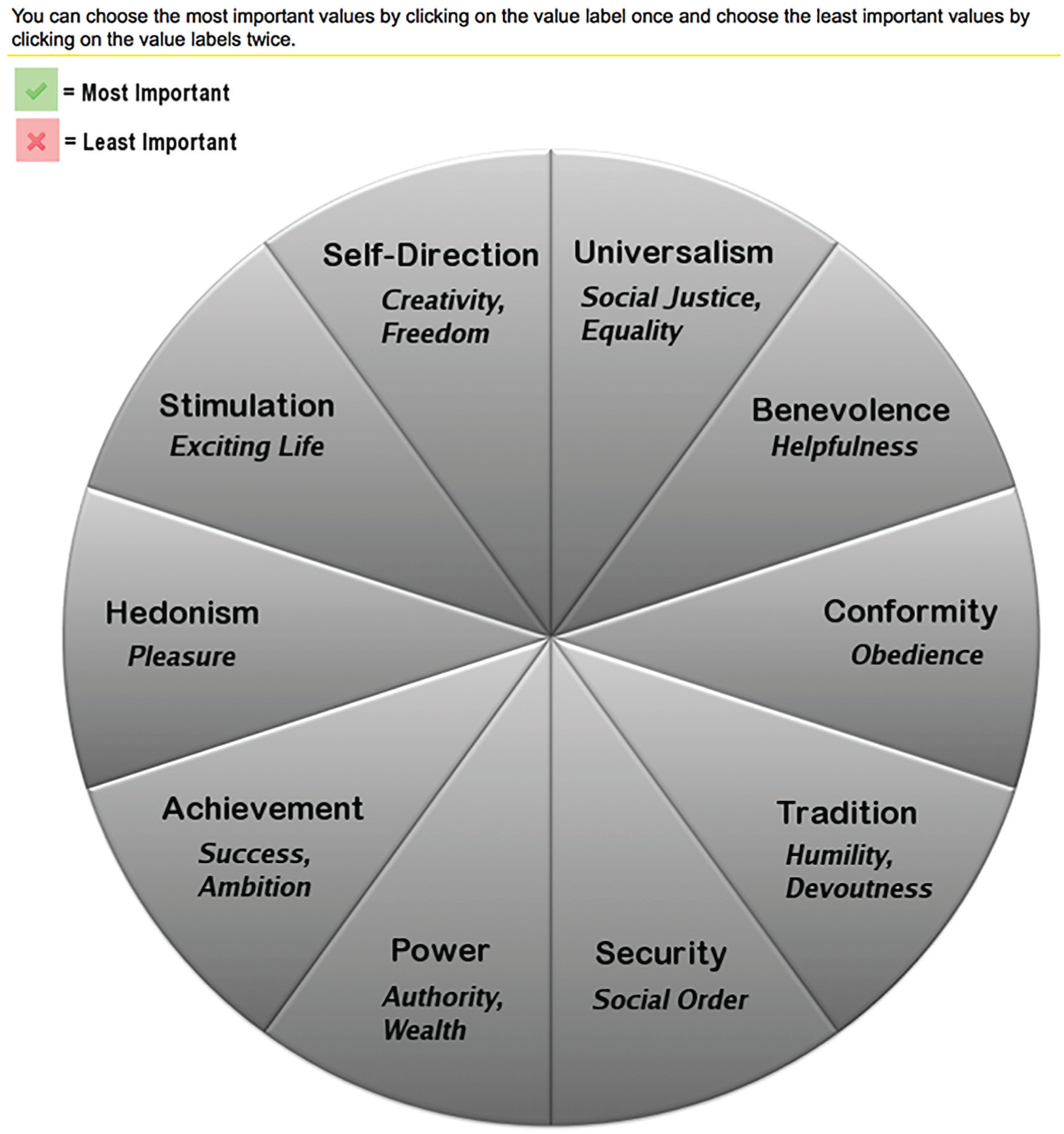
Value boundaries question.
Values at the societal level represent normative systems external to the individual that shape socialization (see Davidov, Schmidt, and Schwartz 2008; see Davidov et al. 2012 for cross-national tests for Schwartz value measurement). Schwartz (2007) suggested that shared values bind people into communities on the basis of moral inclusiveness. This moral inclusiveness is typically measured by aggregating individual-level responses to an average national-level “universalism” score. We suggest that measuring social boundaries by incorporating people’s evaluations of others’ values will offer a better measure of shared cultural value systems and moral inclusiveness than simple aggregation. Thus, we build on the growing literature linking values to both self and national identity to suggest that as values circumscribe one’s own priorities, they can be used to measure perceived in- and out-group priorities. Values anchor part of the self, and we suggest that they also signal the perceived priorities of the group identities that one holds, as well as perceptions of those out-groups that we find less desirable at best and abhorrent at worst.
There is some extant work on the nature of religious moral boundaries (e.g., Edgell et al. 2006), ethnic moral boundaries (Wimmer 2008), and other moral boundaries (Lamont et al. 1996). We explicitly focus on a variety of potential groups individuals determine as their own in- and out-groups and the values that constitute the perceived moral boundaries between them. Our measure asks respondents to choose the three most and least important values for their most important in- and out-group on a visual circumplex of 10 values (Schwartz 1992) (see Figure 1). Respondents are instructed, You indicated that the most important group in describing who you are is/your least preferred choice for neighbors would be [group name]. The diagram below shows different values people may hold. Please choose three most important and three least important values to the members of this group. That is, which values do you think are the most or the least important in determining how members of this group go about your everyday life?
This is a new, visual measurement technique that uses value labels instead of the standard Schwartz PVQ statements, intended to remove the abstraction from previous measures. This is done for two reasons. First, asking about in- and out-group values with the same format as self-values (PVQ) runs the risk of drastically biasing responses because of within-survey familiarity. Second, we are testing the possibility that visual representations of values are as easy for naive respondents to conceptualize while trying to measure the implicit understandings that motivate cultural frameworks (e.g., Vaisey 2009). We move further away from abstraction by presenting value selections for important groups as a visual, binary selection. Respondents are able to choose the most important perceived group values by clicking on the value labels once and to choose the least important values by clicking on the value labels twice. In our analyses, each value is coded 0 if chosen as a “least important” and coded 2 if picked as “most important.” Unselected values are coded 1. The final coded variable ranges from 0 to 2, distinguishing between group values that are unimportant (0), neutral (1), and important (2).
In the next section, we present results from a midwestern, adult sample of respondents who completed an online survey about identities, value boundaries, and their relevant social indicators. We collected data from 637 respondents by using an availability quota sampling technique that recruited volunteers through mass e-mails to alumni, faculty members, and staff members of a large midwestern research university. Participants took the survey online by clicking on an e-mail link. After listwise deletion of the missing cases (largely for the out-group question, which 77 respondents did not answer), our sample consisted of 523 respondents. Respondents were compensated $10 for their participation; the survey averaged 26 minutes to complete. The data are analyzed with a structural equation model that includes dummies for group identification (in-group = 1), gender (male = 1), education, age, income, religious attendance, trust, happiness, and political ideology (increasing values indicate right-wing orientation). Further details on measures, analytical strategy, and descriptive statistics can be found in Online Appendix B.
Results
First, we present results summarizing the most and least important values attributed to the most important in- and out-groups. The most highly rated social group that the respondents identified with was the family status (52.6 percent), followed by occupation (18.9 percent) and religion (10.5 percent). We have grouped the rest of the reported groups under the “other” category. For the least preferred groups (least preferred neighbor), the largest reported category was political orientation (35.2 percent), followed by language (24.3 percent) and social class (20.1 percent). We grouped the rest under the “other” category.
We summarize the values attributed to these groups in Figure 2. For this analysis, we incorporate respondents’ answers about the most and least important values to each in- and out-group (values that are unimportant are assigned 0, those that are neutral are assigned 1, and those that are important are assigned 2). Using this group value variable, we created four higher order values often used with the PVQ—self-transcendence, self-enhancement, openness to change, and conservation—by adding the values under each domain (e.g., self-direction, stimulation, and hedonism were added for openness to change; the resulting scale ranges from 0 to 6). Then we rescaled all the value variables to the same metric so that the minimum value is 0 and the maximum is 1. To create a better visual illustration, we present the values by group types on a two-dimensional chart by calculating two bipolar dimensions (self-transcendence vs. self-enhancement and openness to change vs. conservation) by subtracting the enhancement score from the transcendence score (self-transcendence vs. self-enhancement dimension) and subtracting the conservation score from the openness score (openness to change vs. conservation dimension). Creating these two higher order dimensions is suggested by Schwartz (2013a) to simplify the analyses; however, because substantial nuances might be obscured using this method of calculation, we estimate our final structural equation models using the four separate value categories. The value variables that are drawn on the graph range from −1 to 1 (see Table B2 in Online Appendix B for descriptive statistics). In Figure 2, positive scores indicate that people think certain in- or out-group members view transcendence as more important than enhancement (on the y-axis) and openness to change as more important than conservation (on the x-axis).

Value moral boundaries by in- and out-group identification.
Overall, we find that respondents perceive their in-groups (circles in Figure 2) as valuing self-transcendence rather than self-enhancement while viewing their out-groups as valuing self-enhancement over self-transcendence (triangles in Figure 2). This difference is statistically significant (p < .001) (see Table B2 in Online Appendix B for all the means, standard deviations, and pairwise comparison results). Two groups emerge as the most distinctly situated in terms of the third-order values attributed to them: religious and political groups. Those who identify with religion tend to see their in-groups as valuing self-transcendence versus enhancement (significantly higher than other in-groups, Bonferroni-corrected p < .05) (see Table B2 in Appendix B), whereas those who report those holding a different political orientation as the least preferred group attribute self-enhancement versus transcendence to this out-group (Bonferroni-corrected p < .05). Another interesting finding is that although both in-groups and out-groups are attributed a wide array of values, including enhancement and conservation to in-groups and transcendence and openness to out-groups, in-groups are not perceived to hold both enhancement and conservation high simultaneously, while out-groups are not attributed higher simultaneous levels of transcendence and openness. In sum, there are significant value differences between the in- and out-groups, especially along the transcendence-enhancement value domain.
Next, we turn to the structural equation models estimating the effects of groupness, demographic characteristics, and sociocultural variables on value boundaries (see Table 1). The model has an acceptable fit to the data with an standardized root mean square residual value of 0.09 (the only model fit statistic available with Stata’s clustered standard error structural equation model) (Hu and Bentler 1999; Iacobucci 2010). The factor loadings of the measurement models indicate relatively good fit, as the coefficients are positive and significant and range from moderate to strong, especially given the relatively small sample. To compare effect sizes, we discuss standardized coefficients (β) in the text (unstandardized coefficients, B, are also reported in Table 1). First, looking at the openness to change value equations, we see that in-groups are more likely to be attributed openness values than out-groups (β = 0.210, p < .001), and religious attendance has a negative relationship (β = −0.152, p < .05) and right-wing political ideology a positive relationship (β = 0.139, p < .05) with attributing openness values at the group level. Respondents also report that their in-groups favor enhancement values less than their out-groups (β = −0.465, p < .001); and whereas education has a positive association (β = 0.126, p < .05) with attributing enhancement values at the group-level, religious attendance (β = −0.132, p < .01), trust (β = −0.113, p < .05), and right-wing political ideology (β = −0.277, p < .001) have negative associations. Similarly, in-groups are less likely to be attributed conservation values (β = −0.492, p < .001) than out-groups, and religious attendance has a significant positive effect (β = 0.166, p < .001) on relating conservation values to groups.
Estimated Parameters and Coefficients from the Structural Equation Model Predicting Group Values (n = 523).

Note: Values in parenthesis are standard errors. B = unstandardized coefficient; β = standardized coefficient.
p < .05. **p < .01. ***p < .001.
Last, turning to the transcendence equations, we find a pattern similar to the openness value equations. In-groups are associated with transcendence values more than out-groups (β = 0.747, p < .001), and right-wing political ideology (β = 0.110, p < .001) has a positive influence on attributing transcendence values to the groups. In all models, group identification has the largest effects on values compared with other demographic variables. Moreover, group identification had the strongest effect on transcendence value domain. The effects of group identification on transcendence was almost 7 times larger than those of political ideology and more than three times larger than the effects of group identification on openness.
These results support the descriptive result that in-groups are more likely to be attributed positive (culturally prized) values such as openness and transcendence, while out-groups are more likely to be attributed enhancement and conservation values. Religious attendance seems to be a consistent predictor of group values, such that it is negatively related to openness and enhancement and positively related to conservation values at the group level. This is not surprising, considering that religiosity also predicts these values in this direction at the individual level (Schwartz and Huismans 1995). One surprising relationship that is contrary to previous research on self-values (e.g., Caprara et al. 2006) was that of right-wing political ideology and attributing more openness and transcendence and less enhancement values to the groups. We conducted follow-up structural equation modeling with interaction terms for groupness and political ideology to further investigate this (results not reported, available upon request). These analyses revealed significant interaction effects for all value outcomes. The interaction term was significant and negative for openness and transcendence and significant and positive for enhancement and conservation group values. This suggests that the effects of right-wing ideology are dependent on group identification and are in the expected direction once broken down by group type. People with increasing levels of right-wing ideology seem to be less likely to attribute openness (β = −0.571, p < .001) and transcendence (β = −0.784, p < .001) and more likely to attribute enhancement (β = 0.531, p < .001) and conservation (β = 0.808, p < .001) to their in-groups than out-groups.
In additional analyses (not reported, available upon request) we investigated the effects of individual-level self values (measured with the Schwartz PVQ) on group value distinctions to test the alternative hypothesis that group values are simply a reflection of self-values. We found that, appropriately, all individual value domains significantly predicted the equivalent third-order value (e.g., people who were more open were more likely to attribute openness to groups); however, the coefficients for groupness (in-group vs. out-group) were still significant and about the same magnitude in all equations. These results suggest that group-based value distinctions cannot be reduced to individual value preferences; categorizations of the social world into in- and out-groups exasperate moral boundaries beyond value priorities core to oneself.
Discussion and Conclusion
Schwartz (2013b) suggested that a society’s value emphasis “may be the most central feature of culture” (p. 548). In this article, we argue that focusing on third-order value orientations anchored in group memberships, not simply aggregated from self-evaluations, forms a basis for a more realistic and valid understanding of the ways culture shapes social divisions. We introduce a novel measure garnering information about the content of the in- and out-groups individuals use to define their identities with, and against, meaningful others. This is an improved measure of perceived cultural properties for in-groups and the first measure of values we are aware of for putative out-groups. The measure behaves as theorized, as we present a series of validation checks compared with the established Schwartz scheme. Respondents understand the new measure and provide reliable answers that show relatively high correlations with the standard Schwartz PVQ despite striking differences in instrument formats (studies 1 and 2 in Online Appendix A). After establishing the validity of our instrument, we present evidence that value distinctions underlie the ways people perceive core differences among groups, linking a useful cultural measure to the variety of individual and political factors that shape those values (Hitlin and Piliavin 2004).
Our results indicate that in a midwestern sample, respondents were more likely to attribute self-transcendence and openness values to their in-group and more likely to attribute enhancement and conservation values to their out-group. This is an interesting and important dichotomy, as in-groups seem to be attributed the more positive self-transcendence value, whereas out-groups are associated with a perceived desire to focus on themselves and not others, the less “moral” set of potential beliefs. Although it is possible that these value dichotomies are due to the characteristics of our mostly white, midwestern sample, we have confidence in the generalizability of our results to a wider U.S. population, as we were able to replicate these patterns (especially the group distinction along transcendence vs enhancement continuum) by analyzing data using the same measures from a recent national online survey of American adults (further data analysis is under way).
These findings fit well with previous research showing that in-groups are attributed more with altruistic motives and values, whereas out-groups are associated with antagonistic values that also underlie dehumanization (Schwartz and Bilsky 1990; Struch and Schwartz 1989). Additionally, these findings extend the literature on the so-called healthy personal values, which are related to positive evaluations of the self and higher well-being (transcendence and openness; Sagiv and Schwartz 2000), by demonstrating that at least one of these “good” value domains is attributed to the in-groups in our sample; out-groups might be perceived to be holding one of these values, but they are not reported to be simultaneously holding both at high levels. The need for positive evaluations (Tajfel and Turner 1979) seems to extend beyond the self to the identified in-groups. Not only do people think they are more benevolent than members of out-groups when self-reports are aggregated, but these patterns are also found with our novel measure of third-order beliefs about these values.
Interestingly, socioeconomic indicators had little effect on group values. Income was not significantly related to any group values and education only significantly predicted enhancement values. Although this might be due to the composition of our sample (mostly educated and middle- to upper-income brackets), one other possible explanation would be that it is not the objective socioeconomic status of the respondents but rather perceived status differences between themselves and other group members that crystallize group boundaries. Class-based value judgments made by people who think out-groups “do not respect family values” appear to have little grounding in objective indicators (see also Waters 1990), as our results indicate actual income did not shape value boundaries. However, once group distinctions are made (groups categorized into “in” and “out” groups), value boundaries seem to follow regardless, affirming social identity–based moral distinctions. These results would buttress previous ethnographic work on moral boundaries. As Lamont (2000) suggested, we need to understand the specific orientations of those who prioritize different groups; we cannot make simple claims about self-identity and privileged values by purely looking at background characteristics. Future work comparing, say, countries on their values should incorporate some measure of social identity and group perceptions as potential influences on reported values and third-order values.
Our results mostly supported previous research on the effects of religion and political ideology on self-values. The literature suggests that attitudes and behaviors endorsing traditional morality (such as religiosity) and right-wing political ideology often correlate positively with conservation and self-enhancement and negatively with self-transcendence, while left-wing orientation is related to higher self-transcendence and openness (e.g., Caprara et al. 2006; Devos, Spini, and Schwartz 2002; Schwartz, Caprara, and Vecchione 2010). Our findings are largely in line with these studies, suggesting that sociopolitical culture and worldviews extend beyond self-values into how we perceive our in- and out-group members.
These results have important implications for intergroup relationships, offering insights into the understudied (Ginges et al. 2007) interrelationships between culture, social identities, moral values, collective beliefs, and social behavior. Our measure demonstrates how social identity–based distinctions divide groups. Previous research shows that people holding self-transcendence values such as care, compassion, and fairness are willing to give more money to help out-groups (i.e., donations to Afghani women and children) than those who identify strongly with self-enhancement such as nationalistic values (Reed and Aquino 2003). We speculate that values attributed to in- and out-groups would have an even more direct influence on the behavior geared toward these groups. For example, the belief that an out-group prioritizes power and money (self-enhancement) will likely be associated with an increase in resentment against that group, potentially motivating avoidance from or conflict with the group. Thus, investigating value attributions to in-groups and out-groups has significant implications for understanding the dynamics of intergroup relationships. For this pursuit, future work can build on this measure of values as moral boundaries to explore some of its core properties including permeability, salience, durability, and visibility (Pachucki, Pendergrass, and Lamont 2007).
The present study, of course, has limitations. First, we used convenience samples to develop our instrument, constraining generalizability. Although obviously imperfect, early tests of the Schwartz theory (Schwartz and Bilsky 1987) relied on narrow samples, as did aspects of Rokeach’s (1973) influential initial work. Our measure is currently being replicated with broader, cross-national data for additional validation. Different cultural forms may shape the regulation of values and their place in drawing these moral boundaries (Cheung et al. 2016). Cultural differences exist in the levels of tolerance or social trust toward out-groups (e.g., Hooghe et al. 2009; Inglehart and Norris 2003), and these differences have not been linked to the ways people understand third-order moral obligations toward in-groups and out-groups.
Second, although our visually based methodology is easily graspable by respondents, the binary coding system ends up truncating the potential variation in the original PVQ measure. Our instrument offers the strength of ease of response from naive participants, at the cost of numerical precision.
Third, our group identification measures rely on self-reports of the most important groups; we do not have information on the frequency or the quality of actual interaction with the most important in- and out-groups identified by respondents. This falls in line with conventional measurement of valued identities. Further research is needed to address these issues.
In conclusion, this study offers an important model that links culture with individual-level group moral boundaries through a novel measure of third-order value orientations, offering a new empirical tool for drawing links among individual, group, and cultural levels. Thus, a social psychologically developed measure can be used to address core questions about group divisions that exist more in line with sociology of culture understandings of general beliefs “out there” rather than relying on simple aggregation of individuals to determine those cultural beliefs. Operating in the space between social identity theory and basic value theories, our work calls for more engagement with how cultural patterns connect to deeply internalized individual representations of “us” and “them.”
Supplemental Material
ONLINE_APPENDIX – Supplemental material for A Novel Measure of Moral Boundaries: Testing Perceived In-group/Out-group Value Differences in a Midwestern Sample
Supplemental material, ONLINE_APPENDIX for A Novel Measure of Moral Boundaries: Testing Perceived In-group/Out-group Value Differences in a Midwestern Sample by Rengin B. Firat, Hye Won Kwon and Steven Hitlin in Socius
Footnotes
Acknowledgements
We thank Ethan Rogers for his helpful insights on earlier versions of this article.
Funding
The author(s) disclosed receipt of the following financial support for the research, authorship, and/or publication of this article: The research reported here was funded in whole or in part by award W911NF-13-1-0342 from the U.S. Department of Defense and the U.S. Army Research Office/Army Research Laboratory under the Minerva Research Initiative. The views expressed are those of the author(s) and should not be attributed to the Department of Defense or the Army Research Office/Army Research Laboratory.

Author Biographies
References
Supplementary Material
Please find the following supplemental material available below.
For Open Access articles published under a Creative Commons License, all supplemental material carries the same license as the article it is associated with.
For non-Open Access articles published, all supplemental material carries a non-exclusive license, and permission requests for re-use of supplemental material or any part of supplemental material shall be sent directly to the copyright owner as specified in the copyright notice associated with the article.
