




Abstract
Most scholarship on hookup culture has focused on college students’ sexual activity and has overlooked the post-hookup “ritual retelling” as a subject of systematic research. This study examines the impact of gender beliefs regarding sexual activity, particularly the recreational and relational orientations of men and women, respectively, as well as the situational context, namely, the gender of their conversational partners. Results from a survey of college students (N = 470) reveal that men and women would be more likely to share a hypothetical hookup experience with same-sex than with cross-sex best friends. Moreover, women would be more likely than men to share relational rather than recreational details, though details vary by situational context. Results suggest that women’s ritual retellings generally reflect gender beliefs, but men switch between a recreational and a relational emphasis depending on the gender of their conversational partners. This suggests that women face greater constraints than men in expectations regarding sexual activities.
For more than a decade, scholars have discussed the gendered norms and practices associated with the “hookup culture” on American college campuses (Aubrey and Smith 2013; Bogle 2008; Heldman and Wade 2010; Kuperberg and Padgett 2016; Reiling et al. 2018; Wade and Heldman 2012). More recently, scholars have expanded the conceptualization of hookup culture beyond the realm of the purely sexual to include other practices, such as the “ritual retelling” of the previous night’s events during which college students “fill their friends in on blurry memories, reassure one another that they didn’t act too crazy, stroke the egos of disappointed friends, and brag” (Wade 2017:104). Some attention has been directed to the ways in which college students talk about casual sex more generally (e.g., see Trinh 2016; Trinh and Ward 2016) and about hookups (e.g., see Currier 2013; Holman and Sillars 2012; Paul and Hayes 2002; Wade 2017), but few studies examine variations by gender in the ways individuals talk about hookups (see Currier 2013, for an exception). In general, systematic research on the ritual retelling is relatively sparse and reveals more about what respondents share with researchers than about what respondents share with their peers. Moreover, researchers have overlooked how talk about hooking up might vary by the gendered context of conversations, that is, whether and how men and women would talk with their same-sex and cross-sex friends.
Since findings suggest that sexual activity is relatively moderate among college students (England, Shafer, and Fogarty 2012; Garcia and Reiber 2008; Wade 2017), participating in the post-hookup ritual retelling is likely an important way in which individuals engage with hookup culture. Consequently, college men’s and women’s strategies for talking about their own hookups may reveal how the gender beliefs (Ridgeway and Correll 2004) upon which they draw regarding sexual activity vary by the gender of conversational partners. In addition to contributing to the literature on the ritual retelling, this study speaks more broadly to theoretical approaches to the study of gender. Research suggests that sexuality is an important arena for understanding gender beliefs because there are such strongly gendered notions about men and women as sexual beings (Hamilton and Armstrong 2009). Therefore, conversations about one’s own hookups provide a unique venue in which to examine potential variations in how gender beliefs are invoked depending on the situational circumstances, here the gender of the conversational partners. In other words, cross-sex interactions among friends have the potential to provide conversational spaces that are less clearly dominated by one gender’s norms regarding sexual behavior. Variations in individuals’ hookup stories by the situational context may reveal how the specific gendered context of interactions, in this case, the speaker’s gender in relation to the conversational partner’s gender, influences the gender beliefs that individuals invoke as they portray themselves as sexual beings. Such variations also may suggest that specific gendered contexts affect the gender beliefs that individuals call upon in interactions in other arenas, apart from sexual ones, more so than the existing theory acknowledges.
To examine how individuals would manage gender beliefs in the telling of their own hookup narratives, we examine the likelihood that U.S. men and women college students would share various details of their own hookup experiences with their best male friends and their best female friends. We employ Hamilton and Armstrong’s (2009) application of Ridgeway and Correll’s (2004) gender beliefs approach to this examination as we investigate the ways in which the situational context, especially the gender of conversational partners, influences the extent to which individuals would share details about their own hookups.
Background
Gender Beliefs
While some earlier scholarship on hooking up has conceived of gender as an individual-level status characteristic (e.g., see Bogle 2008; Eshbaugh and Gute 2008; Glenn and Marquardt 2001), more recent research takes the approach that gender is a social structure that operates on multiple levels (e.g., see Currier 2013; Hamilton and Armstrong 2009; Wade 2017; Wade and Heldman 2012). Ridgeway and Correll’s (2004) gender beliefs framework focuses on social-psychological processes implicated in gender at the interactional level. According to Ridgeway and Correll (2004), gender beliefs are schemas, or mental structures (Sewell 1992), that delineate distinguishing characteristics of women and men and function as “rules of the game,” systematically shaping how individuals enact gender and how others evaluate their gender. According to Ridgeway (2009, 2011), however, gender is most salient in situations in which (1) men and women are interacting in a mixed-sex setting, or (2) there are cultural assumptions based on gender about the activities, even in same-sex settings. In these two contexts, both of which are present in our study, powerful hegemonic gender beliefs are likely to shape individuals’ gendered behaviors as well as how others evaluate individuals’ gendered behaviors.
Even those who do not internalize hegemonic gender beliefs are held accountable to the “rules of the game” in many of their interactions (Ridgeway 2009) because the social costs of breaking the rules can be high. Consequently, individuals are likely to act in ways that draw on hegemonic gender beliefs even when they do not personally endorse them. However, when individuals are in settings where they know they are around like-minded individuals who hold gender beliefs different from hegemonic ones, such as a “gathering of feminist friends or African American colleagues” (Ridgeway and Correll 2004:514), alternative gender beliefs will be most salient.
Gender beliefs and sexuality
While Ridgeway’s perspective was originally linked to research on work and occupations, more recently scholars have applied this perspective to activities in the sexual arena, including hooking up and dating (Hamilton and Armstrong 2009:592) and sexualized dancing at college parties (Ronen 2010). Hamilton and Armstrong (2009) called for greater attention to gender beliefs in the sexual arena given the high salience of gender within such relational contexts and strong cultural assumptions that men and women have different sexual desires and needs. They argue that the primary public gender beliefs about men’s and women’s sexual behavior relate to the sexual double standard and the relational imperative (Hamilton and Armstrong 2009).
The sexual double standard holds that men and women are judged differently for engaging in sexual behavior. This double standard historically meant that women were judged negatively for any sexual activity outside of a marital relationship in contrast to men, who largely avoided negative judgment (Crawford and Unger 2000). More recently, the double standard suggests that women are expected to engage in sexual activity only within romantic relationships whereas men are expected to pursue sex regardless of the relational context (Crawford and Popp 2003). Related to the sexual double standard, then, is the belief that women should have a relational orientation to sex; they should desire long-term relationships and engage in sexual activity with romantic partners with whom they are in love rather than with casual acquaintances. Hamilton and Armstrong (2009) call this the “relational imperative.” In contrast, men are expected to be interested in sexual activities and to pursue them regardless of the relational context (Crawford and Popp 2003). Representations of dominant sexual scripts for men in popular media further suggest that men should actively pursue sex for pleasure (Kim et al. 2007). This more recreational orientation means that for men there is less concern about too much engagement in sexual activities.
The evidence is mixed regarding the extent to which individuals endorse these beliefs, especially the sexual double standard (Allison and Risman 2013; Crawford and Popp 2003; Jonason and Fisher 2009; Jonason and Marks 2009; Marks and Fraley 2005); however, many studies reveal that individuals still consider these public beliefs to be widely shared and negotiate with them in their hookups and other sexual experiences (e.g., see Armstrong, England, and Fogarty 2012; Bogle 2008; Conley, Ziegler, and Moors 2013; Hamilton and Armstrong 2009; Kettrey 2016). Moreover, research provides evidence of the consequences of these gender beliefs in individuals’ lives. In their research, Hamilton and Armstrong (2009) note that women shape their behavior, hide their sexual activity, and even work to avoid sexual relationships with men in ways that respond to these gender beliefs. Other studies, while not explicitly engaging in gender beliefs theory, find additional evidence for their existence. For example, women are more likely than men to be aware that their sexual behavior may be scrutinized (Bogle 2008) and worry about the social consequences of hooking up (Napper et al. 2016), particularly when they engage in sexual intercourse with someone they have known less than 24 hours (Owen and Fincham 2011). Women report feeling negatively judged for hooking up (Kettrey 2016) and that if they have hooked up with many partners they may be labeled sluts (Bogle 2008; Currier 2013; Paul 2006) or get a “bad reputation” (England et al. 2012; Farvid, Braun, and Rowney 2016). As a result, alcohol may play a more important role for women than for men in excusing their hookups (Beres and Farvid 2010; Livingston et al. 2013); that is, as women’s behavior veers away from the relational orientation, they may rely on alcohol to excuse them from being responsible for their actions.
In contrast, evidence suggests that men often endorse beliefs about recreational sex (Kimmel 2008) or end up feeling left out of the hookup scene entirely (Wade 2017). Men are more likely than women to receive approval from their same-sex peers for hookups (Holman and Sillars 2012), and evidence or implied evidence of a man’s active heterosexuality has positive consequences for him in that it impresses other men and influences their evaluation of his masculinity (Currier 2013). Moreover, men gain status with other men based on the range of sexual practices in which they engage with female partners and, at times, the skills that they apply to women’s bodies to produce pleasure (Flood 2008). Though men and women are both concerned with the level of attractiveness of their hookup partners, evidence suggests that men are especially focused on the attractiveness of women’s bodies and may experience harsh ridicule when they hook up with the “wrong” female partners (Wade 2017).
Research has shed light on the ways in which gender beliefs regarding the sexual double standard, relational orientation, and recreational orientation shape individuals’ experiences and interpretations of hooking up, but there has been less attention to another part of the hookup script, that is, the ritual retelling of the previous night’s sexual escapades. This relative lack of attention to the ritual retelling in hookup culture is notable for a number of reasons. First, there is considerable evidence that this ritual practice is very common among college students (Bogle 2008; Holman and Sillars 2012; Paul and Hayes 2002; Wade 2017); therefore, the ritual retellings appear to be an important discursive space where meaning is made about hooking up and those engaging in it. Second, ritual retellings are likely to invoke gender beliefs regarding sexuality, requiring men and women to negotiate gendered expectations regarding the sexual double standard, relational orientation, and recreational orientation. Finally, given that ritual retellings occur in situational contexts that may vary by the gender of conversational partners (i.e., best male friends, best female friends), different gender beliefs surrounding men’s and women’s sexuality may shape the content with different conversational partners. Some contexts may involve hegemonic gender beliefs, and others may involve alternate gender beliefs. Research to date has not examined these matters or the ways in which ritual retelling may relate to hegemonic gender beliefs depending on the gender of conversational partners.
Talk among Friends about Hookups and Sex
There has been some attention to the kinds of talk associated with hookup culture (Currier 2013; Holman and Sillars 2012; Paul and Hayes 2002; Wade 2017); however, research on the ritual retelling, particularly as it relates to individuals’ sharing of their own personal hookup stories and the content of these narratives, is rare (for an exception, see Paul and Hayes 2002), and even then, researchers are mostly reporting what respondents shared with them (e.g., see Farvid and Braun 2017; Paul and Hayes 2002) rather than what respondents shared with their friends. Paul and Hayes (2002:649) find in their sample of undergraduates that 54 percent report talking with friends about their best hookups and 40 percent report talking with friends about their worst hookups, though the researchers did not look at how this varies by the respondents’ or friends’ gender. In their discussion of their qualitative data, Paul and Hayes (2002:655) do suggest that men are most likely to discuss the hookup with peers when their hookup partner is attractive whereas women are most likely to share their hookup experience when it is not regretted. In Bogle’s (2008:58–59) study of hooking up, the college students she interviewed report that gossip regarding who hooked up and how “far” they went is “a common pastime,” though it is unclear how much individuals talk about their own experiences. One respondent suggests that men are more graphic in the details they share (Bogle 2008:91), but Bogle does not explain whether there are gender differences in sharing details of the hookups. In their analysis of an online survey of students in a college course, Holman and Sillars (2012:212) asked respondents with whom they talked about “people engaging in casual sex or hookups,” including the connection between alcohol and hookups. Holman and Sillars find that respondents talk with friends more than family members, but they do not examine variation by gender, nor do we know if respondents discuss their own hookups.
In a study examining the ways in which college students describe and interpret hookups, Currier (2013) finds that women and men use the term “hookup” in strategically ambiguous ways with their peers to conform to components of emphasized femininity and hegemonic masculinity, respectively. This strategic ambiguity allows women describing a hookup to downplay their sexual activity in hopes that their peers will believe that sexual intercourse did not occur, thereby protecting their reputations. In contrast, this strategic ambiguity allows men describing a hookup to their peers to imply that they went “far” and that perhaps sexual intercourse did occur in order to enhance their reputations with other men (Currier 2013). Nevertheless, respondents in this study did not report explicitly how they talk about their own hookups; rather they report their perceptions of the ways in which men and women generally talk about hooking up.
Finally, Wade (2017) claims that talk about hookups is widespread among college students, especially in the ritual retelling that occurs the day after parties. While she does not focus on variations in this talk by gender of conversational partners, there are a few findings in her study that touch on how male friends may react to their same-sex friends’ narratives. For example, men who hook up with the “wrong” female partners may face ridicule from their male friends during these conversations (Wade 2017:171). Individuals may claim they were inebriated as an excuse for their hookup (Vander Ven and Beck 2009) and also to establish the meaninglessness of their sexual encounters (Wade 2017:43–45). Overall, then, although the literature on talk about hookups does not engage with a gender beliefs approach, it does provide evidence of moments in which individuals respond to beliefs about the sexual double standard, relational orientation, and recreational orientation in their talk.
Although they are not specifically about post-hookup conversations, previous studies on talk among friends about sex more generally have identified gender variation in the patterns and content of this talk. Studies show that young women discuss sex-related issues, including a variety of topics such as dating, fertility issues, contraception, and abstinence, more than men do (Lefkowitz, Boone, and Shearer 2004; Lefkowitz and Espinoza-Hernandez 2007; Trinh and Ward 2016). Studies also suggest that different discourses are at play in women’s and men’s conversations with friends. Research suggests that adolescent girls view their same-sex friendship groups, in contrast to their wider circle of peers, as safe spaces for discussing romantic and sexual activity, free of judgment (Lyons et al. 2011). However, undergraduate women appear to receive complicated and, at times, contradictory messages about sex from same-sex friends that often combine sex positivity with the encouragement of sexual gatekeeping (Trinh 2016). Women also report receiving messages that highlight different sexual scripts, or sets of commonly communicated “sexual values” (Trinh and Ward 2016:298), from their female and male peer groups. From female peers, they receive a “relational script,” which promotes sexual activity within loving, committed relationships, as well as a “heterosexual script,” which portrays men as active and women as passive in sexual encounters and relates to the sexual double standard (Trinh and Ward 2016:302–303). In contrast to their female friends’ constrained support for their sexual agency, women report receiving from male friends more straightforwardly sex-positive messages, even about casual sexual encounters (Trinh 2016).
Although men report talking less about sex with their same-sex friends (Lefkowitz and Espinoza-Hernandez 2007; Lefkowitz et al. 2004; Trinh and Ward 2016), the messages they report receiving involve a “recreational sexual script” that promotes many forms of sexual activity, including casual encounters, as fun (Trinh and Ward 2016). Their conversations with friends also tend to emphasize sexual performance and avoid discussions of sexual health (Knight et al. 2012). While these studies do not explicitly engage with Ridgeway’s framework, their findings suggest that gender beliefs surrounding the sexual double standard, relational orientation, and recreational orientation are reflected in talk about sex.
Most of these studies do not examine how individuals talk about their own sexual experiences (e.g., see Currier 2013; Trinh 2016; Trinh and Ward 2016); therefore, the patterns of talk that they identify may reflect perceptions of how others talk about hookups and sex rather than respondents’ strategies for sharing their own hookup stories. Moreover, these studies have not included cross-sex friends (Knight et al. 2012; Lefkowitz and Espinosa-Hernandez 2007; Lefkowitz et al. 2004), so the extent to which communication may be similar or different with same-sex and cross-sex friends is not known. Consequently, while research to date indicates that conversations about hooking up are a common practice within hookup culture, a systematic examination focusing on these conversations, particularly those involving individuals’ own hookup stories and how their content would vary by gender of conversational partners, is rather limited.
Research Questions
We pursued three main research questions about the post-hookup ritual retelling. For each of these questions, we were interested in the impact of gender beliefs, specifically those associated with the double standard and sexual activities, including the recreational orientation for men and the relational orientation for women. First, how likely would men and women be to share with their best friends a post-hookup narrative, including particular types of details? Second, to what extent does the gender of the respondents’ hypothetical conversational partners (i.e., best male friends, best female friends) have an impact on the likelihood that men and women would share a post-hookup narrative, including particular types of details, thus reflecting the salience of gender in the situational context? Third, to what extent would invoking alcohol in a post-hookup narrative vary by the respondent’s gender?
Methods
Measures
Since studies show that respondents’ ideas about what constitutes a hookup are quite varied (e.g., see Currier 2013; Garcia et al. 2012) and can range from kissing to sexual intercourse, we standardized the hookup situation. That is, to remove ambiguity, we asked questions about a hypothetical hookup and specified that the hypothetical hookup involved sexual intercourse. A hypothetical situation would allow us to gain access to the mental structures that gender beliefs represent. The Bogardus Social Distance Scale (Bogardus 1933), a long-standing and widely used measure of prejudice (Wark and Galliher 2007), poses to respondents a series of hypothetical situations regarding varying degrees of closeness and was designed to measure respondents’ attitudes about members of select social groups, such as racial or ethnic groups. We, along with researchers who use the Bogardus Social Distance Scale or hypothetical questions about other topics, recognize that responses to hypothetical questions cannot reveal exactly how individuals will act; however, the responses to such questions should reflect individuals’ attitudes and tap into their beliefs (Quattrone and Tversky 1988). Here, we chose sexual intercourse for our questions because college students tend to think of intercourse as “going farther” than other sexual activities (England et al. 2012); therefore, it had the most potential to reveal the impact of gender and gender beliefs. Consequently, the survey read, “Imagine that you hooked up, in this case meaning had sexual intercourse, with a person you had not hooked up with before.” The words that appear in italics were printed in boldface on the survey. For many questions, we wanted to examine the impact of the gender of the conversational partners, specified as their best friends, on the ritual retelling; therefore, the respondents were asked the same questions for their best male friends and for their best female friends. For the presentation of results, these were converted into same-sex best friends and cross-sex best friends based on the combination of the gender of the respondents and the gender of their conversational partners.
Likelihood of engaging in the ritual retelling
Respondents were asked, “How likely would you be to tell each of the following about the hookup?” The response categories were very likely, somewhat likely, not very likely, and not at all likely, though the last two responses were combined in the analysis. Respondents answered this question separately for their best male friends and their best female friends so that the impact of the situational context for men and for women could be evaluated.
Types of details
For both their best male friends and their best female friends, respondents were asked, “What types of details about the hookup would you be likely to share (regardless of whether you volunteered the details or they asked you)?” The battery of 12 details was designed to reflect various aspects of gender beliefs. For each of the 12 specific details, respondents were asked to check the response circle only if it was a detail that they would be likely to share. Of the details, three were more relational, namely, respondent’s emotional feelings for the partner, partner’s emotional feelings for the respondent, and the likelihood of the hookup’s happening again. There were three sexual activities details, namely, sexual positions, sexual acts that took place, and foreplay, all of which reflect a more recreational orientation. Some details were about the hookup partner, namely, the partner’s level of sexual pleasure, the partner’s achievement of orgasm, and the partner’s body, whereas others were about the respondents themselves, namely, their level of sexual pleasure and their achievement of orgasm. These latter details seem more closely aligned with the recreational orientation than with the relational orientation. Finally, and unrelated to the other details, we asked respondents whether they would be likely to share details about the birth control used or lack thereof, suspecting it might be gendered.
Alcohol in the narrative
Here we were not interested in alcohol use per se but rather the role alcohol might play in the portrayal of the hookup in the ritual retelling. Consequently, respondents were asked, “For each of the following situations, regardless of the role that alcohol might have played in the hookup, how much would alcohol play into the narrative you would tell about the hookup?” Respondents were asked about six categories of individuals with whom they could have hooked up: someone with whom they had been wanting a romantic relationship, a platonic close friend, an acquaintance, someone they had not met before, someone everyone thinks is hot, and someone they knew had hooked up with many others. These first four categories represent varying degrees of closeness or desired closeness to the hypothetical hookup partner and will be used to evaluate the impact of the relational orientation on the likelihood of sharing, whereas the last two hypothetical hookup partners reflect a more recreational orientation. The responses provided were a lot, some, a little, not at all, and I do not drink alcohol. For the analysis, the I do not drink alcohol response was removed, and a little and not at all were combined for the analysis of each of the six categories of individuals.
Sample
After receiving approval from the college’s institutional review board (IRB), a web survey was posted on Amazon’s Mechanical Turk (MTurk), a crowdsourcing platform that researchers can use to recruit respondents and administer surveys. According to Casler, Bickel, and Hackett (2013), data collected using MTurkers as respondents produce results comparable to other forms of respondent recruitment, thus affirming MTurk as a reliable platform for the administration of surveys. Casler et al. (2013) further suggest that MTurk provides the opportunity to gather high-quality data with a much greater degree of diversity among respondents than that of a sample of college students on a singular campus, a commonly used source of data.
Through MTurk’s platform, the sample was restricted to those who currently reside in the United States and had graduated from American high schools. Since much of the literature on hookup culture is about men and women who are heterosexual college students, we wanted our sample to match these characteristics. Consequently, we publicized additional restrictions in the MTurk posting and further dedicated the first three survey questions to automatically taking ineligible respondents to the end of the survey, thus preventing them from completing the survey. Only those who indicated they were 18 years or older and responded affirmatively to the voluntary consent agreement began the survey.
Our final sample consisted of 470 respondents, 265 men and 205 women. With regard to college class year, the sample consisted of 197 seniors, 127 juniors, 82 sophomores, 19 first-years, 43 who chose “other”, and 2 respondents who did not answer this question. Respondents who chose “other” were those who felt they did not perfectly align with a class year. Students from 310 colleges and universities located in 45 states participated in the study. With regard to race, respondents were provided with six possible responses, including “other,” and could check as many categories as they wanted. Of the 470 respondents, more than 95 percent checked only one category. Of those, 72.3 percent described themselves as Caucasian, 9.8 percent as Black or African American, 6.0 percent as Asian/Pacific Islander, 5.5 percent as Latino or Hispanic, 0.6 percent as Native American or Aleutian Islander, and 1.3 percent as “other.” Of the remainder, 3.8 percent checked two or more categories, and 0.6 percent did not provide a response to the question.
Results
Likelihood of Telling Their Best Friends
Table 1 shows that more than three-quarters of both men and women would be very likely or somewhat likely to share their hookup experience with their same-sex friends, offering support for the notion that the ritual retelling is a notable aspect of hookup culture. In addition, the table shows that both men (columns 1 and 3) and women (columns 2 and 4) would be more likely to share their hookup experience with their same-sex best friends than their cross-sex best friends. The McNemar-Bowker test, used for within-subject comparisons, indicates that the relationship between the likelihood of telling same-sex and telling cross-sex best friends is significant for men respondents (χ2 = 89.20, df = 3, p < .0001) and for women respondents (χ2 = 103.15, df = 3, p < .0001).
Sharing a Hypothetical Hookup with Same-sex and Cross-sex Best Friends, by Respondent’s Gender.

Note: For men (columns 1 and 3), McNemar-Bowker = 89.20, df = 3, p < .0001. For women (columns 2 and 4), McNemar-Bowker = 103.15, df = 3, p < .0001. For same-sex best friends by gender (columns 1 and 2), χ2 = 11.61, df = 2, p < .003. For cross-sex best friends by gender (columns 3 and 4), χ2 = 0.47, df = 2, p = .467.
Table 1 also shows that a larger percentage of women than men would be very likely to share their hookup experience with their same-sex best friends (columns 1 and 2), and there is a significant relationship with respondents’ gender as revealed by Pearson’s chi-square (χ2 = 11.61, df = 2, p < .01), used for independent samples. Moreover, with regard to sharing the hypothetical hookup with cross-sex best friends, there are only small differences in the responses of men and women (columns 3 and 4).
“Tell Me More”: Sharing the Details of the Hookup
The findings concerning the likelihood of sharing 12 details about a hookup appear in Table 2. Each of the 12 details is designated by category: relational (rl), sexual activity (sa), about the partner (p), about oneself (o), and birth control (br). Table 2 displays a comparison of men’s and women’s likelihood of sharing with same-sex best friends and with cross-sex friends.
Sharing Details with Same-sex and Cross-sex Best Friends, by Gender.

Note: Dashes indicate the relationship with gender was not significant. Details: rl = relational; sa = sexual activity; p = about the partner; o = about oneself; br = birth control. For men (columns 1 and 3), p < .0001 for McNemar tests for 10 of the 12 details and is therefore significant using the Bonferroni corrected critical value (.05 / 12 = .004); the McNemar tests are not significant for two details: feelings for partner (p = .362) and partner’s feelings (p = .314). For women (columns 2 and 4), p < .0001 for McNemar tests for all 12 details using the Bonferroni correction. For same-sex best friends by gender (columns 1 and 2), of the 12 details, the chi-square value is significant for 6 details without using the Bonferroni-corrected critical value and for 4 details with the correction. For cross-sex best friends by gender (columns 3 and 4), the chi-square values are not significant for any of the details, so the p values are not reported.
Top details respondents would share
Based on the percentages, more than half of men would be likely to share 9 of the 12 details (column 1), and more than half of women would be likely to share each of the 12 details (column 2) with their same-sex best friends (see Table 2). Based on those percentages, the top three details, each of which more than 70 percent of women would be likely to share with their same-sex best friends, are the three relational details, namely, their feelings for their partner, their partner’s feelings for them, and the likelihood the hookup would happen again. In contrast, the top three details of the hookup that men would share with their same-sex best friends include only one relationship variable, the likelihood it would happen again; sexual acts, a sexual activity variable; and partner’s body, a partner variable. For cross-sex best friends, the top three details that women would share (column 4), are identical to what they would share with same-sex best friends, namely, the three relationship variables. The top three details that men would share with their cross-sex best friends are also the three relational details (column 3), which is somewhat different from what men would share with their same-sex best friends.
A comparison of sharing with same-sex and cross-sex best friends
We use a McNemar test to examine differences in the likelihood of sharing each of the 12 details with same-sex best friends and with cross-sex best friends for men (columns 1 and 3) and for women (columns 2 and 4) (see Table 2). Given that the test is repeated for each of the 12 details, we use a Bonferroni correction, the most conservative correction for significance tests. To do this, we divided the critical value of .05 by the number of details, namely, 12, and the result, .004, was then used as the critical value for statistical significance. For women, the McNemar tests are significant for each of the 12 details, even using the Bonferroni-corrected critical value of .004 for statistical significance. It is also the case that for same-sex best friends, the percentage of women who would share details such as their own pleasure and their partner’s body differ little from the percentage of women who would share the three relational details; however, for sharing with cross-sex best friends, the percentage of women who would share details that are not relational is much lower. For men, the McNemar tests are significant for all but 2 of the 12 details, both of which are relationship details, namely, their feelings for their partners and their partners’ feelings for them. Men are much more likely to share the other 10 details with their same-sex than cross-sex best friends.
A comparison of men’s and women’s responses for the 12 details
Since men and women represent independent samples, Pearson’s chi-square is used as the test of statistical significance for the relationship between gender and sharing each of the 12 details. Without the Bonferroni correction, there is a significant relationship between gender and the respondents’ likelihood of sharing 6 of the 12 details with same-sex best friends (columns 1 and 2), and a comparison of the percentages reveals that women would be more likely than men to share each of those details (see Table 2). Those six details include two of the three relational details, both of the self details, and also birth control. Using the Bonferroni-corrected critical value of .008 (.05 / 6), the relationship between gender and two details, the likelihood of it happening again and their orgasm, does not reach statistical significance. In contrast, for sharing with cross-sex best friends (columns 3 and 4), gender does not have a significant relationship with the respondents’ likelihood of sharing any of the 12 details regardless of whether the Bonferroni correction is used. For cross-sex best friends, the situational context of the respondent’s gender and the gender of the conversational partner trump the orientation of the detail for all of the details.
Alcohol in the Narrative
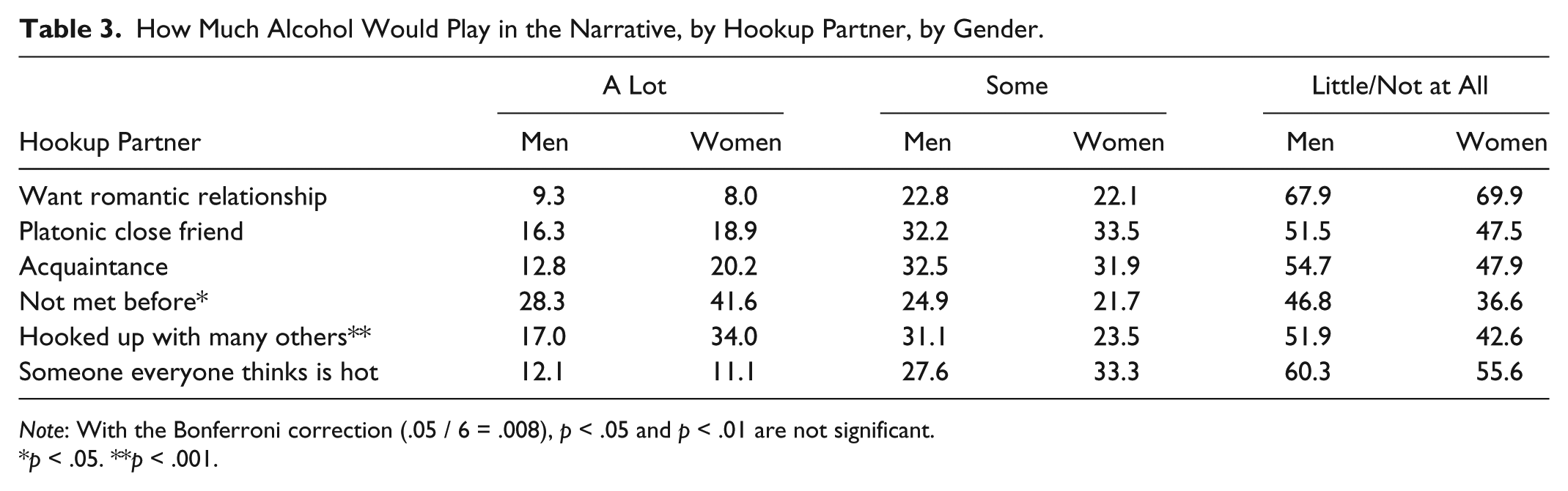
Table 3 shows that the presence of alcohol in the post-hookup narrative that respondents would tell varies by their relationship or desired relationship with their hypothetical hookup partners. Focusing on the a lot response reveals that both men and women would be least likely to invoke alcohol for the situation in which they hooked up with someone with whom they want a romantic relationship, the most relational hookup partner, followed by a platonic close friend and then an acquaintance, which are similar for men and women. The fourth relational situation, hookups with a partner whom they had not met before, is the one for which both men and women are most likely to invoke alcohol in the narrative, though women are much more likely to do so. The relationship (χ2 = 7.68, df = 2, p < .05) between gender and this hookup situation is significant without the Bonferroni correction, though it does not meet the critical value (.05 / 6 = .008) with that correction.
How Much Alcohol Would Play in the Narrative, by Hookup Partner, by Gender.
Note: With the Bonferroni correction (.05 / 6 = .008), p < .05 and p < .01 are not significant.
p < .05. **p < .001.
With regard to the remaining two hypothetical hookup partners, only a small percentage of both men and women choose a lot when the partner is “someone everyone thinks is hot.” However, about one-third of women select a lot for a partner who has hooked up with many others, a potential reputational issue for women, and the relationship between gender and this hookup situation is significant (χ2 = 15.20, df = 2, p < .001) even with the Bonferroni-corrected critical value of .008.
Discussion
Much of the scholarly research on hooking up focuses on sexual activity; however, there is little systematic research on the post-hookup ritual retelling, an important aspect of hookup culture. Consequently, variations in the likelihood and content of the retelling, based on the situational context as well as the impact of gender beliefs regarding sexual activity, have been largely overlooked. Therefore, our study focused on these aspects of the post-hookup ritual retelling. The responses to a variety of questions about a hypothetical hookup, here defined as sexual intercourse, provide evidence that individuals would share hookup stories in ways that reflect gender beliefs. However, we also find some evidence that individuals draw on gender beliefs in ways that would vary by the situational context and reveal either some greater flexibility or different kinds of constraint in men’s compared to women’s responses to dominant gender beliefs.
Overall, a large proportion of both men and women indicate they would share the hypothetical hookup experience with their same-sex best friends, lending additional credence to the notion that post-hookup conversations are an important and common aspect of hookup culture (Bogle 2008; Holman and Sillars 2012; Paul and Hayes 2002; Wade 2017). Similar to findings of previous studies in which women were more likely than men to share conversations with same-sex friends about sexual topics (Knight et al. 2012; Lefkowitz and Espinoza-Hernandez 2007; Lefkowitz et al. 2004; Trinh and Ward 2016), our findings reveal that women would be more likely than men to share the hookup experience with their same-sex best friends. On its face, this finding is somewhat surprising given that a hypothetical hookup involving sexual intercourse with someone with whom the respondent had not hooked up before seems to contradict the relational orientation expected of women. However, the level of disclosure varies by situational context; that is, the highest level of disclosure is directed only toward women’s same-sex friends, supporting the notion that for women, same-sex friends offer safe spaces for discussing sexual topics (Lyons et al. 2011). In addition, the findings that both men and women would be much more likely to share the hookup experience as well as most of the 12 specific details with same-sex than with cross-sex best friends are in line with other research that suggests that individuals express greater comfort regarding disclosures to same-sex than to cross-sex friends (Kito 2005) and points to the importance of considering the situational context.
With regard to sharing details with same-sex best friends, women would be more likely to share relational details than would men, just as the relational orientation suggests. In contrast to dominant gender beliefs, women also would be more likely than men to talk to their same-sex best friends about their own orgasm and pleasure, recreational details, whereas men would emphasize recreational details over all other details with their same-sex best friends. These findings suggest that gender beliefs about women’s relational orientation are powerful but do not preclude women’s attention to sexual recreation. Moreover, they are in line with Wade’s (2017) findings that the “juicy gossip” that some college students share with one another about their hookups often involves a “dramatic play-by-play” (p. 204). Although Wade does not indicate the gender of conversational partners when these recreational details are shared, our results suggest that women would be quite likely to share recreational details with their same-sex best friends and that men would emphasize such details in conversations with their same-sex best friends. Nevertheless, compared to men’s conversations, the findings reflect that women’s conversations about hookups would foreground feelings, as the relational orientation and sexual double standard suggest. Furthermore, the results are in line with Trinh’s (2016) and Trinh and Ward’s (2016) findings that young women receive mixed messages from their same-sex friends that not only promote sexual gatekeeping, especially by encouraging relationships, but also allow for women’s sexual pleasure. As found in other studies, the details that men would be most likely to share with their same-sex best friends reflect a more recreational orientation that includes encouraging casual sexual encounters and an emphasis on performance (Currier 2013; Knight et al. 2012) along with a particular focus on women’s bodies (Flood 2008; Wade 2017). Gender beliefs regarding the recreational orientation for men may encourage them to want to impress their same-sex best friends (Currier 2013; Holman and Sillars 2012; Kimmel 2008) and, therefore, want to openly share such details with them.
There are no significant relationships between respondent’s gender and sharing any of the 12 details with cross-sex best friends, and the top three details that both women and men would share with cross-sex friends are relational. This means that women would most commonly share relational details with both same-sex and cross-sex best friends; this is in line with hegemonic gender beliefs and a relational orientation toward sexual activity. At the same time, women’s emphasis on recreational details varies by situational context. For some relational and recreational details, there is little difference in the percentage of women who would share them with same-sex best friends. However, the percentage of women who would share recreational details is much lower than the percentage who would share relational details with cross-sex best friends. While other research finds that women receive sex-positive messages from men in cross-sex interactions (Trinh 2016), the women in our study suggest that recreational details are more suitably shared with same-sex than with cross-sex friends, highlighting the importance of hegemonic gender beliefs in their cross-sex interactions. That men would be more likely to share relational rather than recreational details with cross-sex best friends indicates a reversal of emphasis for men between their same-sex and cross-sex best friends. Specifically, men would be nearly equally likely to share their feelings for their partner and their partner’s feelings for them with same-sex and cross-sex friends, but they would be significantly less likely to share recreational details with cross-sex best friends.
According to Ridgeway and Correll (2004), “the effects of cultural beliefs about gender in social relational contexts are most often to moderate or exaggerate (i.e., to bias in gendered directions) behaviors and evaluations that are largely determined by more context-relevant identities and roles” (p. 516). Unless social relational contexts involve groups of like-minded individuals who share alternative gender beliefs, it is the hegemonic form of gender beliefs that tend to be at play. However, our results suggest some greater complexity to the ways in which gender beliefs play out in some situational contexts. In line with Ridgeway and Correll’s (2004) predictions, women would quite consistently emphasize relational elements associated with hegemonic gender beliefs about women’s sexual behavior regardless of the gender of their conversational partners. Although women would be less likely to share all 12 details with cross-sex than with same-sex best friends, there is some indication that, in contrast to what they would share with their same-sex best friends, they would be particularly unlikely to share recreational details with their cross-sex best friends. Men, however, would emphasize details reflecting a recreational orientation with their same-sex best friends and details reflecting a more relational orientation with their cross-sex best friends. In other words, although men would make use of hegemonic gender beliefs in their conversations with same-sex friends, they may do more than just moderate their responses to gender beliefs with cross-sex friends, and, instead, flip their scripts to emphasize relational elements. Our results, however, do not allow us to understand what these emphasized relational details reflect for men in conversation with their cross-sex best friends. It is possible that men feel they should not violate the relational orientation associated with women and are, in fact, constrained by those expectations, or it may be that the cross-sex situational context frees men from the expectations of the recreational imperative and allows them to be more comfortable focusing on feelings and revealing their vulnerabilities with cross-sex friends. Certainly, some of the men in Wade’s (2017:92–93) study expressed frustration with the meaninglessness of sexual activity within hookup culture. Our findings suggest that men’s emphasis on relational details in the conversations that they would have with cross-sex best friends might reflect some men’s desires to engage more deeply with feelings and bring greater meaning to their hookups. Consequently, our findings suggest that men have access to a wider range of emphases than women in their conversations with various types of friends about hooking up; this is in contrast to the ways in which gender beliefs play out in other areas of life. For example, young girls are given more latitude than young boys in various aspects of behavior and play (Kane 2006), and women more so than men have entered occupations statistically dominated by the other gender (Statistical Abstract of the U.S. 2018:Tables 233, 638).
Finally, we examined the impact of gender and gender beliefs on the would-be role of alcohol in a post-hookup narrative. With regard to those situations that reflected various levels of previous familiarity with the hypothetical hookup partner, a very low percentage of women, as well as men, would invoke alcohol if their hookup partner were someone with whom they had been wanting a romantic relationship. For both men and women, this may be explained by the idea that hookups are seen as more meaningful when the participants are sober (Vander Ven and Beck 2009; Wade 2017; Wade and Heldman 2012). In addition, for women, this hookup circumstance is the one regarding sexual activity that is most closely aligned with gender beliefs regarding the relational orientation (Hamilton and Armstrong 2009), leaving little need to invoke alcohol. At the other end of the spectrum, women are most likely to indicate they would invoke alcohol in the narrative if they had hooked up with someone they had not met before or with someone who had hooked up with many others. Since women, more generally, seem to respond to gender beliefs by wanting to protect their own reputations (Beres and Farvid 2010; Bogle 2008; Currier 2013; England et al. 2012; Kettrey 2016; Paul 2006), when their sexual encounters are most outside the confines of the relational orientation, it is not surprising that they would invoke alcohol in their hookup narrative. Moreover, perhaps women would invoke alcohol in such circumstances because our survey questions specified that the hookup included sexual intercourse; therefore, respondents could not engage in the strategic ambiguity typically associated with the word “hookup” (Currier 2013). In contrast, the findings that men, for example, would be less likely than women to invoke alcohol in a narrative about a hypothetical hookup with someone who had hooked up with many others provides additional evidence of the recreational script (Trinh and Ward 2016) that reflects gender beliefs. The double standard suggests that men should always want and pursue sex; therefore, alcohol is less important as an explanation or excuse for their hookup behavior. The lack of difference by gender about sharing a hookup experience with someone others think is hot may point to attempts to gain status with particular hookups for both men (Currier 2013) and women but also to the contradictory messages Trinh (2016) indicated women receive.
In answer to our research questions about the impact of situational context on the ritual retelling, we find, overall, that there are both gender similarities and gender differences. With a couple of notable exceptions, both men and women would be more likely to share a one-time hookup experience as well as various details with same-sex best friends than with cross-sex best friends. This further reinforces the value of considering the gender of conversational partners as well as the type of hookup details, particularly those related to relational and recreational orientations. Where there are differences between women and men, they tend to align with gender beliefs linked to the recreational orientation for men and the relational orientation for women, thus revealing the continued impact of such beliefs and the importance of studying them, though there are some notable exceptions described above.
A number of our results reflect hegemonic gender beliefs regarding sexual behavior, revealing the continuing power of the sexual double standard and the recreational and relational orientations in the hookup narratives that men and women, respectively, would share with their best friends while also revealing the importance of situational context for shaping these narratives. The results also suggest that women and men would be strategic not only in the ways in which they discuss hookups (Currier 2013) but with whom they discuss them since their hookup narratives, including specific details, differ across situational contexts that vary by gender. Some research highlights the complexities of both men’s and women’s sexual experiences evident in our study (Dworkin and O’Sullivan 2005; Wade 2017). Although most of our findings demonstrate the strength of hegemonic gender beliefs for shaping interactions, our findings also suggest that situational contexts are very important for not only the ways in which these hegemonic beliefs play out but also whether they play out at all. Specifically, the relational orientation is always at play in conversations women would have with best friends about hookups, regardless of their best friends’ gender, though same-sex friendships appear to provide more space than cross-sex ones for resisting hegemonic gender beliefs. The situational context appears to be even more influential for men than for women in determining the stories they would tell about their hookups. That is, the emphasis of men’s hookup narratives would change from recreational to relational depending on the gender of their conversational partners. Thus, women seem to respond to powerful gender beliefs relating to the relational orientation in the conversations they would have about hookups with same-sex and cross-sex best friends, though the recreational orientation would not be absent with same-sex friends, whereas men would be more flexible in their responses to dominant gender beliefs.
These findings further illuminate how gender inequalities regarding sexuality are entrenched and speak more broadly to issues of gender inequality. Ridgeway (2009) argues that individuals draw on dominant gender beliefs in many of their interactions, even if they do not agree with them, because the social costs of breaking the rules can be high. The responses to some of our questions suggest that the costs are especially high for women. While men would be able to draw on nonhegemonic gender beliefs in some situational contexts, suggesting that they have access to a wider variety of ways of expressing their sexual experiences than do women, women would emphasize a relational orientation regardless of situational context, even if they would also share some recreational details with same-sex friends. Our findings suggest that even though Ridgeway and Correll (2004) developed their theory of gender beliefs to better make sense of men’s and women’s experiences within labor markets, it may be especially important, as Hamilton and Armstrong (2009) suggest, to closely examine situational contexts to make sense of the ways men and women engage in and talk about their sexual activities.
More generally, the findings of this study point to the importance of studying not only the activities associated with hookup culture but also talk about such activities, particularly when that talk is ritualized, as a space for examining how gender beliefs shape interactions. Rituals are an important aspect of culture where meaning is made about the situation and the actors involved. Examining the ritual retelling of hookup stories reveals how this ritual practice of hookup culture both reflects and reproduces distinctions between men and women as sexual beings and as friends. Given the repeated nature of the ritual retelling (Wade 2017), then, the patterns of talk that occur in this ritual may serve to further entrench hegemonic gender beliefs among college students.
Limitations and Suggestions for Future Research
Our study focused on the post-hookup ritual retelling aspect of hookup culture; however, the questions were specifically about a hypothetical hookup, here defined as sexual intercourse, so that respondents would have the same sexual activity in mind. But how would gender beliefs influence whether post-hookup narratives for sexual encounters that do not involve sexual intercourse are shared and with whom? In addition, would the sharing of particular details vary by what individuals volunteer and what friends elicit, depending on the closeness and gender of conversational partners? Since our questions were about a hypothetical one-time hookup, an examination of the sharing of actual hookup experiences, including hookups with the same partner multiple times, would be useful. Open-ended questions related to the topics suggested above might be quite revealing and might also uncover why, for example, men would talk about recreational details with same-sex friends and relational details with cross-sex friends.
Our results suggest that gender beliefs vary by situational contexts, that is, with same-sex and cross-sex conversational partners. However, Ridgeway and Correll (2004) point to particular contexts, such as groups of politically or ideologically like-minded individuals, when alternative gender beliefs may be at play. Consequently, there may be even greater variation in responses to gender beliefs in research that considers not only the gender of respondents but also the impact of the intersection in the friendship on other characteristics, such as sexual identity, religious beliefs, or political affiliation.
In addition, we limited the characteristics of those in our sample to match the samples most often used in past studies; however, expanding the sample such that it would include, for example, those who are gender fluid, homosexual, bisexual, and not enrolled in college would be an important part of painting the picture of hookup culture and the ritual retelling, even if the study was limited to the United States. This, of course, raises the question of the extent to which hooking up is an American or global phenomenon limited to college students or not. Although we had hoped to examine a number of demographic variables, the paucity of individuals in particular categories made that problematic. A different sample could allow researchers to explore the ways in which race and ethnicity, religiosity, political identity, and on-campus memberships, particularly membership on a single-sex athletic team or in a single-sex Greek organization, might affect patterns of post-hookup ritual retelling. We did not have enough respondents in single-sex organizations to examine this, though we wondered whether ties to others in such groups would lead to a broader definition of best friends and, therefore, expand the audience for the ritual retelling to a wider circle or even to an audience that is mixed sex.
Finally, although some aspects of the hypothetical postintimacy ritual retelling are similar between men and women, many aspects vary, often significantly, by gender. And as it turns out, these are not random variations. The largest distinctions seemed to reflect rather dominant gender beliefs, with women’s and men’s responses reflecting a somewhat more relational and recreational orientation, respectively. Past research has shown that continued impact of gender beliefs, including the double standard, on the patterns of sexual activities in hookups, but our research reveals differences in an additional aspect of hookup culture, the post-hookup ritual retelling. Patterns of difference between men and women might not be of particular concern, but patterns that reflect an inequality as it relates to hookup culture reveal that intimate relations continue to be a stronghold of inequality between men and women. In that way, since some aspects of postintimacy communication reflect such inequalities, they will not fully change until intimate justice is achieved.
Footnotes
Acknowledgements
We thank Lisa Auster-Gussman for her helpful suggestions. This project involving human participants was approved by Franklin & Marshall College’s Institutional Review Board.
Funding
The author(s) disclosed receipt of the following financial support for the research, authorship, and/or publication of this article: This project was made possible with funding from the Committee on Grants, Franklin & Marshall College and the Faculty Research and Professional Development Fund, Franklin & Marshall College.
