




Abstract
Though women’s labor force participation has increased over recent decades, it remains lower than men’s in nearly every advanced democracy. Some groups of migrant and ethnic minority women have especially low rates of labor force participation, which is often attributed to cultures of origin that are less normatively supportive of women’s paid work outside the home. I argue in this paper that the gender norms women have been exposed to in their families and countries of origin interact with work-family policies to shape patterns of labor force participation. Cultural and familial norms about women’s employment outside the home are influential for women’s labor force participation in contexts of weak work-family policies. However, they cease to matter in determining women’s labor force participation in contexts of strong work-family policies.
Introduction
Gender gaps in labor force participation have narrowed in advanced democracies in recent years but persist to some extent in nearly every country (OECD 2017). Existing research exploiting differences across countries or policy changes over time suggests that macrolevel social policy contexts and work-family policies in particular reduce such gender gaps, especially because they facilitate the employment of mothers with young children (Hegewisch and Gornick 2011; Olivetti and Petrongolo 2017). Nevertheless, alongside persistent gender gaps in labor force participation, there is also considerable variation across different groups of women within the same social policy context, for instance by educational attainment. Differences across ethnic groups and by migrant status are a growing source of concern, especially in Western European societies, where such differences are often attributed to cultural norms about women’s paid employment and migrants’ (and especially Muslim migrants’) gender norms have been a topic of widespread public debate (OECD 2017; Röder and Mühlau 2014; Rubin et al. 2008). Unfortunately, much existing research on group-level differences in labor force participation neglects or at least underemphasizes the social policy context. This paper combines insights from existing literature documenting macrolevel social policy effects with an approach that is attentive to differences across different groups of women, examining how policy contexts interact with cultural and familial norms about women’s paid employment to shape women’s labor force participation.
Existing studies face two main challenges in examining the effects of norms about women’s paid employment. First, though labor force participation itself may indicate the presence of such norms, the norms cannot usefully be included in a study of labor force participation unless there is some independent measure of them. This rules out the use of many existing census, register, and income or labor force survey data sets that are commonly used to study women’s labor force participation. Second, when a survey contains attitudinal measures that tap norms about women’s paid employment, it can be difficult to determine causal direction, particularly in cross-sectional surveys: Do these attitudes affect women’s labor market decisions, or does participation in the labor market affect attitudes? In this analysis, I use two measures of norms about paid employment to which respondents have been exposed in their families and cultures of origin. The first, pertaining to all women, indicates whether a woman’s own mother worked outside of the home when the woman was an adolescent. The second pertains only to women who are immigrants or whose parents were immigrants; it indicates the rate of women’s labor force participation in a respondent’s own or parents’ origin country. Both of these measures of norms are distinct from and temporally prior to a woman’s current labor force status. Using these measures, I ask whether cultural and familial norms about women’s paid employment matter differently for women’s labor supply in different work-family policy contexts.
Including migrant women in an analysis of how social policy contexts shape labor market participation is analytically useful because scholars of social policy often contend with the challenge that in democracies, policies arise in a context of certain norms and values and it is difficult to disentangle the effects of the policies once they are implemented since the association of policies with outcomes may be due to the preexisting norms and values. In the case of establishing a causal link between work-family policies and women’s labor force participation, for example, it may be the case that residents of countries that implement strong and progressive work-family policies have views about women’s paid employment that are simply more progressive than in other countries—and that the policies therefore have less of an effect than they appear to. An analysis of relative newcomers to a society helps resolve this analytical problem.
To preview the paper’s key findings, the analysis suggests that strong work-family policies act as an equalizer for women from different normative backgrounds. Countries with weak policy support for women’s employment display larger inequalities between women from backgrounds more and less normatively supportive of paid work outside the home. That is, a woman’s exposure to norms encouraging paid employment, either in her family or country of origin, matters little when work-family policies are strong. I conclude the paper with a discussion of the implications of these findings, especially for current debates about immigrants’ economic and cultural integration in the Western European context.
Theoretical Background and Literature Review
Women come of age and are socialized in a variety of family contexts, even within the same country. A long tradition of sociological research on social mobility shows how social class origins shape the aspirations and achievements of the next generation. Similarly, we might expect the gender arrangements in a person’s family of origin to provide the early normative influences for later decisions about labor force participation and for women whose own mothers worked outside the home to be more likely to work outside the home themselves. Existing research in the US context using longitudinal data indeed documents the importance of mothers’ gender role attitudes and employment on the later-life attitudes and employment outcomes of daughters (Farré and Vella 2013; Moen, Erickson, and Dempster-McClain 1997). My analysis considers a mother’s paid employment during a respondent’s adolescence as one indicator of exposure to norms supportive of women’s paid employment.
Gender norms are likely to take shape not only within individual families but also in cultures and communities of origin. Women who have migrated to their current country of residence from another country were socialized in part in their country of origin. Migrant newcomers arrive in their host countries having been exposed to a range of cultural norms related to women’s labor force participation. As Blau and colleagues have shown in the context of the United States (Blau et al. 2013; Blau, Kahn, and Papps 2010), labor force participation rates in immigrant women’s countries of origin continue to influence their and even their US-born adult children’s propensities to participate in the labor force.
In the European context, existing research suggests that many immigrant groups do have different gender-egalitarian values than native-born European populations but that within the immigrant first generation and between the immigrant first and second generations, these values adjust to those of the native-born population (Röder and Mühlau 2014). The role of Islam in shaping the gender norms of immigrants and their descendants in Europe has been particularly politicized in recent years. Maliepaard and Alba (2016) examine the gender ideologies of the Muslim second generation in the Netherlands and much like Röder and Mühlau (2014), find a general pattern of acculturation to the mainstream, albeit with a sizeable minority of the sample (disproportionately male, with low educational achievement and few native-born friends) adopting less gender egalitarian views than their parents. Research on Muslim women in the context of the United States finds no demonstrable effect of religiosity on labor force participation (Abdelhadi 2017), though particular immigrant and minority groups of women do have significantly lower rates of labor force participation (Read and Cohen 2007). In European countries, women from predominantly Muslim countries often have lower labor force participation than their native-born counterparts, even into the second generation, though this varies across host countries (Soehl, Fibbi, and Vera-Larrucea 2012).
The literature on cross-national variation in women’s labor force participation focuses more on overall rates than differences among women by cultural background or other characteristics. This literature highlights the important role of policies that support work-family reconciliation. These policies are generally considered to include public provision of or subsidies for early childhood education and care (ECEC), job-protected and/or paid parental leave, and various regulations related to working time and work scheduling (Hegewisch and Gornick 2011). As in other areas of social policy research, debates about conceptualization and measurement abound. Fraser (1994) outlines an influential typology that distinguishes among a “traditional breadwinner” model, in which women are discouraged from entering paid employment; a “universal breadwinner” model, in which men and women are both viewed primarily as workers and there is little public support for caregiving; and a “caregiver parity” model, in which paid work and caregiving are equally valued and publicly supported. These three types correspond roughly but imperfectly to the conservative, liberal, and social democratic “worlds” of Esping-Andersen (1990; Gornick, Meyers, and Ross 1997) and are all represented among the Western European societies included in this analysis.
There is more continuous variation in actual policies than such ideal types might suggest, however, and another approach in the literature has been to combine different dimensions of policy effort into a composite index (Gornick and Meyers 2003). Critics of this composite approach have argued persuasively that different policies have different effects on gender inequality in the labor market (Misra, Budig, and Boeckmann 2011; Pettit and Hook 2009) since different policies facilitate different forms of work-family reconciliation. The policy with the least conceptually and empirically ambiguous implications for women’s labor force participation is public investment in ECEC. In most societies, fathers are unlikely to provide the bulk of care for young children, and in that context, public support for nonparental care gives women an alternative to exiting the labor force altogether or taking extended leave to care for young children at home. Certainly, women in countries that provide little in the way of public ECEC support may still make private or informal child care arrangements, but this is likely to be practically infeasible or financially out of reach for many families. Not surprisingly, ECEC has been shown to have uniformly positive effects on a range of women’s labor market outcomes as well as fertility rates (Olivetti and Petrongolo 2017). For this reason, it is my primary indicator of work-family policy in the analyses that follow.
Parental leave policies may help parents of young children maintain more continuous employment in the long run, but in the short run, leave reduces paid work and subsidizes parental care of young children at home. Policies that encourage long parental leaves may actually have negative consequences for women’s labor market outcomes (Olivetti and Petrongolo 2017; Pettit and Hook 2009). Furthermore, unpaid leave or a low wage replacement level may encourage families to fall back on the traditional male breadwinner model when children are young (Boeckmann, Misra, and Budig 2015; Brinton and Mun 2015). Beginning in the 1990s, some countries began to incentivize fathers to take parental leave by reserving a share of the family’s paid leave for them (so-called use it or lose it policies). However, even when such policies are in place, fathers generally still take significantly less leave than mothers, and fathers still tend to be economically rewarded rather than penalized for being married and having children (Petersen, Penner, and Høgsnes 2014).
Research examining cross-national variation in aggregate rates of women’s labor force participation misses variation across different groups of women, though some existing literature does address “heterogeneous policy effects.” Public support for child care seems to have disproportionate effects on mothers with lower levels of education (Olivetti and Petrongolo 2017). Single mothers are also more likely to take advantage of public ECEC options for their young children (Cascio and Schanzenbach 2013) and benefit disproportionately from more affordable child care in terms of their rates of employment (Han and Waldfogel 2001). In short, public support for affordable child care is likely to have a greater impact when women have few alternatives and are most in need of support, such as when private child care is financially out of reach.
But in addition to the economic barriers that stand in the way of women’s labor force participation when they have young children, there may be cultural barriers as well. General cultural norms in a given democracy may be institutionalized in work-family policies. That is, the cultural acceptability of women’s and especially mothers’ paid employment may lead voters to support work-family policies. In this case, norms will not be analytically separable from policy. However, there may be divergence between what Pfau-Effinger (2012) has called the “gender culture” and the institutional arrangements of a given country. Furthermore, there is likely to be variability within a given policy regime, across women with different familial and cultural backgrounds, about the normative acceptability of women’s and mothers’ paid work, even when a majority supports it.
The main focus of this analysis is the interaction of work-family policy contexts and norms about women’s paid employment. The analysis addresses the following primary research question: Whose labor force participation rates are most affected by work-family policy, those women from familial and cultural backgrounds more or less normatively supportive of women’s paid employment outside the home? We can formulate two competing hypotheses for the direction of this interaction effect.
On the one hand, women who have been exposed to particularly strong cultural and familial norms in support of women’s labor market participation may be more receptive to social policies that promote women’s labor force participation. We might call this the “synergistic” effects hypothesis:
Hypothesis 1 (synergistic effects): Women from cultural and familial backgrounds in which women’s paid employment is more common are more receptive to work-family policies and experience larger effects.
In this case, we would expect a positive interaction between measures of pro-employment norms and work-family policies. There is some evidence that such synergies between culture and policy exist. For instance, using aggregate country-level measures of gender egalitarian cultural values, Budig, Misra, and Boeckmann (2012) find that policy effects are magnified in the context of gender egalitarian cultural values and may even be negative in less supportive cultural contexts. Note, however, that the aggregate measures of gender egalitarian values indicate how policies align with what a majority of the population thinks is culturally appropriate. I measure norms within particular families and ethnic/immigrant groups, which are likely to be more closely related to individual women’s decisions about labor force participation.
As an alternative to the synergistic effects hypothesis, we could hypothesize that women who have been exposed to particularly strong cultural and familial norms supporting women’s labor market participation might be insensitive to work-family policies because they will be highly likely to work for pay independent of the policy context. Conversely, women who have experienced less normative support for paid employment in their families and cultures of origin will be more in need of alternative supports for them to decide to enter the labor force. We might call this the “need-based” hypothesis.
Hypothesis 2 (need-based effects): Women from cultural and familial backgrounds where women’s paid employment is less common are more in need of support from work-family policies and experience larger effects.
In this case, we would expect the interaction effect between norms and policy to be negative. In some ways, this hypothesis is more in line with the existing research about heterogeneous work-family policy effects by education or marital status. As noted previously, women who have the fewest private economic resources to support their labor force participation are most in need of social policy efforts. If we conceptualize private resources as cultural as well as economic, then we might expect a similar pattern in the case of familial and cultural norms about women’s paid employment.
Data and Methods
The analysis is based on European Social Survey (ESS) data, pooled across all eight existing waves (2002–2016, every two years) to achieve a sufficient sample of key target populations, including immigrants, children of immigrants, and native-born women (Norwegian Centre for Research Data 2016a, 2016b). I merge the individual-level survey data with macrolevel data from the OECD’s Family Database and the World Bank’s World Development Indicators. I limit the analysis to 16 Western European countries: Austria, Belgium, Denmark, Finland, France, Germany, Greece, Ireland, Italy, Luxembourg, the Netherlands, Norway, Portugal, Spain, Sweden, and the United Kingdom. Data are not available in every ESS wave for each country, but in total, 99 country-years are included in the analysis.
The analysis is limited to women of working age (25–59 years). The key dependent variable is labor force participation. As is conventional, I define active participation as either currently employed or unemployed and looking for work. Full-time students are excluded from the analysis, though their numbers are small given the sample age restrictions. The inactive population thus includes those who are unemployed but not looking for work, disabled, retired, or homemakers. By far the largest category among inactive women of working age is homemakers.
Existing research as well as preliminary analysis of these data show that labor force participation tends to be lowest among married mothers of minor children (67.9 percent overall in the pooled ESS sample). However, labor force participation is lower for married women even when they do not have children in the household (80.8 percent among single women vs. 71.2 percent among married women). Single mothers fall somewhere in between (74.7 percent). 1 Furthermore, preliminary analysis suggests that women of every family status have significantly higher rates of labor force participation in countries with more supportive family policies. This could be because gender egalitarian culture is the root cause of both supportive policy implementation and women’s labor force participation. But it could also be that women’s decisions surrounding work and family are complex and may be responsive to the policy context even before (and after) they are married or have young children in the household. For this reason, I include all working-aged women in the analysis, controlling for partnership status and the number and ages of minor children in the household. The four age categories for children are infants (0–2 years), preschool-aged children (3–5 years), primary school–aged children (6–12 years), and secondary school–aged children (13–17 years). Each variable is a simple count of the number of children a respondent has in that age category.
Respondents are categorized into one of three groups with respect to their immigrant origins or lack thereof. The reference group is native-born women, who were born in their country of residence and whose parents were both born in that country too. Immigrant women are those who were born abroad to parents who were also born abroad. Finally, because it is informative in understanding integration dynamics, I include the second-generation children of immigrants, who were born in the country of residence but have at least one parent born elsewhere. 2 Most scholarship on immigrant integration posits it to be a multigenerational process, motivating scholarly interest not only in immigrants themselves but also in their children and subsequent generations. If integration proceeds rapidly, the second generation will display patterns of labor force participation that look more like those of native-born women. On the other hand, if the parents’ culture of origin (as transmitted by a respondent’s parents and ethnic community in the host country) holds more sway, there may still be considerable differences between second-generation and native-born women. In one set of models in the following, using the entire sample, I include the immigrant origins variable as a predictor. I also run models separately by immigrant generation. This allows us to clearly see how patterns of labor force participation differ across groups.
In all models, I include controls for age and age-squared. All models also include a measure of a woman’s highest level of education, coded according to the International Standard Classification of Education (ISCED) schema of UNESCO (United Nations Educational, Scientific and Cultural Organization), with categories for less than secondary education (ISCED 1), lower secondary education (ISCED 2), upper secondary education (ISCED 3), postsecondary nontertiary education (ISCED 4), and tertiary education (ISCED 5/6). There is no direct measure of a woman’s partner’s earnings in the ESS, so if a woman has a partner, I include a variable indicating whether the partner is currently working and if so, the partner’s education as an indicator of earnings potential. This variable may capture the economic necessity of a woman’s labor force participation but also the concentration of joblessness and disadvantage within households (Morrisens 2006). For immigrant women, I include an additional individual-level control indicating how long a respondent has lived in the host country: 0 to 5 years, 6 to 10 years, 11 to 20 years, or more than 20 years.
As noted previously, I use two measures of norms about women’s paid work to which respondents have had exposure. First, at the individual level, I include an indicator for whether the respondent’s mother worked outside the home when the respondent was 14. 3 The second indicator of norms is the rate of women’s labor force participation in a respondent’s own or parents’ country of origin, matched to the approximate year of migration when possible and otherwise measured in 1990. Sending country measures are from the World Bank. 4 Note that both of these measures of norms tap employment behaviors rather than attitudes. For various reasons, women may work outside the home even when they do not consider it ideal, and conversely, they may not work outside the home even when they consider it to be perfectly appropriate. Nevertheless, it is reasonable to suspect that when one’s mother or many other women in one’s country work outside the home, a woman will be more likely to consider women’s paid work normal. The labor market behaviors a woman sees around her in her family or country of origin are likely to provide a normative template for her own labor market choices.
Host country controls include GDP growth, unemployment rate, and size of the service sector at the time of the survey, all as percentages. It is unclear what direction the GDP growth and unemployment effects might have. On the one hand, hard economic times may lead to lower rates of labor force participation as workers become discouraged from seeking employment. On the other hand, in hard economic times, women may be more likely to pursue employment to minimize family financial risks arising from partners’ unemployment. The size of the service sector is expected to increase demand for women’s labor and therefore increase women’s labor force participation. These host country controls come from the World Bank.
Though there are numerous typologies of work-family policy regimes (e.g., Fraser’s typology of earner/carer strategies described previously) that help to understand qualitative differences in how countries approach work-family issues, in this paper, I use a simple indicator of the percentage of GDP that is public spending on ECEC. This measure is available from the OECD and has numerous virtues. First, as much existing research has highlighted, it is important to recognize that different family policies may have different effects on women’s employment and gender equality. Composite indexes conflate policies like ECEC, which consistently promotes women’s employment, with policies such as parental leave, which as I outlined previously, has more complex and ambiguous consequences. 5 Also unlike some existing data sources on family policy, the OECD’s indicator of public ECEC spending is readily available for all countries in the sample across numerous years so that within-country variation can be captured.
Means or frequency distributions of all individual-level variables as well as mean women’s labor force participation in origin countries for those of immigrant descent are reported in Table 1 overall and by immigrant generation. Table 2 displays descriptive statistics and pairwise correlations for host country–level variables at the country-year level, and Table 3 displays descriptive statistics for these same variables separately by country as well as sample sizes specific to country and immigrant generation.
Descriptive Statistics, by Immigrant Generation.

Note: ISCED = International Standard Classification of Education; ISCED 1 = less than secondary education; ISCED 2 = lower secondary education; ISCED 3 = upper secondary education; ISCED 4 = postsecondary nontertiary education; ISCED 5/6 = tertiary education.
Source: European Social Surveys, 2002–2016.
Descriptive Statistics and Pairwise Correlations among Macrolevel Predictors.

Note: Units in this table are country-years, n = 99. ECEC = early childhood education and care.
Source: European Social Surveys, 2002–2016.
Selected Descriptive Statistics, by Country.
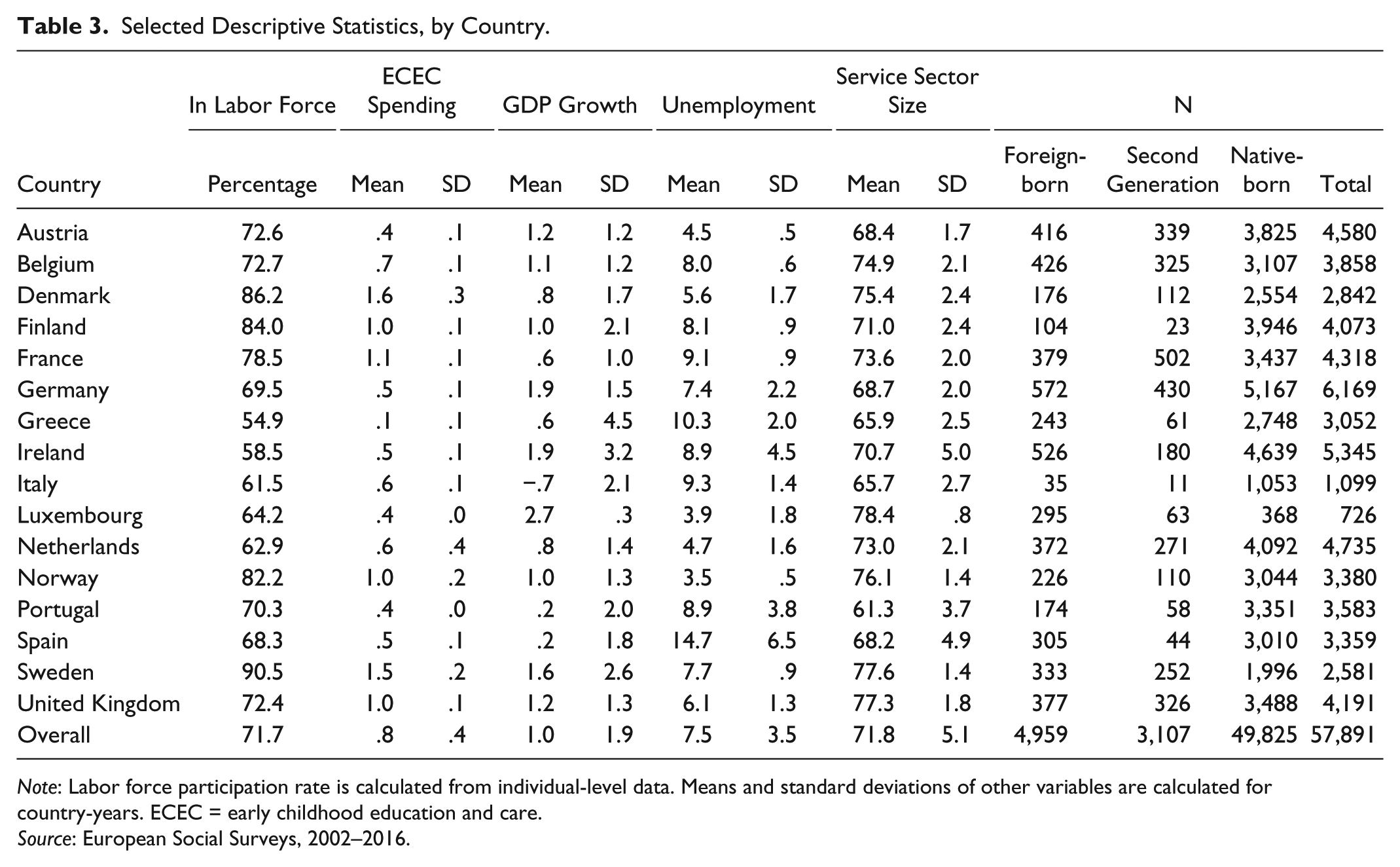
Note: Labor force participation rate is calculated from individual-level data. Means and standard deviations of other variables are calculated for country-years. ECEC = early childhood education and care.
Source: European Social Surveys, 2002–2016.
ECEC spending ranges from a minimum of 0 (e.g., the Netherlands in the early 2000s) to a maximum of 2 (e.g., Denmark since the early 2010s), with a mean of .8. Interestingly, most countries have experienced some change in the level of ECEC spending during this period, which can be seen in the standard deviations for this variable in Table 3. Among macrolevel variables, the two most important pairwise correlations are between unemployment and GDP growth (r = −.220) and between service sector size and ECEC spending (r = .637). This latter correlation means that a large service sector may be increasing demand for female labor at the same time that ECEC spending facilitates women’s labor supply. Note that in the following analyses, the effects of ECEC spending are net of this demand-side control for service sector size.
Table 4 provides some further information by the geographic origins of immigrant and second-generation respondents in the sample. For the purposes of this table only, I categorize geographic origins by region: Northwestern Europe, Southern Europe, Eastern Europe, Middle East/North Africa, Sub-Saharan Africa, Asia, Latin America/Caribbean, and North America/Antipodes. Note that more than 150 unique countries of origin are represented among respondents of immigrant origin, and these broad groupings obviously mask considerable heterogeneity, which can be seen, for instance, in the standard deviations for women’s labor force participation in origin countries. Nonetheless, we do observe variation across regional origins, with the highest rate of women’s labor force participation in North American/Antipodean countries of origin and the lowest rate in Middle Eastern/North African countries of origin. We see a correspondence, albeit an imperfect one, between average rates of women’s labor force participation in origin countries and rates of labor force participation among respondents’ mothers. For example, for North American/Antipodean countries of origin, respondents’ mothers are less likely to work than women in those origin countries on average, whereas for Middle Eastern/North African countries of origin, the opposite is true. Looking at respondents’ own rates of labor force participation displayed in this table, we see that cultural and familial origins may play some role, but the labor force participation of nearly every group outpaces that of women in their own or their parents’ origin countries and that of their mothers, sometimes very considerably.
Selected Descriptive Statistics, by Own or Parents’ Region of Origin (Foreign-born and Second-generation Respondents Only).

Source: European Social Surveys, 2002–2016.
The multivariate analysis presented in the following is based on logistic regression models, in some cases separately by immigrant generation. Standard errors in all models are robust and adjusted for clustering by country of residence, year of the survey, and for those of immigrant descent only, country of own or parents’ origin. I use the procedures outlined in Cameron, Gelbach, and Miller (2012) to adjust standard errors for non-nested multiway clustering, as implemented in the cgmlogit program for Stata (Caskey 2014). I use this procedure rather than multilevel models with country-level random effects because it relies on weaker distributional assumptions. 6 All models and descriptive statistics are weighted to reflect sampling designs. In the discussion of results, I present the logistic regression models as well as predictive margins based on these models. Margins average the predicted probabilities of labor force participation across the sample, fixing the focal variable or variables at the given level. I defer to the findings based on predicted probabilities, presented graphically in Figures 1 and 2, because unlike coefficients in the underlying logistic regression models, margins are comparable across the different groups and models in the analysis and are more straightforwardly interpreted in terms of substantive effects (Mood 2010). In some cases, large and significant differences in log odds translate into meaninglessly small differences in probabilities (for extremely high or low values, near the asymptotes of the cumulative distribution function), while smaller differences in log odds translate into more meaningful differences in probabilities (for more moderate values).

Predicted probability of labor force participation, by selected characteristics of respondent, pooled models.

Predicted probability of labor force participation, by selected characteristics of respondent, separate models for foreign-born (FB) and second-generation (2G) women.
Results
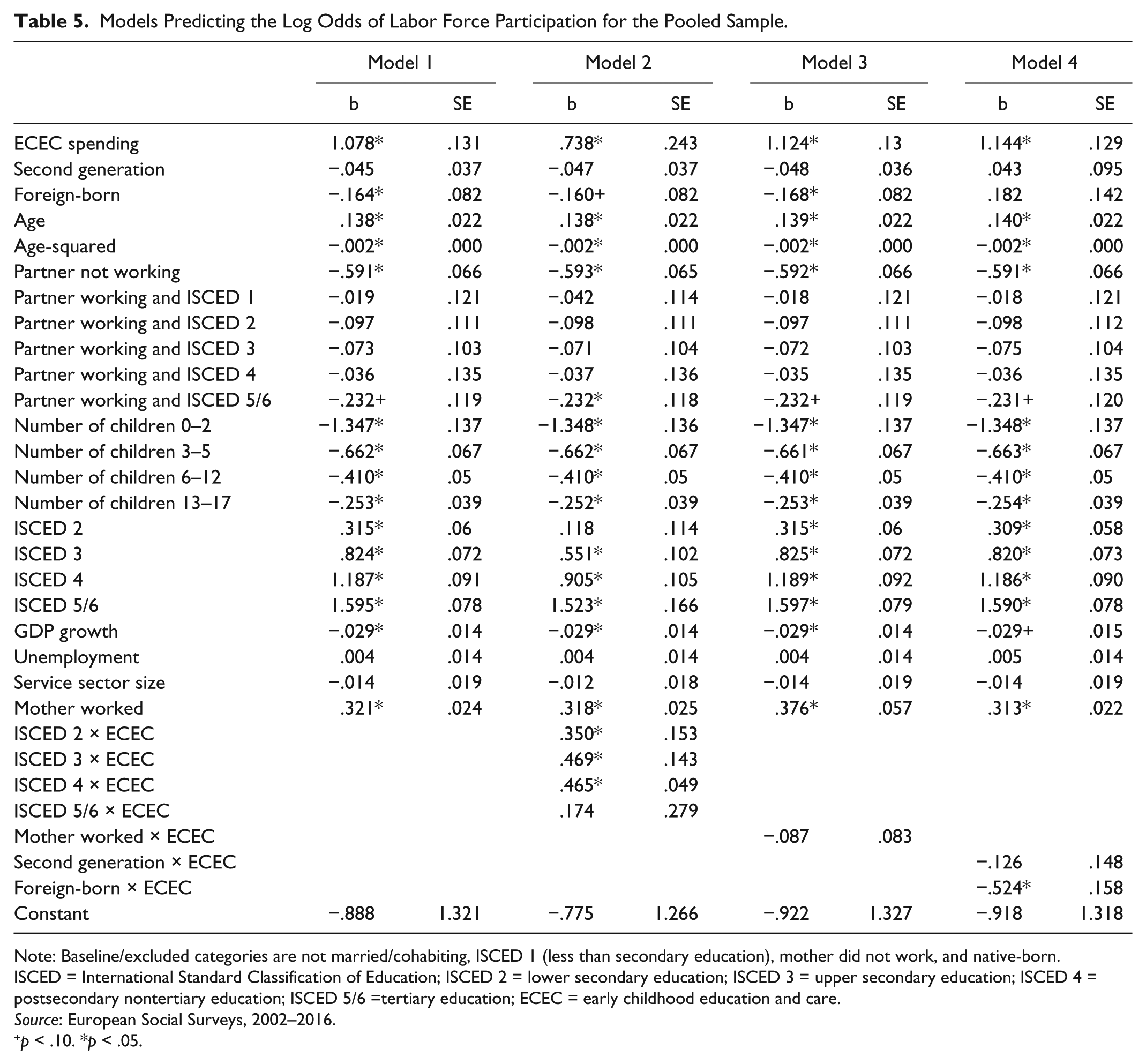
I begin with a set of models using the pooled sample of native-born, foreign-born, and second-generation women. Model 1 in Table 5 assesses the effect of public ECEC spending net of controls. Over the range of ECEC spending we see in this sample (0 percent to 2 percent of GDP), the difference in predicted probability of labor force participation changes more than 30 percentage points, from a predicted probability of .58 to .90 (this is the first set of margins in Figure 1). That is, a country like Denmark in the early 2010s that spends 2 percent of its GDP on ECEC would be expected to have a rate of female labor force participation that is more than 30 percentage points greater than a country like the Netherlands in the early 2000s, all else equal.
Models Predicting the Log Odds of Labor Force Participation for the Pooled Sample.
Note: Baseline/excluded categories are not married/cohabiting, ISCED 1 (less than secondary education), mother did not work, and native-born. ISCED = International Standard Classification of Education; ISCED 2 = lower secondary education; ISCED 3 = upper secondary education; ISCED 4 = postsecondary nontertiary education; ISCED 5/6 =tertiary education; ECEC = early childhood education and care.
Source: European Social Surveys, 2002–2016.
p < .10. *p < .05.
The other models in Table 5 and margins in Figure 1 incorporate interaction effects to examine how ECEC spending affects different groups of women differently, by education (Model 2), whether one’s own mother worked (Model 3), and immigrant generation (Model 4). I calculate all predictive margins as described previously, with public ECEC spending set at the observed minimum (0 percent) or maximum (2 percent). Though it is not the primary focus of the paper, I include the interactions with education to ensure that this result basically replicates existing research and so readers can compare the magnitude of the interactions for the normative background variables to the interactions with this familiar indicator of human capital.
Perhaps the most notable finding based on all of the margins in Figure 1 is that ECEC spending appears to matter for all groups of women: those with a very low level of education or a very high level of education, those whose own mothers worked or did not work, and native-born, foreign-born, and second-generation women alike. All groups of women benefit from public spending on ECEC. Indeed, the only group of women from a low-spending country profiled in Figure 1 that comes close to the labor force participation rates of women in a high-spending country is those with tertiary (university-level) education
In terms of how education interacts with ECEC, findings are reassuringly consistent with existing literature. There is a ceiling on the ECEC effect for highly educated women such that in countries that spend most on ECEC, labor force participation reaches nearly 100 percent among women who have upper secondary education (ISCED 3) and therefore cannot increase much more among women with higher levels of education than that. In part because of this, the overall effect of education on women’s labor force participation is greater in countries that spend less on ECEC. In other words, ECEC spending increases the labor force participation of women with low and medium levels of education more than women with high levels of education. The main effect of ECEC spending is large enough in magnitude that a woman with a low level of education in a high spending state has a statistically indistinguishing probability of labor force participation compared to a highly educated woman in a low spending state. In other words, supporting women through public ECEC spending can fully make up for a low level of educational attainment.
Model 3 and the corresponding margins in Figure 1 give us a first glimpse at how gender norms interact with work-family policy. In a hypothetical country that spends no public funds on ECEC, the effect of one’s own mother’s employment status on one’s own likelihood of labor force participation is approximately 8 percentage points, and this difference is statistically significant at the .10 level. In a hypothetical state that has high spending (2 percent of GDP) on ECEC, on the other hand, a women’s likelihood of labor force participation is not dependent on her own mother’s employment status, with an insignificant and nonmeaningful difference of 1.6 percentage points between the groups whose mothers worked and did not work. In short, the gender norms in one’s family of origin matter for labor force participation but only, it seems, in contexts of weak work-family policies.
Turning to Model 4 and the last set of margins in Figure 1, we see again large and significant effects of ECEC on labor force participation regardless of immigrant status. Though there is a tendency for foreign-born women to work less than native-born women in high-spending states and for them to work more than native-born women in low-spending status, these differences do not reach a level of statistical significance. That is, native-born, second-generation, and foreign-born women participate in the labor force at similar rates once their individual-level characteristics are controlled for, and they also appear to benefit similarly from a country’s ECEC spending.
To investigate in more detail how public ECEC spending shapes labor force participation among women with an immigrant background, I now turn to separate models for foreign-born and second-generation women. Logistic regression models are presented in Table 6, and margins based on them are displayed in Figure 2. Models 1 and 2 in Table 6 pertain to the foreign-born immigrant first generation, and Models 3 and 4 pertain to the second-generation (adult) children of immigrants.
Models Predicting the Log Odds of Labor Force Participation, by Immigrant Generation.

Note: Baseline/excluded categories are not married/cohabiting, ISCED 1 (less than secondary education), 0 to 5 years since migration, and mother did not work. ISCED = International Standard Classification of Education; ISCED 2 = lower secondary education; ISCED 3 = upper secondary education; ISCED 4 = postsecondary nontertiary education; ISCED 5/6 = tertiary education; ECEC = early childhood education and care; LFP = labor force participation.
Source: European Social Surveys, 2002–2016.
p < .10. *p < .05.
I begin with Models 1 and 3, which look at the effect of mother’s work status and its interaction with ECEC for the foreign-born and second generations, respectively. We see that mother’s work status plays a statistically insignificant role for those of immigrant descent and that that is true regardless of a country’s ECEC spending. So though this measure of familial gender norms matters for women’s labor force participation on the whole in the Western European context, the effect appears to be limited to native-born women in contexts of low ECEC spending. Note, however, that these models control simultaneously for the level of women’s labor force participation in the origin country, which is correlated with one’s own mother’s employment status. This could at least partially explain the weaker effects compared to the pooled models, which do not include the origin-country measure.
Models 2 and 4 address the role of gender norms in women’s own or their parents’ countries of origin. Here, as with the ECEC measure, I construct hypothetical scenarios of labor force participation in a woman’s country of origin by setting this variable first to its minimum in the sample (9.7 percent) and then to its maximum (91.9 percent) in the sample (this is the “low” and “high” labor force participation in the bottom half of Figure 2). For first-generation immigrant women, the basic pattern here is that ECEC spending neutralizes the effect of women’s labor force participation in an immigrant woman’s sending country. While there is a statistically significant 26 percentage point difference in the probability of labor force participation between women from the two hypothetical sending countries in host countries with low ECEC spending, there is an insignificant difference of only around 9 percentage points in a host country that spends more. Interestingly, generous child care spending appears to make up for an immigrant woman’s less supportive cultural background, giving her an indistinguishable probability of labor force participation compared to a woman from a more supportive cultural background who settles in a host country with low ECEC spending. The reverse is also true: A more supportive cultural background makes up for a lack of generous ECEC spending in the host country. The measure of women’s labor force participation rate in the origin country thus has a more significant effect than the variable tapping mother’s employment for immigrant women, at least in countries that have low ECEC spending. This may be related to the fact that for many women, the origin-country measure captures a more recent moment in time than the measure of mother’s employment in adolescence. The origin-country measure may also capture a greater range of variation in normative contexts, whereas the dichotomous indicator of whether a woman’s mother worked when the woman was 14 certainly masks heterogeneity in hours and years of the mother’s employment.
For second-generation women, gender norms from the parents’ sending country wane in significance. In neither hypothetical host country does a second-generation woman’s cultural background appear to shape her probability of labor force participation in a significant way. Some specific second-generation groups in some countries may have lower labor force participation than other groups due to a cultural background less supportive of women’s work, but by the second generation, the findings here suggest that this does not appear to be the general pattern in Western European host countries. 7
To summarize, this analysis demonstrates that gender roles from women’s families and cultures of origin do play a role in shaping their likelihood of participating in the labor force. However, that role is circumscribed by the work-family policy context in the country in which they live. Familial gender norms, as measured by whether a woman’s own mother worked outside the home when that woman was an adolescent, matter more for native-born women than women with an immigrant background and are only of consequence in countries that spend little on ECEC. Countries with generous public ECEC spending neutralize the role of gender norms in a woman’s family of origin. Beyond gender norms in one’s own family, a woman’s culture of origin may also provide a normative template for decisions about labor force participation. However, the findings here demonstrate that again, these background cultural norms only matter for immigrant women’s labor force participation when a country has weak work-family policy. As with familial norms, countries with generous public ECEC spending neutralize the effect of immigrant women’s cultural background. For the second-generation children of immigrants, gender norms in parents’ countries of origin matter little, regardless of the supportiveness of work-family policy. In short, we can conclude that the evidence here provides support for the needs-based hypothesis (Hypothesis 2): Women whose familial or cultural backgrounds are less supportive of women’s paid work outside the home are more in need of and benefit more from the support of generous work-family policy.
Discussion and Conclusion
This analysis contributes to the literature about the ways in which the welfare state and work-family policies in particular shape inequities in the labor market. A large existing literature examines inequalities by gender and finds a substantial reduction of gender inequalities when policies are supportive of women with unpaid caregiving responsibilities. Focusing on one major form of supportive work-family policies, public spending on ECEC, I draw out implications not only for gender inequality but also for inequalities between different groups of women. Pundits and policymakers in Western European countries have raised a variety of concerns about gender norms among some groups of immigrant background, norms that may lead to lower rates of labor force participation among women who are members of those communities. Immigrant women from predominantly Muslim countries, such as the Middle Eastern and North African sending countries included in this analysis, are the focal point of such discussions. This study empirically examines how gender norms about women’s paid employment affect women’s labor force participation and how they interact with the work-family policies that are so important for gender equality. Such gender norms do matter, but they matter very little in policy contexts that are institutionally supportive of women’s paid work. In short, cultural differences in labor force participation are not intractable but are instead quite sensitive to the policy context of the host country.
If work-family policies are in part an outgrowth of a country’s existing gender norms, then we might expect the observed association between policies and labor market outcomes to reflect these underlying norms. The synergistic effects hypothesis was based on the logic that women who are already inclined to participate in the labor force may support the implementation of work-family policies and take advantage of these policies once they are in place in order to participate in the labor market. However, the analysis in this paper lends support instead to the idea that women who are least normatively inclined to work, those from familial and cultural backgrounds where fewer women worked, actually benefit most from work-family policies. It seems that all kinds of disadvantages standing in the way of women’s labor force participation—whether the disproportionate burden of child care that falls on women more than men, the inability of less educated women to afford private child care compared to their better educated counterparts, or the disadvantage of having a familial or cultural background that is not supportive of women’s work outside the home—are muted by supportive work-family policies.
Though the political winds have shifted in many European countries in recent years, away from multiculturalism and toward assimilationist expectations that emphasize the responsibilities of immigrants themselves to conform to host country cultural norms, this study suggests that the tangible effects of cultural differences, for instance on labor force participation, can be moderated by host country policies that may be outside the direct realm of immigrant integration policymaking. It is beyond the scope of this analysis to examine in depth how the norms related to women’s employment to which people are exposed in their families and countries of origin (the focus of this paper) shape people’s own attitudes about gender and how attitudes in turn affect labor market behavior. As noted previously, it is difficult with cross-sectional data like these to determine the causal direction of any association between gender attitudes and women’s labor market behavior. Whether or not gender attitudes change, however, there are likely to be benefits of women’s increased labor force participation in terms of autonomy for women, additional income for families, and higher employment levels in the context of an aging Europe.
Footnotes
Appendix
Acknowledgements
I gratefully acknowledge the research assistance of Avery Munns in the final stages of the project. All remaining errors are my own.
Authors’ Note
Earlier versions of the this paper were presented at the Noontime Faculty Forum at Colby College and at annual meetings of the Population Association of America, American Sociological Association, Society for the Advancement of Socio-Economics, and Council for European Studies. All individual- and country-level data used in this analysis are publicly available from the Norwegian Centre for Research Data, the OECD, and the World Bank.
1
Sometimes I use the term married women, but in fact, partnership status is defined according to cohabitation and not legal marriage. In 98.8 percent of cases, partners are male. Respondents with female partners are included in the analysis, but results are nearly identical if they are excluded.
2
Detailed information about respondents’ parents’ countries of birth was not collected in the first European Social Survey (ESS) wave in 2002, so second-generation respondents are included beginning with the 2004 wave. Two small groups of women are excluded from the analysis: women who are return expats (i.e., one or both of the respondent’s parents were born in the survey country even though the respondent was born abroad) and women who along with both parents were born in the given country but do not hold that country’s citizenship.
3
We would ideally be interested in knowing for immigrant women whether this measure pertains to a mother’s employment in the origin or host country. For the majority of immigrant women, who migrated as adults, the measure pertains to the origin country. Results excluding immigrant women who migrated as children and for whom this measure would pertain instead to the host country produce nearly identical findings (see Note 7). For native-born and second-generation women, the measure captures a mother’s employment in the survey/host country.
4
There is no indicator in the ESS of when a respondent’s parents migrated, so the year 1990 is used for all second-generation respondents in constructing this variable. The year 1990 was chosen to minimize missing data. In the rare instances in which a respondent has two immigrant parents from two different origin countries, the mother’s origin country is used to construct this variable. For immigrant women themselves, women’s labor force participation is measured in the country of birth in the approximate year of migration, calculated by subtracting from the survey year the highest number of years in the given category of the years since migration variable, to best capture a time during which the respondent was still in the sending country. However, I bottom-code year of migration at 1990 to minimize missing data.
5
I conduct a robustness test using weeks of paid parental leave available to mothers instead of public ECEC spending as the primary indicator of work-family policy and get largely similar results to those presented in the paper despite the somewhat mixed findings in the existing literature about the effects of parental leave policies on women’s labor force participation. These results are available as Figures A1 and A2 in the  . Public ECEC spending and weeks of paid leave available to mothers are correlated but not overly so (r = .25).
6
Results from multilevel models with country-level random effects are very similar and are available as Figures A3 and A4 in the .
7
I performed an additional robustness test, limiting the sample in a couple of additional ways. Results of these analyses are available as Figure A5 in the . First, I conducted the analysis of first-generation immigrant women excluding those who migrated as minor children since these women would have had less exposure to cultural norms in the sending country and the measure of their mothers’ employment would likely pertain to the host rather than origin country. Perhaps in part because the timing of migration variable in the ESS is so imprecise, the findings from this analysis are largely similar to findings for the full sample of immigrant women. Second, I exclude from the second-generation sample women whose mothers were not immigrants. (Recall that the second-generation sample includes respondents with at least one immigrant parent but that one parent may be native-born.) These results are largely in line with those presented in the paper. Both of these issues could be further investigated if more precise data on the timing of a family’s migration become available.