




Abstract
Pregnant adolescents are a population at risk for dropout and have been found to complete fewer years of education than peers. Pregnant girls’ social experience in school may be a factor in their likelihood to persist, as social integration is thought to buffer dropout risk. Pregnant teens have been found to have fewer friends than their peers, but the academic ramifications of these social differences have yet to be studied. In this study the author examines whether friendship networks are associated with the relationship between adolescent pregnancy and educational attainment. Using data from the National Longitudinal Study of Adolescent to Adult Health and multilevel models, the author specifically explores associations between high school graduation and reported friendships, friendship reciprocation, and network centrality. Having more friends and greater centrality in one’s school prior to pregnancy are associated with reduced risk for high school dropout compared with more socially isolated pregnant teens.
Keywords
Each year, roughly 5 percent of American adolescent girls experience pregnancy, making the United States the leader in adolescent pregnancy among industrialized nations (Kearney and Levine 2012; National Campaign to Prevent Teen and Unplanned Pregnancy 2014). Teenage pregnancy remains a concern because teenage childbearing has been associated with educational difficulties and disadvantaged life outcomes (Assini-Meytin and Green 2015). Pregnancy is a leading cause of high school dropout for female adolescents. Only 50 percent of teens experiencing pregnancy go on to obtain their high school diplomas, a substantial drop from the 89 percent completion rate for girls generally (Perper, Peterson, and Manlove 2010). Pregnant teens, on average, complete between 0.7 and 2 fewer years of schooling than their peers (Kane et al. 2013). This reduced educational attainment has been negatively associated with pregnant teens’ chances of college going and future income (Diaz and Fiel 2016).
Retaining pregnant teens in school is an important step in improving their futures. Although pregnant teens face many challenges, one factor that may influence pregnant teens’ academic behaviors is their school social lives. Social connections and friends are important parts of adolescent development (Hartup 1996). Social integration in schools is considered a key buffer against dropout (Rumberger 2011), with social acceptance and engagement thought to improve academic persistence (Marcus and Sanders-Reio 2001; Parker and Asher 1987). Inopportunely, there are many reasons to expect pregnant teens to face even greater friendship instability than their peers, such as stigmatization (Wiemann et al. 2005), increased responsibilities and health demands (Herrman 2008), and assignment to alternative educational tracks (Kleiner, Porch, and Farris 2002). Indeed, pregnancy has been found to predict having fewer peer-reported and reciprocated friendships compared with nonpregnant girls (Humberstone forthcoming). These friendship differences may relate to academic outcomes for pregnant teens, as friends provide social support, academic resources, incentive to attend school, and/or behavioral expectations (Bourdieu 1999; Burt 2000; Coleman 1988; Lin 1999). Thus, in this study I explore the educational implications of social network differences for pregnant teens, asking what is the association among pregnancy, social networks, and educational attainment.
Background
Pregnancy and Education Attainment
The educational difficulties of adolescents who experience pregnancy are well documented in the literature. Adolescent pregnancy brings with it myriad responsibilities and challenges known to impede regular school attendance (e.g., morning sickness, doctor’s appointments) (Bermea, Toews, and Wood 2018; Clemmens 2003; DeVito 2010; SmithBattle 2007). As a result, pregnant teens report increased absences following pregnancy (Clemmens 2003) and have been found to complete less schooling than nonpregnant teens (Kane et al. 2013). Teens who become pregnant are also less likely to complete high school (Hofferth, Reid, and Mott 2001); approximately one in three female dropouts cite pregnancy as the cause (U.S. Department of Education, Office for Civil Rights 2013). In turn, they are also less likely to enroll in college (Hofferth et al. 2001).
Some argue that these hindered academic trajectories are attributable to background characteristics present prior to pregnancy, making it difficult to disentangle the true ramifications of pregnancy (Basch 2011). Although accounting for differences between pregnant and childless teens’ backgrounds reduces the observed education gap, it does not erase it (Hoffman 2015). Studies such as that of Kane et al. (2013) use a variety of estimation techniques and still find a gap in educational attainment for teen mothers. Regardless of underlying drivers, teen mothers remain a population at academic risk, with an additional set of complications brought on by pregnancy.
Unfortunately, pregnant teens’ academic struggles are often juxtaposed with an increased desire to finish school. Becoming pregnant appears to be an impetus for many to realize the value of education and reprioritize it in their lives. Previous work has found that pregnancy increases motivation to complete one’s education (Cherry et al. 2015; Herrman 2008; SmithBattle 2007; Zachry 2005) and spurs some teens to consider college for the first time (SmithBattle 2007). Yet these educational desires are often not actualized because of the many challenges of childbearing. Indeed, this may be sensed by the teens themselves; pregnant teens are more likely to have a gap between their educational aspirations and expectations compared with their nonpregnant peers (Barr and Simons 2012). In this way, pregnant teens may be primed for better academic futures if the resources and supports are available to mitigate the obstacles keeping them from the classroom.
Friends and Educational Attainment
Friends at school are uniquely positioned to support the behaviors needed to successfully persist in school; they share and understand the classroom demands and the social ecosystem that must be navigated at school in a way that others do not. Friends also regularly share academic trajectories and serve as reference points for one’s own academic behaviors. School friends specifically can offer a number of benefits to an adolescent, including motivation to attend or persist in school, sharing of academic resources, fun and enjoyment, models of school behaviors and expectations, and information on future educational decisions. Indeed, friends have been associated with academic achievement (Flashman 2012), off-track academic behaviors (e.g., trouble completing homework, absences, suspensions) (Crosnoe, Cavanagh, and Elder 2003), school engagement (Perdue, Manzeske, and Estell 2009), and course selection (Crosnoe et al. 2008).
In addition to peer influence, being socially engaged (Rumberger 2011) and accepted (Parker and Asher 1987) in school has been associated with both achievement and dropout risk. For example, peer acceptance and reciprocated friendships have been found to predict academic performance (Wentzel and Caldwell 1997). Having reciprocated friendships (Ricard and Pelletier 2016), greater attachment to peers in school (Marcus and Sanders-Reio 2001), more in-school friends (Ellenbogen and Chamberland 1997), and more close friends at school (Carbonaro and Workman 2013) have all been associated with lessened risk for dropout. Loneliness has also been found to explain more variation in dropout risk than more established attainment predictors such as achievement, parents’ education, and teacher supports (Frostad, Pijl, and Mjaavatn 2015). Furthermore, friends appear to play a role in college enrollment (Fletcher 2015) and college graduation (Cherng, Calarco, and Kao 2013). Overall, these studies reinforce the significance of friendships on adolescents’ academic trajectories.
Pregnancy and Friends
Although studies have been done on how having a pregnant friend affects a youth’s educational attainment (Kapinos and Yakusheva 2016; Yakusheva and Fletcher 2015), parallel work has yet to explore the role friends play in the educational lives of pregnant teens. For pregnant teens, having broad social support predicts lower levels of stress and depression and higher levels of confidence and well-being (Letourneau, Stewart, and Barnfather 2004). Many of the benefits of school-based friends (e.g., sharing academic resources, encouragement for persistence) may be more valuable to a pregnant teen as she faces academic difficulties such as increased absences and medical issues compared with her not-at-risk peers, both during and after pregnancy. For example, a friend with subject knowledge can tutor a pregnant friend on missed content, reducing her risk for falling behind in class. Furthermore, friends have been found to moderate the effects of other forms of disadvantage on adolescent outcomes. Similar work has, for example, found friends to lessen the effects of adverse home environments on adolescent well-being (Gauze et al. 1996).
Yet pregnant teens have been found to have smaller friendship networks than nonpregnant girls (Humberstone forthcoming). Pregnancy, with its added responsibilities and life changes, often exacerbates many of the factors associated with friendship instability, such as changes in a friend or self, decreased shared activities, development of new friendships or dating situations, and increased distance or physical separation (Johnson et al. 2004; Rose 1984). If a teen experiences more friendship dissolution following pregnancy, she may be doubly disadvantaged compared with her better connected counterparts, as she cannot draw on friends to buffer her challenges at school.
The Present Study
This study extends prior work by exploring the potential relationship between social connections and academic success for teens experiencing pregnancy. It connects three separate bodies of work: the literature on pregnancy and academics, the dropout literature on social connections as protective for at-risk students (as a whole, not pregnant teens specifically), and recent work on the social lives of pregnant teens. Figure 1 provides a conceptual model for how these areas relate and situates this study’s research question: What is the association among pregnancy, friendship networks, and academic persistence?
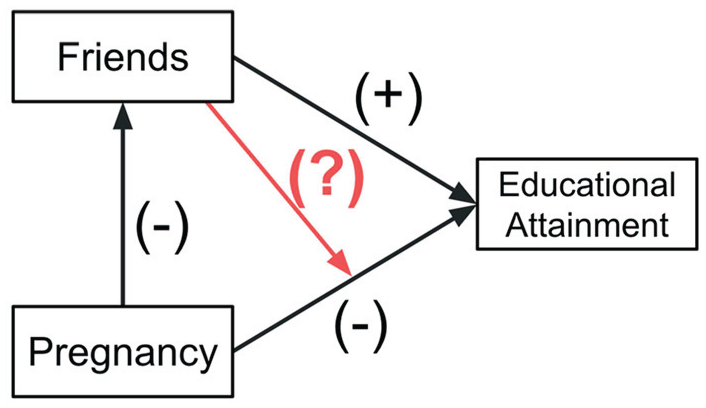
Conceptual model of the relationships among pregnancy, friends, and educational attainment. The highlighted arrow represents the research question of the present study.
I study a subpopulation of teens who became pregnant soon after data collection to assess whether increased social integration prior to pregnancy has a sustained association with later attainment. This study population mitigates selection bias concerns present when studying girls who experience pregnancy before data collection, which likely fails to capture previously pregnant girls who dropped out prior to the study. Cross-sectional measures of friendships held prior to pregnancy (instead of longitudinal social networks) are used given data limitations.
It is expected that pregnant teens with more friends will be less likely to drop out than pregnant teens who are more socially isolated. Identifying potential implications of social integration would justify interventions to socially engage teens at risk for pregnancy. Furthermore, although past work has quantified the ramifications of pregnancy on educational attainment, limited work has been done to identify school-level factors that may be associated with pregnant teens’ persistence. Assessing social networks as they relate to attainment may offer insights in how school environment and attachments contribute to persistence for an at-risk population.
Method
Data
This study uses the nationally representative National Longitudinal Study of Adolescent to Adult Health (Add Health), which follows a cohort of students between grades 7 and 12 starting in the 1994–1995 school year (Harris et al. 2009). Add Health used school-level sampling; 80 high schools were sampled and for each high school that did not include a 7th grade, a feeder middle school was selected, for a total of 132 schools. All students in sampled schools were included in the first wave of data collection (in-school survey), and a subsample of students was followed in subsequent waves of surveys. The subsample was selected on the basis of grade and sex stratification, with oversampling of some groups (e.g., ethnicity, siblings). In addition, in 16 schools all students were followed to allow social network analysis. Two follow-up surveys were conducted while participants were still in secondary school. The first follow-up, Wave 1, occurred in 1995 and also included a survey of a parent or guardian (referred to as the parental questionnaire). Wave 2 took place in 1996. Wave 3, done in 2001–2002, was the first follow-up done after the participants would have completed secondary school and includes high school completion data.
The sample was restricted to female participants completing an in-school survey (n = 44,482), a Wave 1 and/or Wave 2 survey (n = 7,882), and a Wave 3 survey (n = 6,060) with reported pregnancy data in Wave 1 or Wave 2. It was also limited to only participants attending schools with at least 50 percent response rates on the in-school survey, for a final sample of 5,676. Schools with less than a 50 percent response rate may present inaccurate social network structures and constructed network variables (Carolina Population Center 2001). Of these, 3,803 had complete data; prior grade point average (GPA) was most frequently missing (10.38 percent of cases). When possible, missing data were first filled in using data from other parts of the data set (e.g., missing sex in Wave 1 was imputed using Wave 2’s reported sex). Remaining missing data were imputed using multiple imputation by chained equation using the mice package in R (15 imputations, 10 iterations per imputation) (van Buuren and Groothuis-Oudshoorn 2011). Ninety variables were included in the imputation, including pregnancy status, network characteristics (e.g., number of friends, centrality, having a best friend, friends’ GPA, delinquency), educational outcomes (e.g., academic trajectories, college attendance, high school completion), individual characteristics (e.g. age, delinquency, race, GPA, parents’ characteristics), and school characteristics (e.g. urbanicity, school resource, school type). Note that models were attempted on nonimputed data as a robustness check, but there were too few complete cases to estimate the models.
Although the Add Health data are dated and limit the generalizability of this work, they are unique in their whole-school social network and longitudinal educational attainment data. Although the rise of the Internet and social media has changed adolescents’ social worlds, students today still primarily attend brick-and-mortar schools and face in-school social dynamics. Furthermore, recent studies suggest that social difficulties and stigmatization are a continued issue for pregnant girls today (Bermea et al. 2018; Cherry et al. 2015).
Measures
Educational Attainment
Educational attainment is measured through high school graduation. Any participant receiving at least a high school diploma was coded as 1 and those not receiving high school diplomas (including those who obtained GED certification) as 0. Decomposing educational attainment into more refined trajectories (e.g., GED only, no GED or high school) was not possible, because of sample size, but is reported in the descriptive analysis. Furthermore, college attendance immediately following high school was not probed, because of a lack of enrollment dates in the Wave 3 survey.
Pregnancy Status
Participants reported whether they experienced any pregnancy prior to completing high school during the Wave 1 and/or Wave 2 surveys. Four mutually exclusive pregnancy categories were created using self-reported dates of pregnancy onset and the date that the in-school survey was completed. Never pregnant participants reported no pregnancy occurrences in either Wave 1 or Wave 2. Girls were categorized as presurvey pregnant if they experienced at least one pregnancy on or before the in-school survey. Postsurvey pregnant girls experienced pregnancies that started after the in-school survey but prior to either Wave 1 or Wave 2 (i.e., prior to completing high school). Finally, those girls who reported pregnancies with incomplete pregnancy dates (n = 24) were categorized as unknown pregnant. Of these groups, only postsurvey pregnant teens and never pregnant teens were retained for analysis (with postsurvey pregnancies representing pregnancies that occurred prior to completion of grade 12). It can be argued that looking at teens who were pregnant prior to the start of the survey collection potentially presents a selection concern. Feasibly, there are girls who would have been in this presurvey pregnancy group but dropped out prior to the start of the survey. Failing to capture these girls would artificially inflate the reported levels of attainment, as the presurvey pregnant groups represent those girls who have already persisted to some extent. The postsurvey pregnant group captures girls prior to possible pregnancy-related dropout.
Any pregnancy, regardless of pregnancy outcome (e.g., abortion, adoption), is considered in this study. Although it can be argued that pregnancy’s impact on adolescents may vary by outcome, all pregnancies are included for the following reasons: (1) limiting to live births may skew the sample by excluding teens who abort, an often more advantaged group (Ashcraft, Fernández-Val, and Lang 2013); (2) pregnancy occurrence is often a critical juncture in life regardless of outcome, with teens reporting reprioritizing their academic and social lives before birth (Diaz and Fiel 2016); (3) stigma related to pregnancy begins prior to a live birth; and (4) a data collection error in Wave 1 prevents the differentiation of pregnancy outcomes for all girls.
Social Network Characteristics
Social network variables were derived using participant reported friendships during the in-school survey. Participants reported up to 10 friends, and because all students participated in the in-school survey, it is possible to link nominations and construct overall network structure and friend characteristics measures. The following measures of one’s social position within a school were used: (1) friends nominated (out-nominations), (2) friend nominations received from others (in-nominations), (3) number of friendships reciprocated, and (4) network centrality (i.e., how connected a participant is to other well-connected members in her school network). Average friend characteristics (GPA and delinquency) were also probed and found not to be significant. Friends nominated are an indicator of one’s perceived social relationships, whereas friend nominations received represent a measure of how one is socially received by others, as these friendships are reported without respondents’ knowledge. Reciprocated friends are included as friendship reciprocation is considered an indicator of friendship quality and mutual acceptance. Friends reported by the pregnant group are friends held prior to pregnancy. Data on friends held during and after pregnancy for the postsurvey pregnant group are not available, because friendship network data are cross-sectional and captured only at the in-school survey for the majority of respondents. Although the saturated school sample has longitudinal network data, there is an insufficient number of pregnancy occurrences in the saturated sample. Centrality, a proxy for popularity, was probed but excluded from the main models because of multicollinearity concerns detected through variance inflation factors. Instead, centrality was probed in separate models that did not include out-, in-, and reciprocated nominations.
Covariates
The following covariates were used in the regression analysis: age, race, GPA prior to data collection, parents’ education, family use of public assistance, presence of a parental figure, delinquency, school use of alternative placement following pregnancy, district-level provided childcare, and school urbanicity. Age is included to account for the increased opportunity for pregnancy as one gets older and the roughly one-year age gap between the pregnant group and the sample generally (pregnant: M = 15.68 years, SD = 1.42 years; all girls: M = 14.83 years, SD = 1.69 years). Additionally, age accounts for the time difference to high school completion across participants (i.e., participants surveyed in 8th grade have more years until graduating than those surveyed in 11th grade). Racial background has also been associated with differential occurrence of adolescent pregnancy (U.S. General Accounting Office 1998). Prior GPA was included because academic performance relates to future educational attainment (Zwick and Sklar 2005). GPA was calculated by averaging the available grades participants reported in English, math, science, and/or social studies/history for the most recent grading period prior to the in-school survey collection (A = 4, B = 3, C = 2, D or lower = 1). Dichotomous variables for parents’ education, public assistance use, and presence of a parent figure were adjusted for because a variety of family background characteristics, including family composition, income, and stability, have been associated with pregnancy risk (Maness and Buhi 2016; Manlove et al. 2009). Parents’ education was reported by participants during the in-school survey, with missing data completed with parent reported education when possible. Presence of a parental figure was derived from participant response to items asking if they lived with a mother or father figure. Public assistance use was reported by parents in the parental questionnaire. Delinquency is a composite measure verified with factor analysis of frequency (0 = never to 6 = nearly every day) of smoking, drinking, drunkenness, dangerous acts on a dare, lying, and truancy and is included because delinquency behaviors are associated with pregnancy risk and friend selection (Woodward, Fergusson, and Horwood 2001).
School-level covariates were also included to account for environmental factors that may relate to both academic success and/or network differences for pregnant teens. First, differences in school characteristics and resource allocations are thought to relate to academic trajectories (Card and Krueger 1996; Wehlage and Rutter 1985). Furthermore, the formation and importance of friends may also vary across school contexts (Small 2009). For example, maintaining friendships may be easier for a pregnant girl in a school that does not use alternative educational placements (e.g. online classes). The value of friends may also differ depending on school characteristics; for instance, a girl in a school with childcare available may have less need for a friend’s academic support because she presumably has fewer absences. As such, school administrator–reported dichotomous indicators of childcare availability, possible use of alternative educational placement following pregnancy, and school urbanicity are included. Childcare is a measure of whether childcare for students may be available at the school or district level. Possible alternative placement indicates a school that may move pregnant teens into different classes, schools, or home tutoring. Given data limitations, it is not possible to discern if pregnant girls in this sample were alternatively place or the extent to which schools implemented alternate placements. Urbanicity is measured through dummy variables for being located in a rural or suburban setting, with urban as the reference category.
Analytic Strategy
To explore the association between pregnancy and educational attainment, and to account for the nested data structure, multilevel logit models were fit on a sample of pregnant girls and never pregnant girls of similar backgrounds using the R programming language. Likely, there are background characteristics that drive pregnancy risk and academic success. Because of this endogeneity, comparing pregnant teens to all nonpregnant girls would likely overestimate the effects of pregnancy on educational attainment. To mitigate these confounding concerns, propensity score matching was used to identify a group of never pregnant teens that resembles the pregnant group. Propensity score matching identifies a comparison group with a similar distribution of observed covariates as the treatment group (the pregnant group). Therefore, the results of this analysis represent differences between pregnant teens and girls at similar risk for pregnancy only (as proxied through observed background characteristics), as opposed to a comparison with all nonpregnant girls.
Propensity scores were calculated using the following covariates (from the in-school survey): social acceptance, Hispanic, parental care, household size, extracurricular participation, HIV expectation, getting along with teachers, school effort, general health level, pride, self-acceptance, U.S.-born, years at current school, number of friends, and school attended (exact match). HIV expectation serves as a proxy for sexual behaviors/promiscuity; this measure was selected because no other sexual beliefs or activity measures were collected during the in-school survey. Because social behaviors may relate to both pregnancy risk and friendships, social network measures were included in the matching. First, self-reported ability to get along with teachers was included as an indicator of general sociability, which likely relates to friendship formation. Number of nominated friends and nominations received were also included in the propensity score calculation to better identify nonpregnant matches with similar social network sizes, a further indicator of past social behaviors. Given that pregnancies occurred after the in-school survey, these social network covariates are not affected by treatment (i.e., pregnancy).
Each pregnant teen was matched to a similar peer within the same school (with all pregnant teens receiving a match). A propensity score was calculated for each imputation and averaged across data sets to create an overall propensity score (Mitra and Reiter 2016). This propensity score was used for one-to-one nearest neighbor matching (without replacement), with an exact match on school, using the R package MatchIt (Ho et al. 2011; Stuart 2010). Matching resulted in an analytic sample of 274 pregnant participants and 274 comparable peers. Table 1 provides mean difference comparisons of the matched and unmatched groups for each covariate.
Comparison of Pregnant Group to Never Pregnant Groups Matched and Not Matched with Propensity Score Analysis Using Mean Difference Testing and Standardized Biases.

Note: GPA = grade point average; HS = high school.
p ≤ .05.
Propensity scores are befitting for a study of pregnancy because pregnancy occurrence can be viewed as a somewhat random event. Feasibly, two teens with similar backgrounds could engage in equivalent sexual behaviors but only one experience a pregnancy. Furthermore, although propensity scores cannot account for unobserved confounders, the extensiveness of available Add Health covariates and the large group of never pregnant teens from which to draw matches (n = 5,157) adds to the robustness of the matching procedure. A sensitivity analysis to hidden confounding was conducted using Rosenbaum’s approach and the R package rbounds (Keele 2010), resulting in a gamma value of approximately 1.2. Rosenbaum’s sensitivity analysis results may change with sample size because it uses counts of matched pairs (Liu, Kuramoto, and Stuart 2013); given the relatively small number of pairs in this study, the sensitivity results may appear less robust. Note that the use of matching limits the generalizability of results to teens at risk for pregnancy, as opposed to teens generally.
Using the matched sample, multilevel logit models were run with high school graduation as the outcome. Reported models were run without sampling weights. As a sensitivity test, basic regression models with and without weights were compared; similar coefficients were found and unweighted models had smaller standard errors (Solon, Haider, and Wooldridge 2015). A base model including pregnancy only was first run. Then, covariates were added:

where Yij represents the educational attainment variable for student i in school j, β0j is the intercept, u0j is the random school-level component indicated, and eij is individuals’ error terms. For student i in school j, Xij is pregnancy status, Wij is network characteristics, and Zij are covariates. Interactions between pregnancy status and friendships (indicated by Xij × Wij) were then probed:

These interactions include pregnancy interacted separately with number of reported friends, number of friend nominations received, and number of reciprocated friendships. Centrality models also included centrality interacted with the pregnancy variable.
Results
Descriptive Statistics
Background Characteristics and Matching
Table 1 provides descriptive statistics for the pregnant group, matched nonpregnant group, and the nonmatched, nonpregnant group, with mean difference tests and standardized biases reported. Compared with the sample generally, girls who became pregnant after data collection were older, with lower GPAs, more delinquency behaviors, and more disadvantaged families. These differences support the assumption that pregnant teens may systematically differ from some teens who never become pregnant. As such, propensity score matching identified a group of never pregnant teens with background characteristics that more closely resemble pregnant teens’.
The nonmatched group differed from the pregnant group on all individual characteristics covariates except being of other race, whereas the matched group did not differ on any individual covariates. In addition, standardized biases were calculated as a diagnostic of balance achieved following propensity score matching. The pregnant and nonpregnant matched groups had standardized biases of less than .25 on all covariates, indicating sufficient similarity (Stuart 2010); in comparison, before matching, the pregnant and nonpregnant group had differences greater than .25 for age, GPA, family background, and delinquency variables. Overall, the pregnant group was older, with lower GPAs, higher delinquency, and more disadvantaged families compared with the nonmatched and nonpregnant teens.
In terms of social networks, pregnant teens’ pre-pregnancy social networks were generally smaller and less reciprocated networks compared to nonmatched teens. The pregnant group nominated 3.96 (SD = 2.84) friends (out-nominations) compared with the nonmatched group’s 4.78 (SD = 2.88) friends. Pregnant girls generally were also found to be less central in the network before pregnancy than the nonmatched groups, with an eigenvector centrality of .68 (SD = .57) compared with the nonmatched teens’ .89 (SD = .63), respectively. In comparison, the pregnant and nonpregnant matched groups did not differ significantly on any network variables, indicating sufficient similarity in network characteristics.
Educational Attainment
In terms of educational outcomes, pregnant teens averaged more than half a year less education than the matched nonpregnant group and more than a full year less than the nonmatched and nonpregnant group (pregnant M = 12.35, SD = 1.58; matched nonpregnant M = 12.84, SD = 1.76; nonmatched nonpregnant M = 13.58, SD = 1.92). They were, on average, roughly 10 percent and 20 percent less likely to have received a high school diploma (pregnant M = .69, SD = .46; matched nonpregnant M = .79, SD = .41; nonmatched nonpregnant M = .89, SD = .31) and 10 percent and 30 percent less likely to attend some college than the matched and nonmatched nonpregnant groups, respectively (pregnant M = .34, SD = .47; matched nonpregnant M = .45, SD = .50; nonmatched nonpregnant M = .64, SD = .48). Pregnant teens were also more likely to have received neither a GED nor a high school diploma (pregnant M = .15, SD = .36; nonmatched nonpregnant M = .05, SD = .23) or only a high school diploma (pregnant M = .34, SD = .47; nonmatched nonpregnant M = .28, SD = .45) than the nonmatched, nonpregnant group only. Pregnant teens were more likely to earn only a GED compared with both nonpregnant groups (pregnant M = .12, SD = .33; matched nonpregnant M = .06, SD = .23; nonmatched nonpregnant M = .03, SD = .18)
Regression Results
Regression results suggest a relationship between pregnancy and high school completion (Table 2). Experiencing a pregnancy prior to the survey predicts a –.68 (SE = .22) decrease in the log odds of high school diploma receipt, after adjusting for network size and individual covariates. Separate models were run with network centrality as the only network predictor because of multicollinearity concerns (Table 3). These models found similar relationships between the log odds of high school completion and individual covariates and pregnancy status (β = –.66, SE = .22).
Random-intercept Models of Receipt of High School Diploma.

Note: GPA = grade point average.
p ≤ .10. *p ≤ .05.
Random-intercept Model of Receipt of High School Diploma by Centrality.

Note: GPA = grade point average.
p ≤ .10. *p ≤ .05.
Interactions between pregnancy status and network variables were added to the model separately to assess whether the relationship between pregnancy and educational attainment varies depending on a pregnant girl’s level of social integration before pregnancy (Figure 2). Significant interactions were found between becoming pregnant after the survey date and the number of friends a girl reported having prior to pregnancy in predicting educational attainment, suggesting that the relationship between pregnancy and educational attainment differs depending on the size of a pregnant teen’s social network prior to pregnancy. Specifically, pregnancy appears to affect teens with no friends more negatively than teens with friends. Pregnant teens with no reported friends prior to pregnancy have lower odds of completing high school than nonpregnant teen who report no friends (β = −1.32, SE = .40). For pregnant girls, having more friends lowers the negative predicted association between pregnancy and educational attainment, with each additional reported friend increasing the odds of high school completion by a factor of 1.19 (β = .17, SE = .08, p < .05). For context, if an average nonpregnant girl had no friends, her predicted probability of completing high school would be .83, whereas a similar pregnant girl with no friends prior to pregnancy would have a predicted probability of .56. With seven reported friends, this gap between the pregnant and nonpregnant teens would essentially be removed, with the pregnant teen having a .69 probability of graduation and the nonpregnant teen having a .71 graduation probability.

Probability of high school diploma receipt for pregnant and matched nonpregnant groups, holding all else constant for an average girl, by increases in network characteristics (solid gray line = pregnant, dashed black line = never pregnant). X-axis limits are within the range of observed data.
A similar relationship was found for received friend nominations from peers (in-nominations). Pregnant teens without in-nomination friends prior to pregnancy had lower odds of high school graduation than their matched nonpregnant counterparts (β = −1.37, SE = .39). An average nonpregnant teen without in-nomination friends has a predicted probability of graduating of .83 compared with a pregnant teen’s .55 probability. The association between pregnancy and attainment is again found to be lower for teens with friends prior to pregnancy. Each additional in-nomination received predicts the odds of high school completion to improve by a factor of 1.20 (β = .18, SE = .08, p < .05). Each additional friend a teen has prior to pregnancy lessens the graduation probability gap between pregnant and nonpregnant teens. A pregnant teen with seven in-nomination friends would have essentially the same probability (P = .82 vs. P = .84) of completing high school as her nonpregnant counterpart.
In terms of reciprocated friendships, a nonpregnant teen with no reciprocated friends has greater odds of high school completion than a pregnant teen with no reciprocated friends. Pregnancy is associated with having −1.06 lower log odds of graduation when one has no reciprocated friends (SE = .33). An average nonpregnant teen without reciprocated friends has a predicted probability of graduating of .80 compared with a pregnant teen’s .58 probability. Although the reciprocated friendship interaction estimate suggests similar relationship directionality as the out- and in-nomination interaction terms (i.e., additional friends lessening the gap between pregnant and nonpregnant girls’ graduation probabilities), the interaction was not found to be significant (β = .25, SE = .16, p = .11)
Finally, the gap between the odds of graduation for nonpregnant and pregnant teens also appears to lessen as network centrality increases. For pregnant teens, centrality was a marginally significant predictor of high school completion, with an increase in centrality predicting high school completion odds to increase by a factor of 2.0 (β = .84, SE = .43, p = .05). With centrality measures of zero, an average pregnant teen would have an expected probability of .62, while a nonpregnant teen would have an expected probability of .85. When centrality increases from 0 to .7 (roughly the average centrality for the pregnant group), postsurvey pregnant teens would expect their probability of graduating to increase to .75, while the nonpregnant teens would expect no change in probability (P = .85).
Figure 2 graphically represents predicted probability changes for average pregnant and nonpregnant matched teens. Note that although probability of graduation appears to decline as out-nomination friendships increase for the nonpregnant group, this estimate is not statistically significant.
Discussion
Prior research suggests a potential relationship between social engagement and academic success for pregnant teens. This study tests this by probing possible associations between adolescent pregnancy, social networks, and educational attainment. The relationship between pregnancy and educational attainment appears to vary across friendships held prior to pregnancy (with nonpregnant teens of similar background characteristics as the comparison group). Having more friends reported, friend nominations received, and higher network centrality before pregnancy all predicted having higher likelihoods of graduating high school compared with those with no friends prior to pregnancy. These predictions suggest that pregnancy has a smaller association with educational attainment for teens that are more socially integrated prior to pregnancy. These findings support theories that suggest social attachments at school mitigate dropout risk (Rumberger 2011) and align with studies that find differences in friendships and attachments to relate to academic persistence (Carbonaro and Workman 2013; Ellenbogen and Chamberland 1997; Marcus and Sanders-Reio 2001; Ricard and Pelletier 2016). It further extends previous work by assessing a subpopulation at known risk for dropout and finds social connections to lower the estimated impact of a dropout risk factor on future educational attainment.
Having more friends prior to pregnancy may be valuable for a number of reasons. Additional friends may give a teen more opportunities to maintain at least some friends following a pregnancy or may indicate more socially capable or popular teens. Larger in-nomination (received nominations from others) networks may be indicators of stronger friendships that are more likely to endure a pregnancy. In-nominations may also be indicators of the general popularity of a girl. To probe the role of popularity, a measure of centrality was used to assess the extent to which overall connection to the school’s social network (weighted by how well connected one’s friends are) relates to attainment. It again finds increased centrality prior to pregnancy to be related with increased likelihood of high school completion (marginally significant, p = .05), suggesting that overall popularity may also serve as a dropout buffer for this population. More robust social networks prior to pregnancy may also have lasting benefits, such as establishing group norms that persist even after friendships end.
The number of friendships reported prior to pregnancy reflects one’s perceived social standing. Perceptions of one’s social status and capabilities may also contribute to a teen’s well-being. If a teen thinks she has friends, regardless of whether these friendship sentiments are shared by her peers, she may still benefit emotionally and maintain feelings of belonging at school that incentivize continued attendance. Pregnant teens could feasibly continue to benefit from perceived friendships well after a peer’s view of the friendship have changed because she likely is not privy to the inner thoughts of her friends, and sufficient time is often required to sense a change in friendships. More reported friendships prior to pregnancy may represent additional opportunities for a teen to believe she has ongoing friendships, which may buffer the stress and emotional toll of friendship loss, isolation, or stigma.
Interestingly, reciprocated friendships were not found to significantly relate to eventual educational attainment for pregnant teens. It was hypothesized that reciprocated friendships would be beneficial because reciprocation often indicates more robust friendships and deeper sources of social support and because past work suggests a relationship between these types of friendships and academic success and persistence (Ricard and Pelletier 2016; Vaquera and Kao 2008). Although the results were nonsignificant, they were approaching significance (p = .11) and may reflect a lack of power given the small sample size. Conversely, reciprocated friendships may not be as valuable as perceived friendships and received friendships. Conceivably, a pregnant teen could benefit from incongruent friendships, whereby she receives the emotional benefits of perceiving a friendship from someone who does not reciprocate or receives kindness or support from an in-nomination that she does not reciprocate. The measure of reciprocated friendship is also limited by data collection, which restricted respondents to reporting only their top five female and male friendships. Feasibly, a pregnant teen may benefit from reciprocated friendships that were not captured because one of the parties was unable to list more than five female or male friends.
These results are limited by the inability to extend the analysis to the friends this group has at the time of their pregnancy occurrence. Although Add Health has longitudinal network data for a small number of schools, these schools are not representative of the sample generally and have too few pregnant teens from which to draw educational attainment inferences. Because friendship data are cross-sectional for the majority of the sample, this study is unable to determine the extent to which those more socially integrated pregnant teens maintain their friends through their pregnancies. Because social behaviors likely relate to pregnancy risk and pregnancy likely affects social outcomes, future work would benefit from longitudinal analysis of friend change before and after a pregnancy. Such work could additionally probe whether extent of friend change relates to attainment; for example, is a girl more likely to drop out if she has a large network prior to pregnancy but then loses all their friends than a girl who has only one friend consistently through her pregnancy? The generalizability of these findings is limited by the use of propensity score matching. Propensity score matching rests on the assumption of no unobserved confounding. Theoretically, the pregnant and matched nonpregnant groups may differ by an unmeasured or unaccounted for variable. Future work could add to this analysis by assessing different pregnancy trajectories (e.g., abortion, adoption) to gain a more nuanced understanding of how the relationship between social connectedness and educational attainment varies by pregnancy outcome. Finally, this study limits friendship to school-based relationships given the focus on educational attainment. Feasibly, teens may derive social benefits from relationships outside of school that are not accounted for in this analysis.
Overall, this work suggests that social isolation and social connections may be factors in the educational careers of girls who become pregnant. Finding friendships prior to pregnancy to lessen the negative impact of pregnancy on future academic persistence suggests that school-level efforts aimed at socially integrating students at risk for pregnancy and/or social isolation may be beneficial. Social integration interventions would also be expected to benefit all students, given the literature suggesting that social connections improve teens’ attachment to school and ultimately attainment. These findings further suggest that school environment factors, such as one’s social climate, may relate to educational success of pregnant teens. Further work is needed to identify other school climate factors that may benefit this population.
Footnotes
Acknowledgements
This research uses data from Add Health, a program project directed by Kathleen Mullan Harris and designed by J. Richard Udry, Peter S. Bearman, and Kathleen Mullan Harris at the University of North Carolina at Chapel Hill, and funded by grant P01-HD31921 from the Eunice Kennedy Shriver National Institute of Child Health and Human Development, with cooperative funding from 23 other federal agencies and foundations. Special acknowledgment is due Ronald R. Rindfuss and Barbara Entwisle for assistance in the original design. Information on how to obtain the Add Health data files is available on the Add Health website ( ). No direct support was received from grant P01-HD31921 for this analysis.
Author’s Note
This study uses secondary data, so the author did not personally collect informed consent. The data were used and secured in accordance with the requirements of the Add Health restricted-data use contract to maintain participant confidentiality. The study and data security protocols were reviewed and approved by an institutional review board.