




Abstract
Census ethnoracial categories often reflect national ideologies and attendant subjectivities. Nonetheless, Brazilians frequently prefer the non-census terms moreno (brown) and negro (black), and both are core to antithetical ideologies: racial ambiguity versus racial affirmation. Their use may be in flux as Brazil recently adopted unprecedented race-targeted public policy. We examine propensities to self-classify as moreno and negro before and after the policy shift. Using regression modeling on national survey data from 1995 and 2008 that captured self-classification in open and closed formats, we find moreno is highly salient but increasingly constricted, while negro is restricted in use, though increasingly popular. Negro’s growth is mostly confined to the darker pole of Brazil’s color continuum. Education correlates in opposing directions: negative with moreno and positive with negro. Our findings proxy broad ideological shift from racial ambiguity to negro racial affirmation. They suggest race-targeted policy is transforming racial subjectivities and ideologies in Brazil.
The ethno-racial categories states institutionalize in censuses generally reflect either salient social identities embedded in national racial ideologies or identity-building projects (Davis 1991; Emigh, Riley, and Ahmed 2015; Enloe 1981; Lee 2010; Loveman 2014; Nobles 2000). The Brazilian case complicates these theoretical assumptions. Brazilians have long eschewed official census categories when engaging racial identification in everyday life. Instead, they often prefer the terms moreno (brown color) and negro (black race) (Bailey and Telles 2006; Sansone 2003; Silva 1996). Neither of these terms has ever been in Brazil’s censuses since the first in 1872 (Nobles 2000). Yet, scholars hold that moreno and negro reflect salient identities and broad ideologies in Brazil in ways the official census terms do not (Conrado, Campelo, and Ribeiro 2015; Freyre 1971; Harris 1970; Pravaz 2009).
The moreno term has been very popular historically, often representing the “preferred social type” in Brazil (Pravaz 2009:81). The category is notably color ambiguous, making it perhaps applicable to a majority of Brazilians (Harris 1970; Telles 1995). In everyday social interaction, moreno can act to downplay racial differences; as core to Brazil’s racial mixing ideology morenidade, scholars connect it with a denial of racial discrimination (Conrado et al. 2015; Hanchard 1994; Osório 2003). In contrast, negro has been less salient in everyday interaction but is core to Brazil’s ideology of racial affirmation, or negritude (Domingues 2005; Silva and Reis 2011). Negro is the preferred term of Brazilian negro movements (Telles 2004), and it is more recently embraced by many state actors (Pereira 2016). Juxtaposed to branco (white) by movement and state actors to form a binary scheme, the negro term by definition excises racial intermediacy; from this lens, Brazil becomes a majority negro country (Pinho 2005). In sum, the non-census terms moreno and negro represent salient racial subjectivities and ideologies in Brazil. Moreover, each term (and attendant ideology) appears antithetical to the other, namely, “increasing one seems to logically imply decreasing the other” (Martin 2015:13; see also Conrado et al. 2015; Freyre 1971; Pravaz 2009).
Racial identification dynamics in contemporary Brazil, however, are in flux due in large part to the Brazilian state’s recent adoption of race-targeted affirmative action (Bailey 2008, 2009; Francis-Tan and Tannuri-Pianto 2015). To explore the possibly changing uses of moreno and negro in this rarified context, we use national survey data from two points in time, 1995 and 2008, and leverage a unique open-format measure designed to capture “spontaneous” racial classification. Using logistic regression techniques and data pooling, we examine propensities to self-classify as moreno and negro across the 13 years separating the two surveys, capturing a “before” and “after” of affirmative action’s institutionalization. We also explore how educational level, age, sex, region, census classification, and survey year structure the choice of these categories across time. Our findings document constriction in the use of moreno and amplification of the use of negro. In addition, we present evidence of how education works dialectically across trends: negatively with the choice of moreno and positively with negro self-identification. Overall, our analysis suggests a “period effect” (Sewell 1996) on racial identification dynamics in contemporary Brazil constituted in large part by the state’s adoption of race-targeted public policy (Bailey 2008, 2009). A consequence of this state turnabout is movement from racial ambiguity to racial affirmation in subjectivities and ideologies in contemporary Brazil.
Racial Vocabulary and Ideology
An instructive lens on racial ideology is that it is analogous to a map of terrain (Fields 1990). The features of the racial map or landscape, however, make sense through referencing perceived phenotype difference attributed to nature via ancestry. 1 A racial ideology, then, is in part descriptive cognition and vocabulary used to make rough sense of oneself and others referencing phenotype. Beyond description, however, ideologies are also prescriptive in structuring social dynamics through “we/they” positionality or interests (Mannheim 1952; Martin 2015). 2 As we lay out, and as is recognized in the literature, moreno and negro are the vocabulary of two cognitive maps of day-to-day social relations in Brazil, and they both engage positionality, namely, are tethered to ideology (Freyre 1971; Nascimento and Nascimento 2001; Osório 2003).
Moreno and the Ideology of Racial Mixing
The color category moreno is a centerpiece of Brazil’s historical “referential ambiguity” (Harris 1970; Harris et al. 1993). It symbolizes mixed racial origins, in many ways similar to the mestizo and mulato terms found in Spanish-speaking Latin America (Telles and Sue 2009). On a color continuum, moreno speaks to an intermediate “brownness,” a position between the lightest and the darkest poles marked by the categories white (branco) and black (preto) (Pravaz 2009:79). Brazilians have been known to use at least 100 terms or more in referring to self- and other-identification in informal contexts (Harris 1970; Oliveira, Porcaro, and Araújo 1985; Telles 2004). Amid that plethora of description diversity, the moreno label can be used for an incredibly broad range of skin colors and combinations of racial features (Harris 1970; Telles 1995).
Moreno’s high salience in informal contexts is well noted (Bailey and Telles 2006; Harris 1970; Silva 1996). Its use is especially noteworthy because it is not an official census term. Moreno’s appeal may reside in its ability to downplay racial distinctions in everyday interactions (Sansone 2003); it acts as an all-encompassing identity, perhaps historically somewhat equivalent to “Brazilianness” (Pravaz 2009:80; Fryere 1971). However, Harris (1970) early on noted its ideological dimensions. He speculated that moreno’s “prime social function” was in “maintaining and maximizing the noise and ambiguity” among Brazilians (p. 12). He viewed the “structural reason” for ambiguity as inhibiting the formation of a racial ideology for which unambiguous racial distinctions could create the conditions for class conflict. This possibility was due to the correlation between class and race in Brazil, namely, “the more negroid the phenotype, the lower the class” (Harris 1970:12).
In contrast to viewing racial ambiguity as inhibiting class conflict, most researchers point instead to the ideology of morenidade as inhibiting racial mobilization or racial conflict (Hanchard 1994; Marx 1998). Scholars view moreno’s primary social function as a negation of “blackness” or being negro (Nascimento and Nascimento 2001; Osório 2003). The term is seen as denying a reality of race in branco and negro and investing in a broad social identity that strategically dismantles particularistic racial identification to the detriment of racial minorities (Conrado et al. 2015). In addition, researchers often connect the use of moreno with an ideology of whitening (cf. Ribeiro 2010). Colorism permeates Brazilian racial dynamics: “the lighter the skin, the greater the social value” (Pravaz 2009:81). This dialectic is reflected in the many variants of moreno itself, like moreno claro (light moreno) and moreno escuro (dark moreno). In sum, there is a clear connection between the color term moreno and the ideological product morenidade in its role in “structuring power relations across [Brazilian] society” (Conrado et al. 2015:80).
Negro and the Ideology of Racial Affirmation
In contrast to the recognized popularity of moreno, the term negro was not widely diffused as a preferred category for self-identification in the last half of twentieth-century Brazil (Bailey and Telles 2006; Silva 1996). For example, a 1976 national survey found that less than 1 percent of Brazilians self-identified as negro in an open-format question; in contrast, fully one-third self-identified as moreno (Oliveira et al. 1985). Nonetheless, negro has a long history of use in Brazil by negro social movements that define negro as the sum of the two census categories pardo and preto (Domingues 2005; Pinho 2005). From this perspective, pardo and preto are color terms, whereas negro is a term of racial affirmation constructed similarly to the black category in the United States (Freyre 1971; Nascimento and Nascimento 2001).
This branco versus negro lens on racial dynamics in Brazil historically deviated from the official government perspective, which long embraced a color distinction between pardo and preto (Nobles 2000). Telles (2004:22) labels the dichotomous view the “black movement classification system,” and he and other scholars noted its disconnect with the way ordinary Brazilians self- and other-identify in informal contexts (Bailey and Telles 2006; Silva 1996). For example, Hasenbalg and Silva (1999:69) noted: The linguistic racial terms used by Brazilians are different from those used by the black movement, which tends to operate on the basis of a dichotomy of black versus white in an effort to construct an identity that can engage in collective political action. The number of people that identify themselves as black is ridiculously small when the total population of the country is taken into account.
This research noting the low salience of negro correspond mostly to the later 1990s and early 2000s.
The connection of negro with a consciousness of racial discrimination marks the ideology of negritude’s stark contrast to the belief associated with morenidade that Brazil is a land of cordial racial dynamics. Hence, both the myth of racial democracy and the use of moreno became targets of negro movements (Conrado et al. 2015; Osório 2003). Negro identification in negritude’s cognitive map follows three principles: “Politically, it provides a group identity for political organization and mobilization; ideologically, it is related to the development and acquisition of racial consciousness; culturally, it refers to the embrace of all African-origin cultural expressions” (Domingues 2005:26). The negritude struggle is not only to correct distorted understandings of racial dynamics in Brazil; negro social movements also seek to reorient racial subjectivity among everyday Brazilians away from moreno and toward negro racial consciousness (Hanchard 1994). Hence, the embrace of the negro term can plausibly act as a proxy for the salience of the ideology of negritude (Osório 2003).
Shifts in Racial Terrain, 1995–2008
Returning to the aforementioned analogy of ideology as a terrain map (Fields 1990), geographic maps must change to remain useful in response, for example, to new infrastructure or the redrawing of political boundaries. So too a racial ideology and its attendant vocabulary must adjust to changes in social structure lest it be discarded due to its ineffectiveness for making sense of the racial terrain. How did the racial terrain in Brazil change in the period between 1995 and 2008 that could produce ideology shift?
For the lion’s share of the twentieth century, state discourse touted Brazil as a blended nation and an example to the world of “racial democracy” (Wagley 1952). In fact, and in stark contrast to post-abolition United States and South Africa, the Brazilian state never adopted de jure discrimination against its citizens after slavery’s abolition (Fialho 2017; Marx 1998; Telles 2004). 3 UNESCO even sponsored a series of studies in the 1950s in Brazil to understand how Brazil might serve as a model in the international struggle against racism (Maio 2001; Wagley 1952).
Since at least the 1970s, negro social movement actors have nonetheless mounted a growing challenge to the racial democracy perspective (Domingues 2005; Pereira 2016). However, it was during Fernando Henrique Cardoso’s presidency (1995–2003) that the government began working closely with negro movements to change the official narrative, affirm negro identification, and develop race-targeted affirmative action (Htun 2004). An important stimulus was the UN World Conference on Racism in 2001, on the heels of which federal and state government actors began implementing affirmative action policies (Htun 2004; Telles 2004).
Perhaps the most impactful policies involve two areas of education: racial quotas in public universities and obligatory teaching of Afro-Brazilian history and culture in basic education. Racial quotas formally began with a law passed by Rio de Janeiro’s State Assembly in 2001 for its state universities; Law 3.708/2001 mandated a 40 percent quota for pardos and negros (Peria and Bailey 2014). In the months and years following, other public universities and state legislators moved to enact similar policies, most often in the form of quotas for pardos and pretos or negros. By 2005, 24 of the 95 public universities had adopted affirmative action policies; by 2007, a year preceding our 2008 data, that number had grown to 37 (Peria and Bailey 2014).
A federal law passed in 2003 (10.639) requires the teaching of African and Afro-Brazilian history and culture in all basic and intermediate education (Pereira 2016). It mandated the programmatic study of “the struggle of negros in Brazil, Brazilian negro culture and place in the nation’s societal formation, demarcating the negro population’s contributions in the areas of social, economic, and political life in the History of Brazil” (Brasil 2004:35). Implementation has not been easy, due in part to proper formation of teachers; nonetheless, this affirmative action commitment moves forward (Pereira 2016). Its focus is clearly in line with the core ideas of negritude.
In sum, Brazil’s new race-targeted policies constitute a substantial, if not tectonic racial terrain shift (see Fields 1990). The vocabulary and cognition of moreno in epitomizing ambiguity and conviviality would appear inadequate to describe the new terrain (Osório 2003; Telles 1995). In contrast, negritude’s vocabulary and cognition provide an efficient guide to the new racial landscape (Brasil 2004).
Data and Methods
To examine possibly shifting racial subjectivities and ideologies in Brazil, we examine data from two face-to-face surveys collected by DataFolha Research Institute, a major polling company. DataFolha produced Brazil’s first national sample for the study of public opinion on race in 1995 (DataFolha 1995) and then repeated that survey in 2008 (DataFolha 2008). Both surveys are national samples of the urban population aged 16 and older, stratified by geographic macro-regions. 4 Complete samples consist of 5,081 respondents across 121 municipalities in 1995 and 2,982 respondents across 212 municipalities in 2008. 5
Data on respondents’ race were collected in open-ended and closed-format questions. We use a multidimensional analytic approach (Bailey, Loveman, and Muniz 2013; Harris and Sim 2002) that leverages both racial measures. We present a descriptive analysis of frequency distributions for both measures across the two periods. Next, we use multinomial logit techniques to explore propensities to self-classify as moreno and negro in the open format by select respondent characteristics in 1995 and in 2008. 6 We run separate models for each survey year, allowing the comparison of propensities across that 13-year period. We then use data pooling, combining the two samples to test the direction and the significance of survey year (1995 vs. 2008) in propensities for the choice of moreno and negro over time. 7
The dependent variable for our model uses the open-ended survey question “What is your color?” (Qual é a sua cor?). The survey item was designed to capture “spontaneous” expressions of color/race, which we label “folk race” The six most frequently voiced terms as respondents’ folk race (together making up 94 percent of the sample in 1995 and 95 percent in 2008) constitute this variable’s values. They are moreno, moreno claro, negro, branco (white), pardo (brown), and preto (black). Branco, pardo, and preto are Brazilian census categories. We code this variable moreno, moreno claro, negro, other, and a collapsed category of census terms (i.e., those choosing either branco, pardo, or preto as their folk race) (reference category).
Covariates in our preferred statistical model include education, household income, gender, age, and region. We coded education in three levels of attainment: people who completed up to elementary school (reference category), those who have some or complete high school education, and those with some or complete college education. We measured household income in five levels of monthly minimum wages (MW). The minimum wage in Brazil is a set monthly salary below which an employer is prohibited from hiring employees. The values of this variable are: (1) up to 2 monthly MW (reference category), (2) from 2 to 5 MW, (3) from 5 to 10 MW, and (4) 10 or more MW. Gender is a binary variable coded as male (reference category) and female. Age is a continuous variable measured in years and recoded from zero to one; zero represents the youngest (16 years old in both 1995 and 2008) and one the oldest (98 years old in 1995 and 88 in 2008) respondents in the sample. 8 Region is a categorical variable coded in four levels: southeast (reference category), south, northeast, and north/center-west; this variable also serves as a proxy control for local racial composition. 9
In addition, our model includes self-classification in the census format, the second racial measure or dimension we label census race, as a predictor of choices in the open format, or folk race. 10 Question order was important; open-ended responses were elicited prior to responses to the closed format. Our model’s census race variable is categorical and coded branco, pardo (reference), and preto. Due to small sample sizes, those self-classifying as Indigenous or of Asian descent are excluded from all analyses. 11
Findings
Descriptive Statistics
We begin with self-classification in the closed census format, or census race (Table 1). Comparisons of choice of census race categories in 1995 and 2008 show the constriction of the branco category across time, a decline of almost 13 percent in the 13-year period. On the other hand, pardo and preto experienced an expansion of 9.6 percent and 3.4 percent, respectively, between 1995 and 2008. 12
Percentage Distribution Census Race, Brazilian Adults, 1995 and 2008.

Note: First two columns sum 100 percent. Asians and Indigenous not included.
Results for the open-ended question (Table 2) document the salience of folk race terms. The results show that moreno is the most popular term in both 1995 and 2008 after branco. Nonetheless, there is significant constriction of about 10 percent in the number of self-declared morenos. In contrast, the use of negro as folk race is infrequent. In 1995, only 3 percent of the population chose negro in the open format. In 2008, however, almost 8 percent self-identified using negro, more than doubling in its overall frequency percentage.
Percentage Distribution Folk Race, Brazilian Adults, 1995 and 2008.

Figure 1 is a graphic illustration of three cross-tabulations of census race by folk race. It reveals how individuals, sorted by census race categories, expressed their folk race. Among census brancos, for example, between 1995 and 2008, we see a decrease by fully half in the choice of moreno as their folk race. Whereas 13.4 percent of census brancos preferred moreno as their expressed race in 1995, that percentage dropped to 7 percent in 2008. Much of this decrease appears to be from census brancos becoming more likely to also choose branco as their folk race over moreno.
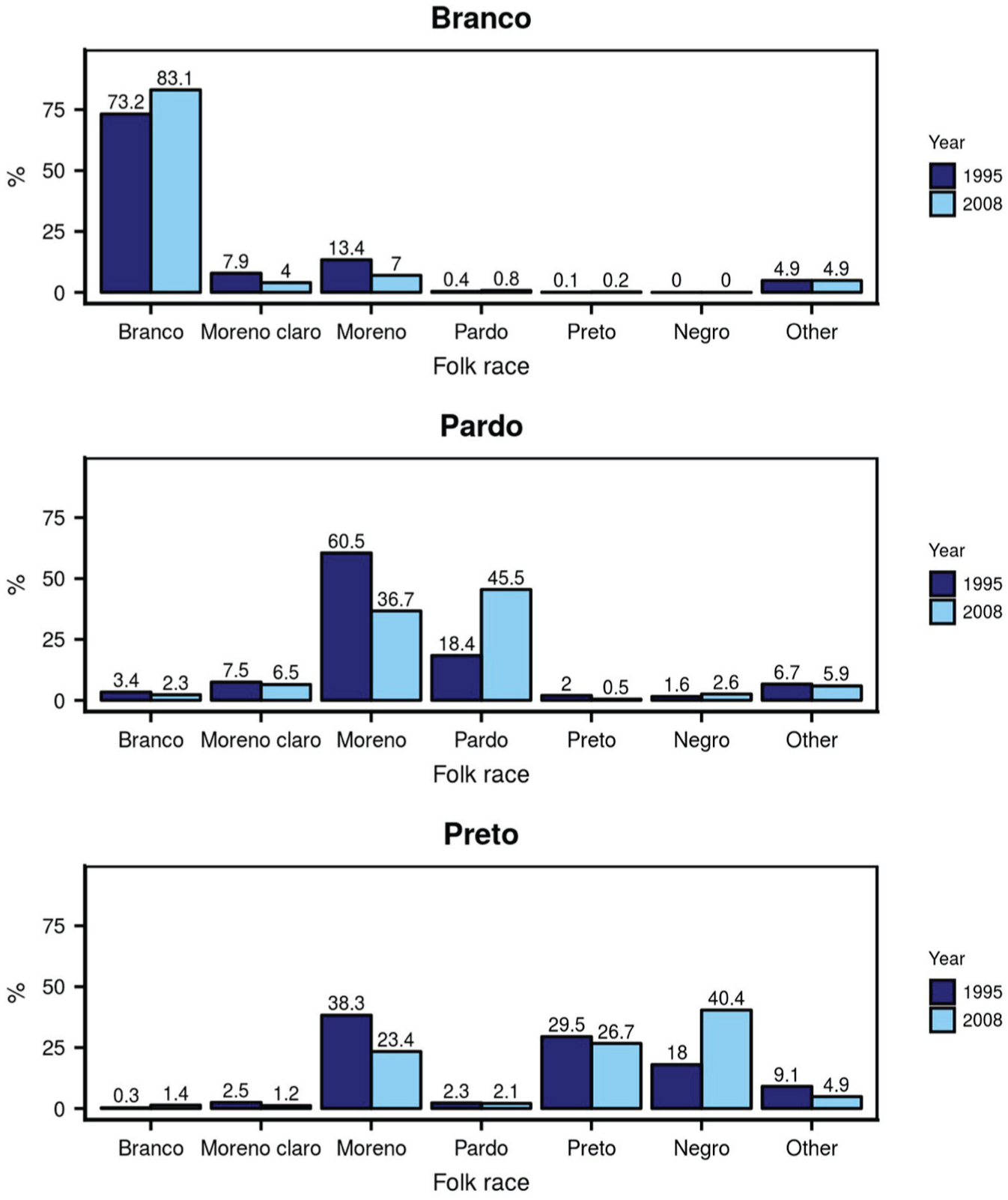
Census race by folk race.
We found a similar dynamic among census pardos in terms of choice of moreno as their folk race. In 1995 fully 60.5 percent of census pardos chose moreno; in 2008, that percentage dropped to 36.7 percent. The decrease appears to flow from census race pardos increasingly using pardo as their folk race: from 18.4 percent in 1995 to 45.5 percent in 2008. Comparatively few census race pardos chose negro for their folk race in either 1995 or 2008; nonetheless, the percentage did increase. Similarly, among census race pretos, those choosing moreno as their folk race decreased from 38.3 percent in 1995 to 23.4 percent in 2008. The decrease came from a dramatic increase in census pretos choosing negro as their folk race in 2008, from 18 percent to fully 40.4 percent.
Multivariate Analysis
Using multinomial logit regression, Figure 2 shows the average effects of census race, education, household income, gender, age, region, and year on the probability of choosing moreno or negro as a respondent’s folk race in 1995 and 2008. The comparison category is formed by all those who opt for a census term as their folk race. The horizontal lines passing through the symbols for the coefficients (circles for 1995 and diamonds for 2008) represent 95 percent confidence intervals; when a coefficient’s line crosses the vertical line marking “0,” the coefficient is not statistically significant (i.e., p > .05). 13

Multimonial logistic regression coefficients for moreno and negro and associated 95 percent confidence intervals.
First, the coefficients for census race categories are overall in line with the descriptive statistics from Figure 1. Compared to pardos (reference category), pretos, for example, had a lower probability of choosing moreno as their folk race and a remarkably higher probability of choosing negro in both years. Holding the other variables constant, the odds of choosing negro as folk race were 9 times larger in 1995 and an astonishingly 33 times larger in 2008 for pretos compared to pardos. For both periods, the odds of brancos choosing moreno is only about 10 percent that of pardos choosing it. Census race brancos never chose negro as their expressed race; hence, there is no coefficient.
Turning briefly to our graph of predicted probabilities in Figure 3, we show that moreno continues to be a term that individuals of all census race categories sometimes choose (Harris 1970; Telles 2004), namely, that it is highly ambiguous; nonetheless, the average probability of choosing moreno as respondents’ folk race decreased significantly from 1995 to 2008 for each census race population. These results suggest that moreno is losing ground over time in what some have called a “classification battle” in Brazil (Bailey and Telles 2006; Nobles 2000).

Average predicted probability of choosing moreno and negro, by census race.
In contrast to the waning popularity of moreno, we also see in Figure 3 that the average predicted probability of census race pretos choosing negro in the open format increases strikingly from 18 percent in 1995 to 41 percent in 2008. The average predicted probability of census race pardos choosing negro, however, remains fairly stable overall, around 2 percent to 3 percent. These results suggest that despite efforts to popularize negro among both census race pardos and pretos (Hasenbalg and Silva 1999; Nobles 2000; Telles 2004), the increased salience of this term in 2008 was almost exclusively constrained to census race pretos.
Interestingly, education has opposing effects on the choice of moreno and negro as a respondent’s folk race, and those effects increase over time. Figure 2 shows that compared to elementary education (reference category), high school education and especially college education reduce the odds of choosing moreno as one’s folk race in 1995 and 2008, holding all other variables constant. Figure 4 illustrates how this effect holds across all census race categories. In contrast, the size of the coefficients for choosing negro as one’s folk race increases with education in 1995 and 2008, though significantly only in 2008, and mainly for census pretos. Both in 1995 and 2008, preto respondents with some college education are about three times more likely to express negro as their folk race compared to pretos with elementary education only. The contrary effects of education on the choice of moreno compared to negro suggest its key role in shifting Brazilian folk race dynamics (Bailey and Telles 2006).

Average predicted probability of choosing moreno and negro, by education.
Gender has no significant effect on the choice of moreno in either 1995 or 2008, as seen in Figure 2. However, female has a positive and statistically significant effect on choosing negra as folk race across both periods. The effect of gender is specific to census race pretos and is consistent with the literature suggesting the especially negative meaning that the preta term may have for women of color (Telles and Lim 1998). In addition, our results reveal that on average, preta women are more likely to prefer negra over preta as their folk race.
We show in Figure 2 that age significantly affects the choices of both moreno and negro in 1995, but its effects become nonsignificant in 2008. Nonetheless, when we examine each census race population separately in Figure 5, age effects are visible across all categories in 2008 in relation to the choice of moreno: Younger respondents tend to choose this term less often than older. In contrast, younger census race pretos in 2008 chose negro more often than older respondents. Hence, for census pretos, these panels suggest the opposing effects of age on folk race choice: negative for negro while positive for moreno.
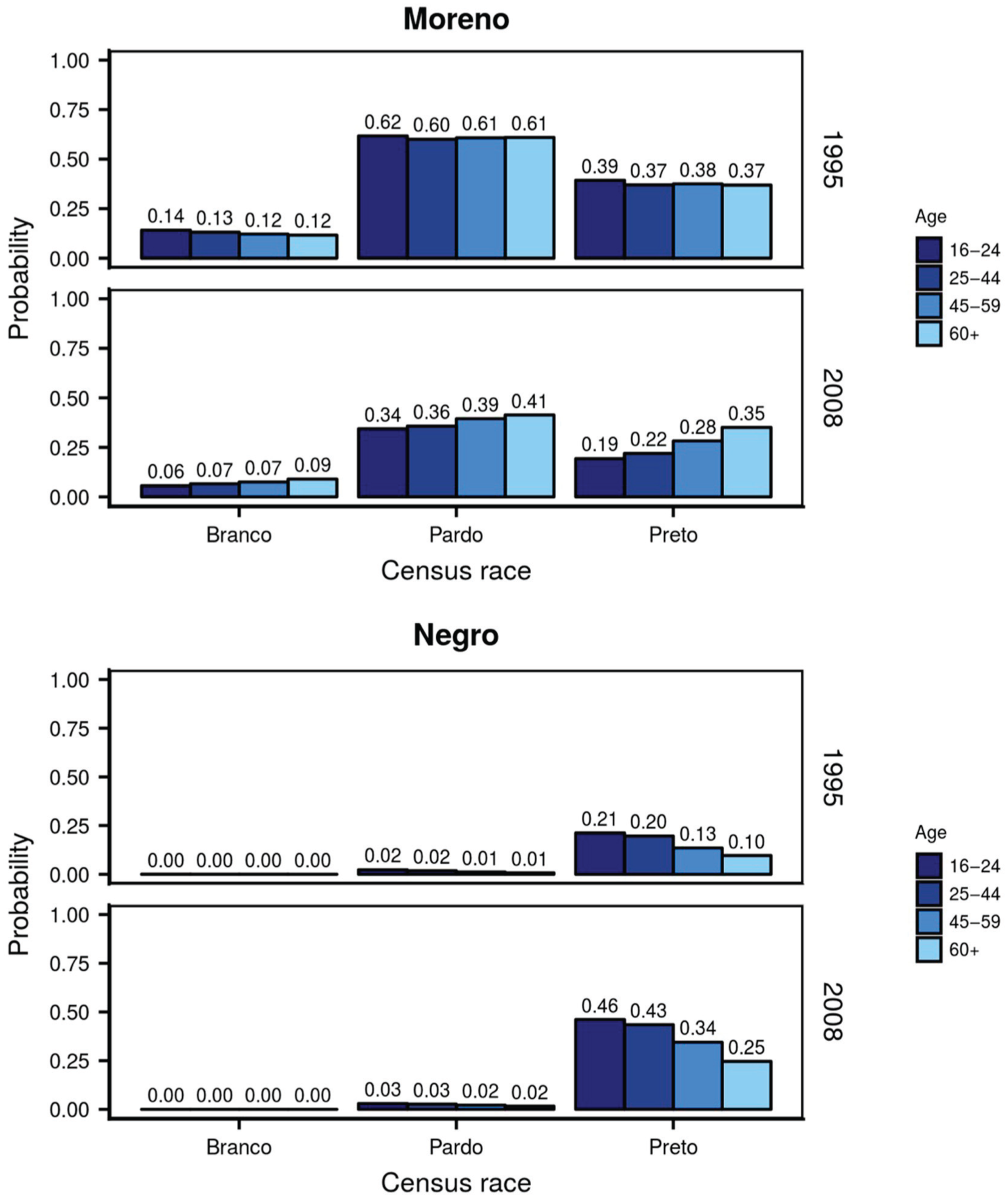
Average predicted probability of choosing moreno and negro, by age.
The coefficients in Figure 2 for region show that individuals living in the southeast (reference category) and the south present the same average odds of choosing moreno as their folk race. In the northeast compared to the southeast, individuals are on average significantly more likely to choose moreno compared to the census categories as their folk race, holding all else constant, in both 1995 and 2008. In the north/center-west, moreno seems to be losing some ground in 2008 compared to 1995. Regarding the choice of negro as one’s folk race by region, the seemingly most intriguing results are found in the south: There is a strong negative effect for choosing negro over a census category in the south in 2008. However, the small number of cases for negro and preto reduce the reliability of estimates in the south, especially in 2008 due to its smaller sample size; hence, caution is in order.
Lastly, we turn to the year variable in the stacked data set. Results in Figure 2 clearly confirm the descriptive trend. The popularity of negro increased, and the use of moreno significantly declined over time. Controlling for the other variables in the model, there is a 60 percent decline in the odds of choosing moreno as folk race in 2008 compared to 1995. In contrast, the odds of expressing negro are 75 percent higher in 2008 compared to 1995. Both estimates are statistically significant.
Discussion
We began by noting a historical disconnect between Brazil’s census terms (census race) and the categories that many Brazilians prefer to use for self-identification (folk race) (Oliveira et al. 1985). As our findings show, in line with earlier work (Bailey and Telles 2006; Silva 1996), this disconnect continued in 1995. Extending the examination of the choice of moreno and negro to 2008 and combining data sets from 1995 and 2008, we document two important shifts in the demography of folk race in Brazil. The first is the precipitous constriction of the use of the term moreno. Although still widely popular and chosen by individuals of all three census race categories (i.e., it continues to be somewhat color-ambiguous), it is chosen at lower propensities in 2008 compared to 1995. Furthermore, the effect of education continues to be significant across time periods and actually grows stronger in 2008. Perhaps most importantly, using the salience of moreno as a proxy for the racial ideology of morenidade suggests that ideology’s substantial decline.
The second important shift our analyses document is the amplification in the use of the term negro . In contrast to the color ambiguity of moreno, however, the growth in the propensity to choose negro comes largely from individuals of the darkest color category in Brazil, namely, census race pretos. This dialectic of increased salience overall but restriction to census race pretos creates a paradox for those who define negro as the sum of both pretos and pardos. In addition, our results suggest education is core to the propensity to choose negro; although insignificant in 1995, higher educational levels are significantly associated with the choice of that term in 2008. Moreover, our year variable clearly documents an increase in the propensity of Brazilians to self-identify as negro for their folk race. Hence, as a proxy for the racial affirmation ideology, our results suggest that those choosing negro find increased value in affirming their race over their color. Indeed, one of the central arguments of those who argue for the adoption of a binary lens on Brazilian racial dynamics is the need for the creation of a strong negro racial group identity (e.g., Nascimento and Nascimento 2001). Our analyses suggest there may be some success on this front, but mostly for census pretos, judging from the period of 1995 to 2008.
We posit that our year variable captures a period effect (Sewell 1996) on racial subjectivity and ideology. From its traditional embrace of racial ambiguity and mixing, along with official denials of racial discrimination, the state began during this period recognizing systematic racial discrimination and embracing racial distinction. From endorsing a paradigm of racial ambiguity, the Brazilian state began investing in a paradigm of racial affirmation (Brasil 2004). On point, some state institutions now use the term negro in their race-targeted policy and racial statutes (Silva 2012), and the mandatory teaching about the contributions of negros to Brazilian culture and society also clearly affirms the use of negro (Pereira 2016). 14 It is clear that these shifting state practices correlate remarkably well with the declining use of moreno and the increasing embrace of negro, and more broadly with the mining of the ideology of morenidade and the bolstering of negritude. Fields (1990) points to the fact that if you want to shift ideologies, you must shift the terrain; she also posits that there is no actor more powerful than the state for that task. Bourdieu (1985), Enloe (1981), and others also point to the symbolic power of the state in shaping the relative social identity cleavages in a given society. In line with that work, our results suggest that the Brazilian state is accomplishing the herculean task of shifting the country’s racial terrain (Bailey 2008, 2009).
Might the concurrent increasing use of pardo and decreasing use of moreno suggest that these two terms are simply synonymous and hence the ideology of racial mixing is not really in decline? In fact, pardo and moreno are far from straightforwardly interchangeable in meaning and use (Harris et al. 1993, 1995; Telles 1995). The racial terrain, though, is shifting as some state actors institutionalize pardo for race-targeted legislation. Hence, its meaning may also begin to shift in the direction of increased value.
Overall, the use of negro is increasing, and the use of moreno is decreasing; but are these two trends necessarily in a zero-sum relationship? Scholars have argued that individuals can indeed hold multiple conceptions of race at the same time, namely, that race is multidimensional (Bailey et al. 2013; Harris and Sim 2002) and that social identities often form cross-cutting cleavages (Martin 2015). As research in Brazil exemplifies, racial labels can be deployed accordingly in differing spaces (Sansone 2003), dimensions (Silva and Reis 2011), or discourses (Sheriff 2001). Notwithstanding their contextualization, our results clearly show that moreno and negro are distinguishable in meaning and by the ideologies they undergird, and that their use and attendant ideologies are clearly in tension.
Conclusion
Since 2008, many other important changes have occurred with respect to the state continuing to reshape Brazil’s racial landscape. In 2010, the state passed the Statute of Racial Equality to guarantee the country’s negro population equal opportunity, and the defense of individual and collective rights. In 2012, the state passed the sweeping Law of Social Quotas, which mandates racial quotas in admissions in all of the country’s federal universities. Also in 2012, Brazil’s Supreme Court ruled that racial quotas for negros at the University of Brasília are constitutional. The reimaging of Brazil in branco versus negro is now firmly institutionalized in Brazil’s racial terrain, and we expect the trends we documented will continue. The waning salience of moreno (and morenidade) and the growing popularity of negro (and negritude) may be associated with certain points of Brazil’s color continuum, levels of education, and age groups; nonetheless, it is hard to imagine that the overall shift from racial ambiguity to racial affirmation could be easily altered in the foreseeable future.
Supplemental Material
Supplementary_file_Socius_accepted – Supplemental material for Shifting Racial Subjectivities and Ideologies in Brazil
Supplemental material, Supplementary_file_Socius_accepted for Shifting Racial Subjectivities and Ideologies in Brazil by Stanley R. Bailey and Fabrício M. Fialho in Socius
Footnotes
1
Perception of phenotype difference does not necessarily correspond to “real” difference.
2
When perceived phenotype differences are connected to perceived descent divides to form the core vocabulary of an ideology, they become “racialized,” namely, form the basis of a racial ideology.
4
Urban areas accounted for 75.6 percent, 81.2 percent, and 84.4 percent of the Brazilian population, respectively, in the 1991, 2000, and 2010 censuses. Municipalities are drawn within macro-regions using probability proportional-to-size sampling; respondents are then selected, adopting quotas for age and gender at sampling points.
5
The data sets contain post-stratification weights. Analyses with and without weights nevertheless return virtually the same results in both descriptive and multivariate regression analysis. For sake of simplicity and to avoid pitfalls in the use of weights in regression analysis ( ), we report unweighted results only.
7
To account difference in sample sizes in 1995 and 2008, we weighted the pooled sample. Results were almost identical to unweighted analyses; hence, we report unweighted results.
8
We recoded age to a 0 to 1 range. This coding does not change the results or fit for the model. We also tested the natural logarithm of age; results remained stable.
9
In an alternative modeling strategy, we created a percent white (branco) measure at the municipality level using data from Brazil’s census. The alternative model’s results were substantially the same.
10
In Portuguese: Considerando as seguintes categorias, qual é a sua cor? branca/preta/parda/amarela/indígena.
11
Our resulting analytic samples sizes were 4,582 (1995) and 2,595 (2008).
12
These constricting and expanding dynamics are consistent with census data on racial composition change between 2000 and 2010 and speak to the robustness of the DataFolha samples.
13
See Supplementary Tables S1, S2, and S3 for full model results.
14
Although some Brazilian institutions use the pardo and preto terms in their policies, they nonetheless may work to clarify the boundary between brancos (nonbeneficiaries) and non-brancos (beneficiaries).
Author Biographies
References
Supplementary Material
Please find the following supplemental material available below.
For Open Access articles published under a Creative Commons License, all supplemental material carries the same license as the article it is associated with.
For non-Open Access articles published, all supplemental material carries a non-exclusive license, and permission requests for re-use of supplemental material or any part of supplemental material shall be sent directly to the copyright owner as specified in the copyright notice associated with the article.
