




Abstract
In uncertain economic times, who are those young adults that show positive expectations about their economic future? And who are those who worry? Based on previous stratification research and extending economic sociology insights into the realm of young people’s economic expectations, we focus on the impact of family class background and a sense of current meaningful community relations on young adults’ general and job-specific economic expectations. Analysis of Panel Study of Income Dynamics (PSID) data reveals that a sense of community belonging has a robust and positive impact on economic optimism of young adults, but the role of family socioeconomic background is weaker. We conclude that imagining one’s economic future is less about realistic calculation determined by early structural conditions but more about identity work of young people who assert their moral worth in how they imagine their economic lives and manage uncertainty and well-being in ongoing social relations.
Introduction
Who are those young adults with positive expectations about their economic future? And who are those who worry? This may be particularly important to understand in the current protracted and highly uncertain transition to adulthood in contemporary America (Arnett 2014; Furstenberg 2010), when young adults face declining job prospects (Danzinger and Ratner 2010) and the rise of precarious work (Kallenberg 2009). Popular accounts extol the right mindset and grit as crucial factors influencing children’s success as adults (Zernike 2016). Underlying these accounts is often the assumption that expectations about the future are individual psychological traits (Carver, Scheier, and Segerstrom 2010). A large sociological literature, however, amply documents how expectations about the future—educational ones in particular—are socially grounded. Indeed, decades of stratification scholarship find that advantaged individuals have higher educational expectations relative to their disadvantaged counterparts (Andrew and Hauser 2011; Glick and White 2004; Reynolds and Burge 2008). This line of research suggests a strong influence of social class background on expectations. However, lessons from recent work on future expectations, influenced by cultural and economic sociology, strongly indicate that the relationship between social class and economic expectations may be more complicated. For instance, Johnson and Hitlin (2017) argue that expectations about the future are different when individuals use an absolute (generalized) or relative (comparative) standard, which may detract from advantaged individuals’ positive assessments or bolster disadvantaged individuals’ expectations about their economic future. Further, sociologists of culture have called for a stronger role of interactions, expressions of agency, and identity work in shaping future expectations (Eliasoph and Lichterman 2003; Frye 2012; Mische 2009; Schafer, Ferraro, and Mustillo 2011; Tavory and Eliasoph 2013). Moreover, economic sociologists’ emphasis on how social relations shape economic action, including getting jobs (Granovetter 1974, 1985), suggests that integration in social networks and community will likely affect one’s future economic expectations. These cultural and economic sociology lines of research highlight the importance of interactional experiences and agency on imaginaries of the future and question a straightforward relationship between one’s social class background and one’s future economic expectations.
With this theoretical backdrop, our main empirical goal is to move beyond educational expectations to examine the predictors of young adults’ economic expectations, with a focus on the role of (a) childhood family socioeconomic background and (b) contemporary meaningful social relations. We assess the impact of these two factors while taking into account alternative explanations that center on individuals’ demographics, psychological dispositions, and existing economic/financial constraints.
We focus on economic expectations during the transition to adulthood because this is an important life course stage that is increasingly variegated and unequal across social class (Furstenberg 2010; Shanahan 2000). Thus, in the context of a prolonged and difficult transition to adulthood, optimistic economic expectations may provide a necessary—if not sufficient—ingredient for young adults to realize their goals, especially among those who hail from disadvantaged backgrounds as they face more obstacles and have fewer resources, material and otherwise (Alexander, Entwisle, and Olson 2014; Turney and Lanuza 2017).
Our data come from the Panel Study of Income Dynamics (PSID) for respondents ages 18 to 24 to explain a general sense of economic worry of young adults as well as two more specific expectations they have about future jobs. Given our focus on the role of socioeconomic background and social relations, we examine predictors of economic expectations—sense of economy worry of young adults as well as two more specific expectations they have about future jobs—during a period of macroeconomic stability, that is before the 2008 economic crisis, as it is reasonable to expect that changes in the macroeconomic environment would also influence individuals’ economic attitudes (Bandelj and Finley 2018; Beckert 2016).
On the whole, we find that socioeconomic family background is not significantly linked to general economic expectations of young adults. However, the most privileged youth who grew up in the highest socioeconomic status (SES) quintile express less optimism that they will have a high-paying job or job they most want compared to those from other SES backgrounds. By contrast, a sense of community belonging has a robust and positive impact on both general and job-specific economic optimism, net of other factors. These findings align with research emphasizing the role of agency and importance of everyday interaction over structural determinants. We conclude that imagining one’s economic future is less about realistic calculation determined by early structural conditions and more about young adults’ identity work through which they assert moral worth and manage uncertainty and well-being in ongoing social relations.
The Role of Socioeconomic Background on Expectations about the Future
A growing sociological literature suggests that beliefs about the future are a crucial dimension of current action and that they help explain long-term attainment (Hallerod 2011; Hitlin and Johnson 2015; Schafer et al. 2011). Because of their potential impact, it is important to understand the predictors of expectations. While the majority of research focuses on the educational domain, affirming educational expectations’ importance for educational attainment (e.g., Bozick et al. 2010; Morgan 2005; Reynolds and Johnson 2011), structural inequality theories (reviewed in the following) underlying this research might pertain to economic expectations as well.
Structural (Dis)Advantages of Socioeconomic Background
The structuralist perspectives emphasize the importance of social class on expectations. The Wisconsin model of status attainment (Sewell, Haller, and Ohlendorf 1970; Sewell, Haller, and Portes 1969; Sewell and Hauser 1975) suggests that SES shapes educational expectations—concretized, internalized ambitions about educational attainment derived from one’s social milieu, especially from significant others during socialization (Blau and Duncan 1967; Hao and Bonstead-Bruns 1998; Mickelson 1990). In a similar vein, Bourdieu (1980, 1984) posits that one’s habitus is shaped by the process of socialization whereby families pass onto children different types of capital—social, cultural, and economic (Bourdieu 1986; Bourdieu and Passeron 1990). The Bourdieusian approach would thus expect family social class background to matter substantially in shaping economic expectations of young adults, in the sense that children whose parents possess bigger stocks of economic, social, and cultural capital—assessed through parental income, education, and occupational status—would have more confidence in their economic future or enhanced economic expectations.
Hypothesis 1: The higher the childhood SES, the more optimistic economic expectations of young adults.
General Versus Relative Expectations
Although structural perspectives provide a compelling explanation for the association between socioeconomic status and expectations, recent stratification scholarship suggests a more nuanced relationship, differentiating between generalized life expectations, following an absolute standard, as opposed to those judged by a relative standard, comparing one’s circumstances to those of referent others (Johnson and Hitlin 2017). Johnson and Hitlin (2017), for instance, find that higher socioeconomic family background is positively associated with individuals’ general belief about success in life but not with their relative understanding of potential improvement (mobility) compared to their parents’ situation. Following this logic, the impact of SES may work differently for general economic expectations compared to specific job expectations if individuals may be shifting to a relative comparison when considering this specific economic domain.
Work on concerted cultivation of middle- and upper-class parents (Lareau 2003) illustrates these potential dynamics. Privileged children are “coached” to monopolize resources in schools (Calarco 2014a) and build competitive capital in extracurricular activities (Friedman 2013). Consequently, they develop a sense of “entitlement” (Lareau 2011), which easily and often morphs into pessimism and disappointment, as opposed to a sense of “appeasement” or “constraint” among children from low-income backgrounds (Calarco 2014b). As a result, young people from higher SES backgrounds may feel a sense of security about their economic future, an absolute standard, but at the same time, may feel a sense of pessimism with regards to specific expectations, such as those related to jobs, if they compare themselves to their economic or occupational elite peers. By contrast, relative to people in their world, young adults from lower SES backgrounds may more easily envision their specific future job accomplishments, however minor, as an improvement over their peers’ (or parents’) circumstances, generating a sense of job optimism.
Hypothesis 2a: The higher the childhood SES, the greater the general optimism about economic future of young adults.
Hypothesis 2b: The higher the childhood SES, the lower job optimism of young adults.
Imaginations about the Future as Identity Work
In contrast to structural inequality perspectives, recent research in cultural sociology suggests that imaginations of the future may have less to do with rational comparisons and more to do with identity work or an attempt to create an identity that provides a measure of self-worth (Snow and Anderson 1987) and expresses a sense of self. Carving new ground in the educational expectations literature, Frye (2012) asserts that the optimism of the underprivileged is not simply—or even mostly—a rational calculation about the likelihood of achieving one’s goals but also identity work bolstered through cultural models propagated in public education campaigns. Frye (2012) interviewed young Malawian women and found that through their unusually high and unrealistic educational and career aspirations, these young women asserted “themselves as forward thinking and morally worthy,” exhibiting a “virtuous identity” (p. 1608) that transcended their otherwise disadvantaged social backgrounds.
Based on this research, it is also plausible that in the United States, young adults from disadvantaged backgrounds engage in similar identity work, expressed through high economic expectations despite limited opportunities. Abundant scholarship shows unabated educational optimism about the future among disadvantaged individuals (Alexander, Entwisle, and Bedinger 1994; Baird, Burge, and Reynolds 2008; Khattab 2003; Reynolds et al. 2006; Rosenbaum 2001; Schneider and Stevenson 2000; Sikora and Saha 2007; Strand and Winston 2008; Yair, Khattab, and Benavot 2004). Indeed, Hochschild (1995) documents that individuals from lower SES backgrounds are more likely to believe in the American Dream and its economic rewards, engendering optimism untethered to their realistic economic conditions. Similarly, Young (2004:10) finds that marginalized black men who experience segregation and social isolation actually voice optimism in how they “ground their visions of their future.” Likewise, Schafer et al. (2011:1054) find that early childhood adversity contributes to rising expectations about the future as individuals do not simply respond to challenges but “interpret the course of their lives in light of the adversity they have experienced.” Finally, a number of researchers document high educational expectations across the socioeconomic spectrum, including those in economically disadvantaged households (Feliciano and Lanuza 2016; Strand and Winston 2008). It is possible that youth across the SES spectrum share optimism about their economic future, consistent with research finding generally high optimism of teenagers today (Alexander, Bozick, and Entwisle 2008; Baird et al. 2008; Reynolds et al. 2006; Schneider and Stevenson 2000). Therefore, the identity work perspective suggests little difference between general levels for optimism of young adults raised in lower compared to higher SES families.
However, it is possible that identity work in imagining one’s economic future, while boosting the economic optimism of the disadvantaged, is simultaneously also deflating the economic optimism of the most privileged when specific career-related economic expectations are concerned. There is a lack of research on the most privileged young adults, but based on what we can glean from a few recent studies, it seems that many of those seemingly most advantaged experience a heightened sense of job uncertainty and insecurity in light of high pressures to achieve. For instance, Binder, Davis, and Bloom (2016) interviewed recent alumni from Harvard and Stanford universities and found that many express confusion and uncertainty about their career paths when first arriving to the university. Moreover, Ramey and Ramey’s (2010) economic analysis points to increased pressures on children of college-educated parents to get into elite universities, where selectivity has increased over time (MacLeod and Urquiola 2015). Similarly, qualitative sociological investigations document pervasive anxiety about intense competitiveness of labor markets for high-end jobs expressed by affluent families (Cooper 2014). If cultural preferences do differ among the most privileged families and impact how they raise their children (Schneider, Hastings, and LaBriola 2018), then those young adults who grow up in the households at the top of the income distribution are likely to be more uncertain about their career goals than their less economically privileged peers. They may also feel elevated pressure because of what they imagine as success on the labor market for top jobs. For all or any of these reasons, we might expect that job/career imaginings of the kids who grew up in the highest SES group reflect lower levels of optimism than those of their peers with other SES backgrounds.
Hypothesis 3a: Childhood SES is not significantly associated with young adults’ general expectations about economic future.
Hypothesis 3b: Those young adults who grew up in the highest SES group do not express as high of a job optimism as their peers from other SES groups.
The Role of Meaningful Social Relations on Expectations about Economic Future
Within the reproduction of inequality theory, social class–based early socialization experience is strongly predictive of children’s future advantage or disadvantage. However, as the identity work perspective on imaginations about the future discussed previously reveals, an overly deterministic account of individual orientation toward one’s future may be limiting. This is also the sentiment expressed in research that has asserted the importance of agency (Emirbayer and Mische 1998; Schafer et al. 2011) and everyday interaction in culture (Eliasoph and Lichterman 2003). Indeed, from a more agency-oriented perspective, we would surmise that expectations are also reflective of practical circumstances of a person’s everyday life. In other words, we expect that everyday circumstances and interactions affect one’s orientations toward their economic future (Silva 2012).
In particular, we focus on meaningful social relations and community belonging. This idea goes back to a trademark contribution of economic sociology about the role of social relations in economy (Granovetter 1985). Following this major insight, many economic sociologists continue to show the influence of social ties and networks on various economic outcomes (for a recent review, see Bandelj 2016). However, our attention to meaningful social relations also responds to the critique that networks are “sparse social structures” (Fligstein 1996:657) and that the focus on structure detracts from the importance of the content of ties (Bandelj 2002; Emirbayer and Goodwin 1994; Fligstein 2002). Fuhse (2009), inspired by the cultural turn in Harrison White’s work, has proposed to view networks as sociocultural structures laden with meaning. Recent scholarship on relational work in economic sociology (Bandelj 2012, 2016; Bandelj, Wherry, and Zelizer 2017; Zelizer 2012) has zeroed in on the negotiation of economic relations, a process infused with meaning, affect, and latent asymmetries in power. We have little research in economic sociology that investigates how subjective meaning of network embeddedness may impact economic outcomes. Still, if social relations are a source of trust, information, and collective problem solving (Uzzi 1996), it is likely that those who believe that they are surrounded with such relations in their community are going to be encouraged about their economic future in both specific and general terms. This may be because they are aware that such relations might be useful for them in pursuit of concrete job opportunities (Granovetter 1974) or because feedback from supportive relations improves well-being in general, as extensive research on social determinants of health has shown (for review, see Umberson and Karas Monetz 2010). The positive effects of community belonging on economic optimism may also come about because social connections seem to promote happiness (Waldinger and Schulz 2010) more generally. From this meaningful social relations perspective, we predict that community belonging can influentially shape how youth imagine their economic futures.
Hypothesis 4a: The higher the perceptions of community belonging, the higher the optimism about overall economic future.
Hypothesis 4b: The higher the perceptions of community belonging, the higher the job optimism.
Empirical Case: Economic Expectations of Young Adults
To test our hypotheses about the impact of social forces on economic optimism, we utilize the Panel Study of Income Dynamics, a nationally representative sample of individuals living in American families. Given our interest in how childhood experience influences young adults’ economic dispositions, PSID study design is ideal because it allows us to link individuals in the three different data sets (PSID Main Files, CDS Files, and TTA Files) to ascertain childhood and adolescent circumstances relevant to our research questions. In particular, we rely on the Child Development Supplement (CDS), a random sample of 3,563 PSID family children, ages 0 to 12. PSID administrators began collecting information on these children in 1997, with follow-up data collection efforts in 2002–2003 and 2007–2008. Because of the age range of the sample, children transitioned into adulthood at different time periods. Due to the PSID main study design, children are not designated as a “head of household” until a specific criterion is met, but because the CDS study design does not collect information on its children when they are 18 years of age or older, PSID administrators introduced the Transition to Adulthood (TTA) module. This module seeks to account for the children’s lives in the “in between” stage—after they are no longer “children” but before they are recognized, under the PSID main study design, as heads of households. We can connect information on individuals in the TTA module with their parents’ information in the main PSID file and their childhood experiences in the CDS file.
The first TTA module was launched in 2005, with follow-ups every two years after that. In this project, we examine young adults’ optimism about their economic future in 2007, before the Great Recession, at a time of economic stability, when we expect broader economic conditions to have less of an impact on economic optimism. The age range of respondents in 2007 is 18 to 24. For the 2007 TTA module, of the 1,259 eligible individuals, TTA administrators completed interviews for 1,115 respondents (88.6 percent response rate), which is the total sample size for 2007 analyses presented here. Following past practice, we utilize cross-sectional individual weights, which are a function of sample attrition in 2007 and the original CDS weights. Our results are thus representative of the 1997 CDS sample. We have a small percentage of missing data on our covariates (ranging from <1 percent to 3.1 percent) in the analytic sample. We preserve these missing values with multiple imputation (Rubin 1987, 1996), averaging results across 20 data sets (Allison 2002). Following standard practice, we do not impute 2 missing values in our “job that pays well” and 14 missing values in our “job most want at 30” dependent variables, respectively (von Hipple 2007).
Measures
Dependent Variables
We use three questions from the TTA module to understand economic expectations during the transition to adulthood. First, we use a general measure of disposition about economic future using an available “economic worry” indicator scale created by PSID administrators (cf. Kendig, Mattingly, and Bianchi 2014; Xiao, Chatterjee, and Kim 2014). This indicator is the average of responses to three items: (a) respondent’s worry about not having enough money to pay for things, (b) respondent’s worry about not having a good job in the future, and (c) respondent’s feeling of discouragement about the future. Values ranged from 1 = never worry to 7 = daily worry. The Crohnbach’s alpha for this scale is .75. We reverse coded this PSID economic worry indicator so that, for ease of interpretation, higher values signal more positive/optimistic expectations.
In addition, we use two more measures that tap into more specific expectations related to economic future, namely, jobs. Here we use answers to two questions. First, “How likely is it that you will have a job that pays well?” (We use this to capture job remuneration optimism.) Second, “How likely do you think it is that you will actually end up in the job you most want at age 30?” (We use this to capture job choice optimism). Respondents could answer from 1 = very likely to 7 = very unlikely. We reverse coded these two variables so that more intuitively, higher values suggest more optimism.
Socioeconomic Status during Childhood
To ascertain the socioeconomic status of respondents during childhood, we utilize parental education, household income, and parental occupation information from the Main Interview files. Following other research that finds importance of middle childhood SES on later life outcomes (Duncan and Magnuson 2011; Feinstein and Bynner 2004; Schaffer 2000), we estimate SES when children were 6 through 14, although the majority of the sample was captured between 8 through 13 years of age. If the child was 6 years old or older in 1997, the initial CDS sample year, we utilize the educational attainment of the head of household (or his or her spouse, whichever was highest) provided in the 1997 Main Interview file. If the child was 5 years or younger in 1997, we utilize the educational attainment of the head of household (or his or her wife/“wife,” whichever was highest) provided in the 2001, the year prior to the 2002 CDS collection efforts. To ascertain childhood household income, we utilize the same Main File years, accounting for the age of the child as we did for the highest parental education variable. The income variable that we utilize includes head of household’s and spouse’s taxable income (and transfer income), taxable income from other family members in the household, transfer income of other family members in household, and social security income where applicable. PSID administrators calculated and provided this variable. Finally, following previous research, we ascertained prestige scores for the head of household and his or her spouse. We utilize the highest prestige score, again, accounting for the age of the child as explained previously. To create a socioeconomic index during childhood, we standardize the education, income (logged), and occupational prestige score distributions and then take the average of the three, following standard practice (see NCES 2012).
Community Belonging
Respondents were asked, “In the last month, how often did you feel that you belonged to a community like a social group, your school, or your neighborhood.” The answers include never = 0, once or twice = 1, about once a week = 2, two or three times a week = 3, almost every day = 4, or everyday = 5. We use this scale from 0 to 5 in our analyses, with higher values denoting a greater sense of community belonging.
Educational Expectations
One reason that children from more advantaged backgrounds may feel more optimistic about their economic future is that they expect to get the necessary education to parlay into economic success. To ascertain educational expectations, we utilize respondent TTA information. Respondents were asked, “Many people do not get as much education as they would like. How far do you think you will actually go in school? Do you think you will graduate from high school (1), graduate from a two-year community college (2), earn a specialized certificate from a vocation or trade school (3), attend a four-year college (4), graduate from a four-year college (5), get more than four years of college (6), or do something else (7)?” We created a categorical variable with four choices: high school 1 (1, 7), some college (2, 3, 4), four-year college graduate (5), and graduate/professional degree (6).
Gender
To ascertain respondent’s gender, we utilize 1997 Main File’s gender information. Two values are provided, male or female.
Age
Using date of birth information provided in the 1997 Main Interview file, we created a continuous age measure.
Race
We use a PSID administrator variable that provides the respondents’ racial/ethnic group membership. We recode the measure into a dummy variable with two categories, white, non-Hispanic = 1 and everyone else = 0. Note that including a more differentiated set of racial/ethnic categories does not change our results.
Immigrant Household
Given the documented optimism of immigrants (and their children), we account for the fact that this may be driving economic optimism of the more economically disadvantaged populations (Feliciano and Lanuza 2016; Kao and Tienda 1995). Hence, using an indicator provided by PSID administrators, we use a dummy indicating household immigrant status.
Parents’ Marital Status
Using the same age limits to generate the SES measure, this measure takes a value of 1 if the respondent’s parent (head of household) was married.
College Enrollment
Respondents were asked, “Are you currently attending college?” Using this variable, we created a college enrollment dummy (1 = enrolled, 0 = otherwise) to account for the possibility that those in college may have more frequent community interactions.
Psychological Dispositions
We also want to account for young adults’ psychological dispositions as previous research suggests that positive expectations are linked to individual psychological traits (Duckworth 2016; Dweck 2006). Consequently, we use personality-related information that parents provided about their children (our respondents) in 1997. Using a three-category response range—not true, sometimes true, and often true—parents indicated whether their children experienced a range of emotional and behavioral states. 2 Then, we ran factor analyses to reduce the amount of covariates under the assumption that the underlying factors that emerge from the data are correlated with psychological dispositions (stable personality traits). We found three factors with eigenvalues higher than 1, which account for 95 percent of the variation that all variables provide. 3 The first factor may be associated with a neurotic personality. Factor 2 may be associated with an anxious and introverted personality. Factor 3 may be associated with an angry/hostile personality. We included predicted values from each of these factors in our models, and only anxious/introverted and angry/hostile dimensions were consistently associated with our dependent variable. Thus, we only included these two in the final models as it is the most parsimonious.
Financial Responsibilities
We tried to capture respondents’ current financial situations, which may influence their economic dispositions. We utilized a financial responsibility index provided by PSID administrators in 2007. The index includes items that ask the respondent about how much (1) responsibility he or she has for earning own living, (2) responsibility he or she has for paying own rent, (3) responsibility he or she has for paying own bills, and (4) responsibility for managing own money. Higher values suggest more financial responsibility. This index was originally generated by the 1992 wave of the Michigan Study of Adolescent and Adult Life Transitions (MSALT).
Debt
We added another measure of respondents’ financial situation that may impact economic expectations, especially in light of rising indebtedness of individuals and households (Carruthers and Ariovich 2010; Dwyer 2018). Respondents were asked, “Do you yourself currently have any carryover credit card and store balances, student loans, medical bills, or loans from relatives?” Using this variable, we create a debt dummy (1 = yes).
Analytic Strategy
We use descriptive as well as regression techniques to examine our research questions. First, we test how levels of economic optimism and community belonging differ across socioeconomic status, breaking up the socioeconomic scale into quintiles. After establishing basic bivariate associations (or lack thereof), we use ordinary least squares (OLS; for overall economic optimism) and ordered logit models (for job-related economic optimism) in a multivariate framework to adjudicate which of our theoretical expectations has empirical support. We use ordered logit models because OLS assumptions are violated. Note, however, that OLS models provide similar results, which is in line with many econometricians’ arguments that minor violations to OLS assumptions rarely change substantive results (Angrist and Pischke 2009), demonstrating the robustness of our conclusions across different estimation strategies. We use robust standard errors in all models. To further scrutinize the relationship between socioeconomic status and economic optimism, we also use two different codings of our SES variable (continuous and categorical). Finally, to address endogeneity concerns, we lag the community belonging variable. All of these different estimation approaches point to the same substantive conclusions.
Sample
Table 1 shows descriptive statistics from our analytic sample. We find variation in all of our variables of interest, including the extent of general and job-related positive economic expectations, or optimism, that individuals express about their economic future, the extent to which they feel like they belong to a social community, their childhood socioeconomic status, and their current financial responsibilities. With respect to demographics, about 53 percent of the sample is female, 48 percent are white, 7 percent come from an immigrant family, 69 percent live in a dwelling where the head of household is married, and 45 percent are enrolled in college.
Descriptive Statistics (Unweighted).

Note: Descriptive statistics come from the first of the twenty multiply imputed data.
Results
Table 2 shows the basic association between socioeconomic background and our dependent variables and community belonging. First, with the exception of the second quintile, mean economic worry scores rise monotonically across SES quintiles; however, the differences across quintiles are not significant. For example, relative to the lowest quintile, only respondents in the highest quintile exhibit higher mean economic worry scores statistically significant at the p < .10 level. (Note that for all of our dependent variables, higher values mean more optimism.) Similarly, with respect to job that pays well and job most wanted, relative to the lowest quintile, only those from the highest quintile exhibit significantly different scores (p < .05). However, in both of these cases, the highest quintile exhibits lower scores—less optimism—than their lowest SES counterparts. With respect to community belonging scores, we observe a modest monotonic rise across increasing SES quintiles. The correlation between these two variables is rather weak at .208. In sum, these bivariate results show (a) a complicated relationship between socioeconomic background and economic expectations and (b) a positive but weak relationship between socioeconomic background and community belonging, which suggests that these two items are capturing distinct social phenomena and are not simply different measures of one’s class background.
Mean Values for Economic Expectations and Community Belonging by Socioeconomic (SES) Quintiles (Q).

Note: Statistical differences are calculated compared to the first SES quintile. If we treat “job that pays well” and “job most want” as ordinal measures, chi-square tests also suggest that they are associated with SES (p < .01 and p < .05, respectively). Standard errors are in parentheses. SES quintiles: Q1 is the top 20 percent of the SES distribution. Worry about future: scale from 1 to 7, with higher scores indicating less worry; likelihood of having a future job that pays well: scale 1 to 7, with higher scores indicating higher optimism; likelihood of having a job one most wants at age 30: scale 1 to 7, with higher scores indicating higher optimism; community belonging: scale 0 to 5, with higher scores indicating higher sense of community belonging.
p < .10. *p < .05. **p < .01. ***p < .001.
To examine these patterns further, Table 3 shows OLS models that predict overall economic worry. These results show that the weak positive relationship between socioeconomic status and overall economic worry (Model 2) is mostly explained away by community belonging. Individuals from higher socioeconomic backgrounds show more optimism about their overall economic futures, but this is in large part because higher SES respondents tend to feel a somewhat stronger sense of belonging to their communities, and a strong sense of belonging is associated with higher optimism (Model 4). Importantly, we find a positive, statistically significant association between community belonging and overall economic worry. This means that economic sociology scholarship that points to the importance of meaningful social relations can be useful to understand not only actual economic outcomes but also future expectations of such outcomes. The association between community belonging and overall economic expectations is unabated even after accounting for college enrollment (Model 6), psychological dispositions (Model 7), and financial responsibilities (Model 8). On the other hand, net of community belonging, socioeconomic status is not associated with general worry about economic future. These results do not conform with the structuralist expectation of a positive association between socioeconomic childhood background and general optimism about the future as young adults. Given the generally high level of optimism (as per Table 2) of young adults, these results conform better with the idea that imaginings of economic future are part of identity work of young adults, whereby both those who grew up in more privileged households as well as those who grew up in less privileged households express a general sense of optimism about their economic future as a way of projecting an imagined future self.
Ordinary Least Squares Regression Models Estimating Overall Economic Worry (Higher Scores = More Optimism).

Note: Standard errors are in parentheses. Higher values of dependent variable mean less worry.
p < .10. *p < .05. **p < .01. ***p < .001.
Still, as recent scholarship has suggested, it is important to differentiate between general and specific life course expectations (Hitlin and Johnson 2015; Johnson and Hitlin 2017). In this sense, young adult economic expectations might differ if they refer to a general sense of the future versus a comparative standard with clear referents. Although we do not find a direct relationship between socioeconomic background and overall economic worry, we find that expectations about job prospects—both in terms of remuneration and choice—can be linked to social class background. Table 4 presents results from ordered logit models with respect to job remuneration, or a likelihood that an individual believes he or she will have a job that pays well. Results suggest that socioeconomic background is negatively associated with job remuneration expectations but that this association emerges after community belonging is accounted for (Model 4). In other words, as socioeconomic background increases, individuals feel less optimism about their job remuneration prospects, but this association is attenuated because respondents from higher SES backgrounds also have a higher sense of community belonging, which bolsters their job remuneration expectations. SES background and community belonging exert opposing influences on job remuneration optimism. With respect to job most wanted (Table 5), we find similar results. As socioeconomic background increases, optimism about having a job one most wants decreases, and as community belonging increases, job choice optimism increases. As with job remuneration expectations, SES and community belonging exert a significant and opposing influences on optimism that one will have a job one most wants at age 30.
Ordered Logit Models Estimating Likelihood of Will Have a Job That Pays Well (Higher Scores = Higher Optimism).

Note: Higher values of dependent variable represent higher likelihood that respondent will have a job that pays well. Standard errors are in parentheses.
p < .10. *p < .05. **p < .01. ***p < .001.
Ordered Logit Models Estimating Likelihood of Will Have Job One Most Wants (Higher Scores = Higher Optimism).

Note: Higher values of dependent variable represent higher likelihood that respondent will have a job one most wants. Standard errors are in parentheses.
p < .10. *p < .05. **p < .01. ***p < .001.
While there is some indication that SES is related to specific economic expectations, we want to directly test our hypothesis about identity work of the most privileged young adults and investigate whether respondents from families with the highest SES quintile (Q5) are different than others in their job optimism. We had some indication for this dynamic in previously reported bivariate analyses (Table 2), which showed statistically significant differences across socioeconomic quintiles between the lowest and highest quintile with respect to the two measures of job-related optimism. In a series of auxiliary regressions (available on request), we dichotomized the socioeconomic variable across the different quintile cutoffs: Q1 versus Q2, Q3, Q4, Q5; Q1, Q2 versus Q3, Q4, Q5; Q1, Q2, Q3 versus Q4, Q5; and Q1, Q2, Q3, Q4 versus Q5. Consistent with the identity work perspective, we see no association between SES and overall economic worry expectations (Table 6), but we see that relative to everyone else, respondents in the highest SES quintile express significantly lower optimism about having a job that pays well, net of all other covariates (Table 7). This means that the negative association we found earlier between socioeconomic family background and future job optimism is largely driven by respondents in the highest quintile. 4 These results show a level rather than a continuous effect of SES on job remuneration optimism. We find similar results in the case of job choice optimism as well. Table 8 shows that relative to everyone else, respondents who grew up in the families belonging to the top SES quintile express lower optimism that they will actually have a job they most want, net of other covariates and compared to those from all other SES backgrounds. Importantly, in all of these models examining the highest quintile SES effect, the importance of community belonging on optimism persists: Those with higher sense of belonging feel higher optimism with regards to having a future well-paying job and having a desired job in the future.
Ordinary Least Squares Regression Models Estimating Overall Economic Optimism (Top Quintile Socioeconomic Background Versus Other Socioeconomic Groups).

Note: Standard errors are in parentheses. Higher values on dependent variable mean less worry.
p < .10. *p < .05. **p < .01. ***p < .001.
Ordered Logit Models Estimating Likelihood of Will Have a Job That Pays Well (Top Quintile Socioeconomic Background Versus Other Socioeconomic Groups).

Note: Higher values of dependent variable represent higher likelihood that respondent will have a job that pays well. Standard errors are in parentheses.
p < .10. *p < .05. **p < .01. ***p < .001.
Ordered Logit Models Estimating Likelihood of Will Have Job One Most Wants (Top Quintile Socioeconomic Background Versus Other Socioeconomic Groups).

Note: Higher values of dependent variable represent higher likelihood that respondent will have a job one most wants. Standard errors are in parentheses.
p < .10. *p < .05. **p < .01. ***p < .001.
Robustness Checks
Our results consistently show that socioeconomic background is not associated with general economic expectations. In contrast, we find support for the hypothesis that compared to everyone else, individuals who grow up in the most advantaged families—the highest SES quintile—have lower optimism with respect to future job expectations. Moreover, we find a strong positive association between community belonging and economic expectations (general and job-related). However, our measure of community belonging is contemporaneous to our measures of economic expectations (dependent variables). Thus, it may be the case that positive economic expectations shape one’s sense of community belonging (not the other way around, as we argue here). Thus, to account for possible endogeneity, we introduced a lagged measure of community belonging, measured in 2005, two years prior to measurement of our dependent variables, the earliest we have available.
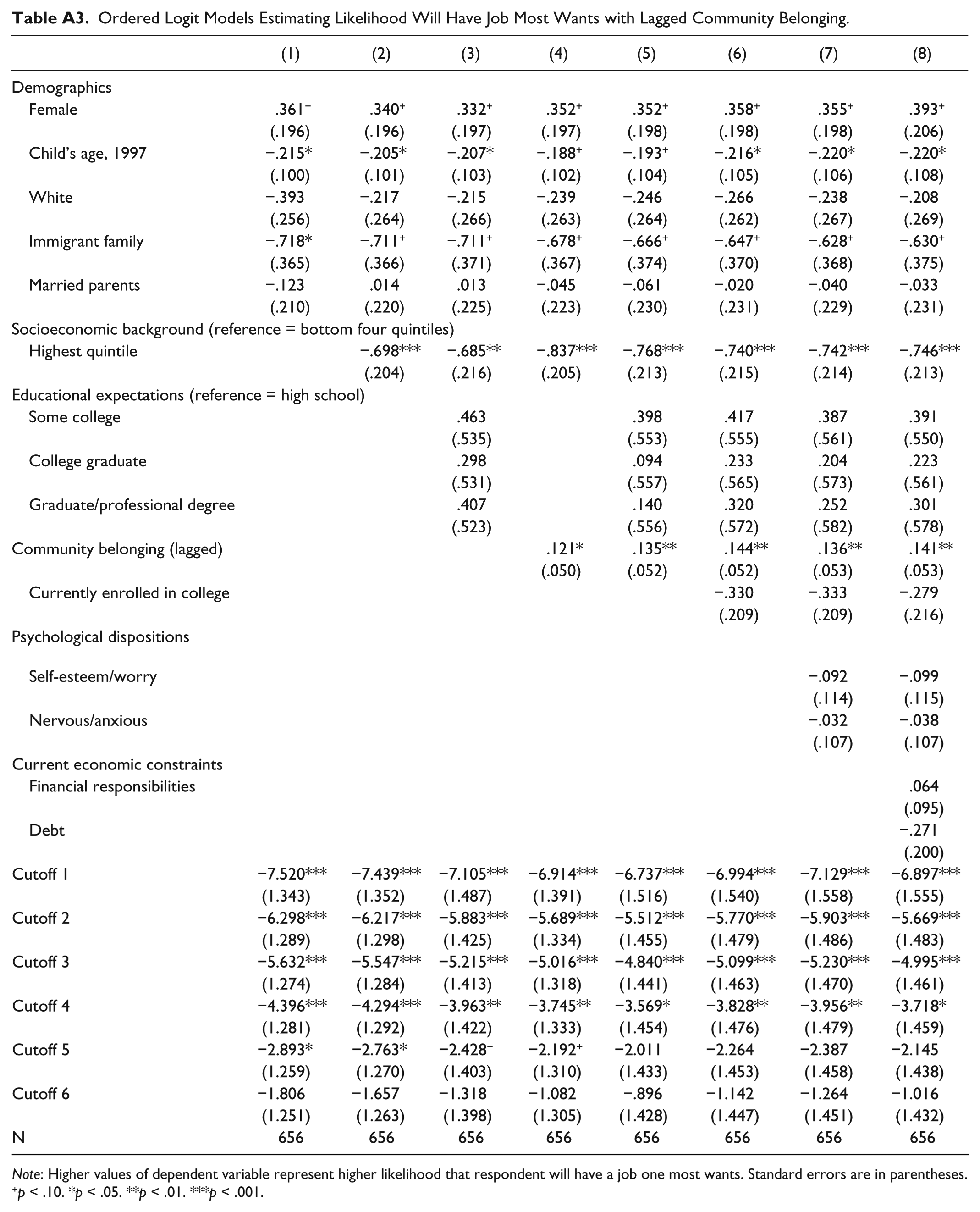
Appendix Tables A1, A2, and A3 provide models that are identical to models presented in Tables 6, 7, and 8, except that the measure of community belonging is now lagged as explained. Because of the TTA design, we lose 459 cases, individuals who were too young in 2005 to be part of the TTA sample but who were subsequently added to the study in 2007. Despite this significantly smaller sample size (N = 656) and the loss of statistical power associated with the reduced number of observations, these tables show that our findings are robust: no association between socioeconomic background and general economic worry (Appendix Table A1), lower optimism about having a well-paid job and a job one most wants among the most advantaged (highest quintile) compared to everyone else (Appendix Tables A2 and A3), and a strong positive association between a sense of community belonging and economic expectations (general and job-related).
Discussion and Conclusion
One of the most important findings in stratification research over the past couple of decades is the importance of aspirations for future attainment (Bozick et al. 2010; Morgan 2005; Reynolds and Johnson 2011). In this paper, our goal was to examine economic expectations rather than educational expectations, which have been the focus of scholarly attention thus far. Economic expectations are crucial for young adults because they may well make a difference between reaching career goals or floundering in the process. In the context of a difficult, prolonged, and unequal transition to adulthood, economic expectations can serve as a necessary—if not sufficient—resource for young adults, especially those from a disadvantaged background, who have very few resources to manage a range of unforgiving markets (e.g., labor, housing, marriage) during this increasingly difficult life course stage.
With our study, we contribute to the scholarship on determinants of economic expectations with three general conclusions. First, our empirical results show that socioeconomic background during childhood is not significantly associated with general economic optimism when these individuals reach young adulthood. This finding stands in contrast to much of stratification literature, which suggests a positive relationship between socioeconomic background and young adults’ expectations. Central to the Wisconsin model developed by Sewell and Hauser (1980) is the idea that socioeconomic status affects attainment through a socialization process whereby class location cultivates higher ambitions among its incumbents. Bourdieu puts forth a more developed and concretized argument, suggesting that social class location determines an individual’s set of dispositions, a habitus, which guides them. A part of one’s habitus is dispositions about the future, which are enhanced and rewarded by mainstream institutions.
In contrast to status attainment and Bourdieusian structural inequality theories, our findings better align with the identity work perspective, a view that expression of future ambitions represents a way for young people to assert their moral worth and sense of self (Frye 2012; Young 2004). This identity work bolsters economic ambitions that may or may not be tethered to realistic goals. Consistent with this perspective, we find that regardless of their social class background during formative socialization years of childhood, young adults, on the whole, hold rather optimistic views about their economic future. Notably, we assessed these attitudes during settled times (Swidler 1986), before 2008, rather than in times of crisis. Thus, at least during settled times, young adults’ views of their economic future are imagined (cf. Beckert 2016) more than they are objectively calculated, determined less by specific childhood circumstances of advantage or disadvantage and reflective more of ongoing identity work and imagination of one’s economic future.
Second, we join recent research in emphasizing the utility of differentiating between general and specific expectations, theorizing that socioeconomic background impacts them differently. Johnson and Hitlin (2017) argued that general expectations may be qualitatively different from those anchored in specific comparisons to one’s past or concrete referents. Likewise, we find that imagining a general sense of economic future is different from thinking about future jobs and their pay and desirability. In particular, whereas socioeconomic background is not a significant determinant of general economic expectations, the most advantaged—young adults who grew up in families belonging to the highest SES quintile—exhibit significantly lower optimism about their specific expectations concerning job remuneration and choice compared to everyone else. It is important to note that these affluent young adults’ absolute level of optimism is still relatively high but lower than optimism of other SES groups. We believe that these findings are in line with studies that reveal heightened uncertainty and pressure related to job market outcomes of affluent young adults. In terms of uncertainty, research among recent Harvard and Stanford alumni shows that these rather privileged young people are nevertheless anxious and uncertain about their future career goals (Binder et al. 2016). Similarly, Cooper (2014) documents anxiety by well-to-do parents about needing to prepare their children for an increasingly competitive global economic world, which could lead these children, who ostensibly had all the advantages, to nevertheless construct a cautious vision of their job prospects when they reach young adulthood. In terms of high pressures to succeed, which may be intense to the point of serious health side effects (Luthar, Small, and Ciciolla 2018), engaging in a race to get into the most selective colleges (MacLeod and Urquiola 2015; Ramey and Ramey 2010) will likely heighten expectations of young adults from high SES families of what it means to excel in their career and as such may make it hard to optimistically envision that their lofty goals can be achieved.
Third, and importantly, we find that a strong sense of community belonging bolsters economic optimism both in a general sense and for specific job-related goals. In addition to showing that how one envisions his or her economic future is largely due to one’s identity work and assertions of moral worth, our results support the notion that everyday interactions have a significant impact on shaping economic expectations, which is consistent with the idea that identity work is processual rather than static (Snow and Anderson 1987). In particular, we find that meaningful social relations—here captured through a sense of belonging in the community—shape young adults’ economic expectations about the future, including general and job-associated optimism. This may be because those who feel a strong sense of belonging draw trust, information, and collective problem solving from their communities, and their social ties can be deployed in a number of ways to secure economic resources. But it could also be that a sense of community belonging bolsters one’s general well-being because integration in social networks can have a multitude of protective benefits and a sense of well-being makes one more optimistic about their future compared to a more pessimistic viewpoint that ensues due to social isolation. Although our data do not allow us to differentiate between the specific mechanisms through which a strong sense of community integration bolsters economic expectations, our results robustly show its importance for shaping economic optimism. Given that we find such a robust relationship between a sense of community belonging and economic optimism, future work should further explore how these two phenomena are connected and allow for the possibility that conclusions of previous research about the strong link between SES and expectations would be modified if community belonging were explicitly accounted for in the analyses.
Our study carries a number of implications for social inequality. Previous research rather firmly established that socioeconomic background has a strong and positive relationship with individual life course expectations, especially with regards to schooling. In contrast, we do not find that one’s socioeconomic background during childhood is significantly related to general economic expectations when one reaches adulthood. These findings suggest that economic expectations do not straightforwardly reproduce economic inequality as individuals who grew up in more disadvantaged households hold a similar general sense of economic optimism compared to their more advantaged counterparts. If economic expectations are a resource that young adults can deploy to reach their economic goals, they are probably most important for the least disadvantaged in our society who lack other forms of resources. High economic expectations, for example, can help low SES young adults maintain the “eyes on the prize.” However, the extent to which economic expectations translate into better economic opportunities remains an empirical question. If a disadvantaged young adult’s ambitions lie far beyond his or her reach, not realizing these ambitions may be a particularly hard blow to withstand (Reynolds and Baird 2010), with potentially negative consequences that would have never occurred had their aspirations been tempered or “cooled off” (e.g., Alexander et al. 2008). Roberto Gonzales (2016) shows, for example, that undocumented students who had high aspirations and managed to attend and complete higher education but then could only find work in blue-collar and immigrant-specific niches have a much more difficult time dealing with their hindered occupational opportunities compared to those undocumented individuals who perform the same work but did not attend higher education.
As concerns the most advantaged individuals in our society (those who grew up in families from the highest SES quintile), we find some evidence about tensions embedded in privilege. Although there is scant research to understand how the most advantaged young adults in our society imagine their futures, there is some evidence of increasing uncertainty and anxiety about elite colleges and very prestigious jobs. This anxiety would likely taper optimism about achieving the most desirable and well-paying careers for young adults who grow up in affluent homes, but we need future research to examine more directly why young adults from the most socioeconomically privileged families express lower optimism about their future jobs compared to their peers from other class backgrounds.
Last but not least, this study advocates for extending the economic sociology perspective in new directions, substantiating its utility to understand not only how social relations and morals influence concrete economic outcomes but also how they influence individuals’ imaginations of their economic future. Recent research in economic sociology has established the morals in markets perspective as one of the key approaches in the field (Fourcade and Healy 2007; Livne 2016; Quinn 2008) and emphasized the importance of examining emotions in economy (Bandelj 2009, 2016; Besbris 2016; Rivera 2015). Most recently, Beckert (2016) has also pointed to the value of studying fictional expectations as the driving engine of capitalism. These strands of research have remained rather separate, but our study combines them to examine a novel object of inquiry, people’s expectations and optimism about their economic future. While economic sociologists have not yet applied their perspective to this object of inquiry, which has been more commonly studied by stratification scholars, we find that economic sociology’s core tenets about the central role of social relations and moral worth in economic pursuits are key to explaining how people imagine their economic future. We surmise that imagining one’s economic future is less a process of realistic calculation determined by early structural conditions and more about young adults’ dynamic identity work through which they assert moral worth and manage uncertainty and well-being in ongoing social relations. As such, it is encouraging to know that if young adults have a sense that they are embedded in meaningful relations, this could boost their optimism about economic future despite possible childhood disadvantages.
Admittedly, this study could only scratch the surface of how sociologists can examine the role of social forces on economic expectations. Future work should build on economic sociology insights about the interplay between values/beliefs and economic/market conditions to investigate how features of the broader economic environment, such as economic crisis or volatility due to intensified financialization, potentially deplete economic optimism and heighten worry and whether they do so differently for some social groups compared to others and for individuals more or less integrated into communities. Another important next step is to test how having high economic expectations translates into achieving desired economic outcomes. Such research would further an agenda that brings into conversation scholars who have a lot to learn from each other but have so far remained unconnected, namely, economic sociologists and those interested in mechanisms of social inequality reproduction and the transition to adulthood.
Footnotes
Appendix
Ordered Logit Models Estimating Likelihood Will Have Job Most Wants with Lagged Community Belonging.
| (1) | (2) | (3) | (4) | (5) | (6) | (7) | (8) | |
|---|---|---|---|---|---|---|---|---|
| Demographics | ||||||||
| Female | .361+ | .340+ | .332+ | .352+ | .352+ | .358+ | .355+ | .393+ |
| (.196) | (.196) | (.197) | (.197) | (.198) | (.198) | (.198) | (.206) | |
| Child’s age, 1997 | −.215* | −.205* | −.207* | −.188+ | −.193+ | −.216* | −.220* | −.220* |
| (.100) | (.101) | (.103) | (.102) | (.104) | (.105) | (.106) | (.108) | |
| White | −.393 | −.217 | −.215 | −.239 | −.246 | −.266 | −.238 | −.208 |
| (.256) | (.264) | (.266) | (.263) | (.264) | (.262) | (.267) | (.269) | |
| Immigrant family | −.718* | −.711+ | −.711+ | −.678+ | −.666+ | −.647+ | −.628+ | −.630+ |
| (.365) | (.366) | (.371) | (.367) | (.374) | (.370) | (.368) | (.375) | |
| Married parents | −.123 | .014 | .013 | −.045 | −.061 | −.020 | −.040 | −.033 |
| (.210) | (.220) | (.225) | (.223) | (.230) | (.231) | (.229) | (.231) | |
| Socioeconomic background (reference = bottom four quintiles) | ||||||||
| Highest quintile | −.698*** | −.685** | −.837*** | −.768*** | −.740*** | −.742*** | −.746*** | |
| (.204) | (.216) | (.205) | (.213) | (.215) | (.214) | (.213) | ||
| Educational expectations (reference = high school) | ||||||||
| Some college | .463 | .398 | .417 | .387 | .391 | |||
| (.535) | (.553) | (.555) | (.561) | (.550) | ||||
| College graduate | .298 | .094 | .233 | .204 | .223 | |||
| (.531) | (.557) | (.565) | (.573) | (.561) | ||||
| Graduate/professional degree | .407 | .140 | .320 | .252 | .301 | |||
| (.523) | (.556) | (.572) | (.582) | (.578) | ||||
| Community belonging (lagged) | .121* | .135** | .144** | .136** | .141** | |||
| (.050) | (.052) | (.052) | (.053) | (.053) | ||||
| Currently enrolled in college | −.330 | −.333 | −.279 | |||||
| (.209) | (.209) | (.216) | ||||||
| Psychological dispositions | ||||||||
| Self-esteem/worry | −.092 | −.099 | ||||||
| (.114) | (.115) | |||||||
| Nervous/anxious | −.032 | −.038 | ||||||
| (.107) | (.107) | |||||||
| Current economic constraints | ||||||||
| Financial responsibilities | .064 | |||||||
| (.095) | ||||||||
| Debt | −.271 | |||||||
| (.200) | ||||||||
| Cutoff 1 | −7.520*** | −7.439*** | −7.105*** | −6.914*** | −6.737*** | −6.994*** | −7.129*** | −6.897*** |
| (1.343) | (1.352) | (1.487) | (1.391) | (1.516) | (1.540) | (1.558) | (1.555) | |
| Cutoff 2 | −6.298*** | −6.217*** | −5.883*** | −5.689*** | −5.512*** | −5.770*** | −5.903*** | −5.669*** |
| (1.289) | (1.298) | (1.425) | (1.334) | (1.455) | (1.479) | (1.486) | (1.483) | |
| Cutoff 3 | −5.632*** | −5.547*** | −5.215*** | −5.016*** | −4.840*** | −5.099*** | −5.230*** | −4.995*** |
| (1.274) | (1.284) | (1.413) | (1.318) | (1.441) | (1.463) | (1.470) | (1.461) | |
| Cutoff 4 | −4.396*** | −4.294*** | −3.963** | −3.745** | −3.569* | −3.828** | −3.956** | −3.718* |
| (1.281) | (1.292) | (1.422) | (1.333) | (1.454) | (1.476) | (1.479) | (1.459) | |
| Cutoff 5 | −2.893* | −2.763* | −2.428+ | −2.192+ | −2.011 | −2.264 | −2.387 | −2.145 |
| (1.259) | (1.270) | (1.403) | (1.310) | (1.433) | (1.453) | (1.458) | (1.438) | |
| Cutoff 6 | −1.806 | −1.657 | −1.318 | −1.082 | −.896 | −1.142 | −1.264 | −1.016 |
| (1.251) | (1.263) | (1.398) | (1.305) | (1.428) | (1.447) | (1.451) | (1.432) | |
| N | 656 | 656 | 656 | 656 | 656 | 656 | 656 | 656 |
Note: Higher values of dependent variable represent higher likelihood that respondent will have a job one most wants. Standard errors are in parentheses.
p < .10. *p < .05. **p < .01. ***p < .001.
Acknowledgements
We thank Viviana Zelizer, Cynthia Feliciano, Sarah Quinn, and Cristobal Young. We presented previous drafts at the Ecole Normale–Paris, University of California-San Diego, and Society for the Advancement of Socio-Economics at Berkeley and received helpful feedback and suggestions. All usual disclaimers apply.
Funding
The author(s) disclosed receipt of the following financial support for the research, authorship, and/or publication of this article: We gratefully acknowledge funding from the NSF Grant No. 1328172.
1
We included “do something else” as “high school expectations” because many applicants had already graduated high school, were about to graduate high school, or had attended some high school. The “do something else” category, therefore, reveals the lowest educational expectations for our entire sample.
2
The states included: (1) sudden mood changes; (2) complained no one loved them; (3) is rather high strung, tense, and nervous; (4) cheats or tells lies; (5) is too fearful or anxious; (6) argues too much; (7) has difficulty concentrating; (8) is easily confused/in a fog; (9) bullies or is cruel/mean to others; (10) is obedient; (11) does not feel sorry after misbehaves; (12) has trouble getting along with other children; (13) is impulsive/acts without thinking; (14) feels worthless/inferior; (15) is not liked by other children; (16) has difficulty getting mind off of certain thoughts; (17) is restless; (18) is stubborn/sullen/irritable; (19) strong temper/loses temper easily; (20) is unhappy/sad/depressed; (21) is withdrawn/does not get involved; (22) break things on purpose/own and others; (23) clings to adults; (24) cries too much; (25) demands a lot of attention; (26) too dependent on others; (27) feels others are out of get him/her; (28) hangs around kids who get into trouble; (29) is secretive, keeps to him/herself; (30) worries too much.
3
We applied a varimax rotation (orthogonal) to distinguish the factors from one another. Factor 1 was highly correlated with items 1, 4, 6, 7, 10, 11, 12, 13, 17, 18, 19, 22, 24, and 25. Factor 2 was highly correlated with items 2, 5, 8, 12, 14, 15, 16, 20, 21, 26, 27, 29, and 30. Factor 3 was highly correlated with items 3, 5, and 9.
4
Any other socioeconomic groupings comparisons did not yield consistent statistically significant differences. Results available upon request.