




Abstract
Organizations normally benefit from being perceived as authentic. Yet an ongoing puzzle persists about self-claims of authenticity: although the weight of findings suggests that individuals will devalue organizations touting themselves as authentic, some findings suggest that such self-claims may be rewarded. The authors suggest that this puzzle can be answered, at least partly, by considering two fundamental but different meanings of authenticity. The authors posit that individuals will react negatively when claims concern being true to a category (“type authenticity”), whereas they will react positively when claims concern being true to the organization’s values (“moral authenticity”). A major part of this reasoning involves the emotional reactions evoked by moral claims. In study 1, authenticity claims made in the texts of 1,393 restaurant menus and corresponding ratings of 449,919 online reviews from 2009 to 2016 were analyzed. Study 2 involved an experiment to examine reactions to the two kinds of claims separately. The findings generally support the argument and apparently help explain audience reactions to organizational self-claims about authenticity.
With increasing regularity, individuals in developed consumer economies prefer products and services that are perceived to be authentic (Peterson 1997). As such, they expect the organizations producing them to reflect this orientation. This heightened appeal of authenticity is well documented in a wide range of important domains such as art (Fine 2004), music (Grazian 2003; Lena 2012), film (Delmestri, Montanari, and Usai 2005; Jones and Smith 2005; Svejenova 2005), food and dining (Carroll and Wheaton 2009; DeSoucey and Demetry 2016; Kovács, Carroll, and Lehman 2014), wine (Beverland 2005; Goode and Harrop 2013), beer (Verhaal and Dobrev 2016), automobiles (Leigh, Peters, and Shelton 2006), tourist attractions (Grayson and Martinec 2004; Wang 1999), celebrity memorabilia (Newman, Diesendruck, and Bloom 2011), fairs and holiday markets (Castéran and Roederer 2013), and room sharing (Bucher et al. forthcoming), among others. Gilmore and Pine (2007) went so far as to assert that authenticity has overtaken quality as the prevailing purchasing criterion. In short, authenticity is in high demand.
Clearly, organizations stand to benefit from being perceived by audiences as authentic. But how do individuals react to organizations that tout themselves as such? Much available evidence is consistent with Elster’s (1981) conjecture in finding that individuals generally view such claims unfavorably (e.g., Holt 2002; Kozinets 2002; Kovács, Carroll, and Lehman 2017; Thompson and Tambyah 1999). These studies argue that individuals are usually aware that these claims are self-promotional; some even posit that making the claim makes the claimant appear less authentic. Some other evidence suggests, however, that individuals might sometimes judge such claims favorably (e.g., Beverland 2009; Busselle and Bilandzic 2008; Johnson, Thomson, and Jeffrey 2015). These studies argue that even if the claims are viewed as self-promotional, and perhaps even if they are known to be stylized versions of the truth, they can still convey a narrative that audiences can appreciate. Moreover, organizational self-claims of authenticity are not rare, suggesting that such attempts might sometimes be beneficial. In short, the answer to the question of how individuals respond to organizational self-claims about authenticity remains a bit of a theoretical and practical puzzle.
We suggest that the answer to this question may rest, at least in part, with the particular language and implied semantics an organization uses to project an image of authenticity. As noted by many, authenticity can take on one of at least two fundamental but different meanings (see Baugh 1988; Carroll and Wheaton 2009; Jago forthcoming; Newman and Smith 2016; O’Connor, Carroll, and Kovács 2017). In the first instance, often referred to as “type authenticity,” an organization might convey its adherence to an institutionalized social category or genre (Davies 2001; Grazian 2003). In the second instance, often referred to as “moral authenticity,” an organization might convey its faithfulness to its owners’ or managers’ values (Baron 2004; Baugh 1988; Dutton 2003). These different meanings of authenticity may arise from the language used in organizational claims about their products, services, and operations.
To illustrate the distinction between these kinds of authenticity claims, consider the messages of the following two restaurants (emphasis added): Lers Ros is an upscale restaurant dedicated to serving authentic, unique and fresh Thai dishes, premium beverages and wines. . . . Lers Ros was named by Tom Narupon Silargorn, owner and chef, and is derived from Sanskrit—the former form of the Thai language. These two words are ancient and formal “Lers” equates to “excellent” and “Ros” to “the taste of the food.” Hence, “Lers Ros” mean “excellent taste of the food.” (Lers Ros n.d.) The perception of Moosewood then and as it remains is authentic, honest food. We’ve never changed that aspect of who we are. We’re not interested in tiny little portions or over-decorated plates. That’s not who we are. We serve generous portions of very satisfying, delicious food. (Wynnie Stein, co-owner of Moosewood Restaurant, Ithaca, New York; Wade 2013)
Both restaurants make explicit claims of authenticity, yet the two claims differ substantially. Lers Ros conveys type authenticity: it claims to be authentic because its dishes fit within the category of Thai food. In contrast, Moosewood conveys moral authenticity: its claim to authenticity concerns its unconventional values rooted in collective and humanitarian ownership and, as suggested in the quotation, a rejection of pretension or purely profit motives. The same lexical term, authentic, is used in both, but the conceptual meaning or semantic interpretation of it differs.
The self-claims of these two restaurants illustrate the general question that motivates this study: when evaluating an organization’s self-claims about authenticity, does it matter whether the claim conveys type or moral authenticity? To address this question, we draw on the legacy of Cooley ([1902] 1964) in the sociology of emotions in developing a theoretical framework of how individuals form perceptions and make valuations about organizations proclaiming their own authenticity. Specifically, we propose that claims about moral authenticity will elicit more positive affective responses compared with claims about type authenticity. These different affective reactions will shape cognitive perceptions of authenticity, which will, in turn, result in different valuations between the two kinds of claims. Claims that convey moral authenticity will thus be judged favorably, whereas claims that convey type authenticity will be judged less so or even unfavorably.
We investigate this conjecture using data from the restaurant domain. Authenticity of the dining experience is of increasing importance in modern consumer societies (Lu and Fine 1995). Research shows that individuals prefer authentic restaurants (Kovács et al. 2014), so it is not surprising that many restaurants attempt to project an image of authenticity to audiences. In two studies, we investigate how individuals respond to such direct attempts at proclaiming authenticity through obvious promotional materials. In the first study we analyze authenticity claims made in the texts of menus from 1,393 restaurants in Los Angeles and corresponding responses to those claims in 449,919 online consumer reviews. In the second study we test the proposed arguments in an experimental setting using fictional restaurant menus, allowing us to examine type and moral claims separately.
In doing so, we aim to make several contributions to our understanding of authenticity and organizational theory more generally. First, we attempt to illuminate how individuals respond to organizational claims about authenticity. As highlighted above, an unresolved question concerns whether audience members respond negatively or positively to explicit self-claims. In analyzing the problem, we introduce and explore a novel theoretical linkage to emerging research on the sociology of emotions (Turner and Stets 2006). Specifically, we ask whether some kinds of self-claims could evoke emotional reactions that color a person’s response. Second, we highlight the importance of delineating between different interpreted meanings of authenticity: type and moral (see Carroll and Wheaton 2009). In prior studies, these interpretations were often confounded by treating authenticity as an unproblematic concept. Third, we strive to broaden our understanding of how authenticity is discussed in key audiences. As noted by Peterson (1997), authenticity is typically a matter of interpretation, and audiences often discuss it in public discourse. The analyses reported here focus on one specific channel of discourse: online reviewer texts that audience members write and post for others to see and react to. We investigate how those particular review texts aid in understanding interpretations of the target entity as authentic or not. The study also raises broader theoretical questions about how individuals respond to organizational claims irrespective of content and the critical role of language in those claims.
Theory
Organizational Self-claims of Authenticity
An attribution of authenticity is often made when someone or something is regarded as real or genuine or true (Peterson 2005). Such attributions are typically based on some level of social agreement (Trilling 1972) and, increasingly, are assumed to accord value for the entity that is perceived as authentic (Lindholm 2008). In some cases, authenticity can be determined in objective terms (Dutton 2003). For example, scientific methods and analysis can reveal whether a painting was actually painted, as claimed, by Rembrandt or, instead, by a forger. If so, it is an authentic work; if not, it is a fake. In such cases, definitive evidence that an item is spatially or temporally connected to a particular person or place as claimed typically deems it authentic (Newman et al. 2011). Such questions of authenticity can generally be determined through careful analysis, even if costly or time-consuming to do.
In most cases of contemporary interest, however, authenticity can be evaluated only in subjective terms. For example, no scientific method or analysis can determine whether Lers Ros is authentically Thai. For some, an authenticity attribution may be appropriate because of its dishes and their ingredients; for others, the attribution may require a Thai owner or staff; and, for still others, perhaps only a restaurant located in Thailand could possibly be considered authentic. An objective determination of the authenticity of Moosewood Restaurant is equally impossible. In both cases, certain facts and cues can point in various directions, and different people might draw divergent conclusions about what is authentic versus what is not. In such cases, authenticity is socially constructed.
Our focus here rests solely with socially constructed authenticity. That is, we concern ourselves with how individuals interpret facts related to authenticity rather than the objective determination of those facts. It is here, as opposed to questions about authorship or originality, where authenticity is most likely to get called into question and where interpretations are especially critical (Peterson 1997). These interpretations are not random or even disordered but commonly agreed upon collectively through exchanges and other social interaction processes. The social construction of authenticity thus depends heavily on language and discourse.
In doing so, we take a narrower but more systematic analytical approach to investigating discourse about authenticity than is commonly used. Sociologists have often taken a deep and immersive approach to uncover the interpretations inherent in the discourse of producers and audience members (e.g., Grazian 2003). In contrast, we analyze the specific words producers and audience members use in communicating about authenticity. These include the use of the word authentic or any of a host of closely associated words (such as real, genuine, or true) typically used by the public (Kovács et al. 2014).
The approach allows us to ask an important question: how do individuals respond when organizational communications contribute explicitly to the public discourse about its authenticity? In other words, how do individuals react to organizational self-claims of authenticity? Although scholars have grappled with this question from various perspectives, the answer remains less than clear.
Most research on the question posits that individuals tend to view organizational self-claims negatively. As Kovács et al. (2017) noted, “authenticity may be an attribute that one cannot appropriately claim for oneself because doing so shows a lack of understanding about the very nature of the attribute, or at least the normative order supporting it” (p. 85). That is, an explicit claim that one’s self is authentic may be considered crass, counter-normative, and lacking credibility, much like self-claims of beauty or intelligence. The argument dovetails with a theoretical observation from Elster (1981): “The terms of sincerity and authenticity, like those of wisdom and dignity, always have a faintly ridiculous air about them when employed in the first person singular, reflecting the fact that the corresponding states are essentially by-products” (p. 440). As he uses the term by-product, Elster means a social state that occurs only because of actions pursued for other reasons. Accordingly, “it can never be brought about intelligently or intentionally because the attempt to do so precludes the very state one is trying to bring about” (p. 413). Elster’s view holds that explicitly claiming authenticity as an identity for oneself shows that the claimant does not understand the nature of the phenomenon.
Consumer researchers tend to agree. They have long argued that individuals are generally skeptical of most self-promotional efforts of organizations (Friestad and Wright 1994), and some of these researchers have even specifically tied the argument to authenticity (e.g., Beverland and Farrelly 2009; Brown, Kozinets, and Sherry 2003; Kozinets 2002; Murray and Ozanne 1991; Thompson and Tambyah 1999). For example, Beverland (2009) argued that claims of authenticity may render genuinely authentic brands fake. Holt (2002) similarly suggested that brands must come off as “uninterested” in order to be viewed as authentic in a postmodern culture. In sum, a significant body of theory and research implies that organizational self-claims of authenticity will universally be interpreted negatively.
A scattering of other studies raises some doubt, however, suggesting that individuals may view self-claims of authenticity in a positive light under certain conditions. For example, Beverland (2005) suggested that such claims can serve to highlight important attributes of an organization that emphasize its authenticity. Johnson et al. (2015) report that even when individuals understand that blatant claims of authenticity are crafted for commercial purposes, they frequently still accept them as authentic nonetheless. Rose and Wood (2005) offered a particularly interesting examination of self-claims in the context of reality television, reporting that viewers readily agree that despite the claim that it is real, the content is in fact an obvious mixture of authentic and inauthentic elements; even so, “viewers engage actively to negotiate this paradox in such a way that they are willing to accept as authentic the fantasy that [they] coproduce” (p. 295). Similarly, Grayson and Martinec (2004) discussed how individuals are often willing to accept claims of authenticity even if such claims are known to be false; acceptance of such claims are especially likely when the claim points to how the observer believes things ought to be. In sum, the findings of these several studies would seem to imply that organizational self-claims of authenticity will sometimes be viewed as authentic and, consequently, result in higher valuation by individuals.
Efforts to reconcile such contradictory findings might take a number of directions. Our approach here involves attempting to carve out theoretically the conditions under which positive valuations will occur. Consistent with prior research, we recognize that many self-claims of authenticity will be received unfavorably. However, we also ask, Under what conditions will individuals value more highly organizations that make self-claims about authenticity?
Type versus Moral Self-claims of Authenticity
In addressing the research question, we first reframe it by posing another one: what exactly is the message being conveyed? That is, what is being claimed, explicitly and implied, by the organization about its own authenticity? Most received theory and research stops short of this question, asking only how an individual will respond when an organization makes a self-claim more generally. In doing so, prior work does not usually consider the various meanings of authenticity that might be conveyed in a claim. Drawing from foundational prior theory, our core argument is that individual responses to organizational self-claims of authenticity will depend, at least in part, on the kind of claim that is being made and its associated interpretation. In assessing such self-claims, we rely here on the decades-old theoretical distinction between type and moral authenticity, which are two fundamental but different meanings of authenticity highlighted in the literatures of several disciplines including philosophy, psychology and sociology.
The type meaning of authenticity is derived from work in sociology on institutional categories (e.g., DiMaggio 1987; Hannan, Pólos, and Carroll 2007; Kovács and Johnson 2014; McKendrick and Hannan 2014). According to this meaning, someone or something is authentic if it fits appropriately into the category to which it has been assigned or someone has claimed for it. As Davies (2001) explained, “something is an authentic X if it is an instance or member of the class of Xs” (p. 203). For example, when an individual says that Lers Ros serves authentic Thai food, this meaning is likely being invoked given that the referent in question is the category of Thai cuisine. Baugh (1988) referred to this interpretation of the concept as artistic authenticity and Newman and Smith (2016) as category authenticity; we refer to it simply as type authenticity.
The moral meaning of authenticity comes mainly from ideas in existential philosophy (e.g., Heidegger 1962; Sartre 1943) and, more recently, social psychology (e.g., Gino, Kouchaki, and Galinsky 2015; Harter 2002; Kernis and Goldman 2006; Seligman 2002). According to this meaning, something is authentic if it is a true expression of its producer’s values or beliefs (Dutton 2003). Similarly, a person is authentic if she is sincere, assumes responsibility for his or her actions, and makes explicit values-based choices concerning those actions and appearances rather than accepting pre-programmed or socially imposed values and actions; in parallel, an organization is authentic to the extent that it embodies the chosen values of its founders, owners, or members rather than simple convention. (Carroll and Wheaton 2009:261)
Dutton (2003) referred to this meaning as expressive authenticity and Newman and Smith (2016) as values authenticity; we refer to it simply as moral authenticity.
The core thesis is that individuals will respond differently to organizational self-claims depending on whether those claims concern type versus moral authenticity. Why? In a departure from prior theory, we suggest that emotion plays a key role. At a general level, we posit that each kind of claim will trigger a different affective response, which will, in turn, shape cognitive judgments and, ultimately, valuations. As we elaborate below, we expect self-claims concerning type authenticity to be treated punitively by audiences but those concerning moral authenticity to be rewarded, mainly because of the emotions evoked by the claim.
Most research examining audience responses to authenticity self-claims adopts a rather cognitive view of the way individuals respond to such claims. For example, those who conclude that individuals will judge authenticity self-claims unfavorably focus on matters such as the individual’s personal knowledge of the producer or its product as a key mechanism in eliciting skepticism (e.g., Friestad and Wright 1994). Similarly, those who conclude that individuals will judge such claims favorably focus on processes such as internal negotiations or reconciliations of the claim and reality (e.g., Rose and Wood 2005). Despite the divergent conclusions, the proposed underlying processes in both cases tend to be purely cognitive ones. Moreover, neither considers the distinction between type and moral authenticity.
Yet a long line of social science evidence suggests that emotional reactions dominate many evaluations in life, and in many cases, these emotional reactions shape cognitive judgments through a motivated reasoning process. As Haidt (2001) put it, “the emotional dog wags the rational tail.” Research shows that emotions are especially important when a product or brand is integrated into a consumer’s life or is central to his or her own identity (Han, Lerner, and Keltener 2007; Holt 2002; Thompson, Rindfleisch, and Arsel 2006; Yeung and Wyer 2004), which is often the case with moral authenticity. The interpretation falls within what Turner and Stets (2006) called the symbolic interactionist approach to emotions in sociology, in which the general working assumption is that “individuals seek to confirm their global self-conceptions as well as their more context-dependent identities in all episodes of interaction” (p. 29). They went on to say that “if self has been verified . . . self experiences positive emotion” and “emotion signals how events in the situation are maintaining (or not maintaining) meanings” (p. 30.)
On a related note, some consumer analysts argue that individuals seek authentic products and experiences primarily to satisfy their own individual goals (Arnould and Price 2000; Beverland and Farrelly 2009) and to authenticate their own personal identities (Leigh et al. 2006; Potter 2010). In this sense, consumers may not be looking to claims of moral authenticity for factual evidence of veracity; rather, they are looking for a narrative to which they can emotionally relate and attach themselves (e.g., Brown et al. 2003; Johnson et al. 2016). In other words, individuals may relate to authenticity issues more with their emotions than with reason or cognitive processing.
Furthermore, at least two studies provide evidence supporting the idea that an individual’s affective response to authenticity claims will shape his or her perceptions of authenticity. Grayson and Martinec (2004) reported that individuals visiting the home of a fictional character are more likely to perceive it to be authentic to the extent that the experience makes one “feel more connected with it” (p. 302). Similarly, Rose and Wood (2005) examined viewers’ responses to reality television; as one informant in their study remarked, “When someone reminds me of someone who I’ve known in the past, whom I’ve had very positive feelings about, those feelings just expand, whether that’s good or bad” (p. 291). In short, a favorable emotional response is expected to enhance perceptions of moral authenticity and, consequently, value judgments.
Accordingly, our view is that moral authenticity claims are more likely to resonate with contemporary individuals and be statements with which they can feel more connected because they are about their values. Values are central to the modern individual and his or her identity, thus arousing positive emotion when congruent (Dutton 2003; Gino et al. 2015; Seligman 2002). Type authenticity claims, on the other hand, are less likely to engender such feelings of connection. Rather, questions of type authenticity involve less emotion and more cognition. Claims of type authenticity are claims about classification and require the audience member to engage cognitively unless she has already internalized a default reaction to the claim. As Burrows (2017) put it, Classification—the process of assigning objects (elements, cases, units, items, and so on) to classes or categories—is fundamental to cognition, language, and the construction of social structures. As such it has long been an important topic for sociological inquiry.
As cognitive stimuli, type authenticity claims should not ordinarily generate emotional responses, as least in response to well-known or clearly typed phenomena.
Moreover, moral authenticity claims refer to values that can more likely be considered in isolation—no reference point is necessarily available or even needed to make the assessment. Alternatively, type authenticity claims, by definition, pertain to matters of classification and, as such, are more likely to elicit comparisons with existing categories (Davies 2001; Kovács and Johnson 2014), an inherently cognitive rather than emotional process. Putting these observations and arguments together, we propose the following hypotheses concerning the impact of organizational self-claims of authenticity on value judgments and the underlying mechanisms:
Hypothesis 1: Individuals will (a) value less favorably those organizations making self-proclamations about type authenticity and (b) value more favorably those organizations making self-proclamations about moral authenticity.
Hypothesis 2: The divergent effects of organizational self-claims on individual value judgments will be associated with more favorable (a) affective responses and (b) perceptions of authenticity for moral claims.
We conducted two studies to test the hypothesized effects and associated mechanisms. In the first study we analyze authenticity claims made in the texts of menus from restaurants in Los Angeles and corresponding responses to those claims in online consumer reviews. In the second study we test the effects of type and moral self-claims separately in an experimental setting using fictitious restaurant menus.
Study 1: Archival Analysis of Online Reviews
Study Context and Data
In this first study we test both hypotheses using archival data from the restaurant domain. We chose this domain for several reasons. First, although restaurants vary widely in terms of the claims that are made and audience perceptions of them, they are also similar enough in function and in form to be compared in a meaningful way (e.g., menus; see Kovács and Johnson 2014), and the language used to assess their authenticity is often common from one to the other (e.g., online consumer reviews; see Kovács et al. 2014). Second, authenticity in the dining experience is of increasing importance in advanced consumer economies because such experiences play a powerful role in shaping the identity of diners themselves (Lu and Fine 2005). As such, a study of restaurants allows us to build on a growing body of work in this domain in which individuals care strongly about issues of authenticity (e.g., Jurafsky 2015; Kovács et al. 2014; Kovács and Hannan 2010; Lehman, Kovács, and Carroll 2014; Rao, Monin, and Durand 2003). Third, detailed and comprehensive records are available on broad sets of restaurants concerning the claims that they make (i.e., menus) and audience responses to them (i.e., online consumer reviews). Data for restaurants in Los Angeles County, California, came from two sources: Yelp.com and MenuPages.com.
Yelp.com was founded in 2004 as an online forum for individuals to voluntarily go online to write reviews about restaurants and other establishments. It tends to have broad-based consumer appeal, as opposed to other forums that focus on critics’ reviews of gourmet food (e.g., Johnston and Baumann 2007) or connoisseurs’ reviews of craft beer (e.g., Frake 2016). Each review contains the following: (1) a unique reviewer identification tag; (2) a star rating of the restaurant, ranging from one to five; (3) a text review of unlimited length written by the reviewer; and (4) the date of the review. We downloaded all reviews of restaurants operating in Los Angeles County that were posted from November 1, 2009, through April 1, 2016; the final sample contained 449,919 reviews.
MenuPages.com was also founded in 2004 as an online forum for restaurants to disperse information about their restaurants—namely, the food and drink they serve—for patrons to view in a manner that is comparable from one restaurant to the next. Restaurants voluntarily provide menus to the Web site’s management. The menus are then reformatted in a standardized manner; all font styles, pictures, colors, and other stylistic items are removed, leaving only the names of the items offered at the restaurants, their descriptions, and their prices. Also included is the cuisine category of the restaurant as indicated by the restaurant management, which is chosen from a list of 91 different categories; most restaurants are in one category (54 percent), others are in two categories (34 percent), and some are in three or more categories (12 percent). We downloaded all menus of restaurants operating in Los Angeles County that were available on November 1, 2011, November 1, 2013, and November 1, 2015; the final sample contained menus for 1,393 restaurants.
Each review from Yelp.com was matched with the most recent menu from MenuPages.com. (For reviews that preceded November 1, 2011, we matched the menu obtained for November 1 2011. 1 ) This panel structure of the data allows us to make causal inferences about the effect of organizational self-claims on consumers’ perceptions and ratings.
Variables
Consumer Value Rating
The primary outcome variable of interest is the overall rating provided by the reviewer on Yelp.com; it is the number of stars (out of 5) assigned to the restaurant in the focal review. The average rating is 3.7; the mode is 4.
Authenticity as Perceived by Consumers
To measure consumer perceptions of the restaurant, we analyzed online reviews with content analysis (Weber 1990). These analyses involved searching for authenticity- and inauthenticity-related keywords in the texts of online reviews. From each online review, a single authenticity score was created to measure the consumer’s perception of the authenticity of the restaurant. To construct this score, we relied on the list of keywords generated by Kovács et al. (2014). Using the All Our Ideas platform (Salganik and Levy 2012; for examples, see www.allourideas.com), they asked participants to make a series of pairwise comparisons about which word was most related to authenticity in the restaurant domain; the experiment resulted in a final list of 92 keywords, each with a score ranging from 0 (highly inauthentic) to 100 (highly authentic). These values were then rescaled to a scale ranging from −1 (inauthentic) to +1 (authentic), such that 0 represents authenticity-neutral words. We used these values to assign an authenticity score to each consumer review. Keywords preceded by no or not were reverse-coded, and for each word that was not listed as an authenticity-related keyword, a neutral value of 0 was assigned. To minimize possible coding biases (see Conway 2006), a computer program was used to generate these scores.
Authenticity Claims by Restaurants
To measure the extent to which restaurants make self-claims of authenticity, we again relied on content analysis by searching for authenticity- and inauthenticity-related keywords in the texts of the menus of the restaurants. For each menu, two authenticity scores were created: one to measure claims of type authenticity and the other to measure claims of moral authenticity. To construct these scores, we relied on the list of keywords generated by O’Connor et al. (2017). Also using the All Our Ideas platform, they asked participants to make a series of pairwise comparisons; they used the same set of keywords as Kovács et al. (2014) but a different set of prompts that instructed participants to choose which word was most associated with one of two different meanings of authenticity (i.e., type or moral). The experiment thus resulted in two sets of keyword scores, one for type authenticity and the other for moral authenticity. For example, the keywords participants scored as highly related to type authenticity include genuine (83), delicious (83), real (83), skilled (81), authentic (79), and professional (79); the keywords participants scored as highly related to moral authenticity include caring (90), moral (85), inspiring (82), or pure (82). (For the full list of keywords and scores, see Table S3 in the Appendix of O’Connor et al. 2017. 2 ) As before, words preceded by no or not were reverse-scored, and authenticity-neutral words were assigned values of zero. Table 1 provides a few examples of menu items with authenticity-related keywords highlighted in the text.
Illustrative Examples of Authenticity Self-claims from Restaurant Menus (Study 1).
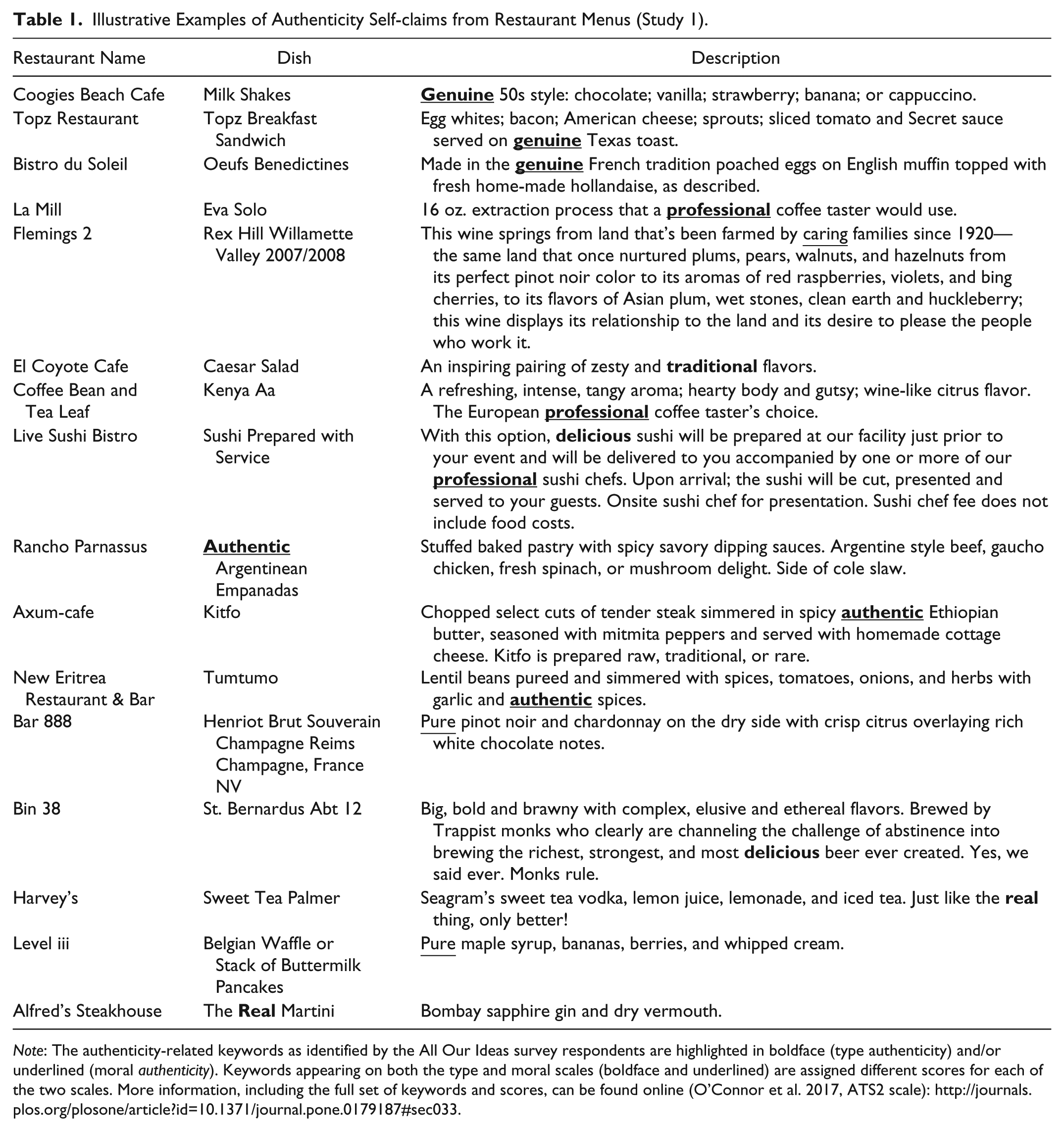
Note: The authenticity-related keywords as identified by the All Our Ideas survey respondents are highlighted in boldface (type authenticity) and/or underlined (moral authenticity). Keywords appearing on both the type and moral scales (boldface and underlined) are assigned different scores for each of the two scales. More information, including the full set of keywords and scores, can be found online (O’Connor et al. 2017, ATS2 scale): http://journals.plos.org/plosone/article?id=10.1371/journal.pone.0179187#sec033.
Affect
Diners’ affective responses to organizational self-claims of authenticity were measured by analyzing the open response text of each review on Yelp.com for emotion-laden words. Here, we relied on the Linguistic Inquiry and Word Count (Pennebaker, Booth, and Francis 2007; see also Pennebaker, Mehl, and Niederhoffer 2003), which labels 407 words as invoking positive emotion and 499 words as invoking negative emotion. We used a simple count of these words as measures of affect.
Control Variables
Several reviewer- and review-specific control variables were also included: (1) total words in the review; (2) reviewer activism, based on the number of reviews written by the same reviewer prior to the focal review; (3) reviewer variety seeking, based on the log of the number of establishments visited by the reviewer; and (4) year fixed effects to account for the varying dates of the reviews.
Several menu- and restaurant-specific control variables were also included: (1) total words in the menu; (2) restaurant self-claims about quality, using the keyword list generated by Kovács et al. (2014); (3) number of cuisine categories to which the restaurant belonged (dummy variables for the specific categories were also included); (4) restaurant age, based on the date of the first review of the restaurant posted to Yelp.com as a proxy (in years); (5) restaurant popularity, based on the logarithm of the number of reviews it had received prior to the focal review; (6) restaurant price, based on the approximate cost per person for a meal, including one drink, tax, and tips (Yelp.com): $ denotes “cheap” (less than $10; 32 percent of restaurants in the sample), $$ denotes “moderate” ($11–$30; 49 percent), $$$ denotes “spendy” ($30–$61; 15 percent), and $$$$ denotes “splurge” (more than $61; 4 percent); (7) chain affiliation, measured as a dichotomous variable (i.e., 0 = no chain affiliation, 1 = chain affiliation), based on whether other restaurants with the same name were in operation (about 12 percent of the restaurants in the sample were affiliated with chains); (8) family ownership, measured as a dichotomous variable (i.e., 0 = not family owned, 1 = family owned), based on the inclusion of whether “family-owned” or “family-operated” appeared in the text of the reviews; and (9) ZIP code fixed effects to account for geographic location.
Findings
Table 2 shows the descriptive statistics and pairwise correlations for the key variables.
Descriptive Statistics and Correlations (Study 1).

Note: N = 449,919 reviews.
Table 3 shows linear regression results on consumer value ratings (hypothesis 1). 3 As expected, perceived authenticity has a substantial and significant effect on ratings in each of the models; an individual tends to rate a restaurant higher to the extent that he or she perceives it to be authentic. Model 1 shows the baseline specification with the covariates only. Model 2 adds a covariate for general authenticity claims, which has a negative effect on consumer value ratings (–.011, p < .01). Model 3 separates the overall effect of authenticity claims to moral and type authenticity claims. Consistent with hypothesis 1, type authenticity claims have a negative effect on ratings (–.027, p < .01; hypothesis 1a), while moral authenticity claims have a positive effect on consumer value ratings (.061, p < .01; hypothesis 1b). Taken together, hypotheses 1a and 1b are supported.
Ordinary Least Squares Estimates of Consumer Value Ratings (Study 1).

Note: N = 449,919 reviews. Values in parentheses are standard errors. All models include year and ZIP code fixed effects and dummy variables for the cuisines of the restaurants.
p < .05. **p < .01.
Table 4 shows linear regression estimates on emotion-laden words (hypothesis 2a) and perceived authenticity (hypothesis 2b). Model 1 estimates the count of positive emotion words in the focal review. As expected, self-claims about moral authenticity elicit more positive emotion words (.040, p < .01), whereas self-claims about type authenticity elicit fewer (–.051, p < .01). Model 2 estimates the count of negative emotion words in the focal review. Although the direction of the estimates is in line with predictions, authenticity self-claims did not have a significant effect on the use of negative emotion words, irrespective of whether the claim conveyed type or moral authenticity. Hypothesis 2a thus receives partial preliminary support. Model 3 estimates the reviewer’s perception of the restaurant’s authenticity. As expected, moral authenticity claims lead to higher perceptions of authenticity (.004, p < .01); however, type authenticity claims did not have a significant effect. Hypothesis 2b thus also receives partial preliminary support.
Ordinary Least Squares Estimates of Linguistic Inquiry and Word Count Word Scales Using Texts of Online Reviews (Study 1).

Note: N = 449,919 reviews. Values in parentheses are standard errors. All models include year and ZIP code fixed effects and dummy variables for the cuisines of the restaurants.
p < .05. **p < .01.
Figure 1 shows estimates of structural equation models designed to examine together whether perceptions of authenticity and emotion-laden responses are indeed the mechanism through which type and moral authenticity self-claims shape consumer value ratings. The model shows an acceptable overall fit (standardized root mean square residual = .081, confirmatory fit index = .700; χ2 = 61,547.703, p < .001). As expected, type claims have a negative direct effect on ratings (–.071, p < .001), whereas moral claims have a positive direct effect (.090, p < .001). In addition, the estimates suggest that type and moral authenticity claims affect ratings via emotion as well as cognition in a manner consistent with the proposed hypotheses. Type claims result in reviews with fewer positive emotion words (–.032, p < .001) and more negative emotion words (.027, p < .01). Moral claims, however, result in reviews with more positive emotion words (.063, p < .01) and fewer negative emotion words (–.024, p < .001). In other words, type authenticity claims apparently have a negative indirect effect on ratings via affect, while moral authenticity claims have a positive indirect effect via the same pathway. Interestingly, type (.002, p < .01) and moral (p = NS) self-claims have an unexpected yet small direct effect on the consumer’s perceived authenticity. However, these effects are counterbalanced by the indirect effects of type (–.001,p < .001) and moral (.002, p < .001) self-claims on consumers’ perceived authenticity via affect. In sum, type claims have an overall negative effect on ratings (–.082, p < .001), whereas moral claims have an overall positive effect (.103, p < .001). Taken together, the structural equation model lends support for both hypotheses.

Structural equation model of consumer value ratings (study 1).
Discussion
Study 1 establishes support for the hypothesized effects of authenticity self-claims on ratings and provides two mechanisms through which these effects may operate. Organizational claims of type authenticity had a negative effect, whereas claims of moral authenticity had a positive effect. The primary mechanism for these effects was the focal consumer’s language used in response to the claim, particularly emotion-laden words. Of course, this study is not without its limitations. First, the data possibly suffer from self-selection bias. That is, we capture only responses from diners who presumably ate at the restaurants and, therefore, exclude those who had a priori negative views of the places, perhaps because of their authenticity self-claims, and opted not to go. Second, we relied on text analysis to construct authenticity scores. On one hand, this is an advantage in that we relied on keywords identified by survey participants as authenticity laden rather than relying on our own analytical filter. However, we recognize that language is more complex than the computer programs used to analyze it. As such, some authenticity keywords are indeed related to both type and moral claims (hence the positive correlation between the two), or alternatively, some keywords could be used to make a claim about something unrelated to authenticity altogether. We chose to follow this approach because of the sheer volume of menus and reviews; however, future research could apply a more rigorous coding approach by, for example, employing human coders to interpret menus and reviews. Third, the panel structure of the data does not allow us to control for all possible extraneous factors, and consequently, definitive claims of causality cannot be made. The steps taken in the analysis and the large sample overcome these limitations to a certain extent. However, to better overcome these limitations of the observational data and to establish a stronger case of internal validity, we conducted an experiment.
Study 2: Analysis of Experimental Prompts
Study Design
In this study, we sought to replicate the findings from the first study in a controlled experimental setting. In particular, we found it important to examine the effects of type and moral self-claims separately in order to determine not only that each kind of claim had the opposite effect from the other but that the effect of each also varied from making no claim about authenticity. We also found value in examining other possible outcome variables that cannot be captured from consumer review Web sites such as Yelp.com (e.g., word-of-mouth referrals to friends and acquaintances, willingness to pay for products and services).
To do so, we presented participants with a minimalist restaurant profile akin to what might be found on an online review Web site. The profile indicated the following: the restaurant name (Little Italy), a logo, a photo of the chef, cuisine (Italian), price level ($$), and a list of several sample menu items; each of these details remained constant across conditions. Also included was a short statement from the menu as well as from the owner; each of these statements varied across three conditions: (1) type authenticity self-claim, (2) moral authenticity self-claim, and (3) no authenticity self-claim. Figure 2 shows the stimulus for each of the three conditions. Participants were randomly assigned to one of the three conditions, asked to study the restaurant profile, and then to answer a set of questions about it, themselves, and their dining habits. Participants were recruited via Amazon’s Mechanical Turk; 170 participants participated, of whom 154 (91 percent) successfully completed the study and were thus included the analysis.

Experimental stimuli for type versus moral versus no authenticity self-claims (study 2).
The following items were included: (1) Consumer value rating was measured using the three-item measure from Kovács et al. (2017) (α = .83). (2) Word-of-mouth was included as an additional outcome variable and was measured using the three-item scale developed by Price and Arnould (1999) (α = .92). (3) Willingness to pay was also included as an additional outcome variable and was measured using a single item: “How much would you be willing to pay to eat at this restaurant?” (4) Perceived authenticity was measured using an ad hoc three-item scale, which was composed of the following statements to which respondents were asked to rate the extent to which they agreed: (a) “This restaurant is authentic,” (b) “This restaurant exemplifies authenticity,” and (c) “This restaurant feels genuine.” The scale was pretested in two other samples (Amazon Mechanical Turk: n = 353, α = .95; field study: n = 206, α = .95) and showed similar reliability here (α = .84). (5) Affect was measured using the Positive and Negative Affect Schedule: Short Form (Mackinnon et al. 1999).
Findings
Figure 3 shows the mean responses across the three conditions. For consumer value ratings, moral claims produced more favorable responses than type claims (Mmoral = 72.21, Mtype = 60.26; p < .01); however, responses to moral claims did not differ significantly from responses to no authenticity claim. Similarly, for word-of-mouth ratings, moral claims produced more favorable responses than type claims (Mmoral = 66.38, Mtype = 55.69; p < .01); however, responses to moral claims again did not differ significantly from responses to no authenticity claim. Contrary to expectations, willingness to pay did not vary significantly across conditions. In terms of perceived authenticity, moral claims produced higher levels of perceived authenticity (Mmoral = 73.67) compared with the control condition (Mcontrol = 66.49), whereas type claims produced lower levels of perceived authenticity (Mtype = 56.03) compared with the control condition (for both pairwise comparisons, p < .01). In terms of positive affect, participant responses trended in the expected directions but did not vary significantly across condition. However, in terms of negative affect, type (Mtype = .812) and moral (Mmoral = 1.537) did not differ significantly, but the former did differ significantly from the control condition (Mcontrol = 1.831, p < .01), which was contrary to expectations.

Participant responses to type versus moral versus no authenticity self-claims (study 2).
Discussion
In sum, the findings lend further support for the central hypothesis (i.e., hypothesis 1). That is, claims about type authenticity engendered negative responses from participants; however, claims about moral authenticity elicited favorable responses in some cases (i.e., perceived authenticity) but neutral responses in others (i.e., value ratings and word of mouth). At the same time, the findings provided somewhat inconclusive evidence about the role of affect as the operative mechanism (i.e., hypothesis 2), even as they pointed back to our central arguments. Specifically, the findings suggest that type claims indeed elicit a weaker affective response overall, indicating that assessments of such claims rely more heavily on cognitive evaluations that are less influenced by emotional reactions compared with moral claims. Taken together, this experiment provides a simple replication of the core findings from the first study and, at the same time, sheds more light on the findings concerning behavioral responses to type versus moral authenticity claims even as it highlights the need for further research in this domain.
General Discussion
Social scientists have long been interested in understanding the role of language in public discourse about social identities. As Berger and Luckmann (1966) noted: “Everyday life is, above all, life with and by means of the language [we] share with [our] fellowmen” (pp. 51–52). An understanding of language and its interpretation thus proves essential for any understanding of the reality of everyday life. In this study, we sought to contribute to this line of thought by examining here the role of language in organizational self-claims of authenticity and individual reactions to such claims. More specifically, we examined how individuals respond to organizational participation in public discourse about their own authenticity and how these responses varied depending on the language an organization uses to make such claims.
To resolve contradictions in prior findings about such self-claims, we proposed here a theoretical framework of how individuals form perceptions and make valuations about organizations touting their own authenticity. We proposed that semantic differences about authenticity are pivotal in understanding reactions. On the basis of our interpretations of prior studies, we argued that although self-claims about authenticity may often lead to lower value ratings, specific claims about type authenticity would be treated less favorably than claims about moral authenticity. The primary rationale relies on the positive affective response we expect from many individuals when faced with a moral claim, which in turn shape cognitive responses as well.
As hypothesized, empirical findings from two very different kinds of studies reported here suggest that claims about moral authenticity are judged more favorably than claims about type authenticity, which tend to be penalized. Both studies lend support for the argument that the effects of the self-claims operate through shaping perceived authenticity. The first study provides evidence suggesting that the effects are driven by affective responses. All in all, both studies suggest that the proposed theoretical framework aids in better understanding how individuals respond to organizational self-claims about authenticity. We suggest that prior findings about the negative effects of general authenticity self-claims can be accounted for by aggregation on the basis of the underlying distribution of type and moral claims.
The theoretical framework proposed and tested here offers at least three key contributions to our understanding of authenticity and organizational theory more generally. First, the findings suggest a scope condition regarding organizational self-claims about authenticity. Whereas most evidence suggests that individuals generally tend to view such claims unfavorably (Elster 1981; Holt 2002; Kozinets 2002; Kovács et al. 2017; Thompson and Tambyah 1999), some evidence suggests that individuals might judge them favorably under specific conditions in which the individual relates particularly strongly to the organization in question (Beverland 2009; Busselle and Bilandzic 2008; Johnson et al. 2015). The findings here suggest that the meaning of the claim itself is an important scope condition. Although self-claims concerning type authenticity tend to engender harsher responses, self-claims about moral authenticity tend to result in less critical responses and sometimes even positive ones. Moreover, individuals’ affective responses appear to play a key role in their cognitive and behavioral responses to such claims, which is consistent with other findings about how affect shapes cognition and action (e.g., Haidt 2001; Han et al. 2007; Shiv and Fedorikhin 1999). As such, these findings offer new theoretical insights into long-standing questions (e.g., Cooley 1902) as well as emerging research (e.g., Turner and Stets 2006) on the sociology of emotions. Future research would possibly do well to extend these findings by examining even more closely the conditions under which individuals exhibit a particularly strong positive emotional response to self-claims about moral authenticity. Conversely, it might also consider whether moral self-claims could prove deleterious in the long run, for example, in the exposure of inconsistency in espoused values.
Second, and directly following from above, this study echoes others (e.g., Grayson and Martinec 2004; Newman and Smith 2016; O’Connor et al. 2017) concerning the importance of delineating between different meanings of authenticity. Although others have emphasized these distinctions conceptually, most empirical studies tend to confound these interpretations by treating the concept of authenticity in a uniform manner. Drawing from prior work on the various kinds of authenticity, and corresponding definitions, we focused here on the fundamental distinction between type and moral authenticity (Carroll and Wheaton 2009). The findings emphasize the importance of specificity about the meaning(s) invoked when studying authenticity. Doing so opens the door to a wide range of exciting new research questions. 4
Third, this study helps us better understand how authenticity is discussed among audiences. In most domains in contemporary society, matters of authenticity cannot be settled definitively (Lindholm 2008; Peterson 1997; Potter 2010; Trilling 1972); instead, they are sorted out through ongoing discourse among observers and the use of language to make (or not) attributions of authenticity (Kovács et al. 2014). As such, many organizations attempt to craft an image of their authenticity by entering into this dialogue with consumers and other observers (Kovács et al. 2017). In an existential meaning, authenticity refers to whether an entity is what it claims to be (Sartre 1943). Thus, the extent to which authenticity can be fabricated or engineered and retain its appeal raises interesting existential questions, particularly if consumers are aware of these facts. Attempts at openly and blatantly crafting authenticity can backfire as audiences may regard these attempts as inauthentic. Yet as we have shown here, consumers might be willing to buy it if it is the right kind of claim, namely, one pertaining to values rather than to category assignment. Additionally, attributions of authenticity tend to evolve over time (McKendrick and Hannan 2014) and even vary across cultural contexts (Carroll and Swaminathan 2000) as audiences collectively agree on what ought to be considered authentic in their particular context. Future research might therefore usefully examine how these attributions and the language used to convey them evolve over time and vary across cultural contexts.
More generally, this study raises questions about the broader theoretical issue of how individuals respond to promotional claims irrespective of content. Organizational researchers have long suggested that the image that organizations intend to portray is not necessarily the identity that audiences perceive (Brown et al. 2006) and that individuals are generally skeptical of most promotional claims made by organizations (Boush, Friestad, and Rose 1994; Friestad and Wright 1994; Mangleburg and Bristol 1998), with such claims frequently causing a cultural backlash (Holt 2002; Murray and Ozanne 1991). The logic driving these assertions is that many individuals believe that these claims are motivated by self-interests and, therefore, are exaggerated or, worse, untrue (Hoorens et al. 2012; Robinson, Johnson, and Shields 1995). However, the findings reported here suggest that a claim need not necessarily be factually true in order to be accepted as such. Instead, individuals recognize that even fictitious claims can be a part of an acceptable brand narrative. The findings suggest that an individual’s emotional reaction is one key mechanism through which consumers might relate to such claims even if they are proclaimed by self-interested organizations. Future research might productively examine more broadly the general conditions under which individuals are willing to accept organizational self-claims irrespective of content. In doing so, we would emphasize, once again, the central role of language (Berger and Luckmann 1966) and emotions (Turner and Stets 2006) in the reception of such claims.
Finally, the findings reported here also offer some potentially useful practical instruction on how organizations can best manage and portray an image of authenticity. Most notably, we now have some better clues about how various individuals respond to organizations that tout themselves as authentic. Given that so many practitioners regularly make decisions about market messaging regarding authenticity (Beverland, Lindgreen, and Vink 2008) and many marketing gurus frequently offer apparently unfounded advice on how to do so (Potter 2010), the findings would seem to have the potential to inform practice. In terms of individual acceptance and endorsement regarding a product or service, the findings suggest that authenticity self-claims are tricky at best and detrimental at worst. Indeed, the findings lead us to join other researchers who have warned about the potential backlash of making authenticity self-claims, but with an added caveat: the meaning of the claim, and thus the language used to make it, matters.
Footnotes
Authors’ Note
Authors’ names are listed in reverse-alphabetical order; all contributed equally.
1
Additional analysis that excluded reviews preceding November 1, 2011, yielded similar (but stronger) results to those presented here; results are available from the authors upon request.
2
Following  , we included only those keywords that are particularly diagnostic of authenticity (i.e., a score > 70) or inauthenticity (i.e., a score < 30) in an effort to avoid concerns of multicollinearity between the type and moral scales (which they refer to as “ATS2”). Additional analysis with a less restricted set of keywords (which they refer to as “ATS1”) produced similar results to those presented here, but the correlation between the type and moral authenticity scales is indeed higher. We therefore concluded that analysis using the ATS2 scale is most appropriate; however, additional analysis using the ATS1 scale is available from the authors upon request.
3
Estimates using an ordered logit modeling framework resulted in similar estimates to those reported here.
4
One promising direction regards price. On the one hand, it might be reasonable to suggest that morally authentic menu items and restaurants will be more expensive than type authentic items and restaurants. The rationale is that it may be costly for an organization to operate on the basis of its values rather than by a purely profit motive. On the other hand, one can easily imagine cuisines (e.g., French) and associated food items (e.g., cheese) that are often more expensive if authentic according to the type interpretation. As such, it remains to be seen if there is an association between the price of goods and services and perceptions of type or moral authenticity regarding the organizations producing them. Such questions represent exciting avenues for future research. We are grateful to an anonymous reviewer for this interesting idea.