




Abstract
In the interest of enlarging their constituencies, social movements often broaden mobilization efforts beyond the directly aggrieved, beneficiary populations. The authors examine this process through an analysis of a movement against unconventional oil and gas development (UOGD or “fracking”) in Illinois. Using data on more than 37,000 public comments submitted during a regulatory review of fracking, the authors examine the composition of the antifracking movement’s constituency. Individuals residing outside the targeted development region submitted the vast majority of the comments opposing UOGD. Analyses reveal that these participants tend to be Democratic partisans who were affiliated with one or more large environmental and progressive organizations. The study offers new insight into how environmental and progressive issue campaigns are organized in the contemporary U.S. context. The authors highlight how partisan discursive opportunities combine with recent organizational innovations in the social movement sector to enable nascent single-issue campaigns to tap into the mobilization potential of motivated partisans.
To achieve their goals, movements seek to mobilize the largest possible constituencies. The labor entailed with achieving an alignment between people’s interests and their beliefs and activating political participation is substantial (Gaventa 1980; McAdam 1982). Organizers use existing formal and informal networks when available but also must build new organizational capacity as necessary (Han 2014). The directly aggrieved are not the only potential movement supporters, however. Activists also frame the issue strategically to extend the issue’s relevance to potentially sympathetic allies (Klandermans and Oegema 1987; Snow et al. 1986). The allies may perceive an indirect stake in the movement’s goals, or they may be conscience constituents (i.e., supporters who have no direct material stake in the outcome but whose ideology or personal values align with the movement’s goals) (McCarthy and Zald 1977). We focus on the composition of a movement’s membership and especially on the balance between movement supporters whose interests are under direct threat and supporters whose participation does not clearly follow from their material interests but is instead accomplished through strategic appeals to their ideology, values, or political identity.
We suggest that the contemporary political environment in the United States privileges mobilization strategies that focus efforts on mobilizing people whose salient partisan identities predispose them to agree with a movement’s message and not on organizing the directly aggrieved around their material interests. We delineate ideational and organizational factors that make this strategy attractive to movement actors. Ideationally, growing partisan polarization among Americans gives rise to large pools of individuals who are prepared to agree on many different issues (Baldassarri and Gelman 2008; DellaPosta, Shi, and Macy 2015). Organizationally, the ascendance of large advocacy organizations and their adoption of rationalized mobilizing strategies enable movements to rapidly introduce new issues to prospective supporters.
We test these ideas through an analysis of the movement against unconventional oil and gas development (UOGD, popularly known as “fracking”) in Illinois. UOGD is the process of extracting oil and gas reserves from new types of formations via hydraulic fracturing of horizontally drilled wells. UOGD resembles other types of controversial industrial land uses, in that it poses a risk to the local environment, public health, and quality of life (Jacquet 2014). 1 Using unique data that consist of all public comments submitted to the Illinois Department of Natural Resources (IDNR) during the implementation of the Illinois Hydraulic Fracturing Regulatory Act, we examine the composition of the supporters of the antifracking cause. In contrast to conventional accounts that view local residents as the primary constituency in challenges to industrial land uses, we find that people residing outside the targeted development region submitted the vast majority of the comments opposing UOGD. Using information on participants’ organizational affiliations, we find that several large environmental and progressive organizations mobilized the overwhelming share of the opposition to UOGD. These organizations did not focus mobilization efforts in the targeted region despite the expectation that proximate communities would face significant negative impacts. Rather, they contributed to the movement by introducing the antifracking movement to their geographically diffuse membership as one more issue in a slate of loosely related causes.
Our research offers new insight into how environmental and progressive issue campaigns are organized in the contemporary U.S. context. We highlight the discursive opportunities and the organizational infrastructure that enable a nascent, local movement to tap into the impressive mobilization potential of motivated partisans. Our results suggest that a mobilization strategy that emphasizes the recruitment of politically engaged partisans can enable a movement to quickly achieve scale. However, the strategy implies trade-offs that are equally important to consider. Drawing on insights from primary documents and fieldwork in Illinois, we conclude by raising several questions about the strategy’s effects on the durability of a movement, its inability to mobilize consensus movements that cross partisan cleavages, and its potential implications for political representation.
Mobilizing Nonbeneficiaries
A foundational question in social movement scholarship is how a group of people experiencing a grievance might overcome quiescence to recognize the injustice of their situation and identify collective action as a method to redress that grievance (Gaventa 1980; McAdam 1982; Morris 1984). This question continues to inspire important research, but there is also recognition that people from advantaged backgrounds increasingly adopt movement tactics to effect political change and not necessarily to redress personal grievances (McAdam et al. 2005; Meyer and Tarrow 1998). McCarthy and Zald (1977) anticipated a growing role for movement participants who held no direct stake in the grievance but whose beliefs, values, or ideology motivated them to contribute to the movement. They attributed this trend to the growth in disposable resources of middle-class Americans and the rise of professional social movement organizations (SMOs) with enhanced abilities to harness these resources. Thus, contemporary SMOs do not just work with aggrieved populations but seek to expand the issue’s relevance to broader constituencies (Klandermans 1997; Rootes 2013). This article examines the nature of these efforts.
It is important to examine the foci of a movement’s mobilization efforts, because contributions by different types of participants are not fungible. Beneficiary and nonbeneficiary constituents may have alternative motivations and may differ in their understanding of the specific issue (Klandermans, van Stekelenburg, and Damen 2015; McCarthy and Zald 1977). The relative balance of different types of participants can thus influence the durability of the movement, its pace and scale of mobilization and the issues that are taken up in the first place.
We expect nonbeneficiary constituents to play a large role in contemporary movements. We seek to identify the structural channels that underlie their mobilization efforts and the ideational frameworks that facilitate frame resonance among this group (Gould 1995). Structurally, we update McCarthy and Zald’s (1977) emphasis on professional organizations’ role in mobilizing conscience constituents by bringing attention to recent organizational and technological developments in the advocacy community. Ideationally, we suggest that partisan polarization, by shaping discursive opportunities, encourages issue movements to structure their mobilization campaigns along narrowly partisan lines.
Organizational Bases
From black churches (McAdam 1982; Morris 1984), to Parisian neighborhoods (Gould 1995), to local civic organizations (Skocpol 2003), scholars of social movements have long argued that indigenous organizations are the basic stuff of which movements are made. This research has yielded evidence that local organizational density is related to civic capacity, but there is also increasing recognition that fundamental changes in the structure of advocacy groups have led to a decoupling between social capital and political mobilization (Putnam 1996; Skocpol 2003). The past half century has seen the rise of professionally staffed, centralized advocacy groups with national headquarters and little organizational penetration at the local level. Once criticized as “bodyless heads” (Skocpol 2003:163), these organizations have since leaned on new technologies, including direct mail and modern online technologies, to develop often very large grassroots “bodies” (Bosso 2005; Walker, McCarthy, and Baumgartner 2011).
The new crop of professional organizations relies increasingly on “supply-side recruitment” strategies, exploiting the fact that it is easier to mobilize an already politically active segment of the population on a new issue than it is to develop capacity among a previously inactive segment (Brady, Schlozman and Verba 1999; Abramson and Claggett 2001; Krueger 2006). As Walker (2014) observed, many eventual participants in an issue campaign would not have independently encountered the issue, were they not a subject of a targeted appeal by an organization. Recent advances in technology and recruitment strategy aid organizations in this task. Professional organizations use data analytics to micro-target likely participants, expending special effort to reach people with a record of previous political engagement (Karpf 2016; Walker 2014). In crafting their mobilization appeals, the organizations also use experimentally tested language, tailored to resonate with the intended audience (Karpf 2016). Modern online technologies, furthermore, allow organizations to maintain greater control of their messaging compared with when they had to rely on mass media to reach a large audience (Tufekci 2013).
An important consequence of these changes is the rise of advocacy organizations that organize around multiple, at best loosely related issues. Perhaps the best known example in the United States is MoveOn.org, which organizes around an array of progressive causes. The reduced cost of using e-mail to communicate with supporters enables organizations such as MoveOn.org to rapidly generate financial support through issuing “action appeals” when the political environment is most receptive (Karpf 2012). “Issue generalists” such as MoveOn.org are particularly well positioned to offer a foothold to incipient and episodic movements seeking to grow their constituency (Heaney and Rojas 2015; Rootes 2013). Getting access to even a small (but targeted) slice of the 8-million-member e-mail list of MoveOn.org, for example, can catapult an emerging contest into a mainstream movement.
It is also important to recognize what the new crop of professional advocacy organizations do not do well compared with their predecessors. They often lack roots in geographic communities and do not create meaningful social ties among their members (Putnam 2000; Skocpol 2003). Putnam (1996) analogized the relationship between members within professional organizations to that of fans of the same baseball team or car enthusiasts devoted to the same brand. They represent a geographically diffuse collection of people with a shared affinity for specific policy preferences (Pacewicz 2016; Skocpol 2003). This hierarchical structure tends to deemphasize cultivation of civic skills among members (Han 2014) and may leave such organizations with little capacity to organize community members around local issues (Skocpol 2003).
Ideational Bases
Social movement participation is precipitated by a perceived alignment between one’s personal beliefs and political goals with those espoused by a SMO (Snow et al. 1986). Ideological congruency is especially important for conscience constituents because their participation is a means to express beliefs and values rather than secure material gains (Klandermans et al. 2015; McCarthy and Zald 1977). Movement actors seek to expand the support for their cause by brokering ideational linkages to potentially aligning “sentiment pools” (Snow et al. 1986; see also Klandermans and Oegema 1987). In pursuit of this goal, they pay close attention to discursive opportunity structures (i.e., the set of belief systems, values, and symbols that resonate with different segments of the population and thereby constrain and enable specific framing strategies) (Gamson 2004; McCammon et al. 2007).
Among the most prominent features of the discursive opportunity structure facing movement actors in the United States today is the increasing salience of partisan political identities. Recent research finds growing alignment between individuals’ partisan identities and the positions they take on a range of political issues (Baldassarri and Gelman 2008). A wealth of research in political science shows that ordinary citizens follow cues from elites with whom they perceive to share a political identity (e.g., Brader, Tucker, and Duell 2013). As political elites—including politicians, media pundits, and other political celebrities—adopt positions on multiple issues, ordinary citizens receive cues that their views on specific issues should go together as well (Layman and Carsey 2002).
Much of the research in political science focuses on the role of partisanship in electoral politics, but there is also a growing recognition of the relevance of partisan identities for mobilization in social movements (Heaney and Rojas 2015; McAdam and Tarrow 2010). The sorting of public opinion along partisan lines structures the set of alliance and brokerage opportunities available to SMOs. Heaney and Rojas (2015), for example, found that the antiwar movement was able to swell its ranks in the wake of the Iraq War by aligning with the political interests of the Democratic Party. Similarly, the environmental movement enjoyed a broad (and bipartisan) base of support during most of the twentieth century, but recent partisan polarization has effectively “narrowed environmentalists’ tactical options” to the left side of the partisan divide (Bosso 2005:127). Vasi (2011) argued that movements often coalesce out of “miscible” groups, ones that are ideologically compatible, because it enables them to spread contention more quickly. Notably, he also finds that by excluding groups with low ideological miscibility, movements impose a limit on how widely they can spread.
Researchers have mostly observed that the partisan environment has been an impediment to broad-based coalitions (Bosso 2005; Vasi 2011), but a less emphasized implication of the unfolding partisan moment is that it may actually incentivize movement actors to appeal to partisan identities. The first step in social movement mobilization is to garner broad attitudinal support for one’s cause (Klandermans and Oegema 1987). With little prospect of reaching across the aisle, appealing to a partisan identity is an attractive strategy for movements seeking to elevate their cause.
Synthesis
The social movement sector constitutes a shared ideational and resource space (McCarthy and Zald 1977). In the contemporary U.S. context, large professional and especially multi-issue organizations provide a robust infrastructure for mobilizing constituents with no or little material stake in the achievement of movement goals, and they are able to do so effectively by framing the issue as one of national significance and partisan salience.
Opposition to UOGD and Nonbeneficiary Constituents
We examine mobilization practices and the resulting composition of movement supporters in the context of opposition to UOGD. UOGD is a highly industrial process with concentrated local impacts (Brasier et al. 2011; Fernando and Cooley 2016; Jacquet 2014; Theodori 2009). In this sense, UOGD sites resemble other types of industrial projects, which researchers collectively refer to as locally unwanted land uses (LULUs) and the opposition to which they describe as being motivated by “not in my backyard” (NIMBY) attitudes (Freudenburg and Pastor 1992; Schively 2007). Both acronyms (LULU and NIMBY) imply that proximate residents represent the key beneficiary constituency in opposition campaigns against industrial siting.
Antifracking mobilization emerged as a local issue in the late 2000s and early 2010s, as industrial activity associated with development of new oil and gas reserves raised concerns among proximate residents (Brasier et al. 2011; Jacquet 2014; Theodori 2009). Early accounts of opposition to UOGD focused on how locals identified risks from UOGD and how they organized against it (Gullion 2015; Vasi et al. 2015). Notably, researchers also identified significant support for UOGD in communities facing development, particularly in cases in which residents associated development with local economic benefits (Boudet et al. 2016; Davis and Fisk 2014; Jacquet 2012). We expect that proximate residents would mobilize in a campaign against UOGD, but additional research suggests that the antifracking movement may look beyond those who perceived a material harm from UOGD to recruit participants from outside the targeted development region (Dokshin 2016). Beyond describing the composition of the movement’s support base, we wish to examine how the movement is able to reach and motivate participants from outside the directly affected communities.
Research on attitudes toward hazardous industrial sites provides evidence that opposition to the sites extends beyond the physical “backyard” (e.g., Michaud, Carlisle, and Smith 2008) and that environmentalists and Democratic partisans are more likely to oppose such sites (Jenkins-Smith et al. 2011; Michaud et al. 2008; Gravelle and Lachapelle 2015). Rootes (2013), for example, argued that environmentalists are natural allies to NIMBY movements and, particularly, that the emergence of climate change as a “master frame” of environmental contention helps connect local siting issues with national constituencies. A notable result from this research is that partisanship and ideology are actually more predictive of attitudes toward proposed industrial projects among respondents who live farther away from the sites (Clarke et al. 2016; Gravelle and Lachapelle 2015). These findings suggest that respondents who lack local experience and knowledge about specific risks and benefits of the proposed industry more readily defer to ideology or partisanship as a heuristic to form opinions.
Thus, independent of proximity to proposed industrial projects, Democratic partisans and environmentalists (two groups with significant overlap in the U.S. context) hold substantial mobilization potential, which organizations adept at supply-side recruitment are well positioned to tap. Connecting this work with the theoretical expectations we developed in the preceding section, we pose the following hypotheses about the antifracking campaign in Illinois. We focus on the composition of individuals who submitted public comments expressing opposition to UOGD during Illinois’s regulatory review of the industry. First, we expect the antifracking movement to have successfully recruited Illinois residents not just from the targeted region, but from across the state.
Hypothesis 1: Communities facing no direct risk of local impacts from UOGD nonetheless have large numbers of commenters opposing UOGD.
Second, we expect that the partisan discursive opportunity structure led antifracking activists to engage in frame extension by appealing to partisan identities. We expect this to be reflected in a disproportionate recruitment of Democratic partisans to the antifracking cause, especially among opponents recruited from outside the development region.
Hypothesis 2a: Communities with higher shares of Democratic voters have more commenters opposing UOGD (per capita).
Partisan appeals may be effective at mobilizing residents of the targeted region as well, but it should be less important, because they also face an observable threat from development. Thus, we can get additional analytical leverage from a comparison between the effect of partisanship on mobilization among the two groups.
Hypothesis 2b: Democratic vote share is a stronger predictor of the number of commenters opposing UOGD (per capita) in the nontargeted communities than in communities that are in the targeted development region.
Finally, we expect that professional, multi-issue advocacy organizations provide the infrastructure for recruiting UOGD opponents from outside of the development region.
Hypothesis 3: Large, multi-issue organizations are instrumental to recruiting commenters opposing UOGD from nontargeted communities.
Data, Measurement, and Methods
In the early 2010s the New Albany Shale, the geologic formation underlying parts of Illinois, was perceived as having the potential to emerge as the next big oil producer. The antifracking campaign that followed is uniquely suitable for examining how movements expand their support beyond the beneficiary constituency. First, the New Albany Shale is limited to the southeastern region of the state. This geography provides a point of comparison between Illinoisans who would face direct impacts from UOGD and Illinoisans who reside beyond the radius of these impacts. Second, the adoption of the Illinois Hydraulic Fracturing Act in 2013 represents a critical event for the antifracking movement, allowing us to analyze the movement’s mobilization efforts in response to it. The regulatory act authorized the IDNR to promulgate rules implementing the law. The release of the draft of the administrative rules kicked off a 45-day public participation period from November 2013 to January 2014. Our analysis focuses on the mobilization of opposition during this public comment period, a focal point of the antifracking campaign in Illinois. Finally, Illinois is one of the few U.S. states that have experienced extensive political mobilization surrounding UOGD regulatory policy. By comparison, there was little popular mobilization around UOGD policy in the states where it was first introduced (e.g., Texas, Pennsylvania, North Dakota), because little was known about the industry and its impacts. By the time IDNR rulemaking began in 2013, however, a national antifracking movement had matured (Mazur 2016). Thus, this study capitalizes on an empirically unique opportunity to evaluate the composition of antifracking constituents participating in UOGD policymaking and the organizational infrastructure that facilitated their mobilization.
Public Comments Data
Our primary data consist of 37,559 public comments the IDNR received during the 45-day public comment period. We obtained copies of all public comments submitted to IDNR from files made available on the agency’s Web site. These data enable us to observe the totality of popular antifracking mobilization in Illinois during the public comment period. Participation in the public comment period is a behavioral indicator of mobilization and the content of each comment provides an indication of the person’s position on the issue. Participants’ self-reported addresses permit us to identify their locations relative to potential oil and gas development. We also use the self-reported organizational affiliations to identify the organization(s) that helped recruit each participant.
Using several computer scripts written in Python, we extracted this information from the files on the IDNR Web site. The scripts combined different file formats, cleaned and standardized the text (including names of cities and organizations), and, in cases in which a participant submitted more than one comment, combined these under a unique participant ID. We then coded each comment’s stance on UOGD—opposition, support, or other—either by assigning the position of the organization with which the participant was affiliated (if the comment was part of an organization’s campaign) or by coding it manually from the text of the comment. The vast majority of the comments, 33,826, expressed opposition to UOGD. We excluded an additional 1,594 comments because they had incomplete data (missing name or address information) or were submitted by individuals who reported non-Illinois addresses. For a detailed description of the preprocessing and coding procedures, see the Supplementary Materials (SM 1). The analyses that follow use 32,232 comments that expressed opposition to UOGD and were submitted by 9,847 unique Illinois residents, who reported affiliations with 136 unique organizations.
Analytical Approach and Modeling Strategy
Our analysis proceeds in two stages. We begin with a comprehensive description of mobilization during the public comment campaign. We focus on the geographic distribution of UOGD opponents relative to proposed development and on the organizations that recruited participants.
In the second stage, we test our hypotheses by examining community-level variation in the number of people that mobilized to oppose UOGD. We analyze two types of dependent variables. First, we predict the total number of people that submitted a comment against UOGD in each community. Second, we predict the numbers of commenters from each community who reported an affiliation with one of several specific organizations. By distinguishing commenters by recruiting organization, this second set of dependent variables enables us to test whether professional advocacy organizations played an outsized role in mobilizing nonbeneficiary constituents and whether specific organizations disproportionately recruited Democratic partisans.
The use of community-level data to study mobilization by individuals introduces well-known concerns about ecological inference (King 1997), but we take several steps to mitigate these. First, we make inferences using the lowest available geographic units. Second, we present a supplementary bivariate analysis using individual-level data on partisanship. Specifically, we use the Federal Election Commission (FEC) campaign contribution data and apply a matching procedure to gather an individual-level indicator of participants’ partisan commitment.
Conducting an analysis using geographic units smaller than the county presents data challenges. Our outcome variable, number of individuals who submitted comments opposing UOGD, is geocoded at the census place level. Unfortunately, there exists no satisfactory measure of partisanship at this geographic unit. The best available measure for Democratic support below the county level is the precinct-level election results maintained by the Harvard Election Data Archive (Ansolabehere and Rodden 2011). These aggregate to the census subcounty units but not to the census place units. Therefore, we translated the dependent variable from the census place units onto the subcounty units. To do this we obtained a translation file from the Missouri Census Data Center. For each census place unit, the file reports the set of subcounty units with which it overlaps and the population-weighted share of each overlap. Some measurement bias is introduced during the translation procedure, but we expect it to be minimal. Sixty-eight percent of all census place units fit completely within a single subcounty unit, and 80 percent have a .90 share or greater allocated to a single subcounty unit. To ensure that our results are robust, we report analyses that only count participants who could be allocated with a high certainty in the Supplementary Materials (SM 2). We also run the analysis using (1) county-level data with county-level election results and (2) the original, census place–level data with a proxy for Democratic support constructed using the FEC database of political contributions. These analyses give us additional confidence in the presented subcounty-level results (see the “Results” section for a full discussion of these checks and the Supplementary Materials for the results).
We use negative binomial regression to model the number of public comment participants in a community. Negative binomial regression is preferred to Poisson regression in this case, because it allows overdispersion by relaxing the assumption that the variance is equal to the mean (Long and Freese 2014):

where P is the population of community i, and Xk are independent variables.
Independent Variables
Our first key variable of interest is proximity to potential UOGD sites. Variation in geological conditions permits us to define two distinct populations of Illinois residents who will experience UOGD in qualitatively different ways. The first population includes people residing above the industry-targeted, fossil fuel–rich geologic formations. For residents in this region, the prospect of UOGD may imply a risk for negative impacts to their property, quality of life, health, and the local environment (Jacquet 2014). In the language of McCarthy and Zald (1977), members of this population who join the antifracking movement are beneficiary constituents, because they hold a direct material stake in the outcome of the movement. In contrast, the second population is composed of Illinois residents who do not live near potential development areas and thus do not face the direct impacts associated with the siting of UOGD projects.
We use estimates of the development area that were published before the public comment period to identify counties that were part of the targeted region. Significantly, we are interested in residents’ perception that UOGD would have a negative local impact. We construct a dummy variable that indicates counties where such a perception could be credibly sustained. In Illinois, this includes 19 counties in the southern part of the state (Higley et al. 2014).
Our second key variable is partisanship. As noted above, we measure the share of residents with a Democratic partisan identity using the vote share for Barack Obama in the 2008 presidential election. We would prefer to use 2012 results, but unfortunately precinct-level results are only available from 2008. 2 To test hypothesis 2b, that conscience constituents tend to be more partisan, we include an interaction term between the indicator of being in the targeted area and Obama vote share. A positive main effect of Obama vote share and a negative interaction would suggest that partisan identity is more important for the mobilization of residents of nontargeted communities than for residents facing a direct impact from UOGD.
Control Variables and Exposure
We include several control variables. First, we include several demographic variables. Rojas and Heaney (2016) suggested that demographic composition of a locale is a critical element of a baseline model of political participation. Following their example, we model racial composition, by including percentages of the community’s population that are black, Hispanic, and Asian, and gender composition, including percentage female. This information comes from the 2010 U.S. census. Next, we include educational attainment as a measure of local resources. We include the percentage of residents with bachelor’s degrees, on the basis of the 5-year estimates from the American Community Survey.
We also include several variables of community context that previous research suggests may influence how residents perceive a proposed industrial siting (Wright and Boudet 2012). First, communities that face economic hardship may view proposed development as an economic opportunity rather than a threat. We include percentage of vacant homes in the community as a control (2010 U.S. census). Second, residents in rural communities have been found to be more likely to support UOGD (Davis and Fisk 2014), so we include a county-level dummy variable indicating rural status, on the basis of the U.S. Department of Agriculture’s rural-urban continuum score. Third, residents in communities that have historic experience with the oil and gas industry may be more likely to support UOGD (Molotch, Freudenburg, and Paulsen 2001; Wright and Boudet 2012). To capture industry presence, we draw on data from the Bureau of Labor Statistics (BLS) to create a county-level measure of the share of the local economy that is composed of the oil and gas industry. We include the share of the county’s business establishments that are part of the oil and gas industry, as classified by the BLS. We also use the BLS data to construct a measure of the share that tourism plays in the county’s economy. Residents of communities that have a strong tourist industry may be more likely to view development as incompatible and thus more likely to see UOGD as a threat.
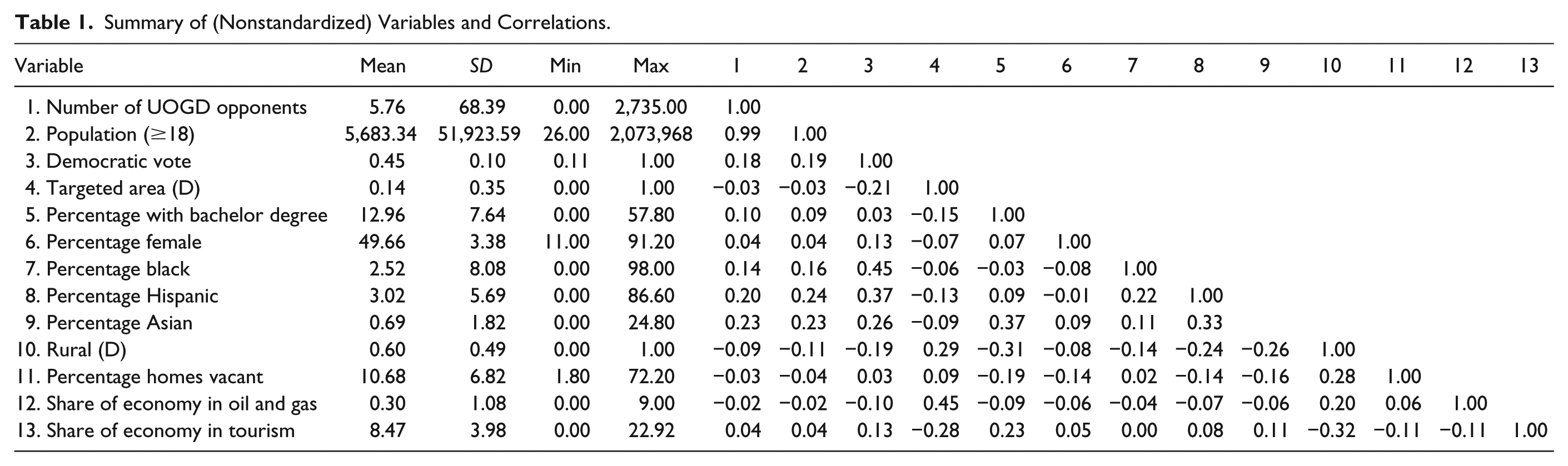
Finally, all else equal, communities with larger populations will have higher counts of participants than communities with smaller populations. In the language of count models, communities of different size differ in their exposure to the onset of events. In our case, the event is a resident’s participation and exposure corresponds to the total number of potential participants. Therefore, we include the adult population as the exposure term in the negative binomial regression model. This means that the natural log of the adult population is included as an independent variable, and its coefficient is constrained to equal 1. Table 1 presents descriptive statistics and correlations for all variables.
Summary of (Nonstandardized) Variables and Correlations.
Findings
Where Did Opposition to UOGD Concentrate, and Which Organizations Contributed to Its Mobilization?
Figure 1 presents a map showing the geographic distribution of Illinois residents who expressed their opposition to UOGD through the comment period. The size of each circle reflects the number of unique participants submitting at least one comment from that county during the 45-day public comment period. The 19 counties targeted for development are all located in the southern part of the state and marked with a black diagonal line pattern. Supporting hypothesis 1, the map shows that mobilization of participants from outside of the prospective shale play was immense in the antifracking campaign in Illinois. In absolute terms, the vast majority of public comment participants reside in areas of the state that have no chance of hosting UOGD. In fact, just 179 of the 9,847 participants (2 percent) reside in counties that were identified as having the potential for gas and oil development by the U.S. Geological Survey. In other words, only these 179 commenters were opposed to UOGD in their “backyards,” and they submitted a total of 432 public comments. The 9,668 participants from the rest of the state submitted the remaining 32,161 comments.

Geographic distribution of Illinois residents expressing opposition to unconventional oil and gas development through the public comment period.
The nontargeted parts of Illinois are more populous, so it is also important to consider the rate of participation. The shading of each county in Figure 1 corresponds to the rate of participation per 10,000 residents. Residents of the targeted region participated in the public comment period at a rate of about 5 per 10,000 residents, whereas the average rate was about 8 per 10,000 residents in the counties not targeted for development. Thus, even after accounting for population, residents from outside the targeted region were more likely to participate. The targeted and nontargeted regions differ in other ways, therefore a multivariate analysis is needed to examine whether these differences are related to proximity to development. Nonetheless, the descriptive statistics clearly indicate that nonbeneficiary constituents played a large role in the political mobilization against UOGD in Illinois.
Next, we describe the organizations that mobilized Illinois residents to express opposition to UOGD during the public comment period. Table 2 lists the top organizations by the number of participants each mobilized for the campaign. 3 Several of the top recruiting organizations fit the profile of what Karpf (2012) called generalist, progressive organizations. CREDO Action, Fair Economy Illinois, IIRON, RISE, and Illinois People’s Action mobilize participants on a variety of issues, including the economy, human rights, and social justice causes. Other top recruiters are professional environmental advocacy groups that command a base of thousands or millions of “listserv” members: Sierra Club, 350.org, Food & Water Watch, Environmental Law and Policy Center, Faith in Place, and Climate Action Network. Although squarely in the environmental movement sector, these organizations focus on multiple issues within that domain at any given time. Frack Free Illinois, Chicagoland against Fracking, and SAFE are organizations focused on UOGD and were all founded in direct response to proposed development in Illinois. We drew on public data and data collected during fieldwork conducted by the second author to create a descriptive profile for each of the top organizations. We include complete profiles on each top organization in the Supplementary Materials (SM 4).
Organizations That Recruited the Largest Number of Comments Opposing Unconventional Oil and Gas Development.

With the exception of the totals for “other organizations,” participants who are members of more than one organization contribute to each organization’s total. Members of “other organizations” do not belong to any of the named organizations.
Results from Community-level and Individual-level Analyses
Table 3 presents results from negative binomial regression models predicting the number of UOGD opponents who mobilized from different Illinois communities. As detailed above, the presented models use the census subcounty designation as the unit of analysis. All variables reported in the results except the dummy variables are standardized and mean centered for ease of interpretation.
Coefficients from Negative Binomial Regression Models Predicting the Number of Individuals in a Community Who Submitted a Comment Opposing Unconventional Oil and Gas Development.

Note: The exposure term (population) is not reported. Standard errors are in parentheses.
p < .05 and **p < .01 (two-tailed tests).
Model 1 includes the exposure term (not reported) and the main variables of interest: Democratic vote share and a dummy indicating location in the area targeted for development. As hypothesis 2a predicts, Democratic vote share is a strong and statistically significant predictor of the number of people who mobilize against UOGD within a community. The result holds with the full set of control variables (models 3 and 4). Consistent estimates from the same model using place-level data and a more restricted specification using county-level data (reported in SM 3a and 3b) provide confidence in this result.
Model 2 includes the hypothesized interaction between Democratic vote share and location in the targeted region. Results from this model support hypothesis 2b: greater share of the Democratic vote is associated with larger numbers of UOGD opponents, but this effect is driven entirely by communities outside the targeted development region. Democratic vote share does not significantly predict the number of UOGD opponents in communities targeted for development. This result holds when we include control variables in models 3 and 4. However, the finding that Democratic partisanship is more important for mobilizing conscience constituents than beneficiary constituents is not stable across estimates that use different units of analysis (see SM 3a, and 3b). The relevant interaction terms are negative but not statistically significant in either the county-level or the place-level analysis.
To further investigate this relationship and mitigate some of the concerns about ecological inference, we examine an individual-level measure of partisanship. Specifically, we matched our list of UOGD opponents with the list of political campaign contributors from the FEC. The FEC database includes any person who contributed at least $200 to an electoral campaign. Using information on each participant’s first and last name, city of residence, and (where available) ZIP code, we implemented an algorithm to match the list of public comment participants with the FEC database of contributors. We limited our search to FEC files from presidential and midterm campaigns between 2008 and 2014. The algorithm is conservative in the sense that it only counts a match when the estimated likelihood of two people sharing the same first and last name combination in the community is less than 1 percent. This procedure means that we may have missed some matches, an acceptable trade-off for reducing the rate of false positives, which would be a more consequential source of bias in the context of the goals of this analysis.
We identified 533 of the 9,847 UOGD opponents who submitted public comments (5.4 percent) as contributors to Democratic candidates. The overall rate of contribution is high considering that only .16 percent of U.S. residents made campaign contributions of more than $200 to Democratic candidates in 2012. 4 Comparing the rate of Democratic contributions between UOGD opponents from outside of the targeted region and opponents from the targeted region, we find support for hypothesis 2b. Of the 533 identified contributors to Democratic candidates, all but three resided outside the 19 targeted counties. In relative terms, commenters from outside the targeted region were 3.1 times more likely than commenters from targeted counties to have contributed to a Democratic candidate (chi-square p < .05). Although these data offer confirmatory evidence that Democrats were overrepresented among UOGD opponents, without additional statistical control at the individual level, we cannot draw strong conclusions about the relative role partisanship played for the two types of constituents. Taking all of the evidence together, we interpret it as strong support for hypothesis 2a and limited support for hypothesis 2b.
An important reason why it is difficult to reliably estimate the interaction effect between Democratic partisanship and location in the targeted region is because of how few beneficiary constituents participated in the public comment period. In the context of the community-level analysis, the 179 participants across the 19 counties in the targeted region do not provide much variation in the outcome variable. 5 Although this presents an inference challenge, it also illustrates an important and unanticipated finding. We expected a robust mobilization from outside the targeted region, but we did not anticipate the observed dearth of mobilization by residents that were most likely to be directly affected. Contrary to the popular view that individuals mobilize against industrial projects in their “backyards,” we find that proximity to proposed development is not significantly associated with overall mobilization. Without the participation of opponents from the northern Illinois counties there would hardly be an antifracking movement in Illinois to examine in the first place.
Before turning to the analysis of organizational recruitment, we briefly highlight a result about nonprimary covariates. We were initially surprised to not find the predicted effects of community context in model 3. Of the four variables we include, only one, share of economy in tourism, is significantly associated with mobilization. Given how politicized the discourse surrounding UOGD had become by 2013 (Mazur 2016), we thought that perhaps these effects were conditioned by the political profile of the community. To test this possibility, we include interactions between Democratic vote and each of the community context variables in model 4. Results from this model offer some support for our intuition. For the context variables that were predicted to have a dampening effect on the number of commenters (being in a rural county, high rate of vacant houses, and experience with the oil and gas industry), the effect is negative only for communities that had low vote shares for Obama (i.e., Republican-leaning communities). The estimated interaction effect for rate of vacant houses is not significant. On the other hand, greater presence of a tourist industry has its predicted positive effect only for Democratic-leaning communities. Although not the main focus in the present study, this result adds an important nuance to recent work on the relevance of local context: that the broader, national discourse about the industry may condition these effects (Wright and Boudet 2012).
Next, we wish to examine whether some organizations were particularly instrumental in recruiting conscience constituents. Figure 2 presents a series of maps that show the distribution of recruitment by the top recruiting organizations. Darker shades indicate that the organization was more likely to recruit UOGD opponents from that county, conditional on the county population. The maps include the top four recruiting organizations This set consists of the three generalist and/or environmental organizations (CREDO Action, Sierra Club, and 350.org), which recruited a combined 77 percent of all UOGD opponents, and Frack Free Illinois, an issue-specific, mostly online-based organization. The bottom right panel displays mobilization rates by individuals who did not report an affiliation with any organization. We suspect that nonaffiliated opponents were more likely to rely on informal channels to learn about and get involved in the opposition movement. The maps show that CREDO Action, Sierra Club, and 350.org recruited participants from across the state, with particularly intense mobilization in the metropolitan areas of the state, including the Chicago suburbs. Mobilization of nonaffiliated participants, in contrast, was most intense in southern Illinois, where NIMBY sentiment was likely to be strongest. Finally, Frack Free Illinois recruited in southern Illinois but also had significant mobilization success in nontargeted counties in the north.

Geographic distribution of Illinois residents submitting comments opposing UOGD by recruiting organization.
Did professional advocacy organizations really play an outsized role in recruiting opponents from outside the targeted region? And did they do so by disproportionately mobilizing Democratic partisans? As a more systematic analysis of these questions, we present results from five negative binomial regression models predicting five different outcome variables, each one corresponding to the number of UOGD opponents in a community that reported a specific organizational affiliation. Table 4 presents results from the five models. Models 1 to 4 predict the number of commenters reporting affiliations with CREDO Action, Sierra Club, 350.org, and Frack Free Illinois, respectively. Model 5 predicts the number of commenters who did not report any organizational affiliations. There is no straightforward way to compare coefficients across multiple models with different outcome variables (Allison 1999), so we draw attention to the overall pattern of the effects of interest.
Coefficients from Models Predicting the Number of Individuals in a Community Who Submitted Comments Opposing Unconventional Oil and Gas Development by Organizational Affiliation.

Note: The exposure term (population) is not reported. Standard errors are in parentheses.
p < .05 and **p < .01 (two-tailed tests).
The pattern of results supports hypothesis 3, that conscience constituents were mobilized disproportionately by professional organizations. In the cases of CREDO Action, the Sierra Club, and 350.org, being located in the targeted region is not a significant predictor of mobilization. Vote share for the Democratic candidate, on the other hand, is a strong and consistent predictor of the number of commenters opposing UOGD mobilized from a community by each of these three organizations. The important contrast is with model 5, which predicts the mobilization of UOGD opponents who did not report an organizational affiliation. In this model, location in the targeted region is a strong and significant predictor of mobilization, whereas vote share for the Democratic candidate is not significantly associated with mobilization.
Together, this set of results supports the expectation that beneficiary and nonbeneficiary constituents form distinct social bases. Nonbeneficiary constituents originated disproportionately from Democratic-leaning communities and were more likely to be recruited by professional organizations. In contrast, Democratic vote share appears to be a weaker predictor of mobilization in communities targeted for development, though our evidence for this point is limited. Additionally, residents of the targeted region were more likely to submit a comment without an appeal from one of the large organizations.
Finally, Frack Free Illinois’s recruitment pattern is unique and conforms neither to the pattern of mobilization by the professional organizations nor to the mobilization of unaffiliated participants. In model 4, which predicts mobilization by members of Frack Free Illinois, coefficients on both Democratic vote share and targeted region are positive and significant. This reflects dynamics related to organizational characteristics as well as recruitment strategies. Frack Free Illinois is a loosely organized group formed by a dynamic environmental activist from Chicago who routinely lobbies Illinois legislators on an assortment of issues. During the public comment period, Frack Free Illinois mobilized comment submission with an online petition, combining the flexible online tools of many professional organizations with prior advocacy relationships with downstate activists to draw participants from both upstate metropolitan areas and the downstate region (from personal interviews by second author).
Discussion
At a meeting organized by a professional advocacy organization involved in the antifracking movement, a concerned resident criticized the organization for “preaching to the choir.” The resident observed that a major event being organized by the organization would not provide opportunity to persuade local residents—including current supporters of proposed development—about the risks associated with UOGD. The professional organizer dismissed this criticism, saying: “The point [of the event] is not to persuade anyone. . . . The strategy is to mobilize those who already agree with us.”
This exchange, witnessed by the first author during the early stages of the antifracking movement in New York, illustrates a main conclusion from the preceding analysis: in pursuit of a critical mass, one expedient strategy is to focus recruitment efforts not on the directly aggrieved, but on a group of politically active people who are predisposed to agree with the movement’s message. The antifracking movement in Illinois sought to stop development in the southern region of the state, but the majority of movement supporters came from outside of this region. Antifracking activists in Illinois tended to come from Democratic-leaning communities and were recruited by a handful of large environmental and progressive organizations.
In this discussion, we offer additional context for our results. First, assessing the effectiveness of a mobilization effort that leaned heavily on activists from outside the targeted region reveals a potential tension between short-term recruitment successes on the one hand and longer term investment in movement capacity on the other. The strategy of mobilizing allies from progressive northern Illinois counties resulted in the single biggest victory for the antifracking movement in Illinois. It transformed UOGD from a parochial land use dispute to a highly visible statewide challenge. The sheer number of comments received by the IDNR, combined with public pressure for a thorough review, slowed the rulemaking process and killed the economic viability of UOGD projects in Illinois as oil and gas prices plummeted in 2014.
The success of a mobilization strategy that relies heavily on nonbeneficiary constituents must be weighed against its drawbacks and unintended consequences. The large professional and environmental organizations that we identify in the antifracking campaign deliver carefully framed messages through low bandwidth channels and exploit the heuristic function of salient identities, like partisanship, to elicit desired responses from members. But they do not invest in the social infrastructure required to facilitate discussions about complex issues (Skocpol 2003), they do not develop civic leadership skills (Han 2014), and they are generally less equipped for the deep canvassing required to persuade the undecided and those who face cross-pressures from other interest groups (Broockman and Kalla 2016). The unintended consequence of focusing mobilization efforts on those who are predisposed to agree is that the strategy may amplify simplified and uncompromising accounts on either side of the partisan divide, while carving out the “messy middle” where many people’s preferences naturally lie (Skocpol 2003:236). Evidence shows a growing partisan divide in attitudes toward hydraulic fracturing (Mazur 2016). Future work should examine whether the mobilizing strategy adopted by the professional advocacy organizations in our study might actually contribute to this trend.
Reliance on conscience constituents also raises questions about political representation. Although some southern Illinois residents opposed UOGD, many in the economically depressed region supported the industry, emphasizing its potential to generate jobs and revenue. This matches results from national surveys, which have found that support for UOGD is highest among those living closer to unconventional oil and gas wells (Boudet et al. 2016). In Illinois, we observed local supporters of the industry expressing resentment at the fact that most of the opposition came from outside of their communities. Seen from their perspective, the antifracking campaign was an attempt by liberals from “upstate” to deprive their struggling region of a desperately needed economic boost. Alluding to the region’s history of oil and gas development, an interviewee captured a common feeling among landowners in southern Illinois: I think when you grow up with that . . . understanding of what the oil provides, then I think you kind of have a better understanding as to how the harmony of it all works together. . . . And there’s nothing wrong with people being concerned. When you are concerned you’re able to put in a safety net and a protocol and responses that are appropriate. . . . [But] I think there has to be a balance there because a lot of people, I think, that were against fracking, jumped on a bandwagon to where they weren’t really educated enough as to what exactly it all means. (Interview with second author)
Opponents from outside the targeted development region rarely addressed the highly salient concerns about economic insecurity among residents of southern Illinois. This perceived imbalance carries broader implication for U.S. politics. On the basis of research in rural Wisconsin, Cramer (2016) argued that residents of rural regions resent what they perceive as elitist paternalism from politically liberal urban centers and that this resentment is a critical source of our divided politics.
Before closing, we note several limitations of the present study. First, community-level analyses of mobilization volume leave open the possibility of biased estimates. The necessary trade-off to using behavioral measures on movement participation is that the data rarely contain an individual-level comparison group of nonparticipants. We take important steps to mitigate concerns stemming from ecological inference, including presenting individual-level bivariate associations of a key variable, but the lack of proper statistical control at the individual level remains a concern.
Additionally, the mobilization process, which is of primary interest, is inherently longitudinal, whereas we measure mobilization during a single episode. It would add to our understanding of how movements mobilize a nonbeneficiary constituency to examine the different roles that local organizations and large professional organizations played in the course of mobilizing around the issue of UOGD. For example, did local organizations take on a greater role in the early stages of the mobilization? And how did the multi-issue professional organizations select UOGD as an issue that their membership bases would rally around?
Finally, it is important to be careful in drawing general lessons from a study of a single case. The fact that the organizations we identified as central to mobilizing nonbeneficiary constituents against UOGD are also involved in many other progressive causes leads us to suspect that similar dynamics hold in other progressive movements. In its 2016 report, CREDO Action, the largest recruiter of UOGD opponents in Illinois, identifies mobilization campaigns on many other progressive issues, including Black Lives Matter, LGBTQ rights, access to abortion, immigrant rights, the construction of the Dakota Access Pipeline, gun control, among others (CREDO Action 2016). We see the antifracking campaign in Illinois as a part of a broader shift in contemporary mobilization processes, whereby professionalized SMOs rationalize recruitment by appealing to partisan identities and subsidize participation by offering members easy ways to contribute to a campaign. This would agree with recent research suggesting that contemporary professional organizations are uniquely equipped to mobilize large numbers of people to take low-cost, one-time actions such as signing petitions or attending protest events (Han 2014; Tufekci 2017).
We expect similar dynamics to apply to many other issues, but additional research is needed to examine the scope of this pattern. Although many of the issues championed by CREDO, MoveOn.org, and similar generalist organizations plausibly follow the professionally led, partisan mobilization documented here, not all politicized issues align easily along the partisan dimension. Additionally, important diversity is evident among the strategies used by contemporary progressive movements. Han (2014) found that the most effective advocacy groups combine the rapid mobilization capacities of professional organizations with concerted organizing efforts, designed to build local leadership capacity. Comparative studies of issue movements are needed to examine the range of strategies used and to assess the remaining prospects for consensus movements in the United States.
Supplemental Material
SRD783476_Supplementary_Materials – Supplemental material for Not in Your Backyard! Organizational Structure, Partisanship, and the Mobilization of Nonbeneficiary Constituents against “Fracking” in Illinois, 2013–2014
Supplemental material, SRD783476_Supplementary_Materials for Not in Your Backyard! Organizational Structure, Partisanship, and the Mobilization of Nonbeneficiary Constituents against “Fracking” in Illinois, 2013–2014 by Fedor A. Dokshin and Amanda Buday in Socius
Footnotes
Acknowledgements
We wish to thank Alicia Eads, David Meyer, David Strang, and Chan Suh for providing valuable suggestions. An early version of this article was presented and received valuable feedback at the American Sociological Association meeting in Seattle in August 2016. This research received institutional funding support from the National Science Foundation (award SES-161602248).
1
Even though hydraulic fracturing (or fracking) is only one step in UOGD, opponents of the industry as well as popular commentators incorrectly use the term to refer to the entire UOGD process. Indeed, the opposition to UOGD self-identifies as the antifracking movement. We therefore use UOGD to refer to the process but stick with the colloquial “fracking” when referring to the opposition movement.
2
High stability of party vote shares between the 2008 and 2012 presidential elections (r = .94 at the county level) gives us confidence that the 2008 figures provide a reasonable proxy for our purposes.
3
Note that the column sums to more than 100 percent of participants, because some participants affiliated with more than one organization.
4
Authors’ calculations based on data from OpenSecrets.com ( ).
).
5
There are additional reasons why the two alternative specifications might fail to pick up the interaction effect. In the county-level analysis, the challenge is compounded by the small number of cases (n = 19) that are in the targeted region. Models that use the census place as the unit of analysis have more cases, but the variable used to measure Democratic partisanship in this analysis (number of contributors to Democratic candidates, normalized by population) does not capture variation in the less populous communities well. See the Supplementary Materials (SM 3a) for more details on this measure.
Author Biographies
References
Supplementary Material
Please find the following supplemental material available below.
For Open Access articles published under a Creative Commons License, all supplemental material carries the same license as the article it is associated with.
For non-Open Access articles published, all supplemental material carries a non-exclusive license, and permission requests for re-use of supplemental material or any part of supplemental material shall be sent directly to the copyright owner as specified in the copyright notice associated with the article.
