




Abstract
Millions of people worldwide immerse themselves in massive multiplayer online role-playing games (MMORPGs). These games generate large, diverse communities that engage in rituals within the game, completing missions or quests. What role do these MMORPG rituals play in commitment to these gaming communities? To address this question, we extend structural ritualization theory to explain the impact of ritual events and emotion on commitment to community in the game World of Warcraft. Our findings suggest that players focused on inanimate resources are less committed than players who focus on social aspects of the ritual events inside the game. We also find that emotional investment is a good predictor of commitment to community.
Online video games, especially massive multiplayer online role-playing games (MMORPGs), have fostered large and active online communities. Online communities built around online video games share many of the same aspects of traditional place-based communities (Rheingold 1999). Regardless of whether a community is place-based or virtual, people learn to identify with their community through special events and collective rituals (Cohen 1985). For place-based communities, these collective events can include religious services, political rallies, anniversary celebrations, or local festivals. MMORPGs offer analogous events, raids and quests, in which a group of players must come together and use their abilities to accomplish a task within the game. Little research has sought to understand these online events using sociological theory of rituals.
We begin by examining the emergence of MMORPGs from the early days of the Internet to today’s multimillion-participant online communities. Next, we provide the theoretical background for our study beginning with a discussion of the sociology of community outlining a definition of community for MMORPGs. We then discuss the role that ritual plays in defining community commitment. Research using structural ritualization theory (SRT) is reviewed, highlighting its strength for examining the impact of ritualized practices on community commitment. However, we critique SRT research for not developing a quantitative research program. Using an extension of SRT focused on the production of emotional intensity, we develop a set of items to quantitatively evaluate the role of four ritual factors dynamics in producing emotional intensity and commitment to community. After presenting our research methodology, we present our results and discuss their implications for SRT and our understanding of MMORPG communities.
The Emergence of Massive Multiplayer Online Role-Playing Games
Information and communication technologies provide an infrastructure for social interaction and human connection (Chayko 2002; Schönbrodt and Asendorpf 2012; Soukup 2006; Wellman and Gulia 1999; Wilson 2006). The concepts of community and ritual are relevant analytical frameworks for examining online social interaction. The development of rituals mediated through new media should not be ignored because they reflect the lived experiences of those who participate in them. Among these technologies are three-dimensional persistent online environments (Castronova 2005). Most often presented as games (e.g., MMORPGs), three-dimensional persistent online environments (frequently referred to as virtual or synthetic worlds) provide a place outside of physical space where individuals are embodied and can interact with other people (Bell 2008). Some argue that there is a more salient sense of place and co-presence in these environments, compared with other online environments (Barker 2016; Cărătărescu-Petrică 2015; Gotved 2002). MMORPGs are maintained over prolonged periods of time with some having been in existence for more than two decades (Taylor 2006).
Massive multiplayer online role-playing games are part of a decades-old computer game genre that allows many people to play a game together across the Internet. The first forms of these games appeared in 1979 and were referred to as “multi user dungeons” (MUDs) (Taylor 2006). MUDs were text-based computer games that allowed users to interact in and create fantasy worlds. MUDs were the electronic equivalent of table top role-playing games like Dungeons and Dragons, which elicited multiple frames of experience including “real-world” frames, player frames, and character frames (Fine 1983). MUDs developed early in the history of Internet technology and are considered one of the first online communities (Rheingold 1999; Taylor 2006).
As the Internet itself moved from a tool used by the government and military into commercial, educational, and corporate settings, the player base for games expanded exponentially. After the Internet was fully commercialized in 1995, a number of public commercial uses were developed, and several companies introduced MMORPGs. The most financially successful at the time was Ultima Online 1997 (Taylor 2006). However, the format of the MMORPG was not popularized on a wide scale until the release of EverQuest in 1999. Since then, there has been dramatic growth in the variety and number of games. While there are several genres of MMORPGs, a majority are medieval/fantasy games (Woodcock 2009).
With the investment of time, money, and labor that players put into MMORPGs, the economic consequences are very real (Castronova 2005, 2008). Players immerse themselves in the game, build relationships, make money, get married, and go to funerals all within the context of these online communities (Servais 2015; Soukup 2006).
Theoretical Background
One of the central themes of sociology is the “loss” of community. Dating back to Ferdinand Tönnies’s ([1887] 1957) seminal Gemeinschaft und Gesellschaft, social scientists have suggested that modernization, urbanization, and other technological forces lead to social isolation, which in turn decreases a strong sense of community and social solidarity (Putnam 2000). Tönnies ([1887] 1957) identified a continuum along which two ideal types of communities exist: Gemeinschaft communities were representative of small-scale, affective, and solidary relationships based on common interests, whereas gesellschaft communities were representative of individualistic, instrumental, and voluntary relationships based on calculating interests. The Internet has been associated with the breakdown of place-based communities (Newman 2002). However, research has shown that community members and community leaders can utilize the Internet to increase and strengthen community involvement (Stern and Adams 2010; Stern and Dillman 2006).
Even if there is growing agreement that the Internet can act as a positive force for place-based communities, there is still disagreement over whether communities can exist online; that is, are there such things as “virtual communities” (Driskell and Lyon 2002; Soukup 2006; Steinkuehler and Williams 2006; Schönbrodt and Asendorpf 2012)? However, Cohen (1985) argued that the use of the word community generates a relational understanding with two central elements: (1) that people have something in common with each other and (2) they can distinguish themselves from others. Thus, online communities can create gemeinschaft-like relationships that are based on sentiment, tradition, and common bonds. MMORPGs are one example of this.
MMORPG Communities
Place is the most complicated concept of community to identify when considering MMORPGs. However, Driskell and Lyon (2002) identify three concepts of place: local place, shared space, and cyberspace. Local place is the traditional base of a community. MMORPGs are certainly not physical or residential local places, but they do provide a shared space where players are represented in a three-dimensional milieu. Some arguments have been made that localized, geographic space is not a requirement to define a community; that is, community does not need propinquity (Fischer 1982, 1997; Oldenburg 1989; Rubin 1969; Webber 1963; Zablocki 1979). Further, Hampton and Wellman (2003) developed the perspective of “networked individualism” in which community can be measured by the connection and interaction within social networks. Thus, an individual resides at the center of their own individualized community, which can include people from their workplaces, social clubs, schools, political parties, and hobby centers; however, the people who make up these various elements of ego’s social network need not have any connection to each other. MMORPGs provide a social space, based on the common experience of being a player and the common place of the game, which represent nicely the concepts of community without propinquity and networked individualism.
Indeed, online communities bring together like-minded individuals or communities of choice (Halvorson 2011; Oldenburg 1989; Wellman 2001). Analogous to other communities of interest or choice, members of MMORPG communities become connected through general knowledge of the game and concern over the state of the game and its players. The growth of MMORPGs as a more mainstream (and less stigmatized) form of leisure activity has resulted in the growth of the player base. Although these games represent a form of social interaction, there is debate over the quality of experience that can be generated through online contact. Emotion is a key component of social interaction and community commitment (Turner 2002). One criticism of online interaction is that there will be dulled or diluted emotional engagement (Driskell and Lyon 2002). While online interaction is certainly not a replacement for face-to-face communication, it has its own distinctive qualities. Research has shown that online interaction, or mediated interaction in general, does generate emotional response (Dupuis and Ramsey 2011; Jenkins 2007; Szell and Thurner 2010; Yee 2006). The degree and type of emotional response varies based on the individual and intensity of the relationship.
Online social interaction is also criticized as being more transient (Driskell and Lyon 2002). Social relationships are measured by the anonymity afforded to online interaction. It is easier to walk away or move on. This perspective is not supported by digital ethnographic research on MMORPG communities. For example, Taylor’s (2006) ethnography of EverQuest examines a community of players that has thrived for almost a decade. She describes the opposite of social transience, community. This MMORPG community forged committed, emotional relationships based around a common interest in the game, and based on that interest, they decreased social anonymity and increased social proximity by holding player conventions, where the online community transcends the “virtual world” and players meet in person.
There are many levels of self-identification within MMORPGs. Players separate themselves from nonplayers and other types of video game communities. They differentiate themselves by the game they play: World of Warcraft, EverQuest, Star Wars Galaxies, Dungeons and Dragons Online, or any of the many others. Because of technological limitations, games must be divided across several servers, creating another level of distinction. Many games have internal story devices that create community identity. For instance, World of Warcraft divides players into the “Horde” and the “Alliance,” opposing forces separated by racial identity and morality. 1 MMORPGs also allow players to create hierarchical subunits referred to as guilds. Guilds can have memberships into the thousands and span multiple games (Ang and Zaphiris 2010; Schönbrodt and Asendorpf 2012).
Ritual
Rituals are necessary for the reproduction and reification of community norms, values, and beliefs (Cohen 1985; Collins 2004; Durkheim [1912] 1995; Goffman 1967; Knottnerus 1997, 2011). The collective ritual events of a community generate connection with place, create shared experiences, establish social interaction, and promote collective identity. Rituals, both secular and religious, define the symbolic boundary of a community (Cohen 1985). Like sociological studies of community, sociological studies of ritual have focused primarily on face-to-face interaction (Cohen 1985; Collins 2004; Durkheim [1912] 1995; Goffman 1967; Knottnerus 1997). This has placed ritual outside the realm of mediated social interaction. Collins (2004) asserts that to even be considered a ritual, there must be face-to-face interaction and that social interaction mediated through telecommunications reduces the significance and emotion of relations. One example Collins (2004) uses to illustrate this point is a person calling a friend who is attending a funeral. The caller is not really a part of the interaction, and the funeral guest is likely distracted by the call. However, while there is some basis for the argument, consider the following. If the friend who died was only known through an online interaction in a virtual community, a funeral might be held online in their remembrance (Servais 2015). The significance of that emotional response would not be muted, just different. Furthermore, there are collective events that are unique to MMORPGs and other mediated communities, raids and quests. Raids and quests are group tasks, oriented toward a specific goal. The tasks and goals can vary but are predominately formulaic, following a basic narrative. In some dungeon/remote wilderness, there are monsters/creatures/rival factions that need to be defeated to acquire experience/renown/treasure. Coordinating a group of players from a variety of geographic locations does not require face-to-face interaction.
Rituals also generate emotions and provide a structure for regular social interaction (Cohen 1985; Collins 2004; Durkheim [1912] 1995; Goffman 1967; Knottnerus 2010; Lawler 2001; Turner 2002). In that regard, a series of experiments over the past 10 years has shown that regular social interaction with the same group generates positive emotions and promotes perceived cohesion and commitment behavior (Lawler 2001; Lawler, Thye, and Yoon 2000; Lawler and Yoon 1993, 1996, 1998).
One contemporary theoretical framework, structural ritualization theory (SRT), provides a set of formal definitions for rituals that facilitate the analysis of ritual events (Knottnerus 1997, 2000, 2011). SRT explains the role that ritualized symbolic practices (RSPs) have in structuring day-to-day life. RSPs can be ranked by relative dominance within a face-to-face social milieu across four factors: repetitiveness, salience, homologousness, and resources. Over the past two decades, SRT has been applied widely to study various social phenomena and extended across eight theoretical applications: (1) deritualization, the breakdown of social and personal rituals in the response to natural disasters (Thornburg, Knottnerus, and Webb 2007, 2008), extreme disruptions of the social order (Knottnerus 2002, 2005), and ecological stress during the East Asia Dark Ages (Sarabia and Knottnerus 2009); (2) ritual identity construction and the transformation of character, identity, and group membership among Chinese Americans (Guan and Knottnerus 1999, 2006), Italian Americans (Knottnerus and LoConto 2003), and the ritualized duties and inequality of the Malawi (Minton and Knottnerus 2008); (3) the enactment (i.e., activation and mobilization) or failure to enact ritualized practices in organizations, institutions, communities, and individuals exemplified by ritualized maltreatment/neglect in nursing homes (Ulsperger and Knottnerus 2007, 2008, 2009a, 2009b, 2011, 2013) and ritualized deviance in the Enron corporation (Knottnerus et al. 2006; Ulsperger and Knottnerus 2006); (4) reproduction of RSPs and social structure among groups, including the slave plantation system (Knottnerus 1999; Knottnerus, Monk, and Jones 1999), boys and girls in the nineteenth-century French educational system (Knottnerus and Van de Poel-Knottnerus 1999; Van de Poel-Knottnerus and Knottnerus 2002), ancient spartan society (Knottnerus and Berry 2002), and reproduction of social structure in task groups (Sell et al. 2000); (5) strategic ritualization (ritual legitimators, sponsors, entrepreneurs, and enforcers) and the role of power exercised by groups like the Orange Order (Edwards and Knottnerus 2007, 2010); (6) ritual dynamics involving social inequality, distinction, exclusion, and persecution such as royal women in ancient patriarchal India and NGO volunteers addressing women’s rights in India (Mitra and Knottnerus 2004, 2008) and golf, civility, class, and exclusion in America (Varner and Knottnerus 2002); and (7) applied research, social policy, and personal/social change—SRT has informed a set of policy recommendations to reform nursing homes and reduce elder abuse and improve end-of-life care (Ulsperger and Knottnerus 2013).
While SRT has a broad scope and applicability, the research methods used to evaluate it have predominately been qualitative in nature. Ethnography, interviews, archival research, and content analysis have all been applied to the investigation of SRT and RSPs. These methods are advantageous for rich and thick descriptions of rituals, personal narratives, patterns, and themes. In a few instances, experimental methods have been deployed (Sell et al. 2000). The development of a psychometric scale to measure the intensity of ritual factors has yet to be fully developed. We offer the first psychometric research design in the SRT research program.
We extend SRT in two other ways. First, we utilize the eighth theoretical extension of SRT, a theory of emotional intensity, group commitment, and solidarity in collective events (Knottnerus 2010). This extension has been used to study collective emotions, religion, and ritual (Knottnerus 2014b); collective pride, emotions, and ritual (Knottnerus 2014a); and heavy metal music culture and ritual (Meij et al. 2013). Four factors affect the degree of emotional intensity: (1) shared focus of attention, (2) interactional pace, (3) interdependence of actors, and (4) resources. Emotional intensity in turn affects commitment to community. Second, we extend the context of RSPs from face-to-face interactions to virtual domains of social interaction where virtual ritualized symbolic practices (VRSPs) are enacted. We explore a common type of VRSP in MMORPGs, raids and quests. The scope of the study is limited to the player’s participation in raids and quests and how these VRSPs help build commitment to their online community (Cărătărescu-Petrică 2015).
Shared focus of attention is the degree to which actors participating in a ritual event are focused on an aspect of that event. Examples include an audience at a political rally who are all focused intently on the speaker. In the context of MMORPGs, players share a focus on events during play. One example would be a large group of players participating in a group mission (raid or quest). The achievement of goals like gaining experience through completing quests serves as a focal point for quest participants (Sell et al. 2000).
Interdependence of actors is the degree of contribution to the ritual performance and the level of complexity involved. The contribution can be stratified or equal; for example, a speaker at a podium is contributing more to the ritual event than the audience. Conversely, all members of a collective protest could potentially contribute equally to the event. The diversity of actions that are involved can also range from the simplistic (e.g., responding to the cues of a speaker) to the very complex (e.g., managing multiple tasks and activities at a large political rally). MMORPGs require the contributions of several players, and this is reflected in the group formation process. To complete quests, individual players solicit partially formed groups, and groups solicit players that meet the group’s requirements.
Interactional pace is the rate of interaction and rhythmic motion involved in a ritual event. Rate of interaction is the frequency with which people interact. An example of this in an MMORPG would be the frequency in which players participate in raids and quests. Rhythmic motion refers to unified action or movement within a group, a crowd swaying together. Quests and raids in MMORPGs sometimes require tight regulation of action. World of Warcraft players have developed intricate computer programs that measure the degree to which players are performing at an appropriate level. Play is tactical in MMORPGs and is regulated and rhythmic and involves split-second social interactions.
Resources are both the human and nonhuman items needed to engage in the ritual event. Human resources include knowledge, experience, player social networks, and the participants themselves. Nonhuman resources could include the location for the ritual to be held, money, technology, or objects required to enact the collective ritual event. Game design aspects can play an important role, particularly the reward system based on completing quests. The 3-D graphic engineering, digital stereo surround sound effects, and musical scoring provide sensory feedback that provides a range of contextual information providing spectacle and emotional resonance, but their analysis is beyond the scope and data of this study. In the gaming context, human resources are expressed through players joining guilds that often encourage experienced players to guide less experienced players; nonhuman resources are material and virtual items, including access to computing technology and the acquisition of in-game money often represented as gold pieces.
SRT conceptualizes resources as a single positive factor influencing commitment to community. Because we are examining a virtual community, we are extending the concept of resources by separating it into human resources and nonhuman resources. Separating resources into two factors allows for the measurement of the independent effects of human and nonhuman resources on commitment to community in a virtual setting.
Finally, the emotional intensity experienced by an actor affects commitment to the group. Emotional intensity is generated by participation in a collective event. The global emotional propensity of individual actors is considered a background condition. SRT is only directly concerned with the consequent positive or negative emotional state of participants in ritual events. For instance, players may begin a raid or quest with any degree of emotionality, but through the course of questing, an emotional response to the activity is generated. Positive emotional states connect participants to any ritualized event, and positive associations are made with the other participants during these events. The repetition of rituals that generate positive emotional states generates shared experience, shared commitment, and shared norms.
Community commitment is the result of ritual intensity and positive emotional experience. There are many dimensions of commitment to community. Our research focuses on only two of these dimensions. First, the formation of relationships within a community and the intensity of those relationships is an indicator of community commitment. Second, socializing behavior (i.e., conversation and co-presence) represents the perception that others in the community view an individual as a member of that community. This, we believe, is particularly true in the analysis of commitment to online gaming communities.
Methods
The data for our study come from a new survey instrument designed to measure the impact of these collective events on actors. This is significant as this is the first time SRT has been examined using quantitative psychometric methodology. The survey was administered to “gamers” who participated in the popular MMORPG, World of Warcraft. We investigate commitment to community in an online gaming environment using quantitative data. Our approach extends previous quantitative research of MMORPGs by incorporating variables representing ritual dynamics, emotionality, and commitment to community (Szell and Thurner 2010). Several advertisement strategies were used: Business cards were passed out to possible respondents and placed at a local gaming store counter; invitations were posted on community message boards, www.10tonhammer.com, www.MMORPG.com, and www.WorldofWarcraft.com; World of Warcraft groups on social networking sites, MySpace.com and Facebook.com, were invited to participate; and respondents were also drawn from the researcher’s own personal network. The only requirement for participation was that an individual had played World of Warcraft. This procedure led to an N of 106, which limits the generalizability of the findings to the group surveyed. Because it was a survey posted online and not sent directly to respondents, there is a chance that respondents could have filled out the survey more than once. However, research has shown that there is a low propensity for Internet survey respondents to reply more than once to a survey (Gosling et al. 2004).
The survey instrument was designed to measure each factor identified by SRT surrounding VRSPs (Szell and Thurner 2010). The scales and single-item indicators used were based on Lawler and Yoon’s (1993, 1996, and 1998) 10-point scale design. Single-item measures ranging in intensity from 1 to 10 are used for measures of interactional pace, human resources, and emotional intensity. Cumulative scales were developed to measure shared focus of attention, interdependence of actors, nonhuman resources, and commitment to community. Each of the scales is coded additively based on the number of items in the scale; for example, the commitment to community scale is based on two items and has an effective range of 2 to 20. Descriptive statistics for all the variables are presented in Table 1.
Descriptive Statistics.
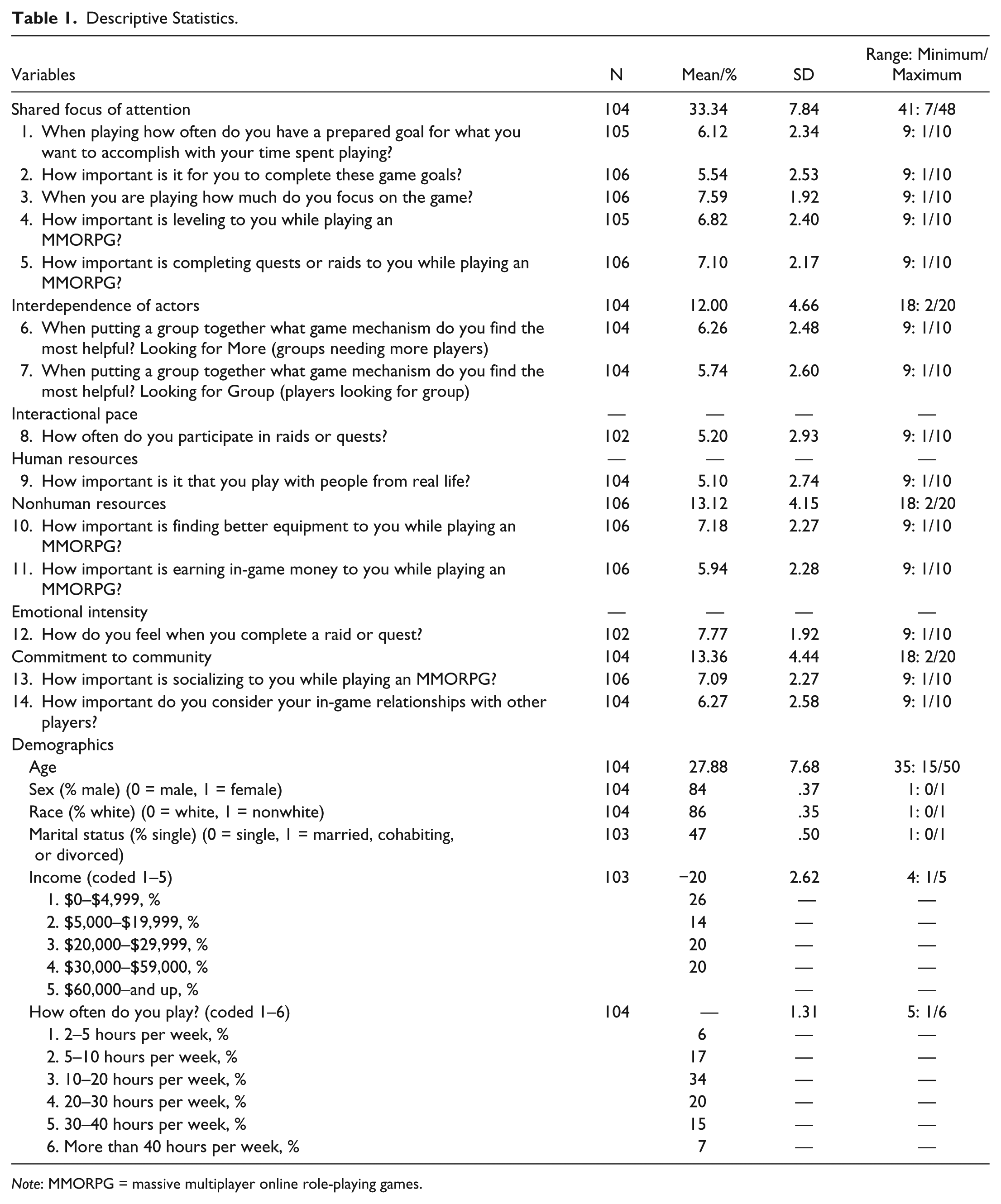
Note: MMORPG = massive multiplayer online role-playing games.
Dependent Variable: Commitment to Community
Commitment to community is the degree to which a member of a community indicates a strong connection to that community. The commitment to community scale (Cronbach’s α = .791) consists of two items. Item 13, “How important is socializing to you while playing an MMORPG?,” measures the importance of socializing while playing the game. Item 14, “How important do you consider your in-game relationships with other players?,” measures how important a player considers their relationships with other players inside the game. Commitment to community represents a player’s social interaction with and common ties to the other players in the game.
Independent Variables and Propositions: Shared Focus of Attention, Interactional Pace, Interdependence of Actors, Resources, and Emotional Intensity
Shared focus of attention is the degree of concentration that players put on playing the game and activities inside the game. The shared focus of attention scale (Cronbach’s α = .735) is made up of five items. We use Item 1, “When playing how often do you have a prepared goal of what you want to accomplish with your time spent playing?,” and Item 2, “How important is it for you to complete these game goals?,” to measure the frequency and importance of prepared goals for a player. Item 3, “When you are playing how much do you focus on the game?,” measures the intensity to which a player focuses on playing the game. We use Item 4, “How important is leveling to you while playing an MMORPG?,” and Item 5, “How important is completing quests or raids to you while playing an MMORPG?,” to measure the importance of leveling and completing quests and raids while playing the game. We expect shared focus of attention to increase commitment to community because the more players share in experiences and goals, the more they are going to have in common.
Interdependence of actors is the degree that players need each other to participate in raids or quests. The interdependence of actors scale (Cronbach’s α = .806) is made up of two items. Both items measure common MMORPG techniques for forming groups in the game. These techniques are equivalent to posting a bulletin at a local gym looking for a fourth for a doubles game of tennis. Item 6, “When putting a group together what game mechanism do you find the most helpful? Looking for More (groups needing players),” measures the importance of “looking for more (LFM)” messages in putting groups together for quests inside the game. Item 7, “When putting a group together what game mechanism do you find the most helpful? Looking for Group (players needing groups),” measures the importance of “looking for group (LFG)” messages in putting groups together for quests inside the game. Both measurements indicate the necessity of interdependence for questing and raiding. We expect interdependence of actors to increase commitment to community because of an increase in the importance of the other members of the community.
Interactional pace is the frequency of interaction and participation in game activities. Interactional pace is indicated by a single item. Item 8, “How often do you participate in raids or quests?,” measures the frequency of participation in raids and quests. We expect interactional pace to increase commitment to community because of the increasing frequency of ritual events.
Factor analysis showed that the items used to measure resources were loading strongly on two separate dimensions, human and nonhuman. Therefore, resources were divided into two separate measures. The first measure uses a single-item indicator of human resources. Item 9, “How important is it that you play with people from real life?,” measures the importance of playing with people with relationships outside the game. Human resources represent social networks that extend outside of the game but can be activated to form groups for participation in collective events (Bergstrom et al. 2017; Ferdig, Pytash, and Muschert 2017). We expect human resources to increase commitment to community because of preexisting and external social networks.
The second scale is the nonhuman resources scale (Cronbach’s α = .799), which is made up of two items. Item 10, “How important is finding better equipment to you while playing an MMORPG?,” measures the importance of finding better equipment for a player’s character inside the game. Item 11, “How important is earning in-game money to you while playing an MMORPG?,” measures the importance of earning in-game money for a player’s character (in-game money often takes the form of gold pieces and is used to purchase virtual items within the economy of the game). 2 Nonhuman resources represent the importance of acquiring in-game items that assist in carrying out events. We expect nonhuman resources to decrease commitment to community because they are a distraction and not directly linked with social interaction.
Emotional intensity is the degree of positive, affective feelings generated as a result of participation in a collective event, in this instance raids and quests. Emotional intensity is measured with a single item indicator. Item 12, “How do you feel when you complete a raid or quest?,” measures the degree of positive emotional response upon completion of a raid or quest. Emotional intensity represents the positive feelings because of participation in quests or raids. We expect positive emotional intensity to increase commitment to community because players that feel good about playing will also feel good about their community.
We collected demographic data, including: age, sex, race, marital status, income, and the amount of time spent playing MMORPGs each week (Table 1). Age was coded as a continuous variable. Sex (1 = female), race (1 = nonwhite), and marital status (1 = married, cohabiting, or divorced) were coded as dummy variables. Income and time spent playing were coded as ordinal variables. Each of these variables was entered into the multivariate models to assess whether commitment to community is associated with the factors discussed by SRT or is simply the product of respondent characteristics.
Results
We began our analysis with a bivariate analysis. Specifically, Table 2 reports the results from the Pearson’s correlations. There are several important findings in the table. First, there is a stark contrast between the human and nonhuman resources (r = .226, p < .01; r = −.194. p < .05, respectively). Thus, human resources have a positive relationship with commitment to community, and nonhuman resources have just the opposite effect. Second, it is obvious that the factors identified by SRT are not completely interrelated as there are few significant relationships between the variables. Third, all the independent variables except for shared focus of attention, sex, and race are significantly related to our dependent variable, commitment to community. Therefore, most of our proxies for the factors outlined by SRT as well as our demographic variables are suitable for inclusion in the multivariate equations, and we reduce our risk of model misspecification.
Pearson’s Correlation Coefficients and (N Cases) for Ritual Factors, Demographics, and Commitment to Community.

Note: Cases selected pairwise.
p < .05. **p < .01 (two-tailed).
Table 3 reports results from ordinary least squares regression models to examine shared focus of attention, interactional pace, interdependence of actors, human and nonhuman resources, emotional intensity, and respondent demographics on commitment to community. In Models 1 through 3, we regress a different subset of the independent variables on the dependent variable, commitment to community. Model 4 regresses all the independent variables against the dependent variable, and Model 5 regresses both the independent variables and demographic variables.
Standardized Regression Coefficients and (Standard Errors) of Ritual Events’ Impact on Commitment to Community in Massive Multiplayer Online Role-playing Games.

p < .10. *p < .05. **p < .01. ***p < .001.
Model 1 includes only the first three factors of SRT (shared focus of attention, interdependence of actors, and interactional pace). All three factors are significantly related to commitment to community. However, while interdependence of actors and interactional pace are positively related to commitment to community (β = .218, p < .05; β = .388,p < .001, respectively), shared focus of attention is negatively related to this variable (β = −.287, p < .01). In the second model containing human and nonhuman resources, we see a similar relationship to the bivariate analysis. Specifically, human resources are positively (β = .225, p < .05) and nonhuman resources negatively related (β = −.196, p < .05) to commitment to community. In the third model, we found that emotional intensity has a positive significant effect on our dependent variable (β = .383, p < .001).
For our fourth model, we examined all the factors pinpointed by SRT without the demographics. The positive association for interactional pace is reduced, as is the negative relationship with nonhuman resources; however, only interactional pace approaches significance (β = .160, p < .10). Our coefficient of determination suggests that we are explaining 40 percent of the variation in commitment to community with these variables (R2 = .411). Finally, in our fifth model, we included the respondent characteristics. Interestingly, interdependence of actors and nonhuman resources does not approach significance. Interactional pace has a more limited impact on commitment to community (β = .166, p < .10). However, shared focus of attention, human resources, and emotional intensity all reach significance (p < .05). Just as previously described, human resources positively (β = .273, p < .001) affect commitment to community. There is a suppression effect where one of the respondent characteristic variables enhances the effects of human resources. Shared focus of attention maintains a significant negative relationship with commitment to community (β = −.234, p < .05). Emotional intensity stays positive and significant (β = .304, p < .01). The model explains about half of the variation (R2 = .479). One surprising finding is that number of hours played per week has no effect on commitment to community.
Discussion
What role do quest and raid rituals play in commitment to MMORPG community? Our findings indicate that the type of resources that members of these communities focus on during a ritualized event will have an impact on how they perceive the importance of their commitment to their community. Players who focus on human resources required for a ritual event, for example, new or preexisting social networks, will be more likely to feel committed to their MMORPG community, while players who focus on nonhuman resources or material aspects of the game like collecting gold or equipment in the game are less likely to feel committed to their MMORPG community. Existing social networks and relationships that extend beyond the game are important for the solidarity of virtual communities (Bergstrom et al. 2017; Ferdig et al. 2017). The different impact that resources have on commitment to community reflect distinct types of community relationships.
Players who focus on human resources are representative of gemienschaft affective relationships, while players who focus on nonhuman resources are more representative of gesellschaft instrumental relationships (Tönnies [1887] 1957). This finding also mirrors explanations of community volunteerism (Pearce 1993; Wilson and Janoski 1995; Wilson and Musick 1997). Wilson and Janoski (1995) argue that voluntary participation can be divided between a community-oriented motivation and a self-oriented motivation. SRT’s extension divides resources into human and nonhuman components. Our findings suggest that within the explicit context of a VRSP, these foci are of key importance. For example, our findings indicate that in MMORPG communities, focusing on different resources creates different motivational incentives for ongoing participation in the community.
As indicated previously, players who rely on nonhuman resources in MMORPGS are more disconnected from socializing in their community and perceive the community relationships developed as less important. Additionally, nonhuman resources also operate on a secondary level of necessity for players focused on human resources. Absolute requirements in-game like money and equipment may recede into the background of a player’s experience. This may be explained as an issue of salience (Knottnerus 1997). The importance of these nonhuman resources may only become salient if they are not sufficient to meet the needs of the quest or raid or are scarce and valuable. This can also explain why we see commitment to community negatively related to shared focus of attention. Players that focus on leveling and quest completion may be more directly associated with the material gains rather than the social or emotional gains. Accordingly, this shared focus of attention on the rewards associated with questing represents an increased salience of nonhuman resources.
This reinforces the need to view MMORPG players as a diverse population with many motivations and reasons for playing (Ang and Zaphiris 2010; Williams, Yee, and Caplan 2008). MMORPGs are a retreat for users, and everyone comes to the game for various reasons. In this regard, three primary motivations have been identified: personal achievement, social interaction, and immersion in the game (Williams et al. 2008). Personal motivation is, however, only one side of this interaction. The social milieu, ritual events, community, and emotional intensity involved in that interaction can all play an important part in engaging and reengaging participants. Emotion is the glue of social cohesion (Lawler 2001). MMORPG communities are held together by emotion. Our research indicates that positive emotions generated because of questing and raiding VRSPs can lead to commitment to that community. Although some research has suggested that emotion is muted or inconsequential when transmitted (Collins 2004; Driskell and Lyon 2002), others have shown that online communities can provide emotional support and a place for the expression of emotion (Sheese, Brown, and Graziano 2004; Winefeild 2006). The management of emotions in certain social contexts, particularly work and home life, can cause distress and confusion about the self (Hochschild [1983] 2003). Support groups of all types exist online and provide a space that allows for emotional outlet. MMORPGs can serve as a “third place” that allows the strain of emotional work to be directed to other venues (Halvorson 2011; Oldenburg 1989; Soukup 2006; Steinkuehler and Williams 2006).
Our research demonstrates the relatively strong impact that emotional intensity and ritual resources relating to raids and quests have on commitment to community in MMORPGs. The challenge of adapting face-to-face interactional theory for an online context should not fetter its application. To develop a more sophisticated understanding of the social impact that MMORPGs have on participants and the wider social milieu, diverse sociological theories and perspectives should be adapted to the peculiarities of an online environment. The sociology of ritual and community can contribute to a better understanding of MMORPGs as a social phenomenon. Quantification of ritual theory is an important counterbalance to the large body of ethnographic qualitative work in SRT. Rather than identifying in detail the presence and character of ritual components, quantification allows us to compare the relative strength of ritual components and rank the importance of different RSPs and VRSPs. Community, ritual, emotion, and mediated social interaction are conceptual tools that can guide empirical research to present a complex and multidimensional view of MMORPG players, the virtual communities that may emerge among those players, and the ritualized practices and events they engage in. Ritual and community can offer an alternative explanation to both colloquial and academic explanations of social isolation and addiction.
Footnotes
Authors’ Note
An earlier version of this paper was presented at the Southern Sociological Society Annual meeting, April 4, 2009, New Orleans Louisiana.
1
There are many examples of this type of division. Usually the divide is a moral separation between factions, into a “good” side and an “evil” side. Games also typically let players choose from one or more different “races.” This is a rather different concept than sociologists are familiar with. In fact, species may be more accurate as these different “races” often include vastly different creatures, everything from elves and dwarves, to minotaurs and orcs; however, in fantasy games, this distinction is always referred to as race.
2
In-game economies have generated real-world value for many years. “Gold farmers,” as they are known, predominately operate out of cramped sweatshop-like apartments and play games to generate income.  discussed the real-world implications of this, in fact showing that virtual money can often have a better exchange rate than some real-world currency.