




Abstract
Most prior research on victimization and alcohol use among homeless youth is retrospective and thus does not allow researchers to determine the sequencing of these events. We address this gap using ecological momentary assessment via short message service surveying with homeless youth during 30 days. Multilevel binary logistic regression results revealed that experiencing physical or sexual victimization on a specific day was positively associated with youth’s drinking alcohol later that day. Because ecological momentary assessment via short message service allows for such specificity, we can link a specific victimization experience with a current drinking episode. Thus, the time ordering of daily events in the current study is a significant improvement over prior research. Understanding the timing between victimization and drinking alcohol is also important for intervention with this underserved population.
An estimated 2.5 million children in the United States experience homelessness on a yearly basis (National Center on Family Homelessness 2014). Many of these young people leave home each year to escape physical or sexual abuse (Bender et al. 2015) and parental drug abuse (Tyler and Melander 2015). Moreover, some youth run away multiple times (Tyler and Schmitz 2013), creating a revolving door effect whereby youth return home for a brief period before running away again. Homeless youth also experience numerous negative outcomes while on the street including physical assault (Tyler and Beal 2010) and sexual victimization (Tyler and Melander 2015). Alcohol use can be both a risk factor for leaving home and an outcome of being on the street (Heerde and Hemphill 2016). More than 75 percent of homeless youth have used alcohol (Walls and Bell 2011). Runaway and/or homeless youth have higher rates of substance use compared to their nonhomeless counterparts (Substance Abuse and Mental Health Services Administration 2004), with drug and alcohol use two to three times more prevalent among homeless compared to nonhomeless youth (Kipke, Montgomery, and MacKenzie 1993). Given the early trauma, such as child physical abuse, experienced by many of these youth in their families of origin (Bender et al. 2015) and their experiences of victimization since being on the street (Tyler and Melander 2015), some young people may use alcohol to cope with these traumatic events (Thompson 2005).
Although street victimization has been shown to be associated with substance use (Bender et al. 2015; Tyler, Gervais, and Davidson 2013), the cross-sectional and retrospective nature of prior studies does not allow researchers to examine the time ordering of these events (Heerde and Hemphill 2016). That is, does drinking lead to victimization, is drinking a response to being victimized, or do victimization and drinking occur simultaneously?
The current study addresses this literature gap by using ecological momentary assessment (EMA) via short message service (SMS) surveying with homeless youth during a 30-day period to examine whether experiencing physical or sexual victimization earlier in the day is associated with drinking alcohol later that day. EMA allows researchers to capture data “in the moment” about an individual’s current behavior in his or her natural environment (Shiffman, Stone, and Hufford 2008). EMA via SMS surveying verifies the timing of one behavior relative to another, allowing for temporal sequencing (Cohn et al. 2011), and minimizes recall biases (Kuntsche and Labhart 2013). Given the high mobility of homeless youth (Tyler and Whitbeck 2004), using SMS to collect daily data from this group is innovative and an improvement over prior retrospective studies of homeless youth. Moreover, being able to directly link victimization experiences with specific drinking episodes has broader implications for agencies servicing this population.
Literature
Substance Use and Street Victimization
Prior retrospective studies have found a prevalence rate of 68 percent for past 30-day alcohol usage among homeless youth (Wenzel et al. 2010). In addition, homeless youth experience elevated rates of street victimization. Tyler, Kort-Butler, and Swendener (2014) found that 39 percent of homeless youth had been sexually victimized since being on the street whereas 94 percent had been physically victimized at least one time. Moreover, research has found that substance use and victimization are inextricably linked (Bender et al. 2015; Heerde and Hemphill 2014; Tyler et al. 2013). Risk factors for homeless youth’s substance use include having substance-abusing parents (Ginzler et al. 2003; Tyler and Melander 2015), spending more time on the street (Tyler et al. 2013), and experiencing childhood abuse (Tyler and Melander 2015).
Reasons for using substances among homeless youth include alleviating painful emotions regarding early childhood abuse (Tyler and Schmitz 2013) and not having a permanent place to live (Bender et al. 2012; Thompson et al. 2009). Youth recognize, however, that being inebriated decreases awareness of potential danger and thus increases risk for victimization (Bender et al. 2012). Heerde and Hemphill (2016) note that though substance use and victimization are associated, the sequencing remains unclear as most studies are cross-sectional and/or retrospective.
Data and Methods
Data are from the Homeless Youth Texting Project, a pilot study designed to examine risk and protective factors for substance use and to field test EMA via SMS to ascertain its utility and feasibility with homeless youth. Findings for the feasibility study have been reported elsewhere (Tyler and Olson 2018). From August 2014 through October 2015, 150 homeless youth were interviewed in two Midwestern cities. Of the 150 respondents interviewed at baseline, 112 youth, or 75 percent, completed a follow-up interview. The university institutional review board approved this study.
Eligibility required youth to be between 16 and 22 years of age and homeless or runaway. Homeless youth, as inclusively defined by the 2015 reauthorization of the McKinney-Vento Homeless Assistance Act, includes those who lack permanent housing such as spending the previous night in a shelter, in a public place, on the street, with friends, in a transitional facility, or in another place not intended as a domicile (National Center for Homeless Education 2017). All participants in the current study were unaccompanied youth, meaning they were not experiencing homelessness with family members or caregivers. Runaway includes those younger than age 18 who spent the previous night away from home without parental permission (Ennett, Bailey, and Federman 1999). Participants were recruited through three local agencies that offer emergency shelter, food programs, transitional living services, and street outreach.
Four trained and experienced interviewers conducted the interviews. Interviewers approached youth at shelters, at food programs, and during street outreach. Informed consent was obtained from youth, who were told that the study had three parts and that if they agreed to participate, they would need to complete a baseline structured interview, the SMS portion, and a follow-up structured interview. The two interviews, which were conducted in a shelter interview room, local library, or outside (weather permitting) lasted 45 min and 15 min, respectively. Participants received a $20 and $10 gift card to a local store for completing the baseline and follow-up interview, respectively. Less than 3 percent of youth (n = 5) refused to participate or were ineligible.
Cell Phone Distribution
Upon completing the baseline interview, each participant was given a disposable cell phone and told he or she would receive 11 texts per day during the next 28 to 30 days and then would be recontacted in approximately 30 days for a follow-up interview. The block of texts came at 10:00 a.m., 4:00 p.m., and 9:30 p.m. Text questions were sent from an automated system, set up to send out text questions in the same order and at the same time each day. Responding to each text question required participants to enter a number(s). Typically, 3 to 4 days prior to the end of their texting period, youth were sent a text informing them how many texting days were left and to set up a follow-up interview. Those who responded to every text question (11 texts per day) were paid $50 cash (prorated at $0.14 per response), and those who responded to at least 85 percent of texts also received a bonus $10 gift card.
Measures
Text questions
From the text data, we use one question asked at 4:00 p.m.: “Today were you” beat up, robbed, threatened with weapon, touched sexually, sexually assaulted, or none of these. This question was divided into two independent variables: physical victimization (i.e., beat up, robbed, threatened with weapon; 1 = yes, 0 = no) and sexual victimization (touched sexually or sexually assaulted; 1 = yes, 0 = no). Next, we use one question asked at 9:30 p.m. for our dependent variable, alcohol use: “How many drinks tonight” (1 = any drinks, 0 = no drinks). Because of the high level of missing data on the victimization variable (approximately 22 percent), we also include a category for “missing victimization text.”
Survey questions
From the survey data (see the appendix), we include the following variables: Child sexual abuse (adapted from Whitbeck and Simons 1990) included seven items that asked youth, “Before you were 18 years old, how often has any adult or someone at least five years older than you asked you, for example, to do something sexual” (0 = never to 6 = more than 20 times). All items loaded on a single factor (α = .92). Due to skewness, the items were dichotomized (0 = never, 1 = at least once). These same items have been used in prior studies of homeless youth (Whitbeck and Simons 1990: α = .93; Tyler and Melander 2015: α = .88).
Child physical abuse was a summed scale of 16 items from the Conflict Tactics Scale (Straus et al. 1998). Youth were asked, for example, how frequently their caretaker kicked them hard (0 = never to 6 = more than 20 times). A mean scale was created (α = .93).
Parent drug problems (adapted from CAST-6; Hodgins et al. 1993) included three items that asked youth, for example, if they ever thought that their parents had a drug problem (0 = no, 1 = yes). A count variable was created where a higher score indicated more parental drug problems (α = .88).
Number of times run was a single item that asked youth for the total number of times that they had ever run away or left home.
Gender was coded 0 = male and 1 = female.
Sexual orientation was coded 0 = lesbian, gay, or bisexual (LGB) and 1 = straight or heterosexual.
Statistical Analysis
Each day of texting (i) is nested within each youth (j); thus, the data have a multilevel format. We predict
First, we examine the intraclass correlation coefficient (ICC) from the empty models with no covariates,
Results
Sample Characteristics
Demographics based on wave 1 survey data included 150 homeless youth ages 16 to 22 years (M = 19.4 years). One half (51 percent) were female, and 22 percent identified as LGB. Youth ran away from home between 1 and 35 times (M = 4.9 times). In the survey data, 42 percent of youth reported a parent with a drug problem, 41 percent of youth had been sexually abused, and 98 percent had been physically abused one or more times.
Base Model
Overall, the base model indicates significant homogeneity within youth in their drinking behavior. In the empty model predicting any drinking, ICC is .499 (random intercept SD = 1.809, χ2 = 145.75, p < .0001), indicating that 49.9 percent of the variance in drinking behavior across texting days is between youth. That is, about 50 percent of the variation is due to the youth and about 50 percent is due to day-specific factors. This model suggests that a multilevel framework is appropriate.
Multivariate Model
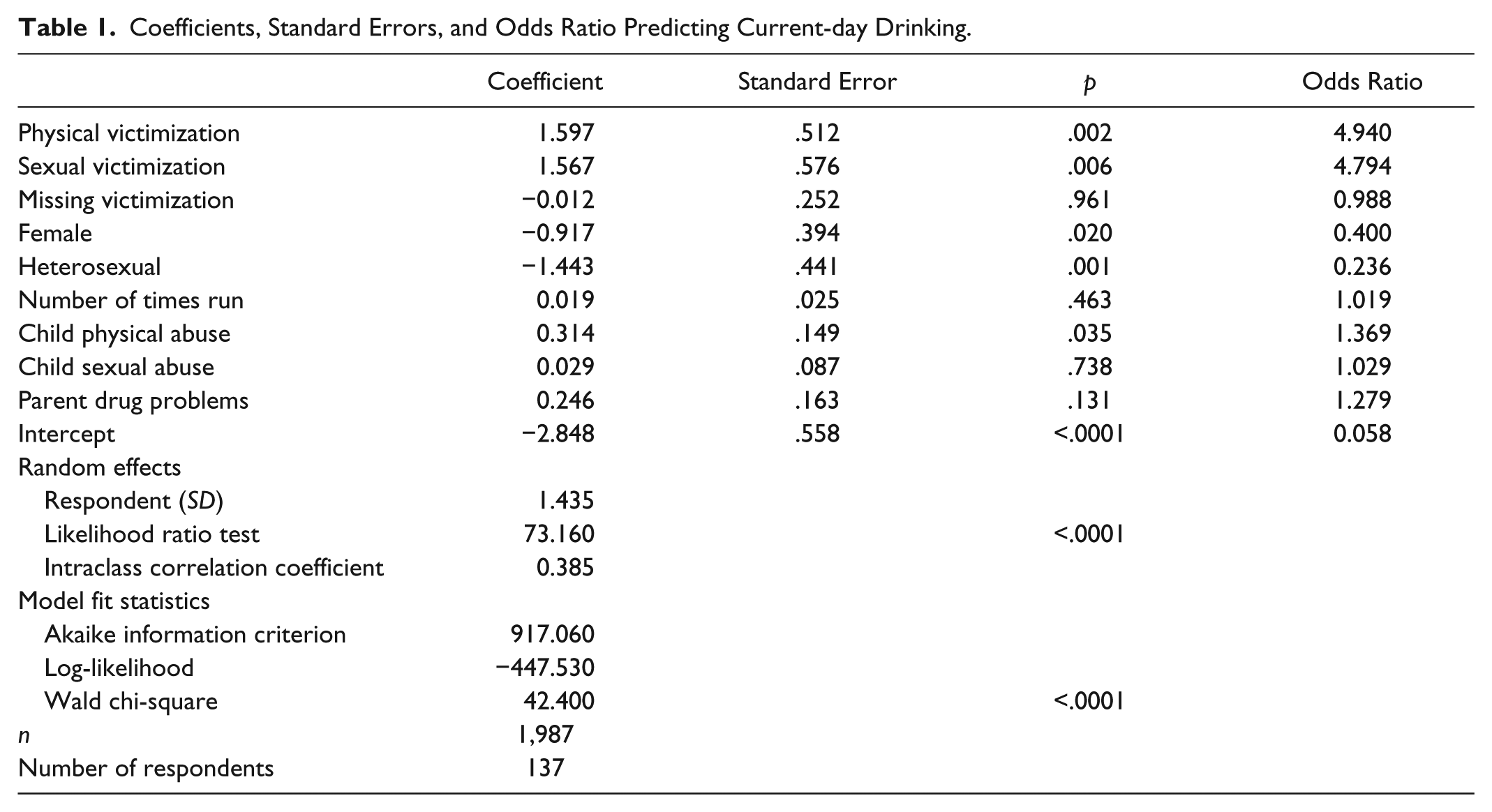
Table 1 shows the results of a multilevel binary logistic model for current day drinking. If youth were physically victimized earlier in the day, they have increased odds of drinking later that day by a factor of 4.94 (p < .01). If youth were sexually victimized earlier in the day, they have increased odds of drinking later that day by a factor of 4.79 (p < .01). Both females and heterosexual youth were less likely to report drinking by 60 percent (p < .05) and 76 percent (p < .01), respectively, than their male or LGB counterparts. In addition, youth who reported higher levels of child physical abuse were more likely to report drinking (odds ratio = 1.37, p < .05) than youth who reported lower levels of child physical abuse. The included covariates explain about 37 percent of the variation across respondents in drinking behavior.
Coefficients, Standard Errors, and Odds Ratio Predicting Current-day Drinking.
Discussion
This study examined whether having experienced physical or sexual victimization earlier in the day is linked with drinking alcohol later that day using EMA via SMS with homeless youth. Overall, we find that those who were sexually or physically victimized earlier in the day were more likely to report alcohol use later in the day. We also find individual effects for gender, sexual orientation, and child physical abuse.
Although prior research is unable to tease out the time ordering of substance use and victimization (Heerde and Hemphill 2014; Tyler et al. 2013), some studies have found a positive relationship between being victimized on the street and having an alcohol use disorder (Thompson et al. 2015). The current study results show that experiencing a physical or sexual victimization episode earlier in the day results in increased odds that homeless youth will drink later that day. This finding supports earlier retrospective studies that have suggested that using alcohol is a way to cope with both the stressors associated with street life (Kidd 2003) and prior traumatic experiences (Thompson 2005) including victimization.
EMA via SMS is a useful technique with homeless youth as we were able to capture data about their daily lives “as it occurred” (Shiffman et al. 2008) even though this is a highly mobile population (Tyler and Whitbeck 2004). Moreover, because EMA via SMS surveying verifies the timing of one behavior relative to another (Cohn et al. 2011), we could determine that a specific victimization episode occurred prior to youth’s substance use. Furthermore, because this technique minimizes recall biases (Kuntsche and Labhart 2013), we could gather daily data on unique, individual episodes of victimization, which allows for more specificity.
Limitations, Strengths, and Future Directions
The biggest limitation is missing texting data. Although we have some information from youth across 2,768 youth-days, we are missing drinking data on 25 percent of these days and victimization data on more than 20 percent of the texting days for which we have drinking data. These missing data do not follow a monotone pattern—youth might not answer questions at 4:00 p.m. but then answer the 9:30 p.m. set of questions. Reassuringly, youth who failed to answer the victimization question were not systematically more or less likely to drink alcohol later that day. Second, physical and sexual victimization on any given day were extremely rare in this sample during the 30 days of texting. Only about 2 percent of texting days contained reports of physical victimization and about 1 percent of texting days contained reports of sexual victimization. It is particularly notable, then, that these rare behaviors were associated with drinking behavior later that day. Third, because the drinking question was asked at 9:30 p.m., we missed drinking that may have occurred later that night. As such, the amount of drinking reported here may be an underestimate. Related to point 2 above, because we asked about victimization at 4:00 p.m., it is possible that we missed some victimization episodes that occurred after this time period and thus underestimate occurrences of victimization.
Despite these limitations, our study has many strengths. To the best of our knowledge, this study is the first to use EMA via SMS with homeless youth to gather daily data. Another strength is that we demonstrated that a specific victimization episode earlier in the day is a contributing factor to drinking alcohol later that day. Thus, our study is an improvement over prior research as it provides a more nuanced understanding of the relationship between sexual and physical victimization and drinking alcohol as the time ordering of these two events has been a limitation of prior studies (Heerde and Hemphill 2016). Finally, because youth readily reported victimization experiences, this technology has strong potential for intervention with this population in the areas of physical and mental health (Tyler and Schmitz 2017) and prosocial networks (Rice, Lee, and Taitt 2011).
Our findings also have implications for intervention. Because we have demonstrated that homeless youth are more likely to drink after a victimization episode, intervention immediately following a victimization may reduce the likelihood that youth will turn to alcohol to cope with the trauma (Bender et al. 2012). Relatedly, there are several potential avenues for future research. Because research generally does not detail which substance (e.g., alcohol, marijuana) homeless youth use to cope with a specific trauma, further research is warranted. In addition, though we examined the temporal order between victimization and alcohol use, we were not able to look at whether using alcohol or other drugs leads to victimization, which is another area for future research. Also, future studies may wish to examine whether youth tell anyone about the victimization. Being able to confide in a trusted individual about the experience may help begin the healing process. EMA via SMS with homeless youth holds enormous potential including learning more nuanced details about youth’s daily experiences and using SMS as an intervention tool with the goal of improving the lives of this underserved population.
Footnotes
Appendix
Funding
The author(s) disclosed receipt of the following financial support for the research, authorship, and/or publication of this article: This article is based on research supported by a grant from the National Institute on Drug Abuse (DA036806). Dr. Kimberly A. Tyler, PI.