




Abstract
The literature on civil resistance finds that nonviolent campaigns are more likely to succeed than violent insurgencies. A parallel literature on democratization poses mass mobilization as exogenous to political liberalization. Contributing to both literatures, we propose the category of unarmed collective violence to capture an empirically recurring form of unruly collective action used by civilians and then use a mixed methods research design to examine its impact on democratization. An event history analysis finds that riots are positively associated with political liberalization in 103 nondemocracies from 1990 to 2004. Attacks by civilians on police stations during the January 25 Egyptian Revolution illustrate one way in which unarmed collective violence can bring about a democratic breakthrough. A qualitative examination of all 80 democratic transitions held between 1980 and 2010 also reveals the salience of unarmed collective violence by civilian forces. These findings contribute to research on the dynamics of contentious democratization and suggest that remaining unarmed may be more consequential for a democracy campaign than adhering to nonviolence.
In recent years, a great deal of attention has been paid to the relationship between contentious politics and democratization. Writing against a transitology literature that portrays mass mobilization as exogenous to successful democratization (e.g., O’Donnell and Schmitter 1986), political sociologists and social movement scholars (Rueschemeyer, Stephens, and Stephens 1992; Tilly 2003a) have argued that popular pressure from below is a key factor in bringing about democratic breakthroughs and sustaining political liberalization. 1 A parallel literature on civil resistance claims that mass mobilization is more likely to result in democratization if protestors adopt nonviolent methods (Celestino and Gleditsch 2013; Chenoweth and Stephan 2012). While transitologists and civil resistance scholars insist that all collective violence is orthogonal to democratization, previous analysis has not adequately accounted for variation in its qualities. This lacuna is puzzling. Instances of unarmed collective violence by civilians—including rioting, hand-to-hand fighting with security forces, and the destruction of property—are common to episodes of mass uprising. This paper asks: What is the significance of such acts for the prospects of democratization?
We develop our analysis in four steps. After reviewing the extant literature on democratization and civil resistance, we propose the category of unarmed collective violence as an empirically recurring but heretofore understudied form of contentious collective action. We then turn to assessing its impact on democratization by quantitatively analyzing cross-national, time-series data on contentious events in 103 nondemocracies from 1990 to 2004. A competing risk analysis allows us to compare the effects of unarmed collective violence on the odds of subsequent liberalization and deliberalization. Our results suggest that riots and property destruction, two common categories of unarmed collective violence, are positively associated with political liberalization. We find no significant effect for riots on deliberalization. Thus, the claim that violence undermines democratization does not hold when we account for whether that violence is unarmed. We are also interested in specifying the underlying mechanisms by which unarmed collective violence can impact processes of democratization. A focused examination of attacks on police stations during the Egyptian Revolution of 2011 illustrates one way in which unarmed collective violence can positively contribute to political liberalization. As the Egyptian case reveals, unarmed collective violence by local residents protected peaceful protestors by disrupting the Mubarak regime’s repressive apparatus while also diverting repressive forces away from frontline protest policing duties. As a further empirical check, we then undertake a qualitative examination of incidents of unarmed collective violence during all 82 democratic transitions held between 1980 and 2010. Our analysis reveals the salience of riots, hand-to-hand fighting, and property destruction to the transitional process, suggesting that instances of unarmed collective violence are not sufficient to derail democratization.
These findings lend support to the contentious democratization literature, which finds that low-level disruption arising from unauthorized and unruly collective action can enhance the prospects for democratization (Kadivar and Caren 2016; Rueschemeyer et al. 1992; Wood 2000). That unarmed collective violence can be productive of democratization holds out a key implication for the civil resistance literature: Some portion of the positive effect of nonviolent tactics on democratization campaigns may in fact be attributable to episodes of unarmed collective violence. That this has hitherto gone unacknowledged is in part an artifact of the civil resistance literature operationalizing violence to mean armed insurgency. 2
Armed Insurgency, Nonviolence, and Democratization
Transitologists stress the role of political elites during episodes of democratic transition (O’Donnell and Schmitter 1986; Przeworski 1991). Viewed from this perspective, democratization is a game played between four main actors: hardliners and softliners in regimes and moderates and radicals in the political opposition. For democratic transitions to succeed, it is argued, members of the moderate opposition must make a pact with regime softliners: Regime hardliners and political radicals are portrayed as potential spoilers, who must be marginalized or bought off. 3 Such studies argue that popular mobilization in any mode increases the perceived costs of the transition for hardliners, incentivizing them to scotch any attempt to diminish their powers and prerogatives. Needless to say, episodes of collective violence are portrayed as particularly ruinous of any attempt to transition away from authoritarian rule. As Samuel Huntington (1993) insisted in his classic study of the third wave of democratization, collective violence cannot be productive of democratization because it enhances the position of a regime’s coercive apparatus. Reflecting on the occurrence of violence during third wave democratization, Huntington surmised that: “Governments created by moderation and compromise [were] ruled by moderation and compromise. Governments produced by violence [were] ruled by violence” (p. 207).
While the transitology literature is skeptical of popular pressure from below in any form, more recent scholarship on nonviolence and civil resistance makes a distinction between the impact of violent and nonviolent action on democratization campaigns. Drawing on a data set of violent and nonviolent secessionist, anti-occupation, and anti-regime campaigns in the twentieth century (NAVCO), Erica Chenoweth and Marie Stephan (2012) find that nonviolent campaigns are more likely to succeed than campaigns employing violent insurgency. According to that study, nonviolent campaigns have lower moral, informational, and material costs for participation and thus are more likely to mobilize a greater number of participants and elicit greater public sympathy. In consequence, it is argued, nonviolent collective action in the name of democracy is more likely to encourage regime defection, increase the cost of repression, and induce international sanctions against the regime. This is contrasted with the dynamics of violent insurgency, which exact a high cost on any potential recruit, serve to justify repression, alienate international support, and reduce the incentives for regime defection. In a follow-up multivariate analysis, Celestino and Gleditsch (2013) find a significant positive relationship between nonviolent campaigns and subsequent democratization, while violence has no discernible effect. A subsequent cross-national analysis does not find significant evidence that violence occurring coeval to civil resistance either positively or negatively enhances the prospects of a nonviolent campaign succeeding, and a qualitative analysis points to mixed results for selected cases (Chenoweth and Schock 2015).
Complicating these conclusions is the definition of violence. In their qualitative analysis, Chenoweth and Stephan (2012:3) adopt a very broad definition of violence, which includes “bombings, shootings, kidnappings, physical sabotage such as destruction of infrastructure, and other types of physical harm of people and property.” To take one example: In their case study of the First Palestinian Intifada, Chenoweth and Stephan identify acts of stone throwing by Palestinian youths as collective violence—tactics that were, the authors argue, deleterious to the Palestinian struggle for national liberation. 4 However, when operationalizing violence versus nonviolence in their quantitative analysis, violence is defined more narrowly as armed insurgency. This is not a coincidence. The coding of violence used in NAVCO derives primarily from the Correlates of War data set (Chenoweth and Stephan 2012), which requires that all combatants be armed and for there to be at least one thousand battle deaths during the course of a campaign (Sarkees and Wayman 2010). This definition excises incidents of unarmed collective violence, which are otherwise coded as episodes of nonviolent protest.
Unarmed Collective Violence
We argue in this paper that unarmed collective violence by civilians constitutes an empirically recurring form of contentious collective action that is distinct from both armed insurgency and nonviolent protest. Following Charles Tilly (2003b), we propose defining unarmed collective violence as episodes of social interaction that immediately inflict physical damage on persons and/or objects (“damage” includes forcible seizure of persons or objects over restraint or resistance) without the use of firearms or explosives, involve at least two unarmed civilian perpetrators of damage, and result at least in part from coordination among unarmed civilians who perform the damaging acts.
Acts of unarmed collective violence by civilians, we posit, are not only conceptually distinct from violent acts undertaken by armed insurgents and instances of nonviolent protest, but they may also have a positive influence in undermining authoritarian regimes and thus set the stage for democratization. This is consistent with classic comparative historical studies on the effects of riots and democratic revolutions. As Piven and Cloward (1979) argue in their study, it is only through the adoption of disruptive tactics that the politically and economically disenfranchised gain concessions from societal elites. Empirical research has found that urban riots play an important role in the expansion of federal welfare programs (Isaac and Kelly 1981; see also Betz 1974). Similarly, scholarship operating in the mode of comparative historical sociology finds that violence is a key motor for democratization. As Barrington Moore (1966:506) argues in his seminal study of democracy formation in Britain, France, and the United States: “In the Western democratic countries revolutionary violence (and other forms as well) were part of the whole historical process that made possible subsequent peaceful change.” So too, Charles Tilly (2003a) argues that episodes of collective violence and transgressive contention shattered trust networks and categorical inequalities in early modern Europe, paving the way of democratization.
In her comparative study of third wave democratization, Nancy Bermeo (1997) also found that tactics such as rioting, destruction of property, and violently occupying factories did not abort democratic transitions. In fact, when moderates had a strong presence in the opposition, violent tactics tended to reinforce the negotiating position of democratic forces and compelled regime incumbents to make concessions. Similarly, Elisabeth Wood (2000), in her paired comparison of democratization in El Salvador and South Africa, found that the use of violent and unruly tactics threatened the interests of economic elites, thus making a peaceful democratic transition more attractive for regime hardliners. Coming from a different analytical tradition, Acemoglu and Robinson (2005) find that most democratic transitions played out against a backdrop of rambunctious street politics and the threat of violent revolutionary takeover. Likewise, Bueno De Mesquita and Smith (2010) argue that under certain conditions, authoritarian leaders may respond to revolutionary threats such as antigovernment demonstrations, strikes, and also riots by introducing political liberalization. Finally, Aidt and Leon (2016) show that drought-induced riots in Sub-Saharan Africa make democratization more likely.
Given the frequency of their occurrence, we hypothesize that episodes of unarmed collective violence, in contrast to claims by transitologists and scholars of nonviolence, do not derail processes of democratic transition and that their disruptive qualities may even enhance the prospects for democratization. This hypothesis brings with it three observed implications. First, civilians rather than members of armed insurgent groups are more likely to engage in acts of unarmed collective violence. Second, episodes of unarmed collective violence are often defensive measures against police repression of civilian-led, street-level mobilization. Third, unarmed collective violence does not credibly threaten a regime’s monopoly over the apparatus of force. In these encounters, civilian demonstrators rely on rocks, Molotov cocktails, sticks, and other improvised weapons. 5 For these reasons, we expect that the effects of unarmed collective violence vary significantly from those of armed insurgency (see also Case forthcoming). Here we adduce three possible effects: First, unarmed collective violence disrupts civic order and so raises the costs of ruling for an incumbent regime. Second, images of unarmed civilians battling with the forces of order can galvanize others to protest, particularly in the wake of repression. Finally, episodes of unarmed collective violence can exhaust the repressive capacity of a regime and divert its coercive agents away from frontline protest policing duties, thus creating opportunities for protest elsewhere. We now explore these hypotheses as they relate to the dynamics of political liberalization and democratic transitions.
Mixed Methods Research Design
In what follows, we focus on the relationship between unarmed collective violence and democratization, which we define as progress toward more representation and political rights that guarantee the peaceful transfer of executive power through elections. By this definition, a polity can be democratizing without meeting the minimums of an electoral democracy; that achievement is marked by the onset of a democratic transition. This follows the literature on hybrid regimes and democratization, which studies improvements in political practice that fall short of an electoral democratic regime (e.g., Aidt and Leon 2016; Howard and Roessler 2006).
In the first section, we present the results of a regression analysis accounting for the effects of different unarmed protest tactics on political liberalization and deliberalization. This allows us to detect a general association between different forms of unarmed protest and political liberalization across time and space. To more properly understand the causal effects of unarmed violence on democratization, we complement the quantitative analysis with a detailed case study of unarmed collective violence in Egypt during the 18 days of the January 25 Revolution to identify potential mechanisms connecting unarmed collective violence with a democratic breakthrough. We then offer a qualitative analysis of episodes of unarmed collective violence during democratic transitions away from authoritarian rule. Taking the broadest possible universe of cases, we focus on all “third wave” democratic transitions that occurred between 1980 and 2010.
Unarmed Collective Violence and Political Liberalization
To investigate the general effect of unarmed collective violence on political liberalization, the most superficial form of democratization, we draw on a daily count of protest events reported in the World Handbook of Political Indicators IV (WHIV; Jenkins et al. 2012). WHIV is a refined version of contentious events from King and Lowe’s (2003) “10 Million Dyadic Events,” which are computer-coded events taken from the Reuters newsfeed. This data set has been used by social scientists to study various phenomena, such as the influence of human rights INGOs (Murdie and Davis 2012), neo-liberal policy reform (Zelner, Henisz, and Holburn 2009), and anti-government protest in democracies (Su 2015). WHIV is an improvement on the original data in several ways. Most importantly, the number of events has been reduced by around 14 percent, after events previously coded as contentious were identified to be noncontentious. The WHIV data have been checked internally against a basecode and externally against other event data sets. 6 An additional advantage of the WHIV data is the ability to temporally locate events in the protest month and so take into account lagged effects with more precision than annual data such as NAVCO. The WHIV covers 1990 to 2004, and so we confine attention to this period.
Kadivar and Caren (2016) first used the WHIV data to test for the effect of protest activities on political liberalization. Their analysis finds that contentious collective action, broadly defined, increases the chance of liberalization in a given month (measured as a 1 point change in a country’s Polity IV score) and has no effect on the odds of deliberalization. That study, however, does not account for variegation in the qualities of contentious politics. In this paper, we expand on that analysis by accounting for the effects of different protest tactics on a more substantive operationalization of de/liberalization. The WHIV data include six categories of protest: protest obstruction, protest procession, protest altruism, protest demonstration, protest defacement, and riots. 7 While these categories are not based on theoretical constructs, protest defamation and riots are examples of unarmed collective violence, while protest obstruction, protest procession, and protest altruism are nonviolent forms of protest. Protest demonstration was the residual coding category for unarmed events that lacked sufficient information to be assigned to a more specific protest type—and so contains instances of nonviolent contention and unarmed collective violence (Jenkins et al. 2016). Of note, two previous studies have explored the impact of different forms of protest on democratization. Teorell (2010) finds that riots have no effect on democratization, while more peaceful protests are positively associated with the onset of democratization. Ulfelder (2005) finds that riots are negatively associated with the breakdown of military dictatorships, while incidents of peaceful protest increase the likelihood of regime failure in military and one-party regimes. Both of these studies rely on data gathered from the New York Times and take the national country year as their unit of analysis with protest variables lagged by one year. WHIV offers two advantages in this regard. First, monthly interval data allow us to account for protest events leading to a liberalization event within the same year. Second, the Reuters newsfeed provides far greater coverage of disparately located world events than a print newspaper.
The dependent variable is time to liberalization and deliberalization. We operationalize liberalization and deliberalization as a positive or negative change of 3 points or larger in a country’s Polity IV score, respectively. This follows the approach used by Cederman, Hug, and Krebs (2010) and is used to measure a substantive change in a country’s democracy score. As a robustness check, we rerun all models with changes of 2 points or larger and also a more basic measure of 1 point positive and negative change. The unit of analysis is the national country month. The polity score is an aggregate measure between −10 and 10, which is derived from five more specific indexes that assess the competitiveness of executive recruitment, openness of executive recruitment, constraints on the chief executive, regulation of political participation, and competitiveness of political participation. Polity classifies regimes with a score between −10 and −6 as closed autocracies; regimes with a score between −5 and −1 are designated as open autocracies; regimes with a score between 1 and 5 are closed democracies; and regimes with a score between 6 and 10 are identified as open democracies. In our analysis, we include closed and open autocracies and closed democracies, that is, all states with a polity score of less than 6, since Polity IV takes this as the threshold of transiting to a democratic regime. By this measure, there are 88 instances of liberalization and 20 instances of deliberalization in our universe of cases. Confining attention to nondemocracies inevitably captures fewer instances of deliberalization. Increasing the threshold of democratic transition to 8 leads to only a modest increase in incidents of deliberalization (27 cases in total). As a further robustness test, we rerun all models with this higher threshold and summarize the results in the following. A series of control variables are introduced to account for various rival explanations. The source and theoretically relevant expectation for each variable is given in Table 1.
Control Variables.

A simple comparison lends support for an association between unarmed collective violence and political liberalization. Across 103 nondemocracies, there were on average more riots in the 11 months before a liberalizing event than a month without a liberalizing event. We see a similar pattern for other protest forms, with the exception of protest altruism (see Figure 1).

Monthly average protest in 11 months prior to liberalization and deliberalization.
To account for rival explanations and possible confounding factors, we use Cox proportional hazards models to more properly evaluate the impact of different forms of protest on political liberalization (Cox 1972; Cox and Oakes 1984). As noted previously, the unit of analysis is the country month, beginning with a country’s last instance of liberalization or deliberalization and ending with either a country exiting the universe of cases due to a democratic transition or censoring at the end of the study period in December 2004. Ties—countries that experienced a liberalization or deliberalization after the same number of months—are handled using the Breslow method. The survival of nondemocratic regimes rates is modeled as a function of key independent variable(s) and a vector of potentially confounding covariates. Robust standard errors account for the clustering of multiple democratic regimes in a single country while also increasing statistical stringency. Regional effects are fixed in all models. 8 Because a given political regime is at risk of both liberalizing and deliberalizing, we use a competing risk model (Fine and Gray 1999). Here, we run the model with liberalization (positive changes of 3 points and greater) as the failure and deliberalization and smaller positive changes (1 or 2) as the competing risk, and then vice versa. This treatment allows us to estimate the effects of different forms of unarmed protest on liberalization and liberalization while the other outcome is also a potential risk (Table 2 presents the summary statistics for the independent variables).
Summary Statistics.
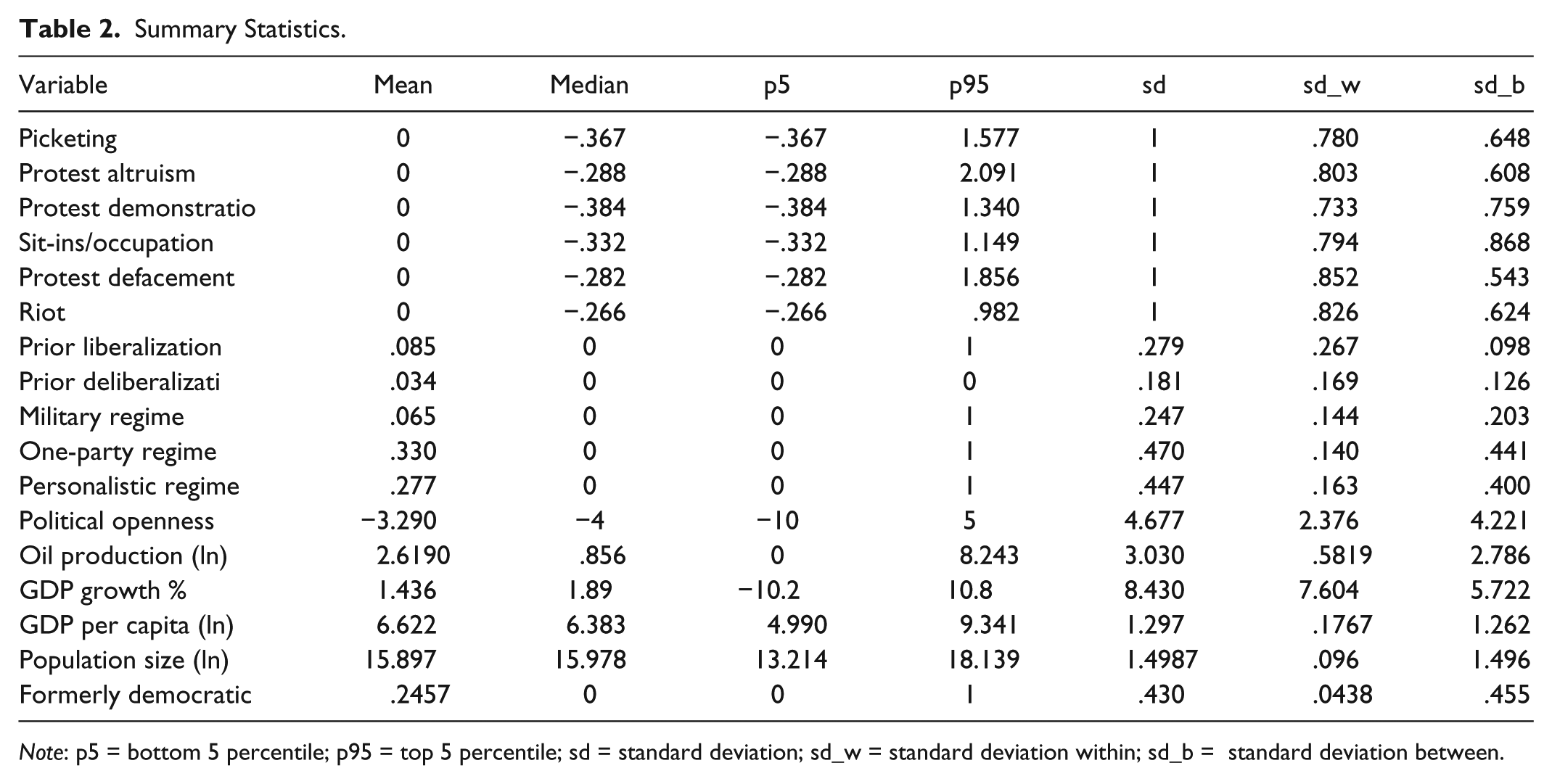
Note: p5 = bottom 5 percentile; p95 = top 5 percentile; sd = standard deviation; sd_w = standard deviation within; sd_b = standard deviation between.
Table 3 presents the results of the duration analysis with liberalization as the main outcome and deliberalization as the competing risk. Model 1 is the baseline model with the primary control variables. Each subsequent model includes an independent variable to account for different forms of unarmed protest. These indicators are counts of events, which are standardized by subtracting the mean of each variable and dividing by its standard deviation. We enter each tactic separately as several are highly correlated (r > .60) and to reflect the fact that movements use different tactics at different stages of a campaign. 9 Beginning with measures of nonviolent protest, the coefficients for protest demonstration and picketing at time t – 1 are statistically significant and positively associated with political liberalization at time t, while the coefficients for sit-ins and protest altruism are not statistically significant. Our two measures for unarmed collective violence are positively associated with political liberalization: The coefficients for riots and protest defacement are statistically significant and associated with an increase in the odds of political liberalization at time t. Taken together, these results suggest that net of all other factors, episodes of unarmed collective violence protest enhance the prospects for democratization.
Competing Risk Survival Analysis for Protest and Liberalization.

Note: Exponentiated coefficients. Standard errors in parentheses.
p < .05. **p < .01. ***p < .001.
Turning to our control variables, the level of political openness has a negative effect on the odds of liberalization, indicating that regimes that have already introduced some measures of liberalization are less likely to experience further liberalization.
The results in Table 3 are provocative. We have found a positive association between different kinds of unarmed collective violence and political liberalization. One objection may be that these forms of contentious events might induce mixed effects on democratization. Indeed, recent studies of political liberalization and deliberalization in authoritarian regimes argue that those factors that push countries toward liberalization can also pull them toward deliberalization (Pop-Eleches and Robertson 2015). 10 This is addressed in Table 4, which presents the results of a duration analysis for the time to experience a deliberalization outcome. Model 1 is the baseline model with the main control variables. 11 Similar to Table 3, the indicator for political openness is statistically significant and shows a positive association with the chance of deliberalization, suggesting that regimes with more open political processes are more likely to see retrenchment and backsliding. The coefficient for military regimes is statistically significant, but the coefficient is close to zero. Models 2 to 7 introduce our protest variables, none of which approach statistical significance. In other words, there is no evidence to conclude that episodes of either unarmed collective violence or nonviolent protest at time t – 1 leads to political deliberalization at time t.
Competing Risk Survival Analysis for Protest and Deiberalization.

Note: Exponentiated coefficients. Standard errors in parentheses.
p < .05. **p < .01. ***p < .001.
A digression on robustness is germane. A well-known shortcoming of the Polity IV data set is that it does not assign a score to countries undergoing a transition or during an interregnum. A second problem relates to the coding of the Polity score itself: two subcomponents of the Polity rating—PARCOMP (competitiveness of participation) and PARREG (regulation of political participation)—measure the level of conflict within a polity. This may lead to an endogeneity problem in which our protest variables are correlated with our dependent variable. We can address both issues by dropping all cases undergoing transitions and interregnums and strip the potentially correlated subcomponents from our polity scores. We can also operationalize de/liberalization as changes of 1 or 2 points or greater in a country’s Polity IV score instead of 3 points and introduce additional controls for a regime’s repressive capacity (military personnel and expenditure per capita) and the age of an authoritarian regime. Further, we can also expand the sample size to include countries with polity scores of less than 8 to see if our results are sensitive to changes in criteria of inclusion into our sample. We also estimated simple logit and multinomial logit regression instead of a Cox model to ensure that our results are not sensitive to assumptions made in the Cox model regarding duration. Rerunning the analysis with those alternative specifications, our results remain substantively unchanged. 12
Another potential limitation of our analysis is the issue of endogeneity in general. It is possible that an omitted variable is responsible for both the incidence of rioting and political liberalization. Note here that our control variables account for a number of plausible alternative explanations for political liberalization, such as a country’s level of economic development, economic growth, the level of openness in the polity, and oil production. Still, we are cognizant that an instrumental variable would be desirable to completely rule out omitted variable bias. This is an important future challenge for the nascent literature on cross-national studies of contentious politics, which has thus far failed to identify an appropriate instrument to study the phenomenon. We proceed here on the basis that the impact of unarmed collective violence on democratization is an important topic for political sociology and political science and welcome a revisiting of our results if and when an instrument or another effective strategy to address the issue of endogeneity is identified. To buttress our quantitative findings, we now go on to explore a qualitative case study of anti-police violence during the January 25 Revolution in an attempt to identify potential mechanisms linking unarmed collective violence with a case of political liberalization.
Unarmed Collective Violence in Egypt
In this section, we spotlight the case of Egypt during the 18 days of the January 25 Revolution in an attempt to illuminate the disruptive effects of unarmed violence during a recent liberalization campaign. Here, the Egyptian case deepens our understanding of the quantitative findings and the qualitative comparison (in the following section) by illustrating one ideal-typical pathway through which unarmed collective violence can enhance other kinds of nonviolent mobilization and thus bring about a transition away from authoritarian rule. A close examination of the Egyptian case reveals that episodes of unarmed violence by civilians can protect peaceful protestors by diverting a state’s repressive forces away from frontline protest policing duties while disrupting the coercive capacity of an authoritarian regime and so help bring about political liberalization. The year after the January 25 Revolution saw the lifting of the emergency law, ousting of a dictator of 30 years, decline in the repression of protest, emergence of an energetic and independent media space, and holding of five competitive national elections (including the first free parliamentary and presidential elections since the founding of the modern Egyptian Republic). We understand these steps as unambiguous indicators of a tentative liberalization process, which was aborted in July 2013 by a military coup that quickly reversed any democratic gains made in the post-Mubarak transition.
Egypt’s democratic breakthrough began on January 25, 2011, when several thousand protestors evaded police forces and staged a brief protest in Midan al-Tahrir, a public square in downtown Cairo (El-Ghobashy 2011; Gunning and Baron 2014). This act of defiance sparked 18 days of unruly protests in public squares and main roads across the country calling for the downfall of Husni Mubarak. After Mubarak stepped down on February 11, scholars working in the civil resistance tradition were quick to hold up the Egyptian case as exemplary of the logics of nonviolent collective action in bringing about a democratic breakthrough (e.g., Lawson 2015; Nepstad 2013; Ritter 2015; Zunes 2011). However, this designation has proven to be premature. Initial scholarly accounts of the protests, following international news coverage, overwhelmingly focused on the occupation of Midan al-Tahrir, where a cross-section of Egyptian society employed a variety of performances to communicate their commitment to “silmiyya” (peaceful) protest. 13 However, occurring coeval to these heartwarming scenes of “people power” was a wave of unarmed collective violence that targeted the Egyptian Interior Ministry’s security forces and in particular, district police stations and state security offices (see El-Ghobashy 2011; Ismail 2013).
In a recent empirical study, Ketchley (2017) found that between a quarter to a third of the country’s police stations were burned down, with most attacks occurring in urban districts in Greater Cairo and Alexandria during the critical early days of the mobilization. Episodes of anti-police violence typically involved local residents using improvised weapons such as Molotov cocktails and concluded with the burning and looting of a police station (see Ismail 2013). Attacks were most likely in the home districts of slain protestors, suggesting that state repression activated local kinship networks (Ketchley 2017). This conformed to an established pattern of state repression and popular retaliation in Egypt in which local residents exact revenge on police forces in response to state violence (for that history, see El-Ghobashy 2011; Ismail 2006, 2013).
Crucially, these acts of unarmed collective violence were pivotal to undermining the ability of Mubarak’s national security state to repress peaceful protestors. As leaked police radio transcripts from January 28 vividly capture, police forces on the ground, faced with roving columns of protestors and crowds of local residents attacking their bases of operation, were ordered to withdraw from the streets and regroup at police stations, leaving anti-Mubarak protestors free to mobilize. 14 Police absence from streets let protestors to set occupations in public squares and streets. In the days following January 28, senior Egyptian police and Interior Ministry officials reported that officers in urban areas were refusing to turn up for duty for fear of further attacks, including in districts where the police station remained intact. 15 The damage to police morale was so great that a politician described Egyptian police as “a broken army. More or less like the Egyptian army after the defeat of 1967” (Ashour 2012:9). State security offices, police checkpoints, police vehicles, courts, offices belonging to Mubarak’s ruling party, and prisons were also attacked and set on fire during this period. Still, in governorates where the police were not attacked, Interior Ministry–controlled security forces remained on the streets and continued to repress protests in the days after January 28, provoking further cycles of repression and retaliation. As a result of these episodes of anti-police violence, the number of protestor deaths and the proportion of protest events that were repressed fell dramatically while the number of protestors taking to the streets increased over successive Fridays, no doubt emboldened by the bottom-up defeat that local residents had inflicted on the Interior Ministry (see Ketchley 2017).
While attacks on police stations during the January 25 Revolution received very little coverage in international news media, one episode of unarmed collective violence did capture the world’s attention. On February 2, 2011, pro-Mubarak thugs and plainclothes security agents launched an assault on the anti-Mubarak protest occupation, leading to bitter scenes of hand-to-hand fighting. In what was the last serious attempt by the Mubarak regime to oust the protestors, anti-regime protestors and pro-Mubarak forces exchanged stones and Molotov cocktails in a protracted street battle that lasted into the following day (Fathi 2012). While the scale of this incident was smaller than attacks on police station in terms of protestor deaths, it was nonetheless profoundly significant for the course of the uprising. As the focal point of the mobilization and a site of great symbolic significance (Said 2015), losing Tahrir would have considerably undermined the morale and the momentum of the campaign to oust Mubarak.
What lessons can be drawn from the Egyptian case? First, during a mass participation democratization campaign, episodes of unarmed violence can easily fall beneath the threshold of scholarly visibility, leading civil resistance scholars to overstate the singular efficacy of nonviolent collective action. As our comparative analysis of unarmed collective violence during recent democratic transitions suggests in the following, such underreporting is not isolated to the Egyptian case. Second, unarmed collective violence can enable, facilitate, and impel other kinds of street-level mobilization. With the Interior Ministry in full retreat, the Mubarak regime was forced to call on local bosses and thugs to harass civilian protestors. This ultimately spared those protesting in Tahrir from greater repression and provoked further outrage and resentment against the regime. The Egyptian military, faced with a growing number of unruly protests, the collapse of law and order, and fraternization between army officers and protestors (Ketchley 2014), abandoned Mubarak, triggering his resignation on February 11, 2011. This paved the way for a parlous and highly flawed democratic transition that nevertheless saw five energetic and competitive national elections and unfolded under the direction of a military-led transitional government. The post-Mubarak transition failed two years later after a military coup ousted Islamist president Muhammad Mursi.
Unarmed Collective Violence in Democratic Transitions
We now turn our attention to the impact of unarmed collective violence on democratic transitions in an attempt to establish how common unarmed violence has been in other cases. Transitions away from authoritarian rule constitute the most substantive kind of political liberalization as a country passes the threshold for a minimal democratic regime. Focusing on democratic transitions also allows for a systematic, qualitative investigation of an important subset of political liberalization. Here, we extend the period of analysis from 1980 to 2010 and so cover all cases of democratic transition from the third wave of democratization.
Our measure of democratic transition is derived from a country’s Polity IV score, which designates a country as undergoing democratic transition when its score exceeds 6. Scholars of democratization often use this measure in studies of democratic transitions (Celestino and Gleditsch 2013; Haggard and Kaufman 2012). Following this measure, 82 democratic transitions occurred between 1980 and 2010. For each transition, we examined secondary sources to identify episodes of popular mobilization. We began by consulting Haggard, Kaufman, and Teo’s (2012) qualitative data set, which lists all Polity IV transitions between 1980 and 2000 and identifies cases involving popular mobilization related to distributive conflict. We then coded the secondary literature on transitions that occurred between 2000 and 2010. This way, we were able to narrow our cases to democratic transitions that resulted from contentious collective action. Next, we searched through protest news in LexisNexis and identified any reports of collective violence in each transition. Scrutinizing the original news reporting allows us to address one of the limitations of the data used in the regression analysis. For the WHIV data, we do not have access to the text of the news sources—and so for this section, we read the whole text of the news story, not just the title or the first line, to identify acts of violence. Note that we do not count the mere occurrence of violence during transition period as evidence for violent mobilization leading to transition. For example, there were food riots during Brazil’s democratization period, but these riots were incidental to the mobilization against the country’s military dictatorship. Thus, we code Brazil as an instance of unarmed mobilization without significant elements of collective violence. We only include acts of unarmed collective violence if these acts occur as part of the mobilization of the pro-democracy movement against the authoritarian regime.
It should also be noted the purpose of this part of the analyses is descriptive. We do not make a causal claim about whether unarmed collective violence independently influenced democratic transition in all of the cases that it occurred. Instead, we investigate whether acts of unarmed violence occurred only on the margins of anti-authoritarian movements or were an integral part of the mobilization that demanded end of authoritarian rule and led to democratic transition. Note that these instances of unarmed collective violence featured as elements in broader mobilizations against autocracy.
Of the 82 transitions that occurred between 1980 and 2010, 27 did not involve episodes of contentious collective action, while 51 saw significant instances of popular mobilization. Of these, 8 involved episodes of armed insurgency, 38 had unarmed campaigns, and 5 transitions involved both. Among 43 transitions that saw unarmed contention, 30 (37 percent of all transitions and 57 percent of all contentious transitions) involved instances of unarmed collective violence, while only 14 (17 percent of all transitions and 25 percent of all contentious transitions) saw no significant eruptions of violence (see Table A1 in the online appendix for the full list). Viewed against this backdrop, it is clear that episodes of unarmed collective violence have figured in a significant number of unarmed campaigns for democratization (see Figure 2).

Democratic transition types.
Table A2 in the online appendix provides a description of unarmed collective violence in all 30 transitions (out of 82 transitions) that saw instances of unarmed collective violence, along with references to the source material. What is especially striking is the frequency of unarmed violent acts by pro-democracy movements, even in supposedly classic cases of nonviolent democratization. For instance, scholars of nonviolent revolution frequently characterize the mobilization against the military junta in Chile as nonviolent (Nepstad 2011). However, an examination of that case reveals numerous unarmed but nonetheless violent altercations between protestors and Pinochet’s security forces. Indeed, during several important episodes of street-level mobilization, newspaper accounts record Chilean demonstrators as throwing rocks and Molotov cocktails at police.16
We see a similar dynamic in Madagascar, where pro-democracy protests ended the autocratic rule of President Didier Ratsiraka. That case has been held up as exemplary of the logics of nonviolent civil resistance (Chenoweth and Stephan 2012). However, an alternative reading of Madagascar’s democratic breakthrough finds that Ratsiraka’s resignation was preceded by a series of riots and violent clashes between unarmed protestors and the police. 17 So too, the anti-apartheid movement in South Africa, which is often reduced to a binary opposition movement encompassing both armed insurgency and nonviolent civil resistance (Schock 2005; Zunes 1999), was involved in episodes of rioting, hand-to-hand fighting with the police, and property destruction. 18
In Eastern Europe, Poland and Serbia are similarly held up as exemplars of how nonviolent activism paved the way for democratization. It is the case that in Poland the Solidarity movement was overwhelmingly nonviolent in the period prior to the Communist government’s announcement of martial law and crackdown on the movement. However, in the subsequent period, Solidarity protestors frequently clashed with security forces, throwing stones and attacking police vehicles. Indeed, Solidarity’s clandestine bulletins celebrated and publicized these episodes of anti-police violence. 19 In 1988, when Solidarity openly resumed its protest activities, demonstrators again clashed with security forces, throwing stones and using other improvised weapons as well as throwing tear gas canisters back at security forces. 20 We see a similar dynamic in Serbia in the period preceding the fraudulent election of 2000 that led to the ouster of Slobodan Milosevic. Opposition to Milosevic had intensified in the years prior to his overthrow, with protestors frequently resorting to throwing rocks and bottles at the police and Milosevic’s supporters. These tactics escalated in the months before the 2000 election, when violent clashes broke out between anti-regime opposition and the police, centering on the state’s seizure of an independent television station. During that episode, protestors threw rocks and Molotov cocktails at security forces. 21 This set the stage for mass protests in October 2000, when stone-throwing protestors occupied the Serbian parliament and set fire to the state television station. 22
The cases of Indonesia and Pakistan present two further examples of how unarmed collective violence occurs during democratic transitions. In Indonesia, the post-Suharto democratic transition in 1999 unfolded against the backdrop of one of the largest waves of unarmed collective violence in our sample. In response to rising food prices and inflation, riots took place in cities across the archipelago, with crowds looting shops and destroying property. Meanwhile, anti-regime student protestors violently clashed with Suharto’s security forces, throwing rocks and Molotov cocktails as well as setting fire to vehicles after police forces opened fire on protestors. 23 These tactics continued in the post-Suharto transition, when student protestors mobilized against both the Golkar party and the military’s continued influence in Indonesian politics. 24 Likewise in Pakistan, the country’s lawyer-led, pro-democracy movement, who took to the streets in opposition to the military government of General Parviz Musharraf, frequently scuffled with police in response to episodes of repression. During those episodes, suited lawyers are recorded as throwing stones and beating individual police officers with tree branches after security forces tried to disperse protestors with force. 25
Of course, the scale of unarmed collective violence varies markedly across these transitions. In some cases, violent clashes broke out coeval to larger, peaceful protests, while in other cases, instances of unarmed collective violence such as rioting constituted the primary form of opposition to an authoritarian regime. One common theme, however, is that civilian protestors often commit acts of unarmed violence while themselves under attack from security forces or in retaliation for repression by regime agents, as illustrated in the Egyptian case study detailed earlier. An alternative trajectory saw riots break out in response to economic immiseration. In these instances, unarmed collective violence was not the primary mode of opposition to autocracy but was instead one of several kinds of contention that occurred coeval to more peaceful methods of contentious mobilization. Nevertheless, the formativeness of such episodes for the fate of democratic transitions should not be overlooked. By violently disrupting social, political, and economic life, unarmed civilians were able to sustain popular pressure from below and enact reprisals for state repression.
Conclusion
What is the impact of unarmed collective violence on democratization? We have argued that episodes of unarmed collective violence have played a hitherto underappreciated role in recent processes of democratization. We have demonstrated this in three different ways. First, a survival analysis of different forms of unarmed protest shows a positive and significant effect for episodes of riot, a common form of unarmed collective violence, on the odds of subsequent political liberalization. At the same time, riots had no significant effect on the odds of subsequent deliberalization. This analysis has its limitations. The data used for protest events are based on machine-coded Reuters news articles and so do not specify important event characteristics, such as whether riots were orchestrated by anti-regime forces and the extent of the violence. The protest data time span is also limited to the years between 1990 and 2004.
To address this shortcoming, we qualitatively examined all cases of democratic transition from 1980 to 2010 to uncover incidents of unarmed collective violence. While democratic transitions are only a subsection of political liberalization, they represent one of its most important forms as polities pass the threshold of having achieved a minimal form of electoral democracy. Confining attention to this subset of democratization also allows for a systematic examination of unarmed collective violence and its impact on democratization. Our analysis reveals that instances of unarmed violence, such as hand-to-hand fighting with riot police, throwing stones and Molotov cocktails, looting, and setting fire to police vehicles and government buildings, occurred in over a third of all democratic transitions and over half of contentious transitions. Viewed together, episodes of unarmed collective violence appear to have been a near-constant feature of democratic transitions in the third wave of democratization. That acts of unarmed violence are frequently carried out by opposition forces and members of pro-democracy movements suggests that they were not merely incidental to democratization campaigns.
Again, this analysis is not without its limitations. While a survey of third wave democratic transitions reveals the prevalence of unarmed collective violence during episodes of contentious democratization, these data do not provide sufficient information for specifying the mechanisms through which unarmed collective violence can push forward the process of democratization. To address this shortcoming, we presented a focused case study of the Egyptian revolution of 2011, which led to the ousting of Egypt’s dictator Husni Mubarak. Egypt is a case of popular mobilization that led to a transition away from authoritarian rule, which ended in 2013 when a military coup brought about a full-blown retrenchment to authoritarian rule. As our case study details, during the 18 days of the Egyptian uprising, there was a massive wave of unarmed attacks on police stations in Cairo, which allowed nonviolent protest to break out and scale up elsewhere. Taken together, these three analyses suggest that the disruptive qualities of unarmed violence can make a positive contribution in pushing forward the process of democratization without provoking the kind of backlash commonly observed in cases of armed insurgency (Chenoweth and Stephan 2012).
This finding holds out an important implication for studies of nonviolent resistance, social movements, and democratization more broadly. The scholarship on nonviolent protest and civil resistance argues that nonviolent campaigns are superior and more effective than violent campaigns in achieving their goals. We agree that unarmed and armed campaigns have different dynamics and that unarmed mobilization has been a more common pathway for bringing about democratization. Nonetheless, it is misleading to conflate unarmed mobilization with nonviolence. Episodes of unarmed protest routinely encompass instances of unarmed collective violence as protestors clash with police, throw Molotov cocktails, or engage in property destruction. Viewed in this mode, unarmed collective violence is one form of action that exists on a continuum of unarmed contentious politics that protestors can draw on in their struggle against authoritarian regimes (Tilly 2003b). In contrast to the assertions by nonviolent resistance literature, such acts of violence have not been detrimental to the cause of democratization but may have even enhanced the chances of a democratizing outcome.
Our analysis also calls for the improvement of existing data on unarmed campaigns. The NAVCO data set in particular stands out for its groundbreaking contribution to cross-national studies of contentious politics—one that has inspired research on various aspects of unarmed contention. Nonetheless, this has not been without criticism. As Fabrice Lehoucq (2016) has argued, NAVCO in its current form overstates the success rate of nonviolent civil resistance campaigns due to systematically underreporting failed nonviolent campaigns. Here, our data highlight another area of improvement for that and comparable data sets: Many campaigns that are coded as nonviolent include significant elements of unarmed collective violence. As our analysis suggests, this holds out a key implication for the future study of contentious democratization and civil resistance more generally: A strict adherence to nonviolence may be significantly less consequential to the outcome of a democratization campaign than whether participants take up arms.
Supplemental Material
SRD773614_Online_Appendix – Supplemental material for Sticks, Stones, and Molotov Cocktails: Unarmed Collective Violence and Democratization
Supplemental material, SRD773614_Online_Appendix for Sticks, Stones, and Molotov Cocktails: Unarmed Collective Violence and Democratization by Mohammad Ali Kadivar and Neil Ketchley in Socius
Footnotes
Acknowledgements
We thank Roksana Borzouei for her research assistance and Christopher Barrie for providing comments on an early draft.
Authors’ Note
An earlier version of this paper was presented to audiences at Brown University and the London School of Economics.
Funding
The author(s) disclosed receipt of the following financial support for the research, authorship, and/or publication of this article: This research was supported by the Watson Institute for International and Public Affairs at Brown University.
Notes
Author Biographies
References
Supplementary Material
Please find the following supplemental material available below.
For Open Access articles published under a Creative Commons License, all supplemental material carries the same license as the article it is associated with.
For non-Open Access articles published, all supplemental material carries a non-exclusive license, and permission requests for re-use of supplemental material or any part of supplemental material shall be sent directly to the copyright owner as specified in the copyright notice associated with the article.
