




Abstract
In this study, I define ethno-racial status as the combination of socially ranked ethnic and racial characteristics individually embodied by mestizos (Spanish for mixed-race individuals). I argue that these characteristics represent distinct dimensions of ethno-racial status—phenotype, ancestry, and self-identification—and should be considered together when analyzing ethno-racial inequality in contexts of mestizaje. Moreover, I interpret self-identification as exposure to pervasive beliefs that give meaning to local ethno-racial identities rather than explaining it as a central indicator of race. Using nationally representative data of Peru, the mestizaje research setting, I examine whether there are significant differences in educational attainment and household possessions by phenotype, ancestry, and self-identification. I find that indigenous ancestry and darker skin colors are inversely associated with both socioeconomic outcomes. Moreover, white self-identification compared to mestizo is negatively associated with educational attainment but positively associated with household possessions. This approach unveils ethno-racial beliefs as instrumental in gaining socioeconomic advantages.
Keywords
mestizo, za. (Del lat. tardío mixticĭus, mixto, mezclado). mestizo, za. (From late latin mixticĭus, mixt, mixed).
La gente no es simplemente mestiza, pues lo que realmente importa es la composición del mestizaje: la blancura relativa de algunos frente a otros.
People are not simply mestizo, what really matters is the composition of mestizaje: the relative whiteness of some individuals compared to others.
El que no tiene de inga, tiene de mandinga.
S/he who does not have indian characteristics, has black.
Recent studies call into question the conceptualization of race as a one-dimensional, invariable characteristic that can be adequately captured by a single measure in surveys. Alternatively, they suggest that the social construct of race includes multiple dimensions that can change over time and in different situations (Bailey, Loveman, and Muniz 2013; Bailey, Saperstein, and Penner 2014; Roth 2010, 2016; Saperstein and Penner 2012). This perspective is especially relevant in Latin America and in its contexts of mestizaje (Spanish for ethnic/racial mixture). 2 In these contexts, the cultural and phenotypic ethno-racial characteristics individually embodied by mixed-race people represent concurrent dimensions that are conceptually and empirically different (see Monk 2016; Saperstein 2012).
In this study, I elaborate on an alternative framework that explains ethno-racial status by connecting the meaning of mestizaje as ethno-racial embodied mixture with the U.S. sociological literature on multidimensionality of race (Paredes 2017). I identify three central dimensions of ethno-racial status: ancestry, phenotype, and self-identification. Moreover, I offer an alternative interpretation of mestizo and white self-identifications as distinct dimensions of ethno-racial status in Peru rather than central indicators of race. I argue that beyond (net of) phenotype and ancestry, mestizo and white self-identifications refer to the beliefs promoted by ethno-racial ideologies that give meaning to local ethno-racial identities. These beliefs are likely instrumental in gaining advantages as cultural resources (Swidler 1986).
Then, I use this framework to examine whether there are significant ethno-racial differences in educational attainment and household possessions by ancestry, phenotype, and self-identification. I argue that the stratification analyses of educational attainment and household possessions are useful to examine whether the dimensions of ethno-racial status represent significantly ranked ethno-racial characteristics when measures of these characteristics are included together as independent variables in regression models. This approach is suitable for examining ethno-racial disparities in detail using models that have better statistical fit compared to models that include a single measure of race/ethnicity. My alternative interpretations of mestizo and white self-identifications are supported by the results of these analyses.
Background
The Complexity of Mestizaje
Mestizaje has been largely explained as the cornerstone of national racial ideologies in Latin America (Anderson 2001; Safa 2005; Telles 2004; Telles and Sue 2009; Wade 2010). Through various means, ideologies of mestizaje have promoted national and regional discourses that have emphasized the strength and the humanistic value derived from racial mixing (e.g., Freyre 1986; Gonzales 2007; Vasconcelos [1925] 1997). These discourses have served to involve indigenous and Afro populations—normally the majorities—in processes of nation-making (Telles and Sue 2009). 3 This understanding of mestizaje is currently predominant in the U.S. sociological literature on Latin American ethnic and racial issues.
In view of relevant differences in the modes and expansion of mestizaje across Latin America, Telles and Bailey (2013:1563) pointed out that mestizaje ideologies constituted a “racial project” (Omi and Winant 1994) orchestrated by governments and elites that forced the assimilation of indigenous populations and the marginalization of all who refused and that ignored previously enslaved Afro-descendants. From this perspective, the mestizo was the epitome of citizenry. Those who conformed to the local mestizo cultural ideal of homogeneity obtained citizenship rights. Consequently, the depiction of the mestizo as the empowered mixed-race individual who is ranked almost alongside or slightly below the white gradually became stronger. Latin American societies composed of mixed-race individuals thus turned into nominally “raceless” contexts despite the varying degrees of indigenous, Afro, and European phenotypic and cultural characteristics embodied by their inhabitants (Goldberg 2009; Moreno Figueroa 2010). Individuals learned how to conform to the mestizo cultural ideal of homogeneity through education (Adams 2005; de la Cadena 2005; Gonzales 2007). Despite the integrating purposes of mestizaje ideologies, however, they have implicitly promoted cultural whitening (Safa 2005; Simmons 2005) and masked discrimination against indigenous and Afro populations with their unattained promise of ethno-racial inclusion (Anderson 2001; Beck, Mijeski, and Stark 2011).
Nevertheless, mestizaje and mestizo ethno-racial identification should not be exclusively tied to the inclusive “myth” of mestizaje and the national depiction of the mestizo as the empowered mixed-race citizen, respectively. While the impact of mestizaje ideologies on contemporary ethnic and racial issues in Latin America is undoubtedly significant, this perspective confidently relies on the capabilities and intentions of governments and elites for efficiently orchestrating mestizaje as racial projects of assimilation (see Gonzales 1987; Gootenberg 1991). Moreover, the core meanings of the terms mestizo as mixed-race person and mestizaje as mixture are commonly disregarded. Commonsense meanings of mestizo do not necessarily refer to the ideological, idealistic strength of racial mixture but to the mixture itself and especially to its components—the contrasting cultural and phenotypic ethno-racial characteristics embodied by the mestizo—to determine the degree of relative whiteness required for succeeding in specific endeavors (Portocarrero 2013). Accordingly, the term mestizo is insufficiently understood as the quintessential ethno-racial identity in contexts of mestizaje, where mestizo also refers to the embodied mixture regardless of individuals’ own ethno-racial identities.
This insufficient understanding of mestizo has relevant implications for the analysis of ethno-racial issues in Latin America. Although race and ethnicity scholars often acknowledge that ethno-racial boundaries in contexts of mestizaje are fluid, ethno-racial self-identification categories—including the mestizo category—are commonly explained as central indicators of race and interpreted as mutually exclusive categories (e.g., whites vs. mestizos). A limitation of this approach is that individuals are white or mestizo based on self-identification. However, it is necessary to consider that individuals in contexts of mestizaje are ethnically/racially mixed (are mestizo) regardless of self-identification. In these contexts, miscegenation has been a structuring social force that historically precedes processes of nation-making (Mörner 1967; Wade 2010).
From this perspective, individuals who self-identify as white are not necessarily as white as those who phenotypically epitomize the local reference of whiteness. 4 They may be accepted as white in their contexts based on their relative degrees of whiteness, but they are not going to be accepted as white in more exclusive contexts (Venturo Schultz 2001). Similarly, individuals with indigenous characteristics are also the result of miscegenation (Quijano 1980). 5 Some individuals may self-identify as indigenous, but they do not necessarily see themselves as equally indigenous compared to others (Planas et al. 2016), or they are not equally indigenous to the eyes of others. If they wear indigenous attires or speak Spanish with an indigenous accent, they will be perceived as more indigenous (Golash-Boza 2010; Huayhua 2014; Wade 2010). Individuals who self-identify as white or indigenous also could be classified as mestizo by considering how they individually embody a mixture of contrasting cultural and phenotypic characteristics. Consequently, it is necessary to underline that the perception of ethno-racial characteristics in contexts of mestizaje is not only necessarily subjective (Villarreal 2012) but also inherently situational (see Wimmer 2008). Furthermore, mestizaje understood as embodied mixture is insufficiently captured by mestizo self-identification.
Peru as a Research Setting for the Analysis of Mestizaje
Peru is a key setting for the analysis of ethnic and racial issues and mestizaje that has received scant attention in the U.S. sociological literature on race and ethnicity in Latin America. This country is characterized by its traditional indigenous ethnicities and old colonial roots. In Peru, individuals have “navigated” across caste/ethnic/racial categories by taking advantage of their mixed-caste/race heritages since colonial times (see Chambers 2003; Larson 2004; Lavallé 1993). Moreover, in contemporary Peru, most individuals self-identify as mestizo according to official surveys even in the traditionally indigenous rural areas (see Table 1). 6
Estimated Percentage Distribution of the Population Aged 12 Years and Older by Ethnic/Racial Self-identification (Continuous National Survey).

de la Amazonía.
Negro/mulato/zambo.
Blanco.
Mochica-moche, chino, japonés, among others.
However, the contemporary significance of mestizo in Peru is not necessarily the consequence of efficient ideological orchestrations that promoted the value of racial mixture. On one hand, it is the consequence of competing ideologies—Hispanismo and indigenismo—that evolved over time into mestizaje discourses broadly disseminated through school education (de la Cadena 2000; Sulmont and Callirgos 2014). In this way, individuals who had access to school education could learn that criollo, mestizo, indio, and negro were common distinctions deeply rooted in Peru’s colonial history (see Fuenzalida 1970). 7 They also could learn that Peruvians were mestizos because “s/he who does not have indian characteristics, has black” (el que no tiene de inga, tiene de mandinga), a colonial saying that prevailed as a contemporary rule of mestizaje (Alcocer Martínez 2004; Portocarrero 2007). This rule stresses the significance of the components of the mix—the embodied inga and mandinga characteristics—rather than underlining the value of racial mixture or the value of the mestizo citizen.
On the other hand, the significance of mestizo is the consequence of multiple redefinitions of the term mestizo—and other terms for ethno-racial hybridity—that occurred in nonorchestrated, spontaneous ways (Chambers 2003; de la Cadena 2000; Quijano 1980). These redefinitions increased and complicated the ethno-racial heterogeneity typical of mestizaje and the ambiguity and conflict intrinsically related to the mestizo individual. 8 Individuals with different ethno-racial characteristics—including Afro and Asian traits combined with other characteristics—learned to self-identify as mestizo.
Ethno-racial Status and Its Dimensions in Contemporary Peru
Contexts of mestizaje are characterized by fluid ethno-racial boundaries. This fluidity has supported depictions of these contexts as “raceless.” Past studies regarded this fluidity as a sign of homogeneity and integration because indigenous individuals could become mestizos. They could self-identify and be recognized as mestizos partly because of the difficulty in distinguishing racial differences among mixed-race individuals (Colby and van den Berghe 1969; Harris 1964; Mörner 1967). Contemporary research, however, suggests that despite the prevalence of ideologies of mestizaje and ethno-racial fluidity, significant ethno-racial inequalities characterize Latin American societies (Ñopo, Saavedra, and Torero 2007; Telles 2004; Villarreal 2010). Quantitative studies of race and ethnicity in Latin America regularly use racial identification categories as central indicators of race regardless of their inherent ambiguity. Accordingly, individuals are defined in terms of their self-identifications without considering that they also embody other ethno-racial characteristics. From this perspective, ethno-racial categories represent real social boundaries that define “groups” and are well supported by prevailing inequalities.
Alternatively, I address ethno-racial fluidity in contexts of mestizaje by considering mestizaje as embodied mixture and the mestizo body as a fluid and unstable carrier of meaning (Nelson 1999). Accordingly, the mestizo body represents different degrees of cultural and phenotypic mixture based on the embodied combination of contrasting ethno-racial characteristics. Although Peruvians openly celebrate mestizo cultural manifestations, ethno-racial boundaries are embodied as contradictions that individuals privately acknowledge and assume with resignation, contradictions that secretly unmask the utopic nature of the ideological depiction of the empowered mestizo (see Portocarrero 2007). Instead of treating ethno-racial characteristics as boundaries or single indicators of well-defined races/ethnicities, I regard these conceptually and empirically distinct characteristics as dimensions of ethno-racial status.
I define ethno-racial status in contexts of mestizaje as the combination of socially ranked characteristics embodied in different degrees by the individual: observed phenotypic differences (characteristics usually but not exclusively acknowledged as racial) and cultural practices such as language use and a sense of belonging (characteristics usually but not exclusively acknowledged as ethnic). Ethno-racial status also acknowledges the racialization of cultural characteristics as relevant in contexts of mestizaje beyond physical appearance (e.g., the racialization of indigenous languages, accents, and traditions). In these contexts, the ethno-racial status of individuals is not merely determined by one characteristic (e.g., phenotype, self-identification) but by their embodied combination. While certain cultural or physical characteristics suggest that the individual could be perceived/classified as indigenous or as Afro, whiter characteristics “improve” one’s status by “softening” one’s indigenousness or blackness. Relatedly, two equally fair-skinned individuals could be perceived/classified differently based on, for instance, the indigenous accent of one of them, which would make the individual more indigenous in the eyes of others.
Therefore, ethno-racial characteristics in contexts of mestizaje should not be treated as isolated indicators of race: They have to be concurrently examined. Ethno-racial status integrates race and ethnicity as an analytic concept that neither “essentializes” racial characteristics nor reifies racial groups (Brubaker 2004; Loveman 1999). This approach relaxes the significance of ethnic solidarity/social cohesion among individuals who share a specific ethno-racial characteristic—the theoretical foundation of ethnic groups—because their ethno-racial status depends on the individual combination of several ethno-racial characteristics embodied in different degrees. Accordingly, ethno-racial self-identification is treated as another ethno-racial characteristic rather than a central measure of a well-bounded ethnic/racial group. Furthermore, this approach acknowledges the analytic relevance of the historical intertwinement of race, ethnicity, and culture in contexts of mestizaje for contemporary social analysis in accordance with more constructivist perspectives (Cahill 1994; de la Cadena 2000). It transcends the debate between the meanings of ethnicity and race by recognizing that cultural and phenotypic characteristics are racialized and embodied by individuals in different degrees.
In line with studies that recognize different facets of race as a social construct (Bailey 2008; Monk 2016; Wagley 1965), I identify three general dimensions of ethno-racial status in Peru: phenotype, ancestries, and ethno-racial self-identification. Phenotype encompasses the visible features of individuals that are commonly acknowledged as racial. Due to miscegenation, individuals are not just phenotypically white, black, or indigenous. 9 Whiter phenotypic traits are normally associated with local standards of beauty, whereas indigenous and Afro traits are still perceived as ugly and disgusting (Portocarrero 2013, 2007; Sue and Golash-Boza 2013). The significance of greater degrees of phenotypic whiteness is manifest in the prevalence of terms such as blanquiñoso and blanquito, which refer to individuals whiter than average who are not necessarily recognized as white beyond their contexts (Venturo Schultz 2001). 10 Empirical analyses found that Peruvians with relatively whiter phenotypes have significant advantages over those with less whiter traits in several socioeconomic outcomes (Ñopo et al. 2007; Telles, Flores, and Urrea-Giraldo 2015).
Hypothesis 1: The darker the phenotype of individuals, the lower their educational attainment and the lower their access to household possessions.
Ancestries refer to inherited cultural features specifically linked to traditional ethnicities or races. Ancestries can significantly improve or lower ethno-racial status when their manifestations are conspicuous. Partial European ancestry reflected in foreign last names and strong familiar traditions are locally perceived as strong indicators of whiteness (Galarza, Kogan, and Yamada 2012; Nugent 1992). Spanish last names, common among mestizos, may lower the perceived degree of indigenousness of individuals. Conversely, conspicuous indigenous and Afro cultural traits such as tastes, accents, traditions, and languages are commonly stigmatized (Benavides, Torero, and Valdivia 2006; Golash-Boza 2010; Huayhua 2014). The more conspicuous these features are, the more indigenous the person will be in the eyes of others even if the latter also share some of these characteristics. Several studies found evidence of significant indigenous/nonindigenous disparities based on ancestry indicators in different socioeconomic dimensions (Castro, Yamada, and Asmat 2012; Macisaac 1994; Trivelli 2005).
Hypothesis 2: Individuals with indigenous and Afro ancestries will have lower educational attainment and lower access to household possessions.
Telles et al. (2015) acknowledge the multidimensional nature of race and ethnicity and suggest that the use of multiple measures may be preferable even after considering that reverse causation could be an analytic problem. They also posit that self-identification reflects phenotype as well as nonphenotypic characteristics such as cultural attachments and exposure to racial ideologies. Similarly, I examine multiple ethno-racial measures together in the stratification analyses presented in the following to capture the complexity of different characteristics individually embodied by mixed-race people. However, I alternatively interpret self-identification as another dimension of ethno-racial status rather than a central indicator of race. I argue that ethno-racial self-identification beyond (net of) phenotype and ancestries reflects exposure to the beliefs—ethno-racial ideologies—that give meaning to local ethno-racial identities. This argument relies on the assumption that we are able to measure accurately the perception of phenotype and ancestries.
If we are able to measure accurately phenotype and ancestries, the remainder of ethno-racial status will reveal the value of local beliefs that allow individuals to enact white, mestizo, indigenous, and Afro personas. These beliefs are not only inculcated through education but also learned through interaction, keeping in mind that ethno-racial identities are the result of negotiation in everyday interaction (see McCall and Simmons 1966). This negotiation can be understood as a vehicle of ethno-racial ideologies taking into consideration that ideologies are not just instruments of orchestrated domination but also deceptive beliefs that pre-reflectively tie individuals with the society’s structure (Eagleton 1991).
Individuals who self-identify as indigenous acknowledge meaningful connections with specific indigenous ethnicities regardless of significant differences among ethnic populations (e.g., Quechua, Aymara). Similarly, individuals who self-identify as negro/Afro recognize their blackness with respect to nonblack populations. Individuals who self-identify as indigenous or Afro may be legitimately proud of their ethno-racial heritage even in the face of the stigmatization of indigenousness and blackness (Benavides et al. 2006; Golash-Boza 2011).
Whiteness refers to the beliefs that normalize and justify the structural advantages of individuals locally recognized as whites over nonwhite individuals. This ideology operates as a major component of the local common sense inherited from European colonialism (Frankenberg 1993; Hartmann, Gerteis, and Croll 2009; Telles and Flores 2013). Beyond phenotype and ancestry, contemporary white identities in Peru reveal the prevalence of past criollo hierarchies in accordance with a western social order in which whiteness normally—and tacitly—represents superiority. White self-identification can be associated with a sense of self-assurance that is usually perceived and accepted as a sign of superiority, especially when placed in contrast with the stereotypical submissiveness associated with the indio. Symbols of modernity have been racialized and have ideologically whitened individuals who had access to western lifestyles. Individuals who lacked access to these lifestyles, the subordinates, have been commonly perceived as more indigenous (Nugent 1992). White self-identification can be associated with the belief that whites’ prerogatives do not necessarily depend on their achievements. The words of a respondent in Oboler’s (1996:41) study summarize how whiteness is locally conceived: “los han acostumbrado a que todo lo tengan fácil” ([whites] are used to get everything easier [my translation]).
Several non–mutually exclusive types of individuals self-identify as mestizo: individuals who de-indianized themselves in their contexts regardless of whether they keep meaningful connections with indigenous cultures (de la Cadena 2000), individuals whose parents self-identified as mestizo, individuals who could self-identify as white (or at least whiter than average) but acknowledge that Peruvians are mestizos, individuals who overcame the racial anxieties of their ancestors (Larson 2004) and accept that “s/he who does not have indian characteristics, has black.” Despite the ethno-racial heterogeneity of individuals who self-identify as mestizo, they are united by a common belief. Individuals who self-identify as mestizo subjectively recognize the value of education as a legitimate cultural tool for de-indianization (de la Cadena 2000, 2005; Portocarrero 2007). It is necessary to underline that the subjective value of education is inherent to mestizo self-identification based on the shared belief that education can overcome “the moral decrepitude” of individuals by converting indios into Peruvian citizens (de la Cadena 2005:270). This old belief evolved into the notion of education as the contemporary meritocratic tool that transforms individuals into Peruvians (Portocarrero 2007). Furthermore, this belief is likely reinforced by educational attainment over time, taking into consideration the prevalence of pedagogical objectives that promote mestizaje (Ministerio de Educación 2005). Without this path, the mestizo distinction would not be socially significant as an ethno-racial condition ranked above other indigenous conditions.
Although mestizo self-identification involves different degrees of de-indianization, it is conceptually different from whiteness. The former refers to beliefs that empower individuals and support subaltern constructions of diversity (de la Cadena 2005; Planas et al. 2016; Wade 2005), whereas the latter refers to beliefs that support white privilege. The subjective value of education among subaltern individuals is identifiable, for example, in the educational demands of Quechua-speaking parents for their children. In García’s (2005:98) study, parents were against bilingual school education and preferred Spanish-only instruction for their children because “being a citizen means speaking Spanish.”
Unlike indigenous and Afro self-identifications, mestizo and white self-identifications refer to beliefs that are likely instrumental as cultural resources in gaining advantages (Swidler 1986). The subjective value of education inherent to mestizo self-identification is likely useful to set objectives and develop strategies for upward mobility founded on educational attainment. Whiteness likely allows individuals to enact successfully white personas (regardless of their phenotypes) who tacitly deserve greater benefits in society.
Hypothesis 3: Net of phenotype and ancestry, individuals who self-identify as mestizo will have higher educational attainment compared with individuals who self-identify as white. However, individuals who self-identify as white will have greater access to household possessions compared with individuals who self-identify as mestizo.
Data and Methods
The data used in the following analyses come from the 2010 America’s Barometer by the Latin American Public Opinion Project (LAPOP). The 2010 survey in Peru was carried out using a multistage national probability sample design of voting-age adults considering stratification and clustering. The total sample consists of 1,500 respondents and is self-weighted (Carrión and Zárate 2010). Although LAPOP has been primarily concerned with the analysis of political issues in Latin American countries, the 2010 surveys introduced a module for gathering information about individual ethno-racial characteristics designed by the Project on Ethnicity and Race in Latin America (PERLA) at Princeton University.
Dependent Variables
My first dependent variables measure educational attainment. Respondents were asked about the last year of schooling that they had completed. I grouped individuals who had completed 11 years or fewer to create a category for complete secondary education or less. I grouped individuals who had completed 12 to 15 years for some university or technical degree and 16 years and over for complete university or more. 11 I created an ordinal variable and three binary variables with these three categories. Educational attainment was included in the analysis of access to household possessions as four binary independent variables after separating those who completed secondary education from those with incomplete secondary education or less. 12
My second dependent variable is a scale of household possessions. Household possessions represent access to more exclusive lifestyles with standards of life closer to the standards in urban areas of developed western societies. Although modern domestic assets are commonly affordable in postindustrial societies, they are still expensive objects in developing regions. Respondents were asked whether they had several household items. I computed this variable by averaging the ownership of a television, refrigerator, home phone, cell phone, washing machine, microwave, computer, flat screen television, and Internet and scaled it from 0 to 100 (Cronbach’s alpha = .82). Using the tetrachoric correlation matrix of these variables, I performed a factor analysis, which suggested that these items revealed an underlying single dimension according to the eigenvalue criterion (Kim and Mueller 1978).
Independent Variables
I use respondents’ skin color as a proxy for phenotype. To my knowledge, the LAPOP survey is the first survey that gathered information about individuals’ skin color in Peru. Interviewers classified respondents’ skin color at the end of each interview using the PERLA skin color palette, which categorizes skin color starting at 1 for the lightest and ending at 11 for the darkest. 13 I recoded this variable by subtracting 1 from the rest of the categories (0 for the lightest) and grouped the original categories 8, 9, and 10 in category 7 for those with the darkest skin color (there were 16 respondents coded as 8, 4 as 9, 2 as 10, and 0 as 11). Based on this recodification, category 3 indicates a light brown, whereas categories 1 and 2 still indicate white skin colors. Categories 6 and 7 indicate darker skin colors. I use skin color as a continuous variable considering that relatively white intensities, captured by the tonalities of the palette, are significant in mestizaje contexts (Ñopo et al. 2007).
I use four ethno-racial self-identification binary variables. Respondents were asked whether they self-identify as blanco (white), mestizo, indígena (indigenous), negro (black), mulato, or other. I created dummy variables for mestizo, white, indigenous, and Afro, for which I grouped negro and mulato, as it is done in official surveys. I discarded observations of respondents who self-identified as other (6 observations) or oriental (Asian, 2 observations) as well as the missing values (43 observations) from the sample. Hence, my analytic sample consists of 1,449 observations. The percentage of those who self-identify as indigenous is very low (see Appendix) with respect to the estimates presented in Table 1 for Quechua and Aymara, which may be the consequence of the negative connotation of the term indígena present in the question, as discussed in the following. Therefore, indigenous self-identification may not be an optimal measure for estimating indigenous/nonindigenous disparities using this survey. Similarly, Afro self-identification may be insufficient to estimate adequately the disadvantages of individuals who self-identify as Afro because they are not oversampled.
I use a binary variable that measures whether an individual could be subjectively and stereotypically stigmatized based on his or her indigenous, Afro, and other ancestries (hereafter ancestry). This variable groups individuals whose first language was an indigenous language (Quechua, Aymara, and Ashaninka), whose parents were fluent in an indigenous language (monolingual or bilingual), and who did not classify their mothers as white or mestizo (including 34 respondents who classified their mothers as negra or mulata, among other classifications). This variable mainly measures indigenous ancestries because it only includes a few Afro-descendants. The Afro sociocultural contribution to the mainstream culture celebrated by mestizaje has been significant (Benavides et al. 2006). Nevertheless, Peru is an indo-Latin American country with a small proportion of Afro-descendants (see official estimates in Table 1).
I created binary variables for region based on the categorical variable departamentos (official regions). I grouped departamentos by traditional geographic regions: coast (without Lima and Callao), highlands, and rainforest, separating Lima and Callao, where one-third of the population lives, into a separate category. These regional divides broadly represent distinct cultures that contrast with the hegemonic views developed in Lima. I use age as a continuous variable and dummy variables for rural (vs. urban) and female (vs. male). Furthermore, I use variables for interviewers’ characteristics: a dummy variable for female and a continuous variable for self-rated skin color according to the PERLA palette. I recoded the latter as I did for the respondents’ skin color. In separate analyses (not presented in this study), I examined the association between interviewers’ characteristics and respondents’ skin color categorization (Villarreal 2010). I opted to control for interviewers’ characteristics because I found that their skin color and sex (female) were significantly associated with respondents’ skin color categorization.
I created binary variables for parents’ occupational status to estimate contemporary ethno-racial differences net of the effects of their class origins (Flores and Telles 2012). I grouped peasants and domestic workers in a category for low-status occupations; artisans, manual workers, retailers, and security workers in a category for medium-status occupations; and office workers, technicians, teachers, government employees, professionals, and executives in a category for conventionally accepted skilled workers and hig-status occupations. I include in the analyses a binary variable for the missing values of parents’ occupations.
Analytic Plan
I use multilevel random-intercept regression models in which respondents are nested within interviewers (133 interviewers) to examine ethno-racial differences in educational attainment (multilevel ordered logistic regression models) and access to household possessions (multilevel linear regression models). 14 These regression models capture unmodeled heterogeneity at the respondent and interviewer levels with separate error terms (Raudenbush and Bryk 2002). This choice is founded on the aforementioned association between interviewers’ skin color and respondents’ skin color categorization. Accordingly, I control for interviewers’ skin color and sex in every regression model. I fit three baseline models in which I separately estimate the associations of each ethno-racial characteristic—skin color, self-identification, and ancestry—with each socioeconomic outcome. I include in the baseline models control variables for female and age. Then, I fit regression models in which I concurrently examine the associations of ethno-racial characteristics with each socioeconomic outcome. In the analysis of educational attainment, I sequentially add in subsequent regression models control variables for region and rurality and next, parents’ occupational status. In the analysis of household possessions, I sequentially incorporate in subsequent regression models control variables for educational attainment; next, region and rurality; and finally, parents’ occupational status.
Moreover, I use seemingly unrelated bivariate probit (biprobit) regression models to examine whether endogeneity biases the estimates of the analysis of educational attainment (Greene 2003). These recursive simultaneous-equations models with correlated errors are useful to predict together educational attainment (using bivariate dependent variables) and mestizo self-identification, taking into consideration that the latter is likely reinforced by the former, as mentioned previously. 15 These models require that each equation does not include the same set of regressors. Instead of adding all the variables for region as independent variables in both equations, I include highlands (vs. other regions) in the educational attainment equation based on the findings presented in the following and rainforest (vs. other regions) in the mestizo self-identification equation. Rainforest is likely associated with mestizo self-identification because Hispanismo and indigenismo, the competing ideologies that led over time to mestizaje discourses, were regional ideologies from the coast and the highlands, respectively (de la Cadena 2000; Nugent 1992). Therefore, it is reasonable to expect lower mestizo self-identification in the rainforest. I also include skin color, ancestry, and age as independent variables in the mestizo self-identification equation.
Results
Figure 1 depicts skin color categorization, ethno-racial self-identification, and ancestry to describe the multidimensionality of ethno-racial status in Peru. According to the ethno-racial status framework suggested in this study, the notable discrepancies between ethno-racial self-identification and the categorization of respondents by interviewers presented in other studies (Moreno and Oropesa 2012; Ñopo et al. 2007) are not necessarily the result of measurement limitations. These discrepancies exemplify the instability of the ethno-racial categorization of individuals in contexts of mestizaje because individuals do not necessarily resemble the stereotypical depictions of their ethnic self-identifications. Figure 1a shows that about 65 percent of Peruvians are categorized as brown (from category three to five), which reinforces the association of a brown complexion with the average perception of the mestizo individual. However, Figure 1b reveals that individuals who self-identify as mestizo have different skin colors. About 42 percent of individuals in category zero, 54 percent in category one, and 72 percent in category two self-identify as mestizo regardless of their whiter skin colors.

(a) Respondents’ skin color categorization. (b) Respondents’ skin color categorization, ethno-racial self-identification, and ancestry (indigenous, Afro, other).
Moreover, a significant percentage of individuals with darker skin colors (categories six and seven) self-identify as mestizo. Although indigenous people could be dark-skinned, these estimates imply that Afro-descendants also see themselves as mixed. The expression of an Afro-descendant respondent in the study by Benavides and coauthors (2006:63), “Al cholo que tiene de negro” (the cholo who has black [characteristics] [my translation]), as well as the multiple self-identifications of Afro-descendants reported in the same study reveal how individuals with Afro characteristics can construct ethno-racial identities that do not exclusively rely on their blackness or Afro self-identifications. 16 Furthermore, ancestry notably overlaps with indigenous self-identification. Ancestry is also noteworthy among individuals who self-identify as Afro and with relatively lower percentages, among individuals who self-identify as mestizo.
Differences in Educational Attainment
Table 2 presents the regression coefficients of multilevel ordered logistic regression models converted to odds ratios predicting educational attainment. As expected (Hypothesis 1 and 2), respondents’ skin color and ancestry are negatively associated with educational attainment (odds ratios lower than 1). These associations are negative when they are included alone (Models 1 and 3, respectively), when they are concurrently included (Model 4), and after controlling for region, rurality, and parents’ occupational status. The odds of attaining a higher level of education are 26 percent lower for individuals with indigenous, Afro, and other ancestries (Model 7: 1–0.744). Moreover, the odds of attaining a higher level of education are 22 percent lower for each additional darker category of skin color (Model 7: 1–0.778).
Coefficients (Odds Ratios) of Multilevel Ordered Logistic Regression Models Predicting Educational Attainment.

Note: Skin color categories are ordered from whitest to darkest with the darkest category subjectively assigned the highest value. Robust standard errors are in parentheses. Threshold values for each category in the dependent variable and intercept are omitted to save space.
Mestizo is the reference category (Models 2, 4, 5, and 6).
Lima and Callao is the reference category (Models 5, 6, and 7).
Office worker, technician, teacher, government employee, executive, and professional are grouped as the reference category. Estimated coefficient of category “missing values” is omitted from the table to save space.
p < .1. *p < .05. **p < .01. ***p < .001 (two-tailed tests).
Ethnicity in Model 2 is solely measured by ethno-racial self-identification. These variables alone do not significantly capture any differences in educational attainment as they were captured by skin color and indigenous first language in Models 1 and 3, respectively. Only the odds ratio of Afro is marginally significant. These results reinforce the idea that self-identification should not be considered alone as an indicator of race and that ethno-racial self-identification, skin color, and ancestry represent different dimensions of ethno-racial status. These dimensions are concurrently examined in Models 4, 5, and 6. As expected (Hypothesis 3), net of the effects of phenotype and ancestry, the odds of attaining a higher level of education are 67 percent lower for individuals who self-identify as white compared with individuals who self-identify as mestizo (Model 7: 1–0.332). The positive interaction term of female and white self-identification suggests that the disadvantage is greater for males who self-identify as white compared with females who self-identify as white (only 46 percent lower for females compared with 67 percent lower for males). 17 This finding is noteworthy because it empirically validates the notion that self-identification and phenotype are conceptually different dimensions of ethno-racial status after comparing the negative effect of white self-identification versus the negative effect of a darker skin color on educational attainment.
According to the Akaike Information Criterion (AIC) and the Bayesian Information Criterion (BIC), regression models with concurrent ethno-racial independent variables presented in Table 2 have better fit than models with a single ethno-racial measure. 18 While these sequential models are useful to examine whether the use of concurrent ethno-racial measures is preferable than the use of single measures, it is possible that these estimates are biased considering that mestizo self-identification may be recursively reinforced by educational attainment. Table 3 presents the regression coefficients of seemingly unrelated biprobit models simultaneously predicting educational attainment and mestizo self-identification. 19 The significant correlations between the errors in the equations (ρ) reveal that mestizo self-identification is endogenous with respect to complete secondary or less and with respect to some university or technical degree (Models 8 and 9, respectively). Interestingly, the coefficients of white self-identification and skin color in Models 8 and 9 are consistent in direction with the estimates presented in Table 2: positive when complete secondary or less is the dependent variable (Model 8) and negative when some university or technical degree is the dependent variable (Model 9). Although ancestry is statistically insignificant in Models 8 and 9, differences in educational attainment by indigenous and Afro self-identification are significant.
Coefficients of Seemingly Unrelated Bivariate Probit Regression Models (Models 8 and 9) and Logistic Regression Model (Model 10) Predicting Educational Attainment.
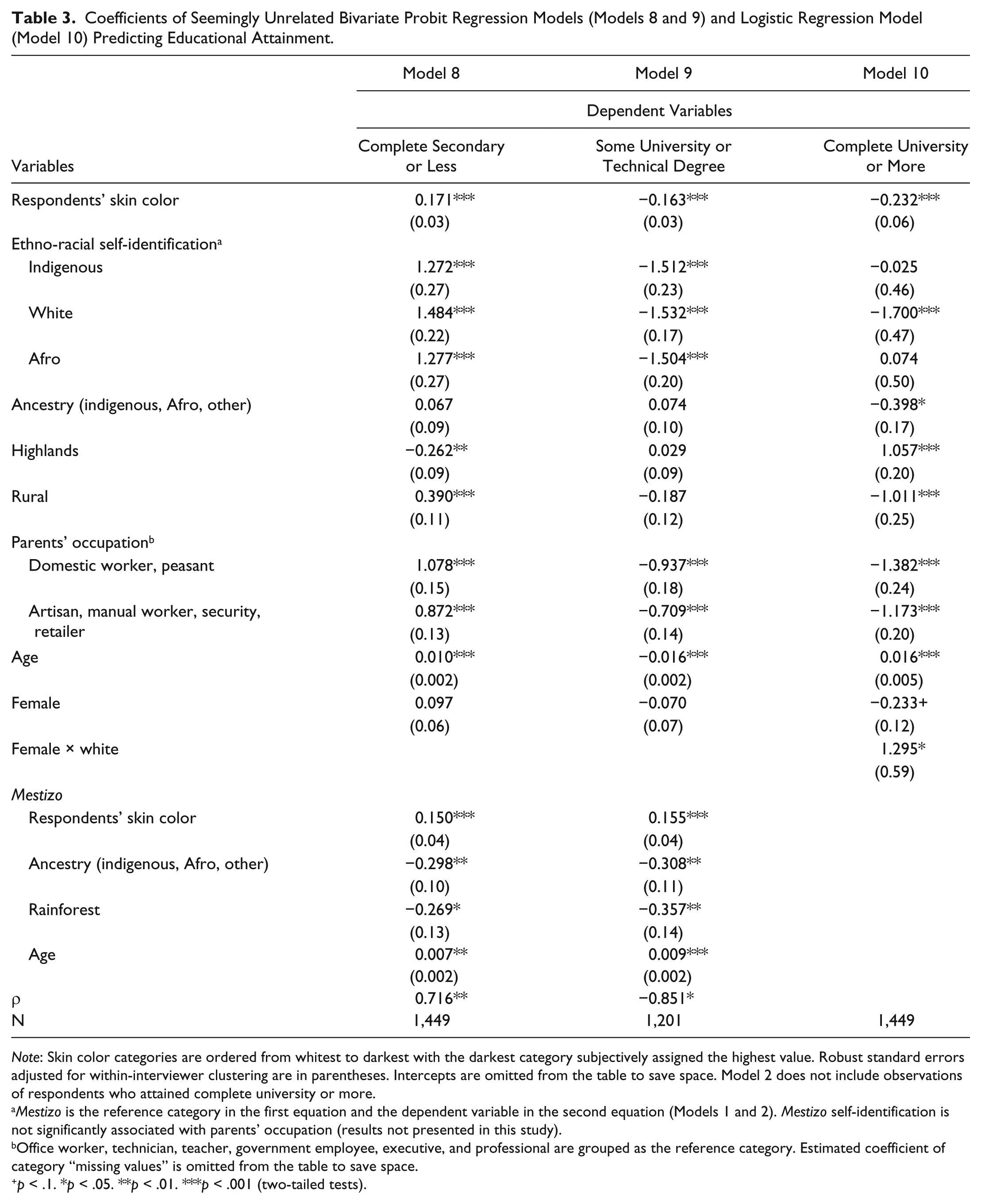
Note: Skin color categories are ordered from whitest to darkest with the darkest category subjectively assigned the highest value. Robust standard errors adjusted for within-interviewer clustering are in parentheses. Intercepts are omitted from the table to save space. Model 2 does not include observations of respondents who attained complete university or more.
Mestizo is the reference category in the first equation and the dependent variable in the second equation (Models 1 and 2). Mestizo self-identification is not significantly associated with parents’ occupation (results not presented in this study).
Office worker, technician, teacher, government employee, executive, and professional are grouped as the reference category. Estimated coefficient of category “missing values” is omitted from the table to save space.
p < .1. *p < .05. **p < .01. ***p < .001 (two-tailed tests).
Furthermore, I found no evidence of a significant correlation between the errors when the dependent variable was complete university or more. I alternatively fitted Model 10 as a logistic regression model predicting complete university or more. 20 Possibly, educational attainment and mestizo self-identification are recursively reinforced only until the years of university or technical degree, when individuals are still defining their personalities. By the time individuals who self-identify as mestizo attain complete university, their mestizo identities are likely well defined. The coefficients of Model 10 are consistent with the results presented in Table 2.
Table 4 presents average marginal effects of skin color, ethno-racial self-identification, and ancestry on the educational attainment outcomes presented in Table 3. These estimates summarize the findings of Models 8, 9, and 10 and can be interpreted straightforwardly. For instance, a darker skin color category increases the probability of just attaining complete secondary or less by .05, lowers the probability of attaining technical education or some university (with respect to complete secondary or less) by .05, and lowers the probability of attaining complete university or more by .03.
Average Marginal Effects of Seemingly Unrelated Bivariate Probit Models (Models 8 and 9) and Logistic Regression Model (Model 10) Predicting Educational Attainment.

Note: Mestizo is the reference category for self-identification. — = statistically insignificant marginal effects.
Differences in Access to Household Possessions
Table 5 presents the regression coefficients of multilevel linear regression models predicting access to household possessions. As expected (Hypothesis 1 and 2), skin color and ancestry are negatively associated with access to household possessions in every regression model even after controlling for region, rurality, and parents’ occupational status. Educational attainment mediates the impact of skin color and ancestry on household possessions, which decrease by 54 percent and 31 percent, respectively, when educational attainment variables are added to the analysis (Model 5). These changes reveal that educational attainment de-indianizes/whitens individuals by shortening skin color and ancestry gaps.
Multilevel Linear Regression Models Predicting Access to Household Possessions.

Note: Skin color categories are ordered from whitest to darkest with the darkest category assigned the highest value. Robust standard errors are in parentheses.
Mestizo is the reference category (Models 2, 4, 5, 6, and 7).
Incomplete secondary education or less is the reference category (Models 5, 6, and 7).
Lima and Callao is the reference category (Models 5, 6, and 7).
Office worker, technician, teacher, government employee, executive, and professional are grouped as the reference category. Estimated coefficient of category “missing values” is omitted from the table to save space.
p < .1. *p < .05. **p < .01. ***p < .001 (two-tailed tests).
Ethnicity in Model 2 is only measured by ethno-racial self-identification. These variables alone capture ethnic differences in access to household possessions, but they become statistically insignificant in Model 4 when all the ethno-racial characteristics are concurrently examined. Skin color and ancestry account for the differences by self-identification. Nonetheless, some of these estimates are biased due to the omission of variables for educational attainment in Model 4 as the most relevant predictors. After including educational attainment in subsequent regression models, I found evidence of significant differences in access to household possessions by white self-identification. Individuals who self-identify as white have greater access to household possessions compared to mestizo net of the effects of skin color and ancestry (Hypothesis 3) as well as net of the effects of region, rurality, and parents’ occupational status. Again, the AIC and BIC suggest that regression models with concurrent ethno-racial measures have better fit than models with a single ethno-racial variable.
Discussion
This study proposes a multidimensional approach for the analysis of ethno-racial status in contexts of mestizaje and offers interpretations of its general dimensions. Ethno-racial self-identification is interpreted as the embodiment of ideological beliefs that give meaning to local ethno-racial identities. Telles and coauthors (2015) did not find the relative advantage of mestizo self-identification compared to white in years of schooling in Peru, but they found it in Ecuador and other countries. They explained this advantage as the consequence of people of lower status self-identifying as white in countries with strong mestizaje ideologies that adopted mestizo self-identification as the authentic national category. Alternatively, I argue that in Peru, the relative advantage of mestizo self-identification compared to white in educational attainment reveals the significance of the subjective value of education inherent to mestizo self-identification as a cultural resource that allows individuals to develop strategies for upward mobility founded on educational attainment.
The significance of whiteness in Peru is reflected in the disadvantages of individuals with darker skin colors in educational attainment and household possessions (the aesthetic value of whiter phenotypes) and the relative advantage of white self-identification compared to mestizo in access to household possessions (the ideological support of white privilege). However, the value of mestizaje reflected in mestizo self-identification does not support white prerogatives beyond its efforts toward de-indianization. Instead, it emphasizes the subjective value of education as a legitimate path toward citizenship that should not be simplistically understood as cultural whitening (de la Cadena 2005).
Moreover, the relative advantage of white self-identification compared to mestizo in access to household possessions does not automatically make individuals who self-identify as white people of higher status. According to the analysis of household possessions, educational attainment and parents’ occupational status determine better the social status of individuals based on lifestyle. This relative advantage reveals the additional benefits of individuals who self-identify as white—beyond their phenotype and ancestry—even when they may not be necessarily accepted as white in more exclusive settings.
This study has limitations that should be considered when interpreting the results. As mentioned previously, the percentage of those who self-identify as indigenous in the 2010 LAPOP survey is very low (see Appendix), especially when compared to the percentage of those who self-identify as Quechua or Aymara in Table 1. The acceptance of the term indígena is problematic in Peru because it negatively refers to an inferior condition like the term indio (Mamani Humpiri 2009). The negative meaning of indigenousness is also emphasized throughout the survey questionnaire with questions that connect the indigenous condition with prejudice and discrimination before the self-identification question. In this way, respondents were possibly motivated to choose another answer. It would be interesting to replicate the analyses presented in this study with data that replace the indígena category with the ethnic terms Quechua and Aymara. These data may have a lower percentage of mestizo self-identification (e.g., the data used by Telles et al. 2015). A lower proportion of individuals who self-identify as mestizo and a greater proportion of individuals who self-identify as indigenous (either Quechua or Aymara) may offer alternative results that tell a different story (a supplementary story) considering that in Peru, indigenousness and mestizaje as identity markers are not necessarily mutually exclusive (de la Cadena 2000; Planas et al. 2016).
The interpretation of self-identification as the embodiment of ideological beliefs that give meaning to ethno-racial identities relies on the assumption that we are able to measure accurately phenotype and ancestries. Nevertheless, certain phenotypic characteristics could be captured by self-identification and not by skin color (e.g., hair type, height). As mentioned previously, the perception of ethno-racial characteristics in contexts of mestizaje is not only necessarily subjective but also inherently situational. Consequently, the reliable and valid measurement of phenotype has significant challenges. A possible solution would be to gather data measuring relative phenotypic intensities with different questions rather than skin color alone (Ñopo et al. 2007) or gather more information about phenotypic characteristics. It is necessary to underline that the “contrasting” coefficients of white self-identification and skin color in the analysis of educational attainment suggest that these variables are capturing different characteristics that represent distinct dimensions of ethno-racial status.
Moreover, the variable respondents’ skin color could be problematic (Villarreal 2010). Differences in socioeconomic status by skin color could result from interviewers classifying respondents perceived to be individuals of higher socioeconomic status. However, observed differences in educational attainment and household possessions are not only net of the characteristics of the interviewer but also net of parents’ occupational status and net of educational attainment and parents’ occupational status, respectively. Educational attainment and parents’ occupational status should work as proxies for the change in skin color categories that may occur with increasing socioeconomic status. Furthermore, I cannot evaluate whether skin color categorization is statistically reliable because the LAPOP data used in this study are cross-sectional. Longitudinal data sets with several measures of ethno-racial characteristics are, to my knowledge, still nonexistent in Peru. This study may establish the need to gather more data in the future that will allow us to revise these estimates and adjust our conceptual approaches.
Conclusion
In this study, I propose a framework that explains multidimensional ethno-racial status in contexts of mestizaje. According to this framework, mixed-race—mestizo—people individually embody socially ranked cultural and phenotypic ethno-racial characteristics in different degrees. This framework treats ethno-racial self-identification as one among other dimensions of ethno-racial status—exposure to beliefs that give meaning to local ethno-racial identities—rather than as a central measure of a well-bounded ethno-racial group. Due to the individual embodiment of multiple ethno-racial characteristics, I argue that stratification analyses in contexts of mestizaje should take these characteristics together into consideration. Accordingly, I present evidence of concurrently examined differences by skin color, ancestry, and ethno-racial self-identification in educational attainment and household possessions in Peru. I found that a darker phenotype—using skin color as a proxy for phenotype—and ancestry are inversely associated with both socioeconomic outcomes. I also found that white self-identification compared to mestizo is negatively associated with educational attainment but positively associated with household possessions.
This approach could be useful to discuss the importance of ethno-racial beliefs in Peru, where ethno-racial issues are inadequately treated as relevant by the state and insufficiently acknowledged by Peruvians (Carrión and Zárate 2010). Peruvians believe that they are equally mestizo as a commonsense rule, but this belief alone does not allow them to recognize the vindication of indigenous and Afro cultures as a national necessity, which should be addressed with educational and cultural policies. Instead of promoting beliefs that advocate the integration of all Peruvians, it is necessary to strengthen and increase the cultural value of indigenousness and blackness, which are the stigmatized components in mestizaje understood as embodied mixture.
Footnotes
Appendix
Summary Statistics for the Variables Used in the Analysis.
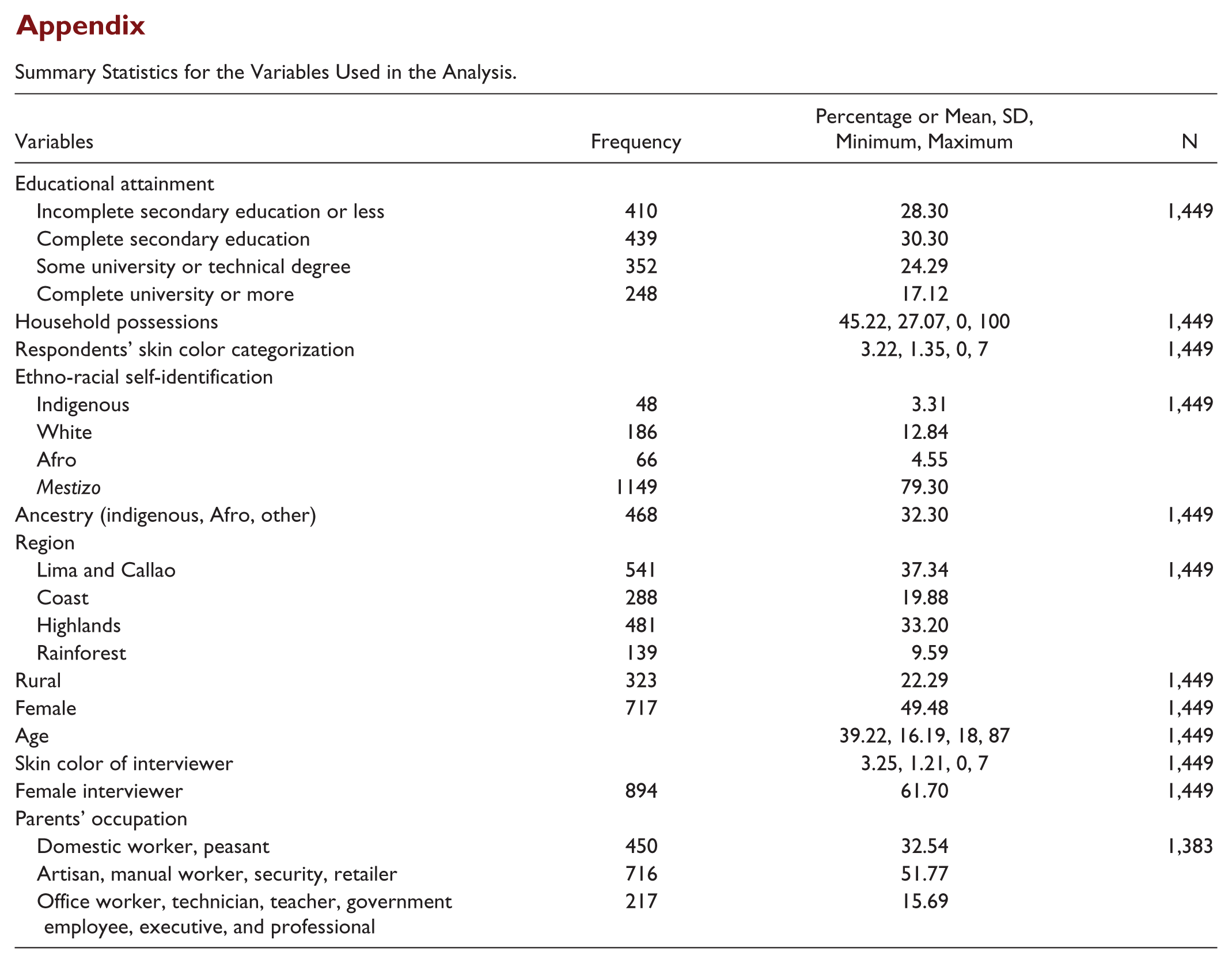
| Variables | Frequency | Percentage or Mean, SD, Minimum, Maximum | N |
|---|---|---|---|
| Educational attainment | |||
| Incomplete secondary education or less | 410 | 28.30 | 1,449 |
| Complete secondary education | 439 | 30.30 | |
| Some university or technical degree | 352 | 24.29 | |
| Complete university or more | 248 | 17.12 | |
| Household possessions | 45.22, 27.07, 0, 100 | 1,449 | |
| Respondents’ skin color categorization | 3.22, 1.35, 0, 7 | 1,449 | |
| Ethno-racial self-identification | |||
| Indigenous | 48 | 3.31 | 1,449 |
| White | 186 | 12.84 | |
| Afro | 66 | 4.55 | |
| Mestizo | 1149 | 79.30 | |
| Ancestry (indigenous, Afro, other) | 468 | 32.30 | 1,449 |
| Region | |||
| Lima and Callao | 541 | 37.34 | 1,449 |
| Coast | 288 | 19.88 | |
| Highlands | 481 | 33.20 | |
| Rainforest | 139 | 9.59 | |
| Rural | 323 | 22.29 | 1,449 |
| Female | 717 | 49.48 | 1,449 |
| Age | 39.22, 16.19, 18, 87 | 1,449 | |
| Skin color of interviewer | 3.25, 1.21, 0, 7 | 1,449 | |
| Female interviewer | 894 | 61.70 | 1,449 |
| Parents’ occupation | |||
| Domestic worker, peasant | 450 | 32.54 | 1,383 |
| Artisan, manual worker, security, retailer | 716 | 51.77 | |
| Office worker, technician, teacher, government employee, executive, and professional | 217 | 15.69 | |
Acknowledgements
I am deeply grateful to Daniel Powers, Néstor Rodríguez, Jorge Derpic, and Anne Figert for their helpful comments and suggestions throughout the writing of this paper. I especially thank Andrés Villarreal for his extensive help during the early stages of this project. I also thank the Latin American Public Opinion Project (LAPOP), its major supporters (United States Agency for International Development, United Nations Development Program, Inter-American Development Bank, and Vanderbilt University), Edward Telles, and the Project on Ethnicity and Race in Latin America (PERLA) for making the data available. Furthermore, I thank the editors of Socius: Sociological Research for a Dynamic World and the anonymous reviewers for their helpful comments and suggestions. Francisco Paredes-Quinones, thank you for being my guiding light.
Author’s Note
Earlier versions of this paper were presented at the 2013 Population Association of America Annual Meeting and the 2016 American Sociological Association Annual Meeting