




Abstract
As elite, heterosexual women delay marriage, complete higher education, and pursue high-status careers, are they able to de-center the other-oriented roles of wife and mother in their lives? Using in-depth interviews with 33 single, college-educated women, the authors examine how elite women balance expectations for self-development and family formation. Participants constructed a timeline with three phases: the self-development phase, the readiness moment, and the push to partner. Women’s initial focus on self-development ends with a shift toward feeling ready to search for a spouse. Classed norms for family formation and a perceived biological deadline for childbearing leave a narrow window to achieve family goals. The authors call this narrow window the condensed courtship clock. The clock results in self-scrutiny and third-party policing for women who are off schedule. The class advantages that allow elite women to engage in concerted self-development after college come with intense classed and gendered expectations for family formation.
In recent decades, women have entered higher education and prestigious occupations in greater proportions (Buchmann and DiPrete 2006; England 2010). This group of women has acquired financial and social resources that put them in an elite class position. However, despite greater access to career opportunities, college-education women remain largely committed to having children within a two-parent, married family unit, something they achieve at higher rates than their less educated counterparts (Goldstein and Kenney 2001). We unpack elite women’s expectations about family in relation to their expectations for self in the pivotal period after college and before marriage. We ask how elite women experience the binds created by intersecting classed and gendered expectations for self and family.
We interviewed heterosexual, professional, college-educated, single women. Rather than leveraging their financial and social resources to construct individualized expectations for their lives, all our participants perceived a uniform set of classed and gendered norms for how to manage relationship progression after college. Participants described two mutually exclusive phases: establishing the self and the push to partner, separated by a readiness moment. After college, women are pushed to focus on self-development explicitly free from relationships. This self-focus, free from family attachments, is cut short as women turn to focus on family in the push to partner. Their search for a partner is bound by a gendered pressure to bear children “naturally” and by a classed pressure to have children within an “appropriate” two-parent married family. The result is the condensed courtship clock, a rigid time window for women to partner.
Our participants’ privileged class position imposes high expectations for self-development alongside classed and gendered demands for how to form families. Those who become off schedule begin to regret their focus on personal development and are perceived as incomplete by family and friends. Some women who are off schedule experience a sense of failure and scrutinize their own everyday interactions. All participants evaluated their lives in relation to this timeline, implicitly endorsing it as an ideal path. Ultimately, elite women’s construction of this shared timeline, and their commitment to it, reproduces the two-parent married family as an ideal. Yet this ideal family is one that our elite participants struggle to achieve and may be even further out of reach for less privileged women.
Classed Expectations for Family Formation
There is a growing class of elite women who are well educated and who have both high earnings and high-status employment (Pew Research Center 2013; Stone and Hernandez 2013). These women navigate heterosexual family formation in the context of classed privileges and classed expectations.
Marriage as a future goal remains prevalent for women of all socioeconomic levels. Most adolescents and adults aspire to marry as a marker of prestige and personal achievement (Cherlin 2004; Goldstein and Kenney 2001). Despite the broad endorsement of marriage as a goal, those who possess socioeconomic advantage are more likely to marry. Women with bachelor’s degrees have a higher probability of marriage by age 35 than women with lesser educational attainment (Copen et al. 2012). Furthermore, a woman’s earnings potential has become an increasingly strong indicator of her marriage prospects (Sweeney and Cancian 2004).
This class gap in achieving marriage corresponds to classed expectations for dating and relationship progression. Lower income youths believe that marriage and family formation should occur at an earlier age than their middle- and upper-class counterparts, who tend to delay marriage (Aronson 2008; Furstenberg 2010; Kefalas et al. 2011; Osgood et al. 2005).
These classed expectations for marriage timing coincide with different challenges in achieving socioeconomic expectations for marriage. Many young adults endorse a “marriage planning” strategy, in which they aspire to marriage, but only after they themselves and their future partners have completed economic and educational goals (Kefalas et al. 2011:857). Furthermore, people also increasingly marry those with similar educational attainment (Schwartz and Mare 2005). College-educated people thus tend to expect partners to match their education: in online dating markets, college graduates are more likely to message and respond to other college graduates than to less educated people (Lin and Lundquist 2013:205). Turning to the perceived financial prerequisites for marriage, the expectation of achieving financially stability before marriage may constitute a barrier to marriage for lower income individuals (Gibson-Davis, Edin, and McLanahan 2005; Smock, Manning, and Porter 2005). The high expectations for marriage may contribute to the growing marriage gap between people with higher socioeconomic status and people with lower socioeconomic status (Copen et al. 2012; Sweeney and Cancian 2004).
Elite women’s expectations about fertility and childbearing are also shaped by their class position. Low-income women cite a lower ideal age for childbearing than what higher income women tend to achieve (Edin and Kefalas 2005). Women in upper-class positions, on average, give birth later in life. For example, more than half of women with at least a master’s degree have their first child in their 30s, and one fifth do not become mothers until after age 35 (Livingston 2015). This contrasts with mothers who did not attend college, a majority of whom have their first child before age 25 (Livingston 2015).
Overall, elite women confront classed ideas about marriage and fertility. As a group, elite women are increasingly delaying relationship formation and childbearing (Copen et al. 2012; Livingston 2015). When they do form families, elite women tend to marry men who match the high socioeconomic expectations they have for both themselves and for a spouse (Schwartz and Mare 2005). These patterns suggest classed orientations toward family formation.
Gendered Expectations for Family Formation
Elite women face gendered expectations for family formation as well. Women face decades of being tied to expectations about femininity and their socially valued roles as wife and mother (Chodorow 1978; Margolis 1998; Wehr 1987). Gendered patterns continue to exist for relationship progression, fertility expectations, and work-family balance.
Women are expected to be more passive early in heterosexual relationships. During dating, women participate in “traditionalist scripts,” expecting men to be active in decision making and planning and expecting themselves to be more passive (Laner and Ventrone 1998). This maintains a “symbolic gendering” in dating rituals (Lamont 2014). Similarly, the decision to get engaged continues to be perceived as men’s domain (Sassler and Miller 2011). Women grapple with expectations for gendered passivity during the courtship processes.
Beyond expectations for passivity, women face gendered expectations for youthfulness as they search for partners. Men perceive younger women as more desirable than older women (Perlini, Bertolissi, and Lind 1997). The older a man is when he marries, the larger age gap between him and his (typically younger) partner (England and McClintock 2009). These expectations for femininity and youth are related to gendered assumptions about procreation. The long-standing focus on the biological clock (Martin 2001) has tied women’s expectations about their ability to form a family to biological age. The clock promotes the idea that childbearing has a fixed deadline. The childbearing deadline is perceived as more strict for women than for men (Billari et al. 2011). Furthermore, women who choose to not have children risk being seen as rejecting femininity (Gillespie 2000). Elite women who become mothers may experience particular binds given that they have the socioeconomic status to make the time and financial investments that “intensive motherhood” and “concerted cultivation” require (Hays 1996; Lareau 2011).
For elite women, the gendered emphasis on women’s primary value as wives and mothers coincides with classed expectations for high personal and professional achievement (Hamilton and Armstrong 2009). This places women in a double bind between expectations for personal and professional development and expectations for family development, with some women feeling that they need to choose one or the other (Blair-Loy 2003; Gerson 2010; Hamilton and Armstrong 2009).
Past research on how women navigate family formation expectations has focused on women during two different stages of life. One set of research focuses on college-aged women who are still planning for a still far-off future (Cech 2016; Lamont 2014; Pedulla and Thébaud 2015). A second set of research emphasizes women who have already made tough decisions in establishing their professional and/or family trajectories (e.g., Blair-Loy 2003). This leaves elite women’s 20s and 30s, an important, transitional time when women decide if and when to start families, underexplored (for an exception, see Gerson 2010). Studying this transitional time provides a case to examine how women form expectations for self and family in light of their privileged class position.
To examine the nexus of upper-class expectations and gendered expectations, we focused on an urban core that has a high percentage of elite women negotiating classed and gendered expectations. We studied women living in New York City. New York is similar to other major cities such as San Francisco, Philadelphia, and Boston (Soma n.d.), where large percentages of highly paid, young, female college graduates have migrated in the past decade. In these cities, the gender gaps in college completion and wages are declining. In fact, young women in New York City outpaced men in income and education; women aged 25 to 34 earned $38,300 compared with their similarly aged men, who earned $37,500 (Status of Women in the United States 2016). Women are also 33 percent more likely to have a college degree than men (Status of Women in the United States 2016). New York City thus provides a group of elite women who are likely to be “marriage planners,” they are based in a metropolitan area, follow an elongated transition to adulthood, and face high expectations for personal and professional success (Kefalas et al. 2011).
In this article, we put women’s constructed meaning of their choices at the center of our analysis, focusing on women’s subjective understandings of their opportunities for shaping their own trajectories for family and personal life. We draw on Gerson’s (1986) argument that scholars should focus on “how women themselves, as actors who respond to the social conditions they inherit, construct their lives out of the available raw materials” (p. 37).
We find that a consistent set of age-graded, classed, and gendered norms set the terms for how elite women are expected to progress after college. Women do focus on personal development while free from family attachments, but they cut this focus short to focus on finding a partner, at which point they find themselves in an extremely rigid window within which to achieve their family goals. We introduce this timeline and describe the complex expectations for family and self-development that elite women navigate.
Methods
We use data from 33 in-depth, open-ended interviews with single, elite, millennial women living in New York City. This allows us to target those currently negotiating expectations for self-development, profession, and marriage in a transitional period after college. We discuss how we operationalize these below.
Previous research considers elite women to be those with high-status employment that provides them with flexibility and agency (Blair-Loy 2003; Stone and Hernandez 2013). The women in this study are too new to their careers to have reached high-level management. Instead, we sampled women who had received bachelor’s degrees from a selective university (ranked in the top 50 by U.S. News & World Report), had higher than median earnings, and were employed in a professional occupation or completing a postgraduate degree. We focus on participants’ current financial and professional status as a means of understanding participants’ current financial and social position.
We define millennial women as those who graduated college between 2000 and 2010 and who were aged 25 to 35 at the time of the interview. 1 We sampled women living in New York City, a city with a relatively high proportion of highly educated and professionally employed young adults (Cortright 2014). We considered women single if they were unmarried and were not in a committed relationship at the time of the interview. Having casual sexual or dating partners was allowed. Although we did not sample on intention to marry, all but one participant hoped to marry in the future, suggesting that our sample excludes women who opt out of marriage before or between the ages of 25 and 35. Our sample also excludes women who are in committed relationships or are married by age 25, meaning that our participants may experience less social pressure or personal desire to form families during or right after college.
Initial participants were purposively sampled using e-mail lists from four selective universities (Princeton University, Columbia University, Cornell University, and Boston College). Additional participants were recruited using snowball sampling. We sampled participants between 2013 and 2014. After 33 interviews, we achieved thematic saturation. Table 1 describes the final sample. The final sample consists of 33 women between the ages of 26 and 35, with an average age of 28 and a median age of 26. These women can be considered elite in both education and income; half of the participants had completed postgraduate degrees at the time of the interview, and the median annual income category was between $50,000 and $75,000, while seven participants earned more than $100,000.
Participant Characteristics (n = 33).
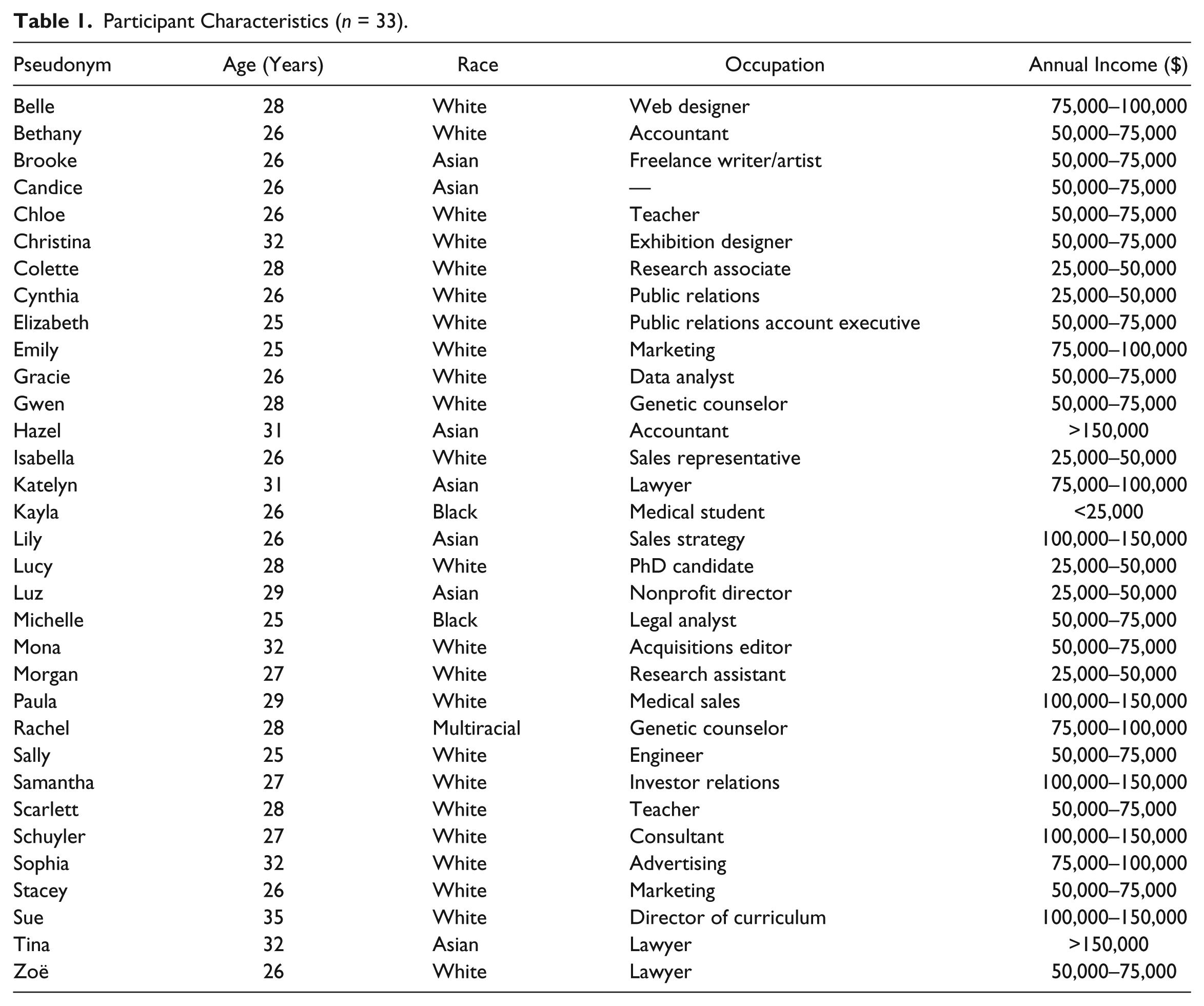
Two thirds of our sample self-identified as white, with seven participants identifying as Asian, two participants identifying as black, and one as multiracial. With the small number of women of color in our sample, we do not make claims about how experiences are racialized may among elite millennial women. We did find, however, that women of all races described the timeline reported here.
We used in-depth interviews to understand how participants made sense of experiences and expectations for the future. Interviews lasted about one hour and focused on women’s careers, personal lives, relationship histories, expectations for finding a partner, advice from others about dating, and future professional and personal goals. Although interviews focused largely on dating and marriage, there was significant leeway for participants to redirect and reinterpret questions. For example, although we did not probe for age-based differences, participants often described age-graded expectations when discussing past behaviors, current strategies, and future orientations. At the conclusion of each interview, participants filled out a brief demographic survey.
Conversations were recorded, transcribed, and then coded using the program NVivo. Our approach to analyzing the data focused on thematic analysis, using a combination of closed and open coding. All interviews were first read and inductively coded for emerging themes, concepts, and ideas. Using this initial coding, we developed a codebook derived from common themes, such as “biological clock,” “settling,” and “wasting time.” Once completed, the codebook was used to conduct closed coding on all the interviews. During closed coding, one author and one undergraduate research assistant coded each interview separately and then compared coding for similarity.
Through analysis, we identified participants’ expectations for and experiences with personal development, dating, and family formation. Below, we describe this timeline and the tensions women faced in meeting it, focusing on the ways that gender, class, and age may influence women’s lived experience.
Constructing a Clock for Courtship
Our participants collectively endorse a normative set of ideal ages for personal development and family formation. Although we expected variation in how participants constructed and managed these expectations, all participants adhered to an ideal timeline composed of three components: (1) establishing the self, (2) the readiness moment, and (3) the push to partner. See Figure 1 for a depiction of this timeline.

Timeline for Self-development and the Condensed Courtship Clock.
Establishing the self entails postponing romantic relationships to focus on personal and professional development. The readiness moment is an attitudinal shift away from self-development and toward the pursuit of marriage and childbearing. Finally, the push to partner is an intensive search for a partner structured by age-graded norms about “safe” childbearing and class-specific expectations for family formation that create what we call a “condensed courtship clock.” Each phase and its place within the sequence were discernible and co-constructed by all participants.
Establishing the Self
The first phase of the condensed courtship clock is establishing the self. This phase occurs after college graduation, extending the self-development focus women demonstrate in college (Hamilton and Armstrong 2009). Our participants have graduated college, entered the workforce, and become financially independent and are living outside their parents’ homes. Yet they still characterize themselves as not yet adults but as adjusting to “the real world.” Michelle (25):
I’ve had a hard time transitioning from being in college and going into the adult living situation. It’s been a struggle for the past few years trying to get grounded and figure out things and find myself and figure out what I like and what I don’t like.
Other participants indicate the focus on self-development is appropriate (and expected) during the early and mid-20s. Katelyn (31): “Your 20s you spend going out and partying and trying to establish yourself in so many areas of your life. In my 20s I spent a lot of time on my career.” Participants did not experience college graduation itself as a completion of their self-development but only as the onset of a period of concerted focus on the self, which involves vague personal and professional pursuits. Participants expect to pursue self-development, a goal concentrated among economically privileged women who have the means to pursue rich experiences and prestigious occupations (Hamilton and Armstrong 2009).
In focusing on the self, our participants describe purposefully postponing relationship formation, framing relationships as time-consuming distractions from self-development. Discussing serious relationships, Gracie (26) says, “I have a difficult job, I work a lot, I have only lived in this amazing city for one year, and I don’t want to have any obligations.” Rather, they present serious relationships as reserved for fully developed individuals, a status they have not yet achieved. Elizabeth (25) says, “I want to be stable enough and mature enough to make [marriage] work . . . and I just don’t see how that could be possible when you’re in your early to mid-20s or late-20s.” Maturity and sufficient development are seen as prerequisites for serious partnering. In pursuit of these prerequisites some elite women continue to delay relationships to focus on the self.
Family and friends reinforce this expectation, encouraging women to remain single to focus on themselves. Elizabeth (25) says,
My family thinks that I’m young and I should be experiencing New York. [They say] meet as many people as you can, and you shouldn’t be tied down right now. You’re too young to be even thinking about getting married.
Participants themselves also engaged in this style of policing; Emily (25), for example, encouraged her sister to delay serious relationships: “[My sister] is only 23, so I am like let her be, let her have fun . . . she graduated from college last year. I don’t think she knows how to be treated in a relationship.” Together, elite women and their networks construct a shared class-based norm that women should focus on establishing themselves as mature and developed.
The period of self-development suggests that professional opportunities give women latitude to develop outside of family goals. However, rather than seeing self-development as a way to defy or avoid family-related goals, participants identify one goal of the self-development period as preparing for future marriage. Cynthia (26):
If I give myself my 20s to do what I want, to figure out what kind of a guy I want to be with and get to a good place professionally, that will allow me to get married at 30.
Although these could be justifications for failed relationships, a majority of our participants under the age of 28 said that they were not looking to date seriously. Instead, they talked about deliberately delaying commitment, while reinforcing their normative commitment to marriage. Schuyler (27):
I don’t want to be in a relationship because I can’t imagine that I could make a decision about who I want to marry right now. I think any relationship I get into right now would be a waste of time.
Participants who did form relationships during this period viewed them as chances to learn about relationships. Paula (29): “My first real long-term relationship . . . was definitely a basis for relationships to come . . . how I learned about how to interact with men and relationships.” Akin to an internship, these casual relationships are an activity oriented toward future marriage goals.
Rather than diminishing the importance of marriage or family, this extended self-development period, voiced by all participants, reinforces the importance and teleological goal of future marriage and family. Belle (29):
I really love my freedom and I especially love dating. . . . In four years or so I am hoping that I will be done with dating. . . . I, of course, want a committed lifelong partnership and, if it’s right, have maybe two kids.
Participants related “successful” relationships to intensive self-development, suggesting that marriage requires this investment in self. This supports Cherlin’s (2004) view of deinstitutionalized marriage, in which individuals are expected to become high-achieving selves within a married unit. Despite being years away from marriage, these expectations push women to emphasize self-development as a precursor to family. Thus, although self-development appears to provide women with a new sense of freedom to pursue individualized life paths, it acts more like an extended finishing school, postponing but not diminishing the value of marriage as a goal.
The Readiness Moment
The self-development phase ends with a “readiness moment,” when women decide they are ready to stop dating casually and are newly suited for a serious relationship. Although this moment felt very personal to individual participants, it was reported across many interviews. More than 60 percent of our participants describe this moment. On the basis of accounts, readiness moments concentrate between ages 26 and 31. The average age of the readiness moment is 27.8. Most of the participants who did not describe a readiness moment were younger than 27, which we interpret as suggesting that women younger than 27 who are still single may have yet to experience the readiness moment. Because our sample excludes women in committed partnerships, it may be that other women experience the readiness moment while being in a committed partnership. 2
Of the women who experienced a readiness moment, about half described their readiness moment as a swift decision, in which they realized they were fit for a relationship. Colette (28) says,
Recently, in the last few months, I have moved over to the realization and decision that I am ready for the idea of looking for a life partner, a husband. . . . This is a big confession, but I have already told some friends, [that] I could actually say that I am open to dating to someone who could be my husband, which is a big change.
For women like Colette, the shift away from self-development was not a gradual process, but a sharp shift of perceptions and expectations. The readiness moment reinforces the notion that self-development and serious partnership are mutually exclusive but sequential stages, as participants turn from self-development directly to the pursuit of a partner. The readiness moment demonstrates how the imperative to find a partner cuts the period of self-development while single short.
Other participants explained the readiness moment as the outcome of personal effort, emphasizing the hard work conducted during the period of self-development. Brooke (26): “I would say now over the past year, I feel ready for a relationship. . . . I think I had to carve out a place in my life, mentally but also physically.” Like Brooke, Gwen (28) says that she achieved this milestone through personal reflection: “I feel like it’s something that’s coming with age. . . . I’m going to actively choose [to get married] after lots of thought and brooding.” Their notion of readiness suggests a newly mature stage in life. Mona (32): “I’m just a different person now . . . older and wiser.”
Regardless of whether the readiness moment was perceived as a sharp moment of realization or a process of hard work, women experienced the readiness moment as a highly personal moment. All women draw a distinct division between their goals and personal orientations during the period of self-development and the stage of life that they enter into when they are “ready.”
We were surprised that the women described no consistent personal factors that precipitated the readiness moment. For example, participants did not note changes in socioeconomic status, such as a promotion at work or newly achieved financial stability. Given the vague definitions of self-development participants voiced, it is difficult to determine how women independently determined that they were sufficiently developed to begin the partner search.
However, women related readiness to two social factors: a perceived increase in close friends entering serious relationships and an increase in friends and family policing their single status. Many participants said that friends of the same age getting married or starting serious relationships prompted a sense of their own readiness. Representing a common story among participants who experienced a readiness moment, Christina (32) says, “Maybe 26 or 27 and 28 is when [my friends] started to get married.” Our participants experience their friends’ serious relationships as a cue that the timing is right for a serious relationship of their own. For example, Lucy (28) says,
I am 28 now and I’m starting to approach that line where I have a lot of friends who have gotten married . . . so I’m looking for something more serious . . . these dates feel different from when I was dating in my mid-20s.
This suggests that social timelines in women’s networks combine with a subjective sense of being self-developed to prompt women to reorient their approaches.
Second, friends and family begin to police elite women’s single status, encouraging them to find partners. Although friends and family previously discouraged serious relationships, now participants hear advice to partner quickly. Brooke (26) says, “Now my mom is like ‘what is up with Brooke, is she dating anyone?’ [She says] ‘you are not getting any younger; you have to use your beauty when you still have it! Guys don’t like older women.’” Michelle (25) faces similar pressure from family: “[My Grandma] says, ‘Oh, you’re getting older! Your biological clock is ticking!’ Maybe thirty, or even younger, 28 or 29 is the year that she expects me to settle down with someone.” Family pressure and friends’ behavior reinforce age-graded and gendered expectations for partnering and family formation.
Although women suggest that they achieve the readiness moment as isolated individuals, their narratives suggest the switch to being ready is partially imposed by external cues. As women turn away from their self-development, they reinforce the continued dominance of familial roles. The readiness marks a cutting short the pursuit of self-development as a single individual to pursue a new phase, when elite women search for long-term partners.
The Push to Partner
The readiness moment initiates a final phase when elite women begin searching for long-term partners. The push to partner is structured by two age-graded timelines. One timeline is for relationship progression, which reaffirms classed expectations that women should marry before having children. The second timeline is for childbearing structured by beliefs about “safe” and ideal biological childbearing. These timelines intersect to condense the period for finding a partner.
Participants communicate a clear and overwhelmingly consistent account of the timeline for ideal relationship progression. Women assert couples should date for two to three years, then become engaged for a year, then marry; only then is childbearing acceptable. Belle (28) articulates this timeline: “I would say two years before getting married . . . my girlfriends say, “this person is 28 and they should get married by 32.’” This requirement for at least two years of dating prior to marriage is consistent with cultural norms observed by Kefalas et al. (2011), who found contemporary young men and women across class and race backgrounds expect a trial period before marrying.
Family members use the normative timeline for relationship progression to pressure women to work hard to find a partner. Emily (25):
There is some pressure from my mom and my family. . . . [My mom] still expects me to get married before I am 30. If you figure out the timing of things, it is going to be a few years before I meet somebody and a couple of years before I get engaged after I start dating somebody. That is 3 years if I met somebody today, and that puts me at 29. I think in my Mom’s head I’m ready to be settled down.
Emily’s mother suggests her daughter’s time to partner is running out, citing a timeline that Emily cosigns.
The timeline for relationship progression ideally culminates in childbearing. Bethany (26): “I would ideally like to meet someone today, be proposed to in three years, get married a year after that, and settle down, and then in a couple years after that, have kids and start a family.” Like Bethany, all participants believed having a child should come after marriage. All but one participant expressed the desire to have children, and none of our participants voiced a desire not to have children.
The second timeline structuring the push to partner is a perceived deadline for “safe” childrearing. Many of our participants believe that the ideal time for childbearing is between 30 and 35, with 35 as a perceived biological deadline. This view contrasts with low-income women, who see the late teens and early 20s as biologically ideal for childbearing (Edin and Kefalas 2005). The latter is a closer fit to findings about female fertility (Leridon 2004; Menken, Trussell, and Larsen 1986). More than half of our participants discuss concerns about biological safety for childbearing; 20 percent explicitly use the phrase “biological clock.” Kayla (26) says,
There’s only a certain age up to which you can have kids in a healthy way or not have concerns about it. . . . [I’m] realizing wow, if I want to have kids by the time I’m 35 or something then there’s this set timeline . . . so that creates some pressure.
Like Kayla, many participants view biological limitations to fertility as natural, inevitable, and outside of their control, which begins to provoke anxiety for participants.
Similarly, Schuyler (27) says, “I want to have a kid by the time I’m 30, I should get married when I’m 28, and I’m 26 already. Oh my god, that’s only two years . . . that’s just too much pressure.” Older participants suggest that this internal pressure intensifies as women achieve the readiness moment.
Biological rationales remain one way for others to sanction participants. Katelyn (31):
When I hit 30 is when it really started. I was always very proud that my family was the one family that didn’t ask or pressure me to start dating. Now it’s like, “how are you going to have kids?”
Invoking notions of fertility, family members warn women to find a man to marry in order to use their reproductive capacities. These warnings intensify the pressure women already feel about their singleness, reminding them that they are in danger of failing to make the shift to prioritizing relationships over self-development in time.
Given their unique elite position, our participants’ social and financial positions might offer them the resources to negotiate biological deadlines and construct alternative families. With their relatively high incomes and education, our participants could support children without spouses through either adoption or nonmarital childbearing. Women could also extend this perceived biological deadline through reproductive technologies such as in vitro fertilization or egg donation (Inhorn, Ceballo, and Nachtigall 2008). Alternatively, our participants have the financial resources that make it possible to have children first and marry later. Our participants are aware of these options, but they framed them as contingencies to avoid, even if that means abstaining from having children. They prioritize “natural” childbearing only within a marital partnership. Hazel (31) describes resisting that pressure:
I’m not going to freeze my eggs or anything. I don’t feel that I need to get married in the five years so that I can have kids. I just want to have it done naturally. And kids will come they’ll come, if not, I’ll probably be sad, but I’m not going to make that effort to freeze my eggs.
For elite women who are committed to the notion of “natural” procreation within marriage, they are pushed to find a partner before their perceived biological deadline for having children ends.
Some of our participants were approaching the perceived deadline for partnering and childbearing. Despite being “off schedule,” none of these women reported considering having children with partners outside of marriage or becoming single mothers by choice. Rather, our participants are inflexible in their plans to conceive children “naturally” with a spouse. This inflexibility results in a tightly controlled timeline.
During this pressure to partner, a handful of women, primarily older than 30, described a gendered pressure to searching for a partner, claiming that men in New York City had different timelines. Sophia (32):
I think it is harder for a woman because they do have that pressure, because maybe my eggs are going to be gone. And then you meet guys that are 40 . . . there is defective sperm the older you get, but guys don’t care about that.
Although Sophia acknowledges that aging affects fertility for both men and women, she suggests that women experience unique scrutiny.
Similarly, Lucy (28) believes that men construct a clock for relationships without attending to biology. She says,
I think [older] guys have this mind-set they had in their mid-20s because, as much as I cringe when I say this, there is a biological factor for women. I would like to have a kid before I am in my mid 30s so I will start doing the math backward for how long I have for it to happen and then I am going to have to be a lot more serious in my dating.
Lucy asserts men can sustain the kind of casual mind-set—perhaps analogous to our participants during the self-development phase—longer.
One participant, Katelyn (31), said that she felt this mismatch between men and women’s perceived biological timeline affected her ability to date:
I’m sure if a guy wants to have kids, [he] wants to date someone who’s 28, rather than someone who’s 31. I’ve messaged guys before who’ve had their age limit at 28 or 29, even though they are 35. And they like won’t message me. So I don’t know if they like, they want kids, maybe they just think it’ll be a lot harder. But that’s really frustrating, I don’t need another reminder that my clock is ticking.
Katelyn’s perception about men being less willing to date older women is supported by data from the dating Web site OkCupid, which shows that women in their early 20s are most desirable to men, and men almost stop considering women who have reached age 35 (Rudder 2010).
While experiencing the pressure of the timeline, as women approach 30 they face additional challenges in a gendered dating market. This suggests that the power of the clock intensifies for women as they become off schedule. The cultural norms that encouraged women to delay childbearing for a period of self-development also require marriage before babies. By age 27, women are cued to shift toward relationship formation. They are then expected to be partnered, married, and with children before age 35, creating a very tight window for relationship formation. To follow the normative timeline, an elite woman must find a suitable partner almost immediately after she experiences her readiness moment.
The Consequences of Being Off Schedule
As women become off schedule from their ideal timeline for finding a spouse, they face judgement from others and internal scrutiny. These women perceive few options outside the timeline, feeling as though they face a looming but unstoppable force.
Single Women as Unfinished Adults
When participants enter the push to partner phase, however, others may focus more on their failure to partner than on their personal achievements. Friends and family expect women to partner and have children on time. Samantha (27) stated, “the older I get people are more . . . concerned for me.” As they become increasingly off schedule to hit the marker of marriage, some participants report that policing becomes more intense. Mona (32) says,
It’s everywhere, people coupled up, people asking if I have a boyfriend, family members asking why I don’t have a boyfriend, my mom getting upset last week when I went to visit her about why there’s no one who wants to be with me. . . . I’m doing the best I can.
The focus on women’s failure to partner suggests that despite women’s other achievements in career and self-development that they achieved, marriage and childbearing remain presumed achievements that women need to complete in order to be seen as acceptable to others.
One participant interpreted policing as a critique on her status as a full person. Katelyn (31):
Society is telling you that there’s something wrong with you, they’re trying to fix something about your life. . . . People are very interested in why I’m single, how long I’ve been single, why can’t I meet anyone. Marriage has become such a badge on your life success . . . you could be a successful lawyer and do all these things, but you’re single, so you’re not actually doing that great.
According to Katelyn, personal and professional successes are trumped by her failure to partner; to others, she is still incomplete.
The result is a modified hierarchy of achievement, such that woman are only fully complete or developed when they have achieved partnership and family status. Although self-development is deemed necessary to move onto the next stage, it is insufficient for complete success.
Strategies for Managing a Tight Timeline
Given the external judgement and personal anxiety that the timeline induces in our participants, they seek strategies to mitigate the risks of being increasingly off schedule. They described three strategies: settling, cultivating openness, or opting out. However, although we call these strategies, participants describe little power to affect their dating results. As they seek to achieve the condensed courtship clock, our participants feel limited by passive, gendered strategies. In each of these strategies, women ultimately reinforce classed relationship expectations and biological requirements for “natural childbearing,” rather than challenging these norms.
Settling on a Spouse
Settling, as our participants describe it, is the practice of relaxing or removing standards for a future partner they previously held. Women who settle on a spouse prioritize securing any partner over a partner with the ideal characteristics they previously imagined. Younger participants, in particular, express an unwillingness to settle currently but consider it a possible future option. Brooke (26): “I wouldn’t rule [settling] out for myself either. If I was getting to a certain age . . . like 32, 33, 35, 36 and I was worried about not having kids and about being happy with a guy, I might settle.” Brooke has an age-specific rationale for settling, suggesting that settling is an alternative strategy intended to meet the demands for normative family formation in the face of a perceived biological deadline. Schuyler (27) says, “I just don’t think that it would be useful or helpful to think about a timeline because there’s not much you can do about it unless you want to settle.”
Being willing to settle offers a necessary, though undesirable, way to meet the inexorable demands of the push to partner, such that women must sacrifice their own demands and expectations to meet the class-specific goals for family formation. Participants—none of whom had yet settled—told us stories about friends who they believed had settled. Discussing a friend, Scarlett (28) says, “She turned 31 and just wanted a kid. She found an okay guy online. . . . I think he’s a good dad, but I think it’s very clear that she settled. But they are a little bit older.” Scarlett includes her friend’s age and desire for children in explaining her choosing an “okay guy” as a spouse. In explaining settling, participants highlight how time pressure intersects with classed relationship expectations to shape elite women’s choices for partnership.
Some older participants argued that their current single status was in part due to their unwillingness to settle. Sue (35) says, “I know that I’m getting older and want to have children and stuff but I’m not willing to settle with someone for the sake of settling.” Ultimately, participants’ ambivalence about the prospect of settling demonstrates the power of classed expectations for marriage and family formation and the powerful pull of perceived biological deadlines. Sue views her ability to have children as contingent on finding a spouse, but resists accepting someone perceived as an unideal match.
Discourse around settling reinforces the classed timelines and expectations for family formation, rather than challenging them. According to our participants, women who settle prioritize marriage, even to a less desirable partner, often for the purpose of having a child. These elite women would rather marry on less than ideal terms than not marry at all. Their choice, as they see it, is to settle or to opt out of family formation entirely. This contrasts with less educated women, who often have children on their own timelines, even if that means remaining unmarried.
Cultivating Openness
The largest portion of our sample remained committed to the search for a high-quality partner. The strategy they choose is what we call cultivating openness. These women described openness as both an approach to dating and a disposition.
To be open as an approaching to dating is to consider dating partners one would not previously have considered. Lily (26) describes it as “being open to meeting different people and giving them a chance outside of just what they look like on paper.” Participants consistently describe becoming more open with age. For example, Colette (28) says,
I am open, as I am older and as I date longer I am more open to going on a first date with someone who might not be at first glance or discretion someone who I would marry or even have as a boyfriend.
Although both openness and settling entail relaxing one’s standards, openness is described as a tactic to avoid having to settle. Paula (29) says,
As I start to become more open I think that the timeline will progress in the way that I want, which is sooner rather than later. . . . I have friends I know have settled, which is definitely not a bad thing, but you know that they just got sick of dating.
Like Paula, many women believe by being open they will be able to meet their intense timeline for partnering. Emily (25) says,
I don’t really want to settle, but at the same time, things that used to be deal breakers for me I realized that is not really a deal breaker. . . . I am becoming more open to more types of people than I was at first.
Women describing being open to a wider range of partners as a way to speed up the process of finding a partner, noting that it comes close to settling. These women would rather be a little more open during their initial search than have to seriously relax their standards and end up settling.
As a disposition, openness is physical positioning that emanates an air of welcoming and availability that is believed to encourage romantic advances from men. Kayla (26) explains openness: “My sister told me that you need to put yourself in a position where you can meet someone . . . you shouldn’t go seeking it actively because it should just happen naturally.” Similarly, Sophia (33) discusses body positioning: “Being out in New York you have to just look around and be open to meeting people. I think a smile on your face, or that kind of thing.” Women cultivate the disposition of openness throughout daily activities.
Although being “open” is constructed as an action that women can control, “being open” is largely passive; participants are making themselves available for men to approach them. Our participants desire the potential for relationships throughout all forms of interaction, without being able to actively assert themselves.
Women and their friends and family police ordinary behaviors, daily routines, and activities to scrutinize the degree to which they put themselves in contact with potential dates. Mona (32):
My stepmom is always like “go everywhere, you never know what opportunity you’re going to miss.” I get it, but I’m only human. . . . [She says] “join more things” and I’m like, “how many things do I need to be a part of? I’m in a book club, I volunteer once a week.”
As a result, women internalize the search for a partner throughout their daily routine, making openness a psychologically challenging and time-consuming endeavor.
Some participants scrutinize their own openness, occasionally questioning their priorities during the self-development period. Brooke (26) says, “I just wonder how much is my own doing, being single for nine years? . . . My energy is not always open; I don’t make eye contact very well.” Some women blame their prior emphasis on self-development, perceiving self-focused activities as not being open because they are not conducive to meeting men. Scarlett (28): “I don’t really go to bars and I work for a school, which is all female. So the things I like to do—I run, I go to yoga—they’re not conducive to meeting people.” Similarly, Katelyn (31) describes her friends policing how open she is: “One of my friends at the wedding said to me, “Even though you feel like you’re open to meeting people, because you’re always around us it actually makes you less likely to like go out and meet someone.” Katelyn’s friend encourages her to spend less time on her own social pursuits in order to remain open to meeting a partner.
Cultivating openness becomes a pervasive focus in daily life, sometimes seen as at odds with activities that women find personally fulfilling. This self-scrutiny is an internalized form of social control that Foucault (1979, 1980) would have recognized as disciplining bodies. As long as they remain single, each year of age intensifies the self-surveillance as well as third-party monitoring that women experience. In this way, singleness detracts from women’s continuing self-development and encourages a high degree of self-surveillance during daily activity.
Opting Out of the Push to Partner
In this elite sample, only one woman considered opting out of the push to partner. This participant privileged her own pride in accomplishing self-development and considered abandoning the pursuit of a spouse, even though this might mean foregoing children too. Christina (32) says,
I used to want [a relationship] more and I don’t know if it is just because it hasn’t happened and I have adjusted my expectations, because I don’t really think it will happen anyways. . . . I have friends that are divorced at this point and it just doesn’t seem as perfect and ideal as it used to.
Although other participants note that opting out could be an option, most appear unwilling to consider it a viable option. Given the upper-class norm that women have children within a marriage, opting out of marriage often means opting out of childbearing as well. The perceived tie between marriage and childbearing makes opting out an abnormal and undesirable alternative for most elite women. Similarly, the idea of opting out shows the degree to which elite women conform to a normative family unit, such that without a partner, they feel unable or unwilling to have children. This perhaps partially explains the why the rate of unmarried, childless women is higher among women with postgraduate degrees than women in any other educational group (Child Trends 2015; Mincieli et al. 2007; Sassler 2010). Although less elite women may be willing to have children out of marriage, our elite sample remains committed to childbearing within marriage. Those who consider opting out may be more willing to reject prevailing social expectations for women.
Discussion
We argue that classed and gendered expectations for self-development and family formation together create binds for elite women, who construct a condensed courtship clock. Although their socially constructed timeline produced anxiety and policing for some participants, the timeline was something against which all participants articulated their expectations and evaluated themselves.
Our sample of highly educated, high-earning, single women in New York City has the privilege to carve out time for professional and self-development. In one respect, this classed emphasis on self-development without romantic attachment signifies a deemphasis of gendered expectations for a portion of women’s lives (Hamilton and Armstrong 2009). This classed focused on self allows women to focus on pursuits while being free from family-oriented roles.
Yet women’s class privilege has costs. Despite enjoying temporary freedom from gendered expectations for family formation, our participants and their friends and family remain committed to the classed demand of a two-parent family. Rather than experiencing distance from the roles of potential wife and mother during the self-development period, elite women develop themselves in the shadow of future other-oriented roles. Our participants partially justify their self-development as preparing them to succeed as future wives and mothers.
Women also face gendered expectations for natural childbearing before age 35. As women reach their mid to late 20s, women who remain single police themselves and are policed by others. Those who are off schedule feel doubt about the time they spent on self-development, viewing the time they spent on self-development as a trade-off that may have limited their success finding a spouse. This reinforces the importance of marriage prior to childbirth for elite women.
Elite women are thus put into a double bind. Sufficient self-development must occur prior to serious partnering; however, self-development alone is insufficient for being seen as a fully developed person. Furthermore, the time women invest in self-development puts them at risk for failing to achieve their ideal, normative family unit. In the end, even as professionally and socioeconomically elite individuals, women who do not occupy the role of wife and mother continue to be viewed as incomplete or unfulfilled.
Women who struggle with the timeline could use their class status to opt out of expectations for both marriage and childbearing. These women have the resources to manage the timing of their family formation, possibly by forming a family later in life or by becoming a single mother by choice. Yet these possibilities may seem unattractive in light of the upper-class insistence on a two-parent family. In fact, for some women, opting out of marriage requires foregoing children by default.
Finally, our participants confront a gendered bind as they try to meet the condensed courtship clock. In the search for a partner, they feel constrained to relatively passive strategies such as trying to exude “openness.” Having to wait to be approached and chosen by a future husband limits women’s ability to shape their family trajectories.
This study makes several contributions to the scholarly conversations. First, we analyze a period in elite women’s lives that has been relatively unaddressed in literature on family formation and work-life balance. We show that elite women assess themselves in light of a stylized timeline that combines classed and gendered expectations for self and family. This timeline shows the long reach of family devotion expectations for women. Our elite participants are assessed in light of their roles as wife and mother before they had even entered these roles.
Second, we bring an intersectional approach to demonstrate how class and gender norms bind elite women’s expectations for family and self. Although there is a rich literature exploring how low-income and less educated women make choices about family (see, e.g., Edin and Reed 2005), we focus here on the choices of elite women, who we see as no less sociologically puzzling. Our elite participants create rigid timelines in the service of maintaining a particular family unit, despite the pressure and judgement they experience and the other family options afforded to them. In doing so, they uphold a family unit that is even harder for poor women to achieve (Gibson-Davis et al. 2005; Mincieli et al. 2007).
This study has several limitations. First, our sample had little racial diversity. Despite our largely white sample, we did find that our black, Asian, and multiracial participants constructed a similar timeline and contended with the pressures of the condensed courtship clock. However, women of color’s ability to achieve the timeline may be even more difficult than that of white women. Given racial inequalities by occupation and income (Grodsky and Pager 2001; McCall 2001), feeling economically established as part of readiness might differ on the basis of women’s racial backgrounds. Women also encounter a racialized dating market, with black women being particularly disfavored by men of all races (Lin and Lundquist 2013). Future research could consider how women’s racial backgrounds might affect the age at which they feel subjectively ready for marriage or whether women of color feel more pressure or spend more time searching for a spouse once ready.
Second, more research is needed on how men understand their self-development in relation to marriage and children in order to further unpack the gendered dimensions of this period of the life course. Although our study provides insight into how women in an elite structural position manage family formation, outlining how elite men define “readiness,” understand self-development, and form expectations for marriage and childbearing would illuminate how gender may differentially shift perceptions of life possibilities.
Finally, we did not interview women aged 25 and older who were currently in serious relationships or who were already married. By not interviewing women of similar ages who were in relationships, we may have selected a group of women who are have a very particular set of expectations for development and relationships or who are less comfortable being in relationships than peers of a similar age. This limits our ability to examine how women who are already married or paired experience the readiness moment or how they balance perceptions of self-development vis-à-vis family formation. The lack of women in relationships may also mean that our participants used the desire for self-development as a narrative to justify their singleness or failed relationships. Nonetheless, these findings remain valuable for analyzing how elite, single women make sense of self-development and family formation goals during their mid-20s and beyond.
Footnotes
Acknowledgements
We thank Miriam Barcus, John DeLamater, Myra Marx Ferree, Katrina Quisumbing King, Katherine Lin, Madeline Pape, Johanna Quinn, David Rangel, Megan Shoji, Christine Schwartz, and the participants in the Femsem and the Social Psychology and Microsociology research clusters for their assistance with this project. We thank Natalie Atchison, Rachel Parks, and Sangay Sirleaf for excellent research assistance.
