




Abstract
Women’s representation in legislative and executive offices has increased in recent decades. We show, though, that while global legislative and executive trend lines have positive slopes, the two institutions experience distinctive temporal dynamics. When levels of women’s legislative representation rise, they tend not to slip back beyond their newly achieved level—women’s legislative representation tends to be characterized by a ratchet effect. This effect is relatively rare in cabinets, where increases in women’s representation are often followed by decreases. We call the latter phenomenon the see-saw effect: Countries experience one or more steps back for every step forward. These differences have normative and analytical implications. Normatively, we suggest that cabinet see-sawing is particularly problematic when domestic power balances are weighted toward executives. Analytically, we encourage researchers to use indicators of women’s empowerment that account for time and inter-institutional balances and identify factors that affect cross-country variation in temporal trends.
In the 2016 elections, American women made slight gains in terms of representation in Congress. Women’s seat share rose from 20.0 percent to 21.0 percent in the Senate and held steady at 19.4 percent in the House of Representatives. This modest progress was offset, however, by a large slide in the percentage of cabinet seats occupied by women. Donald Trump’s initial cabinet (16.7 percent) was noticeably less gender balanced than Barack Obama’s terminal cabinet (30.4 percent).
In this article, we show that the short-term American dynamics—progress in the legislature, volatility in the cabinet—are prevalent over longer sweeps of time in many countries throughout the world. Recognizing, with Alexander, Bolzendahl, and Jalalzai (2016), that “women’s political empowerment” is a complex phenomenon that involves formal and informal institutions in multiple geographic arenas (e.g., global, national, and subnational), we focus here on two critical state-level institutions (legislatures and cabinets) and their respective temporal trajectories. We show that when levels of women’s legislative representation in a country rise, they tend not to slip back beyond their newly achieved level. Rather, women’s legislative representation tends to be characterized by a ratchet effect where representational gains “lock in” over time. We show, additionally, that the ratchet effect is less common at the highest levels of the executive branch. In cabinets, increases in women’s representation in one year are often followed by decreases the next. We call the latter phenomenon the see-saw effect—an asymmetric process in which one year’s representational gains erode in subsequent years. Representational gains in the cabinet, we suggest, are more fragile and subject to backsliding.
We use Inter-Parliamentary Union data on legislatures and a new global data set on cabinets to demonstrate important differences in the gendered temporal dynamics of legislatures (where the ratchet effect is common) and cabinets (where see-sawing is common). We stress that cabinet see-sawing occurs across a range of regimes and constitutes an obstacle to the sustainable representation of women (Darhour and Dahlerup 2013).
Having established the different gendered dynamics of legislatures and cabinets, we briefly discuss the normative and analytical implications of cabinet see-sawing. While cabinets’ powers vary across countries, points in time, and sectoral portfolios, cabinet ministers generally play important roles in setting policy agendas, directing resource allocation, representing state interests to domestic and international audiences, and embodying state prestige. Representational see-sawing suggests that women’s access to this critical institution may be fragile or limited. In addition, in recent years, various strands of literature have suggested that executive branches have been gaining power at the expense of their respective legislatures. If these signs were to hold up to systematic scrutiny, the relative tenuousness of women’s grasp on executive power would be especially normatively troubling. To gain purchase on just how troubling cabinet see-sawing may be, we scrutinize the notion that we are living in an era of “executive ascendance.” We do not find unambiguous evidence in support of this notion. We do, however, suggest that scholars who are interested in women’s political empowerment should take time and inter-institutional balances more seriously than they have to date. Specifically, we argue that global assessments of women’s formal political empowerment that focus exclusively on the legislature or the executive—or that incorporate a measure of cabinet representation that is not time-sensitive—are potentially misleading.
We conclude with a hopeful empirical observation: Cabinet see-sawing is common, but it is not universal, and there are examples of countries that have experienced cabinet ratcheting. We call for research that will isolate the factors that limit cabinet see-sawing and cement women’s representational gains and sketch potentially productive lines of inquiry.
Global Trends in Women’s Political Representation
There are rich theoretical (Mansbridge 1999; Phillips 1995; Pitkin 1967) and empirical traditions that explore the effects of women’s political representation and suggest the importance of promoting women’s representation in high political office. Symbolically, states that consistently incorporate women into leading positions clearly communicate their core values. They signal to domestic (Alexander 2012; Beaman et al. 2009; Franceschet, Annesley, and Beckwith 2017; Morgan and Buice 2013) and international (Bush 2011; Jacob, Scherpereel, and Adams forthcoming) audiences that they are committed to gender equality, and these signals in turn affect the behaviors and expectations of both local and global actors. Substantively, Celis et al. (2008) caution scholars not to focus solely on whether “women represent women[’s interests].” All the same, evidence of women legislators and cabinet ministers “making a difference” continues to mount. For example, women’s inclusion in high political positions can affect maternity and parental leave policies (Atchison and Down 2009), levels of health care spending (Mavisakalyan 2014), and foreign aid priorities (Bashevkin 2014). For these and other reasons, it is important to examine the extent to which various countries incorporate women into their legislatures and cabinets.
Figures 1 and 2 display global mean and median values for women legislators and cabinet ministers. Together, they suggest that since the turn of the millennium, women throughout the world are taking on more high-level positions. Our empirical analysis begins from the premise, though, that aggregated trend lines can be deceiving: Specifically, they mask the fact that the ratchet effect generally characterizes legislatures, while the see-saw effect often characterizes cabinets.

Women’s representation in the world’s legislatures.

Women’s representation in the world’s cabinets.
Legislatures: The Ratchet Effect
Figure 1 shows that global averages of women’s legislative representation increase year on year. This trend is generally reflected in individual countries. Paxton, Hughes, and Painter (2010) demonstrate that women’s legislative representation has tended to increase across countries over time, albeit according to different patterns and rhythms. Paxton and Hughes (2017) take this observation one step further, identifying five general routes of legislative representation over time. Four routes involve holding steady or moving upward; only one involves a temporal dip. The latter route was disproportionally evident in the early 1990s, when single-party Leninist states with artificially inflated numbers dipped in the moment after their regime transitions. To further demonstrate the fact that women’s legislative gains tend to lock in over time, we introduce two simple concepts, backsliding and climbing. Backsliding for year t is defined as the difference in representation between t – 1 and t if the change is negative; climbing is defined as the difference in representation between t – 1 and t if the change is positive. 1 Figure 3 plots time-series graphs for the percentage of countries with annual backslides and climbs in women’s legislative representation. Most countries show no annual variation. On one level, this is not surprising: Legislative terms, after all, typically last several years. Two points, however, bear emphasis in this regard. First, while we know of no global data set presenting annualized information on member turnover, data from advanced industrial democracies (e.g., Matland and Studlar 2004) suggest that approximately 10 percent of legislators turn over each year. Second, the percentage of countries with annual backslides is particularly low for all years. The number of countries backsliding in a given year is less than half the number of countries experiencing annual climbing. Overall, Figure 3 reveals the presence of a ratchet effect for most of the world’s legislatures.

Climbs and backslides in women’s legislative representation.
More finely grained analysis suggests that ratcheting is common in different kinds of countries. The literature juxtaposes two general pathways through which the proportion of women in legislative office has increased—the incremental pathway and the fast-track pathway (Dahlerup and Freidenvall 2005). Incremental countries, of which the Nordics are the paradigmatic examples, are characterized by slow, steady growth in women’s representation. Figure 4 shows that there has been incremental ratcheting in Nordic legislatures. There are no episodes of dramatic backsliding; rather, we see periods of stasis interspersed with climbing. In fast-track countries, the adoption of gender quotas promotes sharp, instantaneous increases in women’s representation. If implemented properly, legislative gender quotas can also put a floor on women’s representation, effectively building ratchet effects into formal arrangements (Franceschet, Krook, and Piscopo 2013; Krook 2009).
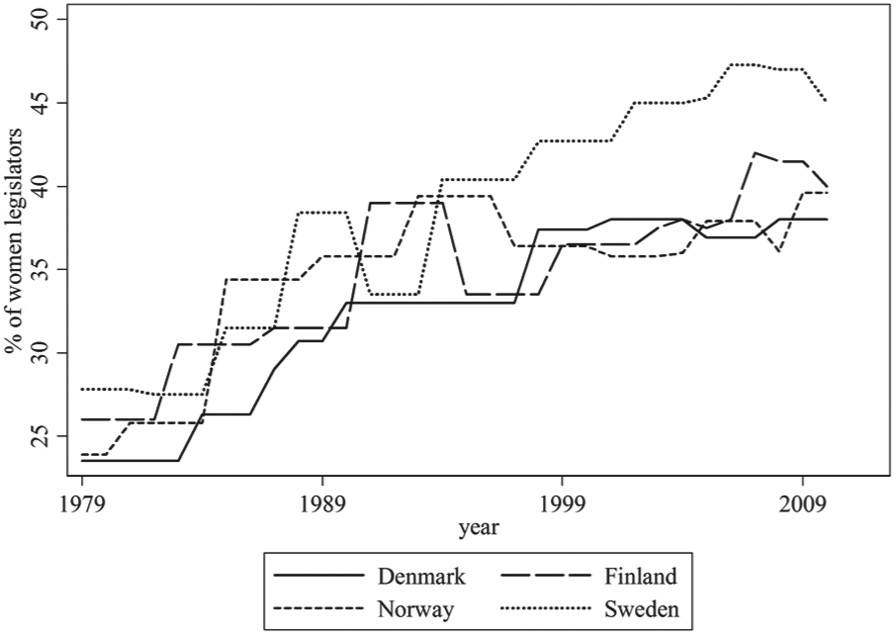
Women’s legislative representation in Nordic countries.
Interestingly, though, even countries without legislative quotas exhibit year-on-year increases in women’s legislative representation—and not just the Nordics. Figure 5, which focuses on recent years (during the period when quotas have gained momentum worldwide), demonstrates as much. The left graph, which focuses on countries that have not adopted quotas, shows that even those countries have relatively few instances of backsliding. This is true both in absolute terms and relative to instances of climbing. In fact, backslides and climbs in countries with quotas (right graph) are not dramatically different than in countries without quotas. This comparison suggests that the factors driving women’s legislative representation—institutional, social, cultural, and other—are themselves relatively irreversible. It suggests, furthermore, that the ratchet effect characterizes legislatures in incremental and fast-track countries alike.

Climbs and backslides in women’s legislative representation for countries without quotas and countries with quotas.
It is neither surprising nor problematic, given this fact, that observers have tended to focus on climbing. With the exception of countries transitioning from left-wing single-party dictatorships, backsliding in women’s legislative representation is quite rare.
Cabinets: The See-Saw Effect
Backsliding is more common in cabinets. To explore cabinet dynamics, we assembled an original data set using information from the CIA’s Chiefs of State and Cabinet Members of Foreign Governments reports. We determined the sex of ministers in the reports through Internet searches, press scrutiny, and correspondence with embassies and country experts. Figure 6 (right graph) shows the percentage of countries with cabinet backslides and climbs for each year. There are more climbs than backslides, but (a) the absolute number of backslides and climbs is high, (b) there are many more episodes of cabinet backsliding than legislative backsliding, and (c) there are many more episodes of cabinet climbing than legislative climbing.

Legislatures versus cabinets: Climbs and backslides.
To demonstrate the magnitude of climbs in women’s cabinet representation and how climbs are interspersed with episodes of backsliding, we separately aggregate each set of episodes. Aggregate backsliding is defined as the sum of all year-on-year backslides; aggregate climbing is defined analogously. 2 To demonstrate, consider the Spanish case, where women controlled the following percentages of cabinet seats for each of the 15 years between 2000 and 2014: 14, 19, 19, 19, 31, 44, 50, 50, 50, 53, 53, 47, 31, 31, 31. In this case, there are 14 corresponding year-to-year changes: +5, 0, 0, +12, +13, +6, 0, 0, +3, 0, –6, –16, 0, 0. We discard all cases where year-to-year changes have absolute values of two or lower. This leaves two instances of backsliding (–6, –16) and five instances of climbing (+5, +12, +13, +6, +3). Spain’s aggregate backsliding score is the sum of its backslide instance values (22); its aggregate climbing score is the sum of its climbing instance values (39).
Figure 7 presents aggregate backsliding and climbing scores for each country in the 2000–2014 period. The figure brings important points to light. First, the extent of aggregate backsliding is considerable, averaging as much as 20.8 percentage points in 2000–2014. Only 7.3 percent of countries have no cabinet backslides in the 2000–2014 period. Second, countries with greater aggregate backslides tend to have greater aggregate upward movements as well. The solid line is the quadratic line of best fit, which shows a strong positive association. These two points are usefully contrasted with Figure 8, which presents the equivalent figure for legislatures. For legislatures, the extent of cumulative backsliding is small (averaging 13.6 percentage points). More than double the number of countries (19 percent) have no legislative backslides in this period, and there appears to be little relationship between aggregate backsliding and climbing across countries.
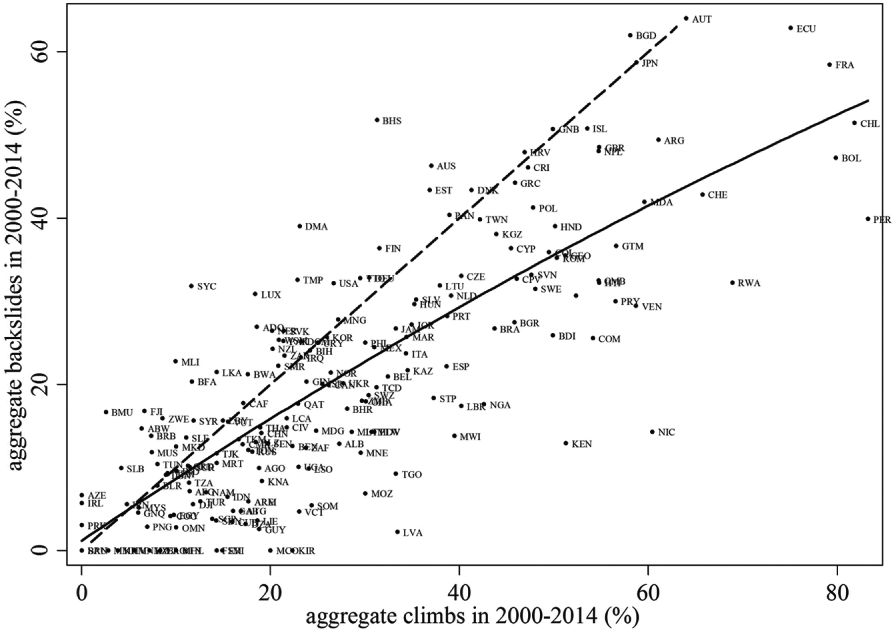
Aggregate climbs and backslides in women’s cabinet representation.

Aggregate climbs and backslides in women’s legislative representation.
Figure 9 checks the robustness of the argument that backslides and climbs are larger in cabinets than in legislatures. It presents the percentage of countries with backslides in each year, where representation is defined in terms of absolute numbers—number of women in the cabinet—rather than percentage. On average, 18.7 percent of countries experienced a net decrease of one woman from the cabinet, 8.5 percent experienced a net decrease of two, and 3.6 percent experienced a net decrease of three.

Aggregate backslides in women’s cabinet representation, absolute values.
In the preceding analysis, we have defined climbs and backslides as a change of at least two percentage points in year t with respect to year t – 1. Given that cabinets are relatively small institutions, we can also recalculate climbs and backslides using a higher, 10 percent threshold. In this analysis, a change registers as a climb or a backslide only if the percentage of women changes by at least 10 percentage points. Figure 10 shows the percentage of countries with climbs and backslides for each year using both the 2 percent threshold and the 10 percent threshold. When employing the higher threshold, the percentage of countries with cabinet climbs (7 percent on average across the 2000–2011 period) is greater than the percentage of countries with legislative climbs (2 percent on average). In terms of backslides, an average of 4 percent of countries experience a backslide each year, while 0 percent of legislatures backslide on average. In summary, even when using this higher threshold, there is evidence of greater average volatility in cabinets.
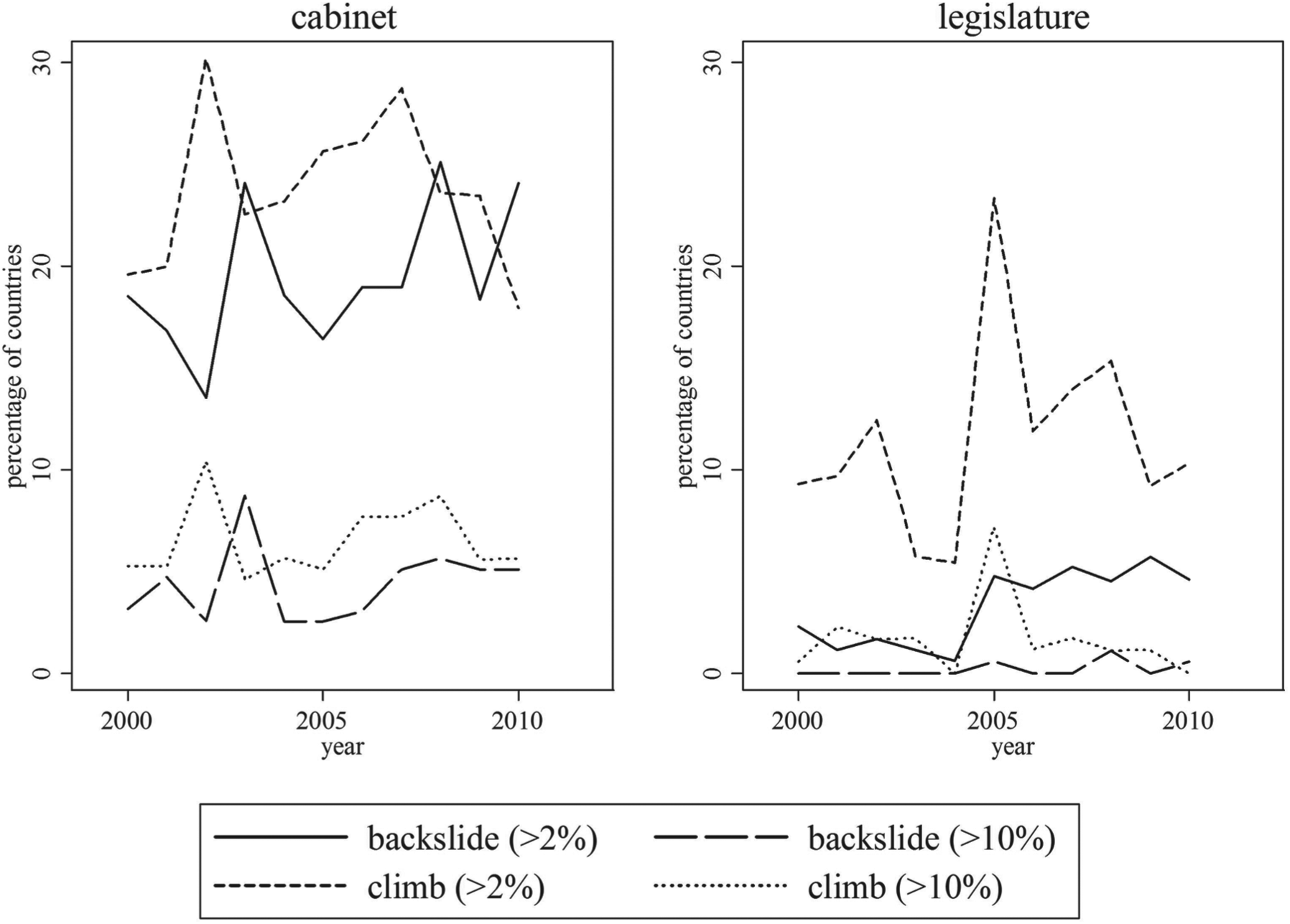
Aggregate climbs and backslides, robustness check.
This discussion establishes that women’s cabinet representation is different than women’s legislative representation. Cabinet representation is disproportionately characterized by see-sawing—interspersed periods of climbing and backsliding. Legislative representation is characterized by ratcheting. See-sawing is particularly important, we posit, because backsliding erodes progress toward gender equality. In this sense, we pick up on Darhour and Dahlerup’s (2013:133) concept of “sustainable representation of women in politics,” which they define as “durable, substantial numerical political representation of women, freed of the risk of immediate major backlash.” We suggest that the absence—or at least the reduction—of backsliding can help to indicate the sustainability of women’s representation.
Normative and Analytical Implications of Cabinet See-sawing
Having established that ratchet effects tend to characterize legislatures and that see-sawing is more common in cabinets, we now explore the normative and analytical implications of these distinctive temporal dynamics. We pursue two general arguments. First, we suggest that the effects of these different patterns are conditioned by legislative-executive dynamics in particular states. See-sawing, we suggest, could be particularly troubling in countries with dominant executives. Second, given the extent of see-sawing within cabinets, we should be wary of measures of women’s cabinet representation and women’s political empowerment more broadly that rely on cross-sectional snapshots.
The extent to which cabinet see-sawing is of normative concern depends to a large extent on the power balance between states’ legislative and executive branches. As Paxton and Hughes (2017:154) note: It is . . . important to ask whether women’s representation in ineffective national legislatures that serve under the thumb of a dictator should be treated the same as women’s representation in an elected body that checks the power of the head of state. If the legislature has no real power and instead serves as a rubber stamp, does women’s political representation still matter?
This idea is germane to the current context. If power is steadily embedded in a legislature, then the fact that women’s legislative presence tends to lock in over time is arguably good news for people concerned with increasing women’s access to power. Of course, most countries are a long way from legislative gender parity, and some countries are approaching parity much more rapidly than others. But if legislatures are institutionally strong, the long temporal arc would seem to bend toward gender equality.
If, however, inter-institutional power balances are shifting toward executives, then legislative ratcheting is less relevant. Indeed, legislative ratcheting may be illusive and misleading: Without a reliable foothold in relevant power corridors, the symbolic and substantive effects of women’s representation may fail to materialize. The risk in such a situation would be analogous to the one faced by women in state-socialist regimes during the Cold War. Leninist single-party states during that era steadily incorporated women into their legislatures. But communist legislatures were glorified rubber stamps, and women were consistently underrepresented in the party-based collective decision-making venues (e.g., politburos) that really mattered (Matland and Montgomery 2003). In all contexts, we must take seriously the facts that power resides in multiple institutions and can shift over time: If executives are gaining power at the expense of legislatures and if women’s foothold at the heights of executive branches is disproportionately fragile, then the long moral arc may not be bending toward justice; it may, rather, be inflecting haphazardly.
These considerations are particularly relevant at a time like the present, when signs in multiple world regions point toward executive ascendance. Of course, the global picture is complex: In some countries, legislatures are gaining power vis-à-vis executives. In others, the opposite is true. And in still others, a more or less stable equilibrium is persisting. But can we make any meaningful global generalizations about the relative power of legislatures and executives worldwide?
On the legislative side, political scientists have only recently established indices of legislative power that facilitate cross-country comparison. Fish and Kroenig (2009), for example, have examined effectively all countries in the world based on 32 dichotomous indicators. Their resulting Parliamentary Powers Index (PPI) facilitates insights into the relative power of one country’s legislature versus any other country’s legislature at a single historical moment (e.g., mid-2000s). Chernykh, Doyle, and Power’s (2017) Weighted Legislative Powers Score (WLPS) aims to improve on the PPI by stressing that some of its 32 indicators are more important than others. The PPI and the WLPS are analytically useful, but as their respective creators clearly admit, they only offer cross-national snapshots. What is clear in the case of both indicators is that some legislatures are dramatically more powerful than others: For the PPI (which runs from 0 to 1), the minimum value is 0, the maximum is 0.84, the mean is 0.49, and the standard deviation is 0.20. For the WLPS (which runs from 0 to 6), the corresponding figures are 0, 5.93, 3.55, and 1.41.
Because neither the PPI nor the WLPS can (yet) generate insight into legislative powers over time, we are left to speculate about the extent to which the world’s legislatures may be gaining or losing influence. As Fish (2006) has noted, there is a strong positive correlation (r = –.92, p < .001) between PPI and democracy (the coefficient is negative since high PPI scores denote strong legislatures and low Freedom House democracy scores denote strong democracies). And democracy, considered globally, is not thriving. Freedom House’s 2017 Freedom in the World report, for example, emphasizes that “2016 marked the 11th consecutive year of decline in global freedom” (Freedom House 2017). The World Justice Project’s Rule of Law Index (World Justice Project 2016) and the Economist Intelligence Unit’s Democracy Index (EIU 2016) offer similarly grim assessments. In advanced industrial democracies, signs of “democratic deconsolidation” (Foa and Mounk 2017) are widespread. Populism and personalism are surging across many geographical contexts, and otherwise diverse executive leaders are spearheading similarly consequential plebiscitary end runs around their respective legislatures: The United Kingdom, Hungary, Colombia, Italy, and Turkey are but a few of the latest cases of such dynamics. It might be tempting, based on these developments, to conclude that legislatures are on the defensive. But such a claim would be premature at best. Fish’s (2006) causal arrow, after all, runs from legislative strength to democratic strength, not the other way around. While weak legislatures tend to produce weak democracies, and while the logic linking weak(ening) democracies to weak(ening) legislatures is not difficult to develop, there is not yet systematic evidence of such a link.
Even if there were clear evidence of global legislative weakening, one could still plausibly ask whether such weakening would necessarily imply executive strengthening and/or more specifically, cabinet strengthening. The contemporary world certainly presents many signs of “aggressive executives”; the plebiscitary reflex is just one example of this. In the United States, to take another important example, there is a rich literature documenting the rise of the “imperial presidency” (e.g., Schlessinger 1974), the legislature’s progressive delegation of authority to the executive (e.g., Schoenbrod 2008), and the general unwinding of legal liberalism (e.g., Posner and Vermeule 2010). In the European Union, concern about the presidentialization of domestic politics (Poguntke and Webb 2005) and the EU’s democratic deficit (Norris 1997) have persisted for decades. While the European Parliament (EP) has undeniably gained power in recent decades (Hix and Høyland 2013), concern about the relative strength of executive and “purely” legislative actors in EU governance persists. Mair (2013), for example, suggested that the EU was designed to isolate executives from the kinds of (legislative and other) political pressures that characterized domestic politics, and the recent assertiveness of national executive leaders in EU decision making (Bickerton, Hodson, and Puetter 2015) may marginalize both the EP and national parliaments in European politics. Strong signs of dominant and ascendant presidencies have also emerged in African, Latin American, and Asian contexts (e.g., Muriaas and Wang 2012; Prempeh 2008; Rose-Ackerman, Desierto, and Volosin 2011; Van Cranenburgh 2011).
At this point, however, cross-national time-series data do not unambiguously support the notion that executives are gaining strength. Superficial examination of Polity IV’s Executive Constraint (XCONST) variable (Marshall, Jaggers, and Gurr 2015)—which is the most relevant available measure of executive power across countries over time—bears out this claim. XCONST values run from 1 to 7; higher variable values indicate a more constrained executive, where legislatures, judiciaries, parties, councils of elders, and other actors are able to limit executive power. The mean values displayed in Figure 11 show that worldwide, on average, constraints on executives have never been stronger. Again, though, aggregated trend lines can be deceiving. Zooming in on the period between 1995 and 2015, the disaggregated global picture is mixed: The median country received the same XCONST score in 2015 as it received in 1995. Thirty-one coded countries (led by Niger, Nepal, and Pakistan) had lower scores (e.g., stronger executives) in 2015 than they had in 1995. Ninety-five countries (including all G7 countries and all BRICS countries except Russia) had the same scores in 1995 and 2015, and 24 countries (including, surprisingly, Russia and less surprisingly, Serbia, Indonesia, and Cuba) had higher values. While the number of “decreasing countries” is higher than the number of “increasing countries” (suggesting that there are more countries in 2015 that had stronger executives than they had in 1995 than the opposite), the global picture is more muddled than newspaper headlines or country-/region-specific lines of inquiry would lead us to believe. This muddle is compounded by the notion that there is not necessarily a perfect correspondence between “executives” and “cabinets.” Even within countries whose executives have been gaining strength, which particular members of the executive have benefitted? If cabinet ministers have gained power at the expense of, say, legislative committees, then attention to cabinet dynamics is critical. If, however, chief executives have usurped power from both legislatures and cabinet ministers, then such attention may be misplaced.

Executive constraints worldwide over time.
Analytically, what do these observations portend? How might researchers interested in women’s political empowerment grapple with these complexities? It is certainly too early to suggest that the world’s legislatures are on the ropes, that we are living in an era of unambiguous executive domination, or that we should be deeply and universally dismayed by cabinet see-sawing. But it is equally clear that some countries’ institutional balances are heavily and/or increasingly tilted toward executives and that an appreciation for the nuances of domestic institutional balances should factor into cross-national assessments of women’s political empowerment. A number of researchers have attempted in recent years to devise measures of empowerment that reflect developments in multiple institutions. Högström (2012), for example, incorporates a snapshot of women’s representation in legislatures and cabinets (in 2008) into his measure of “women’s representation in national politics,” and the World Economic Forum’s annual Global Gender Gap reports use annual snapshots of legislative and cabinet representation alongside a more time-sensitive account of years that women heads of government have served (World Economic Forum 2016). We are suggesting here, though, that snapshots are potentially problematic, especially with regard to cabinets, as women’s representational gains often fail to lock in. Scholars interested in large-N comparisons of women’s political empowerment, we suggest, would benefit from incorporating both time and inter-institutional balances into their assessments. Measures that accounted for these variables would give a much clearer signal of the consolidation of women’s political gains and the likely sustainability of women’s political representation.
Which Factors Affect Cabinet Ratcheting?
Bearing in mind the importance of inter-institutional balances, the relative prevalence of cabinet see-sawing suggests that women’s political gains are still less than entirely secure. Particularly when cabinets are gender volatile and legislatures are politically marginalized, women may be less politically empowered than the upward sloping global trend line implies. Having sounded this caution, it is important to note that not all countries experience cabinet see-sawing. Diverse states in sub-Saharan Africa (Lesotho, Malawi, Mozambique, South Africa) and Europe (Denmark, Finland, and Norway, but also Malta), for example, have all experienced limited cabinet backsliding in recent years. Such cases suggest that while cabinet formation may be a more idiosyncratic process than legislative formation, there may still be factors that limit the “gender discretion” of heads of government and promote gender parity over time. In the future, researchers should seek to identify these factors that promote cabinet ratcheting. While systematic hypothesis testing lies beyond this article’s scope, we suggest that formal institutional characteristics, leader and government characteristics, and the strength of gender equality norms might account for differential temporal patterns in women’s cabinet presence.
Formal institutional characteristics
Drawing primarily from cross-sectional and case-based analyses, we expect that certain formal political institutions might be more compatible with ratcheting than others. Several scholars (Bauer and Okpotor 2013; Claveria 2014; Davis 1997; Escobar-Lemmon and Taylor-Robinson 2016; Siaroff 2000; Stockemer 2017) have shown that the rules governing who can serve as a minister influence the proportion of women ministers at any particular moment. Some constitutions require cabinet ministers to hold legislative mandates. Countries with this method of recruitment are often called generalist systems since ministers in such systems are often selected for their political experience rather than their mastery of particular policy sectors. Other systems prohibit ministers from serving in the legislature; these systems are often called specialist systems since ministers tend to be selected for their expertise in specific issue areas. There are also “hybrid” constitutions that permit (without requiring) ministers to be legislators and/or mandate that some percentage of cabinet seats must be allocated to legislators. 3 In systems with a particularly tight fusion of powers—where ministers must be drawn from the legislature—we might expect less cabinet backsliding. Insofar as chief executives in such systems take descriptive representation in the legislature as a parameter affecting cabinet construction and insofar as legislatures tend to be characterized by ratcheting (e.g., either plateauing or progress in women’s descriptive representation), we would expect generalist systems to have less cabinet backsliding than specialist systems.
For tightly fused generalist systems, the rules governing the recruitment and selection of legislators have a direct role in shaping the pool of eligible ministers. Electoral systems, party selection methods, and gender quotas have all been shown to affect the number of women in the legislature. States with proportional representation (PR) electoral systems (Caul 1999; Matland 1998; Rule 1997) and gender quotas (Krook and O’Brien 2012; Tripp and Kang 2008) generally have a larger proportion of women in the legislature, which can influence cabinets in direct and indirect ways. Again, a larger supply of potential women ministers can provide opportunities for climbs in women’s cabinet representation and inhibit backsliding. Thus, in addition to expecting tightly fused generalist systems to experience less see-sawing than specialist systems, we would also expect those tightly fused generalist systems that use PR and quotas to have more consistently high levels of women’s cabinet representation than those that lack these attributes.
Leader and government characteristics
The process of government formation depends on the values and dispositions of the head of government. While some heads of government are subject to the constraints noted previously, they still tend to enjoy a certain latitude when appointing ministers. The party backgrounds and positions of leaders and the party-political nature of the governments they lead may affect their likelihood of appointing cabinets that promote or threaten women’s representation.
The literature suggests that left leaders will be more likely to include women in their cabinets, due to left parties’ commitment to egalitarianism (Escobar-Lemmon and Taylor-Robinson 2008). Claveria’s (2014) study of 23 advanced industrial states over the past 30 years suggests that left-wing parties appoint more women than right-wing parties and that the predictive power of party ideology has increased in recent years. Thus, parties with successive left-wing governments may be more likely to experience ratcheting than those with successive right-wing governments or governments that alternate between left and right control.
Beyond the issue of party identification, countries’ trend lines may also be driven by the nature of successive leaders’ ties with their respective parties. Siavelis and Morgenstern (2008), for example, differentiate between party leaders who are insiders, adherents, and free-wheeling independents. Party insiders, they suggest, are likely to appoint ministers with strong party credentials. Given the underrepresentation of women among party elites in most countries, this fact may decrease the likelihood of women’s cabinet climbing. “Party adherents” have strong histories within well-established parties but are reform-oriented; adherents are more likely to appoint party dissidents, personal confidantes, and fellow reformers to their cabinet; theoretically, this should open more space for women. The cabinets of party free-wheeling independents, on the other hand, are “likely to be ad hoc, made up of outsiders, and based primarily on the personal networks of support” (Siavelis and Morgenstern 2008:34), which should also create openings for women. In their analysis of Latin American presidents’ appointments, Escobar-Lemmon and Taylor-Robinson (2016) find that free-wheeling independents appoint more women to ministerial posts than both insiders and adherents; there is no important difference, they suggest, between the appointment behaviors of insiders and adherents. Thus, transitions between insiders/adherents and free-wheeling independents (and vice versa) may promote see-sawing.
Additionally, parliamentary arithmetic and the (non)necessity of assembling governing coalitions may affect the extent of ratcheting a country experiences. As Krook and O’Brien (2012) have suggested, governing coalition size may affect temporal dynamics in the cabinet. Given a relatively finite number of cabinet positions, the greater the number of parties in a cabinet, the fewer party members any one party can appoint to the cabinet. Because party leaders tend to be men, it may be more difficult for women in large-coalition contexts to take on cabinet seats. Thus, ratcheting may be more common in countries where single-party governments are the norm.
Overall, we might expect countries with dominant left parties, countries with few transitions between insiders/adherents and free-wheeling independents, and countries with norms of single-party cabinets to experience cabinet ratcheting.
Strength of gender equality norms
Informal norms regarding gender equality and gender-balanced decision making might also affect the strategic calculations of heads of government and promote cabinet ratcheting. Such norms might be primarily domestic or international in origin. Domestically, there are at least two possible mechanisms of norm transmission. First, quotas in institutions besides the cabinet (e.g., legislatures, parties, and corporate boards) might create expectations about the importance of women’s presence and gender balance (Thames and Williams 2013). Heads of government may feel more constrained in contexts where quotas in other institutions have been adopted, independent of the countries’ constitutional fusion or separation of powers. Second, feminist groups might consistently champion gender-balanced decision making. In their case-based study of women’s cabinet participation, Bauer and Tremblay (2011) argue that women’s cabinet gains would not be possible without women’s organizations that promote women’s political representation. Htun and Weldon’s (2012) study of legislation addressing violence against women similarly suggests that feminist movements can constrain policymakers’ behavior by holding public officials accountable for stated commitments to gender equality and calling attention to practices that violate these norms. Mobilized movements can sanction public officials who violate uncodified but important rules about cabinet composition (Franceschet et al. 2017).
Building on this logic, we might expect that countries with women’s movements focused squarely on women’s political representation will experience more ratcheting than countries lacking strong, autonomous movements committed to gender balance. Women’s movements, on this view, may provide a baseline for women’s inclusion that prevents large declines in women’s representation. Where movements are weak, dispersed, and focused on issues not directly related to representation, on the other hand, we would expect to see more cabinet see-sawing.
Normative constraints on executive discretion might also emerge from regional and broader international contexts. Jacob, Scherpereel, and Adams (2014) show, for example, that levels of women’s representation among neighboring states, levels of women’s representation among intergovernmental organizational partners, and years since ratification of the Convention on the Elimination of All Forms of Discrimination against Women are positively associated with a country’s level of women’s cabinet representation. As in the case of strong domestic feminist movements, countries’ exposure to international norms—through international protocols, participation in intergovernmental forums, and reliance on foreign aid—may increase the reputational costs of see-sawing and help to lock in women’s cabinet gains.
Conclusions
National legislatures and cabinets matter as sites of symbolic and substantive power, and both institutions deserve close scrutiny by scholars of women’s representation. But legislatures and cabinets matter to different extents in different moments across different countries.
The fact that inter-institutional balances are fluid is analytically formidable but exciting. We have argued here that legislatures and cabinets tend to be characterized by different temporal dynamics—legislatures tend to experience a ratchet effect, while cabinets often experience a see-saw effect. The implications of this difference depend on countries’ respective institutional settings. While advocates of gender-balanced decision making in two countries with see-sawing cabinets may be similarly frustrated, the symbolic and substantive stakes of see-sawing will likely be higher in the country with an imperial executive than in the country with a dominant legislature.
Departing from this observation, we have identified two important avenues for future research. The first avenue involves work toward a measure of women’s political empowerment that is sensitive to both time and inter-institutional power balances. A measure that incorporates the fact that some legislatures are stronger (weaker) than others and that some executives are more or less constrained by other political actors could give a more accurate sense of the potential for symbolic and substantive representation. The second avenue involves analysis of divergent temporal trends across countries and focuses specifically on why some countries are more successful at locking in women’s representational gains than others. Among other things, understanding the factors that promote ratcheting in certain countries might help to counteract the erosion of representational gains in other countries.