




Abstract
The author analyzes the implementation of diversity policies in France within a traditionally colorblind institutional and cultural context. Using a mixed-method research design, the author focuses on a specific diversity program, gathering qualitative and quantitative data on persons involved in its implementation as well as on its recipients. The author also collects qualitative materials covering institutional actors (governmental services and state agencies) and field actors (associations and economic organizations). The analyses aim to investigate two main questions: (1) What are the population categories targeted by diversity programs, and how are they referred to in the colorblind political and legal context of France? (2) How do the program’s recipients signal categories that make them eligible, and how do they interpret their disadvantage in the job market? The findings highlight the limits of diversity policies in the French colorblind context as they fail to empower both their makers and their recipients.
France is traditionally reluctant to recognize groups in the public sphere and discourages the assertion of separate subnational identities (Amiraux and Simon 2006; Calvès 2005). Policies that target race, religion, or ethnic origin are considered to be unconstitutional. 1 This makes affirmative action–style policy rather ill suited to the French political and legal system and explains the weak and fragmented state-level antidiscrimination policy (Calvès 1999, 2008; Fassin 2003).
Faced with the structural colorblindness of the state, it was the private sector that created the first tangible actions during the early 2000s, originally targeting ethnoracial discrimination and progressively establishing what since have been called diversity policies, taking cues from U.S.-style diversity management (Dobbin 2009, 2009; Doytcheva 2010; Edelman, Fuller, and Mara-Drita 2001; Kelly and Dobbin 1998).
The aim of this article is to analyze the paradox of implementing such policies within a generally colorblind institutional and cultural context. I rely on a diverse set of empirical materials covering institutional actors (governmental services and state agencies), field actors (associations and organizations involved in the implementation of diversity programs), and recipients (young people who applied to such programs). The analyses aim to investigate two main questions: (1) What are the categories of people targeted by diversity programs, and how are they referred to in the colorblind political and legal context of France? (2) How do potential recipients signal categories that make them eligible for the program, and how do they perceive the effect of their ethnoracial background on their success on the labor market?
The contribution of this article is threefold. First, although a valuable body of research describes legal and organizational aspects related to diversity policies in France, this study focuses on the ways in which ordinary actors involved in diversity programs practically refer to ethnoracial categories and how they make use of them in interactions.
Second, this article contributes to the literature on hiring discrimination, highlighting the underlying mechanisms of origin-based discrimination from the perspectives of the actors who are the most concerned or affected by them. I document the extent to which policy makers and recipients perceive ethnoracial factors as legitimate categories of inequality, how they analyze the motivations and consequences of discrimination, and the way in which they try to alleviate it or circumvent its effects.
Finally, this research also contributes to the vast literature on the role of organizations in the implementation of equality policies, which flourished in the United States in the post–equal employment opportunity era. Although evidence emphasizes how American firms have gradually adapted to the new regulation context in compliance with the law, this article shows that the French case alternatively provides an example of organizational failure. Even when designing programs that precisely aim at targeting ethnoracial discrimination, organizations seem incapable of conducting coherent and durable actions mostly because they are unable to reach out and refer to the very people that they are trying to serve. This research thus concretely shows how the French colorblind context leads to the lack of appropriation of diversity policies on behalf of both their makers and their recipients.
Promoting Diversity in French Firms: Antidiscrimination Policies “à la Française”
Although France was relatively pioneering in antidiscrimination legislation, 2 proactive policies were rather timid before the 2000s, especially when it comes to discrimination-related characteristics such as ethnic origin, skin color, and religion (Bereni and Chappe 2011; Fassin 2002; Halpérin 2008; Lochak 1987; Simon 2004). Ethnoracial inequality is indeed supposedly tackled through “common law” actions (oriented mainly against poverty, unemployment, and urban segregation) or incorporated into “immigrant integration” policies. 3 Since the 1980s, the latter have been devised in close collaboration between several government ministries, those dealing with social and urban affairs having played an especially crucial role (Safi 2014). Immigration and integration policies mainly involved local field actions conducted by associations, nongovernmental organizations, and other civil society actors supervised and financed by public or state agencies. They have traditionally targeted disadvantaged neighborhoods where unemployment and poverty rates are high. The concentration of minority populations allows this territorial targeting to indirectly reach out to second- and third-generation immigrants, often referred to as “youth in disadvantaged neighborhoods” (“jeunes des quartiers”) (Doytcheva 2007; Kirszbaum 2004; Simon 1999).
The French Republican model not only forcefully rejects ethnicity, race, and religion as grounds for political organization and claims-making but also as the basis of categories in public, administrative, and firm-level statistics (Simon 2008a). This makes it difficult for ethnoracial inequality to be documented through representative data and for ethnoracially based affirmative action to be enforced (Simon and Stavo-Debauge 2004). Since the 1990s, repetitive controversies over the necessity and legitimacy of the introduction of such categories have spread within the academic sphere and beyond, in what has come to be called the debate over “ethnic statistics” (Felouzis 2008; Héran 2010; Simon 2008b).
Yet considerable improvement has recently been achieved through the introduction of parental birthplace in some crucial public statistical surveys 4 (such as the Labor Force Survey since 2005, the Trajectories and Origins survey in 2008, etc.). Broadening the definition of migrant background beyond the first generation opened the way to new evidence on origin-based inequality (Aeberhardt et al. 2010; Aeberhardt and Rathelot 2013; Aeberhardt, Rathelot, and Coudin 2010; Frickey and Primon 2006; Meurs, Pailhé, and Simon 2006). Most studies highlight the disadvantage of first- and second-generation immigrants from North Africa (also referred to as Arabs or Maghrebi) and sub-Saharan Africa in the labor market, in the housing market and to a lesser extent in schools (Safi 2013). These conclusions have been confirmed in increasingly sophisticated paired-testing studies and expanded to nonmigratory categories such as religion and skin color (Adida, Laitin, and Valfort 2014; Cediey and Foroni 2008; Petit, Duguet, and L’Horty 2014; Valfort 2015). This has contributed to raising political awareness of discrimination and its role in hampering the employment opportunities of ethnic minorities in France (Fassin 2006; Simon 2009). It has also increased the pressure on public policy to specifically target this type of discrimination. In the early 2000s, this pressure was triggered by two other important factors:
the enhancement of European incentives toward the implementation of such policies (Calvès 2005; Guiraudon 2004) and
the emergence of antidiscrimination initiatives stemming from the private sector with noticeable personal involvement of influential CEOs 5 (Bereni 2009; Doytcheva 2009).
This new context has created an antidiscrimination turn in French politics. In 2001, an antidiscrimination public agency was formed with the aim of centralizing the reception of complaints about all forms of illegal discrimination. 6 Most of the reported incidents of discrimination were related to the workplace, and a considerable share mentioned ethnic or racial motivations. Other proactive antidiscrimination initiatives directly targeting ethnic minorities emerged within the economic sector. A “diversity charter” was established in 2004 and quickly supported by the state. It contains a concrete commitment to general antidiscrimination, specifically with regard to human resource management. This initiative extended to the more ambitious project of the “Diversity Label.” Created in 2008, it is a state-recognized label issued after an audit conducted by a commission composed of representatives of the state, unions, employers, and diversity experts. To acquire the label, organizations that apply must prove that their antidiscrimination actions and practices meet the label’s general requirements. More than 350 organizations have been labeled since 2008.
Similar to the development of diversity management in the United States, the implementation of such policies in France draws on the central justification that ethnic minority is good for business (Bereni 2009; Doytcheva and Alaoui Hachimi 2010; Noon 2007). It is also framed as soft-power policy in contrast to more aggressive forms of antidiscrimination claims based on legal and civic equality principles (Junter and Sénac-Slawinski 2010). Such framing is largely inspired by the “retheorization” of employment affirmative action policies on the basis of business and market rationales, with U.S. managers increasingly justifying them as an organizational enhancement of productivity and workers’ loyalty rather than a means of regulatory compliance (Dobbin 2009; Kelly and Dobbin 1998; Sutton and Dobbin 1996). As analyzed in myriad U.S. studies on the topic, this led to the relative resistance of these policies to backlash against civil rights, primarily during the Reagan administration (Dobbin and Sutton 1998). Conversely to the U.S. case, the effectiveness of French diversity policies in alleviating discrimination practices toward ethnoracial minorities has been called into question. Some studies highlight their weak legal prescription and the absence of standard sets of good practices (Bereni 2011; Simon and Escafré-Dublet 2009). There is nonetheless still little research that concretely documents the drawbacks of such policies and explains their ineffectiveness in practice.
Analyzing the day-to-day execution of a concrete diversity program, in this article I aim to bridge this gap. I seek to highlight the paradox of implementing diversity policies in a context in which diversity categories do not exist. I also describe the practical consequences of such a paradox on the scope and efficiency of these policies. How is ethnoracial disadvantage framed, and what types of population categories are used as policy targets? To what extent do programs’ recipients signal their ethnoracial background and perceive it as legitimate category of equality? I try to answer these questions using empirical materials describing actions and perceptions of different actors involved in such policies.
Data and Methods
This study builds on a mixed-methods design involving field research and qualitative interviews on one hand and the collection and exploitation of quantitative data on the other hand. Collected on different actors involved in diversity policies in France, the empirical materials are threefold:
A long-term field study within a private nonprofit organization that has been a main actor in diversity policies in France (this organization is referred to using the acronym DO, for Diversity Organization). DO’s work is oriented mainly toward promoting the social role of businesses and guaranteeing equal access to employment. The organization’s activities include a variety of programs that target employers and firms, potentially discriminated populations, and French society in general through awareness campaigns. The focus of this study is on a particular DO program, quite innovative at the time, that specifically aimed to enhance the employability of visible minorities. 7 The program took a three-stage approach: a sourcing stage (call for curricula vitae [CVs] from visible minority job seekers 8 ), a matching stage (matching CVs with job offers received from DO’s corporate partners 9 ), and an interview stage (arranging interviews for the matched candidates and coaching them). The program also regularly organized employment forums in which job applicants communicated directly with employers. Most activities related to the program were organized in the Parisian region, although some job seekers applied from other regions in France. The DO program lasted for six years (2005–2011), with rather modest results. According to the organization’s official documentation, it achieved about 500 recruitments. The evolution of the types of jobs offered is a clear indicator that the program was running out of steam; there was an increasing tendency toward unstable employment such as internships or temporary job contracts, 10 as well as an increasing focus on coaching and organization of employment forums rather than direct matching of candidates with job vacancies. Several visits to the organization in 2013 and 2014, along with in-depth interviews with the main persons in charge of the program, allowed me to gather a diverse range of material, comprising documentation, informal conversations, and about 15 hours of recorded interviews.
The data also include materials collected on beneficiaries of DO’s diversity program. Having been granted authorization to access archives of CVs sent by applicants to the program, I coded information from the CVs about applicants’ sociodemographic and professional profiles (n = 638). 11 Some CVs were attached to letters of motivation. DO also provided me with a list of persons who benefited from the program; most of them attended forums or had job interviews arranged within the program. Some of them agreed to be contacted for interviews (n = 23).
Finally, some in-depth interviews also covered governmental and civil service actors involved in antidiscrimination policies (governmental and municipal officers, state agencies, representatives of associations, etc.) (n = 7).
Findings
Whom to Target? Nonblind Targeting in Colorblind France
What Are We Talking About? Naming and Identifying Recipients
French antidiscrimination policy makers lack the concepts and the vocabulary to tackle ethnoracial discrimination. The difficulty of naming ethnicity and race is very clear in all the interviews conducted in this study. Instead, one may note the use of a wide variety of expressions indirectly referring to minority populations. The most frequent one is “population stemming from migration,” which is widely used, in both the political and scientific fields, as a politically correct reference. Some interviewees make the use of the word youth with a generic ethnoracial connotation, especially when associated with the word neighborhood (the “neighborhood youth”). Other expressions used include “populations with foreign origins” and “specific population categories.” 12 In rare cases, interviewees also spoke of “visible minorities.”
This issue of naming goes hand in hand with the issue of identification, or what interviewees usually refer to as the “invisibility” of the target audience or the difficulty in “finding” the target audience. This is constantly repeated by Sarah, the director of the DO program under study. Sarah, who has a master’s degree in human resources and who has been deeply involved in the program since its very beginning, stresses that proactive diversity actions are confronted with the issue of “stamping” (to use her own word), that is, marking the program’s beneficiaries as such. This argument is frequently used by firms she approaches, which keep complaining about not being “well equipped” to “find young people” whom they “would be happy to recruit.”
The limitation of official migratory categories (such as birthplace or nationality) and their ambivalent relations to ethnoracial categories are also frequently emphasized. Many of the interviews indeed express a sort of tension between diversity policies on one hand and immigration and integration policies on the other hand. After having worked on a report on origin-based discrimination, Lila realized she needed to make a “clear distinction” between these two policy areas: “It is true that I became aware of the issue of immigration and migration flows . . . when I presented the study and people were talking to me about immigrants, but I said, ‘What are we talking about here?’”
This issue of “identification” is also frequently associated with the official illegality of ethnic statistics in firms, as clearly raised by Sébastien, a senior civil servant working in the field of employment within a ministerial department.
The problem is to identify the public because you talk about the public but who are they? Are they people who just arrived, are they foreigners . . . er . . . are they immigrants? Therefore, the problem is about statistically identifying these people, which is very difficult to do.
Many interviewees denote the discrepancy between theory and practice in this regard, reporting examples of indirect use of such statistics. The most widely used methodology relies on employees’ surnames. These practices are referred to by Sébastien as “good practices” that can “help identify” the population of interest. Lila, a civil society representative at a French public agency, clearly describes the de facto ethnic statistics as a diversity monitoring strategy:
Some companies told me, we use ethnic statistics on the side, hiding in the corner of our office, while counting our staffs . . . er . . . er . . . according to their patronymic consonance and then we conclude . . . here it is, we have as much diversity as that!
Sylvie, who is in charge of diversity programs at DO, nonetheless points out the drawbacks of surname-based approaches (“just because your name is not foreign-sounding does not mean you won’t be black or Asian,” she says) and describes alternative ways in which firms try to bypass official constraints using “questionnaires on perception of discrimination” and subjective “belonging to an ethnic group.”
Thus, diversity policies are clearly confronted with an identification issue, making the implementation of antidiscrimination actions that fit within a generally colorblind framework a real challenge. This context reduces the possibility of naming, targeting, and communicating about these actions.
Playing with the Limits of Nonblind Targeting: The DO Program
Although the DO program under study was designed within the institutional and cultural background described above, it was also intrinsically related to the burgeoning diversity policies in France and was originally an overt attack on ethnoracial discrimination. A crucial step was the publication of the “Fauroux Report” in 2005, which states things in an unusually direct and provocative way: “Discrimination towards North-Africans and Blacks, to call a spade a spade, whether they are French or not, is practiced widely and with impunity in the labor market” (Fauroux 2005:1). DO’s earliest engagement in diversity actions belong to this general dynamic and relied on communication campaigns that were very clear about targeting “visible minorities,” which was at the time quite new in the French policy landscape. “Visible minority” is nonetheless never defined as a policy category in France (conversely to its use in Canada, for example). The interviews show that the meaning of this expression is conveyed using negation rather than direct references. First, as Sarah clearly states, the targeted recipients should not be “migrants” or “foreigners”; the use of the expression “visible minority” thus denotes a strategy of demarcation vis-à-vis the widespread use of migration categories:
It’s not that I didn’t want to help young foreigners. It’s simply not our target. It was young people with foreign origin that we were interested in. . . . The idea of the project is to help those who were born in France, grew up in France, studied in France. That was emphasized by the project founders. Let’s focus on our fellow citizens first before the others.
Visible minority also means that the targeted recipients should not be Europeans/whites, as shown in an episode described by Sarah:
There was a Dane who had contacted me. It slipped through my fingers. These things happen, because I process 800 CVs. So I invited her to a forum. And this young woman obtained three internships at the end of the forum. So I was angry. Not just upset. Really pissed off. Because this young Danish woman, she took the place of someone. It was obvious she ended up there by mistake.
Even if the program clearly refers to “visible minority” as the targeted recipients, ethnicity remains rarely framed as directly discriminatory. When communicating on its activities, DO usually associates this expression with more legitimate categories of discrimination that are more socioeconomic in nature (the program claims to target “college educated youth from sensitive neighborhoods 13 and/or visible minorities”). Three mechanisms are often cited as underlying factors in ethnoracial disadvantages: educational, territorial, and sociocognitive.
Educational Factors
The program’s priority is to reach out to educated visible minorities (two to five years of college). According to Sarah, this strategy is intended to fill the gap of exclusively low-skill-oriented employment policies (“The non-educated . . . we always look after them!”). It is also an acknowledgment that discrimination hits the educated minority (“Because education does not protect from discrimination!”). Sarah also justifies this focus on the most educated as a communication strategy highlighting minorities’ skills and talents and their drive to “do well,” contrary to their widespread representations by the media as “idle young people who don’t know where they are heading, lost, exclusively living in suburbs.”
Moreover, the reference to educational mechanisms draws on a central opposition between public universities on one hand and elitist “grandes écoles” on the other hand, which is supposed to explain a great deal of minority disadvantage. Because they do not have the economic, social, and cultural capital that enhances French elites’ educational trajectories, and because they overwhelmingly attend public French universities, at which selection is low and job prospects are limited, educated minority are trapped in relegated and low-promise tracks. Educational mechanisms are so closely tied to ethnoracial disadvantage that they have gradually overshadowed it as more diversity policies have been implemented. As asserted by Sylvie, who is currently in charge of several equality programs at DO, more recent projects are increasingly aimed directly at “increasing youth’s educational achievements and reinforcing job prospects for university students.” Such recent programs are designed within a totally colorblind framework.
Territorial Factors
Drawing on French official territorial categorization, the DO program also explicitly uses geographic targeting. Sylvie argues its practical advantage—as targeted recipients “are strictly speaking from a neighborhood targeted by urban policies”—and stresses the ways in which this facilitates the reporting and evaluation of the program. Territorial origin is also used as a euphemism, in a context in which it is much more accepted than ethnoracial categorization. Philippe, head of equality programs in a French public agency, clearly presents it as a default solution:
We had to accept this . . . we found ourselves faced with walls. . . . I remember at the time the urban inter-ministerial delegation . . . said nope . . . this is great but you just remove this ethnic thing, uh, uh, the ethnic minority thing, and you replace it with neighborhood . . . and it is perfect. You see . . . at one point . . . I think everyone aligned with this a bit!
References to urban mechanisms also relate to the general framing of ethnic/racial discrimination as closely tied to spatial disadvantage. Using Sarah’s words, “the French with French origins who . . . live in difficult areas have the same issues as young French people with foreign origin.” As analyzed by Philippe, this spatial and socioeconomic reductionism has “rendered the question of blacks and Arabs invisible, which is the question that poses problems in this country.” Sylvie engages in this sort of spatial and socioeconomic reductionism of ethnoracial inequality when I ask her why she thinks that visible minorities are disadvantaged:
I’ll tell you honestly I think it’s, it’s multiple causality. Young people are often discriminated against because they live in a neighborhood and they just happen to be black in addition . . . and they just happen to have been to the university . . . but, what I want to say, uh honestly I can’t say what criterion is predominant.
Sociocognitive Factors
Ethnoracial inequality is also very often associated with sociocognitive factors. They consist in referring to “cultural” mechanisms and mental processes that hinder access to opportunity for ethnic minority youth (DiMaggio 1997). Sarah very frequently refers to these kinds of factors as being an issue of “codes” of which she progressively became aware, not without some disappointment: “I was quite disappointed. I thought that those youths, they knew how to behave, they got the codes!”
The focus on this code problem conveys a colorblind understanding of cultural capital and its close association with educational training (“universities did not teach them these codes,” Sarah adds). This sociocognitive vocabulary used to explain ethnoracial disadvantage has increasingly oriented policy actions toward coaching and training rather than direct access to jobs. Helping these youth can thus be done through a code acquisition process, as described in an example Sarah gives:
They [employers] told me that the applicant is technically good but she doesn’t have some codes. I did not know what that was about. So, they found her a job sponsor. It was a lady with an ENA
14
degree. . . . She trained her. And even on Saturday she would take her to the museum to broaden her knowledge.
All in all, although originally engaged in designing and implementing programs that target visible minorities, DO’s actors hardly use the language of race and ethnicity in their narratives, elaborating instead on educational, territorial, and sociocognitive explanations. This tends to blur their original aim and weaken the scope of their actions.
The Limits of Colorblind Antidiscrimination: Measurability, Accountability, and Competing Categories
Although the difficulty of naming and targeting was overcome to a certain extent in the first phase of the program, it increasingly resulted in structural constraints and deep frustrations that at least partly lie behind its gradual weakening and ultimate suspension. This occurred within a period during which Sarah tried to establish a more engaging large-scale program and therefore sought support from both the state and the private sector. She was surprised, and certainly disappointed, to notice the great reluctance her idea was received with from both sides. She relates the failure of the experiment to a more general paradox: the implementation of diversity policies, and in a sense their success, in a context where no operational definition of the targeted population was used, has slowly demolished their capacity for establishing powerful actions targeting ethnoracial minorities. Indeed, when small-scale actions based on the voluntary engagement of a few businesses, similar to DO’s method, became institutionalized through the diversity charter and label, the targeting problem described above was doubled by the even more problematic issue of reporting. In the absence of operational categories, there was no way for firms to incorporate actions designed to diversify the ethnoracial composition of their workforce in their administrative assessments. This paradox intensified with the expansion of the scope of diversity policies, creating intense competition and increasing tension between categories of discrimination. Indeed, the majority of my interviewees constantly contrast the inefficiency of “origin-based” actions, which are “still very complicated to address in the workplace,” to the increasing focus on “the disabled,” “seniors,” and “women,” for which “there’s either laws, quotas or agreements.” Lila points to this problem of accountability as a major factor of the gradual abandonment of “origin-based” diversity actions as firms “ended up saying anyway we can do nothing for them, they don’t reach out to us, and anyway when we take actions we cannot assess the utility of our actions since ethnic statistics are not allowed.”
This drowning of ethnoracial discrimination in the course of the institutionalization of diversity policies was interpreted by Sarah as a gradual “diversion” of the Charter of Diversity from “its main aim.” This argument was also used by Lila while trying to convince other members of the agency at which she is a civil representative of the legitimacy of dedicating her report exclusively to ethnoracial diversity policies:
They [other members of the agency] told me that it wasn’t only about youths with immigrant backgrounds, but that diversity is also men and women, the disabled, and all that. I said yeah but when the charter was established it does not mention that at all. . . . Consequently, the charter itself has been driven away from its initial recipients and . . . er . . . not only it was misrepresented, but also we’ve completely forgotten the audience that was originally targeted.
This reality leads most of the interviewees working in the public or civil society sector to be quite skeptical about the efficiency of any action in the field of ethnoracial antidiscrimination altogether. As Philippe, head of equality programs in a French public agency, puts it,
As long as we do not have access to such statistics . . . we won’t succeed, we will be doing much more of rhetoric than anything else. . . . You are working in a field where the question of evaluation related to discrimination remains a thorn in its side in this country due to the absence of such statistical data.
Hence, although the DO program under study was implemented with the specific aim of alleviating ethnoracial discrimination, it was confronted with structural limitations in targeting the aimed recipients. Alternative strategies drawing on other more legitimate mechanisms of inequality in explaining the sources of ethnoracial advantage were thus deployed at the cost of blurring the initial policy target. Broader institutionalization and expansion to other categories of discrimination contributed to weakening the value and relevance of ethnoracially based diversity policies altogether, leading to the gradual withdrawal of policy makers from the field.
Applying as Whom? Signaling or Not Signaling Categories of Discrimination While Applying to the Program
In this section I focus on the program’s recipients and attempt to describe the ways in which they refer to ethnoracial categories of discrimination. First, I use objective data from their applications to the program (CVs and letters of motivation). I also collect their perceptions and experiences of ethnoracial discrimination during in-depth interviews.
Ethnoracial Signals in Applications
Direct or indirect references to ethnic and racial background are quite rare in the CVs collected. I identify seven items in which such signals may be potentially suggested: first and/or last names, nationality, photo, number of languages cited, foreign language reported as native, professional experience abroad, and education abroad. Table 1 describes the distribution of these variables in the sample.
Potential Suggestions of Origin.

Unsurprisingly, first and last names are the biggest indicators of ethnic origin. Migratory categories are the rarest: nationality and place of birth are not mentioned in the majority of the CVs. Photos are included in 34 percent of cases. And criteria that may even represent professional assets (languages, education, or professional experience abroad) are quite rarely mentioned.
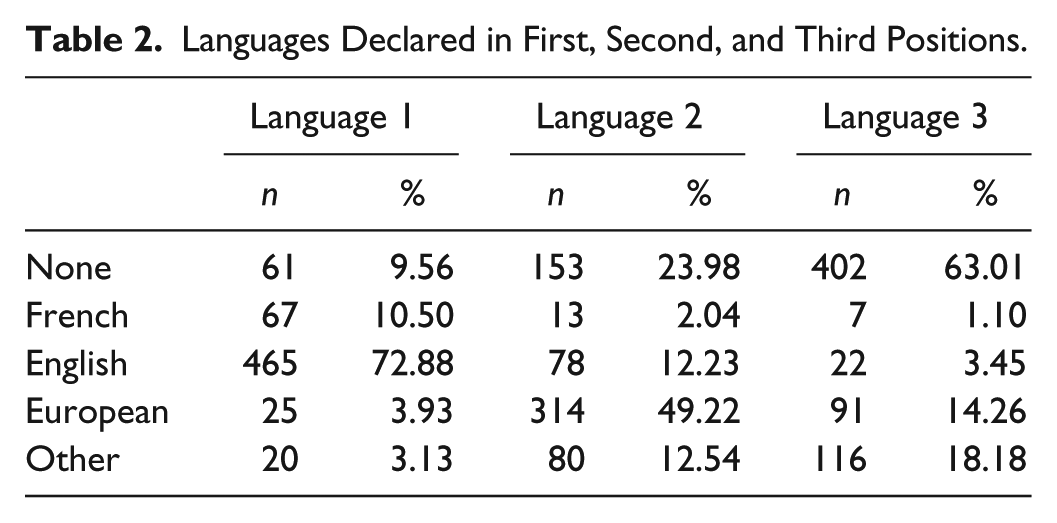
A close look at languages suggests strategic omission or at least some kind of understating of foreign origin. Table 2 compares the order of the languages listed by the applicants in the CVs’ language sections, and Table 3 focuses on languages that are reported as native. Languages mentioned are usually “foreign languages,” as French may be considered as taken for granted. Yet 10 percent of CVs do report French first in the language section, and 55 percent among them refer to it as being native. Such candidates may be assuring employers of their fluency in French in case their ethnic origins may signal lower language abilities. English is overwhelmingly cited in the first position (73 percent of CVs). More strikingly, not only are non-European languages very rarely cited, but they also tend to appear least in the languages list when mentioned (3 percent of languages listed first, 12.5 percent of languages listed second, and 18 percent of languages listed third are non-European languages). Moreover, Table 3 shows that even when non-European languages are reported as native, they tend to be at the bottom of the list. This clearly contrasts with the overwhelming North African and sub-Saharan African origins of candidates as suggested by the classification of applicants’ broad geographic origin displayed in Table 4. 15
Languages Declared in First, Second, and Third Positions.
Languages Declared as Native.

Classification of the Applicants’ Origins in Broad Geographic Regions.

These descriptive findings suggest that signaling ethnoracial background may vary according to the origin of the candidates. To test this hypothesis, I ran two regression analyses focusing on the respective probabilities of attaching a photo and declaring a foreign language as natively spoken. In addition to suggested geographic origin, the models control for basic sociodemographic variables included in the CV (age, sex, education level, economic sector, region of residence, and year of application). Full results are displayed in the Appendix; they show that aside from origin, most covariates do not exert significant effects on the outcomes of interest. 16 Figure 1 focuses on the marginal effects of the candidates’ suggested origins. Asians appear to be the least reluctant to signal their origins; they are more likely to attach a photo and have higher probability of reporting a foreign language as native. Although Europeans also seem to be more inclined to attach a photo, their small subsample size leads to large confidence intervals. Finally, applicants with suggested sub-Saharan and overseas 17 origins are the least likely to attach a photo to their CV, a strategy that may seek to avoid being victim of antiblack racism.
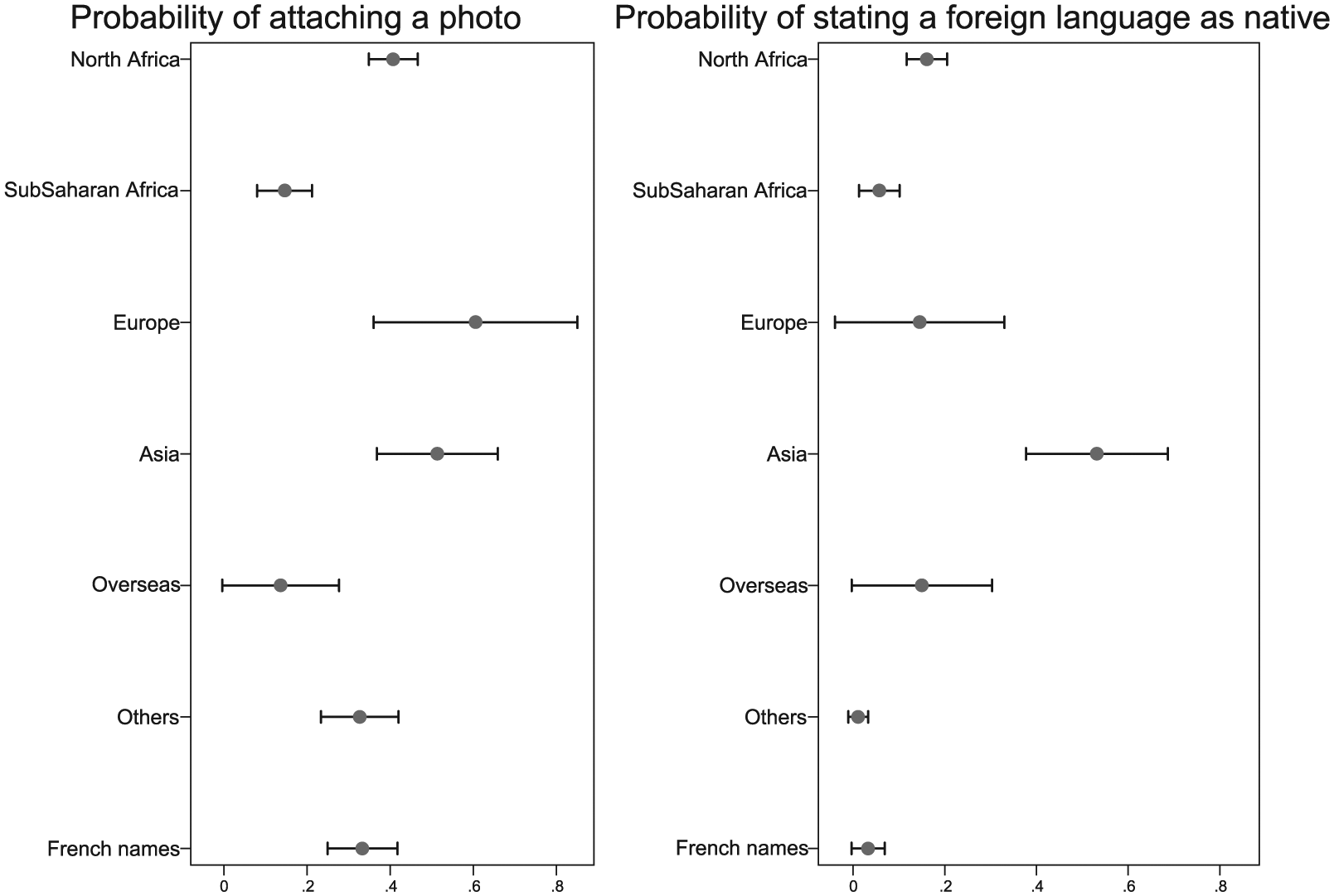
The Effect of Origin on Ethnic Signaling in Curricula Vitae.
These findings are consistent with the bulk of evidence on origin-based discrimination measured specifically in selective and administrative processes such as hiring, labor certification, and naturalization (Hainmueller and Hangartner 2013; Kirschenmann and Neckerman 1991; Leung forthcoming; Rissing and Castilla 2014). Minority job seekers are usually aware of this type of discrimination, and they seek to avoid it by concealing or “whitening” their résumés (Kang et al. 2016). However, although Kang et al. (2016) found that applicants engage relatively little in “résumé whitening” when targeting employers that value diversity, the paradox here is that they refrain from signaling their potentially discriminatory characteristics while applying to a program that is specifically targeted at them.
This strategic omission of ethnic background for the most stigmatized groups is confirmed in the interviews. It seems to be related to the belief that such signals are not useful and may even do more harm than good. One interviewer describes an experience during a forum organized by DO when he explicitly signaled his interest in a job position located in his parents’ country of origin, believing that his profile might be attractive to the employer. He describes how the employer used this information to propose a much lower paid “local contract”:
I told them I was interested in a job contract in Algeria . . . er . . . because it is a country I know well and whose culture I like, etc. I am of Algerian origin . . . uh . . . but then, they tell me . . . uh . . . this is a local contract and . . . uh . . . when you’re French and you are looking for a job in Paris, in France . . . uh . . . it’s not your goal to go settle in Algeria and earn €500 per month. . . . I found it a little bit, uh, how to say this, uh, I thought they had nerve to suggest that in this specific forum!
Omission may also be related to a fear of discrimination. This seems to be overwhelmingly the case when it comes to omitting a photo. Kadija, a black woman with a degree in arts and the textile industry who participated in some of DO’s activities, is afraid that attaching a photo undermines her chances (“It is that my family name is already terrifying”). Latifa, a black woman with a master’s degree in nutrition, was relieved when she learned that she was not obliged to attach a photo, which helped her feel “less afraid” to send her CV “everywhere.” Not only do candidates refrain from signaling origins in their CVs, but they might also lie in order to circumvent potential discrimination. Karim, who has a master’s degree in business, mentions how many of his friends “went very far to get their first job,” as they ended up “lying” and “inventing another background.”
Conversely, attaching a photo to the CV might protect candidates from wasting time with potentially racist employers. Odile, a black young woman with a master’s degree in human resources, describes the “surprise” of some employers when the CV does not include a photo or any signal of origin:
I certainly didn’t add a photo, and uh . . . so then one feels when the recruiter is not expecting to see you . . . and well suddenly this person between the moment she invites you for an interview and the moment you arrive . . . well, you feel that the interview will last 20 minutes when it took you 2 hours to get there!
One might think that a letter of motivation may be a good opportunity to signal origin in such a program without referring to it explicitly in the CV. Nonetheless, only 44 percent of the CVs collected in this study were attached to letters of motivation. And in the vast majority of cases, motivation letters are short (one or two sentences), are quite formal, and do not mention origin or any other ethnoracial signals. Most letters emphasize the candidates’ flexibility, asserting the “versatility of their profile” and their readiness “to accept a mission that does not necessarily relate to [their] education level” or to “adapt to diverse and changing schedules.”
The general tendency to omit or overstate ethnoracial signals in the CV and in the letter of motivation is in contrast with the few cases of disabled candidates present in the sample (n = 16). Indeed, some of these CVs explicitly mention the candidates’ disabilities, mainly using official categorizations. Some others do not make any reference to disabilities in the CVs but expand on this in the motivation letter. Finally, a few signal it indirectly through allusion to parasports in the miscellaneous section.
The Experience of Discrimination: Between Ethnoracial and Nonethnoracial Categories
When asked about the reasons that may lie behind their potential professional difficulties, interviewees very rarely invoke their ethnoracial characteristics and actually use the most common categories described in the former section (i.e., mostly their educational or territorial backgrounds). It is rather because they haven’t attended the “right universities,” did not enjoy an appropriate “educational orientation,” or do not come from the right social “milieu,” and so on. They acknowledge the complexity of identifying the specific discrimination factor, which Karim described as “the story of the egg and the chicken,” as socioeconomic, educational, and ethnoracial backgrounds are so “intertwined” that “ultimately we do not know.” This explains the precautions interviewees take when describing their doubts and hesitations about their skin color or origins being the factors that expose them to discrimination. This is the case of Latifa, who, when “things didn’t work,” started saying to herself that “maybe it was because her name was Saou or that maybe it was a problem of skills or something.” And, as shown by Karim’s statement, most candidates actually refrain from drawing general conclusions out of their personal experience:
Frankly, people who had a name with a “de”
18
. . . I was probably a little bit jealous at the time but they could easily find . . . uh . . . very, very easily and very nice internships. Well, at the end everyone ends up finding something, but I found one long after the others. Well, never mind . . . er . . . I was not the only person coming from a diversity background among my classmates . . . so here I can’t, I can’t say, uh, statistically that it was because of that . . . but perhaps some of that was at play.
This refusal of victimization and stigmatization may be interpreted as a resilience strategy for coping with discrimination (Dubet et al. 2013; Lamont et al. 2016). It may also be related to the power of the “Republican habitus” in the French context, and the way it hinders the interpretation of the subjective experience of disadvantage in terms of discrimination (Eberhard 2010). This is shown by the ways in which some interviewees feel uncomfortable referring to themselves as ethnic minorities even within an antidiscrimination context. Karim describes this type of discomfort while attending a job diversity forum:
I found it a bit degrading, actually, being in a box. . . . I had the impression of being in a forum for social disability . . . uh . . . I know it’s even harder to find a job when you are disabled. So . . . uh . . . . clearly actually it means you have a handicap; you don’t know what it is, but society has said you have a disability and therefore you are here with other disabled people, and we will help you find a job because you need it, and, uh, I am exaggerating, I am a little violent here, but actually this was my feeling, yeah . . . I found it degrading, this forum.
The rare interviewees that do make overt racial interpretation of the reason behind their professional difficulties are black, and they directly relate their unequal treatment to basic antiblack racism. Hence, although her CV clearly shows that she is serious and motivated, studying law while working at the same time, Odile interprets the recruiter’s emphasizing the hard work requirement for the job position she was applying to in relation to racist stereotype about black work ethics.
I could not see what on my file could bring a recruiter to repeat five or six times that in her company one should work hard, because what, uh, what usually the rumors say is that me, apart from sleeping under coconut trees, I do nothing!
Finally, only some rare motivation letters clearly mention prior ethnoracial discrimination (5 letters out of 283). For example, there is the case of Inès, who used this letter to signal her headscarf (in parentheses at the end of a short letter) with a note that she wants “to work while keeping [her] scarf.” Rajat also took the opportunity in the letter to “point out that” her profile “receives interest in England or Belgium” but that she does not “get feedback in France” unless she presents her CV “with a Frenchified name.” Youssef uses the letter to briefly express his exasperation, wondering if young people like him “would not better abandon [their] dreams to embrace the fatalism of factory work initiated by [their] fathers.” And Liam desperately asks “what to think?” and “what to do?” describing his intense frustration after receiving a rejection letter for a job position despite an apparently successful interview. Yet these powerful examples of experienced discrimination are far from being the norm.
All in all, the examination of the recipients’ applications reflects a process of (re)construction of social trajectories within a selection that most frequently avoids ethnoracial signals, although the program is overtly targeting such categories. This avoidance strategy seems to be affected by social desirability consideration as well as anticipations of employers’ tastes, expectations, and requirements. It also seems to be related to weak ethnoracial awareness and refusal of victimization.
Conclusion
This article describes the ways in which ethnoracial categories are used in diversity policies in France. Through the concrete example of an employment diversity program, I analyze modes of targeting ethnoracial minorities in a colorblind institutional context and show how ethnoracial factors tend to be overshadowed by more legitimate categories of inequality. I also document how the recipients refrain from signaling their origin while applying to the program and how they tend to play down the impact of their origins on their employment trajectory. This research thus highlights the ways in which all actors involved in such policies lack the means of their appropriation.
The implementation of diversity policies has crystallized tensions between two paradigms of equality in France. The first paradigm is related to the French universalistic tradition usually referred to as “indifference to differences.” The second paradigm draws on the increasing framing of equality policies in terms of equality of opportunity (égalité des chances) (Dubet 2010; Fassin 2002; Savidan 2007) 19 with growing pressure to alleviate discrimination, whether oriented toward women, seniors, youths, disadvantaged neighborhoods, ethnoracial minorities, sexual minorities, the disabled, and so on. Except for ethnoracial characteristics, most of this tension has been solved within state-level policies; differences such as gender and disability have been increasingly targeted by specific policy programs, including the use of affirmative action–style policy and even quotas (Bereni 2015; Revillard 2016). Conversely, “indifference” proved to be the most strictly respected when it comes to ethnoracial types of differences. The tension in this field between the French universalistic egalitarianism and the paradigm of equal opportunity sought to be solved through the implementation of diversity policies outside the state. The private sector has indeed been at the avant-garde in tackling ethnoracial discrimination, largely by drawing on U.S. diversity management methods and vocabulary and trying to apply it in the French context, all while respecting its general colorblind tradition. This strategy has nonetheless proved to be of quite limited efficiency. In the U.S. context, diversity management flourished in the 1970s as an organizational solution to new, complex, and ambiguous state-level legislation. In this perspective, the “rights revolution” of the early 1970s empowered organizations that learned, adapted, and created solutions to comply with the law, while also interiorizing and recasting them as rational economic strategies. Dobbin and Sutton (1998) analyzed this as the consequence of the “strength of the weak” federal U.S. state: the combination of its normative strength and administrative weakness somehow opened the way to organizational imagination in devising compliance measures. Although one can still criticize the efficiency of employment antidiscrimination policies in the United States given the persistence of both unemployment and earnings gaps, empirical studies tend to show that they played an important role in alleviating ethnoracial inequality (Holzer and Neumark 2006; Tomaskovic-Devey et al. 2006). The French case is quite different; the state, which is both normatively and administratively strong, has been constantly withdrawing from the field of antidiscrimination policies, remains reluctant to any kind of constraining legislation on the topic, and continues to embrace laws, norms, and practices that seek to render race and ethnicity invisible in the public sphere. In this context, the French version of diversity management emanated from the private sector in an attempt to somehow supplant the law and remediate the limitations of state-level action. As documented in this study, in contrast to the U.S. case, this strategy resulted in “organizational failure.” Organizations are not able to refer to or reach out to the specific groups they seek to target, nor can they collect data, set goals, or monitor the progress of their programs. The very recipients of such programs are also affected by this lack of empowerment, as they hardly identify with the struggle against origin-based discrimination and dedicate much effort to conceal their ethnoracial attributes. The case study presented in this article is thus an illustration of the pernicious effects of the French state’s withdrawal from the field of antidiscrimination policies. In line with organizational institutionalism (DiMaggio and Powell 1983; Dobbin, Simmons, and Garrett 2007), the state does indeed seem to be an important force shaping organizational actions and empowering disadvantaged citizens.
Footnotes
Appendix
Determinants of the Probability of Attaching a Photo or Stating a Foreign Language as Native in the Curriculum Vitae (Logistic Regressions).

| Attaching a Photo | Foreign Language as Native | |
|---|---|---|
| Female (reference: male) | 0.126 | −0.708** |
| (0.206) | (0.296) | |
| Age (reference: 22–23) | ||
| 18–22 | −2.655** | 2.253*** |
| (1.092) | (0.836) | |
| 25 | 0.686* | 1.180* |
| (0.358) | (0.666) | |
| 26 | −0.123 | 1.730*** |
| (0.382) | (0.663) | |
| 27 or 28 | −0.557 | 1.637*** |
| (0.389) | (0.634) | |
| 29–32 | −0.354 | 1.285* |
| (0.386) | (0.674) | |
| >33 | −0.439 | 0.0493 |
| (0.435) | (0.927) | |
| Not reported | −0.643** | 1.204** |
| (0.290) | (0.555) | |
| Origin (reference: no ethnic name) | ||
| North Africa | 0.361 | 1.812*** |
| (0.261) | (0.624) | |
| French overseas | −1.271* | 1.723* |
| (0.690) | (0.883) | |
| Asia | 0.850** | 3.815*** |
| (0.406) | (0.711) | |
| Europe | 1.279** | 1.682* |
| (0.643) | (1.019) | |
| Sub-Saharan Africa | −1.189*** | 0.596 |
| (0.370) | (0.738) | |
| Others | −0.0345 | −1.115 |
| (0.328) | (1.177) | |
| Economic sector (reference: administration) | ||
| Finance and insurance | −0.625 | 0.248 |
| (0.428) | (0.480) | |
| Science and technology | 0.213 | 0.0327 |
| (0.266) | (0.399) | |
| Information and communication | 0.138 | 0.800 |
| (0.417) | (0.617) | |
| Retail | 0.684*** | 0.0456 |
| (0.246) | (0.375) | |
| Others | −0.532 | −0.987 |
| (0.423) | (0.708) | |
| Geographic residence (reference: Paris city) | ||
| Eastern and southern Parisian suburbs | −0.0249 | −0.116 |
| (0.291) | (0.425) | |
| Northern Parisian suburbs | −0.546 | −0.267 |
| (0.348) | (0.487) | |
| Western Parisian suburbs | 0.0262 | −0.132 |
| (0.267) | (0.382) | |
| Province | 0.854*** | −0.487 |
| (0.320) | (0.533) | |
| Year of application (reference: not reported) | ||
| 2005–2007 | 0.234 | −0.334 |
| (0.405) | (0.680) | |
| 2008 | −0.0277 | −0.268 |
| (0.281) | (0.420) | |
| 2009 | 0.0137 | 0.0683 |
| (0.246) | (0.342) | |
| 2009–2011 | 0.293 | −1.095 |
| (0.552) | (1.104) | |
| Education | ||
| Baccalaureate and less | −0.202 | −0.173 |
| (0.333) | (0.524) | |
| Baccalaureate + 2 | 0.368 | −1.580 |
| (0.497) | (1.181) | |
| Baccalaureate +3 | −0.0197 | 0.107 |
| (0.418) | (0.582) | |
| Baccalaureate +4 | 0.188 | −0.595 |
| (0.333) | (0.550) | |
| Doctorate | 0.953 | 0.0298 |
| (0.703) | (1.131) | |
| Constant | −0.711 | −3.972*** |
| (0.451) | (0.898) | |
| n | 624 | 624 |
Note: Values in parentheses are standard errors.
p < .10. **p < .05. ***p < .01.
Acknowledgements
I would like to thank Taysheona D. Brodie, Lisa Buchter, Alexandre Diallo, Marine Haddad, Ilhame Hajji, Dadan Kardiana, Haley McAvey, and Anne Revillard for their help, feedback, and support during diverse stages of this research. I am also grateful to the editors and reviewers of Socius for their fruitful comments.
Funding
This research benefited from the financial support of the Laboratory for Interdisciplinary Evaluation of Public Policy (LIEPP, Sciences Po) http://www.sciencespo.fr/liepp/en and the Chaire de Sécurisation des Parcours Professionnels  .
.