




Abstract
In the past 40 years, paternal imprisonment has been transformed from an event affecting only the most unfortunate children to one that one in four African American children experience. Although research speculates that the stigma, strain, and separation resulting from paternal incarceration cause the poor outcomes of children of incarcerated fathers, evidence regarding these mechanisms is lacking. In this article, we use an experimental vignette design to provide causal evidence regarding how the stigma of paternal incarceration affects third- to fifth-grade teachers’ expectations of students in a large southwestern school district (N = 107). We then replicate this experiment using an online Qualtrics panel of third- to fifth-grade teachers (N = 314). The results indicate that the stigma of paternal incarceration shapes teachers’ expectations of students, leading to a 10 percent to 40 percent increase in teachers’ expectations of children’s behavioral problems.
As the American imprisonment rate increased over the last quarter of the twentieth century, paternal imprisonment was transformed from an incredibly rare experience affecting only the most unfortunate children to a relatively common experience for American children—especially African American children. Estimates suggest that around 8 percent of American children will ever have their father imprisoned (Wildeman and Andersen 2015), with risks for African American children of about 25 percent—and over 50 percent for African American children whose fathers did not complete high school (Pettit 2012; Wildeman 2009). Research also suggests that this event is not only common and unequally distributed but also has negative effects (Foster and Hagan 2015; Wildeman and Western 2010). Paternal incarceration leads to more behavioral and mental health problems (Geller et al. 2012; Wakefield and Wildeman 2014; Wildeman 2010), worse school outcomes (Hagan and Foster 2012; Haskins 2014; Turney and Haskins 2014), and higher levels of delinquency, criminal activity, and criminal justice contact (Murray and Farrington 2005; Porter and King 2015; Roettger and Swisher 2011; Wildeman and Andersen 2017), for instance.
While some of this relationship is surely driven by selection into incarceration, the stigma, strain, and separation that result from paternal incarceration may be three causal mechanisms through which this event harms children (Foster and Hagan 2007, 2015). And despite a growing body of evidence detailing the impact of paternal separation and the resulting economic strain on children (Geller et al. 2012; Wildeman 2010), the role of stigma remains unexamined. Indeed, to date, there has been no systematic test of whether paternal incarceration stigmatizes children in school settings, let alone an attempt to quantify the role of this potentially “discrediting characteristic” (Goffman 1963) in explaining variation in child outcomes.
The goal of this article is to contribute to research on the consequences of paternal incarceration for children and the broader literature on the stigma attached to parental incarceration (Braman 2004; Dallaire, Ciccone, and Wilson 2010; Pager 2003, 2007; Pager, Western, and Bonikowski 2009) by testing how having a father absent from the household because of incarceration affects third- to fifth-grade teachers’ expectations of new students’ behavioral and mental health problems using an experimental vignette design in both an in-person setting for teachers from a large southwestern school district (N = 107) and an online setting (N = 314). Our experimental design enables us to isolate the effect of paternal incarceration on teacher’s expectations of students holding all else constant (Aguinis and Bradley 2014); this is essential given that selection into incarceration is likely driven by characteristics that cannot readily be accounted for in observational studies.
We focused on teachers for two reasons. First, virtually all children have teachers and interact with them upward of half of the days in any year, so teachers are the most consistent institutional agents children engage with. Additionally, stigma is particularly salient in the school context in light of how teachers’ expectations affect students’ academic outcomes. Decades of research shows that teachers’ beginning of the school year expectations are correlated with students’ year-end academic achievement, even after controlling for prior differences in achievement (Brophy 1983; Kuklinski and Weinstein 2001; Madon, Jussim, and Eccles 1997; McKown and Weinstein 2008). Teachers do more than accurately predict student achievement (Brophy 1983; Jussim 1989; Südkamp, Kaiser, and Möller 2012); they shape it (Brophy 1983; Jussim and Harber 2005).
Teachers create “self-fulfilling prophecies” (Merton 1948) in tailoring their efforts and attention to match what they expect of students (Jussim, Eccles, and Madon 1996). Teachers with average and above average student expectations employ a different set of didactic tools and provide more regular feedback than teachers with low student expectations (Rubie-Davies 2007). Teachers with high student expectations structure classroom time to engage students and allow high- and low-ability students to work together, fostering peer-learning (Bohn, Roehrig, and Pressley 2004). This differential treatment of students based on differential expectations is then internalized by the students (Kuklinski and Weinstein 2001), who adjust their own motivation and efforts up or down to meet those expectations through the rest of the year (Brattesani, Weinstein, and Marshall 1984; Tyler and Boelter 2008).
Since teachers’ expectations shape student achievement, having differential expectations based on perceived group differences can exacerbate educational inequalities. Teachers have lower expectations of poor students relative to middle-class students (Alvidrez and Weinstein 1999; Rist 1970; Rubie-Davis 2006), ethnoracial minorities relative to white students (Rubie-Davis, Hattie, and Hamilton 2006; Tenenbaum and Ruck 2007), and boys relative to girls (Wood, Kaplan, and McLoyd 2007). The well-known educational gap between black and white students (Jencks and Phillips 2011) is not completely explained by differences in socioeconmic circumstances; evidence suggests that teachers thus perpetuate the racial achievement gap in part by having different expectations of black and white students in certain classroom contexts (McKown and Weinstein 2008).
Research has also found that the effects of teachers’ expectations may be strongest for “stigmatized” groups of students (Jussim and Harber 2005), including African American students and low-income students (Jussim et al. 1996; McKown and Weinstein 2008). Since children who experience paternal incarceration are disproportionately African American and come from low-income families (Pettit 2012; Wildeman 2009), any experimental effects of paternal incarceration on teachers’ expectations of students may thus be especially relevant.
The results from our two experimental studies, one of which took place in person and the other of which took place online, support three conclusions. First, paternal incarceration is a stigmatized trait in the eyes of teachers, leading to a 10 percent to 40 percent increase in teachers’ expectations of children’s behavioral problems among children who were behaviorally identical in the first week of school. Second, the effects were more pronounced for internalizing-type behaviors (e.g., anxiety) than they were for externalizing-type behaviors (e.g., acting out), though the magnitude of this difference is not overwhelmingly large when all the outcomes have been standardized and is well within the bounds of what previous research using similarly aged children has found (e.g., Haskins 2015; Wakefield and Wildeman 2011). Finally, the effects were more pronounced for boys than girls, although few of these differences are significant since the analyses are underpowered for detecting sex-specific effects. Taken together, the results from these two experiments indicate that paternal incarceration does stigmatize children, which likely explains some of the adverse consequences of paternal incarceration for children’s outcomes.
Although the use of an experimental vignette design to estimate the effects of parental incarceration on teachers’ expectations of students is not entirely new, previous research using this methodology (Dallaire et al. 2010) 1 focused solely on maternal incarceration—finding large effects—and so our research greatly extends understanding of the drivers of the intergenerational consequences of mass incarceration by focusing on paternal incarceration, which children are eight times as likely to experience as maternal incarceration (e.g., Pettit 2012; Wildeman 2009).
The Experiment
Samples
To test how paternal incarceration affects third- to fifth-grade teachers’ expectations of their students, we relied on two different samples: an in-person sample (N = 107) and an online sample (N = 314). We used two different samples to be sure that we could replicate our findings using a similar sample in a different forum and with a slightly different behavioral assessment.
For the in-person study, we recruited 107 teachers from a large public school district in a southwestern city. All data from these teachers were collected using an anonymous paper-and-pencil survey. Teachers were given a $25 Amazon gift card as an incentive to participate, and principals who allowed us to recruit teachers in their school were given a $100 Staples or Papa John’s gift card to buy office supplies for their school or throw the staff a pizza party. Due to the sensitive nature of the findings, we are not allowed to disclose any additional information about the demographics of the school district to ensure that it cannot be identified. Power analyses indicated that the in-person study was capable of detecting a medium-sized effect.
For the online study, we worked with Qualtrics, an online survey platform, to recruit an online panel of 314 third- to fifth-grade public school teachers. Core characteristics of the online sample are presented in Table A1. Although the sample was not meant to be nationally representative, there was substantial variation in the age, region, level of experience, and classroom demographics of the teachers. Teachers who participated in this version were compensated by Qualtrics based on the amount of time Qualtrics estimated to complete the survey. We recruited a larger sample for the online study because the scale used in that sample was less sensitive (including three response categories instead of four), as discussed below. Even with the less sensitive scale, the online study was capable of detecting even a small effect.
The Vignette and Manipulation
Our experimental manipulation is embedded in a vignette (see Appendix). The vignette introduces a student named Michael or Ashley and informs the teacher that it is the second week of school and the child is new to their class and the area. Subsequent paragraphs give the teacher information about some things the child enjoys as well as things they have done in the first week of school. We include this information so the teacher has some anchoring information in terms of behaviors. In the following paragraph, we introduce the experimental manipulation by having the mother tell the teacher why there is not another parent to contact about their child’s behavior. In the control condition, the mother says the father is “out of the picture”; in the treatment condition, she says the father is “out of the picture because he is currently incarcerated in another part of the state.” After doing a number of pretests, we settled on this specific experimental manipulation because (1) it is subtle enough to not reveal the purpose of the study and (2) the control group should yield a conservative test of the effects of paternal incarceration on children as it makes the comparison of a father who is incarcerated relative to an uninvolved father.
As discussed in more detail later, in both the in-person and online studies, plausibly racially ambiguous names were used to describe the student and mother. In the online study, we asked respondents to guess the race of the child’s parents as teachers in the paternal incarceration condition may have been more likely to assume the child was African American. This assumption may then have driven their expectations for behavior in light of racial differences in teachers’ expectations of students (Tenenbaum and Ruck 2007). Therefore, asking this question allowed us to explore to what extent observed differences across conditions were driven by this potential mechanism.
Outcomes
To measure teachers’ expectations of children, teachers were asked to complete the Behavioral Assessment System for Children–Teacher Rating Scales (BASC) in the in-person sample and the Achenbach System of Empirically Based Assessment (ASEBA) Teacher Report Form (TRF) in the online version (Achenbach and Edelbrock 1986; Reynolds and Kamphaus 2002). The BASC and the ASEBA are appropriate for children in the age range we consider and have well-established validity and reliability. 2 For our study, the key advantage of the BASC is that it includes information on adaptive and problem behaviors, making it possible for us to provide a global assessment of effects of paternal incarceration on teachers’ expectations. The key advantage of the TRF is that most studies in this area have relied on the TRF or a variant of it such as the Child Behavior Checklist/6-18 (CBCL/6-18) (e.g., Geller et al. 2012). Because the TRF includes three response categories (not true, somewhat or sometimes true, and very true or often true) while the BASC includes four (never, sometimes, often, and almost always), we increased the sample size for the online study to gain sufficient statistical power.
Results from the In-Person Study
Table 1 displays the means for boys and girls in the treatment and control groups across the 10 indicators of behavioral problems and 5 indicators of behavioral competencies in the in-person version of the study. For 8 of the 10 behavioral problem indicators, there was a significant difference at the .05 level for the total sample, with children in the treatment condition experiencing more teacher-reported behavioral problems in each case. Boys in the treatment group were reported to have significantly more behavioral problems for 5 of the 10 outcomes (p ≤ .05); girls in the treatment group were reported to have significantly more behavioral problems for 4 of the 10 outcomes (p ≤ .05).
Experimental Results, In-person Survey (N = 107).

Teachers also rated children in the treatment group less positively when it came to behavioral competencies, with children in the treatment group rated significantly lower on three of these five indicators (p ≤ .05) for the total sample and two of these five indicators for boys (p ≤ .05). There were no significant differences in behavioral competences for girls at the .05 level.
Figure 1 expresses these treatment effects not as an absolute difference between the treatment and control groups but as a relative difference between the two, using differences in shading to express significant differences at various levels. Three findings are particularly notable in this figure. First, the relative teacher-reported difference between the treatment and control conditions is consistently larger for behaviors associated with internalizing problems (i.e., anxious and depressive behaviors) than for those associated with externalizing problems (i.e., aggressive and attention-seeking behaviors). However, there are also significant and substantial differences on the aggression, conduct, and learning problems indicators. Second, differences are larger for behavioral problems than for behavioral competencies. Finally, differences are larger for boys than girls, although these differences are most pronounced for three outcomes (atypicality, social, and communication) and should not be over-interpreted.
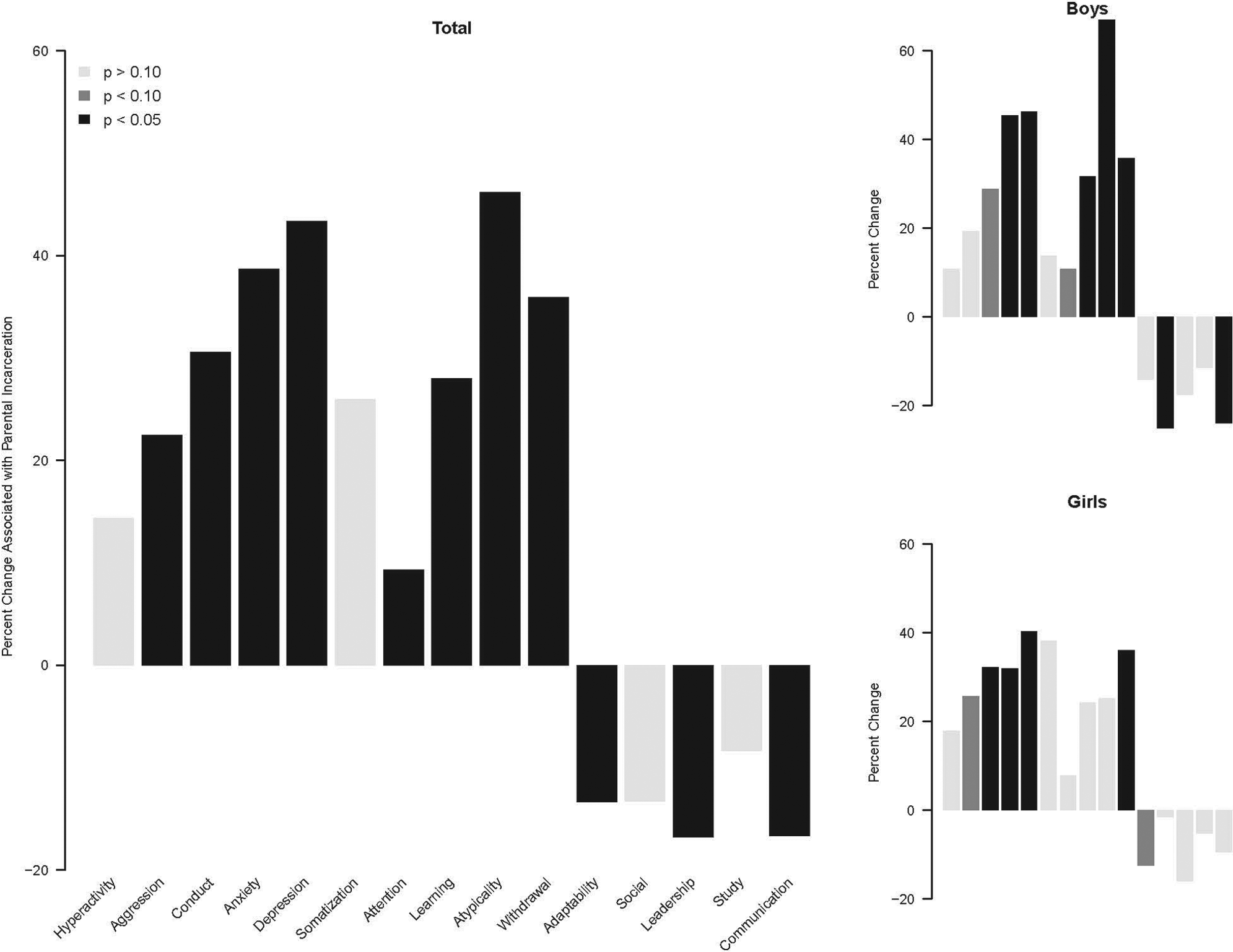
Estimated effects of paternal incarceration for in-person study, N = 107.
Figure 2 expresses the experimental effects not in terms of percentage change but in terms of standardized effects where each dependent variable is standardized with a mean of 0 and a standard deviation of 1. Although the results from these analyses are (obviously) generally similar in terms of magnitude and identical in terms of statistical significance, they are worth showing for two reasons. First, the differences in the magnitude of effects for internalizing-type behavioral problems relevant to externalizing-type behavioral problems does not appear to be quite as large in Figure 2 as in Figure 1. Second, all of the statistically significant effects are in the .20 to .36 standard deviation range, suggesting a substantial but not unreasonably large effect.

Standardized effects of paternal incarceration for in-person study, N = 107.
Results from the Online Study
Table 2 displays the means for boys and girls in the treatment and control groups across the eight indicators of behavioral problems in the online version of the study as well as the composite measures of internalizing and externalizing problems. Consistent with results from the in-person version of the study, children in the treatment group were rated as having more behavioral problems than children in the control condition for all of the outcomes considered, although only five of the differences are statistically significant at the conventional .05 level, with four more of the differences being statistically significant at the .10 level. The differences that are significant at the .05 level involve internalizing-type behaviors in addition to inattention problems, although some externalizing-type behaviors are also significantly different, albeit at the .10 level.
Experimental Results, Online Survey (N = 314).

Figure 3 shows the relative differences between the treatment and control groups in the online version of the study. Relative differences in the online sample were somewhat smaller than in the in-person sample, representing a 10 percent to 30 percent difference for most outcomes, with somatic complaints approaching a 40 percent treatment-control difference. This difference is driven primarily by the very large difference in expected somatic complaints among boys.

Estimated effects of paternal incarceration for online study, N = 314.
Figure 4, which displays the same results but expresses effects in terms of standardized changes rather than percentage changes, supports two conclusions. First, effects are smaller in the online experiment, with significant standardized effects in the .10 to .14 range, which is half the size of the effects estimated using the in-person sample, which peaked at .36 standard deviations. Second, the difference between the effect on internalizing-type behaviors (.14) is only slightly larger than the effect on externalizing-type behaviors (.10), consistent with Figure 2.

Standardized effects of paternal incarceration for online study, N = 314.
Because the use of racially ambiguous names allows for the possibility that teachers in the treatment condition assumed that the child is African American, however, it may be the case that teachers’ expectations are driven not directly by the stigma of incarceration but indirectly through the “darkening” that incarceration causes (Saperstein and Penner 2012; but see also Hannon and DeFina 2016 for a critique of these findings). To consider this possibility, the online version of the study also asked teachers what race the teacher thought each parent was.
Results from these analyses suggested that teachers in the treatment condition were more likely to think the father and mother were African American and less likely to think they were white. (Differences in the proportion of teachers who thought the parents were Hispanic or some other racial/ethnic group varied little between the two conditions.) Specifically, teachers in the treatment condition thought the mother was white 47 percent of the time and African American 28 percent of the time; teachers in the control condition thought the mother was white 57 percent of the time and African American 16 percent of the time. Teachers in the treatment condition thought the father was white 40 percent of the time and African American 37% of the time; teachers in the control condition thought the father was white 52 percent of the time and African American 23 percent of the time.
Yet even after adjusting for this potential mechanism, the negative effect of being in the paternal incarceration condition remains large and robust for five of the eight outcomes that were statistically significant in the results shown in Figures 3 and 4. As Table 3 indicates, controlling for maternal and paternal race/ethnicity via a series of dummy variables does little to change the association between paternal incarceration and teachers’ expectations of students’ behavioral problems. Depending on the measured behavior, the share of the experimental effect explained by parental race ranges from a low of 3 percent for withdrawn behaviors to a high of 36 percent for aggressive behaviors. Mediation was weaker for internalizing-type behaviors throughout. At least based on these analyses, which used a plausibly racially neutral name, these results suggest that the “darkening” (e.g., Saperstein and Penner 2012) that happens as a result of incarceration is unlikely to be driving the stigma attached to paternal incarceration for teachers’ expectations.
Effects of Paternal Incarceration on Teachers’ Expectations of Students before and after Adjusting for Teacher-perceived Parental Race, Online Study (N = 314).
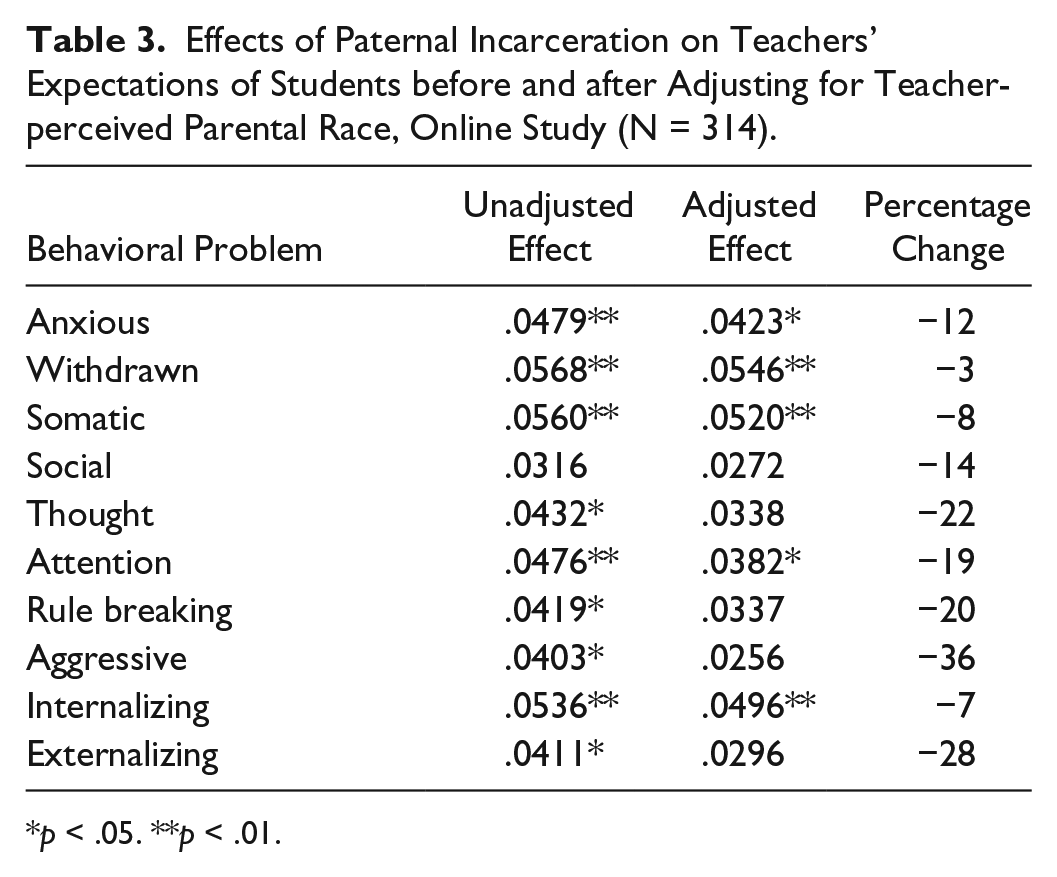
p < .05. **p < .01.
Discussion
Paternal incarceration is now common for African American children whose fathers have low educational attainment (Pettit 2012; Wildeman 2009; Wildeman and Andersen 2015). The children who experience this event fare poorly in a host of domains relative to otherwise similar children who do not experience this event (e.g., Foster and Hagan 2015). Because paternal incarceration is common, unequally distributed, and inhibits child well-being, mass imprisonment has been implicated in racial disparities among children (Wakefield and Wildeman 2011, 2014).
The stigma, strain, and separation caused by paternal incarceration are thought to drive the causal effects of paternal incarceration on children. Empirical assessments of the effects of strain and separation suggest that these two mechanisms combined explain roughly half of the paternal incarceration–child well-being association that persists after adjusting for observed differences in children and families prior to paternal incarceration (e.g., Geller et al. 2012). The goal of this article was to strengthen research on the mechanisms through which paternal incarceration causally affects children’s outcomes by providing the first experimental test of how paternal incarceration (relative to paternal absence) stigmatizes children of incarcerated fathers.
The results from an in-person experiment of 107 third- to fifth-grade teachers and an online study replication with 314 teachers provide the first quantitative evidence that the stigma of paternal incarceration is salient and substantial. The design allowed us to omit any unobserved characteristics between students with and without an incarcerated father, so we can conclude that teachers’ expectations of increased behavioral problems and decreased behavioral competencies are driven by paternal incarceration. The results thus indicate that teachers have biases against students based on the discrediting characteristic of paternal incarceration alone (Goffman 1963).
The second conclusion is that these effects are more consistent and pronounced for internalizing-type behaviors than externalizing-type behaviors. However, there is some evidence that paternal incarceration led teachers to expect that children would act out more and display more attention problems. Finally, though there is evidence of stigma for both genders, these effects are somewhat more pronounced among boys than girls for most outcomes. Taken together, the consistency of these results across two sampling frames and sets of outcomes provides strong evidence that there is indeed a stigma attached to paternal incarceration.
These findings relate in important ways both to previous research using a similar design to study maternal incarceration’s effects (Dallaire et al. 2010) and considering the behavioral consequences of paternal incarceration for children (e.g., Geller et al. 2012; Haskins 2015; Wakefield and Wildeman 2011, 2014). To speak to the methodologically similar work first, our analyses differ from those of Dallaire and colleagues (2010) in a number of core dimensions, beyond the focus on paternal incarceration: Our analysis (1) used validated scales for measuring teachers’ expectations and (2) provided preliminary information on child behavior to anchor assessments. Despite these differences, the results from our analyses were parallel in some ways, with both suggesting stigma attached to parental incarceration. Nonetheless, the effects for the current study (.10–.36 SD) were far smaller than the effects in the earlier study by Dallaire and colleagues (2010; .80 SD). Future research must thus endeavor to find out whether the much larger effects found by Dallaire and colleagues (2010) are driven by a truly larger stigma attached to maternal incarceration or by some of the limitations of their research design. In addition to these differences, it is also worth noting that although much research on younger children finds differentially large effects of paternal incarceration on children’s externalizing behaviors (e.g., Geller et al. 2012; Wildeman 2010), research using samples of children who overlap more directly with our sample (e.g., Haskins 2015; Wakefield and Wildeman 2011) find similarly small differences between effects on externalizing and internalizing behaviors.
Detailing evidence of stigma in an educational setting is particularly important because of its potential to harm children. The preconceived notion that these children will have more behavioral issues than children with an absent father is not innocuous: Teachers’ expectations do not simply reflect reality; they help create it (Jussim and Harber 2005). When teachers expect more behavioral problems, they may look for more problems and have harsher reactions to them (Rist 1970). Our results suggest that teachers’ expectations may be a mediator between paternal incarceration and the low educational achievement of these children (Hagan and Foster 2012). Yet detailing stigma in this setting is also important for even more practical reasons: When researchers and practitioners suggest sites of intervention for children with incarcerated parents, schools are often mentioned as one especially appropriate venue. Yet the results presented here suggest that absent some additional school-level interventions, programs that make a parent’s incarceration status known to teachers could actually have detrimental effects on children.
Although these findings are provocative, this study nonetheless has some limitations that bear mentioning. First, because we used racially ambiguous names in the vignette and did not provide information about the hypothetical student’s race, we were unable to explore how race intersects with information about paternal incarceration in shaping teachers’ expectations of students. Although the sensitivity analyses conducted in the online study give us confidence that there is indeed a true incarceration effect regardless of race, future work should manipulate the race of the child and/or parents. Second, because we focused on how experimentally varying paternal incarceration affected teachers’ expectations, we are unable to directly test how paternal incarceration affects teachers’ responses to and interactions with children. Since how teachers respond to children is more important for children’s outcomes than how they think about them (e.g., Brophy 1983; Jussim and Harber 2005), this is a limitation that must be addressed in the future. Third, because we included only one treatment condition (incarceration) and one control condition (unspecified absence), it is unclear whether it is paternal incarceration per se or paternal criminality or criminal justice contact more broadly that is driving these effects. Although this is a limitation of our study, we nonetheless see it as a relatively small one since paternal incarceration is likely the primary avenue through which teachers would become aware of paternal criminal activity and criminal justice contact. As such, it is not of central importance whether the stigma is related to criminality, criminal justice contact, or incarceration. Finally, it is important to acknowledge the possibility that teachers’ expectations that the student in the treatment condition would exhibit more internalizing-type behaviors may suggest a sensitivity to the emotionally difficult nature of having a currently incarcerated father. Nonetheless, these results still indicate a bias in teachers’ perceptions; there is social stigma attached to internalizing behavioral problems, and the findings that these differences extend to indicators including conduct and attention problems strongly suggest that the bias we found is more generalized.
Limitations aside, this research has implications not only for how we think about the microlevel mechanisms linking paternal incarceration and child well-being but also how we think about the broader consequences of mass incarceration for American society. By being the first article to quantitatively identify the stigma attached to paternal incarceration, this article suggests that the “sticky stigma” (Braman 2004; Goffman 1963) attached to having a father incarcerated noted in qualitative research on incarceration not only exists but is also substantial.
Footnotes
Appendix
Characteristics of Teachers Participating in the Online Experiment, N = 314.

| Mean | SD | |
|---|---|---|
| Female | .88 | .33 |
| Age | ||
| <28 | .11 | .31 |
| 28–34 | .26 | .44 |
| 35–41 | .21 | .41 |
| 42–48 | .13 | .34 |
| 49–55 | .16 | .37 |
| >55 | .13 | .34 |
| Race/ethnicity | ||
| White | .83 | .38 |
| Black | .08 | .27 |
| Hispanic | .05 | .21 |
| Native American | .02 | .13 |
| Asian/Pacific Islander | .04 | .20 |
| Other | .03 | .16 |
| Years teaching | ||
| 1 | .06 | .23 |
| 2–4 | .17 | .38 |
| 5–9 | .26 | .44 |
| 10+ | .51 | .50 |
| Percentage of absent dads in typical class | ||
| 0 | .01 | .11 |
| 1–4 | .12 | .33 |
| 5–9 | .17 | .38 |
| 10–19 | .23 | .42 |
| 20–39 | .28 | .45 |
| >39 | .19 | .39 |
| Percentage of absent dads incarcerated | ||
| 0 | .16 | .37 |
| 1–4 | .39 | .49 |
| 5–9 | .20 | .40 |
| 10–19 | .14 | .35 |
| 20–39 | .09 | .29 |
| >39 | .02 | .15 |
| School location | ||
| Large city | .23 | .42 |
| Small city | .20 | .40 |
| Suburb | .32 | .47 |
| Town | .12 | .32 |
| Rural area | .14 | .34 |
| School region | ||
| Northeast | .34 | .48 |
| Southeast | .24 | .43 |
| Midwest | .18 | .38 |
| Southwest | .11 | .32 |
| West | .13 | .34 |
Acknowledgements
We thank Pat Sharkey, the three anonymous reviewers at Socius, and seminar participants at Brown University, Duke University, Harvard University, New York University, the Rockwool Foundation, and the University of Wisconsin for comments. Cornell’s IRB approved the design; the IRB of the school district that provided access to teachers in its district also approved the design.
Funding
The author(s) disclosed receipt of the following financial support for the research, authorship, and/or publication of this article: Funding was provided through a Faculty Fellowship from the Bronfenbrenner Center for Translational Research at Cornell University and a small grant and a theme project grant from the Institute for the Social Sciences at Cornell University.
1
We discuss how our study relates to the work of Dallaire, Ciccone, and Wilson (2010) in the Discussion section.
2
The full scales are also readily available (Achenbach and Edelbrock 1986;  ) for readers interested in knowing more about how each of the validated scales are constructed from individual measures.