




Abstract
The author introduces the concept of the moral disinhibition effect as a partial explanation for some unanticipated and/or unintended consequences of technologies. The moral disinhibition effect relates to how a reduction in an undesirable consequence of consuming a particular good or service (such as carbon emissions per unit of electricity consumption) may reduce societal or individual-level inhibition about overusing such a good or service and thereby increase demand and, potentially, the total consequence. The author explains the concept at both the individual and societal levels and specifies it using mathematical formalisms.
Keywords
Sociologists have long recognized that social actions and technological developments have unanticipated and unintended consequences (Merton 1936). There are many reasons for this, including the complexities that emerge from interactions, feedbacks, and nonlinear processes that limit the potential for reliable predictions. Nonetheless, there are structural factors, social forces, and psychological processes that can help explain particular outcomes that were unexpected. Here I offer one theoretical explanation for some counterintuitive outcomes of technological change, with my primary interest being to understand why certain technologies that are expected to help curtail environmental problems sometimes do not. However, the concept I develop, the moral disinhibition effect, has broader applicability. To help explain the concept, I provide a hypothetical example focusing on individual-level actions, which serves as an analogy to the macro-level explanation that is my main theoretical interest.
Consider a person who in the past enjoyed eating meat but now abstains from eating it because of ethical concerns about the suffering of animals. He is then faced with the opportunity to eat free-range, “humanely” produced chicken. He is tempted to eat it because its purported humaneness reduces his moral inhibition about eating meat. The producer of this chicken developed her business raising chickens in this manner because she cares about the well-being of animals and wanted to provide an alternative to meat produced in concentrated animal feeding operations. However, the humanely produced chicken may not simply take the place of factory-farmed chicken that would be eaten by habitual meat eaters but also may spur more chicken consumption by recruiting new chicken consumers, such as our vegetarian. Therefore, even though it may lead to fewer chickens being raised on factory farms, ironically, supplying “humane meat” may serve to increase the aggregate suffering of animals if it leads some people to eat meat when they would not otherwise do so (because even “humanely” raised chickens are, after all, slaughtered).
Figure 1 illustrates the potential effect of reducing moral inhibition in this manner. The vertical axis represents the consequence per unit of consumption, in this example the average suffering per animal. The horizontal axis represents the quantity of consumption, in this case the number of chickens. Therefore, the area of each rectangle represents the total amount of suffering. Rectangle A represents the initial state before the introduction of humanely produced meat. If the reduction in average suffering per animal that comes about with humanely produced meat has no effect on demand, then the condition changes from rectangle A to rectangle B, where total suffering declines in proportion to the reduction in average suffering per animal. However, if reducing the consequence per unit (average suffering per animal) increases demand (consumption of chicken), but not greatly, the condition changes to that represented by rectangle C. In this scenario, more animals suffer, but to a lesser degree per animal, so that the aggregate suffering still declines, but not as much as it does in the scenario represented by rectangle B. However, if the effect on demand is sufficiently large so that many more animals suffer, even though not on average as much as those in the initial state, then the shift is to rectangle D, which has a larger area than rectangle A, indicating more total suffering.
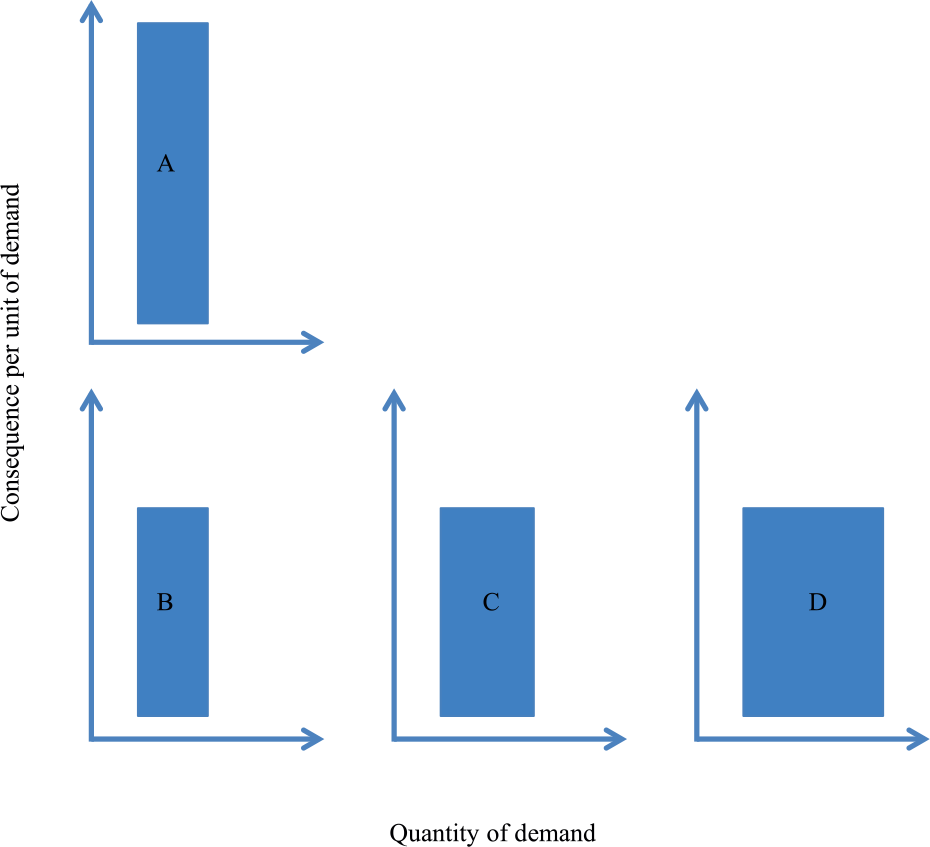
Effect of reducing the consequence per unit of demand on the total consequence. The area of each rectangle (A, B, C, and D) represents the total consequence. Rectangle A is the initial condition. If there is no effect on the quantity of demand from reducing consequence per unit (i.e., the width remains unchanged), then scenario B is realized when consequence per unit declines (the height of the rectangle declines). If declining consequence per unit increases demand (i.e., the width increases), the total consequence will not decline in proportion to the decline in consequence per unit. If the increase in demand is only modest, rectangle C is the result, in which the area of the rectangle declines, although not proportionately to the reduction in height. Total consequence may grow (i.e., the area of the rectangle may increase) if quantity of demand increases substantially, as represented by rectangle D.
Our vegetarian illustrates the fact that people’s decision making and behavior are not based simply on self-interested analysis of economic costs and benefits. Rather, decisions and actions emerge from an interaction of economic considerations, personal preferences, normative influences, emotional states, structural contexts, power relations, and other factors (Bruch and Feinberg forthcoming). Our chicken farmer’s efforts illustrate the aforementioned potential for unintended and unanticipated consequences that sometimes lead to counterintuitive outcomes.
The extent to which “green” technologies help solve environmental problems is a subject of considerable interest in the environmental social sciences, and determining why green technologies sometimes do not deliver on their promise is a point of major concern (Apergis et al. 2010; Mol, Sonnenfeld, and Spaargaren 2009; Schnaiberg 1980; Sellen and Harper 2002; York and McGee 2016, 2017; York, Rosa, and Dietz 2010; Zehner 2012). One example I consider is the finding that over the past few decades in most nations around the world, the addition of electricity from non–fossil fuel sources may have served to increase electricity use (York 2012, 2016). That is to say, non–fossil fuel electricity is to some degree added to fossil fuel electricity, not used in place of it, which may be called the displacement paradox (York 2012). Because even “clean” energy sources have substantial consequences (Zehner 2012), if they contribute to growth in electricity consumption, they may worsen some environmental problems.
Counterintuitive outcomes such as this are not uncommon. For example, the use of water conservation technologies does not always suppress total water use in a region and can in fact contribute to increasing water consumption (deBuys 2013; Ward and Pulido-Velazquez 2008). One of the reasons this occurs is that reducing water consumption in individual households or on farms can allow more development (e.g., growth in housing and hotels) because development is often limited by water availability in arid regions such as the American Southwest (deBuys 2013).
It has been known for a long time that improvements in the resource efficiency of technologies can lead to more resource use (Greening, Greene, and Difiglio 2000; Polimeni et al. 2008; Santarius 2012). When improvements in efficiency of resource use lead to rising consumption, it is often referred to as the “rebound effect” (Greening et al. 2000) or, when the rise in consumption is sufficiently large to overwhelm the benefit of improved efficiency, the “Jevons paradox” (Polimeni et al. 2008). The rebound effect is often explained in strictly economic terms, where it is recognized that higher efficiency reduces cost per unit of utility, which can spur consumption to some degree. However, there are various reasons behind the rebound effect that differ across circumstances (Greening et al. 2000; Polimeni et al. 2008; Santarius 2012). York and McGee (2016) offered a structural, political-economic reason related to how technological refinements that improve efficiency serve to keep societies on high consumption development trajectories.
The concept I explain here, the moral disinhibition effect, is a noneconomic (partial) explanation for why the rebound effect and the displacement paradox may be observed in some circumstances. It is complementary to the structural explanations offered by various scholars (Polimeni et al. 2008; York 2016; York and McGee 2016). With regard to the rebound effect, if, for example, some people avoid driving because of concerns about pollution from cars, the availability of fuel-efficient cars may reduce this inhibition and lead to more driving. Although the disinhibition effect may help explain rebounds in cases of improving efficiency, the concept is not specifically about the rebound effect. It addresses more generally how effective technological changes are at minimizing an undesirable outcome, including issues of displacement or substitution of one resource for another (York 2012).
The central part of my argument is about how perception of consequences affects use of technologies and products at both the individual and societal levels. It is fairly common that technological developments expected to help conserve resources fail to do so because they change human behavior (McGee 2014; Zehner 2012). These counterintuitive outcomes are in part connected with how the consequences of new technologies influence decision-making processes.
Environmental Consequences and Decision Making
Most social scientists agree that decisions at the societal and individual levels are affected by normative considerations (Boudon 2003; Bruch and Feinberg forthcoming; Green and Shapiro 1994). At the individual level, these considerations may stem in part from ethical or moral concerns affecting what behaviors are considered right and wrong (e.g., eating meat) (Baron and Spranca 1997; Bourdieu 2005). It is well established that individuals’ decisions about behaviors that have environmental consequences are affected by social norms (Cialdini 2003). At the societal level, decisions are affected by normative pressure based on politics, values of the public, and social movement activities (Amenta et al. 2010; Green and Shapiro 1994). These normative concerns may inhibit some types of activities or the adoption of some technologies because of considerations that go beyond a calculation of direct costs and benefits in narrow economic terms.
On the basis of these considerations, it is reasonable to expect that in some circumstances, reducing the environmental consequence (e.g., pollution) of a technology, good, or service may serve to increase use of that technology, good, or service by reducing inhibition among agents. This is a concern similar to the one raised by Santarius (2012), who suggested that there may be a “moral hazard effect” whereby people may increase consumption of items they come to believe are “environmentally friendly.” Whether the rise in use stemming from reduced inhibition leads to a rise in the total consequence depends on how much use grows relative to how much the consequence per unit of use declines. This presents the potential for a paradox, whereby reducing the consequence of a good or service may lead to a larger total consequence (with regard to Figure 1, this paradox occurs if there is a shift from rectangle A to rectangle D).
Technologies, products, and actions will, of course, have many types of consequences, and these may be difficult to compare with one another because of qualitative differences. For example, the environmental consequences of coal-powered electricity generation (e.g., carbon and sulfur emissions) are quite different from those stemming from nuclear power (e.g., radioactive waste, the risk for catastrophic meltdown). The extent to which the public and decision makers are aware of various consequences and how they weigh them are empirical questions, the answers to which will depend on the particular context. How people understand consequences will depend on historical events (e.g., nuclear plant disasters) and how environmental consequences have been socially constructed in the public arena by corporations, politicians, social movements, and other forces.
As I noted in an example above, increasing national-level production of electricity from non- or low-carbon (“alternative”) sources is associated with higher energy consumption (York 2016). I suggest that part of the reason for this finding may be that the availability of alternative energy sources can lead to an economy-wide disinhibition about energy consumption because these alternative sources are perceived as having lower consequences than coal and oil. To understand how this could happen, consider a nation faced with the opportunity to add a wind farm with the hope that it will suppress the consumption of coal (the dominant source of electricity generation in many nations). In the process of political negotiations and compromises, the potential addition of wind power, because it is perceived as a “clean” energy source, may reduce inhibitions of policy makers about allowing projects, such as industrial development, that will expand energy demand. Because politicians who are concerned about the environment may expend a considerable amount of their political capital getting support for the expansion of wind power, less effort may be put into energy conservation measures. Similarly, the efforts of environmental organizations to promote wind power may limit the resources they can use to lobby for energy conservation and to oppose development projects that will expand energy consumption. Additionally, because of the perceived benefits of wind power, many actors, including politicians and environmentalists, may be less concerned about pushing to curtail energy consumption. Thus, the expansion of wind power production may reduce concerns about energy consumption and, thereby, contribute to more energy demand. Therefore, the amount of coal-based electricity generated may not be suppressed as much as initially expected.
The types of diffuse and various mechanisms I specify here are not unlike the theorization behind economic phenomena, in which there is no necessary assumption that all individuals behave in a particular manner but simply that a variety of processes and activities in combination lead to regularities. I am not arguing that individuals in general explicitly assess environmental consequences as part of deciding whether to use a technology or product (although surely some individuals do). Rather, I argue that some assessment of environmental consequences may be factored into society-wide decision-making processes. Individuals generally use heuristics, or some general rules, to make decisions, rather than engaging in calculations (Gigerenzer 2008). People who care about the environment may have some rules they generally follow, such as to avoid driving a car or eating meat. This may translate into views on public policies, so that, for example, there may be a common perception that wind power is good and coal power is bad. Thus, I do not assume that individual decision making is especially rational with regard to calculating the consequences of decisions, only that consequences can influence the process. In fact, one concern I raise here is that in some circumstances, agents may be more sensitive to changes in consequence per unit of demand than to the total consequence of all consumption. With respect to Figure 1, I am suggesting that in some circumstances, agents may be prone to focusing on the height of the rectangle rather than the area of the rectangle, because they may not take into consideration aggregate demand.
Governments and organizations may be more explicitly rational in calculations about environmental consequences than are individuals. After all, governments are often charged with (although they frequently may fail to meet this charge) making decisions with the larger public good in mind, rather than making decisions based simply on direct, short-term economic considerations. How the process works, of course, will vary across circumstances. In some circumstances, for example, governments may have explicit policies about capping carbon emissions or other pollutants that directly affect decisions about energy use and development. In this type of circumstance, “clean” sources of energy clearly allow the expansion of energy consumption because they sidestep the policy-based inhibition on expanding fossil fuel use, thereby leading to disinhibition with respect to energy consumption. In other circumstances in which there are not explicit policies, there still may be political pressures stemming from social movements and the public, as well as those internal to government, that lead to inhibition or disinhibition based on perception of the environmental consequences of actions.
The moral disinhibition effect and issues associated with it can be understood through mathematical formalisms. I wish to emphasize that the main argument I make in this article is that demand for a good or service in some circumstances can be affected by the perception of the environmental consequences of that good or service, because the severity of the consequence may inhibit or disinhibit consumption on the basis of normative or moral concerns among decision makers, the public, and social movement organizations. I am not suggesting that this occurs in most circumstances, only that it occurs in some. The nature of this effect will vary across time, place, and technology or product. Thus, I mathematize some concepts below in an idealized form (as is common in economics), while being fully cognizant that the relationships I specify do not reflect universal laws. Rather, they are intended to help more clearly specify the implications of the processes theorized above. These formalizations can be applied to some empirical analyses, but I present them here for conceptual purposes. Some theorized factors, such as the suffering of animals, might be difficult to operationalize and measure. This, of course, is not uncommon in the social sciences, in which a number of important concepts (e.g., alienation, consciousness) present challenges for empirical analyses but are nonetheless theoretically meaningful.
The Consequence Elasticity of Demand
As noted above, there are many potential consequences that may be considered in analyses, and which ones will influence decision making is an open question. So, the formulas I present below for assessing the effect of consequence on demand represent not one calculation but many. Some consequences may be easier to measure than others. Because of qualitative differences, it may be difficult to compare consequences with one another. For empirical purposes, multiple environmental consequences may be considered (Jones, Pejchar, and Kiesecker 2015) and could be combined into a single measure such as the ecological footprint (Global Footprint Network 2017). However, the actual consequences for the environment are not, per se, what will influence decisions, but rather perception of consequences will matter, a point I return to below.
We can think of the total consequence (T) of the use of a particular technology, good, or service as being the product of the quantity used (Q) and the consequence per unit (C), so that (consistent with the geometric presentation in Figure 1)

As simple as this seems, there is an underlying complexity if the quantity used (“demand”) is affected by the consequence per unit. It is my proposal here that in some instances demand is affected by the consequence. Thus, demand is a function of consequence:

We can think of this function in terms of the consequence elasticity of demand, which is like the price elasticity of demand used in economics. As the term suggests, price elasticity of demand conceptualizes demand as purely or primarily a function of price. In contrast, the consequence elasticity of demand, as I develop it here, recognizes that forces other than price can influence demand, such as normative considerations about the consequences of consumption. The typical introductory econometrics text (e.g., Wooldridge 2003) will cover price elasticity and can be referred to for more details than I provide here. The price elasticity of demand relates how price affects consumption, whereby higher prices suppress demand. Specifically, the elasticity is the percentage change in demand for a 1 percent change in price. Thus, price elasticity of demand can be calculated as the percentage (or proportional) change in the quantity consumed divided by the percentage (or proportional) change in the price (this formula, like all subsequent formulas, is based on the ceteris paribus assumption):

where Ep is the elasticity of demand with respect to price, %ΔQ is the percentage change in the quantity consumed (i.e., demand), and %ΔP is the percentage change in price. Thus, for example, if price increases by 4 percent (i.e., %ΔP = 4) and the quantity consumed decreases by 3 percent (i.e., %ΔQ = −3), the price elasticity of demand is –.75 (i.e., –3/4).
For analytic purposes, it can be helpful to use a constant elasticity model, which is based on instantaneous rates of change. This is defined as

where ln(Q) and ln(P) represent the natural logarithm of the amount consumed or demand (Q) and price (P), respectively, ln(A) is a scaling constant, and Ep is the price elasticity of demand. If we consider how change in price affects change in demand and convert ln(Q) and ln(P) to Δln(Q) (change in the log of demand) and Δln(P) (change in the log of price), ln(A) drops out from the model because it is a constant. Using simple algebra, we obtain the formula for the price elasticity of demand:

The value of Ep calculated in formulas 4 and 5 will not be identical to that calculated using formula 3, because formula 3 is based on incremental growth rates, whereas formulas 4 and 5 are based on instantaneous growth rates (a technical subtlety that is beyond the scope of my concern here). However, the values of Ep will be approximately the same across these formulas when the percentage changes in Q and P are small (e.g., <10 percent).
If Ep = 0, price has no effect on demand. If Ep = −1, demand declines in equal proportion to growth in price (this is unitary elasticity). When Ep is between −1 and 0, demand declines when price rises, but proportionately less than the growth in price (this is an inelastic relationship). If Ep < –1, demand declines in larger proportion to price when price grows (an elastic relationship). Positive values of Ep indicate demand grows as price grows (which would be unusual).
By similar reasoning to that regarding the connection between price and demand, demand may be affected by normative or moral concerns about the consequences of the good consumed. The consequence (C) may or may not be as easily measurable as price. For example, the amount animals suffer is hard to operationalize and measure, but carbon emitted per unit of electricity generated for a particular source can be calculated easily on the basis of existing data.
It is also important to recognize that it is the perception of consequence by the public or leaders in governments, social movements, or organizations, not necessarily the actual consequence, that may influence demand. Although this may be a problem for empirical analyses, it is not a problem much different from that regarding the difference between the perception of price and actual cost. For example, when examining price elasticity of demand for car sales, the sticker price on the car will likely be the factor most influential to demand, but this is not the same as the price of owning a car over its life cycle when things such as maintenance, fuel use, and insurance are accounted for. Measuring perception of consequence may be empirically challenging, but this does not alter the conceptual development I present here. Perverse outcomes may happen when there are common misperceptions of consequences or prices.
The consequence elasticity of demand (Ec) for incremental growth rates is

or, for instantaneous growth rates,

Returning to the formula for total consequence (formula 1: T = Q × C), if Ec = 0 (meaning that Q is unaffected by changes in C), then an X percent change in C will lead to an X percent change in T, all else being equal. However, if Ec < 0, then T will not decline as much as C declines, because a decline in C will lead to growth in Q. Therefore, negative values of Ec indicate that there is a disinhibition effect on demand stemming from the consequence per unit of the good or service demanded.
For statistical estimation of the consequence elasticity of demand, a regression model can be used:

The addition of the error term (e) to the model allows stochastic estimation on the basis of observational data. Other relevant factors, such as price, can be added to the model. Isolating the effect of the consequence may be challenging in empirical analyses, because of unobserved heterogeneity, but this is a standard problem for analyses using nonexperimental data.
The Moral Disinhibition Effect, Displacement Coefficient, and Consequence Ratio
I quantify the moral disinhibition effect in a manner similar to the rebound effect (Greening et al. 2000), whereby the effect from disinhibition is the percentage of the decline “expected” in total consequence that is not realized because of rising demand stimulated by the decline in consequence. For particular phenomena over a given span of time, the moral disinhibition effect (D) can be calculated as

where Texpected is the value of the total consequence if demand (Q) does not change in response to the change in the consequence per unit (C). D indicates the percentage of the benefit that was “expected” that did not come about. For example, if C declines by 5 percent, it may be expected that T will decline by 5 percent, because that is what would occur if there was no disinhibition stemming from the change in consequence (i.e., demand remains constant). However, if the measured value of T (Tobserved) declines by only 3 percent, then 2 percent (5 percent – 3 percent) of the expected 5 percent was never realized. Thus, the disinhibition effect was 40 percent (40 = 100[5 – 3]/5), because 40 percent (two fifths) of the expected benefit did not appear. D will be approximately equal to −100 × Ec when percentage changes are small. D can be interpreted in the following manner:
If D < 0, there is inhibition (i.e., a decline in consequence leads to a decline in demand), which is not expected to occur frequently.
If D = 0, there is no disinhibition. In terms of Figure 1, this means there is a shift from rectangle A to rectangle B.
If 0 < D < 100, there is a disinhibition effect, but the total consequences are still reduced. In terms of Figure 1, this means there is a shift from rectangle A to rectangle C.
If D = 100, there is a disinhibition effect that leads to no change in total consequences.
If D > 100, there is a disinhibition effect that leads to a growth in total consequences, indicating a “backfire” whereby the technology or product has the opposite effect from what was intended or anticipated. In terms of Figure 1, this means there is a shift from rectangle A to rectangle D.
Formula 9 allows calculation of the disinhibition effect on the basis of a change in the consequence per unit of demand. However, it is often more helpful to think in terms of how one commodity, good, or service potentially substitutes for, or displaces, another (see York 2012). For example, electricity from natural gas may potentially serve as a substitute for electricity from coal. Therefore, increasing the production of electricity from natural gas may be expected to reduce the use of coal, all else being equal. Natural gas has lower carbon content than coal, so it may be hoped that generating electricity from natural gas may help reduce carbon emissions. Thus, if we take carbon emissions as our consequence of interest, the consequence per unit of electricity production from natural gas (Cg) is lower than the consequence from generating electricity from coal (Ck). However, if a quantity of natural gas–based electricity (Qg) is added to the electricity supply, and if it leads to disinhibition, more electricity will be consumed. Then, the amount of electricity generated from coal (Qk) will not decline as much as the amount of natural gas electricity added. (The subscript g is intended to indicate generically the lower consequence source that is expected to take the place of a higher consequence source, which is marked by the subscript k.)
When combining different sources, the disinhibition effect can be calculated using the formula:

The key conceptual issue underlying this equation is how much Qk declines in response to a rise in Qg and the relative difference in consequence between the two sources: coal-based (Ck) and gas-based (Cg) electricity in this example. In other words, in this example, the important issues are (1) how much coal-based electricity is displaced by the addition of natural gas–based electricity and (2) the consequence of natural gas relative to coal per unit of electricity generation.
I define the displacement coefficient (Z) as the change in the amount of the higher consequence item (coal-based electricity in this example) per unit of the lower consequence item (gas-based electricity in this example) that is added:

This also can be estimated with a statistical model using observational data:

Of course, appropriate control variables should be added to the model to account for forces affecting the total amount of electricity consumption, such as economic activity (e.g., gross domestic product) and demographic factors (York 2012). Total electricity use will grow by Z + 1 for each one-unit increase in Qg.
The consequence of the lower consequence item (natural gas in this example) per unit of demand (electricity consumption in this example) relative to the consequence of the higher consequence item (coal in this example) is the consequence ratio (W):

Using Z and W, an alternative way to calculate the disinhibition effect, which emphasizes the key factors of displacement and consequence ratio, is

This formulation highlights how the degree to which one source of electricity substitutes for another (the displacement coefficient) and the relative consequences per unit of electricity of the two sources (the consequence ratio) determine the effect of disinhibition.
Conclusion
My specific intention here is to offer one potential explanation for certain types of unanticipated and/or unintended environmental consequences from the introduction of technologies that are expected to help curtail environmental problems. In particular, I suggest that when some alternatives to environmentally damaging products or technologies are provided, such as renewable energy sources or lower carbon fossil fuels (e.g., natural gas) as potential substitutes for coal or oil, the lower consequence of the alternatives may lower the inhibition individuals, governments, or organizations have about using the technology or product, thereby increasing consumption. This increase in consumption, when it occurs, will reduce the benefit from the alternative product or technology and in extreme cases can lead to an increase in the total environmental consequences if the expansion of consumption stemming from disinhibition is substantial compared with the reduction in consequence per unit of consumption. This type of process may provide a partial explanation for some instances of the “displacement paradox” (McGee 2014; York 2012). The process of disinhibition also may be one of the reasons why improvements in efficiency sometimes do not lead to the declines in resource consumption that are expected (Polimeni et al. 2008). To the extent that the moral disinhibition effect is common, it calls into question the adequacy of technological fixes to environmental problems that are commonly advocated (e.g., Hawken, Lovins, and Lovins 1999; Mol et al. 2009).
Although I focus on environmental consequences here, the concept of the moral disinhibition effect has much wider potential applicability, because in principle it can be used to examine any decision-making process in which there are normative inhibitions based on the consequences of decisions. These consequences could involve human rights or fair trade, for example, and be connected with any number of goods or services. My main point is that perceptions of consequences influence decision making, and this may, ironically, lead to increases in the total consequences, because the perceived decrease in the consequence per unit of demand may serve to increase demand.
Because this article focuses on conceptualizing the disinhibition effect, rather than empirical analysis, it raises several important questions. First, how closely connected are perceived consequences to actual consequences? There is obviously no singular answer to this question, because it will depend on the details of what is being studied. Second, to what extent are people “consequence rational”? That is to say, given their perceptions of relative consequences, do people make decisions to minimize consequences they find undesirable in an effective manner? Third, which specific consequences or types of consequences have the greatest influence on decision making? Once again, the answer to this will depend on context, but it has obvious relevance regarding how societal decisions are made about addressing social and environmental problems.
Footnotes
Acknowledgements
I thank Camila Alvarez, Patrick Greiner, and Robert O’Brien for their helpful comments.