




Abstract
Discrimination can damage health by limiting an occupation to persons who are physically unsuited to it. In thoroughbred racing, male jockeys damage their health to reach racing weights, while women who could reach those weights more easily are excluded. The authors estimate the number of U.S. men and women who are light enough to work as jockeys and contrast them with the number of male and female jockeys. The authors contrast the distribution of body mass index in the general population and among top jockeys. Male jockeys outnumber female jockeys by 7 to 1, and by 50 to 1 in top races, and these numbers have not declined since the 1990s. Yet among adults who are light enough to work as jockeys, women outnumber men by at least 7 to 1, and women are half as likely to be underweight. Jockeys’ health and performance might improve if barriers to women were lowered.
Thoroughbred jockeys face tremendous health risks. In addition to risking catastrophic injury (Press et al. 1995; Waller et al. 2000), many jockeys use unhealthy practices to reach the low body weights required to race. Large percentages of jockeys undereat, skip meals, vomit, dehydrate in saunas, and use diet pills, water pills, or laxatives to “make weight” (Cotugna, Snider, and Windish 2011; Dolan et al. 2011; Hornung 2007; Press 1992). Chronic underweight and related behaviors may compromise jockeys’ physical and mental health (Cullen et al. 2016; Wilson et al. 2015) and may impair judgment and performance on the track (Wilson et al. 2014).
Thoroughbred racing also has a long history of gender discrimination (Velija and Flynn 2010). After an October 1968 lawsuit forced U.S. racing boards to grant jockeys’ licenses to women (Associated Press 1968), female jockeys were boycotted, harassed, and denied work or assigned to ride inferior horses (Life Staff 1968). Twenty-seven years years later, after a female jockey won the Belmont Stakes, statistical analysis showed that female jockeys were still getting horses that were inferior to the horses assigned to equally accomplished men, despite the fact that women achieved better race results than men on similar horses (Grimes and May 1995). As recently as 2005, Rosie Napravnik, who later became a top 10 jockey, started her career riding under initials to avoid gender stereotypes (CBS News 2013)—just as Patti (P. J.) Cooksey and Julie (J. L.) Krone did when starting their careers in the 1970s and 1980s. “Why ride a girl,” she later reported hearing from trainers and owners, “when you can ride a guy?” (Alfano 2011).
These problems may be related. Discrimination against women steers riding opportunities to men. Then men, who tend to be taller and heavier, resort to unhealthy practices to maintain weights that would be more attainable for women.
In this article, we estimate the underrepresentation of women in the jockey profession by comparing the proportion of women among U.S. jockeys with the proportion of women among U.S. adults who are light enough to work as jockeys. We also show that jockey-weight men are more likely than jockey-weight women to be underweight for their height. This is true among working jockeys and also in the general population of U.S. adults who are light enough to work as jockeys.
Data and Methods
The 2016 New York Racing Association (NYRA) Media Guide (New York Racing Association 2016) gives the height and weight of 21 “top” jockeys. Each jockey’s gender was identified from first names and photos. In addition, a comprehensive list of all jockeys ever to race in the Kentucky Derby, Preakness Stakes, and Belmont Stakes was assembled from historical racing charts.
Broader data on jockeys’ gender comes from Equibase.com (2016), which lists all jockeys who started North American thoroughbred races in each year from 2000 to 2016, along with the number of races each jockey started and the prize money won by their horses (a small percentage of which goes to the rider). The number of jockeys ranges from 1,495 in 2016 to 2,006 in 2000.
Although the Equibase data do not give jockeys’ gender, we can estimate gender from first names. Using the “gender” package for R (Mullen, Blevins, and Schmidt 2016), we compared each jockey’s first name with the distribution of first names across men and women in data from the Social Security Administration. In addition to first name, the “gender” package requires birth year, because over the years some first names, such as Madison, have changed from primarily male to primarily female. Although the Equibase.com data do not provide jockeys’ birth years, we estimated them broadly from the knowledge that working jockeys are between 16 and 58 years old. (Riders must be 16 to apply for a jockey’s license, and the oldest elite jockey was Bill Shoemaker, who retired at 58.)
The “gender” package estimates the probability that each jockey is female, excluding about 5 percent of jockeys whose names or initials did not appear in Social Security records. We averaged these probabilities to estimate the proportion of jockeys who are female, and we weighted the average probability by starts and earnings to estimate the proportion of starts and earnings that go to female jockeys.
For comparison, we obtained data on the weight, height, and gender distribution of the general U.S. population from the National Health and Nutrition Examination Survey (NHANES) (National Center for Health Statistics, Centers for Disease Control and Prevention n.d.). We restricted NHANES to ages 16 to 58 years, because youths under 16 are not eligible for a jockey’s license, and no jockey over 58 has ever started a major race. We compared two periods of the NHANES, the NHANES I of 1971 to 1974 and the continuous NHANES of 1999 to 2014. This permitted us to compare the weight distributions before and after the obesity epidemic that began in the mid-1980s.
By applying sampling weights to the NHANES sample, we estimated the number of men and women in the U.S. population who, in a typical year, were light enough to work as jockeys. Jockeys’ weight is limited by the weight horses may carry in races. For example, in the Kentucky Derby, colts carry 126 lb (57 kg), and because equipment and clothing weigh 7 lb, jockeys can weigh no more than 119 lb (54 kg), which happens to be the highest weight reported for any jockey in the NYRA Media Guide. In less elite races, horses carry less weight, and jockeys may weigh 100 lb (45 kg) or less.
We also estimate the prevalence of underweight among working jockeys and among jockey-weight women and men. Underweight is defined as having a body mass index (BMI) less than 18.5 kg/m2 (Centers for Disease Control and Prevention n.d.).
Results
Jockey-weight Men and Women in the U.S. Population
Figure 1a shows that in an average year between 1999 and 2014, millions more women than men were light enough to work as jockeys. For example, at ages 16 to 30, 18 percent of women (5.2 million), but fewer than 3 percent of men (<800,000) weighed 119 lb (54 kg) or less. That is, jockey-weight women outnumbered jockey-weight men by 7 to 1. The imbalance is more severe at lower weights and older ages; for example, at ages 31 to 58, 25 times more women than men weigh 99 lb (45 kg) or less.

Estimated number of jockey-weight men and women in the U.S. population.
It is sometimes argued that jockey-weight men were more common before the obesity epidemic. Our results contradict this. In an average year from 1971 to 1974—the era of Secretariat, and more than a decade before the start of the obesity epidemic—the estimated number of 16- to 30-year-old men weighing less than 120 lb was 788,000, almost identical to the 790,000 in an average year from 1999 to 2014. The percentage of young men who weighed less than 120 lb was higher from 1971 to 1974 than from 1999 to 2014, but only slightly (3.2 percent vs. 2.6 percent), and this was counterbalanced by the fact that the U.S. population was slightly smaller from 1971 to 1974. The excess of jockey-weight women over men was even greater from 1971 to 1974 than from 1999 to 2014. At less than 120 lb, young women outnumbered young men by 10 to 1, and at less than 110 lb, young women outnumbered young men by 23 to 1.
The finding that jockey-weight men were not more common in the early 1970s may seem surprising in light of the obesity epidemic that began in the mid-1980s. It helps to remember that the lower part of the U.S. weight distribution changed relatively little during the obesity epidemic. What changed most was the upper tail (Wang et al. 2008).
Because they are shorter than men, women can more often meet racing’s weight requirements while maintaining a weight that is healthy for their height. Table 1 shows that among adults who weigh 119 lb (54 kg) or less, more than half of men but only a quarter to a third of women were underweight for their height. At lower weights, the prevalence of underweight increases, but underweight remains less common among women than among men. This was true both from 1971 to 1974 and from 1999 to 2014.
Percentages of Men and Women Who Were Underweight (Body Mass Index < 18.5 kg/m2), by Period, Age, and Weight.

Note: Standard errors, in parentheses, are much larger for men than for women because men are less numerous at these weights. In 1971–1974 at ≤99 lb, there are no standard errors for men, since the sample has no men aged 16 to 30 and only three men aged 31 to 58.
Results for top current NYRA jockeys are similar. Among the 19 male jockeys, 4 were underweight; the average BMI was 19.6 kg/m2, and the average height was 63.4 in (161 cm). But between the 2 female jockeys, neither was underweight; the average BMI was 21.1 kg/m2, and the average height was 60.0 in (152 cm).
Representation of Women
In contrast with the abundance of jockey-weight women in the general population, Figure 2 shows that only 14 percent of working North American jockeys were women in 2016. These women raced less often than men, with just 10 percent of starts. Their horses won just 7 percent of prize money, which could suggest poor results but could also occur because women tend to ride inferior horses in lower class races. All these percentages have declined by 2 to 3 points since 2000.

Proportion of female working jockeys, race starts, and prize money.
Representation of women is even lower in elite races. Table 2 summarizes the history of women in the Kentucky Derby, Preakness Stakes, and Belmont Stakes. Of the 301 different jockeys who have started these Triple Crown races since 1970, only 6 have been women. One woman started in the 1970s, 1 started in the 1980s, 2 started in the 1990s, 1 started in the 2000s, and 1 started in the 2010s. If not for the fact that two of these women started eight races each, it would appear that there has been no increase at all in women’s representation over the decades.
Complete History of Women in Triple Crown Races.
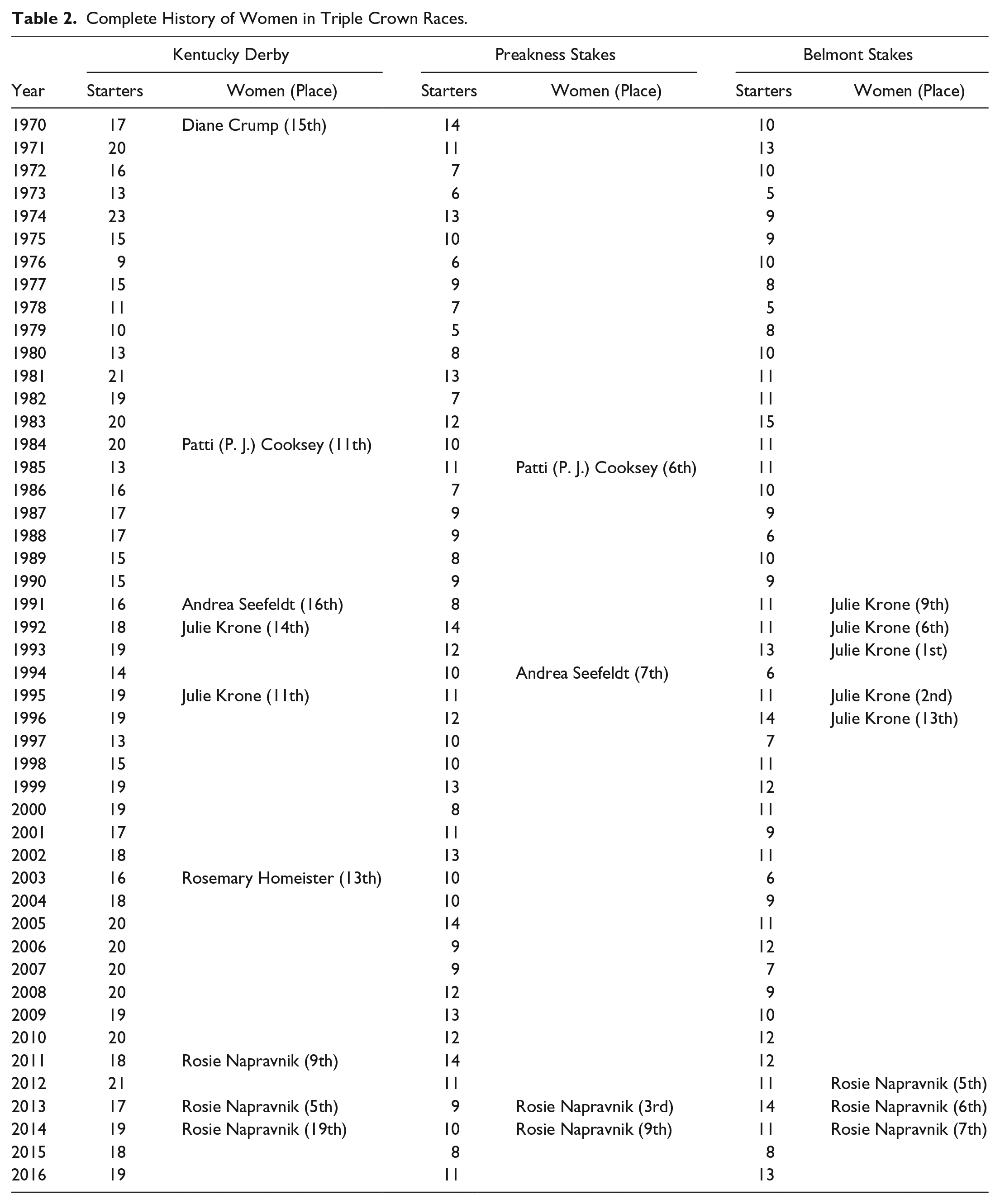
Success has had little impact on these trends. There was no influx of women after Julie Krone won the Belmont Stakes in 1993 or after she finished second in the same race in 1995. Likewise, there was no change after Rosie Napravnik finished third in the 2013 Preakness Stakes.
Results for top current NYRA jockeys are consistent with these patterns. Among 21 top NYRA jockeys, 19 were men, and 13 of those men have raced in recent Kentucky Derbies. Only 2 of the 21 NYRA jockeys were women, and neither had appeared in any Triple Crown race.
Discussion
The low representation of female jockeys would be understandable if women were uninterested in horses. But 90 percent of Americans who own or manage horses are women (Brune 2012). Low representation of female jockeys might also be understandable if women were physically incapable of competing in thoroughbred races. But women are far more likely to have the low weights needed to ride.
Although low weight is the only physical requirement for jockeys, other physical attributes can help jockeys succeed. Jockeys’ crouched riding posture requires flexibility (Pfau et al. 2009), which favors women, while the sport’s quick pace and crowded fields reward quick reaction time, which favors men (Der and Deary 2006; Lipps, Galecki, and Ashton-Miller 2011). Male jockeys have lower body fat and greater lean body mass than female jockeys at the same weight, which indicates greater strength, but female jockeys have higher bone density, greater metabolic energy (Wilson, Hill, et al. 2015), and lower risk of underweight (Table 1).
It is not clear, though, that any physical asset ensures success on the track. If strength and reaction time were paramount, we would expect that young men near the top of the allowable weight range would dominate the sport. Some top jockeys, such as Steve Cauthen or Irad Ortiz, have fit this description, but many top jockeys have been lightweights who raced well into middle age. For example, Bill Shoemaker was born prematurely and in adulthood stood just 4’11” (59 in [150 cm]), with a racing weight of 98 lb (44.5 kg) (Durso 2003). Yet he won 8,833 races, a record that stood for 29 years, and won four Kentucky Derbies, the last at age 54. Shoemaker’s physique and quiet racing style, which did not require great strength, were often compared with those of Julie Krone, the only female jockey in the Hall of Fame, who is also 4’11” and in her racing years weighed 100 lb (45 kg) “soaking wet” (Letterman 1988).
Because it is not clear what attributes are necessary for success, the best way to compare the abilities of male and female jockeys is to analyze their results when riding similar horses in similar races. The one study that made this comparison concluded that women achieved slightly better results than men on similar mounts (Grimes and May 1995). This does not necessarily mean that women make better jockeys in general, but it does suggest that the small number of women who get to ride, typically in lower level races, are better than most men who compete at that level.
It is tempting to imagine that discrimination is fading with time, but the data suggest that this is wishful thinking. Across thoroughbred racing, female jockeys are no more common today than they were in 2000, and in top races, for which our data go back further, women are no more common than they were in the 1990s. This pattern is consistent with a broader pattern in which various measures of workplace gender equality have “stalled” since around 1990 (England 2010).
Progress toward gender equality has been almost nonexistent in working-class occupations (England 2010), and we would argue that jockeying, although unique, is more like a working-class job than a profession. Jockeys’ educational requirements are low, and their work arrangements are casual. Whereas professional football, basketball, and baseball players work on long-term contracts, jockeys are hired race by race and paid $100 per race plus 5 percent to 10 percent of any prize money. Whereas the National Basketball Association requires players to be at least 1 year out of high school, and the National Football League requires players to be at least 3 years out of high school and to use up their college playing eligibility, jockeys can be licensed at age 16, and many famous jockeys dropped out of high school (e.g., Krone, Napravnik, Cauthen, Shoemaker). One jockey who took college courses was nicknamed “professor” (Crist 1982). The sport’s low age requirements may have something to do with size; whereas boys who aspire to play other sports professionally must wait until they are big enough, boys who want to be jockeys must start before they get too big. Because girls and women are less likely to outgrow the sport, reducing gender discrimination might have the effect of permitting more jockeys to finish high school.
As long as women’s access to the saddle is limited, it will be challenging to find grown men who can meet racing’s weight requirements without resorting to unhealthy weight loss practices. The increasing difficulty of finding jockey-weight men in the United States is recognized, but instead of recruiting women, owners and trainers have increasingly recruited men from less developed countries in Latin America, where heights and weights are lower. Yet many Latin American men also struggle to maintain racing weights. In New York’s “fat jockey” case, a retired Panamanian jockey was among two racetrack employees accused of falsifying weights for five male jockeys, four of whom were also Latino (Finley 2006).
To help jockeys in their struggles with weight, some physicians have developed specialized diet and fitness regimens (Wilson, Pritchard, et al. 2015), and the Jockeys’ Guild has long recommended increasing U.S. race weights by 2 to 6 lb. Owners and tracks have resisted weight increases, perhaps fearful that additional weight would reduce horses’ race times or increase their risk of injury. Required racing weights have increased, but only by 3 lb, and only at some tracks in the western US (Voss 2017).
Although we support increasing racing weights, increases of 2 to 6 lb will do only a little to help jockeys make weight without unhealthy practices. It will likely be much more effective to open the sport to women, who in the United States average 27 lb less than men (Ogden et al. 2004).
The suggestion that eating disorders can be reduced by increasing the number of female jockeys may at first seem counterintuitive. In the general population, women are more prone to eating disorders than men (Striegel-Moore et al. 2009). Pressures to lose and maintain weight are greater for women than for men, because for women, having a low BMI has a substantial effect on perceived attractiveness and social and economic success. This much less true for men, whose attractiveness and success are much less affected by BMI (Conley and McCabe 2011; Gortmaker et al. 1993; von Hippel and Lynch 2014). How can we argue that weight issues would become less common if more women entered the male-dominated occupation of jockeying?
Our answer is that the weight requirements of jockeying put much more pressure on men than on women. Female jockeys experience the usual social pressures to stay slim, and they must also contend with the sport’s weight requirements, but those weight requirements are not unrealistic for many of the short young women who become jockeys. For example, a 5’0” woman can have a BMI as high as 23 kg/m2 and still weigh less than 120 lb—light enough to race. For male jockeys, who are taller, the sport’s weight requirements are far less realistic; our results show that more than 20 percent of top male jockeys are underweight, with BMIs less than 18.5 kg/m2.
Some female jockeys have noticed that despite racing’s disadvantaging women in other ways, the sport’s weight requirements may disadvantage men. In an interview, jockey Vicky Baze reported that she “was very lucky and never had any weight problems,” whereas her husband, jockey Gary Baze “has been a reducing rider his whole career” (Forbes n.d.). In her autobiography, Julie Krone described witnessing eating disorders and weight-related drug abuse among male jockeys, especially those who were tall, but then wrote that “because of my height and build I’d never have a weight problem” (Krone and Richardson 1995). Of course, Krone’s height is related to her sex. Her adult height of 4’11” is the fourth percentile for U.S. women but the 0.02 percentile for U.S. men.