




Abstract
Opposition to social justice efforts plays a key role in reproducing social inequalities in the United States. Focusing on supporters of Donald Trump as a possible exemplar of politically structured resistance to these efforts, the author asks whether and why Trump supporters are more likely than other Americans to oppose social justice efforts. Analysis of a proportionally representative, postelection survey (n = 1,151) reveals that Trump supporters are indeed more opposed to social justice efforts. They also express greater overt race, class, and gender bias, yet this bias does not explain their opposition. Rather, many Trump supporters are “rugged meritocratists” who oppose these efforts because they believe U.S. society is already fair. To expand support for social justice efforts, rugged meritocratists must first be convinced that systemic inequalities still exist.
Keywords
Social justice efforts, whether legislative programs and policy change or collective social action, are vital for undermining endemic social inequalities in the United States. Uncovering factors that foster opposition to social justice efforts is thus key to understanding how inequality is reproduced. Resistance to social justice and equal rights efforts tends to vary demographically and regionally (Kluegel and Smith 1986; Rabinowitz et al. 2009), but a particularly strong manifestation of opposition may be that which is embedded in powerful, politically structured constituencies. One such constituency may be the segment of Americans who voted for or supported Donald J. Trump in the 2016 presidential election. Although resistance to social justice efforts by a sizable portion of the U.S. population is nothing new (McCall 2013), the 2016 presidential election seems to have crystallized this opposition among a powerful block of Trump supporters (Hochschild 2016). Inequality scholars and advocates have also expressed concern that the social justice and equal rights advancements of recent decades may be stalled in the election’s wake (Apuzzo 2017; Lopez 2017). Are Trump supporters more opposed to social justice efforts than other Americans, and if so, why?
Scholarship examining opposition to social justice efforts has tended to focus on how overt bias dampens public enthusiasm for equality-promoting social efforts—in other words, how popular views of different groups’ deservingness of equal resources and opportunities shape opinions about social justice efforts (cf. Kluegel and Smith 1986; McCall 2013). Recent public narratives have similarly explained opposition to social justice efforts by conservatives in general and Trump supporters in particular as simply a matter of steadfast social bias: Trump supporters reject equal rights advancements and social justice efforts because they are more racist, classist, and sexist than other Americans (e.g., Apuzzo 2017; Bialik 2017; Khazan 2016; Luttig, Federico, and Lavine 2016; Mulligan 2017; Nelson 2016).
However, overt biases may not be the only, or even the most important, cultural process in play in this opposition (Hochschild 2016; Kluegel and Smith 1986). Equally consequential may be the cultural frames that individuals use to interpret the fairness of the social world more broadly. Do they recognize the existence of enduring structural processes of oppression and disadvantage, or do they tend to see American society as fair? The meritocratic ideology—a widespread cultural schema that frames social advancement systems as egalitarian and explains lack of success as individual deficiencies in effort and dedication (Kluegel and Smith 1986; Young 1994)—might be a central but overlooked factor in resistance to social justice efforts.
In this article I investigate whether Trump supporters are in fact more likely to oppose social justice efforts and whether that opposition is rooted in greater overt status biases, or whether the meritocratic ideology plays an equally or more prominent role in that opposition. Answers to these questions have important implications for both social science literature on popular beliefs about social justice and for the future efforts of equality advocates. Drawing on a unique postelection survey sample that is proportionally representative of the U.S. population by gender, race/ethnicity, and age, I find that respondents who voted for or supported Trump are more likely than other Americans, and even other conservatives, to oppose social justice efforts—specifically, to think that the nation spends too much money promoting equality for the poor, women, and people of color; to agree that disadvantaged groups have gotten more than they deserve economically; to believe that disadvantaged groups are too demanding in their push for equality; and to believe that disadvantaged individuals’ claims of discrimination are invalid. Trump supporters also express greater overt status biases toward the poor, blacks, Hispanics, and women, compared with nonsupporters, and are more likely to adhere to the meritocratic ideology.
Using mediation analysis with structural equation modeling (SEM), I find that Trump supporters’ adherence to the meritocratic ideology helps explain their greater opposition to social justice efforts, while overt status biases have little impact on these outcomes. Put another way, Trump supporters’ resistance to social justice efforts has little to do with greater overt bias toward the poor, racial/ethnic minorities, and women; rather, Trump supporters tend to be “rugged meritocratists”: their resistance to social justice efforts is explained in large part by their belief that the social world is already fair and just.
Unlike most past research on beliefs about inequality, this work uses measures of bias, meritocratic ideology, and views of social justice efforts that tap racial/ethnic, class, and gender disadvantages. This provides a more robust and multidimensional picture of Americans’ attitudes than approaches which limit their examination to a single axis of inequality.
Beyond shedding light on an important moment in U.S. sociopolitical history, these findings have implications for scholarly understanding of cultural beliefs about equal rights and social justice actions. Although overt status biases may be sufficient to spark opposition to social justice efforts, this research suggests that they are not necessary: understanding U.S. society as a properly functioning meritocratic system is enough to shut down support for social justice efforts. These results point to the need for greater sociological understanding of how the meritocratic ideology—in tandem with racism, sexism, classism and other social biases—retrenches public resistance to equal rights advocacy and social change, within and outside long-standing politically structured opposition.
Related to equality advocacy and activism, Trump supporters’ perspectives serve as a proxy for more long-standing trends in conservative beliefs about inequality (Hochschild 2016). If calls for social justice efforts are framed in ways that presume that recipients agree that there are structural inequalities, those calls are likely to speak past those who believe that U.S. society already functions meritocratically. A vital first step is persuading rugged meritocratists that there are, indeed, structural inequalities that require attention. 1
Theoretical Background
To set the stage for the analyses that follow, this section provides background on previous social science research on status bias, support for social justice efforts, and popular beliefs about inequality.
Political Affiliation, Status Biases, and Opposition to Social Justice Efforts
Scholars have investigated a variety of ways that the devaluation of disadvantaged groups manifests in the United States (Quillian 2006). One ubiquitous and durable manifestation is status bias. Status biases are widely shared cultural beliefs about the extent to which the “types” of people who occupy certain status categories are intelligent, honest, and worthy of respect, esteem, and honor (Berger et al. 1977; Ridgeway 2011, 2014). These biases operate at both the macro, institutional level and the micro, interactional level and exist alongside more material inequalities such as income and housing. Status biases can be overt, whereby people believe that members of some social categories are simply better along various dimensions (e.g., more intelligent, more hardworking, more friendly) than members of other categories. They can also be more subtle, such as when an individual makes assumptions about another’s skills or preferences on the basis of his or her social category (Ridgeway 2014).
Scholars have studied status biases toward members of many different sociodemographic groups, from racial/ethnic categories to religious affiliations (Dovidio and Fiske 2012). Across this array of social characteristics, status biases typically fall along two dimensions: biases about competence and biases about warmth. Perceptions of competence include sentiments about perceived (lack of) intelligence, ability, and efficacy, while the warmth dimension includes perceptions of sincerity, trustworthiness, and friendliness (Fiske, Cuddy, and Glick 2007). In this article I examine overt status biases toward the poor, blacks, Hispanics, and women along both the competence and warmth dimensions. Most members of dominant and nondominant groups hold such biases, although some groups express greater levels of bias on average than others (Ridgeway 2014).
Although there are several different strands of conservatism in the United States (Binder and Wood 2014; Hochschild 2016), political conservatism in general tends to be correlated with greater overt bias. Typically, net of race, gender, and age, political conservatism is related to greater distrust and distain for economically disadvantaged individuals (Dimock et al. 2014; Hochschild 2016), more biased views of racial/ethnic minorities (Greenwald et al. 2009; Taylor and Merino 2011), and more stereotypical views of women (Christopher and Mull 2006; Mulligan 2017). This connection between conservatism and bias is generally understood as the result of conservatives’ typically greater adherence to traditional Christian religious ideologies, resistance to social change, and preference for a capitalist power hierarchy that privileges middle class white men (Wilson 1973; Zucker and Weiner 1993). Consistent with prior research on conservatives and recent polling data (Bialik 2017; Mulligan 2017; Schaffner, MacWilliams, and Nteta 2017), I expect that Trump supporters, compared with nonsupporters, will have more negative perceptions of the competence and warmth of the poor, blacks, Hispanics, and women.
Furthermore, political conservatism has long been correlated with greater resistance to equality-promoting social action and legislation (Arrow, Bowles and Durlauf 2000; Hochschild 2016). Americans in general tend to oppose redistributive policies such as affirmative action; even those who are dismayed by social inequality typically prefer policies that advance opportunities for everyone over more targeted approaches (Arrow et al. 2000; McCall 2013; McCall and Kenworthy 2009; Rabinowitz et al. 2009). Conservatives especially tend to prefer reforms that elevate economic growth and reward individual responsibility over those that attempt to directly reduce inequality (McCall 2016). 2 I thus expect that Trump supporters, like conservatives broadly, will be more likely than nonsupporters to oppose social justice efforts. Trump supporters may even express greater opposition to such efforts than other conservatives.
The Meritocratic Ideology and Beliefs about Inequality
Besides overt status biases, why might Trump supporters be more resistant to social justice efforts than other Americans? An equally important factor fostering resistance may be individuals’ understanding of the workings of the social system in which they are embedded. Do Trump supporters recognize enduring structural inequalities, or do they believe that American society is a “just world,” where social advancement systems operate impartially (Jost, Banaji, and Nosek 2004; Jost and Major 2001; Young 1994)? In other words, do Trump supporters more strongly adhere to the meritocratic ideology—the belief that U.S. society is generally fair, and anyone who puts in enough hard work and dedication will succeed (Young 1994)?
The meritocratic ideology is both an assessment of the fairness of the social world and a cultural frame that helps its adherents account for existing differences among individuals and social groups (Cech and Blair-Loy 2010; Cech, Blair-Loy, and Rogers forthcoming). From the perspective of the meritocratic ideology, people are responsible for their own social positions, and existing ascriptive differences are the aggregate result of individual effort (Arrow et al. 2000; Young 1994). This cultural frame helps individuals make sense of both their local interactional environments and broader patterns of social difference (Cech et al. forthcoming). The counter-perspective to the meritocratic ideology, and the one best supported by a century of social science research, is a structural frame, which recognizes that systemic racism, sexism, and classism are alive and well in the United States, and that the poor, racial/ethnic minorities, and women do not have the same opportunities for success as wealthy white men (Gurin 1985; Kluegel and Smith 1986).
The meritocratic ideology is popular in the United States broadly and is a foundational tenet of the “American dream” ideal (Hochschild 1995; Hochschild 2016). This ideology is particularly prominent among conservatives, as it dovetails with other core conservative political values such as individualism and self-sufficiency (Alexander 2010; Hunt 2007; Kluegel and Smith 1986). As such, I expect that Trump supporters will be more likely than nonsupporters to adhere to the meritocratic ideology. On its surface, this ideology may seem to run counter to documented grievances of Trump voters about diminishing economic opportunities (Pew Research Center 2016b). However, the desire for greater opportunities is not necessarily incompatible with the belief that the advancement systems for getting those opportunities are fair (Major and Schmader 2001; McCall 2011). 3 Trump supporters may, for example, be angry that manufacturing jobs have left the United States while believing that the hiring procedures for obtaining the manufacturing jobs that remain are meritocratic.
Furthermore, I expect that adherence to the meritocratic ideology will be a key factor in explaining Trump supporters’ greater resistance to social justice efforts. Conservative Americans in general, and perhaps Trump supporters particularly, are often reticent to support policies or social changes that appear to allow historically disadvantaged groups to unfairly “cut in line” (Hays 2004; Hochschild 2016; Kluegel and Smith 1986). Through the frame of the meritocratic ideology, social justice efforts likely exemplify such line-cutting. Adherents to the meritocratic ideology may also interpret equal rights advocacy not as an attempt to undermine actually existing structural inequalities but a granting of “extra” rights and privileges to those who already have equal footing. 4
Importantly, adherence to the meritocratic ideology does not mean that one is nonbiased; rather, the “paradox” of the meritocratic ideology is that it is integral to the perpetuation of ascriptive inequality (Castilla and Bernard 2010). 5 The meritocratic ideology is likely connected to overt bias, in that existing patterns of social disadvantage are perceived as the legitimate outcome of competition between differently talented groups of people. But the meritocratic ideology is likely also connected to racism, classism, and sexism in other ways. Research over the past three decades has illustrated that race and gender stereotypes manifest not only as overt bias (like what is captured here) but also in more subtle forms, such as the attribution of existing patterns of difference to individual “choices.” For example, “colorblind racism” frames existing patterns of racial/ethnic inequality as largely the outcome of nonracial circumstances (Bonilla-Silva 2003; Bonilla-Silva and Dietrich 2011; Omi and Winant 2015), and “modern” sexism includes a denial of gender discrimination and belief that the gendered division of labor is the result of women’s choices (Barreto and Ellemers 2005; Omi and Winant 2015). These more subtle manifestations of bias are no less consequential than overt status biases for the lived experiences of women and people of color (Barreto and Ellemers 2005) and are similarly predicated on a cultural belief that the social world is generally fair and people are responsible for their own social positions. It is thus important to understand the extent to which the meritocratic ideology fosters resistance to social justice efforts even in the absence of overt status bias.
In summary, the meritocratic ideology frames American society as more or less fair and holds individuals responsible for their own social and economic positions. The meritocratic ideology may thus challenge perceptions that social justice efforts are needed in the first place. Overt status biases may be sufficient to foster opposition to social justice efforts supporters, but they may not be necessary. Adherence to the meritocratic ideology may be a powerful factor in anchoring resistance to social justice efforts.
Data and Methods
In this study I use unique survey data on 1,151 Americans collected three weeks after the 2016 presidential election (November 28 to December 2, 2016). The survey was conducted via the online survey platform Qualtrics, which fielded the survey to a quota sample that is proportionally representative of the U.S. adult population by gender, by racial/ethnic category, and by decile age category. 6 Prior research has found Qualtrics’ national sampling procedure to be generally reflective of the U.S. population along a variety of demographic and attitudinal factors: even without quota sampling, Qualtrics produces samples that are within 7 percent on average of corresponding values in the U.S. population on factors ranging from household income to marital status (Heen, Lieberman, and Miethe 2014). 7
Although not a strictly representative sample, these survey data are more useful than existing nationally representative data sets because they include more than 100 questions related to status bias, meritocracy, and beliefs about inequality, and the survey was fielded immediately following the 2016 presidential election. To increase the quality and reliability of the resulting data, the survey included four attention filters (Oppenheimer, Meyvis, and Davidenko 2009). 8
In total, 1,571 respondents began the survey; respondents who failed the attention filters (15.8 percent) or whose quota group was already filled by the time they completed the survey (10.9 percent) were excluded from the quota sample. 9 I conducted supplemental analyses (described below) with the full sample of 1,571 respondents to test the robustness of the results to sample specification; the pattern of findings with this full sample was the same as that described below using the quota sample of 1,151.
The survey was advertised as a “beliefs about society” survey and asked respondents a variety of questions about their assessments of the fairness of the social world; their perceptions of the status of women, racial/ethnic minorities, and economically disadvantaged individuals; their explanations for existing social differences; and their perceptions of the characteristics of people occupying various sociodemographic categories. Unlike most research on public beliefs about inequality, this work draws on questions about race/ethnicity, class, and gender inequality simultaneously. Because one’s social location affects the types of inequality one may experience or witness, including multiple axes of disadvantage in considerations of respondents’ reactions to social justice efforts, their adherence to the meritocratic ideology, and their overt bias allows a more complete picture than would be possible with an analysis focusing on a single axis of disadvantage. Confirmatory factor analysis and supplemental tests ensure coherence of latent measures that combine questions related to gender, race/ethnicity, and class.
I use SEM to test for relationships between support for Trump and the measures of overt status biases, meritocratic ideology, and resistance to social justice efforts. SEM is preferable to ordinary least squares regression with scales because it allows the use of latent measures that capture multifaceted attitudinal concepts while allowing the measurement errors on each variable to vary independently. Each major outcome of interest is represented by a latent measure, which is a collection of related individual survey questions called manifest variables. SEM also provides a statistical approach for testing mediation (Hancock and Mueller 2006). Missing data were handled with the maximum likelihood function in Stata 14’s SEM builder; each measure used here had less than 4 percent missingness.
Table 1 provides the precise question wording used in the survey and value ranges for each manifest and latent measure used in the analysis. A more detailed discussion of measure operationalization is provided in the supplemental materials. Table 1 also provides the results of the confirmatory factor analysis for each latent measure. 10 All multivariate models include controls for gender, racial/ethnic category, LGBTQ (lesbian, gay, bisexual, transgender, and/or queer) status, education level, age decile, whether respondents were born in the United States, and whether respondents live in an urban, surburban, suburban, or rural area.
Operationalization of Independent and Dependent Variables.

Note: CFA = confirmatory factor analysis; CFI = comparative fit index; SRMR = standardized root mean square residual.
Analytic Approach
I begin by presenting means and standard deviations for the manifest measures for all respondents together and then separately by support for Trump (Table 2). Next, I use SEM to test whether, compared with nonsupporters, Trump supporters have more biased assessments of the competence (intelligent, responsible, hardworking, motivated) and warmth (happy, family oriented, humble, not angry) of the poor, blacks, Hispanics, and women (Table 3). 11 Table 4 tests whether Trump supporters have stronger adherence to the meritocratic ideology, compared with nonsupporters. Tables 5A to 5D present a series of models examining the relationship between support for Trump and opposition to social justice efforts. The first model in Tables 5A to 5D predicts reactions to social justice efforts using the Trump support measure plus controls. The next sets of models add the meritocratic ideology latent measure and the competence and warmth status bias measures one demographic group at a time.
Means and Standard Deviations on Independent and Dependent Variables, for All Respondent and by Support for Trump (n = 1,151).

Note: REMs = racial/ethnic minorities.
p < .05. **p < .01. ***p < .001.
Support for Trump predicting Status Biases toward the Poor, Blacks, Hispanics and Women.

Note: White is the comparison group for race/ethnicity. CFI = comparative fit index; SRMR = standardized root mean square residual.
p < .05. **p < .01. ***p < .001.
Results of Structural Equation Model Predicting Adherence to the Meritocratic Ideology with Trump Support and Controls.

Note: White is the comparison group for race/ethnicity. CFI = comparative fit index; SRMR = standardized root mean square residual.
p < .05. **p < .01. ***p < .001.
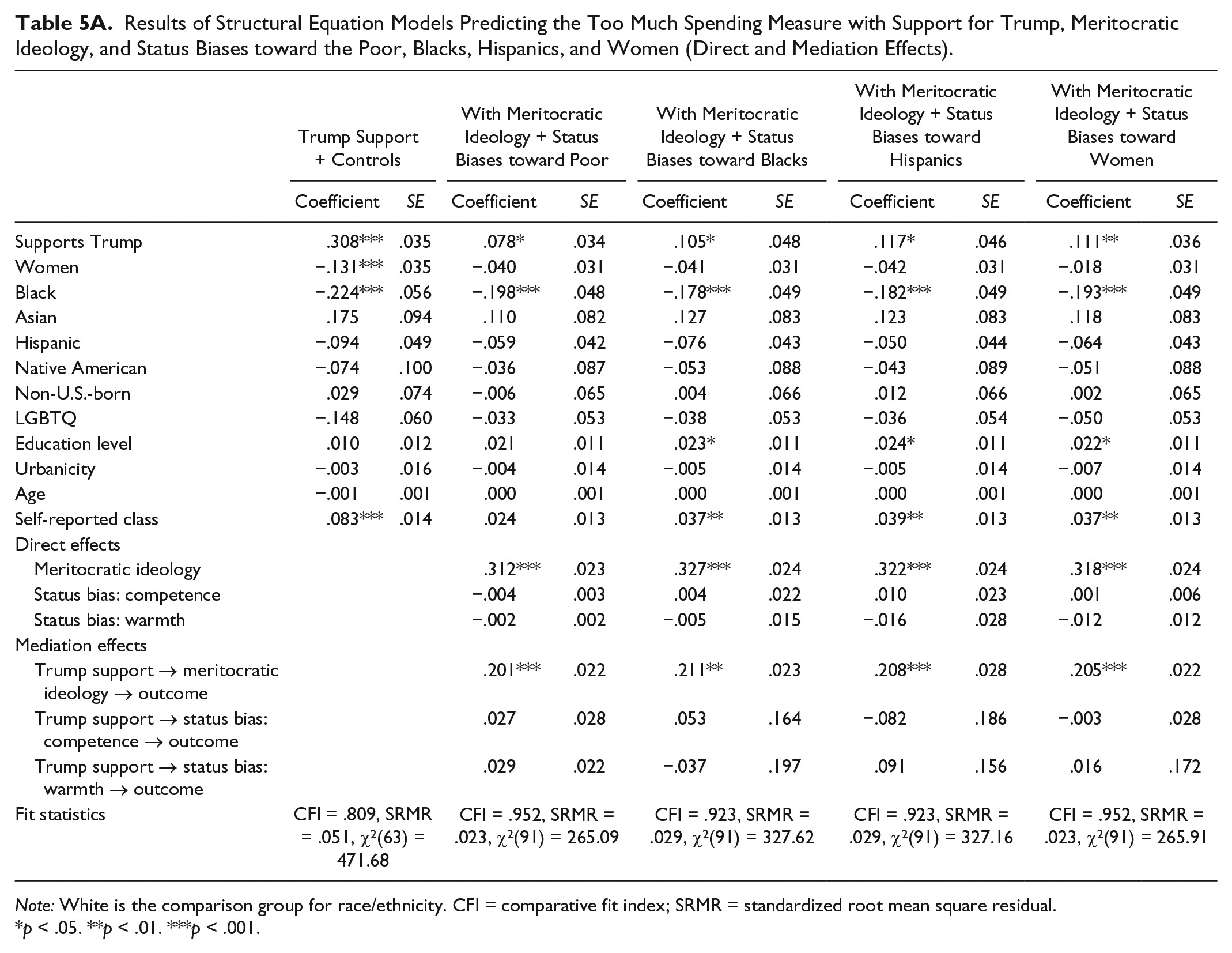
Results of Structural Equation Models Predicting the Too Much Spending Measure with Support for Trump, Meritocratic Ideology, and Status Biases toward the Poor, Blacks, Hispanics, and Women (Direct and Mediation Effects).
Note: White is the comparison group for race/ethnicity. CFI = comparative fit index; SRMR = standardized root mean square residual.
p < .05. **p < .01. ***p < .001.
Results of Structural Equation Models Predicting Beliefs That Disadvantaged Groups Have Gotten More Than They Deserve with Support for Trump, Meritocratic Ideology, and Status Biases toward the Poor, Blacks, Hispanics, and Women (Direct and Mediation Effects).

Note: White is the comparison group for race/ethnicity. CFI = comparative fit index; SRMR = standardized root mean square residual.
p < .05. **p < .01. ***p < .001.
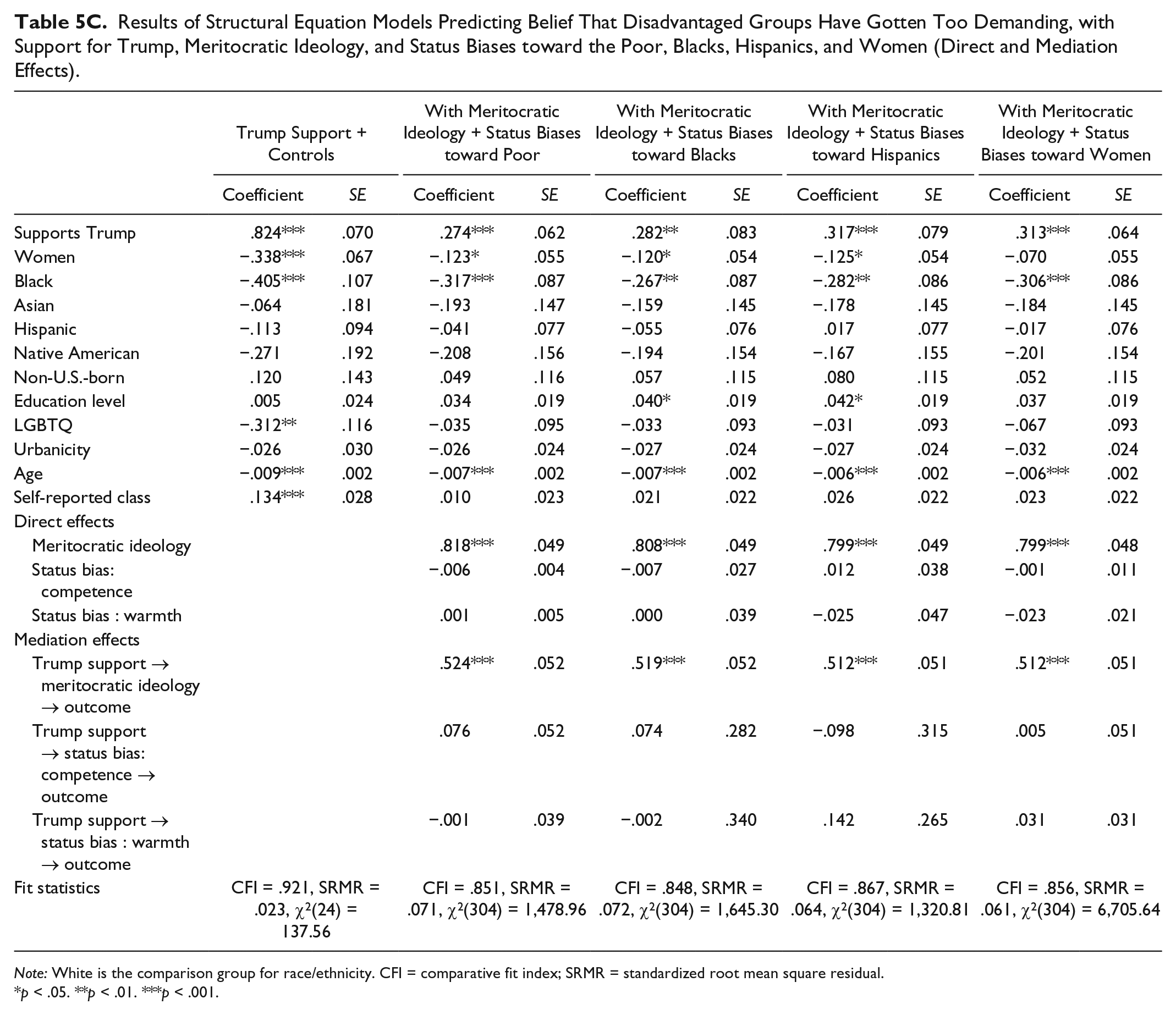
Results of Structural Equation Models Predicting Belief That Disadvantaged Groups Have Gotten Too Demanding, with Support for Trump, Meritocratic Ideology, and Status Biases toward the Poor, Blacks, Hispanics, and Women (Direct and Mediation Effects).
Note: White is the comparison group for race/ethnicity. CFI = comparative fit index; SRMR = standardized root mean square residual.
p < .05. **p < .01. ***p < .001.
Results of Structural Equation Models Predicting Belief That Disadvantaged Groups Say They Are Discriminated Against When They Aren’t with Support for Trump, Meritocratic Ideology, and Status Biases toward the Poor, Blacks, Hispanics, and Women (Direct and Mediation Effects).

Note: White is the comparison group for race/ethnicity. CFI = comparative fit index; SRMR = standardized root mean square residual.
p < .05. **p < .01. ***p < .001.
In addition to calculating the direct effects of status biases and the meritocratic ideology on the social justice efforts measures, these models in Tables 5A-5D also estimate the mediation effects of Trump support on the opposition to social justice efforts through the meritocratic ideology and status bias measures. Significant mediation effects would indicate that the measures in question help explain Trump supporters’ greater opposition to social justice efforts. Figure 1 provides a schematic example of a structural equation model testing the mediation of Trump support on the “too demanding” measure by the meritocratic ideology and status biases toward the poor. The direct effect of Trump support on the social justice outcome is represented by path G in Figure 1. Direct effects of the meritocratic ideology, competence status bias, and warmth status bias are represented by paths B, D, and F, respectively. The mediation effect of the meritocratic ideology is calculated as A × B, and the mediation effects of competence and warmth status biases are calculated as C × D and E × F, respectively.

Schematic of structural equation model with direct and mediating effects predicting “gotten too demanding” measure.
Results
Table 2 provides the means and standard deviations on each measure for all respondents and separately by Trump supporter status. 12 The final column in Table 2 provides the significance of the difference in means (via t tests) between Trump supporters and nonsupporters. Two fifths (40.4 percent) of the sample (n = 465) voted for Trump or would have voted for Trump had they voted in the 2016 presidential election. Closer to half (46.8 percent) of the sample are Clinton supporters, and 12.8 percent supported third-party candidates. 13 This is consistent with research showing that online panel samples tend to be slightly more liberal than the average U.S. population (Pew Research Center 2016a). 14 As with the actual 2016 voting population, women, people of color, LGBTQ persons, and those born outside the United States in this sample are significantly less likely to be Trump supporters. Trump supporters are also significantly older and live in more rural areas than nonsupporters.
Table 2 also presents the means for each of the manifest variables that constitute the status bias, meritocratic ideology, and social justice latent measures. In the t-test results reported in the last column, Trump supporters have more negative assessments of the competence (intelligent, responsible, hardworking, and motivated) and warmth (happy, family oriented, humble, and not angry) of the poor compared with nonsupporters. As discussed in more detail in the supplemental information section, these are difference measures; for example, the values for status biases toward the poor are calculated by taking each respondent’s assessment of the poor on a characteristic and subtracting their assessment of the wealthy on that same characteristic. More negative values indicate greater bias toward the poor relative to perceptions of the wealthy.
Trump supporters also have more negative views of the competence and warmth of blacks and Hispanics, and of the competence of women, compared with nonsupporters. Importantly, most of the status bias measures for the poor, blacks, and Hispanics are negative, meaning that most respondents have overt biases toward these groups regardless of political affinity. However, Table 2 indicated that these values are significantly more negative among Trump supporters, meaning that Trump supporters are more likely than nonsupporters to perceive the poor as less competent and warm than the wealthy and blacks and Hispanics as less competent and warm than whites. The status bias measures for women are positive among both supporters and nonsupporters. This is not surprising for the warmth measures, as women are typically stereotyped as warmer than men (Dovidio and Fiske 2012; Ridgeway 2011). Although the means are also generally positive for perceptions of women’s competence, Trump-supporting men have negative average values on these measures.
Trump supporters have higher levels of agreement across all five of the meritocratic ideology measures than nonsupporters. 15 They are also more likely to oppose to each of the social justice measures than nonsupporters: they are more likely to agree that too much money has been spent on welfare, homeless shelters, and improving conditions for the poor, blacks, and women. 16 Furthermore, Trump supporters are more likely to believe that the poor, racial/ethnic minorities, and women have gotten more than they deserve, have gotten too demanding in their push for equal rights, and say they are discriminated against when they are not. 17 The analyses in the next section will test whether these bivariate differences remain once demographic variation is accounted for.
Predicting Status Biases and Adherence to the Meritocratic Ideology
The next set of analyses determine whether there are significant differences in overt status biases by support for Trump, net of controls. Table 3 is divided into four panels, one for each type of status bias being examined: biases about the poor (panel A), blacks (panel B), Hispanics (panel C), and women (panel D). Structural equation models are used to predict the competence and warmth latent measures in each panel. 18 Panel A reports the coefficients and standard errors for perceptions of the poor as competent and warm. The first row in panel A shows that Trump supporters view the poor as less competent (B = −10.848, p < .001) and less warm (B = −5.985, p < .001) than nonsupporters view the poor (net of controls). Similarly, Trump supporters view blacks (panel B) and Hispanics (panel C) as less competent and less warm than the way nonsupporters view blacks and Hispanics, net of controls. Finally, Trump supporters view women as less competent (but no less warm) than do nonsupporters (panel D).
These status biases also vary predictably by demographic category: respondents have more positive views of their own demographic groups (e.g., Hispanic-identifying respondents are more likely than non-Hispanic respondents to perceive Hispanics as competent and warm). Racial/ethnic minorities in the sample also typically express less bias toward blacks, Hispanics, and the poor compared with white respondents.
As expected, Trump supporters are significantly more likely to adhere to the meritocratic ideology than nonsupporters (see Table 4). Net of controls, support for Trump is positively related to the meritocratic ideology latent measure (B = .578, p < .001). Women, LGBTQ respondents, and older and more educated respondents are less likely than others to believe in the meritocratic ideology, but those with higher self-reported class status are more likely to adhere to this ideology.
Supplemental analyses examining the relationship between the meritocratic ideology and the status bias measures found that adherence to the meritocratic ideology significantly predicts more negative beliefs about the competence and warmth of women, blacks, Hispanics, and the poor. This supports the assertion above that believing that U.S. society is fair can underlie overt status biases. The reverse causal order is generally nonsignificant. Those who believe that the poor are warm are less likely to believe in the meritocratic ideology. However, no other status bias measures significantly predict adherence to the meritocratic ideology. This suggests that although most people with overt status biases believe in the meritocratic ideology, not everyone who adheres to the meritocratic ideology holds overt race, class, and gender biases.
Reactions to Social Justice Efforts
Tables 5A through 5D present structural equation models predicting respondents’ reactions to the four social justice latent measures. These capture the extent to which respondents believe that too much money is spent on equality-promoting endeavors (Table 5A), that disadvantaged groups have gotten more than they deserve (Table 5B), that disadvantaged groups have gotten too demanding in their push for equality (Table 5C), and that disadvantaged groups often claim they are discriminated against when they are not (Table 5D). 19
The first column in each table presents a model using Trump support plus controls to predict the social justice latent measures. These models indicate that Trump supporters are indeed more likely to oppose social justice efforts: net of controls, they are more likely to agree that too much money has been spent on equality-promoting endeavors (Table 5A); that the poor, racial/ethnic minorities, and women have gotten more economically than they deserve (Table 5B); that the poor, racial/ethnic minorities, and women have gotten too demanding in their push for equal rights (Table 5C); and that the poor, racial/ethnic minorities, and women often claim that they are discriminated against when they are not (Table 5D). Furthermore, women, people of color, older respondents, and economically disadvantaged respondents tend to be less likely to oppose social justice efforts than respondents who are white, male, upper class, and younger. Supplemental analysis predicting these social justice measures among only Trump supporters finds the same demographic patterns, whereby racial/ethnic minority and women Trump supporters are less likely than white male Trump supporters to oppose social justice efforts. Nonetheless, among sets of models with just women, just people of color, and just lower and working-class respondents, support for Trump is still a significant predictor of resistance to social justice efforts (see supplemental information).
The next set of analyses helps disentangle whether overt status biases or adherence to the meritocratic ideology better explains these relationships. The models in the final four columns in Tables 5A to 5D include latent measures for the meritocratic ideology and for perceptions of the competence and warmth of the poor, blacks, Hispanics, and women (included separately). The middle rows of Tables 5A to 5D provide the direct effects of status biases and the meritocratic ideology on each social justice measure. In each model, adherence to the meritocratic ideology is strongly related to respondents’ likelihood of opposing social justice efforts. Status biases, on the other hand, have little direct relationship to these social justice measures. Other than the significant effect of bias toward the poor predicting greater agreement with the illegitimacy of discrimination claims (Table 5D), none of the competence or warmth status biases are directly related to the social justice measures. This suggests that overall, the meritocratic ideology is more strongly related to opposition to social justice efforts measures than overt class, racial/ethnic, and gender bias.
Do Trump supporters’ greater overt biases and greater adherence to the meritocratic ideology help explain why they are more likely to oppose social justice efforts? In addition to testing for direct effects, the models in Tables 5A to 5D include paths between Trump support and both the meritocratic ideology and status bias latent measures (see the “mediation effects” rows in each table). This allows me to test whether the effect of Trump support is significantly mediated by the meritocratic ideology or by the status biases measures. Significant mediation effects would indicate that adherence to the meritocratic ideology and/or status biases help explain why Trump supporters are more likely to reject social justice efforts than nonsupporters.
Turning first to the status bias measures, only one measure has a significant mediating effect on a social justice outcome: belief that the poor are (in)competent has a significant mediating effect (i.e., helps explain) Trump supporters’ greater likelihood of seeing discrimination claims as illegitimate (Table 5D). There are no other significant mediation effects of the status bias measures on any other social justice measure.
On the other hand, adherence to the meritocratic ideology is a strong mediator of the relationship between Trump support and all of the social justice measures. (See the row “Trump support → meritocratic ideology → outcome” in Tables 5A–5D.) The meritocratic ideology significantly mediates the relationship between Trump supporters and the belief that too much money is spent on equality-promoting efforts (Table 5A), that disadvantaged groups have gotten more than they deserve (Table 5B), that disadvantaged groups have gotten too demanding (Table 5C), and that disadvantaged groups say they are discriminated against when they are not (Table 5D).
In short, adherence to the meritocratic ideology is a much more robust and consistent mediator of the relationship between Trump support and opposition to social justice efforts than overt status biases. This holds across four separate multivariate measures of social justice efforts and holds net of variation by gender, race/ethnicity, age, LGBTQ status, education level, self-reported class, urbanicity, and whether respondents were born in the United States.
Are Trump supporters distinct from other conservatives on these measures? In supplemental analyses, I examined whether Trump supporters have significantly different beliefs than other conservatives—people who placed themselves between somewhat and very conservative (5–7) on a scale ranging from 1 = very liberal to 7 = very conservative. Suggesting their cultural distinctiveness vis-à-vis other conservatives, I found that Trump supporters are significantly more likely to express opposition to social justice efforts than other conservatives. Trump supporters are also more likely than other conservatives to express overt bias: they are more likely to see the poor as less competent and warm than the wealthy, to see blacks as less competent and warm and Hispanics as less competent than whites, and to see women as less competent than men. See Table A1 for the coefficient estimates and significance levels of the Trump supporter indicator in these conservatives-only models. Trump supporters and other conservatives are equally likely to express adherence to the meritocratic ideology, however. This suggests that although Trump supporters have greater likelihood of opposing social justice efforts, adherence to the meritocratic ideology is similarly prominent among other conservatives. As such, future restructuring of conservative constituencies is unlikely to undermine the mediation effects of the meritocratic ideology documented above.
Additionally, to test whether the relationships examined in Tables 3 to 5 hold if conservatives in general are the focal population, rather than the specific constituency of Trump supporters, I reran the models with the generic measure of political conservatism (1 = very liberal to 7 = very conservative) in place of the Trump support indicator. The significance levels and mediation effects were the same as those presented in Tables 3 to 5: conservatives are more likely than moderates and liberals to have negative status biases toward the poor, blacks, Hispanics, and women and are more likely than moderates and liberals to adhere to the meritocratic ideology and to oppose social justice efforts. As with Trump supporters, the relationship between conservatism and social justice efforts is mediated by adherence to the meritocratic ideology, but not by status biases.
Conclusion
Social justice efforts are a central means though which inequality is undermined locally and nationally; it is thus important for inequality scholars to better understand the factors that drive opposition to such efforts. In this article, I focused on Trump supporters as an exemplar of a salient, politically structured contingency that may nurture opposition to social justice efforts. I asked, are Trump supporters more opposed to social justice efforts, and is this opposition driven by greater overt social bias, or by broader beliefs about the social world? I argued that the meritocratic ideology—a cultural frame that portrays social and economic advancement structures in the United States as generally fair—may be an important but unacknowledged factor in this opposition.
Using unique survey data with questions tapping beliefs across multiple axes of social difference, I found that Trump supporters are more likely to oppose social justice efforts, even compared with other conservatives. They also are more likely to express overt class, racial/ethnic, and gender biases compared with nonsupporters. In contrast to common scholarly and popular narratives, however, the greater overt bias among Trump supporters does little to explain their greater likelihood of resistance to social justice efforts. Rather, Trump supporters are more likely than other Americans to be rugged meritocratists; they are more likely to believe that U.S. society is fair and this adherence to the meritocratic ideology is a more robust explanation for opposition to social justice efforts than overt bias.
Why would belief in the meritocratic ideology be more important than overt bias in explaining opposition to social justice efforts? First, the meritocratic ideology is conceptually more consistent with resistance to social justice efforts than status biases. Second, the meritocratic ideology is directly connected to cultural narratives about the necessity of social activism: the recognition of the validity of social justice efforts requires that people believe that U.S. society is not yet equal. Rugged meritocratists, who frame social advancement systems as already fair, likely see little need for social justice efforts, view equal rights efforts as a demand for “extra” rights, and see claims of discrimination as illegitimate.
This does not mean, of course, that those who believe in the meritocratic ideology do not contribute to racist, classist, and sexist social structures. Supplemental analysis found that adherents to the meritocratic ideology are more likely to express overt status biases than those who reject that ideology. But the meritocratic ideology also undergirds prejudiced beliefs that perpetuate existing social structures of inequality in more subtle ways (Castilla and Bernard 2010). As discussed above, colorblind racism and “modern” sexism rests on underlying beliefs that the social world is meritocratic (Barreto and Ellemers 2005; Bonilla-Silva 2003; Omi and Winant 2015). As such, the meritocratic ideology is likely a cultural belief that not only promotes opposition to social justice efforts but also helps anchor bias in a variety of ways.
The results presented here have several implications for inequality scholarship. First, they point to the need to take seriously cultural beliefs about inequality, not just biases about particular social groups, as mechanisms hindering support for social justice efforts. Second, existing literature on beliefs about inequality tends to focus on one axis of disadvantage at a time. These findings suggest that the meritocratic ideology is a core cultural schema that underlies more general assessments of the legitimacy of social justice and equal rights efforts. This ideology is likely also consequential for reactions to social justice efforts on behalf of disadvantaged groups beyond race, class, and gender, such as LGBTQ persons and religious minorities. Third, more research is needed to understand when and how the meritocratic ideology is invoked in both individual interactions and political discourse. How do individuals and groups maintain a belief in the meritocratic ideology in the face of clear structural disadvantages?
The findings also have important implications for equality advocates and activists. Scholarly and activist circles are increasingly concerned that recent social justice advancements may be halted or even reversed. The results here corroborate other emergent research (Bialik 2017; Schaffner et al. 2017) showing that Trump supporters tend to express more overt social biases than nonsupporters, net of controls. These greater levels of overt bias may be connected to the rise in instances of hate speech, vandalism, and violence toward disadvantaged groups after the 2016 election (Miller and Werner-Winslow 2016).
However, inequality advocates should not assume that overt bias is the greatest—or the only—cultural blockade to social justice efforts and equal rights action. These results indicate that rugged meritocratists may oppose social justice efforts even if they harbor little overt status bias. Overt bias may be sufficient in some cases to produce opposition, but it is not necessary: the meritocratic ideology may serve as an equally powerful and more ubiquitous hindrance to social justice efforts. Rugged meritocratists, whatever their political affiliation, may put up substantial resistance to social justice and equal rights advocacy because such efforts do not align with their framing of U.S. society.
A pressing consideration, then, is how the meritocratic ideology can be challenged. There is obviously no shortage of sociological research demonstrating the enduring presence of systemic inequalities in virtually every corner of the social world. But formalized social science knowledge is likely not the most effective vehicle for belief change. Although more research is needed, social psychological scholarship suggests that emotionally compelling anecdotes that serve as exemplars of broader patterns of structural disadvantage are generally more successful at shifting people’s perceptions of U.S. society than aggregated trends or statistics (Feinberg and Willer 2015). Furthermore, experiences like community service and courses that discuss inequality can help foster young adults’ concerns about inequality before their socio-political views stabilize (Cech 2017).
At the very least, calls to social action that presume that recipients already understand and agree that structural inequalities pervade American society are likely to speak past adherents to the meritocratic ideology. Equality advocates may have better luck reaching rugged meritocratists by couching arguments for social justice efforts not within the moral frames that tend to concern liberals (e.g., fairness, justice, and protection from harm) but within the concerns that tend to dominate conservatives’ moral frames: patriotism, loyalty, and purity (Feinberg and Willer 2015). 20
In sum, resistance to social justice efforts appears to be based less in overt social bias than in a particular framing of the social world, one that denies structural inequality and blames victims of that inequality for their own circumstances. To see meritocracy in a deeply unequal nation is to understand American society in a fundamentally different way from how it is understood by those working to address systemic inequality. Equality scholars and advocates must keep this in mind, or rugged meritocratists will remain unconvinced by demands for social justice.
Footnotes
Appendix
Coefficient Estimates, Significance, and Standard Errors for the Trump Support Measure from Structural Equation Models Predicting Status Biases, Meritocratic Ideology, and Opposition to Social Justice Efforts, among Conservatives Only (n = 459).

| Latent Outcome Measure | Coefficient Estimate for Trump Support Measure | SE |
|---|---|---|
| Overt status biases | ||
| Poor vs. wealthy: competence | −10.202*** | 2.269 |
| Poor vs. wealthy: warmth | −7.106** | 2.462 |
| Blacks vs. whites: competence | −8.379*** | 1.874 |
| Blacks vs. whites: warmth | −6.682*** | 1.604 |
| Hispanics vs. whites: competence | −4.724** | 1.732 |
| Hispanics vs. whites: warmth | −2.469 | 1.757 |
| Women vs. men: competence | −5.723*** | 0.639 |
| Women vs. men: warmth | −1.655 | 1.215 |
| Meritocratic ideology | ||
| Adherence to meritocratic ideology | .154 | .101 |
| Opposition to social justice efforts | ||
| Too much spending | .165** | .058 |
| Gotten more than deserve | .226* | .107 |
| Too demanding | .376** | .115 |
| Say discriminated against when weren’t | .413*** | .101 |
Note: Models control for gender, race/ethnicity, LGBTQ status, nativity, education, urbanicity, age, and self-reported class.
p < .05. **p < .01. ***p < .001.
Acknowledgements
I am grateful to Mary Blair-Loy, Molly Cech, Yanna Lambrinidou, Lindsey Trimble O’Connor, Michelle V. Pham, William R. Rothwell, Heidi Sherick, and the anonymous reviewers for valuable feedback on previous versions of this article.
Funding
The author disclosed receipt of the following financial support for the research, authorship, and/or publication of this article: This research was funded in part by a faculty support grant from the College of Literature, Science, and the Arts, University of Michigan.
1
“Rugged meritocratists” is a nod to “rugged individualism,” an idea articulated by Herbert  that each individual ought to be responsible for his or her own livelihood and that the government should not interfere with people’s economic lives. This ideal of radical self-sufficiency is part of the meritocratic ideology, but the meritocratic ideology more centrally involves notions that the social system is fair and that, as a result, people are personally to blame for their own social standing.
2
3
Indeed, social-psychological research has found that it is harmful to one’s emotional and mental health to recognize that one faces structural disadvantages and discrimination (Jost et al. 2004), and people are often reticent to give up their belief in the meritocratic ideology even when presented with evidence from their own life experiences (Major and Schmader 2001; ).
4
5
In fact, research at the organizational level finds that when managers believe that they have created a meritocratic work environment, they are actually more likely to perpetuate gender bias in their organizations (Castilla and Bernard 2010; Light, Roscigno, and Kalev 2011).
6
Qualtrics uses professionally curated respondent pools that include hundreds of thousands of potential respondents nationwide. Qualtrics is used for both academic and commercial applications and typically produces more representative, high-quality samples than comparable survey platforms such as SurveyMonkey or Amazon Mechanical Turk ().
7
compared the online sampling approaches of Qualtrics, SurveyMonkey, and Amazon Mechanical Turk and found that Qualtrics was superior in its ability to generate national samples. Specifically, in a nonquota sample (in other words, a sample that did not explicitly seek to be proportionally representative of the U.S. population), Qualtrics provided the most accurate representation of respondents by gender, age, race/ethnicity, and education level.
8
The attention filters directed the respondent to choose a specific answer (e.g., “This is an attention filter. Please select ‘somewhat agree’”) or to answer a question with a logically appropriate selection (e.g., “Which is a color? Blue, sad, happy, excited”). Those who failed one or more of the attention filters were excluded from the quota sample. These attention filters substantially increase the quality of online survey responses by selecting out respondents who “satisfice” (), such as answering in only one column of a matrix of Likert-type scale items without reading the questions.
9
For example, if the representative quota for white men 20 to 30 years of age was full, additional respondents with that set of characteristics were excluded from the quota sample of 1,151.
10
11
In practice, popular beliefs about the poor are intertwined with biases about racial/ethnic minorities, especially blacks (Hays 2004; Hopkins 2009). In the models here, I separated status biases about the poor and racial/ethnic groups to discern their distinct impact on opposition to social justice efforts. Supplemental analyses that include competence and warmth biases for both the poor and blacks in the same model produced the same patterns of results as those depicted in Tables 5A to .
12
The quota sampling method required mutually exclusive categories for race/ethnicity, while the question used in the survey allowed respondents to select more than one racial/ethnic category. As such, the means on racial/ethnic categories in are slightly different than the percentages used to produce the proportional quota sample.
13
Actual voting patterns of the sample more closely mirror the 2016 U.S. presidential voting patterns. Among respondents who did vote (n = 903), 42.1 percent voted for Trump, 49.2 percent voted for Clinton, and 8.7 percent voted for someone else or write-in candidates. Nationwide, 46.1 percent voted for Trump, 48.2 percent voted for Clinton, and 5.7 percent voted other candidates. As noted below, supplemental analyses using only the portion of the sample who voted produced results that mirrored exactly those presented here.
14
This may mean that these relationships are actually stronger in the population than they are here: those at the most conservative end of the political spectrum (also the ones with the greatest overt status bias, adherence to the meritocratic ideology, and strongest rejection of social justice efforts) may also have been those most unwilling to participate in an academic survey.
15
Specifically, 65 percent of Trump supporters, but only 32 percent of nonsupporters, have an average across all the meritocratic ideology measures that is on the “agree” side of the scale (above 3 on a scale of 1 to 5).
16
Averaging across these five spending measures, 67 percent of Trump supporters (compared with 36 percent of nonsupporters) fall between “enough money” and “too much money” (between 2 and 3 on a scale of 1 to 3).
17
Sixty percent of Trump supporters, but only 22 percent of nonsupporters, have an average across these undeserving, demanding, and discrimination social justice measures that falls on the “agree” side of the scale (i.e., above 3 on a scale of 1 to 5).
18
Because I am measuring two dimensions (warmth and competence) of respondents’ perceptions of the same ascriptive category (e.g., women), I added an error covariance between the warmth and competence latent measures in each model. The need for this error covariance was confirmed by supplemental analyses with modification indices, which showed modification index values greater than 300 for this covariance when models were run without them.
19
Although support for social activism and equal rights legislation varies by the sociodemographic characteristic in question, and people often hold contradictory beliefs about processes of disadvantage across those axes (Cech et al. forthcoming; McCall 2013), it is nonetheless useful to understand respondents’ reactions to social justice efforts writ large. This allows a more general assessment of respondents’ reactions to social justice efforts, rather than their perspectives on inequality issues specific to certain demographic groups. To ensure that this arrangement was not influencing the results, I conducted supplemental analyses that collated the social justice beliefs by racial/ethnic category, gender, and class. The conclusions draw from this arrangement reflect exactly those presented above (see section).
20
An example of this moral framing might be couching social justice for the poor in terms of appropriate rewarding of patriotic, hard-working Americans who just happen to have been born into poverty.
Author Biography
References
Supplementary Material
Please find the following supplemental material available below.
For Open Access articles published under a Creative Commons License, all supplemental material carries the same license as the article it is associated with.
For non-Open Access articles published, all supplemental material carries a non-exclusive license, and permission requests for re-use of supplemental material or any part of supplemental material shall be sent directly to the copyright owner as specified in the copyright notice associated with the article.
