



Abstract
We draw from psychological research on meaningful activity to identify the conditions that promote ritual experience among individuals. Specifically, we ask whether feelings of agency and expressions of identity inform the extent to which individuals experience routinized parts of their lives as meaningful rituals. Interviews and a random factorial survey of U.S. citizens demonstrate that the three most significant factors productive of ritualized experience for our sample were a sense of purposiveness, the experience of autonomy, and identity enactment. Our findings resonate with the psychological literature on meaningful activities and suggest a new appreciation for the role of agency and identity in generating meaningful ritual experience for individuals.
Rituals are meaningful experiences for many individuals. A large literature in sociology and anthropology examines how ritual serves as a source of social meaning. Comparatively less research considers why individuals experience ritual activity as meaningful. Studies in psychology indicate that personal agency and identity affirmation lead individuals to experience worklife and volunteer activity as meaningful. Drawing on these findings, we ask whether feelings of agency and expressions of identity also inform the extent to which routinized parts of individuals’ lives come to be seen by them as invested with greater meaning and therefore take on a ritualistic aspect. Bridging these two literatures sheds new light on the theory of ritual process by illuminating how ritual significance emerges at the level of individual experience.
Consider the following two examples where a regular activity takes on ritual significance for individuals. Chris, a college student, describes his daily shower, a repeated activity that he performs in a stylized sequence and invests with great significance:
There’s a little routine that goes on in there that’s sort of comforting, which is I take a little minute or two to get soaked a bit and enjoy the warmth of the water, and then I use the soap, so kind of lather up. Then I guess I do my hair every other couple of days, so then I lather up my ears and tell myself, let the lather sit in your hair for a bit, then I enjoy the warm water.
Chris relayed that this routine became increasingly significant to him because it provided a reprieve from other tedious demands. Jane, a retired artist, explains how she came to see her early morning coffee routine as an important ritual:
Slowly, and I wouldn’t have called it a ritual until more recently. So like when I moved into my new place, things—it’s beautiful. My new place, it has bamboo floors, Energy Star appliances, and central air. And I’ve never lived in a new place. Never! And it’s like heaven! And it’s made my life much better because of my environment. And that’s one reason why I feel really comfortable with that morning coffee thing. Yeah because I’m in a great place, and I’m also in a great place emotionally. You know, and I’m able to do my art, which is very positive for me. It’s a part of me. And so all of that stuff adds up to me, who me is.
Jane’s coffee ritual is part of her identity and similar to Chris’s experience in the shower, provides a special time when she feels free from constraint.
The aforementioned cases illustrate instances in which routinized activities come to hold a ritual-like significance for individuals. Many rituals lose meaning and significance for individuals over time (Tavory and Winchester 2012). But, as shown in the preceding examples, routines can also acquire ritual-like significance and become more meaningful over time. This question has received little attention in sociology and anthropology partly because these disciplines define rituals as collective activities, emphasizing that their group aspect makes them meaningful experiences. In sociology, ritual is commonly defined within a Goffmannian framework as “a mechanism of mutually focused emotion and attention producing a momentarily shared reality, which thereby generates solidarity and symbols of group membership” (Collins 2004:7). By contrast, research in psychology, which focuses more on individual-level processes, generally defines ritual as a particular type of action that is as likely to be solitary as it is not (Malley and Barrett 2003; McCauley and Lawson 2002). Prayer, for example, would fit unproblematically into the psychological research on ritual. Psychological research has further demonstrated that agency and identity are crucial to the creation of the sense of heightened meaningfulness linked to ritual activity. We consider the role of agency and identity alongside group participation in the process whereby ritual experience emerges for individuals to shed light on broader questions about the origins of ritual behavior, the development of new rituals, and the largely unexplored differences between individual and group ritual behavior.
A central problem in assessing the factors that generate ritual experience is identifying the set of activities or events that may take on ritual significance. We address this problem by considering repeated sequences of activities that individuals have engaged in throughout their lives. Following a large literature, we define rituals as activities composed of ordered sequences of acts or utterances that carry, encode, or generate meaningful experience for participants (e.g., Collins 1981, 2004; Durkheim [1912] 1995; Handelman 1990; Kapferer 1983; Muir 2005; Rappaport 1999; Scheff 1979; H. White 1992; Wuthnow 1989). This definition is admittedly broad but allows us to take an interdisciplinary approach that makes few assumptions about what generates ritual experience and can encompass both sociological and psychological definitions. We define meaningfulness as the amount of significance an individual ascribes to something—and do not use it to identify a specific cultural or normative meaning, such as good, generous, blue, or green (Pratt and Ashforth 2003). The set we identify includes many activities that are not commonly recognized as ritualistic in sociology and anthropology, including solitary behavior. This step is necessary for understanding how and when ritualistic significance is ascribed to activities not initially considered rituals by individuals or their social group and also for evaluating the impact of collective participation in the process of ritualization.
Results from 24 semi-structured interviews and a random factorial survey (n = 4,390) indicate that a sense of purposiveness, the experience of autonomy, and identity enactment (i.e., engaging in behaviors consistent with one’s self-perceived identity) are the three most important factors in leading individuals to assign ritualistic meaning to routinized behaviors. Our findings thus indicate that individual ritual experience in the United States has either a different basis than group ritual experience or that the role of agency and identity in creating group ritual experience may be underappreciated.
Meaningful Experience and Ritual Activity
A large literature in psychology examines the factors that generate meaningful experience among individuals, focusing primarily on how people find meaning in their work (Rosso, Dekas, and Wrzesniewski 2010). Identity enactment and purposiveness are repeatedly identified as crucial. Authenticity, the alignment of activities with self-perceived identities, is conducive to the experience of work as highly meaningful (Bunderson and Thompson 2009; Elsbach 2003; Shamir 1991; Sheldon and Elliot 1999; Swann, Johnson, and Bosson 2009). Acting in a way consistent with cherished role identities, namely, salient identities (Stryker and Serpe 1994), through work and volunteering can heighten the meaningfulness of those activities for individuals (Ahrens and Rhyff 2006; Burton 1998; Thoits 2012). Self-efficacy, the belief that one has the capacity to produce a desired outcome, also often increases the meaningfulness of work (Grant 2008; Wrzesniewski and Dutton 2001). Purposiveness, self-efficacy, and other variants operate by enhancing feelings of agency, reassuring individuals that they are significant and powerful actors in the larger world (Bandura 1977; Baumeister and Vohs 2002; Gecas 1991; Seligman 1975; R. W. White 1959), and connecting present activities to anticipated and desired future events and states (Baumeister and Vohs 2002; Bunderson and Thompson 2009).
Ritual is a particularly interesting category of meaningful activity. Rituals increase social cohesion, order social relations, and provide a structure through which actors organize their perceptions of the world (Chwe 2003; Clawson 2004; Collins 1981, 2004; DiMaggio and Mullen 2000; Durkheim [1912] 1995; Gluckman 1954; Goffman 1955, [1967] 2005; Moore and Myerhoff 1977; Pattillo-McCoy 1998; Summers-Effler 2006; Turner 1967, 1969, 1982; H. White 1992). They are understood to legitimatize and maintain social order through the enactment and performance of social hierarchies (Bell 1992; Chwe 2003; Douglas 1966; Hunt 1977; Seligman and Weller 2012; Wuthnow 1989). Durkheimians and symbolic interactionists consider group presence—a coordination, synchronization, and resonance between actors—central to the creation of the positive emotional charge associated with ritual (Collins 1975, 1981, 1989, 2004; Della Fave 1991; Durkheim [1912] 1995; Kertzer 1988; Shilling and Mellor 1998; Summers-Effler 2006; Xu 2009). Social psychologists emphasize how belief in the presence of a transcendent power contributes to ritual experience (Atkinson and Whitehouse 2011; Barrett and Lawson 2001; Cerulo and Barra 2008; McCauley and Lawson 2002). Anthropological research on liminality highlights how ritual activity produces a space that serves as a threshold between states, allowing for meaningful social transformations (van Gennep [1909] 1960; Turner 1969, 1982). Additionally, symbols drawn from the larger cultural context are considered important to ritual meaning, as are links to notable past events and sacred realms (Handelman 1990; Lynch 2012; Moore and Myerhoff 1977; Turner 1967, 1982). Superfluous ornamentation designed to highlight the absence of intentional meaning in ritual activity is also noted to increase its meaningfulness by distinguishing ritual from the more mundane activities of everyday life (Bloch 1974; Hobsbawm 1983; Humphrey and Laidlaw 1994). In summary, the factors associated with ritual experience include group presence, liminality, connection to the transcendent, symbolism, commemoration, and superfluity.
While agency and expressions of identity may not be emphasized in the ritual literature, they are also not entirely absent from it. Purposive behavior is not singled out but appears consequential across a variety of cases (Trexler 1980; see also Gmelch 1971; Malinowski 1948; Moore and Myerhoff 1977). Examples include Isona rituals that reconcile estranged married couples (Turner 1969); Sinhalese ritual activities, such as making small offerings to ghosts and demons to alleviate suffering and illness (Kapferer 1983); and Catholic canonization rituals in which the sick or injured are treated (Parigi 2012). The predominance of purposive behavior across different studies suggests that it plays a significant role in producing meaningful ritual activity. Identity may be understood as an individual-level correlate of ritual’s role in legitimizing and maintaining social order. For a group to enact a social order, individuals must affirm their individual parts within that larger order. If individuals are comfortable with the social order they enact through ritual, then it is likely that they are also comfortable with their identity within that order. This is consistent, for example, with Clifford Geertz’s (1973:448) description of ritual as a “story they tell themselves about themselves.” Thus, the performance of identity also has a place in ritual theory (Demerath 2012).
Given the evidence in psychology and an undercurrent of evidence in the ritual literature, we believe that expressions of agency and identity play an underappreciated role in the emergence of ritual significance in routinized behavior and assess their importance in the following two sections.
Interviews
In the first stage of our research, we conducted 24 interviews in summer 2013 and spring 2014. The interviews were semi-structured, evaluating the role of purposiveness and identity enactment as well the other potential influences drawn from the literature on ritual and meaningful activity while also leaving open the possibility for other consequential elements to emerge. We asked respondents to identify activities they repeated daily, weekly or monthly, and yearly; describe the meaning of those activities; explain why they considered some activities more meaningful and others less meaningful; and compare the characteristics of the more and less meaningful activities. We encouraged respondents to identify factors that led to the decline or increase of meaningfulness for activities that waxed and waned in significance over time. After respondents described each activity, we followed up with questions assessing the relevance of agency, identity, and the factors drawn from the ritual literature to the significance of the activity.
While the term ritual was used in the interviews, we put greater emphasis on the language of meaning to capture routine activities that interviewees invested with special significance and thereby identify instances of emergent ritual behavior as we have defined it (i.e., routinized or stylized sequences or repeated activity that take on a heightened sense of meaning). Some respondents associated ritual with meaninglessness and, in some cases, Catholicism; thus, clarification was necessary on this point. This approach is also consistent with Evangelos Kyriakidis’s (2007) critique of the treatment of rituals as etic categories, imposed by researchers on certain behaviors that ritual participants may not themselves consider ritualistic.
The interviews ranged in length from 40 minutes to nearly two hours, averaging just over one hour. All interviews were conducted in person and recorded digitally. Subjects vary by age and religiosity. Table 1 displays respondent characteristics. We expected that age might have an independent effect on the attribution of meaningfulness to actions as life course stage interacts with meaningful experience (Schafer and Upenieks 2016). We also expected age to be associated with religiosity and that religiosity could impact the extent to which individuals experience activities as meaningful. To vary our sample along these two dimensions, we recruited respondents from a retirement community (n = 10), a private university (n = 6), a local church congregation (n = 6), and a secular community advocacy group (n = 2). University students were randomly selected from a complete list of all matriculates compiled using online dormitory rosters. We recruited respondents from the retirement community, church, and advocacy group by first contacting someone in a managerial role within each organization. Our contacts at the church and the advocacy group then distributed our call for participation through internal email lists. We interviewed all individuals who responded to the call. Our contact at the retirement community compiled a list of residents willing and able to participate in interviews. We interviewed those individuals.
Interviewee Characteristics (n = 24).

We coded the interviews by first identifying the regular, repeated activities respondents described. We then coded each activity as having high or low meaningfulness for the respondent and evaluated each activity along six themes drawn from the literatures on ritual and work that are linked to meaningful experience: group interactions, purposiveness, identity enactment, liminality, symbolic content, and commemoration. Contact with the transcendent and superfluity did not make an independent appearance in our interviews. 1 Two themes emerged during the interview and coding process as significant drivers of meaningful ritual experience for respondents. We also coded along these themes, which were autonomy and necessity. Both authors coded all interviews. The consistency rate was 95.6 percent. In the following, we present respondents’ testimony to illuminate how expressions of agency and identity affect the meaningfulness of repeated activities. We refer to respondents by gender and age.
Results
Respondents volunteered a wide range of regular activities, such as playing the dulcimer, going to the ballet, taking outdoor walks, attending continuing education classes, volunteering at a hospital, reciting the rosary, drinking coffee in the morning, visiting family, cleaning a living space, dining alone or as part of a group, and knitting. Respondents used the term ritual to describe many of these activities, including reading the paper, fixing coffee, decorating for the holidays, laying out clothes, eating lunch alone, and even making the bed.
Meaningful routinized behaviors were most frequently associated with a sense of purpose and achievement tied to both personal goals and helping others. One respondent explained how he has been rereading the same book of Søren Kierkegaard’s essays for 25 years. The repetitive experience was meaningful for him because it “changes the way I look at the world” and “gives me a new way to look at the two different worlds that there are: temporality and eternal matters” (man, 60s). Several interviewees identified daily exercise as a meaningful routine because of the sense of accomplishment it provided. One interviewee noted that he did not enjoy running, that it did not give him a sense of escape, but that it became extremely important to him—so much so that he became compulsive about it. Its importance for him derived from his sense that “I felt like I was doing good things for my body” (man, 60s).
Repeated activities that expressed and reaffirmed respondents’ self-perceived identities often met the criteria of increasingly ritualized behavior. One interviewee demonstrated in discussing why she believed some routinized activities became more meaningful to her over time:
I think if it’s connected, how directly connected it is to the central core of who I am. So, going to church is connected and the things that are meaningful to me are connected to who I am as a person whereas answering an email or picking up my clothes or brushing my teeth are not things that are core to who I am. I need to do them but they’re not, like, they don’t define me. (woman, 30s)
Another respondent offered a similar sentiment as she described how daily exercise took on a ritual significance for her over time:
But I do think the exercise becomes a part of [exercisers’] self-identity. This is what they do. This is who they are. In the same way now, my children—they haven’t been around me so much in recent years ’cause they’re grown up, but certainly when they were growing up they would say mommy was somebody who loved books. It was very obvious to them that mommy always had books around. I would buy books. I would always read to them. So books were a big deal and they were an identifying—it’s kind of become like that with this. It just sort of identifies me. (woman, 60s)
As these excerpts illustrate, activities connected to respondents’ self-perceived roles often carried more meaning than activities unrelated to their identities.
In the interviews and the coding process, a sense of autonomy emerged as an additional factor productive of meaningful experience. Three variations of autonomy were important: choice, freedom, and personal motivation. A member of a local church illustrated the first as he reflected on why he considered some of his routine behaviors meaningful while others not: “I think there’s certainly a criteria of choice. The unmeaningful [activities] I do, I feel like I don’t have any choice in the matter. And my walks, I feel, it’s an act of will that’s involved. I do it volitionally” (man, 70s). A college student described how eating lunch alone became “kind of like a ritual” because “I liked not having to be around other people, because in the day-to-day routine it gets really stressful. . . . I had that nice quiet, personal space for myself” (woman, 20s). Finally, a few identified personal motivation as important to meaningful experience. A different college student illustrated when she said that activities were “more meaningful when I’m doing [them] alone because it’s without the motivation of other people” (woman, 20s).
Feeling pressured or obligated to engage in a repeated activity also emerged through the interviews and coding process as a significant factor influencing the meaningfulness of regular activity. A member of a local church described how feeling obligated to work on a fundraising campaign made it less meaningful:
I mean, it was not me. I didn’t have total control over the decision. I was kind of leaned on by the pastor, and other people in the church were looking at me and saying, “Well, you can do this. You’re good at it. So why don’t you do it?” (man, 60s)
A college student offered a similar explanation for why he considered talking to his family on the phone less meaningful, stating
It’s still a routine to do that. . . . I haven’t talked to my mom since Saturday so I should call her right now, so I’m going to call her after I do this thing and that thing. So it’s kind of like becomes another task, and . . . , it doesn’t really feel as meaningful or significant. (man 20s)
In summary, the factors operationalizing agency (i.e., purposiveness, identity enactment, and autonomy) were strongly and positively associated with the meaningfulness of the activities. Group interactions and liminality were also important (see Table 2). Necessity, the opposite of autonomy, was the factor most often associated with routine activities, lending support to the role of agency in generating meaningful ritual experience. Table 2 summarizes support for the different factors by activity. Each interview involved the evaluation of more than one activity, although we tried to narrow in on one comparison wherever possible. Less meaningful or routine activities were more difficult for respondents to identify, explaining the low total count. The number of activities discussed per respondent ranged from 1 to 6, with an average of 3.61. The counts in Table 2 reflect factors associated with all of the activities respondents described as more and less meaningful. Each subject could also identify several factors important to their experience for each activity. The themes were not treated as mutually exclusive. Thus, the totals exceed the total number of activities discussed. The number of themes associated with any one activity ranged from 1 to 6, with an average of 2.05.
Interview Support for Coding Themes by Meaningfulness of Activity.

Vignettes
The interviews were an exploratory method used to identify the characteristics of repeated activities that led respondents to experience those activities as meaningful and ritualistic. Our goal, however, was to systematically assess the importance of agency and identity in generating individuals’ experience of meaning in regular activities. To expand our sample and adjust for the other factors affecting any one activity, we conducted a random factorial survey. Factorial survey design is one of the few viable quantitative methods for analyzing individuals’ evaluations, beliefs, judgments, and intentions (Dülmer 2007; Jasso 2006; Wallander 2009; Weinberg, Freese, and McElhattan 2014). It is effective at capturing real-world complexity because it includes a number of potentially important factors while also controlling for the multicollinearity of conditions found in lived situations (Rossi and Nock 1982). The factorial survey also helped address a problem that arose in the interview process: It was difficult to observe sufficient variation in the dependent variable. Respondents had difficulty identifying, recalling, or describing routine behaviors they considered less meaningful. Additionally, when respondents did recall routine activities, they inevitably attempted to identify the deeper meaning of those activities. 2
In this quasi-experimental method, a sample of respondents is presented with a set of vignettes composed from factors identified in existing research as important to the formation of subjective states (Jasso and Opp 1997; Rossi 1951, 1979; Rossi and Anderson 1982; Rossi and Berk 1985; Rossi et al. 1974; Rossi and Nock 1982). Respondents view a random selection from the total population of vignettes, which is based on all possible combinations of the varying levels within each factor.
Because the universe of vignettes expands rapidly with the addition of each factor, the power of the statistical test is strongly affected by the number of factors tested. We used the interviews to narrow down the range of possible factors, focusing on the conditions that received substantial support. We included the following five factors: purposiveness, group interactions, identity enactment, autonomy, and liminality. Commemoration proved difficult to include because significant past events are already linked to meaningful experience through culturally shared definitions of the event. We ultimately chose to exclude commemoration from the vignettes because of the possibility that it would overwhelm the other factors. Each of the five factors has two levels: 0 for absence and 1 for presence. We varied the gender of the protagonist to adjust for potential expectations about the kinds of activities men and women engage in and their meaningfulness. Finally, to support the random reordering of vignettes, we described activities at an abstract level, which also reduced the likelihood that the type of activity rather than conditions under which the activities were undertaken drove the results.
Table 3 displays the vignette structure, including the factors and their levels. The first sentence is an initial condition establishing that the activity is repeated and does not vary across vignettes except for the gender of the protagonist. The remaining five sentences are composed of random draws from the levels of each factor and are randomly reordered in each instantiation to reduce bias that may result from the ordering of factors.
Vignette Structure.

The total population of vignettes is 64 (2 × 2 × 2 × 2 × 2 × 2). Respondents were sequentially presented with 10 vignettes. The precision of the estimates increases with the number of vignettes presented to each respondent; however, there is a risk of respondent fatigue. After administering a small pilot survey (n = 20 for 200 vignettes), we settled on 10 vignettes per subject to balance efficiency and response quality, which is the same amount Guillermina Jasso and Karl-Dieter Opp (1997) use in their study of the norms of political action. Figure 1 shows an example vignette as it appeared to respondents.

Sample vignette.
After each vignette, respondents performed two rating tasks. These tasks did not vary. The last task asked: “On a scale of 1 to 4, where 1 is a humdrum routine and 4 is an important ritual, where do you think the activity ranks for [Sarah/John]?” This question measures our central dependent variable. The first task, which poses a similar question about meaningfulness, serves as an additional outcome and doublecheck on our results. As Figure 1 demonstrates, the dependent variables are ordinal scales ranging from 1 to 4. To measure attentiveness and response quality, we included two test questions, one after the third vignette and another after the eighth, asking whether the story was about John or Sarah. Finally, after rating the 10 vignettes, respondents answered a series of basic demographic questions.
The survey was administered through Survey Sampling International (SSI), a commercial organization similar to GfK Knowledge Networks that provides access to a large sampling base. A number of recent publications in the social sciences have used SSI samples (Berinsky, Margolis, and Sances 2014; Kam 2012; Malhotra and Margalit 2010; Malhotra, Margalit, and Mo 2013). SSI recruits respondents through online communities, social networks, and advertisements. Potential participants are screened and those who qualify are invited to join panels. SSI randomly selects panelists to invite for participation in any particular survey. Our target sample size was 4,000 vignettes, which consists of 400 respondents. Because of the relatively small number of individuals evaluating the survey, we asked SSI to recruit a sample balanced on age, education, and gender. Our decision to balance the survey respondent sample on age was based on the same justification for varying the interview sample on age; we expected people of different ages might think differently about the meaningfulness of repeated actions and ritual performance. We also balanced the survey sample on education and gender in case of potential biases resulting from overselection on these variables.
SSI distributed our survey to 631 people living in the United States. Table 4 displays respondent characteristics. A total of 555 eligible (those over 18) people started the survey. Of these respondents, 42 did not finish, 43 failed at least one test question, and 77 had zero variance in their responses to the rating tasks. We excluded the 110 respondents who either failed a test question or had zero variance. We do, however, include 11 respondents who did not finish but rated at least two vignettes with some variation. Since the demographic questions came at the end of the survey, we do not have this information for these respondents. The total number of vignettes amounted to 4,390 from 445 respondents.
Survey Respondent Characteristics (n = 434).

We used a proportional odds logistic regression to analyze the survey data since the outcome variables are ordinal but the distances between adjacent levels are unknown (Powers and Xie 2008). 3 Our dependent variable is respondents’ rating of the vignette as an important ritual. Model results using the second outcome, the meaningfulness of the activity, were consistent with the estimates for ritual. 4
Results
Figures 2a and 2b show the percentage frequency distributions of the two dependent variables: ritual and meaningfulness. As expected, the two are strongly and positively correlated (ρ = .70). Both dependent variables are left skewed, though ritual is slightly less so than meaningfulness. This could be a result of response bias; participants might have felt inclined to impute more meaning to the scenario because we asked about its meaningfulness. Nevertheless, the results demonstrate considerable variation in the dependent variables.
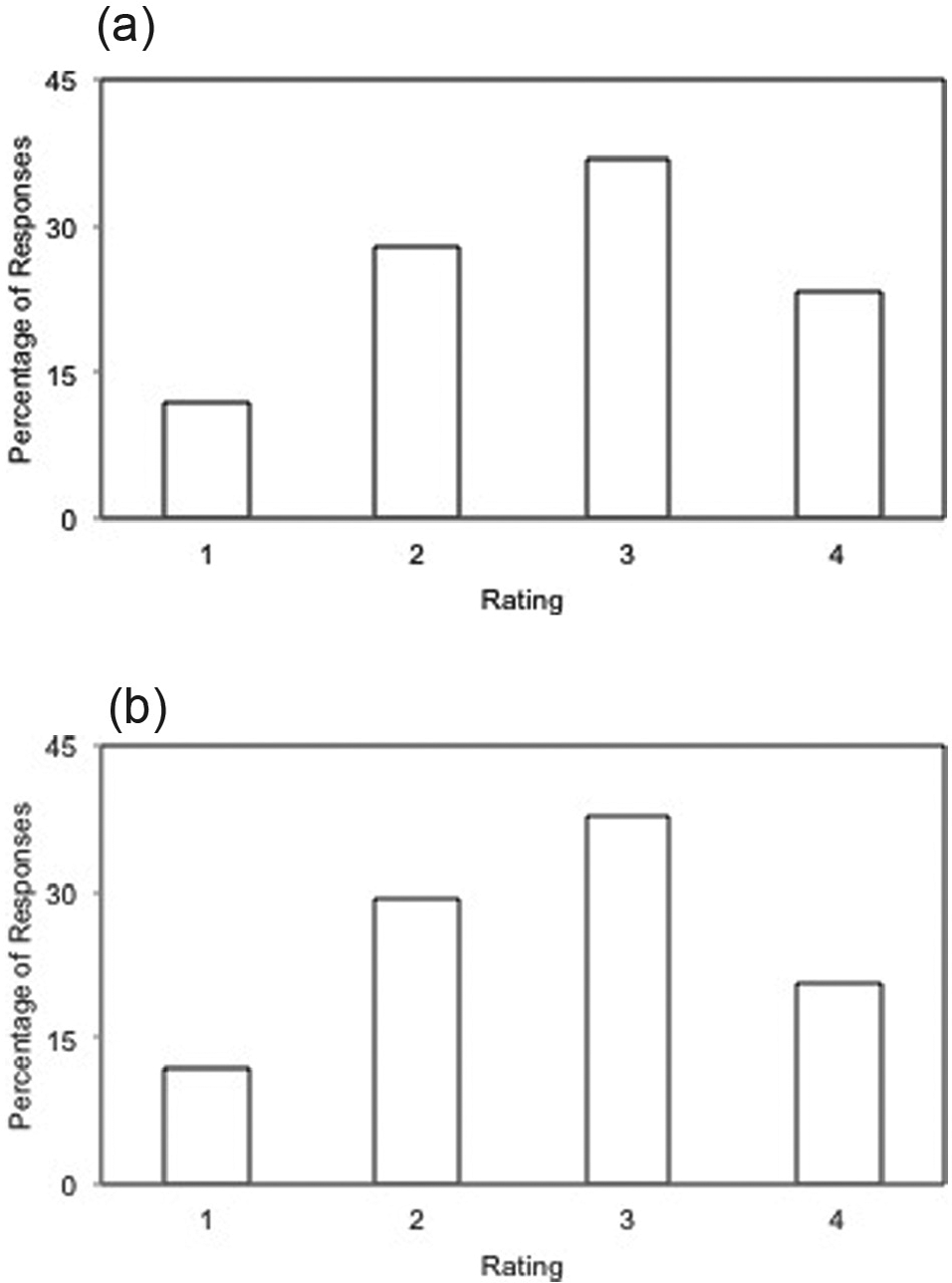
Histograms for overall ratings. (a) Meaningfulness. (b) Ritual.
Table 5 displays an initial descriptive analysis of vignette ratings by factor. We focus on the results for ritual, our central dependent variable. Mean ratings differ insignificantly and only slightly by gender of the protagonist and across the presence/absence of entrainment. There is a weakly significant and slightly larger difference in mean ritual ratings for liminality, where the presence of the liminal condition is associated with a higher rating. The differences in mean ritual ratings for autonomy, purposiveness, and identity enactment are the largest and also significant. The presence of each of these three factors is associated with a higher ritual rating.
Vignette Ratings by Factor (n = 4,390).

Table 6 displays the proportional odds logistic regression estimates predicting the ritual rating of vignettes. Model 1 only includes the independent variables of theoretical interest: group interactions, liminality, autonomy, purposiveness, and identity enactment. Coefficients represent the expected change in the log odds ratio of a vignette receiving a higher ritual rating for a one-unit increase in the predictor, net of all other covariates. For example, the coefficient for purposiveness in Model 1 represents the log odds of a vignette receiving a higher ritual rating when the purposive condition is present and holding all other covariates constant. Although most current theoretical work suggests that group presence and group interactions are central to the emergence of meaningful ritualistic experience, this hypothesis gets little support in our vignette survey. Group interactions is not significant. In fact, subjects were as likely to rate an activity performed alone as ritualistic and meaningful as an activity performed with other people. This finding, though surprising, is consistent with our interviews in which many subjects volunteered solo activities, such as walking, as highly meaningful.
Proportional Odds Logistic Estimates Predicting Ritual Rating of Vignettes.

Note: Standard errors are in parentheses.
p < .10. *p < .05. **p < .01. ***p < .001 (two-tailed tests).
The coefficient for liminality is marginally significant (p < .05) and comparatively small, meaning that respondents were only slightly more likely to define activities “distinct from and somehow different from . . . regular life” as important rituals. This finding also runs slightly counter to conceptions of ritualistic experience in the existing literature, which have emphasized the liminal nature of ritual space since the pioneering work of Van Gennep ([1909] 1960). Instead, autonomy, purposiveness, and identity enactment stand out as significant predictors of ritual classification. The odds of an activity being classified as more ritualistic when it is performed with greater than one individual are 1.044, whereas the odds of a higher ritual classification increase to 2.815 for activities linked to a sense of accomplishment (i.e., purposiveness).
Model 2 includes demographic controls. The results for our main variables of interest are unchanged. We treat the controls conservatively as nominal variables, with the exception of religiosity. As expected, increased religiosity is associated with an increased likelihood of finding a behavior ritualistic rather than routine. Group interactions is not significant. Liminality is marginally significant, and autonomy, purposiveness, and identity enactment are strongly significant.
Model 3 is estimated with fixed effects for respondents to adjust for unobserved heterogeneity. Group interactions is not significant. Liminality becomes slightly more significant than in the previous models. Autonomy, purposiveness, and identity enactment are strongly significant. In all three models, identity enactment and purposiveness have the largest coefficients relative to the other independent variables. The same models with meaningfulness as the dependent variable return similar results: Autonomy, purposiveness, and identity enactment are all strongly significant; group interactions is not significant; and liminality varies between different thresholds of significance across the three different models. The results confirm the findings of the previous two models.
Discussion
Both the interviews and the random factorial survey provide evidence that feelings of agency and the confirmation of one’s identity are important factors in the transformation of routine behaviors into ritual-like performances—even when the performance is enacted for oneself. This research thus offers new insight into the ritual process by revealing individual-level conditions that contribute to the transformation of routines into meaningful ritualistic experiences. We accomplished this by bridging two literatures, on ritual and on the meaning of work, and incorporating insights from both to assess the importance of purposiveness, autonomy, and identity. Our multimethod approach preserves an emphasis on the subjective nature of meaningfulness while allowing for the systematic evaluation of the conditions that generate meaningful experience for individuals. In sum, our results place agency (i.e., feelings of purposiveness and expressions of autonomy) and identity at the center of the process through which repeated activity becomes meaningful at the individual level. Group interactions, liminality, commemoration, and the use of sacred symbols received significantly less support than we anticipated. It is important to note that our sample selection may have influenced the importance of agency and personal identity. We interviewed and surveyed a sample of U.S. residents, and the United States is known to celebrate goal achievement and autonomy. We believe that autonomy and achievement are likely to play a significant role in generating meaningful rituals in any culture, but it is also possible that the results may differ cross-culturally. China, Japan, and India are considered more collectivist than the United States. In these and other collectivist cultures, group interactions may become more significant and purposiveness and autonomy less so. Future research could examine these differences through comparing our findings with those of a replication study conducted in another country.
The results contribute to the literature on meaningful activity in psychology and ritual theory and also to the literature on the roots of religious experience. Meaningful activity is important because it enhances quality of life, well-being, and longevity (Baumeister and Vohs 2002; Francis and Pennebaker 1992; Frankl 1959; Hughes 2006; Pennebaker, Kielcolt-Glaser, and Glaser 1988; Zika and Chamberlain 1992). Meaningful ritual activity, in particular, can reduce anxiety, increase family cohesion, improve marital satisfaction and adolescent well-being, and protect against the impact of chronic illnesses (Brooks et al. 2015; Crespo et al. 2011; Fiese 1993; Fiese and Wamboldt 2000; Johnson et al. 1995; Markson and Fiese 2000). We contribute to this literature by identifying the conditions that foster the emergence of meaningful ritual experience in individuals’ daily lives.
Additionally, our findings resonate with research in psychology on the meaning of work, which argues that individuals often find greater meaning in actions that enhance feelings of agency and align with their self-perceived identities (e.g., Baumeister 1991, 1998; Deci 1975; Grant, 2008; Grant, Dutton, and Rosso 2008; Kahn 1990; Morse and Weiss 1955; Seligman 1975; Vallacher and Wegner 1989; R. W. White 1959; Wood 1989; Wrzesniewski and Dutton 2001). The extension of these results to the domain of ritual activity—more frequently associated with religious experience, social interactions, and evocative symbolism—suggest that the importance of expressions of agency and identity in building meaningful experience may be extremely widespread.
The roots of religious experience, for example, may be one key site where agency and identity are crucial. The meaningfulness of religious activities has been noted to decline over time (Tavory and Winchester 2012). Existing explanations cite habit and repetition as contributing factors. Our findings suggest that habit may have an indirect effect on experience. Habit may operate by eroding the sense of active purpose and choice as well as by pushing the conscious decision to engage in an activity into the background of consciousness.
Given the centrality of ritual to the production of group cohesion, reproduction of social order, and cultural production, these findings may also help link individual experience to social processes. Rituals are increasingly understood in anthropology and sociology as complex interactions merging feeling, action, and symbol to produce meaning (Collins 2004; Deacon 1997; Handelman 1990; Innis 2004; Rappaport 1999). When rituals are experienced as meaningful, their effects can be amplified (Demerath 2012; Kanter 1972). Understanding the conditions that drive the experience of heightened meaning at the individual level may therefore shed light on the broader social impact of ritual activity. And since rituals are vehicles for mobilizing individuals (Bernstein 1997; Blee 2002; Epstein 1994; Morris 1984; Patillo-McCoy 1998; Roscigno and Danaher 2001; Scott 1990), this research may be useful for identifying what individual-level components drive successful political rallies or generate the types of emotionally charged commemorative events that shape political narratives. Thus, our findings indicate that the larger process through which actions and symbols take on social meaning may be grounded in individual-level experiences characterized by a heightened sense of autonomy and the feeling of acting purposively in the world. Ultimately, the question of what role these factors play in collective rituals has yet to be examined. Our research does not resolve this question but does indicate that it may be worthwhile to assess the role of individual-level processes with the capacity to generate ritual meaning in larger instances of collective ritual experience.
Footnotes
Acknowledgements
The authors would like to thank Vivekian L. Ashok, Deborah Davis, Nicholas Occhiuto, Paolo Parigi, Philip Smith, and Mattias Smångs for their assistance and the A. Whitney Griswold Fund for support.
1
To avoid a limited focus on religious activity, we did not expressly ask interviewees to consider the role of transcendence or supra-human agency in relationship to their repeated activities.
2
This reaction supports research in the psychology of action suggesting that interpretation itself is a meaning-making mechanism (e.g., Demerath 2012; Esterling et al. 1999; King and Pennebaker 1996; McAdams et al. 1997;  ).
).
3
We also produced ordinary least squares estimates, which were consistent with the proportional odds logistic estimates.
4
These results are omitted for reasons of space and are available on request.