




Abstract
Recent high-profile research suggests that social indicators like incarceration influence racial categorization. Yet, this research has largely ignored colorism—intraracial differences in skin tone that matter for stratification outcomes. In two experiments, we address how skin tone interacts with criminal background to produce external racial classification and skin tone attributions. We find no evidence that criminal history affects external racial classification or skin tone attribution. However, we find that skin tone is a strong and consistent predictor of external racial classification and skin tone attribution.
Introduction
Although prevailing theoretical notions of race as socially contingent dominate the literature on racial attribution, race is often operationalized in ways that contradict constructionist precepts. On the one hand, much of the empirical research on race in the United States relies on static variables that are at odds with the theoretical claim that race is a fluid category. These variable-based approaches rarely account for within-group racial variation. The vast majority of sociological studies fall into this camp, measuring race as a fixed, unchanging property of individuals (Zuberi and Bonilla-Silva 2008). On the other hand, the literature on racial classification is filled with statements about the fluid, changing, and disputed nature of race. For example, race is described as “contested, unstable, and inexorably bound to the sociohistorical context” (Eberhardt and Randall 1997:198) or as a “changing same” (Bonilla-Silva 1999; Gilroy 1991).
Recently, the Proceedings of the National Academy of Science and the American Journal of Sociology published a series of articles showing that men change their self-described race across the life course (Penner and Saperstein 2008; Saperstein and Penner 2012). In line with social constructionist perspectives, which argue that race is a fluid category, these articles show that spending time in prison, a spell of unemployment, or gaining educational credentials can lead one to identify with the racial group stereotypically associated with these social statuses. For instance, the longstanding association of blackness and criminality (Muhammad 2010) means those who have been incarcerated are more likely to identify as black. Remarkably, the authors found that changing social statuses led to racial category changes in both self- and interviewer reports.
More recently, several scholars have provided evidence that Saperstein and Penner’s (2008, 2012) claims of racial fluidity may be overstated. First, in a reanalysis of the original data, Alba, Insolera, and Linderman (2016) find that racial fluidity is concentrated among mixed race and Latinx respondents. As Latinx and mixed race individuals fall outside the traditional black and white binary classification system in the United States (Davis 1991), the authors imply that observers have difficulty classifying these groups and that observed racial fluidity reflects this uncertainty. Although Saperstein and Penner (2010) used fixed effects models to account for phenotypical variation, Hannon and DeFina (2016) argue that racial categorization is largely driven by phenotypical variation. While Hannon and DeFina (2016:18) find no evidence that incarceration increases the likelihood of being classified as black in subsequent survey years for racially unambiguous cases, they do leave open the possibility that “Saperstein and Penner’s findings could be supported for certain subgroups that are phenotypically or categorially ambiguous.” Focusing specifically on the relationship between criminality and racial attribution, Kramer, DeFina, and Hannon (2016) claim that Saperstein and Penner’s (2012) modeling strategy is incapable of distinguishing between competing hypotheses—are blacks more likely to be imprisoned, or does a stint in prison make one black? The first hypothesis is supported by a massive body of literature. The more novel latter hypothesis, which Saperstein and Penner attempt to verify, essentially claims race is a dependent variable. Given the clear theoretical importance of Saperstein and Penner’s findings, Hannon and DeFina (2016) recommend introducing new methods to tease out the causality central to their claims. We experimentally test these competing assertions about the role of social factors in racial fluidity and move beyond them to consider whether skin tone attribution itself is impacted by social factors via two experiments.
In the first experiment, we extend Saperstein and Penner (2010) by examining the impact of former incarceration status on racial attribution for differing skin tones. Incarceration should be an especially relevant racial prime. There are longstanding historical associations of African Americans with criminality (Muhammad 2010). Scholars argue that incarceration is an expected life course transition for African American men (Western 2002). Although Penner and Saperstein (2008) and Saperstein and Penner (2010) made a case for formerly incarcerated status influencing racial attribution, this work was not experimental, and several factors of the National Longitudinal Survey of Youth (NLSY) survey design may have influenced differential racial attribution across waves. First, as Kramer et al. (2016) argue, the interviewers were given inadequate instructions for racial classification, which, coupled with measurement error, could account for much of the variability documented by Saperstein and Penner (2012). Second, experiments allow for unbiased causal estimates of the direct effect of incarcerated status on racial attribution, which none of the extant research on the NLSY data has been able to provide. Finally, the importance of skin tone in assigning racial categories is insufficiently known. Saperstein and Penner (2016:269) claim that they are interested in elucidating the “process through which social status shapes race” and that experimentally controlled conditions are the best way to isolate specific causal processes. By varying skin tone and incarceration status among fictional job candidates via random selection in our first experiment, we are able to isolate the relative importance of each to racial attribution. In our second experiment, we reverse the causal arrow to see if respondents attribute a darker skin tone to those they believe have been incarcerated.
Theoretical Background
There are strong theoretical reasons to consider colorism in discussions of racial attribution. Although some have argued that the U.S. racial formation exists along a black and white binary system (Davis 1991), a number of studies suggest that lighter-skinned and mixed race blacks have long had advantages in socioeconomic status, marriage markets, and educational outcomes (Frazier 1957; Keith and Herring 1991; Monk 2015). More recently, scholars have argued that the U.S. racial order is undergoing a profound transformation (Bonilla-Silva 2004) in which the black/non-black hierarchy may be overturned. Increased Latin American and Asian immigration, the high-profile status of a number of African Americans (including President Barack Obama), and increased rates of children identifying as biracial or multiracial all contribute to this changing order.
Bonilla-Silva (2004) claims that one aspect of the changing racial structure is the development of a Latin American style “pigmentocracy” in the United States, in which the salience of skin tone for stratification outcomes is increasing. Empirically, for Latinx at least, a number of recent studies support the assertion that skin tone is increasing in significance as a stratification boundary. For instance, skin tone has been shown to influence the level of assimilation (Golash-Boza 2006) as dark-skinned Latinx are more likely to be discriminated against and are therefore less likely to identify as American. Similarly, Golash-Boza and Darity (2008) argue that although demographers are predicting a large influx of Latinx, this may not mean the end of the numerical white majority as many light-skinned Latinx identify as white if given the opportunity. The privilege attendant to their skin tone allows light-skinned Latinx to be perceived as white in U.S. society. Finally, after confirming earlier findings that dark-skinned Latinx suffer from discrimination in the United States, Frank and colleagues (2010) argue that a new racial boundary is forming, separating dark-skinned Latinx from their lighter-skinned co-ethnics.
The literature on colorism and blacks shows a similar gradational pattern according to skin tone. Although some scholars have claimed that intraracial stratification in the black community has substantially subsided in the post–civil rights era (Gullickson 2005), a convincing body of evidence contradicts this claim. In a series of papers, Goldsmith and colleagues (Goldsmith, Hamilton, and Darity 2006, 2007) make two major assertions. The first is that, although scholars in the United States have traditionally claimed that racial stratification is best conceived as a black/white binary (Davis 1991), in fact, the United States has a gradational system based on skin tone, similar to the one prevalent in much of Latin America (Wade 1997). The authors then go on to empirically demonstrate this division through an analysis of wages by skin tone that shows light-skinned black men’s wages to be statistically indistinguishable from those of white men. They call this effect a “preference for Whiteness” (Goldsmith 2007), and, importantly for our purposes, they critique “one drop” models of race that ignore skin tone heterogeneity.
Beyond wages, colorism results in a host of other negative effects. Margaret Hunter (2002) conceptualizes skin tone as a kind of social capital and finds that dark-skinned women of color pay not only an economic but also a psychological toll. Given that European beauty norms exclude dark-skinned women, their employment, education, and access to higher status marriages are curtailed (Hunter 2002). Contrarily, Hunter argues that lighter skin in men may mean that they are not accepted as authentic members of the Mexican or black communities (Hunter 2004). Monk (2014) argues that skin tone privileges black Americans in a number of ways, including higher incomes, educational attainment, and occupational status. Ultimately, the literature on skin tone indicates that the mechanisms underpinning racial attribution cannot be fully interrogated without attention to phenotypical differences.
Criminality and External Racial Classification
Criminality is one of the few factors prior research rather unambiguously associates with racial ascription as a great deal of evidence shows the importance of race for perceptions of criminality (Blair, Judd, and Chapleau 2004; Eberhardt et al. 2006; Penner and Saperstein 2008; Saperstein and Penner 2010). A number of scholars have argued that assumptions of criminality are deeply intertwined with whites’ thoughts about blacks. For instance, Wacquant (2002) argues that incarceration is a central form of social control of blacks, citing the long history of “peculiar institutions” at the intersection of race and labor in U.S. history. Tracing this history through the changing institutional forms that have policed black bodies—slavery, Jim Crow, ghettoization, and mass incarceration—Wacquant sees the modern penal state in the United States as a historical novelty in form but not in content. Similarly, in a theoretical treatise that reviews the scale and consequences of mass incarceration, Alexander (2010) argues that mass incarceration has become so central to the structure of black lives that it should be thought of as the “new Jim Crow.”
Several studies show how deeply entwined notions of blackness and criminality are to the general public. For instance, Correll and colleagues ( 2007) used first-person shooter video games to measure reaction times to threats. In these games, the player was positioned behind a gun with targeting sights and given the objective to shoot threats. Participants were faster to shoot black targets as blackness was perceived to be implicitly dangerous. This finding held regardless of the measured racial attitudes of respondents. Similarly, Eberhardt and her colleagues (2004) used primes to show how stereotypes can influence police officers’ reaction to seeing weapons. They primed participants with stereotypical “black” words such as jazz or basketball and then showed a screen on which an object slowly appeared from a neutral background. Respondents given a black word prime were more likely to see a weapon.
Not only does criminality appear to predict external racial classification in the American mindset, but more specifically, the more an individual embodies phenotypical features reminiscent of stereotypes about blackness, the stronger the association between criminality and attributions of blackness becomes. Arguing that “people associate Black physical traits with criminality in particular,” Eberhardt and colleagues (2006:383) used a photographic data set of 600 death penalty–eligible cases from Philadelphia in the years 1979 to 1999. They found that among those convicted of killing white victims, the more “stereotypically” black-looking a man was, the more likely he was to be sentenced to death. Blair et al. (2004) found a similar effect when analyzing judicial sentencing patterns, with more “Afrocentric”-looking black men receiving longer sentences. Both of these studies point to the importance of colorism as a moderating influence on racial attribution: Here intraracial variation along a spectrum of skin tone and phenotype (rather than blackness as a racial category per se) drives the ascription and leads to harsher outcomes for darker-skinned men.
Recent advances in both sociology (Roth 2016) and political science (Sen and Wasow 2016) have given further reason to examine race as a multidimensional construct whose constituent elements can be usefully disaggregated to determine causality. Roth provides a roadmap for scholars, showing that researchers should be attuned to the potentially different outcomes resulting from measures such as observed race, personal racial identity, skin color, and phenotype. Sen and Wasow (2016) similarly argue that traditional, essentialist understandings see race as an immutable characteristic and therefore incapable of causal attribution (see also Heckman 1998). However, seeing race as a composite variable (a “bundle of sticks” in their terminology) akin to socioeconomic status allows researchers to test the causal power of individual aspects of the multidimensional construct. Both sets of research point to experimental designs as an important methodological tool for disaggregating the effects of components in the overall construction of race.
Prior research has shown that skin tone may be the most important factor in determining external racial classification (Brown, Dane, and Durham 1998). Yet, even perceptions of skin tone and race are potentially colored by other dimensions of the race construct. Garcia and Abascal (2016) recently showed the fruitfulness of using experimental approaches to tease out these differences. Specifically, they conducted an experiment to discover how racialized names influence the perception of phenotypic traits. Respondents were randomly assigned a “racially ambiguous” photograph labeled with a “Hispanic”-sounding name, given a skin tone palette, and instructed to rate the skin tone. They found that regardless of the objective skin tone in the photograph, respondents attributed a darker skin tone to “Hispanic”-sounding names. This is in line with prior research in social psychology that shows racial labels influence the perception of faces (Eberhardt, Dasgupta, and Banaszynski 2003). Given this prior evidence, it is plausible that factors such as prior incarceration could influence external racial classification. Thus, in this article, we vary skin tone and incarceration status simultaneously. We do this by showing how a factor known to influence the social construction of race—criminality—intersects with skin tone variation during the racial classification process.
Experiment 1 Hypotheses
In line with Saperstein and Penner (2008, 2010), we expect racial classification to vary as a function of incarceration status. However, challenging their findings that incarceration status is a primary driver of racial classification, we expect the most variation in attribution to be found among individuals of ambiguous skin tone. Therefore, we hypothesize that:
Hypothesis 1: Respondents will be more likely to classify individuals with medium skin tone as non-white who are described as having previously been incarcerated.
We also expect skin tone to drive much of the external racial classification of light-skinned individuals. However, as a number of scholars argue that incarceration is a primary locus of racial organization in the current era, we expect it to impact external racial classification as well. Thus, we hypothesize that:
Hypothesis 2: Respondents will be more likely to classify individuals with light skin tone as non-white who are described as having previously been incarcerated.
While we do not believe that this invalidates constructionist arguments in the purely theoretical sense, claims that race is a “fluid” property and constantly changing are often underspecified. For instance, in a series of audit studies on criminality and hiring, Devah Pager (2003) shows that in U.S. cities, phenotype is a prime motivator in employer’s willingness to hire blacks. She finds that employers were more likely to hire a white male with a criminal record than a black male without (Pager 2003). Pager (2003) and Pager, Western, and Bonikowski (2009) demonstrate the profound impact that external perceptions of race can have on hiring. However, they did not include a skin tone measure, rendering how intraracial variability may have influenced these outcomes unclear. Incarceration has been associated with blacks in a large body of prior research, and a number of scholars argue that it is a primary locus of racial organization in the current era (Wacquant 2002; Western 2002). This research implies that blacks, regardless of internal skin tone variation, are associated with criminality and have, on average, roughly similar outcomes. Yet, much of this research also lacks skin tone measures that may be important to determine how external racial classification and criminality are related. Despite stereotypical associations between criminality and blacks, we argue that dark skin tones are more important in external racial classification than some theoretical formulations imply and may trump criminality in determining external racial classification in ambiguous cases as dark skin tones will account for more of the variance. Therefore, we hypothesize:
Hypothesis 3: Applicants’ criminal histories will have no effect on the classification of dark-skinned individuals as black.
Experiment 2 Hypothesis
Race attributions can also be influenced through priming that may interfere with recall. A number of recent studies show this. Caruso, Mead, and Balcetis (2009) examined support for President Obama based on manipulations of skin tone. They randomly presented lightened or darkened photographs of Obama, and those who supported Obama rated the lighter photographs as more representative of his “true” self while those who did not support Obama rated darker photographs as more representative. This finding held controlling for political ideology and racial attitude, suggesting that it is a relatively general process. Potential voters were using skin tone as a proxy for political worthiness. Similarly, recent research on attributions of intelligence showed that respondents were more likely to claim that lighter skinned blacks were intelligent (Hannon 2015). This implies that lighter skin is associated with more positive attributes. Moreover, Ben-Zeev and colleagues (2014) found that participants given memory primers that challenge racial stereotypes are more likely to recall someone’s skin tone as lighter, suggesting that the reverse may also be true (that participants given primers supporting racial stereotypes may recall someone’s skin tone as darker). Thus, we hypothesize:
Hypothesis 4: Respondents will remember photos of applicants depicted as having previously been incarcerated as darker in skin tone.
Experiment 1 Methods
Procedures
Experiment 1 was conducted via recruitment of participants using Amazon’s Mechanical Turk (MTurk) website. MTurk is a web-based entrepreneurial portal where businesses and researchers, known as “requesters,” can post “human intelligence tasks” (HITs). Given the often substantial differences in how race is ascribed cross-nationally (Davis 1991; Wade 1997), we used MTurk’s screening capabilities to restrict participation in our study to adults from the United States. Although MTurk is a relatively new tool for researchers, a number of studies show that the data collected are comparable to or of better quality than that collected from local undergraduate populations (Buhrmester, Kwang, and Gosling 2011; Paolacci, Chandler, and Stern 2010). Data collected from MTurk tend to be more representative of the general population than other sources of experimental data, although the sample skews toward women and the highly educated with access to technology (Paolacci et al. 2010). Our HIT provided a link to our experiment in the web-based survey program Qualtrics. This software has the advantage of allowing researchers to perform double-blind experiments, as it can randomly assign respondents to experimental and control conditions.
A total of 324 participants electronically signed an informed consent form that explained that we were interested in exploring what people remembered about candidates who they were considering for hire in the men’s section of a department store. Those who agreed to take part in the study then completed a short demographic questionnaire. After completing the questionnaire, participants were successively presented with five applicant modules. Each module displayed a photo alongside a brief description (see Figure 1). The photos were created by merging the faces of two men using Abrosoft’s FantaMorph software 1 and then placing the face on a white background using Photoshop. An applicant description identified the applicant’s age, number of years of retail experience, and to prime the relevant categorical association, the applicant’s criminal history. After looking at the photo and description for the applicant, participants proceeded to a screen with the instructions, “How much do you remember about this applicant? Below are the features of this applicant. For some of these features, the correct answer is provided for you. If an answer is not provided, type the correct answer in the appropriate blank.” Beneath these instructions were a series of categories: age, gender, race, years of retail experience, and criminal record (yes/no). Some of the spaces next to these categories were already filled in with an answer listed in the description or attributed to the photo while others awaited an answer from the participant. The participant was unable to go back to the previous screen to look at the face and description again.

Example module (Experiment 1).

Participants were presented with four applicant modules, one of which differed by experimental condition. Participants were randomly assigned to one of six different conditions. In the experimental modules, two attributes varied across conditions—the skin tone of the applicant (light, medium, or dark; as seen in Figure 2) and whether the applicant had a record of incarceration (yes or no). For the first attribute, we used FantaMorph to combine a phenotypically dark-skinned man’s face with a phenotypically light-skinned man’s face. We then altered the skin tone using Photoshop to create three different photos: a light skin–toned photo, a medium skin–toned photo, and a dark skin–toned photo. For the second attribute, the applicant’s criminal history, the experimental modules either described applicants as never having been incarcerated or having been incarcerated for 12 months for a drug charge.

Experimental photos (Experiment 1).
In the first three conditions, we varied the skin tone composite photo of the applicant (light, medium, or dark) and kept constant the attribute that none of the applicants had a criminal record. In the next three conditions, we varied the skin tone composite but changed the applicant criminal record to state that each applicant had served 12 months in jail for a drug charge. For all of the experimental applicants, the next screen asked respondents to recall from memory the race and gender of the applicant. This enabled us to determine the external racial classification that each participant assigned to the applicant in the experimental condition. We set Qualtrics up to randomly assign the order in which each respondent saw the four standard applicants and the one experimental applicant to avoid ordering effects. Upon completion of this portion of the study, each participant completed a post-study questionnaire and a funnel debriefing and was then provided with an explanation of the study.
Dependent Variables
Our primary dependent variable was the racial category that participants attributed to the applicant in the experimental module. We constructed a series of dummy variables from the responses participants entered in the blank next to “race” in the memory recall exercise that indicated whether the respondent identified the experimental applicant as a person of that racial/ethnic group (1) or not (0). All respondents identified the applicants as white/Caucasian, black/African American, Latino, or multiracial. Other racial categories (eg, Asian or American Indian/Alaska Native) were not included because no respondents attributed them to the applicants.
Independent Variables
Applicant’s skin tone is measured via three dichotomous variables representing light skin tone, medium skin tone, and dark skin tone with 1 indicating the respondent associated the applicant with a particular skin tone. Given that one’s opinion of the experimental applicant’s attractiveness may influence hiring decisions (Hamermesh 2011) and the vignette was allegedly designed to assess hiring, we measured attractiveness on a 10-point scale with higher numbers signaling perceptions of higher attractiveness.
Aside from the applicant’s previous criminal history (0 = no criminal history reported, 1 = 12 months served in prison for a drug charge), we included a number of independent variables to clarify the effect of respondent characteristics on racial classification. These included participant’s age (constructed in years from the difference between the participant’s date of birth and the date when the participant completed the study), gender (0 = male, 1 = female), income (1 = less than $1,000; 10 = $150,000 or more), education level (1 = less than high school graduate; 6 = graduate or professional degree), and race (0 = non-white, 1 = white). 2 Since prior research has shown that conservatives tend to have more punitive attitudes toward criminality and higher symbolic racism (Sears and Henry 2003), we measured conservativism (0 = very liberal; 10 = very conservative). We also expected the respondents’ degree of racial prejudice to influence how they interpreted the applicant’s skin tone, so racial prejudice is measured from 0 to 8 using Sears and Henry’s (2003) Symbolic Racism Scale, with higher numbers signaling greater racial prejudice. 3
Sample
The 324 participants were, on average, about 31 years of age, female, white, with at least some college education, and average incomes close to the category ranging from $10,000 to $19,999 (see Table 1). Participants tended to assess themselves as more liberal than conservative, display some racial prejudice (mean = 3.29), and describe the experimental applicants as slightly above average in attractiveness (mean = 5.55). Random assignment resulted in approximately 32 percent of participants seeing a light-skinned experimental applicant, while about 32 percent saw a medium-skin toned applicant, and about 36 percent saw a dark-skinned applicant. Approximately 29 percent of participants attributed white race to the experimental applicant, while 38 percent attributed black race, 24 percent attributed Latino race, and 5 percent claimed that the applicant was multiracial.
Descriptive Statistics for Variables in Experiment 1 Analysis (N = 322).

Experiment 1 Results
To test our first hypothesis—that respondents would be more likely to classify medium skin tone applicant photos as non-white when applicants were depicted as having previously been incarcerated—we ran a series of logistic regressions (controlling for applicant criminal history and attractiveness and respondent age, gender, race, education, income, conservativeness, and racial prejudice) (see Table 2).
Experiment 1: Logistic Regression Models of the Effect of Applicant’s Previous Incarceration and Sociodemographic Controls on External Racial Classification Given Medium Skin Tone: Odds Ratios, Standard Errors (in Parentheses), and 95 Percent Confidence Intervals (in Brackets) (N for Medium Skin Tone = 102).

p < .05.
Contrary to our prediction, applicants’ previous incarceration was not statistically significantly associated with white, black, Latino, or multiracial attributions for medium skin tone applicants. Therefore, we find no evidence to support Hypothesis 1. 4 However, we did find that for every one unit increase in education, the relative odds of attributing black race to an applicant increased by 78 percent (p < .05) and the relative odds of attributing Latino race to an application decreased by 44 percent (p < .05) (see Table 2).
To test our second hypothesis—that respondents would be more likely to classify light skin tone photos as non-white when applicants were depicted as having previously been incarcerated—we repeated our previous logistic regressions among respondents in the light-skinned photo conditions (see Table 3). The results of these regressions revealed no evidence for Hypothesis 2.
Experiment 1: Logistic Regression Models of the Effect of Applicant’s Previous Incarceration and Sociodemographic Controls on External Racial Classification Given Light Skin Tone: Odds Ratios, Standard Errors (in Parentheses), and 95 Percent Confidence Intervals (in Brackets) (N for Light Skin Tone = 103).
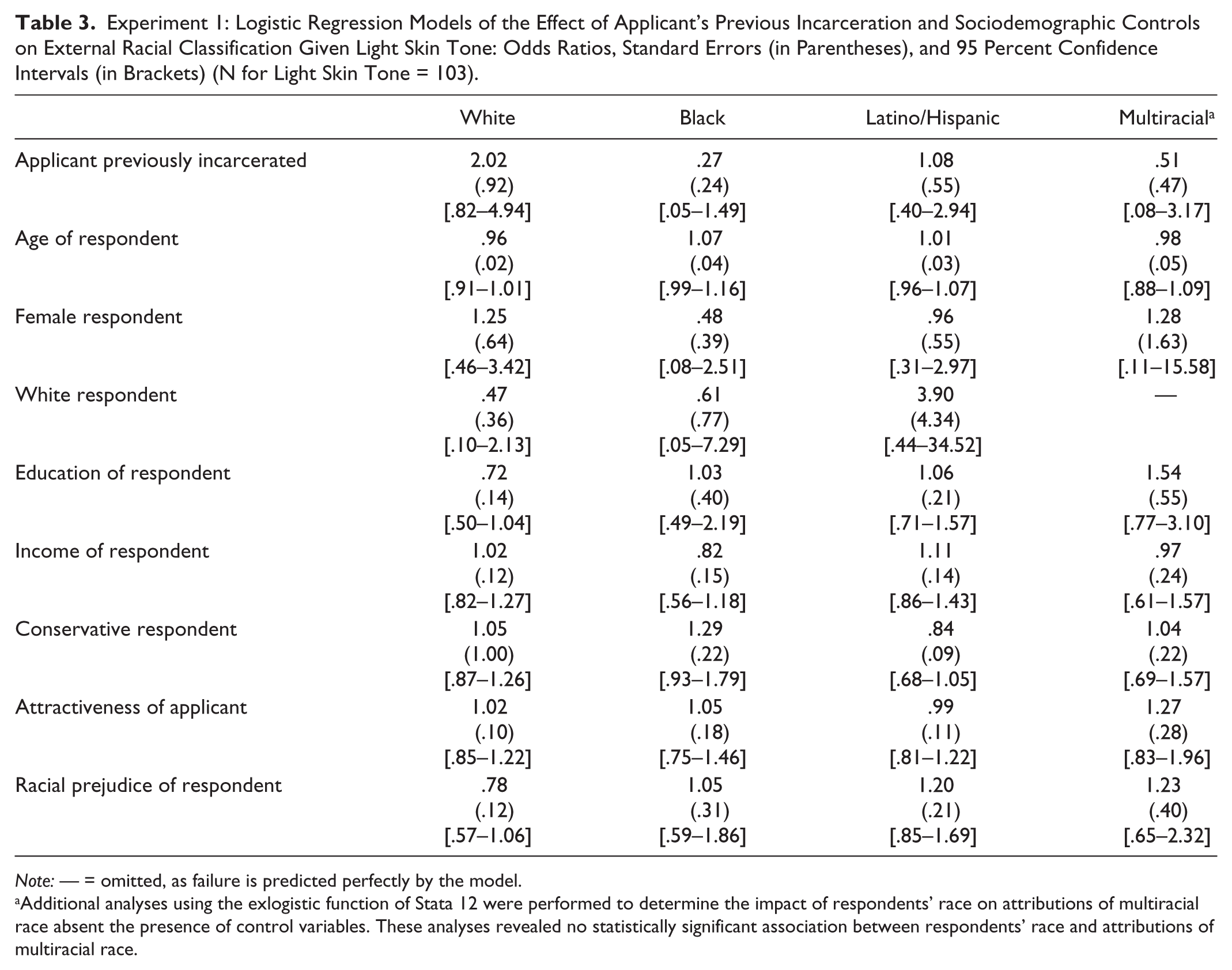
Note: — = omitted, as failure is predicted perfectly by the model.
Additional analyses using the exlogistic function of Stata 12 were performed to determine the impact of respondents’ race on attributions of multiracial race absent the presence of control variables. These analyses revealed no statistically significant association between respondents’ race and attributions of multiracial race.
Finally, to test our third hypothesis that respondents would be no more likely to classify dark skin tone applicants with a criminal history as black than applicants without a criminal history, we conducted logistic regression analyses for respondents assigned to dark-skinned photo conditions (Table 4). The lack of a significant association between applicant’s previous incarceration status and attribution of black race to dark-skinned applicants is consistent with our prediction in Hypothesis 3.
Experiment 1: Logistic Regression Models of the Effect of Applicant’s Previous Incarceration and Sociodemographic Controls on External Racial Classification Given Dark Skin Tone: Odds Ratios, Standard Errors (in Parentheses), and 95% Confidence Intervals (in Brackets) (N for Dark Skin Tone = 117). a

Note: — = omitted, as failure is predicted perfectly by the model.
Additional analyses using the exlogistic function of Stata 12 (available upon request) were performed to separately determine the impact of the following variables on attribution of white race: (1) applicant’s previous incarceration, (2) respondent’s age, (3) respondent’s gender, (4) respondent’s race (non-white vs. white), and (5) respondent’s education. Further exlogistic analyses were performed to separately determine the impact of respondent’s race (non-white vs. race) on attribution of Latino and the impact of respondent’s gender on attribution of multiracial race. These analyses revealed no statistically significant associations.
The prevalence of nonsignificant findings throughout our analyses despite previous findings that criminal history is associated with external racial classification raised an important question: To what extent was skin tone itself driving racial attribution? To answer this question, we conducted a new set of logistic regressions (Table 5) to test the impact of skin tone on external racial classification, controlling for the variables used in our previous analyses (applicant’s previous incarceration status and attractiveness and respondent’s age, gender, race [non-white vs. white], education, income, conservativism, and racial prejudice). The relative odds of attributing white race to an applicant increased by 597 percent (p < .001), and the relative odds of attributing black race to an applicant decreased by 91 percent (p < .001) when the applicant had a light skin tone. The relative odds of attributing black race to an applicant decreased by 83 percent (p < .001), and the relative odds of attributing Latino race increased by 244 percent (p < .001) when the applicant had a medium skin tone. Finally, the relative odds of attributing white race to an applicant decreased by 98 percent, the relative odds of attributing black race increased by 7,092 percent, and the relative odds of attributing Latino race decreased by 77 percent when the applicant had a dark skin tone.
Experiment 1: Logistic Regression Models of the Effect of Applicant’s Skin Tone and Sociodemographic Controls (Not Shown) on Racial Attribution: Odds Ratios, Standard Errors (in Parentheses), and 95% Confidence Intervals (in Brackets). a

For all results reported in Table 5 for the impact of skin tone on racial attribution, we control for the following factors: applicant’s previous incarceration status, respondent’s age, gender, race (non-white vs. white), education, income, conservativism, applicant’s attractiveness, and respondent’s racial prejudice.
p < .001.
Taken together, and contrary to the findings of Saperstein and Penner (2008, 2010), we find no evidence that knowing a potential applicant has a criminal history influences subsequent racial attribution. However, we do find that increased education of the respondent is associated with increased attribution of black race to applicants and decreased attribution of Latino race to medium skin tone photos. Furthermore, we find that skin tone has a strong impact on racial attribution. Our experimental applicants were much more likely to be described as white in light skin tone conditions, as Latino in medium skin tone conditions, and as black in dark skin tone conditions.
Experiment 2 Methods
Procedures
Evidence from the first experiment suggested that previous incarceration did not necessarily impact external racial classification, but it remained unclear whether previous incarceration might impact attribution of skin tone. To address this question, we recruited 265 people via flyers in and around a large university in the West South Central Census Division to participate in person. The participants included students, staff members, and other community members.
Participants completed an informed consent form that explained the study as an attempt to determine how well hiring managers remember details about job applicants. They were given a series of five completed applications for a men’s department manager position in a department store (one at a time). For each application, most answers were blacked out, presumably for confidentiality purposes, but the answers to questions about whether the applicant was 18 or older, whether the applicant was authorized to work in the United States, the applicant’s availability, desired weekly hours, education, whether the applicant’s employer could be contacted, whether the applicant completed the application himself or herself, whether the applicant could perform essential job functions, and criminal background were answered. Work history was blacked out except that the job title of “Sales Associate” could be seen for two previous jobs. All applicants were depicted as 18 or older, authorized to work in the United States on any day of the week for 40 hours per week, and desiring full-time employment. They were high school graduates who were willing to have their previous employer contacted, had completed the application themselves, and could perform essential job functions with or without reasonable accommodation. Each application included a photo and an answer to the question “Have you ever been convicted of a crime? If ‘Yes,’ please explain below.” The photo and answer to the criminal background question for the first application (the experimental application) given to respondents varied based on experimental condition. 5
For the applicant photos, we hired a professional graphic designer to construct three versions of a racially ambiguous man’s face (one with a lighter skin tone, one with a medium skin tone, and one with a darker skin tone) (Figure 3). The answer to the criminal background question was either no or yes with the clarification that the applicant had served a year in prison for felony intent to distribute drugs. In the first condition, we displayed the light skin tone photo and depicted the applicant as never having been incarcerated. In the second condition, we displayed the medium skin tone photo and depicted the applicant as having never been incarcerated. In the third condition, we displayed the dark skin tone photo and depicted the applicant as having never been incarcerated. The fourth, fifth, and sixth conditions displayed, respectively, the light skin tone photo, the medium skin tone photo, and the dark skin tone photo and depicted the applicant as having been incarcerated for a year for felony intent to distribute drugs.

Experimental photos (Experiment 2).
After viewing an application, the respondent then returned it to the experimenter 6 and completed a worksheet that asked him or her to: (1) list any details remembered about the applicant; (2) answer whether the applicant had ever been convicted of a crime or not and, if so, whether the crime was a felony or a misdemeanor; (3) whether the applicant had ever served time in prison for a crime; and (4) whether the respondent would be willing to hire the applicant and why or why not. The worksheet also asked the respondent to look at a skin tone scale and choose the face with a skin tone closest to the applicant’s skin tone. This enabled us to determine differences across conditions in how respondents attributed skin tone. Once participants finished viewing each application and answering its corresponding worksheet, they completed a demographic questionnaire and a funnel debriefing and received an explanation of the study.
Dependent Variable
The dependent variable for this study was the skin tone category attributed to the applicant in the experimental application. Skin tone was measured using a scale developed by Ben-Zeev and colleagues (2014) that includes seven versions of the same face with skin tones ranging from dark to light.
Independent Variables
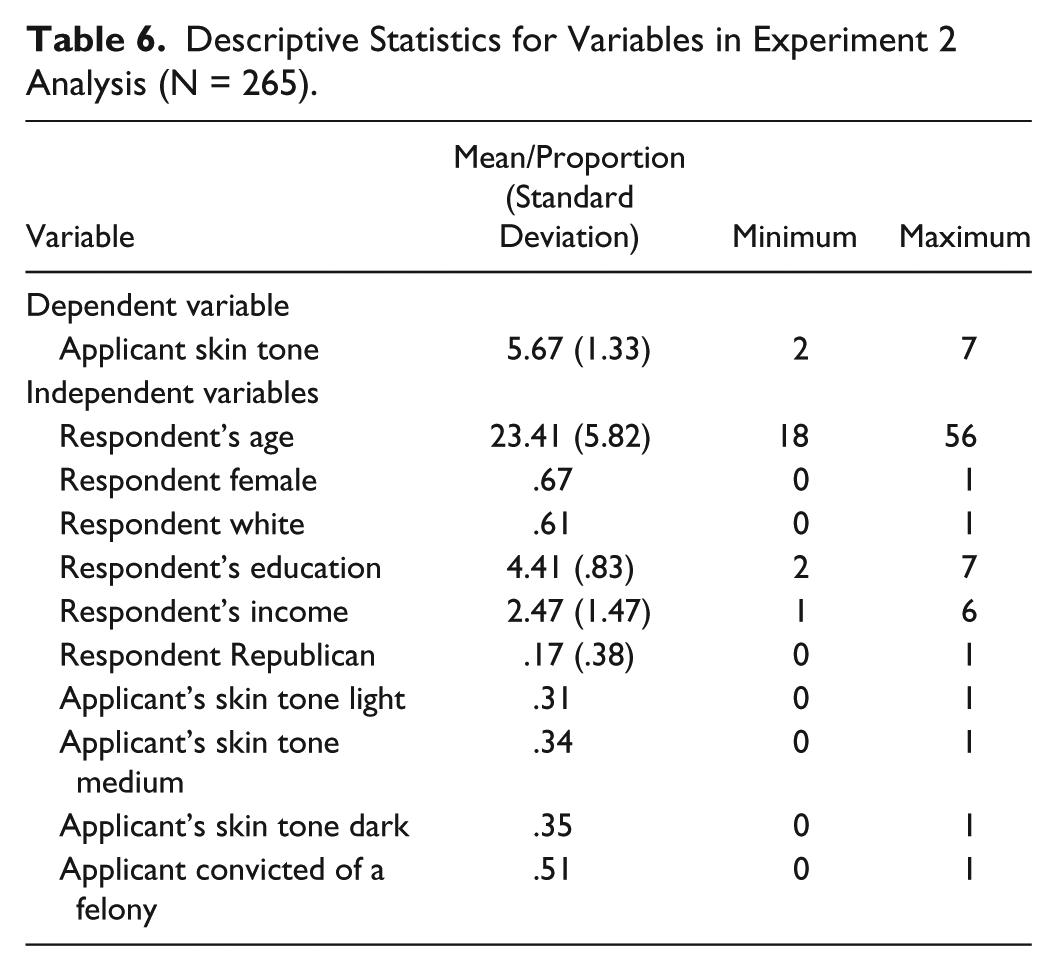
Aside from the applicant’s criminal history (0 = no criminal history reported, 1 = one year in prison served for a felony intent to distribute drugs charge), we included a number of independent variables to clarify the effect of respondent characteristics on skin tone attribution. These included participants’ age (in years), gender (0 = male, 1 = female), race (0 = non-white, 1 = white), and education (ordinal scale from 1 to 6 with 1 = less than high school graduation, 2 = GED or a high school diploma, 3 = some college or vocational school, 4 = bachelor’s degree, 5 = some graduate school, and 6 = a graduate or professional degree). We also measured participants’ income (an ordinal variable from 1 to 7 for which 1 = less than $1,000, 2 = $1,000 to $4,999, 3 = $5,000 to $9,999, 4 = $10,000 to $19,999, 5 = $20,000 to $29,999, 6 = $30,000 to $49,999, and 7 = $50,000 or more) and political affiliation (0 = Democrat or Independent, 1 = Republican) (Table 6).
Descriptive Statistics for Variables in Experiment 2 Analysis (N = 265).
Sample
Participants were, on average, about 23 years of age, female, white, and not Republican (Table 6). The average participant had some college experience and a personal annual income of between $1,000 and $4,999. Random assignment resulted in approximately 31 percent of participants seeing a light skin tone experimental applicant, while about 34 percent saw a medium skin tone applicant, and about 35 percent saw a dark skin tone applicant. The average skin tone respondents attributed to experimental applicants was relatively dark (5.67 out of 7.00).
Experiment 2 Results
To test the hypothesis that respondents would remember photos of applicants depicted as having previously been incarcerated as darker in skin tone, we ran ordinary least squares regression models for (1) applications with a light skin tone photo, (2) applications with a medium skin tone photo, and (3) applications with a dark skin tone photo (Table 7). For all applications, regardless of the skin tone of the attached photo, there was no significant association between an applicant’s criminal background and attribution of skin tone by participants. When the application included a light skin tone photo, attribution of darker skin tone was positively associated with being Republican (p < .05) and negatively associated with age (p < .05). When the application included a dark skin tone photo, attribution of darker skin tone was negatively associated with being Republican (p < .05).
Experiment 2: Ordinary Least Squares Regression Models of the Effect of Applicant’s Previous Incarceration and Sociodemographic Controls on Skin Tone Attribution: Coefficients, Standard Errors (in Parentheses), and 95 Percent Confidence Intervals (in Brackets) (N = 265).

p < .05.
The prevalence of nonsignificant findings throughout our analyses prompted the question of whether applicant skin tone was driving skin tone attribution in this experiment as applicant skin tone was driving external racial classification in Experiment 1. To answer this question, we conducted a manipulation check via ordinary least squares regressions to test the impact of applicant skin tone on participants’ attribution of skin tone to the applicant controlling for the variables used in our previous analyses (respondent’s age, gender, race, education, income, and political affiliation and applicant’s criminal background) (Table 8). Light applicant skin tone was negatively associated with attribution of darker skin tone (p < .001), medium applicant skin tone was positively associated with attribution of darker skin tone (p < .01), and dark applicant skin tone was even more positively associated with attribution of darker skin tone (p < .001). Overall, attribution of skin tone primarily corresponded with the actual skin tone depicted by applicant photos. In other words, not only do we find no evidence that criminal history affects racial attribution, but we also find no evidence that criminal history affects skin tone attribution for any shade of skin tone.
Experiment 1: Ordinary Least Squares Regression Models of the Effect of Applicant’s Skin Tone and Sociodemographic Controls (Not Shown) on Skin Tone Attribution: Odds Ratios, Standard Errors (in Parentheses), and 95 Percent Confidence Intervals (in Brackets). a
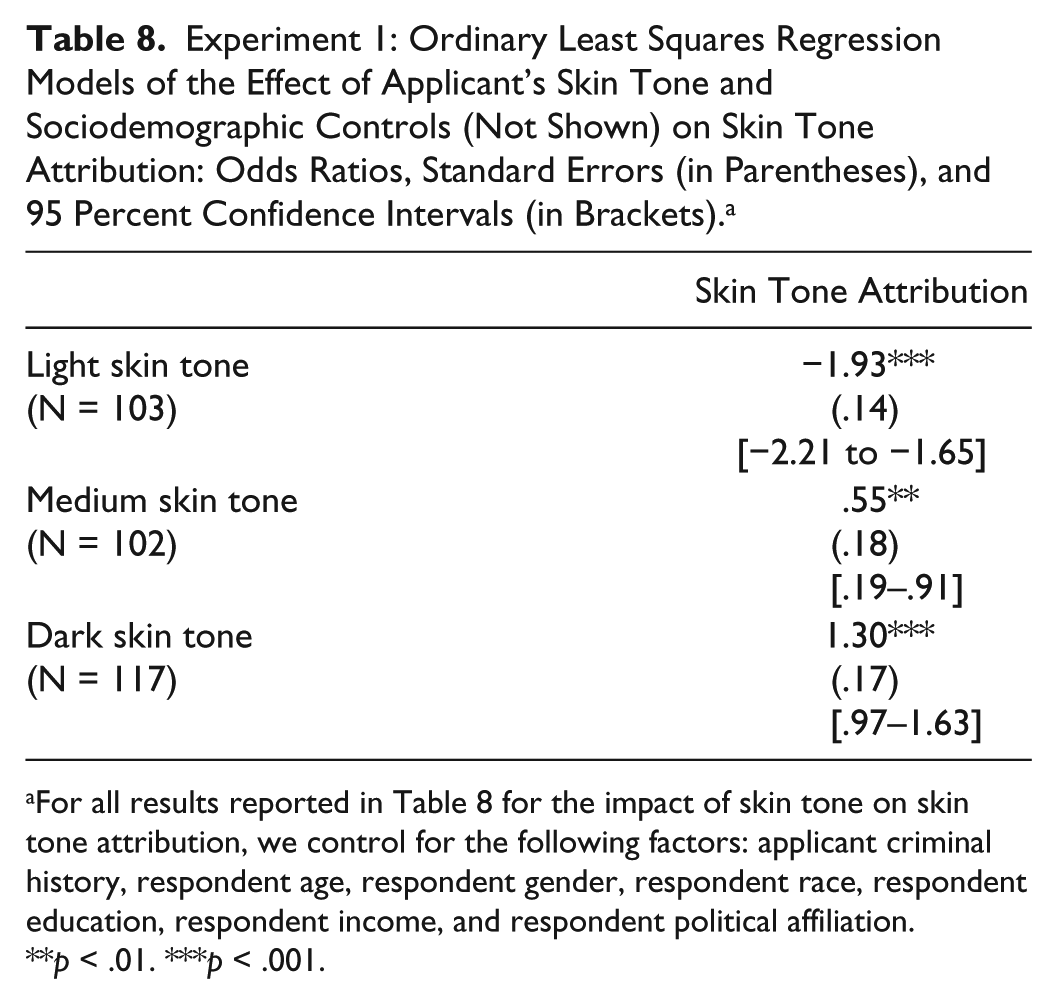
For all results reported in Table 8 for the impact of skin tone on skin tone attribution, we control for the following factors: applicant criminal history, respondent age, respondent gender, respondent race, respondent education, respondent income, and respondent political affiliation.
p < .01. ***p < .001.
Discussion and Conclusion
Although there is a general consensus around constructionist views of race, racial categories are most often measured and examined as static and mutually exclusive. We realize that data limitations in many cases make including skin tone variation difficult, but both the dominant sociological theory on race and a burgeoning empirical literature on colorism indicate that ignoring this variation may bias our findings. In this study, we consider whether phenotypic variation moderates the impact of a social factor—previous incarceration—known to alter perceptions of race on racial attribution. Contrary to previous research (Saperstein and Penner 2010), we find that criminal history has no bearing on external racial classification among members of our sample. Moreover, we find that criminal history also has no bearing on skin tone attribution.
Skin tone was a strong predictor of both external racial classification and skin tone attribution. This is important given the extent to which external use of skin tone to determine race may conflict with self-perception. Feliciano (2016) found that 2 percent of those who identified as black, 7 percent of those who identified as white, and 19 percent of those who identified as Latino/a were viewed by over 60 percent of 29 external coders as a different race from their self-classification. Similarly, Vargas and Stainback (2016) found that 13 percent of self-identified Latina/os, 8 percent of self-identified Asians, 7 percent of self-identified blacks, and 3 percent of self-identified whites report that they regularly experience identity contestation. Thus, the strong reliance we see on skin tone to determine race may be driving contested racial identities.
Our study is not without limitations. First, although the experiments detailed in this study incorporate some degree of diversity in age, gender, race, education, and socioeconomic status, they are not nationally representative. Convenience samples are typical in experimental studies, but it is possible that a nationally representative sample would show different results. On a related note of relevance to generalizability, Experiment 2 involved respondents rating applicants’ skin tones after applicant materials had been removed, consistent with the study’s ostensible focus on memory recall. Thus, our findings may be more relevant to more time-limited interactions than to longer-term engagements.
Other limitations involve our sample sizes. Though our samples were reasonably large for experimental studies (at 324 for the first experiment and 265 for the second), they still only permit limited statistical analyses. Relatedly, we acknowledge that Saperstein and Penner’s (2008, 2010, 2012) use of data from a large number of participants from the National Longitudinal Survey of Youth allowed for statistically significant results of lower magnitude that would be difficult to capture with our sample sizes.
Nevertheless, to our knowledge, our study is the first double-blind, experimental test of the extent to which skin tone moderates the impact of social factors on external racial classification and skin tone attribution. The randomization process of our experiments allows for solid causal claims regarding the impact of criminal history and skin tone on external racial classification within our samples.
This work also contributes to the discussion of contrasting racial orders in the United States and Brazil (Monk 2015, 2016). Scholars have long claimed that in Brazil, “money whitens,” as the country’s more fluid racial boundaries allow movement up the racial hierarchy for those with high status. Similarly, the Latin Americanzation thesis (Bonilla-Silva 2004) implies the United States is moving toward a “pigmentocracy” in which social factors will influence racial categorization and hierarchy. Our findings imply that at least regarding prior incarceration, such fluidity is less likely in the United States. A comparative experiment examining how factors highly correlated with race influence external racial classification in Brazil could further elucidate the potential similarities and divergences between these cases.
Our study represents an important step toward understanding how race is socially constructed by evidencing the powerful role of skin tone. Future research incorporating racial measures should consider the role of skin tone and phenotypical variation. Since societal context may influence the way in which skin tone is viewed, replication of our work using samples from other nations would further enhance our existing knowledge of how external racial classification takes place.
Footnotes
Acknowledgements
We thank Carson Byrd for his helpful comments on a previous version of the article and Avi Been-Zeev and Tara C. Dennehy for providing us with the photos used for the skin tone scale in Experiment 2.
Funding
The author(s) disclosed receipt of the following financial support for the research, authorship, and/or publication of this article: We thank the Duke University Department of Sociology, the Duke Interdisciplinary Initiative in Social Psychology, and the University of Texas Rio Grande Valley for funding these studies.
1
These faces came from publicly available stock headshots. Using FantaMorph, we were able to make the faces we displayed anonymous. As a check, we also included a question asking if respondents recognized any of the faces. Nearly all respondents replied negatively.
2
Supplemental analyses (available upon request) indicate that incorporation of dummy variables for other racial groups with white as the reference category do not yield statistically significant results or alter our findings.
3
For the scale’s specific questions, see Sears and Henry (2003). We follow  suggestion to recode each of the eight items on a 0 to 1 scale to account for differences in the number of response options between items.
4
Furthermore, additional analyses (available upon request) revealed that previous incarceration was also not significantly associated with any form of external racial classification when all controls were removed from the models.
5
The other four applications were given to all respondents. Two of them included a stock photo of a white man (one of whom had no criminal background and the other of whom had served a year in prison for felony intent to distribute drugs). Two of them included a stock photo of a black man (one of whom had no criminal background and the other of whom had served a year in prison for felony intent to distribute drugs). These four applications were included only to distract the respondents from determining which application included the experimental manipulations of interest to us, and responses to these applications were not used.
6
Respondents rated applicants’ skin tones without access to the applicant files and pictures because our recruitment text set the experiment up as an attempt to gain insight into how well hiring managers remember details about job applicants. By focusing respondents’ attention to the explanation of memory recall as the purpose of the study, we hoped to distract them from our actual objective: to determine the extent to which knowledge of a target’s previous criminal history impacts respondents’ categorization of the target’s skin tone.