




Abstract
Despite the growing research devoted to women in science, the connection made between family life and work by men in science is not fully known. Here we present results from interviews with 54 men who were selected from a broader national survey and housed at prestigious U.S. universities. Men remain acutely aware of cultural expectations for devotion to work and breadwinning, either compromising work commitments for more time with family or time at home in exchange for increased academic prestige. Findings are relevant for how universities should make policies that alleviate tension between work and family.
Work and Family for Men
Recent research calls for more in-depth investigation of how male workers manage the tensions between work and family (Bianchi and Milkie 2010). Over the past 50 years, men have increased their time spent at home: Time-use diaries show that husbands have tripled the amount of time spent caring for their children since 1954 (Edin and Nelson 2013), and male professionals increasingly report work-family conflict (Aumann, Galinsky, and Matos 2011). Yet there has been little research on how men manage these new tensions. Aumann and colleagues (2011:2) call the pressure men face to remain the primary breadwinners while also increasing involvement with child care the “new male mystique.” They claim that men are pressured to “do it all in order to have it all” in a way that is similar to the pressures experienced by women (Aumann et al. 2011). Moreover, over 90 percent of men report that they would like to spend more time with their families (Milkie et al. 2004; Williams 2010).
In contrast, other researchers call into question whether and how much fathers’ actual family practices have really shifted to match changing ideologies about fatherhood (Wall and Arnold 2007)—as well as how much ideologies have changed (DeWitt, Cready, and Seward 2013)—and indicate that involved fatherhood varies notably by class (Shows and Gerstel 2009; Usdansky 2011). Middle-class professionals are actually least likely to enact ideals of involved fatherhood, ideals that involve spending more time with their children (Coltrane 2004; Shows and Gerstel). In fact, Nicholas Townsend (2002) contends that with “the package deal” of masculinity, most men enact fatherhood through paid employment—by being good breadwinners for their families. High workloads and a working spouse do not lead to men’s exit from paid labor, and men remain under intense cultural pressure to provide financially for their families and are likely to face negative perceptions if they leave work to act as a caregiver (Cha 2010; Maume 2006; Riggs 1997; Townsend 2002). In fact, many men actually increase their workforce participation after having children (Lundberg and Rose 2000). As a consequence, professionally employed fathers work longer paid hours than their peers who are not fathers and also maintain duties at home (Kaufman and Uhlenberg 2000; Lundburg and Rose 2000). This suggests male professionals adopt strategies that prioritize work over family and are particularly unlikely to adopt coping strategies that reduce commitment to work (Higgins, Duxbury, and Lyons 2010). Men are also more likely to adopt a strategy that relies heavily on their spouses’ increased hours in the household, reproducing gender inequality and reinforcing the separate spheres (Cha 2010; Gerson 2010; Hochschild 1989).
Thus, there appears to be a puzzle about how male professionals negotiate work-family conflict. On the one hand, men report experiencing work-family conflict and new pressures to spend greater time with children. On the other hand, it seems men experience intense breadwinning pressure as well as the benefits of gender norms that stress separate spheres (with women managing the home sphere) and may be unwilling (or unable) to reduce their time at work.
This puzzle is of particular relevance to men in academic science since scholars argue that academic science is a highly demanding career in terms of required work hours as well as personal identity formation (Ecklund and Lincoln 2016), suggesting that their work-family pressures may be particularly acute. Moreover, men in academic science at the institutions studied here may either hold or aspire to hold positions of prominence and power in their fields—their choices therefore may have spillover effects to other institutions that model themselves after the institutions examined (Fox 2010; Mason, Wolfinger, and Goulden 2013). Thus, understanding how this puzzle plays out within this particular group has significant implications for how these men are changing cultural norms about appropriate parenting for fathers and how these strategies may affect men’s identities.
In this article, we analyze whether male academic biologists and physicists from elite U.S. universities subscribe to the “new male mystique” or if they remain tied to “employment as fatherhood” as part of “the package deal” as well as what strategies they employ within these frameworks. We specifically ask: What are the strategies that male scientists use to mediate work and family commitments? We find that 63 percent of the men we interviewed adopt at least one (and often more than one) work-reducing strategy, including decreasing work hours, changing work schedules, lowering work expectations, or leaving their field altogether in search of a more family-friendly workplace. Our findings suggest men’s choices will have noteworthy effects on the future of academic science and deserve the attention of university policymakers.
Gender, Academic Science, and Family
Science seems to be a totalizing professional identity when compared to other professional identities (Ecklund and Lincoln 2016; Latour 1987; Shapin 2008). While professional men often tie their personal identity to work devotion (Lamont 2000), the way that science is used to frame identity for scientists may make the challenge of long work hours and increasing work demands even greater for academic scientists. The shared workplace norms among scientists are especially prone to this sort of framing as the scientific career is seen as without boundaries, demanding a substantial number of hours worked outside of the standard work week and implicitly expecting mental devotion even outside this “on-the-clock time” (Keller 1995). In fact, knowledge workers experience a great sense of hurriedness and time famine compared to those in other categories of employment (Natti, Anttila, and Tammelin 2012). At top universities, it is common for scientists without children to work 50 or 60 hours every week; in our broader research, we find that men in science average about 58 hours per week (Ecklund and Lincoln 2016). And academic scientists with children report working an average of 54 hours per week (Ecklund and Lincoln 2016). This is more hours than many other professions require. For example, data from the nationally representative Current Population Survey show that lawyers averaged 45 hours per week between 2006 and 2008, while physicians averaged about 51 hours. These high expectations for scientists are tied to the characterization of science itself as concerned with “ultimate truth” such that it is assumed to be an especially “worthwhile pursuit” (Keller 1995).
But work is only part of what Nicholas Townsend (2002) calls “the package deal,” which he defines as a “composite” of cultural ideals about what men’s lives should be like in twenty-first–century America. Townsend contends that contemporary American men define themselves according to ideals surrounding four main life stage conventions—work, marriage, home ownership, and fatherhood—and that each element of the package relates to the other and is seen through the prism of its relationship to the rest of the “package.” In Townsend’s framework, fatherhood is enacted primarily through paid employment, but Aumann and colleagues (2011) suggest that changing fatherhood norms no longer allow men to simply parent through breadwinning. Recently, Kathryn Edin and Timothy Nelson (2013) have argued that for poor single fathers in the inner city, the package deal has been turned upside down as work and marriage have become increasingly distant possibilities while engaged fatherhood becomes a priority in these men’s lives. This suggests that cultural norms surrounding the package deal are changing and that men may now be obligated to engage in fatherhood in a different way than in the past. Yet if cultural ideals continue to emphasize the combination of all of these elements in men’s lives, then what strategies might men use to navigate the all-consuming nature of science so as to fulfill the rest of the package deal?
Work-Life Conflict in the Sciences
As male academic scientists’ strategies to navigate work-family life are made within the particular context of academic science, it is critical to understand the facets of academic science institutions that constrain men’s choices to balance work and family. Elite professions—such as medicine, law, and science—have been particularly slow to respond to work-family conflict for men and have not established systems to deal with these conflicts (Coltrane 2004). Elite professions’ stunted response to work-family conflict stems from a “continued acceptance of separate spheres ideology” contributing to “the failure of social institutions to accept gender equality in the home and in the workplace” (Coltrane 2004:217). In fact, scholars argue that the demands of the work environment in universities drive faculty members to consider leaving their institution in search of better work-life balance (Watanabi and Falci 2016). Additionally, universities have vested interest in maintaining the systems that promulgate work-family conflict among faculty. For example, long work hours—with which women as well as men academics report dissatisfaction (Jacobs and Winslow 2004)—are linked with higher levels of research productivity (Jacobs and Winslow 2004). Particularly relevant to academic science is the fact that long or nonstandard hours appear to be demanded by organizations rather than sought by employees (Jacobs and Gerson 2004). While the negative effects of this on women have been widely noted (England et al. 2007; Fox 2010; Preston 2004; Tammelin et al. 2017; Xie and Shauman 2003), the effect on men in academic science is still unclear.
Some researchers find a higher reported conflict of work with family than the other way around (family with work) among both men and women scientists (Fox, Fonseca, and Bao 2011). And prior research reveals that male academics in general report work-family conflict manifesting in the form of sleep deprivation, strained personal relationships, decreased productivity at work, the two-body problem (Reddick et al. 2012), or even having fewer children than desired (Ecklund and Lincoln 2016). The long work hours and an all-consuming dedication to science in particular may go above and beyond the strong devotion to work expected of men (Blair-Loy 2003) to that of a moral commitment to science and knowledge production (Hermanowicz 2009; Shapin 2008). Thus, in certain work environments—and we argue the academy is one of them—a masculine model of intensive work persists, although not necessarily with the cooperation of its workers. Little is known, however, about how these experiences structure male scientists’ daily lives and what strategies they use to respond to these pressures.
Strategies for Negotiating Work-Family Conflict
What strategies, then, do men use to negotiate work-family conflict? Prior research suggests several possibilities, most of which require reducing personal time, work time, or family time. Those attempting to maximize their time both at work and at home may attempt to function on less sleep (Maume, Bardo, and Sebastian 2009), work nonstandard hours (Deutsch 1999), or deploy spatial strategies by working at home (Maume 2006). And dual-earner families may place limits on work hours, prioritize one career over the other, or place one career ahead of the other at particular points in time, trading back and forth depending on career needs (Becker and Moen 1999). Crucially, however, Bianchi and Milkie (2010:715) note that the work-family “literature has not sufficiently recognized individual agency—how workers actively strategize to maximize work-family balance—[through these strategies].”
There may be strategies specific to the academic institution. Male faculty often attempt to delay childbearing until after receiving tenure (Drago et al. 2006). Yet as the path to a tenure-track position and then to tenure has lengthened through one or more postdoctoral fellowships, many assistant professors find themselves unable to wait until after tenure to have children (Jacobs and Winslow 2004). And while male faculty may not engage in strategies to hide their parental responsibilities from colleagues as do some women (Drago et al. 2006; Ecklund and Lincoln 2016), academic men do have fewer children on average than other professionals, such as physicians and attorneys (Wolfinger, Goulden, and Mason 2010).
Moreover, the policies that organizations have established to address work-family conflicts may not be effective for male faculty members. Indeed, men employed in higher status jobs with greater control over their schedules report higher levels of conflict between work and the rest of their lives than do men with lower status positions and less work flexibility (Schieman, Glavin, and Milkie 2009). As a result, contrary to popular belief, having “flexibility” in a job—a system increasingly used in professional settings to assist workers in lessening tension between work and home—may actually bring greater work-family conflict and higher stress levels to workers (Schieman et al. 2009; Williams, Blair-Loy, and Berdahl 2013). While the reasons for this are unclear, recent research reveals that men’s decisions, in particular to utilize available workplace flexibility for family reasons, may be stigmatized or even damaging to their careers (Vandello et al. 2013), except in cultures where the use of policies has become the norm (Fleischmann and Sieverding 2015).
Methods
Data for this article come from a study of family life and science, which consists of a survey as well as in-depth interviews with a subsample of survey respondents. As part of the survey, we selected a random sample of 3,455 male and female scientists from the more than 14,000 graduate students, postdoctoral fellows, and tenure-track/tenured faculty members in the top 20 PhD programs in all subfields of physics and biology in the United States (when astronomy was included in a physics department, we included astronomers in our sample).
We examine the disciplines of biology and physics in particular because these disciplines are two core scientific disciplines yet have very different levels of women’s involvement. At all points on the path to faculty positions, the number of women in biology is increasing rapidly while the number of women in physics remains quite low (England et al. 2007; McDonnell 2005). Programs were ranked by the National Research Council (1995) and correlated with the rankings of U.S. News & World Report (2008). The survey ran from November 2008 through February 2009, using web and phone modes of completion. The sample was stratified by rank in the career track, and where possible, we selected a disproportionately high sample of women within each rank, trying to achieve 50 percent if possible. Overall, this combination of methods resulted in a high response of 72 percent or 2,503 male and female respondents, a very high rate for a survey of academics.
Once the survey was completed, 216 survey respondents (both men and women) were selected to participate in in-depth interviews from a stratified random sample. For the interviews, a contact letter containing a cash pre-incentive was mailed to each of the potential respondents. Overall, a total of 150 interviews (a 69 percent response) were completed with 84 biologists and 66 physicists. Seventy-four of these respondents were men, and 76 were women; however, only male respondents with PhDs are considered in this analysis (N = 54) in order to elucidate the ways in which men with their terminal degrees navigate the work-family relationship. In the final sample for this article, then, we limit the sample by gender (only men), education (PhD completed), and age (all participants are above 30) so as to create a fairly homogenous group within which to examine strategies of combining work and family life (Frieze 2014). The interviews were conducted between June 2009 and April 2011 and took between 20 minutes and two hours. Each respondent was interviewed once, either face-to-face or by phone. Table 1 describes the interview sample demographics in terms of age, career stage, and relationship status compared to the survey population. At all career stages, most of the men are married; postdoctoral fellows and assistant professors tend to be under age 40, while associate and full professors tend to be older than 40.
Interview Sample Compared to Survey Population, Selected Demographics.
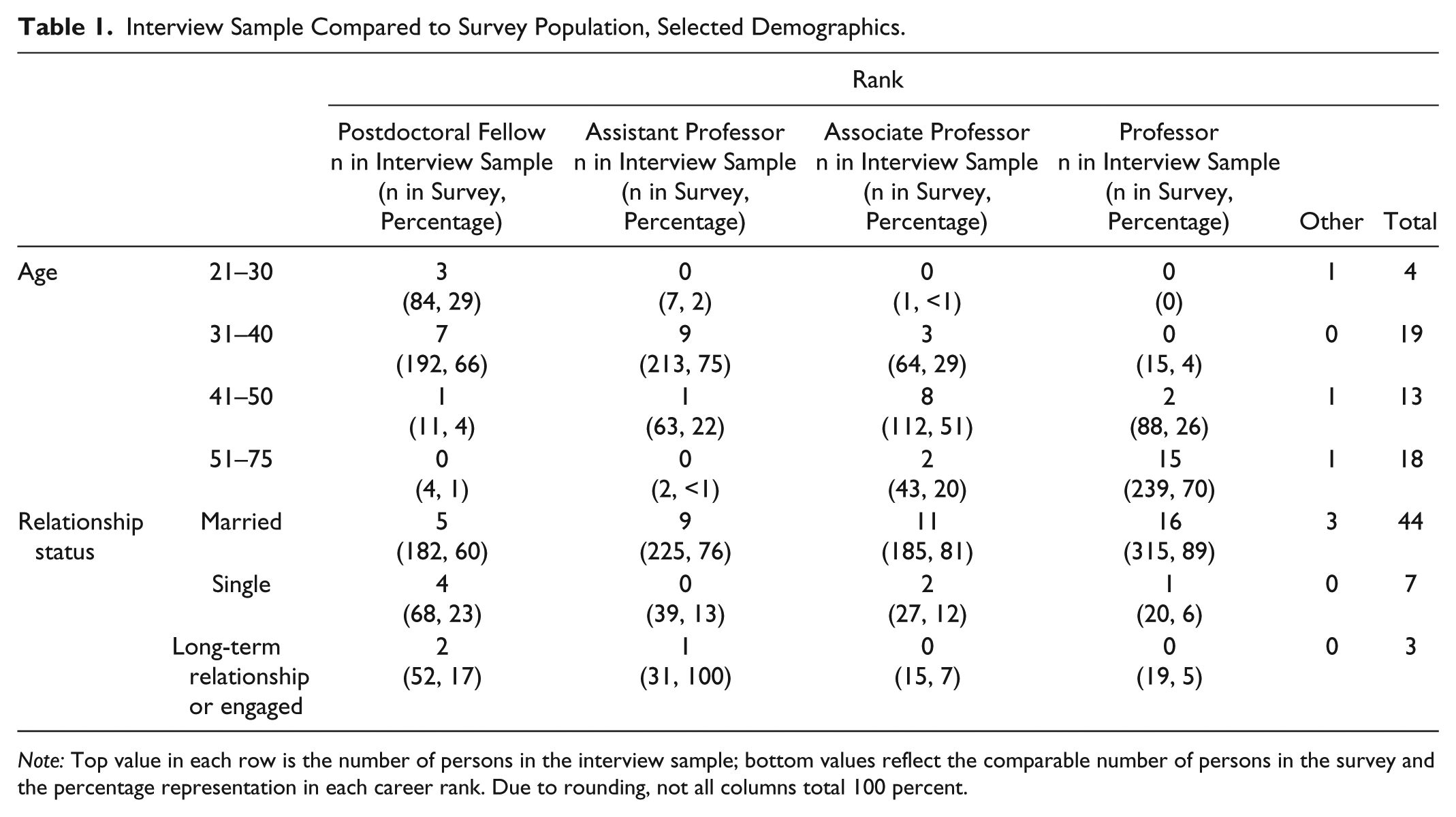
Note: Top value in each row is the number of persons in the interview sample; bottom values reflect the comparable number of persons in the survey and the percentage representation in each career rank. Due to rounding, not all columns total 100 percent.
The semi-structured interview format allowed respondents to elaborate on how men in science see the connection between their academic science careers and family life, revealing the nuances of how scientists think about these issues. Analyses were completed by the authors of the article and proceeded in a semi-inductive fashion. The interviews were transcribed in full and edited by undergraduate transcriptionists. The authors approached the data with the particular research questions in mind but also allowed codes to emerge from the data. This happened through an iterative process by which as new themes emerged, the transcripts were re-read to see if these themes appeared in other transcripts and to examine whether patterns emerged according to the themes. Then the authors systematically applied the codes to all of the interviews. Sections of the interviews were coded by more than one author, achieving an intercoder reliability of .90, calculated as a simple percentage.
Findings: Strategies for Negotiating Work and Family
While few men make the kinds of sacrifices that are common for women to make in the workforce, such as leaving work entirely or reducing to a part-time schedule (see Maume 2006), men in our interview sample are attempting to spend time at home through one of the following strategies: changing work schedules, restricting work hours, lowering their expectations for professional success, or considering leaving academia for another field. Nearly three-quarters of men with children (N = 27/37, 73 percent) modify devotion to work in at least one way; and of those that do, over half (N = 14, 52 percent) combine at least three strategies to reduce work commitment. Notably, we did not find differences between how men in academic physics develop strategies for negotiating family life when compared to men in biology.
We need to be careful not to generalize given the qualitative nature of our sample. Yet, looking at Table 2, it is clear that some patterns emerge. While this is not necessarily a generational issue, as Table 2 demonstrates men across all career ranks make these changes, we did find that assistant professors are more likely than those in other ranks to “restrict work hours,” “change schedule,” and “lower expectations.” Full professors seem more likely to rely on their wives, and those early in their careers (postdocs who don’t have permanent positions yet) are most likely to consider leaving academia. It is also important to note that those who choose science over family may be more likely to have “survived” and be observed.
Work-Life Balance Strategies by Rank (Interview Sample).

The dominant framing around these strategies was that science is so demanding that it requires either compromises at work or compromises at home. In fact, not one respondent in our qualitative sample reported that science is “not demanding.” Instead, academic scientists that we interviewed see their profession as either exceptionally demanding (50 percent) or highly demanding like all other professional fields (25 percent). The quarter of our respondents who indicated that science is deeply demanding but that it is no more demanding than any other professional fields reported that professional positions were generally demanding. Summarizing the demanding nature of academic science well, one physicist explained that the best scientists “remain relentlessly focused on one goal.” This understanding typically centers on tenure-track demands, grant writing, and the open-ended nature of research, all features ubiquitous to academic science.
No Modification to Work
Given the demands of academic science at an elite research university, it is not surprising that some men devote so much attention and energy to their scientific work that they do not report changes to work, yet men who make no change at work (or plan to make no change at work after they have children) represent a distinct minority in our sample, only 37 percent of respondents. These men do not change their work schedules, reduce their hours, lower their work expectations, or consider leaving academia in order to accommodate family life.
Almost 82 percent of interview respondents are married, and only 13 percent are single. Single men were included to allow us to interview young men about their projections for how the academic science career might have an impact on their family choices as well as whether such projections may shape the desire to stay in science; the remaining are in long-term partnerships or are engaged. There were no widowed or single fathers in our sample. Of the male scientists who were married, 10 were married to an academic, and 6 were in the same field as their spouse. Table 3 shows the number of children respondents in our interview sample have by career stage. The table shows that respondents employed in a faculty role typically have at least two children. Table 4 shows the ages of children by career stage.
Number of Children by Rank (Interview Sample).

Age of Children, by Career Stage (Interview Sample).

Men who make no change to work or plan not to are diverse in age and career stage. On average, they are 54 years old, 13 years older than the average age of the entire sample (41 years). They are both physicists and biologists and are represented among all stages of the academic career. Notably, of these 20 men, 10 have children. A scientist in his late 60s, one of the oldest respondents in our sample, explains that although his wife is trained as a nurse, she stayed home to care for their children when they were young. A physicist in his mid-40s describes an intricate arrangement he and his wife—who is a doctor—have maintained with a full-time nanny who shoulders most of the burden of child care. He explained, “between my wife and myself, our income allows us to have a full-time nanny who lives in our house. . . . And so we find it very important that our children are not affected by our relatively busy and fast changing lives, and so her main job is to provide stability.” He reveals his and his wife’s concern for their daughter, “So I think maybe initially we had doubts that it could be difficult to have a family similar to the families we were brought up in . . . but this model, where we have a very good reliable nanny, I think helps us to roughly bring up our children as we were brought up ourselves.” When asked if there are any ways that his family life affects his work, however, he succinctly replies: “As I said before I think it’s important for me that everyone is supportive . . . so I may have been very fortunate that, there is nothing I could think of in terms of real restrictions.”
Unanimously, the men who did not modify work described science as extremely demanding, requiring extraordinary effort to continue their career trajectory. A 45-year-old associate professor of physics whose wife works as an independent entrepreneur sees science as incompatible with having children. He and his wife discussed having children, but she felt that if they were to have children then “[he] would have to be . . . certainly [an] equal amount of caregiver.” He was unwilling to do so because he believes:
To be a successful scientist, it just takes so much of my time. I wouldn’t be able to have children also and do that . . . if I had a nine-to-five job . . . the thing about [academia] you know you never leave it, actually. You take it home with you. And so [that] definitely had a big effect . . . basically, I’m just kind of monomaniacally pursuing science.
For this man, having a successful career as an academic scientist precludes the ability to be an equal caregiver with his wife. Instead of making any change to his work expectations, he and his wife have chosen not to have children.
The belief that not having children has notable positive outcomes for success in science defined most of the men who opted to make no changes to work. A biology postdoctoral fellow in his mid-30s explained, “I think [not having kids] has had a pretty big impact in terms of . . . being able to just pour a lot of time into lab, and try to go for an academic position.” He feels that not having children directly allows him the freedom to unabashedly devote his time and energy to work without modification and admits, “I might have to think a little bit harder about what my goals were if I had any other demands on my time outside of [the] lab.” These men who avoid the demands of family and parenting accept and even perpetuate the demands of the scientific workplace. Others may see them as immutable.
Relying on a Wife’s Caregiving Work
Close to half (43 percent, N = 23) of the male scientists relied on their partner (usually a wife) to oversee substantial family responsibilities, lightening their burden at home. An associate professor of biology in his early 50s, whose wife stays at home to care for their three teenage children, joked that one of the most significant challenges of his career has been “keeping your family together and learning your children’s names.” A minority of respondents explicitly referred to such a strategy, yet narrative data likely underestimate the prevalence of such a strategy as men may not fully recognize their dependence on their wives or alternatively may not perceive it as socially desirable to admit to such a strategy. Nevertheless, some men did explicitly acknowledge and discuss how they benefit from their wives’ care work. For example, a 41-year-old biologist with two small children, currently employed as a research associate, was among the few respondents with children to state that having children and a science career is not particularly challenging. He explains that “It’s not [a] big difficulty because my wife is not working.” He continued on to explain that “my wife loves to take care of my kids—our kids.”
This biologist is among the nearly 15 percent of men we interviewed who has a full-time stay-at-home spouse. These men seem to benefit extraordinarily from their wives’ efforts managing duties in the unpaid sphere. A 37-year-old assistant professor of biology, father to two children under the age of 10, explained that he is constantly emotionally and intellectually involved with his work (an attribute he believes is endemic to doing biological research at an elite research university) and that even when he is home he realizes, “I’m not present with the family and can be distracted easily.” As a consequence, even when he is home, he relies on his wife’s emotional connection with his family so that he can remain constantly emotionally and intellectually devoted to his work. His wife complains about this, yet he sees little possibility for change.
Although men who have wives who stay at home full-time appear to directly benefit from their wives’ contributions, and despite the prominent role that stay-at-home wives played in male scientists’ narratives, few of the scientists in the sample have a stay-at-home spouse. Almost one-third of respondents—across all career ranks—are partnered with another academic, and almost another quarter is partnered with a person employed in another professional career. Yet even many of those with a working spouse report relying on their wives to manage the majority of the household and child care responsibilities.
Having a working spouse who takes on primary care responsibilities allows men to continue more fully with their scientific work. For example, a 63-year-old professor of physics recalls a year he spent completing a short-term collaboration in a different state, during which he spent about half the year commuting and traveling. During this time, his wife worked part-time as a nonprofit administrator and cared for their two children. He said that his wife’s ability to take on all care responsibilities in his extended absence effectively allowed him to take on the demands of commuting and travel created by his work as a scientist.
Even men who are married to other academics and have a commitment to being involved with family care may rely heavily on the cultural expectations for mothers to be more involved in care work than fathers. This 45-year-old associate professor of physics who is married to a history professor realizes that his wife “actually spends more time with my daughter than I do,” although he feels he was “very much involved from day one. And I was not the kind of father that sits back and relaxes.” His desire to identify as an involved father, despite his recognition that he is not as involved in caring for his child as is his wife, is consistent with prior depictions of professional fathers who seek to instantiate the package deal in their lives by being involved at home while also devoted to work but do not necessarily enact this in day-to-day life (Shows and Gerstel 2009).
Another way that men rely on their wives’ caregiving efforts results from the more common entrance and exit of women from the workforce. A professor of physics in his late 60s recalls that his wife left her job as a pediatric nurse when their children were young, only to return once they were fully enrolled in school. As a result, the “day-to-day stress of raising kids was mostly on her” while he “found time to go to the ball games . . . and then all of the events that occur.” In this way, male scientists may be shielded from the most stressful and time-consuming aspects of parenting, relying on their wives to complete these tasks and allowing the men to remain more productive at work.
Overall, the benefits men receive from having a wife who will take care of family responsibilities are so salient and well recognized that even some young unmarried men without children expect to marry non-scientists who will be primarily responsible for children. One postdoctoral fellow of biology in his early 30s explicitly notes that he plans on marrying a non-scientist because two scientists would not have time to properly care for children. Ostensibly, this means he will look for a wife that will allow him to live up to the scientific ideal by relieving him of child care duties while still allowing him to father children. These first two strategies, then, reinforce traditional gender roles and separate spheres.
Changing Work Hours
Another strategy was to change work hours in order to be at home when children are awake and home from school. Unlike previous research, which finds that men are unlikely to adopt strategies that reduce or change work commitment (Glauber and Gozjolko 2011), this notable strategy modifies work commitment by reducing the intrusion of work on home. As this associate professor of biology reports, “it’s not a forty-hour-a-week job, it’s a sixty- or seventy-hour-a-week job for most people . . . [and as a result] I just have to decide when I’m done.” This means practically that men have to choose what hours to work, and many choose to work hours that will allow them to be home when they can interact with their children. Twenty-nine men in our sample employed this strategy. A 38-year-old assistant professor of biology with two children, who is married to a scientist, explains just how important “being home for dinner every night” is to him, regardless of what is going on at work. He describes a typical day: “I drop off my kids, get to lab around 9, stay until about 6, go have dinner with my family, do some stories, some bath and then back at the lab until at least midnight every night, often 1 or 2.” Here we see that he feels compelled to work more than a standard 40-hour work week but that he makes a concerted effort to work these extra hours at times when his family will be least affected. Consequently, he opts to accommodate both demands, carving out atypical hours.
Even men who have a stay-at-home wife and therefore could in theory stay at work unrestrained by child care may choose to change work hours to fulfill their perceived goals for fathering. A 41-year-old research associate in biology, whose wife stays home to care for children, reveals that balancing his work with family has not been “very difficult” because she “loves to take care of [his] kids.” Of course, his role in her decision to stay at home is masked in his retelling; there is no consideration of the role his work or career preferences may have played, although women married to professional men who overwork are likely driven out of work by a spouse’s long hours (see Cha 2010; Stone 2007). Yet, he recalls his decision to stop working on weekends because he wanted to spend more time with his young children. Other men do not have this realization until their children are older. A 52-year-old associate professor of biology, who has three teenage children and is married to a homemaker, recalls the period of his postdoctoral training that coincided with having young children and when he worked “six and a half days a week.” As his children hit adolescence, he began to realize, “[working this much] was destructive to my marriage and bad for my relationships with my kids.” In response, he decided to avoid working on the weekends and “try[ing] to work around my family schedule.” This results in him “often working at home very early in the morning, late in the afternoon, at times when family members are doing other things.” Moreover, he shares that he “also get[s] into work early in the mornings, like . . . seven in the morning. . . . And I leave at 6:30 or 7:00 in the evening so that I’m here five days a week but I’m working 11 or 12 hours a day.”
Restricting Work Hours
Just over one-third of men in our interview sample indicated that they have restricted work hours in order to be with family. No respondent reported, however, adjusting his schedule to less than 40 hours per week. This change nevertheless weighed significantly on many of the respondents. A 38-year-old assistant professor of biology, who has a three-year-old daughter, recalls cutting his work week from “seventy or eighty hours a week” to “roughly fifty.” Although he is relieved to share that he has “managed very well” given this choice, he describes this change as a shift from “defining myself by my science and working really, really hard at it to where now it is a balancing act.” He feels that this is a true “cost to me [laughs].” His ambivalence toward this change reflects an issue of identity construction related to the traditional breadwinning model of masculinity in which men were often expected to centrally define their identity by professional status. Seemingly influenced by the new male mystique, he experiences a “psychological issue” trying to redefine his identity as both father and breadwinner. As this scientist and father attempts to readjust his commitments to work and family, this recalibration of the package deal appears to give him significant stress.
A 34-year-old assistant professor of biology details that despite stringent efforts, “once [his son] started to sort of crawl and interact and stuff like that, it became too stressful to work on the weekends [as he used to],” and so the only solution he has to manage work and home is “working less.” He concludes, “The only way that you can become sated is by being more efficient.” This difficulty reflects the culture of academic science. The 34-year-old assistant professor of biology just quoted highlights that although he is “fine with sort of eliminate[ing] the amount of time that I can be at work,” he perceives it is very “difficult for a self-motivated area [like science].” Since science is perceived as an independent and broadly consuming profession, scientists must set their own boundaries and, in his words, decide when to say, “Okay, I can’t do any more work on this, on this project today.” In other words, the freedom of academic science as well as the personal satisfaction many scientists report gaining from their work does not require (or encourage) a clear stopping point. In order for him to effectively choose to cut his work hours, he has to police himself and critically change how he perceives the very nature of the job; he must, as he says, “treat it more like . . . just like a job, like . . . doing sales for some company . . . [that he doesn’t] really care about.” His narrative reveals that the decision to cut hours within academic science may be difficult for men given the identity as well as the institutional structure of academic science.
Our research further reveals that younger professors most commonly adopt strategies to spend more time at home. Indeed, out of the 24 men in our sample who restrict work hours, 64 percent are either assistant or associate professors. It is possible that their choice to restrict work hours is related to the ages of their children in that perhaps men with younger children either desire or actually must spend more time with young children. The average age of children among the men in our sample who did not report restricting work hours was 13.4 years (median = 9.5 years), while among men who did report restricting work hours, the average age of children was 6.8 years (median = 5 years).
Many men who restricted work hours view it as a cost in order to invest more time in their children and families. One physicist, an associate professor whose wife is a professor in another discipline, describes his decision to severely curtail his work schedule by never working on the weekends or after 4:30 PM in order to care for his four-year-old daughter:
So it is a challenge, it is a challenge, there’s no question. Nothing can happen after 4:30 because I have to pick her up and that’s not something that a lot of people understand. . . . And so your time, so your days are short, there’s no weekends; there’s no work on the evenings, so you’re very restricted. . . . I don’t know how people can do this and still fight for tenure or you know, get their first job, and I just don’t understand.
Although he has achieved success at work, he remains ambivalent about the costs associated with this path. Moreover, unlike some, he worries that those who are following the path that he chose may be unable to achieve tenure and have a family.
Lowering Work Expectations
Lowering expectations for work prestige or success is a less common choice for men in our sample (just under a quarter indicated that they have lessened expectations for what they can achieve at work), yet it is a strategy that has an important impact on the broader institution of science. For some men, these lowered expectations are quantifiable. A 36-year-old associate professor of physics, who is married to an astronomer, describes his commitment to his children as “very, very concrete.” He recalls explaining to his teenage daughter that although “the fact that I come to pick you up after school every day might mean there’s one paper less that I’m writing or reading,” it is “worth it.”
For others, this choice is more holistic. An associate professor of physics believes that he and his wife, who is also a physicist, are not as successful by professional benchmark standards as they would be if they did not have their two children (ages 10 and 13). He discusses the “extra overhead of managing the home life” and concludes that it results in him and his wife not working as many hours as his peers. As a result, “neither one of us is as accomplished or widely published or cited or famous [as we would be if we did not have kids],” and in fact, “any measure of our success we know is reduced because of our decision to have kids.” Yet, he has justified this choice by concluding that he “do[esn’t] think we will change our institutions . . . but . . . there’s nothing about our professional lives that would be so much better that we would give up those personal sides to move.” In other words—even though he is an associate professor at what is typically classified as an elite research university—this scientist has decided to consciously lower his expectations for work prestige in order to live the sort of personal life he would like.
A 49-year-old professor of biology, whose wife is also an academic, explains that although maintaining commitment to his children is “difficult” because “the people that do best in academia, sadly, often are those who don’t have child to care for,” he maintains an unyielding commitment to being involved in his two children’s lives. He intimates that he is involved in the daily tasks of child care, and this has changed his ability to maintain the kind of commitment to work that he would like: “I used to do all the work here till whenever I wanted to and then I’d go home and I could work at night, now I kind of get home, put the kids to bed, right?” Referring to his two children, both under age 10, he declares, “I am not going to miss the kids growing up.” Prior to having children, he and his wife “determined if we were going to have kids, we are going to have kids . . . we are not going to not see them because of work.” With passion, he continues, “What [the] hell is the point of that, then don’t have kids!” He seems to suggest that having children is the sort of choice that requires a father to be committed and involved in their lives, articulating a new fatherhood ideology from that of previous generations. He also suggests that he enacts this ideology by participating in tasks like putting his children to bed. By definition, to him, fatherhood requires notable involvement with children. So, he has “accepted the fact that I am going to be behind on stuff” given these values.
The underlying motivator that each of these men value spending time with family over increased work prestige is central. This suggests that men may be finding satisfaction in previously female-gendered spheres—a serious shift from previous expectations.
Discussion and Conclusion
Our research suggests that there may be a shift from the “separate spheres” (Cha 2010; Hochschild 1989; Moen and Roehling 2005) ideology to a schema in which men are expected to be devoted to both work and home. But as many of the men in our study experienced, this level of commitment to both spheres is not possible, and in the words of one scientist, heavy involvement in one sphere “demands sacrifice” in the other. Given that 66 percent of men we interviewed reported making some modification to their work schedules, our research suggests that academic science that demands total devotion from its workers is not compatible with the lives of either men or women. In other words, what has long been known in the sciences as a “woman’s” problem may in fact be a problem of the very structure of academic science itself; institutional pressures demand far longer hours than the majority of workers are willing or able to provide. Although only a few men in our sample changed their work to the extent that it was a serious detriment to their careers, these were the men who had “made it” in their fields, and they still found that work and family was incompatible. These examples suggest that institutions may need to consider how institutional expectations affect not just women but also men.
These strategies appear to be in response to an altered “package deal,” suggesting that men can no longer simply father only by providing financial resources to their children through employment. Yet even as some men subscribe to the “new male mystique,” the continued gendered division of the separate spheres appears to provide men with options to eliminate (or greatly reduce) the possibility of work-family conflict without engaging in these strategies: by being willing and able to draw significantly on their wife’s caregiving at home. Nevertheless, even for men who are relying on some modification of the traditional separate spheres in which wives continue to do more of the work at home, the cultural norms of fatherhood are undergoing rapid change, ultimately demanding that men be more involved at home than past generations.
These strategies have significant implications for the identities of men in academic science and their possibilities for changing institutional norms of the university. Like the mothers in Stone’s (2007) work who leave professional positions to become stay-at-home parents, scientist fathers seem to experience a conflict between their identity as father and as professional scientist: They are increasingly unable to live up to the idealized norms of what it means to be a scientist—60 to 80 hours of work per week without time constraints or boundaries. Simultaneously, like the mothers in Ecklund and Lincoln’s (2016) book, who continue to identify as “selfless” even after adopting work strategies previously only tied to fathers and breadwinning, we too see scientists adopting work modification strategies that are at odds with their personal identification as scientists whose work demands complete devotion. In all three studies, we see workers who do not have a cultural schema to frame the changing shift in gender norms. Ultimately, this illuminates a disconnect between men’s lived experiences and developing identities and the structural context of academic science. We recognize of course that this research has limitations; we are only looking at men in science who have remained in science rather than those who left science. Our findings further may also be explained by a cohort effect; since we do not follow men over time, we cannot know. We have presented here a first step in research on how men in science respond to family life.
Looking forward, this research suggests that there must be an institutional response to changing work-family norms. Without structural support, work-family negotiation becomes largely, if not solely, the burden of professionals themselves; the onus is on individual agency rather than institutional change. Professionals acting within this structure must make individual choices that are not officially sanctioned by their institutions. Often these choices may negatively affect their career success. For example, individuals who compromise work hours for family concerns may harm their careers and must personally accept all consequences for adopting any work-family balance strategy that affects work time. This is especially detrimental in the academy, where lengthy temporal commitments to work are requisite for research productivity, a key factor in tenure-track processes.
The perception by both men and women that academic science is an especially inhospitable place for those desiring children and involvement in family life should be important to us all. We trust our top universities to generate the best and brightest scientists, keep our country at the forefront of scientific knowledge and research, and address the most pressing problems of our time. It is a national problem if the family unfriendliness of academic science creates a “brain drain” for the most talented men and women. We want the best scientists in the best universities doing the best research.
Footnotes
Funding
The author(s) disclosed receipt of the following financial support for the research, authorship, and/or publication of this article: Research for this paper was funded by National Science Foundation GSE Grant 0920837, Elaine Howard Ecklund (PI) and Anne E. Lincoln, (co- PI), as well as Rice University. Sarah Damaske acknowledges support from the Population Research Institute at Penn State University, which is supported by an infrastructure grant by the National Institutes of Health (2R24HD041025).