




Abstract
Elites often mobilize science and religion to support opposing positions on issues ranging from abortion to families to criminal justice. However, there is little research on the extent to which public preferences for scientific and religious understandings relate to public opinion about these and other controversies. The authors analyze how perspectives on science and religion map onto public attitudes about a wide range of social, political, and economic issues. Using General Social Survey data, the authors find that individuals oriented toward either science or religion hold differing attitudes in nearly every domain investigated. However, individuals whose worldviews incorporate both science and religion stand apart in surprising ways, which suggests that this third perspective is not located on a conventional liberal-conservative spectrum. Previous research has identified religious-scientific perspectives as a basis for polarization about issues that intersect science and religion, but the authors find that the conflict is far more widespread.
In a 2015 American Sociological Review article, we found that the U.S. public is marked by three broad perspectives on science and religion: a traditional one, which holds religion in relatively high and science in relatively low esteem; a modern one, with the opposite point of view; and a postsecular one, which is knowledgeable about and appreciative of science but which is religiously devout and which rejects mainstream scientific accounts of evolution and the big bang (O’Brien and Noy 2015). Moreover, we found that these worldviews correspond to attitudes about controversies related to science and religion, such as stem cell research, independently of other antecedents of public opinion, including race, socioeconomic status, gender, and political ideology. An important implication of this and other recent research is that the science-religion boundary is an area of cultural rather than epistemological conflict (Baker 2012; Evans 2013; Evans and Evans 2008; Johnson, Scheitle, and Ecklund 2015). This suggests that perspectives on science and religion may be associated with deeper divides in public opinion. As central institutions in American public life, elites often invoke scientific and religious knowledge and authority in public controversies. Consequently, individuals’ views of science and religion may correspond to their sociopolitical attitudes in far-reaching ways. However, little research to date has examined how public orientations toward scientific and religious understandings fit into American political culture more broadly.
In this article, we extend our analysis of perspectives on science and religion in the United States to determine the extent to which they map onto public attitudes about a broad array of social, political, and economic issues. We address two related questions: (1) Do perspectives on science and religion divide public opinion about issues that are not directly related to science or religion? (2) If so, are the differences issue specific, or do they extend across domains? The results suggest that individuals who are oriented toward either science or religion hold differing attitudes about nearly every issue we investigate. However, individuals whose worldviews blend science and religion stand apart in surprising ways, which suggests that this third perspective is not located on a conventional liberal-conservative spectrum.
Religion, Science, and Public Opinion
Despite the paucity of scholarship on how perspectives on religion and science correspond to public opinion, there is ample research on the social, political, and economic attitudes of religious Americans. These studies show that religious people tend to hold conservative social and cultural beliefs about issues such as abortion, assisted suicide, gender, sexuality, race, and deviance (Bolzendahl and Myers 2004; Ferree et al. 2002; Gielen, van den Branden, and Broeckaert 2009; Hinojosa and Park 2004; Rothwell and Hawdon 2008; Whitehead and Baker 2002). However, studies have also linked religiosity to progressive attitudes about topics including the economy, the environment, and human rights (Davis and Robinson 2006; Kearns 2013; Swartz 2013). Thus, although religious belief is often associated with a conservative political ideology, a religious worldview may lead to progressive attitudes in certain domains.
Researchers have also found that trust in science is higher among self-described liberals (Gauchat 2012) and that scientists, especially social scientists, disproportionately hold liberal social views (Gross and Simmons 2009). Nevertheless, some scholars view organized science as a racialized and gendered system, which discounts and marginalizes non-White, nonmale voices and experiences (Benjamin 2013). This suggests that scientifically inclined individuals may hold relatively conservative beliefs about issues related to gender, sexuality, race, and other topics that may challenge White, male hegemony. Taken together, existing studies on science suggest that the sociopolitical attitudes of scientifically minded Americans may be domain specific.
Data
We analyze data from the 2006, 2008, 2010, 2012, and 2014 waves of the General Social Survey (GSS) to examine whether and how perspectives on science and religion map onto U.S. public opinion. The GSS is a nationally representative survey of noninstitutionalized U.S. adults conducted biennially using a multistage area-probability sampling frame. The GSS contains questions about a wide range of social, political, and economic attitudes, which we use as dependent variables in a regression analysis, and which are summarized in Table 1. Sample sizes for dependent variables vary according to the survey’s split-ballot design and because of missing data. We use questions about science knowledge and attitudes along with questions about respondents’ religious beliefs to measure religious-scientific perspectives. GSS data also contain detailed information on respondent characteristics, which are control variables in our analysis. Table 1 summarizes independent and control variables for the 3,640 cases with complete information on these items (1,318 from 2006, 811 from 2008, 289 from 2010, 336 from 2012, and 886 from 2014).
Descriptive Statistics for Variables of Interest.

Sources: General Social Survey, 2006, 2008, 2010, 2012, and 2014 waves.
When consecutive survey items were asked about the same topic and measured on the same response metric, we used factor analysis to determine whether items could be scaled. On the basis of factor analysis results, we created standardized summative scales.
1 = Strongly disagree, 2 = disagree, 3 = agree, 4 = strongly agree.
0 = No, 1 = yes.
[Should be] 1 = more difficult, 2 = stay the same, 3 = easier.
1 = There should be laws against the distribution of pornography whatever the age; 2 = there should be laws against the distribution of pornography to persons under 18; 3 = there should be no laws forbidding the distribution of pornography.
1 = Strongly oppose preferential treatment; 2 = oppose preferential treatment; 3 = support preferential treatment; 4 = strongly support preferential treatment.
1 = Strongly disagree, 2 = disagree, 3 = neither agree nor disagree, 4 = agree, 5 = strongly agree.
1 = Government should not, 7 = government should (includes options 2, 3, 4, 5, and 6).
1 = Too high, 2 = about right, 3 = too low.
1 = Hard work most important; 2 = hard work, luck equally important; 3 = luck most important.
1 = Not harsh enough, 2 = about right, 3 = too harsh.
1 = Least important, 2 = fourth most important, 3 = third most important, 4 = second most important, 5 = most important.
0 = Disapprove, 1 = approve.
Dependent Variables: Social, Political, and Economic Attitudes
Dependent variables are organized into seven domains. When consecutive survey questions were asked about a single topic using a common response metric, we used factor analysis to scale the items. Three of the scales had Cronbach’s α values less than .60. In supplemental analysis, we examined scaled items separately and reached similar conclusions to those we discuss below. The first domain we investigate focuses on issues often framed in relation to human life, including abortion, contraception, capital punishment, euthanasia, and suicide. A second set of outcomes focuses on gender and sexuality and includes questions about gender roles, divorce, sexuality, and sex education. A third category examines attitudes about race and civil liberties and contains questions about affirmative action, causes of Black-White differences, and civil liberties for various social groups. A fourth set of outcomes focuses on attitudes about government and social assistance and includes questions about government expenditures, the government’s role in reducing inequality, and taxes. A fifth category of outcomes measures attitudes about criminal justice and contains questions about drug laws and the use of force by police. A sixth category contains attitudes about children and schools, including child-rearing practices, traits respondents value in children, and whether prayer should be allowed in public schools. A seventh set outcomes examines personal well-being and interpersonal trust and includes measures of self-reported health, happiness, excitement about life, and about the extent to which respondents believe others are helpful, fair, and trustworthy.
Independent Variable: Perspectives on Science and Religion
To capture perspectives on science and religion, we replicated our earlier latent class analysis (LCA) using more recently available data (O’Brien and Noy 2015). In survey contexts, LCA detects underlying groups of respondents on the basis of patterns of observed responses (Magidson and Vermunt 2001). Although this “types-of-respondent” approach differs from the “types-of-variables” approach (i.e., factor analysis) we used to create several scales of dependent variables for our regression analysis, the purpose of the LCA is to identify unobserved worldviews related to knowledge of and attitudes about science and religion. In contrast, the aim of the factor analysis is to reduce the number of dependent variables for a more parsimonious investigation of sociopolitical attitudes. Combining these approaches allows us to examine the extent to which individuals’ orientations toward science and religion, two critical sources of knowledge and authority, relate to public views about a wide spectrum of issues in American society.
We conducted our LCA with Mplus software using 20 variables that measure attitudes and knowledge about science and attitudes about religion and religious-based knowledge. These items are summarized in Appendix Table A1. Attitudes about science are measured as four- and five-point ordinal variables. These come from survey questions that asked (1) whether science creates more opportunities for the next generation, (2) whether science makes life move too fast, (3) whether science should be supported by government funding, and (4) whether the benefits of science outweigh its costs. Science knowledge is measured using 14 true-or-false questions about scientific concepts and methods such as radioactivity and experimental design. Two questions about areas of contested knowledge, the big bang and evolution, are critical points of distinction between latent classes.
Indicators of religiosity included a four-point ordinal measure of the intensity of respondents’ religious beliefs and a nominal measure based on a question that asked whether the Bible is (1) the actual word of God, (2) inspired by the word of God, or (3) filled with myths and fables. Although questions about the Bible are most salient to respondents with connections to Christianity, self-identified Christians are a large majority of the sample. Furthermore, focusing on attitudes about religion and religious knowledge rather than institutional or behavioral measures such as religious traditions or attendance allows us to tap the religious values of respondents who do not participate in religious institutions but whose worldviews may incorporate religious belief. Analyses that contained additional indicator variables for religion including belief in God, belief in an afterlife, and confidence in clergy (summarized in Appendix Table A2) led to the same conclusions as those we discuss below.
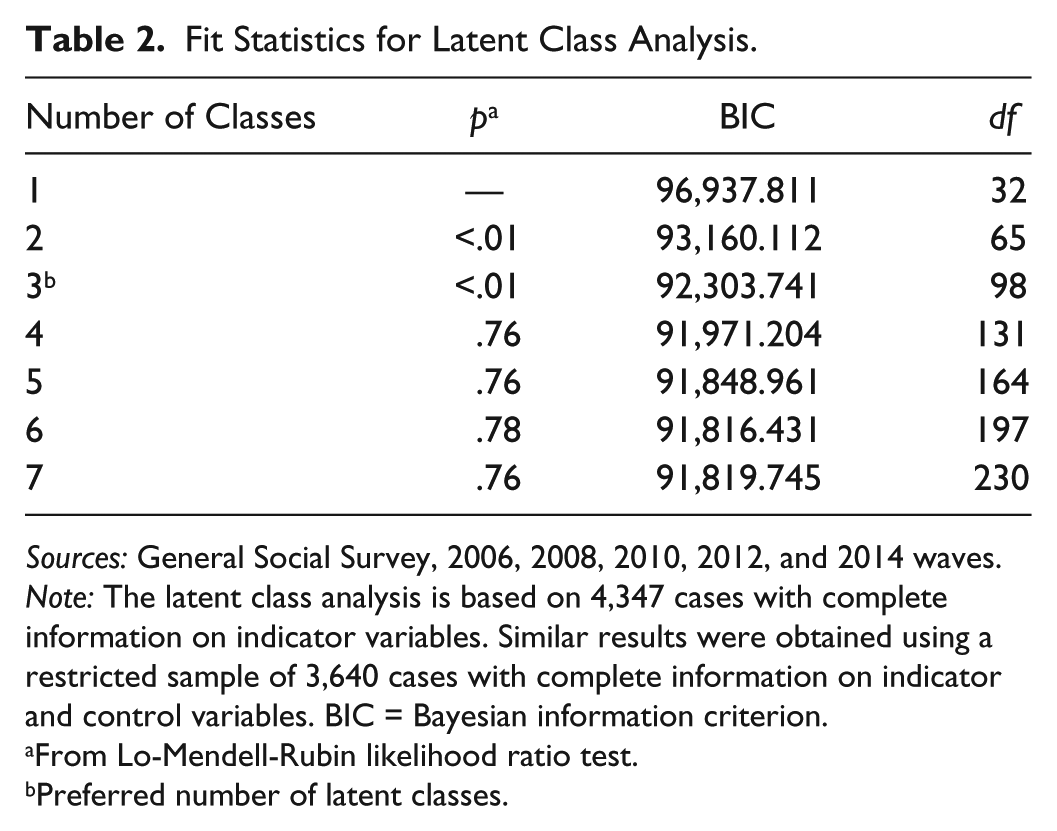
The LCA identified three distinct religious-scientific perspectives: a traditional one with high religiosity and low knowledge and appreciation of science (42 percent), a modern one with high knowledge and appreciation of science and low religiosity (37 percent), and a postsecular one with high religiosity that is generally appreciative of and knowledgeable about science but rejects mainstream scientific theories of evolution and the big bang (21 percent). Fit statistics for the LCA are presented in Table 2, and the sociodemographic profile of each group is reported in Table 3. Although data reduction techniques such as LCA generalize complex social phenomena into ideal types, the categories we identify are theoretically driven, empirically robust, and analytically useful for capturing religious-scientific orientations. Although other typologies based on religious traditions or attitudes about specific scientific controversies could be used to study viewpoints about science and religion, the categories we analyze provide a unique approach to examining the science-religion boundary that focuses on knowledge and belief rather than behavior and which does not presume a causal relationship between preferences for scientific and religious understandings.
Fit Statistics for Latent Class Analysis.
Sources: General Social Survey, 2006, 2008, 2010, 2012, and 2014 waves.
Note: The latent class analysis is based on 4,347 cases with complete information on indicator variables. Similar results were obtained using a restricted sample of 3,640 cases with complete information on indicator and control variables. BIC = Bayesian information criterion.
From Lo-Mendell-Rubin likelihood ratio test.
Preferred number of latent classes.
Sociodemographic Information by Latent Class.

Sources: General Social Survey, 2006, 2008, 2010, 2012, and 2014 waves (n = 3,640).
Note: Significant differences among perspectives are indicated by superscript letters as follows: M = significantly different from modern, p < .05 (two-tailed t test); P = significantly different from postsecular, p < .05 (two-tailed t test); T = significantly different from traditional, p < .05 (two-tailed t test).
Control Variables: Sociodemographic Characteristics
Our regression analysis includes controls for several relevant respondent characteristics. We measure religious traditions using mutually exclusive binary indicators for conservative, mainline, and Black Protestants, Catholics, Jews, followers of other faiths, and those who are not associated with organized religion. We measure religious attendance with an eight-category ordinal variable. 1 We measure race using binary variables for non-Latino African American, Latino, non-Latino White, and non-Latino other race. We measure age in years. We measure geographic location using a binary measure for residents of the South. We measure political ideology on a seven-point ordinal scale. We measure education in years and income as a natural log transformation of household income category midpoints. Finally, because we pool several waves of GSS data, we include binary controls for survey year.
Analysis
We use regression models to examine differences in public opinion associated with traditional, modern, and postsecular perspectives on science and religion. The metric of the dependent variable determined our choice among linear, binary logistic, and ordinal logistic regression models. Group differences discussed in the text are statistically significant, net of control variables (p < .05). We report y-standardized regression coefficients for our key independent variables to facilitate comparison across models. Because of the large number of models we present, we do not report coefficient estimates for control variables or model constants and cut points, which are available upon request. All statistical analyses use recommended GSS sampling weights. Descriptive and regression analyses were performed using Stata software.
Results
Table 4 contains results from regressions of public opinion on religious-scientific perspectives. Several overarching patterns are evident. First, orientations toward science and religion map onto public opinion in far-reaching ways. Moreover, the differences exist net of other political, denominational, and class differences, suggesting that these worldviews do not simply mirror other social cleavages. Together, these findings offer evidence of the external validity of the statistical clusters identified by the LCA. Second, traditional and modern perspectives on science and religion are associated with distinctive beliefs in all but one of the domains we investigate. Importantly, these divides may be a source of political polarization, as the differences imply disagreement about a broad range of public policies. Third, the postsecular attitudinal profile resembles the traditional profile in some ways and the modern profile in others but stands apart from each other group in some domains. As we discuss later, the issues postseculars align with and break against moderns and traditionals are important to identify because this relatively small segment of the public (21 percent) may play an outsized role in shaping social discourse and public policy.
Standardized Coefficients from Regressions of Public Opinion on Traditional, Modern, and Postsecular Perspectives. a

Sources: General Social Survey, 2006, 2008, 2010, 2012, and 2014 waves.
Note: Coefficients are y-standardized. Constants (for linear and binary logistic regression) and cut points (for ordinal regression) are not reported.
Coefficients for control variables not reported. Controls include religious tradition, religious service attendance, race, age, education, income, political ideology, region of residence, gender, and survey year.
p < .10, *p < .05, **p < .01, and ***p < .001 (two-tailed tests).
Human Life
The first set of outcomes in Table 4 suggests that moderns are generally most tolerant of humans intervening in what are often viewed as natural processes related to human life. In contrast, postseculars and traditionals each prefer that humans play a more limited role in this arena. For example, traditionals are less supportive than moderns of abortion rights, and postseculars are even less supportive than traditionals. Similarly, postseculars and traditionals are each less supportive than moderns of making contraceptives accessible to teenagers. Postseculars and traditionals are also less likely than moderns to agree that it is acceptable for individuals to end their own lives and that patients with incurable diseases have a right to die. Although moderns are generally most tolerant of human agency in this domain, they are more likely than traditionals to oppose the death penalty. This first set of results points to an association between a scientific mind-set and a belief that humans should be allowed to intercede in what may be seen as natural events. However, postseculars’ restrictive beliefs about abortion and other issues in this domain are evidence that appreciation and understanding of science do not necessarily lead to liberal social attitudes.
Gender and Sexuality
The second domain in Table 4 includes attitudes about gender and sexuality. Results indicate that compared with each other group, moderns hold more progressive views of gender roles, sexuality, pornography, and sex education. There are no significant differences in postseculars’ and traditionals’ attitudes in this area, indicating that as with attitudes about human life, familiarity with science does not ensure liberal sociopolitical beliefs.
Race and Civil Liberties
The third set of outcomes in Table 4 turns attention to race and civil liberties. Given their liberal views on gender and sexuality, it is perhaps surprising that moderns are less supportive than traditionals of affirmative action. Postseculars are even less supportive than moderns of affirmative action. Yet this pattern aligns with moderns’ and postseculars’ greater likelihood of agreeing that African Americans can overcome prejudice without favors. In addition, traditionals and postseculars are more likely than moderns to explain Black-White differences in terms of innate qualities, whereas moderns are more likely than traditionals to attribute race disparities to educational opportunities and discrimination. This is consistent with Hunt’s (2007) finding that religious fundamentalists tend to favor individual over structural explanations for racial inequality. Our results extend this knowledge by showing that a religious orientation is associated with person-centered explanations of racial inequality independently of religious traditions.
Traditionals and moderns also take different stances on civil liberties. Moderns are more likely than traditionals to agree that atheists, communists, gays and lesbians, militarists, and racists should be able to place books in public libraries and to speak publically. Postseculars are also more supportive than traditionals of these civil liberties these groups. Overall, this third set of results suggests that whereas modern and traditional attitudes about race and civil liberties break in mostly anticipated ways, postseculars’ comparatively progressive views on civil liberties contrast against their more conservative beliefs about life, gender, sexuality, and race.
Government and Social Assistance
The next set of results in Table 4 examines attitudes about government and social assistance. Findings are largely inconsistent with research that associates a religious orientation with communitarian economic attitudes (Davis and Robinson 2006). However, neither traditionals’ nor postseculars’ beliefs about social assistance programs are significantly different than moderns’. In other words, traditionals and postseculars are not marked by uniquely egalitarian economic beliefs. In fact, although postseculars are more religious than traditionals, they are less supportive than traditionals of government efforts to reduce inequality.
The final two outcomes in this domain indicate that traditionals are more likely than each other group to expect the United States to go to war in the next decade, and they are more likely to believe that success in life is due to internal factors (e.g., hard work) rather than external ones (e.g., luck or help). These patterns are consistent with traditionals’ individualistic views of racial inequality. However, in contrast to the first three sets of outcomes, religious-scientific perspectives do little to differentiate public opinion about government and its role in citizens’ lives.
Criminal Justice
Similar to other domains, moderns and traditionals differ in their responses to most questions about criminal justice. Interestingly, although moderns are less likely than traditionals to approve of the police’s use of force in some situations, moderns are more likely than traditionals to approve of police force under other circumstances. Furthermore, compared with traditionals, moderns report that courts should deal with criminals more harshly. Postseculars’ opinions in this domain generally resemble moderns with one exception: despite moderns’ relatively tough-on-crime attitudes, they are more likely than each other group to support the decriminalization of marijuana. Thus, alongside postseculars’ conservative views on certain social issues, moderns’ support for police force in some instances and for the harsh treatment of criminals further calls into question the notion that science is invariably associated with liberal policy preferences.
Children, Families, and Schools
Moderns’ beliefs about children, families, and schools contrast against traditionals’ and postseculars’ in ways that imply broad differences in home life for these groups. For example, traditionals stress children’s obedience more than moderns, whereas moderns attach more importance than traditionals to children’s social acceptance and independent thinking. Postseculars share moderns’ emphasis on independent thinking but emphasize obedience more and social acceptance less than moderns. Furthermore, traditionals are more likely than moderns to view spanking as an acceptable form of punishment for children. Finally, consistent with the prominence of faith in the traditional and postsecular worldviews, these groups are each more likely than moderns to approve of prayer in public schools.
Personal Well-being and Interpersonal Trust
The final domain examines attitudes about personal health and well-being and interpersonal trust. Although there are no differences in self-reported life satisfaction, perceptions of other people vary across religious-scientific perspectives. Compared with traditionals, moderns see other people as more helpful, trustworthy, and fair. Postseculars, too, report more positive interpersonal attitudes compared with traditionals. Together with their attitudes toward social assistance and race relations, this finding further illustrates the importance of individualism associated with a traditional worldview.
To summarize, Table 4 suggests that perspectives on science and religion correspond to extensive differences in traditionals’ and moderns’ attitudes. In most, but not all, domains, moderns’ beliefs are relatively liberal or inclusive, whereas traditionals’ are more conservative or exclusive. However, the postsecular perspective defies this binary. Individuals in this category, who are familiar with and appreciative of science and also deeply religious, are marked by sociopolitical attitudes that cannot be consistently labeled conservative or liberal. For example, postseculars’ attitudes about government spending and social assistance and about criminal justice are largely indistinguishable from moderns’. In contrast, postseculars’ attitudes about gender and sexuality mostly resemble traditionals’. Yet when it comes to issues such as affirmative action and school prayer, postseculars’ beliefs stand apart from each other worldview. Overall, the findings indicate that religious-scientific perspectives in the United States correspond to deep-seated cleavages in social, political, and economic attitudes, which cannot be accounted for by religious traditions, political ideologies, or other sociodemographic differences.
Conclusion
There is growing evidence that the conventional assumption of conflict between science and religion is overstated. To the extent that the public does perceive discord between reason and faith, recent studies indicate that the divides are largely moral rather than epistemological. Our analysis situates these divisions within the broader landscape of U.S. political culture. The findings underscore the diversity of sociopolitical attitudes among religious Americans, who are often portrayed as uniformly conservative, and among scientific Americans, who are often portrayed as uniformly liberal. Results show that many of the most devout members of the U.S. public have relatively progressive views of topics such as civil liberties and criminal justice. Furthermore, this analysis reveals that familiarity with and appreciation of science is not necessarily tied to progressive sociopolitical attitudes. Although scholars increasingly recognize the complexity of the boundary between science and religion, our investigation is the first to establish that religious-scientific perspectives are associated with far-reaching differences in public opinion. This suggests that orientations toward science and religion reflect a previously unaccounted for dimension of polarization.
Aside from the statistical patterns identified in this article, perspectives on science and religion are evident in the discourses used to frame public debates about issues including marriage and families, education, biomedical research, and many others. For example, some groups frame access to abortion in terms of scientific evidence about medical and reproductive health, whereas others focus on religious doctrine about conception and humans’ role in processes related to life (Rohlinger 2002). Still others frame the issue by engaging religious beliefs about the sanctity of life together with scientific arguments about fetal pain and psychological trauma experienced by women and health care providers (Jelen and Wilcox 2003; Williams 2005). By enlisting science and religion to varying degrees, these competing frames reflect traditional, modern, and postsecular perspectives, and they illustrate the consequences of these differing worldviews for U.S. political culture. A potentially fruitful avenue for future research may be to analyze media or policy documents or to conduct interviews to examine how the discourses surrounding political issues arise and the extent to which publics and other stakeholders knowingly draw on reason and faith in support of their positions. Nonetheless, although other approaches to studying linkages between science, religion, and politics are possible, our investigation provides new insights about widespread patterns in public opinion and how it relates to broadly held orientations toward science and religion.
Even with the large number of U.S. adults who do not identify with organized religion (i.e., the “nones”), we find that those with relatively little religious attachment are largely knowledgeable about and appreciative of science. In contrast, religious individuals differ substantially in the degree to which their worldviews incorporate science. Given this, it may be tempting to view postseculars as highly educated traditionals. Although Table 3 indicates that postseculars tend to have more schooling than traditionals, a closer inspection of the data suggests that the greater continuity actually lies between the traditional and modern perspectives. Specifically, LCAs with more than three classes indicate that when a fourth latent class is considered, it is composed of the least religious respondents in the traditional group and the least scientific respondents in the modern group. The postsecular group, however, is mostly unchanged both in size and in the respondents it contains. The continuum between traditionals and moderns is further subdivided when more than four latent classes are examined. In other words, this suggests that the postsecular perspective is a distinctive lens for interpreting the world, not just a scientifically sophisticated version of the traditional worldview.
Findings from our analysis should be viewed in light of the Christian-centric nature of religious life in the United States. One of the variables we used to identify perspectives on science and religion focuses on biblical literalism and may therefore be most meaningful to Christians. However, roughly three out of every four Americans identifies as Christian (Gallup 2015), and questions about the Bible likely resonate with many religiously unaffiliated individuals given Christianity’s cultural embeddedness in the United States. Thus, although survey items about the Bible are valuable measures of religiosity in the U.S. context, the cultural specificity of religion accentuates the need for cross-national research on perspectives on science and religion, especially in societies in which non-Western religious traditions and institutions are more prevalent.
A practical implication of this study is that individuals in the postsecular category may have an outsized capacity to influence public policies, social discourses, and electoral politics. Traditional and modern views on science and religion are held in comparable numbers and pull attitudes about many issues in opposing directions. Although the postsecular perspective is less common, support among postseculars on issues that divide traditionals and moderns may create a majority or plurality among the public. This suggests that democratic institutions in the United States may depend disproportionately on postsecular preferences. Moreover, because of their relatively high socioeconomic status and the political sophistication this implies, postseculars may be an especially vocal and visible minority, further reinforcing political and cultural divisions. Ironically, this may reify the narrative of conflict between science and religion despite these individuals’ tendency to draw on both of these ways of knowing.
Perhaps the most vexing question raised by this research is, how do we interpret the relationship between perspectives on science and religion and public opinion? It may be that views of these two sources of knowledge and influence spill over across domains to inform other social, political, and economic beliefs. However, the opposite may also be true, and sociopolitical attitudes may drive orientations toward science and religion. A third possibility is that perspectives on science and religion and sociopolitical attitudes are each manifestations of broader cultural viewpoints. This analysis provides an intriguing set of results that demonstrate that social cleavages related to science and religion extend far from the intersection of these institutions, although it cannot disentangle the underlying causal relationships because of the cross-sectional structure of the data we use. Although this investigation documents the breadth of the attitudinal divide associated with religious-scientific perspectives, further study is needed to pin down the mechanism linking orientations toward science and religion to public opinion about such a wide array of topics. More work is needed on this intricate cultural landscape, but this article demonstrates the importance of perspectives on science and religion for understanding current divisions in U.S. political culture.
Footnotes
Appendix
To obtain the key independent variables for this investigation, we replicated our earlier LCA using updated data (O’Brien and Noy 2015). We used 20 indicator variables that measured attitudes about and knowledge of science and attitudes about religion and religious-based knowledge. Indicator variables are summarized in Table A1. To choose the number of latent classes for our model, we relied on Lo-Mendell-Rubin (LMR) likelihood ratio tests and the Bayesian information criterion (BIC). In Table 2, the nonsignificant LMR test from the four-class model indicates that the three-class model best fits the data. However, the BIC’s minimum value can also be used to select the number of latent classes, and the BIC is lowest in the six-class model. Although the BIC may be preferable for LCA with continuous indicators, the LMR test is a more reliable indicator of fit for LCA with categorical indicators, such as ours (Lo, Mendell, and Rubin 2001). Moreover, the BIC is less reliable when there is a small number of classes and when class sizes are unequal (Nylund, Asparouhov, and Muthén 2007). Substantively, we found that including more than three latent classes simply divided the continuum between traditional and modern perspectives into increasingly smaller groups, while the postsecular category was largely unchanged. Ultimately, our preference for the more parsimonious three-class model is based on a combination of statistical, substantive, and theoretical considerations. Table A2 contains results from an alternative LCA with additional religion indicators, which show that the three class solution is robust to the inclusion of these variables. Because latent classes are substantively similar with and without additional religion indicators and because including the additional religion indicators reduces the number of complete cases for analysis by roughly 24 percent, we exclude them from the LCA.
Acknowledgements
We thank Brian Powell, Patricia McManus, the editors, and the anonymous reviewers for their comments and suggestions.
Funding
Funding provided by grant SRS 0935815 from the National Science Foundation.