




Abstract
A symbolic politics approach contends that the meanings policy proposals convey, and the audiences they attract, may matter more than whether they become law. Yet, we know little about the sociopolitical conditions prompting lawmakers to engage in symbolic politics. Using a new data set, we analyze proposals to expand or restrict in-state college tuition for undocumented students and find that national events—House of Representatives Bill 4437 and concurrent immigrant rights protests—encouraged state lawmakers to introduce exclusionary proposals, particularly in states with low shares of immigrants. Our findings indicate that “big events” moderate the influence of state sociopolitical conditions on symbolic political activity.
Political acts, such as introducing legislation, may function as symbols (Edelman 1971, 1985; Stolz 2002, 2007) that serve to enhance the status of a political official, reassure the public, threaten outsiders, or establish behavior as acceptable or unacceptable (Stolz 2002). For example, the 2005 House of Representatives Bill 4437 1 (H.R. 4437) proposed to increase penalties for employers who hire undocumented immigrants, dramatically extend border fences, and make unlawful presence a felony rather than a civil offense. The bill sparked protests across the country not only because of its hardline stance but also because of the inflamed rhetoric that accompanied its introduction, which reinforced the framing of Latino/a immigration as a “flood” that threatened to cause the “collapse” of the U.S. economy and social institutions (Benjamin-Alvarado, DeSipio, and Montoya 2009; Curry 2006). Another example includes so-called birther legislation. Proposals introduced in 19 states between 2008 and 2012 would have required presidential candidates to furnish birth certificates. These ideologically charged proposals reinforced the conspiracy theory that Barack Obama was not born in the United States (Shear 2011). In both cases, proposed legislation served symbolic purposes with real consequences. In sum, symbolic politics describes political acts, such as introducing policy proposals, that are concerned primarily with the message(s) political actors wish to convey and the specific audience(s) a proposal seeks to impress.
Although extant research has examined the dimensions and characteristics of symbolic politics (Edelman 1971, 1985; Stolz 2002, 2007), we know relatively little about the conditions that encourage such political acts. In the two examples above, major national events seemed to motivate states to take action. However, not all state-level politicians reacted in the same way. In this study, we elaborate on the concept of symbolic politics and examine the sociopolitical conditions that influence state-level symbolic political acts. We develop the symbolic politics interaction model, which suggests that state political and demographic factors influence the introduction and ideological dimension of state-level bill proposals, particularly after the occurrence of major national events related to a salient topic.
To test these ideas, we focus on the case of state-level proposals to expand or restrict in-state college tuition for undocumented immigrants. We analyze a new database that includes proposed legislation across 50 states from 1996 to 2010. In general, our findings suggest that H.R. 4437 and concurrent immigrant rights protests inspired state lawmakers to introduce bills to prohibit in-state tuition for undocumented immigrants, particularly in states with large shares of conservative voters. In addition, these big events heightened the negative effect of immigrant presence in states on restrictive policy making, such that contexts with higher shares of immigrants deterred exclusionary in-state tuition proposals.
Federal Immigration Policy and Stalled Reform
Past research has documented the increasingly hostile political environment faced by immigrants in the United States (Massey and Sánchez 2010). Federal policies in the 1990s prohibited legal permanent residents from accessing benefits such as food stamps and required the immediate deportation of any foreign-born person who committed an aggravated felony, no matter the circumstances (Hing 2002; Johnson 2008; Massey and Sánchez 2010). The issue of “unauthorized” 2 immigration rose to prominence as a direct result of changes to U.S. policy, which included militarizing the U.S.-Mexico border and criminalizing the employment of undocumented workers. Mandated by the 1996 Illegal Immigration Reform and Immigrant Responsibility Act (IIRIRA), these policy changes fueled the Latino threat narrative, as Latino immigrants came to be seen as endangering “native” jobs and the “American way of life” even though immigrant workers were often employed in low-wage jobs in the expanding agricultural and service industries in the United States, typically viewed as undesirable by “native” workers (Chavez 2008; Santa Ana 1999).
In the educational realm, access to K−12 education has been affirmed for immigrants regardless of legal status (Plyler v. Doe 1982), but opportunities to attend higher education are more limited. Recent estimates indicate that each year, about 65,000 students without formal papers to remain in the United States graduate from high school and face limited prospects for postsecondary education (Flores 2010; National Immigration Law Center 2009). IIRIRA mandated that no undocumented person could receive “preferential” financial benefits for higher education. The law affirmed that states could not declare that undocumented immigrants meet in-state tuition requirements because they lack legal status in the state where they reside (Olivas 2004). In other words, undocumented immigrants could not be awarded a tuition rate that is “preferential” to the tuition rate offered to an individual who resides outside the state but enjoys legal status in the United States. For example, a U.S. citizen residing in Nevada could theoretically sue the state of California for offering a discounted in-state tuition rate to an undocumented immigrant if that rate was not also offered to the Nevada resident. However, IIRIRA does not prevent states from changing residency rules, which is precisely what states granting in-state tuition to undocumented immigrants have done.
In response to IIRIRA and other restrictions, undocumented students and allies have participated in organizing efforts in support of the Development, Relief, and Education for Alien Minors (DREAM) Act. First proposed in 2001, this federal bill would mandate access to in-state college tuition for undocumented childhood arrivals who meet certain other conditions (e.g., grade point average, no criminal arrests) (Schmid 2013). The DREAM Act has been met with resistance from political conservatives who have characterized its benefits as a slippery slope toward “mass amnesty” (Immigration Policy Center 2011). In 2012, President Obama enacted Deferred Action for Childhood Arrivals (DACA) by executive order, encouraging educational hopes among undocumented youth. Although the policy enables youth who meet similar conditions to those in the proposed DREAM Act to request deferral of deportation orders, it does not mandate in-state tuition rates; states must do this on their own if they wish to extend such benefits.
Scholars have established higher education as an important engine of socioeconomic mobility (cf. Rosenbaum 1997). Thus, postsecondary education has become a high-profile avenue for symbolic politics in relation to immigration policy in the absence of federal reform. As of October 2015, 21 states offered in-state tuition rates to undocumented students who meet certain eligibility conditions. Four states extended these rates via state university systems, 16 through state legislative action, and 1 (Virginia) by order of the state’s attorney general (National Conference of State Legislatures 2015b). Texas was the first post-IIRIRA state to enact such legislation, extending in-state resident tuition to undocumented students in 2001. Currently, 3 states (Arizona, Georgia, and Indiana) explicitly prohibit undocumented immigrants from establishing in-state residency. South Carolina and Alabama passed even more restrictive legislation that bans undocumented students from attending public universities, regardless of ability to pay, and other states have considered similar bills (National Conference of State Legislatures 2015a; Olivas 2008). However, an empirical question remains: what sociopolitical factors lead some states to propose exclusionary policies, while others extend inclusionary reforms?
Past Research on Restrictive and Expansive Immigrant Policies
Past research suggests that local political constituencies and growth in immigrant populations shape whether lawmakers introduce and pass immigration-related state legislation and local ordinances. For example, in a study of state legislation in 2005 and 2006, Chavez and Provine (2009) found that a conservative citizen ideology encouraged the passage of anti-immigrant bills and that a liberal state government was associated with proimmigrant lawmaking (see also Graefe et al. 2008). Moreover, Ramakrishnan and Wong (2010) discovered that counties with Republican majorities were more likely to propose and pass restrictive local ordinances, suggesting that political conditions provide legitimacy and support for such policies. Similarly, Steil and Vasi (2014) found that sympathetic political allies encouraged the adoption of pro- and anti-immigrant legislation. In addition, their analyses demonstrated that local anti-immigrant ordinances were adopted in places with growth in immigrant populations, which were interpreted negatively by national anti-immigrant conversations and made their way to local politicians and citizens (also see Hopkins 2010).
Although past studies provide some insights on immigrant-related legislative proposals generally, only a handful of studies address the sociopolitical factors and theoretical motivations behind states’ efforts to grant or deny in-state tuition costs. Among those that do, most are based on case studies, which describe the pathways of states with differing policy choices such as Texas and Arizona (Belanger 2001; Dougherty, Nienhusser, and Vega 2010; Rincón 2010). Such studies provide rich details about the chronology of decisions and actions that led to the adoption of in-state tuition policies. This research suggests that a growing undocumented population, acceptance of the Latino community by local leaders, and effective community organizing help explain why some states adopted expansive in-state tuition policies whereas others did not, but it is not clear whether these factors explain variation across multiple states (see also Sponsler 2011). In a rare study, McLendon, Mokher, and Flores (2011) used event history analysis to examine the factors precipitating the proposal of 22 inclusive in-state tuition bills from 1999 to 2007. Their 47-state analysis found that economic conditions and political partisanship had no effect, but the percentage of female legislators and size of the foreign-born population predicted whether expansive bills made it on the legislative agenda.
We build on past literature by focusing on the introduction of expansive and restrictive bills in state legislatures related to in-state tuition policies for undocumented immigrants, as well as the potential for big events to influence such proposals. We also move beyond past literature and suggest that growing immigrant populations and political contexts alone do not help us understand the introduction of in-state tuition policies in U.S. states but that major national events related to immigration will prompt symbolic political action. Using a new database of 140 in-state tuition bills across 50 states from 1996 to 2010, we test the symbolic politics interaction model, which posits that the effects of state political context and immigrant strength on exclusionary and inclusionary symbolic political acts will depend on big events, which alter the meaning of immigration politics in state contexts. Below, we elaborate on our new model, and introduce two hypotheses to test its predictive power using the case of in-state tuition proposals.
Symbolic Politics Interaction Model
Lawmakers engage in political acts, such as the introduction of proposals to pass important pieces of legislation, which will improve the lives of their constituents. State officials also introduce bills for symbolic reasons, such as to increase their popularity in the eyes of the electorate, reassure the public that they are addressing a major problem, or signal boundaries between acceptable and unacceptable behavior (Stolz 2002). Such political acts are symbolic in the sense that they serve to convey messages to multiple audiences, including constituents, new voters, and federal officials, and to enhance a lawmaker’s position. Thus, symbolic political acts involve meaning-making in addition to lawmaking.
In the case of in-state tuition policies, we argue that major national immigrant events, in combination with certain state political and demographic conditions, will motivate state officials to introduce such bills, which can serve symbolic purposes. First, proposing in-state tuition policies may afford politicians an opportunity to attract voters amidst changing demographics by signaling their stance on this highly polarizing issue. Second, because decisive federal action on the DREAM Act has not been forthcoming, many states have introduced proposals related to in-state tuition. They justify their encroachment onto federal jurisdiction as necessary because of federal inaction or ineptitude, thereby reassuring the public that state politicians are addressing the “immigration problem.” Third, state lawmakers are signaling their normative assumptions about undocumented immigration. In terms of bills granting in-state tuition, state officials are drawing boundaries between “deserving” and “undeserving” immigrants, and ultimately rewarding “deserving” undocumented immigrants who want to attend college. Regarding bills prohibiting in-state tuition, lawmakers are expressing that undocumented immigrants are lawbreakers, unworthy of access to lower-cost public college tuition rates that rule followers and citizens deserve.
Although we argue that these bills serve symbolic purposes, we focus our attention on examining the conditions that predicate such actions. We theorize that big events, captured by the passage of H.R. 4437 in the House (which failed in the Senate) and subsequent immigrant rights protests in hundreds of cities across the United States, increased the salience of the immigration issue and triggered symbolic political action. Blumer (1958:7) posits that big events are key in developing and/or activating group prejudice as these events “set crucial issues in the arena of public discussion” and shape the collective definition of an abstract image (i.e., stereotypes) of a group. We extend Blumer’s notion of big events to argue that the failure of the federal government to enact meaningful immigration reform and concurrent protests attracted the attention of state legislators, prompting them to introduce bills to allow or prohibit in-state tuition for undocumented students. The failure of H.R. 4437 and concurrent protests and media debates constituted massive national immigration events that ignited public discussions of immigration throughout the country, in places far, both geographically and ideologically, from major immigrant gateways (Benjamin-Alvarado et al. 2009; Voss and Bloemraad 2011). As such, the events should alter the meaning of immigration politics in state contexts, thereby shaping the influence of state political and demographic factors on the introduction of bills granting and prohibiting in-state tuition for undocumented immigrants.
In terms of the effects of the state political context, we consider extant literature positing that political opportunities are important in influencing policy making. Specifically, a configuration of allies, such as political elites and voters, can convey to lawmakers that their ideas will receive support and rewards for introducing compatible policy (Kriesi 2004). In other words, political opportunities can encourage the implementation of lawmakers’ agendas by providing increased access to governing coalitions as well as symbolic support for a set of issues (Andrews 2001; Meyer and Minkoff 2004). Generally, more conservative and liberal state contexts should result in more exclusionary and inclusionary bills, respectively. In either case, politicians on both sides of the aisle engage in symbolic politics, sending signals to form coalitions with fellow lawmakers, appeal to their current voter constituencies, and draw in new voters.
We argue that big events will amplify the effects of political opportunities on the introduction of immigration-related proposals. In other words, as the issue of immigration becomes more salient on the national stage and when politicians experience “openings” in the local political environment, exclusionary or inclusionary policy making is more likely. The combination of these factors creates conditions that facilitate the introduction of topical bills regardless of their likelihood of success. Politicians operating under such conditions may introduce bills that serve alternative purposes (i.e., to show constituencies that they can get work done even when federal lawmakers cannot).
In addition to political opportunities, we argue that future voting constituencies are key to the introduction of legislation. Political partisans are not neatly divided on the topic of immigration, as politicians make ideological shifts to keep up with changing voter demographics. We argue that legislators make decisions about introducing new laws on the basis of the ostensible interests of their current and future constituencies, such as immigrants and their families.
Although group threat and competition frameworks suggest that increases in minority group size and political power threaten dominant group 3 interests, and result in restrictive action (Blalock 1967; Blumer 1958; Brown 2010), we maintain that these same demographic changes signal future voter constituencies to be won over rather than threats to be eliminated (Ebert and Okamoto 2015; Okamoto and Ebert 2016). 4 Although an increase in the immigrant population may represent a threat to dominant groups, such change can also signify the fact that minority groups have acquired visibility and sociopolitical power. Conceptualized in this way, increasing immigrant populations and their political participation are indicators of immigrant strength, which will not necessarily result in restrictive policies or action. In fact, we suggest that local stakeholders such as political elites, the business sector, and community members benefit in one way or another from the influx and presence of newcomers (Okamoto and Ebert 2016). 5 Because local political officials need to support their constituencies and political parties need to draw in new members, growing immigrant interests and needs may be more likely to be taken into account in contexts in which immigrants are gaining demographic and political strength (Ebert and Okamoto 2015). Thus, we argue that immigrant strength will influence the process of symbolic politics, such that an increasing immigrant population and rising immigrant political power will deter restrictive action and motivate inclusionary action.
Additionally, we theorize that big events, captured here by the failure of H.R. 4437 in 2006 and concurrent immigrant rights protests, will alter the effects of immigrant strength on in-state tuition proposals. Specifically, big events should increase the salience of immigration and thereby heighten the negative effect of immigrant strength on exclusionary action and amplify the positive effect of immigrant strength on inclusionary action. The combination of these factors, big events and immigrant strength, creates conditions that facilitate inclusionary bills and deter exclusionary bills. Irrespective of partisanship, politicians operating under such conditions may introduce inclusionary bills to placate existing constituencies or attract new voters; at the same time, politicians may be less likely to introduce exclusionary bills for the very same reason.
In sum, we put forward the symbolic politics interaction model to argue that the effects of state political context and immigrant strength on exclusionary and inclusionary symbolic politics will depend on big events, which shape the national discussion of immigration politics.
Hypotheses
To test the symbolic politics interaction model, we test the main effect of “big events” and the interactive effect of “big events” with immigrant strength and political opportunity, respectively, on the likelihood of exclusionary and inclusionary policy proposals. Although the direct effects of immigrant strength and political opportunity are not part of our model, increasing immigrant population and rising immigrant political power should deter restrictive action and motivate inclusionary action. Additionally, more conservative contexts should result in more exclusionary bills, and more liberal state contexts should results in inclusionary bills.
Our hypotheses are as follows:
Hypothesis 1: Symbolic politics interaction model for restrictive action: (A) A “big event” will increase the likelihood of exclusionary proposals. (B) A “big event” will heighten the positive effect of a strong conservative contingent on exclusionary proposals. (C) A “big event” will heighten the negative effect of immigrant strength on exclusionary proposals.
Hypothesis 2: Symbolic politics interaction model for inclusionary action: (A) A “big event” will increase the likelihood of inclusionary proposals. (B) A “big event” will heighten the positive effect of a strong liberal contingent on inclusionary proposals. (C) A “big event” will heighten the positive effect of immigrant strength on inclusionary proposals.
Data and Methods
State Immigration Legislation
To test these hypotheses, we analyzed the State Immigration Legislation data set (Ebert, Estrada, and Lore 2014), constructed with data from the LexisNexis Total Research System. We used a keyword search provided by the Migration Policy Institute (cf. Laglagaron et al. 2008) to select bills related to immigrants and immigration, which were then coded on a number of dimensions. The data for the current study are based on a subset of the State Immigration Legislation data set that includes bills related to state policies regarding in-state tuition between 1996 and 2010. These data are especially useful because they capture a time period immediately following the passage of the 1996 federal law (IIRIRA) dictating that states must pass legislation if they wish to accord residency status to undocumented immigrants attending public universities (Olivas 2008).
From 1996 to 2010, we accounted for a total of 140 bills that were introduced in state legislatures regarding the issue of in-state tuition for undocumented students. Eighty bills were introduced to allow undocumented students to pay in-state tuition, constituting 57 percent of the bills introduced over the time period of study. The remainder (60) of the bills proposed to prohibit in-state tuition for undocumented immigrant students. Of the 140 bills, only 16 became law, 11 of which related to the expansion of policy to include undocumented students as in-state residents: California A.B. 540 (2001), Texas H.B. 1403 (2001), Utah H.B. 144 (2002), New York S.B. 7784, Washington H.B. 1079 (2003), Oklahoma S.B. 596 (2003), Illinois H.B. 60 (2003), Kansas H.B. 2145 (2004), New Mexico S.B. 583 (2005), Nebraska L.B. 239 (2006), and Wisconsin A 75 (2009). The remaining five excluded undocumented residents from receiving in-state tuition, including Arizona Proposition 300 (2006), Colorado H.B. 1023 (2006), Oklahoma H.B. 1804 (2007), Georgia S.B. 492 (2008), and South Carolina H.B. 4400 (2008). The vast majority (n = 106 [76 percent]) of bills introduced never made it out of committee for a vote. Five (2 expansive, 3 restrictive) made it through both houses but were vetoed by their states’ governors. Legislation to allow or prohibit in-state tuition for undocumented students was introduced in 30 states, and some legislators in these states introduced bills in multiple years. For example, 16 bills were introduced in the California state legislature, and 12 bills were introduced in the Mississippi state legislature during the period under study. The majority of restrictive legislation was introduced in 2007 and 2008, indicating a possible reaction to the failure of federal bill H.R. 4437 (introduced in 2005) and the subsequent extensive demonstrations and marches led by immigrant rights groups in 2006.
Dependent Variables and Estimation Technique
We use time-series analysis to estimate two dependent variables, the odds of bill introductions granting and prohibiting in-state tuition for undocumented immigrants in state sessions from 1996 to 2010 (n = 647 state sessions). We use the state-session as the unit of analysis (instead of the state-year) because many states have biennial legislative sessions. 6 Using the state-session as our unit of analysis ensures that all units are eligible for bill introduction as many states with biennial sessions introduce legislation during the first year of assembly, reserving the second year for debate and approval.
We use multilevel mixed-effects maximum likelihood regression, with state characteristics as the level 2 variables and time attributes as the level 1 components (Rabe-Hesketh and Skrondal 2012). 7 Multilevel modeling techniques account for correlated error terms within states while allowing the intercepts to vary by state. Furthermore, they allow a systematic analysis of the effects of explanatory variables at both contextual and temporal levels on bill introduction and of the effects of the interactions between covariates at different levels on the outcome of interest. After computing collinearity diagnostics for each model, we concluded that multicollinearity was not a problem. 8
Independent Variables
We constructed a series of independent variables to estimate the odds of introduction of restrictive and expansive bills. All variables are measured at the state level and are time varying. When yearly data were not available, we used linear interpolation to fill in values between years. Most variables are lagged one year to measure conditions prior to the session of bill introduction. State government characteristics (including interparty competition, percentage Latino elected officials, and party strength) are not lagged, because they should have an immediate, rather than postponed, effect on policy making. Table 1 presents the descriptive statistics of the variables and their respective data sources.
Data and Sources.

Note: All variables are measured at the state level unless stated otherwise; n = 647 state sessions. IPUMS = Integrated Public Use Microdata Series.
Big Events
We rely on Blumer’s (1958) concept of “big events” to explain the conditions under which national politics influence state-level symbolic political proposals. We include a variable measuring years after 2005 (=1) to capture years following the failure of comprehensive immigration reform and concurrent immigrant rights protests.
Immigrant Strength
We include three measures of demographic and political factors that are typically used to measure group threat. Specifically, we include percentage foreign born 9 and the percentage change in the foreign-born population in the previous 10 years to capture group size and change in group size, respectively. We also created a variable to capture the political power of immigrants by measuring percentage Latino of state elected officials. We use percentage Latino here because a near majority of the foreign-born population during this time period identified as Latino. This measure was calculated by dividing the total number of Latino state- and federal-level elected officials within a state by the total number of state- and federal-level elected officials within a state. Taken together, we conceptualize these variables as measuring immigrant strength rather than group threat.
Political Opportunity
We characterize political opportunity as the political environment in the state constituted by voters and elites. Such a political environment may facilitate exclusionary or welcoming legislation and create a setting in which state legislators are rewarded by constituents or powerful interest groups for specific kinds of political behavior. Typically, states are considered to have either a liberal or a conservative political context, encompassing both the orientations and party strength of voters as well as political elites.
In models estimating the introduction of bills prohibiting in-state tuition for undocumented immigrants, we included a measure of elite Republican strength and a measure of the share of conservative voters to capture political opportunity. Because Republican-controlled governments tend to pass more punitive legislation (Jacobs and Carmichael 2002; Miller and Schofield 2008), we constructed an ordinal-level variable of the strength of the Republican Party in the state. This variable ranges from 0 to 3, capturing if Republicans represent a majority in both chambers of the state legislature 10 and have control over the executive branch (Ebert et al. 2014). A score of 0 indicates that Republicans lack a majority in both houses and are not in the governor’s office, while a score of 3 indicates that Republicans have majority control over the state’s executive and legislative branches of government. We also created a measure that captures the share of conservative ideology among voters in the state.
In models estimating the introduction of bills that would grant in-state tuition for undocumented immigrants, we included an ordinal variable similar to the one measuring Republican Party strength, except this time capturing the strength of the Democratic Party. We also included a variable measuring the extent of liberal ideology among voters.
Control Variables
We include a number of control variables in our models, including state population size and unemployment rate. We note that this analysis covers the period of the most recent recession, which we are able to capture by incorporating these demographic and economic indicators. In addition, we include measures for percentage college graduates and per pupil expenditure in each state because these variables could affect whether state legislators introduced immigration- and education-related bills. We also controlled for voter attitudes toward immigrants using a measure gathered from the percentage of voters in each state in favor of decreasing the level of authorized immigration (see Sapiro and Rosenstone 2004 for wording). 11 Additionally, because greater interparty competition in states could lead lawmakers to introduce more exclusionary or inclusionary legislation to show their respective constituencies that they are active in their race for new and unlikely voters, we included the folded Ranney index, which ranges from 0 to 1, with 0 indicating no Democratic control and 1 indicating complete Democratic control (see Ranney 1965 for a more complete description). We transformed this variable to measure interparty competition by “folding” it so that values of 0 equal no party competition and values of 1 equal complete party competition (Ethridge 2002). Finally, to deal with autocorrelation (see Barron 1992), we included variables capturing the number of bills granting and prohibiting in-state tuition for undocumented immigrants introduced in the prior state-session in each of the models.
Results
Exclusionary Bills
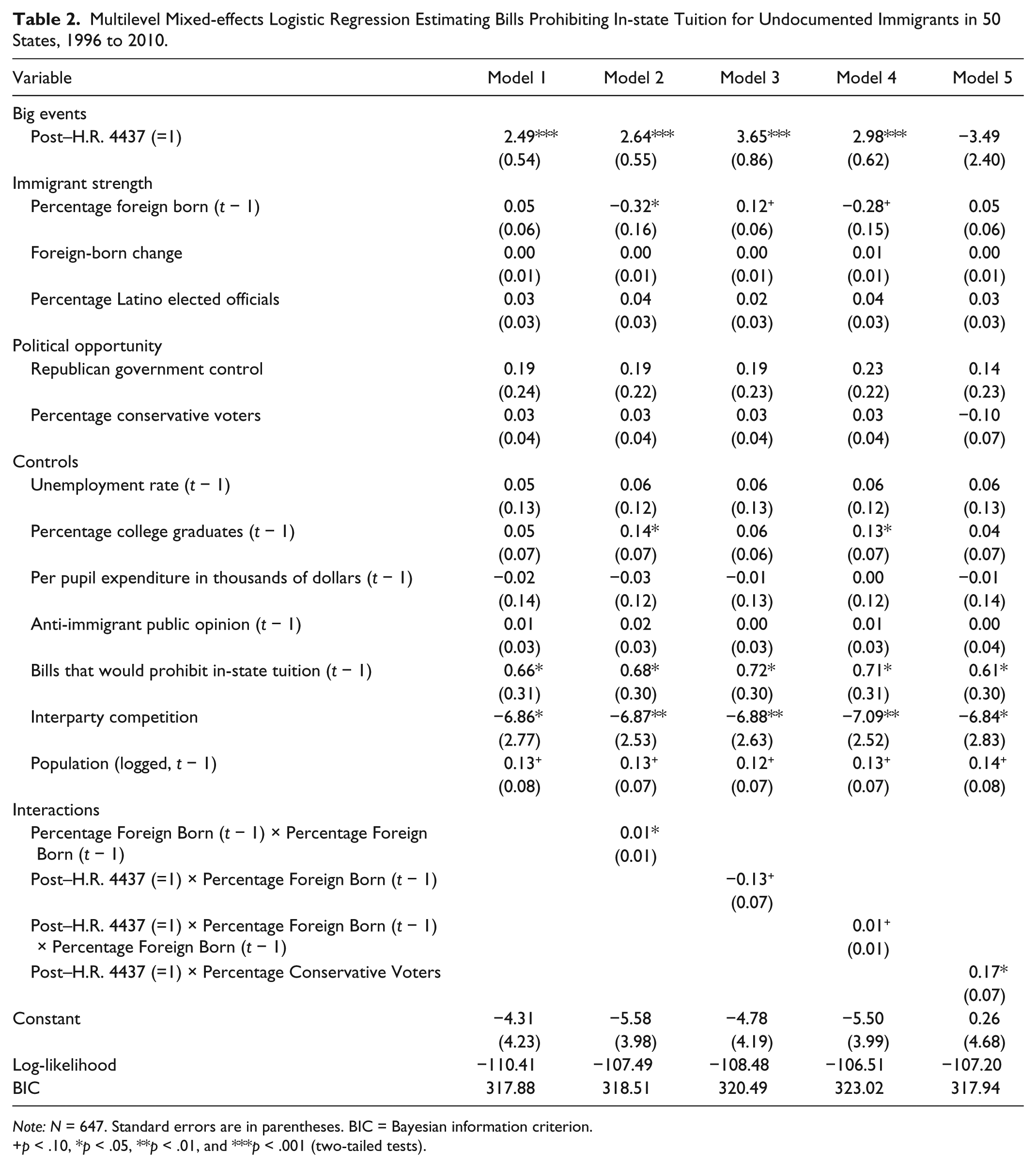
Table 2 presents the results of the analyses estimating the odds of the introduction of bills that sought to prohibit in-state tuition for undocumented immigrants in 50 state sessions (n = 647). Model 1 represents the full model, with measures capturing big events, immigrant strength, and political opportunity. Model 2 adds a squared term for percentage foreign born to assess the nonlinear effects of the variable. Models 3, 4, and 5 add interaction terms to assess whether big events shape the effects of immigrant strength and political opportunity. 12
Multilevel Mixed-effects Logistic Regression Estimating Bills Prohibiting In-state Tuition for Undocumented Immigrants in 50 States, 1996 to 2010.
Note: N = 647. Standard errors are in parentheses. BIC = Bayesian information criterion.
p < .10, *p < .05, **p < .01, and ***p < .001 (two-tailed tests).
Our findings offer support for hypothesis 1A, which posited that big events would increase the likelihood of exclusionary proposals. Results from model 1 indicate that exclusionary policy making is more likely after the House passed H.R. 4437, a bill that would have raised penalties for undocumented immigrants and their employers. Although it did not become law, H.R. 4437 still resulted in protests across the nation (Benjamin-Alvarado et al. 2009; Voss and Bloemraad 2011) and, according to our results, resulted in increased attempts by state policy makers to formally restrict the educational opportunities of undocumented immigrants. This supports the idea that lawmakers introduce bills prohibiting in-state tuition to show their constituents that they are actively addressing the “immigration problem” when federal lawmakers are not “doing their job.”
Although the findings reveal no discernable direct effects of immigrant strength and political opportunity in model 1, we see that the squared term of percentage foreign born is positive in model 2. The results in model 2 indicate that the share of immigrants in states negatively affects the odds of proposing exclusionary bills for the most part, but this negative effect levels off and eventually becomes slightly positive in states with large shares of immigrants (see Figure 1). Furthermore, as suggested in model 4, big events heighten the negative effect of percentage foreign born, providing support for hypothesis 1C. Although the share of immigrants generally deterred exclusionary lawmaking, the failure of comprehensive federal immigration reform and immigrant rights protests amplified this negative effect.

Predicted probability of introducing restrictive legislation (from Model 4).
To further understand these results, Figure 1 13 illustrates the predicted probability of bill introductions, which is at its peak when immigrants constitute smaller shares of the population (low immigrant strength) after 2005. Although this effect is marginal (p < .10), it suggests that the national events surrounding immigration in this era sparked exclusionary symbolic politics in states where immigrants constituted small shares of the population. 14 State lawmakers were more likely to introduce exclusionary bills after H.R. 4437, but they were also much more likely to do so in places with smaller shares of immigrants. These findings suggest that state lawmakers in contexts with larger shares of immigrants might be aware that their future voting pool is composed of immigrants, deterring them from introducing restrictive bills. Furthermore, in these contexts, presumably many immigrants cannot vote, but they likely have friends and family that do.
Findings generally support hypothesis 1B, which posits that big events heighten the positive effect of a strong conservative contingent on exclusionary proposals. These dynamics are illustrated in Figure 2, the opposite effect of state constituencies illustrated in Figure 1. Big events shaped the influence of a conservative constituency on the odds of the introduction of bills that sought to prohibit in-state tuition for undocumented immigrants. Conservative constituencies appeared to be negatively associated with exclusionary bills prior to H.R. 4437 and the immigrant rights protests. But afterward, the effect is positive, with the odds of restrictive policy making at its peak in states where conservatives constitute a majority of the voter pool.

Predicted probability of introducing restrictive legislation (from Model 5).
In terms of the control variables, the occurrence of a bill prohibiting in-state tuition in the previous state-session increased the likelihood of bill introduction, an expected result. Interparty competition has a negative relationship with bill introductions, meaning that states with greater degrees of interparty competition have a decreased likelihood of exclusionary policy making, which makes sense given that politicians in contexts with more interparty competition are vying for new voters. This being the case, politicians in competitive electoral environments appear to avoid introducing exclusionary legislation regarding in-state tuition.
Inclusionary Bills
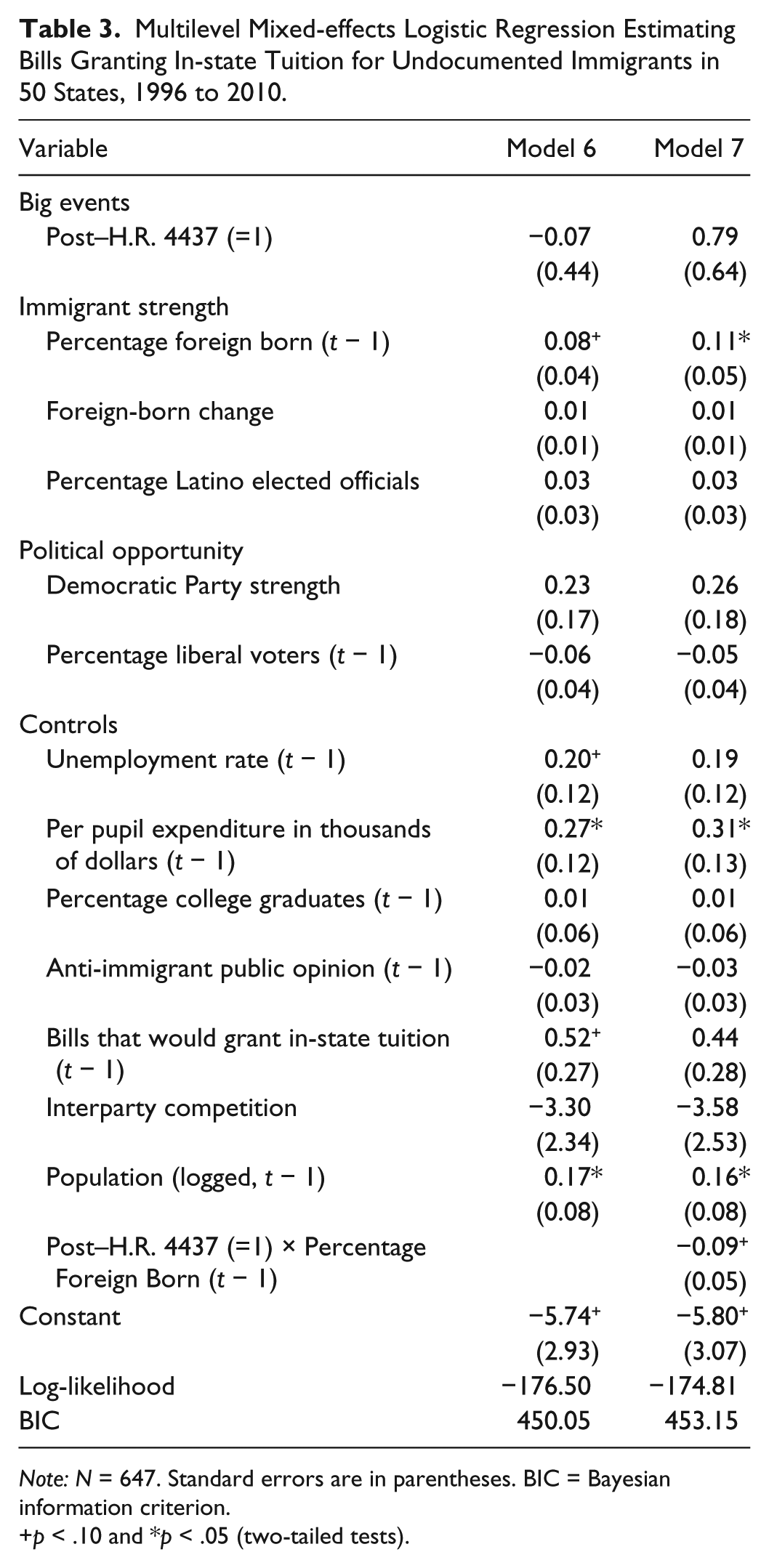
Table 3 presents the results of the analyses estimating the odds of the introduction of bills that sought to grant in-state tuition to undocumented immigrants in 50 state sessions (n = 647). Model 6 includes measures of big events and immigrant strength, as well as political opportunities for elected officials favoring inclusionary policy making. Model 7 adds an interaction term to evaluate the effects of immigrant strength at different time points.
Multilevel Mixed-effects Logistic Regression Estimating Bills Granting In-state Tuition for Undocumented Immigrants in 50 States, 1996 to 2010.
Note: N = 647. Standard errors are in parentheses. BIC = Bayesian information criterion.
p < .10 and *p < .05 (two-tailed tests).
In model 6, we find no detectable effect of H.R. 4437, offering no support for hypothesis 2A. In addition, we find no support for hypothesis 2B, 15 which posited that big events would heighten the positive effect of a strong liberal contingent on inclusionary proposals. Although the results reveal that states with higher shares of immigrants have increased odds of introducing inclusionary bills (though this effect is marginal at p < .10), we find no detectable direct effects for the remaining measures of immigrant strength and political opportunity, but results from model 7 show that the interaction between percentage foreign born and H.R. 4437 is statistically significant, which runs contrary to hypothesis 2C. Here, we find that the percentage share of immigrants has a positive effect on inclusionary policy making, but these effects are heightened in the years preceding H.R. 4437. In other words, in years before H.R. 4437, percentage foreign born has a greater positive effect on the odds of bill introductions compared with its effects in years following H.R. 4437 (see Figure 3).
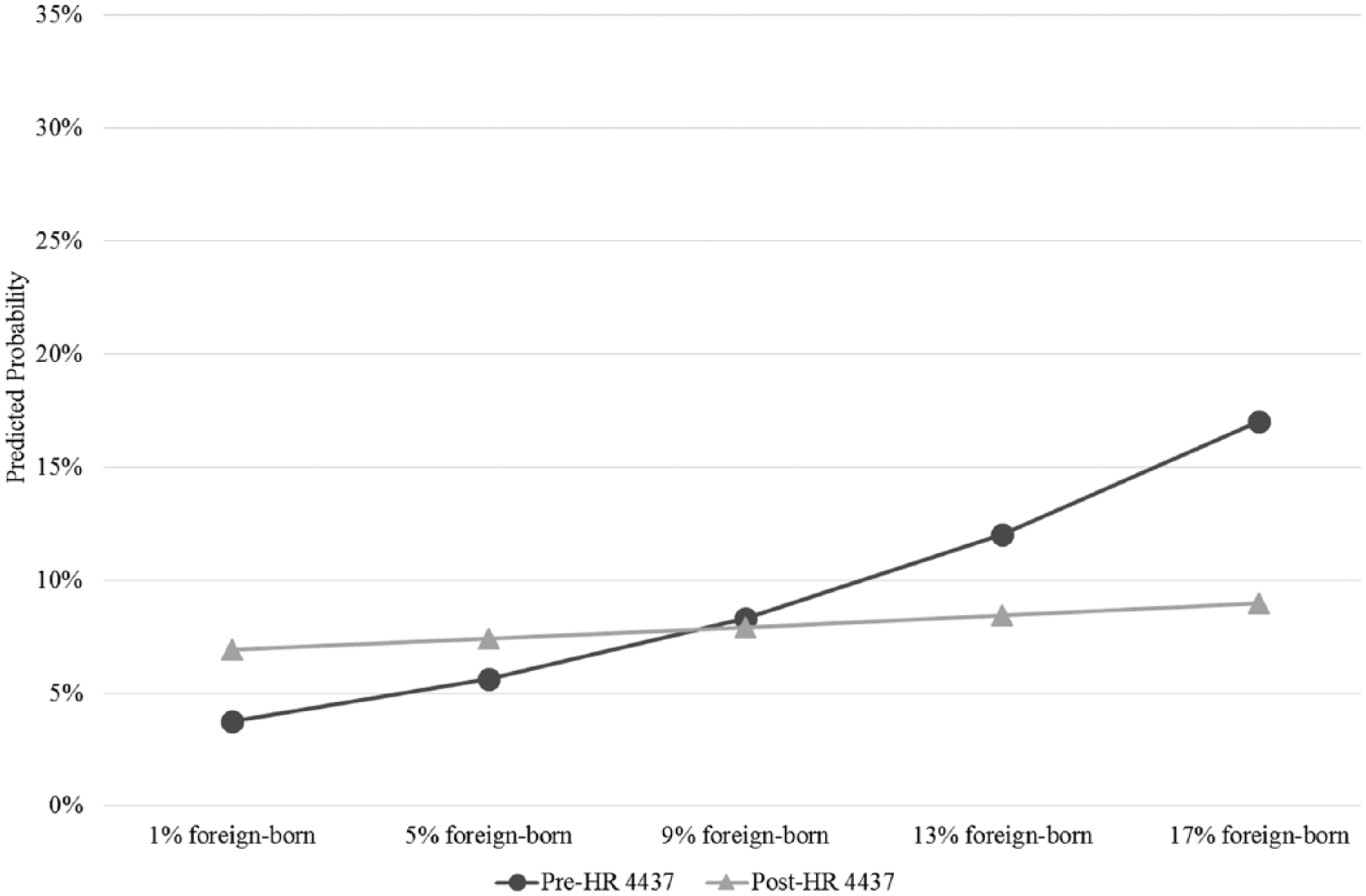
Predicted probability of introducing inclusionary legislation (from Model 7).
Alone, the patterns in Figure 3 do not tell us much, but in combination with Figure 1, they suggest that lawmakers turned their attention away from bills granting in-state tuition for undocumented immigrants and toward bills prohibiting said opportunity. In other words, following H.R. 4437, lawmakers were more likely to propose exclusionary bills, but the timing of big events had no discernable direct effect on inclusionary bills. However, in terms of its indirect effects (illustrated by the interaction term in model 7), the failure of H.R. 4437 resulted in a weaker (but still positive) effect of the percentage foreign born on the odds of inclusionary proposals. Even so, immigrant demographic strength deterred the incentivizing effects of H.R. 4437 on exclusionary proposals (see Figure 1).
Turning to the effects of the control variables, we see that states’ unemployment rates, per K−12 pupil expenditure, introduction of bills granting in-state tuition in the prior state-session, and total population increase the likelihood of introducing inclusionary legislation, though some of these effects are marginal at p < .10.
In sum, H.R. 4437 and concurrent immigrant rights protests shaped the national immigration debate, prompting state lawmakers to restrict in-state tuition for undocumented students, but it did not have a discernable direct effect on inclusionary bills. In addition, these big national events shaped the effects of state political conditions and immigrant strength, activating the positive effect of a conservative voter pool and heightening the negative effect of the share of immigrants on restrictive bills. On the other hand, the big events weakened the positive effect of the share of immigrants on inclusionary bills. Together, these results suggest that the failure of federal immigration reform and concurrent immigrant rights protests mattered more for exclusionary symbolic political acts.
Discussion and Conclusion
In this study, we investigated the sociopolitical conditions shaping legislative proposals related to in-state tuition for undocumented immigrant students, as a means of examining symbolic politics. Our analysis spanned a 15-year period, from 1996 to 2010, and found that exclusionary policy making was more likely after the House of Representatives passed H.R. 4437, a bill that would have raised penalties for undocumented immigrants and their employers. Although it did not become law, H.R. 4437 led to protests across the nation and, according to our results, increased attempts by state policy makers to formally restrict the educational opportunities of undocumented immigrants. Consistent with the symbolic politics interaction model, we find that in the years following H.R. 4437 and the concurrent immigrant protests, lawmakers intensified their exclusionary actions in states with small shares of immigrants and in states with strong conservative voter constituencies. These results suggest that these big events made the issue of immigration salient, and lawmakers introduced bills prohibiting in-state tuition to show their constituencies that they were actively addressing the “immigration problem” when federal lawmakers were not “doing their job.”
Additionally, our results suggest that after H.R. 4437, politicians in states with large shares of immigrants viewed this growing demographic as a “natural constituency” and thus were reluctant to propose restrictive education-related bills. In such a context, Republicans and Democrats might have felt under pressure to demonstrate support for free-market capitalism (i.e., where in-state tuition is available to those who can pay), or expand their base among a rapidly increasing Latino/a population. Framing undocumented minors who fit the DREAM Act or the DACA executive order descriptions as educational strivers of “good moral character” who “do not pose a threat to national security” may be a way for politicians to choose a “soft” entry into what has become a hardened wedge issue politically. That is, “DREAMers” can be framed as minors who seek upward mobility through hard work, education, and service to country, presenting a sympathetic focus that mirrors an American “bootstrap” ideal. Extending more affordable tuition rates to undocumented students can thus be understood as emblematic of basic fairness and U.S. ideals of social and economic mobility.
Additionally, our results indicate that the increasing presence of immigrants does not operate as a threat that leads established groups to defend their group position through introduction of restrictive bills. Instead, after H.R. 4437, with the increasing group size and political power of immigrants, restrictive legislation was less likely to be introduced, suggesting that policy makers are viewing immigrants and their descendants as a new constituency that they cannot afford to offend. Importantly, these findings are counter to standard theories of group threat but consistent with the idea that in an environment with a strong immigrant presence, exclusionary activity is less likely to be tolerated and legitimated by the larger public (see Ebert and Okamoto 2015). This explanation also makes sense in the context of a Republican Party that has publicly announced the need for improved “messaging” and outreach to convince racial/ethnic minorities and women to view their policies as “the best ones to improve the lives of the American people, all the American people” (Barbour et al. 2013:6 [emphasis added]). Yet without the passage of comprehensive immigration reform that would enable undocumented college graduates to obtain employment commensurate with their educational credentials, access to college represents a symbolic dead end rather than a clear pathway to mobility. 16
Regarding inclusionary policy making, legislators were more likely to introduce in-state tuition policies in contexts in which immigrant populations enjoyed demographic and political strength, as expected. We found that when the size of the foreign-born population increased, such changes signified an opportunity for minority groups to acquire more sociopolitical power and the potential for more favorable state policies. This relationship was mitigated after 2006, such that immigrant demographic and political strength increased the odds of inclusionary proposals only in years preceding H.R. 4437. These results are not consistent with the symbolic politics interaction model’s predictions regarding the ability of big events to influence inclusionary policy making. In fact, the failure of H.R. 4437 seems to have weakened the effects of immigrant demographic strength on incentivizing inclusionary proposals. In effect, it appears that the passage of exclusionary H.R. 4437 in the House of Representatives and subsequent failure to pass in the Senate deflated state legislators’ enthusiasm for inclusionary symbolic policy making, even in supportive contexts.
Some of our results are consistent with previous research on inclusionary laws. For example, we found that the share of foreign-born population in states generally has a positive effect on the odds of introducing inclusionary bills. This is similar to findings from Chavez and Provine (2009), McLendon et al. (2011), and Ramakrishnan and Wong (2010), which suggested that the foreign born are viewed as potential constituents who may be met with acceptance in the form of welcoming proimmigrant laws. Our other results, particularly the interactions presented in Tables 2 and 3, do not support typical narratives of resistance from Republican-controlled governments and leniency from Democratic-controlled governments. Instead, these results suggest that state legislators on both sides of the aisle may struggle to define a consistent narrative on the rights accorded to—or restrictions levied on—undocumented immigrants, given uncertainty about the future of immigration policy at the federal level.
In our analyses, we found no direct effects for political opportunity, which we operationalized as partisanship in formal politics. It could be that political party membership does not accurately capture political opportunities related to the issue of granting or prohibiting in-state tuition for undocumented immigrants. In the past few decades, both Democratic and Republican lawmakers have attempted to create clear distinctions between undeserving and deserving immigrants, with those seeking college degrees framed as “deserving.” Although members of the Democratic Party have, on average, adopted more inclusionary policies at the local, state, and federal levels, there is still quite a bit of state-level variation in how Democrats and Republicans approach immigration politics, particularly regarding the matter of in-state tuition. For example, Jeb Bush and Rick Perry, two prominent Republicans in the 2016 presidential race, supported in-state tuition for undocumented immigrants as the governors of Florida and Texas, respectively. This variation could be driven by characteristics of the current and future voter pool (as our results show), rather than politicians’ party affiliation per se.
In general, the symbolic politics interaction model rests on the notion that the motivation for lawmakers to introduce state-level legislation is to show their respective constituencies that they are actively addressing the issues of the day. Symbolic political activity is driven by a desire to satisfy or attract voters by signaling a politician’s position on an issue—in this case, immigration—rather than an expectation that a given bill will become law (Edelman 1971; Marion 1997). Previous research and journalistic reports support our contention that state legislators are motivated to introduce state-level bills signaling support for the issues that their constituents care about. For example, the sponsor of California’s A.B. 540 noted the “changed political climate,” wherein in-state tuition for undocumented immigrants had gained support from “a broad coalition of economic and social interest groups” (Leovy 2001). Thus, state-level politicians pay close attention to the state political climate surrounding immigration, and respond in part by introducing legislation to facilitate, or block, immigrant access to higher education even when such efforts are not supported by changes at the federal level.
In sum, we addressed in-state tuition as a case of symbolic politics that illustrates attempts to either attenuate or heighten boundaries between immigrants and U.S.-born citizens. We predicted that major national immigration events would alter the meaning of immigration politics in state contexts, thereby shaping the influence of state political and demographic factors. Indeed, we found that after H.R. 4437, the share of immigrants in states, constituting mainly future voter constituencies, deterred exclusionary symbolic politics, but that the share of conservative voters—current voter constituencies—motivated exclusionary symbolic politics. After H.R. 4437, Democrats and Republican officials introduced bills to restrict in-state tuition for undocumented immigrants, and this was particularly true in contexts with small shares of immigrants and in contexts with high shares of conservative voters. However, these effects did not unfold in the ways we anticipated in terms of inclusionary lawmaking. To further understand the factors and processes at work, future research should consider enacted laws, and explore the possibility that different conditions encourage the passage of inclusionary and restrictive legislation. More fine-grained analyses should consider contextual differences that vary at the local, county, and state levels that may further affect these processes. Additional studies would also do well to include more measures capturing the state educational environment (e.g., funding, number of public postsecondary institutions), which vary by state and could affect the adoption of educational measures such as in-state tuition laws. Finally, we encourage further research on the influence of interparty competition, as this measure would ideally capture a major motivator for politicians to engage in symbolic politics: to net undecided voters.
Footnotes
Acknowledgements
We thank Emily Estrada and Patrick Delaney, who provided support in collecting and organizing the data. We also wish to thank participants in the 2014 American Sociological Association’s paper session “Hard Times for Immigrants in America,” including Meghan Conley, René Flores, Helen Marrow, Tiffany Joseph, and organizer Maria Aysa-Lastra, for their comments on an earlier version of the analysis. We also extend our appreciation to session discussant Isaac Martin for his helpful suggestions. We gratefully acknowledge Virginia Tech’s Open Access Subvention Fund, which supported the publication of this article.