



Abstract
Introduction
Sleep is essential to health and vital for learning, especially for college students. This study investigated relationships between sleep quality and academic performance in Palestinian nursing institutions. This study's focus on the Palestinian context is analytically important, as it highlights how socio-political and resource-related stressors may uniquely shape sleep and academic outcomes in nursing education.
Method
A cross-sectional study using convenience sampling was conducted from November to December 2024 on 230 4th-year nursing students. Sleep quality was measured using the Pittsburgh sleep quality index (PSQI), and academic performance was measured using self-reported grade point average (GPA). The PSQI demonstrated acceptable internal consistency (Cronbach's α = 0.78).
Results
The average global PSQI score was 6.8 ± 1.6, with 96.5% of respondents classified as having ‘poor sleep quality’ (PSQI ≥ 5). A component-level analysis revealed that the most elevated PSQI sub-scores were for sleep latency (1.6 ± 0.7), daytime dysfunction (1.5 ± 0.6), and subjective sleep quality (1.4 ± 0.6). The mean GPA was 2.6 ± 0.5. A significant negative correlation was found between PSQI and GPA (Pearson's r = −0.639, p < 0.001), indicating lower sleep quality is associated with declining academic performance. Females reported slightly poorer sleep quality (mean PSQI = 6.9 ± 1.7) than males (mean PSQI = 6.7 ± 1.5). Participants with GPA ≥3.0 had significantly lower PSQI scores (5.4 ± 1.3) than those with GPA <3.0 (7.1 ± 1.5, p < 0.01, Cohen's d = 1.23). However, the cross-sectional design and self-reported nature of GPA limit causal inference and precision of estimates.
Conclusion
The study revealed a high prevalence of poor sleep quality among nursing students and its negative association with academic performance. The findings suggest contextualized, hypothesis-generating recommendations including sleep hygiene education, stress management, and flexible scheduling, though these require further empirical testing through intervention studies.
Keywords
Introduction
Sleep is essential for overall health, particularly for university students, as it critically affects physiological functioning and cognitive processes such as memory and learning (Tarokh et al., 2016). Adequate sleep is foundational for optimal functioning, yet there is an increasing prevalence of poor sleep quality among student populations worldwide, creating conditions with significant negative physical, psychological, and academic implications (Hershner & Chervin, 2014). For nursing students, who face unique and demanding academic and clinical schedules, sleep quality becomes paramount for ensuring optimal performance in both educational and patient-care settings.
The challenges are particularly acute for students in high-stress, resource-constrained environments. Palestinian nursing students face additional challenges that may enhance stress and decrease sleep quality. Beyond rigorous coursework and clinical rotations, the socio-political context of Palestine, including economic instability, limited institutional resources, and occasional unrest, creates a persistent backdrop of stress. Furthermore, cultural expectations and family responsibilities, especially for female students, add layers of obligation that can disrupt sleep hygiene and patterns. These compounded stressors place Palestinian nursing students at a potentially heightened and understudied risk for poor sleep quality, which may in turn critically impact their academic success and future professional competence.
No prior studies have examined sleep quality and academic outcomes specifically among Palestinian nursing students. The present study addresses this gap and makes several novel contributions. First, it represents the first comprehensive examination of sleep quality in this population using a validated tool. Second, it explores the relationship between sleep and academic performance within this distinctive high-stress environment, offering insights applicable to similar contexts globally. Third, this research highlights the urgent need for culturally appropriate and institutionally supported interventions to address sleep-related disturbances, ultimately aiming to improve both academic performance and overall student well-being.
Study Objectives: The primary objective of this study was to examine the relationship between sleep quality and academic performance among Palestinian nursing students. Secondary objectives included: (1) assessing the prevalence of poor sleep quality among fourth-year nursing students, (2) investigating gender differences in sleep quality, (3) identifying the association between GPA levels and sleep quality scores, and (4) conducting a fine-grained analysis of the specific PSQI components contributing most to poor sleep quality.
Literature Review
Sleep Quality, Academic Performance, and the Nursing Student Context
Contemporary research robustly demonstrates that sleep quality is a critical determinant of cognitive performance and general health among university students. This relationship is especially pronounced in demanding fields like nursing, where students must balance intensive academic loads with clinical responsibilities, often leading to irregular schedules and heightened stress (Goel, 2017). Recent regional studies from the Middle East confirm this trend, highlighting a widespread prevalence of sleep disturbances linked directly to academic stressors. For instance, Albqoor and Shaheen (2021) reported a high prevalence of poor sleep among Jordanian university students (average PSQI score of 6.2), while Al-Khani et al. (2019) found that 65% of Saudi medical students experienced poor sleep, primarily due to their rigorous programs.
Cultural, Regional, and Technological Influences
Beyond academic pressure, a confluence of cultural, environmental, and technological factors shapes sleep patterns in the region. Research from Saudi Arabia and the United Arab Emirates indicates that social pressures and high academic stress significantly contribute to student sleep problems (Al-Ma'ani et al., 2020; Alotaibi et al., 2020). The role of technology is particularly salient given high smartphone penetration; studies in the Middle East and China link excessive pre-bedtime screen use and smartphone addiction to reduced sleep quality through mechanisms like bedtime procrastination (Alhazmi et al., 2021; Zhang & Wu, 2020). For nursing students, these general challenges are amplified by occupational factors. Evidence shows that shift work and workplace stress are primary disruptors of sleep among practicing nurses (Kunzweiler et al., 2016; Zamanian et al., 2016), and nursing students encounter similar disruptions through clinical rotations combined with academic demands (Toqan et al., 2023).
Psychological and Physical Health Implications
The consequences of poor sleep extend far beyond academic metrics, significantly affecting mental and physical health. Longitudinal research links poor sleep quality to increased anxiety, reduced cognitive efficiency, and a higher risk of conditions like depression and cardiovascular disease (Almarzouki et al., 2022; Cappuccio et al., 2011). In Middle Eastern contexts, where mental health stigma can deter help-seeking, the impact of sleep disturbances on psychological well-being is a particularly pressing concern.
Summary and Identified Gap
The existing literature consistently demonstrates strong associations between poor sleep quality and diminished academic performance across diverse student populations, with effects magnified for nursing students. Regional studies highlight the compounding roles of cultural, technological, and occupational stressors. However, significant gaps remain in understanding these relationships within the Palestinian context, where unique socio-political and economic challenges likely exacerbate sleep-related issues. This study directly addresses this gap by providing the first focused assessment of sleep quality and its link to academic performance among Palestinian nursing students.
Theoretical Framework
This study is guided by the stress-sleep-performance model (SSPM), which provides a comprehensive framework for understanding the relationship between sleep quality and academic performance. The model postulates that stress, whether academic, clinical, or environmental, impairs sleep quality, which subsequently affects cognitive functioning and academic performance (Lund et al., 2010). This model provides a useful framework for examining these interrelated phenomena, especially in high-stress learning environments such as nursing education. According to this model, interventions targeting stress reduction and sleep hygiene improvement can enhance academic performance and overall well-being.
The SSPM is particularly appropriate for Palestinian nursing students who experience unique stressors including political instability, economic challenges, and cultural expectations. Within this framework, stress variables are hypothesized to mediate the relationship between environmental challenges and sleep quality, which in turn influences academic outcomes (see Figure 1). However, it is critically important to clarify that this study did not directly measure stress, and therefore the SSPM is not empirically tested here. Rather, the model is employed as a contextual interpretive heuristic, a conceptual lens to frame the study and interpret findings, rather than a causal framework. This epistemological distinction is essential: the study operationalizes only the terminal link in the proposed mediational chain (sleep → performance). While the full mediational pathway (stress → sleep → performance) cannot be adjudicated with the present cross-sectional data, the SSPM provides a useful backdrop for situating results within broader theoretical discourse on student well-being.

Stress-sleep-performance model (SSPM) application. Note. This model is used illustratively as an interpretive heuristic; stress was not directly measured in this study.
It is important to acknowledge that this cross-sectional study design limits the ability to examine the full complexity of the SSPM model. While the model suggests causal relationships between stress, sleep, and performance, the current study focuses specifically on the association between sleep quality and academic performance as measured by GPA. This study operationalizes only the sleep-performance link within the broader SSPM framework, as stress was not directly measured. Future longitudinal studies would be better positioned to examine the complete theoretical framework including the mediating effects of stress and environmental factors.
Methods
Study Design
This study employed a cross-sectional design to examine the relationship between sleep quality and academic performance among nursing students at Arab American University in Palestine. The study was conducted between November and December 2024. The timing of data collection is a theoretically consequential condition: it coincided with the academic examination period, a peak stress phase. This temporal compression likely captures acute, situationally intensified sleep disturbance rather than habitual sleep ecology. Therefore, findings should be interpreted as reflecting exam-period sleep pathology, which may limit generalizability to non-examination periods.
Sample and Sampling Method
The target population consisted of 500 fourth-year nursing students enrolled in the nursing program. Sample size calculation was performed using Raosoft software with a desired precision of 5% and 95% confidence level, yielding a required sample size of 218 participants. To account for potential non-responses, 260 students were invited to participate, of whom 230 returned completed questionnaires, representing a response rate of 88.5%.
A convenience sampling method was employed due to time and resource constraints. While this approach facilitated rapid data collection, it presents limitations that must be acknowledged. Convenience sampling may result in selection bias, as easily accessible participants may not represent the entire population, potentially limiting the generalizability of findings regarding sleep quality and academic performance among all Palestinian nursing students. Additionally, the single-university sampling may limit the representativeness of the “Palestinian perspective” title. To mitigate potential bias, recruitment was conducted across multiple clinical rotation sites and classroom settings to ensure diverse representation of the student population.
Inclusion Criteria: Participants were required to be fourth-year nursing students enrolled during the study period.
Exclusion Criteria: Students with diagnosed sleep disorders (such as insomnia or sleep apnea) and those with chronic illnesses (such as diabetes and cardiovascular diseases) that could significantly impact sleep quality were excluded from the study. This exclusion criterion was important to ensure that observed sleep disturbances were primarily related to academic and lifestyle factors rather than underlying medical conditions.
Instruments
Data collection was conducted using two validated instruments: a demographic questionnaire and the Pittsburgh sleep quality index (PSQI).
The PSQI consists of 19 self-rated items and five additional items rated by a bed partner or roommate, when available. For this study, only self-rated items were utilized. The scores from the seven components are summed to yield a global score ranging from 0 to 21, with higher scores indicating poorer sleep quality. Scores of 5 or greater are typically interpreted as indicative of poor sleep quality. The PSQI has been extensively used in clinical and research settings, demonstrating robust psychometric properties including high internal consistency and test-retest reliability (Buysse et al., 1989). The PSQI has been previously validated in Arabic-speaking populations (Suleiman et al., 2010) and demonstrated acceptable internal consistency in the current sample (Cronbach's α = 0.78). (The PSQI questionnaire is provided in Supplementary File 1).
Procedure
The questionnaire was pretested among ten nursing students who were excluded from the main study to ensure clarity and comprehensibility. Each participant was informed about the study's nature and purpose. Informed consent was obtained from each participant before questionnaire administration.
Data Analysis
Analyses were performed using IBM SPSS Statistics software (version 23). The distribution of data was examined using the Shapiro-Wilk test to determine appropriate statistical approaches. Normality assumptions were met for continuous variables (p > 0.05 for PSQI and GPA distributions). For descriptive statistics, means and standard deviations were calculated for continuous variables, while frequencies and percentages were calculated for categorical variables. Independent samples t-tests were used to compare PSQI scores between gender groups and GPA categories (<3.0 vs. ≥3.0). Pearson's product-moment correlation coefficient was calculated to examine the relationship between PSQI scores and GPA. Descriptive statistics were also calculated for each of the seven PSQI components to identify which specific aspects of sleep disturbance were most prevalent in the sample. Confidence intervals (95% CI) and effect sizes (Cohen's d for group comparisons, r2 for correlations) were calculated to enhance interpretation. The significance level was set at p < 0.05.
Ethical Considerations
Ethical approval for this study was granted by the Arab American University Institutional Review Board - Ramallah (Approval No. R-2025/A/7/N) on 4th February 2025. The study was conducted in accordance with the ethical principles outlined in the Declaration of Helsinki. Written informed consent was obtained from all participants prior to their involvement. To ensure confidentiality, questionnaires were anonymized, with no identifying information collected. All data were stored on a password-protected computer, and physical forms were secured in a locked cabinet. Participation in the study was entirely voluntary, and respondents were assured of their right to withdraw at any time without any consequences.
Results
Demographic Characteristics
The study included 230 4th-year nursing students out of 260 initially invited. The majority of participants were female (54.3%, n = 125), while males accounted for 45.7% (n = 105). The mean age of participants was 22.0 years (SD = 1.4). Participants’ GPAs ranged from 2.0 to 3.5, with a mean GPA of 2.6 (SD = 0.5), as presented in Table 1.
Demographic Characteristics of Participants (N = 230).

Sleep Quality and PSQI Scores
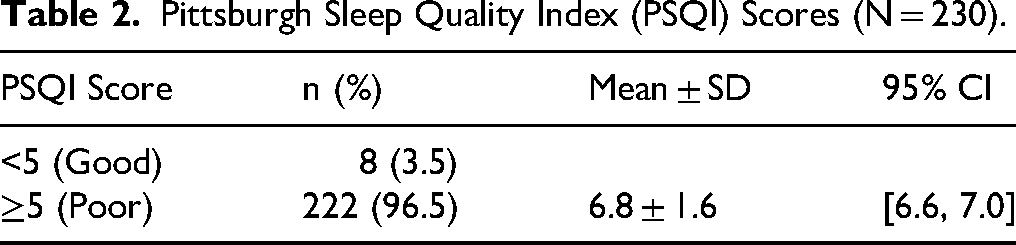
The mean PSQI score was 6.8 (SD = 1.6), indicating poor sleep quality among the majority of participants. A total of 222 participants (96.5%) scored 5 or higher on the PSQI, classifying them as having poor sleep quality, while only eight participants (3.5%) had good sleep quality with scores below 5, as shown in Table 2.
Pittsburgh Sleep Quality Index (PSQI) Scores (N = 230).
(Continued) (a) PSQI Component Scores (N = 230).

To provide a more nuanced understanding of what “poor sleep” means in this context, we analyzed the seven individual components of the PSQI. Table 2a presents the mean scores for each component.
The most elevated components were sleep latency (1.6 ± 0.7), daytime dysfunction (1.5 ± 0.6), and subjective sleep quality (1.4 ± 0.6). This pattern suggests that the primary drivers of poor global PSQI scores in this sample are difficulties with falling asleep and impairments in daytime functioning, rather than sleep maintenance issues or medication use, which was minimal (0.3 ± 0.2).
PSQI scores by gender and GPA category are presented in Table 3. Female students reported slightly higher (poorer) PSQI scores (M = 6.9, SD = 1.7) compared to male students (M = 6.7, SD = 1.5), though this difference was not statistically significant (p = .312). However, participants with a GPA of 3.0 or higher had significantly better sleep quality (M = 5.4, SD = 1.3) than those with a GPA below 3.0 (M = 7.1, SD = 1.5), p < .01, with a large effect size (Cohen's d = 1.23).
PSQI Scores by Demographic Characteristics (N = 230).

Correlation Between Sleep Quality and Academic Performance
Analysis revealed a significant negative correlation between PSQI scores and GPA (r = -0.639, p < 0.001, 95% CI: −0.715, −0.550). This result indicates that poorer sleep quality (higher PSQI scores) was strongly associated with lower GPA. However, the exceptionally large effect size (r2 = 0.408) warrants epistemic caution: shared method variance due to self-reported GPA and sleep, together with unmeasured confounding variables, likely inflates this observed association. Therefore, the finding should be interpreted as indicative of association rather than causal determination. Figure 2 presents a scatterplot illustrating the relationship between PSQI scores and GPA, demonstrating the clear negative trend. Table 4 summarizes the correlation results.

Relationship between sleep quality (PSQI) and academic performance (GPA).
Correlation Between Sleep Quality and GPA (N = 230).

Discussion
This study demonstrates that poor sleep quality is highly prevalent among Palestinian nursing students, with 96.5% of participants classified as having poor sleep quality according to PSQI criteria. These findings align with global trends indicating that university students, especially those in demanding programs like nursing, experience high levels of sleep disturbances. Contemporary research supports these findings, showing that stress, irregular schedules, and lifestyle challenges contribute significantly to sleep problems among nursing students (Almarzouki et al., 2022; Hershner & Chervin, 2014).
Prevalence and Contributing Factors
The exceptionally high prevalence of poor sleep quality (96.5%) observed in this study warrants careful interpretation. This rate substantially exceeds findings from comparable regional studies (e.g., 65% in Saudi Arabia: Al-Khani et al., 2019; average PSQI 6.2 in Jordan: Albqoor & Shaheen, 2021). Several factors likely contribute to this elevation:
First, the timing of data collection during the November–December examination period likely captured acute, stress-induced sleep disturbances rather than habitual patterns. This temporal compression may partially explain the extraordinary prevalence, suggesting the findings reflect exam-period sleep pathology.
Second, cultural calibration of the PSQI deserves consideration. The standard cutoff score of ≥5, validated primarily in Western populations, may exhibit different sensitivity and specificity in Arab contexts. Moreover, certain PSQI components, particularly subjective sleep quality and daytime dysfunction, may have been disproportionately elevated in this sample due to cultural perceptions of rest and fatigue, potentially inflating global scores.
Third, the component-level analysis provides empirical support for this interpretation. The most elevated scores were observed in sleep latency (1.6), daytime dysfunction (1.5), and subjective sleep quality (1.4). This profile is clinically consistent with stress-related sleep disturbance: students are taking longer to fall asleep (likely due to rumination or anxiety about exams) and experiencing significant daytime consequences (fatigue, difficulty staying awake), while perceiving their sleep as poor. In contrast, sleep efficiency (0.9) and sleep medication use (0.3) were relatively low, suggesting that once asleep, students slept reasonably well and did not rely on pharmacological aids. This component-level pattern reinforces the interpretation that the findings reflect acute, exam-period stress rather than chronic sleep disorders.
Fourth, the socio-political environment in Palestine, characterized by economic instability, limited resources, and occasional unrest, introduces chronic stressors that compound academic pressures. These contextual factors likely contribute to the higher observed prevalence compared to neighboring countries.
Thus, while the prevalence is clinically concerning, it should be interpreted as context- and timing-specific, reflecting the intersection of academic stress, cultural measurement considerations, and environmental adversity.
The significant negative association between sleep quality and academic performance in this study underscores the relationship between poor sleep and cognitive functions such as memory and concentration. This finding is supported by previous studies that consistently demonstrate poor sleep quality's negative association with academic success (Goel, 2017; Howell et al., 2008). Recent research by Veldi et al. (2020) found a strong association between poor sleep and reduced academic achievement, while Quader et al. (2023) demonstrated positive relationships between adequate sleep duration and higher GPAs.
Gender Differences
In the present study, female students had slightly poorer sleep quality (mean PSQI = 6.9 ± 1.7) compared to males (mean PSQI = 6.7 ± 1.5), as shown in Table 3. This finding is consistent with both regional and international studies indicating that female students are more likely to experience sleep disturbances due to combined academic, social, and cultural challenges (Alqudah et al., 2020; Gellis et al., 2014). In the Palestinian context, female nursing students face additional stressors that may contribute to poor sleep quality, including managing academic responsibilities alongside family and household duties (Hamdan-Mansour et al., 2017). Cultural expectations and societal pressures may place additional burdens on female students to excel academically while maintaining traditional roles, further exacerbating stress and sleep problems (Alzayyat & Al-Gamal, 2014). These gender-related challenges require specialized interventions focusing specifically on female students’ needs, including time management support and stress reduction strategies (Taylor et al., 2013).
Academic Outcomes
Participants with GPA ≥ 3.0 had significantly lower PSQI scores (better sleep quality: mean PSQI = 5.4 ± 1.3) compared to participants with GPA < 3.0 (mean PSQI = 7.1 ± 1.5, p < 0.01, Cohen's d = 1.23), as demonstrated in Table 3. This finding supports the association between good academic performance and superior sleep quality. However, the magnitude of this association is large for a cross-sectional educational study, and it is important to acknowledge the potential influence of unmeasured confounding variables (e.g., socioeconomic status, study habits) and shared method variance due to the use of self-reported measures for both sleep and GPA. The direction of this causal relationship remains unclear due to the cross-sectional nature of this study. It is possible that better sleep quality enhances cognitive functions such as memory and concentration, leading to higher GPAs (Curcio et al., 2006). Conversely, higher-achieving students may possess better time management skills and healthier sleep habits, contributing to improved sleep quality (Trockel et al., 2000). This bidirectional relationship underscores the complexity of sleep-academic performance interactions and represents a limitation addressed in the following section.
Study Limitations and Strengths
This study has several limitations that must be acknowledged. First, the cross-sectional design limits the ability to establish causality between sleep quality and academic performance. While findings indicate a strong association between poor sleep quality and lower academic performance, the direction of this relationship remains unclear. Poor sleep may lead to lower academic performance due to impaired cognitive functioning, as suggested by Wolfson & Carskadon (2003). Alternatively, students with lower GPAs may experience more stressful conditions that interfere with sleep (Lund et al., 2010).
Second, self-report bias represents a significant limitation, as both PSQI and GPA data were self-reported rather than objectively verified. Students may over- or underestimate their sleep quality and academic performance, potentially affecting the accuracy of observed associations. Shared method variance likely inflates observed correlations, and the large effect size (r2 = 0.408) should be interpreted with appropriate epistemic caution. Future studies should consider verifying GPA data through official academic records and supplementing subjective sleep measures with objective assessments such as actigraphy.
Third, the study did not collect data on important confounding variables that may affect both sleep quality and academic performance, including socioeconomic status, electronic device usage, living arrangements (family, roommates, or alone), lifestyle factors, stress levels, and specific political situation impacts. The absence of these variables may have led to an overestimation of the relationship between sleep quality and GPA based solely on univariate analysis.
Fourth, the use of convenience sampling may limit generalizability of findings to all Palestinian nursing students, as easily accessible participants may not represent the entire population.
Fifth, the timing of data collection (November–December) coincided with the examination period, meaning the findings likely capture acute exam-period sleep disturbances rather than habitual patterns. This seasonal limitation restricts generalizability to non-examination academic periods and should be considered when interpreting prevalence estimates.
Despite these limitations, the study has several strengths. It is the first comprehensive examination of sleep quality among Palestinian nursing students using a validated instrument (PSQI). The study achieved a high response rate (88.5%) and used appropriate statistical methods to examine the research questions. The inclusion of a fine-grained component-level analysis of the PSQI provides a more nuanced understanding of the specific nature of sleep disturbances in this population. The findings provide important baseline data for understanding sleep-academic performance relationships in this population.
Implications for Nursing Education and Practice
The findings of this study offer hypothesis-generating insights rather than evidence-based prescriptions. Given the correlational design, the following recommendations should be viewed as practice-informed suggestions requiring empirical validation through future intervention research.
At the institutional level, universities should consider integrating sleep hygiene education as a formal component of nursing curricula, potentially through wellness modules aligned with global nursing education standards such as the Quality and Safety Education for Nurses (QSEN) competencies and the American Association of Colleges of Nursing (AACN) Essentials, which emphasize student well-being as foundational to quality care delivery.
Contextualized recommendations for improving sleep quality among nursing students include promoting sleep hygiene workshops, implementing stress management programs, and exploring flexible academic scheduling. However, implementation in the Palestinian context may face several barriers. Institutional constraints, such as rigid academic schedules and limited resources, may restrict flexible scheduling adoption (Alzayyat & Al-Gamal, 2014). Additionally, cultural norms and societal expectations may make it difficult for students, especially females, to prioritize sleep over family or household responsibilities (Hamdan-Mansour et al., 2017).
Realistic implementation strategies may include: (1) developing brief, evidence-based sleep hygiene modules that can be integrated into existing courses without major curricular restructuring; (2) establishing peer support groups focused on stress management and healthy coping strategies; (3) exploring limited flexibility in clinical rotation scheduling to allow for adequate rest periods; and (4) providing accessible mental health and counseling services that normalize help-seeking behaviors and address sleep-related concerns within culturally appropriate frameworks.
The PSQI component-level analysis offers specific targets for intervention. Given that sleep latency and daytime dysfunction were the most elevated components, interventions should prioritize: (a) techniques to reduce pre-sleep arousal and rumination (e.g., mindfulness, cognitive behavioral strategies for insomnia), and (b) strategies to manage daytime fatigue and improve alertness during clinical and academic activities (e.g., strategic napping, caffeine management, bright light exposure).
To address these challenges, universities and policymakers must collaborate to create supportive environments for student success. This can be achieved by providing accessible mental health support, raising awareness about sleep importance and benefits, and conducting workshops on effective time management strategies and stress reduction techniques (Taylor et al., 2013).
Comparison with Global Research and Palestinian Context
These findings align with global research demonstrating the association between poor sleep quality and academic performance, while uniquely highlighting the amplified challenges faced by Palestinian nursing students. Similar to other Middle Eastern contexts, academic stress and lifestyle factors significantly disrupt sleep patterns, for instance, 65% of Saudi medical students reported poor sleep quality due to academic pressures (Al-Khani et al., 2019), and Jordanian students averaged a PSQI score of 6.2 (Albqoor & Shaheen, 2021). However, this study reveals a strikingly higher prevalence of poor sleep (96.5% at PSQI ≥ 5) among Palestinian nursing students compared to these regional averages, suggesting that socio-political instability, economic constraints, and limited institutional support compound conventional academic stressors.
Western studies, such as Lund et al. (2010), corroborate sleep's universal influence on GPA, yet Palestinian students face distinct barriers: clinical training in resource-limited settings, cultural expectations (e.g., familial duties), and political unrest, factors rarely examined in prior research. This contextual disparity underscores the need for tailored interventions addressing both academic and environmental stressors in conflict-affected regions, advancing beyond generic sleep hygiene recommendations to include institutional support systems and stress-management programs adapted to local challenges (Hamaideh et al., 2017).
Future Research Directions
Future research should address several key areas to advance understanding of sleep-academic performance relationships among nursing students. First, longitudinal studies are needed to establish causal relationships between sleep quality, stress, and academic performance over time, and to test the full mediational pathways proposed by the SSPM. Second, comprehensive assessment of confounding variables including socioeconomic status, technology usage, living arrangements, stress levels, and political situation impacts should be included in future studies. Third, qualitative research could provide detailed information about students’ perceptions of sleep and specific sleep-disrupting factors within the Palestinian context. Fourth, intervention studies are needed to evaluate the effectiveness of sleep hygiene workshops, flexible scheduling, and stress management programs in improving sleep quality and academic performance among nursing students. Fifth, future research should continue to employ component-level analyses of the PSQI to identify which aspects of sleep disturbance are most responsive to specific interventions. Finally, multicenter studies including multiple Palestinian universities could enhance generalizability of findings and provide broader insights into sleep-academic performance relationships among Palestinian nursing students. By addressing these research gaps, future studies can contribute to evidence-based intervention development that promotes both academic success and overall well-being among nursing students.
Conclusion
This study identified a high prevalence of poor sleep quality among Palestinian nursing students and a significant negative association between sleep quality and academic performance. However, the exceptionally high prevalence (96.5%) should be interpreted with attention to the examination-period timing, cultural calibration of the PSQI, and contextual stressors unique to Palestine. A component-level analysis revealed that sleep latency and daytime dysfunction were the primary drivers of poor sleep quality, providing a more nuanced understanding of the specific challenges faced by these students. Poor sleep quality was associated with lower GPAs, demonstrating that adequate sleep is important for academic success. Females reported slightly poorer sleep quality compared to males, likely due to combined academic, social, and cultural factors. Students with higher GPAs demonstrated better sleep quality, although the causal direction remains unclear.
These findings underscore the need for hypothesis-generating, contextually tailored recommendations rather than evidence-based prescriptions. Specifically, nursing educators and policymakers should consider integrating sleep hygiene education modules into nursing curricula as a prudent, practice-informed step, while recognizing that rigorous intervention trials are needed to establish effectiveness. Practical suggestions include establishing wellness workshops, providing accessible mental health support, and exploring feasible scheduling modifications that accommodate students’ physiological sleep needs without compromising educational rigor. Interventions targeting pre-sleep rumination and daytime fatigue management may be particularly beneficial given the specific PSQI component elevations observed.
The study's limitations, including the cross-sectional design, self-report bias, shared method variance, seasonal timing effects that limit generalizability to habitual sleep patterns, and absence of confounding variable assessment, should be considered when interpreting results. Future longitudinal studies including comprehensive variable assessment are needed to establish causal relationships and develop more effective interventions.
Supplemental Material
sj-docx-1-son-10.1177_23779608261441811 - Supplemental material for Sleep Quality and Academic Performance Among Nursing Students: Palestinian Perspective — A Cross-Sectional Study
Supplemental material, sj-docx-1-son-10.1177_23779608261441811 for Sleep Quality and Academic Performance Among Nursing Students: Palestinian Perspective — A Cross-Sectional Study by Ahmad Ayed, Ibrahim Aqtam, Manwa Ayed, Murad Ayed and Mustafa Shouli in SAGE Open Nursing
Supplemental Material
sj-doc-2-son-10.1177_23779608261441811 - Supplemental material for Sleep Quality and Academic Performance Among Nursing Students: Palestinian Perspective — A Cross-Sectional Study
Supplemental material, sj-doc-2-son-10.1177_23779608261441811 for Sleep Quality and Academic Performance Among Nursing Students: Palestinian Perspective — A Cross-Sectional Study by Ahmad Ayed, Ibrahim Aqtam, Manwa Ayed, Murad Ayed and Mustafa Shouli in SAGE Open Nursing
Footnotes
Acknowledgements
The authors would like to express their thanks to the nursing students who participated in the study.

Author Contributions
Ahmad Ayed and Ibrahim Aqtam conceptualized and designed the study. Mustafa Shouli supervised data collection and contributed to the data analysis. Manwa Ayed and Murad Ayed participated in drafting the manuscript and reviewing the literature. All authors read, revised, and approved the final manuscript.
Ethical Considerations
Ethical approval for this study was granted by the Arab American University Institutional Review Board - Ramallah (Approval No. R-2025/A/7/N) on 4th February 2025. The study was conducted in accordance with the ethical principles outlined in the Declaration of Helsinki. Written informed consent was obtained from all participants prior to their involvement. To ensure confidentiality, questionnaires were anonymized, with no identifying information collected. All data were stored on a password-protected computer, and physical forms were secured in a locked cabinet. Participation in the study was entirely voluntary, and respondents were assured of their right to withdraw at any time without any consequences.
Consent to Participate
Informed consent to participate in the study was obtained from all participants.
Funding
The authors received no financial support for the research, authorship, and/or publication of this article.
Declaration of Conflicting Interests
The authors declared no potential conflicts of interest with respect to the research, authorship, and/or publication of this article.
Data Availability Statement
The data supporting this study's findings are available upon reasonable request from the corresponding author, Dr. Ibrahim Aqtam, at ibrahim.aqtam@nu-vte.edu.ps.
Supplemental Material
Supplemental material for this article is available online.
References
Supplementary Material
Please find the following supplemental material available below.
For Open Access articles published under a Creative Commons License, all supplemental material carries the same license as the article it is associated with.
For non-Open Access articles published, all supplemental material carries a non-exclusive license, and permission requests for re-use of supplemental material or any part of supplemental material shall be sent directly to the copyright owner as specified in the copyright notice associated with the article.
