




Abstract
Introduction
The turnover problem is a serious issue closely related to the shortage of nursing personnel. Therefore, investigating the factors that contribute to nurse turnover is critical.
Objective
The purpose of this study was to test the hypothesis that organizational commitment is a variable that predicts nurse turnover and is influenced by three factors: metacognition, career maturity, and identity in the nursing profession.
Methods
This study employed a cross-sectional design. The participants were 324 new nurses working at hospitals with more than 120 beds and multiple departments in the Kyushu region of Japan. Participants completed self-report questionnaires including their personal characteristics, metacognition, nursing professional identity, career maturity, and organizational commitment. Path analysis was used to test a mediating model of nurses’ organizational commitment to professional identity, career maturation, and metacognition.
Results
A total of 102 valid responses were obtained for the final analysis. Overall, the hypothesized model in this study explained 45% of the variance in career maturation and 8% of the variance in organizational commitment. Metacognition had a direct impact on occupational identity (β = .38, p < .05) and career maturity (β = .27, p < .05) in nurses. Metacognition was also found to influence career maturity (β = .087, p < .001) via occupational identity and indirectly to organizational commitment.
Conclusions
To prevent nurses from leaving the profession, career maturation should be promoted in basic nursing education through education that enhances metacognition and supports the ongoing formation of professional identity. Supporting flexible work choices based on personal, social, and professional values and beliefs, and in accordance with life stages is necessary. The results of this study can be used as basic data for the construction of career support education programs for nursing students.
Keywords
Introduction
Nurses comprise the largest segment of the healthcare workforce and have the most frequent and sustained contact with patients. According to the World Health Organization, the global shortage of nurses is projected to reach 18 million by 2030 (World Health Organization, 2020). This shortage stems from multiple factors, including an aging nursing workforce, an insufficient pipeline of new graduates, and increasing retirement rates driven by unfavorable working conditions (Adams et al., 2021; Al Yahyaei et al., 2022; Park & Yu, 2019).
The COVID-19 pandemic has further exacerbated the situation by intensifying workload demands and exposing nurses to extreme working environments, prompting many to leave their positions. The continued spread of novel coronavirus infections could further deteriorate mental health among nurses and accelerate workforce attrition (Turale & Nantsupawat, 2021). In the context of a rapidly aging society and growing healthcare demands, the departure of experienced nurses poses a significant and ongoing challenge. Nurse turnover is thus expected to remain a critical long-term concern. Addressing this issue is both urgent and essential.
While increasing the recruitment of new nurses may temporarily alleviate staffing shortages, this approach is often costly due to reduced initial productivity and the high expenses associated with turnover and training. These dynamics negatively impact the financial sustainability of healthcare organizations and may compromise the quality and outcomes of patient care (Bae, 2022; Duffield et al., 2014; Hayes et al., 2012). Additionally, workforce shortages contribute to long working hours, heavy workloads, and job-related stress among remaining staff, which can perpetuate a cycle of burnout and further turnover. Therefore, in order to effectively address the nursing shortage, it is imperative to focus on the prevention of turnover rather than relying solely on recruitment.
Review of Literature
Survey studies conducted across 10 European countries report nurse turnover rates ranging from 5% to 17% (Buchan et al., 2018), while turnover in other regions varies between 10% and 30% (Kerzman et al., 2020; Nelson-Brantley et al., 2018). In Japan, the overall nurse turnover rate is approximately 11%; however, there exists also a consistently high turnover rate of 10% among new nurses, which is particularly concerning (Japanese Nursing Association, 2023). Factors contributing to nurse turnover include workplace conditions, personal stressors such as job stress and burnout, and community-related influences like interpersonal relationships (Bae, 2024; Lee, 2022; Woodward & Willgerodt, 2022).
Two primary forms of nurse turnover are commonly identified: organizational and occupational. Organizational turnover refers to a nurse leaving a specific workplace, whereas occupational turnover involves exiting the nursing profession entirely. Although organizational turnover does not necessarily contribute directly to the global nursing shortage, it can reduce staff retention and the availability of experienced nurses, which can adversely affect healthcare delivery (Tang & Hudson, 2019). Addressing both forms of turnover is essential. A well-established predictor of both organizational and occupational turnover intention is organizational commitment (Arslan Yürümezoğlu et al., 2019). Organizational commitment reflects the strength of an individual's identification with and involvement in a specific organization and plays a critical role in shaping nurse behavior within healthcare settings (Dinc et al., 2018; Hakami et al., 2020). Given the diversity of practice settings in nursing—ranging from hospitals to community or specialty facilities—and the variation in organizational roles, nurses may find it difficult to commit to an organization unless they clearly understand how they can contribute and what roles they are expected to fulfill. Therefore, establishing a well-defined nursing identity is essential. Nurses must evaluate whether their professional identity aligns with the values and expectations of the organization.
Nursing identity encompasses personal values, attitudes, and beliefs alongside the norms and standards of the nursing profession. It reflects the internalization of professional characteristics and the process by which individuals begin to think, feel, and act as nurses (Wu et al., 2020). A strong nursing identity influences how nurses perceive their roles and their likelihood of remaining in the profession (Chênevert et al., 2016). Moreover, professional identity has been shown to affect career maturity (Liu et al., 2024). Career maturity refers to the ability to make realistic and consistent career decisions over time and influences an individual's career development and job trajectory. Pre-employment career maturity has been associated with improved mental health, stronger interpersonal relationships in the workplace, and a smoother transition into professional roles (Kawai & Yamazaki, 2006). Students with accelerated career maturity tend to demonstrate characteristics of professional identity that enable them to adapt flexibly and make dynamic career decisions (Rasyidi et al., 2021). Thus, enhancing professional identity and promoting career maturity can foster early organizational commitment and reduce the likelihood of professional turnover.
Promoting professional identity also involves strengthening metacognition, the awareness and regulation of one's own thought processes. Metacognitive skills such as critical thinking, self-discipline, curiosity, attention, confidence, and problem-solving are closely linked to career maturity (Kurniawati, 2021; Linsenmeyer & Long, 2023). Research has demonstrated a positive relationship between metacognitive awareness and decision-making abilities, underscoring the importance of teaching metacognitive strategies to support occupational decision-making (Batha & Carroll, 2007; Symes & Stewart, 1999). Therefore, metacognition is considered a critical ability for developing a nursing identity that aligns with organizational goals and values, while also enhancing career maturity and promoting organizational commitment.
Identifying factors influencing organizational commitment, such as metacognition, nursing identity, and career maturity, could enhance organizational commitment in basic nursing education. Therefore, the aim of this study was to propose and test a hypothetical model (Figure 1) that integrates these four constructs. Specifically, the study sought to verify whether: (a) metacognition directly affects career maturity and, in turn, influences organizational commitment; and (b) metacognition indirectly affects career maturity through its impact on nursing identity, thereby influencing organizational commitment.

Hypothesis Model.
The findings of this study will contribute to the development of evidence-based career education programs incorporating metacognitive strategies to promote nurse retention and organizational engagement.
Methods
Design
This cross-sectional study employed convenience sampling and adhered to the Strengthening the Reporting of Observational Studies in Epidemiology (STROBE) guidelines (von Elm et al., 2007).
Research Questions
Based on the proposed hypothetical model, the following research questions were examined:
Does metacognition directly affect career maturity and, in turn, influence organizational commitment? Does metacognition indirectly affect career maturity through occupational identity and subsequently influence organizational commitment?
Sample
Hospitals with more than 120 beds and multiple departments (excluding psychiatric hospitals) in the Kyushu area of Japan were invited to participate. Eleven hospitals agreed to cooperate, and newly hired nurses at these facilities were recruited. Inclusion criteria specified nurses who had been employed for less than one year. Nurses with prior clinical experience at other hospitals or those deemed unsuitable for participation were excluded by the project leader.
Questionnaires were distributed through nursing managers in March 2021 and March 2022. Participants completed the questionnaires via in-person retention, postal mail, or an online form. Conventionally, the sample size required for path analysis is approximately 5–20 samples for each indicator variable (Kyriazos, 2018). As there were four variables to be analyzed, and with a target response rate of 30%, it was estimated that a sample size of approximately 300 would be required. Per the inclusion criteria, there were 324 potential participants in the study area during the data collection periods. To achieve a 30% response rate, all 324 were targeted.
Inclusion and Exclusion Criteria
Inclusion: Nurses with less than one year of clinical experience. Exclusion: Nurses with clinical experience in other hospitals or judged as ineligible by the project leader.
Ethical Considerations
This study was approved by the Miyazaki University of Health Sciences Ethics Committee (approval number: O-1091) on March 8, 2022. Written informed consent was obtained from all participants. Nurses were provided with details about the study's purpose, expected benefits, potential risks, data confidentiality, and handling of personal information. Consent was confirmed by checking a consent box on the questionnaire. Permissions to use the measurement scales were secured from the original authors. Regarding the use of scales, permission was obtained from each developer. The Japanese version of the Three-Dimension Organizational Commitment Scale was used with permission from Professor Meyer of the University of Western Ontario and Professor Watanabe of Aichi Shukutoku University.
Measures
Adults’ Metacognition Scale
This 28-item scale, developed from the Metacognitive Awareness Inventory (Schraw & Dennison, 1994) and validated for use in Japan (Abe & Ida, 2010), measures three dimensions of metacognition: monitoring (11 items), control (9 items), and metacognitive knowledge (8 items). Items are rated on a 6-point Likert scale (1 = Not at all applicable, 6 = Highly applicable), with higher scores indicating greater metacognitive ability. The Cronbach's alpha coefficients for the subscales “monitoring,” “control,” and “metacognitive knowledge” of this scale were .88, .79, and .75, respectively (Abe & Ida, 2010).
Professional Identity Scale for Nurses (PISN)
Developed in Japan (Sasaki & Hariu, 2006), this 20-item scale assesses professional identity in nurses. Responses are scored on a 5-point Likert scale (1 = not applicable, 5 = applicable). Reverse-scored items were adjusted prior to computing the total score; higher scores indicate a stronger professional identity. The Cronbach's alpha coefficient for this scale was .84 (Sasaki & Hariu, 2006).
Career Maturity Scale
This 27-item scale, developed by Kano et al. (2012), measures three subscales of career maturity: career interest, autonomy, and planning (each with 9 items). Responses are recorded on a 4-point Likert scale (0 = not at all applicable, 4 = very applicable). Reverse-scored items were recoded before summing total scores, with higher values reflecting greater career maturity. The Cronbach's alpha coefficients for the subscales “career interest,” “career autonomy,” and “career planning” of this scale were .70, .64, and .79, respectively (Kano et al., 2012).
Japanese Version of the Three-Dimension Organizational Commitment Scale
This scale, originally created by Meyer et al. (1993) and translated into Japanese by Watanabe and Takahashi (2019), includes three subscales: affective, continuance, and normative commitment (6 items each). Items were rated on a 4-point Likert scale (1 = not applicable, 4 = applicable), with higher scores indicating stronger organizational commitment. The Cronbach's alpha coefficients for the subscales “Affective Commitment,” “Continuance Commitment,” and “Normative Commitment” of this scale were .69, .61, and .77, respectively (Watanabe & Takahashi, 2019).
Personal Characteristics
Participants reported demographic and background information, including sex, age, nursing education type (high school, vocational school, or university), nursing qualifications (nurse, public health nurse, midwife, or licensed practical nurse), interest in nursing certification (yes/no), assignment to a first-choice department (yes/no), presence of a role model (yes/no), and presence of a future vision as a nurse (yes/no).
Data Collection
Data were collected in March 2021 and March 2022 via paper or web-based questionnaires. Hospital nursing supervisors facilitated participant recruitment. Participants received written explanations detailing the study's purpose, guaranteed anonymity, and voluntary participation. Questionnaires were distributed either in paper format or with a QR code linked to an online survey. Participants indicated consent to participate by checking a box on the survey. No personally identifiable information (e.g., names, schools, intern ID numbers) was collected. The questionnaire required approximately 10–15 min to complete. To minimize nonresponse bias and enhance representativeness, multiple modes of survey distribution were implemented, and standardized selection criteria for hospitals were applied.
Statistical Analysis
Data were analyzed using IBM SPSS Statistics for Windows, Version 30.0. Descriptive statistics (means and standard deviations) were calculated for continuous variables. The Shapiro–Wilke normality test assessed data normality. Internal consistency was evaluated using Cronbach's α, with values ≥.60 considered acceptable (Janssens et al., 2008). Pearson's correlation coefficients were calculated to analyze relationships between continuous variables. A mediation model of nurses’ organizational commitment, professional identity, career maturation, and metacognition was tested using Amos Version 30.0. Model fit was evaluated using the following indices: goodness-of-fit index (GFI > .90), adjusted goodness-of-fit index (AGFI > .90), comparative fit index (CFI > .90), normed fit index (NFI > .90), and root mean square error of approximation (RMSEA < .08 (Syafiq et al., 2022). Statistical significance was set at p < .05 (two-tailed).
Results
Sample Characteristics
Of the 324 distributed questionnaires, 111 were returned. Nine were excluded due to lack of informed consent, resulting in 102 completed responses for final analysis (Figure 2).

Participant Flow Diagram.
The mean age was 23.99 years (SD = 4.05). Most participants identified as female (n = 93, 91.1%) and nearly half were university graduates (n = 45, 44.1%). Educational background was primarily from university nursing programs (44.5%) or vocational schools (43.1%). The predominant nursing qualification was Registered Nurse, held by 86.3% of participants. Detailed personal characteristics are presented in Table 1.
Demographic Characteristics of New Graduate Nurses (n = 102).
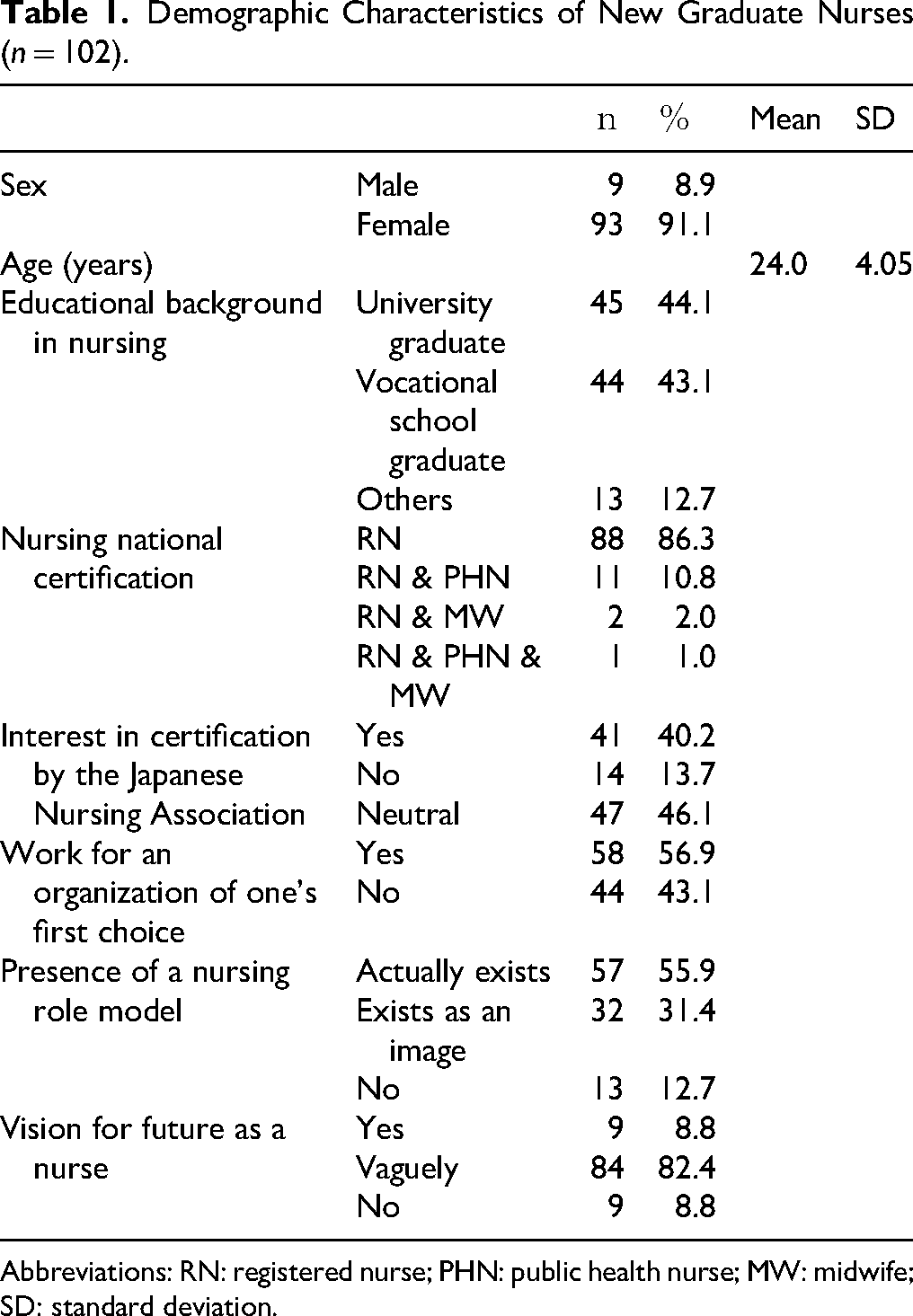
Abbreviations: RN: registered nurse; PHN: public health nurse; MW: midwife; SD: standard deviation.
Research Question Results
Normality, Descriptive Statistics, and Reliability
Table 2 summarizes the means, standard deviations, ranges, skewness, kurtosis, normality test and Cronbach's alpha results for each scale. The Shapiro–Wilk test indicated that the Adults’ Metacognition Scale (p = .516), the Professional Identity Scale for Nurses (PISN; p = .603), and the Organizational Commitment Scale (p = .354) were normally distributed. The Career Maturity Scale showed a statistically significant deviation from normality (p = .019). However, inspection of the Q-Q plot revealed an approximately linear pattern, and the histogram appeared roughly normal, suggesting the distribution approximates normality sufficiently for parametric analysis. The Cronbach's alpha for all scales in this study exceeded the acceptable threshold of .60; internal consistency was satisfactory.
Mean, Standard Deviation, Range, Skewness, Kurtosis and Cronbach's Alpha for Each Scale.

Abbreviations: AMS: Adults’ Metacognition Scale; PISN: Professional Identity Scale for Nurses; Maturity: Career Maturity Scale for Nurses; Commitment: The Japanese version of the three-dimension organization commitment scale.
Correlations Between Variables
Pearson's correlation analysis (Table 3) indicated significant positive correlations between most variables, except for the Adults’ Metacognition Scale and organizational commitment, which showed no significant association. Correlation coefficients ranged from weak to moderate strength.
Correlations Between Variables.
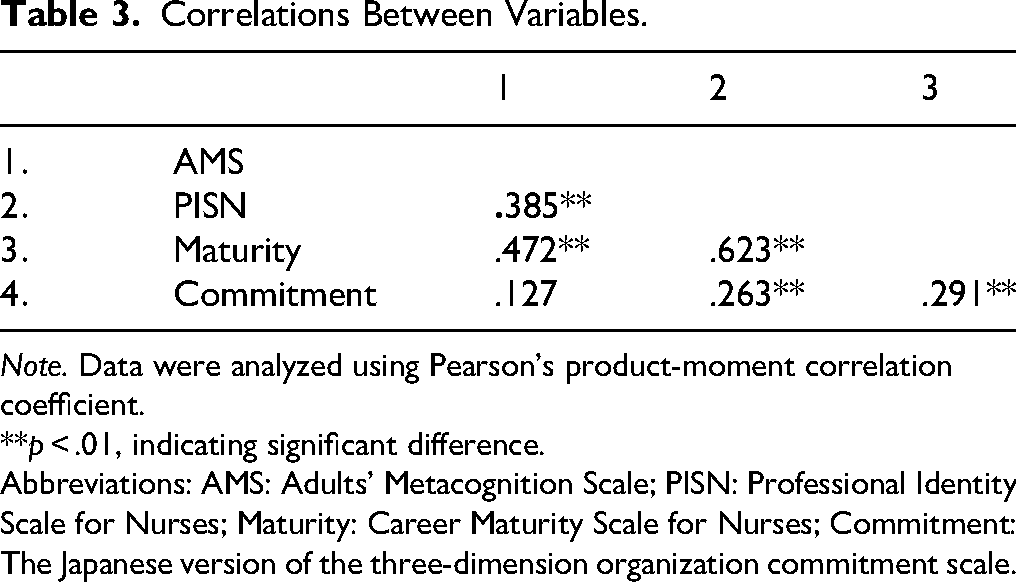
Note. Data were analyzed using Pearson's product-moment correlation coefficient.
**p < .01, indicating significant difference.
Abbreviations: AMS: Adults’ Metacognition Scale; PISN: Professional Identity Scale for Nurses; Maturity: Career Maturity Scale for Nurses; Commitment: The Japanese version of the three-dimension organization commitment scale.
Structural Equation Modeling
A structural equation model (SEM) was constructed based on the hypothesized conceptual framework to examine the effects of metacognition on career maturity and professional identity, and the subsequent effect of professional identity on organizational commitment. The modified model demonstrated an excellent fit to the data, with the following indices: χ(1) = 1.28; p = .526; χ2/df = .642; Tucker-Lewis Index (TLI) = 1.027; Goodness of Fit Index (GFI) = .994; Adjusted GFI (AGFI) = .969; Comparative Fit Index (CFI) = 1.000; Normed Fit Index (NFI) = .985; Root Mean Square Error of Approximation RMSEA) = .00.
The model explained 45% of the variance in Career Maturity and 8% of the variance in organizational commitment (Figure 3). The indirect effect of metacognition on career maturity through professional identity was significant (β = .087, p = .001) (Table 4).

Results of Structural Equation Model.
Indirect Effects of Adults’ Metacognition Scale on Career Maturity for Nurses.
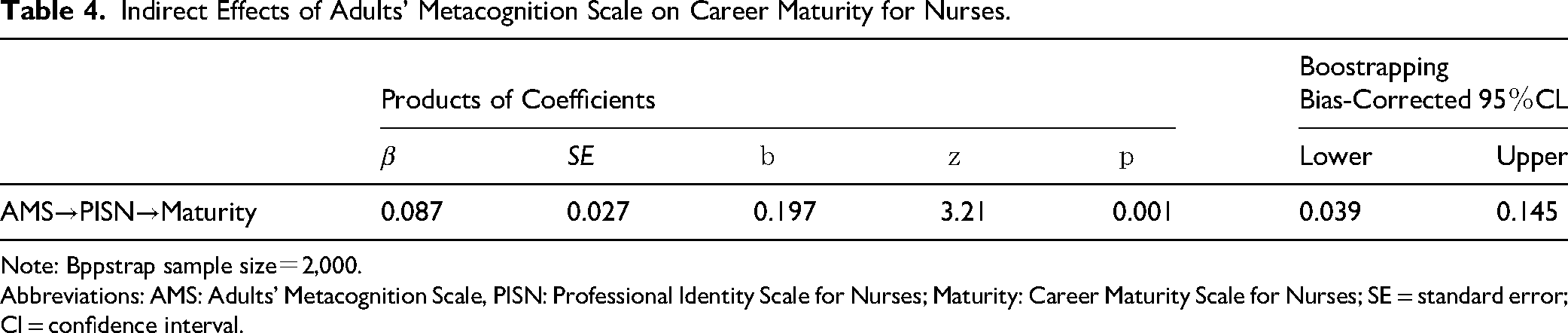
Note: Bppstrap sample size=2,000.
Abbreviations: AMS: Adults’ Metacognition Scale, PISN: Professional Identity Scale for Nurses; Maturity: Career Maturity Scale for Nurses; SE = standard error; Cl = confidence interval.
Discussion
The mean score on the Professional Identity Scale for Nurses in this study was 61.4 ± 11.9, closely aligning with a previous study of nurses with up to three years of experience, which reported a mean of 61.5 ± 10.9 (Suzuki, 2022). Similarly, the mean score for the Career Maturity Scale was 26.7 ± 6.4, comparable to the 27.8 ± 6.6 reported by Ooka et al. (2017) in a nurse population. Notably, despite this study's focus on new nurses, the similarity in scores suggests that professional identity and career maturity are relatively well established even among nurses early in their careers.
Our findings indicate that metacognition has both a direct impact on career maturity and an indirect effect mediated by professional identity. Career maturity, in turn, positively influences organizational commitment. Professional identity, which encompasses the values and beliefs held as a nurse, is recognized as an evolving, lifelong process (Nijboer & van der Cingel, 2019). Rooted in values and ethics (Crigger & Godfrey, 2014), professional identity facilitates congruence between personal, social, and professional beliefs, enabling harmonious professional practice, playing an important role in nurses’ choice to remain in the profession (Kristoffersen, 2021).
To cultivate this alignment, it is essential to explore nursing students’ personal, social, and professional values and their understanding of nursing. This reflection guides their orientation toward societal contribution and fosters independence and responsibility as nurses. Metacognition, characterized by objective self-awareness and insight into one's abilities and professional commitment, plays a critical role in this developmental process. In basic nursing education, fostering this metacognitive reflection—beyond recalling practical experience to include consideration of one's nursing values and aspirations—can deepen students’ connection to their professional identity.
Career maturity, defined as the attitudinal and cognitive readiness to navigate career development (Super, 1984), is essential for making age-appropriate, realistic, and consistent career-related decisions over time (Dybwad, 2009; Ohler et al., 1996). It reflects mental maturity and predicts job satisfaction (Savickas, 1984), thereby influencing career development and organizational commitment. Prior research has identified reflection as a factor enhancing career maturity (Kim & Shin, 2020). Consistent with this, our study supports the notion that higher metacognitive activity correlates with decisive career choices aligned with professional goals (Symes & Stewart, 1999).
The nursing profession's increasing specialization and diverse work environments—including hospitals, welfare facilities, and government agencies—require nurses to adapt to varied roles and organizational cultures. As career development depends on alignment between individual and organizational needs (Schein & Schein, 1978), nurses must not only develop a strong professional identity but also the ability to discern organizational demands and adapt accordingly. Professional identity alone may not be sufficient for organizational adaptation, especially when work environments change, potentially reducing organizational commitment and increasing turnover risk. Therefore, supporting career maturity after professional identity formation is crucial for long-term outcomes such as job retention, career progression, and organizational adaptation. For nurses to establish their values and beliefs and make career choices based on them, it is essential to have a vision of their nursing careers. In addition to having the ability to identify the kind of organization that will help them achieve their career goals, nurses must be able to think through what they can do now to acquire the attitudes, knowledge, and skills needed for the nursing career they aspire to in the long term. It is helpful for nurses to develop metacognitive skills that enable them to objectively assess their own position and opportunities, thereby equipping them with the ability to think about what they can do now to achieve their career goals. Nursing education should encourage students to visualize their long-term professional selves and link these aspirations to their actual clinical experiences, thereby promoting career maturity alongside professional identity development. Fortunately, in basic nursing education, a significant amount of time is allocated to clinical practice, and students gain experience at a variety of practice facilities. Therefore, in each clinical practice, it is beneficial to organize evaluation criteria and the areas that require reflection regarding the nursing care one has provided. Nursing students should reflect on the following: “What emotions did I experience during the clinical?” “Why did I feel that way?” “Based on my nursing philosophy, can I envision myself working as a nurse in this facility?” “In what ways can I contribute to this facility as a nurse?” By linking metacognition with professional identity, students can gain valuable insights.
This study confirmed that only 8% of the variance in organizational commitment could be explained. The following reasons can be considered for this. This study limited the antecedents of organizational commitment to three factors—metacognition, nursing identity, and career maturity—in order to contribute to the development of a career education program using metacognition. Factors influencing organizational commitment include organizational culture, job content, interpersonal relationships in the workplace, and life satisfaction (Vagharseyyedin, 2016). Therefore, considering that organizational commitment is influenced by both personal factors and organizational factors, as well as the surrounding environment, constructing a multiperspective model could increase the ability to explain the variance in organizational commitment.
Strengths and Limitations
This study's primary limitation was its low response rate, which may have introduced response bias favoring nurses with greater interest in career support, thus limiting generalizability. Additionally, data collection was geographically limited, which may affect representativeness. Despite these limitations, this study contributes novel insights by highlighting metacognition's potential influence on organizational commitment via professional identity and career maturity. Future research should expand the scope of research beyond Kyushu, Japan to improve the generalizability of research results, consider longitudinal designs to analyze temporal relationships between variables, and strengthen causal inference. In addition, it is necessary to comprehensively analyze organizational factors and the individual's environment as factors that affect commitment to the organization.
Implications for Clinical, Educational, and Research Practice
Organizational commitment is a key factor influencing nurse retention and workplace behavior in organizations. This study demonstrates that metacognition in new nurses impacts organizational commitment indirectly through professional identity and career maturity. Consequently, integrating metacognition education into basic nursing curricula may strengthen professional identity and career readiness, ultimately enhancing retention. Further research is warranted to evaluate the efficacy of metacognitive educational interventions on these outcomes.
Conclusions
To mitigate nurse turnover, healthcare organizations should prioritize the promotion of career maturation and continuous professional identity development through metacognition-enhancing education, starting from basic nursing education. New nurses require support in selecting an organization that aligns with their personal, social, and professional values, while also considering their current life stage. Additionally, organizations should assist nurses in planning their career trajectories by helping them set realistic career development goals and supporting their progress toward these goals. Access to relatable role models can further bolster their self-efficacy through vicarious experiences. The findings of this study offer foundational insights for designing effective career support programs tailored to nursing students.
Supplemental Material
sj-docx-1-son-10.1177_23779608251391125 - Supplemental material for Relation Between Career Development and Metacognition Among New Graduate Nurses: A Cross-Sectional Study
Supplemental material, sj-docx-1-son-10.1177_23779608251391125 for Relation Between Career Development and Metacognition Among New Graduate Nurses: A Cross-Sectional Study by Sayaka Kato, Aki Nozue and Ayako Yamashita in SAGE Open Nursing
Supplemental Material
sj-docx-2-son-10.1177_23779608251391125 - Supplemental material for Relation Between Career Development and Metacognition Among New Graduate Nurses: A Cross-Sectional Study
Supplemental material, sj-docx-2-son-10.1177_23779608251391125 for Relation Between Career Development and Metacognition Among New Graduate Nurses: A Cross-Sectional Study by Sayaka Kato, Aki Nozue and Ayako Yamashita in SAGE Open Nursing
Footnotes
Acknowledgments

Ethical Considerations
This study was approved by the Miyazaki University of Health Sciences Ethics Committee (approval number: O-1091) on March 8, 2022.
Consent to Participate
All study participants provided informed consent.
Author Contributions
Sayaka Kato: conceptualization, methodology, writing—original draft. Aki Nozue: data collection, formal analysis, writing—review and editing. Ayako Yamashita: supervision, validation, writing—review and editing.
Funding
The authors disclosed receipt of the following financial support for the research, authorship, and/or publication of this article: This work was financially supported by JSPS KAKENHI (Grant Number: 21K10768 to SK). The funders/sponsors had no role in the acquisition or analysis of data or in the content of this study.
Declaration of Conflict of Interest
The authors declared no potential conflicts of interest with respect to the research, authorship, and/or publication of this article.
Data Availability
The datasets generated during and/or analyzed during the current study are available from the corresponding author on reasonable request.
Supplemental Material
Supplemental material for this article is available online.
References
Supplementary Material
Please find the following supplemental material available below.
For Open Access articles published under a Creative Commons License, all supplemental material carries the same license as the article it is associated with.
For non-Open Access articles published, all supplemental material carries a non-exclusive license, and permission requests for re-use of supplemental material or any part of supplemental material shall be sent directly to the copyright owner as specified in the copyright notice associated with the article.
