



Abstract
Introduction
The world is in an era where healthcare professionals require training in soft skills to improve their caring ability. Regrettably, a concise compilation of nursing soft skills remains empirically unclassified.
Objectives
This study described a perceived list of soft skills necessary in nursing, as itemized by nurses and midwives in Ghana.
Methods
This descriptive qualitative study employed semistructured interviews with nurses and midwives from three regions of Ghana regarding key soft skills needed in nursing and midwifery. We conducted individual, face-to-face, in-depth interviews with nursing and midwifery educators and practising clinical nurses. A qualitative content analysis was used to analyze the interview data after transcription.
Results
Twenty-seven nurses and midwives, comprising 18 clinical practitioners and nine educators, were selected and interviewed. Following analysis, two primary categories emerged: one comprising nurse educators instructing soft skills and the other consisting of practising clinical nurses’ soft skills. Whereas educators thought of key soft skills as communication, collaboration, and clinical reasoning, the nurse clinicians considered effective communication, leadership skills, intrapersonal traits, interpersonal skills, critical thinking, and emotional intelligence as the top soft skills required to nurse. The analysis resulted in the identification of nine top soft skills in nursing.
Conclusions
This study highlighted differing yet complementary perspectives on essential soft skills in nursing, as identified by nurse educators and clinical nurses. While educators emphasized communication, collaboration, and clinical reasoning, clinical nurses prioritized a broader range of skills, including leadership, emotional intelligence, and both intra- and interpersonal traits and skills. Overall, the analysis culminated in the identification of nine critical soft skills vital for effective nursing practice, underscoring the multifaceted nature of professional competence in both educational and clinical settings.
Keywords
Introduction
Soft skills are defined as the intrapersonal traits, interpersonal skills, and creativity of the nurse that, through professionalism, teamwork, and good communication skills, lead to quality nursing care and improvement of patient/client outcomes and satisfaction (Laari et al., 2024). Unlike hard skills, which are the technical expertise and knowledge needed for a job, soft skills are interpersonal qualities, also known as people skills, and personal attributes that one possesses that make one the best candidate for a job (Laari et al., 2022; Lyu & Liu, 2021).
Business executives consider soft skills a very important attribute in job applicants, and employers would prefer new employees who possess both soft skills and hard skills because these skills are complementary (Lyu & Liu, 2021). Among the healthcare professions, soft skills are a must-have since human interaction and clear communication are key tenets in achieving success. Soft skills are required in the three nursing domains, including practice, administration, and education. The nurse clinician requires soft skills to navigate the complex healthcare environment to nurse the patient, and the nurse educator needs them to interact well and transmit knowledge to the students under training. However, a comprehensive empirical list of essential soft skills required for teaching and nursing patients/clients is inadequately documented in the literature, particularly in Ghana, hindering its incorporation into the curriculum.
Review of Literature
Soft skills originated from the aviation sector (Laari et al., 2022), with many components mentioned that are sometimes inapplicable in the healthcare sector. Many of these soft skills the literature referenced are dependent on the context and discipline under consideration (Hirudayaraj et al., 2021; Lyu & Liu, 2021). Isolating components necessary for nursing will facilitate its incorporation into the curriculum to train nurses (Hariti & Rejeki, 2020; Laari & Dube, 2017).
Until now, very few studies have isolated components that nurses use during teaching and when nursing their clients in the health landscape. The world is entering an era that demands the deployment of these skills because good nurse–patient encounters are required to improve information sharing in the advent of information technology. Although teaching these skills is difficult because they involve fewer measurable elements, it is essential to rethink their integration into nursing education programs through innovative learning strategies (Widad & Abdellah, 2022). However, the components are not clearly established in the literature to facilitate the development of curriculum content for instructors to rely upon in nursing. Regarding components that should be considered necessary soft skills in nursing, Laari (2024b) mentioned communication skills, listening skills, therapeutic touch, clinical reasoning, creativity, and resourcefulness. The author argues that these six components are very important in professions where human interactions are required to execute a procedure and should, as such, be considered in nursing. Similarly, Elkhalladi and Sefrioui (2024) in teachers’ knowledge of soft skills and flipped classrooms confirmed the above-mentioned list, emphasizing the relevance of these skills in nursing. Song et al. (2024) in another study considering critical soft skills for clinical nurses and educators, prioritized personal growth, effective interactions, professionalism, teamwork, and caring roles as key soft skills. They classified communication skills under effective interaction, while resourcefulness was considered under teamwork. Although Song et al. (2024) perceived communication skills as a subset of effective interaction, Laari (2024b) holds a divergent opinion, stating that there is no nursing without communication, arguing that communication should be emphasized.
Laari (2024b) corroborates the assertion made by Yang et al. (2024) that effective communication between nurses and patients is essential for the successful execution of personalized nursing care for each individual and that to accomplish this, nurses must understand and support their patients and demonstrate courtesy, friendliness, and honesty. Although nurse–patient communication is direct (Al-Ajarmeh et al., 2022) the nurse should provide time to the patient to ensure communication occurs with the requisite confidentiality and must remember that this communication incorporates individuals surrounding the patient (Yang et al., 2024). The language used should be clear to the patient, and nurses should note that communicating well goes beyond the physical ability of the nurse, his education and his experience. One issue that is clear in both Song et al. (2024) and Laari (2024b) findings is that they did not differentiate soft skills components required in nursing education and nursing practice separately. Separating these is important, as the soft skills required to nurse a patient may vary from those required to teach in the classroom.
Patel (2021), reporting on a review about soft skills for healthcare staff, conceived of soft skills as the interpersonal skills, life skills, people skills, social skills, and emotional intelligence that are necessary for individuals to live good lives and succeed in their professions. The author contends that good teamwork with multidisciplinary team members, like the one that happens in the healthcare environment, will require a high level of communication, adaptability, and trust between team members. Also, providing the best care for patients requires professionalism and nurses’ ability to listen, empathize, and show sensitivity to patients’ and their families’ feelings (Malenfant et al., 2022).
Despite the complexity and stress inherent in nursing, professionals in this field are required to possess high levels of proficiency and essential soft skills to maintain a performance that minimizes public grievances. However, these qualities may lead to challenges for novice nurses due to fatigue from workload. Therefore, identifying relevant soft skills in nursing to train them will give all nurses the ability to control their emotions and adapt to the situation. Unfortunately, studies on essential soft skills for nurses, especially in Ghana, are nonexistent. For a novice nurse, Bratajaya and Ernawati (2021) listed nine essential soft skills developed for them during their transition phase from education to practice. Bratajaya and Ernawati (2021) reported self-control, initiation, caring, self-motivation, hospitality, flexibility, adaptability, analytical skill, and presentation skill (Bratajaya & Ernawati, 2021).
In another study, Poláková et al. (2023) identified the importance of soft skills as perceived by the business and labor market while recruiting new employees. According to Poláková et al. (2023), communication, courtesy, responsibility, social skills, positive attitude, professionalism, flexibility, teamwork, and work ethic are the most looked-for qualities in employees. On the other hand, Elkhalladi et al. (2024) examined the knowledge of nurses and other healthcare professionals on soft skills and reported 10 soft skills, including communication, teamwork, stress management, problem-solving, conflict management, honesty, decision making, adaptability, lifelong learning, and confidence. These authors reported that almost 50% (49.7) of their respondents understood the concepts of soft skills even though only 12.3% reported having received training on the subject. This 12.3% confirms the fact that soft skills are not taught in most health training institutions. They, however, interestingly discovered that there were significant associations between soft skills knowledge and experience, academic level, and, most importantly, soft skill training. They, as such, recommended the integration of soft skills into the training of all healthcare professionals (Elkhalladi et al., 2024). This, however, requires the first step of generating an empirical list of soft skills in nursing, which this study purported to describe.
Materials and Methods
Study Design
This is a descriptive qualitative study using an inductive descriptive design by Doyle et al. (2020). A descriptive design is used due to its ability to identify issues with existing practice and provide descriptions (Hunter et al., 2019) where the nurse educators’ and clinicians’ views on components of soft skills are elicited.
Study Setting
Three regions, including the Upper East, Eastern, and Greater Accra regions, were selected based on convenience and to give a better cultural distribution to allow for zone-to-zone participant view comparison.
Sampling and Sample Size
A purposive sampling strategy was employed to select nine educators (5 midwives and 4 nurses) and 18 clinicians, comprising 6 midwives and 12 nurses, all of whom are registered with the Nursing and Midwifery Council of Ghana and have held their current jobs for over 5 years. These categories of professionals were included because five years of working experience is assumed to have given these nurses and midwives enough personal experience at work to contribute their views that will answer the research questions that were created from the research objectives. Participants were selected at each setting based on their availability and willingness if they met the inclusion criteria, and this took place after approval from the Institutional Review Board. Nurses employed by nongovernmental organizations (NGOs) were excluded from the study, as these professionals may engage in responsibilities beyond teaching and delivering nursing care. We gathered sufficient information from 27 participants to describe the phenomenon, following Braun and Clarke (2021) recommendations about data saturation in qualitative studies.
Data Collection
Individual in-depth face-to-face interviews were conducted by trained research assistants who held master's degrees in nursing. The assistants used semistructured interview guides developed based on the objectives of this study to elicit answers from participants. Semistructured interview guides that guided the interviews were developed based on the five steps recommended by Kallio et al. (2016) and we did pilot testing using expert assessment and internal testing before data collection (Kallio et al., 2016). Participants were asked, What do you as educators or clinicians consider to be the components of soft skills in nursing? As a nurse educator, how do you teach your students to nurse using the components you mentioned? Or, as a nurse clinician, how do you nurse your clients using these components you mentioned? Based on the answers from participants, prompts and probes were generated for clarification.
The interviews were conducted in English because English is the official language of communication in the health system in Ghana (Laari, 2024a), and that also facilitated transcription and analysis. Each interview lasted between 30 and 55 min and was audio recorded in the nurse managers’ offices, a conducive environment that was devoid of interference and environmental noise. Data collection went on until data saturation and occurred between February and June 2024; both the research assistants and researchers had no prior relationship with participants.
Data Analysis
Data was analyzed sequentially using qualitative content analysis based on Graneheim and Lundman (2004) qualitative content analysis steps by the first and last authors, who are both nurse academics. The transcripts were stored in an MS Word document on a personal computer with restricted access, imported into the computer software, and analyzed with the assistance of Taguette version 1.4. Field notes from the research assistants were digitized and uploaded into the software along with the transcripts for better understanding. While the first author is a male nurse, the last author is a female nurse, and they both hold PhDs in nursing and are qualitative research experts.
Ethical Considerations and Rigor
This study received ethical clearance from the Noguchi Memorial Institute for Medical Research, Institutional Review Board, with reference number NMIMR-IRB CPN 058/23-24, before data collection. Participation was voluntary. Anonymity and confidentiality were adhered to during and after data collection by ensuring participants’ information was protected through coding to maintain anonymity.
The participants’ information, such as names, age, and location, was coded and stored under key and lock in the first author's office.
To establish trustworthiness, credibility, confirmability, dependability, and transferability, as suggested by Shenton (2004) were ensured. The research assistants randomly selected 13 participants for member checking and validation. They returned to 13 of the participants and allowed them to read their interview transcripts for validation. For confirmability, the co-authors, experts in qualitative content analysis, evaluated, and confirmed the codes derived from the raw data. Precise data, including field notes, was maintained to facilitate an audit trail that details the decisions taken throughout the research process. The audit trail also gives a justification for the researchers’ methodology and interpretive judgment, which may aid in transferability. To assure dependability, qualitative content analysis and processes were applied accurately, and the procedure outlined.
Results
Demographic Characteristics of Participants
Twenty-seven nurses and midwives were interviewed, with an average of 13 years of working experience in the nursing profession. Nine nurse educators and 18 nurse clinicians, comprising 17 females and 10 males, participated in the study. The participants had a mean age of 37.74 years with a standard deviation of 6.71 years.
Thematic Findings
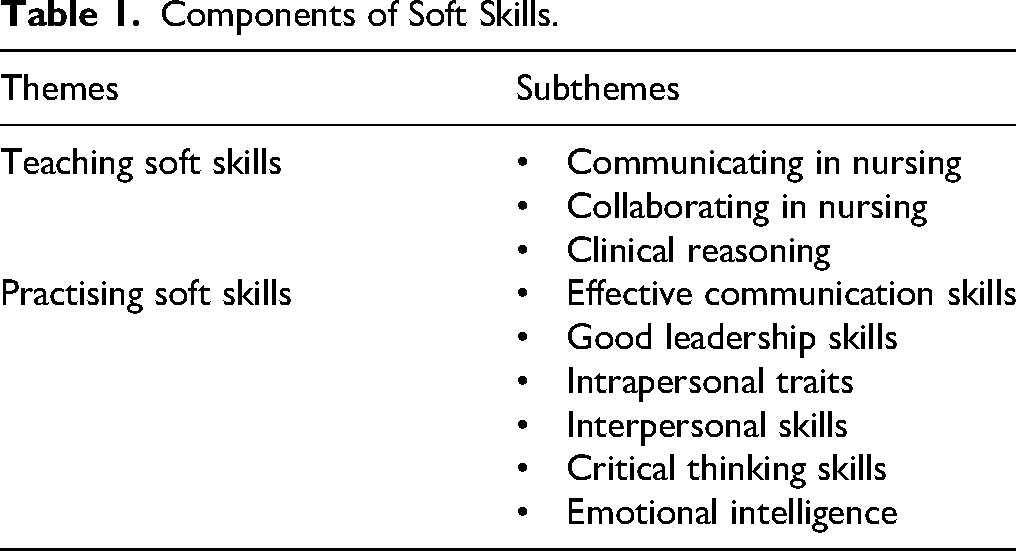
Two major groupings emerged as themes corresponding to the nurse educators’ and nurse clinicians’ soft skills components used in practice. These themes of teaching soft skills and practising soft skills emerged with nine soft skills considered as the top skills needed in the nursing field, either for teaching or nursing clients, as shown in Table 1.
Components of Soft Skills.
Teaching Soft Skills
These are educators’ top list of soft skills that a nurse educator is supposed to possess in order to teach effectively in the classroom. These three soft skills cited by the nurse educators were communication, collaboration, and clinical reasoning (3Cs). Nurse educators perceive these as fundamental for every nurse educator and believe that they should be transferred to nurse trainees, as these skills are required to produce multivalent nurses.
Communicating in Nursing
The nurse educators recognized communication in its diverse forms and highlighted effective questioning skills as a means for nurses to obtain information from patients. They perceive the capacity to communicate with authorities and coworkers and proficient written communication abilities as essential nontechnical competencies that all nursing students should develop. Several educators highlighted the significance of therapeutic communication skills and therapeutic touch in group discussions among students, asserting that emphasizing these concepts in clinical experience is valuable for student instruction. The educators indicated that instructing students on the proper use of titles for colleagues and acceptable attire were considerations in their teaching. They noted that inadequately dressed and groomed students suggest a need for personal connection for guidance.
Educators indicated that monitoring students’ reassuring skills, classroom attitude, and capacity for empathy during classroom discussions and peer interactions are essential soft skills to evaluate during training. “We need to communicate effectively with our students and colleagues to be able to achieve our common goal of training students. How you talk to the person can bring healing and hope to them. Therefore, I believe that effective communication is crucial in my role as a health educator.” (NE 01) “Some clients arrive, and just by touching them or addressing them by name, they experience a sense of warmth. Something within them communicates a sense of hope, so I instruct my students to use appropriate touch during communication.” (NE 02)
Collaborating in Nursing
The interviewed nurse educators believed that collaboration is a crucial soft skill in clinical practice, best acquired during training in educational institutions. The participants perceived collaboration in two dimensions: working with peers on group assignments and engaging with educators. They also asserted that for students to acquire ethically acceptable clinical collaborative behavior, the educator must exemplify and maintain collaboration with their colleagues, as most students often learn by imitation. During training and classroom discussions, educators should observe students’ attitudes toward their peers during disagreements, as this reflects their teamwork capabilities. Encouraging respect for differing viewpoints among students and promoting a nonjudgmental attitude is essential for directing acceptable behavior. “Soft skills enable students to develop the ability to collaborate or work with their colleagues at the hospital or anywhere else they find themselves, as well as to work with a variety of clients at the hospital.” (NE 03) “Collaboration is important because I'm not going to work or manage the ward alone; you need to collaborate with people you like and even those you do not like to care for your patient.” (NE 07)
Clinical Reasoning
Clinical reasoning is perceived as a cognitive process employed by students to address clinical difficulties. Teachers should impart the right clinical reasoning, a vital soft skill necessary for problem-solving, to students to enhance their proficiency in soft skills. They reported that it is important to expose students to developing critical thinking skills, using all their senses in problem-solving, and recognizing others’ uniqueness. They indicated that improvisational learning, adaptability to circumstances and contexts, observational abilities, and the ability to prioritize situations before acting are essential for students to navigate the learning environment with greater ease. The nurse educators identified open-mindedness, flexibility, time management, and self-management as essential soft skills. “Critical thinking skills necessitate a thorough and in-depth analysis of the presented circumstances before making a decision. As a nurse, I believe that this goes beyond simply knowing how to dress a patient's wound or bathe a patient. It's crucial to teach the student to prioritise these problems and decide on the most appropriate course of action.” (NE 07) “I think time management should be taught as a soft skill because it's interpersonal. As one of the components, leadership skills are equally important; the educator should be able to lead the students both inside and outside the classroom.” (NE 09)
Practising Soft Skills
Practising nurses in the clinical area possess varied views of what soft skills in nursing are all about. They consider effective communication skills, good leadership skills, intrapersonal traits, interpersonal skills, critical thinking skills, and emotional intelligence as the most significant soft skills required to care for clients. For the practising nurses in the clinical area, these six components are required by every nurse to render the right nursing care to their clients.
Effective Communication Skills
Effective communication is the ability to transmit and receive information effectively with minimized barriers. The practising nurse views communication as the cornerstone of nursing practice, believing that without it, nothing can occur successfully (Laari, 2024b). Verbal and nonverbal communication encapsulates everything from documenting procedures to talking to the patient. The participants reported that assertive communication, attentive listening, and active listening are integral to communication in nursing, and nurses should prioritize their communication ability. “I think it's essential as a clinician to listen attentively to your patients. You know, because of the workload, sometimes we are only quick to cut them short when they are trying to speak to us, but when you listen attentively, you realise that maybe what you are even doing for the patient at that time is not necessarily what the patient needs from you as a nurse.” (NC 09) “So, you will notice that since the beginning of our conversation, we kept talking about effective communication and how people feel and how people deserve to be treated with respect. So, you cannot take care of a human being and not talk to the person.” (NC 05)
Good Leadership Skills
Every nurse embodies leadership, not in terms of group management, but in their ability to counsel and guide patients toward informed decision making. The participants recognized effective leadership skills as an essential soft skill that all clinical nurses must have in their practice. A nurse must possess conflict resolution skills, effective time management, the ability to foster amicable relationships with subordinates and superiors, the capacity to delegate when appropriate, and the aptitude for negotiation. Effective leaders should demonstrate the capacity to coach and mentor their subordinates. “Delegation and the acquisition of negotiation skills are soft skills that we can instruct individuals to master in order to be able to negotiate, delegate, and even advocate. So, training students can be a strategic approach to inculcating these qualities in them.” (NC O8) “Essential soft skills include leadership traits, problem-solving abilities, team organisation, teamwork, and cultural awareness. While leading a team, one may encounter many challenges from others, necessitating attentive listening or the ability to surrender and adapt accordingly. Soft skills are crucial for achieving that.” (NC 11)
Intrapersonal Traits
The concept of intrapersonal traits refers to an individual's inherent abilities that emerge in their personality within the work environment. The nurses reported that the ability to empathize, show compassion, and spend time with patients is an internal trait that is essential for nurses to possess. The nurse's capability to build a therapeutic relationship with the patient, guide the patient patiently, and respect their opinions without prejudices is required by every nurse. “Among soft skills, I regard empathy as the foremost intrapersonal trait; it encompasses the capacity to comprehend and resonate with patients emotions while remaining attuned to their feelings. Consequently, if you are a clinician lacking empathy for your patient's circumstances, you may neglect critical details.” (NC 16) “Occasionally, you realise that this specific case doesn't require your technical skills. It needs you to spend time with the patients just listening; the ability to stay by him and listen is a skill.” (NC 01)
Interpersonal Skills
Interpersonal skills are the abilities that enable an individual to interact effectively with others. The participants noted that interpersonal skills are social skills required for nurses to create, initiate, and maintain conversations with patients. Every clinical nurse must possess teamwork, good attitudes, good observation skills, and the ability to adapt and be flexible during interactions. Nurses with excellent interpersonal skills are good team players, and good team players are good nurses. “I think being culturally aware and how you are able to adapt to a situation and how flexible you are during interactions with colleagues are situations I consider as parts of soft skills components.” (NC 11) “Building a connection with the patient is very important. When a patient is talking to you, you are not just listening to the patient for listening's sake. If it is even pain that you are assessing, the person's facial expression comes in. You need to look at the person's gestures; that will tell you the intensity of the pain that the patient is going through.” (NC 10)
Critical Thinking Skills
The participants regarded critical thinking as a logical reasoning process that involves the objective analysis of information to arrive at a reasoned opinion. Nurses must employ critical thinking prior to making significant decisions; they view this as a creative process that allows them to recognize patient strengths and address issues within the hospital setting. They also indicated that critical thinking is essential as it enables nurses to identify nonverbal cues from patients. “When you are critical and detailed about issues, the facial expressions convey whether the other person truly understands what you are saying or not. So mostly it's the body gestures that tell you what to do at a particular time; that's the non-verbal aspect. This requires a critical analysis ability.” (NC 11) “Any setting, especially in the clinical field, requires the soft skill of problem-solving. The patient approached you with a problem, demanding a solution. Therefore, regardless of your position, you should be able to assist her. So, you need the critical thinking ability to help you do the problem solving.” (NC 12)
Emotional Intelligence
The ability to recognize, monitor, understand, and manage one's emotions in oneself and in others is conceived as emotional intelligence. The participants noted that one of the most important soft skills every nurse is required to have is the capacity for self- and environmental awareness by the nurses to make preparation for any eventualities. These clinicians observed that emotionally intelligent nurses possess the ability to communicate effectively, exhibit cultural sensitivity, and maintain a positive demeanor when engaging with patients. They also noted that quality and compassionate care emanate from emotionally intelligent nurses, and these nurses send the right signals even in their mannerisms. “I am familiar with many components of soft skills in nursing, including emotional intelligence. Emotional intelligence is a valuable soft skill that teaches us to control certain emotions related to the care we provide as clinicians.” (NC 09) “Emotional intelligence is how you apply your emotions, in other words, your emotional labour, how you are able to suppress your own anger when you are dealing with a difficult patient. You are able to suppress your own anger and feelings and would rather be calm and talk to the patients so you can get whatever you want the patient to do.” (NC 15)
Discussion
This descriptive qualitative study reported the top soft skills in nursing and midwifery used by nurses and midwives in the classroom and the clinical area in Ghana. Out of the 27 participants interviewed, nine were nurse educators and 18 were practising nurses in the clinical area. Both categories agreed regarding the importance of soft skills in nursing and reported that the development of these skills will improve the practice of nursing and midwifery as professions. The assertion by the nurses concerning the importance of soft skills agrees with previous findings by Laari and Dube (2017). They reported that their respondents in a study about nursing students’ perception of soft skills agreed that the introduction of soft skills into the nursing profession would enhance their ability to care for patients.
The present study classifies soft skills into two categories, with nurse educators and practising nurses identifying diverse soft skills they see as vital. The soft skills that the nurse educators proposed were made of communication, collaboration, and clinical reasoning, the 3Cs. The nurse educators considered communication skills as the most important soft skill in nursing and midwifery to be taught to the students. Most believe that there is no nursing without communication, stating that every activity undertaken by nurses is arguably hinged on communication. Communication in the past has been a significant quality of the nurse in performing procedures. Many authors, including Laari (2024b), and Song et al. (2024) reported communication skills in their previous studies as integral to nurses and a major component of soft skills in nursing. Despite the inclusion of communication skills in some nursing curricula, their presentation often lacks practical application. The educators only teach the basics and channels of communication without practical application, which explains why many nurses struggle to initiate and maintain communication with clients beyond basic questions and answers. An in-depth understanding of communication goes beyond a mere demand for answers to relevant questions during care. The language used should be clear to the patient, and nurses should note that communicating well goes beyond the physical ability of the nurse but also their education and experience, as argued by Yang et al. (2024).
The nurse educators reported collaboration as the next key component of soft skills. Collaboration in nursing is an intraprofessional or interprofessional process by which nurses come together and form a team to solve a patient care or healthcare system problem, with members of the team respectfully sharing knowledge and resources (Alrimali & Alreshidi, 2024). The current study uncovered collaboration in twofold during the training of students. Students should be taught horizontal collaboration, where they collaborate with their colleagues, and vertical collaboration, where they are encouraged to collaborate with superiors such as educators and their junior colleagues. Although most of the previous studies did not identify collaboration as a component of soft skills, the ability of a nurse to collaborate is a nontechnical skill required in healthcare services.
The current study identified clinical reasoning as a component of soft skills needed in nursing, which the educators suggested including in teaching students. Clinical reasoning is a complex thinking process that is considered a fundamental thinking skill in nursing programs (Mohammadi-Shahboulaghi et al., 2021). Clinical reasoning is usually used interchangeably with critical thinking (Richards et al., 2020). According to Diamond-Fox and Bone (2021), critical thinking is a process of purposeful, self-regulatory judgement, an interactive, reflective reasoning process used in solving problems. Whereas critical thinking involves some skills and attitudes necessary for the development of clinical reasoning, which is based on existing knowledge and context, these concepts can be used separately (Richards et al., 2020). The nurse educators believe that their ability to expose students to complex problem-solving, team-based teaching, and simulation during training will facilitate the development of clinical reasoning skills. The current findings of clinical reasoning confirm Laari (2024b) assertion that nursing practice requires clinical reasoning because patient care provision is becoming increasingly complex and difficult, requiring sound reasoning skills to maintain patient stability, provide high-quality care with positive outcomes, and avoid costly, even deadly, mistakes that can occur from faulty reasoning and errors in decision-making.
Aside from the nurse educators, the practising nurses recognized soft skills in practice as effective communication, good leadership skills, intrapersonal traits, interpersonal skills, critical thinking, and emotional intelligence. There is a similarity between the required soft skills as perceived by nurse educators and the practising nurses in the clinical environment. We found intersubjectivity with communication and critical thinking and clinical reasoning. Leadership skills, intrapersonal traits, interpersonal skills, and emotional intelligence were exclusively highlighted by nurses in the clinical practice environment.
The nurses thought of leadership skills as innate in some individuals and that leadership in nursing is more than leading groups but includes directing and guiding clients and patients to make informed decisions about their care. Previous studies by Song et al. (2024), Widad and Abdellah (2022), and Laari et al. (2022), all support the significance of decision making and leading as nontechnical skills in nursing practice.
In defining soft skills in nursing, a concept analysis, Laari et al. (2024) reported intrapersonal traits and interpersonal skills as attributes of soft skills. Our current study confirms this assertion, where the nurses interviewed reported intrapersonal traits and interpersonal skills as components required in nursing practice. While the innate traits, like attitudes and personality traits, were noted as intrapersonal, the ability to interact with colleagues and patients was reported as interpersonal. These skills, according to Laari et al. (2022) are important not only in nursing but in every profession where human interaction and teamwork are needed to succeed.
Emotional intelligence, where a nurse is required to have the capacity for self- and surrounding awareness to facilitate preparation for contingencies, was agreed upon by nurses as a must-have soft skill (Madera, 2023). They thought of emotionally intelligent nurses as those who possessed the ability to communicate effectively, exhibit cultural sensitivity, and maintain a positive demeanor when engaging with patients. The findings of Patel (2021) align with our data, indicating that emotional intelligence is essential for individuals to lead fulfilling lives and achieve success in their occupations, particularly in nursing, where human lives are involved.
Strengths and Limitations of the Study
This study's primary strength is its incorporation of both nurse educators and practising nurses, offering a dual perspective on the soft skills necessary for nursing education and clinical practice. This facilitated the recognition of shared attributes, like communication and critical thinking/clinical reasoning, alongside distinct competencies pertinent to either pedagogy or clinical practice. The inclusion of participants from three geographic regions of Ghana ensured diverse perspectives and assisted the capturing of changes across distinct hospital environments. Moreover, the implementation of in-depth interviews aided the acquisition of comprehensive narratives that offered enhanced insights into the conceptualization, instruction, and application of soft skills.
Nonetheless, this study had certain limitations. We gathered data solely from regional hospitals; that falls short of encapsulating the experiences and viewpoints of nurses and midwives employed in district or private health institutions. The noninclusion of these settings restricts the generalisability of the findings outside the examined context. Also, being a qualitative study, the findings are fundamentally interpretative and influenced by the researchers’ perspective; therefore, they may not be immediately applicable to different cultural or professional situations. The sample size, while enough for qualitative saturation, was comparatively limited, hence constraining wider applicability.
Implications for Practice
The findings highlight urgent need to integrate soft skills explicitly and systematically into both nursing curricula and continuing professional development programs. Nurse educators should intentionally teach and model communication, collaboration, and clinical reasoning (the “3Cs”), ensuring these skills are practised and assessed throughout training. Simulation-based education, role-play, and reflective practice could be used to strengthen these competencies.
In clinical practice, nursing leaders and supervisors should prioritize the cultivation of leadership abilities, emotional intelligence, and interpersonal and intrapersonal skills among staff. Structured mentorship programs and peer-support systems could provide opportunities for nurses to develop these skills in real-world settings.
Policymakers and nursing regulatory bodies in Ghana should consider incorporating these identified soft skills into national competency frameworks and professional standards. By embedding them into assessment and licensure requirements, the profession can ensure that new graduates and practising nurses alike are equipped with the interpersonal and cognitive competencies necessary for high-quality, patient-centred care.
Conclusion
Nurses and midwives have indicated that soft skills are crucial in both educational and clinical environments. Nine essential soft skills have been identified, which, according to nurses’ assessments and practical experience, should be regarded as the foremost soft skills in nursing. The skills included communication skills, effective communication, collaboration, critical thinking, clinical reasoning, leadership skills, intra- and interpersonal attributes, and emotional intelligence. Our findings have significance for curriculum development, as these components can initiate the creation of content that imparts essential soft skills to nursing and midwifery students.
Footnotes
Acknowledgments
The authors wish to acknowledge the College of Health Sciences and the Noguchi Memorial Institute for Medical Research of the University of Ghana for granting a waiver for payment.
ORCID iDs

Consent Statement
All participants who took part in this study were above 18 years of age and voluntarily consented to participate in this study.
Informed Consent
Informed consent was obtained from all individual participants included in the study.
Authors’ Contributions
LL was involved in conceptualization, methodology, data collection, data analysis, writing, original draft preparation, reviewing, and editing and OAL, A-BO, AMO, and APA in methodology, writing, original draft preparation, reviewing, and editing.
Funding
The authors received no financial support for the research, authorship, and/or publication of this article.
Declaration of Conflicting Interests
The authors declared no potential conflicts of interest with respect to the research, authorship, and/or publication of this article.
Availability of Data and Materials
Data for this study is available upon reasonable request from the corresponding author.