




Abstract
Introduction
The outcomes of student-directed learning (SDL) compared to teacher-directed learning (TDL) in online education is yet to be established.
Objective(s)
This study compared the academic performance outcomes between students enrolled in SDL online course with those enrolled in TDL online course. Additionally, the researchers assessed student satisfaction with the educational design, communication and interaction, and assessment and evaluation of the SDL online course.
Method
A retrospective comparative design study was conducted. The researchers studied two groups of multidisciplinary students enrolled in two different classes (classes A and B) of the Physical and Psychological Child Health course. A complete enumeration sampling method was followed, where students in class A received the SDL, while students in class B had the TDL. The study outcome measured was students’ grades in the first (Week 3), second (Week 6), and final (Week 8) exams, reflecting the students’ academic performance in the taught course. Additionally, students’ satisfaction with the SDL course was assessed using a 17-item self-reported questionnaire. Descriptive and Mann-Whitney U nonparametric test were used. Significance was set at less than .05.
Results
Data from 118 students, 63 in the SDL group and 55 in the TDL group, were analyzed. Students in the SDL class demonstrated notably higher final exam scores than students in the TDL class (p = .02). Yet after removal of outliers, the difference was not significant (p = .08). Widespread satisfaction was evident with the SDL course, with an overall satisfaction rate of 85%. The satisfaction rate for educational design, communication and interaction, and assessment and evaluation was 88.4%, 78.8%, and 86.4%, respectively.
Conclusion
Applying SDL in online education has strong potentials to improve learning outcomes, while at the same time satisfy students’ learning needs. Future research may focus on investigating the integration of practical components in student-directed online education.
Introduction
Digital transformation is revolutionizing operations across various sectors, including higher education. This transformation, which integrates digital technologies and tools into teaching, learning, administration, and research, brings many benefits (Haleem et al., 2022). It has provided the industry with continuous stream of diverse learning and professional development opportunities (Kapur et al., 2018). Likewise, the digitalization of education significantly improved communication among students and faculty. Online discussion forums, instant messaging, and collaborative platforms have created a space for continuous interaction and knowledge sharing, fostering a culture of ongoing growth and improvement (Greenhow & Chapman, 2020). Moreover, digital education empowers students by providing them with flexibility in terms of time and location. This freedom allows them to access a wealth of multimedia educational resources and engage in learning activities at their convenience (Ulanday et al., 2021). Importantly, this sense of control over their learning journey is particularly beneficial for institutions with multiple locations or those facing challenges in providing adequate physical classrooms or parking, as it offers a viable solution to these logistical issues.
From the teaching perspective, the digitalization of education has also facilitated the administrative processes for faculty, such as grading and attendance, leading to improved efficiency and sparing time for more meaningful interactions and activities (Castro et al., 2023). It has also provided a platform for vast amounts of data related to student performance and learning outcomes (Barzman et al., 2021). The analysis of such data offers valuable insights for improvement, empowering researchers with a wealth of information for personalizing learning experiences and creating databases for continuous research. Given the value of the benefits of digital transformation in education, online learning is likely to become an increasingly important feature of university education (Castro & Tumibay, 2021).
Review of Literature
Learning management system (LMS), a widely used software educational tool in higher education, not only supports the process of teaching and learning but also empowers interaction between traditional teaching techniques and digital learning resources (Oliveira et al., 2016). It offers students personalized e-learning opportunities, fostering individual growth and development and thereby enhancing the learning experience (Aljawarneh, 2020; Mohd Nasir et al., 2021).
Moodle is the most popular and widely used open-source LMS (Altınpulluk & Kesim, 2021). It is well-received by educators and has demonstrated a positive impact on students’ academic performance, as evidenced by its integrated educational measurement and evaluation methods (Gamage et al., 2022; Sergis et al., 2017). Nevertheless, the teaching method employed within Moodle needs to be examined for a clearer understanding of Moodle's impact on academic performance. For example, incorporating interactive activities that engage both cognitive and psychomotor skills, along with encouraging independent learning, can significantly enhance the learning outcomes of online courses (Bilyalova et al., 2020). However, it's common for online learning practices to rely on pedagogical strategies that closely resemble traditional face-to-face education. This includes the use of flexible delivery methods, such as synchronous or asynchronous classes, which often depend on the instructor's presence and reflect the dynamics found in in-person settings (Khamidzhanovna & Rakhmatullaevna, 2022; Tronchoni et al., 2022).
The debate between student-directed learning (SDL) and teacher-directed learning (TDL) in online education is a topic of considerable interest (Schweder & Raufelder, 2024), particularly when viewed through the framework of adult learning theory. Adult learning theory posits that adults with unique characteristics and motivations have learning preferences and outcomes that differ from those of younger learners. Malcolm Knowles, a prominent theorist in this field, highlighted principles such as self-direction, relevance to life experiences, and readiness to learn as critical factors influencing adult learning (Knowles et al., 2014).
In TDL, the instructor is central in designing, delivering, and facilitating learning experiences. This approach echoes traditional face-to-face instruction, where the teacher imparts knowledge, sets learning objectives, and directs the class flow. From the perspective of adult learning theory, TDL classes can effectively provide structured learning environments, clear guidance, and most importantly, expertise-driven insights that cater to the diverse needs of adult learners (Paniagua & Istance, 2018). However, challenges may arise in TDL concerning learner autonomy and the ability to personalize learning experiences according to individual learner's needs and preferences (Szelei et al., 2020). On the other hand, SDL empowers learners to take a more active role in their educational journey, giving them a sense of control and empowerment. It relates to a learning process in which learners control the direction of their learning objectives and means, with or without the help of others’ objectives and means (Robinson & Persky, 2020). Thus, this approach aligns closely with principles of self-directed learning emphasized in adult learning theory, where learners assume responsibility for setting goals, managing their learning pace, and engaging critically with course materials (Manning, 2007).
SDL in online education has gained more attention in the past 10 years (Plews, 2017; Roberson Jr et al., 2021). The initial evidence supports its effectiveness in students’ academic performance (Lau, 2020). A descriptive study with 193 participants found a significant association between SDL and problem-solving abilities among nursing students. This relationship was partially mediated by academic self-efficacy and self-regulated learning, emphasizing the need to integrate these skills into nursing education to enhance student learning (Hwang & Oh, 2021). Furthermore, a quasi-experimental single-group pretest–posttest study involving 34 nursing students demonstrated that the online flipped classroom—an active pedagogical approach promoting SDL—significantly improved their metacognitive awareness, which includes skills related to regulating and managing the thinking process (Khodaei et al., 2022).
In addition to learning gains observed with SDL, studies reported students’ satisfaction with self-directed learning. A multicountry study found that graduating nursing students generally rate their self-directed learning abilities as high, emphasizing its importance for professional development (Visiers-Jiménez et al., 2022). A study involving first-year nursing students revealed that blended learning with electronic resources significantly increased self-directed learning readiness, especially regarding self-management and self-control, in comparison to conventional teaching methods (Govindan et al., 2023).
As noted, the academic outcomes of SDL versus TDL in online education are still unclear (Zhu et al., 2024), particularly in the nursing literature. To fill the gap, this comprehensive study focused on evaluating the academic outcomes of students participating in SDL in contrast to those engaged in TDL within an online educational setting. Furthermore, the study evaluated student satisfaction regarding multiple elements of the SDL online course, such as course design, communication, and interaction, as well as assessment and evaluation. The online course used in this study was the Physical and Psychological Child Health Course. The primary research question was: Is there a significant difference in academic performance between students participating in an SDL online course and those enrolled in a TDL online course? The secondary question was: What is the satisfaction rate of students engaged in SDL online courses with regards to the course design, communication and interaction, and assessment and evaluation?
Methods
Design
The researchers employed a retrospective comparative design to assess the effect of SDL on students’ academic performance compared to TDL in online education. This research design allowed the researchers to compare the outcomes of two existing groups exposed to different conditions (Fitzgerald & Moss, 2012), which is deemed appropriate considering that random assignment of learning strategies is impractical and unethical in educational settings (Taber, 2019). Besides, this design was previously used to compare the students’ academic performance and was regarded as appropriate (Foo et al., 2021). The study compared the students’ academic performance at three time points: the first-course exam, the second-course exam, and the final-course exam. Further, the student satisfaction survey with the course integrating SDL was utilized to identify students’ satisfaction with the educational design, communication and interference, and assessment and evaluation of the course. The research process is illustrated in Figure 1.

Research Process and Outcome Assessment Points.
Setting
This study was conducted at the College of Nursing in Sultan Qaboos University (SQU). The courses were offered online through the institution's Moodle e-learning system. Each class group had its own dedicated Moodle page, overseen by a different course coordinator. However, the exams for both courses were uniform, as the two course coordinators collaborated to create a single set of exam questions. Students from both groups took the exams simultaneously in the computer labs of the College of Nursing.
Sample
Participants in this study were students from two classes enrolled in the online course “Physical and Psychological Child Health.” This course was offered over eight weeks during the Summer 2023 semester, from June 11 to August 3, 2023. We utilized a complete enumeration recruitment method, including all students enrolled in classes A and B to minimize the risks for sampling bias. However, students who did not complete all three course exams were excluded from the study.
A sample size calculation using G*Power (version 3.1) for a two-tailed independent samples t-test indicated a required total of 128 participants (64 per group) for an alpha of .05 and power of 0.80 with a medium effect size (Cohen's d = 0.5). Due to the retrospective design, the study included 63 and 55 participants in each group, almost meeting the required sample size.
Physical and Psychological Child Health Course
The physical and psychological child health course is an online course offered in Arabic by the College of Nursing. It is available as an elective for undergraduate students in various colleges, allowing them to enroll in it during any year of their studies. However, nursing students are not permitted to register for this course to prevent grade inflation.
This course provides an overview of the scientific principles involved in caring for both healthy and ill children. Students learn about the physical, psychological, and social aspects of child care. The course includes topics such as fetal health and newborn care, nutrition, healthy growth, appropriate developmental care, vaccinations, infectious diseases, managing acute illnesses, caring for children with chronic conditions, and handling emergencies involving children. The course specific learning outcomes were (a) recognize the importance of maternal health during pregnancy and its connection to fetal health, (b) explain how to care for a newborn, (c) identify the basics of healthy nutrition for children and nutrition-related diseases, (d) know ways to promote general health in children, (e) learn methods of providing healthcare for a sick child, and (f) realize how to protect and care for a child against environmental hazards.
During the summer of 2023, two classes, labeled A and B, were opened for this course. In this study, students in Class A participated in SDL, while those in Class B were engaged in TDL. Table 1 outlines the educational materials used in the SDL online course and compares them with those of the TDL.
Educational Materials Used in SDL Versus TDL.
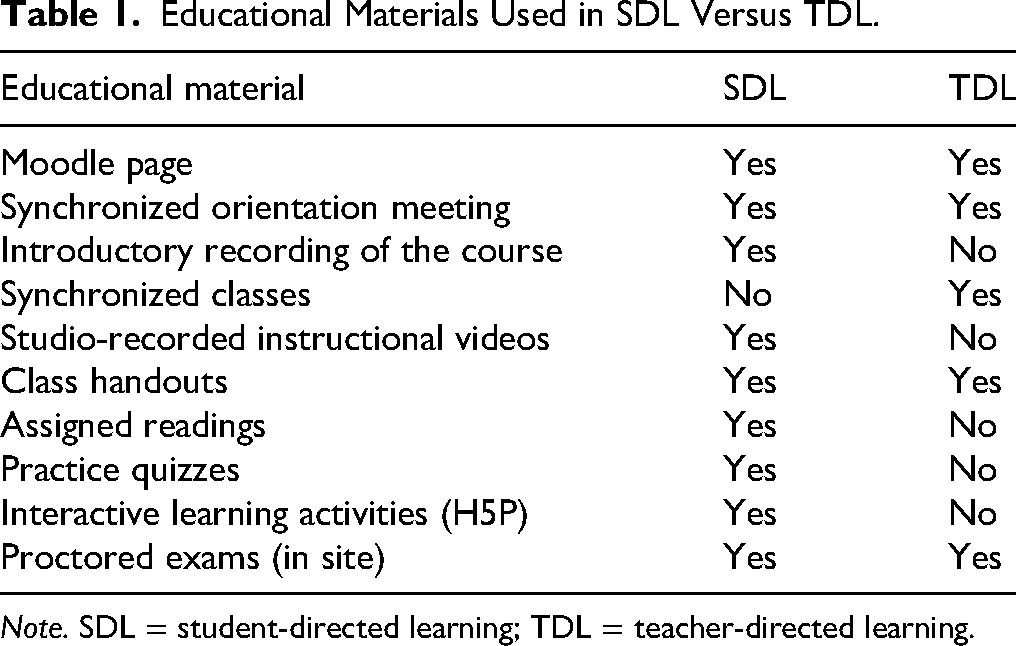
Note. SDL = student-directed learning; TDL = teacher-directed learning.
The course schedule is organized into seven modules. Each module begins with a general instructions page that outlines its objectives, content, and tasks. Within each module, recorded instructional videos from the Center for Education Technology feature the instructor presenting information alongside relevant graphics and images. Video segments are limited to a maximum of 15 min, and longer topics are divided into two parts to maintain student engagement.
After viewing the instructional videos, students participate in several interactive activities created using H5P (HTML5 Package) to reinforce the concepts learned. H5P is an open-source framework for engaging HTML5 content within platforms like Moodle (https://h5p.org/). A list of resources, including class handouts and accessible articles for further independent reading, is provided. At the end of each module, a short practice quiz helps students consolidate their understanding of the material. The completion of weekly activities is tracked using the activity completion feature in Moodle, which is subsequently used to register students’ attendance in class.
Measurements
The study outcomes included academic performance and student satisfaction. The measure of academic performance was the course exam scores. Additionally, students in the SDL group were asked to fill out a student satisfaction survey at the end of the semester.
Five experts in educational technology assessed the validity of the tool by examining both face and content validity, which reinforced its credibility. The researchers tested the tool's reliability using anonymous data from 42 undergraduate university students, provided by the Center for Educational Technology. The results showed a high internal consistency, with a Cronbach's alpha of .92 for the total items. Additionally, the Cronbach's alpha values for the domains of educational design, communication and interaction, and evaluation and feedback were .87, .84, and .76, respectively, further validating the survey's reliability.
Ethical Consideration
The research study received ethical approval from the Research and Ethics Committee of the College of Nursing, SQU (Ref CON/NF/2023/20). Due to the retrospective nature of data collection, written consents were waived. Therefore, we did not collect written informed consents from the students involved. Data were coded using numerical numbers instead of students’ identifying information such as names, University IDs, or emails. Electronic identifying data were securely stored in a password-protected computer within a locked office room. No identifying information was printed as hard copies. All methods were performed according to the ethical guidelines and regulations for research among human subjects following the Declaration of Helsinki.
Statistical Analysis
Quantitative data were entered in SPSS version 24. The researchers ran a descriptive analysis to calculate the means and standard deviations of the course exam scores. Prior to testing the relationships, the Shapiro-Wilk test was used to assess the exam score distribution. The test indicated nonnormally distributed data (p < .001) and thus the researchers followed the Mann-Whitney U nonparametric test to ensure the reliability of this study analysis. In educational settings, exam scores tend to deviate from normal distribution due to the unique students’ abilities and levels of readiness (Fendler & Muzaffar, 2008). The significant value was set at .05.
Moreover, the researchers computed the means, standard deviations, and percentages of the survey domains and overall scores for the SDL course satisfaction analysis. The percentage was calculated based on the mean: gained score/total score × 100.
Results
Students’ Characteristics
Data from 118 students were analyzed for academic performance, with 63 students in the SDL group and 55 in the TDL group. The percentage of male students was higher than that of female students, with 56.8% males compared to 43.2% females. In the SDL group, 55.6% of the students were male, while 58.2% of the students in the TDL group were male. No other information about students’ characteristics were available.
Student Academic Performance Through Exam Scores
Table 2 presents the descriptive statistics for student academic performance in the SDL and TDL, measured at three-time points (first, second, and final). A Mann-Whitney U test was conducted to compare exam scores between the SDL and TDL groups, with the rank-biserial correlation calculated to quantify the magnitude of the differences. At the first exam, the SDL group had a mean score of 24.97 (SD = 3.17), while the TDL group had a mean score of 25.85 (SD = 2.64). The results showed no significant difference between the two groups in the first exam, U = 1465.5, p = .15, r = .13. By the second exam, SDL score was higher than TDL score, 26.98 (SD = 2.76) and 26.29 (SD = 2.73), respectively. However, no significant difference was found, U = 1,424.5, p = .09, r = .15. At the final exam, the SDL group had a mean score of 50.19 (SD = 5.69), compared to the TDL group's mean score of 47.45 (SD = 7.16). Students in the SDL group performed significantly better in the final exam than the TDL group, with results indicating U = 1,326.0, p = .03, and r = .20, suggesting a small effect size.
Comparing the Means of Exam Scores Between the SDL and TDL Online Courses.

Note. SDL = student-directed learning; TDL = teacher-directed learning.
Outlier detection used Q–Q plots, with Z-scores greater than ±3 for confirmation. Statistics in the “After” column are based on the adjusted sample.
A simple boxplot of the final exam scores revealed three outliers in the TDL group (see Figure 2), representing 5.5% of the TDL dataset. The presence of these outliers was confirmed using the Z-score method, as their standardized scores exceeded ±3 (Bakker & Wicherts, 2014). Theses outliers scored 28, 23, and 24 in the final exam, far below the exam total score. Following the removal of these three data points, the mean score for the TDL group increased to 48.75 (SD = 4.760), and the effect was no longer significant (U = 1326, p = .08). Details of the statistics before and after outlier removal are available in Table 2.

Simple Boxplot of Final Exam Score by Class Type.
Satisfaction With SDL Course
For the satisfaction results pertinent to the SDL online course, 27 students participated, yielding a response rate of 42%. The overall mean satisfaction score was 72.15 (SD = 12.78), representing a satisfaction rate of 85%. Amongst the three main domains of the survey, educational design received the highest satisfaction rate (88.4%), followed by assessment and evaluation (86.4%), and lastly communication and interaction (78.8%). Further description of these domains means, and standard deviations are available in Table 3.
Means, Standard Deviations, and Percentages for Student Satisfaction with the SDL Online Course (N = 27).

Note. SDL = student-directed learning.
Discussion
Digital transformation in higher education offers numerous benefits, including an enhanced learning experience, flexibility, improved efficiency, collaboration, data-driven decision-making, lifelong learning opportunities, and innovation. Thanks to LMS, education has become more accessible, and at the same time is cheaper, allowing communities with limited resources to gain the same learning advantages. This study compared the academic performance of two groups of students enrolled in two different classes of an online university elective nursing course embedded in LMS. Class A received an SDL, while the Class B engaged in a traditional TDL. Additionally, the researchers evaluated students’ satisfaction with the SDL online course.
Our findings indicated that SDL contributed to better academic performance among the students when compared to TDL, particularly during the final exam. The SDL pronounced impact on the final exam compared to earlier assessments is possibly due to students’ initial unfamiliarity with the instructional approach. As students adapted throughout the semester, their performance significantly improved compared to those in traditional TDL classes. That said, the analysis associated the significant difference in the final exam scores to the few outliers observed among the TDL group. In fact, this could suggest the TDL's potential for triggering considerable variability in students’ performance, implying that SDL may contribute to better student assessment. Further investigation with robust research methodology and a large sample size would clarify this proposition.
The positive academic performance linked to SDL observed in this study is consistent with findings from other studies. For instance, Lau (2020) found that students enrolled in an economics course performed better academically when SDL strategies were employed, compared to TDL. Another study demonstrated that replacing a face-to-face cardiopulmonary resuscitation course with a Moodle self-directed course significantly increased participants’ knowledge (Ettl et al., 2022). Moreover, SDL has been linked to enhanced problem-solving skills and critical thinking, as revealed by nursing research (Song et al., 2022). In fact, the use of technology in self-directed learning has been shown to have a positive and direct association with students’ engagement, contributing to improved academic performance (Rashid & Asghar, 2016). A systematic review and meta-analysis of 12 studies involving 3,830 nursing students found that SDL levels increase as students advance in their program (Nazarianpirdosti et al., 2021), suggesting the need to adopt student-centered curricula and teach SDL skills early in the program.
Several factors influence academic performance outcomes in online education that employ SDL, which educators should be aware of. For instance, the frequency of students’ interaction with Moodle tasks and access to educational materials using LMS was associated with enhanced academic performance (Bravo-Agapito et al., 2021). Furthermore, a systematic review has indicated that teaching methods that promote individual study and small-group interactions, along with proper support from instructors, significantly improve SDL (Wong et al., 2021). Besides, better outcomes from online courses were perceived when content was designed with updated information, methodological, and instructional materials that allowed students to independently create their knowledge system using available resources (Subashkevych et al., 2021).
It is worth noting that SDL could be influenced by the subject being studied (Brandt, 2020). For instance, a study revealed that students achieved higher outcomes in macroeconomics topics when engaged in SDL classes, whereas their performance was stronger in microeconomics topics within TDL environments (Lau, 2020). Such findings suggest that students would have better self-direction in learning when engaged in general topics, such as the one examined in this study, potentially offering content generally comprehensible to the general population.
In practical health education, SDL through online platforms can be challenging, particularly because it often requires bedside training and skills teaching (Cheung et al., 2023). However, self-paced online modules focused on physical education and cardiopulmonary resuscitation have demonstrated acceptable feasibility and effectiveness (Chong et al., 2023; Cox et al., 2022). That said, opportunities still exist to promote online SDL teaching of practical nursing modules. Looking ahead, educators and instructional designers should strive to create balanced, learner-centered online learning environments that effectively empower adults to achieve their educational goals by maximizing aspects of student-led methodologies.
This study showed that students were satisfied with the SDL online course and across the educational, feedback and evaluation, and communications and interaction domains. The literature has generally highlighted the student's preference for online learning. Online problem-based learning and lecturing were preferable to students compared to face-to-face education (Cheung et al., 2023). More specifically, the findings of this study illustrate the high level of satisfaction with course design and assessment methods of SDL online courses, which might have contributed to student's good academic performance.
The communication domain, which pertains to interactions between students and teachers, as well as among students themselves, received a lower satisfaction rate compared to the other domains. This rate of satisfaction is expected in self-paced method of learning, where students’ dependence on the course teacher is less marked. Hence, the course design itself may benefit from more communication opportunities between students and teachers, or among peers. Furthermore, students may need to be adequately prepared for SDL classes to maximize their benefits. A meta-analysis has shown that training programs designed to educate students about SDL are effective in improving their skills and enhancing academic performance (Theobald, 2021).
Strengths
This study provides valuable insights into the benefits of online education, especially when paired with an SDL approach. Using a comparative study design, it effectively evaluates outcomes from two different conditions, ensuring that all students enrolled in the course participated in the assessment.
Limitations
There are a number of limitations to consider. Firstly, the sample size is limited, and more extensive studies with larger samples are necessary to confirm the findings. Additionally, this study did not have information on the characteristics of the participants, which hindered a correlation analysis between study outcomes and factors such as GPA.
Implications for Practice
The findings of this study highlight the need to integrate SDL not only in traditional face-to-face education but also in online education. This study shows that SDL in online education enhances academic performance and, at the same time, satisfaction, improving the student's learning outcomes. Applying such learning strategies in online education has the potential to promote the student's independent learning attribute, one of the significant nursing program learning outcomes. Thus, targeted faculty training on integrating SDL in teaching helps align the curriculum with current students’ learning demands. The need for further research is crucial to the ongoing development in nursing education. Replicating the study with robust research designs, including randomized controlled trials and using a larger sample size, is essential. Moreover, investigating the effect of integrating SDL into specialized online education and practical nursing education is a promising area for future research.
Conclusions
The finding of this study suggests that there is a potential for the students engaged in SDL online classes to have better academic performance and learning experiences. Embracing digital technologies is crucial for institutions to adapt to the evolving educational landscape and prepare students for the digital age. Further investigations with a larger sample size are necessary to validate the kinds of conclusions that can be drawn from this study. Future research also may focus on optimizing clinical learning strategies through digital transformation.
Supplemental Material
sj-docx-1-son-10.1177_23779608251365990 - Supplemental material for Academic Performance and Satisfaction of Student-Directed Learning in Online Education Among Multidisciplinary Undergraduate Students: A Retrospective Comparative Study
Supplemental material, sj-docx-1-son-10.1177_23779608251365990 for Academic Performance and Satisfaction of Student-Directed Learning in Online Education Among Multidisciplinary Undergraduate Students: A Retrospective Comparative Study by Basma Al Yazeedi, PhD, Zeinab Al Azri, PhD, Lina Shakman, MSN, Safiya Al Shidhani, MED and Maryam Al Kharusi, BSc in SAGE Open Nursing
Footnotes
Acknowledgments
The authors want to acknowledge the students who participated in this study. Also, thanks to the Center for Education Technology at Sultan Qaboos University for their guidance and support in designating the Moodle electronic course.

Funding
The authors received no financial support for the research, authorship, and/or publication of this article.
Declaration of Conflicting Interests
The authors declared no potential conflicts of interest with respect to the research, authorship, and/or publication of this article.
Supplemental Material
Supplemental material for this article is available online.
References
Supplementary Material
Please find the following supplemental material available below.
For Open Access articles published under a Creative Commons License, all supplemental material carries the same license as the article it is associated with.
For non-Open Access articles published, all supplemental material carries a non-exclusive license, and permission requests for re-use of supplemental material or any part of supplemental material shall be sent directly to the copyright owner as specified in the copyright notice associated with the article.
