




Abstract
Introduction
Nurses require good knowledge about professional values to provide quality nursing care. Implementing professional values in clinical areas improves the quality of patients care. Even though applying professional values had significant impact on the continuity and quality of nursing care, there is scarcity of study on professional values in Ethiopia.
Objective
The study was aimed to identify the level of nurses’ professional values and related factors among nurses employed in South Wollo Zone public hospitals.
Methods
A hospital-based, cross-sectional study was conducted among 422 nurses working in South Wollo Zone public hospitals from May to June 2023. Participants were selected by using simple random sampling technique. Nursing Professional Values Scale-Revised was used to measure the professional values. Data entry was performed using Epidata version 4.6.1 and then exported to Statistical Package for Social Sciences version 23.0 for analysis. To identify the strength of association between outcome and independent variables, binary logistic regression was applied. From the final model, those variables having p < .05 and adjusted odds ratio with 95% confidence interval were reported as statistically significant.
Results
The mean (±standard deviation) age was 32.29 (±7.01), with 63% of nurses being males. Less than half, 47.9% (95% confidence interval [CI]: 43.2, 53.4), of nurses had good professional values. Monthly income (adjusted odds ratio [AOR] = 0.33; 95% CI: 0.16, 0.72), position (AOR = 0.22, 95% CI: 0.13, 0.38), training (AOR = 0.56, 95% CI: 0.34, 0.92), promotion (AOR = 3.06, 95% CI: 1.84, 5.1), and respect from one’s profession (AOR = 0.48, 95% CI: 0.29, 0.78) were statistically associated with professional values.
Conclusion
The majority of nurses demonstrated poor professional values. Professional values were substantially correlated with monthly income, position, training, promotion, and professional esteem. In order to ensure the quality and continuity of patient care, we advised nurses to be aware of nursing professional values and apply them in clinical settings.
Introduction
Among medical professions, nurses offer all patients round-the-clock care and employ a holistic approach to patient care (Lai & Lim, 2012). Nurses work independently and collaboratively with other health professionals to provide health promotion, disease prevention, curative care, and rehabilitative services like hospice care, emphasizing empathy for dying patients and their families (Rassin, 2010). The foundational principles of nursing, which uphold professional ethics and ethical performance, include compassion, autonomy, human dignity, integrity, honesty, and social justice (Nursing, 1998).
Values can be personal and professional. Personal values are the character or conduct of individuals and the basis for professional values (PVs) (Olson & Stokes, 2016). Nursing PVs are established norms used by organizations and nurses to evaluate an individual’s or group's integrity (Brown et al., 2015). Nursing PVs are measured by caring, activism, professionalism, trust, and justice dimensions, and levels of nurses possessing these values are categorized as good if nurses answered more than the mean score of 26 items and poor if nurses answered below the mean score of 26 items (Özsoy & Donmez, 2015; Stewart et al., 2020).
Implementing PVs enhances life quality, increases career growth, fosters team spirit, and fosters collaboration among professionals (Swisher et al., 2004). Poor nursing PVs negatively impact services, growth, patient care, occupational satisfaction, retention, and commitment to health institutions (Cetinkaya-Uslusoy et al., 2017; Dehghani et al., 2015).
Ethical values, despite appearing routine, are often overlooked in clinical settings, suggesting the need for PVs to address current issues in nursing practice (Bang et al., 2011; Hariharan et al., 2006). Nurses’ values serve as pillars for their practice and guidelines for interactions with patients, colleagues, other professions, and the general public in medical decision-making (Kaya et al., 2017; Poorchangizi et al., 2019).
Ethical principles are crucial in nursing, ensuring care meets patients’ rights and fulfilling professional obligations. Nurses must actively engage with ethical issues to deliver optimal care (Bijani et al., 2019). Ethics education positively impacts PVs, but nurses often lack knowledge and differ in perspectives. Ethical dilemmas and values impact nurses’ professional lives, burnout, and decision-making in the profession (Boozaripour et al., 2018; Kim et al., 2015).
Nurses often learn routine clinical care skills in health institutions, but lack of knowledge affects patients and society. Integrating PVs in nursing education ensures future success and care concept (Brown et al., 2015).
PVs in nursing are influenced by factors like limited nurses, new diseases, an ageing population, technological advancements, and patient care needs. Knowledge and application of these values prevent medical errors (Bijani et al., 2019; Parandeh et al., 2015).
Hospitals can enhance the PVs of novice nurses by fostering stronger professional bonds and introducing experienced nurses to new nurses (Posluszny & Hawley, 2017). Studying PVs is crucial for research and clinical practice. Despite the fact that implementing these principles greatly increased the quality of nursing care, there is a shortage of research on PVs in Ethiopia. The current gap will be addressed by this study. As a result, the Ministry of Health and the Ethiopian Nursing Association may utilize this information to develop policies pertaining to the PVs of nurses. It also serves as a baseline for upcoming researches.
Literature Review
In order to deliver safe and ethical treatment, nurses everywhere need to uphold PV. Failure to do so can have a detrimental effect on the advancement of the nursing profession and the public’s opinion of healthcare (Poorchangizi et al., 2019).
A study conducted in Turkey found that the mean (± standard deviation [SD]) of PV score for nurses was 165.41 (±20.79). Factors of PV were age, length of service, education, marital status, position at work, and receipt of pertinent in-service training (Cetinkaya-Uslusoy et al., 2017). In another Turkish study, the mean (±SD) of PV score was 106.45 ± (13.61) (Geçkil et al., 2012).
According to an Iranian study, nurses’ scores in the justice and activism domains were 4.23 ± 0.44 and 3.40 ± 0.56, respectively (Bijani et al., 2019). Another study in hospitals of Isfahan, Iran, revealed a mean score of 101.53 ± 18.2, with no correlation found between PVs and sociodemographic traits (age, sex, and educational attainment; Shahriari & Baloochestani, 2014).
A cross-sectional study conducted on nursing students at Kerman University of Medical Sciences in Iran revealed that the mean score was 101.79 ± 12.42. The students determined that “preserving patient confidentiality” and “protecting patients’ right to privacy” were the two most significant values. “Participating in public policy decisions affecting distribution of resources” and “participating in peer review” were values that the students found less important (Poorchangizi et al., 2019).
Results in the United States of America (USA) showed that the following factors were related to a person's level of professionalism: length of nursing education, location of final degree attainment, membership in professional organizations, current nursing position, current employment status, work setting, and total years of nursing experience(Kim-Godwin et al., 2010).
A study conducted in the Ethiopian town of Hawassa revealed that the work environment, working unit, monthly income, and educational status of nurses were all significant determinants of their quality of work life (Kelbiso et al., 2017).
Another study on the professionalism of public hospitals in the South Wollo Zone found that factors such as sex, a positive self-image, a favorable organizational culture, job satisfaction, and involvement in nursing associations were all predictive of professionalism (Bekalu & Wudu, 2023).
PVs are crucial for nurses to provide quality and empathy patient care. Therefore, the purpose of this study was to identify the level of nurses’ PVs and related factors among nurses employed in South Wollo Zone public hospitals.
Materials and Methods
Study Settings, Design, and Period
Hospital based, cross-sectional study was conducted in South Wollo Zone public hospitals from May to June 2023. There are 740 nurses in 13 hospitals in South Wollo Zone public hospitals. The study hospitals were Boru Meda General Hospital, Mekane-Selam General Hospital, Akesta General Hospital, and Dessie Comprehensive Specialized Hospital. Dessie comprehensive specialized hospital serves more than 10 million people. It has 597 beds and provides medical, surgical, gynecology/obstetrics, pediatrics and child health, ophthalmic, chronic illness care, oncology, and other services. It has many specialists and subspecialist physicians. Currently, there are 293 nurses in the Dessie Comprehensive Specialized Hospital. Boru Meda General Hospital provides services like medical, surgical, gynecology/obstetrics, and pediatrics. This hospital is known for ophthalmic and dermatology services. There are 100 nurses in Boru Meda Hospital. It has 140 beds in Boru Meda General Hospital. Akesta General Hospital provides medical, surgical, pediatrics, and maternity services. It has 82 beds and 83 nurses. Mekane-Selam General Hospital provides medical, surgical, gynecology, obstetrics, and pediatrics services. There are 65 beds and 68 nurses in the Mekane-Selam General Hospital. In the study hospitals, there are 544 nurses.
Population
The source population was all nurses who had worked in South Wollo Zone public hospitals, while the study population was nurses who had worked in South Wollo Zone public hospitals during the data collection period.
Inclusion and Exclusion Criteria
The study included nurses who had worked at selected hospitals during the data collection period and excluded nurses with less than 6 months of work experience.
Determination of Sample Size
To calculate the sample size, a single population proportion formula was used. The assumptions were 95% confidence interval (CI) (1.96), 5% margin of error, and population proportion of PVs (50%) because of the absence of study in Ethiopia. By substituting the aforementioned values and inserting via the formula: z = the value of the standard normal curve score corresponding to the given CI = 1.96 p = estimated proportion of PVs (50%) as there is no previous study in Ethiopia as a researchers’ knowledge d = margin of error (the required precision) = 5%


Sampling Procedure and Sampling Technique
There are 13 hospitals in South Wollo Zone. Out of 13 hospitals, 4 hospitals were selected using the lottery method, and the number is determined using the thumb rule (30% of 13 hospitals). The selected hospitals with their respective numbers of nurses were Dessie Comprehensive Specialized Hospital (293), Boru Meda General Hospital (100), Akesta General Hospital (83), and Mekane-Selam General Hospital (68). Then proportional allocation was performed for selected hospitals. Actual participants in each hospital were as follows: Dessie Hospital = 227; Boru Meda Hospital = 78; Akesta = 64; and Mekane-Selam = 53. The number of nurses was obtained from the human resources office of each hospital. Finally, participants were selected using a simple random sampling technique. The total number of nurses who participated in the study was 422.
Study Variables
Outcome variable
The outcome variable was PVs (good and poor).
Independent Variables
Independent variables were sociodemographic characteristics (sex, age, marital status, educational status, and monthly income) and profession/hospital-related factors (training, promotion, and position, membership in nursing association, life insurance, work setting, lack of support and focus to the profession by government, poor organization of the Ethiopian Nursing Association, and respecting of the profession).
Data Collection Instruments (Tools)
A structured, self-administered questionnaire was used to collect data. The questionnaire was first prepared in English, then translated to Amharic (the local language), again back translated to English by a language expert to maintain its consistency. The questionnaire had two parts: part I sociodemographic variables and part II the attributes of PVs in nursing. The Nursing Professional Values Scale-Revised (NPVS-R) was composed from five dimensions: caring (9 items), activism (5 items), professionalism (4 items), trust (5 items), and justice (3 items). Participants specified the importance of each item on a five-point Likert scale ranging from 1 to 5 (1 = not important, 2 = somewhat important, 3 = important, 4 = very important, and 5 = the most important). The score ranges from 26 to 130, with a higher number indicating a greater PV. The internal consistency was checked using Cronbach's alpha coefficient for 26 items with a values of 0.92. The values in Cronbach's alpha were 0.72, 0.73, 0.85, and 0.86 for trust, activism, caring, and professionalism dimensions, respectively (Özsoy & Donmez, 2015). In another previous study, the values of the Cronbach's alpha coefficient for professionalism, justice, caring, activism, and trust were 0.77, 0.7, 0.85, 0.82, and 0.75, respectively (Weis & Schank, 2009).
Validity and reliability of the tool were checked. Validity was checked by nursing experts from academicians, senior clinicians, and nurses working in nursing associations. The reliability of the tool was checked using Cronbach's alpha coefficient with a value of 0.94. The reliability of each dimension is checked: caring dimension (9 items) = 0.86, activism (5 items) = 0.83, trust (5 items) = 0.83, professionalism (4 items) = 0.80, and justice (3 items) = 0.77. Both individual and overall reliability of the tool are above the acceptable value.
Data Quality Management
Supervisors and data collectors received training regarding the purpose of the study and the data collection procedure in order to guarantee the quality of the data. The lead investigator and supervisors had regular phone communications and implemented continuous oversight. Prior to the collection of data, a pretest was conducted at Woldia Hospital (5% of sample size).
Data Processing and Analysis
The collected data was coded and entered into Epidata version 4.6.1 and then exported to SPSS version 23.0 for analysis. Binary logistic regression was applied to see the associations between dependent and independent variables. Variables having a p ≤ .25 in bivariable analysis were candidates for multivariable analysis to control the possible effect of confounding. Adjusted odds ratio and 95% CI were used to identify the presence and strength of association, and p < .05 was declared as statistically significant. Model fitness was checked by the Hosmer–Lemeshow test.
Results
Out of 422 nurses, all of them fill out the questionnaire, which yields a 100% response rate.
Sociodemographic Characteristics of Nurses
The mean age (±SD) was 32.29 (±7.01), with 63% of nurses being males. Nearly two-thirds (67.8%) of nurses had a degree. More than half (53.1%) of nurses had 5 to 10 years of work experience. Age over 40 years, females, having a master's degree, earning more than 8,000 birr per month, and having worked for more than 10 years had a high score on PVs (Table 1).
Sociodemographic Characteristics of Nurses with Relationship to Professional Value.

Profession/Government/Hospital-Related Factors
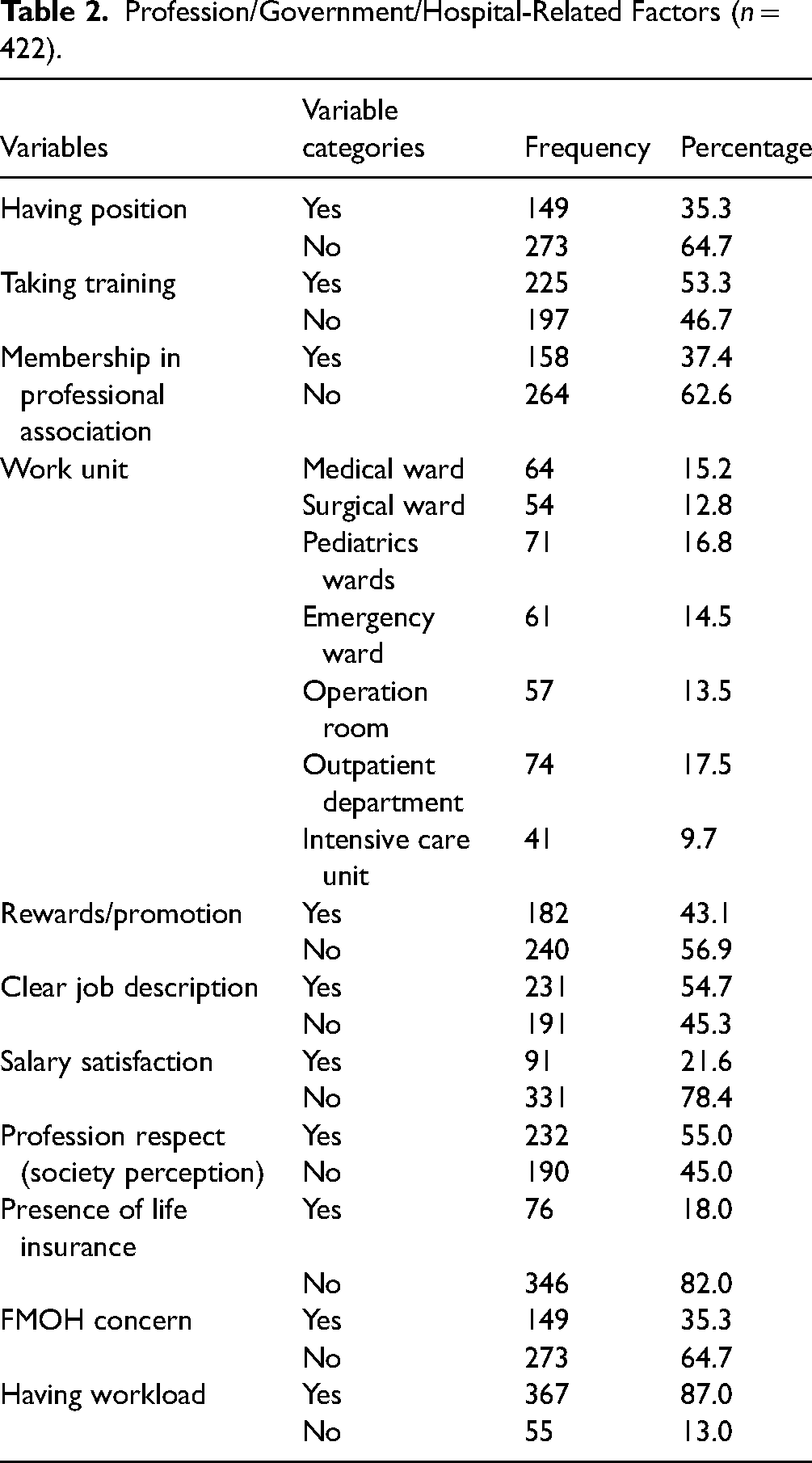
Two hundred twenty-five (53.3%) of nurses had taken training in hospitals. Regarding membership in professional associations, 37.4% of nurses had membership. Most (78.4%) of nurses were dissatisfied by their monthly salary (Table 2).
Profession/Government/Hospital-Related Factors (n = 422).
NPVS-R
The most important response is that, from the trust dimension, 23.7% of nurses maintain competency in their area of practice; from the justice dimension, 27.3% promote equitable access to nursing and healthcare; from the professionalism dimension, 22.5% participate in peer review; from the activism dimension, 22.7% participate in professional nursing association activities; and from the caring dimension, 21.1% act as patient advocate (Table 3).
Nurses’ Response to Nursing Professional Values Scale-Revised.

Scores of Nurses to PVs Based on Five Dimensions
The mean (±SD) scores of nurses on justice, professionalism, activism, trust, and caring were 11.49 ± 2.35, 15.11 ± 2.99, 18.4 ± 3.61, 19.02 ± 3.45, and 32.74 ± 5.99, respectively. Nurses’ scores are high in the caring domain but low in the justice domain. Additionally, nurses score high in seeking additional education to update knowledge and skills and low in maintaining confidentiality of patients (Table 4).
Scores of Nurses to Professional Values Based on Five Dimensions.

Level of PVs in Nursing
A histogram was used to verify the normal distribution following the computation of each participant's answers. Fifty-six was the minimum score, while 129 was the maximum. The mean (±SD) of PVs was 97.69 (±15.24). The participants were divided into two groups according to this value. As a result, good PVs were held by 47.9% (95% CI: 43.2–53.4), whereas poor PVs were held by 52.1% (95% CI: 46.6–56.8) (Figure 1).

Levels of nurses’ professional values in South Wollo Zone public hospitals.
Factors Associated with PVs
Following cross-tabulation, binary logistic regression was carried out. Variables having p-values less than 0.25 were candidate to multivariable analysis to control confounding. In multivariable analysis, PVs were substantially correlated with monthly income, position, training, promotion, and professional esteem.
PVs were substantially correlated with monthly income. Compared to nurses whose monthly income exceeded 8,000 Ethiopian birr, those whose income was less than 5,000 Ethiopian birr had a 67% lower rate of good PVs (adjusted odds ratio [AOR] = 0.33, 95% CI: 0.16, 0.72, p = .004).
Possession of a post was strongly correlated with PVs. Compared to nurses with positions in hospitals, those without positions were 78% less likely to hold high PVs (AOR = 0.22, 95% CI: 0.13, 0.38, p = .0001).
In a similar vein, PVs and training attendance were highly correlated. As a result, compared to nurses who had received training, those who had not had it were 44% less likely to hold good PVs (AOR = 0.56 [0.34, 0.92], p = .021).
Promotions in hospitals have a strong correlation with PVs. Compared to their counterparts, nurses who had received a promotion or other award were 3.06 times more likely to hold good PVs (AOR = 3.06, 95% CI: 1.84, 5.1, p = 0.0001).
Finally, there was a strong correlation between PVs and having professional respect. Compared to their counterparts, nurses who lacked professional respect were 52% less likely to have strong professional worth (AOR = 0.48, 95% CI: 0.29, 0.78, p = .003) (Table 5).
Factors Associated with Compliance with Professional Values.

Note. AOR = adjusted odds ratio, COR = crude odds ratio. *Statistically significant at p < .25.
Discussion
Worldwide, nurses must possess PVs to provide safe, ethical care, as a lack of these qualities can negatively impact the profession's development and public perception of healthcare. As the largest healthcare group, nurses have significant and well-known PVs. The quality of patient care, nurses’ job happiness, nursing retention, and organizational commitment all enhanced when these ideals were used in nursing practice (Bang et al., 2011; Dehghani et al., 2015; Poorchangizi et al., 2019).
In this study, the mean (±SD) score of PVs was 97.69 (±15.24). This finding is less than studies conducted in Turkish (165.41 ± 20.79) (Cetinkaya-Uslusoy et al., 2017), 106.45 (±13.61) (Geçkil et al., 2012), and Iran (101.53 ± 18.2) (Shahriari & Baloochestani, 2014), 101.79 ± 12.42 (Poorchangizi et al., 2019). The difference may be due to sociodemographic characteristics of participants, setup of hospitals, sample size, and study time.
The study found that 47.9% (95% CI: 43.2–53.4) of nurses had good PV. This result was in line with earlier research (Mintrop, 2012). This study showed that South Wollo Zone public hospital nurses have poor expectations for PVs. It has an impact on patient care and the nursing profession's development.
The findings of the present study indicated that nurses scored 11.49 (±2.35) in the justice domain, whereas their scores in the activism area were 18.4 (±3.61). The findings of this study are more significant than those of a study carried out in Iran, which demonstrated that nurses have a score of 4.23 ± 0.44 in the justice area and 3.40 ± 0.56 in the activism domain (Bijani et al., 2019). It is possible that the discrepancy is related to the design of the study. In Iran, the study was a comparison study between nurses, nursing students, and nursing instructors. The study venues included teaching hospitals and nursing schools. Nevertheless, the current study is centered on nurses, and the hospitals that are being studied are not teaching hospitals.
In terms of variables, PVs were strongly correlated with position. Compared to their peers, nurses without a position in the hospital had a 78% lower likelihood to have good PVs. This finding was supported by earlier study in the USA (Kim-Godwin et al., 2010). A plausible rationale for the reason could be that a position entails accountability and duty for completing tasks. Then, in order to help others, nurses read more and more. Having a role may also provide them with the opportunity to speak with senior nurses and other professionals who are knowledgeable about professional ideals.
Results from the USA showed that professionalism was correlated with their work environment, experience, and membership in professional organizations (Kim-Godwin et al., 2010). On the other hand, our research revealed that years of experience, working environment, and nursing association participation are unrelated to PVs. The participants’ sociodemographic makeup, the manner in which the data was gathered, and the instruments (tools) employed could all be to blame. In the USA, survey was mailing, whereas the current study used paper-based data collection. In terms of instruments, a study conducted in the USA examined professionalism as the only domain of PV; the current study evaluates all PV domains.
There was a strong association between PVs and received training. Compared to their peers, nurses who were not enrolled in training had a 44% lower likelihood of adhering to PVs. This is because improving knowledge and skills is one of the goals of training. As a result, nurses with training may be familiar with PVs.
Similarly, there was a strong correlation between monthly income and PVs. Consequently, compared to nurses whose monthly salary exceeded 8,000 Ethiopian birr, those whose monthly income was less than 5,000 Ethiopian birr had a 67% lower rate of PVs. A plausible rationale for this could be that nurses’ quality of life may be enhanced if their monthly salary suffices to meet their fundamental demands. They might therefore implement professional values. This is in line with earlier research conducted in Ethiopia (Kelbiso et al., 2017).
In hospitals, PVs were strongly correlated with promotions. Compared to their peers, nurses who had received promotions had a 3.06-fold higher likelihood to have good PVs. This is because nurses use PVs in clinical settings and become motivated upon receiving promotions.
PVs were substantially correlated with having professional respect. Compared to their counterparts, nurses who lacked professional esteem had a 52% lower rate of having good PVs. This phrase could be interpreted as meaning that nurses employ PVs in the clinical setting to ensure the quality of patient care and that they are respected by the community and government bodies.
The prior study found that sex, job satisfaction, and membership in nursing associations were predictors of professionalism (Bekalu & Wudu, 2023). The current research, however, indicates that the aforementioned characteristics do not differ in terms of PVs. The instrument that the authors used may have caused the discrepancy, as the prior study solely focused on professionalism as a single domain, whereas the current study examines PVs as measured by five domains.
Another finding revealed nurses score high in seeking additional education to update knowledge and skills, and low in maintaining confidentiality of patients. This contrasts with earlier research conducted in Iran (Poorchangizi et al., 2019). Students in Iran score high in maintaining confidentiality of patients but low in taking part in peer review. The sample size, settings, participant characteristics, and nursing education curricula could all be factors in the discrepancy. For example, although the current study includes employed nurses, participants in Iran were nursing students.
Strength and Limitation of the Study
Strength of the Study
The study is pioneering in Ethiopia, and the sample size was adequate enough to give generalizations. Furthermore, a multicenter investigation was carried out.
Limitation of the Study
NPVS-R is not validated for the Ethiopian population, and the results do not allow conclusions to be drawn about causality since the design is cross-sectional. Another, since data was collected using a self-determination question, which leads to overestimation or underestimation, might occur.
Implication for Practice
PVs are essential to providing high-quality treatment, avoiding medical errors, and fostering ongoing professional development in the field of nursing practice. Nursing educators, researchers, students, nursing associations, and policymakers will use the findings to inform nursing care. It is generally important from a theoretical and practical standpoint for nursing professionals as nursing treatment in the absence of PVs is meaningless.
Conclusion
The majority of nurses demonstrated poor PVs. PVs were substantially correlated with monthly income, position, training, promotion, and professional esteem.
Recommendation
Nurses must be knowledgeable about nursing professional values and apply them in clinical settings to ensure quality and continuity of patient care.
Universities and colleges should improve professional values instruction in nursing school curricula and offer continuing education opportunities for practicing nurses.
The Ethiopian Nursing Association is urged to adhere to the nursing code of ethics and establish updated standards to uphold nursing profession values.
The Ministry of Health collaborates with other organizations to address nurses’ dissatisfaction with their salaries and incentives while also establishing clear job descriptions.
The next researchers will conduct large-scale studies on professional values using mixed methods, including quantitative and qualitative approaches.
Footnotes
Research Ethics and Patient Consent
An ethical letter was obtained from Wollo University, College of Medicine and Health Sciences, ethical review committee (reference number: CMHS/228/2014). Letter of permission was obtained from chief executive officers of the study hospitals. Informed consent was obtained from the study participants prior to the study commencement. The objective of the study was clearly explained to the study participants. Data was collected anonymously to ensure confidentiality, and all data collection was conducted in compliance with the Declaration of Helsinki.
Acknowledgments
We would like to express our special thanks to Wollo University. We would also like to extend our special thanks to data collectors, supervisors, and the study participants for their valuable contribution for the study.
Author's Contribution
All authors made a significant contribution to this research. All authors had significant role in the conception, study design, execution, acquisition of data analysis, and interpretation. Lastly, all authors approve the final version of the article to be published; have agreed on the journal to which the article has been submitted; and agreed to be accountable for all aspects of the work.
Declaration of Conflicting Interests
The authors declared no potential conflicts of interest with respect to the research, authorship, and/or publication of this article.
Funding
The authors received no financial support for the research, authorship, and/or publication of this article.
Data Sharing Statement
All necessary data are available from the corresponding author at any time.
