




Abstract
Introduction
Twenty-two Arab countries comprise the League of Arab States. While united in Arab identity, diversities among these countries exist at many levels. Conducting and publishing research in the Arabic speaking countries is an essential pillar for improving the status of the nursing profession.
Purpose
The purpose of this study is to assess the current status, trends, challenges, and opportunities of nursing research in Arab countries.
Methodology
An integrative review was conducted using (1) Index Medicus for the Eastern Mediterranean Regional Office Database Journals Directory (IMEMR), (2) the Iraqi Academic Scientific Journals Database (IASJD), (3) Ulrichsweb (UW), (4) The Geneva Foundation for Medical Education and Research/Middle Eastern Journals (GFMER), (5) the Nursing Journal Directory (NJD), (6) the Directory of Open Access Journals (DOAJ), and (7) Google Scholar. Journals and articles that met inclusion criteria were accessed, retrieved, reviewed, and subjected to content analysis by three authors, two of which were fluent in English, French, and Arabic languages. A third author fluent in all three languages confirmed the findings.
Results
Nursing research in Arabic-speaking countries has evolved over the past decades but is still lacking compared to global nursing research. Moreover, it was found to be largely situated within academic institutions and linked to tenure and promotion requirements.
Conclusion
Nursing journals in Arabic-speaking countries do not adequately represent that overall region and are limited in access.
Keywords
Introduction
Twenty-two Arab countries comprise the League of Arab States including Algeria, Bahrain, Comoros, Djibouti, Egypt, Iraq, Jordan, Kuwait, Lebanon, Libya, Mauritania, Morocco, Oman, Palestine, Qatar, Saudi Arabia, Somalia, Sudan, Syria [membership suspended in 2011 and reinstituted in 2023], Tunisia, the United Arab Emirates, and Yemen (League of Arab States, 2023). While united in Arab identity, diversities among these countries exist in terms of cultural beliefs and practices, native dialects and languages spoken (Arabic, French, and/or English), religious beliefs and practices, cuisine and dietary habits, tobacco consumption, economic status, healthcare issues, and health literacy research (Wikkeling-Scott et al., 2019).
Some of the more affluent Arabic Eastern Mediterranean countries experienced increasing prosperity and modernization due to the discovery of oil which resulted in an influx of migrant populations and expatriate communities. Resulting lifestyle changes and environmental factors such as diet, exercise, and pollution led to an increase in morbidity and mortality rates and chronic and noncommunicable diseases such as obesity, diabetes, cancer, cardiovascular disease, and chronic respiratory disease (Aggarwal et al., 2020; Wikkeling-Scott et al., 2019). In 2021, 537 million adults around the world (20–79 years) were living with diabetes. This number is forecasted to rise to 643 million by 2030 and 783 million by 2045.In 2021, it was estimated that diabetes was prevalent among 24.9% of adults aged 20–79 in Kuwait, and 20.9% in Egypt (IDF Diabetes Atlas, 2021).
In contrast, wars and poor economic conditions leading to unparalleled mass emigration and political turmoil in the region resulted in an increase in chronic malnutrition and infectious diseases in affected countries. Jordan saw a reemergence of polio and measles after the influx of Syrian refugees (Alhusaini et al., 2016; Sun et al., 2019). As a result of rapidly worsening economic conditions, Lebanon experienced a cholera outbreak due to reduced access to clean water and proper sanitation services (World Health Organization, 2022). Infectious diseases are on the rise in the region. The increasing trend of new HIV infections is a growing public health concern as the newly diagnosed HIV infections in the region have increased by 31% since 2001, which is the largest regional increase in the world (Karbasi et al., 2023; Shakiba et al., 2021). The rise in HIV infections is often associated with social stigma, lack of education, and poor access to treatment in this region.
In some Arab countries, a shift from time spent outdoors and traditional diets to increased time indoors and consumption of fast food, carbohydrates, saturated and trans fats, sugar, and salt, coupled with a decrease in physical activity, and a large consumption of tobacco products [a cultural norm in that region], led to an increase in poor health outcomes. As a result, obesity and tobacco use have become the new source of adolescents’ health risk. Obesity is especially prevalent in Jordan, Egypt, Morocco, Oman, Tunisia, Turkey, Saudi Arabia, and Kuwait (Wikkeling-Scott et al., 2019).
Similar to other regions, there is a shortage of nurses in Middle Eastern countries (Alhusaini et al., 2016). In the United Arab Emirates (UAE), only 4% of nurses are of Emirati nationality, and the remaining 96% are expatriate workers from the Philippines, Pakistan, other Arab countries (such as Lebanon and Jordan), and the British Commonwealth. Two-thirds of the expatriate nurses are educated at the diploma level with British nurses mainly operating in senior leadership positions (McCreaddie et al., 2018). Because of poor economic conditions, Lebanon experienced a mass exodus of healthcare professionals who left the country to seek employment in Europe, North America, and other Arab countries, resulting in more than 3,500 out of a total of 10,040 hospital nurses leaving their profession and creating a significant nursing shortage (Alameddine et al., 2020).
For nurses practicing in Middle Eastern and other Arabic speaking countries, it is extremely important that they have access to current research and evidence-based practice that are natively produced to guide and inform their own clinical practice and research (Alhusaini et al., 2016). It is equally important that they have the education, skills, mentorship, and resources needed to conduct and disseminate their own research of significant local issues in languages that are understood by nurses in the region. Moreover, healthcare practices, beliefs, and norms can differ considerably across cultures and regions. Conducting and publishing research in the native language allows Arab nurses to tackle healthcare issues from a culturally sensitive perspective, considering local customs and traditions. Arab nurse researchers play an important role in contributing to the global body of nursing knowledge. As the Arab diaspora increases in Western and other countries, such as the United States, Australia, Canada, France, and Britain, it is crucial to have access to studies done in the Arab countries that promote global cultural competency in nursing practice (Dardas et al., 2019).
Purpose
The purpose of this study is to assess the current status, trends, challenges, and opportunities of nursing research in Arab countries.
Method
To decrease the risk of bias, an integrative review was conducted independently by three authors with international collaboration with a fourth author to examine: (1) the current availability of local nursing journals in Arabic-speaking countries and (2) the current status and trends of Arab nursing research and challenges and opportunities facing nursing research and researchers in that region. Three of the four authors who contributed to this narrative review are fluent in Arabic, French, and English and were therefore able to access resources in all three languages. Results of the search using the databases identified below were reviewed. Duplications were removed and journals and articles that met inclusion and exclusion were identified. A PRISMA graphic was developed to illustrate the process followed in data collection.
Journals and articles that met inclusion criteria were accessed, retrieved, reviewed, and subjected to content analysis. The current status of nursing research dissemination in Arabic-speaking countries, and the opportunities and challenges facing Arab nursing research and researchers in that region, are presented in narrative form.
Information Sources
Review of the Literature
To identify nursing journals published in any of the 22 Arabic-speaking countries previously listed, an electronic search was conducted by three authors, two of which were fluent in English, French, and Arabic languages. A third author fluent in all three languages confirmed the findings. Two university-employed librarians assisted with this search. The following databases were used: (1) Index Medicus for the Eastern Mediterranean Regional Office Database Journals Directory (IMEMR), (2) the Iraqi Academic Scientific Journals Database (IASJD); (3) Ulrichsweb (UW), (4) The Geneva Foundation for Medical Education and Research/Middle Eastern Journals (GFMER), (5) the Nursing Journal Directory (NJD), (6) the Directory of Open Access Journals (DOAJ), and (7) Google Scholar.
To identify previously published integrative, scoping, narrative, systematic reviews, bibliometric analyses, and articles related specifically to the overall status of nursing research published by nurses in Arabic-speaking countries, an electronic search was independently conducted by three authors using the following databases: (1) PubMed; (2) Scopus; (3) Google Scholar; and (4) Cumulated Index to Nursing and Allied Health Literature (CINAHL). The comprehensive searches were conducted using a combination of search terms including: nursing; nurse; journal; research; study; Arabic; Arab; Middle East; Mediterranean; Gulf; Algeria; Bahrain; Comoros; Djibouti; Egypt; Iraq; Jordan; Kuwait; Lebanon; Libya; Mauritania; Morocco; Oman; Qatar; Saudi Arabia; Somalia; Sudan; Syria; Tunisia; United Arab Emirates; Yemen; Palestinian territories; scoping review, bibliometric analysis, narrative review, integrative review, and/or systematic review.
Eligibility Criteria
Given the broad field of the nursing profession, nursing journals, and international allied health journals that identified nursing or nursing specialties within their journal's respective aim and scope were included in this review. To provide an exhaustive snapshot of nursing journals in this region, both active and interrupted or ceased journals as well as open access journals were included. Primary languages used in this region which are Arabic, English, and French were used for the search. Journals and articles with a primary focus on human medicine, medical specialties, veterinary medicine, nutrition, public health, health sciences, dentistry, and other allied health-related disciplines of the health profession were excluded from this review, unless nursing was specifically highlighted as a contributing discipline. Manuscripts for nursing research and journals outside of the 22 identified Arabic-speaking countries were excluded.
For articles addressing the status of nursing research in the Arab region, the review was limited to manuscripts published between 2016 and 2023. Articles that published studies conducted in the region to address specific topics as opposed to the overall status of nursing research in the region were excluded. Given the nature of this review, ethical approval was not necessary and therefore not obtained.
Results
Availability of Local Nursing Journals
In total 2902 American, European, and international nursing journals were located. These included 983 journals retrieved from IMEMR, 250 journals from the Nursing Journal Directory, 294 from DOAJ, 120 from the GFMER, 387 from the Iraqi Academic Scientific Journals Database, 35 from UlrichsWeb, 200 via assistance from the two university librarians, and 633 from Google Scholar. Three researchers independently reviewed the titles of all journals, and a fourth author confirmed the results. Duplicates and journals that did not meet inclusion criteria were removed. The authors fluent in Arabic, French, and English visited the journal websites to confirm journals’ eligibility and retrieved the journals’ publication period, activity status, country of origin, language(s) used, print format, and open access/peer reviewed status. Figure 1 depicts the PRISMA Flow Diagram depicting the process used for data collection and analysis.

PRISMA 2020 flow diagram for identification of nursing journals published in Arab-speaking countries. Adapted from: Page et al. (2021). DOAJ=Directory of Open Access Journals; GFMER=Geneva Foundation for Medical Education and Research/Middle Eastern Journals; IASJD=Iraqi Academic Scientific Journals Database; IMEMR=Index Medicus for the Eastern Mediterranean Regional Office Database Journals Directory; NJD=Nursing Journal Directory; GS= Google Scholar; UW=Ulrichsweb.
Current status of Arab Nursing Journals
Thirty-five journals that date between 1987 to present time were identified including 28 nursing journals and eight interdisciplinary health journals that include nursing as a contributing discipline (see Table 1). Four of the 28 nursing journals are no longer active and have ceased publication resulting in only 24 currently active nursing journals. All 31 active nursing and interdisciplinary health journals publish in the English language and only four currently publish in Arabic in addition to English. Of the four journals that ceased publication, all published in English, two also published in Arabic, and one additionally published in French. None of the currently active journals publish in French. It is worth noting that half of the Lebanese nurses are taught in French universities and therefore speak and understand French. All journals are peer-reviewed and all but one is open-access journals. One of the ceased nursing journals was published in print format and the remaining three were published electronically. Of the 31 active nursing and interdisciplinary health journals, one is published in print format only, 14 online, and 17 in both print and online formats.
Nursing Journals From Arabic-Speaking Countries.
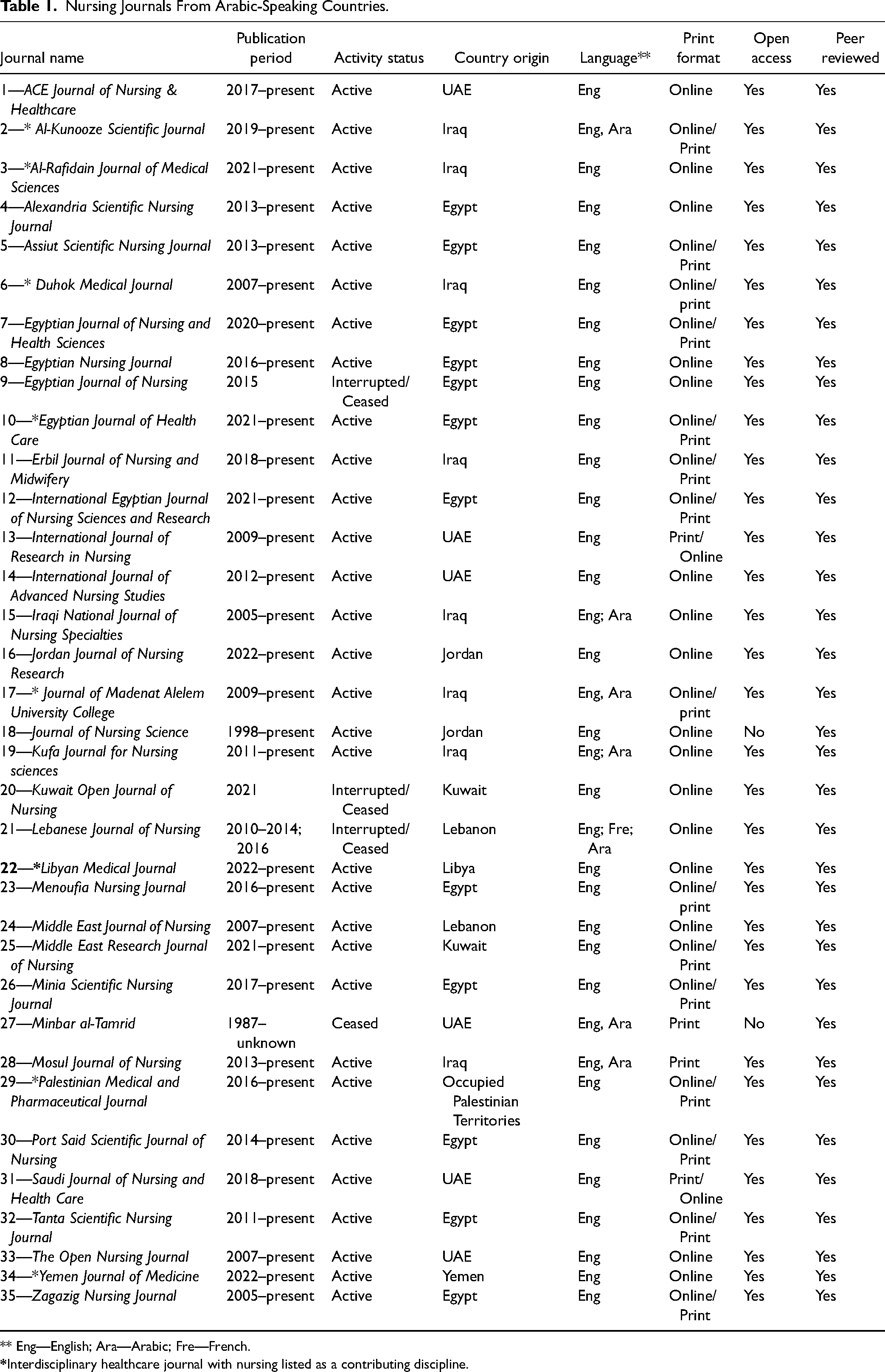
** Eng—English; Ara—Arabic; Fre—French.
Of the 31 active journals, 11 originate in Egypt, eight in Iraq, five in UAE, two in Jordan, one in Lebanon, one in Kuwait, one in Libya, one in the Palestinian territories, and one in Yemen. The four ceased nursing journals originated in Lebanon, UAE, Egypt, and Kuwait. Minbar Al Tamrid was the first nursing journal established in Iraq in 1987 in both the Arabic and English languages (now ceased) followed by Journal of Nursing Science (1998) in Jordan and Zagazig Nursing Journal (2005) in Egypt. The three most recent journals established in 2022 are the Jordan Journal of Nursing Research, the Libyan Medical Journal, and the Yemen Journal of Medicine. It was noted that 12 journals were established and launched since 2018 and 15 active nursing journals had affiliations with local universities or colleges of nursing.
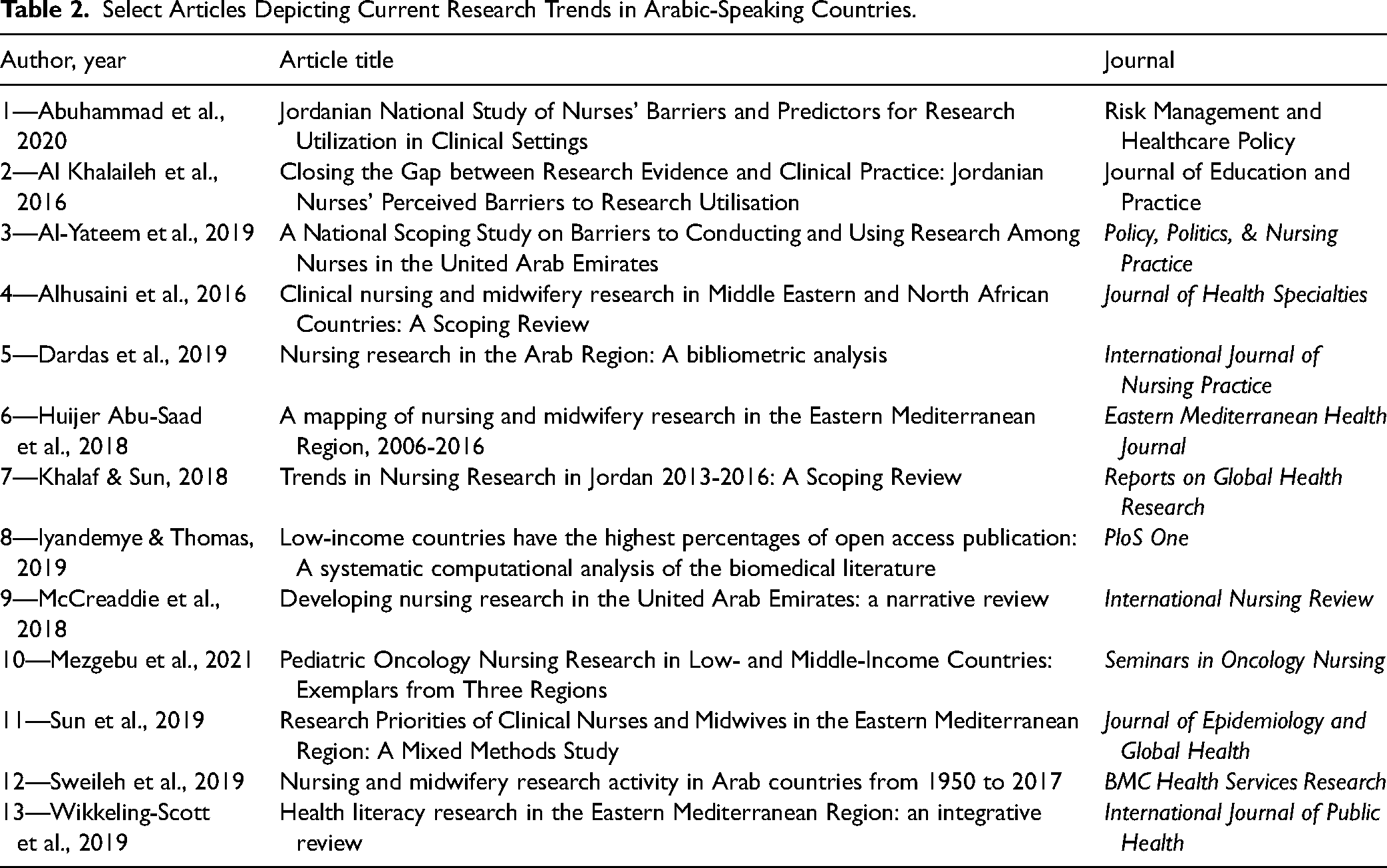
Thirteen integrative, scoping, narrative, systematic reviews, mixed methods, bibliometric analyses, and articles related to nursing research published by nurses in Arabic-speaking countries were identified (see Table 2). Six additional integrative reviews were located but were found to focus on other healthcare disciplines and were therefore excluded from this review. Manuscripts that met inclusion criteria were analyzed for current nursing research status, trends, challenges and opportunities facing nursing research and researchers in Arabic-speaking countries.
Select Articles Depicting Current Research Trends in Arabic-Speaking Countries.
Challenges in Publications
Mezgebu et al. (2021) examined pediatric oncology nursing research in low- and middle-income countries (LMICs) including the Eastern Mediterranean region. They found that low-income countries contributed the highest publishing rates in open-access journals. This finding was similarly supported by Iyandemye and Thomas (2019) who related this phenomenon to the fee waivers and significant publishing discounts offered to authors in low-income countries. Mezgebu et al. (2021) identified numerous barriers facing nursing researchers in that area, including but not limited to: (1) insufficient nursing salaries and research funding, with most funding being dedicated to physicians, rendering the nurse researcher dependent on doctors to conduct research; (2) minimal research mentoring and support; (3) high nursing workloads that increase nurses’ stress and leave no time for research; (4) limited equality in multidisciplinary teams with nurses being considered as physician subordinates; and (5) low and undervalued nursing image resulting in a lack of motivation to perform extra tasks such as research.
Opportunities for Nursing Research in Arab Countries
Mezgebu et al. (2021) recommended the following strategies to improve nursing research in the region: (1) increase nursing funding to facilitate pursuit of advanced nursing education, provide protected research time, and incentivize nursing research; (2) reduce nursing workloads so that nurses are able to conduct research as part of their job and not as a secondary task; (3) provide access to mentoring and support and educational preparation for nursing research; (4) promote nursing's role in multidisciplinary teams; and (5) establish nursing representation and participation in policy decision making at the governmental level. The authors additionally recommended strengthening academic and practice partnerships so that nursing educators can play a more active role in preparing practicing nurses in the research process.
Research Priorities in the Arab Countries
Sun et al. (2019) conducted a mixed-method study to investigate research priorities in the Western Mediterranean region. Some of the identified research priorities included: (1) strategies to relieve nursing shortages, nursing burnout, and improving the public perception of nursing as a profession; (2) health systems research focusing on health team workflow, standardization of nursing practice and training, protocols, infrastructure, and lack of resources; (3) culturally relevant patient care, especially in the areas of patient education, pain management, palliative care, mental health, and Women's Health; and (4) knowledge and skill gaps specifically in relation to evidence-based practice and being informed on current research.
Sweileh et al. (2019) conducted a bibliometric analysis and reviewed 2,935 nursing and midwifery Eastern Mediterranean research documents published between 1950 and 2017. They found that the contribution of nursing research from Arab countries was <1% of the global output, with Jordan ranking first in research output, followed by Saudi Arabia, Egypt, and Lebanon. Lebanon ranked first in the percentage of documents published in high rank Q1 (first quartile or top 25%) journals followed by Qatar and Jordan. The UAE ranked first in the percentage of publications with international authors followed by Qatar then Iraq. The most active academic institutions involved in publication were the University of Jordan, the Jordan University of Science and Technology, and the American University of Beirut (AUB). Noncommunicable diseases and nursing education were identified as the focus of nursing research in the Arab world.
Sweileh et al. (2019) noted that the 10 most cited articles were published in six medical or interdisciplinary health care journals, and three nursing journals. The five most active journals used for publication by nursing researchers from Arab countries were Life Science Journal, International Nursing Review, International Journal of Nursing Practice, Eastern Mediterranean Health Journal, and Journal of Advanced Nursing. The authors found that most of the published documents were of local or regional interest and that international journals were sought for dissemination due to a lack of nursing and midwifery journals published in the Arab region. They concluded that nursing research activity has increased dramatically in Arab countries but still lag in quality and quantity compared to developed countries (Sweileh et al., 2019).
Dardas et al. (2019) conducted a bibliometric analysis of 3,623 nursing research documents published between 2001 and 2017. They noted that only 38 Arab nursing publications were documented before 1990, compared to 114 between 1990 and 2000, and 3,389 between 2001 and 2017. This increase in research and publication productivity was related to increases in international collaborations and in the number of nursing graduate programs and PhD graduates from mostly Western countries. Like Sweileh et al. (2019), they too found that the majority of publications were produced by authors from Jordan, followed by Saudi Arabia, Egypt, and Lebanon and that authors affiliated with the University of Jordan, the Jordan University of Science and Technology, and the American University of Beirut contributed to 40% of overall Arab nursing publications.
Dardas et al. (2019) found that authors affiliated with AUB authored seven out of the top 10 cited articles. Student instruction, development, and validation of Arabic versions of instruments, and quality of life were found to be the major foci of Arab nursing publications. The top five most active journals used by nursing authors from Arab countries were identified as Life Science Journal, International Nursing Review, Eastern Mediterranean Health Journal, International Journal of Health Practice, and Journal of Clinical Practice, which were slightly different from the findings of Sweileh et al. (2019). Dardas et al. (2019) noted that three of the journals that disseminated most of the Arab nursing research were published by Arab academic institutions, thus highlighting the need for promoting the quality of Arab nursing journals to increase Arab research visibility and impact. They suggested Western journals need to increase the inclusion of Arab research given that Arabs constitute significantly increasing ethnic minorities in Western countries necessitating a growing understanding of appropriate delivery of culturally congruent care. According to the authors, dissemination of research targeting Arab populations “will improve the availability of culturally competent, evidenced-based care, thereby improving health and well-being for Arabs across the globe” (Dardas et al., 2019, p. 10).
Huijer Abu-Saad et al. (2018) completed a mapping of nursing and midwifery research in the Mediterranean region, encompassing 3,287 publications dating from 2006 to 2016. They found that 25.4% of the manuscripts addressed maternal and child health, 21% focused on noncommunicable diseases (cancer, mental illness, neurological, cardiovascular, kidney, and respiratory diseases), 19.6% covered health systems (nursing workforce, job satisfaction, retention, patient safety, and electronic medical records), 11.4% investigated nursing education, and 4.7% centered on communicable diseases (infectious diseases and infection control).The authors suggested that reasons for low research participation and potential barriers to Arab nursing research include limited number of PhD prepared faculty, schools of nursing that are departments within bigger faculties that do not encourage nursing research, heavy teaching workloads, and lack of research funding. The authors further noted that considering the high smoking rates and prevalence of Alzheimer's disease and dementia in the region, as well as the high number of refugees, it was surprising that chronic obstructive pulmonary disease, mental health problems, and needs of displaced persons were among the least studied (Huijer Abu-Saad et al., 2018). Disaster management and emergency preparedness were also among the least researched topics and were deemed as pressing research opportunities in need of investigation given the current regional instability and turmoil due to war and high ongoing influx of refugees. The authors concluded that other Arab countries may benefit from following the example of the University of Jordan Faculty of Nursing which established a database that hosts publications by all nursing faculty since 1986, including those conducted in collaboration with students and international researchers. Such databases would help identify other investigators with similar research interests and facilitate global partnership in Arab research.
Threats to Research in the Arab World
Alhusaini et al. (2016) reviewed 1,398 articles about clinical nursing and midwifery research in Middle Eastern and North African countries published between 2000 and 2015 and found that 50.48% of the published manuscripts were conducted in Jordan and 16.67% in Lebanon. They determined that maternal child health and women's health were the most frequently researched topics. Topics that were less frequently researched included complementary and alternative medicine, HIV/AIDS, culturally relevant care, palliative care, men's health, and infectious diseases, among others. The authors maintained that a significant gap exists in Arab clinical nursing and midwifery research with only 0.05% of publications in world leading journals focused on nursing in the Middle East. They found that most of the studies were published in nonindexed journals or in journals outside of the Middle East and suggested a need for more regional journals focused on clinical nursing and midwifery research. They noted that no articles were found in the Arabic language which, coupled with lack of overall Arab nursing research, may limit nurses in the region, and especially those who are not fluent in the English language, from accessing evidence-based research necessary for the delivery of optimal culturally relevant patient care.
Other challenges identified by Alhusaini et al. (2016) included variations among Arab countries in the availability of scholarship programs to support citizens in pursuing undergraduate and graduate nursing studies abroad and scarcity of regional PhD programs that would prepare nurses to engage in research. In addition, a negative nursing image in the region resulted in nursing being considered a low-status job and a less desirable profession thus adversely affecting recruitment, retention, and research. These findings were similarly supported by Al-Yateem et al. (2019). The authors concluded that Arab nursing research may be facilitated through: (1) creation of a culture that emphasizes the importance of nursing research and provides regional nurses with the support and resources needed to facilitate research; (2) provision of adequate academic preparation of nurses related to the research process; (3) allocation of funds to specifically cover nursing research as well as protected research time; and (4) provision of mentors and support for interdisciplinary research collaborations.
Discussion
A large majority of Arab nurse researchers publish in international nursing, medical, or other interdisciplinary journals, as opposed to local or native journals. The increase in English's publication rate of nurses in Arabic countries over the past two decades may correlate with the increase in the number of nursing faculty who completed graduate education in western countries and sought employment in universities that require publications to meet tenure and promotion requirements. Interestingly, these same tenure and promotion requirements often encourage publication in high-impact journals which may explain why nurses in the Arab world seek international journals, rather than local ones, to disseminate the results of their studies.
Only four of the identified active nursing and interdisciplinary health journals publish in Arabic in addition to English. Even though many practicing nurses in Arabic-speaking countries are fluent in Arabic, English, and/or French, those who do not understand English have limited access to current international or locally acquired evidence-based nursing research that could impact their clinical practice and the delivery of culturally congruent care (Mezgebu et al., 2021). Lack of access to relevant and timely nursing research affects the regional advancement of nursing science and research (Khalaf & Sun, 2018).
Many barriers to nursing research engagement, dissemination, and utilization in Arabic-speaking countries were identified. Some of these barriers, which have also been documented in Western countries, were related to healthcare organizations, local attitudes toward nurses and nursing research, lack of support, mentoring, resources, funding, and educational preparation. These findings were supported by Abuhammad et al. (2020) who additionally found that another major barrier to nursing research in Jordan was the failure of nurses to consider themselves capable of changing established patient-care procedures and protocols.
Implication for Practice and Research in Arab Countries
Arab nursing research may benefit from numerous opportunities for growth. Local governments, academic institutions, healthcare organizations, and publishing houses may invest in local nursing journals and in graduate nursing programs that prepare nurses in the research process. They similarly need to invest in ameliorating the regional image of nursing and status and confidence of nurses within a multidisciplinary healthcare team. Practicing Arab nurses should be provided with the mentoring and resources needed to engage in independent and collaborative regional and international clinical research and to disseminate findings in languages that are understood both locally and globally.
Study Limitation
As many of the Arabic nursing journals are affiliated with universities, they are not necessarily indexed in common databases and so it is possible that some Arabic nursing journals were missed during the search process. To compensate for this limitation, the researchers used Google Scholar to search for nursing journals in each of the 22 Arabic-speaking countries. Several of the identified journals in Table 2 were discovered using Google Scholar.
Conclusion
Nursing research in Arabic-speaking countries has evolved over the past few decades but is still lacking compared to global nursing research. Only 24 active nursing journals were identified in Arabic-speaking countries, 23 of which were open access. More than half of the current active nursing journals have affiliations with universities or colleges of nursing. Nursing research in the Arab world was found to be largely situated within academic institutions and largely linked to tenure and promotion requirements.
Despite the increase in the number of journals issued in the Arab countries, there is a lack of professional nursing journals with an Arabic-language. Several challenges facing publication in the Arab world were related to lack of basic conditions such as: funding, research infrastructure, research culture, and sociological factors related to the image of nursing as a profession in the Arab world. This condition left nurses who speak only Arabic without adequate access to latest research evidences while practicing their profession. Unfortunately, nursing journals in Arabic-speaking countries do not adequately represent the overall region and are limited in access. Further evaluation of regional culture and publisher preferences is indicated to identify new collaboration opportunities among nursing and other health professionals and local stakeholders.
Footnotes
Acknowledgment
The authors would like to thank librarians Vera Anderson and Emily Newberry for their assistance with the review of the literature.
Declaration of Conflicting Interests
The authors declare no potential conflict of interest with respect to the research, authorship, and/or publication of this article.
Funding
The authors received no financial support for the research, authorship, and/or publication of this article.
