




Abstract
Introduction
The pandemic of coronavirus disease 2019 (COVID-19) is still affecting individuals all over the world. Restrictions resulting from lifestyle changes have been demonstrated to cause mental and sexual health issues.
Objectives
This research was performed to assess the effect of the COVID-19 pandemic on female sexual function in Egypt and also to assess the knowledge and information for those with sexual dysfunction before and after the administration of nursing guidelines.
Methods
A quasi-experimental research design was carried out for women diagnosed with positive COVID-19 at Isolation Hospital in Heart and Chest Hospital-Zagazig University. The study comprised a purposive sample of 496 women who were active COVID-19 patients. A structured interviewing form and a female sexual function index would be utilized to collect data. The nursing guidelines were designed by the researcher and given to women with positive COVID-19 after assessment of their knowledge and information concerning sexual health during this pandemic.
Results
According to the findings of this study, the incidence of normal sexual function and sexual dysfunction was 62.7% and 37.3%, respectively. Nearly half of the participating women (46.7%) were 25–34 years of age. 63.7% of them were residing in rural areas. Before guidelines administration: poor knowledge (23.5%), fair knowledge (68.4%), and good knowledge (8.1%); and after intervention: poor knowledge (0.0%), fair knowledge (29.4%), and good knowledge (70.6%) were recorded.
Conclusion
Women with sexual dysfunction had statistically higher accurate information following the administration of nursing guidelines regarding sexual function.
Introduction
There is no evidence that COVID-19 can be spread through sexual activity. But as the intimacy included physical contact between partners, which interferes with recommended social distance, kissing, and saliva exchange that could lead to infection transmission. This, together with the current anxiety and stress, causes people to avoid having sex even with healthy partners (Scorzolini et al., 2020).
The COVID-19 pandemic has damaged social life by prolonging quarantine periods, disrupting marital relationships, and increasing anxiety and depression. The majority of research discovered increases in solitary sexual activity, masturbation, and pornography usage, as well as decreases in the frequency of sexual encounters throughout the epidemic (Döring, 2020).
Review of Literature
In Egypt, the first case of COVID-19 was documented in February, 2020. With a death rate of 4.8%, the number of cases has been rising as a result (Egypt Care, 2020). Egypt implemented a lockdown in mid-March 2020 for all non-essential services, including schools, as well as for all employees and students working from home (WHO, 2020).
COVID-19 illness symptoms range from mild (fever and respiratory symptoms like cough and shortness of breath) to severe (pneumonia, severe acute respiratory syndrome, and kidney failure), with a 4% mortality rate (Olaimat et al., 2020). However, certain factors, such as advanced age, cardiovascular disease, diabetes, chronic respiratory disease, and cancer, were linked to a poor outcome. In addition, this pandemic caused life-threatening illnesses, unemployment, poorer income, and female sexual dysfunction as a result of separation from her husband (Omar et al., 2021).
The research’ findings point to a negative impact of the pandemic on sexual functioning and satisfaction as well as an increase in sexual distress, sexual avoidance, and isolated sexual approach behaviors. During the pandemic, there was a decline in both the desire to have children and the usage of contraception. There is conflicting information regarding whether or not the epidemic has affected women's frequency and sexual desire (Voutskidou et al., 2023).
To stop COVID-19 from spreading, most countries are employing various tactics such as contact tracking, self-quarantine, and setting up health-care infrastructures to treat seriously infected patients (Bedford et al., 2020). Finally, a thorough understanding of COVID-19 results in a change in people's perspectives and the appropriate application of preventative actions. These preventative measures have the potential to limit the spread of infection in the absence of COVID-19 treatment (Maffetone & Laursen, 2020). The purpose of this study was to compare the knowledge and information that individuals with sexual dysfunction had before and after receiving nursing guidelines.
Methods
Design
For women diagnosed with positive COVID-19, a quasi-experimental research approach was used. The researcher created nursing guidelines that were offered to women with sexual dysfunction after an assessment of their knowledge and information about sexual health during this pandemic. This study was conducted at Isolation Hospital in Heart and Chest Hospital-Zagazig University-Egypt.
Research Questions
What is the effect of COVID-19 pandemic on female sexual function?
What is the effect of nursing guidelines about sexual health on participant's knowledge?
Sample
The study included 496 female who were positive COVID-19 patients as a purposive sample. More than 1510 cases were used to choose these cases. The chosen cases were contacted by phone and asked to respond to a questionnaire between December 1, 2020, and December 30, 2021 (one year). Participants in the study displayed the following symptoms more frequently: dyspnea, fatigue, cognitive disorders and pain in muscles and joints.
Inclusion/Exclusion Criteria
Women who were married, between the ages of 18 and 50, and who were not menopausal were eligible to participate in the study. Before the pandemic, all of the women in the study were sexually active.
Exclusion criteria were defined as women with any sexual dysfunction hindering sexual relations before or during the pandemic. Women previously underwent treatment for anxiety or depression. Those who have been abused have been excluded.
Study Tool
The questionnaire addressed demographic characteristics, medical history, obstetric history, and participants completed the female sexual function index (FSFI) questionnaire (Reed et al., 2014). The Arabic validated version of FSFI (Anis et al., 2011) was used to assess the sexual function in the participants. It is a self-administered 19-item questionnaire comprising six domains to assess sexual desire (questions 1 and 2), arousal (questions 3–6), lubrication (questions 7–10), orgasm (questions 11–13), satisfaction (questions 14–16), and pain (questions 17–19). FSFI domain scores and full scale score are presented in Figure 1 (Reed et al., 2014). To minimize the possibility of the social-desirability bias and the tendency of respondents to answer questions, we used the following techniques:
The survey's favorable answers according to the researchers were kept vague to respondents to elicit more honest responses. Confidentiality—in our study, the respondents were ensured that maintaining data confidentiality after surveys is complete. Specialized questioning wording techniques (complex question techniques, neutral questions) were sometimes applied when possible, but in the same time we ensured that questions were well-constructed, not confusing or misunderstood by respondents. Leading questions were avoided when possible.

Female sexual function index domain scores and full scale score.
Data Collection Procedure
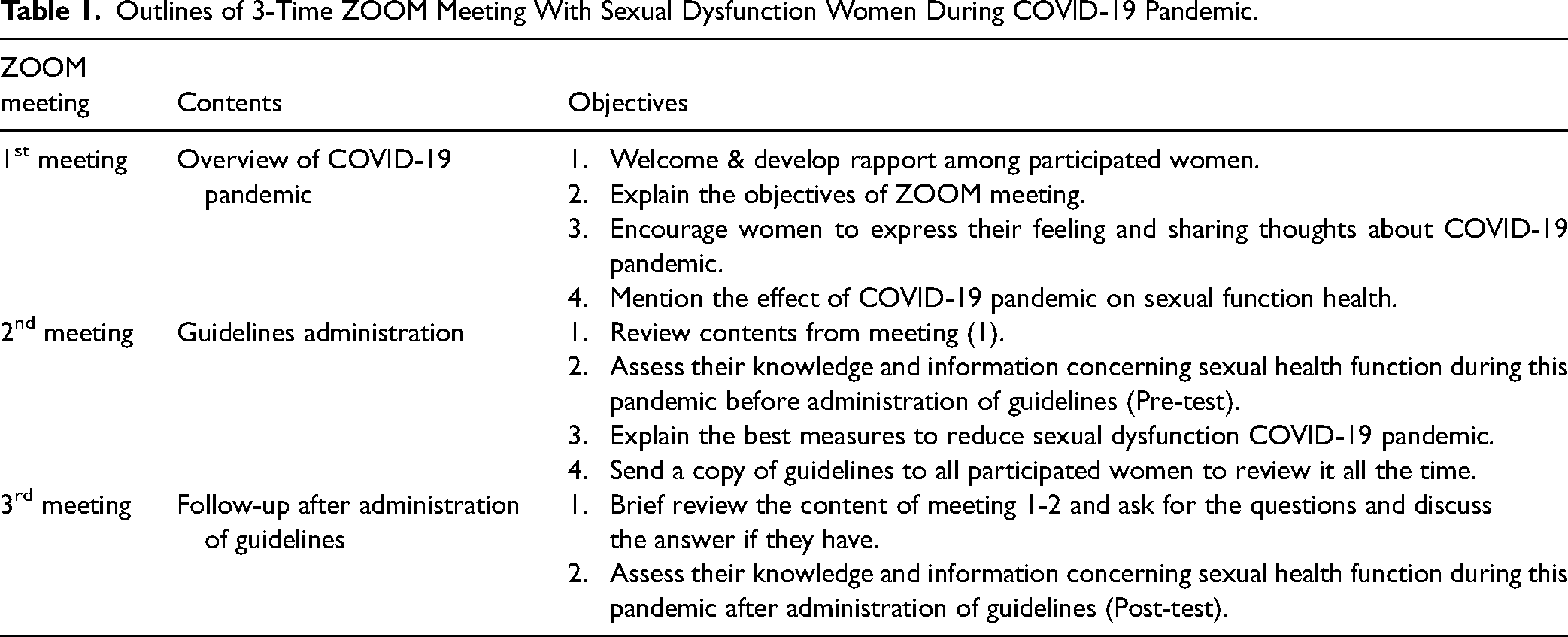
The researcher reviewed the local and international literature to get more knowledge about the study and also designed the study tools. Five obstetrics and gynecological nursing specialists evaluated the instruments for content validity. The recommended modifications were made, and the final form was ready for use. After explaining the purpose of the study to each woman, the researcher began collecting data from women with COVID-19 over the telephone. All the needed information was taken from all the women who agreed to participate in this study. Likert-type Scale was used to assess the knowledge of studied women regarding sexual health during this pandemic (Croasmun & Ostrom, 2011). The researcher created the nursing recommendations, which were then presented to the women with positive COVID-19 results. The contents of educational classes about nursing guidelines are presented in Table 1. The Institutional Review Board (IRB) at Zagazig University-Faculty of Nursing Ethical Committee gave its approval to this study.
Outlines of 3-Time ZOOM Meeting With Sexual Dysfunction Women During COVID-19 Pandemic.
Statistical Analysis
All statistical analyses were performed using SPSS for Windows version 20.0 (IBM Corp, 2011). The continuous data was normally distributed and expressed as mean and standard deviation (mean ± SD). Categorical data were expressed as a number and a percentage. Student T-test was used for comparison between two variables with continuous data. Statistical significance was set at 0.05. The Cronbach's alpha value of the reliability (internal consistency) of the FSFI was 0.917, and that of the knowledge was 0.881. The total score of the knowledge is the sum of the scores of the individual items. The total score of knowledge was categorized as poor knowledge (<50% of the maximum total score), fair knowledge (50–65% of the maximum total score), and good knowledge (>65% of the maximum total score).
Results
Sample Characteristics
A total of 496 women were included in this study. All the subjects were sexually active before the pandemic period. The chosen cases were contacted by phone and asked to respond to a questionnaire between December 1, 2020, and December 30, 2021 (one year). Nursing guidelines were designed by the researcher and given to women with COVID-19 after assessment of their knowledge and information concerning sexual health during this pandemic through ZOOM meeting.
Research Question Results
Demographic and medical characteristics of participants are summarized in Table 2. It is found that just under half of the women who took part (46.7%) were between the ages of 25 and 34. 63.7% of them were in rural areas. About 36.3% of studied women had completed high school and were employed (68.8%). 35.5% of women were married 5 to 9 years. The majority of the women in the study (77.4%) did not have any chronic conditions. The most common related illnesses were hypertension and diabetes mellitus (36.6%) and (31.3%), respectively. Hyperlipidemia and coronary artery disease were among the other ailments mentioned.
Number and Distribution of the Demographic and Medical Characteristics of the Studied Women (n = 496).
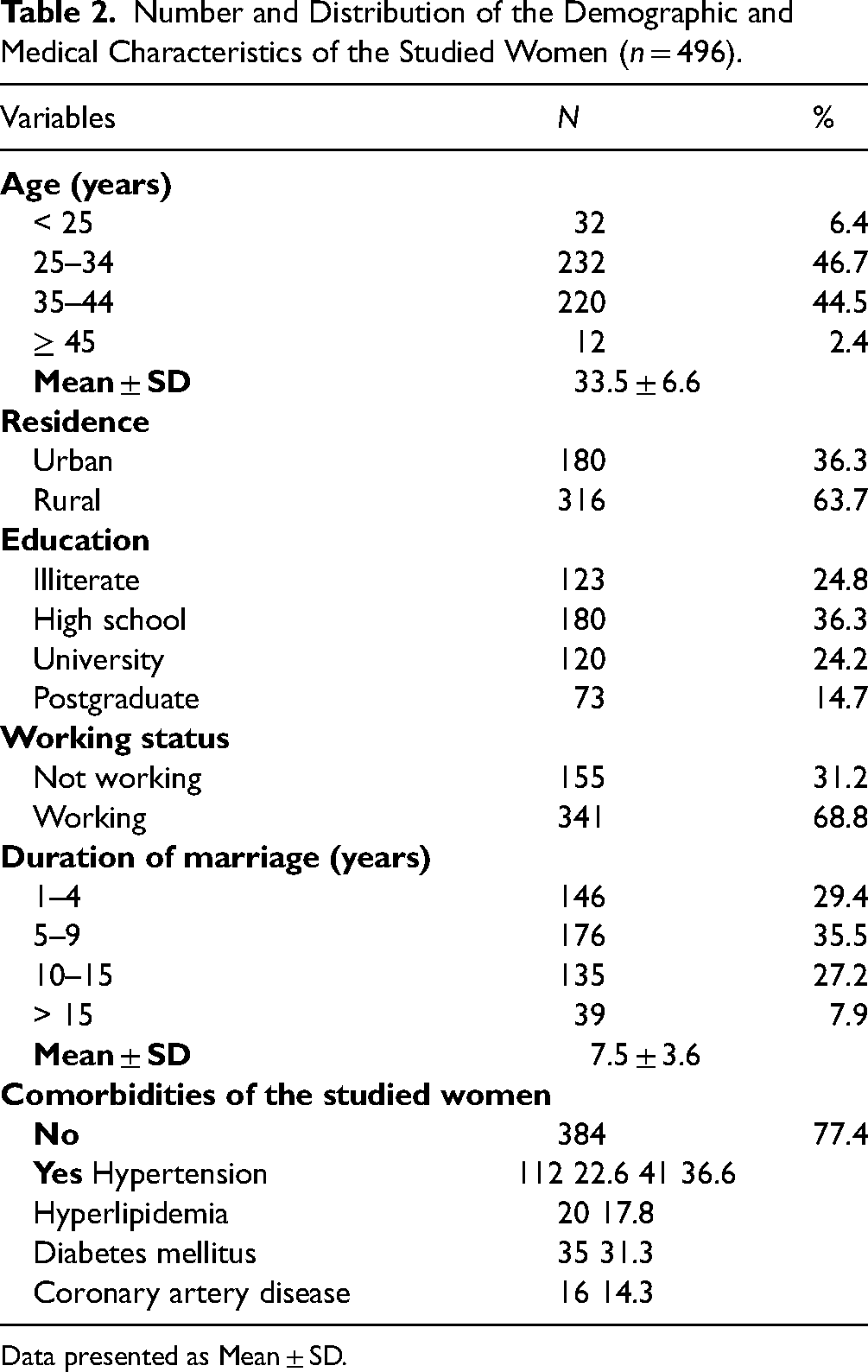
Data presented as Mean ± SD.
Regarding obstetrical history of the studied women, Table 3 demonstrates that 47.3% were primipara and 44.4% were multipara. Almost a quarter of them (24.8%) have previously had an abortion. The majority of women had vaginal birth (65.5%), while 34.5% underwent a caesarean section.
Number and Distribution of the Obstetric History of the Studied Women (n = 496).

The total number of normal sexual functions was (311) and sexual dysfunction was (185). As a result, 62.7% of studied women had normal sexual function, whereas 37.3% had sexual dysfunction. Figure 2 illustrates the number and percentage of sexual dysfunction cases among the sample size during the study period (one year).

Incidence of sexual dysfunction among the studied women during COVID-19 pandemic.
Before and after guideline administration, domain 1 of the FSFI score (sexual desire), domain 2 of the FSFI score (sexual arousal), and domain 3 of the FSFI score (lubrication) were statistically significant (p = .001**). Also, before and after guideline administration, domain 4 of the FSFI score (orgasm), domain 5 of the FSFI score (satisfaction), and domain 6 of the FSFI score (pain) were statistically significant (p = .001**). Table 4 illustrates the FSFI before and after nursing guidelines were given.
Comparison of Female Sexual Function Index Before and After Administration of Nursing Guidelines for Women with Sexual Dysfunction.

MCP: p-value based on Mont Carlo exact probability.
**p < .05 (significant).
p-value analyzed by students t-test.
p-value analyzed by ANOVA with post-hoc Tukey's test.
Poor knowledge (23.5%), fair knowledge (68.4%), and good knowledge (8.1%) were reported prior to administration of guidelines. After guidelines administration, poor knowledge (0.0%), fair knowledge (29.4%), and good knowledge (70.6%) were determined. Figure 3 shows that women with sexual dysfunction had statistically higher correct information after receiving sexual function nursing guidelines during the COVID-19 pandemic.

Comparison of patient's knowledge concerning sexual function before and after administration of nursing guidelines among women with sexual dysfunction (n = 185).
Discussion
The COVID-19 global pandemic has disrupted the health care system, deteriorated social and sexual life, decreased income, and resulted in a large number of deaths (WHO, 2019). We aimed to assess how the pandemic, social constraints, and quarantine affected female sexual behavior, sexual experience, and reproductive health. Our study found that quality of female sexual behavior decreased during this pandemic.
Egyptian government made the decision to close schools and institutions and impose a curfew from 7 PM to 6 AM in response to the sharp increase in the number of cases of COVID-19, which was discovered in mid-March 2020. On Fridays and Saturdays, a complete shutdown was mandated, with all stores and marketplaces closing at 5 PM. During the hours of the curfew, all forms of public and private transportation were halted. Additionally, flights into and out of Egypt were halted. In an effort to stop the spread of COVID-19, all athletic events were suspended and numerous of social activities were prohibited. The sexual function of Egyptian women is anticipated to be impacted by the country's relatively high death rate as well as the strenuous lockdown procedures (Medhat & El Kassas, 2020).
The majority of the female participants in this study (46.7%) were between the ages of 25 and 34. This is consistent with the study conducted by Omar et al. in 2021, in which the majority of the women were between the ages of 25 and 35.This is explained by the age at which sexual activity peaks in eastern societies, which also explains why people are interested in participating in this research (Aggarwal, 2013).
Most of the study participants (77.4%) had no chronic conditions. The most common related illnesses were hypertension and diabetes mellitus (36.6%) and (31.3%), respectively. This result is going with Omar et al., 2021 who found that the majority of females (76.0%) had no associated chronic illnesses. Diabetes mellitus was the most common associated illness. This might be explained by neurological and vascular pathophysiology of diabetes which directly interferes with the sexual response of women (Basson et al., 2001).
In the present study, the majority of women had vaginal birth (65.5%), while 34.5% underwent a caesarean section. The present result comes in agreement with Julia et al. (2013) who performed an observational cohort study in the Kaiser Permanente Northern California (on 1,094 participants to examine postpartum sexual function by self-administered questionnaires, showed that women with a history of vaginal delivery reported lower interest in sex, which could be related to residual delivery-related pain or pelvic floor dysfunction.
According to the total FSFI score, 37.3% of the female subjects were at risk of sexual dysfunction. The majority of our female participants reported coitus-related pain, decreased lubrication and desire, and issues with arousal, orgasm, and satisfaction. This study with a previous cross-sectional conducted by Mamdouh et al. (2017) reported that 462 women (76.9%) had sexual problems. The most prevalent sexual issue was low sexual desire (66.4%). Patients with FSD were considerably more likely to be circumcised, have a partner who was at least 40 years old, have fewer than three sexual relationships per week, be married for at least ten years, have at least five children, be older than 40, and be postmenopausal.
These results show that after receiving sexual function nursing guidelines during the COVID-19 epidemic, women with sexual dysfunction had statistically greater accuracy. Prior to the administration of these guidelines, knowledge levels were poor (23.5%), fair (68.4%), and good knowledge (8.1%). Following the giving of the guidelines, 29.4% had fair knowledge, and 70.6% had strong knowledge. This result come inconsistent with Kaviani et al., 2014 who studied “the effect of education on sexual health of women with hypoactive sexual desire disorder: A randomized controlled trial” and reported that a significant difference in the intervention group's sexual desire index after the intervention.
The findings of this study highlight the importance of providing information and knowledge for women about sexual function during the COVID-19 pandemic. Also, educational intervention regarding sexual health was effective for the women during COVID-19. Thus, establishing sexual health education units in different health centers is highly necessary. These centers can help couples to promote their sexual knowledge and treat their sexual dysfunctions.
In conclusion, the present study demonstrated that women's sexual desire and frequency of sexual intercourse significantly decreased during the COVID-19 pandemic. Sexual problems change a woman's quality of life and can easily disrupt her normal life.
In order to address this major issue, nursing recommendations include (relaxation exercises, communication skills, sex education, employing protective measures during intercourse and assisting women in developing good attitudes towards their genitalia).
Limitations of this Study
The first limitation of the study is that male partners, who can affect sexual behavior, were not included in this study. Telephone surveys were used to collect data from sample size. The number of participants in the study group was relatively small. The study's validity is seriously affected by the absence of a control group.
Implications for Practice
During the COVID-19 pandemic, female sexual behavior and frequency may be impacted. Sexual dysfunction in women reduces quality of life. Hence, nursing guidelines on female sexual health are crucial for assisting couples in promoting their sexual education and treating any sexual dysfunction.
Conclusions
The results of the present study showed that COVID-19-related restrictions were correlated with higher rates of sexual dysfunction and reduced sexual activity. FSFI was statistically significant before and after guideline administration. Additionally, following the distribution of nursing guidelines about sexual function during the COVID-19 pandemic, women with sexual dysfunction had statistically more accurate information.
In addition, direct and indirect support for training and counseling programs about sexual function during COVID-19 should be increased, which itself is an important step in preventing family conflicts and their consequences.
Recommendations
Case-control study design may be used in future researches to investigate the same problem.
Long-term follow-up of the changes in sexual function and satisfaction after the pandemic is recommended to confirm the results and to evaluate changes over time.
We need to increase society's awareness of the importance of acknowledging such complaints (sexual dysfunction) so as to put an end to the stigma attached to them.
These results should be supported by further prospective randomized research, with a larger sample size.
Footnotes
Acknowledgement
The author hereby expresses her gratitude to health centers’ authority. The author would especially want to thank all of our patients who took the time to answer study questions even though they were in quarantine.
Declaration of Conflicting Interests
The author declared no potential conflicts of interest with respect to the research, authorship, and/or publication of this article.
Funding
The author received no financial support for the research, authorship, and/or publication of this article.
Ethical Considerations
The study was affirmed by the Zagazig University-Faculty of Nursing Ethical Committee with the ethical code ZU.NUR/25/22-8-2016.
Institutional Review Board (IRB) Approval and Informed Consent
The Institutional Review Board (IRB) at Zagazig University's Nursing Faculty gave its approval to this study. Oral consent was taken from women who wanted to participate in this research. Because the researcher started gathering data from women with COVID-19 over the phone, written consent wasn't taken into account. All procedures, including the human members, were in accordance with the ethical principles of the institutional and/or national research committee as well as the 1964 Helsinki Declaration and its later corrections, or tantamount moral measures.
